THE 73RD HOUR: THEY SAID SHE WAS GONE, BUT ONE OLD MAN SAW WHAT THE SATELLITES MISSED
Chapter 1: The Static in the Snow
The silence of the Montana wilderness was not empty; it was heavy. It pressed against the frosted windows of the log cabin like a physical weight, a reminder that here, nature was the only law that mattered.
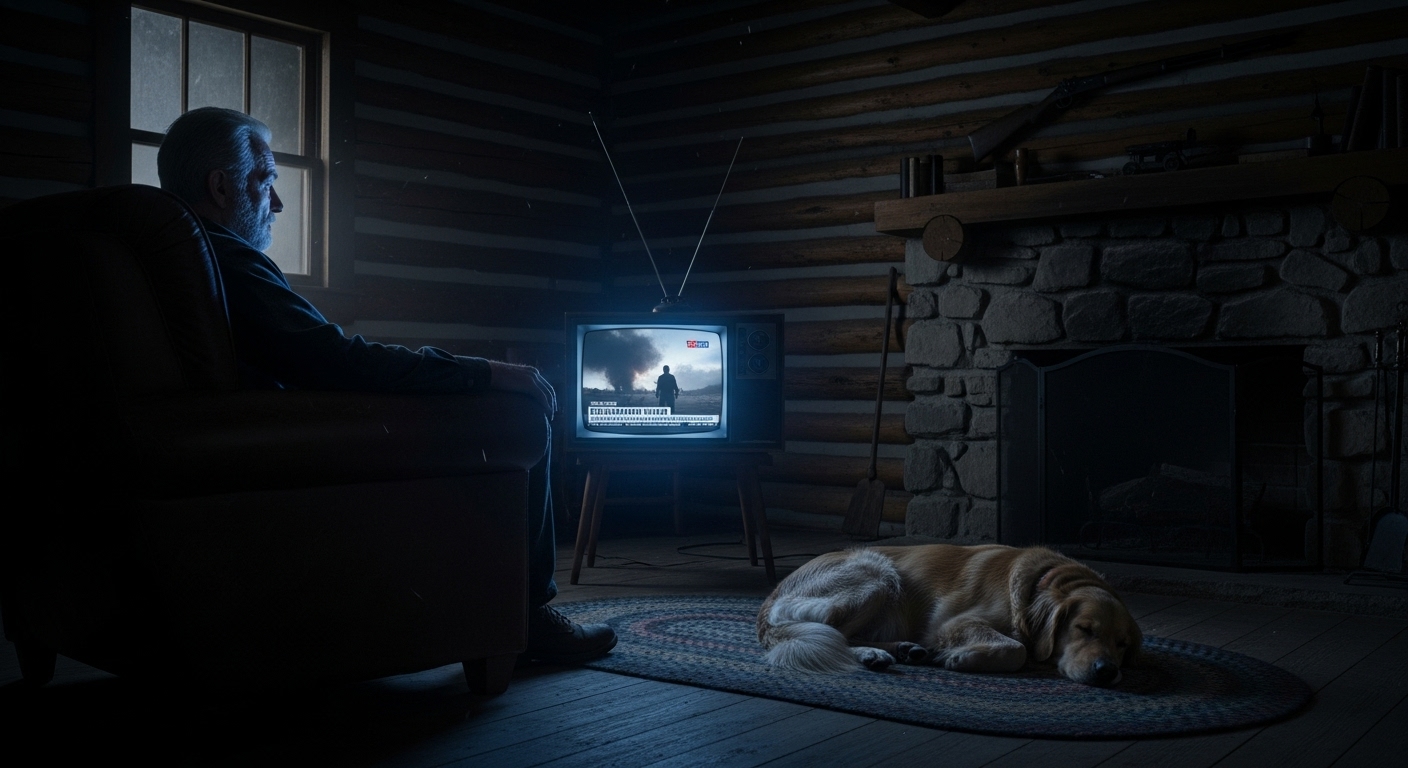
Jack Miller, sixty-eight years old, sat in his worn leather armchair, the material cracked and grooved to the shape of his body over two decades of retirement. A half-empty bottle of bourbon sat on the side table, next to a cold cup of coffee. Outside, the wind howled through the pines, a mournful sound that usually helped him sleep. But not tonight.
Tonight, the old box television set in the corner was humming. The reception was grainy, the satellite dish on the roof fighting a losing battle against the blizzard, but the image was clear enough.
“Breaking News,” the banner read in stark red letters. “Catastrophic 7.8 Magnitude Earthquake Strikes.”
Jack’s hand, scarred and thick with calluses, hovered over the remote. He should turn it off. That was the rule. No news. No disasters. No reminders of the life he had left behind—the life of a FEMA Search and Rescue specialist. He had walked away from the rubble ten years ago, after “The Oklahoma Job,” leaving his career buried under the same concrete slabs that had claimed the one child he couldn’t save.
He pressed the power button. The screen went black.
“Not my problem,” he grunted, his voice gravelly from disuse. He rubbed his left knee, the one that ached whenever the barometric pressure dropped or when he remembered things he wanted to forget.
He limped to the kitchen to refill his coffee. His dog, a Golden Retriever mix named Buster, thumped his tail against the floorboards but didn’t get up. Buster was old too. They were a pair of relics, hiding out in the mountains, waiting out the clock.
But the silence of the cabin was no longer comforting. It felt accusatory.
Jack looked back at the dark TV screen. He could feel the vibration in his bones—not from the storm outside, but from a phantom memory. The feeling of the ground shaking. The smell of pulverized drywall and ruptured gas lines. The specific, metallic taste of fear.
He cursed under his breath, a sharp, violent sound in the quiet room. He walked back to the chair and turned the TV on.
The image flickered back to life. Aerial footage showed a city leveled. It wasn’t a city anymore; it was a gray ocean of dust and twisted rebar.
“International aid is mobilizing,” the anchor said, her voice practiced and somber. “But severe weather and aftershocks are hampering efforts. Authorities are calling the survival rate in Sector 4 ‘negligible.'”
“Negligible,” Jack whispered, testing the word. It was a bureaucratic word. A coward’s word. It meant we are giving up because it’s too hard.
He watched the screen for hours, until the sun began to bleed gray light through the trees. He watched the young rescuers in their clean, high-tech gear looking at tablets and sensors. They looked like astronauts. They looked like they knew everything about data and nothing about concrete.
Jack turned off the TV again. He told himself he didn’t care. He told himself he was just an old man with a bad leg and a worse temper.
But when he closed his eyes, he didn’t see the Montana snow. He saw a hand. A small, dust-covered hand reaching out from the dark.
Chapter 2: The Diner and the Detail
The next morning, Jack drove his rusted pickup truck down the mountain into town. He needed supplies, or so he told himself. The truth was, the silence in the cabin had become deafening.
“Milly’s Diner” was the heartbeat of the small town. It smelled of bacon grease, weak coffee, and damp wool. When Jack walked in, the usual chatter was absent. Every head was turned toward the flat-screen TV mounted above the pie counter.
Jack took his usual stool at the far end of the counter. Milly, a woman in her fifties with hair the color of dried wheat, poured his coffee without asking. She didn’t smile. Her eyes were red.
“Tragic, isn’t it, Jack?” she murmured, nodding at the screen. “Thousands gone. Just like that.”
Jack grunted, blowing on his coffee. “Nature doesn’t negotiate, Milly.”
“Look at this,” a man two stools down said. It was Sheriff Brody. “This video is trending everywhere. Breaking my damn heart.”
On the screen, a grainy, vertical video recorded by a cell phone was playing. It was shaky, filmed by a survivor on the ground. The camera panned over a mountain of debris—what used to be an apartment complex.
The audio was a cacophony of wind and sirens, but then, the person filming moved closer to a jagged opening in the concrete.
A voice cut through the static. A high, thin sound.
“Mama? I’m thirsty. Mama, wake up.”
The diner went dead silent. A truck driver in the booth behind Jack put his sandwich down. Milly wiped a tear from her cheek with her apron.
Jack stopped blowing on his coffee. He didn’t look away. He squinted. His eyes, usually tired and clouded with cynicism, suddenly sharpened into predatory focus.
He watched the video loop. He ignored the child’s voice. He looked at the structure.
He saw the way the main support beam had sheared. He saw the angle of the floor slab resting against the foundation wall.
“It’s a tomb,” Sheriff Brody said, shaking his head. “News says the thermal drones didn’t pick up any heat signatures. They’re bypassing it. Calling it a ‘Pancake Collapse.’ No void spaces.”
Jack slammed his coffee cup down on the counter. The ceramic rattled, spilling brown liquid onto the Formica.
“They’re wrong,” Jack said. His voice wasn’t a whisper anymore. It was a command.
The Sheriff turned to look at him. “Excuse me, Jack?”
Jack pointed a trembling finger at the screen. “That’s not a pancake collapse. Look at the tension cracks on the lateral column. Look at the way the rebar is bent, not snapped. That slab didn’t fall flat. It slid. It created a lean-to.”
“Jack, the experts on the TV said—”
“The experts are looking at heat sensors!” Jack barked, sliding off his stool. “Concrete insulates heat. If that girl is deep enough, the drones won’t see her. But she’s there. It’s a lean-to void. There is a triangle of space about four feet high and six feet wide right under that primary slab.”
The diner was staring at him now. Jack Miller, the town hermit, was vibrating with an intensity they had never seen.
“They are going to bulldoze that sector to clear the road,” Jack said, his voice dropping to a horrified whisper. “If they think it’s a pancake, they’ll bring in the heavy excavators. They’ll crush her.”
“Jack,” Milly reached out to touch his arm. “You’re retired. You haven’t done this in years.”
Jack looked at his hand. It was shaking. Not from age, but from adrenaline. He looked at the screen, at the dark gap where the voice had come from.
“Seventy-two hours,” Jack muttered. “The Golden Window. After seventy-two hours, dehydration and hypothermia take them. The kidneys shut down.” He checked his watch. “We are at hour forty-eight.”
He threw a twenty-dollar bill on the counter.
“Where are you going, Jack?” Brody asked.
“I’m going to make a call,” Jack said, turning for the door. “And if they don’t answer, I’m going to the airport.”
Chapter 3: The Wall of Red Tape
The phone call was a disaster.
Jack stood in the freezing wind outside the general store, clutching his cell phone. He had called the regional FEMA coordination center. He had managed to get a supervisor on the line—a man named Peterson whom Jack had trained fifteen years ago.
“Jack, I hear you,” Peterson’s voice crackled over the line. “But we can’t just deploy a civilian based on a hunch from a TV clip. The teams on the ground have LIDAR. They have acoustic sensors.”
“They are relying on the tech, Peterson!” Jack shouted into the wind. “The tech is blind in dense rebar clusters! You know that! You need ears on the concrete. You need to tap the pipes!”
“Jack, you’re sixty-eight. You have a registered disability with the VA. Even if I wanted to, I can’t insure you. You’re a liability.”
“I’m not asking for insurance! I’m asking for transport! Put me on a cargo bird!”
“I can’t do it, Jack. Stay home. Pray for them. That’s all we can do.” The line went dead.
Jack stared at the phone. He felt the old rage rising, the same rage he felt when the funding was cut, when the politicians posed for photos while the bodies were still warm.
“Liability,” he spat.
He drove back to the cabin. He didn’t pack clothes. He went to the closet in the hallway and pulled out a dusty, heavy duffel bag.
He unzipped it. The smell of old sweat, chalk, and dried mud wafted up. It was the smell of his life.
He pulled out his helmet—scratched, dented, adorned with fading stickers. He pulled out his knee pads. His heavy leather gloves. His pry bar. And finally, a small, battered stethoscope modified with a heavy rubber cone—his “listening stick.”
He went to the safe under his bed. He took out his life savings—six thousand dollars in cash, wrapped in rubber bands.
“Buster,” he called out.
The dog trotted in. Jack knelt down and hugged the dog’s neck, burying his face in the fur.
“Milly will feed you,” Jack whispered. “You be a good boy.”
He drove to the airport in Bozeman. He didn’t have a ticket. He bought the first seat on a commercial flight connecting to the disaster region’s nearest operational hub. From there, he knew how the logistics worked. There would be aid trucks. There would be chaos. And in chaos, there was always room for a man who didn’t ask for permission.
He was going. Not for glory. Not for the government. He was going because he was the only one who knew the geometry of that collapse. He was going because he could still hear the voice: Mama, I’m thirsty.
Chapter 4: The Graveyard of Concrete
The smell hit him first.
It was a scent that never left you once you’d inhaled it—a mixture of pulverized limestone, wet insulation, sewage, and the sweet, cloying scent of decay.
Jack stepped off the back of a disorganized NGO supply truck. He was in the “Yellow Zone,” the staging area about a mile from the epicenter. The air was thick with gray dust that coated everything like a nuclear winter snow.
It was chaos. Tents were flapping in the freezing wind. Generators roared. People were shouting in a dozen languages.
Jack pulled his helmet low and shouldered his duffel bag. He limped slightly, his bad knee protesting the twenty-hour journey, but he moved with the purpose of a tank.
He navigated the labyrinth of the camp until he found the forward command post for the sector he had seen on TV. A young man in a pristine, neon-yellow vest was pointing at a digital map on a tablet. This was Sam, the sector coordinator. He looked about thirty, with the frantic, sleep-deprived eyes of someone in over his head.
“We’re marking Block 4 as Black,” Sam was saying to a group of volunteers. “No survivability. Move the heavy lifters in to clear the arterial road.”
“Hold on,” Jack growled, stepping into the circle.
Sam looked up, blinking. “Who are you? Where’s your badge?”
“My name is Jack Miller. Retired FEMA US&R. And you aren’t taking a bulldozer to Block 4.”
Sam scoffed, looking Jack up and down—at his faded, non-regulation jacket, his gray stubble, his limp. “Sir, this is a controlled zone. You need to evacuate to the civilian perimeter.”
“I saw the footage,” Jack said, stepping closer. He smelled like stale coffee and old resolve. “It’s a lean-to. There’s a void.”
“We scanned it,” Sam snapped, tapping his tablet. “Heat sensors are negative. CO2 sensors are negative. It’s a solid pancake. If we send men in there, and it shifts, they die for nothing. We have to focus on the savable.”
“Sensors don’t work through four feet of double-reinforced industrial concrete!” Jack shouted. “The rebar acts like a Faraday cage for some of your signals, and the insulation blocks the heat. Did you tap the pipes?”
“Tap the pipes?” Sam looked confused. “That’s archaic. We use seismic listening arrays.”
“Arrays pick up wind! They pick up the generators!” Jack grabbed a map from the table. “The girl is here. Under the shear wall. It’s Hour 68, son. You have four hours before she’s dead. Are you going to let me look, or are you going to arrest me?”
Sam hesitated. He looked at the “Black” mark on his map. He looked at the old man’s burning eyes.
“You have one hour,” Sam whispered, lowering his voice. “If the safety officer sees you, I never saw you. And if the structure shifts, I’m pulling everyone back. I won’t lose a rescuer for a ghost.”
Jack didn’t say thank you. He just adjusted his gloves. “One hour is all I need.”
Chapter 5: The Golden Window Closing
The debris pile was a mountain of razor blades. Every inch of it was sharp—twisted metal, shattered glass, jagged rocks.
Jack crawled. He didn’t walk. He moved like a lizard, keeping his center of gravity low. His bad knee screamed with every inch, sending hot lances of pain up his thigh, but he shoved the pain into a box in his mind and locked the lid.
He reached the spot. It looked even worse in person. The massive slab of concrete, easily weighing twenty tons, was hanging precariously, supported by a crushed column that looked like a toothpick.
Jack took out his “listening stick”—the stethoscope. He found a metal water pipe protruding from the rubble. It was twisted, but if his theory was right, this pipe ran down into the basement levels, passing through the void.
He pressed the cone to the pipe. He closed his eyes. He covered his other ear with his hand.
Tap. Tap. Tap.
He struck the pipe with a small rock.
He waited.
Silence. Just the wind whistling through the rebar.
Tap. Tap. Tap. “Can you hear me?” he shouted into the gap. “Strike the pipe! Hit the metal!”
Silence.
Sam’s voice crackled on the borrowed radio. “Miller. You have twenty minutes. The wind is picking up. The structure is vibrating.”
“Shut up,” Jack hissed.
He pressed his ear harder against the cold metal. “Come on, sweetheart. I know you’re there. Don’t you give up on me. Not today.”
He thought of his own daughter. He thought of the empty room in his heart that had been gathering dust for thirty years.
Clink.
Jack froze. It was faint. So faint it could have been a pebble falling.
Clink. Clink.
It was rhythmic. It was intelligent.
Jack’s heart hammered against his ribs. “I hear you!” he roared, his voice cracking. “I hear you! Keep hitting it!”
Clink.
Jack grabbed his radio. “Sam! I have a confirmed response! Tapping on the bravo-line pipe! Get the cribbing team up here! Now!”
The radio was silent for a second. Then, Sam’s voice came back, breathless. “Copy that. Team is inbound. Don’t move, Jack.”
Chapter 6: The Voice in the Dark
The next two hours were a surgical operation performed with sledgehammers.
Sam’s team, young and strong, hauled timber up the pile to “crib” (shore up) the unstable slab. They worked around Jack, who lay on his stomach, tunneling into a small gap beneath the overhang.
Jack was the “tunnel rat.” He was the only one small enough and crazy enough to squeeze into the eighteen-inch hole.
“I’m coming in,” Jack called out. He had a headlamp on. The space was claustrophobic, pressing down on his chest. The air was stale and tasted of copper.
He crawled ten feet. Then fifteen. The jagged concrete tore at his jacket, then his skin. He didn’t feel it.
He reached a mesh of rebar that blocked the path. He pulled out a hydraulic cutter—a heavy, awkward tool. He worked it onto the steel bars. Snap. Snap.
He pushed through.
And then, his headlamp beam hit a pocket of empty space.
There she was.
She was covered in gray dust, looking like a statue. Only her eyes were alive—large, dark, and terrified. She was curled up in a fetal position.
Beside her lay a woman. The mother. She was face down, her body arched over the girl like a human shield. A concrete beam had fallen across the mother’s back. She hadn’t moved in days.
“Amira?” Jack whispered. He guessed the name from the news reports, or maybe he just hoped.
The girl blinked. “Water,” she croaked. Her voice was like dry leaves.
“I’ve got water,” Jack said, unhooking a camel-back tube from his shoulder. He extended it to her.
She drank greedily.
“My mommy is sleeping,” the girl whispered, pulling back. “She’s very cold.”
Jack swallowed a lump in his throat the size of a stone. “I know, honey. She… she protected you. She did a good job.”
“Can you wake her up?”
“We’re going to get you out first, okay? Then we’ll take care of Mommy.”
Jack reached out his hand. “Come here. You have to crawl to me.”
The girl shook her head. “I’m stuck. My foot.”
Jack shined the light down. Her ankle was pinned under a piece of drywall and a heavy wooden beam. It wasn’t crushed, but it was trapped.
“Okay,” Jack said, forcing his voice to remain calm. “I’m going to come to you. It’s going to be tight.”
Chapter 7: The Choice
The radio crackled. “Jack! Seismic alert! Aftershock imminent! Get out! Now!”
The ground groaned. It wasn’t a vibration; it was a growl from the earth itself.
The slab above Jack’s head shifted. Dust poured down like rain. The tunnel he had crawled through began to compress.
“Jack! Abort!” Sam screamed.
Jack looked back at the narrowing tunnel. He could scramble back now. He could make it out before the collapse.
He looked at the girl. She wasn’t crying anymore. She was just looking at him, trusting him.
If he left, the shifting rubble would crush the void. She would die alone in the dark.
Jack clicked his radio. “Negative. I have the subject. I am not leaving.”
“Jack, don’t be an idiot!”
Jack tore the earpiece out and threw it away.
The aftershock hit.
BOOM.
The world turned upside down. The ceiling dropped four inches. A piece of rebar slammed into Jack’s bad leg, pinning him to the floor.
He screamed—a raw, animal sound of agony. His femur felt like it was on fire.
The dust swirled so thick he couldn’t see. He coughed, choking on the grit.
“Mr. Jack?” The girl’s voice was trembling.
Jack bit his lip until it bled to stop from passing out. “I’m here,” he wheezed. “I’m… here.”
He tried to move his leg. Stuck. He was trapped.
He looked at the wooden beam trapping the girl. The aftershock had shifted it slightly. It was loose.
“Amira,” Jack gasped. “Listen to me. I can’t move. But you can.”
“I’m scared.”
“I know. I’m scared too. But look at me.” He shined his light on his own face, blood streaked across his forehead. “I need you to be brave like your mommy. Can you wiggle your foot?”
She tried. “Yes.”
“Okay. Pull it out. Hard.”
She whimpered, pulled, and with a small cry, her foot came free.
“Good girl,” Jack panted. The pain in his leg was making his vision tunnel. “Now… come to me.”
She crawled over her mother’s body and reached Jack. She huddled against his chest, burying her face in his dusty jacket.
“Are we going to die?” she asked.
Jack looked at the crushed tunnel behind him. It was blocked. They were sealed in.
“No,” Jack lied. “We’re just waiting for a ride.”
He grabbed a jagged rock. He began to bang on the rebar pinning his leg. Clang. Clang. Clang.
Chapter 8: The Resurrection
Time lost its meaning. It could have been an hour; it could have been a day.
Jack was fading. The pain had turned into a cold numbness. Amira had fallen asleep against him.
He kept banging the rock. Clang. Clang. Even when his arm felt like lead. Clang.
Suddenly, a vibration. Not from the earth, but from above.
A drill.
Jack looked up. A small beam of light pierced the darkness above them.
“We’re here!” Jack croaked. “Here!”
“Hold on!” It was Sam’s voice. Close. “We’re coming through the top!”
The digging was frantic. Hands, shovels, saws.
Finally, the hole opened up wide enough for a face to peer in. It was Sam. He looked terrified and relieved all at once.
“Jack? Is she…?”
“She’s alive,” Jack whispered. “Get a harness down here.”
They lowered a rope. Jack’s hands were so stiff he could barely tie the knots. He secured Amira.
“Up you go, princess,” Jack whispered, kissing her dusty forehead.
“Come with me,” she cried, reaching for him.
“I’m right behind you.”
They pulled her up. Jack watched her ascend into the light. He heard the cheers from above—a roar of sound that drowned out the wind.
Then, the rope came back down.
“Your turn, old man,” Sam yelled.
Jack looked at his pinned leg. “I’m stuck on the rebar! Send down a cutter!”
It took another twenty minutes of agonizing work. Sam dropped into the hole himself to cut the bar. He grabbed Jack under the arms.
“I got you,” Sam said, his voice thick with emotion. “I’m sorry I doubted you, Jack. I’m so sorry.”
“Shut up and pull,” Jack grunted.
They hauled him out.
When Jack broke the surface, the cold air hit him like a slap. The brightness was blinding.
He was laid on a stretcher. He blinked the dust from his eyes.
The scene was chaotic. Doctors, cameras, other rescuers. But the crowd parted.
A medic was holding Amira. She had an oxygen mask on, but she pushed it aside. She pointed at Jack.
She didn’t speak. She just reached out her hand—her small, dirty hand.
Jack lifted his hand, his fingers broken and bleeding. He touched her fingertips.
A connection. A circuit closed. The ghost of the Oklahoma Job, the ghost of his failure, finally dissolved into the winter air.
Chapter 9: The Quiet
Three days later, Jack was in a field hospital tent. His leg was in a cast. He had three broken ribs and had lost two fingernails.
Sam walked in. He held a tablet.
“You’re famous, Jack,” Sam said, sitting on the edge of the cot. “That video of the rescue… the whole world is watching it.”
“Turn it off,” Jack said, looking at the tent ceiling.
“Not this time,” Sam smiled. “You were right. about the lean-to. I’m writing it into the new protocol manual. We’re calling it ‘The Miller Protocol’ for deep rebar scanning.”
Jack huffed. “Don’t name anything after me. Just teach them to listen.”
“There’s someone on the video call for you,” Sam turned the screen.
It was Amira. She was clean now, sitting in a hospital bed in Germany where her aunt lived. She looked small, fragile, but her eyes were bright.
She held up a piece of paper. It was a drawing done in crayon.
It showed a mountain of gray scribbles. And in the middle, a figure with a white beard and a red cape, holding a little girl.
“Thank you, Mr. Jack,” she said in broken English.
Jack Miller, the man who never cried, the man who lived in a cabin to escape the world, felt a tear slide down his weathered cheek.
“You’re welcome, kid,” he whispered.
Chapter 10: Epilogue – The 73rd Hour
Jack was back in Montana.
The cabin was the same, but the silence was different. It wasn’t heavy anymore. It was peaceful.
He sat in his chair, Buster at his feet. The TV was off.
He didn’t need to watch the news to feel connected to the world. He felt it in the ache of his healing leg. He felt it in the memory of a small hand in his.
They said the survival limit was 72 hours. The “Golden Window.”
Jack took a sip of his bourbon. He looked out the window at the snow falling softly on the pines.
“Seventy-two hours is a statistic,” Jack said to the empty room. “Seventy-three… that’s a choice.”
He closed his eyes, and for the first time in ten years, he slept without dreaming of the dark.