THE DAY THE MUSIC DIED: A GOLDEN BOY’S SILENT SCREAM SHATTERS THE ILLUSION OF A PERFECT FAMILY
Chapter 1: The Museum of Great Expectations
The silence in the Miller household was not peaceful; it was precise. It was the kind of silence that fell over a library or a church, a heavy, curated stillness that demanded respect and muffled footsteps.
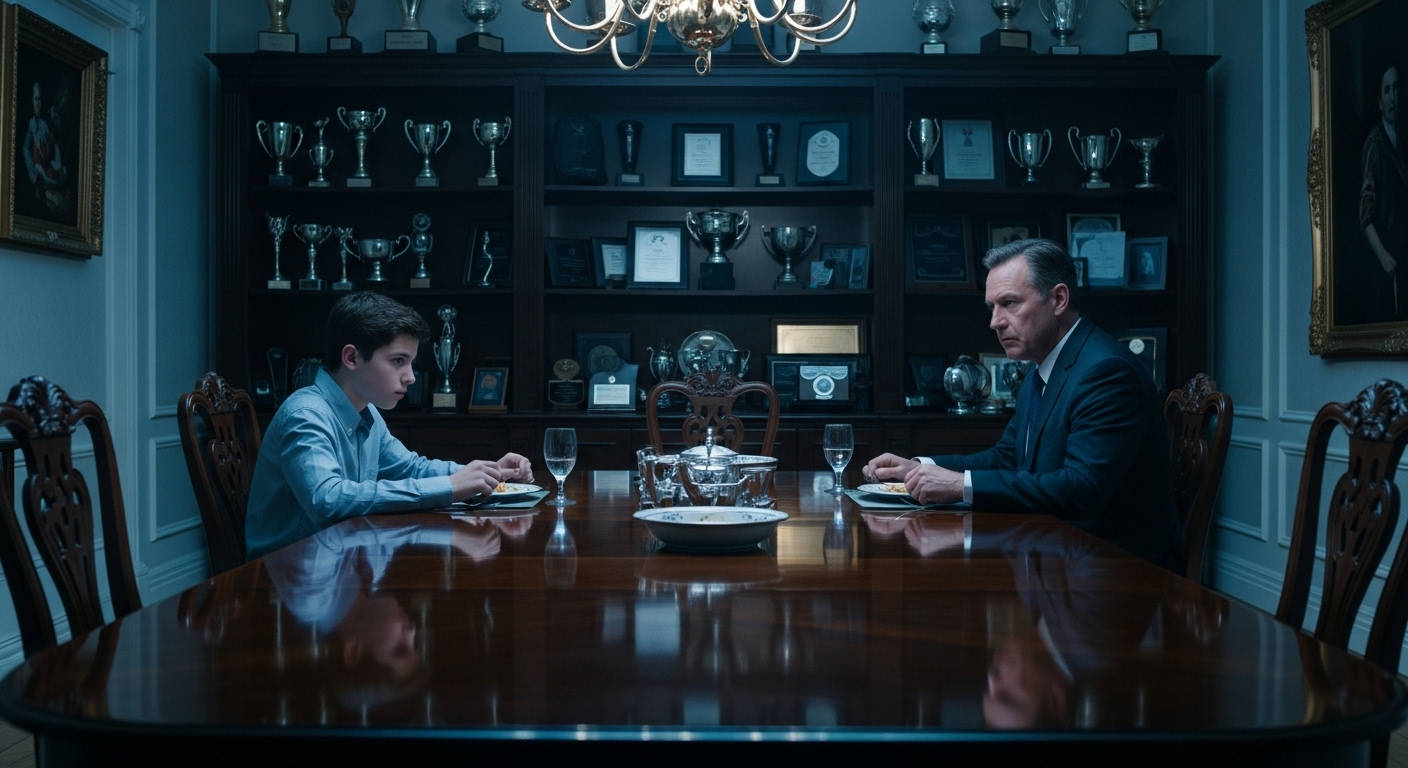
In the dining room of their sprawling colonial home in Connecticut, the only sounds were the rhythmic clink of silver forks against fine china and the grandfathers clock ticking in the hallway. It was 6:30 PM. Dinner was always at 6:30 PM.
Ethan Miller, seventeen years old, sat at his designated spot. To an outsider, Ethan was the portrait of the American Dream. He had the kind of face that yearbooks are built around—sharp jawline, intelligent blue eyes, and hair that fell effortlessly into place. But if you looked closer, past the veneer of the “Golden Boy,” you would see the gray pallor of his skin, the dark circles that looked like bruises under his eyes, and the way his left hand trembled slightly as he lifted a forkful of steamed broccoli to his mouth.
“The Yale recruiter confirmed this afternoon,” Robert Miller said, not looking up from his perfectly seared salmon. Robert was a man who wore his authority like a suit of armor. He was a partner at a top-tier law firm, a man who believed that life was a series of cases to be won. “He will be in the front row on Friday. Seat 1A. He specifically asked to hear the Rachmaninoff.”
Ethan swallowed the broccoli. It tasted like cardboard. “Yes, sir,” he whispered.
“Don’t mumble, Ethan,” Grace Miller chimed in. She was a woman of frantic elegance, always moving, always fixing things that weren’t broken. She reached over and adjusted the collar of Ethan’s polo shirt. “Articulation is key. If you can’t speak with confidence, how will you command a boardroom? Or a surgical theater?”
“I said, yes, Dad. I’m ready for the Rachmaninoff.”
“Ready isn’t enough,” Robert said, finally looking at his son. His eyes were devoid of warmth; they were scanning for defects. “Perfect is the minimum requirement. The Anderson boy was accepted into Stanford early decision last week. Stanford, Ethan. His father made sure to mention it at the club three times.”
Ethan felt a familiar tightening in his chest, as if an invisible belt was being cinched around his ribs. The Anderson boy. The Collins girl. The invisible army of competitors that lived in this house, seated at this table, haunting every meal.
“I’m studying, Dad. I’m practicing four hours a day.”
“Five,” Grace corrected gently, pouring him a glass of alkaline water. “You practiced five hours yesterday, but I noticed your tempo dragged in the third movement. You need to be sharper. And drink this, you look dehydrated. Brain function relies on hydration.”
Ethan looked at the water. He looked at the living room beyond the archway. It wasn’t a living room; it was a trophy case. The mantelpiece was groaning under the weight of gold cups, plaques, and framed certificates. First Place – State Debate Championship. MVP – Junior Varsity Tennis. National Merit Scholar.
They weren’t just awards; they were receipts. Proof that Robert and Grace Miller had invested wisely. Proof that their son was an asset that was appreciating in value.
“I was thinking,” Ethan started, his voice cracking slightly. He cleared his throat. “There’s a convention this weekend. In the city. For… for graphic novels. I was reading about this artist, and—”
Robert dropped his fork. The sound rang out like a gunshot.
“Comics?” Robert asked. The word hung in the air, coated in disdain.
“It’s art, actually. Visual storytelling. I just thought, after the recital, maybe strictly for an hour…”
“Ethan,” Grace said, her voice trembling with a terrifying sweetness. “Does a graphic novel get you into Med School? Does drawing cartoons secure a legacy?”
“No, but…”
“Then it is a distraction,” Robert declared, wiping his mouth with a linen napkin. “Focus, son. We just want the best for you. We are building your future. You don’t have the luxury of childhood. That is a myth for average people. You are not average. You are a Miller.”
Ethan looked down at his plate. The salmon stared back. He felt a sudden, violent urge to scream, to flip the heavy oak table, to smash the china. But the urge passed, replaced by a crushing fatigue. He was so tired. He was seventeen, and he felt like he had lived a thousand years.
“I’m not hungry anymore,” Ethan said softly. “May I be excused to practice?”
Robert checked his watch. “It’s 6:45. You have ninety minutes before your AP Chem tutor arrives. Make them count.”
Ethan stood up. He walked past the trophies, past the framed photos of a smiling boy who didn’t exist anymore, and sat at the Steinway grand piano in the corner. It was a beautiful instrument, polished to a mirror shine. To Ethan, it looked like a coffin.
He placed his hands on the keys. C-sharp minor. The prelude.
He began to play. The music flooded the house, technically flawless, precise, and cold. In the dining room, Robert and Grace nodded to each other. They didn’t hear the sorrow in the notes. They only heard the sound of victory.
Chapter 2: The Ghost in the Hallway
Grandma Rose arrived on Wednesday, bringing with her the scent of lavender and the chaos of a person who didn’t care about coasters. She was Grace’s mother, but they were as different as a hurricane and a stagnant pond.
Rose found Ethan in the study at 11:00 PM. He was surrounded by textbooks—Calculus, Organic Chemistry, European History. The light from the desk lamp cast deep hollows over his face. He was vibrating. His leg was bouncing up and down under the desk, a manic, uncontrollable rhythm.
“Ethan?” Rose whispered, standing in the doorway.
Ethan jumped, knocking a stack of flashcards onto the floor. “I’m awake! I’m studying! I just…” He blinked, his eyes adjusting to the figure in the door. “Oh. Hi, Grandma.”
Rose walked in and sat on the edge of the perfectly made daybed. She looked at her grandson—really looked at him. She saw the tremors in his hands. She saw the way he rubbed his left temple, a tic he had developed over the last six months.
“You look like a ghost, honey,” Rose said bluntly. “When was the last time you slept more than four hours?”
Ethan laughed, a dry, brittle sound. “Sleep is for people who don’t have the SATs in three weeks, Grandma. I have to finish this chapter. Mom says if I don’t get a 5 on the AP, the Yale recruiter might reconsider his recommendation.”
“To hell with the Yale recruiter,” Rose snapped.
Ethan’s eyes went wide. “Grandma, you can’t say that. Dad says…”
“I know what your father says. Robert thinks life is a spreadsheet.” Rose stood up and walked over to him. She placed a warm, wrinkled hand over his cold, clammy one. “Ethan, do you remember when you were seven? You sat at that piano and played ‘Chopsticks’ for three hours because you thought it was funny. You laughed so hard you fell off the bench.”
Ethan stared at the wall. A faint memory flickered—sunlight, laughter, the smell of cookies. It felt like a memory from someone else’s life. “I don’t remember.”
“You do,” Rose insisted. “You loved music. It wasn’t a job. It wasn’t a weapon.”
“I have to practice, Grandma. The recital is Friday.”
“You have to sleep,” Rose countered. “Come downstairs. I made cookies. The kind with the extra chocolate chunks that your mother hates because of the ‘sugar content’.”
“I can’t. Carbs make you sluggish.” The words came out of his mouth automatically, programmed by years of repetition.
Rose’s face fell. She saw the depth of the indoctrination. She walked out of the room and went straight to the master bedroom, not bothering to knock.
Grace was applying night cream in front of the vanity. “Mother? It’s late.”
“He’s breaking, Grace,” Rose said, her voice low and dangerous.
Grace didn’t turn around. “He’s working hard. It’s a stressful year. Senior year is always hard.”
“No,” Rose said, grabbing Grace’s shoulder and spinning her around. “Look at me. He isn’t just stressed. He is disappearing. He’s seventeen and he has the eyes of a combat veteran. He’s terrified of you.”
“He respects us,” Grace hissed, pulling away. “We are giving him the tools to succeed. Do you want him to be mediocre? Do you want him to struggle like we did?”
“I want him to be alive!” Rose shouted. “You are trading his soul for a diploma, Grace. And if you don’t stop, there won’t be anything left of him to graduate.”
“You’re being dramatic,” Grace said, turning back to the mirror. “He’s fine. He’s a Miller. We are built for pressure.”
Rose stared at her daughter’s reflection. “Diamonds are made under pressure, Grace. But humans? Humans just shatter.”
Upstairs, Ethan heard the raised voices. He put on his noise-canceling headphones. He turned on a podcast about Macroeconomics. He opened a bottle of caffeine pills he had bought from a senior behind the gym and dry-swallowed two of them.
He needed to focus. He needed to be perfect. There was no other option.
Chapter 3: The Discordant Chord
Friday night arrived with the weight of a judgment day. The auditorium of the prestigious Wallingford Conservatory was packed. The air smelled of expensive perfume, floor wax, and anxiety.
Robert and Grace sat in the third row, center. They were beaming. Robert wore his lucky tie; Grace was in a black dress that cost more than a car. Beside them, Grandma Rose sat in a floral print dress, her hands clutching her purse so tightly her knuckles were white.
“There he is,” Robert whispered, nudging Grace. “The recruiter. First row. He’s taking notes.”
The lights dimmed. The spotlight hit the Steinway on the stage.
Ethan walked out. He looked impeccable in his tuxedo. He bowed to the audience, a mechanical, rehearsed movement. He sat at the bench and adjusted the height.
He looked out into the black void of the audience. He couldn’t see faces, just the glare of the spotlight. But he knew they were there. The judges. The parents. The competitors. The Recruiter.
His heart was hammering against his ribs like a trapped bird. Thump-thump-thump. It was so loud he was sure the microphone could pick it up. His hands felt numb.
Focus. Rachmaninoff. Prelude in C-sharp minor. The bells. Hear the bells.
He raised his hands. He brought them down. The first three notes crashed out—solemn, heavy, ominous.
A… G-sharp… C-sharp…
He played. It was technically brilliant. His fingers flew across the keys with the precision of a machine. The dynamics were perfect. The tempo was exact.
Robert squeezed Grace’s hand. He’s doing it. He’s going to Yale.
But on stage, Ethan wasn’t at the piano. He was floating somewhere above it, watching a boy play. He felt a detachment so profound it made him dizzy. The music wasn’t music; it was noise. It was a requirement. It was a chore.
He reached the climax of the piece, the chaotic, thundering chords that demanded every ounce of strength.
And then, it happened.
Ethan stopped.
He didn’t hit a wrong note. He didn’t stumble. He simply… ceased.
His hands hovered over the keys. The silence that followed was more deafening than the loudest fortissimo. It stretched for one second. Two seconds. Five seconds. Ten.
In the audience, the murmurs began. “Did he forget?” “Is he sick?”
Robert’s smile froze. “What is he doing?” he hissed. “Play, Ethan! Play!”
Ethan stared at his hands. They looked like alien claws. He looked at the black and white keys. They looked like teeth. Grinning at him. Mocking him. You are not enough. You will never be enough.
A wave of nausea rolled over him. The noise in his head—the lectures, the expectations, the stats, the grades—became a roaring scream.
Ethan slowly made a fist with his right hand. He raised it high above his head.
Gasps rippled through the crowd.
With a guttural, primal grunt, Ethan slammed his fist down onto the keyboard.
CRASH.
A hideous, discordant cluster of notes shrieked through the hall. It wasn’t music. It was violence. It was a plea.
He slammed it again. CRASH.
And again. CRASH.
He stood up, kicking the bench over. It clattered loudly across the stage floor. He walked to the edge of the stage. He shielded his eyes from the spotlight and looked directly into the dark, searching for the third row.
“I…” Ethan croaked. His voice was amplified by the acoustics, raw and broken. “I… hate… this.”
He swayed. The room tilted. The blackness of the auditorium rushed forward to meet him.
Ethan Miller, the Golden Boy, collapsed forward, falling off the stage and into the orchestra pit with a sickening thud.
“Ethan!” Rose screamed, the only sound that broke the horrified paralysis of the room.
Chapter 4: The Diagnosis and the Journal
The waiting room at St. Jude’s Hospital was aggressively beige. The clock on the wall ticked with the same mocking rhythm as the one at home.
Robert was pacing. Grace was sitting in a plastic chair, sobbing into a tissue. Rose stood by the window, staring at the parking lot, her back turned to them.
“He just needs rest,” Robert muttered, trying to convince himself. “It was dehydration. Or low blood sugar. We can explain it to the recruiter. We can get a medical note. It won’t affect his application if we frame it as a medical emergency.”
“Shut up, Robert,” Rose said. She didn’t turn around.
“Excuse me?” Robert stopped pacing. “I am trying to salvage his future!”
“You nearly killed him!” Rose spun around, her eyes blazing.
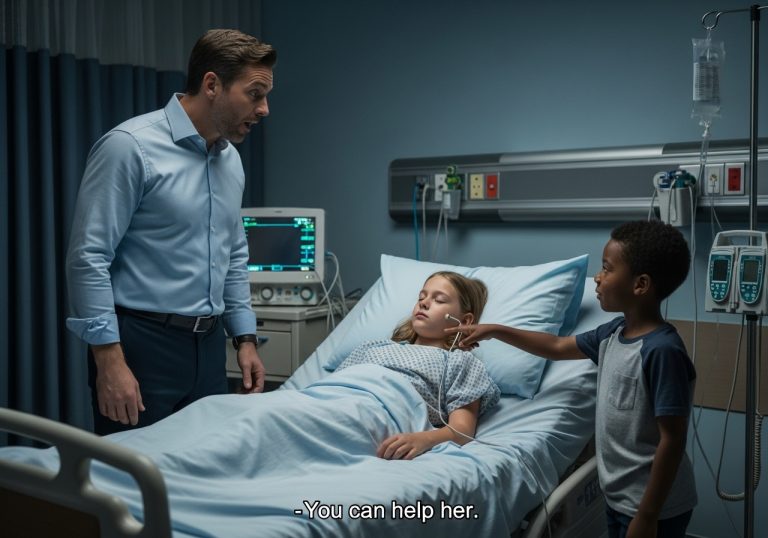
Before Robert could respond, the double doors opened. A doctor walked out. He wasn’t wearing a white coat; he was in a suit. Dr. Aris Thorne, Chief of Psychiatry. He looked tired.
“Mr. and Mrs. Miller?”
“Is he awake?” Grace asked, jumping up. “Can we take him home? He has a calculus exam on Monday.”
Dr. Thorne looked at Grace with an expression of profound pity mixed with professional frustration. “Mrs. Miller, your son is not taking a calculus exam on Monday. Your son is currently in a state of dissociative fugue caused by extreme psychological burnout.”
“Burnout?” Robert scoffed. “He’s seventeen. He doesn’t have a job. He studies.”
Dr. Thorne held up a black notebook. “We found this in his tuxedo pocket. He asked the nurse to give it to you. He said… he said it’s the only way he can talk to you right now because his voice is gone.”
Grace took the notebook. Her hands were shaking. It was a Moleskine journal.
She opened it.
It wasn’t a diary. It was a ledger.
Page 1: Hours Slept: 3. Caffeine intake: 600mg. Grade: A-. Result: Failure. Page 10: Dad looked at me today. He didn’t see me. He saw a diploma. Page 50: I wish I could break my arm. If I broke my arm, I wouldn’t have to play. I wouldn’t have to write. I could just be.
And then, the last twenty pages. They were filled with a single sentence, written over and over again, the handwriting degrading from neat cursive into jagged, frantic scratches.
I am not enough. I am not enough. I am sorry. I am not enough. I am sorry.
Grace read the words. The ink blurred as a tear fell onto the page. She flipped to the very last entry, written just hours before the recital.
Dear Mom and Dad, I’m sorry I’m not the investment you wanted. The piano is too heavy. I can’t carry it anymore. Please let me stop. I just want to read my comic books. I just want to sleep. Please.
Grace looked up. Her face was pale. She handed the book to Robert.
Robert read it. He saw the jagged handwriting. He saw the desperation etched into the paper. He looked at the closed door of the psychiatric ward. He thought about the Yale recruiter. He thought about the trophies on the mantle.
Suddenly, the trophies felt like tombstones.
Robert Miller, the man who never lost a case, the man who never showed weakness, felt his knees give out. He slid down the wall until he was sitting on the sterile hospital floor. He clutched the notebook to his chest and began to weep—ugly, heaving sobs that shook his entire body.
“We did this,” he choked out. “Grace… we did this.”
Chapter 5: The Butterfly and the Ashes
It took six months.
The recovery wasn’t a straight line. It was a messy, winding path filled with therapy sessions, medication adjustments, and long, silent afternoons.
Ethan dropped out of high school. It was the biggest scandal the neighborhood had seen in years. The neighbors whispered. Robert didn’t care. He resigned from the senior partnership to take a “sabbatical.”
The house changed. The trophies were packed into boxes and put in the attic. The grand piano remained, but the lid was closed, and a vase of fresh wildflowers sat on top of it. It was furniture now, not an altar.
It was a warm Tuesday morning in May. The sun was filtering through the oak trees in the backyard.
Ethan was sitting on the grass. He was wearing an old t-shirt and jeans, stained with dirt. He had gained weight—healthy weight. The dark circles were gone.
He wasn’t studying. He wasn’t practicing. He was holding a sketchbook.
Grace walked out onto the patio. She held two glasses of lemonade. She paused, watching him.
Ethan was sketching a butterfly that had landed on a dandelion. His tongue was poking out of the corner of his mouth in concentration. He looked… young. He looked like a child.
Grace walked over and sat on the grass beside him. She didn’t worry about grass stains on her linen pants.
“Here,” she said, handing him the glass.
“Thanks, Mom.” Ethan took a sip. “Check this out. The shading on the wings is tricky.”
Grace looked at the drawing. It was beautiful. Not perfect—the proportions were slightly off—but it was alive. It had movement.
“It’s wonderful, Ethan,” she said, and for the first time in years, she meant it simply because he made it, not because it could win an award.
“I was thinking,” Ethan said, looking at the sky. “I might take a GED prep course next fall. Just… you know, to see.”
“There is no rush,” Robert’s voice came from behind them. He was wearing a t-shirt and cargo shorts, an outfit that would have been unthinkable a year ago. He was holding a garden trowel. “The tomatoes need watering.”
“I’ll do it,” Ethan said.
“No,” Robert smiled. A genuine, crinkly-eyed smile. “I’ll do it. You finish your drawing. It’s… it’s really cool, son.”
Ethan looked at his father. He looked at his mother. The silence in the garden wasn’t heavy anymore. It was just quiet. It was the sound of wind in the leaves and birds calling to one another.
Ethan looked back at the butterfly. The corner of his lip twitched upward. A tiny, faint, real smile.
It wasn’t an acceptance letter. It wasn’t a trophy. It wasn’t a standing ovation. It was just a smile.
And as Grace watched her son, she realized with a breaking heart that this—this simple, imperfect moment—was the greatest success they had ever achieved. They had broken the vessel, yes. But in the ashes of their ambition, they had finally found their son.