I Was A Marine, But Nothing Prepared Me For The Day The Grid Went Down In Chicago And I Had To protect My Neighbor’s 6-Year-Old Son From The Monsters That Used To Be Our Friends.
PART 1
Chapter 1: The Silence Before the Scream
It started with the silence.
That’s the thing movies get wrong about the apocalypse. They play ominous music. They show explosions. They give you a cue that the world is ending.
In reality, it’s just… quiet.
I was in my garage in Naperville, just forty minutes outside of Chicago. It was a Tuesday. I was sanding down an old oak table I’d picked up at a flea market. The radio was buzzing with some talk show host complaining about gas prices.
Then, snap.
The radio cut. The overhead fluorescent lights didn’t flicker; they just died. The hum of the refrigerator inside the house—a sound you don’t realize is there until it’s gone—vanished.
I stood there in the sudden gloom, sandpaper in hand. “Circuit breaker,” I muttered.
I walked out into the driveway. That’s when I realized it wasn’t the breaker.
The streetlights were dead. The hum of the distant highway was fading as cars rolled to stops. I looked down the street. Mrs. Gable was standing on her porch, clicking her key fob at her SUV. Nothing.
No power. No engines. No cell service.
My phone was a black brick.
I’m Jack. I served two tours in the sandbox. I know the difference between a power outage and a tactical blackout. A power outage is inconvenient. A tactical blackout is a prelude.
I went inside and locked the door. My wife left three years ago—couldn’t handle the night terrors I brought back from overseas. So, it was just me. Me and the silence.

For the first six hours, people treated it like a novelty. I saw neighbors grilling meat before it spoiled, sharing beers on the sidewalk. They laughed about how they’d have to actually talk to each other instead of scrolling Instagram.
I didn’t laugh. I filled every container I had with water. I loaded my magazines. I pulled the blackout curtains.
By nightfall, the laughter stopped. The Chicago skyline, usually a glow on the horizon, was a black void.
Then came the first shattered window.
It was 2:00 AM. The sound cracked through the subdivision like a whip. Someone shouting. “Give me the damn keys!”
Looting? Already?
Panic accelerates faster than gravity. When people realize the cops aren’t coming, the veneer of civilization wears thin. It’s paper-thin. And it had just torn.
I sat in my living room, my Glock 19 resting on the arm of the chair. I watched the street through a crack in the blinds. Shadows moved. Flashlights cut through the darkness like erratic lightsabers.
I wasn’t going to get involved. My plan was simple: hunkered down for 72 hours, then hike to my uncle’s cabin in Wisconsin if the grid didn’t come back. I had the skills. I had the gear. I didn’t need liabilities.
Then came the scream.
It was right next door. The Miller family. Nice people. Sarah was a teacher; Dave worked in insurance. They had a kid, Leo. Little guy, maybe six. He always waved at me when I was washing my truck.
“Please! We don’t have anything!” Sarah’s voice. High-pitched. Terrified.
It was coming from their backyard.
Then, a sickening thud. Silence again. Then a man’s voice, low and gravelly. “Check the upstairs.”
I didn’t think. The “me” that wanted to survive to Wisconsin vanished. The “me” that wore a uniform and swore an oath took over.
I moved out the back door, crouching low in the shadows of the hedges. I hopped the fence, landing silently on the grass. The Millers’ back door was kicked in.
I sliced the pie at the doorframe. Clear.
Kitchen. I stepped over broken glass. I saw Dave first. He was on the floor by the fridge. Gone. Blunt force. I didn’t check for a pulse; the angle of his neck told me everything I needed to know.
“Mommy?” A whisper. Upstairs.
I moved to the staircase. The wood creaked. I froze.
Heavy boots thudded above me. “Find the silver. Forget the kid.”
Two intruders. At least.
I crept up the stairs. The master bedroom door was open. I saw the beam of a flashlight sweeping the dresser.
I engaged. Two rapid shots. The man with the flashlight dropped.
“What the—!”
The second man burst out of Leo’s room across the hall. He had a crowbar raised.
I didn’t hesitate. Center mass. He folded.
My ears were ringing. Gunshots indoors are deafening. But through the ringing, I heard it. A whimpering sound.
I cleared the hallway and entered the kid’s room. It was a mess. Drawers pulled out. Toys scattered.
“Leo?” I whispered. “It’s Jack. From next door.”
No answer.
I scanned the room. The closet door was slightly ajar. I moved toward it, lowering my weapon.
“Leo, buddy. It’s okay.”
I opened the door. He wasn’t there.
Panic spiked. Had there been a third man?
Then I heard a scratch. Under the bed.
I got on my knees and lifted the dust ruffle.
There he was. Curled into a ball so tight he looked like a piece of laundry. He was clutching a stuffed tiger. His eyes were wide, unblinking, reflecting the moonlight filtering through the window.
“Leo,” I said softly. “Come on. We have to go.”
He didn’t move. He was catatonic.
I reached out to grab his arm to pull him toward me. That’s when my hand came back wet.
Warm and wet.
I clicked on my tactical light for a split second, shielding the beam with my hand.
Blood. A lot of it. His left forearm was sliced open.
“Oh, kid,” I breathed.
I holstered my weapon and grabbed him. “I’ve got you. I’ve got you.”
He didn’t fight me. He was limp, like a ragdoll. I pulled him out from under the bed and scooped him into my arms. He weighed nothing.
We had to move. The gunshots would attract attention. The neighborhood wasn’t safe. My house wasn’t safe anymore.
I carried him down the stairs, stepping over the bodies of the men who had destroyed his world in less than five minutes. I covered his eyes, pressing his face into my shoulder.
“Don’t look, Leo. Just listen to my heartbeat. Don’t look.”
We ran into the night.
Chapter 2: The Wound and The Oath
I kicked my back door shut and threw the deadbolt. I dragged the heavy oak dining table—the one I’d been sanding just hours ago—in front of it.
My house was dark, smelling of sawdust and stale coffee. It felt like a tomb, but for now, it was a fortress.
I took Leo to the bathroom. It was the only room without windows, the only place I could use a light without turning us into a beacon for every looter in the subdivision.
I set him down on the closed toilet lid. He was shivering now. The shock was starting to wear off, replaced by the cold reality of trauma.
I lit a camping lantern and set it on the floor. The harsh LED light cast long, distorted shadows against the tile.
“Let me see the arm, buddy,” I said, my voice trembling slightly.
He held it out. He didn’t look at it. He was staring at the shower curtain, his eyes focusing on a pattern that wasn’t there.
I inspected the damage. It was a jagged laceration, probably from falling onto a broken vase or window glass during the struggle next door. It ran from his elbow halfway to his wrist. It was deep—muscle was visible—but thankfully, it hadn’t hit the artery.
“Okay,” I said, trying to sound like the medic I wasn’t. “This is gonna sting, Leo. I need you to be brave like a Marine, okay? Can you do that?”
He didn’t answer. He just squeezed the stuffed tiger until his knuckles turned white.
I opened my first aid kit. I grabbed the antiseptic.
“Ready? One, two, three.”
I poured it.
He gasped. It was a sharp, intake of breath, like the air had been sucked out of the room. His little body went rigid. Tears pooled in his eyes, spilling over his cheeks, tracking through the dirt and grime on his face. But he didn’t scream.
That broke my heart more than if he had screamed. A six-year-old shouldn’t know how to suppress pain. That’s a survival instinct for soldiers, not first graders.
I worked quickly. Butterfly closures to pull the skin together. Antibiotic ointment. Gauze. Tape.
I wrapped it tight, checking his fingers for circulation. “Can you wiggle your fingers for me?”
He wiggled them. Good.
I sat back on my heels, wiping the sweat from my forehead. My hands were covered in his blood.
I looked at the bandage. It was stark white against his dirty skin. A small patch of order in a world that had gone chaotic.
I looked up at his face. He was finally looking at me.
“Where are Mommy and Daddy?” he asked. His voice was small, broken glass.
The question hung in the air, heavy and suffocating.
I couldn’t tell him. Not yet. I couldn’t tell this boy that he was an orphan. I couldn’t tell him that the world he knew was dead.
“They… they couldn’t come with us right now,” I lied. “It’s just you and me for a bit, Leo.”
He looked down at his bandaged arm. He touched it tentatively with his other hand.
“It hurts,” he whispered.
I reached out and placed my hand on his shoulder. I felt the smallness of his bones. I thought about the men next door. I thought about the darkness outside. I thought about the miles we had to walk to get to safety.
The soldier in me wanted to assess the tactical situation. The human in me just wanted to weep.
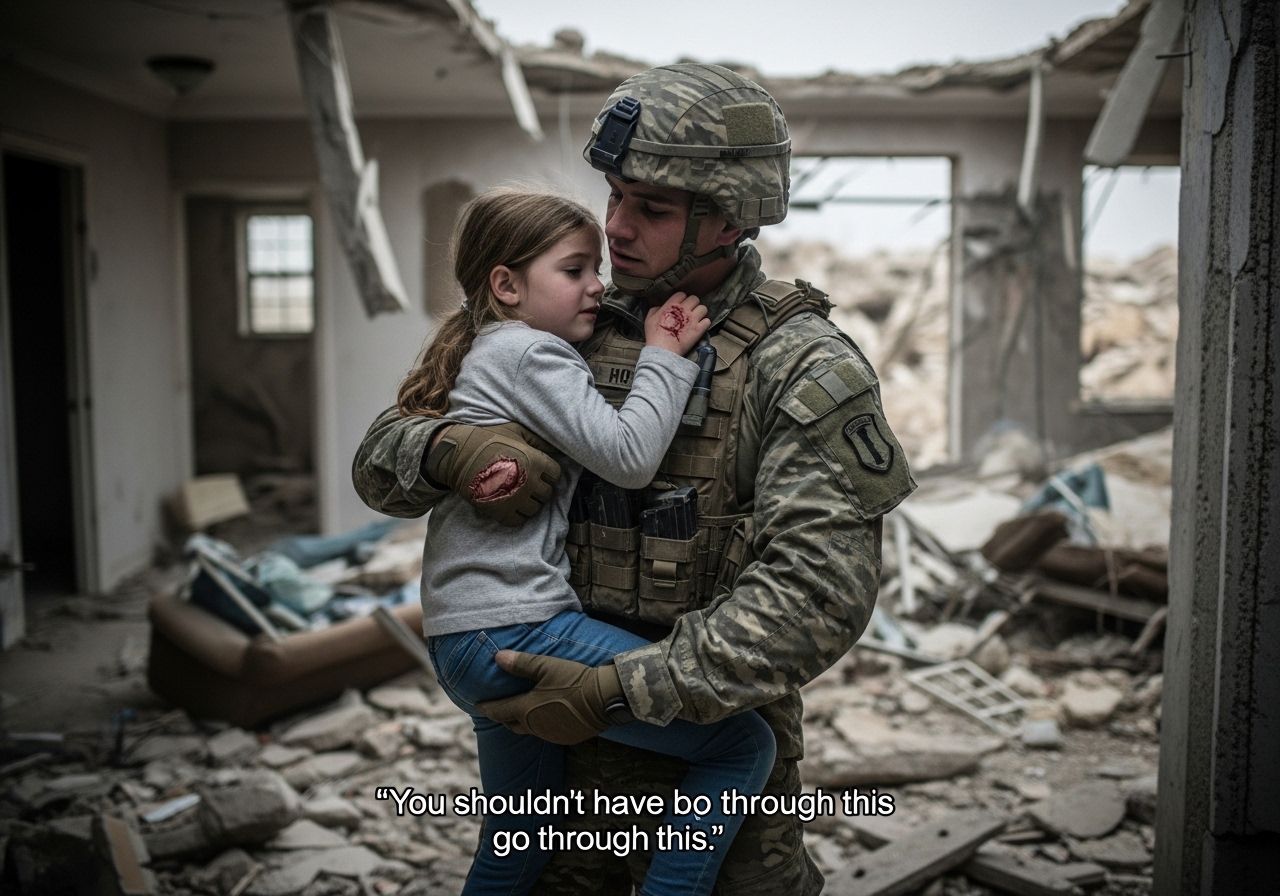
I looked at the wound on the child’s hand and choked up.
“You shouldn’t have to endure these things,” I said, my voice cracking.
It was an admission of failure. Not just my failure, but the failure of every adult who was supposed to keep the world spinning. We let this happen. And now, the children were paying the bill.
Leo looked at me, his eyes searching mine for stability.
“Are you a soldier?” he asked. He had seen the picture of me in my dress blues on the hallway wall.
“I used to be,” I said.
“Do soldiers fight monsters?”
I tightened my grip on his shoulder. “Yeah. Yeah, we do.”
“Are you going to fight the monsters outside?”
I stood up, the grim determination settling over me like armor. I washed the blood off my hands in the sink using the last of the water in the tap.
“Yes, Leo. I’m going to fight them.”
I packed the medical kit. I went to the bedroom and grabbed my tactical vest. I handed Leo a small flashlight.
“Here. You hold this. Don’t turn it on unless I say so.”
“Where are we going?”
“North,” I said. “To the woods. It’s safer there.”
I checked the magazine in my Glock. I slung my AR-15 over my shoulder. I looked at this kid—my new mission.
“Leo, listen to me. From now on, we stick together. You do exactly what I say. If I say run, you run. If I say hide, you hide. Do you understand?”
He nodded. “I understand.”
“Good.”
I blew out the lantern. Darkness swallowed us again.
“Grab my belt,” I said.
I felt his small hand grip the back of my belt.
“Let’s move.”
I opened the front door. The air was cold. The smell of smoke was stronger now. Somewhere in the distance, a siren wailed and then died out abruptly.
We stepped out onto the porch. The street was empty, but I could feel eyes watching from behind curtained windows.
We weren’t neighbors anymore. We were prey.
I took the first step down the driveway, Leo trailing behind me.
The journey had begun. And I knew, with a sinking feeling in my gut, that the worst wasn’t behind us. It was waiting in the dark.
PART 2
Chapter 3: The Tribal Suburbs
We moved through the backyards. The streets were suicide.
That’s the first rule of urban survival when the law evaporates: Stay off the X. The “X” is anywhere people naturally congregate—intersections, main roads, gas stations. That’s where the predators look first.
I kept to the shadows of the fences, moving with a slow, deliberate pace. Leo held onto my belt loop so tight I could feel his knuckles digging into my hip.
We were only three blocks away from my house, but it felt like a different planet.
Naperville is known for its manicured lawns and six-figure incomes. Tonight, it looked like a scene from a dystopian nightmare.
Every few houses, I saw flickers of candlelight. Shadowy figures stood on porches with shotguns and baseball bats. The Neighborhood Watch had turned into a militia in less than twenty-four hours.
“Jack,” Leo whispered. “I’m thirsty.”
I crouched down next to a row of arborvitae hedges. “I know, buddy. We have water in my bag. But we can’t stop yet. Not here.”
We needed to cross Ogden Avenue. It was a four-lane artery. If we could get across, we could hit the forest preserve trails that followed the DuPage River. That was our highway.
We reached the edge of a subdivision. A six-foot privacy fence separated us from the main road.
“Up you go,” I whispered.
I boosted Leo up. He scrambled over, dropping silently onto the grass on the other side. I pulled myself up.
Before I could drop down, a beam of light hit me in the face.
“Don’t move!” A voice cracked. Shaky. Terrified. Dangerous.
I froze, straddling the fence. The light was blinding, but I could make out the silhouette of a man standing ten yards away in his backyard. He was holding a hunting rifle.
“I’m just passing through,” I said, keeping my hands visible. “I’ve got a kid with me.”
“I don’t care what you have! Get back!” the man yelled.
“Please,” I said, keeping my voice low and calm. “We’re leaving. We’re heading north. We don’t want your stuff.”
“Liar! Everyone wants something!”
He raised the rifle.
My hand twitched toward the Glock on my hip. I could drop him. He was shaking; his aim would be garbage. I could put two rounds in his chest before he pulled that trigger.
But Leo was right there below me.
If I engaged, Leo would see it. If I engaged, the crack of the rifle might alert others.
“Leo,” I said, not looking down. “Run to the tree line. Now.”
“Jack—”
“Run!”
The man fired.
The shot went wide, shattering a fence slat inches from my leg. The sound was like a cannon blast in the quiet night.
I dropped down on the man’s side of the fence, not to attack, but to break his line of sight. I hit the ground and rolled.
“Get out of here!” he screamed, racking another round.
I scrambled on all fours, grabbing Leo by the back of his hoodie. We sprinted across the dark lawn, diving into the brush bordering the main road.
We didn’t stop. We tore through the thorns and brambles, sliding down the embankment toward the asphalt of Ogden Avenue.
We hit the pavement and kept running, crossing the four lanes under the dead, hanging traffic lights.
We didn’t stop until we reached the darkness of the forest preserve on the other side.
I collapsed against an old oak tree, gasping for air. My heart was hammering against my ribs.
Leo was shaking. He was crying silently again.
“Did he shoot you?” Leo asked, his voice trembling.
“No,” I lied. A splinter from the fence had gouged my calf, but it wasn’t a bullet. “He missed.”
“Why did he do that? We didn’t do anything bad.”
I pulled the canteen out of my bag and handed it to him.
“People are scared, Leo. When people get scared, they stop thinking. They just react. He thought we were the bad guys.”
“Are we?”
I looked at the moon filtering through the bare branches. I thought about the man on the porch. I had almost killed him. The calculation had been instantaneous. Cold.
“No,” I said. “We’re the survivors. Drink up. We have a long walk tonight.”
Chapter 4: The River of Steel
By 4:00 AM, my boots were heavy. Leo’s steps were dragging.
I ended up carrying him on my shoulders for the last two miles. The kid was light, but with forty pounds of gear on my back, my knees were screaming.
We reached the edge of the forest preserve where it intersected with the interstate. I-88.
I signaled for us to stop. We crept up the embankment to look at the highway.
I expected it to be empty. I was wrong.
It was a parking lot of dead steel.
Thousands of cars were gridlocked, bumper to bumper, stretching as far as the eye could see in both directions. They sat silent and dark, like a graveyard of metal beetles.
“Whoa,” Leo whispered. “Where are they all going?”
“Nowhere,” I said.
When the power died, the traffic signals died. Then the panic set in. Accidents blocked the lanes. Then the cars ran out of gas idling. Now, it was just a monument to the end of the world.
“We have to cross it,” I said.
We slid down the concrete slope onto the highway. It was eerie. We walked between the cars. Some were empty, doors left open where drivers had abandoned them to walk home.
Others weren’t empty.
I saw shapes inside some of the vehicles. People huddled under blankets, sleeping. Or waiting.
“Don’t look in the windows,” I told Leo.
We were halfway across the six lanes when I heard the voices.
“Help! Please!”
It came from a minivan three cars ahead of us.
I stopped. I signaled Leo to crouch behind the wheel of a semi-truck.
“Stay here,” I mouthed.
I peered around the fender.
A woman was pleading with a group of three men. They had flashlights. They were pulling suitcases out of her roof rack and tossing them onto the road.
“You can’t take that! It’s all we have!” she screamed.
One of the men, wearing a ski mask, backhanded her. She fell onto the hood of her van.
“Shut up, lady. It’s tax collection day.”
The rage flared in me again. Hot and blinding.
I had a clear shot. Three targets. Close range. I could drop them. I could save her.
But I looked back at Leo. He was peeking out from behind the tire, his eyes wide with terror.
If I started a firefight here, in the middle of a thousand stranded cars, we would be swarmed. There could be more of them. I had one mission: Get the boy to safety.
Every time I pulled the trigger, I rolled the dice on Leo’s life.
I gritted my teeth so hard I thought they would crack.
I turned back to Leo.
“We’re moving,” I whispered. “Quietly.”
“But Jack,” he whispered, tears in his eyes. “They’re hurting her.”
“I know,” I said, the shame burning my throat like acid. “I know.”
I grabbed his hand and we moved. We ducked low, weaving between the bumpers, moving away from the screams.
We left her.
I felt like a coward. I felt like a traitor to the uniform I used to wear. But I wasn’t a Marine right now. I was a father figure. And fathers make different choices than soldiers.
We reached the other side of the highway and scrambled up the slope, disappearing into the darkness of the trees.
The woman’s screams faded behind us, swallowed by the vast, indifferent silence of the blackout.
We walked for another hour in silence. The sun was starting to bleed gray into the eastern sky.
We found a small maintenance shed near a water treatment plant. The lock was rusty; I broke it with a rock.
It was small, smelling of oil and damp concrete, but it was dry and it had a door that locked from the inside.
“We rest here for the day,” I said, dropping my pack.
Leo curled up on a pile of old canvas tarps. He looked exhausted, his skin pale, the bandage on his arm dirty.
“Jack?”
“Yeah, buddy?”
“Are the bad men going to find us?”
I sat down against the door, my gun in my lap. I listened to the wind howling outside.
“No,” I said. “Because I’m the monster that keeps the bad men away.”
He fell asleep within minutes.
I stayed awake. I watched the dust motes dance in the sliver of light coming through the crack in the door.
We had survived the first night. But we had no food. We were low on water. And we were still forty miles from the state line.
I checked my magazine. Twelve rounds left.
I closed my eyes, but I didn’t sleep. I just replayed the sound of that woman’s scream, over and over again, wondering if the price of survival was my soul.
PART 2 (Continued)
Chapter 5: The Law of the Jungle
Hunger is a sharp stick in the gut. Thirst is a hammer to the skull.
We woke up in the maintenance shed around noon. My internal clock was still ticking on military time, but without the sun to guide us properly in the windowless room, it felt like limbo.
Leo was awake before me. He was sitting cross-legged on the dirty concrete, staring at a line of ants marching toward a discarded candy wrapper in the corner.
“Jack?” his voice was raspy. “My mouth hurts.”
Dehydration.
I checked our supplies. One pint of water left. Two granola bars. That was it.
We had burned more calories in the last twelve hours than I usually did in a week. We needed to scavenge.
“Gear up, Leo,” I said, groaning as I stood. My knees popped. The adrenaline from the night before had faded, leaving behind a deep, aching soreness in every muscle.
We left the shed. The sky was an overcast gray, a heavy lid trapping the smoke and despair over the Illinois suburbs.
We were on the edge of a commercial district. Route 59. Usually, this place is a traffic jam of soccer moms and commuters. Now, it was a ghost town.
Cars were abandoned in the middle of intersections. Traffic lights swung dead in the wind. A stray dog trotted down the yellow line, head low.
“Stay close,” I commanded. “We stay off the pavement. We move through the parking lots, behind the cars.”
We approached a gas station convenience store. The windows were smashed. The shelves inside had been stripped bare. It looked like a swarm of locusts had come through.
I swept the interior with my weapon raised. “Clear.”
I motioned Leo inside. “Look under the shelves,” I instructed. “Look in the back of the cabinets. People panic. They grab what’s eye-level. They miss the corners.”
Leo was small. He crawled under the counter near the register.
“Jack!” he whispered excitedly.
He held up a dusty bag of beef jerky and a bottle of Gatorade that had rolled under the safe.
It was like finding gold bullion.
“Good job, kid. Good job.”
We cracked the Gatorade. I let him drink first. He gulped it down so fast I had to pull it away.
“Slow down. You’ll throw up.”
We shared the jerky. It was tough, salty, and the best thing I’d ever tasted.
We were about to leave when I heard the growl.
It wasn’t human.
I spun around. Standing in the shattered doorway was a Rottweiler. It was massive, likely a guard dog that had gotten loose or been abandoned. And it was starving.
Behind it, two more mixed-breed dogs appeared. They weren’t barking. They were hunting.
“Leo, get behind the counter,” I said, my voice low and steady.
“Jack—”
“Go!”
The Rottweiler lunged.
It moved with terrifying speed for something that big. I didn’t have time to aim. I raised my left arm—wrapped in my thick canvas jacket—to take the bite.
The jaws clamped down. The pressure was immense, crushing. I felt the teeth bruise the bone through the fabric.
I grunted, shoving my arm deeper into the dog’s mouth to trigger its gag reflex, a trick I learned from a K-9 handler in Okinawa. The dog thrashed, its claws tearing at my jeans.
The other two dogs circled, looking for an opening to get to Leo.
I drew my Glock with my right hand.
Pop. Pop.
I put two rounds into the Rottweiler’s rib cage. The dog went limp, its jaws slackening. I shoved the heavy carcass off me.
The other two dogs flinched at the noise.
I leveled the gun at the lead mongrel. “Get back!” I roared. The primal aggression in my voice scared them more than the gun. They turned and bolted into the parking lot.
I leaned against the counter, breathing hard. My arm was throbbing. The jacket had held, but my forearm was going to be a mess of blue and black tomorrow.
Leo peeked over the counter. His face was pale.
“You killed it,” he whispered. He looked at the dead dog, then at me.
“It was him or us, Leo,” I said, holstering the weapon. My hands were shaking slightly. Not from fear, but from the adrenaline dump.
“It was just hungry,” Leo said. Tears welled up in his eyes. “Like us.”
That hit me harder than the bite.
He was right. The dog wasn’t evil. It was just desperate. We were all just animals now, fighting over scraps in the ruins of America.
“I know,” I said, crouching down to his level. “I know, buddy. But my job is to keep you safe. And I will kill anything that tries to hurt you. Do you understand?”
He nodded, but he didn’t look convinced. He looked at the dead dog with a sadness that didn’t belong on a six-year-old’s face.
“Come on,” I said. “The gunshots will draw people. We have to move.”
We left the store, stepping over the carcass. I didn’t look back. I couldn’t afford to feel pity. Pity gets you killed.
Chapter 6: The Bridge of Tolls
We needed to cross the Fox River.
It was the only way to get to the rural backroads that would lead us north to Wisconsin. The problem was, everyone else knew that too.
We reached the tree line overlooking the Main Street Bridge around 4:00 PM. I pulled out my compact binoculars.
What I saw made my blood turn to ice.
The bridge wasn’t empty. It was a checkpoint. But not a police checkpoint or a military one.
It was a gang. Civilians with hunting rifles, baseball bats, and a few handguns. They had dragged cars across the span to create a funnel.
I watched as a family—a man, a woman, and a teenager—tried to cross.
The man at the front of the blockade, a giant in a biker vest, stopped them. He pointed at the teenager’s backpack.
The father argued. He was pleading, gesturing to the sky, to his wife.
The biker swung a bat. The father went down. The group swarmed them. They stripped the backpacks off the family. Then, they pointed back the way they came.
The family retreated, battered and empty-handed. They were lucky. They were alive.
“We can’t cross there,” I whispered to Leo.
“Why?”
“Bad men. Worse than the ones at your house.”
“So how do we get across?”
I scanned the river. The water was gray and chopping. The current was fast. It was October in Illinois; the water temperature was probably in the low 50s. If we tried to swim, we’d get hypothermia before we made the other bank.
“We need a boat,” I said.
We moved south along the riverbank, staying in the thick brush. We passed luxury riverfront homes. Most were dark, abandoned by owners who had fled to their summer homes in Florida or Arizona.
Half a mile downriver, I saw it. A small wooden dock. A covered boat lift.
And sitting in the water, bobbing gently, was an aluminum fishing boat.
“Jackpot,” I muttered.
We crept down the slope. My boots crunched on dry leaves. I winced at every sound.
We reached the edge of the lawn. The house was dark. No cars in the driveway.
“Wait here,” I told Leo, tucking him behind a large oak tree. “If you hear shooting, you run back to the woods and you hide. You don’t come out until I call your name. Got it?”
“Jack, don’t go,” he whispered, grabbing my sleeve.
“I have to. We need that boat.”
I moved across the lawn, keeping low. I reached the dock. The boat was chained to a pylon.
I pulled out my multi-tool. I started working on the padlock hasp. It was cheap metal. It twisted.
Click.
“Hey!”
The voice came from the house.
I spun around, drawing my weapon.
A teenager, maybe sixteen, was standing on the back deck. He was shaking, holding a double-barreled shotgun. It was pointed right at my chest.
“Get away from my boat!” the kid yelled.
I froze. I held my hands up, keeping the gun in my right hand but pointed at the sky.
“Easy, son,” I called out. “I don’t want to hurt you.”
“Drop the gun!” he screamed. His finger was on the trigger. One twitch and I was dead.
“I can’t do that,” I said calmly. “But I’m not going to shoot you. I just need to cross the river.”
“I said drop it!”
He took a step forward. He was terrified. A terrified kid with a scattergun is the most dangerous thing on earth.
“I have a little boy with me,” I said. “He’s six. He’s hurt.”
The kid hesitated. “Liar.”
“Leo!” I shouted, not taking my eyes off the shotgun barrel. “Come out! Hands up!”
A moment later, Leo stepped out from behind the oak tree. He held his hands up, the stuffed tiger dangling from one hand.
The teenager looked at Leo. The barrel of the shotgun dipped slightly.
“He’s… he’s just a kid,” the teen stammered.
“We’re just trying to get north,” I said. “We’re not looters. We’re refugees. Just like you.”
The teen looked at the boat, then back at us. The conflict on his face was painful to watch. He wanted to protect his home, but he wasn’t a killer. Not yet.
“Take it,” the kid whispered. “Just… just go.”
“Thank you,” I said. “What’s your name?”
“Chris.”
“Chris, lock your doors. Don’t come out for anyone. Not even people asking for help.”
He nodded and backed into the house.
I waved Leo over. We jumped into the aluminum boat. I didn’t start the engine—noise travels over water. I grabbed the oars.
I rowed us out into the channel. The current grabbed us immediately, pulling us downstream.
“Row, Jack!” Leo said.
I pulled hard. My shoulder burned. My bitten arm throbbed with every stroke.
We were halfway across when I heard the shout from the bridge.
“Hey! Someone’s on the water!”
I looked upriver. The gang on the bridge had spotted us.
Crack.
A rifle shot splashed into the water ten feet from the boat.
“Get down!” I yelled at Leo. “Flat on the bottom!”
He scrambled onto the cold metal floor of the boat.
Crack. Crack.
Another splash, closer this time. They were dialing in the range.
I rowed like a madman. Adrenaline masked the pain. I dug the oars into the black water, heaving us toward the far bank.
“Almost there!”
A bullet pinged off the side of the boat, punching a hole through the aluminum just inches above the waterline.
“We’re taking on water!” Leo screamed.
“Stay down!”
We hit the muddy bank with a thud.
“Go! Go! Go!”
I grabbed Leo and threw him onto the grass. I grabbed my pack. We scrambled up the muddy embankment, slipping and sliding, as bullets whizzed through the branches above our heads.
We crested the hill and rolled into a ditch behind a row of trees.
Safe.
I lay there, gasping for air, staring at the gray sky. My lungs felt like they were burning.
Leo crawled over to me. He was covered in mud.
“We made it,” he said.
I looked at the river. We were on the west side. The city was behind us. The woods were ahead.
“Yeah,” I wheezed. “We made it.”
But as I looked at the bandage on Leo’s arm, now soaked in river water, I knew we had a new problem.
Infection.
And without antibiotics, the river might have killed us just as dead as the bullets would have.
PART 2 (Continued)
Chapter 7: The Fever and the Farmhouse
Two days.
That’s how long it took for the infection to set in.
We were walking along the railroad tracks near the Wisconsin border. The gravel ballast tore at our boots. The wind had shifted, bringing a biting cold from the north that smelled of snow.
Leo was stumbling. I had to stop every ten minutes to let him rest.
When I touched his forehead, it was like touching a radiator.
“Jack,” he mumbled, his eyes glassy and unfocused. “I’m cold.”
He was burning up, but he was shivering. Sepsis. If the bacteria from the river water hit his bloodstream, he’d be dead in twenty-four hours.
My first aid kit was empty. We needed antibiotics. Real ones. Not the over-the-counter cream I had left.
“Come on, Leo. Up on my shoulders.”
I hoisted him up. He was dead weight now. My own body was screaming—my bitten arm was swollen and throbbing, hot to the touch—but the adrenaline of fear kept me moving.
I saw smoke rising above the tree line a mile ahead.
Smoke meant people. People meant danger. But people might also have medicine.
I left the tracks and cut through a cornfield. The stalks were dead and dry, rattling like bones in the wind.
We emerged into a clearing. A farmhouse sat in the middle of a fenced yard. It was old, white siding peeling, but there was smoke curling from the chimney. And on the porch, a generator chugged away, guarded by a heavy chain.
I scanned the perimeter. No dogs. No sentries.
I walked up the driveway, my hands clearly visible, my rifle slung over my back to show I wasn’t attacking.
“Hello!” I shouted. “I need help!”
The front door cracked open. The barrel of a shotgun poked out.
“Not another step!” An old man’s voice. Hard as iron.
“My name is Jack. I have a sick boy. He has a fever. I think it’s sepsis.”
“Keep walking, Jack. We don’t have anything for you.”
“I don’t want your food!” I yelled, desperation cracking my voice. “I just need antibiotics! Please! He’s six years old!”
The door opened wider. An older woman stepped out, pushing the shotgun barrel down. She squinted at me, then at the lump on my shoulders.
“Let me see him,” she said.
“Martha, no,” the man hissed. “It could be a trap.”
“Look at him, Silas. He’s barely standing. And that boy is limp.”
She waved me forward. “Bring him to the porch. Slowly.”
I walked up the steps. I laid Leo down on the wooden swing.
Martha touched his forehead. She peeled back the dirty bandage on his arm. She gasped. The wound was angry, red streaks tracking up toward his elbow.
“Gangrene is next,” she said bluntly. “He needs Amoxicillin. Maybe Cipro.”
“Do you have it?” I asked. “I’ll give you everything I have. My rifle. My ammo. My labor. Anything.”
Silas looked at the rifle on my back. Then he looked at Leo’s pale face. The hardness in his eyes melted, just a fraction.
“Keep your gun, son. You’ll need it.”
He went inside. A minute later, he came back with a pill bottle and a canteen of clean water.
“Fish antibiotics,” Silas said, handing me the bottle. “Moxifish. It’s Amoxicillin. Same stuff they give humans, just without the FDA approval. It’s all we got.”
“It’ll work,” I said. I popped two capsules and forced Leo to swallow them with the water.
Martha re-dressed the wound with clean gauze and iodine. It stung, but Leo didn’t even wake up.
“You can’t stay,” Silas said, his hand resting on his shotgun again. “We have enough supplies for two. Not four.”
“I know,” I said. “I didn’t expect to.”
I stood up, hoisting Leo back onto my shoulders. He felt lighter now, maybe because I had a sliver of hope.
“Thank you,” I said.
“Go north,” Silas said. “Stay off the roads. The militias are patrolling Highway 12. They’re pressing men into service and taking everything else.”
I nodded. “Good luck.”
“Luck’s gone,” Silas muttered. “Only God left now.”
I walked back down the driveway, the bottle of pills rattling in my pocket. It was the most valuable thing I owned.
Chapter 8: The Cabin and the New World
We crossed the state line into Wisconsin at dusk.
There was no sign. No “Welcome to the Badger State.” Just a change in the pavement quality on the old county road and the sudden onset of snow.
It started as flurries, then thickened into a heavy, wet blanket. It covered our tracks. It muted the sound of the world.
Leo’s fever broke the next morning.
He woke up while we were huddled under a bridge, waiting out a patrol of trucks that had rumbled overhead.
“Jack?” he whispered. “I’m hungry.”
I laughed. It was a dry, raspy sound, but it was a laugh. “Hunger is good, kid. Hunger means you’re alive.”
We walked for two more days. The terrain got rougher, hillier. We were deep in the Driftless Area now.
Finally, I saw it.
The jagged rock formation that looked like a hawk’s beak. My uncle’s landmark.
“Almost there, Leo. Just over that ridge.”
We climbed the last hill. My legs were burning, my lungs screaming.
There it was.
A small log cabin nestled in a valley, surrounded by tall pines. It was dark. Snow had piled up on the roof.
We approached cautiously. I circled the perimeter. No footprints in the snow. No broken windows.
I went to the woodpile on the side of the house. I reached under the third log from the bottom.
My fingers brushed cold metal. The key.
I unlocked the front door. It swung open with a groan.
The air inside was stale and freezing, but it was the sweetest smell I’d ever known.
“Get inside,” I told Leo.
I barred the door. I checked the pantry. Canned peaches. Beef stew. Bags of rice. Matches.
I checked the floorboards in the bedroom. I pried them up.
My uncle’s cache. Two thousand rounds of 5.56. A medical kit. Blankets. A solar radio.
We were safe.
I got a fire going in the woodstove. The warmth spread through the room, chasing away the chill that had settled in my bones for the last week.
We ate cold beef stew out of the can. It tasted like a Michelin-star meal.
Leo sat by the fire, wrapped in a wool blanket. He was holding his stuffed tiger, which was now missing an eye and covered in mud.
“Jack?”
“Yeah, buddy?”
“Are the bad men gone?”
I looked at the fire. I listened to the wind howling outside, a blizzard that would bury the world in white.
“They’re still out there, Leo.”
“Will they come here?”
I looked at the heavy wooden door. I looked at the rifle leaning against the wall. I looked at the radio, silent for now.
“They might,” I said. “But we’ll be ready.”
He looked at me. His eyes were older now. He wasn’t the soft suburban kid I had pulled out from under the bed. He was a survivor.
“You’re my dad now, aren’t you?” he asked.
The question hung in the air.
I thought about his parents, lying on the kitchen floor. I thought about the life I had planned—the solitary life of a broken soldier.
That life was gone.
I reached out and messed up his hair.
“Yeah, Leo. I guess I am.”
He leaned his head against my arm and closed his eyes.
I watched the flames dance. The world outside had burned down. The grid was gone. The laws were written in lead and blood.
But in this cabin, in the middle of the frozen woods, there was a spark.
I wasn’t just surviving anymore. I was living for something.
I checked the safety on my rifle. I leaned back against the wall.
Let the darkness come. We were the fire.
THE END