THE BOY WITH THE TORN SHIRT: HE WAITED EVERY DAY FOR A DAD WHO DIDN’T EXIST, UNTIL THE SCHOOL CROSSING GUARD DID THE UNTHINKABLE
Chapter 1: The Parade of the Loved
The 3:00 PM bell at Oak Creek Elementary didn’t just ring; it shrieked. For three hundred children, that shrill, mechanical blast was the sound of liberation. It signaled the end of multiplication tables and spelling quizzes, the end of sitting still and raising hands. It was the starting gun for the race to freedom.
But for eight-year-old Leo, the bell was a daily alarm that signaled the beginning of his humiliation.
Leo sat at his desk in the back row of Mrs. Gable’s third-grade class—no relation to his foster mother, a cruel irony he thought about often—and packed his backpack with agonizing slowness. He put his math book in. He zipped the pocket. He unzipped it to check for his pencil case. He zipped it again.
“Leo, the bus is waiting,” his teacher called out gently from the doorway.
“I’m a walker today,” Leo lied. He was always a walker.
He slung the backpack over one shoulder. It was a Spiderman backpack, hand-me-down, with the spider web graphic peeling off in flakes. He adjusted his glasses, which were slightly crooked and slid down his nose when he sweated.
He walked out into the hallway, merging into the river of students flowing toward the double doors. The noise was deafening. Shrieks of laughter, the squeak of sneakers on linoleum, the thud of locker doors.
When he pushed through the heavy exit doors, the autumn air hit him. It was a crisp October afternoon in the suburbs of Ohio. The trees lining the pickup loop were burning with gold and crimson leaves. It was beautiful. It made Leo’s stomach hurt.
This was the Pickup Line. The Parade of Happiness.
A serpentine line of minivans and SUVs snaked around the parking lot. Engines idled. Windows rolled down.
“Joey! Over here!” “Sarah, did you forget your flute?” “Hey, champ! Get in!”
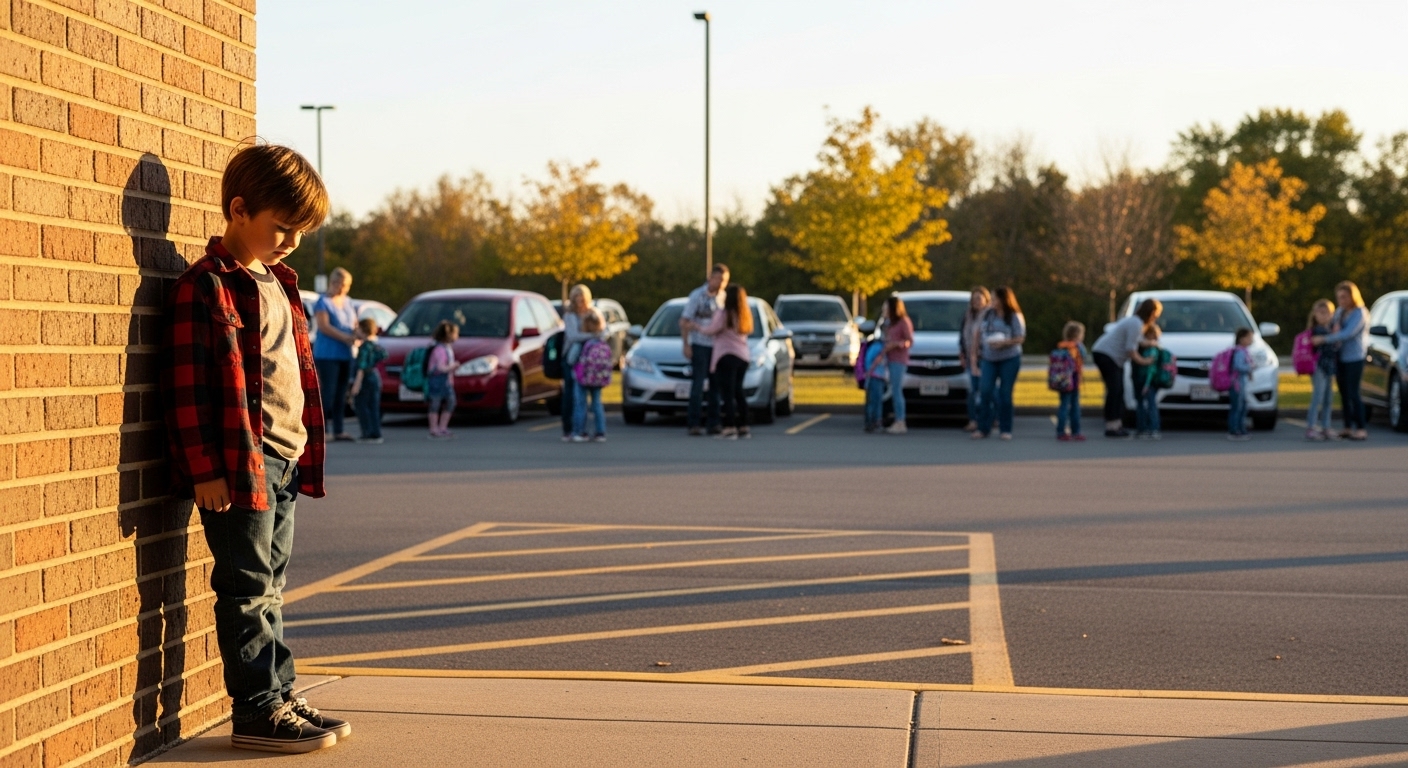
Leo stood by the rough red brick wall of the gymnasium, trying to make himself as small as possible. He watched the rituals. He saw a mother jump out of her car to hug her daughter, smoothing the girl’s hair. He saw a father in a crisp business suit swing a boy Leo’s age into the air, the boy’s legs kicking with joy.
“Daddy!” the boy yelled. “I got an A!”
“That’s my boy!” the father boomed.
Leo felt a physical sting behind his eyes, sudden and sharp like a paper cut. He knew this feeling. It was the prelude to crying.
Don’t you dare, he told himself. Don’t let them see.
He turned his back to the crowd, facing the brick wall. He grabbed the hem of his flannel shirt. It was an oversized, red-and-black plaid shirt that had belonged to a teenager in his last foster home. It smelled faintly of old smoke, no matter how many times he washed it in the sink.
On the bottom left hem, there was a rip. A jagged tear where the fabric had given way.
Leo grabbed the torn fabric. He squeezed it in his fist, grounding himself. Then, he lifted the rough flannel to his face. He rubbed his eyes furiously, digging the wool into his sockets until they hurt.
He pulled his glasses off and rubbed them with the shirt, pretending to clean a smudge.
“Just cleaning my glasses,” he whispered to the bricks. “Just dust in my eyes.”
He stood there for five minutes, performing this pantomime of maintenance, until the crowd thinned out. Until the happy shrieks faded into the distance. Only then did he turn around, put his glasses back on, and begin the walk.
Chapter 2: The Sentinel in Neon
Mr. Henderson checked his watch. 3:15 PM. The rush was over.
At seventy-two years old, Arthur Henderson treated the intersection of Elm and Sycamore with the same gravity he had treated his post in the Mekong Delta fifty years ago. He wore his neon yellow safety vest not as a uniform, but as armor. His stop sign was his weapon.
He was a man of routine. He lived alone in the small bungalow three blocks away. His wife, Martha, had passed five years ago, leaving him with a quiet house and a pension that paid the bills but didn’t fill the silence.
He took the Crossing Guard job to get out of the house. To be useful.
Arthur noticed everything. He noticed which parents were on their phones while driving (too many). He noticed which kids were bullied (the red-headed girl). And for the last three weeks, he had noticed the boy in the plaid shirt.
The boy was always last. He never ran. He walked with the heavy, trudging gait of a man heading to the gallows, not an eight-year-old heading home.
Arthur watched the boy approach the crosswalk. The kid was small, drowning in that flannel shirt. And he was shivering, even though it was fifty-five degrees out.
Arthur blew his whistle, a short, sharp blast, and marched into the center of the road, holding his stop sign high. A Honda Civic braked. Arthur nodded his thanks.
“Afternoon, young man,” Arthur said, his voice gravelly but kind.
Leo looked up, startled. “Afternoon, sir.”
Arthur frowned. The kid had manners. That was rare these days. Most kids just ran past with their noses buried in a Nintendo.
“No ride today?” Arthur asked. He asked it casually, but his eyes were scanning the boy. He saw the scuffed sneakers. He saw the rip in the shirt. He saw the redness around the boy’s eyes behind the thick lenses.
Leo stiffened. He gripped the strap of his backpack.
“No, sir,” Leo said. His voice sounded thin. “My dad… he couldn’t make it.”
“Working late?” Arthur asked.
“Yeah,” Leo nodded vigorously. “He’s really important. He’s a… a corporate executive. He has a big meeting in the city. He called me and told me to walk. He says walking builds character. He wants me to be tough.”
Arthur looked at the boy. He looked at the direction the boy was walking—toward the east side of town. The “Bottoms.” There were no corporate executives living in the Bottoms.
Arthur knew a lie when he heard one. But he also knew dignity. He saw the way the boy lifted his chin, daring Arthur to challenge the fantasy.
“Sounds like a man with a plan,” Arthur said, playing along. “You march on, then. Building character is good work.”
“Yes, sir,” Leo said.
Leo hurried across the street. Arthur watched him go. He watched the small figure disappear down the sidewalk, past the nice houses with the manicured lawns, heading toward the peeling paint and chain-link fences of the east side.
Arthur lowered his stop sign. He felt a heaviness in his chest that had nothing to do with his old heart condition.
“Corporate executive,” Arthur muttered to himself. “In a pig’s eye.”
Chapter 3: The Long March
The walk was two point three miles. Leo had measured it on the odometer of the social worker’s car the day she dropped him off.
“Mrs. Gable is a very experienced foster mother,” the social worker had said, checking her clipboard. “You’ll be safe here, Leo.”
Safe. That was the word they always used. Not loved. Not happy. Safe.
Mrs. Gable’s house was safe in the way a storage unit was safe. It was dry. It had a lock. But it wasn’t a home.
Leo walked past the grocery store. He saw Mrs. Gable’s beat-up sedan in the parking lot. He stopped for a moment, watching through the window. She was standing at the lottery machine, scratching off tickets with a coin. A cigarette dangled from her lips.
She hadn’t come to pick him up because she was “busy.”
Leo kept walking. The indignation burned in his gut, hot and acidic. It wasn’t fair. It wasn’t fair that Tyler in his class got picked up in a Lexus and taken to soccer practice. It wasn’t fair that Mrs. Gable got a check from the state every month to take care of him, but he had to walk home in the cold.
He reached the house. It was a gray, siding-clad box with a yard full of weeds. He let himself in with the key around his neck.
The house smelled of cat litter and stale frying oil.
“I’m home,” Leo called out to the empty room.
Silence.
He went to his room—a small space with a bunk bed he shared with no one. He sat on the bottom bunk. He looked at his flannel shirt.
The rip had gotten bigger.
Earlier that day, during recess, a fifth-grader named Kyle had shoved him.
“Nice shirt, orphan,” Kyle had sneered. “Did you get that out of the dumpster?”
Leo had snapped. He usually stayed quiet, but today was different. “My dad bought this for me!” Leo had yelled. “He’s a rich businessman and he bought it in New York City!”
Kyle had laughed and grabbed the hem. “Your dad is a ghost, loser.” He yanked. Riiiiiip.
Now, Leo fingered the loose threads. He tried to push the fabric back together, as if his will could stitch it.
He lay back on the thin mattress and closed his eyes. He imagined his dad. Not the “corporate executive” he told Mr. Henderson about. The real one. The one he dreamed of.
His dad was tall. He had big, rough hands that smelled like sawdust. He drove a truck. And when Leo ripped his shirt, his dad didn’t get mad. He just laughed and said, “That means you were playing hard, Leo. Let’s fix it.”
Leo drifted to sleep, hungry, waiting for the sound of Mrs. Gable’s car in the driveway.
Chapter 4: The Storm
November arrived with teeth. The gentle autumn breeze turned into a biting gale, and the golden leaves turned into brown sludge in the gutters.
On a Tuesday, the sky turned a terrifying shade of green-black around 2:00 PM. The principal’s voice crackled over the intercom.
“Attention students and staff. Due to severe weather warnings and freezing rain, all after-school activities are canceled. We are initiating Indoor Dismissal procedures. Students must remain in the building until a guardian signs them out.”
A groan went up from the class, but Leo felt a cold stone drop in his stomach.
Indoor Dismissal.
This was his nightmare.
The bell rang. The kids didn’t rush out. They went to the gymnasium. Parents started arriving in droves, shaking off wet umbrellas, looking anxious.
“Smith! Your mom is here!” “Johnson! Dad’s at the door!”
The gym slowly emptied. 3:30 PM. 4:00 PM. 4:30 PM.
Outside, the rain was coming down in sheets of ice. It hammered against the gym windows, blurring the world.
By 5:00 PM, it was just Leo, the school secretary Mrs. Higgins, and the janitor, Mr. Earl.
Mrs. Higgins was at her desk in the main office, typing furiously. She looked at Leo, who was sitting on the floor by the radiator.
“I’ve called her three times, Leo,” Mrs. Higgins said, her voice tight with annoyance. “It goes straight to voicemail. Do you have another number?”
“No, ma’am,” Leo whispered.
“Well, I can’t stay here all night,” she muttered, mostly to herself, but loud enough for him to hear.
Leo pulled his knees to his chest. He buried his face in the torn flannel shirt. The smell of wet wool and his own fear was suffocating.
He wasn’t crying. He was past crying. He was entering a state of numbness. He was accepting the truth.
He was forgettable.
He was an item on a checklist that someone had lost. He was a package sent to the Dead Letter Office.
My dad isn’t coming, he thought. Because he doesn’t exist. And Mrs. Gable isn’t coming because she doesn’t care.
He closed his eyes and wished he could disappear into the wall.
Chapter 5: The Intervention
The front doors of the school flew open with a bang, catching the wind.
Mrs. Higgins jumped. “We are closed! You can’t—”
A figure stomped into the office, shaking off water like a wet bear.
It was Mr. Henderson.
He wasn’t wearing his neon vest. He was wearing an old, brown leather bomber jacket that looked like it had survived a war. He was soaked. His white hair was plastered to his forehead, and his face was red from the cold.
He looked frantic. His eyes scanned the room until they landed on Leo curled up by the radiator.
The old man let out a breath that sounded like a sob. “Thank God.”
He marched over to Leo.
“Sir!” Mrs. Higgins stood up. “Who are you? You can’t just walk in here. Are you a guardian?”
Mr. Henderson spun around. He drew himself up to his full height. He wasn’t the kindly Crossing Guard anymore. He was Sergeant Arthur Henderson, US Army, Retired.
“I am his neighbor,” Henderson barked. “And since it appears his ‘guardian’ has decided to leave a child in a freezing school while a storm rages, I am taking command of this situation.”
He turned back to Leo.
Leo looked up, eyes wide. “Mr. Henderson?”
“Stand up, soldier,” Henderson said gently.
Leo stood up. He was shivering, his teeth chattering from the drafty hallway.
Mr. Henderson didn’t ask questions. He didn’t ask why Mrs. Gable wasn’t there. He unzipped his heavy leather bomber jacket. Underneath, he was wearing a thick wool sweater.
He took the jacket off. It was huge, heavy, and warm. It smelled of old leather, peppermint, and safety.
He draped it over Leo’s shoulders. The jacket swallowed the boy, covering the torn flannel shirt, covering the scrawny arms, covering the shame.
“Your dad called me, Leo,” Henderson lied. He said it loud enough for Mrs. Higgins to hear.
Leo froze. “He… he did?”
“Yes,” Henderson said, buttoning the jacket around Leo’s chin. “He got stuck in the city. The storm shut down the trains. He called me and asked me to be his backup. He said, ‘Arthur, don’t you leave my boy behind.’ And a soldier never leaves a man behind.”
Leo looked at Mr. Henderson. He knew it was a lie. But it was the kindest lie anyone had ever told him. It was a lie that gave him dignity in front of the secretary.
“I’m taking him home,” Henderson told Mrs. Higgins. “You tell Mrs. Gable to call me. She knows where I live.”
Mrs. Higgins looked at the old man, then at the boy bundled in the giant jacket. She softened. “Go ahead, Mr. Henderson. Drive safe.”
Chapter 6: The Stitch
Mr. Henderson’s car was an old Buick that smelled like vanilla. The heater blasted hot air.
“We aren’t going home yet,” Henderson said. “A man can’t march on an empty stomach.”
They pulled into ‘Sal’s Diner’ on Main Street. It was a glowing beacon of yellow light in the storm.
They sat in a red vinyl booth. Henderson ordered meatloaf, mashed potatoes, and hot cocoa for Leo. Coffee for himself.
Leo ate like a starving wolf. He hadn’t realized how hungry he was. The warmth of the food, the warmth of the jacket, and the warmth of the man sitting across from him made him feel dizzy.
When the plates were cleared, Henderson sat back. He looked at Leo.
“Let me see that shirt, son.”
Leo froze. He pulled the leather jacket tighter. “It’s… it’s ripped.”
“I know,” Henderson said. “Let me see.”
Reluctantly, Leo opened the jacket. He held up the jagged hem of the flannel. “A kid at school did it. He said I was garbage.”
Henderson’s jaw tightened, but his voice remained calm. “You are not garbage, Leo. And this is a fine shirt. It just needs some reinforcements.”
Henderson reached into the pocket of his trousers. He pulled out a small, tin Altoids container. He opened it. Inside wasn’t mints, but a spool of black thread, a few needles, and a small pair of scissors.
“My wife, Martha, taught me,” Henderson mumbled, threading a needle with steady hands. “But in the jungle, you learn to fix your own gear. If you wait for someone else to fix you, you’ll be waiting a long time.”
He didn’t ask Leo to take the shirt off. He leaned across the table.
“Hold still.”
Right there in the booth, amidst the clatter of silverware and the hum of the jukebox, the old soldier began to sew.
His hands were calloused and rough, scarred from years of labor and war. But his touch was incredibly gentle. He stitched the flannel with precision. In and out. Loop and pull.
Leo watched, mesmerized. He felt the slight tug of the thread against his side.
“There,” Henderson said, tying off the knot and snipping the thread. “Good as new. Stronger than before, actually. That stitch won’t break.”
He packed up his kit.
“Scars heal, son,” Henderson said, looking Leo dead in the eye. “Rips get mended. You aren’t broken. You’re just… under construction.”
Leo touched the stitches. They were rough, slightly raised, and black against the red plaid. They were beautiful.
For the first time in his life, an adult had fixed something for him instead of throwing it away.
Tears welled up in Leo’s eyes again. But this time, he didn’t use his shirt to wipe them away. He let them fall.
“Thank you,” Leo whispered.
Chapter 7: The Arrival
The drive to Mrs. Gable’s house was quiet. The storm had passed, leaving the world slick and glittering under the streetlights.
Henderson walked Leo to the door. He didn’t leave.
He rang the doorbell. He rang it again.
Mrs. Gable opened the door. She looked disheveled, the TV blaring in the background. She looked surprised to see them.
“Oh,” she said. “I… I thought he was still at school. I was going to go get him after my show.”
Mr. Henderson stepped forward. He didn’t yell. He didn’t curse. He spoke in a voice that was low, deadly, and vibrating with authority.
“Mrs. Gable,” he said. “We need to have a conversation. A very firm conversation.”
He turned to Leo. “Go pack your bag, son. Just the important stuff.”
“Pack?” Mrs. Gable squawked. “You can’t just take him! I get checks for him! I’ll call the police!”
“Please do,” Henderson smiled, a cold, dangerous smile. “I would love to speak to the police. I would love to tell them about the negligence. I would love to tell them about the lack of food. I would love to tell them about a boy walking two miles in the rain.”
Mrs. Gable went pale.
Leo ran to his room. He grabbed his Spiderman backpack. He grabbed his few comics. He grabbed the photo of his real mom, who died when he was a baby.
He ran back to the door.
Mr. Henderson was waiting. He put his hand on Leo’s shoulder.
“Let’s go home, Leo.”
Chapter 8: A New Post
Three Months Later
The 3:00 PM bell rang at Oak Creek Elementary.
The doors burst open. The noise. The chaos. The Parade of Happiness.
Leo walked out. He was wearing a new winter coat—a blue parka with a fur hood. Underneath, he was wearing the red plaid shirt. The black stitches were still visible on the hem, a badge of honor.
He didn’t stand by the brick wall. He didn’t hide his face.
He walked straight to the crosswalk.
The Crossing Guard was there. He was wearing his neon yellow vest. He blew his whistle to stop the traffic.
But he didn’t just nod at Leo.
Mr. Henderson lowered his stop sign. He opened his arms.
Leo ran. He didn’t care who was watching. He didn’t care about the other kids. He ran into the old man’s arms.
Mr. Henderson scooped him up in a bear hug, lifting his feet off the ground.
“How was school, son?” Henderson asked, setting him down.
“I got an A on my spelling test,” Leo beamed. “And Tyler asked if I wanted to play soccer.”
“That’s my boy,” Henderson boomed.
Leo grabbed Mr. Henderson’s hand—the rough, calloused hand that had mended his shirt and his life.
“Ready to go home, Dad?” Leo asked.
“Ready,” Henderson said.
They walked home together, not to the foster house, but to the bungalow with the warm lights and the smell of meatloaf cooking in the oven. It was the shortest walk of Leo’s life, and the best.