THE LIE IN THE ATTIC: AFTER MY “SAINTLY” MOTHER DIED, I FOUND A LETTER THAT EXPOSED A 50-YEAR-OLD CRIME
Chapter 1: The Saint of Savannah
The humidity in Savannah, Georgia, has a weight to it. It presses down on your shoulders like a wet wool blanket, much like the expectations of the Vanderwood name had pressed down on me for sixty-eight years.
We buried Evelyn Vanderwood on a Tuesday, under a sky the color of a bruised plum. The turnout was, predictably, immense. The entire congregation of the First Baptist Church, half the City Council, and a flock of women in wide-brimmed hats who smelled of gardenias and old money crowded into our parlor. They sipped sweet tea and nibbled on ham biscuits, their hushed voices weaving a tapestry of praise that felt like a suffocation.
“She was a saint, Martha,” Mrs. Higgins said, patting my hand with a withered, ring-bedecked claw. “To raise you all alone after your father passed? A pillar of strength.”
“A true matriarch,” another chimed in. “You have big shoes to fill, dear. But you’ve always been… quiet. Like your father.”
I nodded, my face arranged in the mask of dutiful grief I had practiced in the mirror that morning. “Thank you,” I whispered. “She was… unique.”
That was the only truth I could muster. Evelyn Vanderwood was unique. She was a sculpture of ice in a climate of fire. She was precise, demanding, and utterly devoid of warmth. My entire life had been a series of failed auditions for her affection. I was too plain, too soft, too clumsy. “You walk like a plow horse,” she would say when I was twelve. “Stand up straight, Martha. You are a Vanderwood. Try not to be such a disappointment.”
I never married. I never moved out. I stayed in the sprawling, columned estate, nursing Evelyn through her “spells” and her eventual decline, waiting for a thank you that never came. Now, looking at her empty velvet armchair, I didn’t feel grief. I felt a terrifying, hollow sense of relief, followed immediately by a wave of crushing guilt. What kind of daughter feels relief when her mother dies? A defective one. Just like Evelyn always said.
By Friday, the last of the casseroles had been eaten or thrown away. The house was silent, save for the rhythmic ticking of the grandfather clock in the hall and the incessant drone of cicadas outside. I decided it was time to tackle the attic.
Evelyn had forbidden me from entering the attic since 1962. She claimed the floorboards were rotten, that it was filled with bats and insulation that would choke me. But now, the house was mine. The keys were in my pocket.
I pulled the cord for the attic stairs. They creaked down, expelling a puff of stale, hot air that smelled of cedar and decay. I climbed slowly, my knees popping.
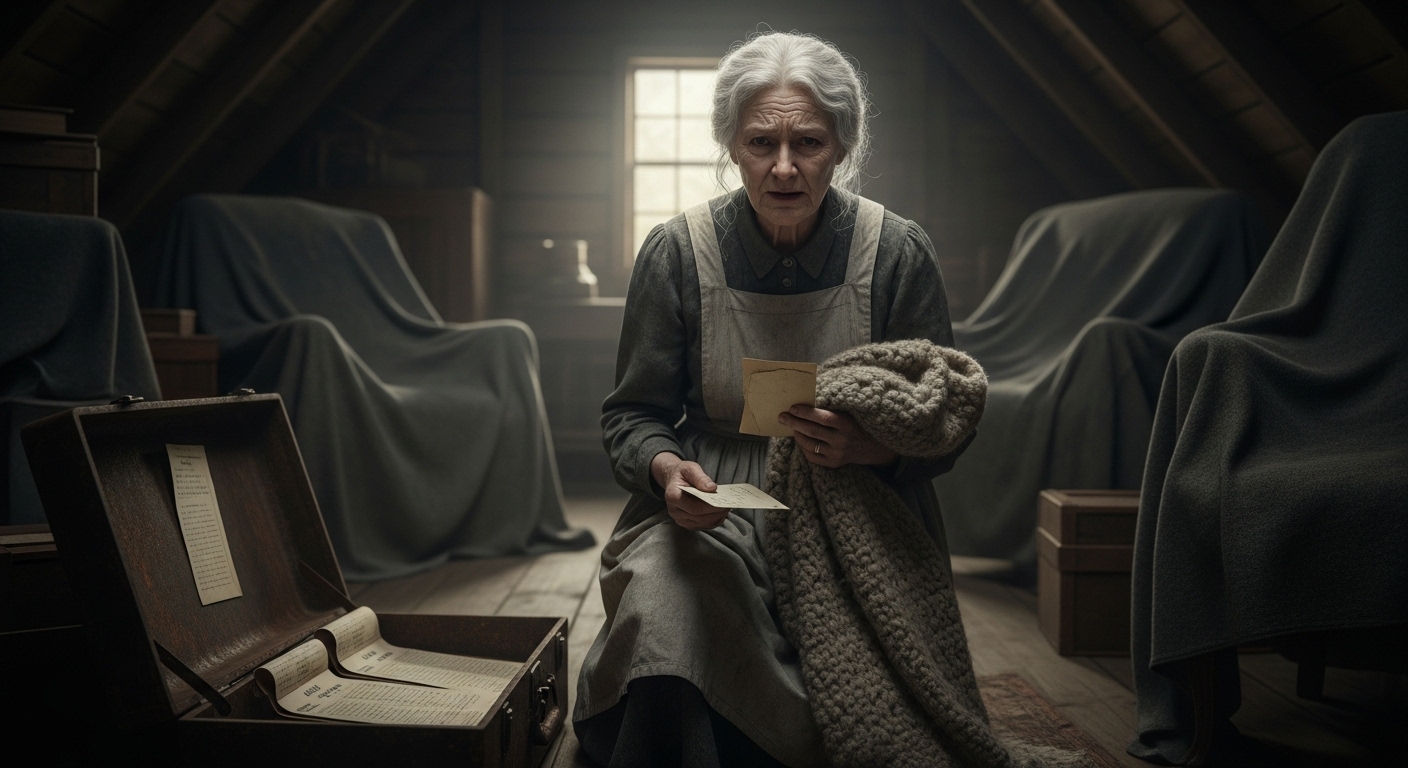
The attic was a cavern of shadows, illuminated by slivers of sunlight piercing through the slate roof. It wasn’t full of bats. It was full of history. Furniture covered in white sheets looked like ghosts standing in formation. There were boxes of china, old portraits of ancestors who frowned at me, and racks of moth-eaten coats.
I worked for hours, sorting through the debris of a dynasty. It was near sunset when I pushed aside a heavy, rolled-up Persian rug in the far corner.
Behind it sat a trunk.
It wasn’t like the other elegant steamer trunks labeled with travel stickers from Paris and London. This was ugly—black iron, rusted at the hinges, heavy and brutish. A thick padlock secured it.
I frowned. I knew where Evelyn kept her keys—in a porcelain bowl on her vanity. I went downstairs, retrieved the heavy brass ring, and returned. I tried every key. The small silver one, usually reserved for her jewelry box, didn’t fit. Finally, a jagged, tarnished key I didn’t recognize slid into the lock. With a groan of protest, the mechanism clicked.
I threw back the heavy lid.
I expected silver. I expected perhaps the “missing” jewelry Evelyn claimed the maids had stolen over the years.
Instead, the trunk was nearly empty.
Inside lay three things: A folded baby blanket made of rough, scratchy wool; a hospital admission ledger; and a single, yellowed envelope.
The envelope was addressed to Mrs. Evelyn Vanderwood, postmarked June 12, 1955. The return address made my breath hitch in my throat.
Greystone Psychiatric Hospital.
My hands trembled as I picked it up. I knew of Greystone. It was the bogeyman of our childhoods. A place where the unwanted were sent to be forgotten. And I knew, vaguely, that Evelyn had a sister. Rose.
“Your Aunt Rose was deranged,” Evelyn had told me once, cutting her steak with surgical precision. “Violent. Dangerous. She died in an institution years ago. We do not speak of her. It is a mercy she is gone.”
I slid the letter out. The handwriting was erratic, deeply indented into the paper, as if written in a hurry or in great distress.
I began to read, and with every word, the ground beneath my feet began to crumble.
Chapter 2: The Bargain of Blood
June 10, 1955
Evelyn,
I have signed the papers. I have admitted to the hallucinations I do not have. I have told the doctors that the voices tell me to hurt myself, just as you scripted for me. I will let them lock me in this hell, and I will never speak the truth to a soul.
But you must keep your end of the bargain. You sworn it on Mother’s bible.
You cannot have children. The doctors told you your womb is barren. I have a child I cannot feed, a child born of a love you call “filthy” but was the only pure thing in this miserable world. Take my baby. Take my little Martha. Raise her as a Vanderwood. Give her the silk dresses, the education, the safety that I can never provide as an unwed mother in this town.
I will rot in here, Evelyn. I will take your pills and sit in the dark. But if you hurt her—if I find out, even from behind these padded walls, that you have treated her with the coldness you showed me—I will find a way to kill you. I will claw through these stone walls to get to her.
Goodbye, my sweet baby girl. If you ever read this, know that I didn’t give you up because I didn’t want you. I gave you up so you wouldn’t starve.
Your sister, Rose
I dropped the letter. It fluttered to the dusty floorboards like a dying moth.
The silence in the attic was deafening. My heart hammered against my ribs, a frantic bird trapped in a cage.
Take my little Martha.
I wasn’t Evelyn’s daughter.
The room spun. I grabbed the edge of the trunk to steady myself. Every memory of my childhood flashed before me, recontextualized in an instant.
The lack of photos of Evelyn pregnant. The way she looked at me not with love, but with ownership—like I was an expensive vase she had acquired. The constant criticism. It wasn’t just perfectionism; it was resentment. I was the daughter of the sister she hated. I was the living reminder of her own infertility.
“Oh my God,” I whispered, my voice cracking. Tears, hot and angry, blurred my vision.
I reached back into the trunk and pulled out the ledger. It wasn’t a hospital ledger; it was a personal accounting book of Evelyn’s. I flipped through the pages, the dates matching the years of my life.
1960: Renovation of the South Wing – $15,000. (Source: Rose Trust) 1965: Purchase of Sapphire Brooch – $4,000. (Source: Rose Trust) 1970: Country Club Life Membership – $10,000. (Source: Rose Trust)
My biological mother, Rose, hadn’t just been sacrificed; she had been robbed. Evelyn had declared Rose mentally incompetent, committed her to an asylum, and then assumed control of Rose’s inheritance—an inheritance she used to renovate this very house, to buy the clothes she wore, to build the reputation of the “Saint of Savannah.”
I scrambled for the medical file at the bottom of the trunk. It was a copy of Rose’s patient file, likely stolen or bribed out of the hospital administrators by Evelyn to keep tabs on her prisoner.
I scanned the dates. Evelyn had told me Rose died in 1965.
Entry: August 14, 1985. Patient stable but catatonic. Sedation continues. Entry: March 3, 1998. Patient requests to see daughter. Request denied per Guardian (E. Vanderwood). Entry: November 12, 2019. Patient deceased. Cause: Pneumonia. Buried in State Plot 404.
Rose didn’t die fifty years ago. She died five years ago.
While I was sitting in this house, listening to Evelyn complain about the tea being too lukewarm, my mother—my real mother—was alive. She was rotting in a state ward less than two hours away.
I screamed.
It wasn’t a ladylike sound. It was a guttural, animalistic roar of pure agony. I grabbed a porcelain figurine from a nearby box—a shepherdess Evelyn had always loved—and hurled it against the brick chimney. It shattered into a thousand pieces.
I destroyed the box of china. I ripped the sheets off the furniture. I raged against the dust and the lies. Evelyn had stolen my life. She had stolen my mother. And she had let Rose die alone, nameless, while she played the role of the benevolent widow.
I sat amidst the broken porcelain, clutching the rough wool baby blanket to my chest. It smelled faintly of mildew, but I pressed my face into it, imagining—hoping—that somewhere in the fibers, a molecule of Rose’s scent remained.
I remembered something then. A fragment of a dream I thought I’d invented. A smell of lavender. A soft voice singing, “Hush little baby, don’t you cry…”
It wasn’t a dream. It was her. It was Rose.
I stood up. The timid, sixty-eight-year-old spinster who was afraid of her own shadow had died in that attic. The woman who walked down the stairs was someone else entirely. I was a Vanderwood by name, but I had Rose’s blood in my veins. And Rose had promised she would claw through stone walls for me.
Now, I would do the same for her.
Chapter 3: The Numbered Grave
The next morning, I didn’t dress in the black mourning clothes the town expected. I put on a red blouse. Evelyn hated red. She said it was “vulgar.”
I got into Evelyn’s pristine Lincoln Town Car and drove. I drove out of the manicured streets of Savannah, past the weeping willows, onto the highway that cut through the rural heart of Georgia.
Greystone was a ruin now, mostly shut down, but the state cemetery was still there, maintained by a skeleton crew of groundskeepers. The air was thicker here, buzzing with gnats.
I found the administration building, a small brick structure near the gates. A bored-looking clerk looked up from his computer.
“I’m looking for a grave,” I said, my voice steady. “Plot 404. Buried in 2019.”
He typed slowly. “Name?”
“She… she might not have a name on the marker. But her name was Rose.”
He printed out a map. “Section D. It’s the pauper’s field, ma’am. Just metal markers. Grass is a bit high.”
I walked to Section D. It was a far cry from the Vanderwood family plot with its marble angels and manicured hedges. This was a field of uneven earth, dotted with small, rusted metal placards.
I counted the numbers. 400… 402… 403…
There it was. A rectangle of dirt. A metal stake with the number 404 stamped on it. No name. No dates. No “Beloved Mother.”
I fell to my knees in the dirt, disregarding my slacks.
“I’m here,” I whispered.
I placed my hand on the warm earth. “I didn’t know, Mama. I didn’t know.”
I wept for the years lost. I wept for the woman who sat in a windowless room for decades, holding onto the hope that her sacrifice gave me a good life. And what a life it was—a life of servitude to the woman who jailed her.
Evelyn had won. She had lived a long, celebrated life and died peacefully in her sleep. She had gotten away with it.
No, I thought, wiping the mud from my hands. Not yet.
Tomorrow was the town’s memorial service for Evelyn. The Mayor was coming. The Historical Society was unveiling a plaque in her honor. They wanted me to speak. They wanted the daughter to eulogize the saint.
I stood up. I looked at the rusted marker one last time.
“I’m coming back for you,” I promised Rose. “I’m going to take you out of here. But first, I have to burn the witch.”
I drove home with a clarity I had never possessed. I went back to the attic. I took the letter, the ledger, and the medical records. I went to the local copy shop and made twenty copies of everything.
Then, I went to Evelyn’s closet. I found her favorite pearl necklace—the one she claimed was a family heirloom but the ledger showed was bought with Rose’s money. I put it on. It felt heavy, like a noose.
Chapter 4: The Unveiling
The First Baptist Church was packed to the rafters. The air conditioner struggled against the body heat of three hundred people. The scent of lilies was overpowering.
I sat in the front pew, clutching my purse. Inside it was the letter.
The Mayor spoke first, droning on about Evelyn’s charitable contributions (paid for, I now knew, by Rose). Then the head of the Garden Club. Finally, the pastor gestured to me.
“And now, we invite Martha Vanderwood, Evelyn’s devoted daughter, to share a few words.”
I stood up. My legs felt like lead, but my spine was steel. I walked to the pulpit. I looked out at the sea of faces—the people who had judged me for being “odd” all my life, the people who worshiped Evelyn.
I adjusted the microphone.
“My mother,” I began, my voice projecting clearly, “was a woman of secrets.”
A few people nodded politely.
“Everyone here knows Evelyn Vanderwood as a philanthropist. A pillar of virtue. A devoted mother.” I paused. “But none of you knew the cost of that virtue.”
I reached into my purse and pulled out the yellowed envelope.
“This is a letter,” I said. “It was written in 1955. By Evelyn’s sister, Rose.”
A ripple of confusion went through the crowd. The older folks exchanged glances. They remembered the rumors of “Crazy Rose.”
“Evelyn told you all that Rose was insane. That she died in an institution in the sixties.” I held up the medical record. “This is a death certificate. Rose died five years ago. In a state ward. Alone.”
The church went silent. Absolutely silent.
“And this,” I said, opening the ledger, “is Evelyn’s financial book. It details how she took control of Rose’s inheritance—money that should have cared for her sister—and used it to buy the chandeliers you see in her foyer. To buy the pews we are sitting in right now.”
Gasps erupted. The Mayor looked uncomfortable.
“But the greatest theft wasn’t the money,” I said, looking directly at the large portrait of Evelyn on the easel next to the casket. “It was me.”
I opened the letter and read it. I read every word of Rose’s desperate plea. I read the part about the bargain. Take my baby. Raise Martha as a Vanderwood.
When I finished, I looked up. There were tears in the eyes of the strangers in the back. The front row, Evelyn’s inner circle, looked pale, as if they had seen a ghost.
“I am not Evelyn Vanderwood’s daughter,” I declared, my voice ringing off the vaulted ceiling. “I was a prop. A cover-up for her infertility. A servant she raised to polish her silver and nurse her in her old age. She treated me with contempt because every time she looked at me, she saw the sister she betrayed.”
I took off the pearl necklace.
“These pearls were bought with my mother Rose’s money.”
I dropped the necklace onto the wooden floor. The sound of the pearls hitting the wood was like a gunshot.
“Evelyn Vanderwood was no saint,” I said. “She was a monster in silk. And today, her legacy ends. I am Martha, daughter of Rose. And I am going to take my mother home.”
I walked off the stage. I didn’t go back to my seat. I walked straight down the center aisle.
No one stopped me. No one said a word. They parted like the Red Sea, staring at me with a mixture of horror and awe.
I pushed open the heavy oak doors of the church and stepped out into the blinding sunlight. The humidity hit me, but for the first time in sixty-eight years, I didn’t feel the weight of it. I felt light.
Chapter 5: The Cherry Tree
It took six months to navigate the legal red tape, but the letter and the ledger were powerful evidence. I sold the Vanderwood estate. I couldn’t spend another night in that mausoleum of lies.
I sold the antique furniture, the silver, the china. I sold it all to the very people who had sat in that church. They bought it out of morbid curiosity, I suppose. I didn’t care. The money was dirty, but I was going to use it for something clean.
I bought a small cottage on the outskirts of town, one with a wraparound porch and a view of the marsh. It was small, cozy, and messy—everything Evelyn hated.
But the most important thing I did was the exhumation.
On a crisp November morning, a hearse carried a simple pine casket from the state cemetery to a small, private graveyard near my new home.
I had chosen a spot under a sprawling cherry tree.
The priest was kind. There were no crowds this time. No mayor. No society ladies. Just me, the funeral director, and the wind in the branches.
We lowered Rose into the ground.
I had commissioned a headstone. It was pink granite, warm and soft.
ROSE 1935 – 2019 A Mother who gave everything. Beloved by her daughter.
I placed a bouquet of fresh lavender on the fresh dirt.
I sat on the stone bench I had placed nearby. I was sixty-nine years old now. My hair was white, my hands arthritis-ridden. I had lost a lifetime to a lie. I could have been bitter. I could have spent my remaining years cursing Evelyn’s name.
But as I sat there, watching the cherry blossom leaves drift down, I felt a strange sensation. It was a warmth, wrapping around my shoulders, distinct from the autumn sun.
I closed my eyes and inhaled. The scent of the turning earth was there, but underneath it, faint but undeniable, was the smell of lavender.
“I’m here, Mama,” I whispered. “We’re both free.”
I wasn’t the disappointment anymore. I wasn’t the “slow” daughter of the Vanderwood dynasty. I was Martha. And for the first time in my life, I knew exactly who I was.