I WAS DROWNING IN DEBT AND READY TO CLOSE MY GRANDMOTHER’S DINER FOREVER WHEN A LETHAL BLIZZARD TRAPPED ME INSIDE WITH TWELVE INTIMIDATING STRANGERS WHO LOOKED LIKE THEY HAD NOTHING TO LOSE, BUT WHAT HAPPENED OVER THE NEXT 72 HOURS OF ISOLATION DIDN’T JUST SAVE MY BUSINESS—IT RESTORED MY FAITH IN HUMANITY AND REVEALED A SECRET THAT CHANGED OUR SMALL TOWN HISTORY.
PART 1: THE WHITE WOLF AT THE DOOR
The bank notice was sitting on the counter, right next to the stale pot of coffee. It was pink—a cheerful color for a death sentence. Final Notice. Two words that felt heavier than the three feet of snow currently drifting against the north wall of “Millie’s Mile-Marker Diner.”
I looked around the place. It was a time capsule. The red vinyl booths were cracked, patched with duct tape that was peeling at the edges. The neon sign in the window buzzed with an annoying, intermittent fzzzt sound. This place had been my grandmother’s pride, the heart of Bennett’s Creek, Montana. Now, it was just a sinking ship, and I was the captain going down with it.
The weatherman on the crackling AM radio was screaming about a “Bomb Cyclone.” They were calling it the storm of the decade. A total whiteout. 60 mph winds. Temperatures dropping to twenty below zero.
“Smart folks are staying home,” I muttered to myself, flipping the sign on the door to CLOSED. It was 4:00 PM, but the sky was already pitch black, swallowed by a swirling, angry void of white.
My plan was simple: Lock up, drive the three miles home in my beat-up Ford before the roads became impassable, and spend the night figuring out how to tell my staff they didn’t have jobs come Monday.
I grabbed my keys and reached for the light switch.
That’s when I saw the lights.
It started as a faint glow cutting through the blinding snow—yellow, hazy beams that looked like eyes in the dark. Then came the rumble. A low, guttural vibration that shook the floorboards beneath my feet.
One by one, they emerged from the white curtain. Big rigs. Eighteen-wheelers. Not just one or two, but a convoy. They pulled onto the gravel shoulder, their air brakes hissing like angry snakes. The snow was coming down so hard I could barely see the outline of the cabs, but I counted twelve of them before the line disappeared into the darkness.
My heart hammered against my ribs. The interstate was five miles away. They must have been diverted, or the highway was already shut down.
I stood frozen behind the counter. A lone woman, twenty-eight years old, in a diner in the middle of nowhere, facing a convoy of twelve massive trucks in a blizzard.
A figure detached itself from the lead truck. He was huge. Even through the swirling snow, I could see the bulk of him. He wore a heavy Carhartt jacket that looked stained with grease, and a hat pulled low. He marched toward the diner, fighting the wind, sinking knee-deep into the drifts.
Thud. Thud. Thud.
The knock on the glass door shook the frame.
I hesitated. The “CLOSED” sign was staring right at him.
He knocked again, harder. I saw his face pressed against the glass. A thick, gray-streaked beard, eyes red-rimmed with exhaustion, ice clinging to his eyebrows. He didn’t look like a customer. He looked desperate.
My grandmother’s voice echoed in my head: “When in doubt, feed them, Sarah. Hunger makes monsters of men, but a hot meal brings them back to God.”
I unlocked the deadbolt. The wind ripped the door from my hand, slamming it against the wall and blowing snow halfway across the linoleum floor.
“Ma’am,” the man rasped. His voice sounded like gravel in a blender. “We’re dying out here. Highway patrol shut down I-90. We can’t idle the trucks all night, we’ll run out of fuel, and if we turn ’em off, we freeze.”
He looked past me at the dark coffee pot.
“We got twelve guys,” he said. “We don’t need fancy. Just warmth. And coffee. Please.”
I looked at him. Really looked at him. Beneath the grit and the size, he was shaking. Not just from cold, but from the sheer stress of hauling eighty thousand pounds on ice.
“Get them inside,” I said, my voice steadier than I felt. “Lock the door behind the last one.”
PART 2: THE SIEGE
They filed in like a defeated army. Twelve men. They smelled of diesel, cold air, and stale tobacco. They were big men—rough hands, scarred knuckles, faces weathered by wind and sun.
The diner, usually empty these days, suddenly felt very small.
“I’m Sarah,” I announced, tying my apron back on. “And here are the rules. One: Wipe your boots. I don’t want a lake on my floor. Two: No cussing. This was my grandma’s place. Three: I’m one cook. You wait your turn.”
The big leader—the one who knocked—cracked a smile. It transformed his face from scary to grandfatherly. “Yes, ma’am. I’m Mike. That’s ‘Tiny’ over there”—he pointed to a guy who was easily 6’5″—”and the kid shivering by the jukebox is Rookie. It’s his first winter run.”
I went to work.
I fired up the flat top grill. The smell of sizzling bacon and onions began to combat the smell of diesel. I brewed pot after pot of coffee. I raided the pantry. I mixed pancake batter in a five-gallon bucket.
For the first two hours, it was chaos. I was flipping burgers, scrambling eggs, and pouring coffee like a machine. But then, the supplies started to dwindle.
“That’s the last of the bacon,” I called out around 7:00 PM. “And we’re out of bread.”
The wind outside was howling like a banshee now, rattling the plate glass windows. The lights flickered once. Twice.
“Power’s gonna go,” Tiny said, looking up at the ceiling. “Those lines are heavy with ice.”
As if on cue, the diner plunged into darkness.
A collective groan went up. The only light came from the red embers of the gas grill and the headlights of the trucks outside. The heating system clunked and died.
Silence fell over the room. The temperature dropped instantly.
“Well,” Mike said in the dark. “That’s a problem.”
I felt a rising panic. “I don’t have a generator,” I whispered. “The pipes will freeze. If the pipes freeze, they burst. If they burst… the repair costs…” I trailed off. The bank notice was still on the counter, invisible in the dark.
“Don’t you worry, Sarah,” a voice came from the corner. It was the Rookie. “Mikey, isn’t your reefer unit running a separate gen-set?”
“Damn right,” Mike said. He stood up, his silhouette massive against the window. “Boys, we got tools. We got parts. We ain’t letting this lady’s place turn into an icebox.”
What happened next was something I’ll never forget.
These men, exhausted and hungry, didn’t just sit there. They mobilized.
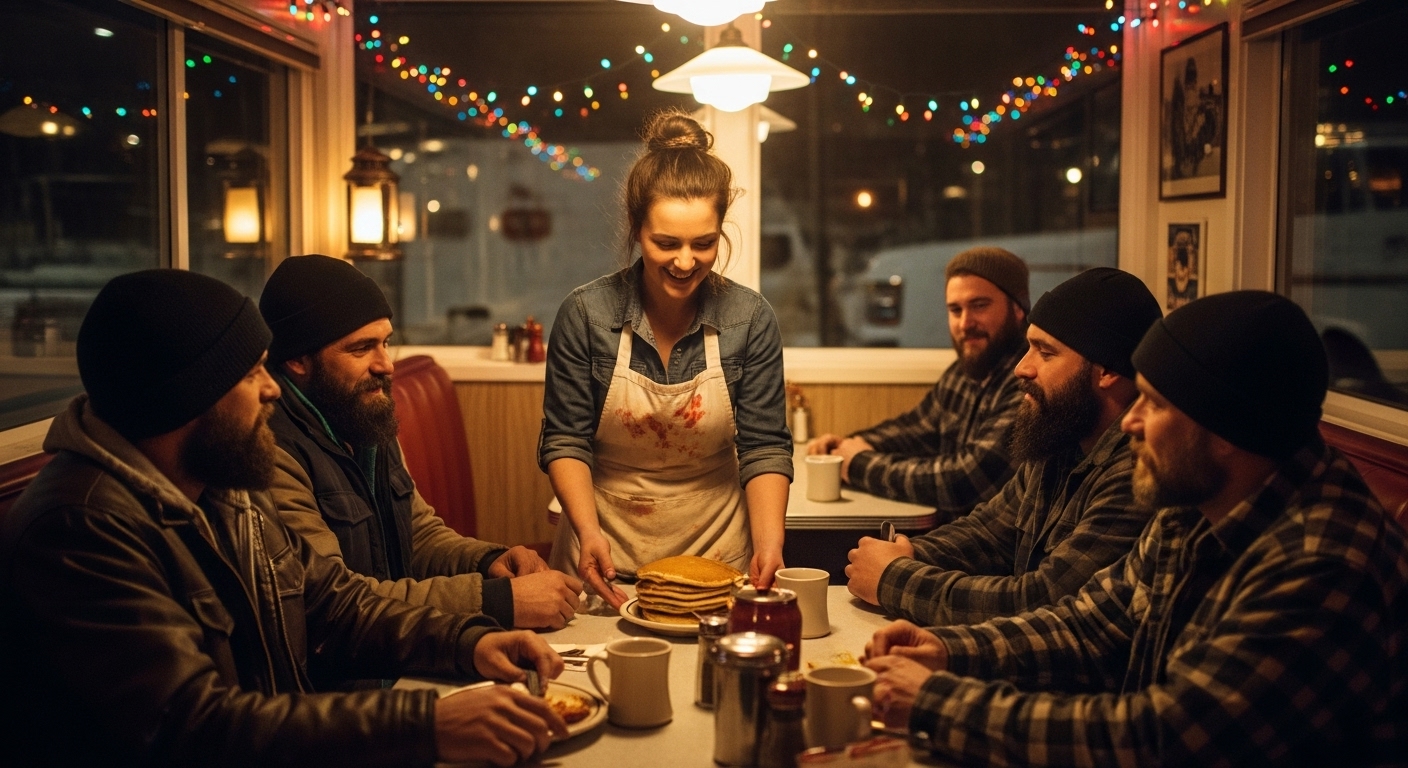
Mike and Tiny went out into the screaming storm. They jury-rigged a cable from one of the refrigerated trailers, running it through the back door of the diner. Within twenty minutes, a single string of Christmas lights I kept up year-round flickered to life, and the blower on the furnace kicked back on.
Another guy, a mechanic named ‘Grease’, went into the back and fixed the leaky faucet I hadn’t been able to afford a plumber for. “Was driving me nuts,” he grunted.
They brought in sleeping bags from their cabs. We pushed the booths together to make a fort.
That night, the diner wasn’t a business. It was a lifeboat.
We sat around the glow of the Christmas lights, drinking the last of the coffee. And they talked.
They didn’t talk about sports or politics. They talked about what they were missing.
“My little girl turns six tomorrow,” Tiny said, staring into his mug. “I got a dollhouse in the sleeper berth. She thinks Daddy’s magic. I guess Daddy’s just stuck in Montana.”
“My wife’s got chemo on Thursday,” another man said softly. “I just need to get this load to Seattle so I can pay the deductible.”
I listened to them. I realized that while I saw twelve intimidating strangers, the world saw essential workers. Invisible men who kept the country running, sacrificing their own families to bring us ours.
I told them about the bank notice. I don’t know why. Maybe it was the exhaustion. I told them about Grandma Millie, about how I failed her.
“You didn’t fail,” Mike said, looking me dead in the eye. “You opened the door. Most folks would have turned off the lights and hid. You’re a hauler, Sarah. You just haul hope instead of freight.”
PART 3: THE DEPARTURE AND THE MIRACLE
The storm raged for 36 hours.
We rationed the food. By day two, we were making “stone soup”—a stew made of canned beans, frozen corn, and some venison jerky one of the guys had in his truck. It was the best meal I ever ate.
We played cards. We told jokes. Rookie fixed the hinge on the front door.
On the morning of the third day, the sun broke through. It was blindingly bright. The silence was deafening.
The plows came through around noon, throwing arcs of snow like diamonds.
The mood in the diner shifted instantly. They were back on the clock. The brotherhood of the storm was over; the road was calling.
They packed up their gear. They put the booths back.
Mike walked up to the counter. He pulled out a wallet that looked like it had survived a war.
“How much?” he asked.
“On the house,” I said. “You fixed my heat. You fixed my door. We’re even.”
He shook his head. “No, we ain’t.”
He slapped a hundred-dollar bill on the counter. Then Tiny did the same. Then Rookie.
“Take it,” Mike said. “For the next guy who gets stuck.”
I watched them leave. I stood in the doorway, shivering in the crisp air, waving as twelve air horns blasted a salute. The convoy rolled out, a serpentine beast returning to the wild.
I went back inside. The diner was empty. The silence was heavy. I looked at the stack of cash on the counter—$1,200. It was enough to pay the electric bill, maybe make a dent in the mortgage. But it wasn’t enough to save me.
I sat down and cried. Not out of sadness, but out of the sheer emotional release of it all.
Then, the phone rang.
“Is this Millie’s Diner?” a sharp female voice asked.
“Yes,” I croaked.
“This is Karen from the Billings Gazette. I’m looking at a photo on Facebook that’s been shared about fifty thousand times in the last three hours. Did you shelter the ‘Dirty Dozen’?”
“The who?”
“The truckers. One of them, the young kid, he posted a picture of you cooking pancakes by flashlight. He wrote a caption. It’s… well, you need to see it.”
I hung up and opened my laptop.
There it was. A grainy photo of me, hair messy, apron stained, flipping pancakes under the glow of Christmas lights.
The caption read: “We were 12 strangers about to freeze to death in the Montana dark. She was one woman with a mountain of debt and a heart of gold. She didn’t ask for ID. She didn’t ask for money. She just asked if we were hungry. If you’re ever on Hwy 90, stop at Millie’s. She saved us. Let’s save her.”
EPILOGUE: THE AFTERSHOCK
The next day, a line formed. Not trucks. Cars.
People from town who hadn’t eaten here in years. People from the next county.
“I saw the post,” a woman said, ordering a coffee she didn’t really need. “I wanted to meet the Angel of the Highway.”
The GoFundMe page that Rookie set up hit $50,000 in two days. The debt was gone.
But that wasn’t the best part.
Two weeks later, a package arrived. No return address.
Inside was a dollhouse. A beautiful, hand-carved wooden diner, painted red, with a tiny sign that said Millie’s.
A note was attached: My daughter loved the dollhouse I brought her. But she said you needed one too, so you’d remember that you have family on the road. See you on the return trip. – Tiny.
I keep that dollhouse on the counter, right next to the register.
I still run the diner. The duct tape is gone, replaced by new upholstery. The neon sign is fixed. But I kept the Christmas lights up.
They remind me that even in the darkest, coldest storms, when you think you have nothing left to give, opening your door can let the whole world in.
My grandma was right. Feed the people. The rest takes care of itself.