I stood in the freezing rain outside a Motel 6 in Ohio with three dollars in my pocket and my seven-year-old sister gripping my hand so hard her knuckles turned white, watching the only life we knew get tossed into a dumpster by a landlord who didn’t care that our parents hadn’t come back in three weeks, and just when I thought the darkness was going to swallow us whole, she looked up at me with eyes way too old for her face and whispered the sentence that broke me and saved me all at once: “If nobody takes care of us, we take care of each other.”
PART 1: THE EVICTION
The banging on the door didn’t sound like a knock. It sounded like an ending.
It was 6:00 AM in early November, the kind of Ohio morning where the cold doesn’t just sit on your skin—it hunts for your bones. I was already awake, sitting on the edge of the stained mattress, staring at the particle-board door of trailer number 42. I had been staring at it for three hours, waiting for this exact sound.
“Open up! Miller! I know you’re in there!”

It was Henderson. The landlord. A man who smelled perpetually of stale cigar smoke and cheap aftershave, a man who had zero patience for “sob stories,” as he called them.
I looked over at Lily. She was curled up in a ball under the thin quilt, her blonde hair a tangled mess on the pillow. She didn’t move. She didn’t even flinch. At seven years old, she had already learned the most tragic skill a child can learn: how to be invisible when things get loud.
“Just a minute!” I yelled back, my voice cracking. I was twenty-two, but in that moment, I felt about six.
I grabbed my backpack. It was already packed. It had been packed for a week. Two changes of clothes for me, three for Lily. A flashlight. A box of granola bars I’d shoplifted from the Rite Aid on 3rd Street. A toothbrush. And the envelope—the empty envelope where Mom used to keep the rent money before the pills started eating it all.
I went over to Lily and shook her shoulder gently. “Lil, wake up. We gotta go. Like, right now.”
Her eyes snapped open. No grogginess. No “five more minutes.” Just instant, terrifying alertness. Blue eyes, wide and scanning the room. She knew the drill. We’d done this before.
“Is it Mom?” she whispered.
“No,” I said, grabbing her pink puffer coat—the one that was a size too small, leaving her wrists exposed to the air. “It’s Henderson. We have to move.”
“Did Mom come back?”
I paused, just for a second, fighting the urge to punch the wall. Mom hadn’t come back. Mom had gone out for “cigarettes” three weeks ago and the only trace we had of her was a missed call from a blocked number four days later. Dad had been gone since Lily was in diapers.
“No, Lil. She didn’t. Grab your shoes.”
The pounding got louder. The doorframe shook. “I’m using the key, Miller! If you ain’t out, I’m throwing you out!”
I shoved Lily’s feet into her sneakers, not bothering with the laces. I grabbed her hand. It was cold. Clammy.
The lock tumbled. The door swung open, letting in a blast of grey, freezing wind and the towering silhouette of Henderson. behind him, two guys I didn’t know—big guys, wearing work gloves.
“Time’s up, kid,” Henderson grunted. He didn’t look me in the eye. He looked past me, at the TV, assessing its value. “Three weeks late. I told you. No cash, no crash.”
“We just need one more day,” I pleaded, though I knew it was useless. I stepped in front of Lily, blocking her from their view. “My paycheck from the warehouse hits tomorrow. I can give you—”
“You’re fired from the warehouse, kid. Bob told me you stopped showing up.”
“Because I can’t leave her alone!” I gestured behind me. “Whatever. Just… let us get our stuff.”
“You got what you can carry,” Henderson said, stepping inside. His boots left muddy streaks on the linoleum. “Everything else covers the cleaning fee and the back rent. Boys, clear it out.”
The two men stepped in. One of them grabbed the TV. The other grabbed the microwave.
“Wait!” Lily screamed. It was the first sound she’d made. She lunged forward, trying to grab a raggedy stuffed rabbit sitting on the counter. “Mr. Buns!”
“Leave it!” the man barked, shoving past her.
“Hey!” I shoved the man back. Hard. “Don’t touch her!”
The man turned, his face hardening. Henderson stepped between us. “Don’t do anything stupid, Alex. Just get out. Before I call the cops. And you know if the cops come, they’re calling CPS. You want that? You want them to take her?”
The threat hit me like a physical blow to the stomach. That was the trump card. That was the gun to my head. If Child Protective Services found us, they wouldn’t just find us a home. They’d separate us. I had a record—petty theft, shoplifting, stupid teenager stuff—but enough to make me “unfit.” They’d put Lily in a foster home, and I’d never see her again.
I looked at Henderson. I looked at the men ransacking the only shelter we had.
“Come on, Lil,” I whispered, my voice trembling with a rage I couldn’t let out.
I grabbed the stuffed rabbit from the counter before the man could stop me, shoved it into Lily’s chest, and pulled her out the door.
We walked out into the rain. It wasn’t a heavy rain; it was that misty, freezing drizzle that soaks you to the skin in seconds. The sky was the color of a bruise. We walked past the other trailers, past the curious eyes peering through blinds. No one came out to help. In the trailer park, you mind your own business, because usually, business is bad.
We walked to the edge of the highway. I checked my pockets. Three dollars and forty-two cents. No car—I’d sold the beat-up Honda two weeks ago to buy food.
“Where are we going, Alex?” Lily asked. She was clutching Mr. Buns so tight the stitching looked like it was about to pop.
I looked down at the highway, cars zooming past, people going to jobs, going to warm houses, going to lives that made sense.
“We’re going on an adventure,” I lied. It was a pathetic lie.
“To the diner?” she asked hopefully.
“Maybe later,” I said. “First, we gotta find a… a base camp.”
We walked for three miles. The cold started to hurt. My fingers were numb. Lily’s teeth were chattering, a rhythmic clicking sound that tore my heart out. We reached the downtown area of the small rusted-out town. Storefronts were boarded up. The library was closed for renovations.
We ended up under the concrete awning of an abandoned gas station. It was dry, at least. I sat down on the curb and pulled Lily into my lap, wrapping my denim jacket around her pink puffer coat.
“I’m hungry,” she whispered.
“I know,” I said. I opened the backpack and handed her a granola bar. “Eat this. Slow.”
She tore into it. I watched her eat, my own stomach cramping with hunger. I hadn’t eaten since yesterday morning.
“Aren’t you eating?” she asked, offering me a piece.
“I’m not hungry,” I said. “I ate a huge breakfast while you were sleeping. Eggs, bacon, the works.”
She looked at me skeptically, but she ate the piece.
The sun started to go down. The temperature dropped. The streetlights flickered on, buzzing like angry hornets. I realized then that we had nowhere to go. The homeless shelter was three towns over, and they wouldn’t take a single male with a minor unless I had legal guardianship papers, which I didn’t officially have because Mom never signed them. If I went there, they’d call the cops.
We were trapped.
A police cruiser rolled slowly past the gas station. I held my breath, pulling Lily’s head down into my chest. The cruiser paused. The brake lights flooded the pavement with red. My heart hammered against my ribs like a trapped bird. Please, don’t stop. Please, don’t see us.
The cruiser moved on.
I let out a breath that puffed white in the air.
“Alex?”
“Yeah, Lil?”
“Is Mom dead?”
The question hung in the cold air, heavier than the rain.
“I don’t know, Lil.”
“If she is,” she said, her voice matter-of-fact, devoid of the tears I expected, “who’s going to take care of us?”
I looked down at her. Her face was dirty. There was a smear of chocolate from the granola bar on her cheek. She looked exhausted, cold, and small. So incredibly small against the backdrop of the decaying American town.
I opened my mouth to say something reassuring, something like “I will,” or “We’ll be fine,” but the words stuck in my throat. Because I didn’t know if I could. I was twenty-two, broke, homeless, and terrified. I was failing her. I was failing the one promise I made to myself.
I started to cry. I couldn’t help it. The stress, the cold, the hunger—it broke the dam. I put my head on her small shoulder and just sobbed, quiet, racking sobs that shook my whole body.
“I’m sorry, Lil,” I choked out. “I’m so sorry. I don’t know what to do. I don’t know where to go.”
I expected her to cry too. I expected her to panic.
But she didn’t.
PART 2: THE OATH
She pulled away from me slightly. Her small, cold hands reached up and cupped my face. Her skin was rough from the dry winter air. She forced me to look at her.
Her eyes weren’t scared anymore. They were fierce. It was a look I’d never seen on a child before. It was the look of someone who had seen the bottom of the well and decided not to drown.
She squeezed my cheeks.
“Don’t cry, Alex,” she said firmly.
Then, she said the words that would burn themselves into my soul forever.
“Con bé ôm chặt tay em, nói: ‘Không ai nuôi mình, thì mình nuôi nhau.'” (Translation: She hugged my arm tight, saying: ‘If no one feeds us, then we feed each other.’)
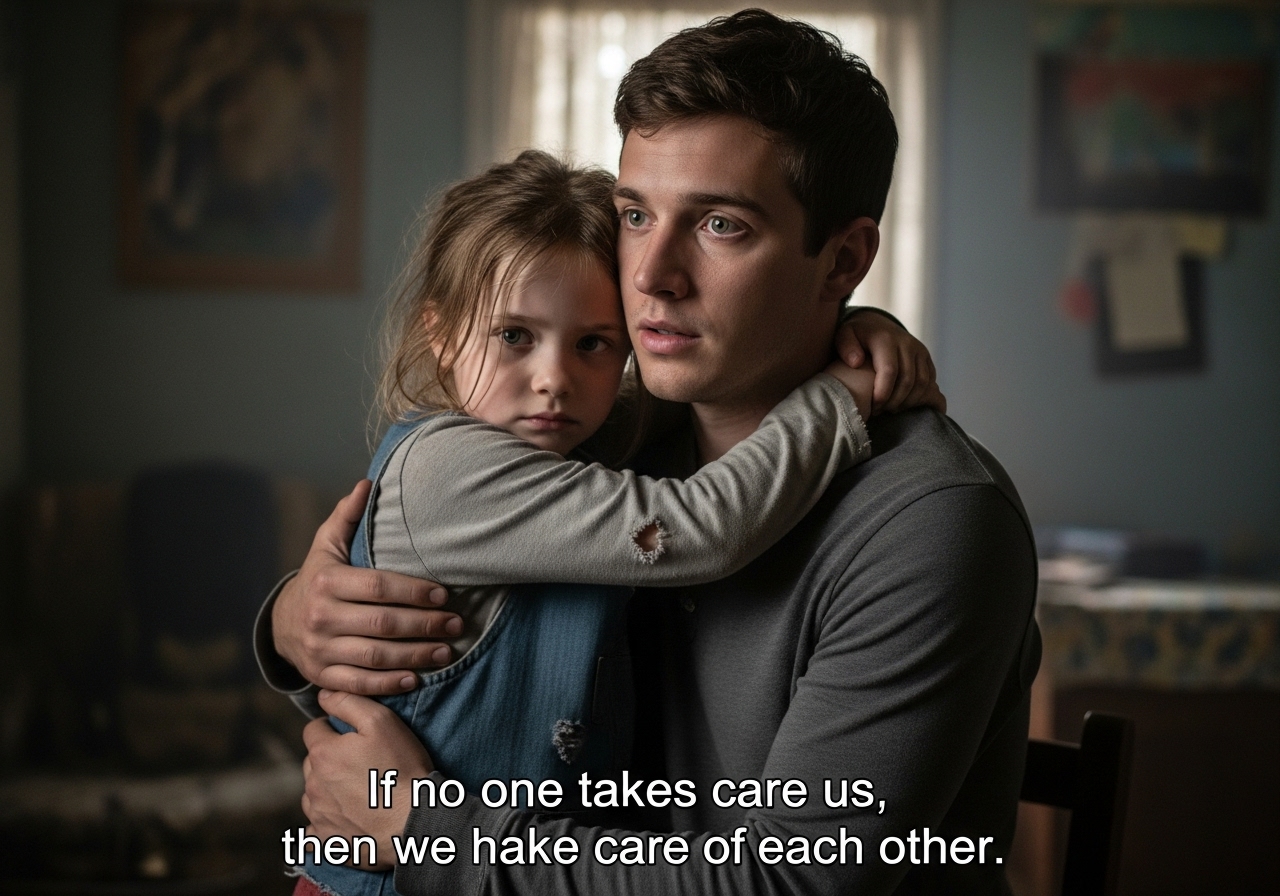
“If no one takes care of us,” she whispered in English, translating the sentiment of her fierce little heart, “then we take care of each other.”
She grabbed my hand—the one that was trembling—and squeezed it with surprising strength.
“You take care of me. I take care of you. We don’t need them. We don’t need Mom. We don’t need Henderson. We’re a team. Right?”
I stared at her. The fog in my brain cleared. The panic receded, replaced by a sudden, hot surge of adrenaline.
She was right.
I wiped my face with my sleeve. “Right,” I said. My voice sounded stronger. “We’re a team.”
“So,” she said, standing up and brushing the dirt off her jeans. “What does the team do now?”
I stood up. I looked around. I stopped seeing the threats and started seeing the opportunities. I stopped waiting for permission to survive.
“The team,” I said, “is going to find a warm place to sleep. Come on.”
We left the gas station. I remembered an old construction site near the river. They had been building luxury condos before the funding dried up. The skeletons of the buildings were there, but I knew—from my days of exploring as a teenager—that the basement levels were sealed and dry.
We hiked another mile. The wind whipped at us, but I didn’t feel it as much anymore. Lily’s hand was in mine, anchoring me to the earth.
We found the site. The fence was chain-link, topped with barbed wire.
“How do we get in?” Lily asked.
“Watch this.” I found the section of the fence I used to slip through in high school. The bottom was loose. I pulled it up. “Ladies first.”
She crawled under. I followed.
We navigated the muddy lot to the main structure. It was a concrete shell, dark and imposing. But inside, out of the wind, it was ten degrees warmer.
I used my flashlight to guide us down the concrete stairs. We went down two levels. The air here was still and smelled of wet dust, but it wasn’t freezing.
In the corner of the basement, there were stacks of insulation foam and leftover tarps.
“Jackpot,” I whispered.
We built a nest. We stacked the foam boards on the floor to block the cold concrete. We piled the tarps on top. It wasn’t a bed, but it was insulation.
We sat down on our makeshift mattress. I turned off the flashlight to save batteries. It was pitch black, the kind of darkness that feels heavy.
“Alex?”
“Yeah?”
“I’m scared of the dark.”
“I know.” I reached into my pocket and pulled out my phone. 12% battery. I turned on the screen. The dim light illuminated our faces.
“We’ll save the light for emergencies,” I said. “But I’m right here. I’m holding your hand. I’m not letting go.”
“Okay.”
We lay down. I wrapped my coat around both of us. She huddled into my chest, fitting perfectly against my ribs.
“Tell me a story,” she mumbled, sleep finally overtaking her adrenaline.
“What kind of story?”
“A story about us. In the future.”
I closed my eyes, imagining a future that felt a million miles away.
“Okay,” I began. “In the future… we live in a big house. Not a trailer. A house with bricks. And it has a fireplace that’s always burning. And the fridge… the fridge is never empty. It has milk, and juice, and those little cheese sticks you like.”
“The stringy ones?”
“Yeah, the stringy ones. Hundreds of them.”
She giggled softly. “And Mom?”
I hesitated. “No. Just us. And maybe a dog. A big dog that barks if anyone tries to mess with us.”
“I like that,” she whispered. Her breathing slowed. She was drifting off.
I lay there in the dark, listening to the wind howl outside the concrete walls. We were homeless. We were broke. We were alone in a world that wanted to chew us up and spit us out.
But as I felt the rhythmic rise and fall of her breathing against my chest, I realized something.
I wasn’t afraid anymore.
Because she was right. If the world wouldn’t feed us, we’d feed each other. If the world wouldn’t love us, we’d love each other.
I closed my eyes.
“Goodnight, partner,” I whispered into the darkness.
“Goodnight, Alex,” she murmured in her sleep.
The next morning, I woke up before her. I left her sleeping in the nest of insulation and walked to the nearest day labor center. I stood in line for three hours in the freezing cold. I got picked for a demolition job. I worked for ten hours straight, swinging a sledgehammer until my hands blistered and bled.
I made eighty dollars cash.
I bought a large pizza, a gallon of milk, and a new pair of gloves for Lily.
When I got back to the construction site, she was waiting for me, holding a jagged piece of metal she’d found.
“I was guarding the base,” she said seriously.
I smiled, dropping the pizza box on the tarp. “Mission accomplished, soldier. Dinner is served.”
We sat there on the dirty floor, eating pepperoni pizza that tasted like victory.
That was five years ago.
It wasn’t easy. We spent six months in that basement. We dodged CPS. We dodged the cops. I worked three jobs. I didn’t sleep for a year. There were nights we cried. There were nights we starved so the other could eat.
But we never let go.
Today, I’m writing this from the kitchen table of a small two-bedroom apartment. It’s not a mansion. But it has brick walls. And the fridge is full. Lily is twelve now. She’s in the living room, doing her homework. She’s on the honor roll.
She doesn’t remember much about the trailer park. But she remembers the motto.
Every time things get hard, every time I feel like I can’t pay a bill or I’m too tired to go on, she looks at me with those same fierce blue eyes and says:
“If no one takes care of us, we take care of each other.”
And we do. We always will.