He Visited His Daughter’s Grave Every Tuesday for a Year. He Thought He Was Alone, Until the Day His Wife Finally Showed Up… to Start a War.
Chapter 1: The Tuesday Ritual
Mark Jacoby checked his watch. 4:17 PM. He was late.
A bitter, familiar spike of self-loathing jabbed him in the gut. Late again, Mark. Even for this.
He turned his Ford F-150, a truck far too large for his suburban life, through the ornate black iron gates of Willow Creek Memorial Park. It was a Tuesday. It was always a Tuesday. For the past fifty-two weeks, Tuesday was the day the world had ended, and Tuesday was the day he came to visit the wreckage.

He parked under the drooping branches of a massive weeping willow, the park’s namesake. The spot was always empty. He grabbed the small bouquet of pink carnations—her favorite, or at least he thought they were—from the passenger seat. His hand, thick and calloused from a life spent managing construction sites instead of holding his family, fumbled with the cellophane.
The walk was always the hardest part. Past the imposing marble angels of the “Founders’ Circle,” past the rows of gray, identical headstones for veterans, and into the newer section, “Garden of Innocence,” reserved for… for this.
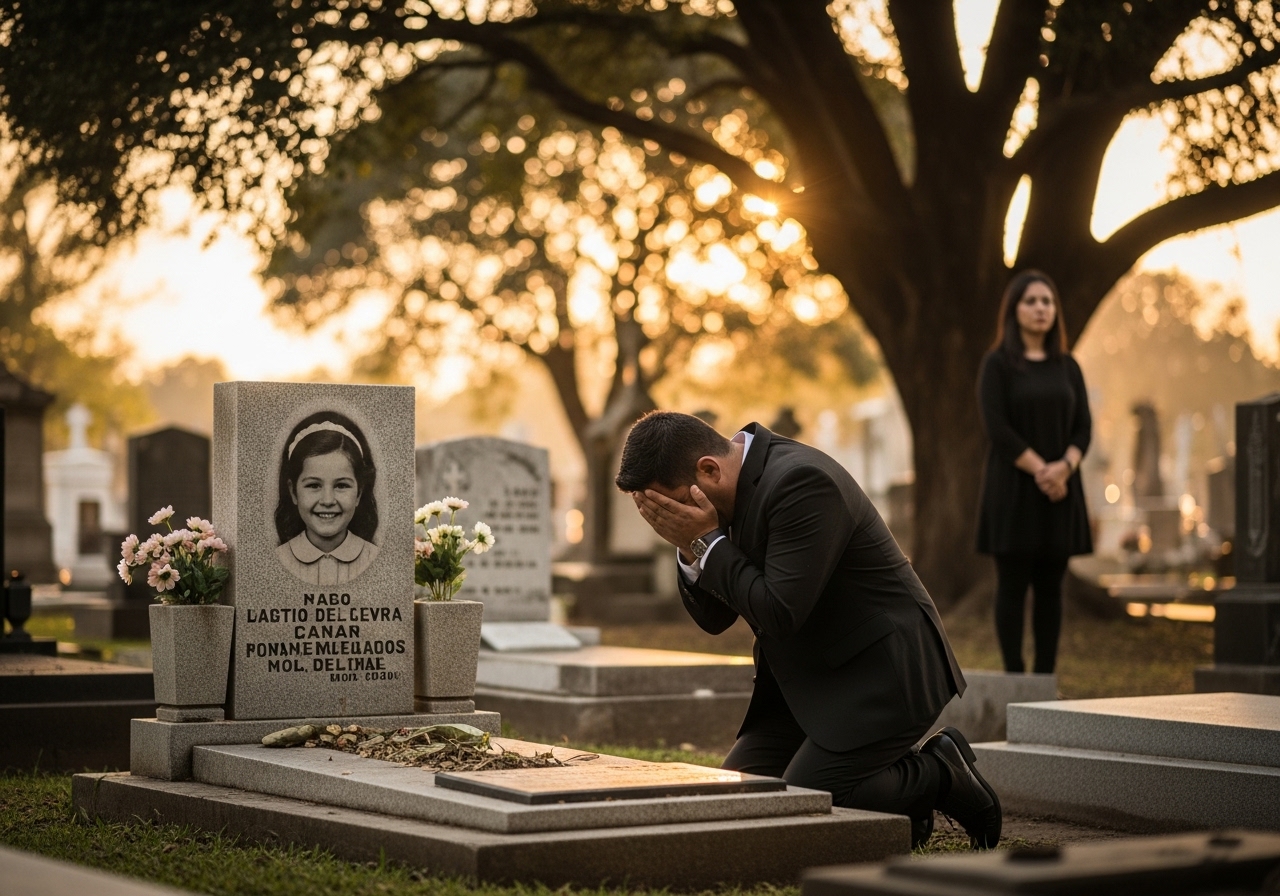
He saw the stone from fifty yards away. It was small, polished white marble, and it looked painfully out of place, like a single baby tooth in a row of adult molars.
LILY ANNE JACOBY April 10, 2017 – June 4, 2023 Our Little Light
Mark, forty-four years old, a man who could command a crew of fifty rough-necked men with a single gesture, felt his knees threaten to buckle. It happened every time. He sank onto the damp grass, his work trousers staining with mud. He didn’t care.
“Hey, sweet pea,” he whispered, his voice a low rasp. “Daddy’s here. I’m… I’m sorry I’m late. Traffic on the 95 was a bear.”
He began his ritual. He pulled a rag from his back pocket and meticulously wiped the pollen and bird droppings from the stone. He pulled a few weeds that dared to sprout near the base. He arranged the carnations in the small, built-in vase. All of it was a pantomime, a desperate act of fatherhood performed for an audience of one who couldn’t see.
“So, uh… big week,” he continued, settling back on his heels. “We, uh… we finished the foundation pour on the new library. You’d have liked it. It’s going to have this… this huge kids’ section. With a castle. Like the one in that book… the one with the dragon.”
He paused, waiting for a reply that would never come. The silence of the cemetery was deafening.
“Mommy’s… Mommy’s doing okay,” he lied. “She’s… quiet. You know.”
He didn’t know how to talk to his wife anymore. He didn’t know how to talk about his wife. Sarah. They were two ghosts haunting the same house, a house that had become a museum to the life they’d lost. They hadn’t shared a bed in a year. They hadn’t shared a real conversation in six months. The grief wasn’t a shared burden; it was a chasm that had opened between them, and they were on opposite sides, unable to even see each other through the fog.
His grief was here, in the damp earth. It was a weekly pilgrimage, a penance. He had to come. He had to show Lily that he remembered, that he was trying.
Sarah’s grief was different. It was a fortress. She had not set foot in this cemetery since the funeral. She never spoke Lily’s name. She simply… stopped. She still washed Lily’s clothes, folding them and putting them back in the dresser. She still kept the pantry stocked with Lily’s favorite apple juice. The house was a shrine, and Sarah was its silent, terrifying curator.
“I wish you were here, Lils,” Mark choked out, the words tearing at his throat. “God, I wish you were here. I… I don’t know what to do, baby. I don’t know how to fix it.”
The memory, the one he spent every waking hour trying to suppress, returned with its usual, brutal clarity.
It had been a Tuesday. 4:17 PM. He was on a conference call. A stupid conference call about concrete tensile strength. He was supposed to pick her up from ballet. His phone buzzed. It was Sarah. He hit “ignore.” It buzzed again. He ignored it again. The call was important.
By the time he finally picked up, it was 4:30. It wasn’t Sarah. It was a state trooper.
A dump truck had run a red light. The nanny, a college kid named Emily, had been driving. Lily, in her pink tutu, had been in the back seat.
The guilt was a physical weight. It wasn’t his fault. That’s what the police said. That’s what the therapist said. But they were wrong. It was his fault. He was late. He was always late. He had been late for her birth, stuck on a job site two hours away. He had been late for her fourth birthday, his flight delayed. He had been late for her ballet recital, arriving just as she took her final bow.
And on the day she died, he had been late again. If he had been on time, he would have been at that intersection. Maybe he would have seen the truck. Maybe he would have turned. Maybe… maybe…
The word “maybe” was a special kind of hell.
“You should have had a dad who… who was there,” he whispered to the stone, the tears finally coming, hot and sharp. “You should have had me. I was always at work. I was always… building something. Everything but a life with you.”
He looked at his hands, the hands that had built skyscrapers but couldn’t protect his own child.
“I’m trying to talk to Mommy, Lils. I really am. But she… she looks at me, and I know what she’s seeing. She’s seeing the man who wasn’t there. The man who let you down.”
He pressed his forehead to the cold, unfeeling marble. “Our little light,” he read. “She’s right, you know. You were. And now… it’s all just dark.”
He stayed until the sun began to dip below the horizon, painting the sky in shades of violent orange and purple. The cold was setting in. He stood, his joints cracking.
“I gotta go, sweet pea. I’ll… I’ll be back. Next Tuesday. I promise. I love you.”
He turned and walked back to his truck, a hollowed-out man leaving a piece of his soul in the ground. He drove home, dreading the silence that awaited him. He dreaded the sight of Sarah, sitting at the kitchen table, staring at a cup of tea she would never drink.
He pulled into the driveway. The house was dark, as usual. But as he got out of the truck, he saw something that made his blood run cold.
Sarah’s car was gone.
She was never gone. Not at this hour. His heart hammered. He fumbled for his phone, his mind instantly leaping to the darkest possible conclusions.
He burst through the front door. “Sarah! SARAH!”
The house was empty. Silent. But on the kitchen counter, next to the row of untouched apple juice boxes, was a note. It wasn’t a note. It was a piece of paper. A legal document.
He picked it up, his hands shaking.
It was from a law firm. And at the top, in stark, bold letters, were the words: PETITION FOR DISSOLUTION OF MARRIAGE.
He stared at it, uncomprehending. She was leaving him. After all this, after everything… she was leaving him.
He sank to the kitchen floor, the crisp legal paper crumpling in his fist. He had spent the last year grieving his daughter. He had just realized, in that one cold, heart-stopping moment, that he had lost his wife, too.
He just hadn’t been paying attention. He had been late. Again.
Chapter 2: The Museum of What Was
The house on Sycamore Drive was, by all accounts, a perfect example of the American dream. A two-story colonial with neat white siding, professional landscaping, and a welcoming front porch. But like so many things that looked perfect from the outside, the Jacoby house was rotting from within.
It had been three days since Mark found the divorce papers on the counter. Three days of a silence so heavy it felt like a physical pressure, pressing the air from his lungs.
Sarah had returned late that night, her face pale and set, her eyes holding nothing—not anger, not sadness, just a profound, chilling emptiness.
“You… you went to a lawyer,” he had stammered, holding the papers like they were a venomous snake.
“I did,” she replied, her voice flat. She walked past him, up the stairs, and closed the bedroom door. The master bedroom. The one he hadn’t slept in for a year. The lock, which had never been used in twenty years of marriage, clicked shut with the finality of a coffin lid.
Now, it was Friday. Mark sat at the kitchen table, the same spot where Sarah used to sit, nursing a mug of bitter, cold coffee. He hadn’t slept. He hadn’t showered. He had called his foreman, muttered something about the flu, and had been wandering the first floor of his house like a restless spirit.
He looked around the kitchen. Everything was clean. Spotless. Sarah had always been tidy, but this was different. This was sterile. There were no crumbs, no mail on the counter, no life.
Except for the “shrine.”
On the refrigerator, held up by whimsical magnets—a ladybug, a smiling sun, a cartoon bee—was Lily’s last drawing. It was a family portrait. A stick-figure Mark, comically tall. A stick-figure Sarah, with bright yellow hair. And a tiny stick-figure Lily in the middle, holding both their hands. Above them, a rainbow.
Mark traced the purple crayon of the rainbow, his finger trembling. This was the lie his daughter had told. They hadn’t held hands like that in years, not even before the accident.
His gaze drifted to the pantry. He opened the door. The top shelf was lined, labels out, with small, cardboard juice boxes. Honest Kids Organic – Appley Ever After. He had tried to throw one out, once. Six months ago. He’d come home to find Sarah digging through the trash, hysterical, clutching the empty juice box to her chest, shrieking at him, “You can’t! You can’t throw her away!”
He had backed away, hands raised, as if calming a feral animal. He never touched anything of Lily’s again.
He walked out of the kitchen and into the living room. Here, the museum was in full effect. The white sofas were pristine. The coffee table books were perfectly aligned. And on the mantel, a row of silver frames. Lily at one. Lily at two. Lily on her first day of preschool, small and scared. Lily at five, beaming, holding a trophy from her T-ball team.
He had missed that T-ball game. He was in Chicago, closing a deal.
He couldn’t be in this house anymore. He needed air. He needed… he didn’t know what he needed.
He found himself walking up the stairs. His feet, acting on some deep, unconscious impulse, stopped at the second door on the left.
Lily’s room.
He hadn’t been inside in a year. Not since the day they came home from the hospital, empty-handed. Sarah had gone in, closed the door, and when she emerged six hours later, she was a different person. She was the ghost he lived with now.
He put his hand on the doorknob. It was cold. He turned it.
It wasn’t locked.
He pushed the door open. The smell hit him first. Not the stale, dusty smell of a disused room, but the faint, sweet scent of baby powder and strawberry shampoo. Sarah. She must come in here every day, perfuming the air, preserving the scent.
The room was… perfect. It was a snapshot. A pink canopy bed, the comforter pulled tight. A row of stuffed animals—a floppy-eared rabbit, a worn teddy bear, a large purple octopus—sat against the pillows, their glass eyes staring at him. On the small white desk, an open coloring book and a cup full of crayons, sharpened to perfect points.
On the wall, a framed certificate: “Most Enthusiastic Dancer – Miss Cindy’s Ballet School.”
This was Sarah’s world. This was where she lived. While he was at the cemetery, talking to a piece of marble, Sarah was here, in this pink, suffocating room, talking to the things her daughter had left behind.
He saw, for the first time, the profound, terrifying depth of her delusion. She hadn’t just stopped living. She was actively, meticulously curating a past that she refused to let go of.
“What are you doing in here?”
Mark spun around. Sarah stood in the doorway. She wasn’t angry. She wasn’t sad. Her expression was one of absolute, pure-white horror. She was looking at him as if he were a burglar, a vandal who had broken into her most sacred space.
“I… I just…” Mark stammered. “Sarah, this… this isn’t healthy.”
“Get out,” she whispered, her voice shaking.
“Sar, we have to talk. The papers… this room… this isn’t living.”
“You have no right to be in here,” she said, her voice rising, gaining a hysterical edge. “This is her room. This is our room. You… you were never in here. You were never home.”
“That’s not fair!” Mark shot back, his own guilt and pain finally erupting as anger. “I was working! I was paying for this house! I was paying for the ballet lessons, for the… the juice boxes, for God’s sake!”
“She didn’t want the juice boxes, Mark!” Sarah screamed, and the sound was so raw it seemed to tear the air. “She wanted you! She would wait by the front window, every night. 6:00. 6:30. 7:00. She’d just wait. ‘Is Daddy home yet? Is Daddy home?’ And I had to lie. Every. Single. Night. ‘He’s busy, baby. He’s on a big job.’ She would just… nod. And her face… that little face… she just thought she wasn’t important enough.”
“I…” Mark had no words. He had never known this.
“And now…” Sarah’s laugh was a terrible, broken sound. “Now you’re ‘Daddy of the Year.’ Every Tuesday. You go to that… that rock… and you talk to it. You bring it flowers. You probably tell it you love it. You tell that stone all the things you never bothered to tell her when she was alive!”
The accusation hit him like a physical blow. He staggered back, knocking into the small white desk. The cup of crayons clattered to the floor, scattering bright colors across the pink rug.
Sarah gasped, as if he had struck her. She looked at the scattered crayons, then at him, and her face, which had been contorted in rage, suddenly crumpled.
“Get out,” she sobbed, sinking to her knees, her hands scrambling to pick up the crayons. “Just… get out. You broke it. You… you broke everything.”
He looked at his wife, a forty-three-year-old woman, weeping on the floor of her dead daughter’s bedroom, gathering broken crayons. He looked at the room, a perfect, pink prison of her own making.
He had come up here to find his wife. But the woman he had married wasn’t here. She was gone. She had died a year ago, right alongside her daughter.
He backed out of the room, pulling the door shut, leaving her alone with her ghosts. He went downstairs, grabbed his keys, and left the house.
He didn’t know where he was going. He just drove. He drove until the manicured suburbs gave way to strip malls, and the strip malls gave way to open highway.
He had thought the divorce papers were the end. He was wrong. The end had happened a year ago. This… this was just filling out the paperwork.
He realized his hands were clenched so tightly on the steering wheel that his knuckles were white. And he was weeping. Not the quiet, mournful tears he shed at the cemetery, but wracking, agonizing sobs of a man who had just realized he hadn’t just lost his child. He had lost everything. And Sarah was right. It was his fault.
Chapter 3: The Storm at the Gate
It was Tuesday.
Mark hadn’t been home in four days. He’d been sleeping in his truck at a rest stop, then in a cheap, anonymous motel off the highway. The kind of place with peeling wallpaper and a lingering smell of stale cigarettes. He’d called his foreman, his voice dead. “Family emergency. I’m out. Indefinitely.”
He hadn’t called Sarah. She hadn’t called him. The divorce papers were a declaration of war, and their fight in Lily’s room had been the first, bloody battle. Now, a ceasefire. A cold war.
But it was Tuesday.
He couldn’t not go. The ritual was the only thing that made sense. It was the only act of love he had left.
He bought the flowers—pink carnations—from a gas station. He drove to Willow Creek. The sky was a bruised, angry purple, and a raw, cold wind whipped the willow trees into a frenzy. A storm was coming.
He parked in his usual spot and began the walk. The wind tore at his jacket. He clutched the flowers to his chest.
He got to the “Garden of Innocence” and stopped.
There was someone there. At Lily’s grave.
His first thought was a flare of irrational anger. This is my spot. My time.
Then he recognized the slim figure, her back to him, her shoulders rigid.
Sarah.
She wasn’t dressed for the weather. She wore a thin cardigan, her hair whipping across her face. She was just… standing. Staring at the stone.
Mark stopped, his feet rooted to the spot. She hadn’t been here in a year. Not once. Why now? Was she here to say goodbye? Was she here because of the divorce?
He took a tentative step forward. The sound of his shoe on the gravel path made her flinch.
She turned.
If he had expected tears, or sadness, or even recognition, he was wrong. Her face was a mask of cold fury. Her eyes, red-rimmed and wild, locked onto the flowers in his hand.
“Still playing the part,” she spat, her voice nearly carried away by the wind.
“Sarah? What… what are you doing here?” Mark said, his voice weak.
“I came to see it,” she said. “This… this thing you love so much. This rock.”
“Don’t, Sar. Please.”
“Don’t what?” she cried, stepping toward him. “Don’t interrupt your… your date? Your precious Tuesday confession? Does it make you feel better, Mark? Does bringing flowers to a piece of marble suddenly make you a good father?”
“That’s not what I’m…”
“It is!” she screamed, and the first fat drops of rain began to fall, cold and hard. “This is easy! This is clean! You come here, you cry for an hour, you wipe off the stone, and you get to feel like you did your job. You get to feel absolved.”
“Absolved?” he yelled back, his own anger rising to meet hers. “You think I feel absolved? I feel like I’m in hell, Sarah! Every single day!”
“Your hell?” she laughed, that same broken, terrible laugh from the bedroom. “You get to leave your hell! You get to go to work, you get to talk to people, you get to drive your truck! You get to live! My hell is in that house! My hell is a pink bedroom and a juice box I can’t throw away! My hell is knowing my baby died, and my husband… my husband was on a phone call.”
The words hit him, and all the air left his body. She had finally said it. The one, unspoken, nuclear-level truth that had been poisoning them for a year.
“You blame me,” he whispered, the rain starting to plaster his hair to his head.
“Of course I blame you!” she shrieked, her hands balled into fists. “You weren’t there! You were never there, Mark! You were at the office, you were in Chicago, you were on a plane! You were building a ‘future’ for us. But what about the present? She didn’t need a 5,000-square-foot house! She needed a father! She needed you to pick her up from ballet! She needed you to be at that intersection instead of a nineteen-year-old kid!”
“You think I don’t know that?” he roared, the sound tearing from his chest, a raw, animal sound of pain. “You think I don’t play that second over in my head, every single minute of every day? I should have been there! I know I should have been there! But I… I… I had to work. I had to provide!”
“That’s your excuse for everything!”
“It’s not an excuse! It’s the truth! Who do you think paid for… for this?” He gestured wildly at the expensive marble headstone. “This isn’t cheap, Sarah! The funeral… the hospital bills… this life! It all costs money!”
“She’s dead, Mark!” Sarah screamed, pointing a trembling finger at the grave. “She is in the ground! And all your money couldn’t stop it! All your skyscrapers and foundation pours… and you couldn’t save her!”
A jagged fork of lightning split the sky, followed by an immediate, deafening crack of thunder. The heavens opened. It wasn’t rain; it was a deluge.
“And you…” Mark’s voice dropped, his rage turning to a cold, venomous despair. “You just… left. You checked out. You died with her. You’re a ghost. You’re a ghost in a pink room, hoarding juice boxes. You want to blame me? Fine! Blame me! But at least I’m still here. At least I’m trying to feel something. You… you don’t feel anything.”
He had gone too far. He saw it in her eyes. The fury vanished, replaced by a look of such profound, bottomless hurt that it stopped his heart.
She looked at him, the rain streaming down her face, indistinguishable from tears. “You’re right,” she whispered, her voice dead. “I don’t. I can’t. Because if I… if I let myself feel it, Mark… if I let it in… I will come apart. I will… I will just disintegrate. And I won’t ever… I won’t ever come back.”
She turned from him.
“And you…” she said, her back to him. “You come here to talk to her? Fine. I’m going to tell you a secret you can tell your rock. The reason I filed for divorce. The reason I can’t look at you.”
She turned her head, looking at him over her shoulder. Her eyes were empty.
“The morning she died… she… she asked me if you loved her.”
Mark’s knees gave out. He fell onto the muddy grass. “What?”
“She was sitting at the table, eating her cereal. And she just… asked. ‘Mommy, does Daddy love me?'”
“What… what did you say?” he choked out.
“I said ‘Of course he does, baby. He’s just… he’s just busy.’ And you know what she said? She said… ‘He must be very, very busy.’ And then she went to ballet.”
Sarah turned and began to walk away, into the heart of the storm.
“Sarah! Sarah, wait!” Mark tried to get up, but his legs were lead.
She didn’t stop. She just walked, past the rows of graves, her shoulders shaking, until she disappeared into the driving rain.
Mark was left alone. He was on his knees, in the mud, in the middle of a thunderstorm, in front of his daughter’s grave. The pink carnations, ripped from his hand by the wind, were scattered across the grass.
He had thought he’d known what hell was. The phone call. The hospital. The funeral. The last year of silence.
He had been wrong. This was hell. Knowing his daughter’s last coherent thought was that her father didn’t love her.
He looked at the small white stone. “I did, baby,” he sobbed, his voice lost in the thunder. “I did. I just… I just… I was so busy.”
He pressed his face into the wet, cold mud and wept, a broken, forty-four-year-old man who had just lost the very last thing he had.
Chapter 4: The Sound of a Lock
The drive back from the cemetery was a blur. Mark didn’t remember it. The storm had passed, leaving the world washed clean and raw, the air smelling of ozone and wet asphalt. He drove on autopilot, his mind stuck on an endless, agonizing loop: ‘He must be very, very busy.’
He pulled into his driveway. Sarah’s car was there. She was home.
He sat in the truck for a long time, the engine ticking as it cooled. What did you do? What did you say? How did you… fix this?
You couldn’t.
This wasn’t a problem to be solved. This wasn’t a blueprint. This was a demolition site. And the only question was whether anything, anything at all, was salvageable.
He finally got out, his clothes still damp and muddy. He walked to the front door. It was locked. He fumbled for his keys. They weren’t in his pocket. He’d left them in the truck.
He rang the doorbell.
He heard the faint sound of footsteps. Then, the slide of the deadbolt.
Sarah opened the door.
She was wearing a dry robe. Her hair was toweled. She looked… exhausted. She didn’t look angry anymore. She just looked empty.
She looked at his muddy clothes, at his hollowed-out eyes. She didn’t say anything. She just stepped aside, leaving the door open for him.
He walked in. The house was quiet.
“I… I’m going to take a shower,” he muttered.
She just nodded, and he walked past her, up the stairs, the squelch of his wet shoes on the hardwood floor the only sound.
The hot water was a shock. He stood under the spray for half an hour, the mud and grime and shame swirling down the drain. He wasn’t crying. He was past tears. He was in a new place now. A place of terrible, quiet clarity.
She was right. He was right. They were both right. And they were both wrong. And none of it mattered. None of it would bring Lily back.
He got out, dressed in an old pair of sweatpants and a T-shirt, and walked downstairs.
Sarah was in the kitchen. She was doing something impossible. She was cooking.
Not just microwaving a frozen dinner. She was… cooking. There were chopped vegetables on a cutting board. There was a pot on the stove, and it smelled… it smelled like…
“Minestrone,” he said.
She flinched, not having heard him. She turned. “It’s… it’s just from a can,” she said, her voice defensive. “I… I’m just heating it up.”
“Oh,” he said.
They stood in the silence. The fight at the grave had been a nuclear bomb. This was the fallout. The quiet, toxic-gray ash settling on everything.
“I, uh…” he started, not knowing what to say. “What you said… at the… at the cemetery…”
“Don’t,” she whispered, turning back to the stove. “I… I shouldn’t have said that, Mark. It was… cruel.”
“Was it true?”
She stopped stirring. Her shoulders tensed. She nodded, a tiny, almost imperceptible movement. “Yes.”
He sat down at the kitchen table. The one he’d found the divorce papers on. He put his head in his hands.
“God, Sarah. God.”
“I… I didn’t tell you to hurt you,” she said, her back still to him. “I mean… I did. But… I’ve been… I’ve been holding that. For a year. Like a… like a hot coal. And I just… I had to… I had to drop it.”
“I never knew,” he whispered, his voice muffled by his hands. “I was so… so…stupid.”
“No,” she said. She turned around. Her face was pale. “You were just… busy.”
The words, which had been a curse an hour ago, were now just… a fact. A sad, pathetic fact.
“I loved her, Sar,” he said, looking up at her. His eyes were raw. “I loved her so much. I just… I didn’t know how to… I thought… I thought my job was to build things. To… to provide. That’s what my father did. It’s… it’s all I knew.”
“I know,” she said, and for the first time in a year, her voice was soft. It was just… soft.
She ladled the soup into two bowls. She put them on the table. She sat down, opposite him.
They ate.
It was just canned soup. It was watery and too salty. But they ate. In silence.
But the silence was different. The fight had broken the arctic ice. The angry, jagged silence of the last year was gone. This was… an exhausted silence. A empty silence. A silence that was, perhaps, waiting to be filled.
When he finished, Mark took his bowl. He took Sarah’s bowl. He went to the sink and washed them. He washed the pot. He washed the cutting board. He dried them and put them away.
Sarah just watched him.
He finished, dried his hands, and turned to her.
“I’m… I’m tired,” he said.
“Me too,” she whispered.
He looked at her, this stranger who had been his wife for twenty years. “I… I’m going to sleep on the couch.”
“Okay.”
He walked to the living room. He pulled a blanket from the hall closet. He lay down. He was asleep in thirty seconds.
He woke up hours later. It was dark. 3:00 AM. The house was dead quiet. He needed a glass of water.
He walked to the kitchen. And he stopped.
Sarah was there. She was standing in front of the open pantry, her back to him.
She was holding a juice box. One of the Honest Kids – Appley Ever After.
He watched, not breathing. She stood there for a full minute, just looking at it.
Then, she did the impossible.
She turned. She walked to the trash can. She lifted the lid. And she dropped the juice box in.
It landed with a small, muffled thud.
She closed the lid. And then, her shoulders began to shake. She didn’t make a sound. She just… shook. A silent, agonizing quake of grief.
Mark took a step forward. “Sarah?”
She didn’t turn. She just held up a hand. Stop.
So he did. He stood in the kitchen doorway, and he watched his wife cry, really cry, for the first time in a year. She was finally letting it in. She was finally letting Lily go.
He didn’t go to her. He didn’t touch her. He knew this was something she had to do alone. This was her battle.
He just… stood there. He bore witness.
After a long time, the shaking subsided. She wiped her face on the sleeve of her robe. She turned, saw him, and didn’t flinch.
She looked at him, her eyes swollen and red, but… clear. For the first time in a year, they were clear.
She walked past him, not touching him, and went up the stairs.
He heard her footsteps. He heard the door to the master bedroom open. And then, he heard the sound that broke his heart and mended it, all at the same time.
He heard the click of the lock. But it wasn’t the sound of it locking.
It was the sound of her, on the other side, turning the deadbolt to unlocked.
She was leaving the door open.
Chapter 5: The Birdhouse
It wasn’t a miracle. It wasn’t a movie.
Mark didn’t go upstairs that night. He slept on the couch again. And the next night. And the night after that.
The unlocked door wasn’t an invitation. It was just… a possibility. A single, fragile “maybe” in a house that had been full of “never.”
They lived in the new quiet. They made coffee in the same pot. They sat at the same table and read the newspaper. They spoke. “Pass the salt.” “Looks like rain.” “I’m going to the store, do you need anything?”
The divorce papers sat on the hall table, a silent, unaddressed bomb. Neither of them touched them.
A week after the storm, Mark found himself in the garage. This had been his space. His sanctuary. It was filled with tools, saws, and the smell of sawdust and oil.
In the back corner, under a dusty tarp, was his workbench. And on it, a project, untouched for over a year.
It was a birdhouse. A lopsided, poorly assembled little box. He had been building it with Lily.
He picked it up. He remembered the Saturday. She had been “helping.” She had insisted on hammering the nails, her small tongue sticking out in concentration. He had held his hand over hers, guiding the hammer. Most of the nails were bent. The roof was crooked.
She had said, “It’s for the bluebirds, Daddy. They’re my favorite.”
He ran a thumb over a smear of purple paint. She had been painting it when he’d gotten a call. Another “emergency” at a job site. He’d told her, “We’ll finish it next weekend, sweet pea. I promise.”
There was no next weekend.
He sat on the stool, the birdhouse in his hands, and he didn’t cry. He just… looked at it. He looked at the bent nails, the crooked roof, the purple paint.
He found a piece of sandpaper. And, slowly, methodically, he began to sand the rough edges.
He worked for an hour. Sanding. Straightening a nail. Wiping away the dust.
The side door of the garage opened.
Sarah stood there, silhouetted by the light from the kitchen. She was holding two mugs of coffee.
She didn’t say anything. She just walked over, set one mug on the workbench beside him, and looked at the birdhouse.
“I remember this,” she said. Her voice was quiet.
“Yeah,” Mark replied, his hands still. “We, uh… we never finished it.”
“She wanted it to be purple.”
“I know.”
Sarah picked up a piece of sandpaper. She sat on the other stool. And she began to sand the other side of the birdhouse.
They worked.
The only sound was the shh-shh-shh of the sandpaper on the pine.
It wasn’t a big, dramatic reconciliation. There were no soaring strings. No passionate kisses.
It was just a man and a woman. Forty-four and forty-three. In a dusty garage. Sanding a crooked birdhouse.
“The… the lawyers called,” Sarah said, her eyes on her work.
Mark stopped sanding. “What… what did you tell them?”
“I told them… I told them I’d call them back. That I… that I needed more time.”
Mark nodded. He picked up his sandpaper.
“Okay,” he said.
They kept working. The silence, for the first time in their lives, was not empty. It was not angry.
It was companionable.
It was a start.
“I was thinking,” Mark said, his voice rough. “Maybe… maybe we could put it in the backyard. By the… by the oak tree.”
Sarah stopped. She looked at the birdhouse. She looked at her husband. A tiny, almost invisible smile touched the corner of her mouth.
“She’d like that,” Sarah whispered. “She’d like that a lot.”
Mark met her gaze. He saw his wife. Not the ghost. Not the curator. His wife. Her eyes were still sad. They would always be sad. His were, too. But they weren’t empty anymore.
He nodded. And he went back to sanding.
It was a Tuesday. He hadn’t gone to the cemetery. He would go. Maybe next week. Maybe… maybe he’d even ask Sarah to come with him. And maybe, this time, she would.
But not today. Today, he had work to do. He had a promise to keep. He had a birdhouse to finish.