A 10-Year-Old Boy Spent His Life Savings on a School Blazer. The Headmaster’s Cruel Words Were Heard by Everyone.
Chapter 1: The Watcher
Before the sun, the city had two sounds: the distant, lonely sigh of the highway and the scrape of Milo’s cart.
At 10 years old, Milo was a creature of the pre-dawn dark. He was small for his age, a fact accentuated by the oversized, oil-stained parka he’d found last winter. His hands, even in the fingerless gloves, were perpetually chapped, the skin under his nails permanently etched with the black grease and copper-rust of his trade. He was a scrapper, a ghost who haunted the curbsides of the wealthy, pulling his rickety wagon—a grocery cart chassis welded to bicycle wheels—and collecting the high-grade trash of the fortunate.
His route was a science. He knew which days the recycling bins were put out in the “Heights” and which ones held the copper wire, the brass fixtures, and the aluminum cans that paid the best prices. He was invisible. People didn’t see him; they looked through him. Their eyes registered a smudge of poverty, and they looked away, uncomfortable. Milo was used to it. Invisibility was a kind of armor.
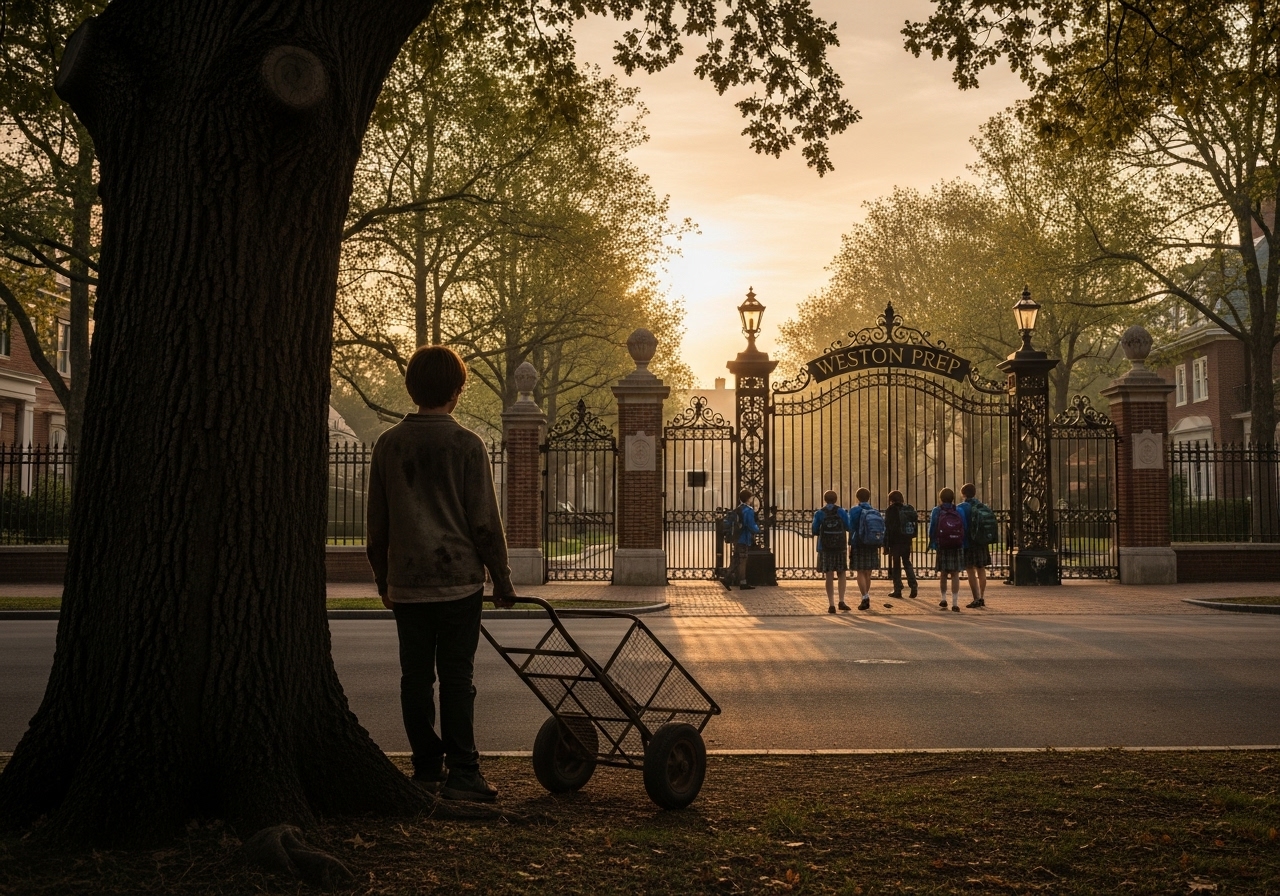
But there was one part of his route where he was not invisible, if only to himself. It was a three-block stretch of high stone walls, ancient oak trees, and immaculate, wrought-iron fences. This was the Weston Preparatory Academy.
Every morning, just as the sky turned from black to a bruised, cold purple, Milo would park his cart in a small, hidden alley. He’d wipe his hands on his jeans—a futile gesture—and creep to a spot behind a massive oak tree across the street.
From there, he would watch.
The 7:30 AM bell was his signal. To him, the sound, a deep, resonant bong, didn’t sound like a school bell. It sounded like a church bell.
Then they would come. The cars, mostly black or silver, long and quiet as sharks, would glide to the curb. The doors would open, and they would spill out. The Weston students.
They were clean. It was the first thing he always noticed. Their hair was perfect, their faces bright. They carried leather bags instead of plastic ones. But most ofall, they wore the uniform.
The Weston Prep uniform was a simple, dark blue blazer with a small, gold-and-yellow crest on the breast pocket. It was a shield. It was a key. It was a costume that made you real. Milo would watch them, listen to them. They’d laugh, complaining about homework or a teacher named “Mr. Snerd.” They looked… normal. Cared for. They looked like they belonged to the world.
Milo’s life was a collection of sharp edges. His apartment was two rooms above a tire shop, shared with an aunt who was always tired and smelled of the cleaning solvents she used at her night job. His world was survival. Their world, the world of the blue blazer, was living.
His fascination was quiet, private, and total. He collected their cast-offs: a Weston-branded pencil he’d found in the gutter (he never sharpened it), a crumpled test paper on The Odyssey (he couldn’t read the words, but he traced the “100%” in red ink at the top).
One morning, his ritual was broken. A girl, about his age, with bright red hair, was climbing out of a pristine white SUV. She tripped, and her books scattered onto the sidewalk. A heavy, blue textbook skidded to a stop just feet from the gate.
“Anna, for heaven’s sake, hurry up!” her mother called from the driver’s seat.
Anna scrambled, her face red, but the book was too far.
Milo, before he could think, darted from his hiding place. He ran across the empty street, his boots loud on the pavement. He snatched the book, his grimy fingers registering the smooth, glossy cover. He ran to the gate and held it out to her.
Anna looked at him. Her eyes, green and curious, didn’t slide past him. They looked at him. She saw his face, his dirty hands, his hopeful eyes.
“Thank you,” she whispered, taking the book. She smiled. It was a real smile.
“Anna! What did I tell you?” The mother was at the window, her face a mask of pinched disapproval. “Don’t talk to them. You’ll get… just get in the car.”
Anna’s smile vanished. “Sorry,” she whispered again, and was pulled away, disappearing past the iron gates.
Milo stood there, the ghost of her smile still on him. He had been seen. A girl in a blue blazer had spoken to him.
The obsession, which had been a dull ache, now became a sharp, singular goal.
It took him a week to find it. Not in a dumpster, but in a place that smelled of mothballs and forgotten lives: the “Second Time Around” thrift shop, blocks away, on the border between his world and theirs.
It was hanging on a rack in the back, hidden between a stained tuxedo jacket and a floral housecoat. A Weston Prep blazer. It was old. The cuffs were frayed, and the lining near the collar was torn. But the crest, the beautiful gold-and-yellow shield, was intact.
He looked at the tag. A complete, mismatched set was bundled with it—a pair of grey wool trousers, also too big, and a faded, yellowed-white button-down shirt.
The price, written in faded red marker, was $40.
Milo’s heart sank. Forty dollars. He made, on a good week, twenty. Forty dollars was food money for his aunt. It was rent money. It was an impossible sum.
But he had been seen.
He started that day. He took every piece of scrap, even the low-grade tin. He worked past his usual quitting time, his hands aching. He stopped buying his one daily treat, a 50-cent hot chocolate from the corner bodega. He skipped meals, telling his aunt he’d eaten at the shelter, a lie she was too tired to question.
After three weeks, he had $32. It wasn’t enough.
He went home. He pulled a small, tin box from under his cot. Inside was his only non-functional possession: a small, silver-plated locket, empty, that had belonged to his mother. He didn’t even remember her face. He just had the locket.
He sold it to the pawn shop on the corner. The man gave him $8.
He now had $40, held in a crumpled ball of ones, fives, and a small mountain of quarters. He ran to the thrift store, the coins heavy in his pocket, praying it was still there.
It was.
He paid the woman, his hands shaking. He didn’t take the bag. He held the uniform, the scratchy wool of the blazer, clutched to his chest, all the way home. It was the most expensive, most valuable thing he had ever owned.
Chapter 2: The Transformation
The day was a Tuesday. The first day of the new term at Weston Prep. Milo knew this because he’d seen the banner go up over the gates last week.
He woke up before his 4:00 AM alarm. He didn’t even hear the rumble of the first trucks. There would be no scrap collection today. Today, he had a different purpose.
He moved with the quiet reverence of a priest preparing for mass. His aunt was long gone, her shift at the hospital cafeteria having started at midnight. The apartment was cold and still.
First, the ritual of cleaning. He didn’t just wash. He scrubbed. He took the half-used bar of lye soap, the kind his aunt used for laundry, and stood over the rust-stained sink. He scrubbed his face and neck until the skin burned red. He spent ten minutes on his hands, using a stiff-bristled brush he’d found, digging under his nails, trying to erase the permanent, black lines of grease. He scraped and scraped, but the stains wouldn’t fully lift. They were part of him. He winced, but he didn’t stop until his knuckles were raw.
He dried himself on the cleanest towel he could find. Then, he went to his cot.
He had laid it out the night before. The gray wool pants. The yellowed shirt. The blazer.
He dressed slowly. The shirt was stiff and smelled of mothballs. The pants were held up only by a piece of rope he used as a belt, the excess fabric bunching around his waist. They were too short, ending a good two inches above his ankles, revealing his only pair of shoes: beat-up, non-descript sneakers, the brand long since worn away.
Then, the blazer.
He slid his arms into the silk lining. It was too big. The shoulders slumped past his own, and the frayed cuffs covered his raw hands completely. He stood in front of the largest piece of mirror he owned—a jagged shard leaning against the wall.
He looked at his reflection.
The world that had only ever seen a “trash kid,” a “street rat,” a “ghost,” was wrong. The mirror was wrong.
Milo stood up straight. He pushed the sleeves up just enough so his hands could be seen. He ran his fingers over the golden crest on the pocket.
He didn’t see the stains. He didn’t see the ill-fitting shoulders. He didn’t see the scrapper’s hands or the cheap sneakers.
He saw a student. He saw a boy who belonged. He saw, for the first time in his life, just Milo.
He left the apartment, locking the door behind him. The walk was forty-five minutes. He set out, not at his usual scrapper’s pace—head down, darting, in the shadows—but with a new, terrifying, wonderful sense of purpose.
He walked on the sidewalk.
This, more than anything, was the change. His entire life, he had walked in the street, next to the curb, or in the alleys. The sidewalk was for them, for the people who belonged. Today, he belonged.
He walked with his head up. The sun was just beginning to touch the tops of the buildings, and for the first time, he felt its warmth as a welcome, not as a signal that his working day was almost over.
A woman walking a poodle passed him. She smiled. A quick, polite, dismissive smile. But she smiled. She hadn’t crossed the street. She hadn’t clutched her purse. She saw the blazer, and she saw a boy.
Milo felt a surge of pride so powerful it made him dizzy. He was invisible no more. He was wearing the shield. He was one of them. He wasn’t going to hide behind the oak tree today.
He wasn’t going to enter the school. That thought was too fantastical. He knew, even in his 10-year-old heart, that the blazer was a costume, not a key. He didn’t have the tuition. He didn’t have the “family name.”
His goal was simpler. His goal was to stand by the gate. To stand on the same sidewalk as the other students. To be there, in his uniform, and for one morning, for one perfect, ten-minute window, to feel the sun on his face and pretend he was just another boy, waiting for the bell that sounded like a church, on his way to a class called The Odyssey.
He turned the final corner onto the long, tree-lined street. The gates of Weston Prep were in sight. He clutched the locket-money, the skipped meals, the cold mornings, all of it—and felt it had been worth it. He was almost there.
Chapter 3: The Gate
He arrived at 7:25 AM, just as the river of cars began to flow. He saw the white SUV. He saw Anna get out, her red hair tied back. She didn’t see him. She ran to join a group of friends, their laughter bright and sharp in the cool morning air.
Milo took a deep breath. His heart was hammering against his ribs, a frantic drumbeat of fear and excitement. He didn’t go to his tree. He walked directly to the entrance.
The gates themselves were massive, 15-foot-tall monuments of black wrought iron, curled into the shapes of leaves and, at the very top, the Weston crest. They were open, inviting.
He didn’t try to pass them. That was not the plan.
He found his spot. A small patch of sidewalk just outside the gate, next to a large stone pillar. He stood there, hands clasped behind his back, trying to imitate the posture of the other, older boys he’d seen. He stood still. He watched the students file past. He belonged.
He smiled. A small, real, unguarded smile. He was here.
At the same time, a modest, dark blue American sedan pulled to the curb about fifty yards down the street. Mr. Henderson checked his watch. 7:30 AM. His appointment with the bursar wasn’t until 9:00 AM, but his wife, Eleanor, had always said, “Better an hour early than a minute late.”
He was here to finalize the details of the Eleanor Henderson Memorial Scholarship. A $100,000 endowment for a bright student from the “other” side of town. Eleanor had been a public school teacher for forty years. She believed in bridges. This scholarship was his bridge, a way to connect his quiet, lonely life to the world she had loved.
He saw the students. He saw the energy, the privilege. He hoped the money would do some good.
His eyes landed on a small boy standing alone by the gate pillar. The boy was in uniform, but he looked… lost. Or maybe new. The blazer was far too big, the pants too short. He looked nervous, but also deeply, profoundly proud. Mr. Henderson smiled. “Good for you, son,” he murmured to himself, mistaking the boy for a new, nervous scholarship student. “You stand your ground.”
A man emerged from the school’s main doors and strode toward the gate, a man who seemed to command the very air around him. This was Dr. Croft, the Headmaster. He was in his fifties, tall, with a severe face that looked immune to smiling. He wore his own suit like a uniform, his obsession with class, order, and lineage a palpable aura. He was the guardian of the gate.
He was greeting parents. “Mrs. Althorp, lovely to see you.” “James, that tie is crooked. Straighten it.”
Then, his gaze fell on Milo.
Dr. Croft stopped. His eyes, cold and analytical, swept over the boy. He didn’t see a child. He saw a stain. He saw disorder.
He saw the frayed cuffs. He saw the bunched-up pants. He saw the cheap, dirty sneakers.
“Young man.”
Dr. Croft’s voice was not a question. It was a command. It cut through the morning chatter.
Milo jumped, startled. He looked up at the tall, imposing man. “Sir?”
“I do not recognize you.” Dr. Croft said, stepping closer. “What is your name?”
“Milo, sir,” Milo whispered, his voice trembling. The dream was breaking.
Dr. Croft’s face hardened. The parents, sensing a spectacle, began to pause, their conversations fading. Mr. Henderson, in his car, leaned forward, a frown touching his lips.
“Milo who?” Dr. Croft demanded. “What is your family name?”
Milo was silent. He had no answer. His aunt’s name? The name from the tire shop? He just stared, his smile gone, his face pale with terror.
The silence was his confession.
Dr. Croft’s voice became cold, sharp, and loud, carrying to all the watching parents and students.
“This is private property,” he announced. “You think you can come here, in that… that costume… and impersonate a Weston student?”
Milo flinched as if struck. “No, sir. I just…”
“You are mocking this institution,” Croft spat, his face flushing with a self-righteous anger. “You are mocking the families who work to send their children here. This uniform is earned.”
“I… I bought it,” Milo stammered, his eyes filling with tears. “I paid…”
“You paid?” Dr. Croft laughed, a short, ugly sound. “You can’t buy your way in. Not with a stolen, filthy rag. You are an imposter, boy. Now, take that blazer off. It doesn’t belong to you.”
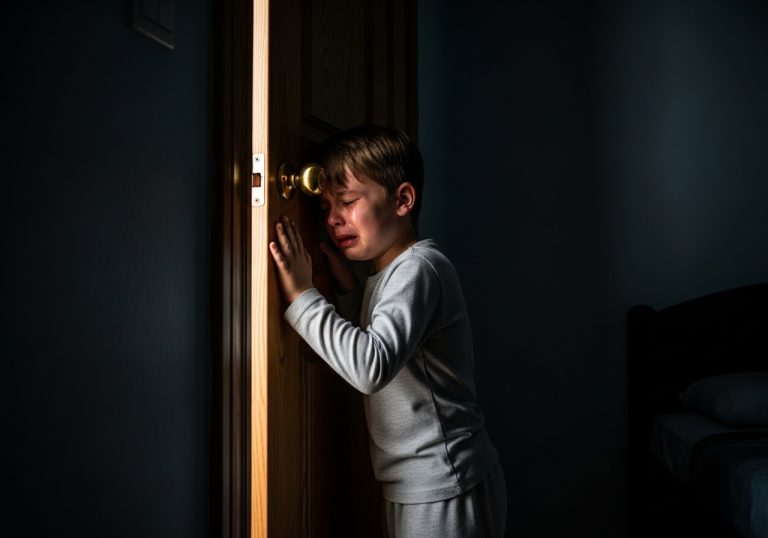
“Please, no…” Milo was sobbing now, a deep, silent, full-body shake.
“I will not have this… this deception at my gate.”
And then, Dr. Croft did the unforgivable.
He reached out and grabbed the lapels of Milo’s blazer. He gripped the old, frayed wool, the wool Milo had saved for, the wool that represented his mother’s locket.
“GET. OUT.”
Dr. Croft yanked.
The force was violent, ripping the old fabric. Milo was pulled forward, stumbling, off the curb and into the gutter. He fell to his knees, his raw hands scraping the pavement.
The humiliation was total. It was a physical, public, and absolute destruction.
Milo, completely broken, scrambled to his feet. He didn’t look back. He just ran. He ran as fast as his small legs could carry him, the oversized, flapping blazer a flag of his shame. He ran, the sound of Dr. Croft’s voice echoing in his ears: “Imposter. Filthy. Stolen.”
Chapter 4: The Reckoning
In the blue sedan, Mr. Henderson sat frozen, his hands gripping the steering wheel so hard his knuckles were white. He had witnessed the entire, grotesque execution. He had seen the boy’s hope, the headmaster’s cruelty, and the child’s absolute devastation.
A cold, unfamiliar rage, the kind he hadn’t felt since a battlefield in his youth, settled over him. His late wife, Eleanor, had a saying: “The only thing evil needs to win is for good people to do nothing.”
Dr. Croft, his duty done, was smoothing his tie, turning back to the parents with a thin, reassuring smile, as if he’d just shooed away a stray dog.
Mr. Henderson put the car in park. He got out. He was 68 years old, and he walked with a slight limp, but this morning, he crossed the street with the speed and purpose of a man half his age.
“Dr. Croft,” he called out. His voice was not loud, but it was firm, and it carried.
Dr. Croft turned, annoyed at this new interruption. He saw a well-dressed, older gentleman. A potential donor. His scowl instantly vanished, replaced by a practiced, welcoming smile.
“Yes? Good morning,” Dr. Croft said, extending a hand. “Can I help you? Are you here for a tour?”
Mr. Henderson ignored the hand.
“My name is Arthur Henderson,” he said, his voice quiet, drawing the remaining parents in. “I had a 9:00 AM appointment with your bursar. I was here to establish the Eleanor Henderson Memorial Scholarship.”
Dr. Croft’s eyes lit up. “Mr. Henderson! Of course! We are so looking forward to… “
“An endowment,” Mr. Henderson continued, his voice as cold as the iron gate. “One hundred thousand dollars.”
A gasp went through the small crowd. Dr. Croft’s smile became radiant.
“However,” Mr. Henderson said, “I’ve just had the privilege of witnessing your ‘educational philosophy’ in action.”
Dr. Croft’s smile flickered. “I… I’m not sure I understand. What you saw was a simple matter of…”
“What I saw,” Mr. Henderson interrupted, “was not ‘order.’ It was not ‘discipline.’ It was a grown man, a man in charge of children, using his power to break a small boy who had done nothing but dream.”
The headmaster’s face turned from pale to a splotchy, angry red. “That boy was an imposter! He was trespassing! He was a… a vagrant in a stolen uniform!”
“That uniform,” Mr. Henderson said, “was a symbol. A symbol of everything you claim to teach: aspiration, dedication, hard work. That boy, whoever he is, wanted nothing more than to be a part of this. And you, sir… you didn’t just turn him away. You humiliated him. You assaulted him. You told him he was nothing.”
Mr. Henderson looked around at the other parents, who were now staring at the ground, ashamed.
“I came here to build a bridge for a child like him. But I see now, this school isn’t a bridge. It’s a wall. And you,” he said, pointing a steady finger at Croft, “are just a brick.”
He took a business card from his wallet. “I will not be making my donation.” He dropped the card on the pavement at Dr. Croft’s feet. “And you can be assured, I will be telling the city board exactly why.”
He turned, not waiting for a reply, and walked back to his car. The fury was still thrumming in him, but now it was joined by a more urgent, painful emotion: concern.
He got in his car and started the engine. He didn’t drive toward his home. He drove in the direction the small, sobbing boy had run.
He drove past the manicured lawns and pruned hedges, back toward the part of town where the concrete was cracked and the buildings sagged. He scanned the alleys, the bus stops. Where would a wounded animal go to hide?
He found him three blocks later, huddled in a narrow alley between a pawn shop and a laundromat.
Milo was on his knees, his back to the street. He was desperately trying to get the blazer off, his sobs so violent they were silent, his whole body shaking. He was clawing at the buttons, but his fingers were trembling too much. The blazer, his shield, had become a prison. It was a mark of shame, and he couldn’t get it off.
Mr. Henderson pulled the car to the curb, blocking the mouth of the alley. He got out, his heart aching. He walked slowly, so as not to startle the boy.
“Son?” he said, his voice gentle.
Milo froze. He whipped around, his face a mess of tears and dirt, his eyes wide with terror, expecting Dr. Croft to be back, to finish the job.
He just saw an old man with kind, sad eyes.
Mr. Henderson didn’t offer pity. He didn’t say, “It’s okay.” He just sat down, with a groan, on the cold, dirty pavement a few feet away from the boy.
They sat in silence for a full minute, the only sound being the distant traffic and Milo’s ragged, catching breaths.
Chapter 5: The New Gate
“That’s a fine-looking blazer,” Mr. Henderson said finally, his voice casual.
Milo looked at him, his expression a mixture of confusion and anger. He swiped at his nose with a dirty sleeve.
“It’s not,” he whispered, his voice hoarse. “It’s a… a rag. He said so. It’s… it’s stolen.”
“Did you steal it, Milo?” Mr. Henderson asked.
Milo’s head snapped up. “How… how do you know my name?”
“I heard the Headmaster. Before he made an absolute fool of himself.” Mr. Henderson looked at him. “Did you steal it?”
“No!” Milo said, a spark of his old pride returning. “I paid! I saved for a month. I… I sold my mom’s locket. I paid forty dollars for it.”
Mr. Henderson’s heart cracked. Forty dollars. A locket.
“Then it’s not a rag, is it?” the old man said gently. “It’s the most expensive, valuable blazer in the entire city. It cost you everything. That Headmaster… he was wrong. He wasn’t mad because the blazer was fake. He was mad because the boy wearing it was real.”
Milo stared at him, the tears slowing.
“You know,” Mr. Henderson continued, “that blazer… it’s just cloth. It’s a symbol. And as it turns out, it’s a pretty worthless one. It stands for exclusion, and for angry men in suits. But what you did to get it… the saving, the work, the wanting it… that’s the real part. That’s the part that matters. They can’t take that away from you.”
Milo’s hands, which had been clawing at the buttons, slowly relaxed.
Mr. Henderson struggled to his feet. “Come on, son. I know a different school. A better one. The uniform is… well, there is no uniform. And the gate is always open.”
Milo, hesitant, looked at the old man. Then, slowly, he stood up, still wearing the blazer. He followed Mr. Henderson to the car.
They didn’t drive back to the Heights. They drove downtown, to a part of the city Milo had only ever seen from a distance. Mr. Henderson parked the car in front of a building so large, Milo thought it must be a palace. It was made of white stone, with massive columns and two great, stone lions guarding the entrance.
“What is this place?” Milo whispered.
“This,” Mr. Henderson said, “is the City Public Library. This is the real school.”
They walked up the grand stone steps. Inside, it was quiet, and vast. The ceilings were painted with clouds, and the main reading room was a cathedral of books, stretching up three stories high. Sunlight streamed in through enormous, arched windows, illuminating the dust motes dancing in the air.
A woman at the main desk smiled at them. She looked at Milo, in his dirty sneakers and oversized, torn blazer, and her smile didn’t falter.
“Good morning,” she said. “Can I help you?”
“Yes,” Mr. Henderson said, placing a warm hand on Milo’s shoulder. “My young friend here would like a library card.”
Ten minutes later, they were sitting at a massive, polished oak table in the children’s wing. Milo had his first library card. Mr. Henderson had a stack of books.
He placed the first one in front of Milo. It was old, with a picture of a ship on the cover. Treasure Island.
“My wife… she loved this one,” Mr. Henderson said, his voice a little thick. “She used to say books are just maps to places you’ve never been.”
He opened the book to the first page.
“Let’s start at the beginning,” Mr. Henderson said.
Milo looked at the man. He looked at the book. He looked around the grand, warm, quiet room, where anyone could enter.
He was still wearing the blue blazer. It was torn at the lapel, and the cuffs were still too long. But here, in this light, it didn’t look like a rag. It didn’t look like a costume. It just looked like a coat.
“T-r-e-a…” Milo began, his finger tracing the first, large letter. “Treasure…”
Mr. Henderson smiled. Milo was not at the gate; he was inside. He was not an imposter; he was a student. He was, at last, home.