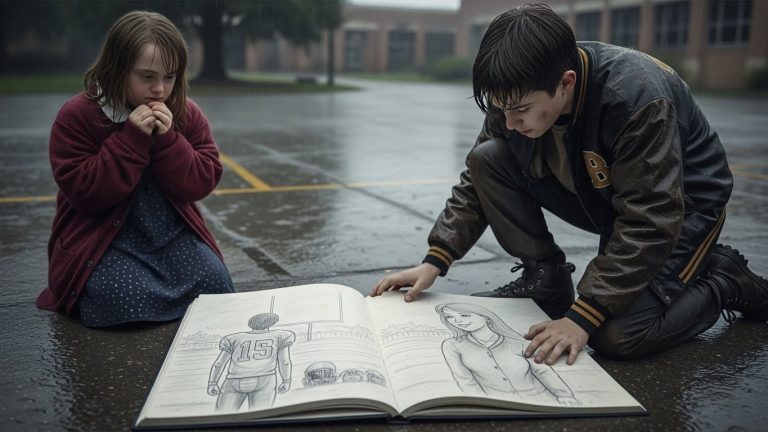
He Hired a Maid to Clean His Mansion. He Never Expected Her to Heal His Broken Family.
Chapter 1: The House of Glass
The Stanhope mansion wasn’t a home; it was a mausoleum.
In the year since Eleanor’s death, Arthur Stanhope had systematically scrubbed the sprawling estate of her presence. The bright, chintz curtains she had loved were replaced with heavy, gray velvet. The scent of her lemon and rosemary baking was replaced by the sharp, sterile sting of industrial cleaner. The laughter, of course, had vanished on its own.

The silence that remained was absolute, broken only by the ticking of a grandfather clock in the foyer and the hushed, fearful footsteps of the staff. But the loudest silence—the one that clawed at Arthur’s sanity—came from his children.
Liam, Nora, and Chloe. The seven-year-old triplets.
They had been in the backseat of the SUV when it happened. A deer, a swerve, the sickening crunch of metal, and then… nothing. They had emerged from the wreckage without a single scratch, but they had left their voices behind with their mother on the rain-slicked asphalt of the highway.
Not one word. Not one smile. Not one tear.
Arthur Stanhope was a man who fixed things. He was a self-made millionaire who had built a logistics empire from a single rusty truck. He solved problems with brutal efficiency. But he could not fix this.
He had buried his own grief under mountains of work and rivers of expensive Scotch. He looked at his children and saw not three traumatized souls, but a problem that defied solution. A living, agonizing reminder of his failure.
He had hired—and fired—an army. Dr. Feldman, the child psychologist with the triple-board certification, was dismissed for “coddling them.” Madame Dupree, the stern Belgian nanny, was fired for “upsetting their routine.” A team of behavioral therapists was sent packing when their “positive reinforcement” charts remained empty.
His solution, now, was management. The children’s lives were run by a color-coded schedule that would have impressed a military academy. 7:00 AM: Wake. 7:30 AM: Breakfast (oatmeal, no sugar). 8:00 AM: “Cognitive Play.” 12:00 PM: Lunch (no “messy” foods).
It was into this house of glass that Grace arrived.
She was the 14th applicant the agency had sent that month. Her file was thin. “Grace McKinley. Age 58. Widow. Previous experience: household management, private elder care.” She had none of the flashy credentials Arthur usually demanded. She was a woman of medium height, medium build, with kind, tired eyes and hands that were slightly calloused, as if she had spent a lifetime wringing them, or building things.
Arthur interviewed her in his study, a dark, oppressive room that smelled of old leather and stale whiskey.
“You understand the situation, Mrs. McKinley?” he asked, not looking up from her file. His voice was a low growl.
“I understand there are three children who are unwell,” Grace said. Her voice was quiet, but it didn’t waver.
“They are not unwell,” Arthur snapped, finally looking up. His eyes were cold. “They are… silent. Your job is not to ‘fix’ them. The doctors have failed. Your job is to manage the household and ensure their schedule is adhered to. That is all.”
He stood and walked to the window, staring out at the perfectly manic-ured, joyless garden.
“There are rules, Grace,” he said, his back to her. “We do not speak of the… event. We do not speak of their mother. We do not have emotional outbursts. This house runs on order. Any deviation, and you will be dismissed. Is that clear?”
“Yes, Mr. Stanhope,” Grace said.
“Good. The housekeeper will show you to your room. Your duties begin immediately.”
Grace was led not to a room, but to a small, cold apartment over the garage. It was clean, but as impersonal as a hotel room. She unpacked her single suitcase, placing a small, framed photo on the bedside table. It was of a smiling young man in a graduation cap.
Her first encounter with the children was in the playroom. “Playroom” was a generous term. It was a large, white room filled with expensive, educational toys that were all in their proper bins. There was no paint, no clay, no glitter. Nothing that could make a mess.
Liam, Nora, and Chloe were sitting at a small table, each completing a wooden puzzle. They were dressed in identical gray jumpers. They looked up when Grace entered, their three pairs of blue eyes—Eleanor’s eyes—landing on her with a chilling, vacant assessment. Then, as one, they looked back down.
Grace didn’t speak. The file had said the previous nanny had tried to force a hug on her first day and had been met with a wall of terrifying passivity.
So Grace just sat.
She pulled up a small wooden chair, one that creaked under her weight, and sat near the door. She didn’t try to engage them. She didn’t smile brightly or coo in a high-pitched voice. She just sat, her hands folded in her lap, and joined them in their silence.
For an hour, the only sound was the click-clack of wooden puzzle pieces.
Liam was the observer, his eyes flicking to her every few minutes. Nora was the perfectionist, her small hands turning a piece over and over until it fit perfectly. And Chloe, the smallest, was the dreamer. Her puzzle lay untouched; she was just staring at the back of her own hand.
Grace’s heart ached. It was a familiar, dull pain she carried with her every day. She recognized this. This hollow, airless grief. It wasn’t a problem to be fixed. It was a wound. A wound that, without air, had begun to fester.
She saw her own son, Thomas, in their faces. Thomas, who had been so full of life before the illness, had also grown quiet at the end. But his silence had been peaceful. This was not. This was a silence of armor.
That evening, Grace prepared the children’s dinner, following the approved menu. Steamed chicken, plain quinoa, steamed broccoli. As she placed the plates on the table, she hummed.
It was an unconscious act. A low, tuneless sound, a fragment of an old folk song.
All three children froze. Liam dropped his fork. It clattered onto the plate with a sharp clang.
Footsteps pounded down the hall. Arthur burst into the dining room, his face a thundercloud.
“What was that noise?” he demanded.
Liam, his eyes wide with panic, pointed a trembling finger at Grace.
Arthur’s gaze turned on her, full of ice. “Was that you?”
“I… I was humming, sir. I apologize,” Grace said, her voice steady.
“Rule number one, Mrs. McKinley,” Arthur hissed, stepping close to her. “No emotional outbursts. That includes… singing.”
“It was just a hum, Mr. Stanhope.”
“It is a distraction,” he said. “Do not let it happen again.”
He turned and left. The children stared at their plates. Grace picked up Liam’s fork, wiped it, and handed it back to him. His small hand was cold as ice.
That night, Grace sat in her cold room and looked at the photo of her son. “Oh, Thomas,” she whispered. “Those poor, poor babies.”
She knew, with a certainty that settled deep in her bones, that she wouldn’t be able to follow Mr. Stanhope’s rules. She wasn’t here to manage a schedule. She was here to tend a wound. And she knew the only way to do that was to first show them her own.
Chapter 2: The Sound of a Memory
The next few weeks were a quiet battle of wills. Grace followed Arthur’s schedule to the letter, but she infused it with a gentle, stubborn resistance.
When she baked sugar-free, whole-wheat muffins for breakfast (a deviation from the oatmeal), Arthur confronted her. “It smells… sweet,” he said, accusingly.
“It’s the vanilla, sir. It’s on the approved pantry list,” she replied, meeting his gaze. The children ate the muffins, their first new food in a year.
When she opened the heavy velvet curtains in the playroom to let the sunshine in, he stormed in. “The glare! It’s distracting them from their cognitive work.”
“The light is good for them, Mr. Stanhope. It helps with Vitamin D,” she said, her voice as calm as a lake. The sunlight fell across the floor, and Grace saw Chloe trace the bright square with her toe.
Grace learned the topography of their grief. She learned that the children would not go near the west wing, where their mother’s studio was. She learned that they flinched at the sound of a car braking too hard on the main road. She learned that Arthur drank more on rainy days—the same weather as the day of the accident.
She, in turn, shared her own. She didn’t talk to the children; she talked in front of them. While she dusted the sterile playroom, she would murmur, as if to herself.
“My Thomas, he loved the color blue,” she said one afternoon, straightening Liam’s blocks. “He said it was the color of the sky right before the stars come out. He would have loved these blocks.”
The triplets continued their play, but the click-clack of the blocks slowed. They were listening.
“He was a musician, my Thomas,” she said another day, wiping the windows. “Well, he tried to be. He had a lovely old guitar, but he couldn’t keep it in tune to save his life. But oh, the noise he would make. He loved to sing old songs. Songs my grandmother sang to me.”
She saw Nora’s head tilt, just slightly.
Grace’s apartment over the garage was her sanctuary. In the bottom of her suitcase, wrapped in an old, soft flannel shirt, was her son’s most prized possession: his old, slightly beat-up acoustic guitar. It was a simple thing, the wood scarred and worn. One of the tuning pegs was a mismatched white plastic.
She hadn’t touched it since the funeral, three years ago. The silence of her own home had been as profound as this one.
That night, with trembling hands, she lifted it from the case. The smell of old wood and rose-scented polish filled her small room. She ran a hand over the strings. They were terribly out of tune. She spent an hour, patiently, painstakingly, twisting the old pegs until the chords sounded almost right.
She held it, and for the first time in a long time, she felt the presence of her son. She felt his joy, his frustration, and his unending, boundless love. It was not a memory that hurt. It was a memory that held.
The next day, Arthur Stanhope was gone. A business trip to Chicago. He wouldn’t be back for forty-eight hours. The housekeeper, Mrs. Birch, looked at Grace with a mix of pity and warning. “He’ll call, you know. He always calls to check on them.”
“I’ll have the phone with me,” Grace said.
That afternoon, during the 2:00 PM “Cognitive Play” slot, Grace did not bring out the puzzles. Instead, she brought the guitar.
She walked into the playroom and the children looked up, their eyes widening at the sight of the large, unfamiliar object. Grace didn’t say a word. She sat in her usual small chair, settled the guitar in her lap, and just… held it.
The children stared. They had been taught that anything new was a potential threat.
Grace simply rested her fingers on the strings, letting them get used to the sight of it. Finally, Liam, the brave one, pointed at it.
Grace’s heart leaped. A gesture. It was the most communication she had ever received from them.
“This?” she said softly. “This is a guitar. It belonged to my son, Thomas. He wasn’t very good, but he played it very loud.”
She strummed a C-chord. The sound was warm, resonant, and shockingly loud in the silent room.
All three children flinched, their shoulders rising to their ears. But they didn’t run.
“It’s just a sound,” Grace said gently. “It’s a G-chord. And this… this is a C.” She strummed again. “They go together. See? G… C… G…”
She began to hum, the same old folk song she’d been scolded for. But this time, she added the quiet, simple chords. It was a song about a riverboat, a song her grandmother had sung. Her voice was not beautiful. It was a little cracked, a little thin, but it was real.
Nora, the perfectionist, crept closer. She sat on the floor, just out of reach, her head tilted, analyzing this new element. Liam stayed by the block tower, watching Grace’s hands. Chloe, the dreamer, had her thumb in her mouth, her eyes fixed on the soundhole of the guitar, as if she expected something to fly out.
Grace played for twenty minutes. Simple songs. “You Are My Sunshine.” “This Little Light of Mine.” “Down by the Riverside.”
When the phone rang, she startled, ending a chord with a dissonant twang. She picked up the playroom extension. “Stanhope residence.”
“Mrs. McKinley.” Arthur’s voice was clipped, tinny. “Report. Are they on schedule?”
Grace looked at the three children, who were all watching her, their faces pale. “Yes, Mr. Stanhope. We are… in the playroom.”
“Good. Keep them there. My flight was delayed. I’ll be home in the morning.”
“Very good, sir.” She hung up.
The spell was broken. The children looked away, the invisible walls slamming back into place.
That evening, Grace felt a new, unfamiliar tension in the house. The children were wired, restless. They didn’t eat their dinner. They wouldn’t settle for “Quiet Reading.” When Grace went to tuck them in, she found all three of them in Liam’s room, huddled under his duvet, wide awake.
They weren’t just silent. They were afraid.
The next morning, Grace knew she had to push. Arthur was coming home. The house would be locked down again. She had one more chance.
She went to the west wing. The door to Eleanor’s studio was locked, just as she’d known it would be. But her goal wasn’t the studio. It was the piano room adjacent to it.
She found a stack of sheet music in the piano bench. It was mostly classical, but tucked in the back was a handwritten piece. The title, in elegant, feminine script, was “Chloe’s Lullaby.”
It was simple, almost a nursery rhyme. Grace’s heart pounded. She took the music.
When Arthur’s car pulled up the gravel drive, he wasn’t just early. He was furious. The Chicago deal had fallen through. He stalked into the house, peeling off his coat and tie, and barked for Mrs. Birch.
“Where are they?”
“In the playroom, sir. With Mrs. McKinley.”
He headed for the stairs, and that’s when he heard it.
It wasn’t just the guitar. It was a voice. A soft, clear voice, singing.
“Sleep, my child, and have no fear… for Mommy is right here…”
It was Eleanor’s lullaby. The song she had written for the triplets. The song he had banned from this house, the song he hadn’t been able to bear hearing.
A roar of white-hot rage, fueled by grief and whiskey, erupted from his chest. He didn’t walk; he ran. He burst through the playroom door, his face a mask of terrible, broken fury.
Chapter 3: The Breaking of the Dam
The scene in the playroom was frozen in a tableau of quiet intimacy. Grace was on the floor, the guitar in her lap. The three triplets were, for the first time, not in a neat, orderly line. Liam was sitting cross-legged, his chin on his fist. Nora was on her stomach, absently stroking the carpet. And Chloe, his little Chloe, was sitting almost in Grace’s lap, her small hand resting on the warm, vibrating wood of the guitar.
Grace was singing. She was singing that song.
The sound of Arthur’s entrance was a sonic boom. He didn’t just enter the room; he violated it.
“STOP!” he roared. The word was so loud it seemed to shake the very walls.
The children flinched violently. Liam and Nora scrambled backward, crabs in the sand, until their backs hit the wall. Chloe let out a tiny, silent gasp, her hand flying to her mouth.
Grace stopped singing, her hand hovering over the strings, which continued to hum with the ghost of the lullaby. Her face was pale, but she didn’t look afraid. She just looked sad.
“What… is… this… NOISE!” Arthur spat. His eyes were wild, bloodshot from the flight and the anger. He didn’t see a healing moment. He saw a betrayal. He saw a minimum-wage employee undoing the sterile, painful order he had fought for a year to maintain. He saw his wife, he heard her song, and the pain was unbearable.
“You are fired, Mrs. McKinley,” he hissed, his voice trembling.
“Mr. Stanhope, please,” Grace began, her voice soft. “The children…”
“You do not speak of the children!” he yelled. “You do not touch them! You do not sing to them! You are here to clean! To manage!”
He advanced on her, his target not the woman, but the instrument. The source of the sound. The source of the memory.
“Give me that guitar,” he demanded.
Grace, instinctively, pulled it closer, shielding it with her body. “Mr. Stanhope, you’re frightening them.”
“I told you to STOP!” he lunged, his hands outstretched, not to hurt her, but to grab the guitar, to silence the music, to break the thing that was breaking him.
And then, it happened.
A small, rusty, utterly impossible sound cut through the rage.
“Don’t.”
The word was tiny. It was barely a whisper, cracked with disuse. It was a thread of sound, but it hit Arthur Stanhope with the force of a physical blow.
He froze. His hands were inches from the guitar. He slowly, agonizingly, turned his head.
It wasn’t Liam. It wasn’t Nora.
It was Chloe. His smallest, most fragile-looking child. She was no longer hiding. She was standing, her small body trembling, her fists clenched at her sides. Her hand was held up, palm out, just like her father had seen her do to her brothers when they tried to take a toy.
She was looking right at him. Her blue eyes, Eleanor’s eyes, were not vacant. They were blazing.
“Don’t,” she said again, a little louder this time. “Don’t… hurt… her.”
The tension in the room snapped. The world, which had been loud and red for Arthur, went completely, utterly silent. He stared at his daughter. He saw her. For the first time in a year, he truly saw her. Not as a broken asset, but as a person. A person who had just protected someone.
The sound that came from Arthur next was one no one in the house had ever heard. It was a strangled sob, a sound of air being ripped from his lungs. He stumbled backward, his legs giving out. He fell, ungracefully, into a pile of soft, educational blocks, which scattered around him.
He looked at Chloe. He looked at Liam, who was staring at his sister with his mouth wide open. He looked at Nora, whose eyes were filling, for the first time, with tears.
And he looked at Grace. Her own face was wet, but she wasn’t looking at him. She was looking at Chloe, and her smile was the most beautiful, heartbreaking thing Arthur had ever seen.
With her hands trembling, Grace’s fingers found the strings again. Very, very softly, she began to hum the lullaby. She didn’t sing the words. Just the tune.
Hum… mmm… mmm…
It was a question.
Chloe, her great act of bravery having exhausted her, seemed to deflate. She turned, crawled the two steps to Grace, and buried her face in the woman’s soft-knit sweater.
Then Liam, the observer, unfolded himself from the wall. He walked slowly, carefully, over to Grace, and laid his head on her other knee.
Nora, the last holdout, watched her father. He was a wreck. A millionaire in a $3,000 suit, sitting on the floor, weeping openly into his hands. He was no longer a monster. He was just a man. Nora crawled over and didn’t go to Grace. She went to her father. She placed her small, cold hand on his shaking shoulder.
Arthur’s head snapped up. He looked at his daughter, his vision blurry. “Nora?” he whispered.
Nora didn’t speak. She just tightened her grip.
Arthur’s façade, the cold, hard shell he had built, didn’t just crack. It disintegrated. He pulled Nora into his lap, burying his face in her hair, and he sobbed. He cried for his wife. He cried for his silent, broken children. He cried for the year of his life he had lost to a grief so profound he had tried to suffocate it.
Grace just sat there, a child on each side, her guitar in her lap, and hummed. She hummed the lullaby until the storm of Arthur’s grief passed, and the only sound in the room was the sound of four people, breathing.
The healing was not instant. It was not a movie. The triplets did not suddenly start speaking in full sentences.
But the silence was broken.
That night, Arthur did not fire Grace. He asked her, his voice hoarse, “What do I do?”
“You listen,” Grace said.
“They’re not talking,” he said.
“That doesn’t mean they have nothing to say.”
The next day, Arthur didn’t go to the office. He sat on the floor of the playroom. He didn’t force it. He just sat, like Grace had. He watched his children. After an hour, Liam pushed a blue block toward him. Arthur took it.
A week later, they were in the garden. Grace was telling a story about her son, Thomas. She had told it before, but this time she was telling Arthur.
“He… he tried to build a treehouse,” she said, a small, genuine laugh escaping her. “He used two-by-fours and about fifty nails, and the whole thing collapsed as soon as he put his foot on it. Oh, the look on his face.” She laughed, but a tear rolled down her cheek.
Nora, who was sitting on the grass nearby, looked up. She watched Grace—watched her laugh and cry at the same time. And then, a small, slow, hesitant smile touched her own face. It was the first one.
Arthur saw it. He caught Grace’s eye. And he smiled, too.
The “impossible” wasn’t just making the children speak. It was teaching a broken family that it was okay to be sad. It was okay to miss someone. And it was still, after all of it, okay to be happy, too.
The house was still quiet. But it was no longer silent. It was filled with the sound of a softly strummed guitar, the occasional, rusty sound of a child’s laugh, and the quiet, steady, breathing of a home that was, finally, coming back to life.