Chapter 1: The Hollow Echo
Chapter 1: The Hollow Echo
The air in the room felt heavy, almost pressurized, as if the house itself were holding its breath. The rhythmic thumping behind the drywall wasn’t random; it possessed a deliberate, mechanical cadence that rattled the wooden frame of the bed.
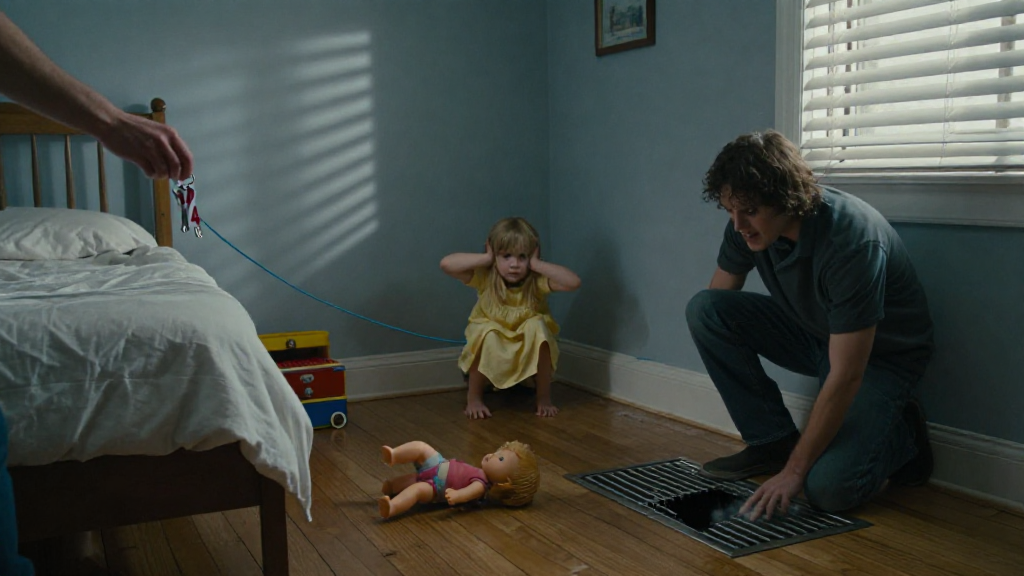
Lily remained curled in the corner, her small frame trembling violently. Her eyes were wide, fixed on the floor vent with a mixture of terror and recognition that chilled me to the bone.
Who is down there? I thought, my mind racing through impossible scenarios.
“Lily,” I whispered, keeping my voice low so as not to startle her further. “Can you hear them? Do you know who that is?”
She didn’t look at me. Instead, she pressed her hands tighter against her ears, her knuckles turning white. She shook her head once, sharply, but her gaze remained locked on the vent.
I knelt, the floorboards creaking under my weight. The sound from the vent wasn’t just a whisper; it was a rasp, a dry, grating noise that sounded like sandpaper rubbing against stone.
“Eleanor,” the voice croaked.
My heart slammed against my ribs. Eleanor was not a name I had ever used in this house. It was not a name Lily had ever heard from me.
I leaned closer, my ear inches from the metal grate. The air rising from the vent felt icy, carrying the faint, metallic scent of old, stagnant water.
“Who is Eleanor?” I demanded, my voice trembling.
The thumping stopped.
The silence that followed was worse than the noise. It was absolute, suffocating, and unnatural. Then, slowly, the blue yarn connecting the plastic dolls to the vent began to pull taut.
One by one, the dolls began to drag across the floor, sliding toward the grate as if being pulled by an invisible, relentless current.
I scrambled back, reaching for Lily, but she suddenly stood up, her movements jerky and stiff. She stopped trembling. She dropped her hands from her ears, her expression shifting from terror to a blank, hollow stillness.
She walked toward the center of the room, her eyes fixed on the empty space above the vent.
“They’re hungry,” she whispered.
It was the first time she had spoken a single word. The sound of her voice, thin and brittle, cracked the remaining composure I had left.
“Lily, stay back,” I ordered, grabbing her shoulder.
She didn’t flinch. She simply pointed at the wall behind her bed, where the wallpaper was beginning to peel, revealing the dark, cavernous space between the studs.
“You shouldn’t have moved the furniture,” she said, her voice devoid of emotion.
Chapter 2: The Scars in the Plaster
My mind struggled to process the sheer impossibility of what Lily had just said.
You shouldn’t have moved the furniture.
The heavy oak bed frame she was pointing at had been pushed against that wall the day before she arrived. I had moved it myself to make room for her small desk near the window.
“What do you mean, Lily?” I asked, my voice barely more than a ragged breath. “Who is hungry?”
She didn’t answer. Her blank, unblinking stare remained locked on the faded floral wallpaper directly behind her headboard.
The rhythmic thumping had completely ceased, but the silence that replaced it felt thick and suffocating. The air in the bedroom had plummeted in temperature, leaving a biting chill that raised the hairs on my arms.
I slowly approached the bed, my eyes tracking the thin blue yarn that was still pulled taut across the faded rug. The dolls were clustered near the floor vent, frozen in their unnatural migration.
I gripped the solid oak footboard, my palms slick with cold sweat. With a deep breath, I pulled.
The heavy wood groaned against the floorboards as the bed slid forward, exposing the section of wall that had been hidden for weeks.
My stomach dropped.
The wallpaper here wasn’t just peeling; it had been violently clawed away from the inside out. Long, jagged strips of floral paper hung down like dead skin, revealing the raw, gray drywall underneath.
But it wasn’t just drywall.
Right where the center of the bed had been, a crude, uneven hole had been carved into the plaster. It was roughly the size of a dinner plate, perfectly aligned with where Lily’s head rested every night.
Oh my god, I thought, my pulse hammering in my ears. Something has been listening to her sleep.
I leaned closer to the ragged opening, shining the flashlight from my phone into the dark cavity between the wooden studs.
The smell of decaying wood and rusted metal hit me instantly, making my eyes water.
Inside the wall, suspended by dozens of intersecting threads of blue yarn, was a massive, intricately woven nest made entirely of shredded fabric.
I recognized the material immediately.
It was the bright pink sweater Lily had worn on her first day here—the one that had mysteriously gone missing from the laundry room last week.
“They take things,” Lily whispered from directly behind me, her sudden proximity making me jump.
I spun around. She was standing inches away, holding the porcelain doll with the crumpled paper key tightly against her chest.
“Who takes things, sweetie?” I pleaded, dropping to my knees to be at eye level with her.
Before she could speak, a sharp, deafening snap echoed through the room.
The blue yarn strung across the floor had severed, the tension suddenly broken.
The metal grate of the floor vent violently lifted an inch off the ground, crashing back down with a heavy, echoing clang.
A pale, impossibly long finger with a cracked yellow nail slowly curled out from the darkness between the metal slats.
Chapter 3: The Map in the Porcelain
I lunged backward, my heart seizing in my chest as I scrambled away from the floor vent. I snatched Lily by her waist, pulling her small, rigid body against my chest and dragging us both toward the bedroom door.
The heavy iron grate groaned in protest as a second finger, just as pale and abnormally long, curled around the metal slats. The air in the bedroom suddenly tasted like copper and centuries-old dust.
“Get away from her!” I screamed, my voice tearing through the suffocating, unnatural silence of the house.
Lily didn’t scream. She didn’t even cry. She just clutched the porcelain doll and the crumpled paper key tightly to her chest, her chin resting heavily on my collarbone.
The pale fingers scraped against the iron, emitting a sickening, bone-grinding squeal. Then, with a sudden, violent jerk, the heavy vent cover was ripped upward.
It flipped through the air and slammed into the drywall with a deafening crash, leaving a gaping, black square in the middle of the faded rug.
I didn’t wait to see what would crawl out. I dragged Lily out into the hallway, slamming her bedroom door shut and throwing my entire weight against the wood.
I stood there gasping for air, the blood rushing in my ears, fully expecting a massive weight to slam against the other side of the door.
What the hell is living under my house? I thought, my mind fracturing as I tried to rationalize the impossible geometry of the crawlspace below.
But the door remained perfectly still. Instead, a slow, methodical dragging sound began directly beneath the floorboards of the hallway.
Whatever it was, it wasn’t trying to get out of Lily’s room. It was moving away from the bedroom and toward the center of the house, slithering through the narrow ventilation shafts.
I looked down at my silent foster daughter. She wasn’t looking at the bedroom door; her hollow, terrified gaze was tracking the dragging sound beneath our feet.
“They want the door,” Lily whispered, her brittle voice cutting through my blinding panic.
“What door, sweetie? The front door? We can leave right now,” I pleaded, grabbing her hand and trying to pull her toward the main staircase.
She dug her heels into the carpet, resisting me with a sudden, desperate strength. She shook her head violently, her messy hair whipping across her face.
“No,” she rasped. “Door fourteen.”
I froze at the top of the stairs, my grip on her hand loosening. The crumpled paper key she had hidden under her mattress flashed vividly in my mind. The rough, red crayon “14.”
“Lily, this house only has six rooms,” I said, my voice trembling as I knelt down to look her in the eyes. “There is no door fourteen.”
She didn’t argue. She simply lifted the tiny, antique porcelain doll she had been holding hostage all evening.
With trembling fingers, she slowly flipped the delicate figurine upside down, exposing its smooth, ceramic base.
My stomach violently hollowed out.
Carved roughly into the bottom of the doll’s ceramic foot, completely hidden from casual view, was a tiny, jagged square. Inside the square, etched in dried, dark brown flakes, was the number 14.
The dolls weren’t just toys; they were a scale model of a subterranean layout that had been hidden inside this house long before we moved in.
Before I could process the horrifying implication, the hallway lights flickered violently, buzzing with a sharp electrical whine before dying completely.
We were plunged into total, suffocating darkness.
And from the pitch-black void of the living room downstairs, a heavy, wet footstep echoed onto the bottom step of the staircase.
Chapter 4: Door Fourteen
The heavy, wet slap of a bare foot hitting the hardwood echoed from the darkness below.
Squelch. Thud.
My mind screamed to run, but my muscles felt frozen, anchored by the sheer impossibility of what was climbing my stairs.
“We have to hide,” I whispered, my voice cracking in the pitch-black hallway.
I scooped Lily into my arms, abandoning any attempt at being quiet, and sprinted blindly toward the master bedroom at the end of the hall.
I slammed the heavy mahogany door shut behind us, my fumbling hands frantically twisting the brass deadbolt just as the wet footsteps reached the top of the landing.
I pulled my phone from my pocket, my shaking thumb struggling to activate the flashlight.
When the harsh, LED beam finally pierced the darkness, it illuminated Lily.
She wasn’t looking at the locked bedroom door; she was already walking calmly toward my walk-in closet, the tiny porcelain doll still clutched in her hand.
What is she doing? I thought, my panic peaking as a heavy, deliberate knock echoed against the bedroom door.
“Lily, get away from there!” I hissed, grabbing a heavy brass lamp from the nightstand as a makeshift weapon.
But she ignored me, stepping into the closet and pointing her small finger directly at the massive, vintage return-air grate bolted to the floor.
“Fourteen,” she stated clearly.
I rushed to her side, dropping to my knees and shining the flashlight through the wide, dusty metal slats of the floor grate.
My breath caught in my throat.
It wasn’t a shallow ventilation duct. It was a sheer, vertical brick shaft plunging deep into the foundation of the house, equipped with a rusted iron ladder built directly into the stone.
The house didn’t have a room fourteen; it had a subterranean level that wasn’t on any public blueprint.
A deafening crack split the air as the bedroom door behind us buckled, the thick mahogany splintering under an immense, unnatural weight.
“Down,” Lily whispered, tugging fiercely at the edge of the heavy iron grate.
Adrenaline overpowered my terror. I jammed the base of the brass lamp under the lip of the grate, using all my leverage to pry the rusted iron free.
It popped loose with a shriek of scraping metal, exposing the dark, cavernous shaft just as the bedroom door hinges snapped completely.
“Go, go, go!” I ushered Lily onto the rusted ladder, my heart hammering against my ribs as she swiftly descended into the dark.
I swung my legs over the edge, pulling the heavy grate back into place just as a towering, pale mass slithered into the bedroom.
The descent felt like hours, the air growing thick and suffocatingly cold the deeper we climbed into the earth.
When my feet finally hit the solid concrete floor, I shined my flashlight around the damp, subterranean tunnel.
At the far end of the passageway stood a massive, reinforced steel door, slightly ajar, with a faded, jagged red “14” painted on its center.
We didn’t look back. We ran through the heavy steel door, emerging into the sprawling, echoing labyrinth of the city’s municipal storm drains, leaving our home—and whatever lived inside its walls—far behind us.
I held Lily tight as we stumbled toward a distant grate filtering moonlight from the street above.
She finally looked up at me, her wide eyes reflecting the pale moonlight, and whispered, “They aren’t hungry anymore.”
Thank you for reading! I hope you enjoyed the suspense, mystery, and terrifying twists of Lily’s story. If you’d like to explore more immersive stories or need help generating completely new concepts, just let me know!