Chapter 1: The Observer on the Sidelines
Chapter 1: The Observer on the Sidelines
The heat of the afternoon sun baked the cracked concrete outside Oakridge Elementary. It was a suffocating, heavy kind of warmth that made the air shimmer above the endless line of idling cars.
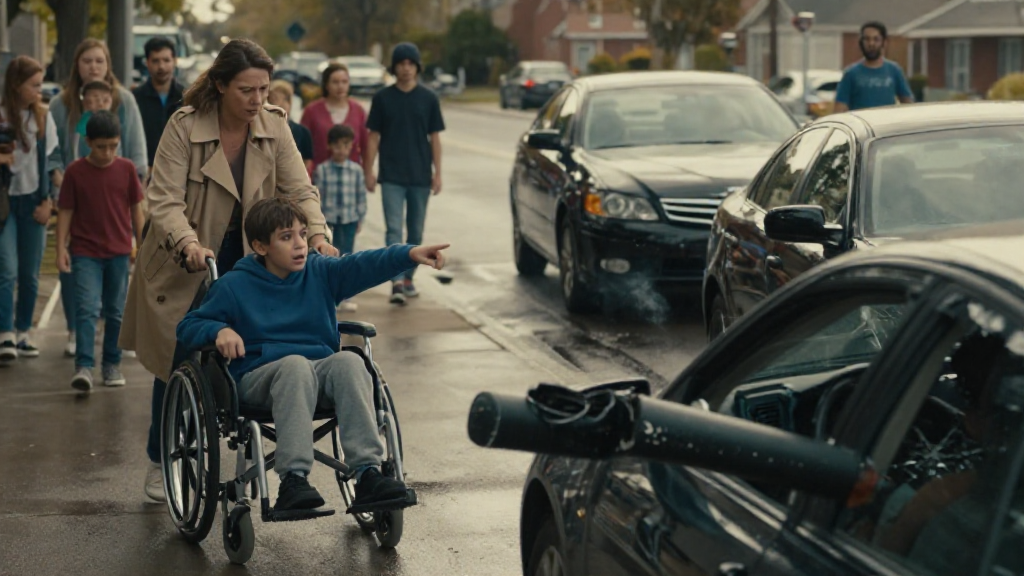
I pushed Leo’s wheelchair toward our usual spot near the side gate, navigating through the chaotic swarm of hyperactive children. The final dismissal bell had just rung, and the noise of shouts, whistles, and slamming car doors was deafening.
Leo sat perfectly still. He almost always did.
Since he spent most of his life confined to that chair, he couldn’t join the frantic games of tag or the chaotic race to the playground. While other kids burned off their energy, my son had quietly become a master observer.
He sees the things the rest of us are simply too rushed to notice, I often thought, watching his sharp blue eyes meticulously scan the crowd.
Usually, his intense, quiet gaze just broke my heart. It was a daily, painful reminder of the childhood he was forced to watch from the sidelines.
But yesterday, the atmosphere felt entirely different. The air between us felt thick, charged with an undeniable, heavy dread.
“Mom,” Leo whispered, his voice barely cutting through the roar of a nearby diesel engine.
“Just a minute, sweetie. I’m trying to get us safely past the crosswalk,” I replied, deeply distracted by a group of third-graders sprinting blindly into our path.
Suddenly, Leo grabbed the metal rims of his wheels, forcefully locking them in place. The abrupt, violent stop sent a sharp jolt of pain up my wrists.
I looked down, ready to scold him gently for the sudden brake. But the words completely died in my throat.
Leo’s knuckles were stark white as he gripped the black plastic armrests. His small, fragile body was entirely rigid, as tense as a coiled spring.
He wasn’t looking at the other kids. He wasn’t looking at the teachers.
His terrified, unblinking eyes were locked on a vehicle parked entirely out of place near the exit of Classroom 9.
“Leo, what’s wrong?” I asked, my maternal instincts instantly flaring to life.
Earlier that week, the playground monitors had scolded him for “just staring” at the street. They assumed he was daydreaming or acting out of frustration because he couldn’t play kickball.
They had no idea what his hyper-vigilance actually meant.
He didn’t stutter. He didn’t pull away or point a finger, clearly knowing better than to draw any unwanted attention to us.
“The black sedan, Mom,” he whispered, his voice trembling but terrifyingly clear. “It’s an older model. Tinted windows. No front plate.”
I followed his discreet gaze through the sea of completely oblivious, chatting parents.
There it was. A heavy, pitch-black car, idling silently and illegally right next to the second-grade pedestrian gate.
Nobody else had noticed it. The teachers were busy ushering children onto the yellow buses, and the neon-vested crossing guards were entirely focused on the main intersection.
“It’s been sitting there for exactly twelve minutes,” Leo continued, his voice dropping to a harsh, strained whisper. “And the driver isn’t waiting for a kid.”
Why is he paying such dangerously close attention? I thought, a cold, heavy knot forming deep in my stomach.
I knelt down to his eye level on the hot pavement, attempting to block his line of sight. I desperately wanted to calm what I hoped was just an overactive, anxious imagination.
“It’s probably just a parent waiting, Leo. Maybe they’re early, or maybe their kid got held back in class.”
“No,” Leo said, looking back at me with eyes that seemed decades older than his nine years.
He swallowed hard, his breathing turning shallow.
“Parents look at the doors. He hasn’t looked at the school once. He’s only watching the gap in the fence, and I saw exactly what he just pulled out from under the passenger seat.”
Chapter 2: The Weight of the Truth
“What did you see, Leo?” I asked, my voice cracking despite my desperate attempt to stay calm.
I kept my body positioned between his wheelchair and the idling black sedan, trying to act as a human shield without drawing attention.
Leo didn’t blink. His pale hands remained locked onto his armrests, his knuckles glowing stark white in the afternoon sun.
“It was heavy, Mom,” he whispered, his eyes darting frantically toward the dark, tinted window. “It wasn’t a phone. It was dark gray metal, and he had to use both hands to pull it up into his lap.”
A gun.
The word echoed in my mind, drowning out the chaotic noise of the schoolyard. My blood turned to ice water, freezing the breath in my lungs.
I slowly turned my head, trying to make my movement look like a casual glance over my shoulder.
The heavy, black car sat completely motionless. The engine let out a low, steady rumble, a predatory growl hidden beneath the sounds of laughing children and slamming bus doors.
Through the narrow crack in the driver’s side window, I could just make out the silhouette of a broad shoulder.
Leo was right. The driver’s head wasn’t angled toward the main exit where hundreds of kids were streaming out.
He was staring directly at the chain-link fence gap. The exact spot where the youngest, most vulnerable children were corralled before crossing the street.
I stood up instantly, my hands grabbing the rubber grips of Leo’s wheelchair with bone-crushing force.
“We’re leaving,” I said, my voice leaving no room for argument. “Right now.”
I spun the chair around, my heart hammering violently against my ribs. I needed to get Leo out of the open, but I also had to warn someone.
“Mrs. Gable!” I shouted, waving frantically at the second-grade teacher managing the crosswalk.
She turned, her face instantly dropping into a look of exhausted annoyance. She was the same teacher who had complained about Leo “staring inappropriately” earlier in the week.
“Not right now, Sarah,” Mrs. Gable called back, holding up a bright orange stop sign. “We need to keep the line moving. If Leo is having another episode, please take him to the quiet zone.”
Another episode.
Rage flared hot and fast in my chest, momentarily burning away the terror. They thought my son was just acting out because of his disability.
“It’s not an episode!” I yelled, abandoning all social decorum as I pushed the wheelchair straight toward her. “There is a strange man in that black sedan, and he has a weapon!”
The word hung in the air, instantly silencing the few parents standing immediately around us.
Mrs. Gable lowered her stop sign. The look of annoyance on her face didn’t fade; it morphed into deep, condescending disbelief.
“Sarah, please keep your voice down,” she hissed, marching over to us. “You are inciting a panic. That car belongs to Mr. Trent. He’s a neighborhood resident who parks there sometimes.”
“I don’t care who you think it is,” I fired back, my voice trembling. “Leo saw him pull a weapon from under the seat!”
Mrs. Gable sighed deeply, looking down at my son with a mixture of pity and frustration.
“Leo has a very active imagination, Sarah. We’ve discussed this. He sits on the sidelines all day, and he makes up stories for attention.”
I opened my mouth to scream at her, to force her to look at the dark, idling car.
But before I could form the words, a sharp, metallic clack echoed over the noise of the crowd.
It was the unmistakable sound of the sedan’s heavy door unlatching and kicking open.
Chapter 3: The Cover-Up
The metallic clack echoed like a gunshot in my mind. The heavy, dark door of the sedan swung open, casting a long, ominous shadow across the sun-baked concrete.
Mrs. Gable froze. Her condescending lecture died instantly on her lips as she finally turned toward the vehicle, her eyes narrowing against the harsh afternoon glare.
A man stepped out into the stifling heat. He was broad-shouldered and thick-necked, wearing a faded gray work shirt that clung tightly to his sweating frame.
But his hands were completely empty.
He didn’t have a weapon. He wasn’t aiming a dark, metallic object at the vulnerable children clustered near the chain-link fence.
Instead, he slowly crouched down by his front driver’s side tire. He began casually inspecting the rubber tread, looking exactly like an ordinary, frustrated commuter dealing with a sudden flat.
He’s lying, I thought, my heart hammering a frantic, painful rhythm against my ribs. He heard me screaming.
He casually glanced over his broad shoulder, his eyes locking directly onto mine through the scattered crowd of parents.
For a fraction of a second, his ordinary facade slipped. His gaze was cold, hollow, and filled with a silent, terrifying warning that made my stomach plummet.
Then, he stood up, smiled warmly at Mrs. Gable, and offered a short, apologetic wave.
“Just a low tire, folks!” the man called out, his voice unnervingly smooth and cheerful. “Sorry if I was blocking the gate. Just wanted to be safe before hitting the highway.”
The suffocating tension that had paralyzed the immediate area evaporated in an instant. A collective, embarrassed sigh of relief rippled through the surrounding parents, who quickly returned to checking their phones and grabbing their children’s backpacks.
Mrs. Gable spun back to face me. Her face was no longer a mask of exhausted annoyance; it was flushed with absolute, rigid fury.
“Are you satisfied, Sarah?” she hissed, her voice trembling with indignation. “You just tried to incite a mass panic over a local resident checking his tire.”
“He had something else,” Leo whispered desperately from his wheelchair.
My son’s small, pale hands were still gripping the armrests, his eyes glued to the man.
“Mom, I promise,” Leo pleaded, his voice cracking with panic. “He shoved it backward under the passenger seat right before he kicked the door open.”
“That is entirely enough, Leo!” Mrs. Gable snapped, pointing a strict, trembling finger down at my son. “I am reporting this disruption straight to Principal Harris. We cannot have you screaming about weapons in a crowded school zone just because you feel left out!”
I stepped in front of the teacher, my own anger flaring hot and blinding. I told her exactly where she could shove her report, grabbed the handles of Leo’s chair, and briskly pushed him toward our car, ignoring the stares of the other parents.
The rest of the afternoon was a humiliating, agonizing blur of administrative red tape. We were marched into the principal’s office, where I was lectured for twenty agonizing minutes about “projecting my personal anxieties” onto my disabled son.
Principal Harris sat behind his massive oak desk, steepling his fingers as he officially threatened Leo with a three-day suspension. He called it a necessary measure for “inciting a panic and disrupting the peace of the student body.”
They demanded we keep quiet about the entire ordeal. They looked at us like we were nothing more than neighborhood hysterics desperate for attention.
I wanted to scream. I wanted to drag both of them out to the sweltering parking lot and force them to tear that black sedan apart.
Instead, I squeezed Leo’s trembling shoulder, nodded silently at the principal, and wheeled my son out in defeat. I spent the entire drive home with my eyes glued to the rearview mirror, terrified that the heavy, tinted car was trailing us.
But the true nightmare didn’t begin until much later that night, long after Leo had cried himself into a restless sleep.
I sat alone in my dark kitchen, unable to shake the cold, lifeless look the driver had given me over his shoulder. Desperate for any shred of proof, I logged into our neighborhood’s shared security camera portal, knowing the camera on the corner of Elm Street pointed directly at the school’s side gate.
I scrubbed through the timeline to the exact minute of dismissal. I zoomed in on the grainy, black-and-white footage, praying to see an empty, quiet street.
Instead, my blood ran completely cold as I watched the black sedan return to the exact same spot in the dead of night, and the driver finally pull the heavy, metallic object out into the open.
Chapter 4: What the Camera Caught
The glow of my laptop screen was the only light in the suffocating darkness of my kitchen. The faint, mechanical hum of the refrigerator felt deafening in the dead silence of the house.
I leaned closer to the monitor, my nose almost touching the cold glass. My finger hovered over the spacebar, pausing the grainy, black-and-white security footage from the Elm Street corner camera.
I’m not crazy, I whispered to myself, the words trembling out into the empty room. Leo wasn’t lying.
The timestamp in the top right corner glowed a harsh, neon white: 02:14 AM. The black sedan was parked in the exact same spot by the chain-link fence, completely shrouded by the heavy shadows of the large oak trees.
I took a deep, shaky breath and hit play.
The driver’s side door swung open again, but this time, there were no oblivious parents around to put on a theatrical show for. There was no cheerful smile or casual wave to excuse his presence.
The broad-shouldered man stepped out onto the empty street. He reached back into the vehicle, leaning his entire upper body across the passenger seat, exactly where Leo had seen him struggling earlier.
When he pulled back out, the moonlight caught the dull, terrifying glint of dark gray metal.
It was long. It was incredibly heavy. And it was unmistakable.
He wasn’t holding a car jack or a tire iron. He was holding a high-powered tactical rifle, followed immediately by a thick, heavy duffel bag that dragged clumsily across the asphalt.
My breath caught in my throat, violently choking me. My hands flew to my mouth to stifle a scream that threatened to wake Leo sleeping upstairs.
On the screen, the man walked purposefully toward the second-grade gate. He didn’t try the locked handle. Instead, he moved into the deep shadows of the school’s large outdoor HVAC units, situated just beneath the classroom windows.
He produced a crowbar from the bag and violently pried open the heavy metal grating of the utility crawlspace. Methodically, he shoved the rifle and the duffel bag deep into the darkness under the school’s floorboards.
He’s hiding it for tomorrow, my brain screamed, the horrific realization hitting me with the force of a speeding freight train. He’s coming back when the morning bells ring.
I didn’t wait to watch him drive away. I lunged across the kitchen island, frantically snatching my cell phone from the marble counter.
My fingers were shaking so violently that I dropped the phone twice before finally dialing 911.
“Emergency operator, what is your location?” the calm, steady voice on the other end answered.
“Oakridge Elementary,” I gasped, tears of pure, unadulterated terror finally streaming down my face. “There’s a man hiding weapons under the second-grade classrooms right now. I have it on video. You have to get there!”
The next twenty minutes were a chaotic blur of pure adrenaline and agonizing fear. I ran upstairs, barricaded Leo’s bedroom door, and sat on the floor beside his bed in the pitch black.
I watched out his second-story window as a silent fleet of police cruisers descended onto Elm Street. They killed their sirens, completely bathing the neighborhood in a chaotic, flashing sea of red and blue lights.
Dozens of officers swarmed the school grounds, their heavy flashlights cutting aggressively through the darkness. It didn’t take them long to find the broken utility grate by the side gate.
At exactly 4:00 AM, my phone buzzed on the nightstand. It was a direct call from the local precinct captain.
“Ma’am, we have the suspect in custody. We apprehended him two blocks away, parked in an alleyway, just watching the school from his vehicle,” the captain’s heavy voice echoed through the speaker.
He paused, letting out a long, ragged exhale that conveyed more emotion than any police statement ever could.
“You and your son saved a lot of lives tonight. We found a fully loaded assault rifle and hundreds of rounds of ammunition stashed directly beneath the primary wing.”
A heavy, suffocating weight finally lifted from my chest, instantly replaced by a fierce, undeniable pride. My disabled nine-year-old son, the boy everyone ignored, had seen the one thing that mattered.
The next morning, the school board didn’t call to enforce my son’s suspension. Instead, Principal Harris and Mrs. Gable stood awkwardly in my living room, looking completely utterly humiliated and pale with shock.
They offered endless, stuttering apologies. They frantically promised systemic changes, new security protocols, and begged for our forgiveness.
But I didn’t care about their hollow words or their sudden realization of my son’s worth. I walked right past them, pushing Leo’s wheelchair out onto the front porch to enjoy the warm morning sun.
He looked up at me, his sharp blue eyes calm, steady, and observant as always.
“They found it, didn’t they?” Leo asked quietly, placing his small hand over mine.
“Yes, sweetie,” I smiled, kneeling down to hug him tighter than I ever had before, my tears soaking his shoulder. “They found it, all because you never stop watching.”
Thank you for reading this story! I hope you enjoyed the suspense and the journey of Leo and his mother. If you liked this thrilling tale, let me know your thoughts in the comments below!