I Watched My Neighbor Pour Boiling Water Over My Golden Retriever Just Because He Wagged His Tail For A Scrap Of Food. She Didn’t Know That My Dog Was The Only Thing Keeping A Very Powerful, Very Dangerous Man From Tearing This Neighborhood Apart. – storyteller
Chapter 1: The Tether Snaps
Pinecrest Lane was supposed to be a graveyard for my past. A quiet, meticulously manicured suburban purgatory where a dangerous man could finally disappear.
For three years, I had successfully played the role of the unassuming neighbor. I kept my lawn mowed, paid my HOA fees on time, and never spoke of the violent life I had left behind.
They don’t know what you are, I would remind myself every morning, staring at the faded scars crossing my chest in the bathroom mirror. Keep it that way.
My only companion in this self-imposed exile was Buster. He was a two-year-old Golden Retriever with eyes like pooled honey and a heart entirely too pure for this ugly world.
Buster wasn’t just a pet to me. He was the heavy, unbreakable chain keeping the darkest, most terrifying parts of my soul securely locked away.
Whenever the cold, familiar itch of my old life started creeping into the back of my mind, Buster would shove his wet nose into my palm. He was my anchor to humanity.
Next door lived Martha Higgins. She was a bitter, deeply miserable woman whose soul seemed to curdle a little more with each passing day.
Martha despised anything that dared to be happy in her general vicinity. She complained about the neighborhood children laughing, the morning birds singing, and most of all, she complained about Buster.
It was a quiet Tuesday afternoon. The suburban air was thick with the peaceful scent of cut grass and blooming jasmine.
I was kneeling in the dirt of my garden, quietly fixing a broken sprinkler head. I was trying to ignore the dull, phantom ache in my right shoulder—a souvenir from a life I was trying to forget.
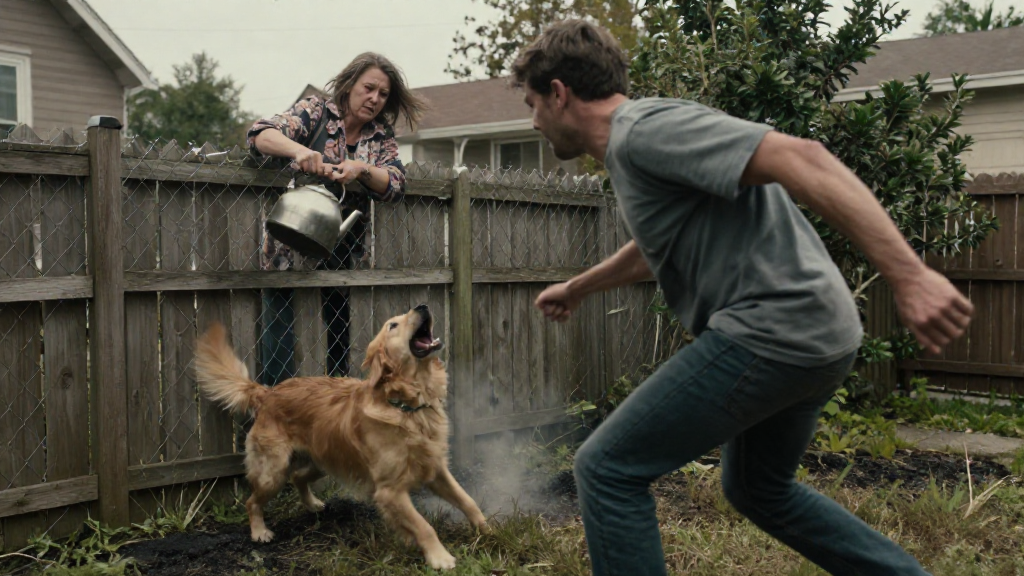
Buster was trotting happily along the low, wooden chain-link fence separating our properties. His tail was a rhythmic metronome of pure joy, thumping a steady beat against the wooden slats.
Martha was standing on her back patio, wearing a faded floral apron. She had just accidentally dropped a small, burnt sausage scrap onto the grass right near the fence line.
Buster, ever the eternal optimist, pressed his golden snout against the small gap in the wood. He let out a soft, polite whine, his tail wagging furiously at the prospect of a free treat.
“Shoo! Get away from my yard, you filthy mutt!” Martha hissed, her voice dripping with unwarranted venom.
Buster didn’t understand cruelty or malice. He just wagged his tail harder, giving a small, friendly bark as he looked up at her.
Just leave him be, Martha, I thought to myself, wiping dirt from my jeans and rising to my feet to call my dog back inside.
But Martha didn’t just walk away. She turned toward her patio table, her bony hands wrapping tightly around the handle of her heavy, steaming metal tea kettle.
I froze in place. The logic of what I was witnessing didn’t immediately process in my mind.
“Let’s see if this finally teaches you not to beg,” she sneered, her eyes narrowing with malicious intent.
She stepped forward, aggressively tilting the spout of the kettle directly over the wooden fence.
A thick, cascading sheet of boiling water rained down directly onto Buster’s unsuspecting back.
The sound that tore from my dog’s throat was something that will haunt me until the day I die. It wasn’t a bark or a yelp; it was a high-pitched, human-like scream of absolute agony.
Buster scrambled backward, thrashing violently in the dirt as he desperately tried to escape the burning. Plumes of white, hissing steam rose from his beautiful golden coat as the scalding water melted directly into his skin.
My heavy gardening trowel slipped from my numb fingers. It hit the concrete patio with a hollow, ringing clatter.
Martha stood there, casually holding the dripping kettle. She watched the dog writhe and whimper in the dirt, a cruel, entirely satisfied smile playing on her thin lips.
Then, she slowly looked up from the suffering animal and finally met my eyes through the fence.
The quiet, polite neighbor she had known for three long years vanished in an instant. The man standing in the garden was someone else entirely.
My anchor was broken, and the monster was finally off its leash.
Chapter 2: The Smell of Scorched Earth
The world narrowed down to the agonizing sound of Buster’s cries.
I vaulted over the low chain-link fence, my heavy boots hitting Martha’s meticulously manicured lawn with a dull thud. I didn’t even look at her.
Not yet. He comes first.
I dropped to my knees beside my thrashing dog. The smell of wet, scorched fur hit my nostrils, a sickeningly sweet and metallic scent that instantly transported me back to blood-soaked rooms I swore I’d never revisit.
Buster was snapping his jaws in blind panic. His normally gentle honey-colored eyes were wide and unseeing, rolling back in his head as the scalding pain overwhelmed his fragile senses.
“Easy, buddy,” I whispered, my voice an unnatural, dead calm. “I’ve got you. I’m right here.”
I stripped off my thick flannel shirt in one fluid motion. I draped it gently over his blistering back, hyper-aware of the angry, inflamed red skin peeling underneath.
Martha took a clumsy step backward, her patio chair scraping loudly against the concrete.
“He—he shouldn’t have been begging,” she stammered, her cruel confidence suddenly wavering in the face of my absolute, terrifying silence. “I have the right to protect my property.”
I didn’t answer. I didn’t even blink.
I scooped Buster’s seventy-pound frame into my bare arms as carefully as humanly possible. He let out a sharp whimper, burying his wet, trembling snout deeply into my neck for comfort.
I turned and walked back toward my house. I could feel Martha’s terrified eyes tracking my every movement, but her presence no longer registered in my mind.
She was already a ghost; she just didn’t know it yet.
The drive to the emergency vet clinic was a blur of calculated, reckless speed.
My bare hands gripped the steering wheel with bone-crushing force, the leather creaking in protest under the pressure. In the passenger seat, Buster lay wrapped tightly in my shirt, his shallow, ragged breathing filling the silent cab of the truck.
I didn’t take my eyes off the asphalt. I couldn’t.
If I let my mind wander for even a fraction of a second, the carefully constructed dam holding back my old life would shatter entirely. I needed to remain cold. I needed to remain surgical.
The clinic’s glass doors slid open, and I carried him inside. The sterile, biting smell of bleach and rubbing alcohol grounded me instantly.
“Scalding water,” I told the wide-eyed receptionist, my tone flat, commanding, and purely informational. “Right flank and back. Immediate trauma care required.”
They rushed him back on a stainless steel gurney. I stood alone in the brightly lit, sterile waiting room, my hands stained with garden dirt and my chest bare, mapping out the architecture of my neighbor’s house in my mind.
For three agonizing hours, I sat completely motionless in a plastic chair, staring at a faded poster of a smiling golden retriever on the opposite wall. The bitter irony tasted like ash on my tongue.
Finally, the lead veterinarian emerged from the swinging double doors. Her face was incredibly grim, her green surgical scrubs stained with water and silver sulfadiazine ointment.
“He’s stable,” she said softly, pulling off her latex gloves. “Second and third-degree burns. He’s in a massive amount of pain, but we have him heavily sedated. He’s going to make it.”
A small, terrifying knot of tension released in my chest. Buster would live.
“Was this an accident?” the vet asked, her eyes narrowing suspiciously at my frighteningly stoic demeanor. “Because deliberate chemical or thermal burns like this… we are required by law to report them to animal control.”
“It was an incident,” I replied, my voice devoid of any human warmth. “Don’t bother with the paperwork. It won’t ever happen again.”
I left Buster at the clinic for overnight observation, paying the massive bill in cash from my wallet.
Walking back into my empty, painfully dark house, the absence of his clicking nails on the hardwood floor was absolutely deafening.
I didn’t turn on the lights. I walked straight past the kitchen. I walked past the quiet living room.
I went directly to the master bedroom closet, dropping to one knee and pulling up the edge of the plush carpet. There, perfectly hidden beneath the false floorboards, rested a heavy, matte-black steel biometric safe.
I pressed my thumb against the glowing green scanner. It chirped cheerfully, a stark contrast to the heavy, oiled metallic clack of the locking mechanism disengaging.
You promised you were done, a small, fading voice in my head whispered.
I reached inside the cold metal box, bypassing the banded stacks of hundred-dollar bills and the fake passports. My calloused fingers wrapped around the textured grip of a suppressed tactical sidearm, pulling it out alongside a heavy roll of industrial zip-ties.
Some promises were meant to be broken.
Chapter 3: The Ghost in the Suburbs
The night air was deceptively cool, carrying the faint scent of blooming night-jasmine and chlorine from a neighbor’s pool.
It was the smell of absolute safety. The smell of a community that had never known true, unfiltered terror.
I stood in my dark kitchen, staring through the window at Martha’s house. Her living room lights were still on, casting a warm, inviting yellow glow across the perfectly trimmed hedges.
She’s probably watching her late-night talk shows, I thought, a cold, humorless smile touching my lips. Probably drinking chamomile tea and feeling perfectly justified in her cruelty.
I slipped out the back door, moving with a silent, fluid grace that my heavy boots shouldn’t have allowed.
Years of muscle memory took over completely. My breathing slowed to a deliberate, shallow rhythm, and my heartbeat leveled out into an icy, steady cadence.
I was no longer the polite, unassuming neighbor who fixed sprinklers and waved at the mailman. I was the phantom I had spent three years trying to bury.
The low wooden fence that had been the site of Buster’s agony was easily bypassed. I stepped over the very spot where the ground was still damp from the boiling water.
A fresh wave of white-hot rage flared in my chest, but I ruthlessly tamped it down. Anger makes you sloppy. Cold execution requires absolute detachment.
Martha’s back door was locked with a standard, cheap deadbolt. It was the kind of lock that gave suburbanites a false sense of security, completely useless against anyone who actually wanted to get inside.
I didn’t even need my lock picks. I simply slid a stiff piece of tensioned plastic from my pocket, wedging it expertly between the door frame and the latch.
With a muted, almost imperceptible click, the door gave way.
I stepped into her pristine kitchen. The house smelled intensely of bleach and stale potpourri.
The soft, blue flicker of a television screen illuminated the hallway. I could hear the canned laughter of a studio audience echoing from the living room.
I moved down the hallway, the heavy suppressed pistol hanging loosely at my side. My footsteps made absolutely zero sound on her plush, expensive carpet.
Martha was sitting in her floral recliner, her back to me. She was wearing a thick velvet robe, a half-empty teacup resting on the side table beside her.
She was completely oblivious. The ultimate arrogance of a predator who truly believed she had no natural enemies.
I stepped fully into the room, standing just two feet behind her chair.
“The water was exactly two hundred and twelve degrees, Martha,” I said softly, my voice barely above a whisper, yet it cut through the noise of the television like a razor.
Martha gasped violently, her teacup shattering against the hardwood floor as she tried to leap out of the chair.
She never even made it to her feet.
In one blindingly fast motion, my left hand clamped down on her shoulder, pinning her back into the cushions with bone-bruising force. Before she could open her mouth to scream, my right hand flashed forward, securing a thick industrial zip-tie around her wrists and the wooden armrest.
Zip.
The heavy plastic ratcheted tight in a fraction of a second. She was entirely immobilized.
“W-what are you doing?!” she shrieked, her eyes wide with a terror so profound it made her pale skin look almost translucent. “I’ll call the police! I’ll scream!”
I casually walked around to the front of the chair. I didn’t look angry. I didn’t look unhinged.
I calmly placed the heavy, matte-black suppressed pistol directly onto her glass coffee table with a heavy, metallic thud.
Martha’s eyes locked onto the weapon, her jaw dropping open in silent, suffocating horror. The scream died instantly in her throat.
“You aren’t going to scream, Martha,” I stated evenly, pulling up a small ottoman and sitting directly across from her. “And you aren’t going to call the police. Because if you do either of those things, this conversation ends, and my work begins.”
She was hyperventilating now, trembling so violently the entire recliner shook with her.
“Who… what are you?” she choked out, tears of sheer panic welling in her eyes. “You’re just the gardener… you’re just the quiet guy from next door…”
I leaned forward, resting my elbows on my knees. I let her stare into my eyes, letting her see the vast, empty darkness that Buster’s warm presence usually kept hidden.
“I tried very, very hard to be the quiet guy, Martha,” I whispered, the coldness in my voice dropping the temperature in the room. “That dog was the only thing keeping me polite. He was the only tether I had left to the human race.”
I picked up the pistol, feeling the comforting, familiar weight of the steel. I didn’t point it at her; I just held it, tracing the suppressor with my thumb.
“And today, Martha, you burned my tether.”
Chapter 4: The Terms of Survival
The silence in Martha’s living room was absolute, broken only by the rhythmic, agonizingly slow ticking of her antique grandfather clock.
I sat completely motionless on the ottoman, watching the stark realization wash over her pale, terrified face.
She wasn’t looking at the quiet gardener anymore. She was staring directly into the abyss, and she finally understood that the abyss was looking back.
She thought the world was a safe, predictable place, I mused, tilting the heavy, suppressed pistol slightly so the hall light caught the matte-black steel. She thought cruelty had no consequences.
“Please,” Martha whimpered, her voice cracking as a single tear carved a path down her powdered cheek. “I’ll pay for the vet bills. I’ll do whatever you want.”
I didn’t smile. I didn’t offer her an ounce of comfort or humanity.
“You don’t have enough money to buy your way out of this room, Martha,” I replied, my tone flat and devoid of any emotion. “This isn’t a negotiation.”
I stood up slowly, towering over her trembling form in the floral recliner. I slipped the heavy pistol into the waistband of my jeans.
Martha squeezed her eyes shut, bracing for a gunshot that was never going to come.
“I’m not going to kill you,” I stated calmly, watching her chest heave as she let out a ragged, desperate gasp of relief.
“Killing you brings police,” I continued, leaning down until my face was only inches from hers. “It brings detectives, and questions, and a spotlight I simply cannot afford.”
I pulled a small, razor-sharp pocketknife from my jacket. With one swift, precise motion, I sliced through the heavy industrial zip-tie binding her right wrist to the chair.
She snatched her hand back as if I had burned her, rubbing the red welt on her skin.
“But you are not going to live here anymore,” I whispered, the cold menace in my voice freezing her in place. “You are going to list this house for sale by tomorrow morning.”
Martha stared at me, too stunned and terrified to even nod.
“You are going to pack your bags tonight, and you are going to stay at a hotel,” I instructed, my eyes locking onto hers with predatory intensity. “You will not speak to the neighbors. You will not look at my property.”
I took a slow step back toward the hallway.
“And if you ever, ever own another animal as long as you live,” I added, letting the silence hang heavy in the room for a long, agonizing moment.
“I will know, and I will come back to finish this conversation.”
The morning sun cast long, golden rays across the sterile linoleum floor of the veterinary clinic.
I sat on the edge of a stainless steel observation table, gently running my hand over Buster’s unbandaged head. He was awake, heavily medicated, and wrapped tightly in pristine white gauze.
Despite the agonizing pain he was surely in, the moment he saw me walk through the door, his tail had given a weak, rhythmic thump against the metal table.
He shouldn’t forgive so easily, I thought, a tight, painful knot forming in my chest. The world doesn’t deserve this kind of loyalty.
“He’s a fighter,” the lead veterinarian said softly, stepping into the room with a fresh clipboard. “His vitals are strong. We can discharge him by tomorrow afternoon.”
I nodded silently, pressing my forehead gently against Buster’s warm snout. He let out a soft, contented sigh, his honey-colored eyes fluttering shut.
“Thank you,” I told the doctor, my voice finally sounding like the quiet, unassuming neighbor I had worked so hard to become.
By noon the next day, a bright yellow moving truck was parked aggressively in Martha’s driveway.
I stood on my front porch, holding a steaming mug of black coffee, watching as movers frantically hauled her heavy, floral furniture out the front door.
Martha was nowhere to be seen. True to my word, she had vanished into the night, leaving behind the quiet suburban purgatory she had tried to poison.
Buster was sleeping soundly on his plush orthopedic bed in the living room, surrounded by new toys and healing in the safety of our home.
I took a slow sip of my coffee, feeling the warm, familiar breeze of Pinecrest Lane brush against my face. The neighborhood was peaceful again.
My anchor was battered, but it was still holding. I had stepped back from the edge of the abyss, choosing the love of a good dog over the blood of a cruel woman.
But as I watched the moving truck drive away, I felt the cold, comforting weight of the steel safe resting beneath my floorboards.
I was a ghost once more, but now the monster knew exactly how to slip its leash.
Thank you for reading! If you enjoyed this story, please like, comment, and share. Let me know what raw idea or prompt you’d like to see brought to life next!