Nobody Understood Why The Enemy Knew Our Highly Secret Logistics Route, Until Forty Gunmen Pinned Our Rangers And I Saw What Was Underneath Their Masks. – storyteller
Chapter 1: The Phantom Corridor
Heat shimmered off the jagged rocks of the canyon like a living, breathing entity. My boots crunched against the dry earth, every step kicking up a plume of red dust that coated my throat. We shouldn’t even be here, I thought, wiping a thick layer of sweat and grime from my tactical goggles.
Route Whiskey-Niner didn’t exist on any official map. It was a phantom corridor, a strictly classified logistics vein meant to bypass the hostile strongholds bleeding our forces dry in the valley below.
“Keep your spacing, eyes on the ridgeline,” Captain Miller’s voice crackled through the secure comms, barely louder than a breath.
“Copy that, boss,” I whispered back, my grip tightening around my rifle until my knuckles turned white.
Only four people in the entire theater of operations knew the coordinates and timing of this resupply convoy. The clearance level required to even glance at the briefing documents was astronomical, restricted to the highest echelons of High Command.
Yet, as our heavy transports navigated the narrowest choke point of the ravine, a heavy, unnatural silence fell over the convoy. The local wildlife had gone completely dead, a primal warning that we were no longer the apex predators in this canyon.
Then, the sky tore open.
The first armor-piercing round didn’t just hit the lead transport truck; it completely vaporized the engine block. A concussive shockwave of heat, shattered glass, and twisted metal violently threw me into the dirt.
“Contact! Contact front and elevated!” someone screamed, their voice instantly drowned out by the deafening roar of coordinated automatic fire.
This wasn’t the erratic, spray-and-pray tactic of the local insurgents we had been fighting for months. The incoming fire was terrifyingly disciplined, a perfectly executed L-shaped ambush designed to trap us in the kill zone and eliminate us systematically.
I scrambled behind the shredded tires of a logistics transport, the air around me snapping and hissing with near misses. Dust and debris rained down, blinding my vision as I desperately tried to locate our attackers through the smoke.
“They’re on the ridges! Full squad strength!” Miller roared over the din, firing short, controlled bursts into the rocky outcroppings above.
I peered through the settling smoke, raising my weapon, and felt my stomach drop into a bottomless abyss.
There weren’t just a few snipers up there. Over forty figures clad in pitch-black, unmarked tactical gear were moving down the canyon walls with horrifying synchronization.
Their faces were completely obscured by heavy ballistic masks, reflecting the harsh desert sun like blank, featureless skulls. They bounded from cover to cover like ghosts, silently communicating through intricate hand signals that looked disturbingly familiar to my own unit’s training.
How did they know? The question pounded in my skull, louder than the relentless gunfire. How the hell did they know we were coming?
A masked gunman broke from cover, sliding recklessly down a steep gravel embankment to flank our pinned down position. Miller adjusted his aim and fired, taking the figure down with a clean, three-round burst to the chest armor.
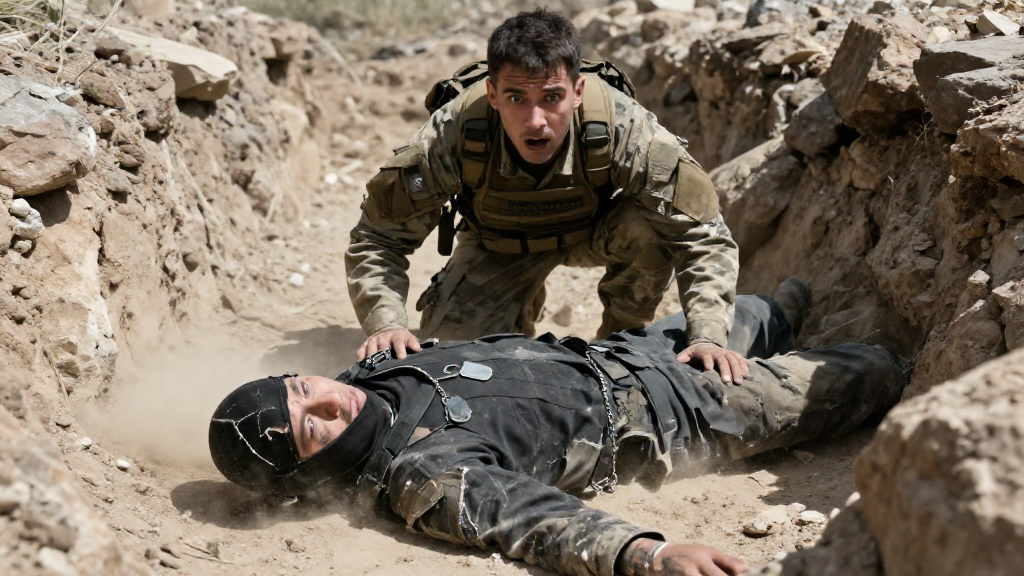
The body tumbled down the jagged rocks, violently catching on a coil of discarded razor wire before slamming heavily into the dirt just three feet from my boots.
The impact was brutal. The sharp metal wire dug deep into the tactical fabric, violently tearing the thick black ballistic mask away from the dead man’s face.
I crawled forward through the mud, my breathing shallow and ragged, desperate to see the face of the phantom who had just ambushed a top-secret Ranger convoy.
The dust settled over the lifeless body, revealing a face I knew, and my entire world shattered in a single, terrifying heartbeat.
Chapter 2: Ghosts in the Dirt
The dust swirled around the lifeless face, mocking my sanity. I blinked aggressively, rubbing the grit from my eyes, desperate for the harsh desert sun to be playing a cruel optical illusion.
But the face remained unchanged.
It was Sergeant First Class Elias Thorne.
This is impossible, my mind screamed, a cold sweat breaking out across my spine despite the suffocating, ambient heat of the canyon. Thorne is dead. I was a pallbearer at his funeral.
Exactly six months ago, Thorne was officially declared Killed in Action during a catastrophic, high-casualty extraction in the Korengal Valley. I had stood at attention in the rain and personally watched his flag-draped casket get lowered into the earth.
Yet here he was, bleeding out in the dirt of a highly classified transit corridor, wearing the unmarked tactical gear of the enemy forces that were currently tearing my unit to shreds.
I crawled inches closer, the deafening roar of incoming gunfire fading into a muted, distant buzz as severe tunnel vision took over my senses.
His skin was unnaturally pale, devoid of the rugged, sun-baked tan he had always carried, but the identifying physical markers were undeniable. The jagged, distinct scar cutting vertically through his left eyebrow. The faded ink of crossed rifles peeking out from the collar of his black tactical undershirt.
My trembling hands reached out, brushing aside the heavy ceramic plates of his chest rig to find the silver chain resting against his collarbone. I pulled the cold metal dog tags free from the blood-soaked fabric.
THORNE, ELIAS J. O POS.
“Jax! Move your ass!” Captain Miller’s roar shattered my paralyzing trance.
The command was instantly followed by the deafening crack of a high-caliber bullet striking the truck’s armored wheel hub, just inches from my right ear.
I couldn’t move. My lungs refused to draw air.
Miller abandoned his firing position, sliding recklessly through the mud and grabbing me by the heavy nylon of my shoulder harness. He hauled me violently backward just as a fragmentation grenade detonated exactly where I had been kneeling seconds prior.
A wave of concussive force, dirt, and jagged shrapnel rained down on us like deadly hail.
“Are you hit? Talk to me!” Miller yelled, his own face covered in a thick mask of dust and a fresh graze of blood on his cheek.
“It’s him, Cap,” I stammered, my voice cracking as I pointed a shaking, dirt-caked finger at the corpse lying in the wire. “It’s Thorne.”
Miller’s frantic eyes darted to the body. His hardened, stoic expression immediately fractured, the seasoned commander momentarily replaced by a man looking directly at a ghost.
“That’s a negative, Jax. Thorne’s gone. It’s a psychological tactic, a body double—”
“Look at the tags! Look at the neck scar!” I screamed, the raw panic finally bubbling over into full-blown hysteria.
Miller hesitated, his chest heaving, then lunged forward. He grabbed the bloodied silver tags still clutched in my fist, reading the stamped metal.
His jaw clenched so tight I thought his teeth would shatter.
Suddenly, the synchronized, deafening automatic fire from the canyon ridges ceased entirely.
The silence that followed was heavier and more terrifying than the chaos of the ambush. It wasn’t a retreat; it was a deliberate, tactical pause.
They were repositioning. They were closing the final net around our disabled convoy.
Then, the absolute impossible happened.
Our secure, heavily encrypted comms unit—a localized channel so tightly guarded it required daily rotating biometric keys—crackled to life with a sharp burst of static.
A voice came through my earpiece. It was cold, incredibly calm, and intimately familiar.
“Echo actual, this is Vanguard-One,” the voice stated clearly, using Thorne’s officially retired, localized callsign.
Miller and I locked eyes, the remaining color draining from our faces as the reality of the situation crashed down on us.
“Drop your weapons, Jax. We only came for the cargo.”
Chapter 3: The Payload
The radio transmission hung in the air, heavier than the suffocating canyon heat. My brain flatlined, entirely unable to process the calm, authoritative voice of a man I had buried six months ago.
“Thorne?” I whispered, my voice trembling so violently I barely recognized it. “Elias… is that you?”
It can’t be. This is a trick. Advanced psychological warfare. Voice modulation.
But the localized, biometric-locked comms channel couldn’t be hacked from the outside. The key had to be physically present.
“Stand down, Jax. I won’t ask twice,” the voice crackled back, the familiar cadence and slight Texas drawl absolutely unmistakable.
Captain Miller violently ripped the earpiece from my head, his eyes burning with a frantic, desperate intensity.
“Vanguard-One, this is Echo Actual. Identify yourself!” Miller barked into his own transmitter, his hand instinctively dropping to his sidearm.
A low, dry chuckle echoed through the comms. It was a sound I had heard a hundred times around campfires in the Korengal Valley.
“Cut the official bullshit, Cap. You know exactly who this is. And you know exactly why we’re here.”
Miller’s face went completely ashen, the remaining color draining beneath his mask of sweat and dirt. He looked frantically toward the rear of our crippled convoy, staring specifically at the heavily armored, windowless transport truck we had been ordered to protect with our lives.
“You’re not getting it, Elias,” Miller replied, his voice dropping to a dangerous, icy register. “I’ll detonate the primary asset before I let you take it.”
Detonate it? The words hit me like a physical blow.
Our mission briefing stated we were escorting high-value mechanical parts and classified communication relays for a forward operating base. You don’t rig communication relays with self-destruct charges.
“Cap… what the hell is he talking about?” I asked, my grip tightening on my rifle. “What’s in the truck?”
Miller ignored me. He frantically tapped a complex sequence into his wrist-mounted tactical pad. A harsh red light on the exterior chassis of the armored transport began to pulse aggressively.
Outside our shallow trench, the canyon remained terrifyingly silent. The red dust had finally settled, revealing the sheer number of masked gunmen holding strict positions on the surrounding ridges.
They had us completely boxed in, their weapons trained steadily on our shredded tires and blown-out engine blocks, yet nobody was firing.
“They aren’t going to shoot,” Miller muttered to himself, his eyes darting frantically between the cliffs and his blinking wrist pad. “They need the payload completely intact.”
“Sir, I am asking you a direct question,” I said, stepping closer and physically grabbing his shoulder. “What are we dying for today?”
Miller finally looked at me, a deep, sorrowful exhaustion etching new lines into his dirt-caked face. He didn’t look like a hardened Ranger commander anymore; he looked like a man standing at the gallows.
“It’s not hardware, Jax. It’s a prisoner transfer.”
Before my mind could process the statement, the heavy hydraulic doors of the primary armored transport hissed loudly. They unlocked with a massive, metallic clank that echoed off the canyon walls.
The thick steel ramp slowly lowered into the blood-stained dirt, revealing the pitch-black interior of the climate-controlled cargo bay.
I raised my weapon, aiming into the dark, expecting a high-value terrorist leader or a captured insurgent warlord to emerge.
Instead, a frail figure stepped out into the harsh desert sunlight, wearing standard-issue military fatigues, their hands tightly bound in heavy kinetic shackles.
My breath caught sharply in my throat, and every single lie I had ever been told by the military suddenly came crashing down.
Chapter 4: The Dead Don’t Bleed
The heavy iron shackles clinked together, an excruciatingly loud sound in the dead silence of the canyon. The frail prisoner slowly raised their head, squinting painfully against the blinding desert sun.
I stopped breathing. The rifle in my hands suddenly felt like it weighed a thousand pounds, my grip growing weak and trembling.
It couldn’t be.
The face looking back at me was battered, bruised, and hollowed out by months of starvation, but I knew those piercing green eyes. It was First Lieutenant Sarah Jenkins, our squad’s former lead medic.
She had died in the exact same catastrophic ambush as Thorne. I had personally written the condolence letter to her parents, sitting up all night trying to find the right words to explain her sacrifice.
“Sarah?” I choked out, the name tearing at my dry throat like swallowed glass.
She didn’t respond to me. Her hollow, exhausted gaze was locked entirely on Captain Miller, and a look of pure, unadulterated hatred burned in her eyes.
“You’re a dead man, Miller,” she whispered, her voice a dry, rasping croak. “He came for me.”
I slowly turned to look at my commanding officer. Miller’s hand was hovering over his wrist-mounted tactical pad, his thumb trembling just millimeters from a glowing red detonation key.
“What the hell is going on, Cap?” I demanded, stepping backward and leveling my rifle directly at Miller’s chest. “Why is Jenkins in that truck? Why is she in chains?”
Miller swallowed hard, a heavy drop of sweat carving a muddy trail down his dirt-caked cheek. He refused to look at me, his panicked eyes darting frantically between Jenkins and the heavily armed figures on the surrounding ridges.
“Drop your weapon, Jax. That’s a direct order,” Miller spat, his voice laced with venom and desperation. “They aren’t who you think they are. They’re highly classified anomalies—subjects of a black-site biological project.”
The encrypted radio in my ear crackled violently back to life. Thorne’s cold, steady voice echoed through the earpiece once more.
“He’s lying, Jax,” Thorne said softly. “High Command needed immediate scapegoats for an off-the-books, multi-million dollar weapons sale to the enemy. They faked our deaths, threw us in a subterranean black site, and sold us out to cover their tracks.”
We bled and died for a flag that sold us for scrap metal. The horrific realization hit me like a physical blow, knocking all the air from my lungs.
“We managed to break out, Jax,” Thorne continued, the sound of heavy combat boots crunching on gravel echoing from the cliffs above. “And we came back to get Sarah. Tell Miller to step away from the transport, or my snipers will turn his head into a canoe.”
“I’ll do it!” Miller screamed, his military composure finally snapping into raw panic. “I’ll detonate the explosive collar on her neck! Command will have my head on a pike if I let her walk!”
I looked at Jenkins, a brave woman who had physically dragged me from the line of fire twice during our tours, now wearing a blinking explosive ring locked around her bruised throat. I looked at the bodies of the “insurgents” on the ridge—my supposed brothers in arms, forced to hunt their own just to survive.
My finger slipped heavily into the trigger guard.
“Stand down, Miller,” I said, my voice dropping to an eerily calm register as I rested my iron sights squarely on the center of his chest. “Let her go right now.”
Miller sneered, a desperate, feral look crossing his face as his thumb pressed down heavily toward the red key. “Traitor.”
I didn’t hesitate. I pulled the trigger twice.
The deafening cracks of my rifle echoed violently off the jagged canyon walls. Miller’s eyes went wide as the impact of the heavy rounds threw him violently backward into the dirt, his lifeless hand slipping off the tactical pad before the fatal signal could transmit.
The canyon silence returned, absolute, heavy, and terrifying. The thick red dust began to slowly settle over Miller’s bleeding body in the dirt.
From the high ridge line, over forty shadows in unmarked black tactical gear stood up in perfect unison. They began to descend the steep canyon walls, their weapons lowered, moving toward us like phantoms finally returning from the grave.
I lowered my smoking rifle, my hands shaking uncontrollably as Thorne reached the bottom of the rocky embankment. He pulled off his heavy black ballistic mask, revealing the tired, deeply scarred face of a brother I thought was gone forever.
“Good to see you, Jax,” Thorne said quietly, pulling a specialized keycard from his combat vest to unlock Sarah’s blinking collar.
“What happens now?” I asked, looking around at the burning, blood-soaked graveyard of our top-secret convoy, knowing with absolute certainty that I could never go back to the military.
Thorne clapped a heavy, dirt-stained hand on my shoulder, looking out past the wreckage toward the endless, shimmering desert horizon.
“Now, we let the dead start fighting back.”
Thank you for following along with this story! I hope you enjoyed the twists, the tension, and the final revelation. If you have any more prompts or want to explore another concept, just let me know!