13 Seconds Of Pure Terror Under The High Chair – storyteller
Chapter 1: The Sound of Metal on Tile
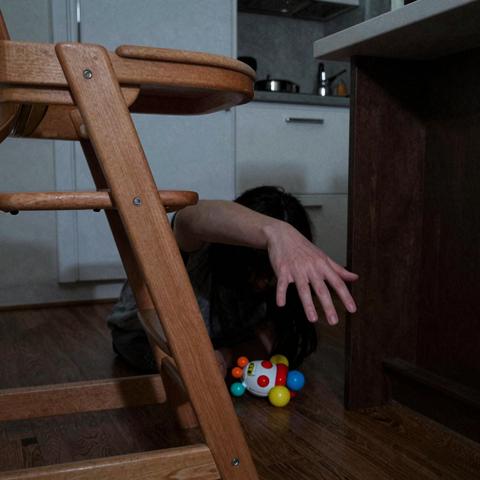
The silence in the kitchen wasn’t empty; it was heavy, pressing against my eardrums like deep-sea pressure. I was huddled in the sliver of space between the refrigerator and the wooden high chair, my knees pressed so hard into the linoleum that the pattern had imprinted itself into my skin.
My breath hitched, a ragged, involuntary sound that seemed deafening in the stillness. I clamped my hand over my mouth, my knuckles white, staring at the discarded plastic rattle lying just inches away.
Don’t move. Don’t breathe.
Then, the sound came—a sharp, metallic clink. The baby bottle, which had been sitting precariously on the edge of the tray, vibrated, tipped, and clattered to the floor. It rolled across the tiles with a hollow, rhythmic sound that echoed like a gunshot in the confined space.
My heart hammered against my ribs, a trapped bird desperate to break free. I looked toward the dining room, where my golden retriever, Buster, was wedged as far under the mahogany table as he could physically go. He wasn’t barking. He wasn’t even growling. He was shivering, his eyes locked on the kitchen entrance with a look of pure, primal terror that made the hair on the back of my neck stand up.
Something shifted in the living room.
It wasn’t a footstep—it was too fluid for that. It was the sound of something dragging, slow and deliberate, across the hardwood floors. Each movement was punctuated by a wet, slapping sound, as if bare skin was adhering to and peeling away from the polished wood.
My phone, clutched in my trembling hand, illuminated the dark corner with a faint, ghostly glow. I didn’t dare turn off the screen; the darkness felt like a physical weight, something that would swallow me whole the moment the light died.
I leaned my head back against the cold metal of the fridge, my eyes darting toward the edge of the kitchen island.
Just stay hidden. They’ll pass by.
But the dragging stopped. The silence returned, but this time, it was different. It felt expectant. The air in the room seemed to drop ten degrees, turning sharp and metallic. A single drop of something dark and viscous landed on the linoleum, just beyond the reach of the high chair’s shadow. It pooled instantly, a small, obsidian stain that refused to spread, defying gravity.
Then, from the other side of the island, a sound broke through the static of my panic: a wet, ragged wheeze. It was labored, strained, as if the person—or thing—making it had forgotten how to draw air into their lungs.
It was standing exactly three feet away. I could feel the heat radiating off it.
“I know you’re there,” a voice whispered.
It wasn’t a roar. It wasn’t a threat. It was my own voice, perfectly mimicked, tumbling out of the darkness with a soft, bone-chilling giggle that sounded like shattered glass.
Chapter 2: The Logic of the Unseen
I didn’t scream. The terror was too sharp, too clinical for that; it felt like a cold blade pressing against my jugular, paralyzing my vocal cords. Instead, I pressed my eyes shut, forcing my mind to search for an exit strategy that didn’t exist.
My phone screen flickered, the battery icon flashing a dying red: 5%.
The creature—or whatever was wearing my husband’s voice—began to circle the island. I heard the scuff of bare feet on the hardwood, slow, deliberate, and entirely too heavy. It wasn’t human movement. It sounded like an animal testing the ground, mapping the kitchen floor with a predator’s precision.
It’s waiting for me to panic. It wants me to run.
I realized then that the kitchen was a cage. I was trapped between the appliances and the island, and the only way out was directly past the point where the wet, wheezing shadow now stood.
I looked at the high chair. The tray was empty, save for a stray cracker crumb. My daughter was in the nursery upstairs—at least, I prayed she was. I had put her down for a nap twenty minutes ago.
If I can reach the mudroom door, I can bolt for the car.
But the dragging sound stopped again. A hand—long, grey, and tipped with nails that looked like splintered bone—slithered around the corner of the island. It didn’t reach for me; it just rested against the granite countertop, its fingers twitching with a rhythmic, erratic cadence.
“Why are you hiding, sweetheart?” it whispered.
The voice was closer now, vibrating through the floorboards. It sounded like me, but filtered through a drainpipe—hollow, echoing, and devoid of any warmth.
I looked down at the puddle of black liquid on the floor. It was beginning to crawl. It moved against the grain of the tile, reaching out like a living thing, sniffing the air toward my shoes.
I shifted my weight, trying to silently scoot back toward the pantry. My sleeve caught on the edge of the high chair, sending a small, plastic toy—a spinning top—tumbling across the floor.
It hit the tile with a pathetic, high-pitched ping.
The wheezing stopped instantly.
The hand on the counter curled into a fist, its knuckles cracking like dry kindling. The kitchen fell into a silence so absolute it felt like the air had been vacuumed out of the room.
“Found you,” it hissed.
The shadow moved. It wasn’t the slow, dragging pace anymore. It lunged, a blur of movement that defied physics, slamming into the side of the island with enough force to make the dishes in the cabinets rattle in their frames.
I didn’t think. I scrambled backward, my back slamming into the refrigerator. My hand found the handle of the freezer door, and in a moment of pure, reckless desperation, I yanked it open.
The sudden blast of sub-zero air and the hum of the cooling unit flooded the small space. The creature recoiled, emitting a screech that sounded like grinding metal, a sound so unnatural it made my nose begin to bleed.
I had three seconds. I kicked the high chair into the path of the island entrance, creating a makeshift barrier, and bolted for the pantry door.
I didn’t look back. I couldn’t. I just kept running, my lungs burning, the sound of that giggle chasing me into the dark.
Chapter 3: The Geometry of the Pantry
The pantry was a dead end—a claustrophobic box of wire shelves, half-empty cereal boxes, and the faint, sweet smell of rotting fruit. I slammed the door shut, my fingers scrambling for the deadbolt. It was old, brass, and stiff.
Click.
The lock slid into place just as a heavy, wet weight slammed against the other side of the door. The wood groaned, bowing inward. The hinges screamed in protest, metal biting into wood, but for the moment, the barrier held.
I backed away, my chest heaving, the air in the cramped space tasting of dust and stale sugar. My phone vibrated in my hand. 4% battery. I didn’t have time for fear, not anymore. I had to think.
The thumping on the door stopped. The house fell into that terrifying, unnatural silence again. I could hear the muffled, rhythmic ticking of the wall clock in the kitchen, a sound that usually comforted me but now felt like a countdown to my own expiration.
I clicked the camera icon on my phone, ignoring the low battery warning. I didn’t record a video; instead, I flipped the camera to selfie mode and used the flash to illuminate the dark corners of the pantry.
The light flared, blindingly white.
In the reflection of a stack of canned tomatoes, I saw it.
It was standing directly behind me.
It hadn’t broken the door down because it didn’t need to. The thing—this entity that wore my skin, my clothes, and my husband’s voice—wasn’t bound by the physical constraints of walls or doors. It was pressing itself into the room like a shadow cast by an unseen light source. Its face was a smooth, featureless surface of pale, shifting skin, save for a mouth that was currently stretching into a smile that reached far beyond the natural limits of a human jaw.
“You’re making this so hard,” it whispered.
This time, the voice didn’t come from the kitchen door. It came from right behind my left ear, warm and damp, smelling of ozone and wet earth.
I whipped around, swinging my heavy smartphone like a weapon, but there was nothing there. Just the empty, cluttered shelves. My heart was thudding so hard against my chest that I could feel the vibrations in my teeth.
It’s playing with me. It’s feeding on the panic.
I looked down at my feet. The black, viscous liquid was seeping under the pantry door, pooling around my sneakers. It was cold—not just chilly, but a deep, freezing cold that seeped through the rubber soles of my shoes and into my skin. It wasn’t just a liquid; it was anchoring me to the spot.
I grabbed a heavy jar of pasta sauce from the shelf, my hands slick with sweat. If I couldn’t run, I would fight.
“I’m not going anywhere,” I said, my voice shaking but loud enough to fill the small space.
The shadows in the corner of the pantry began to coalesce, rising up like black smoke. The entity was solidifying, its limbs elongating as it detached itself from the wall.
“Neither am I,” it replied, its voice finally dropping the mimicry.
It was a guttural, wet sound, like stones grinding together underwater. The pantry door began to peel away from its frame, not from the force of a blow, but as if the wood itself were rotting away in seconds.
The light on my phone died, plunging me into absolute, total darkness.
The last thing I heard before the screaming started was the unmistakable sound of my daughter’s laughter drifting down from the nursery above.
Chapter 4: The Nursery Door
The darkness was not empty. It had texture—a cold, slimy film that coated my skin as I scrambled blindly against the back wall of the pantry. I didn’t know which way was up or down anymore. I only knew that the laughter from upstairs was getting louder, sharper, more insistent.
My brain was screaming at me to move, but my legs felt like lead, weighed down by that viscous, black pool. I reached out, my fingers scraping against the rough drywall, searching for the doorframe, for the handle, for anything that felt solid.
I am a mother. I am not a victim.
The thought hit me with the force of a physical blow. I wasn’t just fighting for my life; I was fighting to keep the thing above me away from my daughter.
I found the doorframe. My hands, slick with sweat and the black, oily substance, gripped the splintering wood. I hauled myself up, ignoring the way my muscles burned and the way the shadows seemed to reach out, snagging at my clothes like long, hooked fingers. I didn’t care about the entity anymore. I didn’t care about the pantry.
I kicked the remaining shards of the door out of my way and lunged into the kitchen.
The house was completely still. The kitchen island was pristine, untouched, as if the struggle from moments ago had never happened. The high chair stood perfectly centered on the linoleum, the plastic rattle resting quietly on the tray. But the air—the air was thick, tasting of copper and decay.
I didn’t stop. I hit the hallway at a dead run, my footsteps echoing like thunder in the silence.
I reached the stairs. I took them two at a time, my lungs searing, my heart hammering a rhythm of pure, unadulterated survival. At the top of the landing, the nursery door was slightly ajar.
A sliver of golden light spilled out from inside.
I pushed the door open, my chest heaving, ready to scream, ready to fight, ready to do whatever it took to shield her.
But the room was empty.
The crib was perfectly made, the blankets smoothed down without a single wrinkle. The mobile hung motionless above the mattress. There was no sign of a struggle, no sign of the nightmare that had been hunting me downstairs.
I walked toward the crib, my knees shaking, my breath coming in shallow gasps. I looked down into the mattress.
There, sitting exactly where my daughter had been sleeping, was my own smartphone.
The screen was cracked, the battery dead, but the camera was still active. I picked it up, my hands trembling violently.
I tapped the screen.
The video feed didn’t show the room I was standing in. It showed the kitchen, from the perspective of the floor, right behind the high chair.
In the video, I saw myself—not the “me” who had been running, but another version of me, huddled on the floor, holding a phone, recording.
I looked up from the screen, my blood turning to ice.
The wardrobe door in the nursery was slowly, agonizingly, beginning to creak open.
A Final Note from the Author
Thank you for joining me on this 13-second descent into terror. While the screen may be dark and the story ends here, the shadows in the kitchen are always waiting for the next echo. If you enjoyed this journey, keep your doors locked, your lights bright, and—most importantly—never trust the things that sound like you.
Until the next nightmare.