A 40-Minute Tantrum Ended When The Captain Saw His Name – storyteller
Chapter 1: The Descent
The silence in the cockpit wasn’t peaceful; it was heavy, pressing against Captain Elias Thorne’s eardrums like deep-sea pressure. For forty minutes, the cabin behind him had been a theater of absolute, unadulterated madness.
The screams had started shortly after takeoff—a cacophony of panicked passengers and a flight attendant, Sarah, who had gone completely catatonic near the cockpit door. Elias had tried the intercom, but the wires seemed to be broadcasting only static and the faint, rhythmic sound of heavy breathing that definitely didn’t belong to any of his crew.
He gripped the yoke so tightly his knuckles turned a translucent, ghostly white.
Stay the course, he told himself, his internal voice trembling. Just get them on the ground. Whatever this is, it ends on the runway.
But the autopilot had disconnected ten minutes ago. The plane was currently fighting him, the yoke jerking rhythmically to the left as if pulled by an invisible, insistent hand. He scanned the instruments, his eyes darting across the flickering glass displays that refused to show altitude or heading.
Instead, every screen was pixelated, bleeding shifting patterns of static that looked uncomfortably like constellations.
Elias wiped sweat from his forehead with the back of his hand, his eyes locking onto the primary navigation screen—the one that still held a semblance of clarity. He froze.
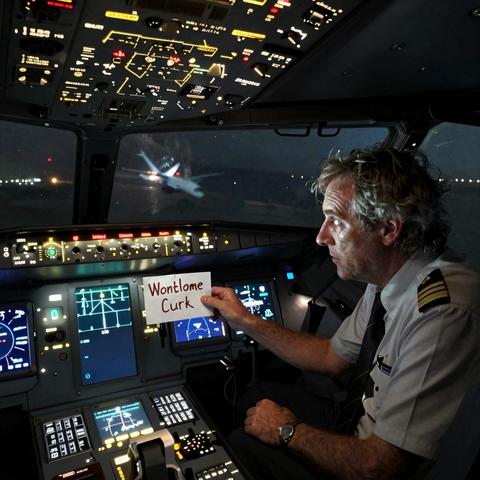
A small, crinkled piece of yellow flight-plan paper was taped to the bottom corner of the monitor. It hadn’t been there when he finished his pre-flight checks.
In jagged, aggressive red ink that looked like it had been applied with a dry, splintered pen, his own name was scrawled across the paper: ELIAS THORNE.
His breath hitched. He reached out, his fingers trembling, to touch the note. The moment his skin brushed the edge of the paper, the cabin lights flickered and died, plunging the cockpit into a suffocating, unnatural darkness, save for the pulsating red glow of the instrument panel.
How did it get here? his mind raced. The cockpit has been locked since we left the gate.
A rhythmic thumping began against the cockpit door, heavy and deliberate. It wasn’t the frantic scratching of a panicked passenger; it was the slow, measured knock of someone who knew exactly who was on the other side.
“Captain,” a voice whispered through the closed door. It was distorted, layered with a static hum that made Elias’s teeth ache. “You forgot to sign the logbook.”
Elias recoiled, slamming his back against the bulkhead. He realized with a sickening jolt that he hadn’t touched his logbook since he boarded the plane. He reached into his side pocket, his heart hammering against his ribs like a trapped bird, and pulled it out.
The leather cover was warm to the touch. He flipped it open to the final page, his blood turning to ice.
The last entry was written in his own, unmistakable handwriting, dated for today. It detailed the flight path, the altitude, and the weather conditions—except he hadn’t written it. And at the bottom of the page, written in that same jagged red ink, was a single, terrifying instruction:
THE FUEL IS GONE. START THE COUNTDOWN.
Chapter 2: The Weight of the Yoke
Elias stared at the ink as if it were a venomous snake coiling on the page. His pulse was a frantic, irregular drumbeat against his collarbone. He looked back at the navigation screen, but the red ink of his name had begun to weep—tiny, dark droplets running down the glass, sizzling as they hit the plastic casing.
He slammed the logbook shut, his hands shaking so violently he nearly dropped it. He needed to get out. He needed to find Sarah.
He reached for the door handle, but the cold metal felt wrong. It wasn’t just chilly; it was frigid, the kind of absolute zero that instantly numbs the skin. As his fingers gripped the latch, he realized the door wasn’t locked from the outside. It was fused shut. The seam where the door met the frame had been replaced by a jagged, seamless weld of frost and rusted metal.
Think, Elias. Think.
The intercom system crackled to life, cutting through the heavy atmosphere. It wasn’t the flight attendant. It was his own voice, playing back from the cockpit’s black box system, but the inflection was entirely different—dark, hollow, and devoid of the fatigue he felt.
“The fuel is gone, Elias,” the recording whispered, echoing through the small space. “But you were always better at gliding than landing.”
He spun toward the control console, desperate for any indication of their altitude. The altimeter, which had been dead just moments ago, suddenly snapped to life. The needle didn’t sweep upward toward a cruising altitude; it spun backward with dizzying speed.
30,000 feet. 20,000 feet. 10,000 feet.
The aircraft wasn’t just descending; it was plummeting toward a terrain that shouldn’t have been there. Through the center windscreen, the dark, stormy night had vanished. Instead, he saw a sprawling, glowing expanse of something that looked like a burning forest, stretching as far as the eye could see.
The air in the cockpit grew hot, smelling faintly of sulfur and ozone. The thumping on the door changed tone—it was no longer a knock. It was a rhythmic pressure, as if something on the other side was trying to push through the bulkhead, molding the metal like soft clay.
“I didn’t authorize this flight,” Elias shouted, his voice cracking. He grabbed the yoke, hauling it back with every ounce of strength he possessed.
The plane didn’t respond to the control inputs. It wasn’t a mechanical failure; it felt as though the plane were being guided by a massive, unseen gravity well. He looked down at his hands again. They were glowing with the same faint, flickering red light as the ink on the navigation screen.
He realized then that he wasn’t flying a plane anymore. He was holding onto the steering column of a machine that was feeding on his own history.
He looked at the digital readout for the flight time. It wasn’t counting up. It was counting backward, rapidly approaching a series of zeros.
00:05… 00:04…
He stared at the door, where a dark, wet stain was beginning to seep through the seams of the metal, spreading outward like a spiderweb.
“Open the door!” he screamed at the empty cabin. “Sarah! Anyone!”
There was no response, only the sound of a thousand voices whispering his name at once—a chorus of every passenger he had ever flown, every person he had ever failed, rising in a terrifying, unified crescendo.
He gripped the yoke, closed his eyes, and braced for the impact that was no longer a question of if, but when.
Chapter 3: The Echo of the Void
The countdown hit zero, but the world didn’t end in an explosion. Instead, the cockpit walls began to dissolve. The reinforced steel and complex avionics thinned, turning into a translucent, shimmering membrane that pulsed in time with Elias’s own ragged breathing.
Through the thinning bulkhead, he could no longer see the cabin or the screaming passengers. He saw his life.
Images flickered past like a strobe light: a cluttered desk in an old apartment, a forgotten suitcase left on a rainy platform, the face of a woman he had promised to call back twenty years ago. The plane was acting as a lens, focusing the scattered, broken fragments of his personal history into a single, localized point of convergence.
“It’s not a malfunction,” he whispered, his voice sounding thin and alien. “It’s a collection.”
He turned his gaze back to the navigation screen. The red ink had pooled into a shape—a map of his hometown, marked with a single, glowing X on the house where he’d grown up. The plane wasn’t heading toward an airport; it was homing in on the geography of his deepest regrets.
The thumping on the cockpit door stopped abruptly.
The silence that followed was worse than the noise. It was a vacuum, a total absence of sound that made his ears pop painfully. Then, the door didn’t open; it simply ceased to exist. Where there had been a barrier, there was now a swirling vortex of ash and cold air, pulling at the loose papers and manuals on the dashboard.
A figure stood in the doorway. It wore the silhouette of a flight attendant, but the edges were frayed, blurring into the shadows of the cabin.
“The fuel is gone, Elias,” the figure repeated, its voice a perfect, chilling mirror of his own. “But the debt remains. You’ve spent your life flying away from everything that matters. Today, you finally arrive.”
Elias scrambled back, his hands scraping against the control panel. He grabbed the microphone, his fingers fumbling with the button. “Mayday! Mayday! This is Flight 402, I have—I have an intruder in the cockpit! I’m losing control of the aircraft!”
But there was no static in response.
Instead, the radio crackled with the sound of a woman laughing—the woman from the photograph in his mind. The voice that came over the headset wasn’t a distress call. It was a recording of him, ten years younger, whispering a secret to the wind on a desolate cliffside.
“You can’t ground a ghost,” the voice over the radio said, mocking him.
Elias realized, with a surge of terror, that the plane wasn’t flying under its own power. The wings were no longer airfoils; they were made of the same flickering, impossible light as the cockpit walls. The engines had stopped humming and were now singing—a discordant, mournful harmony that vibrated through the very marrow of his bones.
He reached for the emergency fire handle, hoping to force a manual override, but his hand passed straight through the metal. His body was fading, turning as translucent as the ship he commanded.
I am not the pilot anymore, he realized, a grim acceptance washing over him as the floor dropped away entirely, leaving him suspended in a sea of his own memories. I am the fuel.
Chapter 4: The Final Heading
The cockpit didn’t feel like a room anymore; it felt like a collapsing lung. Elias hovered, his physical form vibrating in and out of existence, a ghost haunting his own flight path.
He looked down at his lap. The logbook was gone, replaced by a mirror of his own face, reflected in the dark, non-reflective surface of the navigation console. But the reflection wasn’t static. It was aging, decaying, and then reverting to infancy in a rapid, nauseating loop.
Is this the arrival? he wondered, the thought drifting through the air like smoke. Is this the terminal destination?
The singing from the engines grew deafening, a high-pitched frequency that tore through the logic of his remaining thoughts. He saw the world outside the window solidify for a split second. They were not flying over a burning forest. They were flying over the graveyard of his own choices—the house he’d sold, the office he’d walked out of, the hospital room he’d never visited.
The plane was physically manifesting the wreckage of his life.
The figure in the doorway drifted forward, the fabric of its uniform turning into strands of gray static. It stopped directly behind Elias, a freezing sensation pressing against his spine.
“The fuel was never kerosene, Captain,” the entity whispered, the voice vibrating inside Elias’s own skull. “It was the time you refused to spend, the words you refused to speak, and the apologies you kept locked in the cargo hold.”
Elias turned, his vision blurring, his hands now nothing more than wisps of shadow. He looked at the yoke one last time. It was covered in rust, ancient and brittle. He realized that if he let go, the flight would conclude. If he held on, he would remain in this eternal, liminal descent, fueling the void with his own fading essence.
“I choose to land,” Elias whispered, his voice finally shedding the hollow, distorted quality. It sounded, for the first time in an eternity, like him.
He let go of the yoke.
The cockpit exploded into blinding white light. There was no impact, no crunch of metal, no scream of engines. There was only the sudden, absolute cessation of the humming.
The silence that followed was warm. It wasn’t the silence of a vacuum; it was the silence of a quiet room at dawn.
Far below, a flight logbook lay open on the grass of an abandoned field, its pages fluttering in a gentle breeze. The final entry, written in fading, messy ink, was complete:
DESTINATION: HOME.
The plane was gone. The sky was empty, save for a single, lingering contrail that slowly unraveled, drifting away until there was nothing left to mark the passage of Flight 402.
Thank you for following Captain Elias Thorne on this final, harrowing flight. Your engagement and curiosity have brought this story to its conclusion. I hope you found the journey as haunting and thought-provoking as I did.