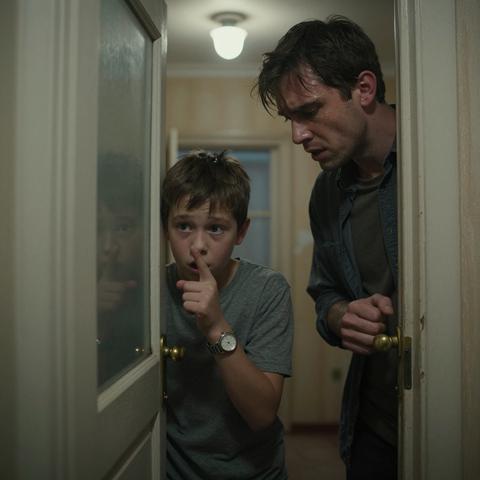
The Silent Boy Tapped My Watch Three Times. I Sealed The Door. – storyteller
Chapter 1: The Weight of Seconds
The apartment was suffocating. It smelled of ozone and stale, wet concrete, the kind of scent that clings to your lungs long after the air has cleared. I backed away from the door, my heart hammering against my ribs like a trapped bird. My hand was still trembling, the sensation of the boy’s touch—cold, unnervingly deliberate—lingering on the silver casing of my watch.
It wasn’t just a watch. It was a countdown, a tether to a reality that was rapidly fraying at the edges.
“Why three?” I whispered, my voice cracking.
The boy stood in the center of the narrow hallway, perfectly still. He didn’t answer. He never answered. He just stared at me with those eyes—hollow, ancient, and completely devoid of the chaotic spark that should have defined a child his age. He wasn’t looking at me, really. He was looking through me, focused on the ticking machinery of the world that only he seemed to perceive.
Outside, the stairwell was alive. The sound wasn’t human. It was a rhythmic, wet scraping, like heavy canvas being dragged over gravel. Thump. Drag. Thump. Drag. They were closer than they had been ten minutes ago. Much closer.
I looked down at my wrist. The second hand, which had been frozen since the third tap, suddenly lurched forward. It didn’t tick; it shuddered.
I moved to the window, pulling the heavy blackout curtain just enough to peer into the alleyway below. The streetlights were flickering, dying out in sequence down the block, one by one. The shadows didn’t just grow; they pooled, thickening into a physical substance that defied the geometry of the architecture.
A man in a tan coat stood at the mouth of the alley. He wasn’t moving. He was standing perfectly still, his head tilted at an impossible angle toward my window. Even from the third floor, I could feel his gaze. It felt like a needle pressed against the back of my neck.
I turned back to the boy. “They’re here.”
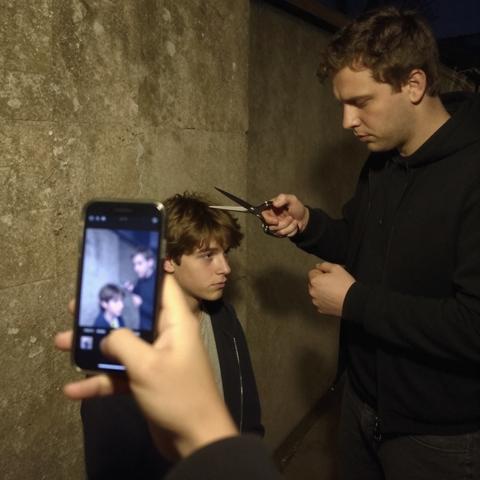
The boy finally blinked. It was a slow, agonizing motion. He walked toward the heavy oak door—the one I had just triple-locked—and placed his palm against the wood. The heavy brass deadbolt began to glow a dull, bruised purple. It wasn’t locking the door anymore. It was fusing it to the frame.
“We don’t have much time,” the boy said. His voice sounded like dry leaves skittering across pavement. It was the first time he had spoken in days, and the sound of it sent a shiver of pure, unadulterated terror down my spine.
“What do you mean?” I demanded, moving to grab my pack. “I thought this door was the only thing holding them back!”
The boy turned his head. For a fleeting second, the hollowness in his eyes vanished, replaced by an intensity so profound it made my knees buckle. “The door is not for them, Elias. It is to keep you from running toward what is coming.”
Outside, the scraping stopped. Absolute silence fell over the building, a vacuum so deep my ears began to ring. Then, a single, soft knock sounded on the door. It didn’t sound like a fist. It sounded like a fingernail, delicate and precise, tapping on the wood.
One. Two. Three.
The wood of the door didn’t splinter; it began to turn into glass. I could see the silhouette of the man in the tan coat on the other side, his hand pressed flat against the now-translucent barrier. He wasn’t trying to break in. He was waiting for me to realize that there was nowhere left to hide.
I reached for the light switch, desperate to plunge the room into darkness, but my hand stopped in mid-air. The bulb overhead had already shattered, and yet, the room was bathed in a brilliant, blinding white light emanating from my own watch.
The countdown hadn’t stopped. It had just changed its purpose.
Chapter 2: The Geometry of Regret
The watch was no longer a timepiece; it was a beacon, pulsing with a rhythm that felt disturbingly like a second heartbeat—mine. The white light washed over the peeling wallpaper, bleaching the room of its grime and revealing hidden etchings I had never noticed before. Marks, thousands of them, carved into the plaster. They weren’t graffiti. They were tallies.
I have been here before.
The realization hit me with the force of a physical blow. The boy didn’t move. He continued to watch the glass-fused door, his hand still pressed against the surface. On the other side, the man in the tan coat had stopped moving entirely. His hand, pressed against the glass, began to blur and smudge, as if the reality behind the door was losing its resolution.
“Elias,” the boy murmured, and for a moment, his voice lost its arid, papery quality. It sounded younger. More fragile. “You keep choosing to look at the time. You have to stop looking at the time.”
“How can I ignore it?” I shouted, my voice bouncing off the shifting walls. “It’s the only thing that tells me I’m still here!”
“That is exactly why they catch you,” he replied, turning to look at me.
His eyes were no longer hollow. They were mirrors. In his pupils, I could see myself—not as I was now, standing in a terrified sweat in a cramped apartment—but as a silhouette drifting through an infinite, gray void. A loop. I was trapped in a temporal feedback loop, and the watch was the needle scratching the record, over and over again.
The floorboards groaned, not from the weight of someone walking, but as if the house itself were trying to fold. The light from the watch intensified, turning the room a blinding, sterile blue.
I looked at the window. The alleyway was gone. In its place was a vast, yawning expanse of nothingness, a dark tapestry stitched together with threads of flickering, dying stars. The city outside, the life I remembered—it was all dissolving.
I scrambled backward, my back hitting the opposite wall. “What is happening to the world?”
The boy didn’t look back at the window. He was busy tracing the light-etched marks on the wall with his free hand. Every time his fingertip touched one, the mark would glow, then fade into nothingness. He was erasing the tally.
“The countdown isn’t about their arrival,” he said, his focus singular and intense. “It’s about the erosion of the ‘Now.’ Every time you reach the third tap, the world resets. You are the architect of your own containment, Elias. You locked the door because you were afraid of the end. But the end is the only way out.”
A sound tore through the room—a screech of metal on glass.
The door, now entirely transparent, cracked. A single, long fissure webbed out from where the man’s hand rested. Through the crack, I didn’t see the hallway of my apartment building anymore. I saw a sterile, white room filled with clocks. Thousands of them. All stopped at different times.
And in the center of that room, sitting at a desk and staring directly at me, was myself. Older. Tired. Holding a watch exactly like mine.
“You have to break the watch,” the boy whispered, his eyes locking onto mine with an intensity that promised salvation or destruction. “If you don’t, you will spend the rest of eternity waiting for a knock that has already happened.”
I looked down at the watch on my wrist. The second hand began to accelerate, spinning so fast it became a blur of silver light. It was burning into my skin, the heat becoming unbearable.
“Break it!” the boy commanded.
I raised my arm, looking for a hard surface, a heavy object, anything—but the floor beneath me turned to liquid, and the walls began to peel away like wet paper. I wasn’t in the apartment anymore. I was falling into the white room on the other side of the door.
Chapter 3: The Architecture of Silence
I didn’t hit the floor. I hit a memory.
The transition wasn’t a fall; it was a folding of space. One moment I was in a crumbling hallway, and the next, I was suspended in the center of that white room. The gravity here was different—thick, syrupy, dragging at my limbs.
Surrounding me were thousands of clocks. They hung in the air like constellations, a spherical cage of ticking brass and clicking gears. My older self sat at the desk, his back to me, hunched over a leather-bound journal. He didn’t turn around. He didn’t have to.
“You’re early,” he said. His voice was a mirror of my own, but stripped of the panic. It was hollow, polished by years of absolute, soul-crushing isolation.
“Where am I?” I gasped, trying to steady myself. The white floor beneath my feet felt like thin ice, rippling with every step I took.
The man stood up slowly. He turned, and I felt the air leave my lungs. He looked exactly like me, but his skin was the color of old parchment, and his eyes—the same eyes the boy had—were filled with a terrifying, ancient weariness. He held a pocket watch that was burning with that same, blinding blue light.
“You are in the interstitial space between the second and the third tap,” he explained, gesturing to the surrounding clocks. “Every time the boy taps the glass, we try to break the cycle. We fail. You fail. I failed.”
He walked toward me, his movements fluid and unnatural, like a figure moving through deep water. He reached out and tapped my chest, right over my heart.
“The watch isn’t a tool, Elias. It’s a parasite. It feeds on your perception of time to keep this loop self-sustaining. The boy isn’t a prisoner—he is the guardian of the loop.”
I looked back. The door I had just fallen through was gone, replaced by a wall of ticking pendulums. The boy wasn’t here, but his presence was heavy in the room, a phantom weight on my shoulders.
“If I break it,” I whispered, glancing down at the searing heat on my wrist, “what happens to you? What happens to him?”
The older version of me smiled, a expression devoid of joy. “We cease to be a possibility. We become a past tense. And that, Elias, is the only way to finally wake up.”
He pressed his watch against mine. The synchronization was instantaneous. A sound like a thousand glass bells shattering erupted in the room, vibrating through my bones, shaking the very foundations of this white void.
The clocks around us began to spin backward. Fast. The ticking accelerated into a singular, high-pitched scream of metal teeth grinding against metal teeth.
“Close your eyes!” the older man shouted, his voice barely audible over the mechanical chaos. “Don’t look at the time! Look at the space between the seconds!”
I squeezed my eyes shut, but the blue light burned through my eyelids. I felt the floor crack beneath me. I felt the weight of years, decades of loops, suddenly bearing down on me all at once.
I wasn’t just in the room anymore. I was everywhere. I was the boy tapping the glass. I was the man in the tan coat waiting in the alley. I was the ticking of every clock in the universe, and I was the silence that followed.
And then, the room simply ceased to exist.
I felt myself plummeting into a darkness so absolute it tasted like iron. Just before I lost consciousness, a final thought crystallized in my mind: The third tap wasn’t the trigger. It was the key.
I reached for my wrist in the darkness, my fingers closing around the cold, frozen casing of the watch. With a scream that was ripped from the depths of my lungs, I didn’t just try to stop it.
I crushed it.
Chapter 4: The Aftermath of Infinity
The sound of shattering glass wasn’t just a noise; it was a physical force. It hit me like a shockwave, tearing through the fabric of the room and shredding the white void into ribbons of light. The smell of ozone—sharp, metallic, and agonizing—filled my nostrils, followed by the familiar, damp scent of rain on concrete.
My eyes snapped open.
I was lying on the floor of my apartment. Not the one from the loop, but my own. The real one. Sunlight—actual, unfiltered, golden sunlight—was streaming through the window, warming the worn wooden floorboards beneath my cheek. The silence was heavy, but it was the silence of a Sunday morning, not the vacuum of a dying reality.
I pushed myself up, my muscles screaming in protest. My wrist ached with a dull, throbbing intensity. I looked down.
The watch was gone. In its place was a faint, silvery scar, shaped like a clock face, etched directly into my skin. It pulsed rhythmically, a gentle, fading reminder of the thousands of lives I had lived in the space between heartbeats.
I scrambled toward the door. The deadbolt was nothing but standard brass. No purple glow. No glass fusion. I reached out and turned the lock, my breath hitching as the door swung open to reveal the empty, sun-drenched hallway of my building.
The boy was gone.
I stumbled out into the hallway, my legs feeling like lead. I walked down the three flights of stairs, past the familiar peeling paint and the neighbors’ doors, each one hiding a life that had continued forward while mine had been suspended in a stasis of my own making.
When I reached the ground floor and pushed the front door open, the city hit me. The cacophony of traffic, the distant hum of voices, the smell of street food and exhaust—it was overwhelming, chaotic, and beautiful.
I walked to the corner, where the alleyway used to be. It was just a brick wall now, covered in faded advertisements and graffiti. I stopped, staring at the bricks, waiting for the man in the tan coat to appear, waiting for the tapping on my watch, waiting for the universe to fold.
Nothing happened.
I looked at my hand, the scarred skin on my wrist feeling warm against the cool morning air. I was no longer the architect of a loop. I was simply a man standing on a street corner, finally subject to the relentless, beautiful progression of linear time.
The dread didn’t vanish instantly. It lingered, a phantom itch at the back of my mind, warning me that seconds were ticking away—but for the first time, I didn’t reach to check a watch. I realized then that the boy hadn’t been my jailer. He was the part of me that had finally grown tired of the fear. He was the part of me that wanted to let the world move on.
I turned and walked away from the alley, stepping into the stream of people heading toward the subway. I didn’t know where I was going, but for the first time in an eternity, I wasn’t running from the end. I was walking toward the beginning of something else.
The sun felt warm on my face. I looked up at the sky, watching a clock tower in the distance. The minute hand ticked forward.
I smiled, and for once, I didn’t mind the time.
Thank you for joining Elias on this journey through the ticking void. While the loop is broken, the mystery of the Silent Boy remains—a memory etched in silver and shadow.