My Daughter Cried That Her Neck Hurt, But The Pastor’s Wife Claims She Was Faking It For Attention. Then She Lifted Her Hair, And The Look On Her Face Told Me Everything. – storyteller
Chapter 1: The Weight of Silence
The church basement smelled of stale coffee and industrial floor wax. It was the kind of place that felt like it should be safe, yet my skin had been crawling since the moment we walked through the heavy steel doors.
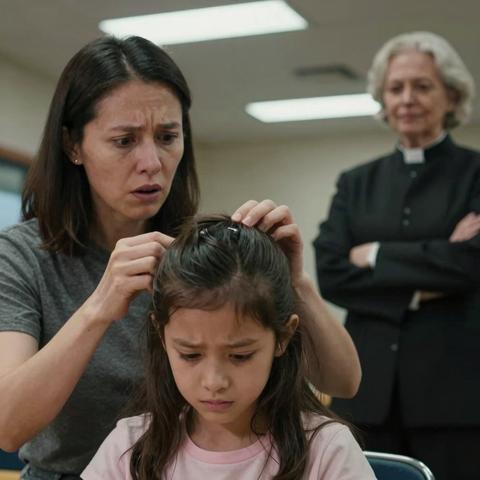
My daughter, Lily, sat on the folding metal chair beside me, her small frame curled in on itself. She’d been complaining about her neck hurting since we left the Sunday school room an hour ago. I had brushed it off at first, thinking she had just slept on it wrong, but her quiet, rhythmic sobbing was starting to grate on my nerves—or perhaps, it was just grating on the nerves of the woman standing a few feet away.
“Honestly, Sarah,” the pastor’s wife, Mrs. Gable, sighed, not even bothering to look up from her clipboard. “Children are remarkably adept at manufacturing ailments when they don’t get their way during the craft hour. She’s fine. She’s just acting out for attention.”
I tightened my grip on my purse. Mrs. Gable was a pillar of the community—polished, iron-pressed, and utterly devoid of warmth. I had never liked her, but she held too much sway in our social circle for me to say anything back.
“She’s never complained like this before,” I said, my voice tight. “She’s not a crier, Mrs. Gable.”
Mrs. Gable offered me a thin, condescending smile that didn’t reach her eyes. “Every child discovers the power of the sympathy card eventually. It’s a stage. Don’t coddle her, or you’ll never hear the end of it.”
Lily let out a sharp, involuntary gasp, her head dropping further toward her chest. Her hand hovered near the back of her neck, trembling.
“Lily, honey,” I whispered, kneeling in front of her. “Let me see.”
I gently reached for her hair. It was matted slightly with sweat, dark against the pale skin of her neck. As I began to part the golden strands away, I heard Mrs. Gable tut loudly.
“Are you really going to indulge this performance?” she asked, turning on her heel to walk away. “I have the potluck logistics to finalize, Sarah. Please, let’s maintain some dignity.”
I ignored her. My fingers brushed the skin beneath Lily’s hairline, and my heart slammed against my ribs. It felt wrong. The skin was hot—feverishly hot—and there was something hard, something uneven, embedded against the base of her skull.
I pulled her hair back fully, the fluorescent light of the basement catching the sight.
I didn’t just see a bruise. I saw a jagged, dark purple welt that looked suspiciously like the outline of a firm, gripping hand. It was fresh, angry, and undeniably violent.
My breath hitched in my throat, a sharp, cold spike of terror piercing my chest. I looked up, my eyes locking onto Mrs. Gable’s back as she moved toward the kitchen.
She hadn’t just ignored a crying child. She had looked at Lily with an expression of cold, calculated boredom, as if she already knew exactly what lay beneath that hair.
“What did you do?” I whispered, the words barely audible, even to myself.
My entire world tilted on its axis. The mother in me, the protector I didn’t know I was, surged to the surface, drowning out the fear. I stood up, my legs feeling like lead, and stared at the woman who was currently pouring lemonade as if she hadn’t just witnessed a crime.
The air in the room suddenly felt thin, suffocating, and far too small for the secret that had just been unearthed.
Chapter 2: The Porcelain Facade
I stood paralyzed, the hum of the church basement fans sounding like a jet engine in my ears. Across the room, Mrs. Gable was laughing at something the organist said. It was a light, airy sound—the sound of someone who had never known a single day of consequence.
Lily whimpered, a thin, sharp sound that snapped me out of my trance. She pulled her hair back over the spot, shielding the injury as if she were ashamed of the pain itself.
Don’t let them see, I told myself. If they see, they’ll bury it.
I took a deep, shaky breath and forced my hands to relax. I couldn’t confront her here. Not with the entire Sunday School committee within earshot, and certainly not when Mrs. Gable was so well-entrenched in the church’s hierarchy.
I grabbed Lily’s hand, my grip firmer than I intended. She looked up at me with wide, tear-filled eyes, but I didn’t soften.
“We’re leaving,” I said, my voice low and hard.
“But Mom, the crafts—”
“Now, Lily.”
I guided her toward the heavy double doors, keeping my back to the refreshment table. My heart was thudding a frantic rhythm against my ribs. Every instinct screamed at me to run, but I moved with forced, agonizing slowness. I refused to let Mrs. Gable see me panic.
As we passed the refreshment table, I felt a shadow fall over us.
“Leaving so soon, Sarah?”
Mrs. Gable’s voice was like velvet draped over a razor blade. I stopped, my muscles locking up. I turned slowly, making sure to keep Lily tucked firmly behind my hip.
Mrs. Gable was standing just a foot away, her perfume—a cloying, aggressive floral scent—filling my nose. She wasn’t smiling anymore. Her eyes, pale and searching, were fixed directly on the back of Lily’s neck.
“She’s not feeling well,” I said, my voice steady despite the tremor in my knees. “The environment is a bit overwhelming for her today.”
Mrs. Gable’s gaze flickered to me, then back to Lily. Her lips thinned into a line that was devoid of any Christian charity.
“It’s a shame,” she murmured, stepping slightly closer. “We try so hard to cultivate a peaceful atmosphere here. It’s such a disappointment when that peace is disrupted by… theatrics.”
She reached out, her hand hovering near Lily’s shoulder. I stepped sideways, creating a physical barrier between them.
“We’ll see you next week, Mrs. Gable,” I said, my tone final.
She didn’t move. She just stood there, her head tilted, studying me as if I were a specimen under a microscope.
“I certainly hope so, Sarah,” she replied, her voice dropping to a near-whisper. “It would be such a pity if your daughter continued to be so… prone to accidents.”
She turned and walked away, her heels clicking perfectly against the concrete floor.
I didn’t wait for her to change her mind. I hustled Lily out into the humid afternoon air, the sun blinding me as we reached the parking lot. I didn’t stop until we were locked inside the safety of our car, the engine purring to life.
“Mom? You’re hurting my hand,” Lily whispered.
I looked down. My knuckles were white, my fingernails digging into her soft skin. I let go instantly, horror washing over me.
“I’m sorry, baby. I’m so sorry,” I sobbed, finally letting the wall crumble.
I looked into the rearview mirror. Across the parking lot, through the reflection of the glass, I saw her. Mrs. Gable was standing at the window of the church basement. She wasn’t doing anything—she was just watching us.
She was holding a small, silver object in her hand, turning it over in the light.
It was a key. A very specific, very old-fashioned key that I recognized all too well.
It was the key to the nursery’s back storage closet—a room that had been officially “locked and decommissioned” for years.
Chapter 3: The Keeper of the Keys
The drive home was a blur of blurred streetlights and white-knuckled steering. My mind was spinning, untangling the implications of that key.
Mrs. Gable didn’t just manage the church; she curated its secrets. And that storage room—the one behind the old nursery—had been off-limits since my own childhood.
“Mom, you’re shaking,” Lily whispered from the backseat.
I looked in the mirror. My hands were vibrating against the steering wheel. I forced myself to pull into our driveway, the gravel crunching beneath the tires. I didn’t want to go inside. The house felt too fragile, too exposed.
“I’m okay, baby. Just… a long day.”
I went to the medicine cabinet, my hands moving on autopilot. I reached for the antiseptic cream and a fresh bandage, but my eyes caught a small, wooden box on the top shelf.
It was my grandmother’s. Inside were old photographs and mementos from her time at the church fifty years ago.
I pulled out a faded black-and-white picture of a group of women standing in front of the church. My eyes locked onto the woman in the center—the former head of the Sunday School committee.
She was holding something. A silver key. The same one Mrs. Gable had been twirling in her fingers.
What does it open? I thought, my pulse quickening. And why is it passed down like a cursed heirloom?
I turned back to Lily. I had to look at the mark again. I had to know if it was really a handprint or something else.
“Lily, let me see your neck again.”
She hesitated, then leaned forward. I carefully peeled back the bandage I had applied earlier. The mark had changed.
The purple welt was gone. In its place was a distinct, raised pattern of red, swollen lines that looked unmistakably like a series of strange, geometric symbols.
They weren’t bruises. They were burns.
My skin went cold. The realization hit me with the force of a physical blow. This wasn’t just a sadistic woman bullying a child. This was something systematic, something hidden, something ancient.
My phone buzzed on the counter. It was a text from an unknown number.
“The craft hour isn’t over, Sarah. We’re still working on her. Don’t try to scrub it off. It won’t come out.”
I dropped the phone. It clattered against the tile, the screen glowing ominously in the dim light of the kitchen.
I looked at the clock. It was nearly midnight. Outside, a pair of headlights swept across my living room wall, pausing, then slowly dimming.
Someone was parked at the edge of my driveway.
I didn’t run to the door. I didn’t reach for a weapon. I simply sat there, watching the headlights, feeling the weight of that silver key—now etched into my mind—press against the very foundation of my reality.
The pastor’s wife wasn’t just protecting a reputation. She was guarding a threshold. And she had just invited herself into my home.
Chapter 4: The Inventory of Shadows
The knocking began seconds later. It wasn’t the frantic, rhythmic pounding of an intruder; it was slow, measured, and deliberate. Three knocks. A pause. Three more knocks. It sounded like a call to order in a courtroom, a chilling reminder of the authority she wielded in our small town.
I stood up, my legs feeling like they were carved from ice. Lily was huddled on the kitchen rug, her eyes wide, staring at the front door. I placed a finger to my lips, signaling for absolute silence.
I moved to the hallway, peering through the peephole.
Mrs. Gable was standing on my porch, bathed in the harsh orange glow of the streetlamp. She wasn’t alone. Behind her stood two men I recognized from the church’s deacon board—men who were usually soft-spoken, kind-hearted fathers who coached Little League. But their faces were blank, devoid of any recognition or warmth.
They were carrying a long, heavy wooden box.
“Sarah,” Mrs. Gable’s voice drifted through the wood, calm and terrifyingly polite. “We know you found the mark. And we know you’re terrified. But you don’t understand the nature of the work. It isn’t a burden for your daughter; it’s an appointment.”
My hand hovered over the deadbolt. My thumb traced the metal, shaking violently.
An appointment.
“Go away,” I hissed, though I knew she couldn’t hear me through the solid oak.
“The craft hour never truly ends,” she continued, her voice gaining a strange, rhythmic quality. “We are simply moving the location of the workshop. Open the door, Sarah. Let us finish the pattern on her skin. If you don’t, the mark will deepen on its own. You don’t want to see what happens when the design reaches the bone.”
I looked down at my hand. My skin was starting to tingle—a sharp, electric sensation that mirrored the pattern I had seen on Lily’s neck. A small, red line was forming on my own wrist.
She wasn’t just coming for Lily. She was coming for me.
I realized then that the church wasn’t a sanctuary. It was an incubation chamber. And the silver key? It wasn’t to a storage closet. It was a conduit. A way for them to bind anyone who dared to notice, anyone who dared to look beneath the surface of their perfect, Sunday-morning facade.
I looked at the kitchen table, where the wooden box from my grandmother’s collection sat open. There was a letter inside, tucked beneath the photos. I hadn’t noticed it before.
“To whoever inherits the sight: The key doesn’t lock the door. It seals the wound. If they come for you, do not open the door. Burn the key.”
I looked at the front door again. Mrs. Gable was now pressing the silver key against the wood, the metal glowing with a faint, sickly white light. The wood of my door began to splinter, not outward, but inward, as if the very atoms of the door were being unmade.
I didn’t think. I grabbed the old, rusted key from my grandmother’s box, shoved it into the gas stove’s flame, and watched as the metal groaned and warped.
“Open it!” one of the deacons bellowed, his voice sounding like grinding stone.
The front door groaned, the hinges screaming as they were forced past their breaking point. I gripped the burning, twisted metal in my hand, feeling the skin of my palm blister, and slammed the white-hot key into the deadbolt hole just as the door began to swing open.
There was a deafening sound, like a thunderclap inside a cathedral. A blinding flash of light filled the hallway, and then—silence.
Absolute, heavy, suffocating silence.
I opened my eyes. The front door was standing wide open, but the porch was empty. Mrs. Gable, the deacons, the wooden box—they were gone. The street was empty.
But as I looked down at the floor, I saw the truth. The key had worked, but it hadn’t just saved us.
Embedded in the wood of my hallway, burned deep into the floorboards, was the same geometric symbol that had been on Lily’s neck. And as I turned to check on my daughter, I saw her standing by the kitchen counter, her hair perfectly parted, her neck completely clear of any mark.
But then she turned to look at me, and I felt my blood turn to ice.
Her eyes were no longer the vibrant, warm brown I had known for seven years. They were a cold, polished silver—the exact color of the key.
“Mom,” she whispered, her voice layered with a dozen different echoes. “They’re not outside anymore. They’re inside.”
I looked into her silver eyes, and I knew: the workshop wasn’t over. It had just been moved to the only place they couldn’t be touched.
They were waiting for me to close my eyes.
Thank you for following this chilling story of secrets and shadows. While the church doors may be locked, the mysteries we uncover are only the beginning. Stay vigilant, and keep searching for the truth hidden in plain sight.