THEY EVACUATED WITH THE SILVERWARE BUT LEFT HIM CHAINED TO THE RAILING AS THE RIVER ROSE, AND I KNEW I HAD SECONDS BEFORE THE PORCH COLLAPSED UNDER THE CURRENT.
The sound wasn’t a bark anymore. It was a scream.
You don’t know what a dog sounds like when it realizes it’s going to die until you hear it. It cuts through the humidity, through the sound of rain hammering against aluminum siding, through the roar of a river that shouldn’t be there.
I was standing on what used to be Main Street. Now it was a brown, churning canal. The National Guard trucks had pulled back an hour ago, the water rising too fast for the high-axle vehicles to navigate safely. Everyone was gone.
Or so I thought.
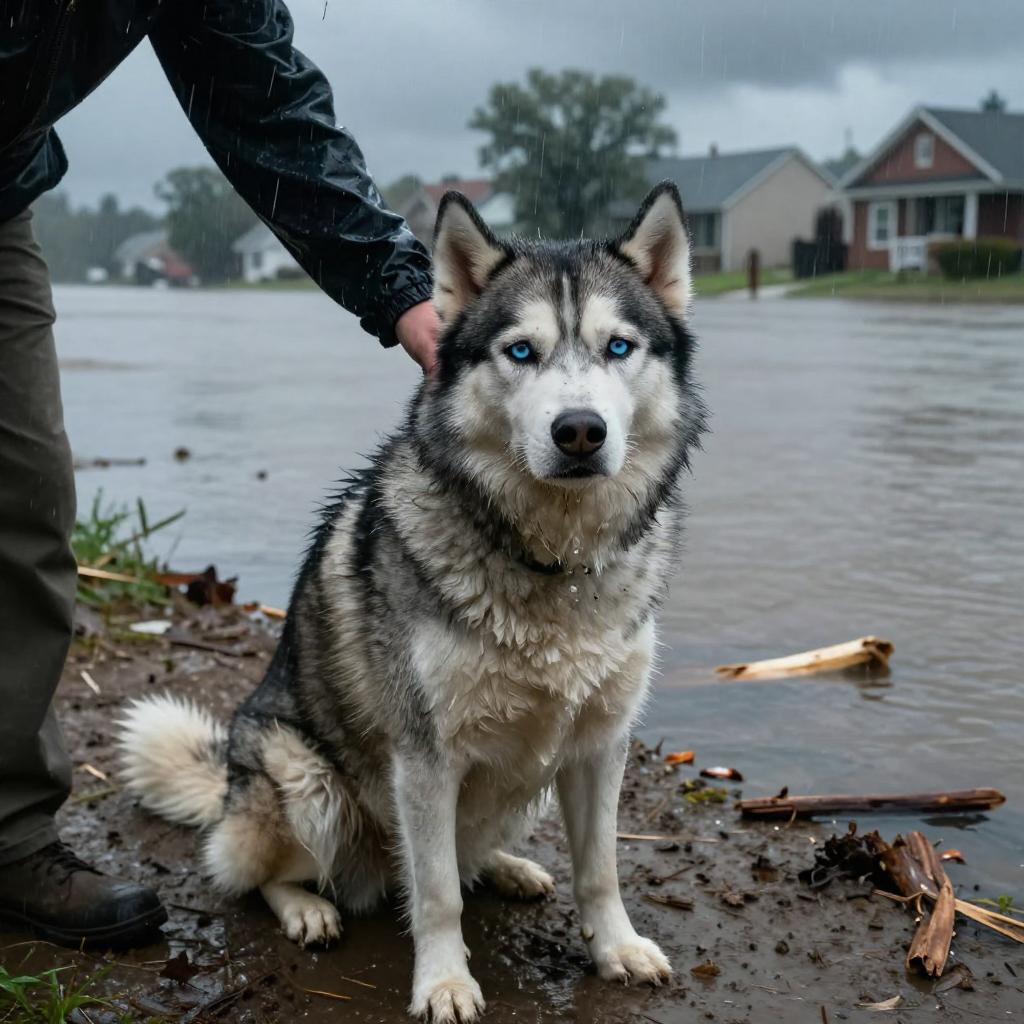
Then I heard him again. A Husky. I knew the voice. It belonged to the house three doors down—the Millers’ place. A beautiful, grey-and-white animal with eyes like cracked ice. I’d seen him pacing the yard a thousand times.
I looked at the water swirling around my waist. It smelled like gasoline and sewage. It was thick, heavy, carrying the wreckage of our lives downstream. A cooler floated by. Then a child’s plastic tricycle, bobbing upside down.
My chest tightened. “No,” I whispered. “They wouldn’t.”
But the scream came again, choked off by a splash.
I didn’t think. If I had thought about the debris, the hidden drop-offs, or the sheer force of the current, I would have turned around. I would have climbed back to the second story of my house and covered my ears.
Instead, I pushed off the submerged hood of my truck and waded in.
The cold hit me instantly. It wasn’t just water; it was liquid earth. It grabbed at my jeans, heavy and suffocating. Every step was a gamble. I used a broken fence post as a walking stick, probing the murky depths ahead of me. One wrong step into a storm drain or a washout, and I’d be gone, swept toward the river bend where the trees were snapping like matchsticks.
“Hang on!” I shouted, though I doubted he could hear me over the rushing water.
The house came into view. It was worse than I imagined.
The foundation was buckling. The floodwaters had undercut the driveway, creating a whirlpool of mud and timber near the front steps. And there he was.
He was clinging to the top rail of the porch banister, his claws digging into the wet wood. The water was already lapping at his stomach. He was shivering so violently that he was shaking the railing.
And then I saw the chain.
A heavy, galvanized steel chain, wrapped tight around the support pillar, pulling his neck down toward the rising black water. He was trying to keep his head up, craning his neck toward the sky, gasping for air.
Rage, hot and blinding, flared in my chest. Who does that? Who packs their car, locks their door, and leaves a living, breathing soul tied to a sinking ship?
I reached the edge of the yard. The current here was ferocious. It slammed into my chest, knocking the wind out of me. I stumbled, swallowing a mouthful of grit and oil. I gagged, spitting it out, and grabbed onto a floating submerged mailbox to steady myself.
The dog saw me. His ears flattened. He didn’t bark this time. He just looked at me with those terrifyingly human eyes. He was pleading.
“I’m coming, buddy. I’m coming.”
I lunged for the porch stairs. They were gone—washed away. I had to hoist myself up onto the rotting wood of the deck. The whole structure groaned under my weight. It tilted dangerously to the left.
“Easy,” I murmured, crawling on my hands and knees across the slick planks. “Easy now.”
The dog whined, a high-pitched, broken sound. He lunged toward me, but the chain snapped him back, choking him. He coughed, water splashing into his nose.
“Stop moving,” I commanded, my voice trembling. “You have to stop moving.”
I reached him. Up close, he smelled of wet fur and fear. He was soaked to the bone, his body feeling frail and small under the heavy coat. My fingers fumbled for the collar.
It was tight. Too tight. He had been pulling against it so hard that the nylon was embedded in the fur of his neck. The clip was jammed with mud and debris.
I clawed at it. My fingernails tore against the metal. The water washed over the porch floor, soaking my legs. The house groaned again—a deep, tectonic crack that vibrated through my knees.
The porch was separating from the house.
“Come on,” I gritted out, tears of frustration stinging my eyes. “Open, damn you.”
The dog licked my hand. Just once. A rough, wet rasp against my skin. It broke my heart.
I stopped trying to use my fingers. I grabbed a loose nail protruding from the railing and jammed it into the release mechanism of the buckle. I leveraged it with everything I had.
*Click.*
The sound was the most beautiful thing I had ever heard. The collar sprang open.
“Go!” I screamed.
But he didn’t run. He couldn’t. He was frozen, his legs stiff from the cold and the cramping.
The porch gave a sickening lurch. The support pillar where he had been chained snapped with the sound of a gunshot. The roof above us sagged.
I grabbed him. I wrapped my arms around his chest, hauling all sixty pounds of him into my lap, and I threw us both backward, away from the collapsing wood.
We hit the water.
It swallowed us. For a second, there was only darkness and the roar of the current tumbling us over and over. I felt a paw strike my face, then the heavy weight of his body thrashing against mine. I kicked hard, my boots finding purchase on something solid—maybe the driveway, maybe a car.
I broke the surface, gasping. I still had a handful of fur.
We were drifting fast, past the stop sign, past the unrecognizable lumps of debris. I kicked toward a grove of trees that was still standing on higher ground. The dog was swimming now, his head high, paddling with desperate energy.
“This way!” I choked out.
We hit the mudbank together. I clawed my way up the slope, dragging myself through the silt until I felt dry grass. The dog scrambled up beside me, shaking the water from his coat in a massive spray.
We collapsed there, side by side, breathing in the damp air. behind us, a loud crash echoed over the water. I turned just in time to see the Miller’s porch detach completely and disappear into the brown torrent, taking the chain with it.
If I had been thirty seconds later…
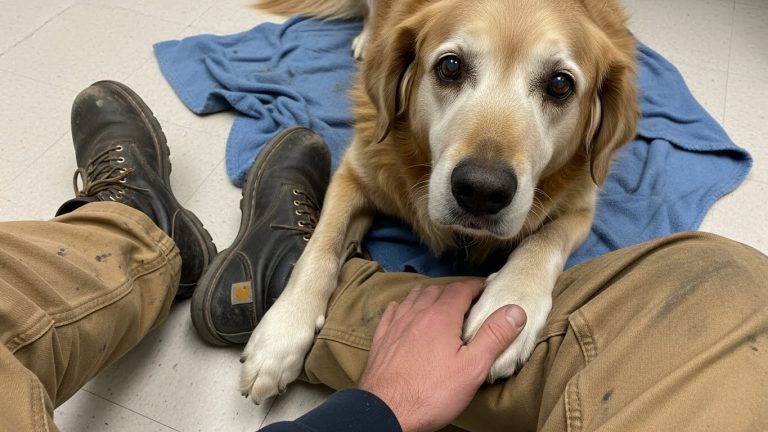
The dog crawled over to me. He didn’t run off. He pressed his wet body against my side and laid his heavy head on my chest. I could feel his heart hammering against his ribs, matching the rhythm of my own.
I buried my hands in his wet fur, shivering uncontrollably. I looked out at the devastation, at the empty houses, at the ruin of our neighborhood.
And then, the anger came back. It started in my gut and burned its way up my throat. I looked at the red ring around his neck where the collar had been.
“I’ve got you,” I whispered into his ear. “And I promise you, they are never, ever getting you back.”
But as I lay there, watching the sun begin to set over the flooded wreckage, I saw a boat engine in the distance. A rescue skiff.
I stood up, waving my arms, the dog glued to my leg. As the boat drew closer, I saw the lettering on the side. Sheriff’s Department.
And in the back of the boat, wrapped in a dry thermal blanket, looking dry and concerned, was Mr. Miller.
He pointed at us. He shouted something to the deputy driving the boat.
My blood ran cold. He wasn’t looking at me. He was looking at the dog.
CHAPTER II
The mud here is a different kind of living thing. It’s thick, grey-brown, and smells of silt and diesel, clinging to my boots like it’s trying to drag me back into the river. My lungs feel heavy, scorched by the cold water I must have swallowed, and my heart is still hammering a rhythm that doesn’t belong in a quiet body. Beside me, the dog—the one I’ve started calling Shadow in my head—is a shivering mass of wet fur. He’s pressing his weight against my thigh, his body vibrating so hard I can feel it through my soaked jeans. We are both alive, but the air feels thin, as if the world hasn’t quite decided what to do with us yet.
The sound of the outboard motor cuts through the low roar of the rain. It’s a flat-bottomed rescue boat, the kind the Sheriff’s department uses for shallow water, and it’s pushing its way toward this narrow strip of high ground. I see the reflective stripes on Sheriff Vance’s jacket first, and then I see him. Jim Miller. He’s sitting in the middle of the boat, hunched over, looking every bit the victim of a natural disaster. He looks clean, though. Too clean. His yellow raincoat isn’t even splattered with the mud that’s currently coating my skin like a second layer of grief.
As the boat’s hull scrapes against the gravel, the silence between me and the dog becomes a heavy, suffocating thing. I want to run. I want to pick this sixty-pound animal up and disappear into the treeline, but my legs are like lead. I just stand there, dripping, watching them land. Vance is the first one out, his boots splashing into the shallows. He looks at me, then at the dog, and his face is a map of exhaustion and pity. He’s known me since I was a kid; he knows I don’t usually go looking for trouble, but he also knows I’ve never been good at looking away from it.
“My God, you found him!” Jim Miller’s voice is a practiced explosion of relief. He jumps out of the boat, stumbling slightly in the muck, and starts toward us with his arms outstretched. “Buster! Come here, boy! I thought you were gone, I swear to God, I thought the house took you.”
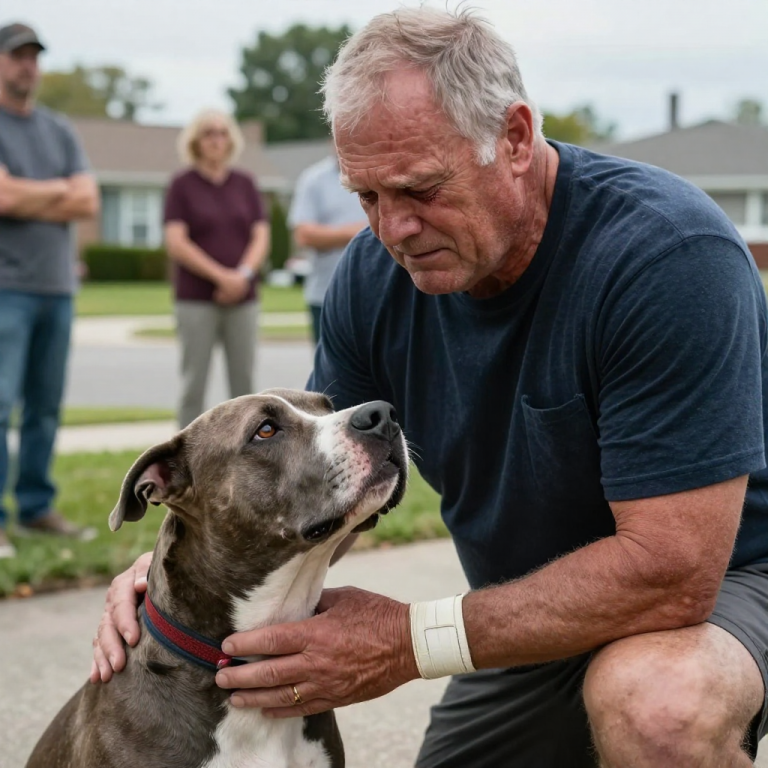
Shadow—or Buster, as the world knows him—doesn’t move. He doesn’t bark, he doesn’t wag his tail, and he doesn’t run to his master. Instead, he shrinks. He tucks his tail so tightly against his belly that he looks smaller, deformed by fear. He presses his snout into the back of my knee, hiding from the man who is currently claiming to love him. It’s a visceral, silent scream of a reaction, and it turns my stomach. I put my hand on the dog’s head, my fingers tangling in the matted, wet coat. My knuckles are white. I don’t let go.
“He’s okay, Jim,” I say. My voice sounds like it’s been dragged over gravel. It’s low, steady, and dangerous. “I got him off the porch. Just before it went.”
Miller stops about three feet away. He’s a big man, a successful contractor who built half the modern eyesores in this county, and he’s used to being the loudest person in any room. Up close, his eyes are darting, scanning the dog, then me, then the Sheriff. There’s no warmth in them, only a frantic sort of calculation. “I can’t thank you enough,” he says, though his tone suggests he’s already thinking about the next thing he has to do. “I felt sick leaving him. The water came up so fast, I couldn’t get back. I tried, Vance, didn’t I tell you? I tried to get back to the house.”
I feel a cold spark in my chest. It’s an old wound, one that never quite scabbed over. It’s the memory of my father standing by the front door with a suitcase, looking at me the same way Miller is looking at this dog—like an inconvenience that had finally been managed. My father had left the front door open when he walked out, letting the autumn wind whistle through the house, a final gesture of total disregard for what he was leaving behind. I remember the draft. I remember the silence. And I remember the way I’d waited for a return that never happened. I recognize that look in Miller. It’s the look of a man who didn’t forget; it’s the look of a man who decided some things weren’t worth the weight.
“You didn’t try, Jim,” I say, and the words are out before I can think to stop them. The Sheriff shifts his weight, his hand resting near his belt, not threatening, but signaling that the air has changed. “The door was locked. The house was empty. And he was chained. You didn’t just leave him. You tied him to a sinking ship.”
Miller’s face hardens. The performative grief vanishes, replaced by the sharp, jagged edges of a man who’s been caught in a lie. “Now, wait a minute. You don’t know what happened. It was chaos. The chain… that was for his own safety. So he wouldn’t run off and get swept away before I could get back. I just… I lost the key in the panic. I was coming back with the boat.”
“You weren’t coming back,” I say. My hand stays on Shadow’s head. The dog is leaning into me so hard I’m starting to lose my balance. “I saw your truck, Jim. Three hours before the sirens even went off. You were at the gas station on the ridge, filling up extra cans. You had your files in the front seat. You had your life packed up. This dog wasn’t part of the plan.”
This is the secret I’ve been holding, the thing I saw while I was frantically trying to board up my own windows. I saw Miller leaving the valley early, calm and collected, while the rest of us were still figuring out how high the crest would be. He wasn’t a victim of a sudden surge; he was a man making an exit. I suspect, though I can’t prove it yet, that Miller wanted that house to go. He’d been complaining about the foundation for years, about the insurance premiums in the flood zone. If the house went and the dog went with it, it was a clean slate. A total loss. No witnesses to the neglect.
Vance clears his throat. “Alright, let’s settle down. Jim, you’re safe, the dog is safe. That’s what matters right now. Why don’t you take him and we’ll get you both to the shelter at the high school?”
Miller reaches out again, his hand moving toward the dog’s neck. “Come on, Buster. Let’s go.”
As his hand nears, Shadow lets out a sound I’ve never heard an animal make. It isn’t a growl. It’s a whimpering, rhythmic sob, a sound of absolute terror. He tries to crawl between my legs, nearly knocking me over. I step forward, placing myself directly between Miller and the dog. I feel the Sheriff’s eyes on me, heavy with the weight of the law. This is the moral dilemma that has been building since I first saw that porch. The law says this dog is property. Jim Miller paid for him, he has the papers, he has the ‘right’ to take him. But the reality—the shivering, sobbing reality at my heels—says that giving him back is a death sentence, if not physical, then spiritual.
“He’s not going with you,” I say. The words are flat. They feel like a finality.
“Excuse me?” Miller’s voice goes high, incredulous. He looks at the Sheriff. “Vance, you hear this? This guy is trying to steal my dog. In the middle of a flood! I want my dog. Now.”
Vance steps in closer. He’s in a hard spot. This is a small town, and the rules are often written in the margins of long-standing relationships. “Look, I know tensions are high. We’re all cold, we’re all tired. But Jim’s right. He’s the owner. You did a brave thing, saving him, but you can’t keep him.”
“He was abandoned, Vance. Left to drown on a six-foot chain. That’s not ownership. That’s a crime.” I look the Sheriff in the eye. “If I give him back, and he ends up back on that chain, or ‘accidentally’ left behind in the next disaster, that’s on you. You want that on your ledger?”
“I’m not a criminal!” Miller shouts. A few other people who were waiting on the bank—neighbors, other evacuees—begin to turn their heads. The rain is still falling, a grey curtain that makes everything feel public and isolated all at once. “I love that dog! I’ve had him since he was a pup. You have no right to judge me because I panicked during a once-in-a-century flood!”
“You didn’t panic,” I say, and I realize I’m shouting now too. “You calculated. You weighed the cost of your house and your dog against your own comfort, and you chose yourself. I’m not letting him go back to a man who thinks of him as an asset to be liquidated.”
The word ‘liquidated’ hangs in the air, bitter and sharp. Miller’s face turns a deep, mottled red. He looks around at the growing crowd. He’s a man who lives for his reputation. He’s the guy who donates to the little league, the guy who shakes hands at the diner. Seeing people whisper, seeing them look at the dog cowering behind me, is more than he can handle. He realizes he’s losing the room. The public nature of this—the fact that his neighbors are seeing the dog’s fear—is the irreversible moment. He can’t just take the dog and walk away now without looking like a monster.
“You’re crazy,” Miller spits. He looks at Vance. “Are you going to do your job or what? Arrest him! He’s stealing my property!”
Vance looks at me, his face pained. He reaches for my arm, his grip firm but not violent. “Let him go. I can’t let you do this. We’ll document it, okay? We’ll look into the abandonment claim later, through the proper channels. But right now, you have to hand him over.”
I look down at Shadow. His eyes are wide, showing the whites, fixed on Miller with a look of pure, unadulterated dread. If I let go, I am a participant in the betrayal. If I don’t, I am a thief. There is no version of this where I come out clean. My heart aches with the unfairness of it—that the law protects the cruel simply because they have the receipt.
I feel the ghost of my father’s hand on that doorknob again. I remember the feeling of powerlessness as he walked away, the knowledge that there was nothing I could say to make him stay or make him care. But this isn’t me as a child. This is me now. And this isn’t my father. This is a dog that can’t speak for itself.
“No,” I say. I don’t shout it. I say it with a quiet, terrifying clarity.
I reach down and unclip the heavy, mud-caked lead I’d used to lead him from the boat. I don’t give it to Miller. I throw it into the rising floodwaters. It disappears instantly, swallowed by the silt.
“You want him, Jim? You come and get him.”
Miller takes a step forward, but he stops when he sees my eyes. I am a man who has lost a house to the water today, a man who has nothing left but the clothes on his back and the conviction in his soul. I have nothing to lose, and that makes me the most dangerous person on this bank. Miller, for all his bluster, is a coward. He likes things easy. He likes things quiet. This is neither.
“You’re a thief,” Miller hisses, backing away toward the boat. “Everyone see this? He’s a goddamn thief. Vance, I’m filing charges. I want his name in the report. I want him in jail.”
Vance sighs, a long, weary sound. He doesn’t arrest me. Not yet. He knows the optics are terrible. He knows that dragging a man to jail who just saved an animal from a watery grave, while the ‘owner’ stands there looking like a cornered rat, is not how he wants to spend his afternoon. He looks at me, and there’s a warning in his eyes. “This isn’t over. You’re making a mistake.”
“Maybe,” I say, watching Miller climb back into the boat, defeated by his own shame and the eyes of the town. “But it’s the first mistake I’ve made that I can live with.”
The boat pushes off, heading back toward the main rescue point. Miller doesn’t look back. He’s already rehearsing his story, I’m sure—how a crazed man attacked him and stole his beloved pet. But as the sound of the motor fades, the tension on the bank begins to settle like the silt.
Shadow stops shivering. He looks up at me, his ears twitching. He doesn’t know about property rights or insurance fraud or the legal definition of abandonment. He only knows that the man who tied the chain is gone, and the person who broke it is still here.
I start walking. I don’t head toward the shelter. I head toward the ridge, toward the old logging trails that the water can’t reach. My boots are heavy, my body is screaming for rest, and I am officially a man on the wrong side of the law. Every step I take away from that bank is a step into a life that will never be the same. I have claimed something that wasn’t mine to take, and in doing so, I’ve tied my fate to an animal that has no one else.
The rain keeps falling, washing the mud from my face, but it can’t wash away the choice I’ve made. As we reach the tree line, Shadow trots ahead of me, his tail giving a single, tentative wag. It’s the most beautiful thing I’ve ever seen. And it’s the most expensive. I can feel the weight of what’s coming—the police, the court dates, the loss of my standing in this town. But as I look back at the valley, now a vast, grey lake of ruined lives, I know I’d do it again.
Because for the first time in my life, I didn’t let the door stay open. I closed it. I locked it. And I stayed on the side that mattered.
CHAPTER III
I spent the first night in a hunting shack five miles up the ridge, where the air smelled of wet cedar and the rot of old leaves. The floodwaters were still churning below, a brown, muscular thing that had swallowed the town’s pride and spat out the bones. Shadow—or Buster, as the paperwork likely called him—sat by my feet. He didn’t pace. He didn’t whine. He watched the door with a stillness that felt like a judgment. He knew we were being hunted. He’d been hunted before, in a way. Every time Miller raised a hand or forgot a meal, the hunt had been on.
By the second morning, the local radio station, broadcasting from a generator-powered tent in the high school parking lot, was calling me a ‘disoriented individual.’ That’s the polite way to say crazy. Jim Miller had been busy. He was on the air, his voice cracking with a practiced tremor, talking about how I’d used the chaos of the flood to steal his ‘best friend’ and heir. He’d framed it perfectly: a community grieving its losses, and here was a thief taking the only thing a man had left. It was a lie so clean it shone like a new coin.
I looked at the dog. He was chewing at a thick, matted clump of fur on his hind leg. Underneath the mud, his skin was a map of old indignities—scars that didn’t come from a flood. They were the kind of marks that come from life on a short chain. My father had left marks like that, too, though mine were harder to see. They were tucked away in the way I flinched when a door slammed or the way I never looked a man in the eye for too long. Protecting this dog wasn’t just an act of mercy; it was an act of war against the version of the world where the Jim Millers always win.
I knew I couldn’t stay in the shack. The Sheriff, Vance, knew these woods better than I did. He was a good man caught in the machinery of small-town loyalty. He’d come for the dog because the law said the dog was a piece of furniture, and Miller held the receipt. But I had something Miller didn’t know I had. In the rush to save the dog from the porch, I’d grabbed a satchel sitting on the bench—the one Miller had dropped when he was loading his truck. I hadn’t opened it until now.
Inside were the insurance papers I’d suspected. But it wasn’t just for the house. There was a specific rider for ‘Livestock and Working Animals.’ Jim Miller had insured Shadow for ten thousand dollars as a ‘prize-winning breeder.’ The policy had been updated forty-eight hours before the rain started. But the real kicker was the vet’s certificate stapled to the back. It was a recommendation for euthanasia, dated a week ago, citing ‘aggressive tendencies and incurable hip dysplasia.’
Miller hadn’t left the dog because he forgot him. He’d left him because the dog was a liability he had turned into an asset. If the dog drowned, Miller got ten grand. If the dog lived, Miller had a broken animal he didn’t want to feed. By ‘rescuing’ him, I hadn’t just saved a life; I’d ruined a payout. That was why Miller was so desperate to get him back. He needed a dead dog, or at least a dog he could control.
I heard the engines before I saw the lights. Two trucks, grinding up the fire road. I didn’t run. I stood in the doorway of the shack, the satchel in my hand, and waited. The headlights cut through the mist, turning the trees into ghosts. When the engines died, the silence that followed was heavy, dripping with the sound of the receding flood.
Sheriff Vance climbed out of the first truck. Miller stepped out of the second. There were three other men with them—local guys, the kind who did what Miller told them because Miller owned the hardware store and half the rental properties in the county. They looked uncomfortable, their eyes shifting away from mine. They weren’t bad men; they were just neighbors. And in a small town, a neighbor’s lie is often more believable than a stranger’s truth.
‘Give it up,’ Vance said. He sounded tired. His boots sank into the soft earth. ‘It’s over. You can’t hide a dog in the woods forever. Just hand him over, and we can settle this as a misunderstanding. No charges, if Jim agrees.’
‘He’s my dog!’ Miller shouted, stepping forward. He was wearing a clean hunting jacket, looking every bit the victim. ‘You’re a thief. You’re sick. Give me my Buster.’
I looked at Miller. I felt a strange, cold calm. For the first time in my life, I wasn’t the little boy watching the tail-lights of my father’s car disappear into the dark. I was the one holding the line.
‘He’s not Buster,’ I said. My voice was low, but it carried in the damp air. ‘And he’s not yours. Not anymore.’
‘The law says different,’ Vance said, taking another step. ‘Don’t make this hard.’
‘The law cares about fraud, doesn’t it, Vance?’ I held up the satchel. ‘I found your papers, Jim. The ones you dropped. The ones that say this dog was supposed to be put down last week. The ones where you insured a ‘dying’ dog for ten thousand dollars right before the storm hit.’
Miller froze. The mask of the grieving owner didn’t slip—it shattered. His face went pale, then a mottled, ugly red. ‘That’s private property. You stole those papers. That’s a felony.’
‘Is it?’ I asked. ‘I think it’s evidence. I think the state insurance board would be very interested in why you chained a ‘prize breeder’ to a porch during a flood warning after you already had a euthanasia order in your pocket.’
One of the men behind Miller whispered something. The tide was turning. The silence wasn’t about the dog anymore; it was about the man. In a town like ours, everyone suspected Miller was a corner-cutter, but no one had ever held the receipt before.
‘You don’t know what you’re talking about,’ Miller hissed. He moved toward me, his hand balled into a fist. He wasn’t thinking about the law anymore. He was thinking about his reputation. He was thinking about the money.
Shadow stepped out from behind my legs. He didn’t bark. He didn’t growl. He just stood there, his hackles raised, a low vibration humming in his chest. It wasn’t the sound of an aggressive dog. It was the sound of a protector. He wasn’t Miller’s dog. He had never been Miller’s dog. He was mine, not by paper, but by the shared language of the abandoned.
‘Stay back, Jim,’ Vance said. He saw it now. He saw the way the dog looked at Miller, and the way Miller looked at the dog. There was no love there. There was only fear and resentment. Vance turned to me. ‘Is that true? About the insurance?’
I walked forward and handed the satchel to the Sheriff. My hands didn’t shake. ‘Read the dates, Vance. Check the vet’s signature. Then tell me who the criminal is.’
As Vance flipped through the papers by the light of a flashlight, a third vehicle pulled up. It was a black SUV with state plates. A woman stepped out. She wore a windbreaker with ‘State Emergency Management’ on the back, but there was a badge on her belt. She was a State Marshal, sent to oversee the recovery efforts.
‘What’s the situation here, Sheriff?’ she asked. Her voice was like iron. She didn’t have time for local squabbles.
Vance looked up from the papers. He looked at Miller, then at me, then at the dog. He was a man who had lived his whole life in this valley, and he knew that once certain truths were out, you couldn’t put them back in the bottle. He handed the satchel to the Marshal.
‘I think we have a case of insurance fraud, Ma’am,’ Vance said. He sounded relieved. ‘And potentially felony animal cruelty. It seems Mr. Miller here was trying to use the disaster to cover a fraudulent claim.’
Miller started to scream. He called me every name he could think of. He told the Marshal it was a setup. He told his friends to help him. But they were already backing away. They were looking at him like he was a stranger. The social capital he’d spent decades building had evaporated in the time it took to read a date on a vet’s form.
The Marshal looked at the papers, then at the dog. She walked over to Shadow. He let her approach. She reached out and touched his head, her fingers grazing the scar behind his ear.
‘This animal is evidence now,’ she said, looking at Miller. ‘He’ll be taken to a state-certified facility for a full medical evaluation. And you, Mr. Miller, are going to come with us to the station to discuss these documents.’
‘He’s my property!’ Miller yelled, but the Marshal didn’t even look at him. She motioned for Vance to take him.
I felt a surge of panic. ‘A state facility? You’re taking him?’
The Marshal looked at me. Her eyes were hard, but not unkind. ‘He needs a vet, son. A real one. And he needs to be away from him.’ She jerked her thumb at Miller. ‘If what’s in these papers is true, Miller’s rights are gone. But the law has to follow the process.’
She walked back to her SUV and opened the back. Shadow looked at me. He didn’t want to go. I knelt down in the mud, right there in front of everyone. I put my face against his neck. The smell of wet fur and woodsmoke was the only thing that felt real.
‘Go with her,’ I whispered. ‘It’s okay. You’re safe. I’ll find you. I promise. I’m not leaving you.’
It was the promise I’d waited twenty years to hear. Saying it to him felt like saying it to the ghost of the boy I used to be. The wound didn’t disappear, but the bleeding stopped. I wasn’t the victim anymore. I was the person who stayed.
Shadow hopped into the back of the SUV. He sat down, his eyes fixed on mine through the glass. As the Marshal drove away, followed by Vance and a defeated, silent Miller, I stood alone in the dark fire road.
The woods were quiet again. The water was still flowing, but it was lower now. The world had been scrubbed raw, and so had I. I had lost the dog, for now. I had no home to go back to. I was a man with a ruined reputation and mud on his boots.
But as I started the long walk back down the mountain, I realized I’d never felt lighter. I had exposed the monster. I had saved the innocent. And for the first time in my life, I wasn’t running from the shadow of a man who didn’t want me. I was walking toward a future where I decided what was worth keeping.
The town would talk. They would say I was a hero, or they would say I was a snitch. It didn’t matter. The only thing that mattered was the look in Shadow’s eyes as the car pulled away. It wasn’t the look of a dog who had been abandoned. It was the look of a dog who knew someone was coming back for him.
CHAPTER IV
The news vans left Harmony Creek three days after Miller’s arrest. The satellite dishes that had sprouted on every lawn like poisonous mushrooms vanished as quickly as they’d appeared, leaving behind only tire ruts and the lingering smell of diesel. The gawkers thinned out too, the rubberneckers and the curiosity seekers who’d clogged Main Street, hoping for a glimpse of… what? Me? Miller? Shadow? I wasn’t sure. I just knew I was glad they were gone.
It wasn’t over, not by a long shot. But the immediate circus had packed up, and I could finally breathe. Or at least, I could try.
The quiet, when it came, was almost worse. The silence amplified everything – the creak of the floorboards in my old house, the ticking of the grandfather clock in the hall, the incessant drone of my own thoughts. Thoughts that circled endlessly around Shadow, around Miller, around Sheriff Vance, and most of all, around the hollow ache in my chest that refused to go away.
The town itself felt… different. There were whispers, of course. Everywhere I went, I could feel the eyes on me, the averted glances, the hushed conversations that stopped abruptly when I walked by. Some people offered cautious smiles, a tentative pat on the back. Others just stared, their faces unreadable. And some, like Mrs. Henderson from the bakery, simply turned their backs and pretended I didn’t exist.
I understood it, I guess. Harmony Creek was a small town. Things like this didn’t happen here. Or maybe they did, but they stayed hidden, swept under the rug, buried beneath layers of polite smiles and unspoken agreements. I had ripped that rug away, exposed the rot underneath, and now everyone was left to deal with the mess.
My boss, Tom, at the hardware store, called me into his office the day after Miller was taken into custody. He looked tired, the circles under his eyes darker than usual. “Look, Mark,” he said, rubbing his forehead, “this whole thing… it’s been a lot. For everyone.”
I nodded, waiting.
“Business has been… slow,” he continued, avoiding my gaze. “People are… well, they’re talking. Some of them aren’t too happy with the… attention… you’ve brought to Harmony Creek.”
I braced myself. I knew what was coming.
“I’m not saying you did anything wrong, Mark,” Tom rushed on, “but… things are complicated. I need to think about the store, about my employees, about my family.”
He didn’t have to say it. I was fired. Or, as he put it, “taking an indefinite leave of absence.”
I didn’t argue. What was the point? I gathered my things, the few personal items I kept in my locker – a faded photograph of my mother, a worn-out multi-tool, a dog-eared copy of “Old Yeller.” The irony wasn’t lost on me.
As I walked out of the store, I saw Sarah, one of my coworkers, watching me from behind the counter. Her eyes were filled with pity. She gave me a small, sad smile. I forced one back, but it felt brittle, like it might shatter at any moment.
That night, I sat on my porch, the same porch where I’d first seen Shadow huddled against the rain. The floodwaters were long gone, but the mud stains remained, a permanent reminder of what had happened. I felt… numb. Empty. I’d done the right thing, I knew that. I’d saved Shadow’s life. But at what cost? My job? My reputation? My peace of mind?
The old wound, the one I thought had finally healed, throbbed with a familiar ache. My father’s abandonment. Had I just repeated the pattern? Had I driven everyone away, just like he had?
I got up and went inside. The house felt cold and empty without Shadow. I missed the weight of his head on my lap, the warmth of his body pressed against my side, the soft rhythm of his breathing.
He was in a kennel at the state police barracks, a temporary arrangement while the investigation was ongoing. Sheriff Vance had assured me he was being well cared for, but I couldn’t shake the image of him alone and scared in a strange place.
I picked up the phone and dialed Vance’s number.
“Sheriff,” I said when he answered, “it’s Mark. About Shadow…”
I. Public Fallout
Sheriff Vance met me at the courthouse the next morning. He looked even more exhausted than Tom had, his face etched with worry lines. The waiting room was nearly empty, save for a couple of lawyers in expensive suits and a woman clutching a tattered Bible.
“The wheels of justice turn slow, Mark,” Vance said, leading me down a long corridor. “Especially in cases like this. Animal cruelty… it’s not exactly a high priority around here.”
He ushered me into his office, a small, cluttered space filled with stacks of files and overflowing ashtrays. The air was thick with the smell of stale coffee and cigarette smoke.
“Miller’s lawyer is already working overtime,” Vance continued, settling into his chair. “Trying to paint him as a misunderstood businessman, a pillar of the community who made a… regrettable… mistake.”
I snorted. “A mistake? He tried to kill his dog for ten thousand dollars!”
Vance sighed. “I know that, Mark. You know that. But proving it in court is another matter. He’s got money, he’s got connections. And he’s got people in this town who are willing to look the other way.”
He told me about the articles that had started appearing in the local paper, subtle but insidious pieces that questioned my motives, that hinted at my… instability. Anonymous letters had been sent to the editor, accusing me of harassment, of vigilantism, of being a “danger to the community.”
“It’s a smear campaign, plain and simple,” Vance said, his voice grim. “Miller’s trying to discredit you, to make you look like the crazy one.”
I felt a familiar anger rising inside me, a hot, burning rage that threatened to consume me. But this time, it was different. It wasn’t just about me anymore. It was about Shadow. It was about justice. It was about not letting Miller get away with it.
“What can I do?” I asked, my voice tight.
Vance leaned back in his chair, his eyes narrowed. “We need evidence, Mark. Solid evidence. Something that can’t be twisted or denied. Something that will convince a jury that Miller is guilty as hell.”
He told me about the insurance company, about the investigators who were already looking into Miller’s claim. He told me about the veterinarian who had examined Shadow, who could testify to his good health before the flood.
“And we need witnesses,” Vance added. “People who are willing to come forward and tell the truth about Miller. People who aren’t afraid of him.”
That was the hard part. Fear was a powerful weapon, and Miller had wielded it expertly for years.
Leaving Vance’s office, I felt a renewed sense of purpose. It wasn’t going to be easy, but I wasn’t going to back down. I owed it to Shadow. I owed it to myself.
II. Personal Cost
The days that followed were a blur of phone calls, meetings, and interviews. I talked to lawyers, reporters, animal rights activists. I spent hours online, researching animal cruelty laws, gathering information, building a case.
I barely slept. I barely ate. I was running on adrenaline and a desperate hope that I could somehow make things right.
The financial strain was enormous. I’d lost my job, and my savings were dwindling fast. I knew I couldn’t afford a lawyer, not a good one anyway. I was relying on the kindness of strangers, on the pro bono work of a young attorney named Emily Carter who had been following the case in the news.
Emily was smart, dedicated, and fiercely determined. She believed in Shadow, and she believed in me. But even with her help, the odds were stacked against us.
The emotional toll was even greater. The constant scrutiny, the endless questions, the relentless pressure… it was exhausting. I felt like I was living in a fishbowl, every move I made dissected and analyzed.
I started having nightmares. Vivid, disturbing dreams about the flood, about Shadow trapped on the porch, about Miller’s cold, dead eyes. I would wake up in a cold sweat, my heart pounding, my body trembling.
I stopped answering the phone. I stopped checking my email. I closed myself off from the world, retreating into my own little bubble of fear and anxiety.
One evening, Emily came to my house. She found me sitting on the porch, staring blankly into the distance. I hadn’t showered in days. I hadn’t shaved. I looked like a ghost of my former self.
“Mark,” she said gently, “you can’t do this to yourself. You have to take care of yourself. Shadow needs you.”
Her words hit me hard. She was right. I was so focused on saving Shadow that I was forgetting to save myself.
I looked at her, really looked at her, and saw the concern in her eyes. Saw the genuine compassion. And for the first time in a long time, I felt a flicker of hope.
“I know,” I said, my voice hoarse. “I know. I’ll try.”
III. New Event
The trial was set for three weeks away. Three weeks to gather evidence, to prepare witnesses, to steel myself for the inevitable onslaught of Miller’s defense team.
Then, a week before the trial, I received a letter. It was typed on plain white paper, with no return address. The message was simple: “Drop the case, or you’ll regret it.”
I showed the letter to Sheriff Vance. He took it seriously, opening an investigation into the threat. But he warned me that it would be difficult to trace the letter back to its source.
The threat rattled me, more than I wanted to admit. It confirmed my worst fears: that Miller was capable of anything, that he wouldn’t hesitate to use violence to get what he wanted.
I started looking over my shoulder, watching for strange cars, listening for unfamiliar noises. I jumped at shadows. I became paranoid.
Then, two days later, it happened. I was driving home from Emily’s office when I noticed a car following me. It was a black SUV, with tinted windows. It stayed behind me for several miles, never getting too close, but never disappearing either.
I tried to shake it, taking different routes, making sudden turns. But the SUV stayed with me, like a persistent shadow.
Finally, I pulled over to the side of the road. The SUV stopped a short distance behind me.
A man got out of the SUV. He was tall and muscular, with a shaved head and a menacing look on his face. He started walking towards me.
I got out of my car, my heart pounding in my chest. I didn’t know what he wanted, but I knew it wasn’t good.
“Mark,” the man said, his voice low and gravelly. “We need to talk.”
I stood my ground, trying to appear braver than I felt.
“I don’t have anything to say to you,” I said, my voice trembling slightly.
The man smirked. “You don’t want to make things difficult, Mark. Just drop the case. Walk away. It’s for your own good.”
“I’m not afraid of you,” I said, even though I was terrified.
The man took a step closer. “You should be,” he said, his eyes cold and hard. “You have no idea what you’re up against.”
Then, he turned and walked back to the SUV. The SUV sped away, leaving me standing alone on the side of the road, my legs shaking, my mind racing.
I knew then that this was more than just a legal battle. It was a fight for my life.
I drove straight to Sheriff Vance’s office. I told him everything that had happened. He listened intently, his face grim.
“This changes things,” he said. “We need to get you some protection.”
He arranged for a deputy to stay at my house, to provide security. It was a comfort, but it didn’t ease my fear. I knew that Miller was desperate, and that he was willing to do anything to win.
The trial was still on, but now it felt like a war. A war I wasn’t sure I could win.
IV. Moral Residues
The trial lasted five days. Five days of tense testimony, of legal maneuvering, of emotional exhaustion.
Emily Carter was brilliant. She dissected Miller’s lies, exposed his inconsistencies, and presented a compelling case for animal cruelty.
The veterinarian testified about Shadow’s good health. The insurance investigators testified about Miller’s suspicious claim. Several neighbors came forward, despite their fear, and spoke about Miller’s cruelty and neglect.
Miller’s lawyer tried to discredit me, to paint me as a disturbed individual with a vendetta against his client. He brought up my father’s abandonment, my history of depression, my… unconventional lifestyle.
But the jury wasn’t buying it. They saw through Miller’s lies. They saw the truth in Shadow’s eyes.
On the fifth day, the jury returned a verdict: guilty. Guilty on all counts.
The courtroom erupted in applause. I felt a wave of relief wash over me, so powerful that I almost collapsed.
Miller was led away in handcuffs, his face pale and defeated. He didn’t look at me. He didn’t say a word.
Outside the courthouse, a crowd had gathered. They cheered and applauded as I walked by. Some people offered congratulations. Others just smiled and nodded.
I felt… empty. The victory felt hollow. I had won, but at what cost? My job, my peace of mind, my sense of security… all gone.
And Shadow was still in state custody. The legal process for adopting him could take months, even years. There were no guarantees.
That night, I sat on my porch, alone in the darkness. The deputy was inside the house, watching over me. I felt like a prisoner in my own home.
I thought about Miller, about the choices he had made, about the damage he had caused. I thought about Shadow, about his resilience, about his unwavering loyalty.
I realized that the real victory wasn’t about punishing Miller. It was about saving Shadow. It was about breaking the cycle of abuse and neglect. It was about creating a better world, one dog at a time.
And I knew that I wasn’t alone. There were people in Harmony Creek who cared, who were willing to stand up for what was right. People like Emily Carter, like Sheriff Vance, like the neighbors who had testified against Miller.
Maybe, just maybe, I could rebuild my life. Maybe I could find a new job, a new sense of purpose. Maybe I could even find love again.
But first, I had to get Shadow back. And I wasn’t going to give up until he was home, safe and sound.
I heard a noise behind me. The deputy was standing in the doorway.
“There’s someone here to see you, Mark,” he said. “She says it’s important.”
I frowned. “Who is it?”
The deputy smiled. “You’ll see.”
He stepped aside, and Emily Carter walked onto the porch. She was holding a leash. And at the end of the leash was Shadow.
My heart leaped. I rushed forward and knelt down, burying my face in Shadow’s fur. He licked my face, his tail wagging furiously.
“They released him,” Emily said, her voice choked with emotion. “The judge signed the order this afternoon. He’s all yours, Mark.”
I stood up, tears streaming down my face. I hugged Emily tightly.
“Thank you,” I whispered. “Thank you.”
She smiled. “You did it, Mark. You saved him.”
I looked at Shadow, at his bright, intelligent eyes, at his wagging tail. He was home. He was safe. And he was mine.
“We did it,” I said. “We did it.”
As I sat there on the porch, with Shadow by my side, I felt a sense of peace I hadn’t felt in years. The old wound was still there, but it wasn’t throbbing anymore. It was just a scar, a reminder of the past, but not a shackle that bound me to it.
CHAPTER V
The silence after the storm wasn’t peaceful. It was heavy, pregnant with the unspoken. Harmony Creek was healing, slowly stitching itself back together, but the scars were visible everywhere – in the silt lines staining the buildings, in the vacant stares of people who had lost too much, and, I knew, in the way I flinched at the sound of approaching vehicles.
The job at the hardware store was gone. It wasn’t a firing, not officially. Mr. Henderson, a good man caught in the crossfire, simply said business was slow. He couldn’t afford to keep me on. I understood. Miller’s shadow lingered, poisoning everything it touched. The whispers followed me, the sideways glances. I was the guy who made trouble, the one who stirred things up. Even though Miller was behind bars, his influence still choked the town.
I spent my days walking Shadow. We’d head out past the edges of town, past the ruined farmlands, to where the creek still gurgled and the trees held on to the muddy banks. He was my anchor, my reason to get out of bed. His goofy grin, his boundless energy – it was a stark contrast to the hollowness I felt inside. I was going through the motions, pretending to be okay, but the truth was I was adrift. The victory over Miller felt pyrrhic. I’d won the battle, but the war… the war had just begun.
One afternoon, Emily found me by the creek. She sat on a fallen log, watching Shadow chase butterflies. “How are you holding up, Mark?” she asked, her voice gentle.
I shrugged. “Getting by. Job hunting’s not going great. Apparently, sticking up for a dog doesn’t look good on a resume.”
She smiled, a sad kind of smile. “Harmony Creek will forget eventually. It always does. But you did the right thing.”
“Did I?” I asked, the question raw and honest. “Or did I just make things worse? For myself, for everyone else?”
“You exposed a corrupt man,” she said firmly. “That’s never a bad thing.” She paused. “Look, I know it’s hard right now. But you’re not alone. You have Shadow, you have… people who care about you.”
Her words were kind, but they didn’t fill the void. The problem wasn’t loneliness. It was something deeper, something tied to the ghost of my father. He’d left, abandoning us to the whispers and judgment. And now, in a way, I was experiencing the same thing. Abandoned, judged, alone.
I considered leaving Harmony Creek. Starting over somewhere new. But the thought of uprooting Shadow, of running away again, felt wrong. This was my home, for better or worse. And maybe, just maybe, there was something worth fighting for here.
Weeks turned into months. The floodwaters receded further, revealing the extent of the damage. Houses were rebuilt, businesses reopened. But the emotional scars remained, etched into the collective memory of the town. I kept walking Shadow, kept sending out resumes, kept fighting the urge to disappear.
One day, I got a call. A small construction company on the outskirts of town needed a handyman. It wasn’t glamorous, but it was work. Honest work. I took it.
The owner, a gruff but fair man named Frank, didn’t ask about my past. He just needed someone who could swing a hammer and follow instructions. I was grateful for the anonymity, for the chance to rebuild something, even if it was just a wall or a fence.
Shadow came to work with me every day. He’d lie in the shade, watching me work, occasionally greeting visitors with a friendly bark. He became the unofficial mascot of the construction site, a furry reminder that even in the midst of rebuilding, there was still room for joy.
Emily would sometimes stop by after work. We’d sit on the tailgate of Frank’s truck, watching the sunset, talking about nothing and everything. I found myself looking forward to those conversations, to her quiet strength, to the way she made me feel… seen.
One evening, as we were saying goodbye, she turned to me and said, “You know, you’re not your father, Mark.”
The words hit me like a punch to the gut. It was the first time she’d directly addressed the elephant in the room, the thing I’d been trying to outrun my entire life.
“I know,” I said softly. But did I really? I’d spent so long defining myself by his absence, by his failures. Was it possible to break free?
“You stayed,” she said, her eyes searching mine. “He ran. That’s the difference.”
Her words were a lifeline, a reminder that I had a choice. I could continue to wallow in the past, or I could choose to build a different future. A future where I wasn’t defined by my father’s mistakes.
That night, I had a dream. I was standing on the banks of the flooded creek, watching my father walk away. But this time, I didn’t chase after him. I didn’t beg him to stay. I simply turned around and walked in the opposite direction. Towards the light.
I woke up with a sense of clarity I hadn’t felt in years. The ghost of my father still lingered, but it no longer held the same power. I was free to define my own life, to create my own family. And maybe, just maybe, that family already existed.
I started spending more time with Shadow. We went for longer walks, explored new trails, played fetch in the park. I started to see him not just as a rescue, but as a companion, a friend, a member of my chosen family.
I also started spending more time with Emily. We went to the movies, had dinner at the local diner, even went dancing at the community center. I realized that I was falling in love with her, with her kindness, her intelligence, her unwavering belief in me.
One Saturday morning, I woke up to the sound of Shadow barking excitedly. I looked out the window and saw Emily standing on my porch, holding a bouquet of wildflowers.
“Good morning,” she said, smiling. “I thought we could go for a hike. Just the three of us.”
We drove out to the state park, a place I hadn’t been to since I was a kid. The trails were overgrown, the trees were thick with leaves, and the air was alive with the sound of birds. Shadow bounded ahead, sniffing at every tree and rock.
As we walked, Emily told me about her plans for the future. She wanted to open her own law practice, focusing on environmental issues and animal rights. She wanted to make a difference in the world.
I listened, admiring her passion, her commitment. And I realized that I wanted to be a part of that world, too. I wanted to be a part of her life.
We reached a clearing overlooking the valley. The view was breathtaking. The sun was shining, the sky was blue, and the world felt full of possibility.
I turned to Emily and took her hand. “I love you,” I said, the words feeling both terrifying and exhilarating.
She smiled, her eyes sparkling. “I love you too, Mark.”
We stood there for a long time, holding each other, watching Shadow chase butterflies in the meadow.
As we walked back to the car, I realized that I had finally found what I had been searching for. Not a replacement for my father, not a cure for my past, but a family. A chosen family, built on loyalty, love, and mutual respect.
The threats from Miller’s associates never fully disappeared. There were still whispers, still sideways glances. But they no longer held the same power. I had built a life worth fighting for, a life filled with love and purpose.
The following spring, Emily and I got married in a small ceremony by the creek. Frank was my best man, and Shadow was the ring bearer. It wasn’t a perfect day, but it was ours.
Miller remained in prison. I refused to visit him. Some wounds were too deep to heal, some bridges too burned to cross. Forgiveness wasn’t always possible, and it wasn’t always necessary.
The years passed. Emily opened her law practice, and it thrived. I continued to work for Frank, honing my skills, taking pride in my work. We bought a small house on the edge of town, with a big yard for Shadow to run in.
We never had children, but we had each other. And we had Shadow, who remained our loyal companion until his final days. When he was gone, the house felt empty. We mourned him deeply, but we also celebrated the joy he had brought into our lives.
One evening, as we were sitting on the porch, watching the sunset, Emily turned to me and said, “You know, we made it.”
I smiled, taking her hand. “Yeah,” I said. “We did.”
I looked out at the valley, at the trees, at the creek. Harmony Creek was still there, still scarred, but also still resilient. Just like me.
I had learned that family wasn’t about blood, it was about loyalty. It wasn’t about perfection, it was about acceptance. It wasn’t about the past, it was about the present. And it wasn’t about what you were given, but what you chose to create.
We kept going, kept building, kept loving. One day at a time.
That night, as I lay in bed, listening to the crickets chirp outside, I realized that I was finally at peace. The ghost of my father no longer haunted me. I had found my own path, my own family, my own happiness. It had taken a long time, and it hadn’t been easy, but I had made it. And in the end, that’s all that mattered.
Maybe home isn’t a place, but a feeling you earn. END.