THEY LAUGHED WHILE HURTING THE HELPLESS CREATURE IN THE ALLEY, BUT WHEN I STEPPED OUT OF THE DARKNESS AND GRIPPED THE LEADER’S ARM, THE LAUGHTER DIED IN THEIR THROATS.
The sound of laughter is usually a warm thing. It belongs in parks, in living rooms, spilling out of restaurants on a Friday night. But there is a specific pitch of laughter that makes the hair on the back of my neck stand up. It is a hollow, wet sound. It is the sound of power being exerted over something that cannot fight back. I hadn’t heard that specific timber of laughter in years, not since I handed in my badge and my service pistol and moved to this quiet, sleepy suburb to forget what human beings are capable of doing to one another.
I was walking home from the corner store. It was that gray hour of the evening, just before the streetlights hummed to life, when the world loses its color and turns into silhouettes. I had a carton of milk and a loaf of bread in a paper bag—the mundane armor of a normal life. I was thinking about the dripping faucet in my kitchen, about the football game on Sunday. I was trying to be Elias the retiree, Elias the neighbor who waves and keeps his lawn trimmed. But then I heard it.
It came from the empty lot behind the old textile factory, a stretch of cracked concrete and overgrown weeds that the town council kept promising to turn into a park. The laughter was sharp, punctuated by a thud and a high-pitched yelp that cut through the humid air like a jagged piece of glass.
I stopped. My body reacted before my mind did. My pulse didn’t speed up; it slowed down. My breathing grew shallow and quiet. It was the training. It never really leaves you, no matter how many years you spend trying to wash it away with domestic routines. I set the grocery bag down gently behind a dumpster, hidden from view. I didn’t want to be Elias the neighbor anymore. I needed to be the man I used to be, just for a moment.
I moved toward the chain-link fence, my footsteps silent on the asphalt. I kept to the shadows, hugging the brick wall of the factory. I peered through a gap in the fence, the metal rusting against my cheek.
There were four of them. They looked to be about sixteen or seventeen, dressed in that casual, expensive way that screams of parents who solve problems with checkbooks. Brand new sneakers, varsity jackets, hair styled perfectly even for a Tuesday evening. They stood in a semi-circle, blocking the only exit from a small alcove formed by two shipping containers.
Trapped in that corner was a dog. It wasn’t a dangerous stray. It was a scrawny, trembling thing, ribs counting themselves against its matted fur, its tail tucked so far between its legs it was practically invisible. It was pressing itself into the rusted metal of the container, trying to become part of the wall, trying to disappear.
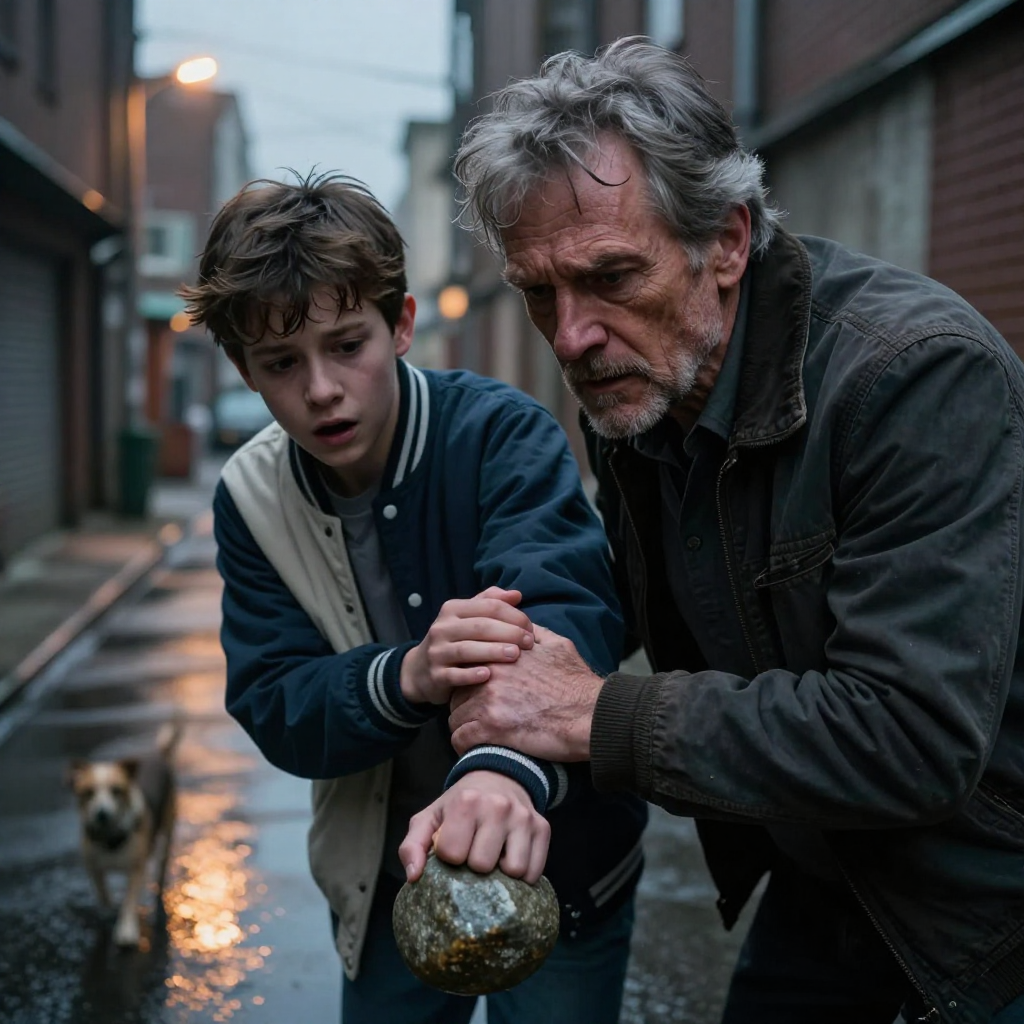
One of the boys—the tallest one, wearing a red jacket—held a rock in his hand. It wasn’t a pebble. It was a jagged chunk of concrete, heavy enough to break bone. He weighed it in his palm, grinning at his friends. He said something I couldn’t quite catch, a joke that made the others double over. Then he pulled his arm back and let it fly.
The stone struck the dog in the flank. The animal didn’t growl. It didn’t bare its teeth. It just screamed—a terrible, human sound of confusion and pain. It tried to scramble up the side of the container, claws scrabbling uselessly against the steel, slipping back down into the dirt.
The boys roared. They high-fived. One of them, a shorter kid with blonde hair, kicked a cloud of dust at the animal. “Look at it dance!” he shouted. His voice cracked with puberty and excitement.
I felt a cold pressure in the center of my chest. It wasn’t anger. Anger is hot; anger makes you sloppy. This was a deep, freezing calculation. I looked at these boys and I didn’t see children. I saw the seedlings of the men I used to hunt. I saw the absolute lack of empathy, the joy derived from suffering. They weren’t doing this because they were threatened. They were doing it because they could. Because they felt big, and the dog was small.
I checked the environment. No cameras. No other witnesses. Just the fading light and the echo of cruelty. I slipped through the hole in the fence. I didn’t run. Running attracts attention; running signals panic. I walked. I walked with a measured, heavy pace, my boots crunching deliberately on the gravel now.
They didn’t hear me at first. They were too focused on their game. The tall boy in the red jacket was bending down to pick up another stone, a larger one this time. He was laughing, telling his friend to film it on his phone.
“Get a good angle,” he said, hefting the rock. “I’m gonna get it right in the head this time.”
He winded up. The dog squeezed its eyes shut, shivering violently, accepting its fate.
“Drop it,” I said.
My voice wasn’t loud. I didn’t shout. I spoke in a tone I hadn’t used in ten years—a tone that suggests that the person speaking is the only reality that matters in the room.
The boys froze. The laughter cut off as if someone had severed the audio cable. They turned, startled, squinting into the gloom where I stood.
“Who the hell are you?” the leader asked. He didn’t drop the rock. He stood up straight, puffing out his chest. He was tall, taller than me maybe, fueled by the invincibility of youth and adrenaline. He looked me up and down—my graying hair, my faded denim jacket, my plain work boots. He dismissed me instantly. To him, I was just some old bum, some nobody.
“I said, drop it,” I repeated. I took another step forward. I was ten feet away now.
“Get lost, old man,” the leader sneered, his confidence returning. His friends snickered nervously behind him. “This is private property. You want trouble?”
“You have no idea,” I whispered. “You have absolutely no idea what trouble looks like.”
The leader laughed, a sharp, arrogant bark. “You’re crazy. Come on guys, let’s finish this.” He turned back to the dog, raising the rock high above his head, intent on bringing it down on the animal’s skull.
I covered the distance in two strides. I didn’t run; I surged. It was muscle memory, dormant but not dead.
As his arm came forward, I didn’t block it. I stepped inside his guard. My left hand shot out and clamped around his wrist—the one holding the rock. I didn’t just hold it; I squeezed. I pressed my thumb into the nerve cluster just below the joint, a technique designed to force a suspect to drop a weapon without breaking the bone—usually.
The effect was instantaneous. The boy gasped, his eyes going wide. His fingers spasmed involuntarily, and the heavy chunk of concrete fell from his hand, landing inches from his own expensive sneakers with a dull thud.
He tried to yank his arm back, but I held fast. I stepped in closer, invading his personal space, forcing him to look directly into my eyes. I know what my eyes look like in moments like this. My ex-wife used to say they looked like shark eyes—flat, black, and completely devoid of warmth.
“Ow! Let go! You’re hurting me!” he yelped, his voice jumping an octave. The tough guy facade evaporated instantly, replaced by the whine of a child who has never been told ‘no’.
His friends stepped forward, posturing. “Hey! Get off him!” one shouted, though he didn’t come closer than arm’s length.
I didn’t look at the friends. I kept my eyes locked on the leader. I tightened my grip slightly, twisting his arm behind his back in a hammerlock, forcing him to bend forward, lowering his face until it was level with the dog he had been tormenting.
The dog whimpered and scrambled back, terrified of the sudden movement.
“Look at it,” I commanded, my voice a low rumble near his ear. “Look at what you were doing.”
“It’s just a stupid dog!” the boy cried out, tears of pain starting to form in the corners of his eyes. “Let me go! My dad is a lawyer! He’ll sue you! He’ll destroy you!”
I almost laughed. A lawyer. That was the threat? I had stared down cartel enforcers. I had negotiated with terrorists in damp basements. The threat of a suburban lawsuit felt like a feather against a tank.
“Your dad isn’t here,” I said calmly. “And right now, neither is the law. It’s just you, me, and the animal you wanted to kill.”
I felt him trembling. It was the same trembling the dog was doing. Fear. It is the great equalizer. It strips away the varsity jacket and the arrogance and leaves just the biological imperative to survive.
“You think power is hurting something that can’t hurt you back?” I asked, leaning closer. “That’s not power. That’s cowardice. You want to see power?”
I released the pressure on his nerve slightly, just enough so he could breathe, but kept him pinned. I looked up at his friends. They were paralyzed. They had their phones out, but they weren’t filming anymore. They were holding them like shields.
“Put the phones away,” I said. I didn’t raise my voice. I didn’t have to.
They scrambled to pocket them.
“This dog,” I said, looking back at the boy in my grip. “This starving, frightened animal… has more dignity in its little finger than you have in your entire body. You were laughing. Do you remember laughing?”
“I… I was just joking,” he stammered. “It was just a joke.”
“Pain isn’t a joke,” I said. “Fear isn’t a punchline.”
I could feel the shift. The adrenaline in the boy was fading, replaced by the cold reality of consequences. He wasn’t the alpha male anymore. He was prey.
I glanced at the dog. It had stopped shivering. It was watching us. Its ears had perked up slightly. It sensed the change in the dynamic. It knew the threat had been neutralized.
“I’m going to let you go,” I said to the boy. “But before I do, I want you to understand something. I walk this neighborhood every day. I see everything. I know faces. If I ever—ever—see you near this animal, or any animal, or anyone weaker than you again…”
I let the sentence hang there. Unfinished threats are always more terrifying because the imagination fills in the blanks with its own worst nightmares.
I shoved him away. He stumbled, almost tripping over his own feet, and fell onto the gravel. He scrambled backward, crab-walking away from me, clutching his wrist. His face was pale, his eyes wide and wet.
“You’re crazy,” he whispered, but there was no venom in it. Only shock.
“Go,” I said.
They ran. They didn’t walk; they didn’t look back. They turned and sprinted toward the street, their expensive sneakers slapping hard against the pavement, disappearing into the suburban twilight.
I stood there in the silence. My heart rate was still steady. 60 beats per minute. I took a deep breath, smelling the ozone of the coming rain and the stale dust of the alley. I turned slowly to the corner where the dog was huddled.
It didn’t retreat. It looked at me with large, liquid brown eyes. There was blood on its flank where the rock had hit, matting the fur. It let out a small, hesitant sound—not a growl, not a bark, but a question.
“It’s okay,” I said, my voice softening, returning to the voice of Elias the neighbor. “It’s over now.”
I crouched down, extending a hand, palm up. The dog flinched, expecting another blow. I froze, letting it smell me. Letting it smell that the violence was gone.
This was the part I was good at. The de-escalation. The aftermath. But as I looked at the dog’s injuries, I knew this wasn’t just over. Those boys… they were local. They were entitled. And humiliation is a dangerous thing for a teenage boy with an ego. They wouldn’t just forget this. They would go home, they would spin a story, and they would come back. Or worse, they would find a new target.
I looked at the dog, and then I looked at my trembling hand. I wasn’t trembling from fear. I was trembling because the mask was slipping. The old life was leaking back in, and I wasn’t sure I could put the cork back in the bottle.
CHAPTER II
The dog didn’t have a name yet, but he had a weight. He was a heavy, trembling mass of matted fur and protruding ribs as I carried him into my apartment. The air in my hallway always smelled of stale floor wax and the faint, metallic tang of the radiator, a scent that usually grounded me. Tonight, it felt suffocating. I laid him down on a pile of old towels in the kitchen, the linoleum cold beneath us. He didn’t try to run. He just looked at me with eyes that had seen the worst of humanity and had somehow decided to expect more of it from me. That was his first mistake.
I moved with a practiced, mechanical efficiency I had spent three years trying to forget. I didn’t think about the boy in the red jacket or the way his wrist had felt like a dry twig in my hand. I thought about antiseptic, clean gauze, and the steady rhythm of my own breathing. My hands, which had been shaking in the alley, were now perfectly still. This was the ‘civilian mask’ I had built, a shell of a man who worked in a hardware store and remembered to water his single spider plant. But as I cleaned the gash on the dog’s flank, I realized the mask wasn’t just cracked; it was dissolving. The salt of my sweat stung my eyes, but I didn’t wipe it away. I just watched the dog. He winced when the peroxide bubbled, a low, guttural whimper that vibrated against the floor.
“Easy,” I whispered. My voice sounded foreign to me, rusty from disuse. “It’s okay, Cooper.”
I don’t know why I called him Cooper. It was a name from a life I’d buried, a man I used to know who had been reliable and unremarkable. The dog—Cooper—rested his chin on my forearm. The heat of his body was a searing reminder that I had brought a living thing into a space I had designed specifically to be empty. For three years, my apartment had been a tomb for a man who wasn’t allowed to exist anymore. Now, there was blood on the towels and a heart beating against my wrist. I stayed on the floor with him for hours, watching the shadows of the streetlamps crawl across the ceiling. I was waiting for the adrenaline to fade, but it stayed, coiled in the base of my spine like a sleeping predator.
This was the return of the Old Wound. It wasn’t a physical scar, though I had plenty of those. It was the memory of a night in a different city, under a different name, when I had allowed myself to care about the outcome of a situation that wasn’t my business. I had been told then that my empathy was a structural flaw, a leak in the pressurized cabin of my career. I had tried to patch it with silence and isolation, but here I was again, holding a broken thing and waiting for the world to notice. I felt the familiar ache in my knuckles, the ghost of a dozen different fights, a history of ‘discreet resolutions’ that the government had paid handsomely to keep off the books. That was my Secret: I didn’t just have training; I had a file that, if opened, would reveal that the man living in 4B didn’t officially exist. I was a ghost who had just punched a hole in the real world.
By morning, Cooper was breathing more easily, though he still couldn’t put weight on his back leg. I knew I couldn’t keep him here without a proper medical check. I had to go to the vet. It was a risk, but the alternative was watching him die of an infection in my kitchen. I wrapped him in a clean blanket and carried him down to my old sedan. The morning air was crisp, the kind of autumn chill that makes you feel like the world is starting over. But as I drove toward the clinic on the edge of town, the feeling of being watched began to itch at the back of my neck. I checked my mirrors every thirty seconds. Habit is a hard thing to kill.
Dr. Aris was a woman who spoke in short, clipped sentences and didn’t ask questions about where a dog gets a four-inch laceration that looks suspiciously like it was caused by a jagged piece of metal. She was busy, her waiting room crowded with the usual morning rush of pampered poodles and nervous cats. I sat in the corner, the blanket-wrapped bundle on my lap, trying to be invisible. It was an art form I had mastered, but today, the colors were all wrong. I felt too large for the chair, too loud in my silence.
Then the door chimes rang, a bright, cheerful sound that heralded a storm.
Julian, the boy from the alley, walked in first. He wasn’t wearing the red jacket today. He was wearing a soft, expensive-looking cashmere sweater and a sling on his right arm. His face was pale, his eyes wide and performatively glassy. Behind him was a man who could only be his father—Marcus Thorne. I recognized the name from the local news; he was a powerhouse attorney, the kind of man who didn’t just win cases, he erased opponents. Following them were two uniformed police officers. The room went silent. The soft yapping of a terrier in the corner died out as if someone had turned off a switch.
Julian pointed a trembling finger at me. “That’s him,” he said, his voice cracking perfectly on cue. “That’s the man who attacked me.”
It was sudden, public, and irreversible. The eyes of every person in that clinic turned toward me. I saw the shift in their expressions—from mild curiosity to instant, curdled judgment. In an instant, I wasn’t the man who saved a dog; I was the monster who broke a child’s arm. I felt the weight of Cooper in my lap, and for a second, I thought about the exit. I knew three ways to leave that room without being touched. I knew exactly where the officers’ holsters were positioned, and I knew the structural weaknesses of the glass storefront. But I didn’t move. If I moved like an agent, I would confirm their worst fears. If I moved like a civilian, I was a victim.
Marcus Thorne stepped forward, his presence filling the small lobby with the scent of expensive cologne and cold authority. He didn’t look at the dog. He looked at me as if I were a smudge on a legal brief. “Mr. Elias Vance?” he asked, his voice low and dangerous.
“Just Elias,” I said. I stood up slowly, keeping my hands visible, still cradling Cooper. The officers moved closer, their thumbs hovering near their utility belts. They weren’t aggressive yet, but they were prepared for it.
“My son is fifteen years old,” Thorne said, the words measured and heavy. “He has a fractured radius and a severe concussion. He says he was trying to help a stray dog when you came out of the shadows and assaulted him. He says you threatened to kill him.”
I looked at Julian. The boy met my eyes for a split second, a flicker of triumph dancing behind his feigned trauma. He knew he had won. He had the narrative, the power, and the father to back it up. I looked back at Thorne. “That’s not what happened. He was torturing this dog. I stopped him.”
“A likely story from a man with your… background,” Thorne said. My heart skipped. Did he know? Or was he just fishing? “We’ve done a preliminary search, Elias. No employment records for the last five years beyond a part-time gig at a hardware store. No family. No social footprint. You’re a vacuum. And now, you’re a violent offender who thinks he can hide behind a ‘rescue’ story.”
One of the officers, a younger man named Miller whose badge was too shiny, stepped in. “Sir, we’re going to need you to come down to the station. And we’ll need to take the animal into custody as evidence of the alleged incident.”
That was the moment the floor fell away. If they took Cooper to the county shelter as ‘evidence,’ he would be processed, likely euthanized given his condition and the nature of the case. He was a witness they could silence with a needle. This was my Moral Dilemma. If I surrendered the dog, I might be able to disappear again, to slip into the shadows of a legal battle and eventually flee. If I refused, I was resisting arrest and confirming the ‘violent’ label. I could see the phones coming out—people were recording this. My face was going to be on every local feed by noon. My Secret was being peeled away, layer by layer, in the most public way possible.
“The dog stays with the vet,” I said, my voice dropping into that low, flat tone that used to make people in dark rooms start talking. “He needs surgery. You want to arrest me? Fine. But the animal is under medical care.”
Thorne laughed, a dry, humorless sound. “You’re in no position to negotiate. You attacked the son of a man who owns this town’s legal system. You think you’re a hero? You’re a drifter with a temper problem. Officers, take the dog.”
Officer Miller reached for the blanket. I didn’t strike him. I didn’t use a pressure point. I simply shifted my weight, turning my shoulder so that he couldn’t reach Cooper without physically shoving me. It was a subtle move, one that only a professional would recognize as a defensive posture. To the room, it looked like I was just being stubborn. To the officers, it was a challenge.
“Don’t make this harder than it has to be, Elias,” Miller warned.
I looked at Dr. Aris. She was standing behind the counter, her face unreadable. I needed an ally, but I was a stranger who lived in a basement apartment. Why would she help me? But then, she looked at Julian, then at the shivering bundle in my arms. She had seen the wounds. She knew what a rock does to a dog’s skull versus what a hand does to a boy’s arm.
“The dog is a patient,” she said suddenly. Her voice was thin but steady. “He is currently being prepped for emergency surgery. Under state law, I cannot release a stabilized patient in critical condition to anyone other than a licensed animal control officer with a court-ordered seizure warrant. Do you have a warrant, Officer?”
The room shifted again. Thorne’s eyes narrowed. “I can have one on your desk in an hour, Doctor.”
“Then come back in an hour,” she replied. “Until then, I am the only one who touches this animal.”
I felt a surge of something I hadn’t felt in years: hope. It was a dangerous emotion. Thorne leaned in close to me, so close I could smell the peppermint on his breath. “You think this helps you? All you’ve done is ensure that when I destroy you, I do it slowly. You’re going to jail, Elias. And by the time I’m done with the civil suit, you won’t even own the clothes on your back. I’ll make sure everyone knows exactly what kind of ‘man’ you are.”
He turned to the officers. “Take him. We’ll deal with the dog later.”
They didn’t handcuff me—not yet, not in front of the cameras. They escorted me out through the lobby. I felt the heat of a dozen gazes on me. I saw a woman I recognized from the hardware store; she looked at me with a mixture of fear and disgust. The community I had tried to blend into was ejecting me like a toxin. As we stepped out into the bright morning sun, the reality of the situation settled into my bones.
I was being taken to a place where they would fingerprint me. They would run my prints through the national database. They would find the gaps. They would find the ‘redacted’ flags. My carefully constructed life was over. I had traded my anonymity for the life of a starving dog, and as the cruiser door clicked shut, I wondered if I had finally made the mistake that would kill me.
Inside the station, the atmosphere was thick with the smell of floor cleaner and adrenaline. I sat in an interrogation room, the fluorescent lights humming a low B-flat that vibrated in my skull. I didn’t ask for a lawyer. I knew that anything I said would be twisted by Thorne’s influence. I just sat and waited. I thought about the Old Wound—the time I had let a witness go because I couldn’t bear to see her die, only to find out she had been killed two days later because I hadn’t finished the job properly. I had learned then that half-measures were the most violent thing you could do.
I had tried to be half a man here. I had tried to be a civilian who only used enough force to stop a crime. But in the eyes of the law, there is no such thing as ‘just enough’ force when it’s used against the sons of the powerful.
After three hours, the door opened. It wasn’t an officer. It was a woman in a sharp grey suit. She looked like she was made of flint and iron. She sat down across from me and laid a file on the table. It was empty.
“My name is Sarah Vane,” she said. “I’m with the District Attorney’s office. Or, at least, that’s what the badge says.”
I looked at her. Her eyes were too intelligent, too observant. She wasn’t looking at my face; she was looking at my hands, my posture, the way I scanned the room. She knew.
“Mr. Thorne is demanding your head on a platter,” she said, leaning back. “He wants felony assault, child endangerment, and a dozen other charges. He’s already talking to the press. You’re the ‘Alleyway Stalker’ now, Elias. That’s the name the local news is using.”
“I didn’t stalk anyone,” I said.
“I know you didn’t,” she replied. She tapped the empty file. “I also know that your fingerprints came back with a Level 4 Security Clearance flag. Do you know how hard it is to get one of those? It usually requires a presidential signature or a very deep grave. The system didn’t give me a name. It just gave me a phone number to a Langley extension that doesn’t exist.”
This was the moment of no return. My Secret was out, at least to her. “What do you want?”
“I want to know why a man like you is living in a town like this, breaking the arms of spoiled teenagers,” she said. “And I want to know if you’re as dangerous as the computer says you are. Because Marcus Thorne is a cancer on this county. He’s been protecting his son’s ‘indiscretions’ for years. There are three other boys who were in that alley. They’re all terrified of you, but they’re more terrified of Marcus. They’ve all signed statements saying you attacked them unprovoked.”
“They’re lying.”
“Of course they are,” she snapped. “But a lie told by four ‘respectable’ families is the truth in a courtroom. Unless you have something better.”
I thought of Cooper. I thought of the way the boy’s father had looked at me. This wasn’t just about a dog anymore. It was about the fact that I had dared to challenge the hierarchy. I had reminded a predator that there were bigger things in the dark than him.
“The vet has the dog,” I said. “The dog is the evidence. If you look at the wounds, you’ll see they don’t match his story. The boy had a rock. He was going to kill it.”
“Thorne is already moving to have the dog destroyed,” Vane said. “He’s claiming it’s a public safety hazard, that it’s a vicious animal that attacked his son first. The warrant will be signed by Judge Halloway—who happens to be Thorne’s golfing partner—within the hour.”
I felt the predator in my spine wake up. The mask was gone now. There was no point in wearing it anymore. The community had already decided I was the villain. If I was going to be the monster they wanted, I might as well be the one they deserved.
“What happens if I walk out of here?” I asked.
“You can’t walk out. You’re being processed.”
“I’m not asking for permission,” I said softly. I looked at the camera in the corner of the room. I knew exactly where the blind spot was. I knew how to disable the lock on the door with the wire from my own notebook.
Sarah Vane didn’t flinch. She just watched me. “If you leave, you’re a fugitive. They’ll hunt you. Your life here is over.”
“It was over the moment I stepped into that alley,” I said. “I’m just deciding what kind of ending it’s going to have.”
I stood up. My body felt light, the way it used to before a jump. The Moral Dilemma had resolved itself into a singular, cold clarity. I could stay and let the system crush me and the dog, or I could return to the shadows and fight the way I was trained to fight. There was no ‘right’ choice. There was only the choice that allowed me to live with the man I saw in the mirror.
“The dog’s name is Cooper,” I told her. “If anything happens to him before I get back to that clinic, tell Marcus Thorne that he didn’t just find a drifter. He found a ghost. And ghosts don’t have anything left to lose.”
I moved toward the door. I didn’t look back. I could hear the sirens in the distance, the sound of a world that was about to find out exactly who Elias Vance really was. The Old Wound was open, the Secret was a weapon, and the dilemma was gone. Now, there was only the mission. I had a dog to save, and a town to burn down—metaphorically or otherwise.
As I stepped into the hallway, bypassing the distracted guard at the desk with a ghost’s grace, I realized that for the first time in three years, I wasn’t pretending to be a man. I was being exactly what the world had made me. And God help anyone who stood in my way.
CHAPTER III
The rain against the windshield sounded like static, a white noise that helped me find the old frequency. I sat in the shadows of the alley across from the County Animal Control facility. It was 3:12 AM. In less than an hour, a technician would arrive to execute a ‘destruction order’ signed by a judge whose re-election campaign was funded by Marcus Thorne.
I looked at my hands. They were steady. The civilian mask hadn’t just slipped; it had dissolved in the acid of the last forty-eight hours. I wasn’t a retired man looking for a quiet life anymore. I was a ghost returning to the halls of the living.
I didn’t need a gun. I needed a ghost’s tools. A slim jim, a frequency scanner, and the cold, calculated patience of a man who had forgotten how to feel fear.
I moved. The asphalt was cold under my boots. I cleared the perimeter fence in one fluid motion, a ghost climbing over a graveyard wall. The facility was a low-slung concrete bunker, a place where mistakes were erased and silence was the only language spoken. I found the service entrance. The electronic lock was a standard Grade 4. I had it bypassed in under thirty seconds.
Inside, the air smelled of bleach and despair. The sound of distant, whimpering dogs echoed off the tile walls. It was a hollow, haunting sound. I moved through the corridors, my shadow stretching out ahead of me like a warning. I knew where they would keep him. The ‘high-risk’ wing. The place they put animals that had the misfortune of crossing the powerful.
I found the kennel at the end of the hall. Cooper was there. He wasn’t barking. He was sitting at the back of the cage, his head low. When he saw me, he didn’t growl. He let out a soft, broken sound.
“Hey, boy,” I whispered. My voice sounded foreign to my own ears. It was the voice of the man I used to be. “We’re leaving.”
I picked the lock on his cage. He stepped out, his body trembling. I checked his collar. They had already tagged him for the procedure. A bright red plastic strip. I ripped it off and shoved it into my pocket.
But I wasn’t done. Saving the dog was the impulse; saving my soul required the evidence. I left Cooper in the shadow of the hallway and moved toward the administrative offices. I knew Thorne’s reach. A man like that doesn’t just bribe a judge; he leaves a trail of digital breadcrumbs, convinced he is too big to be tracked.
I reached the main server room. My fingers danced over the keyboard. I wasn’t looking for current files. I was looking for the archived logs of the Thorne family’s interactions with the county. I found a hidden directory, encrypted with a key that was laughably simple for someone with my training.
I opened the folder labeled ‘J.T. – Incident Reports.’
My breath hitched. It wasn’t just a list of dead dogs. It was a chronological history of a monster in the making. Julian Thorne hadn’t just started with Cooper. There were reports of neighbors’ pets disappearing, of ‘accidental’ fires at a summer camp, of a private tutor who had been paid six figures to sign a non-disclosure agreement after an ‘unfortunate fall.’
Marcus Thorne hadn’t just been a protective father. He had been a curator of violence. He had spent twenty years cleaning up the blood Julian left behind, treating his son’s sociopathy as a PR problem to be managed rather than a sickness to be cured.
I felt a cold rage settle in my marrow. This wasn’t about a dog anymore. This was about a system that allowed a predator to grow in the shade of a legal empire.
“You should have stayed in the shadows, Elias.”
The voice came from the doorway. I didn’t look up immediately. I finished the data transfer to my encrypted drive before turning around.
Marcus Thorne stood there. He wasn’t alone. He had two men with him. They weren’t police. They were private security—the kind of men who worked for firms that didn’t have names, only offshore bank accounts. Marcus looked different without the suit and the television lights. He looked small. He looked desperate.
“I expected you to come,” Marcus said. He was holding a heavy folder. “You’re a predictable man, Mr. Vance. You have that hero complex. It’s a very dangerous thing in a world that doesn’t want heroes.”
“I’m not a hero, Marcus,” I said, standing up slowly. “I’m just the man who’s going to stop you.”
Marcus laughed, a dry, rattling sound. “With what? The word of a fugitive? You’ve been erased. I’ve seen your file. Or rather, I’ve seen the holes where your file used to be. You’re a non-person. I, on the other hand, am the law in this town.”
“The law is a fragile thing when it’s built on a foundation of dead things,” I said. I pointed to the screen. “I just read Julian’s history. You didn’t just hide his crimes. You funded them. You bought the silence of every victim he ever touched. That tutor? She didn’t fall. He pushed her. And you paid for the reconstructive surgery and the new house in Arizona.”
Marcus’s face went pale. The arrogance flickered for a second, replaced by a raw, naked fear. “You think you can use that? I’ll have it deleted before you hit the parking lot. My men will take that drive, and you’ll disappear into a hole you’ll never crawl out of.”
He signaled the two men. They moved forward, their hands reaching for the concealed holsters beneath their jackets.
I didn’t move. I didn’t need to.
The lights in the hallway suddenly flashed, then died. The facility’s backup generators groaned to life, casting the room in a sickly red emergency glow.
“Nobody is moving anywhere,” a new voice said.
It was Sarah Vane. But she wasn’t dressed as a District Attorney’s representative. She was wearing a tactical vest, and she was holding a sidearm with a level of familiarity that didn’t come from a courtroom. Behind her, a team of men in dark uniforms flooded the hallway. They weren’t local. They were federal.
“Sarah?” Marcus stammered. “What is this? I have an agreement with the DA’s office—”
“The DA doesn’t know I’m here, Marcus,” Sarah said, her voice like ice. “And the people I work for don’t care about your agreements.”
She looked at me. There was a look in her eyes I recognized. It was the look of a handler.
“You were supposed to stay retired, Elias,” she said softly. “You were the best ghost we ever had. But ghosts aren’t supposed to haunt the local news.”
My heart hammered against my ribs. “You,” I said. “You’re the one who scrubbed me. You’re ‘S’.”
She nodded slightly. “I was your lead analyst for ten years. When you took the civilian package, I made sure you stayed invisible. I thought you wanted peace.”
“I did,” I said. “Until the world stopped being peaceful.”
Sarah turned her attention back to Marcus. The two security guards had their hands in the air now. They knew a federal sweep when they saw one.
“Marcus Thorne,” Sarah said. “You’ve spent a lot of time and money hiding your son’s activities. But you made a mistake. You tried to crush a man who doesn’t exist. When you started digging into Elias’s past, you triggered a series of red flags at the Agency. We don’t like people digging into our retired assets. It tends to expose things we’d rather keep buried.”
Marcus looked between us, his mouth hanging open. “You… you’re protecting him? He’s a criminal! He assaulted my son!”
“Your son is a psychopath who was one week away from killing a human being,” Sarah said. She held up a tablet. “We’ve been monitoring Julian for months. We were waiting for a reason to bypass your local protections. You gave it to us by making this a national spectacle. We’ve seized your firm’s servers. Every payoff, every bribe, every NDA you ever signed is currently being uploaded to a federal grand jury.”
Marcus collapsed into a nearby chair. The powerful attorney, the man who owned the city, looked like a child who had just realized the floor was falling away.
“What happens now?” I asked.
Sarah looked at me, her expression unreadable. “For Marcus? A very long, very public trial. For Julian? A secure psychiatric facility where he will never have access to another living thing again. The Thorne legacy ends tonight.”
“And for me?” I asked.
Sarah stepped closer. The red emergency lights made her eyes look like embers. “That’s the hard part, Elias. You broke cover. You used tactical skills on a civilian population. You escaped custody. You’re a liability now.”
I looked down at Cooper, who had crept into the room and was now sitting by my leg. He leaned his weight against me.
“I’m not going back into the box, Sarah,” I said.
“I know,” she replied. “But the civilian mask is gone. You can’t go back to your little house. You can’t go back to your quiet life. The world knows your face now. Or at least, the parts of the world that matter do.”
She reached out and took the flash drive from the server. “I’ll take this. It’s more than enough to bury the Thornes. But you need to leave. Now. Before the local police arrive to see what the feds are doing.”
“Where am I supposed to go?” I asked.
“Run,” she said. “Just like you were trained. I’ll give you a twenty-four-hour head start before I have to report your location. After that, you’re on your own. No more pension. No more protection. Just the ghost and his dog.”
I looked at Marcus, who was staring at the floor in a trance of total defeat. I felt no satisfaction. I felt no joy. I only felt the weight of the life I had lost and the uncertainty of the one that was beginning.
I whistled softly. Cooper stood up.
“One more thing,” Sarah called out as I reached the door.
I stopped but didn’t turn around.
“The dog,” she said. “He’s officially listed as ‘destroyed’ in the county records. As far as the law is concerned, he doesn’t exist. Just like you.”
“Good,” I said. “He’s in good company.”
I walked out of the facility and into the cold morning air. The rain had stopped, but the sky was a bruised purple, the sun struggling to break through the horizon. I walked to my car, Cooper trotting at my side.
I opened the door, and he jumped into the passenger seat. He looked at me, his tail giving a single, tentative wag.
I sat behind the wheel and looked at the rearview mirror. I didn’t recognize the man looking back. The lines around his eyes were deeper. The stillness in his gaze was terrifying.
I started the engine. I didn’t have a destination. I didn’t have a home. I had a tank of gas, a dog who trusted me, and a set of skills that the world had tried to make me forget.
As I pulled out of the parking lot, I saw the blue and red lights of the local police units screaming toward the facility. They were too late. The storm had already passed, and it had taken everything with it.
I turned the car in the opposite direction. I drove toward the edge of the city, toward the open road where the shadows were long and the silence was absolute.
I was a ghost again. And for the first time in a long time, I felt like I could finally breathe.
But the peace was a lie. I knew it as soon as I looked at the dashboard clock. 4:00 AM. The time Cooper was supposed to die. We had survived the night, but Marcus Thorne was a man with many friends, and the Agency was an organization that didn’t like loose ends.
Sarah had given me twenty-four hours.
I pushed the accelerator down. The city began to shrink in the mirror. I had twenty-four hours to disappear. Twenty-four hours to become someone else.
I looked at Cooper. He was watching the road, his ears perked.
“It’s just us now,” I whispered.
He licked my hand. The skin felt cold, but the heart beneath it was finally, painfully, awake.
I drove into the dawn, a man without a name, heading toward a future that had no map. The climax was over, but the war for my life had only just begun. The truth about the Thornes was out, but the truth about myself—the lethal, restless truth—was the one I would have to live with forever.
CHAPTER IV
The silence after the sirens was the worst. Not the absence of sound, but the thick, suffocating blanket it laid over everything. The Animal Control facility was a ruin of shattered glass and twisted metal, the air acrid with the smell of burnt electronics and fear. Marcus Thorne was gone, Julian was locked away, and Cooper was safe, panting softly at my side, but the victory felt…hollow. Tarnished.
Sarah, ‘S’, had given me a day. Twenty-four hours to disappear before the Agency came looking. A head start, maybe a gesture of…what? Loyalty? Regret? I didn’t know Sarah anymore than I ever had, which was to say, not at all.
I didn’t go back to the house. Too many memories, too many ghosts. Instead, I found a cheap motel on the outskirts of the city, a place where the sheets were thin and the silence wasn’t so heavy. Cooper deserved a clean space, no matter how temporary.
The television flickered with images of the aftermath. Marcus Thorne’s empire crumbling, his network of corruption exposed. Julian, finally held accountable for his actions. There were interviews with the teacher he’d assaulted, her voice trembling as she recounted the years of silence and fear. They even showed Cooper’s picture, calling him a ‘victim of circumstance.’ Ironic, really. He was the only one who’d come out of this whole thing unscathed.
I watched it all, feeling strangely detached. It was like watching a movie about someone else’s life, a life I no longer recognized. Elias Vance, the quiet retiree, the dog-loving neighbor, the man who almost had a normal life—he was gone.
My phone buzzed. A text from Sarah. One word: “Go.”
I turned off the television and looked at Cooper. He was asleep, his head resting on his paws. I stroked his fur, feeling the steady beat of his heart. He was all I had left.
The first few hours were a blur of practiced movements. Draining bank accounts, shedding identities, erasing digital footprints. It was like putting on an old coat, the skills and instincts resurfacing with unnerving ease. I was a ghost again, a shadow moving through the world, leaving nothing behind.
But this time, it was different. There was no mission, no objective, no handler whispering in my ear. Just me and Cooper, running from ghosts of our own making.
**PHASE ONE: PUBLIC ECHOES**
The media frenzy was relentless. Every news outlet dissected the Thorne case, turning it over and over like a macabre puzzle. They interviewed former employees, alleged victims, even distant relatives, all eager to offer their version of the truth. The narrative shifted daily, painting Marcus Thorne as a monster, a victim, a misunderstood genius. Julian became a symbol of spoiled privilege, a cautionary tale, a lost cause. And I? I was the enigma, the ghost in the machine, the vigilante who’d brought it all crashing down.
Online, the debate raged. Some hailed me as a hero, a champion of the downtrodden, a symbol of resistance against corruption. Others branded me a dangerous criminal, a loose cannon, a threat to the established order. There were hashtags, memes, conspiracy theories, even calls for my capture and prosecution. It was a circus, a digital feeding frenzy, and I was the main attraction.
The community where I’d lived was in shock. Neighbors I’d known for years avoided eye contact, their faces a mixture of fear and suspicion. The local grocery store, where I’d been a regular, suddenly felt like enemy territory. Whispers followed me, accusations hung in the air. I was no longer Elias Vance, the friendly retiree. I was a pariah, an outcast, a reminder of the darkness that lurked beneath the surface of their quiet lives.
Even the animal shelter, where I’d volunteered, felt tainted. The director, a kind woman named Emily, called to express her concern, her voice strained with anxiety. She said the shelter had received threats, that people were accusing them of harboring a fugitive. I told her I understood, that I wouldn’t come back.
That hurt more than anything. Losing the connection to those animals, the feeling of making a difference, however small—it was like losing a piece of myself.
**PHASE TWO: PRIVATE WOUNDS**
Sleep was a luxury I couldn’t afford. Every time I closed my eyes, I saw Marcus Thorne’s face, contorted with rage and desperation. I heard Julian’s taunts, his empty threats. I felt the weight of the gun in my hand, the cold steel against my skin.
Guilt gnawed at me. Guilt for the lives I’d taken, the lies I’d told, the people I’d hurt. Guilt for dragging Cooper into this mess, for exposing him to danger. Guilt for shattering the illusion of normalcy I’d so desperately tried to create.
I tried to push it down, to compartmentalize, to shut it off like I used to. But it didn’t work. The years of repression had taken their toll. The dam had finally broken, and the flood of emotions was overwhelming.
I thought about Sarah, about her role in all of this. Was she really trying to help me? Or was I just a pawn in her game, a tool to be used and discarded? I didn’t know. And I realized, maybe I never would.
Cooper sensed my turmoil. He stayed close, nudging my hand with his nose, his eyes filled with concern. He didn’t understand what was happening, but he knew I was hurting. And he was there for me, unconditionally, without judgment.
His presence was a lifeline, a reminder that I wasn’t completely alone. That even in the darkest of times, there was still hope, still a reason to keep going.
But the truth was, I was exhausted. Emotionally, physically, spiritually exhausted. I was tired of running, tired of fighting, tired of living in the shadows.
I wanted to stop. I wanted to give up. I wanted to find a place where I could finally rest, where I could finally be at peace.
But I couldn’t. Not yet. Not while Cooper was still depending on me.
**PHASE THREE: THE TRACE**
Around hour eighteen, I felt it. A prickling sensation at the back of my neck, a sense of being watched. I’d been too comfortable, too complacent. I’d let my guard down.
I checked the rearview mirror, scanning the road behind me. Nothing. But I knew. They were out there. Hunting me.
It could have been the Agency, following Sarah’s orders. Or it could have been someone else, someone connected to Thorne, seeking revenge. Either way, I was in trouble.
I changed routes, taking back roads and side streets, trying to lose them. But they were persistent. Always a few cars behind, never too close, but always there.
I needed to find out who they were. And I needed to lose them, for good.
I pulled into a deserted gas station on the outskirts of town. The kind of place where the pumps were rusted and the windows were boarded up. I told Cooper to stay in the car and went inside.
The station was empty, except for an old man behind the counter, reading a newspaper. He looked up as I entered, his eyes wary.
“Can I help you?” he asked, his voice raspy.
“I need to make a phone call,” I said.
He pointed to a payphone in the corner. “Help yourself.”
I dialed a number I hadn’t used in years, a number etched in my memory. It rang several times before someone answered.
“Yeah?” a gruff voice said.
“It’s Vance,” I said.
There was a pause. “Elias? What the hell do you want?”
“I need your help,” I said. “I’m being followed.”
“Followed? By who?”
“I don’t know. But they’re good. I need you to find out who they are and what they want.”
“I don’t know, Elias. I’m out of that life. I don’t want any part of it anymore.”
“Please, Ben. This is important. It’s not just about me. There’s a dog involved.”
There was another pause. I could hear Ben sighing on the other end of the line.
“Alright,” he said finally. “Give me your location. I’ll see what I can do.”
I gave him the address of the gas station and hung up. I went back to the car, feeling a little less alone. Ben was a contact from my old life, a fixer, a guy who knew how to get things done. He wasn’t someone I trusted completely, but he was the best I had.
As I waited, I noticed a black SUV pull into the gas station across the street. Two men got out, their faces obscured by sunglasses. They stood by the vehicle, watching me.
I knew then. This wasn’t just a tail. This was an ambush.
**PHASE FOUR: THE CLEANER**
They didn’t rush me. They were patient, professional. They knew I was trapped. I had nowhere to run.
The old man from the gas station shuffled outside, pretending to check the pumps. He was their lookout, I realized. They had this whole thing planned.
I took a deep breath and looked at Cooper. He was still in the car, oblivious to the danger. I couldn’t let them get to him.
I grabbed my bag from the backseat and opened the car door. “Stay,” I told Cooper. “Stay right here.”
He whined, sensing my urgency. But he obeyed.
I walked towards the black SUV, my hands raised. “I know who you are,” I said. “What do you want?”
The two men approached, their faces still hidden behind sunglasses.
“Elias Vance,” one of them said, his voice cold and emotionless. “We have orders to eliminate you.”
“Who gave you those orders?” I asked.
“That’s not important. What is important is that you come with us quietly. It will be easier that way.”
“And if I don’t?”
The man smiled, a cruel, predatory smile. “Then we’ll do it the hard way.”
I knew I couldn’t win. Not in a straight fight. They were younger, stronger, better equipped. But I wasn’t going to make it easy for them.
I lunged forward, catching them by surprise. I tackled one of the men to the ground, pinning him beneath me. The other man reached for his weapon, but I was too fast.
I grabbed a rock from the ground and smashed it against his head. He crumpled to the ground, unconscious.
The man I was pinning struggled, trying to break free. But I held him tight, my grip unyielding.
“Who sent you?” I demanded. “Tell me!”
He spat in my face. “Go to hell,” he said.
I tightened my grip, cutting off his air supply. His face turned red, his eyes bulging.
“Tell me!” I repeated.
Finally, he relented. “Thorne,” he gasped. “Marcus Thorne…before he…”
I released him, disgusted. Even from behind bars, Thorne was still trying to control things. Still trying to destroy me.
The man lay on the ground, gasping for air. I could have killed him. I should have killed him.
But I didn’t. I couldn’t.
I walked back to the car, my body shaking. Cooper was still there, waiting for me. He licked my hand, his eyes filled with concern.
I got in the car and started the engine. It was time to go. Time to disappear again.
As I drove away, I looked in the rearview mirror. The two men were still lying on the ground, unconscious. The old man was nowhere to be seen.
I knew they would come after me. But I was ready. I was no longer running from my past. I was running towards my future. Whatever that may be.
CHAPTER V
The desert swallowed us whole. Not the romantic desert of postcards, but the scrub-choked, unforgiving landscape that baked by day and froze at night. I’d chosen it deliberately, a place where no one would look, a place as empty as I felt. Cooper, though, seemed to thrive. He chased jackrabbits, dug in the sand, and slept curled at my feet, his presence a constant, warm weight against the cold. He was my reminder that even in the bleakest landscapes, life persisted.
My escape had been clean, efficient. Sarah had provided the necessary documents, a new identity: Daniel Crane. A name as unremarkable as the life I intended to lead. The Agency, I knew, wouldn’t pursue me actively. I was a ghost, a loose end they preferred to forget. But the memory of Thorne, of Julian’s face twisted with cruelty, lingered. It wasn’t the fear of capture that haunted me, but the echo of what I’d become, the ease with which I’d embraced violence.
I spent weeks in that self-imposed exile, the silence broken only by the wind and Cooper’s occasional bark. I’d whittled down my possessions to the bare essentials. A knife. A change of clothes. A worn photo of my wife, Emily. Her smile, a faded beacon, reminded me of the man I once was, the man I desperately wanted to be again.
Then, one day, I saw her. A young girl, no older than ten, standing by the side of the dusty road, her clothes torn, her face streaked with dirt and tears. Her eyes, wide and haunted, mirrored something I knew too well. I pulled over.
“Are you okay?” I asked, my voice rough from disuse.
She flinched, shrinking back. “He’s gone to get more gas,” she whispered, her voice barely audible. “He said if I move, he’ll… he’ll leave me here.”
I didn’t need her to spell it out. I saw the fear etched on her face, the silent plea in her eyes. My hands tightened on the steering wheel. My new life, my quiet anonymity, shattered against the reality of her terror. I knew, in that moment, I couldn’t turn away.
* * *
The next few hours were a blur of adrenaline and instinct. I got her into the car, reassured her with quiet words, and drove to the nearest town – a forgotten speck on the map. I found a motel, paid in cash, and got her cleaned up. Her name was Lily. She hadn’t eaten in a day. While she ate, Cooper stayed by her side, his big head resting on her lap. He seemed to know, instinctively, that she needed comfort.
I contacted Sarah, using a burner phone and a coded message. She didn’t ask questions. She simply listened, her voice tight with concern. She got Lily into the system – a network of safe houses and social workers who specialized in rescuing children from abusive situations. It was a world I knew existed, but had always remained separate from… until now.
Watching Lily leave with the social worker, clutching a new teddy bear, I felt a strange mix of emotions. Relief, certainly. But also a profound sadness. I was still a ghost, still living on the fringes. But perhaps, I thought, a ghost could still do some good.
I moved on, drifting from town to town, taking odd jobs – mechanic, ranch hand, construction worker. I kept a low profile, avoided attention. But I also kept my eyes open. I started noticing things I’d never seen before – the stray dog cowering in an alley, the homeless veteran begging for spare change, the elderly woman struggling to carry her groceries. People who were invisible, forgotten.
And I started helping them. Anonymously, quietly. A bag of food left on a doorstep. A vet bill paid in cash. A warm coat slipped onto a sleeping figure in the park. Small acts of kindness, fueled by a need to atone, to find some meaning in the wreckage of my life.
Cooper was my constant companion, my shadow. He was getting old, his muzzle graying, his gait a little slower. But his loyalty never wavered. He was a reminder that even a broken creature could offer unconditional love.
One evening, in a dusty border town, I saw a familiar face. A man I recognized from Thorne’s organization. He was leaning against a car, talking on a cell phone, his eyes scanning the street. He didn’t see me, not at first.
I ducked into a darkened doorway, my heart pounding. My instincts screamed at me to run, to disappear again. But then I saw who he was watching. A young woman, her face bruised, being dragged into a bar by a burly man. Her silent scream, her desperate eyes, froze me.
* * *
I followed them inside. The bar was dimly lit, filled with the smell of stale beer and desperation. The man was forcing the woman into a booth, his hand clamped on her arm. I walked over, my face expressionless.
“She doesn’t want to be here,” I said, my voice low and dangerous.
The man looked up, his eyes narrowing. “Mind your own business, old man.”
“It is my business,” I replied. “Let her go.”
He laughed, a harsh, ugly sound. “Or what? You gonna stop me?”
I didn’t answer. I simply moved. It was like stepping back into an old skin, a muscle memory honed by years of training. The fight was short, brutal. I didn’t enjoy it, didn’t revel in the violence. I simply did what was necessary to protect her.
The man lay on the floor, unconscious. The woman stared at me, her eyes wide with shock and gratitude. I helped her up, led her out of the bar, and flagged down a taxi.
“Go to the police,” I told her. “Tell them what happened.”
She nodded, tears streaming down her face. “Thank you,” she whispered. “Thank you for saving me.”
I watched the taxi disappear down the street, then turned and walked away, Cooper padding silently beside me.
I knew then that I couldn’t run anymore. I couldn’t hide. My past would always be a part of me, a shadow that trailed my every step. But I could choose how to use it. I could use my skills, my knowledge, to protect those who couldn’t protect themselves. It wouldn’t erase the things I’d done, the lives I’d taken. But it could give my life some purpose, some meaning.
* * *
Sarah found me a few months later. I wasn’t surprised. I’d left a trail, a subtle breadcrumb of good deeds, knowing she’d eventually pick it up. She found me in a small town in Montana, working as a handyman. Cooper was lying in the sun, his tail thumping softly against the porch.
“Elias,” she said, her voice tight with emotion. “What are you doing?”
“Living,” I replied. “Trying to, anyway.”
She looked at me, her eyes searching my face. “The Agency knows you’re alive,” she said. “They’re not actively hunting you, but… they’re aware.”
“I figured as much.”
“They could make things difficult for you, Elias. Very difficult.”
“I’m not afraid,” I said. “Not anymore.”
She sighed. “I know. That’s what worries me.”
We talked for hours, sitting on the porch, watching the sun set over the mountains. I told her about Lily, about the stray dogs, about the battered woman in the border town. I told her about my need to atone, to find some redemption in the darkness.
She listened patiently, her expression unreadable. When I was finished, she simply nodded.
“I can’t protect you forever, Elias,” she said. “But I can help you. I can provide you with resources, with contacts. I can make sure you have what you need to keep doing what you’re doing.”
“Why?” I asked.
She smiled, a sad, weary smile. “Because,” she said, “I think you’ve finally found your purpose.”
* * *
I didn’t become a hero. I didn’t change the world. I simply did what I could, where I could. I became a guardian of the forgotten, a protector of the vulnerable. I was still a ghost, still living on the fringes. But I was a ghost with a purpose.
Cooper died peacefully, in his sleep, a few years later. I buried him under an old oak tree, overlooking a valley bathed in sunlight. I mourned him deeply, but I also knew that he’d lived a good life, a life filled with love and loyalty. He’d taught me that even in the darkest of times, there was still hope, still goodness to be found.
I continued my work, traveling from town to town, helping those in need. I never stayed in one place for too long. I was always looking over my shoulder, always aware of the shadows. But I wasn’t afraid. I knew that I was doing what I was meant to do.
One day, I received a letter. It was from Lily, the little girl I’d rescued in the desert. She was grown now, a young woman with a bright future. She was studying to become a social worker, dedicating her life to helping children like herself.
“I never forgot you,” she wrote. “You saved my life, Mr. Vance. You showed me that there was still good in the world. Thank you.”
I smiled, a genuine smile that reached my eyes. Her words were enough. They were the validation I’d been searching for, the proof that my life, even in its brokenness, had made a difference.
I folded the letter carefully, placed it in my pocket, and walked out into the sunshine, ready to face whatever the future held. I was still a ghost. But I was finally at peace.
I knew that I’d likely die alone, unremembered. That was the price of the life I’d chosen, the life that had been thrust upon me. But I was okay with that. Because in the end, I had found something worth living for, something worth fighting for.
The desert wind whispered around me, carrying the scent of sage and the promise of rain. I closed my eyes, and for the first time in a long time, I felt a sense of quiet hope.
Sometimes, the only way to truly live is to embrace the things you can’t escape.
END.