THEY LAUGHED WHILE STONING THE TRAPPED DOG BEHIND THE FENCE, MOCKING MY TEARS, UNTIL THE GROUND SHOOK AND THE ‘GUARDIANS’ ARRIVED TO TEACH THEM A LESSON IN RESPECT.
The sound wasn’t a bark. It was a hollow thud, followed by a whimper that sounded heartbreakingly human.
I dropped my coffee mug. It shattered on the kitchen floor, ceramic shards skittering across the linoleum, but I didn’t look down. My eyes were fixed on the window, on the dusty vacant lot next door that separated my small, peeling siding house from the old abandoned textile factory.
There was a chain-link fence running the perimeter of the factory, topped with rusted barbed wire that hadn’t kept anyone out in twenty years. But today, it was keeping something in.
And it was keeping the help out.
I grabbed my cane. My hands were shaking, not from the Parkinson’s this time, but from a rage that felt too big for my chest. I’m seventy-two years old. I served in Vietnam. I raised three daughters. I’ve seen the world change, usually for the better, but sometimes, like today, it feels like we’re sliding backward into something primal and ugly.
I pushed open the screen door. The heat of the July afternoon hit me like a physical weight, thick with humidity and the smell of asphalt. But cutting through the heavy air was the laughter. High-pitched, cracking, cruel laughter.
“Get him! Look at him try to run!”
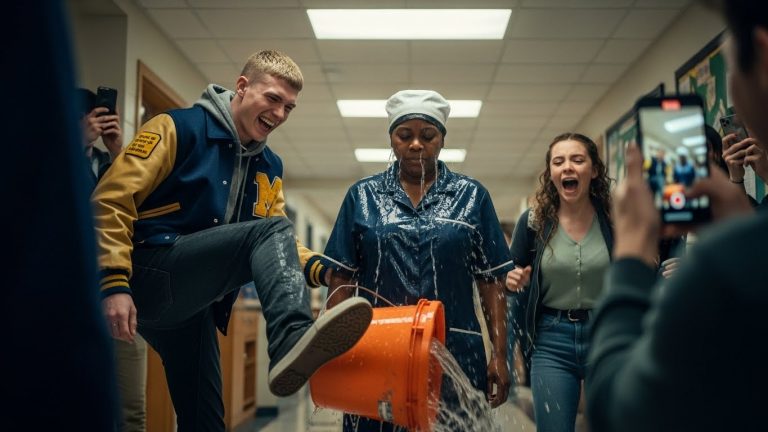
There were four of them. Boys. No, young men. Maybe sixteen or seventeen years old. They stood on the safe side of the alley, armed with jagged chunks of concrete and gravel from the construction site down the road.
Trapped in the narrow dead zone between the factory wall and the outer fence was the dog. We called him Rusty. He wasn’t anyone’s dog, really. He was a neighborhood fixture, a scruffy, wire-haired terrier mix with eyes that looked like melted chocolate and a tail that never stopped wagging, even when he was hungry.
I fed him scraps. Mrs. Higgins down the street left out water. He was gentle. He was innocent.
And right now, he was cowering in the corner where the fences met, pressing his small body into the dirt as another rock sailed through the air and struck his flank.
Rusty yelped—a high, sharp sound that tore at my heart.
“Hey!” I screamed. My voice sounded thin, reedy. “Hey! You stop that!”
I hobbled down the porch steps, ignoring the shooting pain in my bad knee. I waved my cane like a weapon, though I knew I couldn’t get within twenty feet of them before they could run.
The leader turned. He was a tall kid, wearing a generic black t-shirt and expensive sneakers that were currently covered in dust. He had that look—the look of someone who had never been told ‘no’ in a way that mattered.
He didn’t run. He just smirked.
“Go back inside, old man,” he shouted back. He didn’t even sound angry. He sounded bored. “We’re just playing fetch.”
“That’s not playing!” I yelled, reaching the edge of my lawn. “You’re hurting him! I’m calling the police!”
The boys laughed. It was a collective, ugly sound. One of the others, a stocky kid in a red cap, bent down and picked up a heavy stone, the size of a baseball.
“Call ’em,” Red Cap said. “By the time they get here, we’ll be gone and this mutt will be sleepin’.”
He wound up and threw it.
I flinched. The rock clattered against the chain-link, missing Rusty’s head by inches. The dog scrambled, paws slipping in the dust, trying to dig a hole through the concrete to escape. He looked at me through the fence, his ears flattened, shaking violently. He wasn’t growling. He wasn’t fighting back. He was begging.
I pulled my phone from my pocket, my fingers fumbling over the screen. I dialed 911. I told the operator there was animal abuse in progress. I gave the address. I heard the weary sigh on the other end.
“We have a unit dispatched, sir, but there are higher priority calls in the area. Please do not intervene physically.”
Priority calls. Of course. A stray dog getting stoned to death wasn’t a priority.
I hung up, feeling tears prick my eyes. Frustration, hot and shameful, washed over me. I was useless. I was just an old man with a cane shouting at the wind.
“Please,” I tried again, changing my tone. I hated myself for begging, but for Rusty, I would beg. “Just leave him alone. He’s never hurt anyone. Just walk away.”
The leader picked up another rock. He weighed it in his hand, looking me dead in the eye.
“He’s annoying,” the boy said simply. “Barking all night. We’re fixing the noise complaint.”
He threw the rock. It hit Rusty’s hip. The dog screamed.
Something inside me snapped. I took a step forward, ready to… do what? Hit a teenager? Get beaten up? Die of a heart attack on the sidewalk?
“Look at him,” Red Cap laughed, pointing at me. “Grandpa’s gonna have a stroke.”
They were enjoying this. My pain, the dog’s pain—it was all just content for them. I saw one of them holding up a phone, filming. They were streaming it.
I felt the vibration before I heard the sound.
It started as a low hum in the soles of my shoes, a trembling in the loose change in my pocket. The air seemed to tighten, the pressure dropping as if a storm was rolling in.
Then came the noise.
It wasn’t a car. It was a roar. A deep, guttural thunder that seemed to swallow all the other sounds on the street. The birds stopped singing. The wind seemed to hold its breath.
The boys stopped laughing. They looked around, confused.
“Is that thunder?” one asked, looking up at the clear blue sky.
The leader frowned, dropping the rock he was holding. He looked down the street toward the main avenue.
Around the corner, they came.
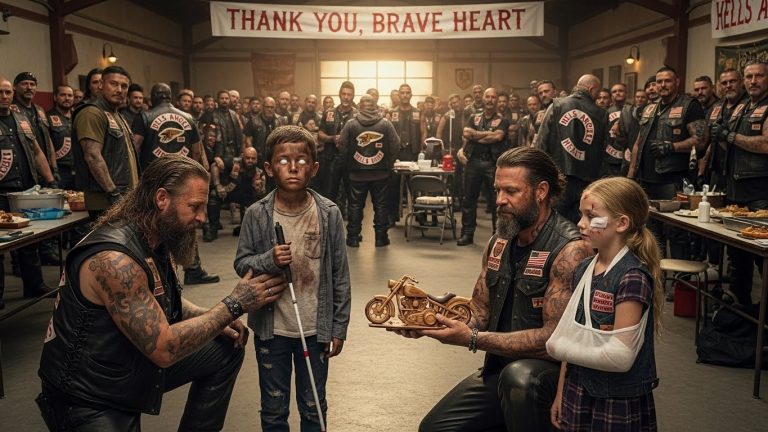
It wasn’t just one motorcycle. It was a formation. Chrome glinted in the sun like armor. Black leather absorbed the light. The engines were deafening, a synchronized mechanical growl that vibrated in your chest cavity.
There were twenty of them. Maybe thirty. Big, heavy touring bikes and choppers, riding two by two, taking up the entire width of the road.
They didn’t speed. They didn’t rev their engines aggressively. They just rolled in, a tide of steel and iron, slowing down as they approached the vacant lot.
On the back of their vests, in bold white rockers, I saw the words:
**BIKERS AGAINST ANIMAL ABUSE**
I had heard of them. Everyone had. They were a group of volunteers—vets, ex-cops, mechanics, fathers—who stepped in when the law was too slow or too indifferent. They didn’t carry weapons. They didn’t need to.
The lead biker killed his engine. One by one, the others followed suit. The sudden silence was heavier than the noise had been.
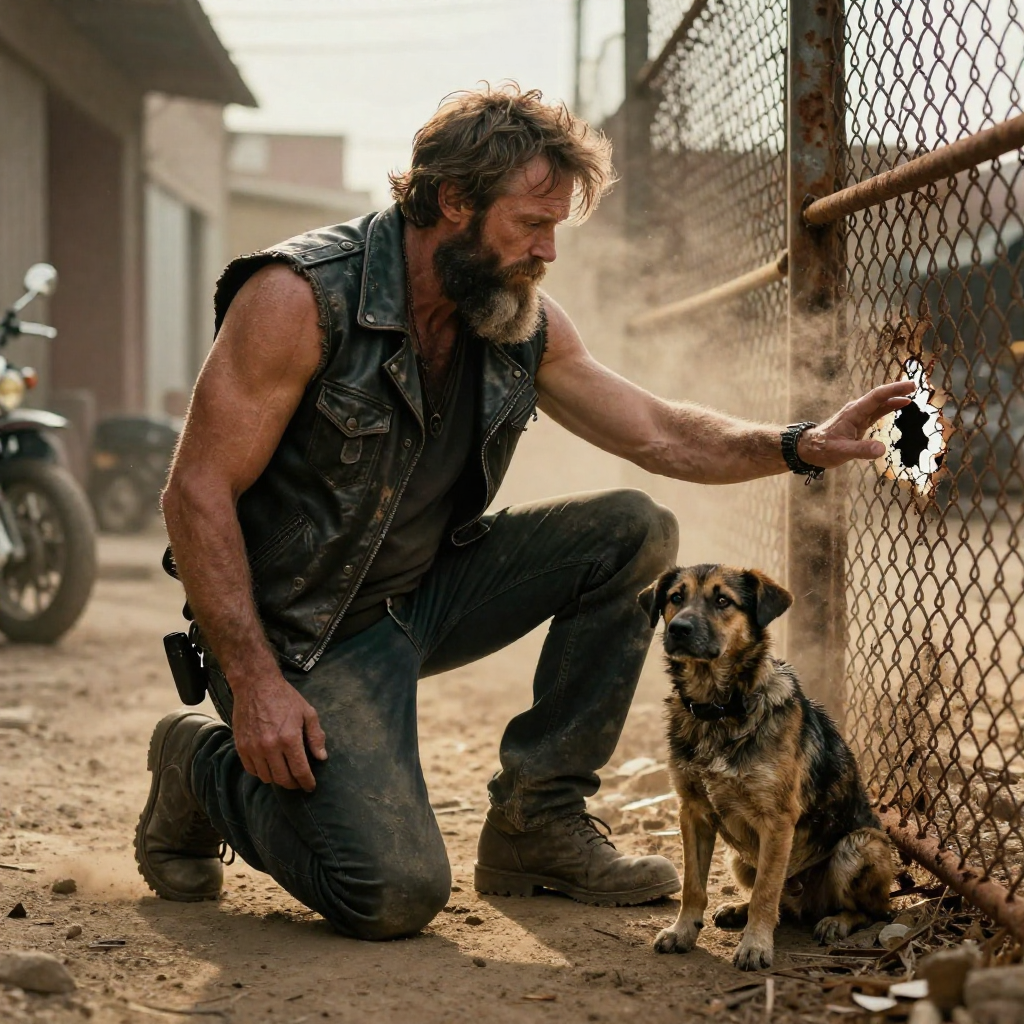
The leader kicked down his kickstand and swung a heavy boot over the seat. He was a giant of a man. He had a grey beard that reached his chest, sunglasses that hid his eyes, and arms the size of tree trunks covered in faded ink. He wore a bandana tied around his head.
He didn’t look at the boys immediately. He walked calmly over to the fence. He knelt down, ignoring the dust on his jeans, and looked through the mesh at Rusty.
Rusty, who had been trembling, crawled forward. He sniffed the man’s hand through the wire. The biker whispered something too low for me to hear, and for the first time in twenty minutes, Rusty’s tail gave a tiny, tentative wag.
The giant stood up. He turned slowly, deliberately, to face the four boys.
The boys had clustered together, their bravado evaporating like water on a hot sidewalk. The leader of the pack, the one who had thrown the rock at Rusty’s hip, took a half-step back.
“We were just…” the boy started, his voice cracking. “We were just leaving.”
The biker didn’t shout. He didn’t threaten. He just took off his sunglasses. His eyes were cold, hard, and absolutely unforgiving.
“I saw you throwing,” the biker said. His voice was like gravel grinding together. “I saw you laughing.”
The other bikers had dismounted now. They formed a semi-circle behind their leader, a wall of crossed arms and stern faces. They were silent. They just watched.
“It… it was just a joke,” Red Cap squeaked.
“A joke,” the biker repeated. He took a step forward. The boys took two steps back.
“You think pain is funny?” the biker asked. He pointed a gloved finger at the leader’s chest. “You think picking on something that can’t fight back makes you a man?”
“No, sir,” the boy whispered.
“You’re wrong,” the biker said. “It makes you a coward. And I really, really don’t like cowards.”
The boy looked at his friends. They were looking at their shoes, terrified. The phone that was recording had been shoved hastily into a pocket.
“Empty your pockets,” the biker said.
“What?”
“The rocks,” the biker said, pointing to the boy’s bulging cargo shorts. “Put them on the ground. Slowly.”
The boy obeyed, his hands shaking as he pulled out three more jagged stones and dropped them in the dirt.
“Now,” the biker said, his voice dropping an octave, “Run.”
They didn’t need to be told twice. They scrambled over each other, tripping over their own expensive sneakers, sprinting down the alleyway as if the devil himself was snapping at their heels.
We watched them go until they disappeared around the corner.
The biker turned to me. The hardness in his face melted away instantly. He looked just like a tired, concerned neighbor.
“You okay, Pop?” he asked gently.
I nodded, wiping my eyes with the back of my hand. “I am now. But the dog… he’s hurt.”
“Not for long,” the biker said. He turned to his crew. “Get the bolt cutters. We’ve got a rescue to do.”
I watched as they went to work. Two men brought a heavy blanket. Another brought a bottle of water and a bowl. A woman with a med-kit on her belt moved to the front.
They cut the chain link with a sharp *snap*. The giant man crawled into the space—the same space the boys had used as a target range. He moved with surprising gentleness for a man his size.
He wrapped Rusty in the blanket. The dog didn’t fight. He seemed to know. He let out a long sigh and rested his head against the leather vest, right over the man’s heart.
As they carried him out, the giant stopped in front of me.
“You did good, calling it in,” he said. “Most people just close their blinds.”
“I couldn’t stop them,” I said, the shame still lingering.
“You stood witness,” he said firmly. “That matters. We heard the call on the scanner. We were just a few miles out.”
He looked down at the dog in his arms.
“We’re taking him to the vet. Then he’s coming to the sanctuary. He won’t ever feel a rock again.”
I watched them pack up. The efficiency was military. Rusty was secured in a sidecar, goggled and wrapped up. The engines roared to life again, but this time, the sound wasn’t threatening. It was a promise.
As the last bike faded into the distance, I looked at the rocks on the ground. I looked at the hole in the fence.
My quiet afternoon was gone. But for the first time in a long time, the silence left behind didn’t feel empty. It felt like justice.
CHAPTER II
I didn’t sleep the night Rusty was taken. The silence in my small house, usually a comfort, felt heavy, like the humidity before a monsoon in the Highlands. I kept seeing those boys’ faces—not just the cruelty, but the absolute certainty that they were untouchable. It’s a look I’ve seen before, on men with more rank and less soul than they knew what to do with.
The next morning, my joints ached with the kind of damp cold that settles into your marrow when you’ve spent too many years carrying things you should have dropped. I drove my old truck out to the sanctuary, a place called The Haven, tucked away behind a stretch of pine woods where the city noise finally dies out. My hands were shaking on the wheel, and I gripped it harder, trying to hide the tremor from myself. It was my secret, a private erosion of my nerves that I hadn’t even told the VA doctors about. If they knew how much I shook, they’d take my license, maybe my independence. And in this town, once you lose your keys, you’re just waiting for the dirt to settle.
When I pulled up, Silas was there. He looked different without the helmet—his grey hair was tied back in a messy knot, and his eyes were the color of a winter lake. He didn’t say much, just nodded and led me to a large, fenced-in run. Rusty was there. The dog wasn’t the trembling wreck I’d seen behind the factory. He was bandaged around his midsection where the rocks had bruised his ribs, but he was standing. When he saw me, his tail didn’t wag, but his ears perked up. He recognized the man who had stood there when the world was throwing stones.
“He’s going to make it,” Silas said, his voice a low rumble. He was brushing a large, three-legged golden retriever while we talked. There was a strange, meditative rhythm to his movements. These men, these ‘bikers’ the town looked at with suspicion, had a softness for the broken that they didn’t show to the rest of the world.
“Why do you do it?” I asked, leaning against the wooden post of the kennel. My leg was throbbing, an old gift from a landmine in ‘71.
Silas stopped brushing. He looked at the dog, then at me. “Because they don’t have a voice, Arthur. And because most people would rather look the other way than admit there’s a monster in their own backyard. We’ve all been the stray at some point. Some of us just never found our way back to the porch.”
I felt a lump in my throat. I knew about being a stray. When I came back from the war, the world didn’t want to hear about the mud or the heat or the friends I’d left in the elephant grass. They wanted me to be a hero or a villain, and when I couldn’t be either, they just wanted me to be quiet. I had carried that silence for fifty years. It was an old wound, one that had never quite scarred over, always raw beneath the surface.
We spent the morning talking about nothing and everything. Silas told me about the other animals—each one had a story of neglect or malice. He didn’t judge the animals for being afraid, and he didn’t judge me for the way my hands twitched when the wind caught a piece of loose tin and made a sound like a rifle shot. For the first time in a long time, I felt like I wasn’t an anomaly. I was just another survivor.
But the peace didn’t last. It never does.
I had to stop by the Main Street Diner on my way back to pick up some supplies. It’s the kind of place where the air smells like burnt coffee and old gossip. I just wanted a sandwich and to get home, but the moment I stepped inside, the atmosphere shifted. The low hum of conversation dropped an octave.
In the corner booth sat Marcus Miller. He was a man who wore his power like a tailored suit—crisp, expensive, and designed to intimidate. He was a City Councilman, a man who sat on boards and shook hands with governors. And sitting next to him, looking sullen and small but fueled by his father’s presence, was the boy in the Red Cap. Leo.
I tried to keep my head down, but Miller wasn’t having it. He stood up, his chair scraping against the linoleum with a sound that made my teeth ache. This was the moment. The sudden, public, and irreversible break in the fabric of my quiet life.
“Arthur,” Miller said. He didn’t yell. Men like him don’t need to yell. His voice carried to every corner of the room. “I believe you had an encounter with my son yesterday.”
I stopped by the counter. My heart was hammering against my ribs. “He was throwing rocks at a trapped dog, Marcus. I told him to stop.”
Miller walked toward me, his eyes fixed on mine. He had that politician’s smile—the one that doesn’t reach the eyes. “My son tells a different story. He says he was trying to help a stray that looked rabid, and he was suddenly surrounded by a gang of armed outlaws on motorcycles. He says you coordinated it. He says you threatened him.”
“That’s a lie,” I said, my voice steadier than I felt. “He was torturing an animal. The men who showed up didn’t touch him. They just did what I couldn’t—they saved the dog.”
Miller was standing a foot away from me now. The diner was dead silent. Even the waitress had stopped mid-pour. “Leo is a good boy. He’s a scout. He’s on the honor roll. And now he’s having nightmares because some unstable old man decided to play vigilante with a bunch of criminals. Do you have any idea how much damage you’ve done to his reputation? To mine?”
“I saw what I saw,” I replied. The old wound in my chest was burning. This was exactly like 1971—the people in power rewriting the truth to protect their own interests, while the ones on the ground were left to bleed.
Miller leaned in closer, dropping his voice so only I could hear, though his posture remained performative for the crowd. “I know about your health, Arthur. I know you’ve been missing your appointments at the VA. I know about the ‘episodes’ your neighbors have mentioned—you staring off into space, getting lost on your own street. If you persist with this story, if you keep associating with those thugs at that ‘sanctuary,’ I will have no choice but to file a report with the Department of Health. For your own safety, of course. A man in your condition shouldn’t be living alone, and he certainly shouldn’t be making accusations against prominent families.”
It was a moral dilemma that felt like a trap. If I backed down, if I said I was confused and it was all a misunderstanding, I could keep my house. I could keep my dignity in the eyes of the town. But I would be abandoning Rusty. I would be letting Leo believe that cruelty has no price if your father is important enough.
But if I stood my ground, Miller would follow through. He’d have me declared incompetent. He’d take my home, the only place where I still felt the ghosts of my past were at peace. He’d shut down Silas’s sanctuary by tying them up in legal fees and zoning violations. I saw the calculation in his eyes. He wasn’t just defending his son; he was protecting the image of his dynasty.
“I’m not confused, Marcus,” I whispered. “And I’m not afraid of you.”
Miller pulled back, his smile widening into something genuinely predatory. “We’ll see about that. You’re an old man, Arthur. You’re a relic of a war everyone wants to forget. Don’t make the mistake of thinking anyone is going to take your word over mine.”
He turned and walked back to his booth, gesturing for Leo to finish his fries. I stood there, rooted to the spot, while the rest of the diner slowly began to whisper again. I wasn’t the town’s veteran anymore. I was the ‘unstable old man’ who had picked a fight with the most powerful family in the county.
I walked out of the diner, my legs feeling like lead. I didn’t go home. I drove back toward the sanctuary, but I stopped at the bridge overlooking the creek. I looked at my hands. They were shaking violently now. I couldn’t hide it. The secret was out, or at least, Miller had a lead on it. He was going to use my own body against me.
I thought about the moral weight of what lay ahead. Someone was going to get hurt. If I fought, Silas and his animals would be caught in the crossfire. If I didn’t, the cycle of cruelty would just keep spinning. Every choice felt like a loss.
I remembered a night in the jungle, crouched in a spider hole, listening to the movement in the brush. My sergeant had told me, ‘Arthur, the hardest part isn’t the fight. It’s deciding what’s worth dying for when nobody’s watching.’
I wasn’t dying today, but I was losing the life I knew. The public confrontation had severed my ties to the community. I saw it in the eyes of the people at the diner—fear, judgment, and a desperate desire not to be involved. They’d rather believe I was crazy than believe their Councilman’s son was a monster. It was easier for them that way.
I reached into my pocket and pulled out a small piece of paper Silas had given me. It had his personal number on it. I stared at it for a long time. I knew that if I called him, I was declaring war. Not a war with guns, but a war of status, law, and endurance.
My mind drifted back to the factory fence. I saw Rusty’s eyes again—that look of utter betrayal by the world. I realized then that I wasn’t just fighting for a dog. I was fighting for the version of myself that didn’t speak up all those years ago. I was fighting for the truth that gets buried under ribbons and speeches.
I went home and sat in the dark. The phone rang three times. I didn’t answer. I knew it was either a reporter or one of Miller’s lackeys. I just sat there, watching the shadows stretch across the floor. I thought about the secret I’d kept—the failing of my mind and body. It felt smaller now, less like a cage and more like a deadline. If I only had a little bit of time left before the fog took me, I didn’t want to spend it being a coward.
But the weight of the decision pressed down on me. By tomorrow, the rumors would be everywhere. The ‘crazy vet’ narrative would be the talk of the town. I could see the headlines in the local paper, the whispers at the grocery store. I would be isolated, vulnerable, and targeted.
And what about Silas? He had built something beautiful at The Haven. He had given a second chance to those who had none. If I brought this storm to his doorstep, would he forgive me? Or would I be the reason another sanctuary was destroyed?
I finally picked up the phone, but I didn’t dial Silas. I dialed the VA. I needed to know exactly how much time I had. I needed to know if Miller’s threats had a medical basis. The line rang and rang, a hollow sound in the empty house. When the machine picked up, I didn’t leave a message. I just hung up.
The moral dilemma wasn’t just about the dog or the boy. It was about the cost of integrity in a world that sells it for spare change. Miller had a reason for his malice—he loved his son, in his own twisted, protective way. He believed he was doing the right thing for his family’s future. And in his mind, I was just a casualty of that necessity.
I stood up and went to the closet. I pulled out my old trunk. Inside was my uniform, folded and smelling of mothballs and history. I touched the fabric. I wasn’t that young man anymore, but the core of him was still there, stubborn and tired.
I realized then that the public trigger—the diner scene—wasn’t just a confrontation. It was an invitation. Miller had thrown down the gauntlet in the most public way possible, ensuring that if I went down, I’d go down as a pariah. He had stripped away my anonymity. He had made me a character in his story.
I walked to the kitchen and made a pot of coffee. It was going to be a long night. I had to plan. I had to find a way to protect the sanctuary while keeping my own secrets from becoming the weapon that destroyed us all.
The conflict had shifted. It was no longer about stones and fences. It was about the power of a name versus the weight of a witness. And as I sat there, watching the moon rise over the trees, I knew that the peace I had sought in my old age was gone. The war had followed me home, and this time, there was no extraction point.
CHAPTER III
The envelope sat on my kitchen table for three days, a white rectangle of sterilized aggression. It didn’t need to be loud to scream. It was a summons for a competency hearing, signed by a judge whose name I’d only seen on campaign posters next to Marcus Miller’s face. The charge was clear in its legalese: I was a man of advanced age, suffering from progressive neurological decline, posing a risk to myself and the community. In Miller’s world, a shaking hand wasn’t a medical condition; it was a weapon to be used for my own eviction from the world of the living.
I spent those three days in a fog of memory and mechanics. I didn’t call Silas. I didn’t go to the sanctuary. I sat in my armchair and watched the dust motes dance in the late afternoon sun, wondering if they felt the same drift I did. My house felt smaller, the walls leaning in as if they were already being measured for demolition. I thought about the war, about the times we sat in the tall grass waiting for an enemy we couldn’t see, only to find out the enemy was the heat, the hunger, and the silence. Now, the enemy was a man in a tailored suit who wanted to erase me because I’d seen his son’s true face.
The morning of the hearing, the tremor was worse. It wasn’t just my hand anymore; it was a rhythmic thrum in my shoulder, a vibration that felt like an old engine trying to turn over in sub-zero weather. I dressed in my only suit—a charcoal wool number that smelled of cedar and the seventies. I tied my tie four times before I gave up and let it hang slightly crooked. I looked in the mirror and saw a ghost. A ghost with a secret.
I drove to the county courthouse, the steering wheel vibrating under my palms. The building was a limestone monument to a justice that had always felt like it was meant for someone else. When I walked into the hearing room, it wasn’t a grand courtroom with a jury. It was a sterile, wood-paneled chamber that felt like a surgical theater. Marcus Miller was already there, sitting at a table with a lawyer who looked like he’d been carved out of expensive soap. Leo sat behind them, dressed in a school blazer, looking bored, his eyes fixed on his phone. He didn’t look like a boy who had spent his afternoon torturing a living creature. He looked like a boy who was waiting for a ride to the mall.
Judge Sterling entered. He was a man who looked like he had been born with a gavel in his hand—ancient, brittle, and perfectly aligned with the status quo. He didn’t look at me. He looked at the paperwork. He looked at the ‘evidence’ Miller’s team had compiled: records of my pharmacy visits, a statement from a neighbor I barely knew saying I wandered the yard at night, and a medical evaluation I’d never authorized from a doctor who had treated me once for a cold five years ago.
“Mr. Miller, you may proceed,” Sterling said, his voice like dry leaves.
Marcus stood up. He didn’t yell. He didn’t even sound angry. He sounded heartbroken. “Your Honor, this isn’t about politics or personal grievances. This is about a man I’ve known and respected for years. Arthur is a hero. But he’s a hero who is breaking. We’ve seen him in the streets, confused, aggressive. He’s been seen wandering the old Miller & Sons factory grounds—a site filled with hazardous materials—at all hours. He’s hallucinating. He’s accusing my son of unthinkable things because he can’t differentiate between memory and reality anymore. We aren’t asking for punishment. We’re asking for care. For a structured environment where he won’t be a danger to himself.”
I sat there, my hands clasped tightly in my lap, trying to squeeze the tremor into submission. The humiliation was a cold weight in my gut. He was painting me as a senile wanderer, a tragic figure to be tucked away in a padded room so he could sell the factory land without a ‘witness’ complicating his zoning permits. It was a perfect, bloodless assassination.
Then came the medical testimony. A specialist I’d never seen before spoke about the ‘clear indicators of early-onset dementia’ and the ‘neurological instability’ evidenced by my motor tremors. He used words like ‘impulse control’ and ‘cognitive drift.’ Every word was a nail. I looked at Leo, and for a split second, the boy looked up. He didn’t smirk. He smiled. A thin, cruel line that told me he knew exactly what was happening. He was winning. He had broken the dog, and now he was breaking the man.
“Mr. Vance, do you have anything to say?” the judge asked, looking over his spectacles with a pity that felt like a slap.
I stood up. My legs felt like they belonged to someone else. My hand jerked, hitting the table with a dull thud. I saw the lawyer whisper something to Marcus. They were counting on my body to betray me. They were counting on my silence to be the final proof of my absence.
“I’m not a doctor,” I started, my voice thin but steady. “And I’m not a politician. I’m a man who lives in a house he paid for with forty years of sweat. I’m a man who saw what I saw.”
“Mr. Vance,” the judge interrupted, “the medical evidence is quite compelling. Your health is—”
“My health is a mess, Your Honor,” I said, cutting him off. A murmur went through the small room. “I have Parkinson’s. I’ve had it for three years. I kept it a secret because I knew men like Marcus would use it as a reason to treat me like a broken toy. But my eyes still work. And my memory is the only thing I have left that’s worth a damn.”
I reached into my pocket and pulled out a small, battered USB drive. This was the moment. The point of no return.
“Marcus mentioned I’ve been wandering the old factory grounds,” I said, looking directly at Miller. His face didn’t change, but his eyes narrowed. “He’s right. But I wasn’t wandering. I worked that floor for thirty years. I know every inch of it. I know where the old security loops still run. And I know that the ‘hazardous materials’ Marcus mentioned are being dumped into the creek behind the sanctuary.”
A heavy silence fell over the room. The lawyer shifted. Marcus’s hand tightened on his pen.
“That’s irrelevant to this hearing,” the lawyer snapped. “We are here to discuss Mr. Vance’s mental state.”
“It’s very relevant,” I said. “Because I wasn’t just watching the creek. I was watching the north gate. The one Leo uses to get onto the property. I set up a trail cam six months ago because I was tired of people using the factory as a dump. I caught more than just illegal dumping.”
I walked the drive over to the court clerk. I knew what this meant. To have this footage, I had to admit to being on the property illegally after the foreclosure. I had to admit to monitoring private citizens. I was handing them the keys to my own arrest, but I was taking them down with me.
“This video,” I said, my voice rising, “is from the day Rusty was found. It’s not a hallucination. It’s a record.”
As the clerk began to set up the laptop, the heavy doors at the back of the room swung open. The sound was like a thunderclap. In walked Silas. He wasn’t alone. He was wearing a clean shirt, his hair tied back, followed by three other men from the sanctuary. They didn’t look like bikers. They looked like a wall of granite. Behind them was a woman in a sharp navy suit—Elena, the legal aid lawyer Silas had mentioned. But she wasn’t the one who stopped the room.
It was the man beside her. State Representative Elias Vance. No relation to me, but a name every person in this county knew. A fellow veteran. A man who sat on the Veteran’s Affairs oversight committee.
“Your Honor,” Elias said, his voice echoing with an authority that Marcus Miller could only dream of, “I apologize for the interruption, but the State is taking an interest in this proceeding. We’ve received reports of the weaponization of medical records against a decorated veteran. My office is here to ensure that Mr. Vance’s rights are being protected, not dismantled for the sake of a real estate deal.”
The air in the room changed. It was as if the oxygen had suddenly been doubled. Marcus Miller’s face went from smug to a pale, sickly grey. He looked at Silas, then at the Representative, then at the laptop where the video was starting to play.
The video was grainy, the colors washed out by the afternoon sun. But there was no mistaking the boy. There was no mistaking the red cap. There was no mistaking the pipe in his hand or the way the dog cowered in the dirt. The room went deathly silent. It wasn’t just the cruelty of the act; it was the casualness of it. Leo looked like he was playing a game of catch.
Then the video continued. It showed Marcus Miller pulling up in his black SUV ten minutes later. It showed him looking at the dog. It showed him talking to his son, patting him on the shoulder, and then helping him load the dog into the back of a truck while Leo laughed. It showed the cover-up in real-time. It showed the Councilman of our town witnessing an act of felony animal cruelty and choosing to hide it rather than fix it.
“Turn it off!” Marcus shouted, his voice cracking. “That’s illegally obtained! It’s inadmissible!”
“It’s a competency hearing, Marcus,” Representative Vance said, stepping forward. “The judge is looking for the truth of Arthur’s ‘delusions.’ It seems his delusions are remarkably high-definition.”
Judge Sterling stared at the screen. He looked at Marcus, then at me. The power in the room had shifted so fast it left a vacuum. Silas caught my eye and gave a single, slow nod. He had risked everything to bring the Representative here. He had risked the sanctuary’s legal standing by inviting this level of scrutiny, just to stand by a man who had only ever given him a few bags of dog food and a shaky handshake.
“The petition for involuntary commitment is denied,” Judge Sterling said, his voice no longer like dry leaves, but like a hammer. “Furthermore, I am referring this footage to the District Attorney’s office for immediate review regarding the conduct of Leo Miller and the potential obstruction of justice by Councilman Miller.”
Marcus didn’t wait for the gavel. He grabbed Leo by the arm and shoved his way out of the room, his lawyer scurrying behind them like a beetle. The door slammed, but the silence remained.
I sat down. The tremor was still there, but it didn’t feel like a betrayal anymore. It just felt like a part of me.
Representative Vance walked over and put a hand on my shoulder. “You did good, Arthur. But you know what comes next, right?”
I knew. By admitting I had been on that land, by exposing the dumping and the footage, I had triggered an environmental investigation that would tie up the factory land for years. It would also lead to the foreclosure of my house being fast-tracked as retaliation from the bank Miller controlled. I had won the war for my mind, but I had lost the ground I stood on.
We walked out of the courthouse together. The sun was blinding. Silas was waiting by his bike. Rusty was in the sidecar of one of the other bikes, his tail thumping against the metal.
“You’re homeless, Arthur,” Silas said, though he didn’t sound sad about it. “The bank’s going to have your locks changed by morning.”
“I know,” I said. I looked back at the limestone building. I felt lighter than I had in decades. The secret was out. The shaking was visible. The world knew I was broken, and somehow, that made me unbreakable.
“We have an extra room at The Haven,” Silas said. “It’s small. Smells like wet dog and cheap coffee. But nobody’s going to tell you your hands can’t shake there.”
I looked at Rusty. The dog was watching me, his eyes bright and expectant. He wasn’t a stray anymore. He was home. And as I looked at the group of men who the town called thugs, I realized I wasn’t a stray either.
I didn’t go back to the house. I didn’t need the old suits or the cedar-smelling ghosts. I climbed onto the back of Silas’s bike. As the engine roared to life, a sound that drowned out the trembling in my bones, I realized that freedom didn’t look like a clear title to a house. It looked like a road that didn’t care if you were shaking, as long as you were still moving forward.
We rode out of town, leaving the scandal and the suits behind. I watched the courthouse disappear in the rearview mirror. For the first time in my life, I wasn’t waiting for the other shoe to drop. I had dropped it myself. And the sound it made was the most beautiful thing I’d ever heard.
CHAPTER IV
The first few days at The Haven felt… strange. Not bad, just strange. Like wearing someone else’s clothes that almost fit. My room was small, but clean. A bed, a dresser, a window overlooking the motorcycle repair shop. The constant thrum of engines was a new kind of white noise. Better than the silence of an empty house, though.
Silas had given me the space I needed. He wasn’t hovering, wasn’t trying to fill the silence with empty chatter. Just a nod in the morning, a shared meal in the evening. Rusty, though, he was always there. A warm, furry shadow. He’d lie at my feet while I tried to read, his head resting on my shoes. Sometimes, I’d look down and see him staring up at me, those big, brown eyes full of something I couldn’t quite name. Gratitude? Understanding? Maybe just hunger. Whatever it was, it was a comfort.
The news cycle, predictably, moved on. Marcus Miller’s name became a footnote. The local paper ran a few articles about the investigation into his factory, the potential environmental violations. Leo’s name appeared less and less. People forgot, or pretended to. That’s how it always worked. The outrage faded, the hashtags disappeared, and life went on. Except for those of us who were left picking up the pieces.
My lawyer, Daniels, called with updates. The legal battle over my house was lost. The fine print, the loopholes, the bureaucratic indifference – it was all too much. He sounded defeated, apologetic. I told him not to worry. What was done was done. I had a roof over my head, food on the table, and a friend by my side. That was more than enough.
**PUBLIC CONSEQUENCES**
One evening, about a week after the hearing, Silas and I were sitting on the porch, watching the sunset. The air was thick with the smell of gasoline and honeysuckle. He took a long drag from his cigarette, the cherry glowing in the twilight. “The town council’s in an uproar,” he said, finally breaking the silence. “They’re trying to distance themselves from Miller as fast as they can. Claiming they had no idea what he was really like.”
I chuckled. “Politicians. Always looking out for themselves.”
“Yeah, well, it ain’t just them. The Rotary Club kicked him out. The Chamber of Commerce, too. Even his church is giving him the side-eye.” Silas flicked his cigarette butt into the gravel. “His name’s mud, Arthur. Complete and utter mud.”
It should have felt like a victory. But it didn’t. It felt… hollow. Like winning a war only to find out that the battlefield was your own soul.
“And Leo?” I asked.
Silas shrugged. “Last I heard, he was shipped off to some fancy rehab clinic in Arizona. Daddy’s trying to make the problem disappear. Again.”
I thought about Leo, about the cruelty I’d seen in his eyes. About the broken dog he’d left for dead. Rehab wouldn’t fix that. Money wouldn’t fix that. Some things just fester, no matter how much you try to cover them up.
The Haven became a refuge for others too. Word spread, quietly, that it was a safe place. People started showing up with injured animals, with stories of abuse and neglect. Silas never turned anyone away. He’d patch them up, find them a home, or give them a place to stay until they got back on their feet. It was a ragtag bunch, but we were a family. Bound together by scars, by a shared understanding of what it meant to be broken.
**PERSONAL COST**
One afternoon, I found myself staring at my reflection in the bathroom mirror. The tremors were worse than ever. My face was gaunt, my eyes sunken. I looked like a ghost of my former self. The Parkinson’s was winning. It was a slow, relentless erosion, and there was nothing I could do to stop it.
The cost of speaking out, of fighting back, had been high. My health, my home, my peace of mind. But as I looked at my reflection, I realized something else. I also gained something. A purpose. A connection. A sense of belonging I hadn’t felt in years.
I thought about my late wife, Sarah. About the quiet life we’d built together. About the unspoken promise we’d made to protect each other. I’d failed her, in a way. I hadn’t been able to protect her from the cancer that took her away. But maybe, just maybe, I could protect others. Maybe I could make a difference, however small.
That night, I had a dream about Sarah. We were young again, walking hand-in-hand along the beach. The sun was setting, casting a golden glow on the water. She turned to me, her eyes sparkling. “You did the right thing, Arthur,” she said. “I’m proud of you.”
I woke up with tears streaming down my face. It was just a dream, but it felt real. It felt like a blessing.
The days turned into weeks, the weeks into months. Life at The Haven settled into a rhythm. I helped out with the animals, cleaned the stables, ran errands. Silas taught me how to do some basic motorcycle repairs. I wasn’t very good at it, but it kept my hands busy, my mind focused.
Rusty was my constant companion. He’d follow me everywhere, his tail wagging. He’d sleep at the foot of my bed, his warm body a comforting presence in the night. We were two broken souls, finding solace in each other’s company.
**NEW EVENT**
One morning, a letter arrived. It was addressed to me, in unfamiliar handwriting. I opened it cautiously. It was from a woman named Emily Carter. She said she was a reporter from a national news magazine. She’d been following the Miller case, and she wanted to interview me.
My first instinct was to say no. I was tired of the attention, tired of reliving the whole ordeal. But then I thought about Sarah, about the promise I’d made to make a difference. Maybe this was my chance. Maybe this was a way to reach a wider audience, to shine a light on the kind of corruption that thrived in the shadows.
I called Emily Carter back. We spoke for over an hour. She asked tough questions, probing questions. She wanted to know everything – about my past, about my motivations, about the toll the whole experience had taken on me. I answered as honestly as I could. I didn’t sugarcoat anything. I told her the truth, even when it hurt.
She flew in a few days later. We met at a diner in town. She was young, sharp, and determined. She listened intently as I told her my story, her pen scribbling furiously in her notebook. She asked about Rusty, about Silas, about The Haven. She wanted to understand the whole picture.
The interview lasted for hours. By the time it was over, I was exhausted. But I also felt a sense of… release. Like I’d finally gotten everything off my chest.
The article came out a few weeks later. It was long, detailed, and unflinching. It painted a portrait of Marcus Miller as a ruthless, power-hungry man who would stop at nothing to protect his own interests. It exposed the corruption that ran rampant in our town, the backroom deals, the hidden agendas.
It also told my story. About my service in Vietnam, about my struggle with Parkinson’s, about my decision to speak out against injustice. It portrayed me as a flawed, but ultimately decent man who was simply trying to do the right thing.
The article went viral. It was shared on social media, discussed on cable news, and debated in op-ed columns. Marcus Miller became a national pariah. His political career was over. His business empire crumbled. He was facing multiple investigations, both criminal and civil.
Leo, too, was caught in the fallout. The article detailed his history of animal abuse, his reckless behavior, and his privileged upbringing. He was publicly shamed, ostracized by his peers, and forced to confront the consequences of his actions.
The article also had a profound impact on The Haven. Donations poured in from all over the country. Volunteers showed up, eager to help. The sanctuary became a symbol of hope, a beacon of light in a dark world.
But the attention also brought its own challenges. The Haven was inundated with media requests, with curious onlookers, with people who wanted to exploit our story for their own gain. Silas had to hire security to keep the place safe. The quiet, peaceful sanctuary was now a tourist attraction.
I retreated further into myself. I spent most of my time with Rusty, walking in the woods, sitting by the creek, just trying to find some peace.
**MORAL RESIDUES**
One evening, Silas found me sitting on the porch, staring out at the sunset. He sat down beside me, took a long drag from his cigarette, and sighed.
“It’s a mess, ain’t it?” he said.
I nodded. “Yeah. A real mess.”
“Miller’s ruined. Leo’s a mess. And we’re stuck dealing with all the… stuff that comes with it.”
“Is it worth it?” I asked.
Silas thought for a moment. “I don’t know,” he said, finally. “Maybe. Maybe not. But we did the right thing, Arthur. That’s all that matters.”
I wasn’t so sure. I’d like to believe that, but the truth felt more complicated. There were no easy answers, no simple victories. Just shades of gray, and the lingering taste of ashes in my mouth.
The legal proceedings against the Millers dragged on for months. Marcus eventually pled guilty to several environmental violations and was sentenced to a few years in prison. Leo was ordered to undergo mandatory therapy and community service. It wasn’t the justice I’d hoped for, but it was something.
The Haven continued to thrive. Silas expanded the facilities, hired more staff, and created new programs for abused and neglected animals. It became a model for other sanctuaries across the country.
I continued to live at The Haven, surrounded by the animals and the people who cared for them. I found a sense of purpose in helping others, in making a difference, however small. But the scars of the past remained. The memories of the hearing, the humiliation, the loss of my home – they haunted me still.
One afternoon, I was sitting in the stable, brushing Rusty. The sun was streaming through the window, casting a warm glow on his fur. He leaned into me, his tail wagging. I looked into his eyes, and I saw something I hadn’t seen before. Not gratitude, not understanding, but… peace.
He’d been through so much, this dog. Abuse, neglect, abandonment. But he’d survived. He’d found a way to heal. And in that moment, I realized that maybe, just maybe, I could too.
I put down the brush and wrapped my arms around Rusty. He licked my face, his tongue rough and warm. I held him tight, and I cried. Not tears of sadness, but tears of… hope.
The sun set, casting long shadows across the stable. Rusty and I sat there in the darkness, together. Two broken souls, finding solace in each other’s company. And for the first time in a long time, I felt… whole.
Later that evening, as the sky deepened into night, I sat on the porch with Rusty by my side. The air was still, the world quiet. I looked up at the stars, and I thought about Sarah. I thought about the life we’d shared, about the love we’d lost. And I realized that even in the darkest of times, there was always hope. Always a chance for redemption. Always a reason to keep fighting.
The fight for justice, for truth, might never be truly over. But for now, in this small corner of the world, I had found my peace. And that was enough.
**A Quiet Morning**
The morning arrived, painting the sky with hues of soft lavender and rose. I woke to the gentle nudge of Rusty’s wet nose against my hand. He looked up at me, his eyes bright with a simple, unwavering love.
We stepped outside, the cool air crisp against my skin. The Haven was slowly stirring to life – the soft whinny of horses, the distant clucking of chickens, the comforting sounds of a world waking up.
I walked with Rusty towards the small garden I had started tending. It was a humble patch of earth, filled with wildflowers and herbs. The act of planting, of nurturing something back to life, had become a form of therapy for me.
As I knelt, weeding around a young sunflower, Rusty lay beside me, his head resting on my lap. I stroked his fur, feeling the warmth of his body against mine. In that moment, surrounded by the quiet beauty of the morning, I felt a profound sense of gratitude.
The tremors in my hands were still there, a constant reminder of my failing body. But they didn’t define me. They were simply a part of me, like the scars on Rusty’s body were a part of him.
We were both broken, in our own ways. But we were also whole. We had found a way to piece ourselves back together, to find strength in each other’s company.
I looked at Rusty, and he looked back at me. And in that shared gaze, I saw a reflection of hope, of resilience, of the enduring power of love.
The world outside might still be filled with darkness and injustice. But here, in this small sanctuary, we had created a haven of our own. A place where broken souls could find healing, where love could conquer fear, and where even the smallest act of kindness could make a world of difference.
And as the sun climbed higher in the sky, casting its golden light upon The Haven, I knew that I was finally home.
CHAPTER V
The morning sun cut through the blinds in my small room at The Haven, painting stripes across the floor. Rusty, ever vigilant, thumped his tail against the side of the bed, a soft, reassuring rhythm. Parkinson’s had tightened its grip. My hands trembled more, my movements were slower, and the words didn’t always come when I called for them. But here, surrounded by the rumble of motorcycles and the scent of engine oil, I was home.
Silas had converted a small storage room for me, making it accessible. It wasn’t much, but it was mine. More than the big house ever was. The public attention Emily’s article brought had faded, but the ripples remained. More often now, people stopped by The Haven, not just with broken bikes, but with stories—neglected animals, unfair evictions, whispers of corruption. Silas, with his quiet strength, had become a reluctant leader, and The Haven, a refuge.
My role was simpler. I listened. Sometimes, just being heard was enough. Other times, I offered what little advice I had, gleaned from a lifetime of mistakes and a war I couldn’t forget. I was no longer fighting battles, just trying to ease the burdens of those who were.
PHASE 1
One afternoon, a young woman named Maria came to The Haven. Her eyes were red-rimmed, her voice barely a whisper. She told us about her landlord, who was threatening to evict her and her children because she couldn’t afford the rent increase. He was preying on vulnerable families, she said, knowing they had nowhere else to go. Silas listened patiently, his face hardening with each word.
I watched him, remembering Marcus Miller, the arrogance, the abuse of power. It was a familiar story, just a different face. “What do you need, Maria?” I asked, my voice raspy.
“Time,” she said. “Just a little more time to find a new place.”
Silas nodded. He gathered some of the Haven members, and they started making calls, checking local listings, offering to help Maria pack and move. I couldn’t do much physically, but I could offer a different kind of support. I sat with Maria, listening to her fears, sharing stories of my own struggles. I told her about Sarah, about losing my house, about the fear of being alone.
“You’re not alone,” I said, my hand trembling as I reached out to touch hers. “We’re here.” That night, Silas and a few others confronted the landlord. There was no violence, no shouting. Just a quiet, firm message: leave Maria and her family alone. He backed down. Maria and her children found a small apartment on the other side of town, and The Haven helped them move. It wasn’t a grand victory, but it was a victory nonetheless. A small act of defiance against the darkness.
That night, as I lay in bed, Rusty snoring softly beside me, I thought about Sarah. I wondered if she would be proud of what I was doing. I hoped so. I still missed her terribly, the ache a constant companion. But the pain was different now, less sharp, more like a dull ache. It was a reminder of what I had lost, but also of what I had found.
PHASE 2
A few weeks later, Elias came to visit. I hadn’t seen him since the hearing. He looked older, his face etched with worry. He sat beside me on the porch, the silence stretching between us like a taut wire.
“I wanted to thank you, Arthur,” he said finally, his voice thick with emotion. “For everything.”
I shrugged. “There wasn’t much I could do.”
“You stood up for what was right,” he said. “That’s more than most people do.” He told me about the investigation into Marcus Miller, the mounting evidence of corruption and abuse of power. Marcus was facing serious charges, his reputation in ruins. Leo had been sent away to some private school, far from the spotlight. It was a hollow victory. It wouldn’t bring back the dog, it wouldn’t erase the pain.
“Are you happy, Arthur?” Elias asked, his eyes searching mine.
I looked around at The Haven, at the motorcycles gleaming in the sun, at the faces of the men and women who had become my family. “I have peace,” I said. “That’s enough.”
Elias nodded, his eyes filled with tears. He stood up, gave me a hug, and walked away. I watched him go, feeling a pang of sadness. We had never been close, but we were still family. And family, no matter how fractured, was still worth fighting for. The Parkinson’s was getting worse. Some days, I could barely walk. My voice was a whisper, my hands shook uncontrollably. But I was alive. And I was making a difference, however small. That was all that mattered.
One evening, Silas found me sitting on the porch, staring at the sunset. He sat beside me, Rusty resting his head on my lap.
“You okay, Arthur?” he asked, his voice gentle.
I nodded. “Just thinking.”
“About what?”
“About life,” I said. “About death. About everything in between.”
Silas was silent for a moment. “It’s been a long road, Arthur,” he said. “But you’ve made it. You’ve found your place.”
I smiled. “I guess I have.”
PHASE 3
Time passed. The Haven continued to grow, a beacon of hope in a world that often felt hopeless. We helped families facing eviction, rescued abused animals, and stood up to bullies and corrupt officials. We weren’t always successful, but we never gave up. We were a family, bound together by a shared sense of purpose. One day, Emily Carter came back to visit. She wanted to write a follow-up story, to see how The Haven was doing.
I was hesitant at first. The publicity had brought its share of problems, attracting unwanted attention from those who didn’t understand what we were trying to do. But Emily was persistent, and I trusted her. She had told the truth before, and I believed she would tell it again.
She spent several days at The Haven, talking to the members, observing our work, and listening to our stories. She saw the good we were doing, the lives we were changing. She also saw the challenges we faced, the constant struggle to make ends meet, the threats from those who wanted to shut us down.
When her article was published, it was fair and accurate. She didn’t sugarcoat the truth, but she also didn’t sensationalize it. She told the story of The Haven, of the people who had found refuge here, and of the man who had inspired it all. The article brought a new wave of support, both financial and emotional. People from all walks of life reached out, offering to help in any way they could. The Haven was becoming more than just a motorcycle club; it was becoming a movement.
My health continued to decline. The Parkinson’s was relentless, slowly robbing me of my strength and my independence. I knew my time was limited, but I wasn’t afraid. I had lived a full life, I had fought my battles, and I had found peace. I had also found a family, a purpose, and a legacy. That was more than I could have ever asked for.
One sunny afternoon, I was sitting on the porch, watching the world go by. Silas came out and sat beside me, Rusty resting his head on my lap. “You know, Arthur,” he said, “you’ve changed a lot of lives.”
I shrugged. “I just did what I thought was right.”
“That’s all anyone can do,” he said.
We sat in silence for a while, watching the sunset. The sky was ablaze with color, a fiery farewell to the day. As the last rays of light faded, I felt a sense of contentment wash over me. I had lived a good life. I had made a difference. And I was surrounded by people who loved me. What more could I ask for?
PHASE 4
The end came quietly, peacefully. I was in my room at The Haven, with Rusty by my side. Silas was holding my hand. I could feel the warmth of his touch, the strength of his grip. I looked at him, my eyes filled with gratitude.
“Thank you,” I whispered, my voice barely audible.
He smiled. “Don’t thank me, Arthur. Thank yourself.”
I closed my eyes, took a deep breath, and let go. There was no pain, no fear, just a sense of peace and acceptance. I was ready. I had lived my life to the fullest. I had fought my battles. And I had found my place. My legacy would live on through The Haven, through the lives I had touched, and through the memories of those who loved me. I drifted off, and felt nothing more.
The Haven continued without me, stronger and more resilient than ever. Silas took over as the leader, guiding the group with his quiet strength and unwavering commitment. Rusty became the unofficial mascot, offering comfort and companionship to all who needed it.
People still came to The Haven, seeking refuge, support, and hope. They found it, just as I had. The Haven was more than just a place; it was a symbol of what could be achieved when people came together to fight for what was right. It was a testament to the power of compassion, the importance of community, and the enduring legacy of a man who had stood up for what he believed in, even when it meant losing everything. Elias visited my grave often. He would tell me about his life, about his struggles, and about his hopes for the future. He had learned a lot from me, he said. He had learned the importance of standing up for what was right, of fighting for justice, and of never giving up on hope.
Emily Carter continued to write about The Haven, keeping my memory alive and inspiring others to follow in my footsteps. She wrote about the lives that had been changed, the battles that had been won, and the legacy that had been created. She wrote about the power of one man to make a difference in the world. And she wrote about the importance of never forgetting the lessons of the past. The Haven became a permanent fixture in the community, a symbol of hope and resilience. It continued to grow and evolve, adapting to the changing needs of the people it served. It was a place where anyone could come for help, regardless of their race, religion, or background. It was a place where everyone was welcome, everyone was valued, and everyone was loved.
And so, my story comes to an end. It was a long and difficult journey, filled with pain, loss, and heartache. But it was also a journey of hope, resilience, and redemption. I lost a lot along the way, but I also gained a lot. I lost my wife, my house, and my health. But I gained a family, a purpose, and a legacy. I learned the importance of standing up for what is right, of fighting for justice, and of never giving up on hope. And I learned that even in the darkest of times, there is always light to be found.
The Haven stands as a reminder that even one person can make a difference, that even in the face of overwhelming odds, hope can prevail, and that even after everything is lost, something can still be built.
My life was not perfect, but it was mine. And in the end, that was all that mattered.
The tremors are gone now.
END.