THEY DOUBLE-KNOTTED THE BAG TO MAKE SURE NO ONE WOULD HEAR THE SCREAMS. I climbed into the filth while the store manager threatened to call the police, but when I tore that plastic open, his shouting turned into a horrified silence.
The heat that day wasn’t just hot; it was angry. It was the kind of July afternoon in Florida where the asphalt softens under your sneakers and the air feels heavy enough to choke on. I had just parked my car behind the strip mall, trying to find a shortcut to the pharmacy, avoiding the main road traffic. The alleyway smelled of rotting vegetables and hot garbage, baked by a sun that had no mercy. I was walking fast, keys in hand, just wanting to get into the air conditioning, when I heard it.
It was a sound so faint I almost convinced myself it was the squeak of a rusty AC unit or a bird. But then it came again. A low, muffled rhythmic scratching. Not a metallic scratch. A desperate one.
I stopped. The sound was coming from the large green dumpster behind the discount grocery store. The lid was closed, heavy black plastic baking in the ninety-degree heat. I stood there for a second, the sweat trickling down my spine, telling myself to keep walking. It was probably a raccoon. It was probably nothing. But my feet wouldn’t move toward the pharmacy. They turned toward the dumpster.
I stepped closer. The smell was intense—soured milk and decay. I placed my hand on the plastic lid; it was burning hot to the touch. I shoved it open. The hinges screamed, and a wave of flies dispersed into my face. I swatted them away, peering into the gloom of the bin. It was half-full of black trash bags, cardboard boxes, and loose debris. Silence.
“Hello?” I felt foolish saying it.
Then, the bag moved.
It was a blue recycling bag, tied tightly at the top, resting near the bottom on a pile of wet cardboard. It jerked violently, then stopped. Then jerked again. And I heard it clearly this time—a high-pitched, strangled whimper. A sound that stops your heart.
I didn’t think. I grabbed the rim of the dumpster and hoisted myself up. I’m not an athletic person, and I was wearing work clothes, but adrenaline is a strange fuel. I swung my leg over, my shoe slipping on something slick and greasy as I dropped inside. The stench enveloped me immediately, a physical weight. I waded through the trash, coffee grounds and slime coating my ankles, until I reached the blue bag.
“Hey! You! What do you think you’re doing?”
The voice boomed from above. I looked up, blinking against the sun. A man in a short-sleeved white shirt and a tie—the store manager—was standing at the back door, his face red with irritation. He looked like a man who had been dealing with problems all day and had just found one more.
“Get out of there!” he shouted, walking toward the dumpster. “I’m sick of you people diving in here. This is private property! I’m calling the cops!”
I didn’t answer him. I reached for the bag. It was hot. Terrifyingly hot. It felt like holding a fever.
“I said get out!” The manager was banging his hand on the side of the metal bin now, the sound echoing like a gunshot inside the enclosed space. “Are you deaf? I’m calling the police right now!”
“Shut up!” I screamed back, my voice cracking. I had never spoken to a stranger like that in my life. “Just shut up and help me!”
I tried to untie the knot. It was impossible. Whoever had done this had double-knotted it, pulling the plastic so tight it had stretched into a thin, white cord. They didn’t just want to throw these things away; they wanted to ensure nothing inside could ever get out. It was a knot meant to kill.
Inside the bag, the movement was slowing down. The jerking was becoming a tremble.
“I’m not asking you again!” The manager was on his phone now, keying in numbers. He thought I was looking for drugs. He thought I was scavenging for food.
I dug my fingernails into the blue plastic. I pulled with everything I had. The plastic stretched, white stress lines appearing, but it wouldn’t break. My hands were slippery with sweat and the filth of the dumpster.
“Do you have a knife?” I yelled at him, looking up, tears of frustration stinging my eyes. “Throw me a box cutter! Anything!”
He paused, the phone halfway to his ear. He finally looked—really looked—at me. He saw the panic in my face. He saw that I wasn’t scavenging. I was rescuing.
“What… what is that?” his voice dropped, the aggression bleeding out of it.
“Give me something to cut this!” I shrieked.
I didn’t wait for him. I used my teeth. I bit into the thick plastic below the knot, tasting the chemical bitterness, tearing at it like an animal. I ripped a hole and jammed my fingers inside, pulling with savage force. The bag gave way.
I ripped it open down the center, and the sunlight hit them.
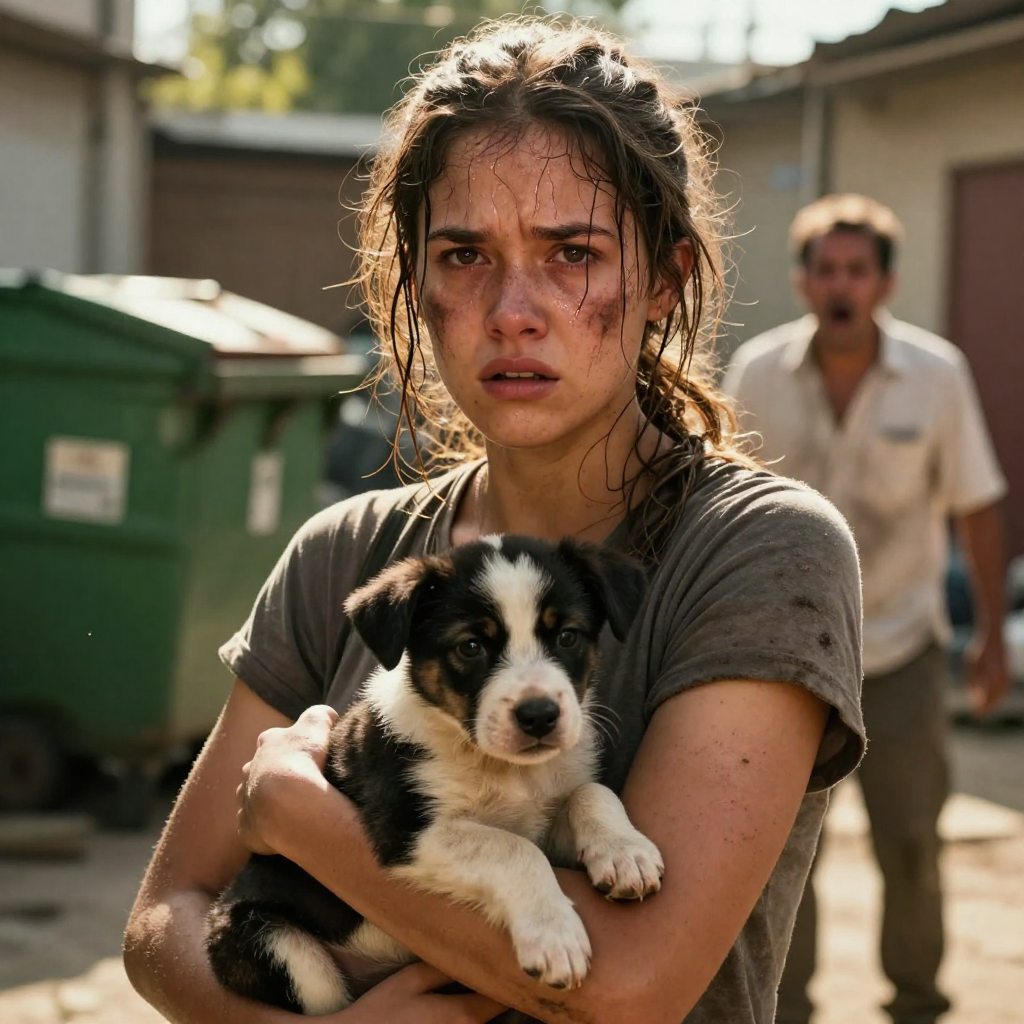
Six of them. Puppies. They couldn’t have been more than four weeks old. They were a tangle of black and white fur, matted with sweat and urine. They were gasping, their tiny mouths open, tongues lolling out, pink turning to a terrifying grey. They were piled on top of each other, suffocating in the vacuum of that bag.
The manager had climbed up on the rim of the dumpster to look. I heard him gasp. A sharp, intake of breath that sounded like pain.
“Oh my god,” he whispered. The phone slid out of his hand and clattered onto the pavement below, forgotten.
I grabbed the first one. It was limp. I rubbed its chest, blowing air onto its face. “Come on,” I sobbed. “Come on, breathe.”
It didn’t move.
The second one—a runt with a white patch on its eye—let out a weak cough. Then another. It was alive.
“Take them,” I ordered the manager, lifting two puppies up toward him.
He didn’t hesitate this time. He reached down, his clean white shirt pressing against the dirty rim of the dumpster, and took the puppies from my shaking hands. He cradled them against his chest, not caring about the filth.
“Is the car AC on?” I yelled, grabbing the next two.
“My car is right there,” he said, pointing to a sedan parked by the loading dock. “It’s running.”
We worked in a frenzy. I passed them up, one by one. The heat in the dumpster was unbearable, but a cold fury had taken over my body. I wasn’t just sad. I was enraged. I was looking at these tiny, helpless things—creatures that had done nothing but be born—and I felt a hatred for the invisible person who did this that scared me. This wasn’t negligence. This was torture.
When the last puppy was out, I scrambled over the edge, falling onto the pavement, scraping my knees. I didn’t feel it. I gathered the limp puppy—the first one—and ran to the manager’s car.
We sat in the front seat, the air conditioning blasting at max power. The manager—his nametag said ‘Stan’—was driving. He was speeding, running a stop sign out of the parking lot.
I had three on my lap. He had three on the passenger seat between us.
“Come on, buddy,” I whispered, rubbing the lifeless one with my thumb. “Please.”
The puppy was cold, despite the heat of the day. Too still.
Stan glanced over, his face pale. “Who does this?” he asked, his voice shaking. “Who throws babies in the trash?”
“I don’t know,” I said, staring at the blue plastic shreds still stuck to the fur of the living ones. “But I kept the bag.”
Stan looked at me, confused.
“I kept the bag,” I repeated, my voice hard, staring out the windshield as the vet clinic came into view. “Because there might be a fingerprint. Or a receipt. Or something.”
We screeched into the vet’s parking lot. I didn’t wait for the car to stop completely before I kicked the door open. I ran inside with my arms full of dying dogs, shouting for help before I even reached the desk. The lobby fell silent. Techs rushed out from the back.
They took them from me. They took the limp one first.
I stood there in the lobby, covered in dumpster slime, my hands trembling uncontrollably. Stan was standing behind me, breathing hard.
A few minutes later, the vet came out. She looked tired. She looked at me, then at Stan.
“Four of them are stable,” she said softly. “Dehydrated, heat exhaustion, but they’ll make it.”
I held my breath. “And the others?”
“The little one… the one you were doing CPR on… he was gone before you got here,” she said gently. “And one of the females is critical. We’re doing everything we can.”
I nodded. I couldn’t speak. I sat down on the bench and put my head in my hands. I felt Stan sit next to me. He didn’t say anything about the police. He didn’t say anything about trespassing.
“I saw something,” Stan said quietly after a long silence.
I looked up.
“When I was holding them… inside the bag. There was a piece of paper stuck to the bottom. Like a shipping label.”
I reached into my pocket. I had stuffed the torn blue remnants of the bag in there without thinking. I pulled it out. It smelled of death. I uncrumpled the wet, dirty plastic.
Stuck to the side, half-peeled off but legible, was a white sticker. It wasn’t a shipping label. It was a prescription sticker for dog dewormer, from a pharmacy across town.
And it had a name on it.
I looked at the name. Then I looked at the address. It was an address in the wealthy part of town, the gated community on the hill where the houses have three-car garages and manicured lawns.
“They didn’t just throw them away,” I whispered, my blood turning to ice. “They planned this.”
I wasn’t crying anymore. I was done crying. I looked at Stan, and for the first time, we weren’t strangers in a parking lot. We were witnesses.
“I’m going to find him,” I said.
Stan looked at the address, then back at me. He reached into his pocket and pulled out his car keys. “That neighborhood has security gates,” he said. “My brother-in-law works the booth there.”
He stood up. “Let’s go.”
This wasn’t a rescue mission anymore. It was a hunt.
CHAPTER II
The air conditioning in Stan’s old sedan hummed with a desperate, rattling effort, but it couldn’t quite cut through the thick humidity of the afternoon or the heavy, metallic smell of the vet’s office that seemed to have clung to my skin. We sat in the parking lot for a few minutes after the vet had taken the puppies back—those small, fragile lives that had been reduced to a heap of wet fur in a blue plastic bag. The silence between us was punctuated only by the occasional tap of Stan’s fingers on the steering wheel. He looked older than he had an hour ago, the fluorescent lights of the grocery store replaced by the harsh, honest glare of the sun. I held the prescription bottle in my palm, the plastic warm and the label slightly peeling at the edges. “Evelyn Thorne,” I whispered. “2140 Heritage Way. That’s in the Heights, isn’t it?”
Stan nodded, his jaw tight. “The gated part. You can’t even get past the front kiosks without an invite or a work order. My brother-in-law, Gary, he’s on the gate today. He’s been there twelve years. He hates it, but it’s a pension.” He turned the key, and the engine groaned into life. “We’re going. I can’t just go back to the store and pretend I didn’t see those eyes. One of them didn’t make it, kid. One of them is dead because someone couldn’t be bothered to drive to a shelter.”
As we drove, the landscape began to shift. The cracked asphalt and boarded-up storefronts near the grocery store gave way to wide, sweeping boulevards lined with ancient oaks that cast long, skeletal shadows across the road. I watched the houses grow larger, more insulated behind stone walls and wrought-iron fences. It felt like entering another country, one where the air was cooler and the problems were quieter. But my mind was stuck in the past, a wound I thought I’d stitched shut years ago. Seeing that blue bag in the dumpster had triggered a memory of my mother, a woman who had spent her life cleaning houses exactly like the ones we were passing. I remembered her coming home with her hands raw from bleach, telling me how she’d found a discarded silk scarf in the trash of a client—someone who had thrown it away because of a tiny, invisible snag. ‘They discard things when they aren’t perfect anymore,’ she’d said. I felt that same discarded weight now, a phantom sensation of being something unwanted, left in the heat to wither. That was my old wound: the knowledge that to some people, life is only valuable as long as it is convenient.
We reached the entrance to Blackwood Estates. It was a massive stone archway that looked more like a fortress than a neighborhood entrance. Stan pulled up to the guard shack. A man in a crisp navy uniform stepped out, his face softening when he saw Stan. This was Gary. He looked tired, the kind of tiredness that comes from a decade of saying ‘Yes, sir’ to people who don’t know your name. Stan leaned out the window and spoke in a low voice, explaining what we’d found. He showed Gary the prescription bottle. I saw Gary’s eyes flicker with a mix of recognition and fear. He looked back at the security cameras, then at the long line of expensive SUVs idling behind us.
“Stan, you’re going to get me fired,” Gary hissed, though he didn’t move away. “Evelyn Thorne is on the board of the homeowners’ association. Her husband owns half the commercial real estate in the county. If I let you in and you cause a scene, I’m done. I have two kids in college.”
“Gary, look at the bag,” Stan said, gesturing to the floorboard where the blue plastic sat, empty now but still stained. “Just let us through. Tell them we’re here for… I don’t know, a maintenance check on the irrigation. Anything. I won’t mention you.”
There was a long, agonizing pause. Gary looked at me, then back at the bag. He sighed, a sound of pure defeat, and tapped a button on his console. The heavy iron gates began to swing open with a slow, mechanical groan. “House is at the end of the cul-de-sac. The one with the white hydrangeas. Don’t stay long, Stan. Please.”
As we rolled onto the pristine pavement of Heritage Way, the secret I’d been keeping from Stan began to itch at the back of my throat. I hadn’t told him that I recognized the name Thorne for another reason. Years ago, before the grocery store, I’d worked as a junior clerk for a law firm that handled the Thorne estate. I knew their finances were a facade—a crumbling empire held together by credit and a desperate need to maintain appearances. If I went in there and confronted her, I wasn’t just confronting a dog abuser; I was stepping into a cage with a cornered animal who had everything to lose. If this went public, the social standing that kept their loans afloat would evaporate. I was holding a match in a room full of gasoline, and I wasn’t sure if I was ready to strike it.
We pulled up to the house. It was a sprawling colonial, painted a blinding, virginal white. In the driveway, several luxury cars were parked, and the sound of polite laughter drifted from the backyard. It was a luncheon. Of course it was. A garden party on the hottest day of the year, where women in linen dresses drank chilled Chardonnay while six puppies baked in a dumpster five miles away. The contrast was so sharp it felt like a physical blow to the stomach. Stan looked at me, his hands shaking slightly on the wheel. “You still want to do this?”
“I have to,” I said. I grabbed the blue plastic bag from the floorboard. It was light, but it felt like it weighed a hundred pounds.
We walked toward the side gate that led to the garden. A catering staff member in a white coat tried to stop us, but Stan simply walked past him with a grim authority I didn’t know he possessed. We rounded the corner of the house, and the scene opened up: a lush, emerald lawn dotted with white umbrellas. About twenty people were gathered around a long table. At the head of the table sat a woman in her late fifties, her hair a perfect silver bob, wearing a dress the color of seafoam. Evelyn Thorne. She was mid-sentence, laughing at something a man next to her had said, a glass of wine raised in her hand.
I didn’t wait. I walked straight toward the table, the grass soft and unforgiving under my boots. The laughter began to die down as people noticed us—two sweat-stained, dust-covered strangers intruding on their curated peace. Stan stayed a few paces behind me, his presence a silent, heavy anchor.
“Mrs. Thorne?” I asked. My voice was surprisingly steady, though my heart was hammering against my ribs like a trapped bird.
She looked up, her smile freezing into a mask of polite confusion. “Yes? Can I help you? If you’re here about the catering, you should speak with the manager in the kitchen.”
“I’m not here about the food,” I said. I reached the edge of the table. The smell of expensive perfume and grilled salmon was nauseating. I reached into my pocket and pulled out the prescription bottle, set it down on the white linen tablecloth next to her plate. “I believe this belongs to you. It was in a blue plastic bag in a dumpster behind the Food-Mart on 5th. Along with six puppies.”
The silence that followed was absolute. It was the kind of silence that has a weight to it, a pressure that makes your ears ring. Evelyn Thorne’s face didn’t crumble. It didn’t turn red. It turned into stone. She didn’t look at the bottle. She looked at me, her eyes narrowing into cold, predatory slits. Around the table, the guests began to murmur, their heads turning like a flock of startled birds.
“I have no idea what you’re talking about,” she said, her voice a low, dangerous whisper. “You are trespassing on private property. I suggest you leave before I call the police.”
“Call them,” Stan said, stepping forward. “We’ve already been to the vet. One of them is dead, Evelyn. Does the board of the Animal Rescue League know how you handle ‘accidents’?”
I realized then that Stan knew her too, or at least knew of her. The tension in the air was thick with the irreversible nature of what had just happened. There was no taking this back. I took the blue bag—the actual bag I’d pulled from the trash—and I shook it out. A small, dried smear of blood and a few tufts of golden fur fell onto the pristine tablecloth, right next to a crystal bowl of lemons. It was the triggering event, the public shattering of her carefully constructed world. Several women gasped, one pushed her chair back with a harsh scrape against the patio stone.
“My daughter’s dog… it was a mistake,” Evelyn hissed, her composure finally beginning to fray at the edges. She stood up, her seafoam dress shimmering. “The dog is a champion bloodline. A litter of mutts would have ruined her standing, our business… it was a lapse in judgment. I told the gardener to take them to a shelter. I didn’t know… I didn’t think…”
“You didn’t think because you didn’t care,” I said. “You tied the bag, Mrs. Thorne. The knot was double-looped. That’s not a mistake. That’s an execution.”
The moral dilemma suddenly crystallized in the heat. Evelyn stepped closer to me, so close I could see the fine lines of age around her eyes that no amount of cream could hide. “Listen to me, you little nothing,” she whispered, her voice meant only for me. “If you walk away now, I will write a check to that vet that will cover every animal in this county for a year. I will fund a new wing. But if you persist with this, if you go to the press or the police, I will make sure your friend at the gate loses his job. I’ll make sure the grocery store loses its lease. My husband owns that plaza, did you know that? You want to be a hero for some dogs? Fine. But you’ll be destroying the lives of three families to do it. Is that ‘right’ enough for you?”
I looked at Stan. He had heard her. I could see the color draining from his face. He thought about Gary, about the two kids in college. He thought about his own job, the only thing he’d had for twenty years. He looked at the bag on the table, then at the ground. This was the choice: justice for the voiceless that would cause real, tangible harm to the innocent people standing right next to me, or silence bought with blood money.
Evelyn Thorne saw the hesitation. She sensed the kill. She smoothed her dress and looked around at her guests, her voice rising back to its melodic, social register. “These people are clearly disturbed. They’ve had a tragedy and are looking for someone to blame. Please, everyone, let’s go inside. It’s far too hot for this.”
She turned her back on us, a gesture of supreme power. She was betting that we were too small to fight back, that our empathy for the people we loved would outweigh our anger for the animals we’d saved. As the guests began to shuffle toward the French doors, castigating us with their glares, I felt a wave of nausea. The puppies were stable, yes, but the woman who had tried to kill them was walking away into a climate-controlled house, her reputation intact, while Stan and I stood in the sun, holding the evidence of a crime that no one wanted to prosecute.
“Stan?” I whispered.
He didn’t look at me. He was staring at the prescription bottle. “I have to think about Gary,” he said, his voice breaking. “I can’t let him lose everything because I wanted to feel like a big man for an afternoon.”
I felt the old wound throb. This was exactly how it always went. The people with the white hydrangeas and the gated entries always had a way to make the truth feel like an expensive luxury the rest of us couldn’t afford. But as I looked at the blue plastic bag, I remembered the way the smallest puppy had licked my thumb in the car. It hadn’t known about leases or pensions or social standing. It only knew it was alive.
We walked back to the car in a silence that felt like lead. The drive out was different. Gary didn’t look at us as he opened the gate. He kept his head down, staring at the monitors. The gates closed behind us with a final, echoing thud, sealing the secret back inside the manicured walls.
“She’s going to call the owner of the plaza,” Stan said as we reached the main road. “I know she is. She’s not the type to leave a loose end.”
“We have the bottle, Stan. We have the bag. We have the vet’s statement.”
“And she has the keys to the world we live in,” he replied. He gripped the steering wheel so hard his knuckles were white. “What are we supposed to do? How do you win against someone who can buy the referee?”
I didn’t have an answer. All I knew was that the confrontation hadn’t brought the catharsis I’d hoped for. It had only exposed the jagged edges of a world where morality is a sliding scale based on the balance of your bank account. The moral dilemma wasn’t just about the dogs anymore; it was about whether I was willing to set fire to the lives of my friends to see a monster burn.
As we pulled back into the grocery store parking lot, the sun was beginning to dip, casting long, bloody streaks across the sky. The dumpster was still there, a dark shadow against the brick wall. It looked small now, insignificant, but I knew it was the center of a storm that was just beginning to brew. I looked at the prescription bottle in my hand one last time before slipping it into my bag.
“Go home, kid,” Stan said, not looking at me. “Just go home. I’ll handle the store. I’ll… I’ll wait for the phone call.”
I got out of the car, but I didn’t go home. I sat on the curb and watched the shoppers come and go, oblivious to the war that had just been declared in a garden five miles away. I thought about the secret I still held—the knowledge of the Thorne’s failing empire. Evelyn thought she held all the cards because she owned the land under our feet. She didn’t realize that I knew the land was already sinking.
But using that information meant becoming like her. It meant using leverage and secrets to destroy a person. It meant stepping into the mud. I felt the weight of the choice pressing down on me, heavier than the humidity, heavier than the bag of puppies. There was no clean way out. Someone was going to get hurt, and for the first time in my life, I had to decide if I was okay with being the one who caused it.
CHAPTER III
I sat in the back office of the grocery store, the walls thin enough to hear the hum of the industrial refrigerators. Stan was across from me, his head in his hands. The fluorescent light flickered, casting a sickly yellow pulse over everything. On the desk lay the folder I had compiled. It was a map of a sinking ship—the Thorne family’s private financial ledgers, hidden debts, and the leveraged shell companies that were currently propping up their social standing. It was enough to ruin them. But it was also the only thing keeping Stan from losing his job and Gary from being fired. Evelyn’s threat was a cold, hard weight in the room. She would pull the lease. She would crush the store. She would make sure Gary never wore a uniform again. It was a simple trade: our silence for their livelihoods.
Stan looked up. His eyes were bloodshot. He had spent twenty years building this store into a community hub. He knew the names of the elderly women who came in for half-pints of cream and the kids who spent their pocket change on candy after school. All of that was on the line because we found six puppies in a dumpster. It felt absurd. It felt like the world was tilted on its axis, where the life of a dog was weighed against the stability of a dozen local families. I felt the weight of the decision pressing into my chest. I could leak the documents to the press tonight. I could watch the Thorne name vanish from the social register by morning. But if I did, Stan would be packing his desk by noon.
Gary paced the small space, his boots squeaking on the linoleum. He didn’t look at me. He was thinking about his pension, his mortgage, and the way Evelyn had looked at him at the garden party—like he was a cockroach she had forgotten to step on. The silence in the office was stifling. Every time the refrigerator hummed, it sounded like a countdown. We were waiting for a miracle, or a disaster. The puppies were in a crate in the corner, five of them huddled together, their breathing synchronized. The sixth—the one we had named Mouse—was still at the vet, fighting a battle we weren’t sure he could win. That was the real cost. Not the money. Not the lease. The quiet, desperate struggle for breath in a small, frail body.
Then the phone rang. It was Dr. Aris from the veterinary clinic. I picked it up on the first ring, my fingers trembling. The doctor’s voice was clipped, professional, but underneath it, there was a vibration of cold anger. He didn’t talk about survival rates or recovery times. He talked about chemistry. He told me that Mouse hadn’t just been abandoned; he had been systematically weakened. The blood work had come back. It showed high concentrations of a very specific herbicide—a restricted chemical used primarily on large, private estates to maintain ‘trophy’ lawns. It was a chemical that was supposed to be handled by licensed professionals only. It wasn’t just neglect. It was a slow, agonizing poisoning. The puppies hadn’t been thrown away because they were a burden; they were being discarded because they were evidence of a crime.
I hung up the phone and looked at Stan. I didn’t have to say a word. The air in the room changed. The moral dilemma shifted from a choice between livelihoods and justice to a realization that we were dealing with something far darker than social hypocrisy. This wasn’t just a lady who didn’t want dogs. This was a household where life was treated as a disposable byproduct of a perfect lawn. The power Evelyn held over us—the lease, the jobs, the social standing—suddenly felt like a paper wall. I opened the folder. I looked at the names of the banks, the outstanding loans, and the dates of the missed payments. Then I looked at the recording that had been sent to me an hour earlier by Mrs. Gable, the woman in the pearls from the garden party.
Mrs. Gable hadn’t spoken up at the party, but she had kept her phone out. The video was clear. It captured Evelyn’s face, the sneer of her lip, and the specific moment she had admitted to ‘clearing out the clutter’ behind the estate. Mrs. Gable’s email had been short: ‘She’s been doing this for years. No one had the courage to stop her. Please do what I couldn’t.’ The video, combined with the vet’s report and the financial records, formed a cage. It was time to invite Evelyn into it. I told Stan to call the store’s owner—the man who supposedly reported to Evelyn’s husband. I told Gary to stand by the door. We weren’t going to her world anymore. We were bringing her to ours.
We set the meeting for 10 PM in the grocery store after closing. The aisles were dark, the only light coming from the front windows and the flickering neon ‘Open’ sign that had been turned off. Evelyn arrived in a black SUV, her husband Richard in the passenger seat. They walked into the store as if they were inspecting a prison camp. Richard Thorne was a man who smelled of expensive gin and old wood, his face a mask of bored irritation. Evelyn looked triumphant. She carried a leather portfolio, likely filled with the termination papers for the lease and Gary’s employment. She didn’t look at the puppies in the crate. She didn’t look at Stan. She looked at me with a smile that didn’t reach her eyes.
‘Let’s keep this brief,’ Richard said, his voice echoing in the empty produce aisle. ‘You have something that doesn’t belong to you. We have a business to run. We’re prepared to offer a generous settlement for the return of the documents and your permanent silence regarding the… incident at the party. Otherwise, this store becomes a parking lot by the end of the month.’ He spoke with the casual confidence of a man who had never been told no. He thought he was negotiating. He didn’t realize he was already bankrupt. I let the silence stretch out. I let him feel the coldness of the store at night. I let him look at the rows of canned goods and the stacks of fruit, the mundane reality of the lives he was threatening to destroy.
I pulled out the vet’s report first. I read the name of the chemical aloud. Richard’s face didn’t change, but Evelyn’s hand flickered toward her throat. She knew the name. She knew that the chemical was stored in their shed. I then played the video from Mrs. Gable. The sound of Evelyn’s own voice filled the aisle, shrill and panicked, admitting to the abandonment. Richard looked at his wife, a flash of genuine loathing crossing his features. He wasn’t angry about the puppies; he was angry that she had been caught on camera. He started to speak, to offer more money, to double the ‘settlement,’ but I cut him off. I didn’t want his money. I wanted the leverage to change. I wanted the power to shift.
‘It’s not just the dogs, Richard,’ I said, sliding the financial folder across the checkout counter. ‘It’s the fact that you’ve been cooking the books for three years. It’s the fact that this store’s lease is the only asset you have left that isn’t underwater. You aren’t in a position to cancel anything. If I send this to the bank tonight—the bank where your primary creditor, Mr. Henderson, sits on the board—you lose the house. You lose the cars. You lose the estate. And given the necropsy report, you might also lose your freedom.’ The room went deathly quiet. The hum of the refrigerators felt like a roar. Richard reached for the folder, his fingers fumbling with the latch. He scanned the pages, his face turning a gray, ashen color.
Evelyn tried to rally. She stepped forward, her voice trembling with a mixture of rage and desperation. ‘You think you can do this? You’re a nobody. You’re a clerk. You have no idea how this world works. No one will believe you.’ But her voice lacked the bite it had at the garden party. She was a ghost in a designer dress, haunted by the sudden realization that the walls were closing in. I looked past her to the front door. A man was standing there, silhouetted against the streetlights. It was Mr. Henderson, the bank representative and a member of the local town council. I had called him an hour ago. He had been a guest at the party, too. He had seen the puppies. And more importantly, he saw a liability that could sink his own reputation if he stayed silent.
Mr. Henderson walked into the light. He didn’t look at me. He looked at Richard. ‘Richard, we need to talk about these credit lines,’ he said, his voice low and heavy with the weight of institutional authority. ‘And Evelyn, the animal control investigators are waiting in the parking lot. They’ve seen the vet’s report.’ The shift in power was instantaneous and total. It wasn’t a fight; it was a collapse. Richard didn’t even try to defend his wife. He stepped away from her, as if her presence were a contagion. He began to talk about ‘misunderstandings’ and ‘restructuring,’ but Henderson wasn’t listening. The authority that had protected the Thornes for decades had suddenly decided they were no longer worth the trouble.
Evelyn stood alone in the center of the aisle. The woman who had threatened to destroy our lives was now just a person standing in a grocery store at midnight, surrounded by cheap linoleum and the smell of floor wax. She looked at the crate of puppies. For the first time, she really looked at them. There was no remorse in her eyes—only a cold, sharp fear of the consequences. She realized that the ‘clutter’ she had tried to throw away was the very thing that was going to bury her. Gary stepped forward, no longer the shaking security guard, but a man who had his dignity back. He didn’t say a word. He just opened the front door and gestured for them to leave.
As the Thornes walked out into the cold night air to meet the investigators and the bank’s legal team, the store felt different. The tension didn’t evaporate; it condensed into a hard, cold reality. We had won, but the victory felt heavy. Stan sat on a crate of oranges, staring at the floor. He still had his store. Gary still had his job. But we had seen the dark underbelly of the town’s elite, and we had used their own corruption to save ourselves. I went to the crate and picked up one of the puppies. It licked my hand, a small, warm tongue against my skin. It didn’t know about bank loans or herbicide or garden parties. It only knew that it was safe.
The final twist came an hour later. As we were cleaning up, the vet called back. Mouse hadn’t just survived the night; he had turned a corner. But the doctor had found something else. In the bag where the puppies had been found, tucked into a hidden seam, was a small, waterproof digital recorder. It hadn’t belonged to Mrs. Gable. It had belonged to Richard Thorne’s personal assistant, who had been documenting the family’s ‘cleanup’ operations for months as an insurance policy. The assistant had seen Evelyn put the puppies in the bag. He had seen her add the poison. And he had been the one who dropped the bag in the one dumpster he knew Stan checked every morning. He hadn’t been trying to kill them; he had been trying to get them found by the only person in town who would care.
I looked at the recorder in my hand. The truth was far deeper than we had imagined. The Thornes hadn’t just been cruel; they had been at war with each other, and the puppies were the casualties of a domestic battlefield. We had the evidence now—not just of financial fraud, but of a calculated, malicious act of cruelty designed to frame or leverage one another. The institutional intervention was only the beginning. The Thornes weren’t just losing their money; they were going to lose their narrative. The town would know everything. I looked at Stan and Gary. We were tired, drained of everything but the basic instinct to protect what was left. The store was quiet now. The refrigerators hummed. The puppies slept. And for the first time in weeks, I felt like I could breathe.
We sat there until the sun began to peek over the horizon, casting long shadows across the produce. The battle was over, but the aftermath was just beginning. The phone started to ring again—reporters, lawyers, the curious and the outraged. The world was waking up to the story of the six puppies and the fallen monarchs of the gated community. I stood up and stretched, my bones aching. I had a choice to make about what to do with the assistant’s recording. I could hand it over and finish the job, or I could use it to ensure that no one like Evelyn Thorne ever held power over this town again. I looked at the puppies, now waking up and yapping for food. The answer was simple. It had always been simple. Justice wasn’t about the fall of the wicked; it was about the safety of the small.
I walked to the front of the store and flipped the sign from ‘Closed’ to ‘Open.’ The light hit the glass, reflecting the world outside. It was a new day, and the air felt clean. The Thornes were gone, their empire a pile of smoking ledgers and legal briefs. Stan came up beside me, a cup of coffee in his hand. He looked at the street, at the regular customers starting to gather for their morning milk and bread. He smiled, a genuine, weary smile. ‘We’re still here,’ he whispered. ‘Yeah,’ I said, watching the first customer walk through the door. ‘We’re still here.’ And as I looked at the puppies playing in their crate, I knew that for once, the right side had won. Not through luck, but through the simple, stubborn refusal to let the small things be thrown away.
CHAPTER IV
The morning after felt…thin. Like waking from a fever dream only to find the world outside unchanged, except for a persistent ache in my bones. The Thornes were gone, yes, hauled away in the dead of night. But the air hung heavy with unspoken things, with the residue of what we’d done, what we’d exposed. It wasn’t a victory parade. It was…cleanup.
The news trucks descended on our town like vultures. They camped outside the grocery store, their satellite dishes glinting under the harsh morning light. Reporters shoved microphones in my face, asking the same questions over and over: “How did you feel when you discovered the puppies?” “Were you afraid of the Thornes?” “Do you consider yourself a hero?”
I hated the word ‘hero.’ Gary hated it too. We weren’t heroes. We were just…stuck. Stuck with the knowledge, stuck with the guilt of inaction, stuck with the responsibility of doing something, anything, to make it right. And now, stuck with the spotlight.
The town was split. Some cheered us, calling us brave. Others whispered behind cupped hands, calling us fools for taking down the people who, for better or worse, had kept this town afloat. My sales plummeted. People avoided my eyes in the aisles. The silence was louder than any accusation.
Even my family felt…distant. My sister, bless her heart, tried to be supportive, but I could see the worry etched on her face. She feared for my safety, for my job. She didn’t understand that I was already stripped bare. What more could they take?
Gary fared no better. He became a local celebrity, signing autographs at the diner. But behind the forced smiles, I saw the exhaustion in his eyes. He hadn’t slept properly in days. The nightmares, I suspected, were vivid.
The puppies, the surviving five, became a symbol. The local animal shelter was overwhelmed with adoption requests. It was a small comfort, a tiny spark of light in the encroaching darkness. But finding them homes wasn’t enough. We needed to do more.
One afternoon, a woman approached me in the parking lot. Her name was Martha, and she worked at the Thorne Foundation, or what was left of it. She told me that the foundation had funded several local initiatives, including a soup kitchen and a program for underprivileged kids. With the Thornes gone, those programs were in jeopardy.
“They weren’t all bad people,” Martha said, her voice trembling. “Evelyn…she had her demons. But the foundation did good work.”
Her words hit me hard. It wasn’t as simple as good versus evil. There were layers, nuances, unintended consequences. We’d toppled a corrupt empire, but in doing so, we’d hurt innocent people.
That night, I couldn’t sleep. I tossed and turned, haunted by Martha’s words. The puppies were safe, but the town was wounded, fractured. And we were the ones who had wielded the hammer.
I decided to call Gary. “We need to do something,” I said. “Something to help the people who are going to get hurt by all this.”
He didn’t hesitate. “I’m in,” he said.
**PHASE 2: THE TRIAL AND THE TRUTH**
The legal proceedings started quickly. The Thornes, facing charges of animal cruelty, fraud, and a host of other financial crimes, were denied bail. The media circus intensified. Every day brought new revelations of their shady dealings, their hidden debts, their carefully constructed lies.
I was called to testify. So was Gary. So was Mrs. Gable, the woman who had given me the recording. The courtroom was packed, the air thick with tension. I felt like I was on trial, too, my every word scrutinized, my every motive questioned.
The defense attorneys painted me as a disgruntled employee, a nobody seeking revenge against a powerful family. They tried to discredit my testimony, to twist the facts. But I stood my ground. I told the truth, as plainly and honestly as I could.
Gary was a natural on the stand. He spoke with a quiet dignity, his words carrying the weight of his convictions. He talked about the puppies, about their suffering, about the injustice of it all. He didn’t grandstand. He didn’t preach. He just told the truth.
Mrs. Gable, a frail woman with a sharp mind, provided the most damning evidence. Her recording, played for the court, revealed Evelyn Thorne’s cold-blooded indifference to the puppies’ fate. It was a turning point in the trial.
But the real shock came when Richard Thorne’s assistant, a nervous young man named David, took the stand. He revealed that the puppies were pawns in a twisted game between Richard and Evelyn. Richard, desperate to gain leverage in their failing marriage, had orchestrated the poisoning to frame his wife. Evelyn, in turn, had planned to blame it on a local farmer.
The courtroom erupted in gasps. The Thornes, sitting side-by-side, glared at each other with undisguised hatred. Their carefully constructed facade had crumbled, exposing the rot beneath.
As the trial dragged on, I felt a growing sense of disillusionment. The truth, it turned out, was far more complicated, far more ugly, than I had imagined. It wasn’t just about animal cruelty. It was about power, greed, and a family consumed by its own demons.
Even after the Thornes were found guilty on several counts, I didn’t feel any sense of triumph. The victory felt hollow, tainted by the knowledge of the pain and suffering that lay beneath the surface.
**PHASE 3: A COMMUNITY DIVIDED**
The trial ended, but the divisions in our town remained. Some celebrated the downfall of the Thornes, seeing it as a victory for the little guy. Others mourned the loss of jobs and opportunities, fearing for the future of our community.
The grocery store, once a bustling hub, became a symbol of the conflict. Protesters picketed outside, some supporting me, others condemning me. My sales continued to plummet. The store was on the brink of collapse.
The owner, a kind but weary man named Mr. Henderson, called me into his office. He told me that he was considering selling the store. He couldn’t afford to keep it open any longer.
I felt a pang of guilt. My actions, however well-intentioned, had put his livelihood in jeopardy. I offered to resign, but he refused. “It’s not your fault, Stan,” he said. “The town…it’s just changed.”
I talked to Gary about it. We sat in his apartment, surrounded by newspapers and legal documents. He was unusually quiet, his eyes filled with a sadness I hadn’t seen before.
“What are we going to do?” I asked.
He shrugged. “I don’t know,” he said. “Maybe…maybe we should just leave. Start over somewhere else.”
His words stung. Was it all for nothing? Had we sacrificed everything, only to end up with nothing to show for it?
That night, I walked through the aisles of the grocery store, the silence amplified by the empty shelves. I thought about Mr. Henderson, about Martha and the people who depended on the Thorne Foundation, about the puppies and the town that had become so divided.
I couldn’t leave. I couldn’t abandon them. This was my home, for better or worse. And I wasn’t going to let it fall apart.
I called Gary again. “I have an idea,” I said. “A crazy idea.”
**PHASE 4: A NEW BEGINNING**
My idea was simple: we would try to buy the grocery store. We would pool our savings, ask for donations, and try to convince Mr. Henderson to sell it to us at a reasonable price. It was a long shot, but it was worth a try.
We started a GoFundMe campaign, telling our story and asking for help. To our surprise, the response was overwhelming. People from all over the country donated, touched by our story and inspired by our determination.
Local businesses also stepped up, offering their support. The diner, the hardware store, even the gas station pitched in. It was a sign that, despite the divisions, the community still had a heart.
Mr. Henderson, moved by our efforts, agreed to sell us the store at a discounted price. He even offered to stay on as a consultant, helping us navigate the challenges of running a business.
It wasn’t easy. We worked long hours, stocking shelves, managing employees, and dealing with the constant stream of customers. But we were doing it together, united by a common purpose.
Gary, surprisingly, turned out to be a natural entrepreneur. He had a knack for connecting with people, for understanding their needs. He transformed the store into a community hub, a place where people could gather, share stories, and support each other.
The puppies, of course, played a role. We organized adoption events at the store, partnering with the local animal shelter. All five puppies found loving homes, each one a testament to the power of compassion.
Mouse, the runt of the litter, ended up staying with me. He was a small, frail creature, but he had a spirit that wouldn’t quit. He became my constant companion, a reminder of what we had fought for, what we had lost, and what we had gained.
One evening, as I sat on my porch, watching Mouse chase butterflies in the yard, I realized that we hadn’t just saved a grocery store. We had saved a community. We had shown that, even in the darkest of times, hope can prevail. We had proven that, even the smallest of acts can make a difference.
The cost was high. The scars remained. But we had emerged from the storm stronger, wiser, and more determined than ever. The town still whispered, the memory of the Thornes lingered. But now, there was a new story being told: a story of resilience, of community, and of a grocery store manager, a security guard, and five little puppies who changed everything.
One day I saw Mrs. Gable in the store, her face lined but her eyes still sharp and kind. She thanked me again. “You did the right thing,” she said. “Even when it was hard.”
I wasn’t sure if she was right, but I smiled, because Mouse was nudging my hand, wanting attention. We all had a long way to go, but we were heading somewhere, together. Maybe that was all that mattered.
CHAPTER V
The first spring after the Thorne trial felt different. The air was lighter, maybe, or maybe I was just breathing easier. The grocery store, now officially ours – ‘Ours’ as in, the community’s. We had incorporated as a co-op with Mr. Henderson, who I am glad stuck around – buzzed with an energy it hadn’t possessed since I was a kid. People weren’t just buying groceries; they were meeting, talking, reconnecting. The fear, the icy grip Evelyn Thorne had held on this town, was finally thawing.
Gary, ever the rock, was still by my side, though he spent more time organizing community events than patrolling aisles. He was a natural leader, even if he didn’t see it himself. He started a monthly potluck in the parking lot, and it became a sensation. Mrs. Gable always brought her famous potato salad, and even David, Richard Thorne’s former assistant, volunteered, helping set up tables and chairs. He told me once he was just trying to do something good after being blind for so long. I think we all were.
Richard Thorne was another story. After the trial, he vanished. Some said he’d gone to Europe, others whispered about a secluded retreat. I didn’t know, and frankly, I didn’t care. He was a ghost, a reminder of a life I wanted to forget. The only Thorne I thought about was Martha, from the Thorne foundation, who now had become a regular at the store. She told me about her plans to convert the foundation into a scholarship fund. I was invited to be on the board.
Mouse, of course, was thriving. The sickly, shivering pup we’d pulled from the dumpster was now a bouncy, energetic dog, my constant shadow. He slept at the foot of my bed, greeted me with frantic tail wags every morning, and was, without a doubt, my best friend.
The weight of the past hadn’t vanished entirely, but it felt… different. It was a scar, not an open wound. We all carried scars, reminders of what we’d been through, but we were learning to live with them, to build a future on the shaky foundation of what remained.
PHASE 1
One afternoon, maybe six months after the trial ended, I was in my office, wrestling with invoices, when Gary poked his head in. “Stan, got a minute?” he asked, his voice uncharacteristically hesitant.
I sighed, pushing the papers aside. “Always, Gary. What’s up?”
He shuffled his feet. “There’s someone here to see you. Says her name is… Evelyn Thorne.”
The words hit me like a punch to the gut. Evelyn Thorne? Here? I hadn’t seen her since the courtroom, hadn’t even heard her name mentioned in months. A wave of anger, fear, and a strange sort of morbid curiosity washed over me.
“What does she want?” I asked, my voice tight.
“She didn’t say. Just asked to see you. I told her you were busy, but she insisted.” He paused. “I don’t trust her, Stan. Maybe I should tell her to leave.”
Part of me wanted to tell Gary to throw her out, to banish her from our newly rebuilt world. But another part, a darker, more twisted part, needed to see her, to understand why she was here. “No, Gary,” I said, surprising myself. “I’ll see her.”
Gary frowned, his eyes filled with concern. “You sure, Stan?”
I nodded, trying to project an air of confidence I didn’t feel. “Yeah, I’m sure. Just… stay close, okay?”
He squeezed my shoulder. “Always.”
I took a deep breath and walked out of my office, steeling myself for whatever confrontation awaited me. There she was, standing awkwardly near the customer service desk, looking smaller, frailer than I remembered. Her expensive clothes hung loosely on her frame, and her usually impeccable hair was slightly disheveled. The imperious glint in her eyes was gone, replaced by something I couldn’t quite decipher.
“Mr. Henderson,” she said, her voice raspy. “Thank you for seeing me.”
“It’s Stan,” I corrected her, my voice flat. “And you can skip the pleasantries, Mrs. Thorne. What do you want?”
She hesitated, her gaze darting around the store as if she were afraid of being overheard. “I… I wanted to apologize.”
The words hung in the air, thick with disbelief. Evelyn Thorne, apologizing? It was almost laughable.
“Apologize?” I repeated, my voice laced with sarcasm. “For what, exactly? The animal cruelty? The financial fraud? The way you terrorized this town for decades?”
Her face flushed. “For all of it,” she said, her voice barely a whisper. “I know what I did was wrong. Terribly wrong. And I… I’m sorry.”
I stared at her, searching for any sign of insincerity, any hint of the manipulative woman I knew she was. But all I saw was… exhaustion. A deep, bone-weary exhaustion.
“Why now?” I asked, my voice softer this time. “Why apologize now, after everything?”
She sighed, her shoulders slumping. “Because I have nothing left,” she said, her voice filled with a strange sort of resignation. “My money is gone, my family is scattered, my reputation is ruined. All I have left is the knowledge of what I did, and it’s… it’s crushing me.”
I didn’t say anything, just continued to stare at her, trying to process what she was saying. Was this genuine remorse, or just another act? I honestly couldn’t tell. But something in her eyes, something in the way she carried herself, suggested that this was more than just a performance.
“I don’t expect you to forgive me,” she continued, her voice cracking. “I don’t deserve it. But I needed to say it. I needed you to know that I… I regret everything.”
She reached into her purse and pulled out a small, worn photograph. It was a picture of a young girl, maybe eight or nine years old, with bright, smiling eyes. “This is my granddaughter,” she said, her voice choked with emotion. “She lives in another state, with my daughter. I haven’t seen her in years. I’m afraid… I’m afraid she’ll never know me, except as the monster everyone talks about.”
She handed me the photograph, and I reluctantly took it. The girl’s smile was infectious, her eyes filled with a joy that seemed a world away from the darkness Evelyn Thorne had created. “I just want her to know that I… I wasn’t always like this,” she said, her voice barely audible. “That somewhere, deep down, there was a person who cared.”
She turned and walked away, her figure disappearing into the crowd of shoppers. I stood there for a long time, staring at the photograph, wondering if there was any truth to her words. Could a person like Evelyn Thorne truly change? Could she ever be forgiven?
PHASE 2
I don’t know how long I stood there, holding the photograph. Gary came over, concern etched on his face. “You okay, Stan? What did she want?”
I handed him the picture. “She said she was sorry,” I said, my voice numb. “She wanted me to know she regretted everything.”
Gary looked at the photo, then back at me, his expression skeptical. “You believe her?”
I shook my head. “I don’t know,” I admitted. “Part of me wants to, but… I just don’t know.”
He put his arm around my shoulder. “It’s okay to be angry, Stan,” he said, his voice gentle. “She hurt a lot of people. You don’t have to forgive her.”
I knew he was right. I didn’t have to forgive her. But the idea that she was suffering, that she was haunted by her past, gave me a strange sense of… unease. I didn’t want her to suffer, not really. I just wanted her to understand the consequences of her actions.
That night, I couldn’t sleep. I kept tossing and turning, the image of Evelyn Thorne’s granddaughter burned into my mind. I thought about Mouse, about the other puppies we had rescued, about the lives Evelyn Thorne had almost destroyed. And I realized that forgiveness wasn’t about her; it was about me. It was about letting go of the anger, the resentment, the bitterness that had been poisoning me for so long.
I got out of bed and went to the living room. Mouse, who was sleeping soundly on his dog bed, looked up at me with sleepy eyes. I sat down on the floor next to him and stroked his fur. “It’s okay, boy,” I whispered. “It’s all going to be okay.”
I thought about the community we had rebuilt, about the people who had come together to support each other, about the hope that had blossomed in the wake of Evelyn Thorne’s downfall. And I knew that I couldn’t let her continue to control me, to dictate my emotions.
The next morning, I went to see Martha at the Thorne Foundation. I told her about Evelyn Thorne’s visit, about the apology, about the photograph. Martha listened patiently, her expression thoughtful.
“I’m not surprised,” she said finally. “I think she’s been struggling for a long time. She never knew how to be happy. She was lost.”
“What do you think I should do?” I asked.
Martha smiled. “That’s up to you, Stan,” she said. “But I think… I think forgiveness is always the best path. Not for her sake, but for yours.”
I nodded, feeling a sense of clarity I hadn’t felt in months. “You’re right,” I said. “I need to let it go.”
We talked for a while longer, about the scholarship fund, about the future of the foundation, about the possibility of creating a community center in the old Thorne mansion. And as I left, I felt a weight lift off my shoulders. I wasn’t ready to forgive Evelyn Thorne completely, but I was ready to move on.
PHASE 3
Time passed. The grocery store continued to thrive, the community grew stronger, and life in our town settled into a new normal. I saw Martha regularly, working on the scholarship fund and the community center. Gary was still organizing potlucks and events, bringing people together in ways I never thought possible. And Mouse, of course, remained my constant companion, a furry reminder of the power of resilience and hope.
One day, I received a letter. It was postmarked from a small town in Arizona. The return address was simply “E.T.” I hesitated for a long time before opening it.
The letter was short and to the point. Evelyn Thorne wrote that she was living a quiet life, working at a local library, and trying to make amends for her past. She didn’t ask for forgiveness, but she did say that she thought about our town often, and that she was grateful for the opportunity to have apologized.
I read the letter several times, trying to decipher her true intentions. Was this another manipulation? Another attempt to worm her way back into our lives? Or was it simply a genuine expression of remorse?
I decided to believe the latter. I didn’t know if Evelyn Thorne had truly changed, but I knew that I had. I had learned to let go of the anger and resentment, to focus on the present, and to build a future filled with hope and compassion.
I folded the letter and put it away, feeling a sense of closure I hadn’t expected. Evelyn Thorne was no longer a threat, no longer a shadow hanging over our town. She was just a woman, trying to find her way in the world, just like the rest of us.
I never saw Evelyn Thorne again. But I did hear, through Martha, that she had reconnected with her daughter and granddaughter. That she was slowly, painstakingly, rebuilding her life.
One evening, as I was closing up the grocery store, I saw Mrs. Gable standing near the entrance. She was holding a small bouquet of flowers.
“Mr. Henderson,” she said, her voice soft. “I just wanted to thank you. For everything.”
I smiled. “It was a team effort, Mrs. Gable,” I said. “We couldn’t have done it without you.”
She shook her head. “No,” she said. “You gave us hope. You showed us that even in the darkest of times, there is always light.”
She handed me the flowers and walked away, leaving me standing there, filled with a sense of gratitude and humility.
I looked down at the flowers, then out at the town, at the houses twinkling with light, at the people walking along the streets, laughing and talking. And I realized that we had done it. We had rebuilt our community, stronger and more resilient than ever before.
PHASE 4
The years passed. The grocery store remained the heart of our town, a place where people came together to shop, to socialize, and to support each other. Gary continued to organize community events, bringing joy and laughter to our lives. Martha’s scholarship fund helped countless students pursue their dreams, and the community center became a hub of activity, offering programs for people of all ages.
Mouse, of course, grew old. His muzzle turned gray, his steps became slower, and his energy waned. But he remained my loyal companion, always by my side, always ready with a wagging tail and a wet nose.
One day, Mouse got sick. The vet said there was nothing more we could do. I brought him home and laid him on his bed, stroking his fur as he drifted in and out of consciousness.
Gary and Martha came over to say goodbye. We sat there together, watching Mouse, remembering all the joy he had brought into our lives.
As the sun began to set, Mouse took a final breath and closed his eyes. He was gone.
The grief was overwhelming. I had lost a friend, a companion, a symbol of hope and resilience. But as I looked at Gary and Martha, at the community we had built together, I knew that Mouse’s legacy would live on.
We buried him in the backyard, under a big oak tree. I planted a small rosebush on his grave, a symbol of love and remembrance.
Life went on. The seasons changed, the years passed, and our town continued to grow and evolve. We faced new challenges, new obstacles, but we faced them together, united by our shared history and our unwavering hope for the future.
I grew old, my hair turned gray, and my steps became slower. But I never forgot what we had been through, what we had learned, and what we had accomplished. And I never forgot Mouse, the little puppy who had brought us all together.
One day, as I was sitting on my porch, watching the sunset, I realized that everything was going to be okay. That even in the face of loss and adversity, there is always hope. That even in the darkest of times, there is always light.
The community we had rebuilt was thriving. The scars of the past had faded, replaced by a sense of unity and resilience. And Mouse, the little dog we had rescued from the dumpster, had become a symbol of our town’s rebirth, a reminder that even the smallest of creatures can make a big difference.
I smiled, feeling a sense of peace I hadn’t felt in a long time. The world was still a messy, complicated place, but it was also filled with beauty, kindness, and hope. And I was grateful to be a part of it.
As I sat there, watching the sunset, I thought about Evelyn Thorne. I wondered if she had found peace, if she had truly made amends for her past. I didn’t know, and I probably never would. But I hoped that she had. I hoped that she had found a way to forgive herself.
Because in the end, that’s all that really matters. Forgiving ourselves, and forgiving each other. Letting go of the past, and embracing the future. And remembering that even in the darkest of times, there is always light.
The air felt crisp as another day ended. The rebuilt community, a testament to collective will, bloomed radiantly. The grocery store remained the heart of it all, a place not just for commerce, but for connections. The past, though marked by pain, had paved the way for a future filled with newfound appreciation and a profound understanding of togetherness.
The once scared and hesitant Stan had transformed. He stood as a beacon of resilience, his life a testament to the power of community and the enduring strength of the human spirit. The town was still recovering, but it did have the grocery store and the love they found together. They will make it. We will all make it.
The last rays of sunlight painted the sky in hues of orange and pink, casting a warm glow over our town. As darkness fell, I felt an overwhelming sense of gratitude. The scars might remain, but they were a reminder of how far we’d come, of the battles we had fought, and of the victories we had won. I looked at the town. It was beautiful.
I will forever hold on to the lessons learned, the friendships forged, and the unwavering hope that had guided us through the storm. For in the end, it wasn’t about the money, or the power, or the revenge. It was about the people, the community, and the enduring power of love.
We are all just doing our best.
END.