HE POURED FREEZING WATER ON A CHAINED DOG AND LAUGHED, BUT HE DIDN’T SEE ME WATCHING FROM THE ROAD UNTIL I PARKED MY BIKE ON HIS LAWN AND REFUSED TO MOVE.
The thermometer on the bank sign down the road read twenty-two degrees, but on the back of a motorcycle doing fifty, it felt like sub-zero. My hands were numb even through the heavy leather gloves, and the wind had found the one gap in my scarf, biting at my neck like a jealous ghost. I just wanted to get home. I wanted hot coffee, a thermostat set to seventy, and silence. I wasn’t looking for trouble. I wasn’t looking for anything other than the next mile marker.
But you don’t always get to choose what you see. Sometimes, the world forces you to look.
I saw the motion first—a splash of white against the grey siding of a house that had seen better days. It was a split-second thing, visible through the gaps in a chain-link fence. A man standing on a porch, a five-gallon bucket in his hands, and a cloud of steam rising where the water hit the frozen ground. And then I saw the animal.
It was a dog, maybe a mix of boxer and something else, short-haired and shivering so violently that I could see the tremors from the street. It was tethered to a rusted pole in the middle of a yard that was nothing but hard-packed dirt and patches of ice. The chain was short, maybe four feet, leaving the creature nowhere to go, nowhere to hide. The water the man had just thrown wasn’t warm. I knew it wasn’t warm because the dog didn’t shake it off; it collapsed, curling into a tight, miserable ball, trying to disappear into the mud.
And the man? He was laughing. I could see his shoulders shaking with it. He wiped his hands on his jeans, turned around, and started to head back inside, leaving the animal wet in twenty-degree weather.
I didn’t make a conscious decision to stop. My body just did it. My boot slammed down on the rear brake, the back tire locked for a fraction of a second, sliding on a patch of black ice before the rubber bit into the asphalt. The engine roared as I downshifted, the sound echoing off the suburban houses like a gunshot. I swung the bike around in the middle of the empty street, ignoring the double yellow line, ignoring the cold, ignoring the fact that I was tired and aching.
I pulled up onto the curb, the heavy front tire crushing the dead, frozen grass of his lawn. I didn’t bother with the kickstand immediately. I just sat there for a moment, letting the engine idle, a low, guttural rumble that vibrated through the frame. The man on the porch stopped. His hand was on the screen door handle. He froze, looking at me. I looked back.
He was average. That’s the scary part about cruelty; it doesn’t wear a monster’s mask. It wears a flannel shirt and blue jeans. He looked like a guy you’d stand behind in line at the grocery store. He looked annoyed, not guilty. He squinted at me, confused by the sudden intrusion of a stranger on a loud machine in his front yard.
I killed the engine. The silence that followed was heavy, broken only by the whimpering of the dog. It was a high, thin sound, the sound of something that has given up on barking and is just begging for mercy.
I dismounted. My boots crunched loudly on the frozen lawn. I took my helmet off, setting it on the seat, and walked toward the fence. I didn’t run. I didn’t shout. I just walked with the kind of pace that suggests I wasn’t planning on stopping.
“Can I help you?” the man called out. His voice was defensive, scratchy. He stepped down from the porch, puffing his chest out a little. He saw the cut, the patches on my vest, the road dust on my face. He was trying to calculate how much of a threat I was.
I stopped at the gate. It was latched. I looked at the dog. Up close, it was worse. The water was already freezing on its coat. Its ribs were visible, creating ridges under the wet fur. The collar was tight, digging into the neck skin. The dog looked up at me, one eye swollen shut, the other wide with terror. It flinched when I put my hand on the fence.
“You threw water on him,” I said. My voice sounded calm, surprisingly steady. It didn’t feel steady inside. Inside, there was a fire lighting up, burning away the cold.
The man scoffed, a nervous, dismissive sound. “He was barking. Needed to cool him off. It’s my dog. You got a problem, pal? Get off my property.”
“It’s twenty degrees out,” I said, unlatching the gate. “Water freezes at thirty-two. You know that, right?”
He took a step forward, his face reddening. “I said get off my property. I’ll call the cops.”
“Go ahead,” I said. I pushed the gate open. The metal screeched on rusty hinges. I stepped inside the yard. “Call them. Tell them there’s a man in your yard who won’t leave until this dog is inside. Tell them exactly what you did.”
He hesitated. He looked at his phone, then back at me. He realized I wasn’t leaving. He realized that the intimidation tactic—the shouting, the property rights argument—wasn’t working. I wasn’t moving toward him. I was moving toward the dog.
“Don’t touch him,” the man warned. “He bites.”
“I bet he does,” I muttered. “I would too if I lived like this.”
I knelt down in the mud, ignoring the wetness seeping into the knees of my jeans. The dog tried to scramble backward, hitting the end of the chain, choking itself. I stayed still. I took off one of my gloves. I held my hand out, palm up, low to the ground. “It’s okay,” I whispered. “I’m not him. I’m not him.”
The man was still shouting something behind me, something about trespassing and the Second Amendment and his rights. I tuned him out. It was just noise. The only thing that mattered was the trembling creature in front of me.
The dog sniffed the air. He smelled the leather, the exhaust, the sweat. He stopped pulling against the chain. He lowered his head, his ears flat against his skull. He let out a breath that formed a small white cloud in the air. Slowly, painfully, he crept forward. He touched his cold, wet nose to my fingers.
I carefully reached around and touched the clip of the leash. It was frozen shut. Rusted and iced over. I couldn’t undo it with my fingers.
I stood up and turned to the man. He had backed up onto the porch now, his hand in his pocket, looking unsure. The dynamic had shifted. He realized that I wasn’t just passing through. I was an obstacle.
“I need a towel,” I said. “And I need bolt cutters. Or a key.”
“I ain’t giving you nothing,” he spat. “You’re crazy. You’re trespassing!”
I didn’t argue. I just took my phone out of my pocket. I dialed 911. I put it on speaker so he could hear.
“911, what is your emergency?”
“I’m at…” I looked at the number on the mailbox. “402 Maple Street. There is an animal cruelty situation in progress. The homeowner is agitated. I am requesting an officer immediately.”
The man’s face went pale. He hadn’t expected me to actually make the call. He thought he was the one with the power to threaten law enforcement. But bullies rarely like it when the lights get turned on.
“You can’t do that,” he stammered. “It’s my dog!”
I sat down on the edge of the porch, putting myself between the man and the dog. I crossed my arms. “We’ll wait and see what they say.”
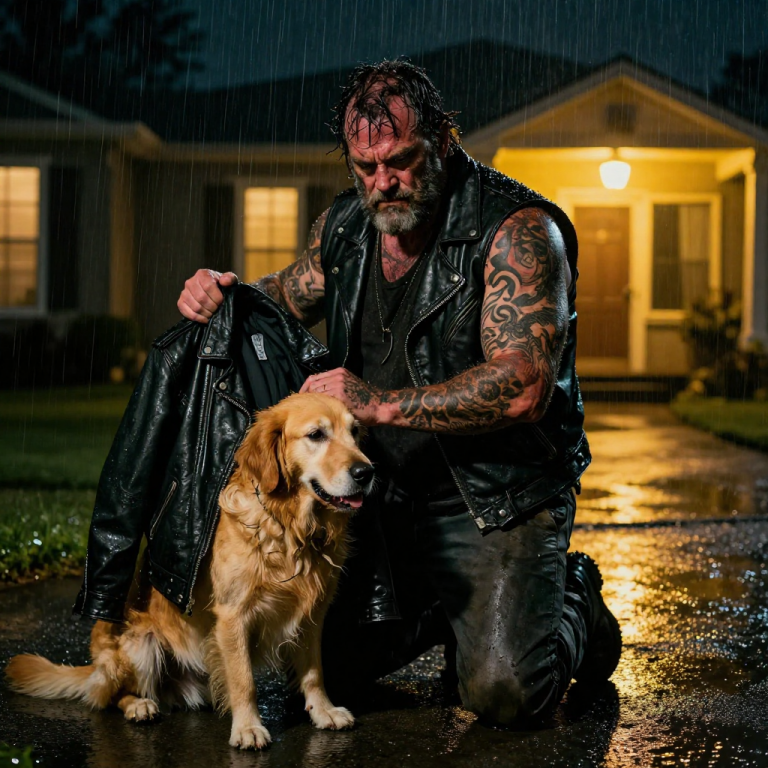
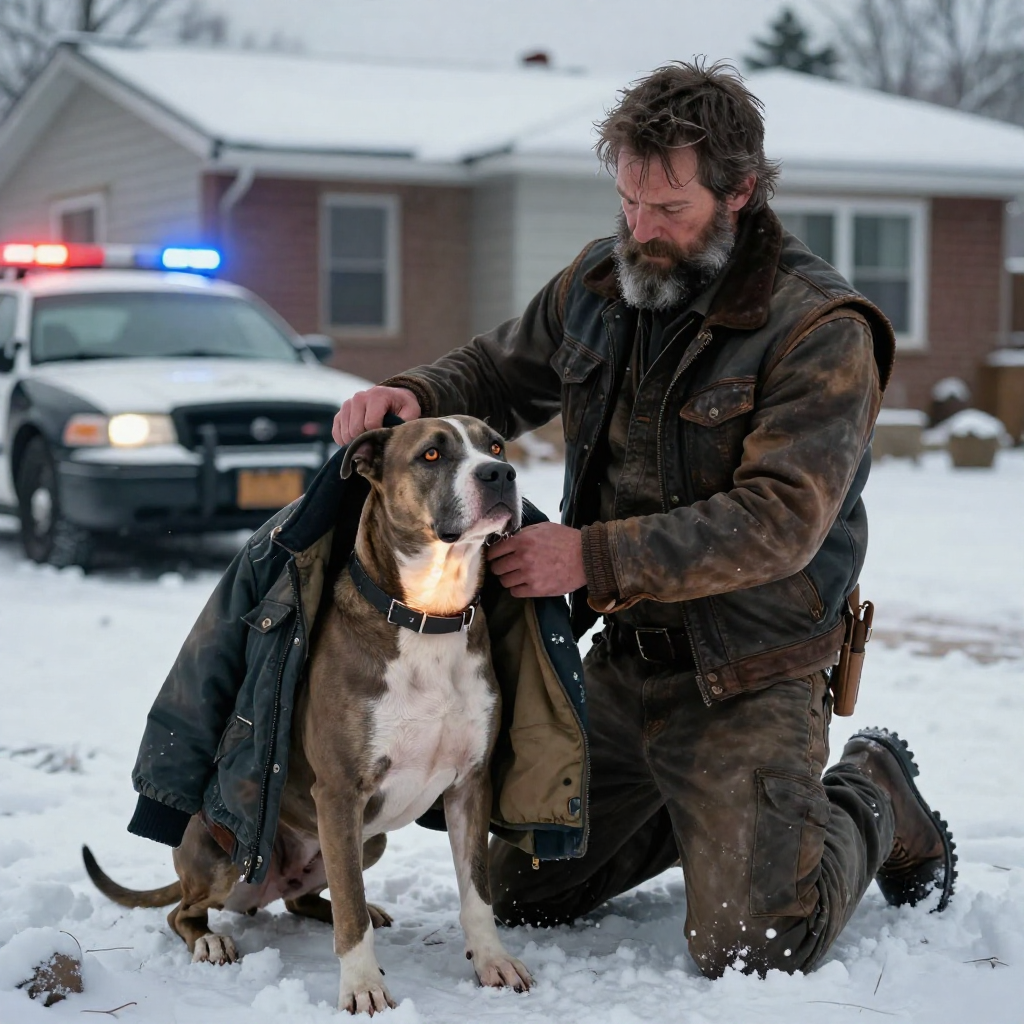
The next ten minutes were the longest of my life. The man went inside and locked the door. I could see him peeking through the curtains. I stayed on the porch steps. I took off my heavy leather jacket and draped it over the dog. He was so cold he didn’t even fight it. He just sank into the warmth of the lining, resting his chin on my boot. I sat there in just my flannel and vest, shivering, feeling the cold seep into my bones, sharing the misery so he wouldn’t be alone in it.
When the cruiser rolled up, no sirens, just lights flashing against the grey sky, I felt a wave of relief so strong it almost made me dizzy. Two officers stepped out. One was older, grey moustache, looked tired. The other was young, sharp, hand resting near his belt.
“Sir, step away from the animal,” the older officer said, his voice commanding but calm.
I stood up slowly, keeping my hands visible. “I’m the one who called,” I said. “The owner is inside.”
The officer looked at the dog—wrapped in my jacket, shivering on the frozen mud, the bucket of ice lying nearby. He looked at the chain. He looked at the water splashed up against the siding of the house.
“Did you do this?” the young officer asked, pointing at the wet dog.
“No,” I said. “I saw him do it. He threw a bucket of water on him and laughed. It’s twenty degrees.”
The front door opened. The man came out, putting on a show of righteous indignation. “Officer! Thank God. This maniac rode his bike onto my lawn and threatened me! He’s trying to steal my dog!”
The older officer looked at the homeowner, then back at the dog. He walked over to the animal. He touched the wet fur. He checked the frozen water in the bucket. He stood up, his face hard. He turned to the homeowner.
“Sir,” the officer said, his voice dropping an octave, becoming dangerously quiet. “Why is this dog wet?”
“I… he was dirty!” the man stammered. “I was washing him off!”
“In sub-freezing temperatures?” the officer asked. “With a hose disconnected?”
The lie crumbled. The man stuttered. The officer shook his head.
“I’m going to need you to step down here,” the officer said. “And bring the key for this chain.”
“I lost it,” the man muttered.
The officer looked at me. “You got tools on that bike?”
I nodded. “Saddlebag. Bolt cutters.”
“Get them.”
I walked to my bike, my legs stiff from the cold and the adrenaline. I grabbed the cutters. When I came back, the officer stepped aside. I knelt down next to the dog again. I positioned the jaws of the cutter over the rusted link.
*Snap.*
The sound was louder than the engine had been. The chain fell away. The dog didn’t move at first. He didn’t realize he was free. I gently pulled the jacket tighter around him and lifted him up. He was heavy, dead weight, but I didn’t care.
“We’re taking the dog,” the officer told the man. “And you’re coming with us. We need to have a conversation about state statutes regarding animal cruelty.”
I walked the dog to the back of the cruiser. The heater was blasting inside. I laid him on the back seat. He looked up at me then. It wasn’t a look of happiness. It wasn’t a tail wag. It was a look of absolute, confusing relief. A look that said, *I thought I was going to die here today.*
I petted his head one last time. “You’re good, buddy,” I whispered. “You’re done with him.”
The officer shut the door. He turned to me. “We’ll need your statement. You can come by the station?”
“I’ll be there,” I said.
I walked back to my bike. The homeowner was in handcuffs, shouting about lawyers. I didn’t look at him. He didn’t matter anymore. I put my helmet on, the padding feeling cold against my ears. I looked at the empty patch of dirt where the dog had been chained. The ice was still there, but the chain was broken.
I started the bike. My hands were shaking, and it wasn’t from the cold. It was the rage leaving my body, replaced by a hollow kind of sadness. I pulled out onto the road, the winter wind hitting me again, but this time, I didn’t mind it. I had helped someone get warm. That had to be enough.
CHAPTER II
The police station smelled like industrial-strength floor cleaner and stale coffee, a scent that always seems to cling to places where people are forced to wait for bad news. I sat on a hard plastic chair in the lobby, my leather jacket creaking every time I shifted my weight. My hands were still buzzing from the vibration of the bike and the adrenaline of the last hour. Every time the heavy glass doors opened, a blast of that twenty-degree air would rush in, reminding me of the dog—the dog that was currently in the back of Officer Miller’s cruiser, hopefully thawing out.
I looked down at my boots. They were scuffed, salt-stained from the winter roads. I’ve spent most of my life moving, never staying in one zip code long enough to receive jury duty notices or holiday cards. That was the point of the bike. It was a machine designed for escape. But sitting there, in the stagnant air of the precinct, I felt a strange, heavy tether pulling at me. It wasn’t just the statement I had to give. It was the memory of those dark, pleading eyes looking up from the ice.
Miller came out after twenty minutes. He looked tired. He was a guy who’d probably seen too many domestic disputes and petty thefts in this town. He beckoned me into a small side room. There was a table, two chairs, and a single window looking out into a parking lot filled with salt-crusted patrol cars.
“Take a seat,” Miller said, clicking a pen. “I need the whole sequence. From the moment you turned onto that street to the moment I arrived. Don’t leave anything out, especially the part where you went over the fence. I need to know exactly what he said to you.”
I told him. I spoke slowly, trying to keep the anger out of my voice. Anger makes a witness look unreliable, and I needed to be the most reliable person in this building. I described the bucket. I described the sound of the water hitting the fur. I described the way the man, whose name I found out was Garrett Vane, laughed when the dog started to shiver.
As I spoke, an old wound began to ache in my chest—one I hadn’t thought about in fifteen years. I remembered my father, a man of hard edges and sudden silences. I remembered a hound we had back in Kentucky, a sweet-natured thing named Blue. When Blue got sick and we couldn’t afford the vet, my father didn’t look for help. He didn’t even look at the dog. He just took him out behind the shed and told me to stay in the house. I remember the silence that followed the single crack of a rifle, and the way my father walked back inside, washed his hands, and never mentioned Blue again. That feeling of absolute powerlessness, of being a child watching something innocent be discarded because it was an inconvenience, was the real reason I had jumped that fence today. I wasn’t just saving a dog; I was trying to rewrite a story that had ended badly a long time ago.
“He’s claiming you threatened him with the bolt cutters,” Miller said, interrupting my thoughts.
“I had them in my hand to cut the chain,” I said. “I never raised them at him. I told him I wasn’t leaving until the dog was safe. That’s not a threat, that’s a fact.”
“In the eyes of the law, it’s a gray area,” Miller sighed. “But the ice water… that’s what’s going to sink him. We have a vet coming to the municipal shelter to do an assessment. If they find signs of long-term neglect, it’s a felony. If it’s just the one incident, it’s a misdemeanor and a fine.”
“A fine?” I felt the heat rising in my neck. “He tried to freeze that animal to death for fun. You don’t fine a person for that. You stop them from ever doing it again.”
Miller leaned back. “I’m on your side, man. But I’ve seen guys like Vane before. He’s got a clean record until today. He’s a property owner. In this county, that carries weight.”
I finished the statement and signed it. Miller told me I could head out, but he gave me the address of the vet clinic where they were taking the dog. He didn’t have to do that. It was a small gesture of solidarity.
I rode over to the clinic, the wind whipping through my layers. The sun was starting to dip, casting long, bruised shadows across the snow. The clinic was a small brick building on the edge of town. When I walked in, the bells above the door chimed, and the warmth hit me like a physical weight.
A young woman in green scrubs looked up from the desk. “Can I help you?”
“I’m here about the dog Officer Miller brought in,” I said. “The one from the chain.”
Her expression softened instantly. “Oh. You’re the one who got him out. He’s in the back. Dr. Aris is checking his vitals. He’s… he’s had a rough go of it.”
“Can I see him?”
She hesitated, then nodded. “Come on back.”
In the exam room, the dog was lying on a padded table. He was wrapped in thick, heated blankets. A space heater hummed in the corner. He looked smaller now that he wasn’t huddled in the snow. He was a pit-bull mix, mostly white with a large brindle patch over one eye. His skin was thin, and I could see the outlines of his ribs even through the blankets.
The vet, a woman with graying hair and kind eyes, was listening to his heart. She looked up at me. “He’s severely dehydrated. Underweight by at least fifteen pounds. And the skin on his neck… the chain has been there a long time. It’s grown into the tissue in some spots.”
I walked over and let him sniff my hand. His tail didn’t wag, but his eyes followed me. He didn’t look afraid anymore; he just looked exhausted.
“What’s his name?” I asked.
“No tag. No chip,” the vet said. “Vane told the police he didn’t have a name. Just called him ‘the dog.’”
“Well, he needs one,” I muttered, stroking the soft fur between his ears. I thought about the odds of me being on that specific road at that specific minute. I thought about the bolt cutters I almost didn’t pack this morning. “How about Chance?”
“Chance,” the vet repeated, smiling slightly. “I like it.”
For an hour, I sat there in the quiet of the clinic. I told myself I was just waiting to make sure he was stable. But deep down, I knew I was trying to figure out how a man who lives on a Harley-Davidson could possibly care for a creature that needs a home. I had a secret I didn’t like to share: I wasn’t just a nomad by choice. Five years ago, I’d walked away from a life that had crumbled—a failed marriage, a house I couldn’t afford, and a career in construction that ended when a fall broke my back and my spirit. I had spent the last half-decade making sure nothing and no one depended on me. It was easier that way. No one could get hurt if no one was involved.
But Chance reached out his paw from under the blanket and rested it on my forearm. The weight of it was terrifying.
The peaceful moment was shattered when the front door of the clinic slammed open. I heard the receptionist’s voice rise in protest.
“Sir, you can’t go back there! Sir!”
Then the door to the exam room burst open. It was Garrett Vane. He wasn’t in handcuffs. He looked livid, his face a mottled purple in the harsh LED light of the clinic. Behind him was a man in a crisp wool coat carrying a briefcase.
“That’s my property,” Vane shouted, pointing a shaking finger at the dog. “You have no right to have him here. You stole him.”
“Mr. Vane, please calm down,” the vet said, stepping between him and the table.
“Calm down?” Vane sneered. “This biker freak trespassed on my land. He threatened me. And now you’re charging me for ‘medical care’ I didn’t authorize? This is a setup.”
The man in the wool coat stepped forward. “I’m Arthur Sterling, Mr. Vane’s attorney. We’ve already spoken to the magistrate. The seizure of this animal was performed without a proper warrant based on the testimony of a trespasser with a criminal record.”
My heart skipped a beat. A criminal record. They’d looked me up. My old conviction for ‘disorderly conduct’ and ‘assault’ from a bar fight ten years ago—a fight I hadn’t started, but one that stayed on paper nonetheless. In the eyes of a judge, I was a violent transient, and Vane was a tax-paying citizen.
“The officer saw the abuse,” I said, my voice low and dangerous.
“The officer saw a dog being bathed,” Sterling countered smoothly. “Mr. Vane was merely cleaning his pet. The temperature is a matter of subjective comfort. What is objective, however, is that you broke a gate and entered private property. We are filing for an immediate injunction to have the property—the dog—returned to its owner.”
“He’s not property,” I growled, standing up. I’m six-foot-two and I know how to use my size to intimidate, but Sterling didn’t flinch. He knew he had the law in his pocket.
“In this state, he is,” Sterling said. “And if you touch my client, or if you attempt to interfere with the transport of this animal, I will have you arrested for grand larceny and assault. We’ve already checked your history, Mr. Thorne. You really can’t afford another strike, can you?”
This was the triggering event. The realization hit me like a physical blow. The system wasn’t designed to protect the innocent; it was designed to protect ownership. If I stayed and fought this legally, I would lose. Chance would be handed back to the man who enjoyed watching him freeze, and I would be lucky to leave town without a fresh set of charges.
“The dog is in no condition to be moved,” Dr. Aris said, her voice trembling with anger. “He has an IV. He’s severely hypothermic.”
“Then we’ll have him moved by a licensed transport service,” Sterling said. “But he is staying in Mr. Vane’s legal possession. We’ll be back with the sheriff in one hour. If that dog isn’t ready to go, we’ll sue this clinic into the ground.”
Vane looked at me, a smug, hateful grin spreading across his face. He leaned in close, so close I could smell the tobacco on his breath. “You thought you were a hero, didn’t you? You’re nothing. You’re just a bum on a bike. I’m going to take him home, and I’m going to make sure he remembers why he shouldn’t let strangers get him hopes up.”
They turned and walked out, the heavy front door clicking shut behind them.
The room was silent except for the hum of the space heater. Dr. Aris looked at me, her eyes wet. “I can’t stop them. If the sheriff comes with a court order, I have to release him.”
I looked at Chance. He was looking at me, his head tilted slightly, as if he understood that the shadow was coming back for him.
I faced a moral dilemma that felt like a trap. If I followed the law, a living being would be tortured, perhaps killed. If I broke the law, I would lose everything I had spent years building—my freedom, my anonymity, my peace. I was a man who had spent five years running from trouble, and now trouble was the only way to do the right thing.
“How much time do we have?” I asked.
“They said an hour,” Dr. Aris whispered. “But the sheriff’s office is short-staffed tonight. It might be two.”
“I need a favor,” I said.
“I can’t get involved in anything illegal,” she said, but her hand stayed on Chance’s head.
“I’m not asking you to do anything,” I said. “I’m asking you to go to the breakroom and make a pot of coffee. I’m asking you to not look at the security monitors for ten minutes.”
She looked at me, really looked at me. She saw the biker with the record, the man who had nothing left to lose but his soul. Then she looked at the scars on the dog’s neck.
“The back door doesn’t lock properly,” she said softly. “Sometimes it just… swings open in the wind.”
She turned and walked out of the room without another word.
I was alone with Chance. I felt the weight of my secret—the fact that I was already a man on the edge, that one more mistake would end my life as I knew it. But as I looked at the dog, I realized that my life as I knew it wasn’t worth much if I let this happen.
I reached down and carefully unhooked the IV line, taping the small puncture site on his leg. I gathered him up in the heated blankets. He was heavy, but he didn’t struggle. He leaned into my chest, his wet nose pressing against my neck.
“It’s you and me, Chance,” I whispered. “And the world is about to get a whole lot smaller for both of us.”
I carried him to the back door. The cold air hit us, sharp and unforgiving. I walked to where my bike was parked in the shadows of the alley. I had a sidecar frame I’d been hauling parts in, covered with a heavy tarp. I cleared it out, lining it with every spare blanket and piece of clothing I had in my pack.
I tucked him in, making sure he was shielded from the wind. He looked up at me, his eyes reflecting the pale moonlight. I felt a surge of something I hadn’t felt in years—purpose. It was a dangerous, jagged purpose, but it was real.
I kicked the engine over. The roar of the Harley felt like a declaration of war. I didn’t turn on the headlight until I was two blocks away.
As I rode toward the interstate, the city lights fading in my mirrors, I knew there was no going back. Garrett Vane would call the police. Sterling would file his motions. Officer Miller would be forced to put out a BOLO for a black-and-chrome Harley with a stolen dog in the sidecar.
I was a fugitive now. A man with a record, a stolen animal, and a thousand miles of frozen highway ahead of me. The nomadic life I had chosen to avoid pain had suddenly become the only way to protect the only thing I now cared about.
I reached down with my left hand, feeling the side of the sidecar. I felt a small movement—Chance shifting his weight, settling in for the ride.
The wind screamed past us, and the temperature dropped even further. I didn’t know where we were going, only that we couldn’t stay. The old wound from my father and Blue felt like it was finally starting to close, replaced by a new, raw ache. I had chosen the wrong side of the law, but for the first time in my life, I knew I was on the right side of the truth.
CHAPTER III
The snow didn’t just fall; it hunted. It swirled in white, blinding sheets that erased the world fifty feet in front of my handlebars. I gripped the throttles until my fingers were numb, feeling the heavy vibration of the engine beneath me. In the sidecar, tucked under a heavy tarp and two wool blankets, Chance was a silent weight. Every few miles, I’d reach out a gloved hand to feel the rise and fall of his ribs. He was breathing. That was the only victory I had left.
I was a thief now. A felon. Again. The word ‘recidivism’ tasted like copper in my mouth. I had spent years trying to scrub the grease of my past off my skin, trying to be a ghost in a world of solid objects. But Garrett Vane and his suit-and-tie shark, Sterling, had reached back into the archives of my life. They didn’t see a man saving a dog. They saw a convict stealing property. The law is a machine, and I had jammed a crowbar into its gears. Now, the machine was resetting to crush me.
I headed north, toward the jagged spine of the mountains. There was an old logging trail I remembered from years ago, a path that led to a seasonal crossing. If I could get over the pass before the drifts became impassable, I’d have a chance to disappear into the backcountry. But the storm was faster than my bike. The wind screamed through the pines, a high, thin sound like a wounded animal. My vision was a blur of gray and white. I wasn’t just running from the sirens; I was running from the realization that I had nowhere to actually go. A man like me doesn’t get a happy ending. We just get longer roads.
Phase Two began when I pulled into a derelict sawmill to let the engine cool. My breath came in ragged plumes. I pulled back the tarp to check on Chance. He looked up at me, his eyes clouded with a mix of exhaustion and a strange, terrifying trust. He didn’t know we were fugitives. He just knew he wasn’t tied to a post in the ice anymore. I offered him a piece of jerky, and he took it gently, his tail giving a single, weak thump against the metal floor of the sidecar.
I sat on a rusted crate, my back against the vibrating wall of the mill, and pulled out my phone. One bar of service. I shouldn’t have looked, but I did. The local news was already running my face. Sterling had been busy. He hadn’t just reported a theft; he had framed a narrative. They were calling me an ‘unstable drifter’ with a ‘history of violent outbursts.’ They mentioned my old record—the bar fight in Reno, the assault charge from a decade ago that I’d earned protecting a kid. They stripped away the context and left only the skeleton of a criminal. I wasn’t the hero of this story. I was the threat.
I felt a coldness that had nothing to do with the weather. It was the weight of the system. It didn’t matter that Vane had let that dog freeze. It didn’t matter that he was a monster. He had the papers. He had the deed. He had the right to be cruel, because he owned the thing he was hurting. I was just the man who broke the rules to stop him. In the eyes of the state, the rules were more sacred than the life of the living soul shivering in my sidecar.
I heard the sound then. Not the wind. The low, rhythmic thrum of heavy tires on packed snow. I didn’t see the lights at first, just the glow reflecting off the white curtains of the storm. They were coming. They had tracked the GPS on my phone, or maybe someone had spotted the bike. I didn’t have time to think. I threw the tarp back over Chance, kicked the engine over, and roared out of the mill into the teeth of the gale.
Phase Three was the narrowing of the world. I hit the logging road, the tires sliding and gripping, the bike fishtailing as I climbed the incline. The blue and red strobes appeared in my mirrors, dancing like ghosts. They were closer than I thought. I pushed the bike harder, the engine screaming in protest. My hands were freezing to the grips. I could feel the ice forming in my beard. I was heading for the high ridge, a place where the road narrowed to a single lane with a sheer drop on one side.
I rounded a sharp bend and slammed on the brakes. The road was gone. A massive cedar had come down in the storm, its trunk spanning the entire path, buried under four feet of fresh powder. I was trapped. I turned the bike around, but the cruisers were already there, three of them, forming a semicircle across the trail. The headlights blinded me. I stood there, straddling the bike, the engine idling with a low, metallic rattle. Chance poked his head out from the blankets, blinking at the lights.
Officer Miller stepped out of the lead car. He wasn’t wearing his hat. The snow was already piling up on his shoulders. He looked tired. Behind him, another door opened, and Arthur Sterling stepped out, wrapped in a designer cashmere coat that looked ridiculous in the wilderness. He was holding a briefcase like a shield. He looked at me with a smirk that said he’d already won. He wasn’t just here for the dog; he was here for the victory. He wanted to see the ‘convict’ back in a cage.
‘End of the line, kid,’ Miller called out. His voice was flat, drained of the warmth he’d shown at the clinic. ‘Shut it down. Step away from the vehicle.’
‘He’s mine!’ Sterling shouted, stepping past Miller. ‘That animal is the property of the Vane estate! You’re looking at ten years for grand theft and kidnapping a protected asset, you low-life piece of trash!’
I looked at Miller. I didn’t look at Sterling. I looked at the man who had seen the ice water. I looked at the man who knew what Vane was. ‘You know what happens if I give him back,’ I said. My voice was a rasp, raw from the cold. ‘You saw the dog, Miller. You saw the ribs. You saw the fear. You’re going to let this man take him back to a cage?’
Miller’s face was unreadable. He took a step forward, his hand resting on his belt. ‘The law says he belongs to them. My job says I bring you in. I don’t get to choose which parts of the book I follow.’
‘Then your job is a lie,’ I said. I reached down and put my hand on Chance’s head. The dog leaned into me. He knew. He was trembling, but he stayed quiet.
Sterling was laughing now, a sharp, ugly sound. ‘The record speaks for itself, Officer. This man is a career criminal. He has a history of ‘heroic’ interventions that end in blood. Take him down. Now.’
Phase Four began with a sound that didn’t come from us. A heavy black SUV roared up the trail, bypassing the police cruisers and sliding to a stop in the middle of the standoff. The door opened, and a man stepped out who made Miller look small. It was the County Sheriff, a man named Henderson, a legend in these parts for being more interested in justice than politics. He walked straight into the light, ignoring the snow.
‘What the hell is going on here?’ Henderson growled.
Sterling immediately began his pitch. ‘Sheriff, I’m Arthur Sterling, representing—’
‘I know who you are,’ Henderson interrupted. He looked at me, then at the dog, then at Miller. ‘Miller, did you see the animal when you responded to the first call?’
‘I did, sir,’ Miller said, his voice regaining its strength.
‘And did you see the evidence of abuse?’
‘Objection!’ Sterling yelled. ‘This isn’t a courtroom! This is a recovery of stolen property!’
Henderson turned to Sterling. ‘Shut up. I’ve spent the last three hours looking at Mr. Vane’s history. It seems he has several sealed records regarding animal cruelty in three other counties. Records that your firm, Mr. Sterling, worked very hard to hide.’ He looked back at me. ‘And I’ve spent the last hour looking at this man’s record. Yeah, he’s been in trouble. But every single time, it was for stopping something worse. Every. Single. Time.’
Henderson walked toward me. I didn’t move. I didn’t know if he was going to cuff me or shoot me. He stopped two feet away. He looked at Chance. The dog didn’t growl; he just watched.
‘The law is the law,’ Henderson said, his voice low so only I could hear. ‘But the law is also supposed to protect the helpless. If I take this dog back to Vane, I’m an accomplice to a crime that hasn’t happened yet, but will. And if I let a felon run off with stolen property, I’m a bad cop.’
He turned to Miller. ‘Miller, I think the visibility is too low for an arrest. I think the suspect disappeared into the woods. I think he crashed his bike into that ravine over there and we couldn’t find a body in the dark. We’ll have to wait for the spring thaw to recover the remains.’
Sterling went purple. ‘You can’t do that! This is a conspiracy! I’ll have your badge! I’ll sue this county into the stone age!’
Henderson turned on him, his eyes like flint. ‘You do that. And while you’re at it, I’ll release the unredacted files on Garrett Vane to the state prosecutor. I’ll make sure every news outlet in the country knows your firm specializes in protecting animal abusers. We can start the litigation tomorrow. Or, you can get in your car, drive back to your warm office, and tell your client his dog died in a tragic accident during a high-speed chase.’
The silence that followed was absolute. The wind had died down to a whisper. Sterling looked at the Sheriff, then at Miller, then at the dark, freezing woods. He saw the wall of silence being built in front of him. He wasn’t a man of courage; he was a man of contracts. Without the law to hide behind, he was nothing.
He turned without a word and got back in his SUV. He didn’t even look back.
Henderson looked at me. ‘You have five minutes. There’s a cabin three miles past that fallen tree. The keys are under the porch. Hide that bike. Stay there until the storm breaks. Then, get as far away from this state as you can. Change your name. Change the dog’s name. If I ever see you again, I’ll have to do my job.’
I couldn’t speak. My throat was tight. I just nodded.
Miller stepped forward and handed me a small thermal bag from his cruiser. ‘Dog food,’ he said quietly. ‘And some sandwiches. Get going.’
I kicked the bike into gear. The power had shifted. The monster had lost. But as I turned the bike toward the narrow gap Henderson had cleared for me, I realized the cost. I was dead now. To the world, I was a ghost in a ravine. I had no past, no record, and no home. I was just a man and a dog, riding into a white void.
I looked at Chance. He was looking back at me, his ears perked up. For the first time, he didn’t look like a victim. He looked like a companion. We were both outlaws now. We were both free. And as the tail-lights of the cruisers faded into the snow, I realized that for the first time in my life, I wasn’t running away from something. I was finally riding toward something else.
CHAPTER IV
The silence after the storm wasn’t peaceful. It was the heavy, expectant silence of a world holding its breath. Sheriff Henderson had given me a chance, a ghost pass to a life beyond the reach of Garrett Vane and Arthur Sterling. But it came at a cost: the life I knew was gone, replaced by a shadow existence in a cabin so remote it felt like the edge of the world.
Chance seemed to understand. He didn’t whine or bark at the unfamiliar surroundings. He curled up by the fire, his eyes following me with a quiet understanding that mirrored my own exhaustion. We were both refugees now, clinging to the warmth of a stolen peace.
The first few weeks bled together. I chopped wood, hauled water, and tried to ignore the gnawing anxiety that followed me everywhere. Every distant car, every snap of a twig, sent a jolt of fear through me. I was a prisoner in my own sanctuary, haunted by the knowledge that my freedom was conditional, dependent on the silence of a few good men and the vastness of the wilderness.
The outside world, however, wasn’t silent. The news of my ‘disappearance’ had become a local sensation, fueled by Vane’s accusations and Sterling’s carefully crafted narrative of a dangerous criminal evading justice. The media painted me as a villain, a menace to society who had absconded with a valuable animal. They didn’t mention Vane’s history of abuse, or the fear in Chance’s eyes. They didn’t see the desperation that had driven me to cross the line.
I saw it though, splashed across every flickering screen in the general store, whispered in every hushed conversation I overheard. The looks I got, even from strangers who didn’t know my face, felt heavy with judgment. I was a ghost, but a notorious one.
One morning, a package arrived. No return address, just my name scrawled on the cardboard. Inside was a thick file of newspaper clippings, all detailing the case, alongside printouts of online forums buzzing with speculation and condemnation. Someone wanted me to know what the world thought of me.
It was Martha, Henderson’s deputy. A good woman caught in the crossfire. She had gone out of her way to get them for me.
“They know about you. Vane is going to keep digging and digging until he finds the truth. Be careful.” Martha had sent me a burner phone with her message.
I burned the clippings, but the words stayed with me. Vane wouldn’t let it go. He was a man who couldn’t tolerate losing, especially not to someone like me. The law hadn’t stopped him before; it had only been a tool to manipulate. Now that tool was gone. What would he do?
I didn’t have to wait long to find out.
One evening, weeks later, a truck rumbled up the long, winding driveway. Not a Sheriff’s vehicle. This was a black, late-model pickup, the kind favored by men who liked to keep their business private. My blood ran cold.
Garrett Vane stepped out, his face etched with a cold fury that even the dim porch light couldn’t hide. He was alone.
“I know you’re in there,” he yelled, his voice echoing in the stillness. “I want my dog back.”
I didn’t answer. Chance whimpered, pressing against my leg.
“You think you can hide from me?” Vane continued, his voice rising. “You’re nothing but a thief, a nobody. I always get what I want.”
He started walking towards the cabin, his hand reaching inside his jacket.
That’s when I stepped out onto the porch, a rifle in my hands. It wasn’t loaded, but he didn’t know that.
“Get off my property,” I said, my voice low and steady.
Vane stopped, his eyes narrowing. He saw the rifle, and for a moment, something flickered in his gaze – fear, perhaps, or maybe just a grudging respect.
“You think that thing scares me?” he sneered. “I’ve dealt with worse than you.”
“Maybe,” I replied. “But you haven’t dealt with me. Not really.”
I raised the rifle slightly, aiming it at the ground near his feet.
“I’m not afraid to use this,” I said. “And I won’t hesitate to protect what’s mine.”
He looked at me, then at Chance, then back at me. He saw something in my eyes, something that wasn’t there before – a quiet resolve, a willingness to do whatever it took to defend the life we had built.
He knew he’d lost.
“This isn’t over,” he spat, turning and walking back to his truck.
“It is for me,” I said, but he didn’t hear me. He was already gone, swallowed by the darkness.
That night, I didn’t sleep. I sat by the window, the rifle by my side, listening to the sounds of the forest, waiting for Vane to return. He didn’t.
But I knew he wouldn’t give up easily. He would find another way, another angle. He always did.
The next morning, I made a decision. I couldn’t stay in the cabin, waiting for Vane to come back. I had to move on, to find a place where he couldn’t reach us.
I packed our meager belongings, loaded them into my bike, and with Chance riding in the sidecar, we set off into the unknown.
We rode for days, traveling back roads and avoiding major cities. I sold the bike when it began to fail on me, using the money to buy a beat-up old truck. I found work where I could, odd jobs that didn’t require too many questions. We slept in the truck, ate cheap meals, and kept moving.
Eventually, we ended up in a small town in Montana. It was a quiet place, surrounded by mountains and forests, far from the reach of Vane and his influence. I found a job as a ranch hand, taking care of horses and mending fences. It wasn’t glamorous, but it was honest work.
Chance thrived in the wide-open spaces, running and playing with the other ranch dogs. He was finally free, no longer looking over his shoulder, no longer living in fear.
I started to heal too. The nightmares faded, the anxiety lessened, and I began to feel like myself again. I even started talking to people, making friends. I wasn’t a ghost anymore, but I wasn’t entirely alive either. A part of me was still lost, wandering in the wilderness, searching for something I couldn’t name.
One day, a letter arrived. It was from Sheriff Henderson.
“I thought you should know,” he wrote. “Garrett Vane died last month. Heart attack. They say it was sudden, but I have my doubts. He had a lot of enemies.”
Vane was dead. The man who had haunted my life was gone. I should have felt relieved, but I didn’t. I felt empty.
He had taken so much from me, and in the end, he had died without ever facing the consequences of his actions. There was no justice, no closure. Only a hollow sense of loss.
Henderson’s letter continued. “Sterling tried to stir things up again after Vane passed, trying to reclaim the dog. I shut him down. Told him the case was closed, and it would stay that way.”
He ended with a simple sentence: “You’re free now. Truly free.”
I read the letter again, and this time, something shifted inside me. The weight on my chest lifted, the knot in my stomach loosened. I was free. Not just from Vane, but from the past, from the guilt, from the fear.
I looked at Chance, who was lying at my feet, his eyes full of trust and affection. He was mine, and I was his. We had saved each other, and in doing so, we had found a new life, a new purpose.
I still didn’t know what the future held, but I knew that whatever it was, we would face it together. We were no longer running from something, but towards something – a life of peace, of freedom, of love.
The ghost life had ended. It was time to truly live.
Years passed. The scars remained, but they faded with time. Chance grew old, his muzzle turning gray, his steps slowing. But his spirit never dimmed. He was my constant companion, my loyal friend, my family.
One evening, as the sun was setting, Chance lay down by the porch, took a deep breath, and closed his eyes. He was gone. I buried him under the old oak tree in the yard, the same tree where we had first met.
His death hit me hard. It was like losing a part of myself. But I knew that he had lived a good life, a full life, a life of love and happiness. And I knew that his spirit would always be with me.
I stayed in Montana, working the ranch, living a quiet life. I never forgot what had happened, but I didn’t let it define me. I had learned that the past can haunt you, but it doesn’t have to control you. You can choose to break free, to create a new future, to own your own soul.
And that, I realized, was the true meaning of freedom.
CHAPTER V
The letter felt lighter than it should have. Henderson’s writing, familiar and somehow comforting, filled the page, but the words themselves seemed to float away as I read them. Garrett Vane was dead. A heart attack, Henderson wrote. Quick, unexpected. Just like that, the shadow that had haunted me for years, the reason I’d become a ghost, was gone.
Chance was gone, too. Old age, the letter said. He’d passed peacefully, surrounded by the kind folks at the shelter who’d taken him in after… after everything. I imagined him, gray around the muzzle, his tail thumping weakly against a soft blanket. I hoped someone had scratched him behind the ears, the way he liked it. My Chance had reached his rest.
The ranch was quiet that evening. The Montana sky stretched out, vast and indifferent, the stars cold pinpricks in the darkness. I walked out to the corral, the scent of hay and horses thick in the air. The animals shifted, their breath misting in the cold. They were alive, solid, present. I wasn’t.
I wasn’t sure how to feel. Relief? Maybe. But mostly, there was just… nothing. An emptiness that echoed the endless sky above. Vane was gone, but the fear he’d instilled, the habit of looking over my shoulder, remained. Chance was gone, and with him, a piece of my own heart. I was alone, truly alone, for the first time in a long time. I had to learn to be human again, not just a ghost.
PHASE 1
The first few weeks were the hardest. I kept expecting Vane to appear. Every unfamiliar car on the long dirt road leading to the ranch, every shadow in the corner of my eye, sent a jolt of adrenaline through me. I knew it was irrational, that he was really dead, but the fear was a part of me now, etched into my bones.
The ranch hands noticed. They’d seen me jump at sudden noises, watched me scan the horizon with a vigilance that was out of place. They didn’t say anything, not at first, but I could feel their eyes on me, filled with a mixture of curiosity and concern. One evening, after a particularly rough day, old man Abernathy, the foreman, found me sitting on the porch of my cabin, staring into the darkness.
“Rough day, son?” he asked, his voice raspy from years of sun and wind.
I shrugged. “Just thinking.”
He sat down beside me, the porch creaking under his weight. We sat in silence for a while, the only sound the chirping of crickets.
“You remind me of myself, a long time ago,” he said finally. “Came here running from something. Thought I could leave it all behind, but it follows you, doesn’t it?”
I didn’t answer. He knew. They all knew, in their own way. Everyone on the ranch had a story, a reason for being there, a past they were trying to outrun or reconcile with.
“Only way to get rid of the ghosts is to face them,” Abernathy continued. “Can’t outrun them forever.”
He stood up, his joints popping. “Just something to think about.”
His words hung in the air long after he was gone. Face them. How could I face something that was already dead? How could I face the memory of Chance, the guilt of knowing I’d dragged him into my mess?
I thought about leaving. Packing my bags and disappearing again, becoming a ghost in another town, another state. But where would I go? And what would I be running from?
The truth was, I was tired of running. Tired of being afraid. Tired of being alone.
That night, I dreamed of Chance. He was young again, his eyes bright, his tail wagging furiously. He was running through a field of tall grass, the sun shining on his coat. He looked happy, truly happy. And then he turned and looked at me, his expression filled with… forgiveness?
I woke up with a start, my heart pounding. The dream stayed with me all day, a persistent whisper in the back of my mind.
Maybe Abernathy was right. Maybe the only way to find peace was to stop running, to turn around and face whatever was behind me.
PHASE 2
The next morning, I went to see Henderson. I didn’t know why, exactly. Maybe I needed to hear the words from his own mouth, to see the confirmation in his eyes. Or maybe I just needed to talk to someone who understood what I’d been through.
The drive was long and familiar. The landscape was harsh, beautiful in its own way. The snow-capped mountains, the endless plains, the windswept trees. It was a place that demanded resilience, a place that didn’t offer easy answers.
Henderson was in his office when I arrived, sitting behind his desk, a stack of papers in front of him. He looked older, more tired than I remembered.
He looked up as I walked in, his expression unreadable.
“I got your letter,” I said.
He nodded. “I figured you would.”
We sat in silence for a moment, the tension thick in the air.
“Is it true?” I asked finally. “Is he really gone?”
Henderson sighed. “Yeah, it’s true. Heart attack. Found him at his house. Alone.”
He paused, then looked at me directly. “You’re free now, you know that? You don’t have to run anymore.”
I looked away, out the window. Free. The word felt foreign, almost meaningless.
“What about Chance?” I asked.
Henderson’s expression softened. “He had a good life, after… after you left him with those folks. They took good care of him. He was old, peaceful.”
I closed my eyes, trying to picture him. Old and peaceful. It was hard to reconcile that image with the memory of him, young and scared, cowering in the back of Vane’s truck.
“I’m sorry,” I said, my voice barely a whisper. “I’m sorry I dragged him into all this.”
Henderson didn’t say anything for a long moment. Then he stood up and walked over to the window, looking out at the street.
“We all make mistakes,” he said finally. “The important thing is to learn from them. And to try to make amends.”
He turned back to me, his eyes filled with a strange mixture of sadness and understanding.
“What are you going to do now?” he asked.
I shrugged. “I don’t know. I haven’t thought that far ahead.”
“Maybe it’s time you did,” he said. “You’ve got a whole life ahead of you. Don’t waste it looking over your shoulder.”
I left the sheriff’s office feeling… lighter, maybe. But also more confused than ever. Henderson was right, I was free. But what did that even mean?
As I drove back to the ranch, I realized something. I’d spent so long running from Vane, so long focused on surviving, that I’d forgotten how to live. I didn’t know what I wanted, what I needed. I didn’t even know who I was anymore.
PHASE 3
I stayed on at the ranch. It wasn’t a conscious decision, more like a default setting. It was familiar, safe. The work was hard, but it was honest. It kept me busy, kept my mind from wandering too far into the past.
I started to pay attention to the world around me. The way the sunlight slanted across the fields in the morning, the sound of the wind rustling through the trees, the smell of the earth after a rain. I’d been so focused on my own internal world for so long that I’d forgotten how to appreciate the simple things.
I started to talk to the other ranch hands, too. Not about my past, not about Vane or Chance. Just about the weather, the horses, the work. I learned their names, their stories. I started to feel like I was a part of something again, a part of a community.
One day, Abernathy found me sitting by the creek, watching the water flow by.
“You seem different,” he said. “More… settled.”
I shrugged. “Maybe I am.”
He sat down beside me, the porch creaking under his weight. We sat in silence for a while, the only sound the chirping of crickets.
“It takes time,” he said finally. “To heal. To forgive yourself. To move on.”
I nodded. “I know.”
“But you will,” he said. “You’ll get there.”
He stood up, his joints popping. “Just keep putting one foot in front of the other.”
He walked away, leaving me alone with my thoughts.
I thought about Chance, about Vane, about Henderson, about Abernathy. About all the people who had touched my life, for good or for ill.
I realized that I wasn’t defined by my past, by the mistakes I’d made, by the things that had happened to me. I was defined by my choices, by what I did with the time I had left.
And I decided that I wanted to live. I wanted to be present, to be engaged, to be a part of the world.
I didn’t know what the future held, but I was no longer afraid of it.
I stood up and walked back to the ranch, the setting sun warm on my face.
PHASE 4
The following spring, I left the ranch. It wasn’t a dramatic departure, no grand farewell. I simply packed my bags, said goodbye to Abernathy and the others, and drove away.
I didn’t have a specific destination in mind. I just wanted to see the country, to experience new things, to meet new people.
I drove south, through Montana, Wyoming, and Colorado. I stopped in small towns, ate in roadside diners, and slept in cheap motels. I talked to farmers, ranchers, truckers, and waitresses. I listened to their stories, their hopes, their fears.
I learned that everyone is carrying a burden, everyone is fighting a battle. And that everyone is capable of kindness, of compassion, of love.
I eventually ended up in Arizona, in a small town nestled in the foothills of the mountains. I found a job working at a horse rescue, caring for neglected and abused animals. It was hard work, but it was rewarding. I felt like I was finally making a difference, giving back in some small way.
One evening, as I was brushing down a mare with a scarred back, I thought about Chance. I imagined him running free, no longer afraid, no longer in pain. And I smiled.
I realized that he hadn’t died in vain. He’d taught me about love, about loyalty, about the importance of fighting for what’s right.
And he’d given me a purpose, a reason to keep going, even when things were at their darkest.
I don’t know what the future holds. I may stay in Arizona, I may move on to somewhere else. But wherever I go, I’ll carry Chance with me, in my heart.
I will never forget what happened, what I did. But I will no longer let it define me.
I am not a ghost anymore. I am a survivor.
And I am finally, truly free.
The desert air was cool against my skin, the scent of sage and dust filling my lungs. The stars were bright, impossibly bright, in the clear night sky. I stood there for a long time, listening to the silence, feeling the peace settle over me like a warm blanket. I was ready to face the rest of my life, one day at a time. There were still moments of doubt, moments of sadness, moments when I missed Chance so much it felt like a physical ache. But those moments were becoming less frequent, less intense. The past was still there, but it no longer had the power to control me.
I am more than the shadows of my past; I am the quiet strength I found in surviving it.
END.