HE LAUGHED WHILE AIMING HIS BOOT AT THE TERRIFIED DOG, BUT HE DIDN’T SEE THE SCARRED HAND REACHING FOR HIS ANKLE UNTIL IT WAS TOO LATE.
The sound of a boot scraping against asphalt shouldn’t trigger a fight-or-flight response in a civilian parking lot, but some sounds you never unlearn. It was ninety degrees in the shade, the kind of humid, sticky heat that makes the air feel like a wet wool blanket draped over your face. I was standing outside the pharmacy, nursing a black coffee that was rapidly losing its appeal, just watching the heat waves distort the air above the car hoods.
I try to mind my own business these days. That’s the rule I gave myself when I got back to the States. No more interventions, no more trying to be the sheepdog. I just wanted to be a guy buying toothpaste and coffee on a Tuesday morning. I wanted to be boring. I wanted to be invisible.
But then I heard him.
“Move, you stupid mutt! I swear to God, you’re useless!”
The voice cut through the parking lot chatter—loud, abrasive, and dripping with that specific kind of petty rage that weak men use to feel strong. I turned my head slowly. About twenty feet away, near a silver sedan, a man in a rumpled business suit was yanking on a leash. He looked like he was late for a meeting he didn’t want to attend, sweating through his shirt, his face flushed a blotchy red.
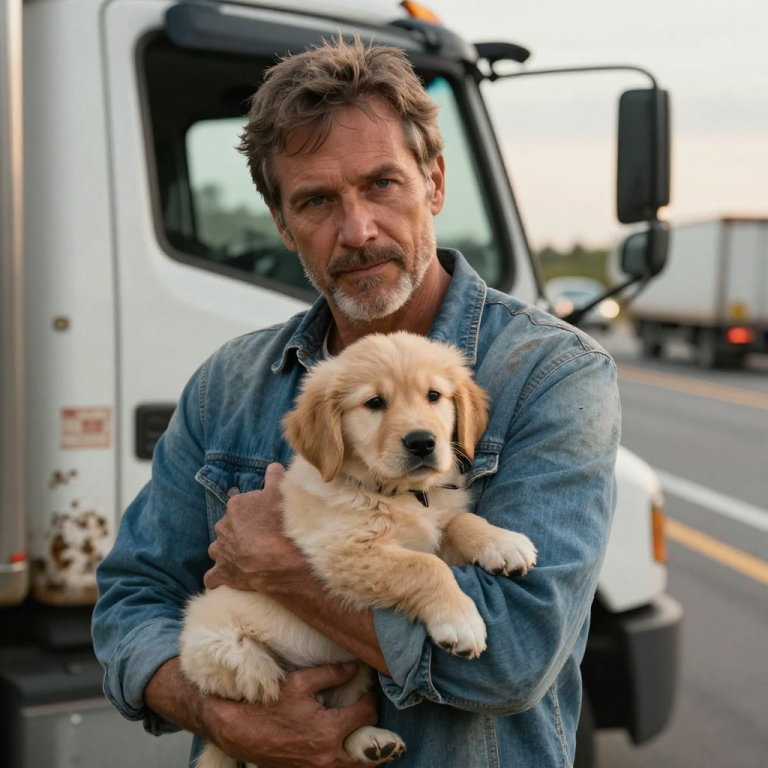
At the end of the leash was a dog. It looked like a mix, maybe some Lab and something smaller, with golden fur that was matted and dirty. It wasn’t fighting him. It was just terrified. It had planted its paws on the hot pavement, cowering, tail tucked so far between its legs it was practically touching its stomach. The dog was panting, eyes wide and rolling white with panic, looking for an escape that didn’t exist.
“I said move!” the man screamed, yanking the leash so hard the dog’s neck jerked sideways. The animal let out a high-pitched yelp, a sound of pure distress that made several people walking by pause. But they didn’t stop. They glanced, frowned, and then looked at their phones or hurried toward their cars. It’s the bystander effect. Everyone assumes someone else will handle it. Or maybe they just didn’t want to deal with a guy who looked like he was one bad day away from an aneurysm.
I took a sip of my coffee, feeling the bitterness coat my tongue. *Don’t get involved, Jack,* I told myself. *It’s not your circus.*
The man was shouting into his phone now, holding it between his shoulder and ear while he wrestled with the leash. “No, Linda, I can’t pick up the dry cleaning because this stupid animal is refusing to get in the car! Yes, I’m trying!”
The dog, sensing the aggression, tried to back away, its claws skittering on the blacktop. That was the wrong move.
The man hung up the phone and shoved it into his pocket. He turned his full attention to the dog. The frustration of his day, his job, his life—it all focused like a laser on the one living thing smaller than him. I saw the shift in his body language. His shoulders squared, his jaw clenched, and he took a step back to wind up.
My body reacted before my brain signed off on the decision. It’s muscle memory. You see a threat, you assess, you engage. The distance between us was twenty feet. I covered it in four long strides, moving silently. That’s the thing about real violence—it’s usually quiet until it isn’t.
“Shut up or I’ll give you something to cry about!” the man yelled, his voice cracking with exertion.
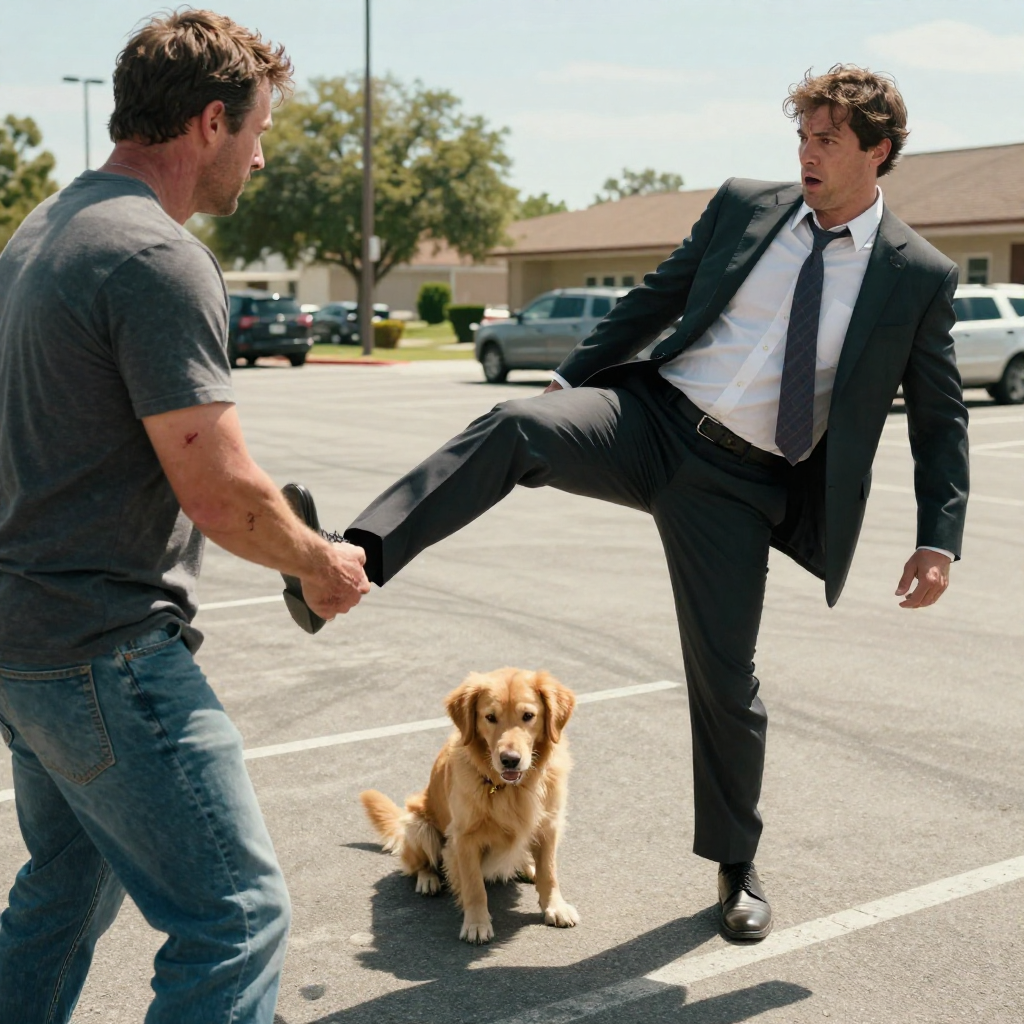
He raised his right leg, a heavy leather dress boot poised to deliver a kick right into the dog’s exposed ribcage. The dog squeezed its eyes shut, bracing for the impact.
The kick started. The leg swung forward with intent to harm.
But it never landed.
I didn’t tackle him. I didn’t shout. I just stepped into the space between his intention and his target. As his leg came forward, I dropped my center of gravity and caught his ankle mid-swing. My hand wrapped around the leather of his boot and the bone of his ankle like a vice. It wasn’t a casual grab; it was the kind of grip that crushes soft tissue if you aren’t careful.
The momentum of his kick, suddenly arrested, threw him off balance. He flailed, his arms windmilling as he tried to stay upright on his one planted foot. I held him there, suspended, his leg in the air, looking ridiculous and vulnerable.
“What the—?” He sputtered, looking down at me. Shock replaced the rage on his face for a split second.
I didn’t let go. I tightened my grip just enough to let him know that I could snap something if I wanted to. I looked up at him. I didn’t blink. I didn’t frown. I just gave him the look—the one they teach you when you’re learning how to de-escalate a situation by promising absolute destruction.
“Let go of me!” he shouted, trying to yank his leg back. It didn’t move an inch. “Who do you think you are? Let go!”
The crowd that had been ignoring him was watching now. A woman near the cart return stopped loading her groceries. A teenager on a bike skidded to a halt.
“You were about to kick a dog,” I said. My voice was low, barely above a whisper, but in the sudden silence of the immediate area, it carried perfectly. “A forty-pound animal that’s already scared of you.”
“It’s my dog!” he spat, his face turning a darker shade of crimson. “I’ll do what I want! Now get your hands off me before I call the cops!”
He tried to hop backward, struggling to free himself. The dog, sensing the change in power dynamics, had scrambled back to the end of the leash, watching me with cautious, wide eyes.
I slowly lowered his foot to the ground, but I didn’t step back. I stepped into his personal space. I’m not a giant man, but I carry myself in a way that takes up room. I could smell his stale cologne and the fear sweat starting to break out on his forehead.
“Try that again,” I whispered, leaning in close enough that only he could hear the edge in my voice. “Try that again and see what happens to you.”
He scoffed, trying to regain his composure in front of the audience. He adjusted his suit jacket, puffing out his chest. “You’re threatening me? Do you know who I am? I’m an attorney. I could have you arrested for assault. You touched me first!”
“I stopped you from committing a felony animal abuse charge in front of witnesses,” I corrected him calmly. “And if you think a badge scares me, you’re misreading the situation.”
He looked at me—really looked at me—for the first time. He looked at the scar running down my forearm, the way I stood with my weight balanced, the lack of adrenaline shaking in my hands. He saw something in my eyes that made his throat bob. It was the realization that he was dealing with a predator, not prey.
“You’re crazy,” he muttered, backing toward his car door. He yanked the leash again, but less violently this time. “Come on! Get in the car!”
The dog hesitated. It looked at the car, then it looked at me. It let out a small whine.
“I’m not done,” I said. I didn’t raise my voice, but the finality in it stopped him dead. “You’re not putting that dog in the car like that. Look at him. He’s dehydrated. He’s terrified.”
“This is none of your business!” he shrieked, his voice rising an octave. He was losing control of the narrative. He pointed a shaking finger at me. “You stay away from me!”
A heavy silence hung in the air. The woman at the cart return spoke up. “I saw it too,” she called out, her voice shaky but determined. “He was going to kick it. I saw him.”
“Me too,” the teenager said, pulling out his phone. “I got you on video, dude.”
The man looked around, realizing he was surrounded. The anonymity of the parking lot had evaporated. He was the villain now, and he knew it. But men like him, when cornered, don’t apologize. They double down.
He sneered at me. “You think you’re a hero? You’re just a thug. I’m leaving. And if you follow me, I’m calling 911.”
He opened the back door of his sedan and practically threw the dog inside. The animal scrambled onto the seat, desperate to be out of the line of fire. He slammed the door shut, the sound echoing like a gunshot.
I memorized his license plate number in a single glance. *KJT-409.* Silver BMW 5-series. There was a dent on the rear bumper.
He stormed to the driver’s side, got in, and gunned the engine. He peeled out of the parking spot, narrowly missing a shopping cart, and sped toward the exit. As he drove past me, he flipped me off through the window.
I stood there, watching the car disappear into traffic. My heart rate hadn’t gone above eighty. I took another sip of my coffee. It was cold now.
“Sir?” The woman from the cart return walked over. She looked concerned. “Are you okay? That guy was… intense.”
“I’m fine,” I said, turning to her. “Did you see which way he turned?”
“Right. Toward the interstate,” she said. Then she paused. “You held him like… like it was nothing. Are you a cop?”
I shook my head. “No, ma’am. Not anymore.”
I walked back to my truck, my mind racing. I knew that look in the dog’s eyes. I’d seen it in different places, in different faces, halfway across the world. It’s the look of a creature that has given up hope of rescue. And I knew that man. I didn’t know his name yet, but I knew his type. He wasn’t going to stop because a stranger scared him in a parking lot. He was just going to wait until he was behind closed doors, where no one could grab his ankle.
I unlocked my truck and climbed in. The interior was sweltering, but I didn’t turn the AC on immediately. I sat there, gripping the steering wheel, feeling the ghost of the vibration from when I caught his boot.
I couldn’t let it go. I told myself I wanted a quiet life. I told myself I was done with missions. But the mission finds you, whether you want it or not.
I pulled my phone out and dialed a number I hadn’t used in two years. It rang four times before a gruff voice answered.
“Jack? I thought you were dead or in Mexico.”
“I need a plate run, Marcus,” I said, staring at the empty spot where the silver BMW had been. “And I need to know where this guy lives before tonight.”
“Jack,” Marcus sighed, the sound of a weary man who knows trouble when he hears it. “What did you do?”
“Nothing yet,” I said, watching the heat rise off the asphalt. “But I’m about to give someone a reason to cry.”
CHAPTER II
Marcus called me at three in the morning. That’s the time of day when the world feels thin, like you could poke a finger through the fabric of reality and touch whatever cold, dark thing lies behind it. I was sitting at my kitchen table, staring at a lukewarm cup of black coffee, the license plate number—KJT-409—scrawled on a napkin like a curse.
“His name is Julian Thorne,” Marcus said, his voice gravelly from years of cheap cigars and even cheaper secrets. “He’s not just a lawyer, Jack. He’s a partner at Sterling & Vance. He’s got his hands in local politics, the kind of guy who gets invited to the mayor’s Christmas party and has the police chief’s cell phone on speed dial. He lives in a gated community out in Oak Ridge. The kind of place where the grass is exactly two inches high and everyone has a security system that costs more than my first house.”
“The dog?” I asked. My voice sounded like it was coming from someone else, someone colder.
“Registered as a purebred, though you said it looks like a mix. His name is ‘Rex’ on the papers. Thorne bought him six months ago. Look, Jack, I know that look in your voice. Let it go. The guy’s a shark. You touch him, and he’ll sue you into the next decade. He’s already filed a police report about the parking lot incident. He’s calling it ‘assault and attempted robbery.’ If you show up at his house, you’re walking into a cage.”
I thanked Marcus and hung up. I didn’t tell him that I’d spent the last four hours thinking about a dog I’d known ten years ago. A Belgian Malinois named Cooper. We were in a valley in the Kunar Province, taking fire from three sides. The extraction bird was coming in hot, and the orders were clear: personnel only. No equipment, no K9s if it risked the timeline. I’d looked into Cooper’s eyes as the ramp closed. I’d felt his paw against my chest as my handler buddy tried to drag him on, only to be shoved back by a superior officer. We left him. I can still hear the way he whined over the roar of the rotors. That’s my old wound. It doesn’t bleed anymore, but it aches every time the wind changes. It’s the reason I don’t sleep. It’s the reason I can’t look at a leash without feeling like a traitor.
I have a secret, too. One that isn’t on my military record. Since I got back, I’ve done this three times before. Three dogs, two cats, and one horse that was being starved in a dry lot. Each time, I’ve moved them to a sanctuary three states away. The police in my old town had a file on a ‘phantom’ who broke into properties and only took the animals. They never caught me, but they were getting close. If I get caught tonight, I’m not just a disgruntled vet; I’m a serial offender. I’ll lose the small apartment, the quiet life, and the last shred of dignity I have left.
I drove to Oak Ridge around 4:00 AM. The neighborhood was a sea of beige mansions and silent streets. It smelled of mulch and expensive fertilizer. I parked three blocks away, blending my black sedan into the shadows of a large oak tree. I wasn’t wearing my old gear—no tactical vest, no night vision. Just a dark hoodie, a pair of work gloves, and a set of heavy-duty bolt cutters tucked into a duffel bag.
Thorne’s house was a monstrosity of stone and glass. A high wrought-iron fence circled the perimeter. I spent twenty minutes watching the house from the tree line. No motion lights triggered. No patrol cars. I found a blind spot near the service entrance and went over the fence. It was a familiar motion, the muscle memory of a man who spent his twenties climbing over things he wasn’t supposed to.
I expected to find the dog inside the house, maybe in a mudroom. But as I rounded the corner of the detached four-car garage, the smell hit me. It wasn’t the smell of a home; it was the smell of neglect. Sour hay, old waste, and the metallic tang of fear. There, tucked under a lean-to behind the garage, was a small, wire-mesh kennel. It was far too small for a dog of that size. There was no bedding, just the cold concrete floor.
I saw a shape shift in the dark. A low, pathetic whimper vibrated in the air.
“Hey, buddy,” I whispered, dropping to one knee.
The dog didn’t bark. He was too broken for that. He dragged himself toward the wire, his tail giving a single, hesitant thump. I reached out a gloved hand, and he licked the fabric, his tongue dry. In the faint light of the moon, I saw the marks on his flanks. Not just the kick from today, but older scars. Some looked like cigarette burns. Others were long, thin welts. Julian Thorne wasn’t just a man who lost his temper; he was a man who enjoyed the power of the pain he inflicted.
I felt a heat in my chest that had nothing to do with the night air. It was a cold, focused rage. I took the bolt cutters from my bag. The snap of the padlock was loud in the silence of the suburb, a sharp *clack* that sounded like a gunshot to my ears. I swung the door open.
“Come on,” I said. “Let’s go.”
The dog hesitated. He looked at the open door, then at me, then back at the dark house. He was terrified of the freedom. I reached in, gently looping a slip-lead over his head. I felt his ribs—he was nothing but bone and matted fur. As I began to lead him out, the back porch lights of the main house suddenly flared to life, bathing the entire backyard in a blinding, artificial white glow.
“Who’s there?” a voice boomed. It wasn’t Thorne. It was younger, more aggressive.
I froze. I was thirty feet from the fence. I looked toward the house. The sliding glass doors were open, and three men stepped out onto the patio. They were dressed in expensive suits, holding crystal tumblers of amber liquid. Thorne was in the middle, his face flushed with drink. He was laughing, pointing a cigar toward the garage.
“I’m telling you, it’s the best security money can buy,” Thorne was saying to his guests. Then he saw me.
Our eyes locked across the manicured lawn. The silence that followed was absolute. For a second, time didn’t exist. There was just the man who owned the world and the man who lived in the shadows. This was the moment. The public collision. Thorne wasn’t alone. He had witnesses—rich, influential witnesses who would back his play.
“You!” Thorne screamed. He didn’t sound scared; he sounded delighted. He saw an opportunity. “He’s here! The lunatic from the parking lot! He’s trying to steal my property!”
One of the guests pulled out a phone, the camera light clicking on. “We’re recording you, buddy. Stay right there. The police are on their way.”
I had a choice. I could drop the lead, jump the fence, and disappear. I could save myself. If I stayed, I was a thief caught in the act. If I left, the dog would pay the price for my failure. Thorne would take his humiliation out on this animal until there was nothing left. I looked down at the dog. He had pressed his body against my leg, his head bowed, waiting for the blow he thought was coming.
“He’s hurt,” I said, my voice carrying across the lawn. It wasn’t a shout. It was a statement of fact. “Look at his ribs. Look at the burns. You’re all standing there with your drinks, watching a man torture an animal, and you’re worried about the law?”
“It’s a dog, you idiot!” Thorne stepped off the patio, walking toward me with the confidence of a man who knew he was protected by the system. “It’s my dog. I paid five thousand dollars for him. He’s my property, and you’re a trespasser. You’re going to prison for a long, long time.”
He was ten feet away now. The other two men followed, their phones raised like weapons. They were filming me, capturing my face, my clothes, my crime. This was the irreversible point. My identity was burned. My secret life was over. The ‘phantom’ was now just a man named Jack with a record and a very bleak future.
“I’m not leaving without him,” I said.
“Then you’re not leaving,” Thorne sneered. He reached out, trying to grab the lead from my hand. He was close enough that I could smell the expensive scotch on his breath.
I didn’t hit him. I didn’t have to. I simply stepped into his space, a move designed to unsettle, to remind him that despite his money and his friends, he was small. He flinched, tripping over his own feet and falling back into the dirt. His friends gasped. The camera caught it all—the ‘assault’ they would claim later.
“You’re pathetic,” I told him.
I turned my back on them. It was the most dangerous thing I could do, but I didn’t care. I picked up the dog—he was light, dangerously light—and I ran for the fence.
“Stop him!” Thorne yelled, his voice cracking with rage. “Someone stop him!”
I tossed the dog over the lower section of the gate. He landed softly in the mulch on the other side. I scrambled over behind him, the metal of the fence cold against my palms. Behind me, I heard the sirens. They were close. Oak Ridge police didn’t take long to respond to a call from a man like Julian Thorne.
I reached my car just as the first cruiser turned the corner two blocks away. I shoved the dog into the passenger seat and tore away from the curb. My heart was a hammer against my ribs. I looked in the rearview mirror. I saw the flashing blue and red lights reflecting off the windows of the mansions.
I had the dog. But I had lost everything else.
I drove through the backstreets, avoiding the main arteries where the cameras were. I knew I couldn’t go back to my apartment. They’d have my plates. They’d have my name by morning. Marcus would be caught in the blast radius if I wasn’t careful.
As I reached the outskirts of the city, the adrenaline began to fade, replaced by a crushing weight. I had committed a felony. I had been filmed by three wealthy men while doing it. There was no way to spin this. In the eyes of the law, I was the villain. I was the unstable veteran who broke into a prominent citizen’s home to steal his property.
I pulled over into a darkened gas station parking lot to catch my breath. The dog was shivering in the seat next to me. He looked up, his brown eyes reflecting the dim glow of the dashboard. He didn’t know about the law. He didn’t know about my career or my pension or the prison cell that was likely waiting for me. He just knew that for the first time in six months, he wasn’t being kicked.
I reached over and touched his head. His fur was matted with filth, but he leaned into my touch.
“I’m sorry,” I whispered. “I’m sorry it took me this long.”
My phone buzzed in the cup holder. It was a text from an unknown number.
*The video is already online, Jack. Thorne’s people posted it to the local news ‘crime watch’ page. They’re calling you ‘The Oak Ridge Intruder.’ You need to get out of the state. Now.*
It was Marcus. He was trying to help, but we both knew it was too late. The event was public. The damage was irreversible. I had chosen a side, and in doing so, I had declared war on a man who owned the battlefield.
I looked at the dog. He had fallen asleep, his breathing ragged and shallow. He was safe for tonight. But the sun would be up in three hours, and when it rose, I would be a hunted man.
I thought about the moral dilemma I had faced in that backyard. Choosing the ‘right’ thing—saving a life—had caused a personal loss that I couldn’t yet calculate. Choosing the ‘wrong’ thing—leaving him there—would have been a different kind of death. A death of the soul.
I put the car in gear and headed toward the highway. I had one more stop to make before I disappeared. There was a vet I knew, a woman who didn’t ask questions if you paid in cash. She was my only hope of getting this dog the help he needed before I had to leave him behind.
Because that was the final realization. I couldn’t keep him. I was a fugitive now. I couldn’t provide a home for a dog when I didn’t have one myself. I had saved him, only to have to give him away.
The irony wasn’t lost on me. I had spent my life following orders, protecting a system that was now coming to crush me. And all for a dog that didn’t even have a name he could trust.
I drove into the night, the weight of the secret I’d kept—the ‘phantom’—finally coming to light. It wasn’t just about the dogs anymore. It was about the fact that I had never truly come home from the war. I was still in that valley in Kunar, trying to fix a mistake that could never be fixed.
But as I looked at the sleeping creature beside me, I knew I would do it again. Even with the sirens, even with the video, even with the ruin of my life. Because some things are worth the fall.
I reached the vet’s office just as the sky began to turn a bruised purple. I carried the dog to the door and knocked. I didn’t know what I would say. I didn’t know where I would go next. All I knew was that the line had been crossed, and there was no going back. The world was waiting for me, and it wasn’t going to be kind.
CHAPTER III
The basement of the industrial laundry smelled of bleach and ancient, damp concrete. It was the kind of place that didn’t exist on any modern map, a relic of a city that had moved on to glass and steel. I sat in the corner, my back against a rusted boiler, watching Rex. The dog was breathing in shallow, jagged rhythms. Every time a pipe hissed or a rat scurried in the rafters, his ears would twitch, but he didn’t have the strength to lift his head. I had spent fifteen years in the shadows of the world, moving through jungles and deserts where the air tasted like copper and cordite, yet I had never felt as hunted as I did in that basement. My hands, usually steady enough to thread a needle in a gale, were vibrating. It wasn’t fear for myself. It was the weight of the life resting on the floor beside me. I had broken the law. I had crossed a line that most people only see in movies, and I had done it for a creature that the world viewed as property.
I pulled out the burner phone Marcus had provided. The screen was a smear of blue light in the darkness. The video was everywhere. Thorne’s legal team had been surgical. They hadn’t just released the footage; they had framed it as a home invasion by a ‘disturbed veteran.’ The headline on the major news sites read: ‘Renowned Attorney Julian Thorne Targeted in Violent Estate Raid.’ The footage was grainy, night-vision green. It showed me—a shadow in a tactical jacket—hauling a resisting animal through a broken gate. It looked like a kidnapping. It looked like a crime. I watched it three times, my jaw tight. Thorne was a master of narratives. He knew that the first story told is the one that sticks. In the video, he sounded like a victim, his voice pitched in a perfect octave of practiced distress. He was calling for his dog. He was playing the part of the grieving owner. I looked down at Rex, at the raw, hairless patches on his flanks where the chemical burns had never healed, and I felt a cold, sharp anger crystallize in my chest.
‘They don’t see you, Rex,’ I whispered. The dog’s tail gave a singular, weak thump against the concrete. ‘They only see what he wants them to see.’ I scrolled through the comments. Thousands of them. Calls for my arrest. Demands for ‘justice’ for Thorne. People were talking about the ‘sanctity of the home.’ It was a landslide of public condemnation. I felt the walls closing in. Marcus had told me the police were checking every veteran-owned property within a fifty-mile radius. My face wasn’t in the video, but my movement was. Anyone with military training could see the way I pivoted, the way I checked my corners. I was a ghost, but ghosts leave footprints in the snow if you look hard enough. I realized then that I couldn’t keep running. If I stayed in the shadows, Rex would die in a basement, and Thorne would go back to his marbled halls and his expensive wine, finding a new victim to break. The noise of the city above us felt like a closing fist.
Then, the narrative began to shift. It started with a single post from a veterinary technician in Seattle. She had stabilized the frame at the three-minute mark. She pointed out the way the dog’s ribs protruded, not from leanness, but from atrophy. Then a professional trainer noticed the way Rex cringed when Thorne approached him in the background of the shot—not a reaction to a stranger, but a deeply ingrained fear of his own master. By the four-hour mark, the hashtag #WhatIsThorneHiding began to flicker across social media. People were pausing the video, zooming in on the collar, on the heavy, industrial chain I had bolt-cut. The ‘counter-narrative’ wasn’t a roar yet; it was a whisper, a collection of people who knew what true neglect looked like. I watched as a digital crowd began to do the work I couldn’t do from a basement. They were dissecting Thorne’s perfection. They were finding the cracks. And I knew, with the clarity of a man staring down a sniper scope, that I had to give them the rest of the puzzle. I couldn’t be a ghost anymore. I had to be a witness.
I contacted Marcus one last time. I didn’t ask for a getaway car or a fake passport. I asked for a meeting. Not with a lawyer, and not with the press. I told him to send a message to Thorne’s personal line—the one I’d lifted from his home office. I told him to meet me at the old shipyard at Pier 19. It was neutral ground, open and exposed, a place where a man like Thorne would feel powerful because he could bring his security, and where a man like me would feel safe because I could see him coming from a mile away. I didn’t tell Marcus that I was planning to surrender. I didn’t tell him that I was betting my life on the conscience of a stranger. I just loaded Rex into the back of a stolen, nondescript van and drove toward the water. The city lights were a blur of neon and rain, a cage of light that I was finally stepping out of.
When I arrived at the pier, the wind was coming off the Atlantic, sharp and smelling of salt and decay. Thorne was already there. He wasn’t alone. Two large men in black overcoats stood ten paces behind him, their hands folded in front of them in that universal posture of hired muscle. Thorne looked immaculate, even in the damp night air. He wore a cashmere coat that probably cost more than my first three cars combined. He looked at me with a mixture of amusement and pure, concentrated loathing. There were no cameras here, no dinner guests to impress. This was the man behind the mask. He looked at the van, then at me. ‘You’re a difficult man to find, Jack,’ he said, his voice smooth as oil. ‘But you’re an easy man to predict. You think you’re a hero. You think this is a movie where the guy with the heart wins. But in the real world, the guy with the deed to the property wins.’
I stood by the van door, my hand resting on the handle. ‘He’s not property, Julian,’ I said. My voice was low, devoid of the heat I felt inside. ‘He’s a living thing you tried to break because you’re hollow inside. You can have the van. You can have the dog back. But you’ll have to take him in front of the people watching.’ I gestured toward the perimeter. Out of the darkness, three black SUVs pulled onto the pier, their headlights cutting through the fog like searchlights. Thorne didn’t flinch. He smiled. ‘The police? You think they’re here for me? I called them the moment Marcus sent the text. You’re a felon in possession of stolen property, Jack. I’m the victim of a deranged vigilante. Do you really think they care about a few scars on a mutt?’ He stepped closer, his eyes gleaming with a sick kind of triumph. ‘I’m going to take that dog back, and I’m going to make sure he spends his last days remembering why he should have stayed in that crate.’
The SUVs screeched to a halt, forming a semicircle around us. Men in tactical gear emerged, but they didn’t move toward me. They stood by their doors, waiting. A woman stepped out from the lead vehicle. She wasn’t wearing a uniform. She was wearing a professional suit, her face set in a mask of grim determination. It was Elena Vance, one of the guests from Thorne’s dinner party—the one who had looked at Rex with such horror when I broke in. Beside her was a man I recognized from the morning news: District Attorney Miller. Thorne’s smile flickered. It didn’t disappear, but it wavered, like a candle in a draft. ‘Elena?’ he said, his voice losing its oily sheen. ‘What is this? This man is a criminal. He’s the one who ruined the evening.’
Elena Vance didn’t look at Thorne. She looked at me, then at the van where Rex was hiding. She stepped forward into the light of the headlamps. ‘I’ve known Julian for ten years,’ she said, her voice clear and carrying over the sound of the waves. ‘I’ve seen the way he handles cases. I’ve seen the way he handles people. I always told myself it was just the price of doing business at this level. That he was just… rigorous.’ She turned to face Thorne, and the disgust on her face was more powerful than any weapon I’d ever carried. ‘But that night, seeing what you did to that animal… it reminded me of the files I found in the firm’s archives three years ago. The ones about the construction kickbacks. The ones about the witnesses who suddenly stopped talking.’ She held up a small, silver flash drive. ‘I didn’t have the courage to use this until I saw a man risk everything for a dog that didn’t even belong to him.’
Thorne’s face went white. The composure he had spent a lifetime building disintegrated in seconds. He looked at the District Attorney, his mouth opening and closing like a fish out of water. ‘This is hearsay,’ he hissed. ‘That drive is stolen property. Elena, you’re throwing your career away for a thief!’ He turned to the officers, his voice rising to a panicked shout. ‘Arrest him! Arrest them both!’ But the officers didn’t move. They looked at the District Attorney, who simply nodded. The power in that moment shifted so violently it was almost physical. Thorne, the man who owned the city, was suddenly just a small, angry man standing in the cold. The institutional weight he had used as a shield was now a crushing burden. Miller stepped forward, his eyes locked on Thorne. ‘Julian Thorne, we have a warrant for your arrest on charges of racketeering, witness tampering, and felony animal cruelty. Hands where I can see them.’
I felt the air leave my lungs. It was over. The ‘phantom’ rescuer was no longer a shadow; I was standing in the brightest light imaginable. One of the officers approached me, his movements slow and non-threatening. ‘Sir, I need you to step away from the vehicle,’ he said. I complied, raising my hands. As they moved in to cuff me, I looked back at the van. Elena Vance was already at the rear door, sliding it open. She didn’t reach for Rex; she just sat on the bumper and spoke to him in a low, soothing voice. I saw the dog’s head lift. For the first time since I’d found him, Rex didn’t look like he was waiting for a blow. He looked like he was waiting for a friend. The handcuffs clicked shut around my wrists, the cold steel a strange comfort. I had lost my freedom, but Thorne had lost his soul, and for the first time in a long time, the world felt like it was beginning to tilt back toward the light.
As they led me toward the patrol car, Thorne was being pushed against the hood of his own expensive sedan. He was screaming about lawsuits, about his connections, about how he would burn the city down. But no one was listening. The silence of the officers was the loudest thing on the pier. I sat in the back of the cruiser, the smell of plastic and old coffee filling the cabin. I watched through the window as they loaded Rex into an animal control vehicle—not a cage, but a padded transport with a technician who held his paw the whole way. I knew the road ahead for me was long. I was still a man who had broken into a private estate. I was still a man with a past that didn’t hold up well under scrutiny. But as the car pulled away, leaving the dark water of the shipyard behind, I felt a lightness I couldn’t explain. I had done what I set out to do. The truth was out, and Rex was safe. The rest was just the price of admission.
CHAPTER IV
The silence in the cell was a different kind of deep than the ocean’s abyss. In the Navy, the quiet was a choice, a discipline. Here, it was imposed, heavy, expectant. I wasn’t alone, not really. Every breath felt amplified, every clank of the distant plumbing a hammer blow. The media circus outside was a dull roar I could almost taste—the ‘Phantom SEAL’ versus the ‘Devil’s Advocate.’ They loved a good fight, even if it was my life on the line.
My lawyer, Ms. Davies, visited twice a day. Young, sharp, public defender material. She reminded me too much of my late daughter, only hardened, calloused by the system. “Jack,” she’d say, her voice tight, “the DA is pushing for the maximum. Breaking and entering, aggravated animal cruelty… resisting arrest. It’s a mess.”
I didn’t tell her the half of it. Couldn’t. The things I’d seen in Thorne’s basement, the images that flickered behind my eyes when I closed them – those were mine to carry. Rex’s whimpers echoed in my head.
The first consequence was Thorne’s empire crumbling. The news ran endless loops of Elena Vance’s flash drive evidence. Racketeering, bribery, witness intimidation – the whole rotten structure exposed. His law firm dissolved practically overnight. Clients scattered like rats from a sinking ship. Elena, I heard through Davies, had gone silent, vanished back into her own world, the act of betrayal seemingly consuming her. I wondered if she regretted it, if the ‘right’ thing felt as hollow to her as it did to me.
Then came the hate mail. Thick envelopes stuffed with threats, curses, accusations. They called me a vigilante, a terrorist, a disgrace to the uniform. Some were typed, mass-produced; others were scrawled in trembling hands, fueled by rage. I didn’t read them. Just handed them to Davies, who added them to the growing pile of evidence for… something. I wasn’t sure what anymore.
My phone call never came. I had to speak with Marcus through Davies. I learned that Rex was still alive, under veterinary care but stable. It was all Marcus could say.
The trial became a spectacle. Every news outlet covered it, dissecting every angle. Davies fought hard, painting me as a flawed hero, a man driven to extremes by compassion. The prosecution, led by a DA Miller, portrayed me as a dangerous fanatic, a man who believed he was above the law. They showed the security footage of the break-in, Thorne’s terrified face. They paraded ‘expert’ witnesses who testified about the psychological damage caused by vigilante actions. Every day was a new round of accusations and defenses. The crowd outside the courthouse was a volatile mix of supporters and detractors, their chants a constant reminder of the stakes.
Davies leaned forward, her voice low. “Jack, they’re offering a deal. Five years, plead guilty to breaking and entering and animal endangerment. No resisting arrest. You’ll be out in three with good behavior.”
Three years. A lifetime. I thought of the ocean, of the sun on my face, of the taste of salt in the air. Gone. “And if I don’t take it?”
“They’ll go for the maximum. Fifteen, maybe twenty. They want to make an example of you.”
I looked at her. “What do you think I should do?”
She didn’t flinch. “I can’t tell you that, Jack. It’s your life.”
I closed my eyes. Three years. Fifteen. What difference did it make? The world outside these walls felt alien, tainted. I was already living in a cage.
I spent days in this limbo. Sleep offered no escape. I kept replaying Thorne’s face, the glint of his eyes as he hurt Rex. Rex’s fear was now my own. I was drowning in my own sense of guilt.
“I’ll take the deal,” I told Davies when she returned. Her expression didn’t change. “I figured you would.”
The sentencing was a formality. I stood before the judge, a figure of cold authority, and listened to the recitation of my crimes. I didn’t speak. I didn’t look at the reporters, at the gawkers in the gallery. I just stared straight ahead, at a point somewhere beyond the walls of the courtroom.
Five years. It was done.
Days blurred into weeks, weeks into months. Prison was a different kind of war, a constant struggle for survival. The guards were indifferent, the inmates predatory. I kept to myself, exercising, reading, trying to find some semblance of order in the chaos. Sleep was scarce, haunted by nightmares.
One day, Davies came to visit, her face unreadable. “I have news about Rex,” she said, her voice carefully neutral. “He’s been adopted.”
A wave of relief washed over me, so intense it almost brought me to my knees. “Who?”
“Remember Marcus?” I nodded. “He took him. He’s got a place upstate, a farm. Says Rex is doing well, running around, chasing squirrels.”
Marcus. Of course. The only man I trusted to care for him the way he deserved. I let myself imagine it: Rex, free, loved, finally safe. It was enough.
Then Davies cleared her throat. “There’s something else. A letter.”
She handed me a thin envelope. My name was written on it in elegant script. Elena Vance.
I hesitated, then opened it. The letter was short, concise, like her. She wrote about the aftermath, the ostracism, the shame. She’d lost everything – her friends, her status, her sense of self. But she also wrote about a strange sense of liberation. “I saw what he was,” she wrote, “and I couldn’t unsee it. Thank you for showing me.”
She ended with a single sentence: “I’m starting over.”
I folded the letter, my heart aching for her. We were both paying the price for doing what we thought was right.
Then, one day, my isolation was broken. A new inmate arrived on my block. Young, scared, clearly out of his depth. He was assigned to the bunk next to mine.
“What you in for?” he asked, his voice barely a whisper.
I looked at him. “Animal cruelty,” I said. “And breaking and entering.”
He looked at me with a mixture of fear and awe. “You’re the Phantom SEAL, aren’t you?”
I didn’t answer. Just turned away, back to my book. But I could feel his eyes on me, the unspoken question hanging in the air.
And then a NEW EVENT happened. A riot broke out in the prison yard. I didn’t want any part of it. Tried to stay in my cell. But the violence spread like wildfire, fueled by anger and despair. Inmates were fighting, screaming, destroying everything in sight. The guards were overwhelmed, unable to contain the chaos.
I saw the young inmate from my block being cornered by a group of older, more experienced cons. They were taunting him, threatening him. He looked terrified, helpless.
I hesitated. I didn’t want to get involved. I’d done my time, paid my dues. I just wanted to survive.
But then I thought of Rex. Of the helpless fear in his eyes when Thorne had hurt him. And I knew I couldn’t stand by and do nothing.
I stepped out of my cell. The riot was still in full swing. Shouting faces, desperate eyes, all around me. I knew what I had to do.
I pushed my way through the crowd, towards the young inmate. The cons saw me coming. They knew who I was. They hesitated.
“Leave him alone,” I said, my voice low and steady.
They laughed. “What are you going to do about it, old man?”
I didn’t answer. I just looked at them, my eyes cold, hard, unforgiving. They saw something in my gaze that made them step back. Fear, maybe. Or respect. Or maybe just the knowledge that I was willing to die.
They backed down, grudgingly. “Not worth it,” one of them muttered.
They left the young inmate alone. He looked at me, his eyes filled with gratitude.
“Thanks,” he whispered.
I nodded. “Stay out of trouble,” I said. “And keep your head down.”
I walked away, back to my cell. The riot continued, but I didn’t care. I’d done what I had to do. I’d protected someone who couldn’t protect himself. I’d kept a promise, to myself and to Rex.
Back in my cell, I couldn’t sleep. The noise of the riot still echoed in my head. But there was something else, too. A strange sense of peace. I wasn’t a hero. I was just a man who had done what he thought was right.
The public consequences of Thorne’s actions and my own reverberated long after the trial. Laws were proposed to strengthen animal protection measures. Discussions about the limits of vigilantism raged on television and online. The media spotlight eventually shifted, but the questions remained.
My personal cost was clear: Years of my life gone, the stigma of my crimes. But I had also gained something. A sense of purpose. A knowledge that even in the darkest of places, it was possible to make a difference.
The trial of Julian Thorne and Jack Harper did not end the story, but started it again from another point of view.
Even in prison, I wasn’t done yet. I had to find peace with who I was. If I can’t do good, I can still try to be better.
CHAPTER V
The clang of the metal door was a familiar song now, a daily rhythm in this new, unwelcome chapter of my life. I wasn’t naive. I knew actions had consequences. Rescuing Rex came with a price, and this… this was it. The orange jumpsuit, the bland food, the constant surveillance – it was all part of the deal I’d unknowingly made. But I wasn’t broken. Not yet.
My first few weeks were a blur of observation. Prison wasn’t a movie. There were no dramatic brawls in the yard, no menacing figures lurking in the shadows (at least, not openly). It was a world of its own, a society built on unspoken rules and power dynamics I was only beginning to understand. Most of the inmates kept to themselves, their faces etched with a mixture of resignation and bitterness. The guards were a mix of indifferent and outright cruel, their power amplified by the confined space.
I found myself drawn to the prison library. It was a small, dusty room, but it offered a sanctuary of sorts. Books became my escape, my connection to the world outside these walls. I devoured everything I could get my hands on – history, philosophy, even trashy thrillers. Anything to keep my mind occupied, to prevent the darkness from creeping in.
One afternoon, while browsing the shelves, I noticed a young man sitting alone at a table. He looked lost, his eyes filled with a fear I knew all too well. His name was Daniel, and he was barely out of his teens. He’d been caught up in a drug deal gone wrong and was now facing a lengthy sentence. He reminded me of myself, years ago, adrift and searching for something to hold onto.
That’s when I knew I couldn’t just sit idly by, counting down the days until my release. I had to do something. Prison was a place where hope went to die, but I refused to let it extinguish completely. I started small, offering Daniel help with his reading, sharing stories from my time in the Navy. Slowly, hesitantly, he began to open up. He told me about his dreams of becoming a musician, about his family, about the mistakes he’d made. And I listened, offering him a non-judgmental ear and a glimmer of hope in the darkness.
The letter from Elena Vance was a surprise. It arrived weeks after the trial, a simple white envelope with my name scrawled across the front. I recognized her handwriting instantly. Inside, she thanked me for what I’d done, for exposing Thorne and his cruelty. She wrote about the outpouring of support for animal rights, about the changes that were being made to protect vulnerable creatures. And she mentioned Rex, now living in a loving home, thriving under the care of a dedicated family. Reading those words, I felt a flicker of something I hadn’t felt in a long time: a sense of purpose. My actions, however flawed, had made a difference.
That didn’t erase the reality of my situation, the fact that I was still behind bars. But it gave me the strength to face each day, to continue helping those around me. I started a small reading group in the library, sharing books and discussing ideas with other inmates. I offered advice to those struggling with addiction, drawing on my own experiences with loss and trauma. And I became a mentor to Daniel, helping him navigate the complexities of prison life and encouraging him to pursue his musical dreams.
I knew I couldn’t save everyone. Prison was a breeding ground for despair, and some inmates were simply too far gone. But I could offer a lifeline, a glimmer of hope in a hopeless place. And that, I realized, was enough.
My time in prison wasn’t easy. There were days when I felt overwhelmed by the darkness, when the weight of my past threatened to crush me. But I refused to succumb. I held onto the memory of Rex, the image of Elena’s grateful smile, the knowledge that I had made a difference. And I found strength in the connections I forged with the other inmates, the shared humanity that transcended our circumstances.
One morning, I was called to the warden’s office. I assumed it was another disciplinary hearing, another bureaucratic hurdle. But when I arrived, I was greeted by a different scene. My lawyer, Ms. Davies, was waiting for me, a weary but triumphant look on her face. She explained that the DA, Miller, had reviewed my case and, after considering the overwhelming evidence of Thorne’s corruption, had agreed to reduce my sentence. I was going home.
Stepping out of the prison gates was like stepping into a different world. The sun felt brighter, the air cleaner, the sounds of the city sharper. I took a deep breath, savoring the taste of freedom. Ms. Davies drove me to a small apartment she’d helped me find, a simple one-bedroom place with a view of the park. It wasn’t much, but it was mine.
I spent the next few weeks adjusting to life on the outside. I reconnected with Marcus, who’d been a constant source of support during my imprisonment. We spent hours talking, catching up on lost time, reminiscing about the old days. He told me about his own struggles, about the challenges he faced in his work, about the importance of staying true to his values. And I listened, grateful for his friendship and his unwavering loyalty.
I didn’t try to recapture my old life. I knew that was impossible. Too much had changed. But I didn’t want to erase the past either. I wanted to learn from it, to use my experiences to make a difference in the world.
I started volunteering at a local animal shelter, working with abused and neglected animals. It was hard work, emotionally draining, but it was also incredibly rewarding. I found solace in the company of these vulnerable creatures, a connection that transcended words. And I knew that I was making a difference, providing them with the love and care they deserved.
One day, while walking through the shelter, I saw a familiar face. It was Elena Vance. She was volunteering as well, her hands covered in mud as she cleaned out a kennel. We exchanged a smile, a silent acknowledgment of the shared experience that had brought us together.
We talked for hours that day, about Rex, about Thorne, about the changes that were happening in the world. She told me about her new job at a non-profit organization dedicated to animal welfare, about her determination to fight for justice. And I told her about my experiences in prison, about the lessons I’d learned, about my commitment to helping others.
We didn’t talk about the future, about whether we would see each other again. But there was an unspoken understanding between us, a connection forged in the crucible of shared adversity. We had both been changed by what had happened, scarred but not broken. And we were both determined to move forward, to create a better world for those who couldn’t speak for themselves.
Time passed. The news cycle moved on. Julian Thorne became a footnote, a cautionary tale. Elena Vance continued her work, a tireless advocate for animal rights. Marcus remained my steadfast friend, a constant reminder of the importance of loyalty and integrity.
As for me, I found my purpose in helping others. I continued to volunteer at the animal shelter, providing care and companionship to abused and neglected animals. I also started a support group for former inmates, helping them navigate the challenges of re-entering society. And I spoke out against injustice whenever I saw it, using my voice to advocate for those who were marginalized and forgotten.
I never forgot my time in prison. It was a dark chapter in my life, but it was also a transformative one. I learned about resilience, about the power of hope, about the importance of human connection. And I realized that even in the darkest of places, there is always light to be found.
One evening, I received a letter from Daniel. He was out of prison now, living in a small town, working as a musician. He thanked me for believing in him, for giving him the strength to pursue his dreams. And he told me that he was dedicating his first album to me, the man who had shown him that even in the deepest darkness, there is always hope.
Reading those words, I felt a profound sense of peace. I had made mistakes in my life, choices that had led me down a difficult path. But I had also done good, touched lives, made a difference. And that, I knew, was all that mattered.
I learned to live with the echoes of the past, the memories of violence and loss that still haunted my dreams. I learned to forgive myself, to accept my imperfections, to embrace the present moment. And I learned that true strength lies not in physical power, but in the ability to connect with others, to offer compassion, to find meaning in the face of adversity.
Sometimes, late at night, I would think about Rex, running free in a field, his tail wagging, his eyes filled with joy. And I would smile, knowing that I had played a small part in his happiness. That was enough.
The world wasn’t perfect. Injustice still existed. Cruelty still thrived. But I refused to be discouraged. I would continue to fight for what I believed in, to advocate for those who were vulnerable, to make a difference in the world, one small act at a time.
My journey had been long and arduous, filled with pain and loss. But it had also been filled with love, compassion, and hope. And I had emerged from the darkness stronger, wiser, and more determined than ever.
I sat on my small balcony, looking out at the city lights twinkling in the distance. The air was cool and crisp, carrying the scent of rain. I closed my eyes, took a deep breath, and smiled.
The scars never truly disappear; they just fade into a new landscape.
END.