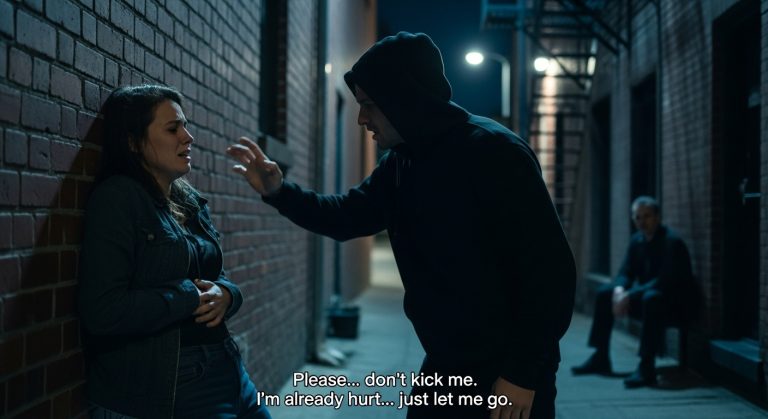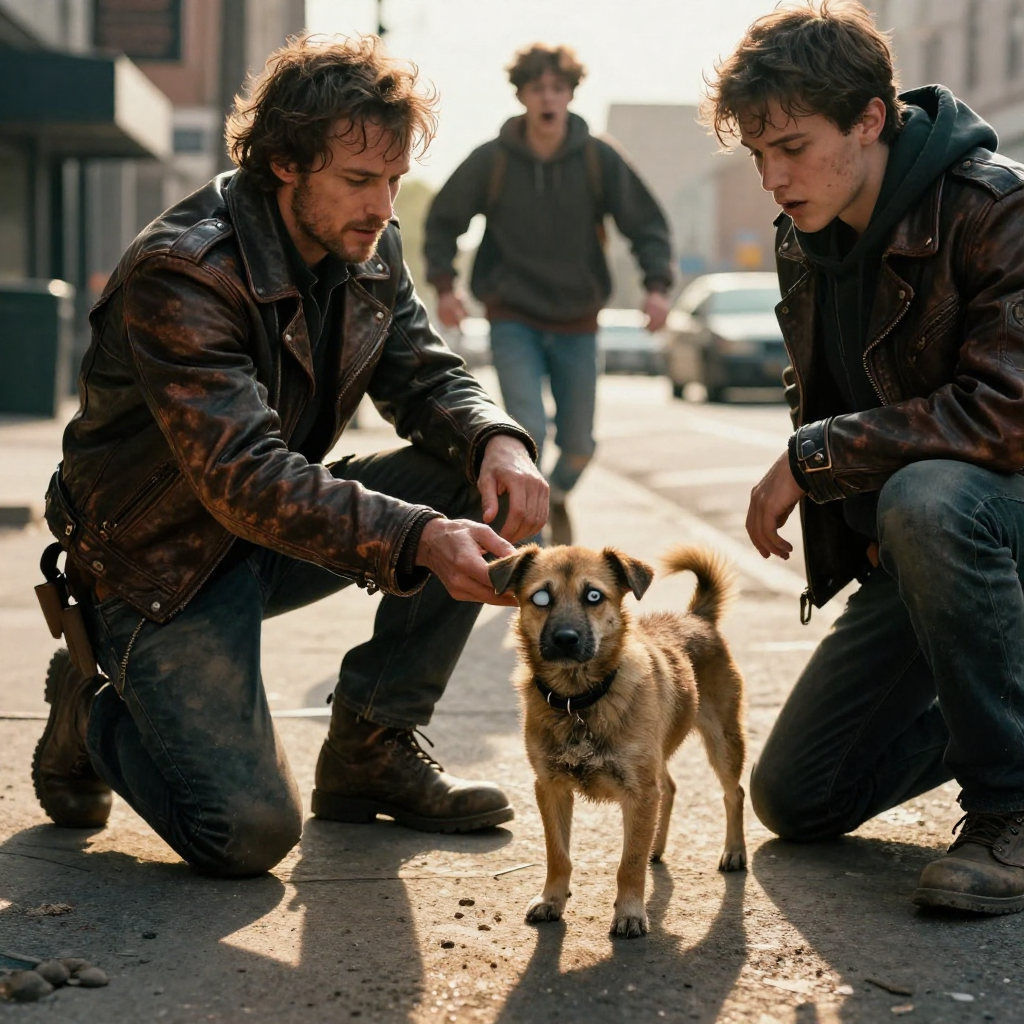
HE LAUGHED WHILE KICKING DIRT INTO A BLIND DOG’S EYES FOR A VIDEO, BUT HE DIDN’T NOTICE THE BIKER WATCHING BEHIND HIM UNTIL IT WAS TOO LATE.
The engine of my cruiser was a steady, rhythmic thumping beneath me, a mechanical heartbeat that usually calmed me down after a long shift at the shop. But today, as I sat idling at the intersection of Cedar and 4th, that calm was shattering, replaced by a cold, sharp spike of adrenaline that I hadn’t felt in years. It wasn’t the traffic. It wasn’t the heat rising off the Florida asphalt in shimmering, suffocating waves. It was what was happening on the sidewalk, not twenty feet from my front tire.
There was a kid—couldn’t have been more than seventeen—wearing expensive sneakers and a designer hoodie that looked ridiculous in the humidity. He was holding his phone out, arm extended, the camera lens pointed downward. He was laughing. It was that ugly, performative laughter, the kind designed for an audience that wasn’t there yet, the kind that begs for validation from strangers on the internet. And at his feet, huddled against the brick wall of a derelict convenience store, was a dog.
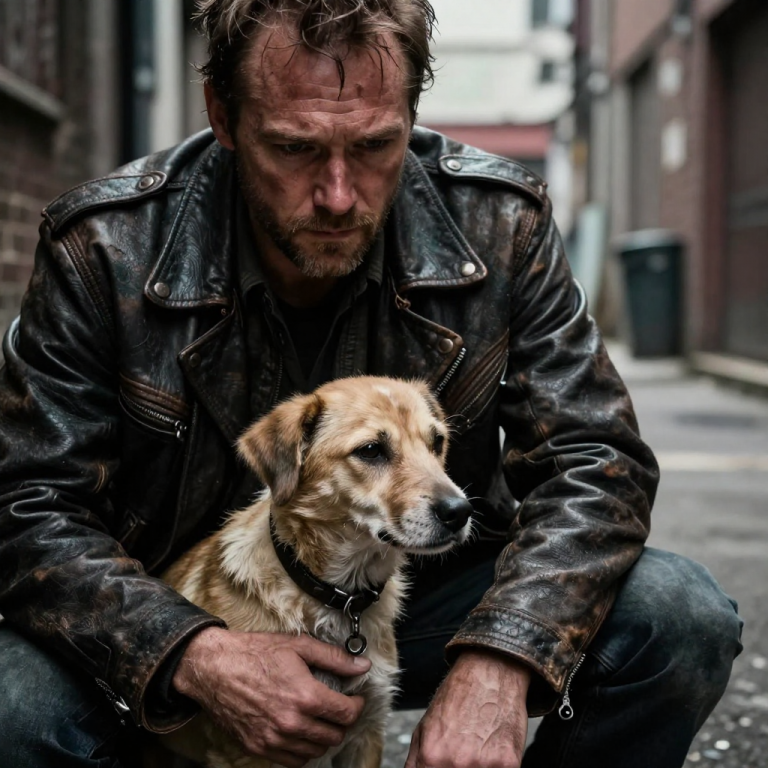
It was a small thing, maybe a terrier mix, its fur matted into thick, gray ropes of filth. It was shaking so hard I could see the tremors from where I sat. But what made my hands tighten around the handlebars until the leather of my gloves groaned was the animal’s face. It was looking up, but it wasn’t seeing anything. Its eyes were milky white, clouded over with cataracts or infection. It was blind. It was completely helpless.
And the kid was kicking dirt into its face.
He wasn’t kicking the dog directly—not yet—but he was scraping the sole of his pristine sneaker against the dry, loose earth of the planter box, sending showers of grit and dust directly into the animal’s open, unseeing eyes. The dog whimpered, a high, thin sound that cut right through the rumble of my exhaust. It tried to bury its head in its paws, sneezing, confused, terrifyingly alone in the dark. The kid laughed harder, panning the camera to get a better angle of the misery, narrating something I couldn’t hear but could easily imagine. “Look at this rat,” he probably said. “Look how stupid it is.”
The light turned green. The cars ahead of me started to move. The SUV behind me honked, a short, impatient blast.
I didn’t move.
I killed the engine. The sudden silence was heavy, broken only by the kid’s voice and the distant hum of traffic. I kicked the stand down. The metal clack against the concrete was sharp, distinct. I swung my leg over the seat, my boots hitting the pavement with a heavy thud. I’m not a small man. Years of welding and lifting heavy steel beams have given me a build that people tend to give a wide berth. I was wearing my riding leathers, my helmet still on, the visor tinted black. I was a faceless, voiceless wall of consequence walking toward him.
The kid didn’t notice me at first. He was too busy checking his screen, maybe making sure the lighting was right for his story. He kicked more dirt, harder this time. A clump of soil hit the dog’s nose, and the poor creature yelped, backing up until it hit the brick wall, nowhere left to go.
“That’s it, cry for the camera,” the kid sneered, stepping closer.
I was five feet away when his peripheral vision finally registered the shadow looming over him. He spun around, the phone still held high, a reflex of his generation to document everything. But when he saw me, the phone lowered. Slowly.
I didn’t say a word. I didn’t have to. I just stood there. I let him take it in. The scuffed black boots. The dust on my jeans. The armored jacket. The black helmet staring down at him like the eye of judgment itself. I could hear his breathing hitch. He looked at the traffic, then back at me, realizing that no one was going to stop their car to help him. He was alone with the reality of what he was doing, and the person who had caught him doing it.
“I… I was just…” he stammered. His voice cracked. The arrogance that had been so loud just ten seconds ago evaporated, leaving behind a scared child who realized he had made a very grown-up mistake.
I took one step forward. Just one.
He flinched so hard he almost dropped the phone. He scrambled backward, his expensive sneakers slipping on the very dirt he had been using as a weapon. “I’m leaving! I’m leaving, okay? My bad!”
He didn’t walk away; he ran. He turned and sprinted down the sidewalk, glancing back over his shoulder to see if the monster in the helmet was chasing him. I watched him go until he turned the corner, disappearing into the safety of the busy avenue. He wouldn’t be posting that video. He wouldn’t be laughing for a while.
Only then did I exhale. My heart was hammering, not from fear, but from the effort it took not to do something that would land me in a cell. I turned back to the wall. The dog was trembling, pressing itself so hard against the bricks it looked like it was trying to merge with them. It could smell me. It could hear the heavy tread of my boots. It didn’t know I was different from the boy. To this dog, I was just another large, terrifying presence in a world that had been nothing but cruel.
I slowly unbuckled my helmet and pulled it off, setting it on the ground. I wanted the dog to feel the air move, to hear a human breath that wasn’t jagged with malice. I crouched down, ignoring the creak in my knees. I didn’t reach out. I didn’t make a sound. I just sat there, occupying the space between the dog and the world, letting my body act as a shield.
Minutes passed. The sun beat down on my neck, sweat trickling down my spine. The dog stopped shivering violently, the tremors reducing to a low, rhythmic vibration. It lifted its nose. Sniffing. It smelled the oil on my jeans, the leather, the sweat. It smelled that I wasn’t moving. I wasn’t kicking.
“It’s okay,” I whispered. My voice was rough, unused to softness, but I tried. “He’s gone. I’m not going to hurt you.”
The dog’s ears twitched. It tilted its head, the milky eyes scanning the darkness for the source of the sound. Slowly, painfully slowly, it uncurled. It took a step toward me, sniffing the air tentatively. I stayed frozen, my hand resting palm up on the concrete, fingers relaxed. This was the test. This was the moment where trust was either born or buried forever.
The dog inched closer. Its nose touched the tip of my glove. It flinched, expecting a blow, but when none came, it sniffed again. Then, with a sigh that sounded like the weight of the world releasing, it stepped forward and rested its chin on my heavy boot. It was a surrender. It was a plea.
I felt a lump form in my throat, thick and painful. I looked at the dirt still clinging to its wet nose, the dust in its eyelashes. Rage flared in me again, hot and bright, thinking about that kid and his phone. But I pushed it down. Rage wouldn’t help this dog. Gentleness would.
“Yeah, buddy,” I whispered, finally daring to stroke the matted fur on its head. The dog leaned into my touch, starving for it. “You’re coming with me. No more dirt. No more cameras.”
I didn’t know how I was going to get a blind, filthy dog home on a motorcycle, but I knew one thing for certain: I wasn’t leaving this spot without him.
CHAPTER II
Getting a blind, terrified animal onto a Harley-Davidson isn’t a feat they teach you in any manual. It requires a specific kind of patience, a stillness that most men my size don’t bother to cultivate. I knelt there on the gravel for what felt like an hour, my leather jacket creaking every time I shifted my weight. The dog, whom I had started calling Buddy in the quiet chambers of my mind, was pressed against my shin, his ribs vibrating with every shallow breath. He didn’t know me. To him, I was just a different set of smells—heavy tobacco, old oil, and the salt of a long day’s ride. But I was better than the alternative. I was better than the kid with the boots and the camera.
I reached into my saddlebag and pulled out my spare flannel shirt. It was thick, worn soft by a dozen washings, and smelled of the cedar chest where I kept my winter gear. I laid it out on the ground, murmuring low, nonsense words—the kind of talk you use for babies or the dying. Buddy flinched when the fabric touched him, but he didn’t pull away. I slowly wrapped him in it, making a makeshift sling. I had to be careful; I didn’t know if his ribs were cracked or if he had internal injuries I couldn’t see. He was so light. It was the kind of lightness that haunts you, the weight of a life that has been starved of everything but fear.
I tucked him against my chest, inside the zip of my heavy leather jacket. His head poked out just beneath my chin. I could feel his heart hammering against my pectoral muscle, a frantic, syncopated rhythm. “Easy, easy,” I whispered. I mounted the bike, the weight of the machine familiar and grounding. Starting the engine was the risky part. The roar of a 103-cubic-inch V-twin is enough to startle a healthy dog, let alone a blind one. I felt him seize up as the vibration tore through the frame, but I kept my hand on his back, pressing him firm against my ribs. I didn’t kick the kickstand up until I felt him relax, just a fraction. We rode slow, avoiding the potholes, the wind whipping around us like a shroud. I wasn’t heading home. I was heading to the only person I trusted with a broken soul: Dr. Aris.
The clinic was a small, white-washed building on the edge of town, the kind of place that smells permanently of antiseptic and wet fur. Dr. Aris was a man who had seen too much of the world’s ugliness and decided to fix what he could with his own two hands. He didn’t ask questions when I walked in, looking like a mountain of leather and denim carrying a bundle of flannel. He just pointed to the exam table.
“Found him on the shoulder near the old mill,” I said, my voice sounding gravelly and foreign in the sterile room. “A kid was… he was messing with him.”
Aris didn’t look at me. He was already unwrapping Buddy. His hands were steady, surgical. He began to check the dog’s eyes—or what was left of them. As he worked, I stood by the door, feeling out of place. This room was too clean for a man like me. It reminded me of a time I tried to forget, a time when I was the one on the table, listening to the sound of metal clicking against glass.
That was my old wound, the one that never truly closed. Twenty years ago, I wasn’t the guy on the bike. I was a kid in a bad neighborhood, trying to be tougher than I was. I’d stepped in to stop a fight, much like I did today, and I’d paid for it with a shattered orbital bone and a vision that’s never been quite right since. The doctors told me I was lucky to keep the eye, but the scarring on the inside—the literal and the metaphorical—remained. Seeing Buddy’s milky, sightless eyes felt like looking into a mirror of my own past. I knew what it was like to be caught in a moment of violence that changes the trajectory of your life forever. I knew what it was like to feel the world go dark while people watched.
“It’s not just age, Elias,” Aris said, breaking the silence. He used my real name, the one I didn’t use in the bars or at the shop. “There’s chemical scarring. Someone threw something in his face. A long time ago. He’s been living like this for years.”
I felt a heat rise in my chest, a slow-burning fuse. It wasn’t just the kid today; it was the whole history of this animal’s suffering. I’d spent my life trying to be the kind of man who didn’t let things get to him, the kind of man who moved through the world like a ghost, leaving no tracks. I had a secret to protect, after all. For fifteen years, I had lived in this town under a quiet profile, avoiding the authorities, avoiding the shadows of a record that said I was a violent offender. If people knew who I really was—the man who had spent five years in a state facility for a ‘disorderly’ past—the life I’d built would vanish. I was a mechanic now. I fixed bikes. I didn’t get involved. But standing there, watching Aris wipe away the grime from Buddy’s face, I knew I was already too deep.
My phone buzzed in my pocket. It was a sharp, intrusive sound. I ignored it at first, but it buzzed again. And again. A frantic series of haptic pulses. I pulled it out, expecting a call from the shop about a delayed part. Instead, I saw a text from Miller, a guy I rode with occasionally.
*‘Is this you? Please tell me this isn’t you.’*
Beneath the text was a link to a social media platform. I clicked it. My stomach dropped into my boots. It was a video, filmed from a distance, likely from one of the cars that had slowed down on the shoulder. The angle was grainy, but the subject was unmistakable. There I was, a giant in black leather, looming over a scrawny teenager. The video was titled: ‘BIKER HERO VS. ANIMAL ABUSER.’
I watched myself. I looked terrifying. From the perspective of the camera, it didn’t look like I was protecting a dog; it looked like I was seconds away from snapping a child’s neck. I didn’t say a word in the video, which made it worse. The silence made me look like a predator. The comments were scrolling so fast I couldn’t read them. *‘Find out who he is!’ ‘Give that man a medal.’ ‘Does anyone know the kid? He needs to be punished.’*
“Aris,” I whispered, turning the screen toward him.
He looked at the phone, then back at me, his eyes grave. “That’s over three hundred thousand views, Elias. It was posted twenty minutes ago.”
“I didn’t see anyone filming,” I said, the panic starting to claw at the back of my throat. This was exactly what I couldn’t have. I needed to be invisible. I needed to be the guy who fixed the engines, not the guy on the evening news. If the police saw this, if they started digging into the ‘hero’s’ background, they’d find the man I used to be. They’d find the warrants that had been cleared but the reputation that never was.
And then, the triggering event happened. The door to the clinic swung open with a violent clang. A woman burst in, her face twisted with a mixture of terror and fury. She was holding a phone in her hand, the screen glowing. Behind her, looking smaller and more pathetic than he had on the road, was the teenager.
“Is he here?” she screamed. “Is the man who threatened my son here?”
She saw me standing by the exam table. She stopped dead, her eyes widening as she realized the scale of the man she was confronting. The boy, whose name I would later learn was Tyler, hid behind her, his face pale and tear-streaked. He wasn’t the arrogant little punk from the roadside anymore. He looked like a hunted animal.
“You,” she hissed, pointing a trembling finger at me. “You have no right. Do you know what you’ve done? My son’s face is all over the internet. People are calling our house. They’re saying they’re going to burn our garage down. He’s a child! He made a mistake, and you… you turned him into a monster!”
“He was kicking a blind dog,” I said, my voice low. I was trying to stay calm, but my hands were shaking. Not from fear, but from the sheer weight of the dilemma landing on my shoulders.
“He’s fifteen!” she yelled. “He’s a kid who doesn’t think! But you’re a grown man. Look at you. You’re a thug. You threatened him. You intimidated him. I’ve already called the police. They’re on their way. We’re going to show them that video. We’re going to show them how you stalked him.”
This was it. The point of no return. If I stayed and fought this, if I tried to defend myself by telling the truth about the dog, the spotlight would only get brighter. The internet would hunt Tyler down, and I would be the catalyst for a fifteen-year-old’s life being destroyed before it even started. But if I didn’t defend myself, if I let her narrative take hold, I’d be the one in the back of a squad car. My record would surface. My shop would be closed. My peace would be over.
I looked down at Buddy. He was shivering on the table, oblivious to the shouting, only sensing the tension in the air. He reached out a paw, blindly searching for something stable.
“Mrs. Vance,” Aris said, his voice a calm anchor in the storm. “Your son was committing an act of animal cruelty. I am a mandated reporter. If the police come, they won’t just be looking at this man. They’ll be looking at what your son was doing to this dog.”
“I don’t care!” she sobbed. “They’re doxxing us! They found our address! They know where he goes to school! He can’t go back there. You don’t understand—the internet doesn’t care about the truth, they just want someone to hate. And you gave them my son.”
She was right. That was the sickening part. Even though Tyler had been cruel, the punishment being meted out by the digital mob was disproportionate. It was a digital lynch mob, and I had handed them the rope without even meaning to.
I looked at Tyler. He was staring at me, and for a second, I didn’t see a bully. I saw a kid who had grown up in a world where everything was a performance, where kicking a dog was just ‘content’ for his followers. He was a product of the same ugliness that had scarred me, just a different version of it.
“Tell them to stop,” Tyler whispered, his voice cracking. “Please. Tell them you’re not mad. Tell them I’m sorry. They’re saying they’re going to kill me.”
I felt a cold sweat break out on my forehead. My moral dilemma was laid bare. If I spoke up to protect him, I’d have to step into the light. I’d have to go on camera, show my face, and explain myself. I’d have to become a public figure. Every skeleton in my closet would be dragged out and picked clean by the same people currently attacking Tyler. If I stayed silent, the kid would be crushed by the weight of the world’s judgment, but I might survive. I might stay invisible.
But then Buddy whimpered. It was a small, high-pitched sound of pure distress. He couldn’t see the woman screaming or the boy crying or the giant man caught in a lie. He just felt the fear in the room.
I stepped forward, and Mrs. Vance flinched, drawing Tyler back. I wasn’t going to hurt them. I just needed to breathe.
“I didn’t film that video,” I said, my voice sounding like grinding stones. “And I don’t want any part of this. But that dog… he’s staying with me. And he’s going to get better.”
“The police are coming,” she repeated, though her voice lacked its earlier conviction. She was realizing that the police couldn’t stop the internet. They couldn’t stop the thousands of people who had already decided that her son was a villain.
“Let them come,” I said, though my heart was sinking. I knew what would happen once they ran my prints. I knew the quiet life I had spent fifteen years building was effectively over the moment I stopped my bike on that shoulder.
I turned back to Aris. “What does he need? Right now.”
“He needs surgery to remove the damaged tissue,” Aris said, ignoring the mother and son. “And he needs a quiet place to recover. No stress. No noise.”
I looked at the phone again. The video now had half a million views. Someone had already commented with my shop’s name. *‘Is this the guy? He works at Elias’s Custom Cycles.’*
The trap had snapped shut. There was no way out that didn’t involve someone getting hurt. If I protected the kid, I lost myself. If I protected myself, the kid’s life was over. And in the middle of it all was a blind dog who just wanted to rest his head on someone’s boot.
I felt a strange sense of resignation. It was the same feeling I had years ago when I saw that fight breaking out in my old neighborhood. You don’t choose the moments that define you; they choose you. And usually, they choose the worst possible time.
“Tyler,” I said. The boy looked up. “You’re going to come over here.”
“No!” his mother shouted.
“He’s going to come over here,” I repeated, my voice leaving no room for argument. “And he’s going to look at what he did. He’s going to see the eyes of this animal up close. And then, he’s going to help me.”
“Help you with what?” the boy asked, trembling.
“He’s going to help me explain to the world that he’s not a monster,” I said, the words tasting like ash in my mouth. “We’re going to do a video. Together. You’re going to apologize, and I’m going to tell them to leave you alone.”
It was the only way. It was a gamble—a massive, dangerous gamble. By doing a video with him, I was tying my fate to his. I was stepping directly into the center of the frame. I was ending my anonymity forever. I was choosing the ‘wrong’ path for my own safety to do the ‘right’ thing for a kid who didn’t deserve my grace.
Mrs. Vance lowered her phone. The anger seemed to drain out of her, replaced by a hollow, desperate hope. “You’d do that? After what he did?”
“I’m not doing it for him,” I said, looking at Buddy. “I’m doing it because the world has enough scars. We don’t need to add any more.”
I knew what it meant. Tomorrow, the news crews would be at my shop. The day after that, someone from my past would see my face on the screen and realize where I’d been hiding. The life of Elias the mechanic was dead.
I reached out and touched Buddy’s head. He leaned into my hand, his tail giving a single, tentative wag. It was the first time he’d wagged it. That one movement, that small sign of trust, was worth the collapse of everything I’d worked for. Or at least, that’s what I told myself as the sirens began to wail in the distance, getting closer with every passing second.
The moral weight of it pressed down on me like a physical burden. I was about to sacrifice my freedom for a boy who had been cruel and a dog who had been broken. There was no clean outcome. There was only the choice to be the man I wanted to be, rather than the man the world told me I was.
As the red and blue lights began to flash against the clinic’s windows, I realized that the silence I had cherished for fifteen years was finally gone. The roar of the engine was nothing compared to the noise that was about to come. I took a deep breath, adjusted my jacket, and waited for the door to open. I wasn’t a hero. I was just a man who had run out of places to hide.
CHAPTER III
The silence in the shop was different now. It wasn’t the peaceful quiet of a man who had successfully hidden from the world. It was the heavy, pressurized stillness that comes before a levee breaks. I sat on my workbench, the metal cold against my palms, watching the views on the video climb. Five hundred thousand. Seven hundred thousand. A million. I was a hero. The internet said so. The comments called me a ‘guardian angel.’ They didn’t know the angel had grease under his fingernails and a file in a federal database that would make their skin crawl.
Buddy was asleep at my feet. He didn’t care about the numbers. He cared about the rhythm of my breathing. He knew when my heart rate spiked. He would lift his head, his milky eyes searching for a light he would never see again, and huff a small puff of air. It was his way of telling me to settle down. But I couldn’t settle. My face was everywhere. The scars I’d spent a decade trying to blend into the shadows were now being analyzed in high definition on every smartphone in the county. I had saved Tyler from the mob, but in doing so, I had lit a flare. And I knew who would see it.
Phase One: The Arrival
The bell above the door didn’t chime. It rattled. Someone didn’t just walk in; they pushed the door with the weight of a person who owned the space they occupied. I didn’t look up immediately. I kept my eyes on the carburetor I was supposed to be cleaning. I knew that scent. Stale cigarettes and expensive leather. It was a smell from a life I had buried under layers of sawdust and motor oil.
“Nice dog, Leo,” a voice said.
I froze. Nobody in this town called me Leo. To them, I was Elias. To the state of Illinois, I was Elias Thorne. To the man standing by the door, I was Leo ‘The Ghost’ Moretti. I looked up. Marcus looked older, thinner, but his eyes still had that predatory shine. He was wearing a suit that cost more than my entire shop. He was leaning against the doorframe, checking his cuticles as if we were just picking up a conversation from yesterday, not ten years ago.
“His name is Buddy,” I said. My voice was raspy. I felt the old instinct to reach for a wrench, something heavy, something blunt. I forced my hands to stay flat on the workbench. “And you’re trespassing.”
Marcus chuckled. It was a dry, rattling sound. “Trespassing? After I flew halfway across the country because I saw my old friend’s face on the evening news? You shouldn’t have done that video, Leo. The Boss thought you were dead. He actually felt bad about what happened in Cincinnati. But seeing you play the Good Samaritan… that changed things.”
He walked toward me, his shoes clicking on the concrete. Buddy stood up. The fur along the dog’s spine rose in a jagged line. He couldn’t see Marcus, but he could smell the malice. He let out a low, vibrating growl that started deep in his chest. It was a warning. Marcus stopped, looking down at the blind dog with amusement.
“The video says he’s a victim of cruelty,” Marcus said, pointing a finger at Buddy. “Kind of ironic, isn’t it? Coming from the man who used to handle the ‘collections’ for the family. You’ve gone soft, Leo. You’re living in a shed with a broken animal.”
Phase Two: The Demand
I stood up. I’m a big man, and I used to use that size to hurt people. Now, I used it to shield things. I stepped in front of Buddy, cutting off Marcus’s line of sight. The air between us felt thick, like we were standing underwater.
“I’m not that man anymore,” I said. “I’m Elias now. I pay my taxes. I fix bikes. I don’t handle collections. I don’t handle anything for the Boss. Go back to Chicago, Marcus. Tell him I’m a ghost. Tell him the video was a mistake.”
“It’s too late for that,” Marcus replied. He pulled a folded piece of paper from his pocket and tossed it onto the workbench. It was a printout of a property deed. My property. “The Boss doesn’t want you dead, Leo. He wants you back. There’s a new operation. Something that needs a man with your particular… discretion. You come back, and this little shop stays standing. You come back, and the blind dog keeps breathing. You refuse, and well, the internet found you once. They can find out the truth about who you really are just as easily.”
He was threatening the life I had built. He was threatening the dog. I felt a heat rising in my chest, a dark, familiar pressure that I had fought to keep down for a decade. It was the urge to end the threat. To use the violence I knew so well to make the world quiet again. But I looked down at Buddy. If I became Leo again, I would lose the very thing I was trying to protect. I wouldn’t be the man Buddy thought I was.
“I’m not going back,” I said. I said it clearly. No hesitation.
Marcus sighed, a theatrical sound of disappointment. “I figured you’d say that. You always were stubborn. That’s why you took the fall for the Cincinnati job, wasn’t it? To protect that girl? The one who didn’t even know your real name? You’re a sucker for a lost cause, Leo.”
He moved then, reaching out as if to pat Buddy’s head. It was a test. Buddy snapped—not a bite, but a sharp, defensive bark that echoed off the metal walls. Marcus flinched, his face twisting into a mask of sudden rage. He reached into his jacket. I braced myself, my muscles coiling, ready to move, ready to do whatever was necessary.
Phase Three: The Intervention
Before Marcus could pull whatever was in his pocket, the front windows of the shop were flooded with blue and red light. The rhythmic pulse of a siren cut through the tension, short and sharp. A ‘chirp.’
Marcus froze. He looked toward the door, his eyes wide. He wasn’t expecting the law. Not here. Not in this tiny town where he thought he could bully a hermit into submission.
Two patrol cars had pulled up, blocking Marcus’s black sedan. A third car, an unmarked black SUV, pulled in behind them. Sheriff Miller stepped out of the first car. He wasn’t rushing. He moved with the slow, deliberate pace of a man who knew exactly what he was doing. He adjusted his belt and walked toward the shop door.
Marcus shoved his hand back into his pocket, trying to look casual, but the sweat was already breaking out on his forehead. “You called the cops?” he hissed at me. “You’re a snitch now, Leo?”
“I didn’t call them,” I said, and it was the truth. I was as surprised as he was.
Sheriff Miller entered the shop. He didn’t look at me. He looked straight at Marcus. Behind him, two men in windbreakers with ‘State Police’ emblazoned on the back followed.
“Mr. Moretti,” the Sheriff said, his voice flat and professional. “You’re a long way from Chicago. And you’re parked in a fire lane.”
“This is a private conversation, Sheriff,” Marcus said, regaining some of his bravado. “My friend and I were just reminiscing.”
“Reminiscing is fine,” the Sheriff said. He stepped closer, his presence filling the room. He was shorter than me, but he had the weight of the law behind him. “But we’ve been tracking your vehicle since you crossed the county line. See, the thing about viral videos is that everyone watches them. Including the Witness Protection Bureau and the State Attorney’s office.”
One of the state officers stepped forward. “Leo Moretti, or Elias Thorne, or whoever you’re calling yourself today—you aren’t the one we’re interested in. We know about the deal you made ten years ago. We know you weren’t the one who pulled the trigger in Cincinnati. We know you stayed quiet to keep a family safe.”
I felt the world tilt. The secret I had been carrying, the shame of my past, was being laid bare. But it wasn’t the story Marcus told. It wasn’t the story of a criminal. It was the story of a man who had sacrificed himself to stop a slaughter.
Phase Four: The Truth Revealed
“Mr. Moretti,” the Sheriff continued, turning his full attention back to Marcus. “We’ve been waiting for a reason to pick you up. Threatening a witness is a good start. Extortion is better. We have your phone tapped, Marcus. We heard the ‘reminiscing’ you did on the way down here. We heard the Boss giving you the orders.”
Marcus’s face went pale. He looked at me, then at the officers, then at the door. He was trapped. The power had shifted so fast it left the air vibrating. He was no longer the hunter. He was the prey.
“You think this guy is a hero?” Marcus spat, looking at the Sheriff. “He’s a killer. He’s got more blood on his hands than I do.”
“Maybe,” the Sheriff said. He looked at me then, really looked at me. He looked at the scars on my arms and then at the way Buddy was leaning against my leg. “But today, he’s a man who saved a dog. And yesterday, he was a man who saved a kid from a mob. People change, Moretti. Some do, anyway. You didn’t.”
The officers moved in. They didn’t need to use force. Marcus knew the game was over. They led him out in handcuffs. The black sedan was towed. The flashing lights began to fade, leaving the shop in the dim orange glow of the late afternoon sun.
Sheriff Miller stayed behind. He walked over to my workbench and picked up the deed Marcus had thrown down. He handed it back to me.
“He was right about one thing,” Miller said quietly. “The internet is going to find out. The state police can only keep a lid on this for so long. Your old life… it’s not a secret anymore, Elias. People are going to know you were Leo Moretti. They’re going to know you were part of that syndicate.”
“I know,” I said. I felt a strange sense of relief. The mask was gone. I didn’t have to hide the scars anymore.
“They’ll also know you’re the reason that case finally closed,” Miller added. “They’ll know you gave up everything to make sure a mother and her daughter got out alive. You’re going to have a lot of people calling you a hero again. And this time, it’ll be for the truth.”
“I don’t want to be a hero,” I said. I looked down at Buddy. The dog had settled back down, his head resting on my boot. “I just want to be left alone.”
“You might get your wish,” the Sheriff said. “But you’ll have to do it as Elias Thorne. Leo Moretti is officially dead. We’ll file the paperwork. Marcus and his Boss? They won’t be coming back. They’ll be too busy dealing with the indictments we’re unsealing tonight.”
He tipped his hat and walked out.
I was left alone in the shop. The silence returned, but the pressure was gone. I looked at the bike on the stand. I looked at the dog at my feet. The world knew my face. They knew my name. They knew my sins.
I reached down and scratched Buddy behind the ears. He leaned into my hand, his tail giving a single, tentative wag against the concrete floor.
“It’s just us, Buddy,” I whispered.
But it wasn’t just us. As I looked out the window, I saw Tyler and his mother pulling into the lot. They weren’t there to yell. Tyler was carrying a bag of high-end dog food, and his mother was holding a plate covered in foil. They were coming to check on us.
I realized then that the walls I had built to keep the world out had also kept me in. The viral video hadn’t just exposed me to my enemies; it had connected me to my neighbors. I wasn’t a ghost anymore. I was a man. A flawed, scarred, middle-aged man with a blind dog and a shop that needed sweeping.
I walked to the door and opened it. I didn’t hide my face. I didn’t look for the shadows. I stood in the light and waited for them to reach the porch. The ghosts were gone. The truth was out. And for the first time in ten years, I wasn’t afraid of what was coming next.
CHAPTER IV
The silence after was the loudest thing I’d ever heard. The news trucks packed up, Sheriff Miller stopped by less, and even Mrs. Vance and Tyler gave us space, an unspoken understanding that sometimes, the quiet is all that’s left. But it wasn’t a peaceful quiet. It was the kind that hummed with unanswered questions and the echoes of choices made.
My face was everywhere. The local paper, the news sites, even some national outlets picked up the story: “Local Mechanic, Former Mob Enforcer, Foils Blackmail Attempt.” They loved the sensational angle, the reformed killer, the blind dog, the bully redeemed. They devoured the story, chewed it up, and spat it out, leaving me feeling exposed and raw.
Buddy, oblivious as ever, was my only anchor. He still needed walks, food, and the familiar scratch behind the ears. The routine was a lifeline, a reminder that some things remained untouched by the chaos. But even with him, I felt a distance growing. People stopped by the shop, not for repairs, but to gawk. Whispers followed me in the grocery store. I was no longer just Elias Thorne, the quiet mechanic. I was Elias Thorne, the guy with a past. The ‘Ghost’.
The first real blow came from Chicago. Not Marcus, he was rotting in a cell. But his people… they had long memories. A letter arrived, no return address, just a few words: “Chicago remembers its debts.”
It wasn’t a direct threat, but it didn’t need to be. I knew what it meant. They wouldn’t come after me directly, not with the heat I was under. They’d go after what I cared about. Buddy. The shop. Maybe even Tyler and Mrs. Vance. The thought turned my stomach. I had dragged them into this.
I started sleeping at the shop, a shotgun by my side. Every creak of the floorboards, every rustle in the bushes outside sent my heart racing. I was back in that old life, the one I thought I’d left behind, always looking over my shoulder, waiting for the other shoe to drop.
Tyler started coming by more often. He didn’t say much, just helped out around the shop, sweeping floors, organizing tools. I could see the guilt in his eyes. He knew, somehow, that he was part of the reason all this was happening. One afternoon, he stopped sweeping and looked at me, his face pale. “Are they gonna… are they gonna hurt Buddy?”
I didn’t lie. “They might try.”
He swallowed hard. “I can help. I can watch him. I can… I owe you.”
That was the first crack in the wall I’d built around myself. Tyler, the kid who used to torment Buddy, now offering to protect him. Maybe there was hope in this mess after all. But hope was a dangerous thing. It made you vulnerable.
Phase 2: Loss and Isolation
The mechanic shop started to fail. People stopped coming. Not because they were afraid, but because they were uncomfortable. I was a reminder of something they didn’t want to see, the darkness that lurked beneath the surface of their quiet town.
Sheriff Miller tried to help, sending business my way, but it wasn’t enough. I saw the pity in his eyes, and it stung more than any threat from Chicago. I didn’t want his pity. I wanted to be left alone, but that was no longer an option.
Mrs. Vance stopped baking. Her visits became less frequent. I understood. She had her own life, her own family to protect. I was a danger to them now, a walking target. I couldn’t blame her for pulling away.
The days bled together, filled with the metallic tang of motor oil and the gnawing fear that something bad was about to happen. I barely slept, haunted by nightmares of Chicago, of Marcus’s cold eyes, of Buddy lying hurt and whimpering.
One morning, I found a small package on the doorstep. Inside was a photograph. Me, walking Buddy in the park. On the back, a single word: “Soon.”
That was it. I couldn’t risk it anymore. I had to leave. Protect Buddy, protect Tyler, protect Mrs. Vance. Vanish again, become a ghost once more.
I started packing, stuffing my few belongings into a duffel bag. Buddy watched me, his tail drooping. He sensed something was wrong. I knelt down and hugged him tight, burying my face in his fur. “I’m sorry, boy,” I whispered. “I’m so sorry.”
That night, Tyler found me in the shop, surrounded by tools and half-packed boxes. He looked angry, his fists clenched.
“You’re leaving?” he demanded.
I nodded. “I have to.”
“But… what about Buddy? What about me?”
“I’ll find someone to take care of Buddy,” I said, trying to sound reassuring. “Someone who can protect him.”
“And what about me? Am I just supposed to go back to being… nothing?”
His words hit me hard. I had become a mentor to him, a reluctant father figure. Leaving him now felt like abandoning him all over again.
“I don’t know, Tyler,” I said, honestly. “I just don’t know.”
He turned and walked away, disappearing into the night. I watched him go, feeling the weight of my failures crushing me. I was a ghost, a shadow, destined to drift from place to place, leaving wreckage in my wake.
Phase 3: A Desperate Choice
The decision to leave haunted me. I imagined Buddy alone in a new home, Tyler back to his old ways, Mrs. Vance living in fear. It wasn’t a solution, it was an escape. A cowardly one at that.
I spent the next day in a haze, going through the motions, pretending to pack, but really just trying to figure out a way out of this mess. I thought about going to the police, but what could they do? Marcus was already locked up. These were ghosts, shadows. They wouldn’t leave a trace.
That evening, Sheriff Miller stopped by. He looked tired, his face lined with worry.
“Elias,” he said, “we need to talk.”
He told me that Chicago had been sniffing around. Asking questions, making veiled threats. They hadn’t done anything concrete yet, but it was only a matter of time.
“I can offer you protection,” he said. “Witness protection. New identity, new life.”
I shook my head. “I’ve done that dance before, Sheriff. It doesn’t work. They always find you.”
“Then what are you going to do, Elias? You can’t stay here. You’re putting everyone in danger.”
I didn’t have an answer. I was trapped, caught between my past and my present, with no way out.
That night, I made a decision. A desperate one. I called Chicago.
It took a few calls, a few coded messages, but eventually, I got through to someone who mattered. Someone who could make the threats go away.
“Leo the Ghost,” the voice said, crackling over the phone line. “We heard you were back in town.”
“I need a favor,” I said.
“Favors come at a price, Leo.”
“I know,” I said. “Name it.”
The voice on the other end chuckled. “We want you back, Leo. One last job. Then we’ll leave you and your little friends alone.”
My heart sank. I knew what they wanted. Something dirty, something dangerous. Something that would stain my soul forever. But what choice did I have?
“What is it?” I asked, my voice barely a whisper.
The voice told me. And as I listened, I felt the last vestiges of hope drain away. I was selling myself back to the devil. But I was doing it to protect the people I cared about. That’s what I told myself, anyway.
Phase 4: Moral Residues
The job was simple, in theory. Intimidate a judge, make sure a certain case went their way. No violence, just a little… persuasion.
But it felt like a betrayal of everything I had worked for. I had spent years trying to atone for my past, and now I was diving right back into it.
I didn’t sleep for days, wrestling with my conscience. I thought about running, disappearing, leaving everyone behind. But I knew that wasn’t an option. Chicago would find them. They always did.
I did the job. I won’t go into the details. It was quick, clean, and utterly soulless. I felt like a puppet, dancing to someone else’s tune.
Afterward, I waited for the relief to come. But it never did. All I felt was a deep, gnawing emptiness. I had saved Buddy, Tyler, and Mrs. Vance. But I had lost myself in the process.
I went back to the shop, numb and exhausted. Tyler was there, waiting for me. He looked at me, his eyes searching.
“You okay, Elias?” he asked.
I didn’t answer. I couldn’t. He knew something was wrong. He could see it in my face.
“What did you do?” he asked, his voice trembling.
I turned away, unable to meet his gaze. “I did what I had to do,” I said.
He didn’t say anything else. He just walked away, his shoulders slumped. I had disappointed him. Maybe irreparably.
The next day, the news broke. The judge in the case had mysteriously recused himself. The case was delayed indefinitely. Everyone knew what had happened. But no one could prove anything.
Chicago kept their word. The threats stopped. The shadows disappeared. But the silence remained. A heavier, more oppressive silence than before.
Mrs. Vance started baking again. Tyler came by the shop, but he didn’t say much. He just helped out, his movements stiff and awkward. Buddy was happy, oblivious to the darkness that had consumed me.
I was still Elias Thorne, the mechanic. But I was also Leo the Ghost, the man who had sold his soul to protect the ones he loved. And I didn’t know which one I hated more.
One evening, Tyler came to me, holding a piece of paper. It was a drawing. A picture of me, Buddy, and him, standing in front of the shop, smiling. Underneath, he had written: “Thank you, Elias.”
I looked at the drawing, and something inside me broke. I had done a terrible thing, but I had also done it for them. And maybe, just maybe, that made it worth it. Or maybe I was just trying to justify my actions.
I still don’t know. All I know is that the scars remain. On my body, on my soul, on the hearts of the people I care about. And they will never truly fade.
One week later, a letter arrived. It was a formal notice. I had been nominated for a ‘Citizen of the Year’ award by the town council for my bravery in stopping Marcus. The irony was a physical blow. I crumpled the letter and threw it in the trash.
CHAPTER V
The quiet didn’t last. It never does. I knew that, deep down, the moment Marcus was hauled away. The quiet was just the eye of the storm, a chance to catch my breath before the real damage hit.
The fallout was… complicated. Mrs. Vance, bless her heart, tried to act like nothing had changed. She still brought over casseroles, still asked about Buddy, still made small talk about the weather. But I saw the way she looked at me now. Not with fear, exactly, but with a… measured respect. Like she was reassessing everything she thought she knew. And Tyler… Tyler was quiet. He didn’t avoid me, but he didn’t seek me out either. There was a distance, a hesitation in his eyes that hadn’t been there before. It was like he was trying to reconcile the gruff, gentle mechanic he knew with the ‘Leo the Ghost’ he’d heard about.
I didn’t blame them. I barely knew how to reconcile those two versions of myself.
The men I’d contacted in Chicago, they’d kept their word. As far as I could tell, Marcus wouldn’t be bothering anyone again. My ‘contacts’ handle these things with… finality. It was a dark cloud hanging over me. Did I do the right thing? Maybe. I’d protect the people around me no matter the cost. I’d always been that way. The cost was my soul.
One afternoon, a few weeks after everything went down, Tyler came to the garage. He didn’t say anything, just stood there, kicking at a loose stone on the floor. Buddy, sensing his unease, whined softly and nudged his hand.
“Hey, Ty,” I said, trying to sound normal. “What’s up?”
He shrugged, still looking at the ground. “Mom said I should thank you… for everything.”
“I didn’t do anything special.”
He finally looked up at me, his expression unreadable. “Yes, you did. You saved Buddy. And… you helped us.”
He reached into his pocket and pulled out a crumpled piece of paper. It was a drawing. A simple crayon drawing of me, Buddy, and him, standing in front of the garage. I was smiling, Buddy was wagging his tail, and Tyler… Tyler had given himself the biggest grin I’d ever seen on him.
“I… I drew it for you,” he mumbled, shoving the drawing into my hand. “It’s… it’s not very good.”
I looked at that drawing, at the awkward, childlike lines, and something inside me shifted. It wasn’t about being a hero, or a criminal, or anything grand like that. It was about this. This small, simple act of kindness, this connection with a kid who needed someone to look out for him. It was about a blind dog who deserved a good home.
“It’s perfect, Ty,” I said, my voice thick with emotion. “Thank you.”
That drawing became a turning point. It didn’t erase the past, or suddenly make me a good person. But it reminded me why I’d done the things I’d done. It was about protection.
I. The Weight of Choices
The drawing Tyler gave me stayed pinned above my workbench. Every time I looked at it, I was reminded of the person I wanted to be versus the person I was. Chicago was calling, needing something done. They had a new “problem,” but I wasn’t that guy anymore, was I? Or had I gone too far to turn back?
I stared at my hands, calloused and scarred. These hands had fixed cars, built things, but also… done other things. I’d lived by a code for so long, a twisted code, perhaps, but mine nonetheless. Now, that code felt…wrong.
The phone rang. It was Sal, my contact. “Elias, we got a situation. Guy’s skimming, big time. Needs to be handled.”
“I’m out, Sal. I told you.”
“Out? You don’t get to be out, Elias. You owe us.”
“I paid my debts.”
“Debts like ours don’t get paid, they get deferred. We helped you, remember? Marcus?”
He had me there. They’d helped, or at least, removed a problem. But at what cost? My soul? Tyler’s admiration? Mrs. Vance’s trust?
“I can’t do it, Sal.”
“Think about it, Elias. Think about what happens if you don’t.”
The threat hung heavy in the air. They wouldn’t come after me directly, but they could make things… difficult for those around me. Mrs. Vance. Tyler. Buddy. The thought of them getting hurt because of me was unbearable.
I hung up, my hands shaking. I had a choice to make. A terrible choice. Again.
That night, I couldn’t sleep. I tossed and turned, the weight of my past crushing me. Was I forever bound to that life? Was there no escape? The answer seemed clear: no.
II. A Different Path
The next morning, I went to see Mrs. Vance. I needed to talk to someone, and despite everything, I trusted her. She was in her garden, tending to her roses.
“Elias,” she said, surprised to see me. “Is everything alright?”
“Can we talk?”
We sat on her porch, the air filled with the scent of flowers. I told her everything. About Sal, about the call, about the threat. I didn’t spare any details, painting a picture of the darkness that clung to me.
She listened without interrupting, her expression calm and steady. When I was finished, she sighed and took my hand.
“Elias,” she said softly, “you can’t keep living like this. You can’t let your past control you.”
“It’s not that simple, Mrs. Vance. They won’t let me go.”
“Then you have to find a way to make them let you go. For Tyler, for Buddy, for yourself.”
Her words resonated with me. She was right. I couldn’t keep running, couldn’t keep hiding. I had to face my past, to confront it, and to find a way to break free.
I spent the next few days thinking, planning. I couldn’t go back to Chicago, couldn’t risk hurting anyone else. But I couldn’t just disappear either. I had to find a way to use my skills, my… connections, for good.
An idea started to form, a risky, dangerous idea, but one that might just work.
I called Sal back.
“Alright,” I said. “I’ll do it. But I have conditions.”
III. Turning the Tide
My condition was simple: I would handle the situation, but my way. No violence, no bloodshed. I would use my knowledge of their operation, their weaknesses, to dismantle it from the inside.
Sal was hesitant, but he agreed. He didn’t have much of a choice. He needed me, and he knew I was the best at what I did.
I started gathering information, piecing together the puzzle. I learned about the skimming operation, the players involved, the flow of money. I used my contacts, my skills, to gather evidence, to expose the corruption. But instead of turning it to the gang, I sent it to the authorities.
It was a dangerous game. I was playing both sides, walking a tightrope between two worlds. One wrong move, and I would be dead. But I was determined to see it through. I was doing this for Tyler, for Mrs. Vance, for Buddy, and for myself.
Slowly, methodically, I began to dismantle the operation. I leaked information to the FBI, provided evidence to the IRS, exposed the corruption to the media. The organization started to crumble, the players turning on each other, the empire collapsing.
Sal was furious. He knew I was behind it, but he couldn’t prove it. He threatened me, screamed at me, but I stood my ground. I had nothing to lose.
“You’re finished, Elias,” he hissed. “You’re a dead man.”
“Maybe,” I said. “But at least I’ll die knowing I did the right thing.”
The threats continued, but I didn’t back down. I kept feeding information, kept exposing the corruption, kept dismantling the operation. The organization, once powerful and untouchable, was now in ruins. I was free.
IV. Scars and Redemption
The aftermath was… quiet. Sal and his associates were arrested, the skimming operation shut down. The town was safe, at least from that threat. But I wasn’t a hero. I was still Elias Thorne, the man with a dark past.
Mrs. Vance and Tyler knew what I had done. They didn’t say much, but I saw the gratitude in their eyes. The trust was still there, perhaps even stronger than before.
One evening, Tyler came to the garage, carrying a small box. He handed it to me without a word.
I opened it. Inside was a collection of small, polished stones, each one carefully chosen. “They’re for you,” he said softly. “To remember.”
I looked at the stones, at the smooth, worn surfaces, and understood. These were his way of saying thank you, of acknowledging my past, of accepting me for who I was.
I started to work in my mechanic shop again, fixing cars, helping people. I also started volunteering at a local animal shelter, helping to care for abandoned and abused animals. It was a way of giving back, of atoning for my sins. It didn’t erase the past, but it helped to heal the wounds.
Buddy stayed by my side, always. His blindness was a reminder that it’s possible to trust even in the dark. He depended on me, and I depended on him. We were two lost souls, finding our way together.
One day, I was sitting on my porch, watching the sunset, when Mrs. Vance came over.
“Elias,” she said, sitting beside me. “You’ve changed.”
“I don’t know about that,” I said. “I’m still the same guy.”
“No,” she said. “You’re not. You’re… at peace.”
Maybe she was right. Maybe I was finally starting to find peace. I would never forget my past, the things I had done. But I could learn to live with it, to use it as a reminder of what I had overcome.
The darkness would always be a part of me, a shadow lurking in the corners of my soul. But it didn’t have to define me. I could choose to focus on the light, on the good, on the people I cared about.
Tyler came running up to the porch, yelling, “Elias, Elias, look what I can do!”
He was doing a wheelie on his bike, wobbling back and forth. I knew I had to be there, for him, for the future, to break the cycle of bad choices. I had to try.
I smiled. The scars may fade, but the memory of what caused them remains, a subtle reminder that even broken things can be made whole again. END.