THE POLICE SAID THEY NEEDED PROOF, BUT WHEN THE BELT CRACKED AGAINST BONE, A VETERAN FIREFIGHTER KICKED DOWN THE DOOR AND DECIDED THE LAW DIDN’T MATTER ANYMORE.
The sound of a belt snapping against skin is distinct. It does not sound like a hand clapping, nor does it sound like a book falling off a shelf. It has a whip-crack quality to it, a sharp, biting report that travels through drywall as if the building itself is shivering. I know this sound because I have lived in Apartment 3B for six months, and for the last four of them, that sound has been the soundtrack of my Tuesday nights.
Our building, a crumbling brick pre-war setup on the edge of the city, was designed for privacy but delivers none. The walls are paper-thin, membranes of plaster that transmit every cough, every argument, and every secret. My neighbor in 3C, a man whose name I only knew from the junk mail that occasionally slipped into my box—Mr. Killeen—was a ghost during the day. He worked shifts, I assumed, or perhaps he just avoided the light. But at night, the anger came home with him.
And then there was the dog. I never learned the dog’s name until later. To me, he was just The Whimper. A scruffy, medium-sized mix with eyes that seemed to apologize for existing. I’d seen them in the hallway once or twice, Killeen dragging the poor creature by a leash so tight the animal’s front paws barely touched the linoleum. The dog never barked. That was the thing that haunted me most. A dog that is loved will bark at intruders, at squirrels, at the wind. A dog that has given up hope learns that making noise only invites pain.
Tonight was different. Usually, the sessions lasted ten minutes. A few shouts, the snap of leather, the low, guttural growl of a man taking his inadequacy out on something smaller than him. Then, silence. I would sit on my sofa, knees pulled to my chest, the television on mute, feeling the corrosive acid of guilt eating through my stomach lining. I had called the police twice. They knocked, Killeen didn’t answer, or he answered with a smooth smile, claiming the dog was playing rough. Without probable cause, without a warrant, without blood on the floor visible from the threshold, they walked away. “Civil matter,” they said. “Noise complaint,” they said.
But tonight, the rhythm was broken. The snapping didn’t stop. It was frantic, rapid, breathless. And for the first time in months, the dog wasn’t silent. It wasn’t barking, though. It was screaming. A high-pitched, tearing yelp that sounded terrifyingly human.
I stood up, my phone in my hand, my thumb hovering over the emergency dial. My heart was hammering against my ribs like a trapped bird. I couldn’t just sit here. I couldn’t just be the girl on the other side of the wall who turned up the volume on Netflix to drown out the suffering.
I opened my door and stepped into the hallway. The fluorescent light buzzed overhead, flickering like a dying pulse. The air smelled of stale cabbage and old dust. The noise from 3C was deafening out here. “You stupid mutt!” Killeen’s voice was ragged, wet with rage. *Thwack.* The yelp cut off into a choked gurgle.
I froze. Fear, cold and heavy, anchored my feet. What was I going to do? Knock? Ask him to stop? He was twice my size. I was a twenty-four-year-old barista who panicked when I got a parking ticket. I wasn’t a hero.
Then, the stairwell door swung open. Heavy boots hit the concrete steps. Not walking—stomping. A rhythm of purpose.
It was Miller. He lived on the ground floor. I’d only spoken to him in passing—a nod by the mailboxes, a “good morning” when he was taking out the trash. He was a retired firefighter, a man in his late fifties with hair the color of steel wool and a face carved from granite. He moved with a kind of heavy, silent gravity. He was wearing a faded navy t-shirt with the logo of Engine Company 52 on the back, and he looked like he had just woken up from a nap, or perhaps he hadn’t slept in years.
He didn’t look at me. He didn’t look at the peeling paint or the flickering light. His eyes were locked on the door of 3C. His jaw was set so hard I could see the muscle jumping in his cheek.
“Mr. Miller?” I whispered, my voice trembling.
He held up a hand. Not a wave, but a command. *Stay back.*
He stopped in front of Killeen’s door. Inside, the abuse was escalating. The sound of furniture overturning. The sound of glass breaking. And that terrible, rhythmic striking.
Miller didn’t knock. He didn’t announce himself. He didn’t shout, “Fire Department!” or “Open up!”
He simply leaned back, shifted his weight onto his back leg, and drove the heel of his boot into the wood just below the lock.
The sound was like a gunshot. The doorjamb splintered, wood chips exploding into the apartment. The door flew inward, banging violently against the interior wall. The noise inside the apartment cut off instantly.
I gasped, my hands flying to my mouth. Miller didn’t hesitate. He stepped over the threshold, into the gloom of 3C.
I should have run back to my apartment. I should have locked my door and hidden. But my legs moved on their own, pulling me toward the open door, toward the silence that was suddenly louder than the screaming had been.
Inside, the apartment was a wreck. Take-out boxes littered the floor. The air was thick with the smell of cheap beer and fear. In the center of the living room, Killeen stood, frozen. He was holding a thick leather belt doubled over in his hand. His face was flushed, sweaty, his eyes wide with the shock of the intrusion. He looked like a child caught doing something forbidden, but with the malice of a grown man.
And there, in the corner, wedged between a dirty recliner and the wall, was the dog. It was shaking so violently it looked like it was vibrating. It was pressed as flat as it could get, trying to become part of the floorboards, trying to cease to exist.
“What the hell?” Killeen sputtered, stepping forward, trying to summon bravado. “Who do you think you are? This is private property! Get out before I call the cops!”
Miller ignored him. He didn’t even look at Killeen’s face. He looked at the belt. Then he looked at the dog. When he finally turned his eyes to Killeen, the temperature in the room seemed to drop ten degrees.
“You’re going to put that belt down,” Miller said. His voice was low, a rumble that you feel in your chest more than you hear. It wasn’t a question. It wasn’t a request. It was a statement of fact, like saying the sun will rise.
Killeen laughed, a nervous, high-pitched sound. “Or what, old man? You gonna fight me? You broke into my house! I have rights!”
“Your rights ended the second you decided to torture a helpless animal,” Miller said, taking a step forward. He wasn’t rushing. He moved like a glacier—slow, unstoppable, and capable of crushing anything in its path. “Now. Drop. The. Belt.”
Killeen sneered, his grip tightening on the leather. “Make me.”
I saw the shift in Miller’s stance. It wasn’t the stance of a brawler; it was the stance of a man who had pulled bodies out of burning buildings, a man who had used axes to chop through roofs while infernos raged beneath his feet. He had faced death a thousand times. A bully with a belt was nothing to him.
Killeen swung. It was a sloppy, desperate lash, meant to intimidate. The belt whistled through the air.
Miller didn’t flinch. He caught the belt mid-swing, wrapping his callous hand around the leather. He didn’t pull back. He just held it, stopping Killeen’s momentum dead. The shock on Killeen’s face was almost comical.
“Wrong move,” Miller whispered.
With a sharp jerk, Miller yanked the belt, pulling Killeen off balance. As the younger man stumbled forward, Miller shoved him. It wasn’t a punch. It was a shove with the force of a hydraulic ram. Killeen flew backward, tripping over the coffee table and landing in a heap on the soiled carpet.
Miller stood over him, breathing steady, calm. “Stay down.”
He turned his back on the man—the ultimate insult, the ultimate show of dominance—and walked toward the corner. toward the trembling pile of fur.
I watched from the doorway, tears finally spilling over my cheeks. Miller knelt down. The man who had just kicked a door off its hinges softened instantly. He held out a hand, palm up, steady as a rock.
“Hey, buddy,” Miller whispered, his voice cracking just a little. “It’s over. You hear me? It’s over.”
The dog didn’t move. It peed on the floor, terrified. Miller didn’t care. He moved closer, slow, gentle, ignoring the filth, ignoring the man groaning on the floor behind him. He reached out and touched the dog’s head. The dog flinched, closing its eyes, waiting for the blow. When the blow didn’t come, when instead a warm, rough hand stroked its ear, the dog let out a sound that broke my heart into a million pieces. A long, shuddering exhale.
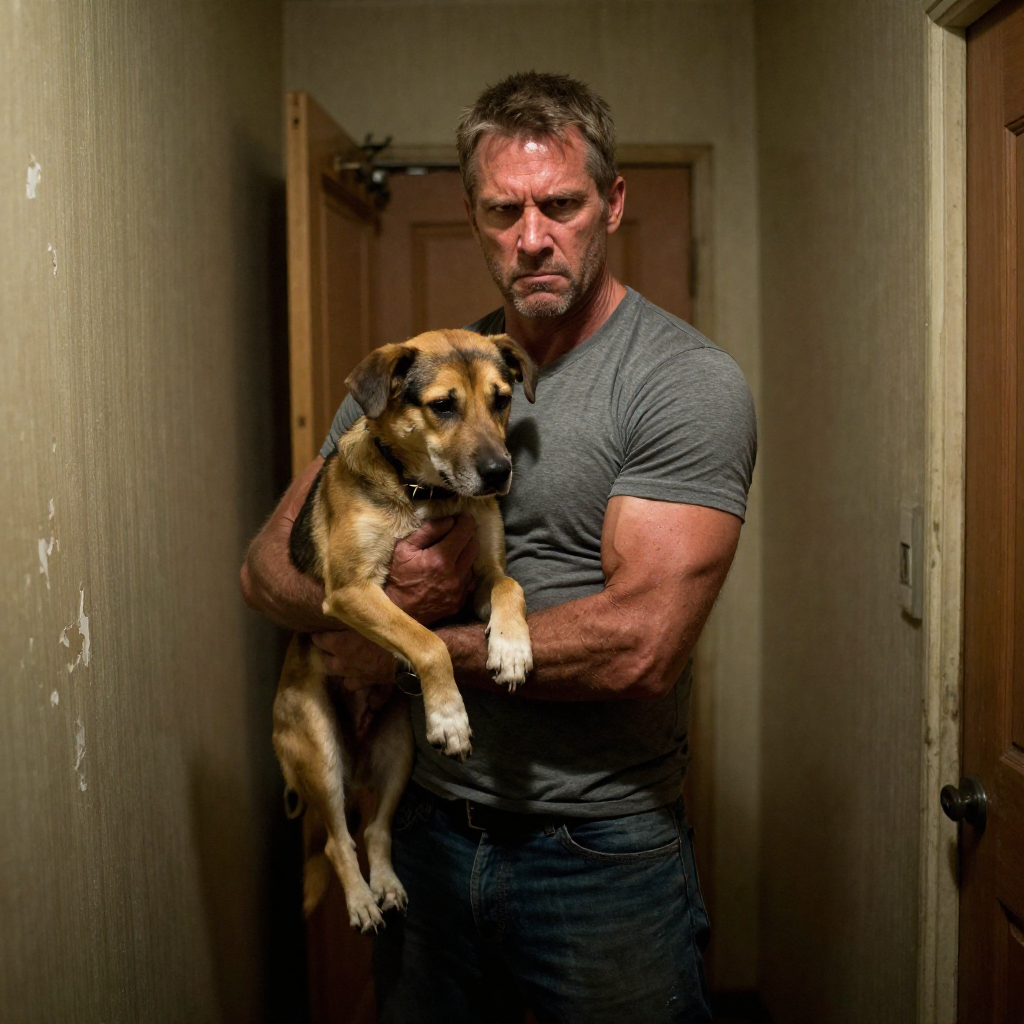
Miller scooped the dog up in his arms. The animal was heavy, dead weight, completely surrendered. Miller stood up, cradling the dog against his chest like a baby.
He turned to leave. Killeen was scrambling to his feet, red-faced and humiliated. “You can’t take him! That’s my dog! That’s theft!”
Miller stopped in the doorway, right where I was standing. He looked back at Killeen. “You call the cops,” Miller said. “You tell them I broke your door. You tell them I stole your property. And when they get here, I’ll show them the bruises on this dog’s ribs. I’ll show them the scars. And I’ll tell them exactly what I heard through these walls.”
He paused, his eyes narrowing.
“But we both know you won’t call. Because bullies are cowards. And if you ever come near this dog again, or if I ever hear a sound like that coming from this apartment again… I won’t stop at the door next time.”
Miller walked past me, into the hallway. He looked at me, his eyes softening just a fraction. “You okay, miss?”
I nodded, unable to speak. I wiped my face.
“Come on,” he said, hitching the dog higher in his arms. “Let’s get him some water.”
I followed him down the stairs, leaving the broken door hanging on one hinge, leaving Killeen shouting impotent threats into the empty hallway. As we descended, the dog rested its head on Miller’s shoulder, and for the first time, the trembling stopped.
CHAPTER II
Miller’s apartment felt like a different world. It was a space of heavy oak furniture, the scent of old pipe tobacco, and a quiet that felt earned rather than forced. I followed him inside, my heart still hammering against my ribs like a trapped bird. He didn’t say a word as he led the way to the bathroom, his large hands cradling the shivering dog as if it were made of thin glass. He set the creature down on a bath mat and looked at me. His eyes were tired. Not the fatigue of a man who needed sleep, but the weariness of someone who had seen too many fires and was finally realizing he couldn’t put them all out.
“Get some warm water,” Miller said. His voice was low, devoid of the roar he had used in the hallway. “And the unscented soap under the sink. We need to be gentle.”
I knelt beside him. Up close, the dog was a map of misery. It was a pit mix, or something close to it, though you could see every rib and the sharp protrusion of its hip bones. The fur was patchy, matted with things I didn’t want to identify. As I turned on the faucet, testing the temperature with my wrist, I felt a familiar, cold knot tightening in my stomach. It was a physical sensation I hadn’t felt in years, a phantom limb of a memory I thought I’d buried.
Growing up, my father hadn’t been a man of noise. He was a man of cold, calculated silences. He didn’t hit us with his fists; he hit us with his absence, with the way he could make a room feel like an Arctic tundra just by walking into it. I had spent my childhood making myself small, learning the exact frequency of a floorboard that didn’t creak, the exact way to breathe so no one would notice I was there. This was my old wound: the shame of the bystander. I had watched my mother wither under that silence for eighteen years and I had done nothing but stay quiet to save myself. And here I was again, standing in a bathroom with a man who had actually done something, while I felt the old urge to slip back into 3B and lock the door.
“Hey,” Miller said, noticing my hands shaking as I poured the warm water over the dog’s back. “You’re doing fine. He knows we’re helping.”
The dog didn’t struggle. That was the most heartbreaking part. It just stood there, head bowed, its entire body vibrating with a terror so deep it had moved past the point of resistance. As the water cleared away the grime, the true extent of the damage emerged. There were cigarette burns—perfectly circular, hairless patches of scarred skin—and long, thin welts that looked like they had been made by a wire hanger.
“He’s been at this a long time,” I whispered, my voice cracking.
“Killeen is a coward,” Miller replied, his fingers carefully lathering the soap. “Cowards always pick something that can’t fight back. They like the feeling of being a god over something small.”
I looked at Miller. He was a retired firefighter, a man whose entire life had been defined by walking into buildings everyone else was running out of. I felt a sudden, sharp pang of guilt. I had a secret I hadn’t told anyone in the building, not even the landlord when I signed the lease. Three years ago, I’d been the one to call the cops on a domestic dispute in my old building. The man had found out it was me. He’d smashed my car windows and followed me to work for a month until the restraining order finally stuck. I had moved here specifically to be anonymous, to be a ghost. I had promised myself I would never get involved in someone else’s nightmare again. My anonymity was my armor, and I could feel it cracking.
“We should call the vet,” I said, trying to focus on the practical. “Maybe a shelter?”
“Not yet,” Miller said. “If we take him to a shelter tonight, it’s just more paperwork and questions I’m not ready to answer. I need to make sure he’s fed and warm first. Then we’ll see.”
We spent the next hour in that ritual of healing. We dried the dog with soft towels and Miller found an old fleece blanket to wrap him in. The dog, whom Miller started calling ‘Gus’ for no particular reason, eventually curled up in the corner of the kitchen, his eyes following us with a wary, unblinking intensity. I felt a strange sense of peace, a fragile bubble of safety that we had constructed in the middle of a Thursday night.
Then the sirens started.
They weren’t the distant, passing wail of a city in motion. They were approaching, getting louder, until the red and blue lights began to pulse against Miller’s kitchen walls, slicing through the blinds in rhythmic, jagged strobes. My heart skipped a beat.
“The police?” I asked, standing up. “You called them?”
Miller shook his head slowly, his face hardening. “No. I figured Killeen wouldn’t have the nerve.”
We walked to the window. Down below, two patrol cars had slanted across the street, blocking traffic. But they weren’t looking for an animal abuser. I saw Killeen standing on the sidewalk. He looked different. The trembling, pathetic man from the hallway was gone. He was wrapped in a shock blanket provided by an officer, his face twisted into a mask of calculated distress. He was pointing up at the building, his gestures wide and dramatic. He was holding his arm as if it were broken, though Miller hadn’t done more than hold him against a wall.
“He’s flipping it,” I whispered. “Miller, he’s calling it in as a home invasion.”
A heavy knock sounded at Miller’s front door. Not a neighbor’s knock. The authoritative, metallic thud of a nightstick or a heavy boot.
“Police! Open up!”
Miller looked at Gus, then at me. He didn’t look scared, which somehow made me more terrified. He walked to the door and opened it. Two officers stood there, their hands resting on their belts, their faces set in that neutral, professional mask that signals the start of a long night. Behind them, I could see Killeen peering over the shoulder of a third officer in the hallway.
“That’s him!” Killeen wailed, his voice high-pitched and theatrical. “That’s the man who broke into my home! He kicked my door down! He attacked me and stole my property! I was just sitting there, minding my own business, and he came in like a maniac!”
One of the officers, a younger man with a buzz cut, looked at Miller. “Sir, did you enter apartment 3C tonight without permission?”
“I did,” Miller said calmly. “I entered because I heard an animal being tortured. I’ve reported it three times this month. No one came.”
“That doesn’t matter right now, sir,” the officer said, his tone shifting. “A report of a forced entry and assault takes precedence over a noise complaint. Mr. Killeen claims you physically assaulted him and took his dog. Is the dog in here?”
“He’s not property,” I blurted out, stepping forward from the kitchen. “He’s a living thing. Look at him! Look at what Killeen did!”
I pointed toward the kitchen, but the officers didn’t move to look at Gus. Their eyes were on Miller. The public nature of the confrontation was escalating. Other neighbors were sticking their heads out of their doors—Mrs. Gable from 2A, the college kids from the fourth floor. They were all watching. Killeen saw his audience and leaned into it.
“He’s a vigilante!” Killeen cried, pointing a trembling finger at Miller. “He thinks he’s above the law because he’s a retired city worker! Look at my door! It’s off the hinges! I don’t feel safe in my own home anymore! I want to press charges. I want him arrested!”
The younger officer looked at his partner, then back at Miller. “Sir, I’m going to need you to turn around and place your hands behind your back. We have to take a statement at the station, and given the forced entry, we have to process this as a burglary and assault.”
“You can’t be serious,” I said, my voice rising. “He saved that dog’s life! Killeen was killing it!”
“Miss, step back,” the second officer said firmly. “We’ll get to your statement in a minute. Right now, we have a complainant with visible distress and a clear case of forced entry. Mr. Miller, don’t make this harder than it needs to be.”
Miller didn’t resist. He didn’t argue. He simply turned around and let them click the handcuffs onto his wrists. The sound—the sharp, metallic double-click—felt like a gavel coming down. It was irreversible. The narrative had been hijacked. In the eyes of the law, the monster was the victim, and the savior was a criminal.
As they led Miller out, Killeen caught my eye. For a split second, the mask of the victim slipped. He gave me a tiny, chilling smirk—a look of pure, unadulterated triumph. He knew. He knew that by the book, he had won. He knew that Miller’s history of service wouldn’t protect him from a felony charge if the facts remained ‘breaking and entering.’
The officer with the buzz cut stayed behind to talk to me. He pulled out a small black notepad. The hallway was quiet now, the spectacle of the arrest over, but the air felt heavy with the lingering scent of Killeen’s victory.
“You’re the neighbor in 3B, right?” the officer asked. “Mr. Killeen says you were in the hallway when it happened. He says you watched Miller break the door down and that you encouraged him. Is that true?”
I looked at the notepad. This was the moment. My moral dilemma sat before me like a jagged piece of glass I had to swallow.
If I told the truth—the full truth—I would be confirming that Miller did, in fact, break the law. I would be testifying that he used force to enter a private residence. Under the current legal framework, that would bury him. But if I focused only on the abuse, I would be Killeen’s primary target. He would know I was the one who could sink his counter-claim. He was my neighbor. He lived thirty feet away from my bed. He knew my schedule. He knew when I came home from work and when I took out the trash.
If I stayed silent or claimed I didn’t see the start of it, I might be able to stay ‘neutral.’ I could protect my anonymity, protect my safety, and avoid the retaliation I had fled from three years ago. But Miller would go to jail. A man who had spent thirty years saving people from fires would spend his retirement in a cell because he tried to save one dog from a different kind of fire.
“I…” my voice failed me. I looked toward the kitchen, where Gus was still huddled under the fleece blanket. He was looking at me. He didn’t know about laws or burglaries or statements. He only knew that for the first time in his life, he wasn’t being hit.
“Miss?” the officer prompted, his pen hovering over the paper. “Did you see Mr. Miller kick the door in? Did you see him threaten Mr. Killeen?”
I looked down the hallway. Killeen was still there, talking to the other officer, his eyes darting toward me every few seconds. He was waiting to see what I would do. He was counting on my fear. He was counting on the fact that most people, when faced with a choice between their own safety and a stranger’s justice, will choose safety every single time.
My mind raced through the consequences. If I testified, I’d be labeled a witness in a criminal case. My name would be on the public record. My address—this address—would be linked to the testimony. I thought about my car windows. I thought about the feeling of being followed. I thought about the silence I had maintained as a child, the safety of the shadows.
“I heard the dog,” I started, my voice barely a whisper.
“We know about the dog, Miss. But did you see the entry? We need to know if the entry was forced and if there was a physical altercation initiated by Mr. Miller.”
I looked at the officer. He wasn’t a bad guy, he was just doing his job, following the protocol of a system that values property rights over the screams of a nameless animal.
“It wasn’t like that,” I said, trying to find a middle ground that didn’t exist. “He had to. He had no choice.”
“In the eyes of the law, there’s always a choice,” the officer said, not unkindly. “If you saw him kick that door, I need you to say so. If you didn’t, I need to know that too. But lying to me is a crime in itself. So, what’s it going to be?”
I felt the weight of Miller’s kindness in the bathroom earlier. I felt the warmth of the water he’d asked me to prepare. He hadn’t thought about the consequences for himself when he heard those screams. He had simply acted. And now, he was in the back of a squad car while the man who had burned a dog with cigarettes was being comforted by the state.
I looked at the officer’s notepad again. I thought about the old wound, the one that still bled every time I stayed quiet. I thought about my secret—the fear that had governed my life for three years, turning me into a ghost in my own skin.
“I saw everything,” I said, my voice finally steadying.
“And?” the officer asked.
I looked past him at Killeen. He was watching me, his eyes narrowing. He knew I was at a crossroads. He shifted his weight, his fake injury forgotten for a moment, and gave a small, slow shake of his head. It was a warning. A clear, silent threat: *Stay out of it, or you’re next.*
The choice felt like a physical weight pressing down on my chest. If I spoke the truth about the abuse, I had to acknowledge the break-in. If I defended the break-in, I was an accomplice. There was no clean way out. No matter what I said, someone was going to get hurt. Either Miller’s life was over, or my hard-won peace was destroyed.
“I saw him go in,” I said, the words feeling like lead. “But you’re asking the wrong questions. You’re asking about a door. You should be asking about what was happening behind it.”
“We’ll get to that, Miss. Just answer the question. Did he kick the door down?”
I looked at Gus in the kitchen. He had crawled out from under the blanket and was sniffing at the spot where Miller had been standing. He looked lost.
“Yes,” I said, the word hanging in the air like a confession. “He kicked it down. And thank God he did.”
The officer started writing. I could see the words *‘Confirmed forced entry’* appearing on the page. Each stroke of the pen felt like a nail in the coffin of Miller’s freedom. But I wasn’t done. The fear was there, pulsing under my skin, but for the first time in my life, it wasn’t the only thing there.
“But you need to see the dog,” I said, my voice louder now, attracting the attention of the neighbors in the hall. “You need to see the burns. You need to see the wire marks. Because if you take Miller away and leave that dog with Killeen, or even if you just take the dog to a pound, you’re missing the point. The crime didn’t start when the door broke. The crime has been happening for months, and we all heard it. Every single one of us.”
I looked around at the other neighbors. Mrs. Gable looked away. The college kids stared at their feet. They were choosing the silence I knew so well. They were choosing the Arctic tundra.
“I’ll testify,” I said, looking the officer dead in the eye, even as I felt the blood drain from my face. “I’ll testify to what Miller did. And I’ll testify to why he had to do it. I’ll give you a full statement. Everything I’ve heard for the last three months. Every scream. Every thud. Everything.”
Killeen’s face went pale. The smirk vanished, replaced by a look of sharp, poisonous hatred. He took a step toward me, but the third officer put a hand on his chest, holding him back.
“You’re making a mistake, girl,” Killeen hissed, his voice no longer theatrical. It was a low, jagged sound. “You don’t know what you’re getting into.”
“I think I do,” I said, though my knees were shaking so hard I had to lean against the doorframe.
As the officer led me into Miller’s kitchen to take the formal statement, I realized that my anonymity was gone. My armor was in pieces on the floor. I had stepped out of the shadows and into the red and blue light. I had no idea what would happen to Miller, or to Gus, or to me when the sun came up. I only knew that for the first time since I was a child, I wasn’t just a bystander. I was a witness. And in this building, in this city, that was the most dangerous thing you could be.
CHAPTER III
The building didn’t just feel empty after they took Miller away; it felt hollowed out, like a rotted tree still standing but waiting for the first strong wind to topple it. The silence in the hallway was no longer the quiet of a peaceful afternoon. It was a heavy, suffocating thing. I stayed behind my door, the chain slid home, the deadbolt turned. I watched through the peephole until my eye ached, seeing nothing but the dim yellow light of the corridor and the closed door of 3C. Killeen was in there. He was free, while Miller—a man who had spent thirty years running into burning buildings—was sitting in a holding cell because he couldn’t stand to hear a creature scream.
I couldn’t eat. I could only think about the look Killeen had given me as the police led Miller out. It wasn’t just anger. It was a promise. It was the look of a man who knew exactly how to dismantle a person’s life piece by piece. My old wound, the one from years ago when I had been the girl who spoke up and paid for it with her safety, began to throb. I felt the phantom weight of my previous stalker’s presence, the way he used to leave notes under my wiper blades, the way he used to call and say nothing. I had moved here to escape that. Now, the ghost had a new face, and it lived ten feet away.
The intimidation didn’t start with a bang. It started with a click. Every time I stepped near my front door, I heard his door click open just a fraction. He wouldn’t come out. He would just stand there, hidden in the darkness of his own apartment, letting me know he was watching. I’d freeze, hand on the knob, breath held. Then, the soft, metallic slide of his deadbolt would echo through the thin walls. It was a rhythm. He was orchestrating my fear, setting the tempo of my heartbeat. He knew I was the only one who had seen what happened before the door came down. He knew I was the one who could turn a home invasion charge into a justified rescue.
On the second day, I found the first ‘gift.’ I was leaving for work, my keys shaking in my hand, when I looked down. There was a single, tuft of matted grey fur sitting on my welcome mat. It was Gus’s fur. It had been pulled out, not shed. It was a message: *I still have pieces of what you tried to save.* My stomach turned over. I realized then that Killeen didn’t just want to win the legal battle. He wanted to break me so thoroughly that I would never dare to speak his name in a courtroom. He wanted me to see myself as a victim again. He wanted the silence back.
I went to the precinct to check on Miller, but they told me I couldn’t see him. He was being held without bail because of the ‘severity’ of the assault and the ‘firearm’ Killeen claimed he’d seen—though no gun was ever found. Killeen had played the system perfectly. He had presented himself as a vulnerable, terrified tenant attacked by a violent, unstable neighbor. The law, in its blind adherence to procedure, was protecting the predator. I sat on a hard plastic bench in the waiting room for four hours, feeling the walls close in. I saw Miller’s lawyer, a harried public defender who didn’t even know Gus’s name. ‘It’s not about the dog,’ he told me. ‘It’s about the door. It’s about the property rights. Your testimony helps, but it’s your word against a man with a bloody face.’
When I got back to the apartment, the air felt different. Thicker. I walked up the stairs, avoiding the elevator because I didn’t want to be trapped in a small box if Killeen was waiting. As I reached the third floor, I saw him. He wasn’t hiding this time. He was sitting on a folding chair right in the middle of the hallway, directly in front of my door. He was cleaning his fingernails with a small pocket knife. The light from the flickering overhead fixture made his skin look grey, almost translucent. He didn’t look like a victim. He looked like a spider.
‘You look tired, neighbor,’ he said. His voice was a low, melodic rasp that made the hair on my arms stand up. I didn’t answer. I reached for my phone, but my hands were numb. ‘You should really mind your own business. It’s a dangerous world for people who stick their noses where they don’t belong. Especially people with… history.’ He paused, letting the word hang there. My heart stopped. How did he know? I had never told anyone in this building about what happened in my old city. I had used a different last name on the lease. But Killeen wasn’t just a brute. He was a hunter. He had looked into me. He had found the girl who ran away, and he was telling me there was nowhere left to go.
‘I’m not recanting,’ I said, my voice cracking but audible. I forced myself to walk toward him, even though every instinct told me to turn and bolt down the stairs. I had to get into my apartment. I had to get to my sanctuary. ‘I saw what you did to that dog. I heard him.’ Killeen stood up slowly, the knife folding shut with a sharp, final snap. He moved into my personal space, his breath smelling of stale coffee and something metallic. He didn’t touch me—he knew better than that—but he leaned in close enough that I could see the broken capillaries in his eyes.
‘Gus is property,’ he whispered. ‘And Miller is a felon. And you? You’re just a witness who can’t be trusted. I know about the ‘incidents’ at your last job. I know about the restraining orders you filed that the judge threw out. They’ll call you hysterical. They’ll call you a professional victim. By the time I’m done with you, you’ll be the one people are afraid of.’ He smiled then, a slow, yellow-toothed grin. ‘I want my dog back. The shelter won’t release him to me because of the ‘investigation.’ But if you tell them you didn’t see any abuse… if you tell them you were confused by the noise… then Gus comes home. And Miller gets a plea deal. If you don’t? Well, Miller rots, and I might just have to move even closer to you.’
I pushed past him, my shoulder brushing his chest, a contact that felt like an electric shock of pure revulsion. I got inside and slammed the door, leaning my back against it, gasping for air. He knew. He had weaponized my own trauma against me. He was using the legal system as a garrote. I looked at the folder I had been keeping—the notes I’d taken, the photos of the scratches on the door. It all felt so small, so pathetic against a man who could erase the truth with a whisper. I felt the old familiar urge to pack a bag and disappear in the middle of the night. To let the silence win. It would be so easy to just leave Miller to his fate and find a new city, a new name, a new life.
But then I remembered Gus. I remembered the way his tail had thumped once against Miller’s chest—a tiny, flickering spark of hope in a world of pain. If I left, that spark would be snuffed out. Killeen would get the dog back, and he would finish what he started. I wouldn’t just be failing Miller; I would be failing myself. I would be confirming everything Killeen said about me. I sat on the floor of my kitchen, the dark pressing in, and I did something I hadn’t done in years. I didn’t hide. I started searching. If he could find my past, I could find his. I spent the entire night bathed in the blue light of my laptop, digging through public records, court archives, and old news clippings from three different states.
That’s when I found it. The Twist. Killeen wasn’t his name. He was Garrett Vance. He had lived in Ohio, then Pennsylvania, then here. In every city, he had been the victim of a ‘violent neighbor.’ He had a pattern. He would adopt a dog, abuse it until the neighbors intervened, and then sue them for everything they were worth. He was a professional provocateur, a man who built a career out of being ‘assaulted’ by people with consciences. He chose his targets carefully—people like Miller, people with everything to lose and a hero complex. And Gus? Gus wasn’t the first dog. There had been a Boxer in Cleveland, a Shepherd in Pittsburgh. Both were ‘lost’ after the court cases ended. I saw the photos of the previous neighbors, their lives ruined, their houses foreclosed on to pay his settlements. He wasn’t just a bad man; he was a parasite who fed on the goodness of others.
Morning came, and with it, a knock on the door. Not the rhythmic, predatory tap of Killeen, but a heavy, authoritative boom. I looked through the peephole. Three men stood there, dressed in dark suits. They didn’t look like the local police. They looked like power. ‘Ms. Thorne?’ one of them said. ‘I’m David Moreno, legal counsel for the International Association of Firefighters. We’d like to speak with you about Brother Miller.’ I opened the door. They didn’t just walk in; they occupied the space. They were the intervention I hadn’t dared to hope for. Behind them, I saw Killeen—Garrett—looking out from his door, his face pale, his smirk gone.
‘We’ve been monitoring the situation,’ Moreno said, his voice like grinding stones. ‘The city thinks Miller is a lone old man who lost his temper. They don’t realize he has twenty thousand brothers who don’t take kindly to one of their own being set up by a professional grifter.’ They had been doing their own digging, far more effectively than I had. They had found the link I’d missed—the bank accounts where Garrett deposited his settlement money. They had a private investigator who had tracked Garrett’s movements for weeks. But they needed one thing. They needed the witness who hadn’t broken. They needed me to stand in front of a judge and say that Miller didn’t break that door down out of malice, but out of a duty to protect life—a duty they all shared.
The final confrontation didn’t happen in the hallway. It happened two hours later in the lobby of the building. Garrett was trying to leave, a suitcase in each hand, realizing the tide had turned. The firemen were everywhere. They didn’t touch him. They didn’t have to. They just stood there, a wall of silent, uniformed men, blocking every exit except the one that led to the waiting police cruiser outside. The District Attorney’s office had issued an emergency warrant for insurance fraud and animal cruelty based on the new evidence. Garrett looked at me, his eyes darting like a trapped animal’s. He tried one last time to use the fear. ‘You think this changes anything?’ he hissed as he passed me. ‘You’re still the girl who runs.’
I looked him straight in the eye, and for the first time in my life, the fear didn’t make me want to hide. It made me want to stand still. ‘No,’ I said, my voice steady and cold. ‘I’m the woman who stayed.’ I watched as the officers took him. I watched as the suits followed. The building felt different then. The air was clearing. But the victory felt heavy. Miller was still in a cell, and Gus was still in a cage at the shelter. The moral landscape had shifted—the predator was gone, but the damage he had done was carved into the walls of 3B and 3C. Justice wasn’t a clean, happy ending. It was a messy, painful process of rebuilding what had been torn apart. As the lobby cleared, I realized that the fight wasn’t over. It was just moving to the courtroom, and for the first time, I wasn’t afraid of the light.
CHAPTER IV
The news vans vanished first. One day they were camped on the sidewalk, satellite dishes glinting under the morning sun, the next they were gone. The reporters followed, their insistent knocking replaced by an echoing silence that felt heavier than any noise. Garrett Vance’s arrest wasn’t a national story, just a local one with a brief, bright flame. The world moved on, but our building didn’t.
The silence wasn’t peace. It was the kind of quiet that follows an explosion, when your ears ring and you can’t quite process what you’re seeing. The kind where you keep expecting the next aftershock.
I walked Gus every morning, partly to give him some normalcy, but mostly because I couldn’t stand being alone in my apartment. The stares hadn’t stopped, but they’d changed. The open hostility had faded, replaced by a kind of guarded curiosity. People whispered as we passed, their faces a mix of judgment and something that almost looked like…respect?
My reputation had shifted. I was no longer just “the woman who called the cops.” I was now “the woman who helped bring Vance down.” But the label felt flimsy, like a costume I couldn’t quite fill. I didn’t feel like a hero. I just felt tired.
The hardest part was Miller. He was still in custody, awaiting his hearing. His lawyer, provided by the firefighter’s union, assured us they were working on it, but the wheels of justice turned slowly, especially when they involved breaking and entering, even with the best intentions. Every day I looked at his empty apartment, the silence screaming his absence.
My phone rang. It was Sarah, Miller’s daughter.
“They set a date,” she said, her voice tight. “His hearing is next week.”
I swallowed. “Okay. What can I do?”
“He wants you there. He wants you to testify.”
My stomach clenched. Testifying against Vance had been one thing. But testifying in defense of Miller, admitting I’d encouraged him even knowing he was breaking the law, felt different. It meant admitting my own culpability, my own willingness to bend the rules for what I believed was right.
I took a deep breath. “I’ll be there.”
—
The courtroom was cold, sterile. The air smelled like old paper and disinfectant. I sat in the waiting area, my hands clammy, watching people shuffle in and out. Lawyers in expensive suits, victims with haunted eyes, court officers with bored expressions. Everyone was a player in this strange, theatrical production of justice.
When they called my name, my heart leaped into my throat. I walked into the courtroom, feeling every eye on me. Vance was already there, sitting at the defendant’s table. He looked different. Gone was the arrogant swagger, the manipulative charm. He looked smaller, deflated, like a punctured balloon. But his eyes still held that unsettling glint, a flicker of resentment that made my skin crawl.
I raised my right hand, swore to tell the truth, the whole truth, and nothing but the truth. The lawyer for the prosecution, a sharp woman with a no-nonsense demeanor, began her questioning. She walked me through the events leading up to Miller’s breaking into Vance’s apartment, carefully framing the narrative to highlight the illegality of his actions.
“So, Ms. . . .,” she said, pausing to read my name from her notes. “You admit that you knew Mr. Miller was planning to enter Mr. Vance’s apartment illegally?”
“Yes,” I said, my voice barely a whisper.
“And you did nothing to stop him?”
“I…I didn’t think he’d actually do it.” A half-truth, but I couldn’t bring myself to say the words out loud: I wanted him to do it. I needed him to do it.
The prosecution lawyer raised an eyebrow, but moved on. “And did you at any point call the authorities to report a suspected crime?”
“No.”
“So, to be clear, you knowingly allowed a crime to take place, and failed to report it. Is that correct?”
“Yes,” I repeated, the word hanging in the air like a confession.
Then it was the defense lawyer’s turn. He was a kind-faced man with weary eyes, but his voice was strong, confident. He approached me with a gentle smile.
“Ms. . . . , can you tell us about your interactions with Mr. Vance prior to this incident?”
I told the truth. About the late-night parties, the constant noise, the subtle intimidation. About Gus’s cries and my growing fear for the dog’s safety. About Vance’s calculated campaign of terror against me.
“Did you believe that Mr. Vance posed a threat to Gus?”
“Yes,” I said, my voice stronger now. “I was terrified for him.”
“And did you believe that Mr. Miller was acting out of concern for Gus’s well-being?”
“Absolutely. He’s a good man. He couldn’t stand to see an animal suffering.”
He paused, looked at the jury. “Ms. . . . , in your opinion, was Mr. Miller’s actions justified?”
The prosecution lawyer objected, but the judge overruled. I took a deep breath.
“Yes,” I said, my voice clear and firm. “He did what was right.”
Vance stared at me, his eyes burning with hatred. For a moment, I saw the old Vance, the one who reveled in his power, the one who delighted in causing pain. But then it was gone, replaced by a look of something I couldn’t quite decipher. Defeat? Regret?
My testimony was over. I stepped down from the stand, my legs shaky. As I walked past Miller, he gave me a small, grateful nod. It was enough.
—
The verdict came two days later. I sat in the courtroom, my hands clasped so tightly my knuckles were white. Miller sat beside me, his face etched with anxiety. Sarah was on the other side of him, her hand resting on his arm.
The jury filed in, their faces unreadable. The foreman, a middle-aged woman with a stern expression, stood and read the verdict.
“On the charge of breaking and entering, we find the defendant, Robert Miller…not guilty.”
A collective gasp filled the courtroom. Miller sagged with relief, Sarah burst into tears, and I felt a wave of emotion wash over me so powerful it almost knocked me off my feet.
He was free. But the victory felt hollow. The judge, while acknowledging the jury’s verdict, made it clear that Miller’s actions were still technically illegal. He sentenced Miller to community service and a hefty fine, a symbolic punishment that left a bitter taste in my mouth. Justice, it seemed, was always imperfect, always compromised.
Vance, on the other hand, was found guilty of multiple counts of insurance fraud and animal cruelty. His sentence was significantly harsher, a small consolation in the face of the messy, complicated truth.
As we left the courthouse, Miller put his arm around my shoulder. “Thank you,” he said, his voice thick with emotion. “I couldn’t have done it without you.”
“We did it together,” I said, the words feeling inadequate, but true.
The media was waiting outside, cameras flashing, reporters shouting questions. We ignored them, pushing our way through the crowd, eager to escape the spotlight.
Back at the apartment building, a small crowd had gathered, waiting for us. As we approached, they erupted in applause. Some people cheered, others simply smiled, their faces filled with relief. It was a moment of unity, a collective sigh of relief after weeks of tension and uncertainty.
But even in that moment of triumph, I couldn’t shake the feeling that something was still missing. Gus. His fate still hung in the balance, dependent on the whims of the legal system.
—
The animal shelter was a depressing place. Rows of cages filled with lonely, abandoned animals, their eyes pleading for attention. I walked through the aisles, my heart aching, until I found him. Gus.
He was huddled in the back of his cage, his tail tucked between his legs. When he saw me, his ears perked up and he let out a small whine. I reached through the bars and stroked his head. He licked my hand, his tail thumping weakly against the floor.
“He’s still traumatized,” the shelter worker said, her voice gentle. “He flinches at loud noises, and he’s very clingy.”
“Can I…can I adopt him?” I asked, my voice trembling.
The worker smiled. “We were hoping you would. He needs someone who understands what he’s been through.”
The adoption process was surprisingly easy. I filled out the paperwork, paid the fee, and then, finally, Gus was mine. As I led him out of the shelter, he stayed close to my side, his body pressed against my leg. He seemed to know that he was safe now, that he was finally home.
Back at the apartment building, Miller was waiting for us. When he saw Gus, his face lit up. He knelt down and Gus ran to him, licking his face, wagging his tail with unrestrained joy.
“Hey, buddy,” Miller said, his voice choked with emotion. “I missed you, pal.”
We stood there for a long moment, the three of us, bound together by a shared experience, a shared love for this small, broken dog. It wasn’t a perfect ending. The scars of the past would always be there, a reminder of the darkness we had faced. But it was a start. A new beginning.
That night, I sat on my couch with Gus curled up at my feet, his warm body a comforting presence. I looked around my apartment, at the familiar furniture, the books on the shelves, the photos on the wall. It was just an ordinary apartment, but it was my sanctuary, my haven. And for the first time in a long time, I felt safe. Truly safe.
The phone rang. I hesitated, my hand hovering over the receiver. It could be anyone. A reporter, a lawyer, someone from Vance’s past. But I knew, deep down, that it was time to answer. Time to face whatever came next. I took a deep breath and picked up the phone.
It was Sarah.
“He wants to see you,” she said. “My dad. He wants to thank you, properly.”
“When?” I asked.
“Tomorrow. He’s making dinner.”
I thought of Miller, alone in his apartment, trying to cook. I smiled.
“I’d like that very much,” I said.
CHAPTER V
The silence in apartment 3B felt different now. It wasn’t the heavy, oppressive silence of fear, the one that clung to the walls after Vance… after everything. This was a lighter silence, one filled with a cautious kind of hope. It had been three weeks since Miller was sentenced to community service, three weeks since Gus had officially become a permanent member of my life, and three weeks since I’d slept through the night without waking up screaming.
Miller wasn’t around as much, of course. His community service took up most of his days, cleaning up parks and helping out at the local animal shelter. He told me, with a gruffness that couldn’t hide the sincerity, that he liked working with the animals. Said it reminded him of Gus, of what was worth fighting for. I found myself missing his presence, the quiet reassurance of knowing he was next door. Even though the reason for our connection was rooted in something so awful, I couldn’t deny the comfort I found in his steady, unwavering presence.
I spent my days working from home, the rhythmic tapping of my keyboard a constant backdrop to my thoughts. Gus was my shadow, padding softly behind me from room to room. He’d nudge my hand with his wet nose when he thought I was working too hard, his big brown eyes a silent plea for attention. I’d usually give in, taking a break to play fetch with his favorite squeaky toy or just to sit on the floor and bury my face in his soft fur. He was a grounding force, a reminder that even after everything, there was still goodness in the world.
The hardest part was still the looks. The whispers. People remembered the trial, the headlines. They saw me as the woman who testified, the one who was harassed, the one who was… involved. Some looked at me with sympathy, others with curiosity, and still others with a thinly veiled judgment. I tried to ignore it, to build a wall around myself, but the whispers always found a way in. I started avoiding the grocery store, ordering takeout instead of going to my favorite restaurants. The world felt smaller, more confined.
One evening, a knock on my door startled me. It was Miller, his face etched with a weary kind of smile. “Hey,” he said, his voice rough. “Thought you might want some company. I, uh, brought pizza.”
I stepped back, letting him in. He held up a large pizza box, the aroma of pepperoni and melted cheese filling the air. Gus, sensing the arrival of a friend, wagged his tail furiously, circling Miller’s legs.
We ate in silence, the only sound the gentle munching of pizza and the occasional thump of Gus’s tail against the floor. It wasn’t an awkward silence, but a comfortable one, born of shared experience and unspoken understanding. After we finished, Miller cleared his throat. “I wanted to say thank you,” he said, his eyes meeting mine. “For everything. For testifying, for believing in me, for… for taking care of Gus.”
I shrugged, feeling my cheeks flush. “You would have done the same for me,” I said, the words barely a whisper.
He nodded slowly. “Yeah,” he said. “I would have.”
***
PHASE 2
That night, after Miller left and Gus was curled up asleep at the foot of my bed, I couldn’t shake the feeling of unease that had settled over me. The trial was over, Vance was gone, and Miller was… well, he was Miller. But the fear, the anxiety, it lingered. It was like a ghost, a shadow that followed me everywhere I went. I knew I needed to do something, to break free from the cycle of fear that had consumed me for so long.
The next morning, I woke up with a newfound determination. I decided to go back to therapy. I hadn’t been since… well, since before Vance. It felt like admitting defeat, like acknowledging that I wasn’t strong enough to handle things on my own. But I knew, deep down, that it was the right thing to do.
Finding a new therapist was harder than I expected. The first few I spoke with didn’t seem to understand what I had been through. They offered platitudes and generic advice, but none of it resonated. I needed someone who could understand the specific kind of trauma I had experienced, someone who could help me navigate the complex web of emotions that had ensnared me.
Finally, after weeks of searching, I found Dr. Chen. She was a specialist in trauma recovery, and she had a calm, empathetic demeanor that immediately put me at ease. In our first session, I told her everything. About the stalking, about Vance, about the trial, about the fear that had taken root in my soul. I didn’t hold anything back.
Dr. Chen listened patiently, nodding occasionally, her eyes filled with understanding. When I was finished, she didn’t offer any easy answers or quick fixes. Instead, she said, “What happened to you was terrible, and it’s okay to feel the way you feel. But you don’t have to let it define you. You are stronger than you think, and you can heal.”
Her words were like a balm to my wounded spirit. For the first time in a long time, I felt a flicker of hope. Maybe, just maybe, I could find a way to move on, to rebuild my life, to reclaim my sense of self.
The therapy sessions were difficult, often emotionally draining. I had to confront the darkest parts of my past, to relive the moments of fear and vulnerability that I had tried so hard to bury. But with each session, I felt a little bit stronger, a little bit more in control. Dr. Chen helped me to identify the triggers that sparked my anxiety, to develop coping mechanisms for managing my fear, and to challenge the negative thought patterns that had been holding me back.
I also started practicing mindfulness and meditation. At first, it was difficult to quiet my racing thoughts, to focus on the present moment. But with practice, I learned to observe my thoughts and feelings without judgment, to let them pass through me like clouds in the sky. It was a slow process, but gradually, I began to feel more grounded, more centered.
***
PHASE 3
One afternoon, while I was walking Gus in the park, I saw her. Killeen’s mother. She was sitting on a bench, her head in her hands, her shoulders shaking with silent sobs. I hesitated, unsure of what to do. Part of me wanted to turn around and walk away, to avoid any confrontation. But another part of me felt a strange sense of compassion for her. She had lost her son, after all, even if he was… who he was.
Gus, sensing my hesitation, nudged my hand with his nose, his eyes filled with concern. I took a deep breath and walked over to her.
“Excuse me,” I said, my voice barely above a whisper. “Are you okay?”
She looked up, her eyes red and swollen. When she saw me, her face contorted with anger. “You,” she spat, her voice filled with venom. “You did this to him. You ruined his life.”
I flinched, but I stood my ground. “I’m sorry for your loss,” I said, my voice trembling slightly. “But your son… he hurt a lot of people.”
“He was a good boy,” she insisted, her voice cracking. “He just made some mistakes.”
I wanted to argue, to tell her about the lies, the manipulation, the fear he had instilled in me. But I knew it wouldn’t do any good. She was grieving, and she wasn’t ready to hear the truth.
Instead, I said, “I hope you can find peace.” And then I turned and walked away, Gus trotting faithfully by my side.
Later that day, I received a phone call from Miller. He sounded different, more subdued than usual. “Hey,” he said. “Can you come over? I need to talk to you.”
I rushed over to his apartment, my heart pounding with anxiety. When he opened the door, I could see that something was wrong. His eyes were bloodshot, and his face was pale.
“What’s wrong?” I asked, my voice filled with concern.
He sighed heavily. “I got a letter,” he said. “From the fire department. They’re… they’re suspending me.”
My heart sank. I knew how much his job meant to him. It was his life, his identity. “Why?” I asked.
“Because of what happened,” he said. “Because of the trial. They said it brought discredit to the department.”
I felt a surge of anger. It wasn’t fair. He had risked his life countless times to save others, and now they were punishing him for trying to save a dog.
“That’s bullshit,” I said, my voice rising. “You didn’t do anything wrong.”
He shook his head. “It doesn’t matter,” he said. “They’ve made up their minds.”
I wanted to say something, to offer some words of comfort, but I didn’t know what to say. I knew that nothing I could say would make it better.
***
PHASE 4
Miller spent the next few weeks in a daze. He barely left his apartment, and he stopped taking Gus for walks. He just sat in his armchair, staring blankly at the television, his face etched with a deep sadness.
I tried to talk to him, to offer him support, but he just brushed me off. He said he needed time to process everything, to come to terms with what had happened.
I understood. I knew what it was like to feel lost, to feel like your world had been turned upside down. But I also knew that he couldn’t stay like this forever. He needed to find a way to move on, to find a new purpose in life.
One evening, I decided to take matters into my own hands. I went to his apartment and knocked on the door. When he opened it, he looked surprised to see me.
“What do you want?” he asked, his voice gruff.
“I’m taking you out,” I said, my voice firm. “Get dressed.”
He stared at me for a moment, then shook his head. “I don’t want to go anywhere,” he said.
“Too bad,” I said. “You need to get out of this apartment. You need to see the world. You need to remember that there’s more to life than this.”
I didn’t give him a chance to argue. I grabbed his jacket and practically dragged him out the door. We walked in silence to the park, Gus trotting happily beside us.
When we reached the park, I led him to a bench overlooking the lake. We sat down, and I pointed to the ducks swimming in the water.
“Look at them,” I said. “They don’t care about what happened. They’re just living their lives.”
He looked at the ducks for a moment, then sighed. “It’s not that easy,” he said.
“I know,” I said. “But you can’t let this define you. You’re still a hero, Miller. You saved Gus’s life, and you helped me to find my strength again. That’s not something to be ashamed of.”
He looked at me, his eyes filled with gratitude. “Thank you,” he said. “For everything.”
We sat in silence for a while, watching the ducks. Then, Miller reached out and took my hand. It was a simple gesture, but it spoke volumes. It was a sign of trust, of friendship, of hope.
As the sun began to set, casting a golden glow over the lake, I felt a sense of peace settle over me. The fear was still there, lurking in the shadows, but it no longer had the same power over me. I knew that I could face whatever the future held, as long as I had Miller and Gus by my side.
The next morning, Miller went to the fire department to turn in his badge. He didn’t fight it, didn’t argue. He just accepted it with a quiet dignity.
Later that day, he came to my apartment. He had a box in his hands.
“What’s that?” I asked.
“It’s my stuff from the firehouse,” he said. “I thought you might want to see it.”
He opened the box, and I saw his helmet, his uniform, his awards. I picked up his helmet and ran my fingers over the worn leather. It was a symbol of his bravery, his dedication, his sacrifice.
“You were a good firefighter,” I said, my voice filled with emotion.
He smiled sadly. “I tried,” he said.
He took the helmet from my hands and placed it back in the box. Then, he closed the lid.
“What are you going to do now?” I asked.
He shrugged. “I don’t know,” he said. “But I’ll figure something out.”
He looked at me, his eyes filled with hope. “Maybe,” he said, “maybe I’ll start a dog rescue.”
I smiled. “That sounds perfect,” I said.
We spent the rest of the day together, talking, laughing, and remembering. It was a good day, a day filled with healing and hope.
As I drifted off to sleep that night, with Gus curled up at the foot of my bed, I realized that I was finally free. The fear was still there, but it no longer controlled me. I had faced my demons, and I had emerged stronger on the other side.
And Miller? He’d find his way, too. Maybe not back to the fires, but to something new, something meaningful. We both would. We had Gus, and we had each other.
Some wounds never fully heal; they just become a part of who you are. END.