THEY CORNERED THE OLD BLIND DOG AGAINST THE BRICK WALL, KICKING DUST INTO HIS MILKY EYES AND LAUGHING AS HE WHIMPERED FOR A WAY OUT, BUT THE CAMERAS DROPPED AND THE LAUGHTER DIED THE SECOND THE BLACK HARLEY CUT THE ENGINE BEHIND THEM.
The heat in the alleyway was suffocating, the kind of mid-July humidity that sticks your shirt to your back and makes the air feel heavy, like a wet wool blanket. I had just stepped out the back door of the bakery to toss a bag of trash, wiping flour from my forehead, when I heard the sound. It wasn’t a bark. It was a high-pitched, confused yelp, followed by the sharp, jarring sound of teenage laughter.
I froze. My hand gripped the handle of the dumpster, my knuckles turning white. I knew that yelp. Everyone in the neighborhood knew that sound. It was Barnaby.
Barnaby wasn’t just a stray; he was a fixture of our block. A Golden Retriever mix with fur the color of old straw and eyes that had clouded over years ago. He was completely blind. He didn’t belong to anyone on paper, but he belonged to all of us in spirit. We took turns leaving out bowls of water and kibble; the butcher saved him bones; the kids usually petted him gently on their way to school. He was harmless, a soft, stumbling soul who navigated the world by scent and the kindness of strangers.
But the voices I heard now were not kind.
“Look at him, he doesn’t even know which way is up!” a boy’s voice cracked, thick with the arrogance of youth.
I stepped around the corner of the dumpster, and the scene that met my eyes made my stomach churn with a mix of nausea and instant, white-hot rage. There were three of them—boys, maybe sixteen or seventeen, dressed in expensive streetwear that looked too clean for this grimy alley. They had Barnaby cornered against the rough brick of the old laundromat.
One of them, a tall kid with bleached tips and a phone held high in landscape mode, was narrating. “Yo, check this out. Dog’s glitching.”
The other two were the ones doing the damage. They weren’t hitting him—not with their fists—but what they were doing felt crueler. They were stomping the ground right next to his head, sending vibrations through the pavement that terrified him. Barnaby was spinning in tight circles, his nose twitching frantically, his milky eyes darting around in a panic he couldn’t understand. He was trying to find a scent, an escape, a friendly hand, but all he found was the dust they were kicking into his face.
“Back up! Back up!” one of the boys shouted, kicking a cloud of dry grit right into Barnaby’s face. The old dog sneezed violently, his head shaking, whimpering as he backed his rear legs into the wall. There was nowhere left to go.
“Hey!” I screamed, my voice tearing out of my throat before I even decided to speak. “Get away from him!”
They didn’t even look at me. The boy with the camera just laughed, panning the phone toward me for a split second before turning back to the ‘content.’ “Karen alert,” he sneered, and his friends howled as if it was the funniest thing they’d ever heard.
I started running toward them, but I was fifty feet away, and I’m not a fighter. I’m a baker. I felt small, powerless against their collective lack of empathy. They fed off the cruelty, their posture loosening, their smiles wide and predatory. They liked that he was scared. They liked that he couldn’t see them coming.
Barnaby let out a low, mournful howl—a sound of pure defeat. It broke my heart into a thousand pieces.
And then, the ground shook.
It wasn’t an earthquake. It was a low, rhythmic thrumming that vibrated through the soles of my sneakers. The boys stopped laughing. The one with the camera lowered his phone an inch. The sound grew louder, a mechanical roar that bounced off the narrow brick walls of the alley, amplifying until it felt like a physical weight pressing against our chests.
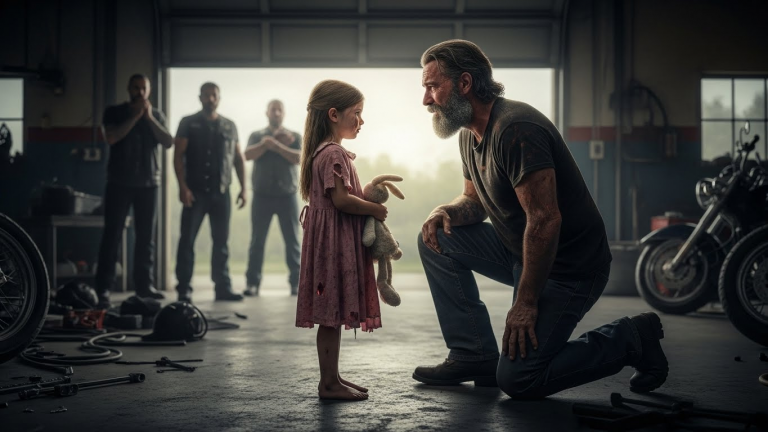
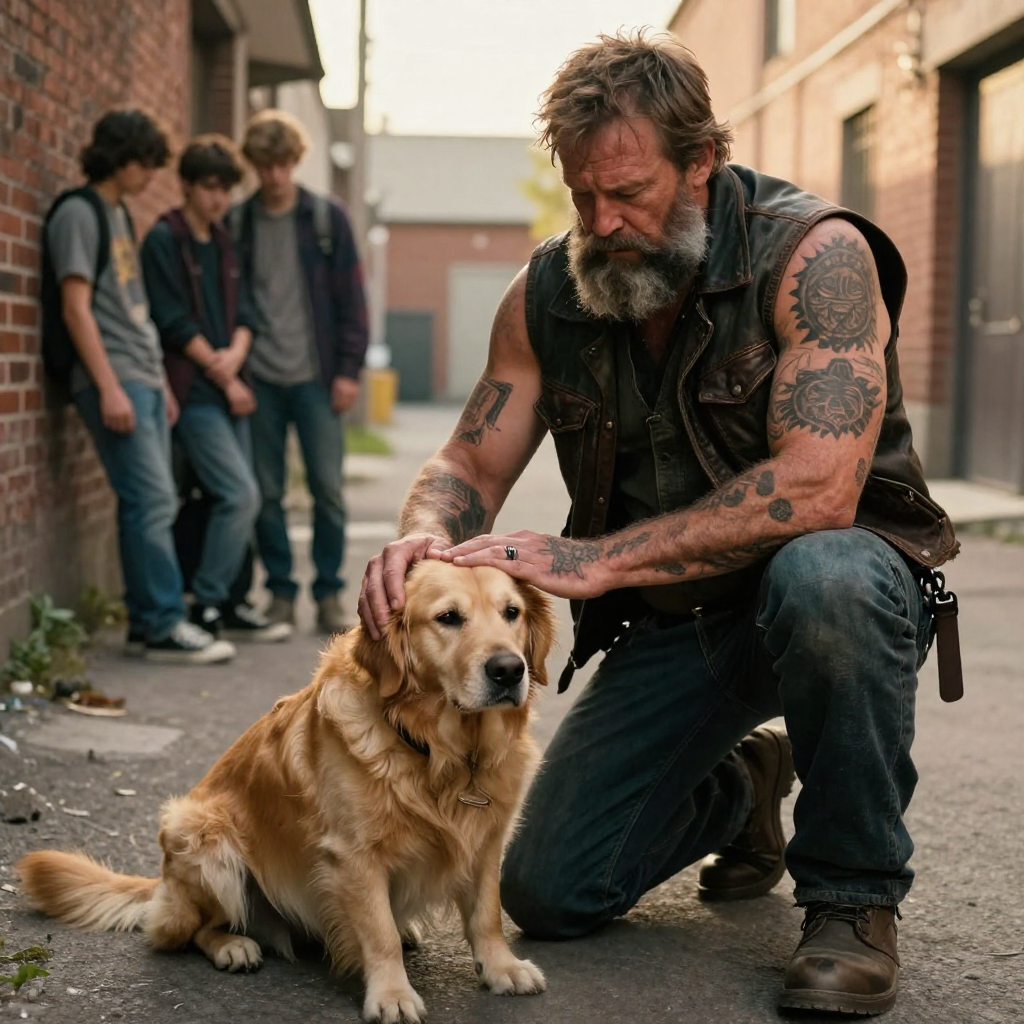
Around the corner, blocking the only exit to the main street, a motorcycle appeared. It wasn’t just a bike; it was a beast of a machine, all black chrome and matte paint, moving with a slow, predatory grace. The rider was massive. He wore a leather vest that looked like it had seen a thousand miles of rain and sun, his arms thick with muscle and covered in ink that faded into the hair on his knuckles.
He didn’t rev the engine to scare them. He didn’t shout. He simply let the bike roll forward, closing the distance, the idle of the engine sounding like a slow, heavy heartbeat.
*Thump-thump. Thump-thump.*
The boys shrank. Physically shrank. The bravado evaporated from their shoulders. The leader, the one with the phone, took a step back, but his heel hit the same wall they had pinned Barnaby against.
The biker killed the engine. The silence that followed was louder than the roar had been. The only sound left was Barnaby’s heavy panting and the soft scuff of a boot hitting the pavement.
The man kicked the kickstand down with a metallic *clank* that sounded like a gunshot in the quiet alley. He swung a leg over the seat and stood up. He had to be six-foot-four. He took off his helmet, revealing a shaved head and a gray goatee, his face set in a mask of absolute, terrifying calm.
He didn’t look at Barnaby yet. He looked at the boys. He looked at the phone still loosely gripped in the leader’s hand. He folded his massive arms across his chest and just stood there, staring them down with eyes that looked like flint.
“Content,” the biker said. His voice was gravel grinding on concrete. It wasn’t a question.
The boy with the phone swallowed hard. I could see his Adam’s apple bob from ten feet away. “We… we were just…”
“Just what?” the biker asked, taking one slow step forward. The sound of his heavy boot on the grit made the boys flinch. “Just recording a blind dog? For what? Likes?”
He took another step. The space between them seemed to vanish. The boys were trembling now. This wasn’t a teacher scolding them. This wasn’t a parent. This was a force of nature they had no script for.
“He’s blind,” the biker said, his voice dropping an octave, becoming dangerously quiet. “He can’t see you mocking him. He can’t see you kicking dirt in his face. He trusts that the world is good. And you’re showing him it isn’t.”
The biker stopped three feet from them. He towered over the leader. He held out a hand, palm up. A silent command.
“The phone,” the biker said. “Give it to me.”
The boy hesitated, his eyes darting to his friends, looking for backup. But his friends were staring at their shoes, praying to become invisible. The leader looked back at the biker, saw the cold fury in those eyes, and realized he had no choice. His hand shook violently as he placed the sleek smartphone into the biker’s calloused palm.
The biker didn’t look at the screen. He didn’t delete the video. He just closed his fist around the phone, his knuckles popping, and held it there, looking the kid dead in the eye.
“You like fear?” the biker asked softly. “You think fear is funny?”
He leaned in, his face inches from the boy’s terrified expression. “Let’s see how funny it is when you’re the one in the corner.”
For a moment, nobody breathed. I stood there, forgotten by the wall, watching justice take a shape I had never expected. Barnaby, sensing the change in the air, stopped whimpering. He lifted his nose, sniffing the air, and for the first time in ten minutes, his tail gave a tiny, tentative wag. He smelled the leather. He smelled the exhaust. But mostly, I think, he smelled the safety.
CHAPTER II
The silence that followed the Biker’s question was heavy, the kind of silence that usually precedes a storm or a collapse. It wasn’t just that the air had gone still; it felt as though the oxygen had been sucked out of the alleyway, leaving the three boys gasping in a vacuum of their own making. Leo, the one who had been holding the phone with such arrogant confidence only moments ago, looked like he was shrinking. His shoulders, previously squared in a display of performative dominance, were now hunched, and his face had turned a sickly shade of gray that matched the damp concrete beneath our feet.
I took a step forward. My hands were still dusted with flour from the morning’s batch of sourdough, the white powder stark against the dark fabric of my apron. I felt a strange, vibrating heat in my chest—a mixture of lingering fear and a newfound, sharp-edged clarity. For too long, I had been the man who watched from the window, the man who sighed at the state of the world but went back to kneading dough because it was safer than speaking up. Standing there, next to this mountain of a man and his idling Harley-Davidson, I realized that my silence had been a kind of complicity.
“He asked you a question,” I said, my voice sounding steadier than I felt. “Is it still funny?”
Leo didn’t look at me. His eyes were locked on the Biker’s boots. The Biker didn’t move. He didn’t have to. He just stood there, holding the thin plastic device in his massive, grease-stained hand as if it were a piece of evidence at a crime scene. He looked down at the screen, and I saw a flicker of something pass over his face—not anger, but a profound, weary disappointment. It was the look of a man who had seen the worst parts of humanity and was tired of being proven right.
“You like to film,” the Biker said, his voice a low rumble that seemed to vibrate in the very marrow of my bones. “You like the way it feels to have an audience. You like the power of the lens. But you don’t understand what power is. You think it’s the ability to make something smaller than you hurt. You think it’s the ability to laugh while something else suffers.”
He turned the phone toward Leo. “Look at it.”
Leo tried to turn his head away, but the Biker’s other hand, large and calloused, moved with surprising speed, not to strike, but to gently, firmly cup the boy’s chin and force him to look at the screen.
“Look at what you’re doing,” the Biker commanded.
I stepped closer, glancing at the screen over the Biker’s shoulder. What I saw made my stomach turn. It wasn’t just a video. It was a live stream. At the bottom of the screen, a red icon blinked ‘LIVE,’ and a scroll of comments was flying by. Some were laughing, some were egging them on, but as the Biker’s face entered the frame, the tone of the comments began to shift. The audience was growing. People were watching this unfold in real-time. This wasn’t a private cruelty anymore; it was public, documented, and rapidly spiraling out of their control.
“This is the irreversible part,” the Biker said, his voice dropping an octave. “You put this out there. You wanted the world to see how tough you are. Well, the world is watching now. But they aren’t seeing a tough guy, Leo. They’re seeing a coward. And that’s a brand that doesn’t wash off.”
Leo’s eyes welled up. The bravado had completely evaporated, replaced by a raw, naked terror. “I—I’ll delete it. I’ll take it down. Just give it back, please.”
“Delete it?” The Biker let out a short, dry laugh that had no humor in it. “You can’t delete the internet. You can’t delete what you’ve done to this dog’s heart. You think because he can’t see you, he doesn’t feel the shape of your malice? He’s blind, not dead.”
The Biker shifted his weight, and for a moment, I saw a flicker of an old wound in his posture—a slight stiffness in his shoulder, a way of standing that suggested he had once carried a much heavier burden than a leather jacket. He looked at Barnaby, who was huddling against the brick wall, his tail tucked so tightly it disappeared between his legs. The dog’s ears were flat, and he was shivering with a violence that made my own heart ache.
“I had a partner once,” the Biker said, his eyes still on Barnaby. The words were quiet, meant more for the dog than for us. “A K9 named Sarge. We worked the units in the city for eight years. He saved my life more times than I can count on these scarred hands. When a flashbang went off too close and took his sight, the department wanted to put him down. They said he was ‘surplus equipment’ once he couldn’t see the threat anymore.”
He finally looked back at the boys, and his eyes were like cold flint. “I spent my entire pension fighting to keep him. I spent three years teaching him how to walk a world made of shadows. He was the bravest soul I ever knew because he walked into the dark every single day without a complaint, trusting me to be his eyes. When I see you—healthy, sighted, privileged kids—using your eyes just to find ways to torment something that can’t fight back… it makes me wonder what the point of all that sacrifice was.”
This was the secret he carried—the weight of a lost companion and the bitterness of a world that discarded the vulnerable. It was why he had stopped his bike. It wasn’t just a random act of heroism; it was a personal reckoning.
I felt the moral weight of the moment pressing down on me. I looked at Leo, Jax, and the third boy, whose name I didn’t even know. They were just kids, really. In another context, they might have been the boys who mowed my lawn or bought donuts after school. If the Biker handed that phone back now, they would run, they would hide, and they would likely harbor a simmering resentment that would eventually turn into more cruelty. But if he kept it, if he let the live stream continue, their lives in this small town were effectively over. Their reputations would be scorched before they even graduated high school.
“What do we do?” I whispered to the Biker.
He didn’t answer me immediately. He was looking at the screen again. The viewer count was climbing. People in our own town were recognizing the alleyway. I saw a comment from the local hardware store owner’s daughter. The public exposure was the trigger—the event that could never be taken back. The boys’ parents would know within the hour. The school board would hear of it by morning.
“You have a choice,” the Biker said to the boys. “I can turn this phone over to the police, and we can let the legal system and the court of public opinion handle the rest of your youth. Or, you can start making it right, right now. And I don’t mean saying sorry. I mean you’re going to stay here. You’re going to look into that camera, and you’re going to tell everyone watching exactly what you did, why you did it, and how you’re going to spend the next six months at the animal shelter cleaning cages.”
Leo choked back a sob. “My dad will kill me.”
“Your dad should have taught you better,” the Biker snapped. “Decide. Now.”
Jax, who had been silent the whole time, suddenly broke. “I’ll do it. I’ll do whatever. Just… don’t call the cops. Please.”
The next twenty minutes were some of the most uncomfortable I have ever witnessed. The Biker held the phone, acting as a grim cinematographer, while the three boys, one by one, confessed to the camera. They were crying, their voices cracking, their faces puffy and red. It was a public shaming that felt both necessary and excruciating to watch. I stood by, a silent witness, realizing that this was the only way to break the cycle. They had to feel the weight of the gaze they had so callously turned on Barnaby.
Once the stream was ended, the Biker didn’t give the phone back. He tucked it into his vest pocket. “I’ll keep this. When I see you’ve completed your first month of service at the shelter, you’ll get it back. If I hear you’ve skipped a day, I’ll drop the footage at the precinct. Now get out of here. Before I change my mind.”
They didn’t need to be told twice. They scrambled out of the alley, running as if the shadows themselves were reaching for them. The sound of their footsteps faded, leaving only the low, rhythmic thrum of the Harley and the heavy breathing of three beings left behind.
The Biker stood still for a long time, his back to me. The persona of the terrifying enforcer seemed to leak out of him, leaving behind a man who looked suddenly very old. He let out a long, shuddering breath and slowly knelt down in the dirt.
Barnaby whined, a high, thin sound. He was still pressed against the wall.
“Hey there, big guy,” the Biker murmured. His voice was completely different now—soft, melodic, and incredibly gentle. It was the voice of a man who spoke to creatures who couldn’t speak back. “It’s okay. The bad air is gone. It’s just us now.”
He didn’t reach out to grab the dog. Instead, he laid his hand flat on the ground about six inches away from Barnaby’s nose. He waited. He stayed perfectly still, ignoring the grime of the alley staining his jeans. He was giving the dog the power to choose, a dignity the boys had stripped away.
Barnaby’s nose twitched. He leaned forward, his neck extending cautiously. He sniffed the Biker’s hand—smelling the leather, the tobacco, the old oil, and the deep, unmistakable scent of another dog. I watched, breathless, as Barnaby’s tail gave a single, hesitant wag. Then another.
The Biker reached out and very slowly stroked the top of Barnaby’s head, avoiding the eyes. “You’re a good boy, Barnaby. You’ve got a heart of gold, haven’t you?”
Barnaby leaned into the touch, his entire body sagging with relief. He let out a deep sigh and finally sat up, resting his head against the Biker’s heavy leather sleeve. In that moment, the giant of a man looked like he might cry. He buried his fingers in the dog’s scruffy fur, scratching behind the ears in a way that spoke of years of practice.
I felt a lump form in my throat. I looked at my own hands, still white with flour. I thought about the bread I made every day—something meant to nourish, to sustain. I realized I had been making bread for people, but I hadn’t been looking at the people themselves. I hadn’t been seeing the Barnabys or the Leos of this world. I had been living in a bubble of yeast and warmth while the cold was just outside my door.
“He needs a vet,” I said softly. “And a bath. And about three of my biggest beef pies.”
The Biker looked up at me and gave a small, weary smile. “The pies sound like a good start. I’ve got a sidecar on the bike. It’s got a harness in it. Used to be Sarge’s favorite place in the world. I think Barnaby might like the wind in his ears.”
“You’re taking him?” I asked.
“I’ve got a blind girl at home named Daisy,” he said, standing up with a grunt. “She’s a golden retriever who lost her sight to cataracts. She’s lonely. I think she needs a brother who understands what it’s like to walk in the dark.”
As he led Barnaby toward the mouth of the alley, the dog walking trustingly beside his massive frame, I realized that the irreversible event wasn’t just the video going live. It was the shift in the atmosphere of our town. The secret was out—not just the boys’ cruelty, but the fact that we were all being watched by our own consciences.
I walked back toward my bakery, the smell of the Harley’s exhaust lingering in the air. I had work to do. I had to face the town tomorrow, to answer the questions about what happened in the alley. But for the first time in a long time, I didn’t feel like hiding behind the counter.
I stopped at the edge of the sidewalk and watched as the Biker carefully lifted Barnaby into the sidecar. The dog looked confused for a second, then his nose began to work furiously, catching the scents of the street. The Biker hopped on, the engine roared to life, and with a wave of a gloved hand, they pulled away into the late afternoon sun.
I stayed there until the sound of the engine was gone, replaced by the normal, everyday sounds of the street. But nothing felt normal anymore. The world felt larger, more dangerous, and yet, somehow, more hopeful. I looked down at my apron and began to brush the flour away, one stroke at a time, preparing myself for whatever was coming next. Because I knew that while the video might be deleted or buried, the memory of that silence—and the man who broke it—would never leave me.
CHAPTER III
The digital world doesn’t bleed, but it tears things apart just as effectively. By Monday morning, the video Elias had forced the boys to record wasn’t just a local curiosity; it was a contagion. It had been ripped, reposted, and reframed a thousand times. In some circles, Elias was a folk hero, the ‘Biker Guardian.’ In others, he was a violent vigilante who had kidnapped and psychologically tortured three ‘innocent’ minors. My bakery, usually a sanctuary of yeast and sugar, felt like it was standing in the path of a slow-moving hurricane. The air was thick. The customers who did come in didn’t look me in the eye. They looked at their phones, then at me, then back at their phones. Silence wasn’t a comfort anymore. It was a weapon being sharpened.
I spent the early hours kneading dough, but my hands were shaking. Every chime of the bell on the door made my heart jump into my throat. I kept thinking about Barnaby, the blind dog, now safe in Elias’s garage, oblivious to the fact that his rescue had set the town on fire. The internet’s revenge is a blind thing; it doesn’t care who it hits as long as it hits someone. By ten o’clock, the first stone was thrown—not literally, but a digital one. Someone had posted my address, my business license, and a grainy photo of me standing next to Elias during the confrontation. The caption read: ‘The accomplice. This man watched while a giant threatened children. Boycott the blood-bread.’
Then came the black SUVs. They didn’t park; they occupied the curb. Three of them, sleek and menacing against the weathered brick of my shop. The man who stepped out of the lead vehicle was Arthur Vance. He was the kind of man who owned the air he breathed—a developer, a donor, and the father of Leo, the boy who had held the leash. He didn’t look like a grieving father. He looked like a man who had been inconvenienced and was now going to delete the inconvenience from the map. He walked into my bakery with two men in suits who had the hollow, hungry eyes of career litigators. They didn’t buy coffee. They stood in the center of the room, and the remaining customers vanished like smoke.
‘Julian, isn’t it?’ Vance asked. He didn’t wait for an answer. He began to pace, his leather shoes clicking on my tiled floor. ‘I’ve lived in this town for forty years. I’ve built the schools my son attends. I’ve funded the parks where that… creature… was found. And yet, I wake up to find my son’s face on a global hit list because a degenerate on a motorcycle and a baker with a guilty conscience decided to play judge and jury.’ He stopped in front of the counter. His presence was a physical weight, pressing the air out of my lungs. He wasn’t shouting. He was worse. He was calm.
‘It was a mistake, Arthur,’ I said, my voice sounding thin and foreign to my own ears. ‘The boys were hurting a helpless animal. They were filming it for sport. Elias just wanted them to take responsibility.’ Vance laughed, a dry, metallic sound. ‘Responsibility? My son is seventeen. He’s a child. What you and your pet thug did is a felony. It’s coercion, unlawful restraint, and assault of a minor. I’m not here to talk about a stray dog, Julian. I’m here to talk about the end of your life in this town.’ He leaned in closer, the smell of expensive cologne and cold ambition wafting off him. ‘I know why you’ve been so quiet all these years. I know why you moved to this corner of the world and hid behind a flour sack.’
This was the moment the floor dropped out. My secret, the one I had buried under a decade of pre-dawn shifts and sourdough starters, was being dragged into the light. Ten years ago, I wasn’t a baker. I was a foreman for Vance’s construction firm. I had seen the structural shortcuts on the community center project. I had seen the substandard steel. I had seen the reports, and when the roof collapsed during the winter storm—mercifully at night, when the building was empty—I had stayed silent. Vance had paid for that silence, a ‘severance package’ that bought this very bakery. I wasn’t a moral man; I was a man who had been bought. And now, the man who owned my past was here to collect the interest.
‘One word from me, Julian, and the police don’t just look at what happened in that alley. They look at where the money for this oven came from. They look at the old safety logs,’ Vance whispered. ‘All you have to do is sign this statement. It says you were intimidated by the biker. It says he forced you to participate. It says he threatened you too. We make him the monster, and you go back to being the quiet baker. Do we have a deal?’ He slid a document across the flour-dusted counter. The pen he offered was heavy, gold, and felt like a lead pipe in my hand. I looked at the paper, then at the door. Outside, a small crowd had gathered. They weren’t there for bread. They were waiting for a show.
I looked at my hands, white with flour. I thought about the way Elias had held Barnaby—with a tenderness that didn’t fit his scarred knuckles. I thought about the way I had felt when I finally stood up in that alley, the feeling of the air actually reaching my lungs for the first time in a decade. If I signed this, I would be safe. I would keep my shop. I would keep my silence. But I would be dead inside. I would be a ghost haunting a bakery. I looked up at Vance, seeing the predatory gleam in his eyes. He thought he knew me. He thought he had bought me once, so he owned me forever. But he didn’t realize that the silence had become a prison I was tired of living in.
‘I’m not signing it, Arthur,’ I said. The words were small, but they felt like boulders. Vance’s face didn’t change, but his eyes narrowed. ‘Think very carefully, Julian. You have everything to lose.’ I felt a strange surge of heat in my chest. ‘I already lost it ten years ago. I’m just starting to get it back.’ He stepped back, a sneer curling his lip. ‘Fine. We’ll do it the hard way.’ He turned to his lawyers, gesturing toward the door. ‘Call the Sheriff. We’re filing the complaint now. And call the news crews. I want this place boarded up by sunset.’ He started to walk out, the crowd outside parting for him like the Red Sea.
Just as he reached the door, it swung open. It wasn’t Elias. It was a boy. He was small for his age, wearing a hoodie that was two sizes too big, his face pale and eyes rimmed with red. It was Toby, the third boy from the alley. The one who hadn’t spoken, the one who had just watched. He stood in the doorway, blocking Vance’s exit. ‘Move, kid,’ Vance snapped, not recognizing him. Toby didn’t move. He reached into his pocket and pulled out a phone—not the one Elias had taken, but another one. ‘I recorded it too,’ Toby said, his voice trembling but audible to everyone on the sidewalk. ‘I recorded the whole thing. From the beginning.’
Vance froze. ‘What are you talking about?’ Toby looked at me, then at the crowd, then back at Vance. ‘Leo didn’t just find the dog. He brought the gasoline. He told us it would be funny. He told us if we didn’t help, he’d tell everyone my dad was a drunk.’ The silence that followed was absolute. The lawyers shifted uncomfortably. The crowd outside pressed closer to the windows. Toby held up the phone. ‘The video the biker made… that was just the apology. My video shows what Leo was going to do before the biker stopped him. It shows Leo laughing while he poured the liquid.’
Vance’s face went from pale to a deep, bruised purple. ‘Give me that phone, boy,’ he growled, reaching out. But before he could touch him, a hand the size of a dinner plate settled on Vance’s shoulder. Elias had arrived. He didn’t come in a car; he had walked, his presence massive and immovable. He didn’t look at Vance. He looked at Toby. ‘You’re doing the right thing, son,’ Elias said softly. Then, he looked at me and nodded. It wasn’t a nod of triumph; it was a nod of recognition. We were both in the storm now, but at least we were standing on our own feet.
Suddenly, the sound of a siren cut through the tension. A white cruiser with ‘County Sheriff’ on the side pulled up. But it wasn’t the local deputy who usually took my coffee. It was Sheriff Miller herself, a woman known for being as sharp as a razor and twice as cold. She stepped out, her eyes taking in the crowd, the black SUVs, and the trembling boy with the phone. She didn’t go to Vance, even though he began shouting about his rights and his son. She walked straight to Toby. ‘I heard there’s some evidence that hasn’t been seen yet,’ she said, her voice echoing in the quiet street. She took the phone from Toby’s hand as if it were a sacred relic.
Vance tried to intervene, his lawyers flanking him. ‘This is a private matter, Sheriff! This boy is being coerced!’ Miller didn’t even look at him. She watched the screen of the phone for three minutes. Her face, usually a mask of professional indifference, softened into a look of pure, unadulterated disgust. She handed the phone to one of her deputies. ‘Take the boy to the station. Secure that device. And someone find Leo Vance. Now.’ The shift in power was instantaneous. It was like the air had been sucked out of a vacuum. Vance, the man who owned the town, suddenly looked very small in his expensive suit. He looked at me, his eyes full of a new kind of hatred—the hatred of a man who knows he has lost his leverage.
The Sheriff turned to me. ‘Mr. Julian, I think we’re going to need to have a very long talk about some old building records. And you,’ she said, looking at Elias, ‘you’re not off the hook for the intimidation. But right now, I have a animal cruelty case to handle.’ She signaled her deputies, and they began to clear the area. Vance was escorted to his SUV, no longer a king, just a man under investigation. The crowd began to disperse, their phones still out, but the narrative was shifting. The ‘Biker Guardian’ wasn’t a monster; he was a shield. And the ‘innocent children’ were something else entirely.
I sat down on the flour-dusted stool behind my counter. My legs wouldn’t hold me anymore. Elias walked over and leaned his elbows on the glass case, looking at the rows of cooling loaves. ‘Rough morning?’ he asked, his voice a low rumble. I looked at him, then at the empty space where Vance had stood. ‘He was going to ruin me, Elias. He knew about the community center.’ Elias nodded slowly. ‘He probably knew about a lot of things. Men like that build their houses on other people’s secrets. But secrets are like bad foundations. Eventually, the whole thing comes down.’ He reached out and tapped the glass. ‘Toby came to see me this morning. Before he came here. He was scared. I told him the truth is the only thing that doesn’t change when you stop looking at it.’
I looked out the window. The black SUVs were gone. The street was quiet again, but it was a different kind of quiet. It wasn’t the silence of things being ignored; it was the silence of things being settled. I knew the coming weeks would be a nightmare. There would be depositions, investigations into my past, and the very real possibility that I would lose my bakery anyway. My deal with the devil was officially over, and the bill was coming due. But as I looked at Elias, and thought about Barnaby wagging his tail in a safe garage, I realized I didn’t care. For the first time in ten years, the bread I smelled in my own shop didn’t smell like regret.
‘I’m going to have to tell them everything,’ I said, more to myself than to him. ‘About the fire, the shortcuts, the money.’ Elias straightened up, his leather jacket creaking. ‘Then tell them. It’s a heavy load to carry alone, Julian. You’ve been carrying it for a decade. Put it down.’ He turned to leave, but stopped at the door. ‘And by the way. I’ll need two dozen rolls. Barnaby’s got an appetite, and I think he earned a treat.’ I smiled—a real, genuine smile that reached my eyes. ‘On the house, Elias. On the house.’ As he walked out into the sunlight, I reached for my ledger. Not to check my profits, but to start writing down the truth. The climax had passed, the explosion was over, and now all that was left was the ash. But from ash, you can grow something new. You just have to be willing to clear the ground first.
CHAPTER IV
The bakery felt hollow. Not just because the ovens were cold, the flour dust settling on the silent mixers, but because the heart had been ripped out. The heart I’d tried to bury for so long, only to have it claw its way back to the surface. I stood amidst the chairs stacked on tables, the lingering scent of cinnamon and regret hanging heavy in the air, and wondered if this was what true freedom felt like: utterly, devastatingly empty.
The news cycle, predictably, had devoured us all. Arthur Vance’s empire was crumbling, his name now synonymous with corruption and cruelty. Leo, Jax, and even Toby were plastered across every screen, their faces masks of shame or defiance, depending on the hour. Elias, the reluctant hero, was fielding interview requests, his gruff voice a surprising balm to the town’s collective anxiety. And me? I was the ghost in the machine, the silent partner turned state’s witness, the baker who finally dared to speak.
The public reaction was a messy, contradictory thing. Some hailed me as a courageous truth-teller, finally breaking the conspiracy of silence that had gripped our town for so long. Others saw me as a self-serving opportunist, trying to save my own skin after years of complicity. The online forums were a warzone, my name a constant battle cry. The bakery’s Yelp page was a wasteland of one-star reviews and accusations. Even people I thought I knew crossed the street when they saw me coming.
It wasn’t just the court of public opinion that was weighing me down. The official investigation had begun, and every day brought new questions, new demands, new reminders of my past failures. My lawyer, a weary woman named Sarah, kept telling me to stay strong, to focus on the bigger picture, but the bigger picture felt a million miles away when I was staring at the cracks in the bakery’s floor, wondering how I was going to pay the bills.
The first blow came in the form of a notice: pending the investigation, my business license was suspended. The bakery was officially closed. I taped the notice to the front door, the official seal mocking my attempts at honesty. As I walked away, I saw Mrs. Davison, my oldest customer, standing across the street, her face etched with disappointment. She didn’t wave, didn’t smile, just turned and walked away.
That night, Elias found me sitting in the dark, a bottle of cheap whiskey my only companion. He didn’t say much, just sat down beside me and handed me a bag of takeout. “Didn’t figure you’d be cooking tonight,” he said, his voice rough but kind. We ate in silence, the only sound the distant hum of traffic. After a while, he said, “You did the right thing, Julian.” I wanted to believe him, but the words felt hollow, like a pat on the back for a job that had destroyed everything I held dear.
Barnaby was recovering well. Elias had taken him in, and the dog seemed to thrive in his care. He was still blind, still scarred, but he had a new home, a new purpose. I visited them every day, finding a strange solace in the dog’s unwavering trust. He didn’t care about my past, about the accusations and the investigations. He just wagged his tail and licked my hand, a reminder that forgiveness was possible, even when it felt impossible.
Then came the second blow, the one I hadn’t anticipated. My bank called to inform me that my loan was being called in. Apparently, Arthur Vance had been a silent partner in the bank, and his influence still lingered, even in his downfall. I tried to negotiate, to plead, but it was no use. The bank wanted their money, and they wanted it now. I was facing bankruptcy, the loss of everything I had worked for, everything I had sacrificed for.
I didn’t tell Elias. I was ashamed, humiliated. I didn’t want him to see me as a failure, as the same weak man who had allowed Vance to manipulate him for so many years. I started avoiding him, making excuses, retreating back into my shell of silence.
One evening, Sarah called. “Julian, I need you to come down to the office. There’s something you need to see.” I hesitated, dread filling my stomach. “What is it?” I asked, my voice barely a whisper. “Just come,” she said. “It’s important.”
Her office was small and cluttered, filled with stacks of files and legal documents. She led me to a conference room, where a young woman was waiting. “This is Emily,” Sarah said. “She has something to tell you.” Emily looked nervous, her hands trembling as she handed me a USB drive. “This is a copy of Arthur Vance’s financial records,” she said. “I used to work for him. I couldn’t stand by and watch him destroy more lives.” I looked at Sarah, confused. “What does this have to do with me?” Sarah sighed. “It shows that Vance was systematically laundering money through shell corporations, using your bakery as a front.”
The realization hit me like a punch to the gut. Vance hadn’t just been protecting his own interests; he had been using me, using my bakery, to hide his crimes. I had been a pawn in his game, a patsy for his corruption. The anger rose inside me, a burning rage that threatened to consume me.
That night, I went looking for Elias. I found him at the local bar, nursing a beer and staring into space. I sat down beside him, the silence stretching between us like a taut wire. “I know why you’ve been avoiding me,” he said, his voice low. “Sarah told me about the bank. About Vance.”
I didn’t say anything, just looked down at my hands. “I’m sorry,” I said finally. “I didn’t want you to see me like this. As a failure.”
Elias put his hand on my shoulder, his grip firm and reassuring. “You’re not a failure, Julian,” he said. “You’re a survivor. And you’re not alone.”
That was when I found out. That Toby, wracked with guilt, had told his parents everything. His parents, disgusted by what they heard, had hired a forensic accountant to investigate Vance’s finances. Emily was that accountant’s intern. She’d risked everything to get us the evidence.
We spent the next few weeks working with Sarah and the authorities, piecing together the puzzle of Vance’s financial empire. The evidence was overwhelming, undeniable. Vance was arrested, his empire crumbling around him. Leo, facing mounting charges, finally agreed to cooperate with the investigation in exchange for a lighter sentence. Jax, abandoned by his parents, disappeared, rumored to have fled the state.
The bakery remained closed, but the cloud of despair began to lift. People started stopping me on the street, offering words of encouragement, apologies for their earlier judgments. Mrs. Davison brought me a loaf of her homemade bread, her eyes filled with tears. “I’m so sorry, Julian,” she said. “I should have known better.”
The investigation dragged on, each day bringing new revelations, new challenges. But I wasn’t alone anymore. Elias was always there, his quiet strength a constant source of support. Barnaby, now a fixture in our lives, greeted me with unwavering enthusiasm, his tail wagging furiously.
One afternoon, as we were sitting in Elias’s backyard, watching Barnaby chase a ball, a car pulled up to the curb. A woman got out, her face familiar. It was Claire Vance, Arthur’s wife.
She walked towards us, her expression unreadable. “I need to talk to you,” she said, her voice barely above a whisper. Elias and I exchanged glances, unsure of what to expect.
“Arthur is gone,” she said, her voice cracking with emotion. “He’s lost everything. His money, his power, his reputation. Even his family.”
I didn’t say anything, just waited for her to continue. “I know what he did to you,” she said, her eyes filled with tears. “I know he used you, manipulated you, ruined your life.”
“Why are you telling me this?” I asked, my voice cold. “Because I’m sorry,” she said. “I’m sorry for everything he did. I’m sorry for the pain he caused.”
She reached into her purse and pulled out a check. “This is all I have left,” she said. “It’s not much, but I want you to have it. To help you rebuild your life.”
I looked at the check, then back at Claire. Her face was etched with exhaustion and regret. I could see the toll that Arthur’s actions had taken on her, the years of living in his shadow, of turning a blind eye to his misdeeds.
I shook my head. “I can’t take your money,” I said. “It wouldn’t be right.”
“Please,” she said. “I want to do something, anything, to make amends.”
I hesitated, then took the check. “Thank you,” I said. “I appreciate it.”
She turned to leave, then stopped. “There’s one more thing,” she said. “Arthur told me something before he was arrested. About the construction scandal. About your involvement.”
My heart sank. I had hoped that chapter of my life was closed, that I had paid my debt to society. But apparently, the past wasn’t finished with me yet.
“He said that you were the one who signed off on the faulty materials,” she continued. “That you knew about the shortcuts, the safety violations.”
I closed my eyes, the memories flooding back. The pressure from Vance, the fear of losing my job, the rationalizations I had made to justify my actions. “It’s true,” I said, my voice barely a whisper. “I was involved. I knew what was happening, and I didn’t stop it.”
“He has evidence,” she said. “Documents, emails, recordings. He’s planning to use them to clear his name, to make you the scapegoat.”
I felt a chill run down my spine. Vance wasn’t finished with me yet. Even from behind bars, he was still trying to control my life, to destroy me.
Claire looked at me, her eyes filled with pity. “I’m sorry, Julian,” she said. “I wish there was something I could do.”
She turned and walked away, leaving me standing in the backyard, the check clutched in my hand, the weight of my past crushing me once again.
I looked at Elias, his face grim. “What are you going to do?” he asked.
I didn’t know. But I knew one thing: I wasn’t going to let Arthur Vance win. I wasn’t going to let him silence me again. I was going to face my past, no matter how painful, no matter how costly. I was going to speak the truth, even if it destroyed me.
The check? I gave it to Toby’s parents to help with his therapy. It felt like the right thing to do.
CHAPTER V
The bakery was gone. Not just closed, but gone. Sold to a developer who, I heard, was planning condos. Condos. The irony wasn’t lost on me; Arthur Vance’s empire, built on shoddy construction, would be replaced by…more construction. Maybe that was the lesson, the circle never really broke, it just kept turning. I was staying at Elias’s place. It wasn’t big, just a small spare room, but it was safe. Barnaby, of course, was with us, curled up on a dog bed that took up half the floor. He seemed content, oblivious to the storm that had upended my life. Or maybe he wasn’t oblivious. Maybe he sensed the quiet despair that had settled in my bones.
Elias tried to be cheerful, but I saw the worry in his eyes. He’d lost his K9 partner years ago, and I think he feared losing me too. “We’ll figure it out, Julian,” he’d say, clapping me on the back. “You’re a good baker. People need bread. We’ll find a new oven.”
But it wasn’t about the bakery. It was about the weight of it all. The years of silence, the guilt, the fear. Vance hadn’t let go. Claire’s warning hung in the air like smoke. He had evidence, she’d said. Enough to bury me. Sarah, my lawyer, was doing her best, but the truth was, I’d made it easy for him. My signature was on those documents, even if I’d signed them under duress. I was complicit. And now, the bill was coming due.
The phone rang. It was Sarah. Her voice was grim.
“Julian, they’ve filed the charges. Conspiracy to commit fraud, obstruction of justice… it’s bad.”
I closed my eyes. “What’s the evidence?”
“They have the original contracts, Julian. The ones you signed. And Vance is claiming you were the mastermind. That you orchestrated the whole thing.”
“That’s a lie!”
“I know, Julian, but it’s his word against yours. And he has the money to make it stick.”
“What are my options?”
There was a long pause. “We can fight it, Julian. But it’ll be a long, expensive battle. And I can’t guarantee we’ll win. Or… you could take a plea bargain. Admit guilt, cooperate with the investigation, maybe get a reduced sentence.”
A reduced sentence. Jail. The thought sent a shiver down my spine. After everything, after finally telling the truth, I was going to end up in jail.
“I need time to think, Sarah.”
“I understand, Julian. But don’t wait too long. Vance isn’t going to disappear.”
I hung up the phone and stared out the window. The sky was gray, mirroring the landscape of my soul. Elias put a hand on my shoulder. I shrugged him off. I knew he was trying to help, but I felt suffocated by his concern. I needed to be alone.
“I’m going for a walk,” I said, grabbing my jacket. “With Barnaby.”
Elias didn’t say anything. He just nodded, his eyes full of understanding. I clipped Barnaby’s leash on and we stepped out into the cold. The park was deserted. The trees were bare, their branches reaching up like skeletal fingers. Barnaby sniffed at the ground, his tail wagging tentatively. He didn’t care about condos or court dates or conspiracies. He just wanted to walk.
I sat down on a bench and closed my eyes. The weight of it all threatened to crush me. I could run. Disappear. Start over somewhere new. But I knew I couldn’t. I’d spent years running from my past, and it had finally caught up with me. It was time to face the music. Time to pay the price.
PHASE 1
The first few days after Sarah’s call were a blur. I barely slept, barely ate. Elias tried to coax me, but I was lost in my own head, replaying every decision, every mistake. I started drinking again. Just a little at first, a glass of wine with dinner, but it quickly escalated. Soon, I was sneaking shots of whiskey in the morning, just to numb the edges.
One evening, Elias found me passed out on the couch, an empty bottle of bourbon on the floor. He didn’t say anything. He just cleaned me up, put me to bed, and sat by my side until I woke up. When I finally opened my eyes, his face was etched with worry. I hated myself for putting him through this.
“I’m sorry,” I mumbled. “I didn’t mean to…”
“I know,” he said softly. “But you can’t keep doing this, Julian. You’re going to kill yourself.”
His words hit me like a punch to the gut. He was right. I was spiraling. I was using the alcohol to escape, to avoid the inevitable. But it wasn’t working. It was just making things worse. I looked at Elias, his face full of love and concern, and I knew I couldn’t do this to him. Or to myself.
“I’ll stop,” I said. “I promise.”
He didn’t say anything. He just looked at me, his eyes searching mine. I knew he was waiting for me to mean it. And I did. I really did. I was tired of running. Tired of hiding. Tired of being afraid.
The next morning, I poured the rest of the bourbon down the drain. It felt like a small act of defiance, a tiny victory in a war against myself. I still didn’t know what I was going to do about Vance, about the charges, but I knew I couldn’t face it drunk. I needed to be clear-headed. I needed to be strong.
I called Sarah. “I want to fight it,” I said. “I’m not going to let Vance bury me.”
There was a moment of silence. “Are you sure, Julian? It’s going to be tough.”
“I’m sure,” I said. “I’m not guilty. Not of what he’s accusing me of, anyway. I made mistakes, yes, but I didn’t orchestrate anything. I was just trying to survive.”
“Okay,” she said. “Then we fight. I’ll file a motion to dismiss. We’ll see what the judge says.”
I hung up the phone feeling a flicker of hope. It was going to be a long road, but at least I was on it. I was no longer running. I was standing my ground.
PHASE 2
The legal battle was grueling. Sarah worked tirelessly, digging into Vance’s finances, uncovering more and more evidence of his corruption. Emily, the accountant who had leaked the original documents, agreed to testify. She was terrified, but she knew it was the right thing to do. Leo, Vance’s son, also agreed to cooperate with the prosecution. He was trying to make amends for his past actions, to atone for the hurt he had caused.
Vance, of course, fought back. He used his money and influence to try to discredit us, to smear my name. He hired a team of high-powered lawyers who filed motion after motion, trying to delay the trial, to wear us down. The media was relentless. They dug up every detail of my past, every mistake I had ever made. I was a pariah, a symbol of corruption and greed.
Elias was my rock. He stood by me through it all, offering support, encouragement, and a much-needed distraction. We spent hours walking Barnaby in the park, talking, laughing, just trying to forget the storm that was raging around us. He reminded me that I wasn’t alone, that there were people who believed in me, who cared about me.
One afternoon, Claire Vance came to visit me. She looked tired, defeated. Her eyes were red from crying. “I’m so sorry, Julian,” she said. “For everything. For what Arthur did to you, to your bakery. To everyone.”
“Why are you here, Claire?” I asked.
“I wanted to apologize,” she said. “And to tell you… Arthur is getting desperate. He’s afraid of going to jail. He’s capable of anything.”
“What do you mean?”
“I don’t know exactly,” she said. “But please, Julian, be careful. He’s not going to let you win.”
Her words sent a chill down my spine. Vance wasn’t just going to let me go to jail. He was going to try to destroy me. I had to be ready.
PHASE 3
The trial was a circus. The courtroom was packed with reporters, spectators, and lawyers. Vance sat at the defense table, looking smug and confident. He seemed to enjoy the attention, the power. I sat opposite him, feeling a knot of anxiety tighten in my stomach.
The prosecution presented their case first. Emily testified about Vance’s fraudulent accounting practices. Leo testified about his father’s manipulation and control. Sarah presented the contracts, the documents, the evidence that proved Vance was the mastermind behind the construction scandal.
Vance’s lawyers tried to discredit the witnesses, to cast doubt on the evidence. They painted me as a greedy opportunist who had used Vance to get ahead. They argued that I was the one who had orchestrated the scheme, that Vance was just a victim.
I took the stand. I told the truth. I admitted my mistakes, my complicity. I explained how Vance had pressured me, how I had been afraid. I didn’t try to excuse my actions, but I didn’t let Vance off the hook either. I told the jury everything. And as I spoke, I felt a weight lifting off my shoulders. The truth was out there. It was up to them to decide what to do with it.
The closing arguments were fiery. The prosecutor argued that Vance was a corrupt businessman who had used his power and influence to exploit others. Vance’s lawyer argued that I was a liar and a manipulator who was trying to save his own skin.
The jury deliberated for three days. Three days of agonizing waiting. Three days of wondering if I was going to spend the rest of my life in jail.
Finally, the verdict came. Guilty. Vance was found guilty on all counts. Conspiracy to commit fraud, obstruction of justice, tax evasion. The courtroom erupted in cheers. I sat there, stunned. It was over. I had won.
But the victory felt hollow. Vance was going to jail, yes, but I was still guilty of something. I had still been complicit. I had still made mistakes. And those mistakes had consequences.
PHASE 4
The judge sentenced Vance to fifteen years in prison. It was a victory, but it didn’t erase the past. It didn’t bring back the bakery. It didn’t undo the damage that had been done. After Vance’s sentencing, I still had my own reckoning. While the jury didn’t convict me of the charges Vance tried to pin on me, my previous testimony still stood. I was guilty of misusing funds, of covering up construction irregularities. In the end, the judge sentenced me to community service. I had to do 500 hours. It wasn’t jail, but it was a consequence. It was accountability.
I started my community service at the local animal shelter. At first, I was resentful. I felt like I was being punished for telling the truth. But as I spent more time at the shelter, as I cared for the animals, as I saw their resilience, their unconditional love, something shifted inside me.
I started to understand that punishment wasn’t the point. Redemption was. I wasn’t just paying my debt to society. I was making amends for my past actions. I was helping others. And in doing so, I was helping myself.
Barnaby came with me to the shelter every day. He was a natural. The other dogs loved him. The cats rubbed against his legs. He brought comfort and joy to everyone he met.
One day, I was cleaning out a kennel when I saw a familiar face. It was Toby, the teenager who had filmed the video of Leo and Jax abusing Barnaby. He was volunteering at the shelter, too.
We looked at each other for a long moment. There was awkwardness, but also understanding.
“I’m sorry,” he said softly. “For what happened. For everything.”
“It’s okay, Toby,” I said. “You did the right thing. You told the truth.”
“It doesn’t feel like it,” he said. “Jax is gone. His parents are a mess. Leo’s in trouble. I feel like I ruined everything.”
“You didn’t ruin everything, Toby,” I said. “You exposed the truth. And that’s always a good thing. Sometimes, the truth hurts. But it’s always better than lies.”
We worked side by side in silence for a while. Then, Toby spoke again.
“What are you going to do now, Julian?”
“I don’t know,” I said. “Maybe I’ll open another bakery. Maybe I’ll just keep volunteering here. I haven’t decided yet.”
“I think you should open another bakery,” he said. “Your bread was really good.”
I smiled. “Thanks, Toby. That means a lot.”
I never opened another bakery. The thought of it, the pressure, the memories… it was too much. Instead, I kept volunteering at the animal shelter. I found purpose in caring for the animals, in giving them a safe and loving home. I found peace in the quiet moments, in the simple acts of kindness.
Elias and I stayed together. Our relationship deepened, strengthened by the trials we had faced. He was my family, my friend, my rock. We didn’t talk about the past much anymore. We focused on the present, on the future. We were both broken, in our own ways. But we were broken together. And that made all the difference.
Jax never returned. Leo had to make restitution and do his community service as well. He still visits Barnaby at the shelter sometimes, and I think he is going to be okay.
The condos were built on the site of my old bakery. I drove past them once, but I didn’t stop. I didn’t need to. The past was the past. It was over. I had paid my debt. I had faced my demons. And I had survived.
I learned that truth has a price. It can cost you everything you thought you valued: a business, a reputation, a comfortable lie. But in the end, the truth is the only thing that sets you free. Even if that freedom is just a quiet acceptance of what cannot be changed.
Barnaby and I still go to the shelter every day. He’s getting old now, his fur is graying, his steps are slower. But his tail still wags when he sees me. And that’s enough. That’s more than enough.
Sometimes, late at night, I still think about the bakery. I remember the smell of the bread, the warmth of the oven, the faces of my customers. It was a good life, in many ways. But it wasn’t the only life. And it wasn’t the most important one.
I had found a new life, a new purpose. A life of service, of compassion, of truth. It wasn’t easy, but it was worth it. Because in the end, it’s not what you have that matters. It’s what you do with it. It’s how you use your life to make the world a better place. Even if it’s just one dog, one cat, one person at a time.
I think back to the day I saw Elias protecting Barnaby, the day that set everything in motion. If I could go back, would I do anything differently? Would I stay silent? Would I protect my bakery, my reputation? I don’t think so. Because in that moment, I saw something that I had been missing for a long time. I saw courage. I saw compassion. I saw truth. And I knew that I wanted to be a part of it.
The scars of the past may never fully fade, but they remind us of what we’ve overcome, and that sometimes, the greatest freedom comes from facing the things we fear most.
The most important thing I learned wasn’t about baking, but about bravery, truth, and the quiet redemption found in helping those who can’t help themselves.
That evening, Barnaby leaned against my leg, his blind eyes staring out into a world he could never see, but somehow, understood better than I ever had.
That was the end of it all.
In the quiet of the shelter, surrounded by the soft snores of rescued animals, I finally understood: some debts can only be repaid with a lifetime of kindness. END.