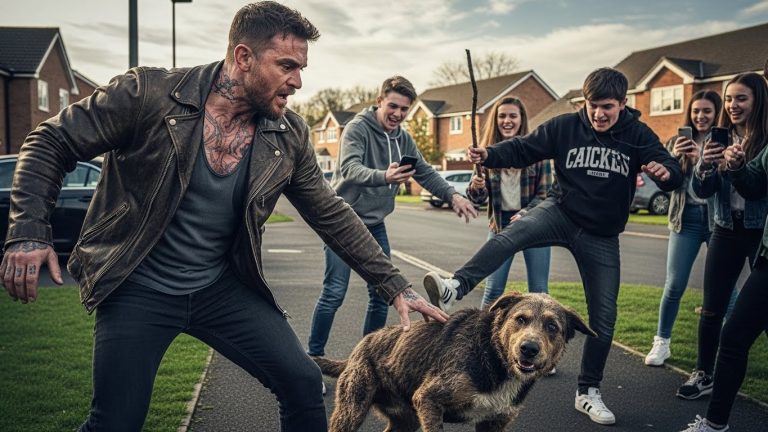
HE STOOD ON THE MANICURED LAWN WATCHING THE SMOKE CURL FROM THE VENTS, AND WHEN I HEARD THE DESPERATE SCRATCHING FROM THE BASEMENT WINDOW, HE CALMLY TURNED THE DEADBOLT TO LOCK THEM INSIDE. I screamed for the key, but he just dusted a speck of ash off his pristine jacket and whispered, ‘It’s a mercy, kid—don’t interfere with natural selection.’ I didn’t think about the consequences; I slammed my shoulder into his chest, shattered the door frame, and crawled into the suffocating black heat, only to discover that the fire wasn’t an accident—and what he was really trying to burn was the only evidence that could put him away for good.
The first thing I noticed wasn’t the smoke, but the silence. Fire is supposed to roar, isn’t it? That’s what they tell you in movies. But this fire, the one eating the foundation of the old Victorian house next door, was hissing. It sounded like a snake moving through dry leaves. Then came the laugh.
It wasn’t a maniacal cackle. It was a dry, dismissive chuckle, the kind a man makes when he reads a typo in the morning paper. I was standing on my porch, coffee cup frozen halfway to my mouth, watching the gray plumes spiral up from the basement vents of 42 Oak Street. And there he was. Silas. The neighborhood association president. The man who measured grass height with a ruler and threatened to sue anyone whose trash bins sat out past 6:00 PM.
He was standing by the bulkhead doors—the slanted wooden storm doors that led directly into the basement. The wood was already warping from the heat beneath, paint blistering into white bubbles. I heard it then. The sound that turned my blood into ice water. High-pitched yelping. Frantic scratching against wood. There were lives down there.
“Silas!” I shouted, dropping my mug. It shattered on the concrete, scalding my ankles, but I didn’t feel it. I bolted across the strip of lawn separating our properties. “The dogs! Open the door!”
Silas looked at me. He didn’t look at the smoke. He didn’t look at the blistering paint. He looked me dead in the eye, his face composed of that terrifying, hollow calm that only the truly arrogant possess. He reached into his pocket, pulled out a brass key, and instead of unlocking the padlock on the bulkhead, he snapped it shut. I heard the click. It sounded louder than the fire.
“Don’t be dramatic, Arthur,” he said. His voice was steady, infuriatingly reasonable. “It’s structural. If I open that, the oxygen feeds the draft. The whole house goes up. It’s fire safety 101.”
“There are puppies in there!” I was screaming now, grabbing the chain-link fence. “I can hear them!”
“They’re strays,” he said, smoothing the lapel of his windbreaker. “Runts. Even if you get them out, who pays for the vet bills? Who takes them in? You? With your studio apartment? No. Sometimes, nature just cleans up the mess.”
He turned his back on the doors. He turned his back on the screaming. He started walking away, toward the street where the distant wail of sirens was just beginning to cut through the morning air. He was going to meet the fire trucks. He was going to play the grieving homeowner. He was going to let them burn alive because they were inconvenient.
I have never been a violent man. I work in accounting. I avoid confrontation. I pay my bills on time and apologize when someone else bumps into me. But in that moment, the tether that held me to civilized society snapped. It wasn’t courage. It was rage. Pure, blinding, white-hot rage.
I didn’t vault the fence; I scrambled over it, tearing my jeans, scraping my palms raw on the metal ties. I hit the grass running. Silas turned when he heard my feet pounding the earth, his eyes widening in genuine shock—not fear, but offense. Like I was a dog that had jumped onto the sofa.
“Arthur, stay back, it’s—”
I didn’t stop. I didn’t slow down. I lowered my shoulder and hit him. I hit him with every ounce of frustration I had swallowed over five years of living next to his tyranny. The air left his lungs in a wet *whoosh*, and he crumpled into the hydrangeas. I didn’t check on him. I didn’t care if he never got up.
I scrambled to the bulkhead. The heat radiating off the wood singed the hair on my arms. The padlock was heavy, hardened steel. Locked. I grabbed the handle and yanked, but it held fast. The yelping inside had turned into a high, thin whine. They were suffocating.
“No, no, no,” I whispered, slamming my fist against the wood.
I looked around wildly. A garden hoe lay in the mulch bed nearby. I grabbed it, raised it high, and brought the metal blade down on the wood near the hasp. It splinters. I swung again. And again. The smoke was starting to seep through the cracks now, thick and oily. It smelled of burning plastic and accelerant. Not wood smoke. Chemical smoke.
With one final, guttural scream of effort, I drove the hoe through the rotted wood near the hinges and leveraged it back. The wood groaned and snapped. I kicked the door in, and a wall of black smoke punched me in the face.
My eyes slammed shut, streaming tears instantly. My throat seized. Every instinct in my reptilian brain screamed *Run. Leave. Live.* But the whining was right there. Just below the steps.
I took a breath of fresh air, held it, and dove into the dark.
It was an oven. The heat wasn’t just hot; it was heavy. It pressed against my skin like a physical weight. I crawled down the wooden steps, feeling my way. One step. Two. The third one crumbled under my weight, and I slid, banging my shin against the concrete floor. I opened my eyes to slits. The orange glow of flames was licking up the far wall, dancing near a pile of old newspapers.
“Here,” I croaked. “Here, puppy.”
I saw movement in the corner, away from the fire but trapped by the smoke layer descending from the ceiling. A wire crate. Silas hadn’t just locked them in the basement; he had crated them so they couldn’t run. The cruelty of it made me dizzy.
I scrambled over the cold concrete, keeping low. The crate was hot to the touch. Inside, three small shapes were huddled together, no longer making noise. I fumbled with the latch. My fingers were shaking, slippery with sweat and soot. The metal was hot. I burned my thumb, bit my lip to keep from screaming, and forced the latch up.
The door swung open. They didn’t move. They were too weak.
I scooped them up. They were tiny, maybe six weeks old. I shoved two into the front of my hoodie and grabbed the third, a spotted one, in my left hand. I turned to run back to the stairs, and that’s when I saw it.
The fire light flickered, illuminating the area under the workbench where the fire had started. It wasn’t a faulty wire. It wasn’t a stray spark. There were red jerry cans lined up in a row, tipped over. And next to them, illuminated by the flames eating the wall, were stacks of boxes. Not trash. Files. Transparent plastic bins filled with documents.
One bin had melted slightly, spilling its contents. Even in the smoke, even in the panic, I recognized the logo on the top paper. It was the Neighborhood Association letterhead. But scrawled across it in red marker were lists of names—my neighbors—and dollar amounts that didn’t make sense. And at the bottom, a stack of photos. Photos of houses in the neighborhood that had recently been condemned or sold cheap.
Silas wasn’t just killing dogs. He was burning the evidence of something much bigger. He was burning the paper trail.
The ceiling groaned. A beam shifted above me, showering sparks.
I didn’t have time to grab the papers. I barely had time to save myself. I scrambled up the broken stairs, my lungs burning as if I’d swallowed broken glass. The light from the open bulkhead was a gray square of salvation. I clawed my way out, gasping, retching, tumbling onto the cool grass just as the first siren wailed close by.
I lay there, clutching the puppies to my chest, coughing up black soot. I looked up. Silas was standing over me. He wasn’t looking at the dogs. He was looking at the basement door, terror finally breaking through his mask. He looked at me, and he knew. He knew I had been down there. He knew what I had seen.
“You should have let them burn, Arthur,” he whispered, his voice trembling not with sorrow, but with a threat. “You really should have let them burn.”
CHAPTER II The air outside was a different kind of violence. After the furnace-thick heat of Silas’s basement, the night air hit my lungs like a series of small, cold blades. I staggered across the lawn, the three puppies a shifting, whimpering weight against my chest. My knees gave out about ten feet from the property line, and I collapsed into the damp grass, my face pressed against the earth. The smell of wet clover and dirt was the most beautiful thing I had ever known, until the sirens drowned it out. Red and blue lights began to bounce off the white siding of the neighboring houses, turning the suburban street into a frantic, pulsing crime scene. I could hear the roar of the fire behind me—a predatory sound, the house finally surrendering to the gasoline Silas had planted. I looked up, coughing thick, grey phlegm, and saw him. Silas was standing near the curb, perfectly framed by the flashing lights of the first arriving fire engine. He wasn’t running. He wasn’t screaming. He was smoothing his hair back with both hands, adjusting the collar of his expensive polo shirt as if he were preparing for a board meeting rather than watching his home go up in flames. When his eyes met mine, there was no fear in them. There was only a cold, vibrating hatred. He didn’t look at the puppies. He didn’t look at the smoke. He looked at the charred, wet folder I had tucked into my waistband—the evidence of his fraud. I tried to stand, but my legs were like water. A pair of heavy boots crunched on the grass near my head. ‘Stay down, sir. Don’t try to move.’ The voice was firm, clinical. I looked up to see a man in a dark navy uniform, a fire investigator’s badge clipped to his belt. This was Detective Elias Vance. He had the kind of face that had seen a thousand tragedies and had grown tired of all of them. He knelt beside me, his gloved hands reaching for the puppies. I pulled them closer instinctively, a low, ragged growl escaping my own throat before I even realized I was doing it. ‘It’s okay,’ Vance said, his voice softening slightly. ‘I’ve got them. You need to breathe. You’ve inhaled a lot of carbon monoxide.’ As Vance took the dogs, Silas moved. He didn’t run away; he ran toward us. He didn’t look like a villain; he looked like a victim. His face was suddenly a mask of well-rehearsed anguish. ‘Officer! Thank God!’ Silas cried out, his voice cracking with a precision that made my skin crawl. ‘He’s the one! I caught him in the basement! I tried to stop him, but he tackled me—he’s lost his mind!’ I tried to speak, but another fit of coughing seized me, racking my ribs with agony. I pointed toward Silas, then toward the burning house, but the words were trapped behind a wall of soot and shame. This was the moment the ground shifted. I could feel the neighbors—the people I had shared hedge-trims and polite nods with for five years—gathering at the edge of the yellow tape. I saw Mrs. Gable from three doors down, her hand over her mouth, looking at me with a mixture of horror and pity. They didn’t see a hero. They saw Arthur, the quiet, brooding accountant from 42B, covered in ash, clutching stolen dogs, being accused by the most influential man in the neighborhood. Silas wasn’t done. He turned to the growing crowd, his voice carrying over the crackle of the flames. ‘He’s been stalking us! For weeks! I didn’t want to say anything, I wanted to protect my family’s privacy, but he’s been obsessed!’ He reached into his back pocket and pulled out a folded piece of paper, handing it to Detective Vance. ‘I had to file for a protective order this morning. I knew he was dangerous.’ My heart stopped. A protective order? It was a lie, a calculated move Silas must have initiated the moment he realized I was onto his financial schemes. He had pre-empted the truth with a legal fiction. Vance looked at the paper, then back at me. His expression didn’t change, but his eyes grew colder. ‘Is that right, Arthur?’ he asked. I finally found my voice, though it sounded like someone grinding gravel. ‘He… he set it. The puppies… they were locked in. He was letting them burn.’ Silas let out a short, bitter laugh. ‘The puppies? Those are my dogs, Arthur. I was trying to save them from the fire you started. You broke in through the basement window. I have the security footage of you trespassing on my lawn at 2:00 AM last night.’ He didn’t mention that the footage would also show him meeting with a city developer in the shadows, or that he had disabled the cameras inside before pouring the gasoline. He only needed the sliver of truth that made me look like a predator. The weight of my ‘Old Wound’ began to throb in my temples. Three years ago, I had tried to report a discrepancy in a municipal audit. I had been right then, too. But the people I accused were powerful, and they had turned the narrative around. They called me ‘unstable.’ They said I had a ‘fixation.’ I spent a week in a psychiatric observation ward because I couldn’t stop shouting the truth at people who were paid to ignore it. Now, looking at Silas’s smug, grieving face, I realized I was back in that ward. The world wasn’t built for the truth; it was built for the best story. And Silas was a master storyteller. ‘We need to check your hands for accelerant, Arthur,’ Vance said, his hand moving toward his handcuffs. I looked at my hands. They were black with soot, but also stained with the red-brown residue of the old gasoline cans I had moved to get to the puppies. To an investigator, I didn’t look like a savior; I looked like an arsonist who had gotten caught in his own trap. ‘Wait,’ I wheezed, reaching for the charred folder in my waistband. ‘Look at this. The HOA funds. The Bixby development. He’s been skimming. He burned the house to hide the records.’ I pulled the folder out, the edges crumbling in the wind. Silas didn’t flinch. He didn’t even look nervous. He just looked at Vance and shook his head. ‘That’s my personal financial file. He stole it from my desk before he lit the match. He’s been trying to blackmail me with ‘discrepancies’ for months because I wouldn’t support his bid for the park committee. It’s a classic obsession, Detective.’ Then came the secret—the one that made my stomach turn into a knot of lead. As I fumbled with the folder, a single piece of paper fluttered out. It was a check, partially burned but still legible. It was a payout from the HOA’s ‘Emergency Maintenance Fund’ made out to Loomis & Associates. My breath hitched. Marcus Loomis was my boss. He wasn’t just my employer; he was the man who had hired me when no one else would after my breakdown. If I handed this folder to Vance, if I exposed this fraud, I wasn’t just taking down Silas. I was taking down the man who gave me my life back. Silas saw the recognition in my eyes. He stepped closer, leaning in as if to offer a comforting word to a madman, but his voice was a sharp, private needle. ‘Think about it, Arthur,’ he whispered, so low only I could hear over the sirens. ‘You give that folder to the cop, you’re not a whistleblower. You’re an accomplice. Who do you think authorized those transfers on the firm’s end? It has your digital signature all over it. I made sure of that months ago.’ My blood turned to ice. The moral dilemma wasn’t about the fire anymore. It was about my soul. If I stayed silent, Silas would walk away with the insurance money, the puppies would be returned to a man who tried to kill them, and I would likely go to prison for a crime I didn’t commit. But if I spoke, I would destroy Marcus, and in doing so, I would prove to the world that I was exactly what Silas said I was: a crooked, unstable man who bit the hand that fed him. I looked at the puppies. They were being loaded into the back of a black animal control van. They were safe for now, but for how long? Silas followed my gaze. ‘They’re just dogs, Arthur. Don’t throw your life away for a few mutts. Give me the folder, tell the Detective you were ‘confused’ by the smoke, and I’ll tell the DA I don’t want to press charges. We can both walk away.’ The public ‘triggering event’ happened then, the moment that sealed my fate. Silas’s wife, Elena, pulled up in her SUV, screeching to a halt at the edge of the lawn. She jumped out, her face a mask of genuine, heart-wrenching terror. She ran past the police line, throwing herself into Silas’s arms. ‘The kids!’ she screamed. ‘Silas, where are the kids?’ Silas held her, stroking her hair, his eyes never leaving mine. ‘They’re at your mother’s, honey. They’re safe. But look… look what he did to our home.’ He pointed at me. The crowd erupted. Neighbors who had been hesitant before were now shouting. ‘Arsonist!’ someone yelled. ‘You could have killed them!’ The shift was irreversible. The community had made its judgment. I was the monster. I looked at Detective Vance. He was waiting. He had the handcuffs out. The folder was in my hand, heavy as a tombstone. I could see the logic in Silas’s offer. It was the only way to survive. I could burn the folder myself, right here in the grass, and let the truth die with the house. My ‘Old Wound’ screamed at me to run, to hide, to take the deal. But then, one of the puppies—the small, golden one I had pulled from the very back of the cage—let out a high, piercing yelp from the van. It was a sound of pure, unadulterated fear. It was the same sound I had made three years ago when the walls closed in. I looked at the charred check in my hand. My signature was there, just as Silas said. A forgery, or perhaps something I had signed in a stack of a hundred documents, trusting Marcus. Silas was smiling now, a tiny, triumphant curve of the lips that no one else could see. He thought he had won. He thought he knew exactly what my life was worth. He thought I was a man who would trade the truth for a comfortable cage. ‘Arthur,’ Vance said, his voice a final warning. ‘The folder. Hand it over.’ I looked at Silas, then at the burning ruins of a house that was never a home. I realized then that I had been living in the smoke for years, trying to breathe in a world that didn’t want me to. If I was going down, I wasn’t going down for his lie. I was going down for my truth. I didn’t hand the folder to Vance. I didn’t hand it to Silas. I held it up so the neighbors, the cameras, and the whole grieving, angry street could see it. ‘This isn’t just about a fire!’ I screamed, my voice breaking the night. ‘Look at the names! Look at the money!’ I lunged forward, not at Silas, but toward the nearest news crew that had just arrived, the folder held high like a torch. Silas’s face transformed. The mask of the victim shattered, revealing the predator beneath. He lunged at me, his fingers clawing for the paper, and for a second, the entire world was just the two of us, locked in a struggle over a few scraps of burnt paper. Vance tackled us both to the ground, but it was too late. The folder had split open. The checks, the photos of the condemned houses, the documents linking Silas to the city’s worst slumlords—they scattered across the wet lawn like black confetti. The secret was out, but the cost was already being tallied. As Vance pinned my arms behind my back and the cold steel of the handcuffs snapped shut, I saw Silas standing over me. He wasn’t smiling anymore. He looked at the scattered papers, then at the news camera that had captured everything. He leaned down, his voice a ghost in my ear. ‘You think you’ve saved them, Arthur? You’ve just ensured that no one will ever believe a word you say again. Welcome back to the ward.’ As I was led away to the police cruiser, the puppies were driven off in the opposite direction. The house was a skeleton of fire, and I was a man with no job, no reputation, and no future. But as the door of the cruiser slammed shut, I took a breath. It was full of smoke, and it hurt like hell, but for the first time in three years, it was mine.
CHAPTER III
The interrogation room smelled of ozone and cheap industrial floor wax. It was a sterile, windowless box designed to make a man feel small, and for a long time, it worked. My wrists ached from the metal cuffs. They were too tight, biting into the skin where I’d already been burned by the embers of Silas’s house. I sat there, staring at the scarred laminate of the table, listening to the hum of a fluorescent light that flickered at a frequency that seemed to vibrate inside my skull. I was an accountant; I understood systems, but I didn’t understand the machinery of a precinct at midnight. My mind kept looping back to the sight of those papers fluttering through the night air like white birds over the lawn. I had done it. I had let the secret out. But as the minutes turned into hours, the weight of the silence told me that the secret was currently being buried under a mountain of procedural paperwork.
Detective Elias Vance entered the room without a sound. He didn’t look like the heroes in movies. He looked tired. He looked like a man who had seen too many liars and had stopped looking for the truth, settling instead for the most convenient version of the story. He dropped a heavy manila folder onto the table. It was the evidence I had scattered. Most of it was singed at the edges. Some of it was damp with dew or footprint-smeared from the crowd. He sat down, leaned back, and just watched me. He didn’t speak for a full minute. He wanted the silence to be my interrogator. He wanted me to fill the void with a confession of madness.
“You have a history, Arthur,” Vance finally said. His voice was a low gravel. “St. Jude’s Psychiatric. Three years ago. A breakdown following a ‘whistleblowing’ incident at your previous firm. The records say you suffered from paranoid delusions regarding financial conspiracies that, upon investigation, did not exist. You were medicated. You were released. And now, here we are again. A fire. A prominent neighbor accused of puppy-murder. A stack of papers you’re claiming is the Holy Grail of fraud. It’s a very consistent pattern, don’t you think?”
I felt the old wound opening. It wasn’t a physical pain, but a coldness that started in my stomach and spread to my extremities. This was what Silas counted on. He knew the system would look at my past and see a symptom, not a person. I looked Vance in the eye. I didn’t blink. “The numbers don’t have a history, Detective. They just have a value. Look at the shell company listed on page fourteen. ‘Red Oak Holdings.’ Cross-reference the tax ID with the HOA’s maintenance budget for the last three years. The money for the new pool didn’t go to contractors. It went to a bank in the Caymans. If I’m crazy, I’m a very specific kind of crazy that knows how to track international wire transfers.”
Vance didn’t look at the paper. He looked at me. “Silas has a restraining order against you, Arthur. He filed it months ago. He says you’ve been stalking his wife. He says you’ve been obsessed with his ‘perfect’ life. Tonight, he says you broke in, set the fire to play the hero, and then tried to ruin his reputation when he caught you. The neighborhood stands behind him. You’re the outsider. You’re the man who talks to dogs because humans won’t listen.”
I wanted to scream, but screaming was exactly what a madman would do. I had to be the accountant. I had to be the man of spreadsheets and ledgers. “Ask him about the dogs, Detective. Ask him why he had five puppies locked in a laundry room during a fire. Ask him who they belong to. He doesn’t own dogs. Elena is allergic. So why were they there?”
Vance opened his mouth to respond, but the door opened. A man stepped in who I hadn’t expected to see until morning. It was Marcus Loomis, my boss. He looked impeccable in a charcoal suit, though his eyes were sharp with a predatory focus. He wasn’t here as my friend. He wasn’t here to post bail. He sat down next to Vance, and for the first time, I saw the two of them exchange a look of professional understanding. My heart plummeted. This wasn’t just Silas. This was the firm.
“Arthur,” Marcus said, his voice dripping with a fake, paternal concern. “We are so sorry it’s come to this. We knew you were struggling. We tried to give you a light workload, a quiet environment. We didn’t realize the extent of the relapse. But these documents you took from my private office… they are proprietary. And, unfortunately, they’ve been altered. We have the originals. What you have there… it’s a fabrication. A desperate attempt to justify your actions tonight.”
I looked at Marcus and saw the truth. He wasn’t a victim of Silas’s fraud. He was the architect. Silas was just the local muscle, the face of the operation that laundered the firm’s ‘black’ funds through the mundane, boring accounts of a suburban homeowners association. It was brilliant. Nobody audits an HOA. Nobody looks at the lawn care bill and sees a million-dollar kickback. I was the only one who had looked. And now, my own boss was standing in a police station telling a detective that I had forged the evidence of my own discovery.
“You’re lying, Marcus,” I whispered. “I saw the original ledger. I saw the signatures.”
“You saw what your mind wanted to see, Arthur,” Marcus replied smoothly. He turned to Vance. “The HOA has called an emergency meeting at the community center. The neighborhood is in an uproar. They want the police to move for a permanent commitment order. For everyone’s safety. Silas is there now, trying to calm them down, but he’s devastated. His house is a shell. His wife is in shock.”
Vance stood up. He looked conflicted, but the weight of Marcus Loomis’s status was a heavy thumb on the scale. “We’re moving the venue. The DA wants a preliminary statement before we process the commitment papers. We’re going to the community center. You’re going to face the people you’ve terrorized, Arthur. Maybe when you see the damage you’ve done, you’ll stop this fantasy.”
They moved me in a squad car. The ride was short, but it felt like a descent into a deeper circle of hell. The community center was packed. I could see the glow of flashlights and the flashing blue lights of more police cars. The entire neighborhood was there, huddling in the parking lot or packing the small gymnasium. They saw me being led in, cuffed, and a low hiss of murmurs followed me like the sound of a gathering storm. I saw Silas at the front of the room. He was wearing a borrowed jacket, his face smeared with soot, looking every bit the tragic figure. Elena sat beside him, her head bowed, her hands trembling in her lap.
Silas stood up as we entered. He didn’t look angry; he looked disappointed. That was his greatest weapon. He played the role of the benevolent leader who had been betrayed by a sick man. “We don’t want vengeance,” Silas told the crowd, his voice projecting perfectly. “We want help for Arthur. We want our community to be safe again. We want to know that a man can’t burn down a home and then spit on the reputation of the people who tried to be his friends.”
The crowd erupted in support. People I had waved to for years were now looking at me with pure, unadulterated hatred. I felt the walls closing in. The system was working exactly as intended. The power was concentrated in the hands of the articulate, the wealthy, and the ‘sane.’ I looked at the table where the puppies were being kept in small crates by a local vet tech. They were whimpering. They were the only ones who knew the truth, and they couldn’t speak.
Then, a woman stood up from the back of the room. It was Mrs. Gable, a widow who lived three houses down. She was ninety years old and rarely left her porch. She walked slowly toward the front, her cane clicking against the hardwood floor. Silas tried to smile at her, to usher her back to her seat, but she ignored him. She walked straight to the crates.
“That one,” she said, pointing a gnarled finger at the golden retriever mix. The puppy wagged its tail frantically, pressing its nose against the wire mesh. “That’s Barnaby. That’s my grandson’s dog. He went missing four days ago from my fenced backyard.”
A hush fell over the room. Silas’s smile flickered, just for a fraction of a second. “Mrs. Gable, you must be mistaken. Those are strays Arthur must have gathered…”
“I am not mistaken, Silas,” she snapped. Her voice was thin but sharp as a razor. “Barnaby has a microchip. And he has a very specific scar on his left paw from when he stepped on a piece of glass in June. I reported him stolen. I told you, Silas. I asked you to check the neighborhood cameras. You told me the cameras were broken. You told me to stop bothering you.”
Vance moved toward the crate. He signaled the vet tech. They pulled a handheld scanner from a bag and ran it over the puppy’s neck. A loud beep echoed through the silent gymnasium. Vance looked at the small screen, then looked at Silas. The air in the room shifted. It was a physical change, like the drop in pressure before a tornado.
“The chip matches the registration for a Barnaby Gable,” Vance said. His voice was no longer tired. It was cold. He looked at Silas, then at the other four puppies. “Why was a stolen dog locked in your laundry room during a fire, Silas? And why did you lie to a neighbor about the security footage?”
Silas didn’t skip a beat. “I… I found him. I was going to return him. I didn’t want to get her hopes up until I was sure. I was keeping them safe from Arthur! Arthur was the one taking them!”
But the spell was broken. Elena Silas stood up then. She didn’t look at her husband. She looked at me. Then she looked at Detective Vance. She reached into her handbag and pulled out a small, silver thumb drive. “He’s lying,” she said, her voice clear and resonant. “Silas wasn’t saving them. He was using them. He takes the pets of anyone who questions the HOA fees. He hides them, frightens the owners, and then ‘finds’ them once the owners fall back into line. It was a game to him. A way to maintain control.”
Marcus Loomis stood up, his face turning a sickly shade of grey. “Elena, you’re distraught. You don’t know what you’re saying.”
“I know exactly what I’m saying, Marcus,” Elena said, turning to him. “I know about the ‘Red Oak’ accounts. I know about the weekly meetings you had in our basement while I was told to stay upstairs. I have the digital ledgers. The ones you didn’t have time to delete because you were too busy making sure your house burned down correctly.”
The room exploded into chaos. Silas reached for Elena, his face contorting into something monstrous, but Vance was faster. He stepped between them, his hand on his holster. He wasn’t looking at me like a madman anymore. He was looking at Silas like a predator.
“The fire,” Vance said, his voice cutting through the noise. “The arson investigator found the accelerant in the laundry room. It wasn’t tossed through a window from the outside, Silas. It was poured from the inside. Right next to the dogs. You didn’t just try to frame Arthur. You tried to burn the evidence of your theft and take the lives of these animals just to make the story believable.”
Silas looked around the room. He looked at the neighbors who had just been cheering for him. Their faces had turned. They weren’t a crowd anymore; they were a mob. The betrayal was too deep, too personal. It wasn’t just about money; it was about the dogs. It was about the fundamental trust of a neighbor. Silas backed away, his hands up, his eyes darting toward the exit, but the exits were blocked by the very people he had manipulated.
Marcus Loomis tried to slip away during the commotion, but I stood in his path. I was still in handcuffs, my clothes were ruined, and I probably looked like a ghost, but I didn’t move. “The numbers don’t lie, Marcus,” I said. “You taught me that. You just forgot that eventually, someone always audits the books.”
Vance walked over to me. He didn’t say he was sorry. He didn’t have to. He took the key from his pocket and unlocked my cuffs. The click of the metal releasing felt like the loudest sound in the world. I rubbed my wrists, watching as Vance’s partner led Silas and Marcus toward the squad cars. The ‘Old Wound’ was still there, but for the first time in years, it didn’t feel like it was festering.
Elena came over to me as the police began to clear the room. She looked exhausted, her life as she knew it lay in ashes, both literally and figuratively. She handed the thumb drive to Vance, but her eyes stayed on me. “You saved them, Arthur,” she whispered. “You went back into the fire for them. Nobody else would have done that.”
I looked at the puppies. Mrs. Gable was clutching Barnaby to her chest, crying into his fur. The other four were being led out to the vet’s van. I had won. The fraud was exposed, the corruption was crumbling, and my sanity was no longer a matter of public debate. But as I watched the neighbors start to argue among themselves—blaming each other for believing Silas, shouting about their lost money, turning their anger toward the next convenient target—I realized that the fire hadn’t just destroyed a house. It had stripped away the thin veneer of our little civilization.
I walked out of the community center alone. The night air was cool, and the smell of smoke was finally fading. I had my name back, but I didn’t have a home, a job, or a community. I had the truth, and as I stood under the streetlights, I realized that the truth is a very cold thing to hold onto when you have nothing else left. I looked down at my hands, still stained with soot, and wondered if the price of being right was always going to be this high.
CHAPTER IV
The silence after the sirens was the loudest thing I’d ever heard. It wasn’t a peaceful silence, but the kind that hummed with unspoken accusations, lingering fear, and the dull ache of collective embarrassment. Red Oak Estates, once a picture of manicured lawns and enforced smiles, felt like a stage set after the actors had left, the props still in disarray.
My apartment, once a sanctuary, now felt exposed. The yellow police tape was gone, but the invisible lines of suspicion remained. I was exonerated, yes, the charges dropped, Silas and Loomis in custody. But the victory felt hollow, tainted by the knowledge that I’d been right all along, and it had almost cost me everything.
The first wave was the media. Local news vans parked haphazardly on the curb, reporters eager to capture the ‘accountant who cracked the case.’ I ignored them, pulling the blinds, letting the answering machine eat their breathless requests for interviews. What could I possibly say? That I’d been driven to the brink of madness proving what should have been obvious? That the system was broken, and I was just a glitch that briefly exposed it?
The HOA dissolved. The revelation of Silas’s embezzlement, the fake invoices, the shell companies—it all crumbled the foundation of Red Oak. People started moving out, ‘For Sale’ signs sprouting like weeds on the perfectly manicured lawns. Those who stayed eyed each other with distrust, the unspoken question hanging in the air: Who else was in on it?
Elena Silas was gone. I saw her once, briefly, loading boxes into a U-Haul. Her face was pale, her eyes red-rimmed. She didn’t look at me, didn’t acknowledge the part I’d played in her world collapsing. I wondered if she hated me, or if she simply didn’t have the energy to care. I wondered if she regretted marrying Silas, or if she regretted not seeing through him sooner. I wondered if she blamed herself, and if so, for what?
Detective Vance stopped by a few days later. He looked tired, the weight of the case etched into the lines on his face. “They’re talking,” he said, meaning Silas and Loomis. “Pointing fingers, trying to cut deals. It’s a mess.” He paused, looking around my apartment. “You did good, Arthur. You really did.”
I just nodded, unable to find any satisfaction in his words. “What about the dogs?” I asked.
“Animal Control took them. They’re being cared for.” He hesitated. “Mrs. Gable wants Barnaby back, of course.”
Barnaby. The little terrier who’d inadvertently exposed Silas’s lies. I thought of him, safe and warm in Mrs. Gable’s arms, and felt a pang of something akin to relief.
Then came the call from Loomis Accounting. A curt voice informed me that my services were no longer required. The scandal, the negative publicity—it was bad for business. They thanked me for my…contributions…and wished me well in my future endeavors. I hung up without a word.
The puppies, all five of them, were still at the shelter. I visited them every day. They were a mixed bunch, different sizes, different colors, different personalities. But they were all survivors, just like me. I brought them toys, blankets, and talked to them in a low, soothing voice. They seemed to sense my own brokenness, offering unconditional affection in return.
One day, a woman approached me at the shelter. She was young, with kind eyes and a hesitant smile. “I’m a volunteer here,” she said. “I’ve been helping with the puppies. They’re…special.”
We talked for a long time, about the dogs, about the case, about the aftermath. Her name was Sarah. She listened patiently as I recounted the events of the past few weeks, the paranoia, the fear, the isolation. She didn’t offer platitudes or easy answers. She just listened.
That night, I couldn’t sleep. I kept replaying the events in my mind, searching for some kind of meaning, some kind of redemption. But all I found was emptiness.
The days turned into weeks. The media circus died down. Red Oak Estates settled into an uneasy quiet. I spent most of my time at the animal shelter, volunteering alongside Sarah. The puppies were growing, becoming more playful, more confident. I started taking them for walks, teaching them basic commands. It was a simple routine, but it gave me a sense of purpose.
One morning, I received a letter. It was from Silas. It was postmarked from the county jail. My heart sank as I read the words, carefully typed on a legal pad.
He didn’t apologize. He didn’t express remorse. He simply stated that he knew about my past, about the whistleblowing incident that had landed me in a psychiatric facility years ago. He claimed that he had ‘information’ that could discredit me, information that could be used to challenge the legitimacy of the evidence I’d presented.
He ended the letter with a chillingly simple sentence: “I’m not done yet, Arthur.”
The letter rattled me. It was a reminder that Silas, even behind bars, still had the power to hurt me. It was a reminder that my past was never truly buried, always lurking beneath the surface, waiting to be used against me.
I showed the letter to Detective Vance. He read it with a grim expression. “He’s grasping at straws,” he said. “But we need to be careful. He’s a dangerous man.”
Vance suggested I consider a restraining order. He also started digging deeper into Silas’s past, looking for any other potential victims, any other evidence of wrongdoing. He was determined to make sure that Silas paid for his crimes.
I found myself increasingly drawn to Sarah. We spent hours talking, sharing our fears, our hopes, our dreams. She told me about her own struggles, her own battles with anxiety and depression. She understood what it was like to feel like an outsider, to feel like you didn’t belong.
One evening, as we were cleaning the kennels, Sarah turned to me and said, “You know, Arthur, you’re a good person. You have a kind heart.”
I scoffed. “I’m a mess,” I said. “I’m damaged goods.”
“We’re all damaged,” she said. “It’s what we do with the damage that matters.”
Her words resonated with me. Maybe she was right. Maybe I wasn’t defined by my past. Maybe I could still find a way to build a future.
I decided to confront Silas. I knew it was risky, but I couldn’t let him control me with his threats. I needed to look him in the eye and tell him that I wasn’t afraid.
Vance arranged for me to visit Silas at the jail. He warned me not to engage, not to let Silas provoke me. “Just listen,” he said. “Let him say his piece. Don’t give him anything to use against you.”
The jail was cold and sterile. The air smelled of disinfectant and despair. Silas was waiting for me in a small, windowless room. He was wearing an orange jumpsuit, his hair slicked back. He looked thinner, but his eyes still held that familiar glint of malice.
“Arthur,” he said, a sardonic smile on his face. “I was wondering when you’d come crawling back.”
I didn’t say anything. I just stared at him.
“So,” he continued, “you think you’ve won, don’t you? You think you’ve exposed me, ruined me. But you’re wrong. This is just a setback.”
He leaned forward, his voice dropping to a whisper. “I know about your little secret, Arthur. I know about what happened at your old firm. I know why you were institutionalized.”
He paused, letting his words sink in. “I have friends, Arthur. Friends who are very good at making things…disappear. People, evidence, reputations.”
I felt a surge of fear, but I refused to show it. “What do you want, Silas?” I asked, my voice barely above a whisper.
“I want you to leave me alone,” he said. “I want you to drop the charges. I want you to disappear.”
“That’s not going to happen,” I said, my voice gaining strength.
Silas’s eyes narrowed. “You’re making a mistake, Arthur. You’re playing with fire.”
“I’m not afraid of you anymore, Silas,” I said. “I’ve already lost everything. What else can you take from me?”
Silas lunged forward, grabbing my arm. His grip was surprisingly strong. “You think you’re so righteous, don’t you? But you’re just as guilty as I am. You’re just as broken.”
Vance and another officer rushed into the room, pulling Silas away from me. “That’s enough,” Vance said, his voice stern. “The visit is over.”
As I was being escorted out of the jail, I turned back and looked at Silas one last time. He was standing in the middle of the room, his face contorted with rage. I saw a flicker of something else in his eyes, something that looked like fear. For the first time, I realized that Silas wasn’t invincible. He was just a man, trapped by his own greed and ambition.
I left the jail feeling shaken but resolute. Silas’s threats had failed to intimidate me. I was determined to move on with my life, to find a new sense of purpose, to heal the wounds of the past.
The puppies were adopted quickly. Even Barnaby went home to Mrs. Gable. I missed them terribly, but I knew they were going to good homes. Sarah and I still volunteered at the shelter. And I also started working with Vance to try to help some of Silas’s victims. I knew it would take a long time for everyone to heal.
One afternoon, Sarah and I were sitting on a park bench, watching the dogs play. “What are you going to do now, Arthur?” she asked.
I shrugged. “I don’t know,” I said. “I haven’t really thought about it. Maybe I’ll go back to accounting. Maybe I’ll do something completely different.”
Sarah smiled. “Whatever you do,” she said, “I know you’ll be great at it.”
I looked at her, really looked at her, and saw a depth of kindness and compassion that I hadn’t noticed before. Maybe, just maybe, I was finally starting to heal.
And then, one final letter arrived. This time, not from Silas, but from a law firm. Silas had filed a civil suit against me, claiming defamation of character and emotional distress. He was seeking damages, a substantial amount that could bankrupt me.
The cycle starts again.
CHAPTER V
The subpoena arrived on a Tuesday. I recognized the law firm’s name instantly – a group of bloodhounds Silas had undoubtedly unleashed from his gilded cage. It felt like a physical blow, this reopening of wounds I’d barely begun to tend. My hands trembled as I read the sterile legal jargon, each phrase a fresh accusation, a reminder of the chaos I’d unleashed, the life I’d lost. It demanded my presence, my testimony, my truth – as if truth hadn’t become a weapon against me long ago.
Sarah found me staring blankly at the document. Her eyes, usually bright with life, softened with concern. “Another one?” she asked quietly, already knowing the answer.
I nodded, the weight of it crushing me. “Silas is suing me. For defamation, emotional distress… the whole nine yards.”
She sat beside me on the worn sofa, taking my hand. Her touch was grounding, a lifeline in the swirling storm of my anxieties. “Arthur, you can’t let him do this to you again. You can’t let him drag you back into that darkness.”
But the darkness was already inside me. It had been there long before Silas, long before Red Oak Estates, a constant companion whispering doubts and fears. This lawsuit was just giving it a voice, a legal mandate to torment me.
The first few days were a blur of anxiety and sleepless nights. I replayed every conversation, every decision, every mistake I’d made, searching for a way out, a way to avoid the inevitable. I considered running, disappearing, starting over somewhere new. But where could I go? The internet followed me everywhere. My name was now synonymous with ‘troublemaker.’
Then, a surprise. Elena Silas called. I almost didn’t answer, thinking it was some kind of cruel prank. But her voice, when I finally picked up, was strained, sincere. “Arthur, I know this is… unexpected. But I heard about the lawsuit. And I want to help.”
I was wary, suspicious. Why would she help me? She’d seemed as cold and calculating as her husband before her change of heart. But there was a desperation in her tone that I couldn’t ignore. “Why?” I asked bluntly.
“Because,” she said, her voice cracking, “what Silas did was wrong. To you, to the community, to the animals… to me. I can’t undo the past, but I can try to make amends.”
She offered to connect me with a lawyer, someone who knew Silas’s tactics, someone who wouldn’t be intimidated. I hesitated, still unsure if I could trust her. But I was out of options. I agreed.
**PHASE ONE: Accepting Help**
My new lawyer, a sharp, no-nonsense woman named Ms. Davies, was a godsend. She listened patiently as I recounted the events of the past year, her expression unwavering. She didn’t judge, didn’t offer false assurances. She simply laid out the facts, the risks, and the potential outcomes.
“Silas has deep pockets,” she said, “and he’s not afraid to use them. This will be a long, expensive fight. But he’s also vulnerable. His credibility is shot, and Elena’s testimony will be a major blow to his case.”
The prospect of another legal battle was daunting, but Ms. Davies gave me something I hadn’t had before: a sense of control. She explained the process, prepared me for the questions, and helped me understand my rights. For the first time, I felt like I wasn’t alone in this fight.
Elena provided crucial information, documents that further exposed Silas’s financial dealings. She risked everything to help me, facing the wrath of her estranged husband and the judgment of a community that had once revered her. I still didn’t fully understand her motives, but I was grateful for her support.
Sarah was my rock throughout it all. She listened to my fears, calmed my anxieties, and reminded me of my worth. She encouraged me to focus on the present, on the things I could control, rather than dwelling on the past.
One evening, as we sat on the porch watching the sunset, she said, “Arthur, you’re not defined by what Silas did to you. You’re defined by how you choose to respond. You can let him break you, or you can use this as an opportunity to heal, to grow, to become even stronger.”
Her words resonated deeply. I realized that she was right. I couldn’t change the past, but I could choose my future. I could choose to be a victim, or I could choose to be a survivor. I chose to survive.
**PHASE TWO: Facing the Past**
The lawsuit forced me to confront not just Silas, but my own past. His lawyers dredged up the whistleblowing incident from years ago, painting me as a disgruntled employee with a vendetta against authority. They questioned my motives, my integrity, my sanity.
During cross-examination, Silas’s lawyer tried to rattle me, to make me lose my composure. He hammered me with questions about my past, about my mental state, about my relationships. He tried to portray me as a liar, a manipulator, a man driven by revenge.
But I was ready for him. Ms. Davies had prepared me well. I answered his questions calmly, truthfully, without emotion. I didn’t deny my past, but I refused to let it define me. I acknowledged my mistakes, but I also highlighted my accomplishments, my integrity, my commitment to justice.
I talked about the puppies, about the fire, about the financial documents. I spoke with passion and conviction, my voice resonating with truth. I looked the jury in the eye and told them my story, the story of a man who had tried to do the right thing, even when it was difficult, even when it was dangerous.
Silas watched me from across the courtroom, his face a mask of anger and resentment. He knew he was losing. He could see it in the jurors’ eyes, in the judge’s demeanor, in the way his own lawyers were starting to avoid his gaze.
Elena testified against him, her voice clear and unwavering. She recounted his financial schemes, his lies, his cruelty. She exposed his true nature to the world, shattering the illusion he had so carefully crafted.
After weeks of testimony and deliberation, the jury reached a verdict. They found in my favor, dismissing Silas’s lawsuit. I had won.
But the victory felt hollow. Silas’s actions had left deep scars. The lawsuit had reopened old wounds. The community remained divided, fractured by distrust and resentment. I had proven my innocence, but I hadn’t restored my life.
**PHASE THREE: A Quiet Reckoning**
In the days following the verdict, I found myself reflecting on everything that had happened. I had sought justice, but I had found only more pain. I had exposed corruption, but I had created only more division. I had won a legal battle, but I had lost something far more valuable: my peace of mind.
I realized that my quest for justice had been driven by a need to prove myself, to vindicate my past, to silence the voices of doubt and fear that had haunted me for so long. I had believed that if I could just expose Silas’s wrongdoing, I could finally be free.
But freedom wasn’t something I could achieve through external validation. It was something I had to find within myself. I had to learn to accept my past, to forgive myself for my mistakes, and to embrace my imperfections.
I started volunteering at a local animal shelter, caring for abandoned and neglected animals. The work was hard, but it was also rewarding. I found solace in the unconditional love of the animals, in their ability to forgive and forget.
I reconnected with old friends, people who had known me before the whistleblowing incident, before Red Oak Estates, before Silas. They reminded me of who I was, of what I valued, of what truly mattered in life.
I started taking long walks in the woods, listening to the birds, watching the squirrels, feeling the sun on my face. I found peace in nature, in the simple beauty of the world around me.
Slowly, gradually, I began to heal. The scars remained, but they no longer defined me. I had survived the storm, and I had emerged stronger, wiser, and more compassionate.
**PHASE FOUR: Choosing Connection**
One afternoon, I visited Mrs. Gable. I hadn’t seen her since the community meeting, since Barnaby had been returned. I wanted to apologize for the role I had played in disrupting her life, in exposing her to the ugliness of Red Oak Estates.
She greeted me warmly, her eyes filled with kindness. “Arthur, come in, come in. I’ve been meaning to call you. Barnaby misses his friends.”
We sat in her living room, surrounded by photos of her family, her pets, her life. She talked about Barnaby, about his playful antics, about the joy he brought to her life. She didn’t mention Silas, or the lawsuit, or the community meeting. She simply focused on the present, on the good things in life.
Before I left, she took my hand and said, “Arthur, what you did was brave. You stood up for what was right, even when it was difficult. Don’t let anyone tell you otherwise.”
Her words meant the world to me. They reminded me that even in the darkest of times, there is always hope, always kindness, always connection.
I still live in Red Oak Estates. The HOA is gone, but the community remains. Some people still shun me, suspicious of my motives. Others thank me for exposing the truth. But most people simply ignore me, going about their lives, trying to forget the past.
I don’t expect to be fully accepted, to be welcomed back into the fold. But I’m okay with that. I’ve learned that my worth isn’t tied to the opinions of others. It’s tied to my own actions, to my own integrity, to my own commitment to living a life of compassion and connection.
I still see Sarah. We take walks, we talk, we laugh, we cry. She is my friend, my confidante, my anchor. She has helped me through the darkest of times, and she has celebrated my triumphs. I don’t know what the future holds for us, but I know that I will always be grateful for her presence in my life.
Silas is still in prison, awaiting trial on federal charges. I don’t think about him often. I’ve moved on. I’ve found peace.
I look at the rescued puppies, now grown dogs, playing in the park. They are a reminder of what I did, of what I risked, of what I lost. But they are also a symbol of hope, of resilience, of the power of kindness.
The scars remain. The memories linger. But I am no longer defined by my past. I am defined by my present, by my choices, by my commitment to living a life of purpose and meaning.
It wasn’t a happy ending. It wasn’t a fairy tale. It was simply life, with all its complexities, its contradictions, and its quiet moments of grace.
The knowledge of what people are capable of doing to each other settles in the bones.
END.