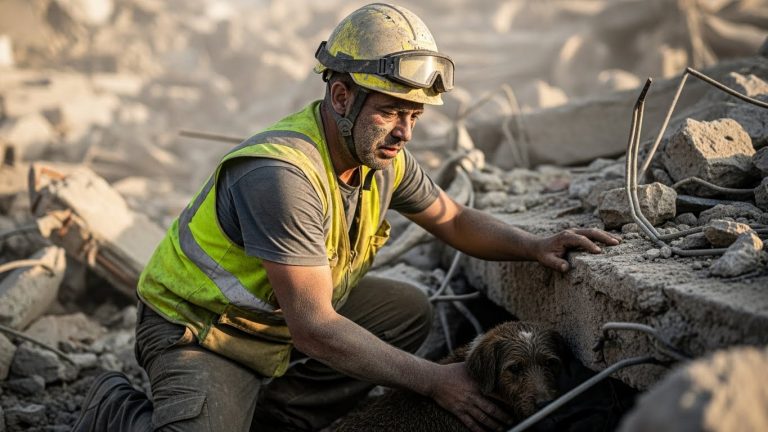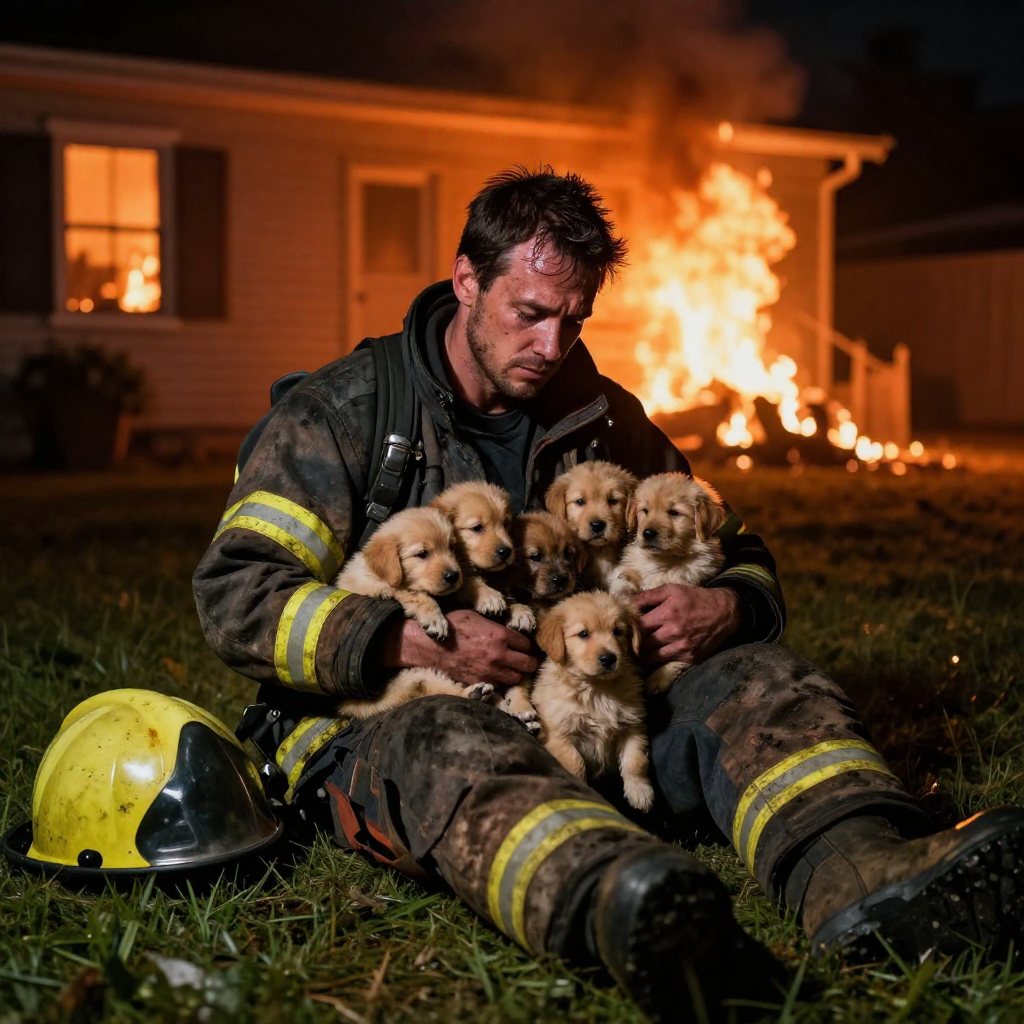
THE ROOF WAS ALREADY SAGGING WHEN THE CAPTAIN SCREAMED AT ME TO GET OUT, BUT I COULD HEAR THEM CRYING THROUGH THE CRACKLE OF THE FLAMES. I KNEW IF I LEFT THAT ROOM, THE SILENCE THAT FOLLOWED WOULD HAUNT ME FOREVER. I DIDN’T CARE ABOUT THE PROTOCOL OR THE HEAT MELTING MY VISOR; I CARED ABOUT THE SIX TINY HEARTBEATS HUDDLED IN THE DARK. I TOOK A BREATH OF POISONOUS AIR, WRAPPED MY TURNOUT COAT AROUND THEM, AND WALKED THROUGH HELL TO BRING THEM HOME.
The heat doesn’t just touch you; it pushes you. It’s a physical weight, a heavy, suffocating hand pressing against your chest, trying to force you backward. I was twenty minutes into the burn, and my turnout gear felt like it was lined with lead. Every breath through the SCBA regulator was a labor, a mechanical wheeze that echoed in my own ears, drowning out the roar of the fire devouring the structure around me.
We were at a two-story colonial on the east side of town. Standard suburban nightmare. It started in the kitchen—grease fire, probably—and by the time Engine 4 rolled up, the dragon had already eaten the back half of the house and was chewing its way through the ceiling joists. We had verified that the humans were out. The family, a young couple named Sarah and David, were on the front lawn. I had seen them when I jumped off the rig. Sarah was on her knees, screaming at the windows, held back by a neighbor. She wasn’t screaming for David. She was screaming for “Bella.”
At the time, I didn’t know who Bella was. In this job, you assume the worst. You assume a child is hiding in a closet. You assume a grandmother is trapped in a back bedroom. That assumption is what makes you ignore the temperature gauge redlining in your brain. It’s what makes you crawl on your hands and knees through black smoke so thick you can’t see the floor six inches beneath your face.
“Miller! Status!” The Captain’s voice crackled in my ear piece, distorted by the static and the inferno.
“Primary search on the second floor is negative,” I grunted, sweeping the hall with my tool. “Too much heat. I’m backing down to the first.”
“Copy. Roof is looking spongy, Miller. You’ve got two minutes before we pull everyone for defensive ops.”
Two minutes. In fire time, that’s a lifetime. In human time, it’s a blink. I scrambled down the stairs, sliding more than walking. The stairwell was acting like a chimney, channeling the superheated gases right up into my face. My mask was fogging around the edges. I hit the landing and stayed low. The living room was an orange hellscape. The furniture was gone, replaced by skeletal shapes wreathed in flame.
That’s when I heard it.
It wasn’t a scream. It wasn’t a human cry. It was a high-pitched, frantic yipping. A chorus of terror.
My heart hammered against my ribs. Not a child. Animals. But the urgency didn’t fade. Life is life. Pain is pain. And fear—God, the fear in that sound—was universal. It was coming from the laundry room, just off the kitchen. The kitchen that was currently the heart of the fire.
I keyed my mic. “Cap, I’ve got live victims. Ground floor. Laundry room.”
“Miller, negative. We’re shifting to defensive. The structure is compromised. Get out. Now.”
The order was clear. It was the right call. No firefighter is supposed to trade their life for a pet. It’s the math we’re taught at the academy. Human life first. Property second. Pets… pets are a gray area that usually falls under “don’t die for it.”
But I couldn’t move toward the door. The yipping turned into a howl, then back to a whimper. I imagined them in there. Trapped in a crate. Watching the orange glow get brighter. Feeling the air turn into poison. Waiting for someone to come.
I looked at the front door. I looked at the wall of fire separating me from the laundry room. I thought about my own dog, a beat-up Labrador named Buster waiting for me in an empty apartment. If it were him, would I want someone to turn around?
“Miller! Did you copy? Evacuate!”
I reached up and turned the volume down on my radio.
I dropped to my belly. The air is always coolest at the floor. I crawled. My knees scraped against debris—broken glass, melted plastic, wet drywall. The heat was radiant now, stinging any exposed skin on my neck. I could feel the water in my turnout coat starting to steam. If you stay in too long, you don’t burn; you boil.
I reached the laundry room door. It was hot to the touch. I didn’t have time to verify if there was fire behind it. I kicked it. It held. I kicked it again, putting my hip into it. The wood splintered, and the door swung inward.
Smoke rolled out like a black tide, blinding me instantly. I switched my thermal imaging camera on. White hot everywhere. But in the corner, a cool blue shape. A plastic crate. And inside, a cluster of small, frantic heat signatures.
I scrambled over. The plastic of the crate was already warping, melting like wax. The metal door was jammed. I ripped my glove off—stupid, dangerous, but necessary—and jammed my fingers into the latch. The metal seared my skin, a sharp bite of pain that cleared my head. I yanked the door open.
Inside, a Golden Retriever mother was curled around them. She wasn’t moving. The smoke had gotten her. But underneath her body, shielding them from the worst of it, were the puppies. Six of them. Tiny, wriggling balls of soot and fur.
They were screaming. They were suffocating.
I didn’t think. I couldn’t carry the crate; it was too big and falling apart. I grabbed them. One by one. I shoved two into the deep cargo pocket of my pants. I unzipped my turnout coat—violating every safety rule in the book—and stuffed the other four against my chest, zipping it back up halfway. They scratched at me, their tiny claws sharp, but I pulled them tight. I needed to protect their lungs. My coat would act as a filter, however poor.
“Sorry, girl,” I whispered to the mother. I touched her head once. There was no time to take her. The guilt of that decision hit me harder than the heat.
I turned to leave, and the ceiling in the kitchen collapsed.
A wave of sparks and burning insulation crashed down, blocking the path I had just come from. The roar was deafening. I shielded my face, feeling the debris rain down on my helmet. The exit was gone.
I was trapped.
I looked around, panic finally starting to claw at my throat. The window. There was a small window above the dryer. It was high, and it was small. But it was the only way.
I climbed onto the dryer. It was slick with water and foam. I slipped, bashing my shin, but I held my arms tight against my chest, protecting the bundle inside. I used the Halligan bar to smash the glass. Fresh air—sweet, cold oxygen—rushed in, feeding the fire behind me. The flames roared up, sensing the new fuel.
I had seconds.
I couldn’t fit through with the tank on my back. I had to ditch the SCBA. This is the part they tell you never to do. You never take off your air in a burning building. But I was dead if I stayed.
I unbuckled the straps. Took one last deep breath from the regulator. Held it. Ditched the tank. The weight fell away, leaving me light but vulnerable. I squeezed through the window, the jagged glass tearing at my trousers.
I fell. It wasn’t a long drop, maybe five feet to the grass, but I landed hard on my shoulder to avoid crushing the puppies. The impact knocked the wind out of me. I rolled onto my back, gasping. The air outside tasted like smoke, but it was cold. It was wonderful.
I lay there for a second, staring up at the night sky, which was lit up orange by the flames consuming the roof I had just been under. My lungs burned. My hand throbbed.
Then, I felt it. A wiggle against my chest. A tiny squeak from my pocket.
I sat up, ripping my Velcro open. I pulled them out. One. Two. Three. Four. I dug into my pocket. Five. Six.
They were black with soot. Wet. Shivering violently. But they were breathing.
“Miller!”
I looked up. The Captain was running across the lawn, his face a mask of fury and relief. Behind him, Sarah broke through the police line. She didn’t run to the house. She ran to me.
I tried to stand up, but my legs were jelly. I sank back down to the grass. The adrenaline crash was hitting me like a freight train. I held the puppies out, my hands shaking uncontrollably.
“I couldn’t get the mom,” I choked out, the smoke making my voice sound like gravel. “I’m sorry. I couldn’t get her.”
Sarah fell to her knees in front of me. She didn’t care about the house crumbling behind us. She didn’t care about the dead mother in the kitchen, not yet. She saw the six tiny lives in my lap.
She reached out, her hands trembling as much as mine, and picked one up. She pressed it to her cheek, sobbing. The puppy let out a small, weak bark.
I looked at my Captain. He was standing over me, looking at the collapsing roof, then down at the puppies. He took a deep breath, the anger draining out of him.
“You idiot,” he whispered, but he reached down and put a hand on my shoulder. “You lucky, stubborn idiot.”
I laid back on the grass, closing my eyes. The fire was still roaring, destroying everything Sarah and David owned. Their photos, their clothes, their furniture—all gone. But in my arms, and in Sarah’s hands, there was a warmth that had nothing to do with the fire.
I had defied orders. I had risked my life for animals. I had left a mother behind. I was going to be in a world of trouble when we got back to the station.
But as a rough, wet tongue licked the soot off my chin, I knew I’d do it again.
CHAPTER II
The smell of smoke doesn’t leave you. It settles into the pores of your skin, hitches a ride in the fibers of your hair, and curls up in the back of your throat like a sleeping animal. In the hospital, they scrubbed me until my skin was raw and pink, but every time I breathed, I could still taste the laundry room. I could still taste the plastic melting off the washing machine and the heavy, wet wool of my own coat.
I sat on the edge of the thin hospital bed, my hands wrapped in heavy gauze. They looked like clubs, white and oversized. The doctor said the burns were mostly second-degree, a ‘lucky’ consequence of my gear failing just as I hit the window. I didn’t feel lucky. My lungs felt like they had been scraped with sandpaper, and every cough brought up a greyish phlegm that reminded me exactly of what I had done. I had traded the structural integrity of a building and the safety of my crew for six heartbeats that fit in the palm of my hand.
Captain Henderson came in on the second day. He didn’t bring flowers. He didn’t bring a card signed by the guys at Station 42. He brought a manila folder and a cup of coffee that smelled like burnt rubber. He sat in the plastic chair by the window, looking out at the parking lot for a long time before he looked at me.
“The house is a total loss, Miller,” he said. His voice was level, which was worse than if he had been screaming. When Henderson screams, it’s a fire he’s trying to put out. When he’s quiet, it’s the aftermath he’s surveying. “The investigators say the roof collapse happened forty-five seconds after you jumped. If you had tripped, if you had hesitated, I’d be writing a very different report today.”
“I heard them, Cap,” I said, my voice cracking. It felt like I was swallowing glass.
“We all heard them,” he replied, finally turning his eyes toward me. They were hard, grey, and tired. “But we follow the line. We follow the orders because the line is what keeps us alive. You broke the line. You went rogue for animals. Do you have any idea what that does to the morale of a team? To know that their brother might decide his own moral compass is more important than the tactical safety of the unit?”
I looked down at my bandaged hands. I couldn’t tell him why I did it. Not the real reason. I couldn’t tell him that when I heard those whimpers, I wasn’t in a burning house in the suburbs. I was seven years old again, standing on a sidewalk in a different city, watching the orange glow in our upstairs window while my younger brother’s hamster cage sat on the desk inside. It’s a small, stupid thing—a hamster—but to a seven-year-old, it was the world. I had begged the firemen then. I had screamed at them to go back. They had held me back, told me it wasn’t safe. And I had watched that window melt. I had spent thirty years carrying the weight of that one small, unsaved thing. When I heard those puppies, it wasn’t an act of bravery. It was an act of desperation. I was trying to fix a thirty-year-old hole in my soul.
“I’m sorry,” I whispered.
“Sorry doesn’t fix the precedent,” Henderson said. He stood up. “There’s going to be an inquiry. Disciplinary action is on the table. But for now, you’re on administrative leave. And Miller? Stay off the internet.”
I didn’t listen. As soon as he left, I reached for my phone with my clumsy, bandaged fingers. I was already everywhere. A neighbor across the street had filmed the whole thing on their phone—the moment I crashed through the window, the way I collapsed on the grass, and the sight of me pulling those tiny, soot-covered creatures from my jacket. The video had three million views. The comments were a sea of ‘Hero,’ ‘Angel,’ and ‘Give this man a medal.’
Two days later, Sarah and David came to see me. They didn’t look like the people I had seen on the lawn. They looked smaller, hollowed out. They had lost their clothes, their photos, their bed—their history. But Sarah was carrying a small plastic pet carrier.
“They’re doing well,” she said, her voice trembling as she sat on the bed. “The vet says they’ll make it. All six of them.”
She opened the carrier. The puppies were tiny, their eyes still closed, smelling of formula and warmth. They were a miracle, and yet, looking at them felt like looking at a crime scene.
“We can’t thank you enough,” David said. He reached out and touched my bandaged arm. “You saved the only things we had left. The house is just wood and brick. These… these are family.”
“The mother,” I said. It was the first time I had mentioned her. “I’m sorry I couldn’t…”
Sarah’s face crumbled. “Molly was a good dog. She stayed with them. She wouldn’t leave them.”
I felt a sickening wave of guilt. I knew Molly had stayed. I had seen her. And in the back of my mind, a dark thought took root: I could have tried to drag her out first. I could have tried harder. But I had panicked. I had grabbed the easiest things to carry and fled. The world called me a hero for saving six, but in the dark of the hospital room, I only thought about the one I left behind.
But there was a deeper secret, one I hadn’t even told Henderson. During the crawl through that hallway, just before I reached the laundry room, the world had gone white. It wasn’t the smoke. It was my head. For the last six months, I’d been having these ‘episodes’—brief flickers of vertigo and loss of vision. A doctor friend of mine told me off the record it was likely vestibular, a lingering effect of an old concussion, or maybe stress. I hadn’t reported it. If I did, I’d be taken off the line and put behind a desk. I lived for the line.
Inside that house, I had blacked out for maybe five, ten seconds. When I came to, I was disoriented, heading the wrong way. I only found the puppies because I tripped over a fallen beam in my daze. I hadn’t saved them through skill. I had stumbled upon them while I was physically unfit to be in that building. My ‘heroism’ was a mask for a medical liability that could have gotten my whole crew killed.
By the end of the week, the pressure reached a boiling point. The Fire Department’s PR department saw the viral video as a godsend. They were facing budget cuts from the city council, and here was a ready-made hero to put on the front page. They ignored Henderson’s complaints. They ignored the pending inquiry. They scheduled a ‘Hero’s Homecoming’ press conference at the station for Saturday morning.
I was told to be there. I was told to wear my dress blues. I was told to smile and hold a puppy.
Saturday was a bright, cruel day. The sun hit the red paint of the engines outside the station, making everything look too vivid, too clean. There were three local news vans and a crowd of about fifty people from the community. Sarah and David were there, holding the puppies, looking like the posters for a charity drive.
I stood in the bay, my hands still bandaged, feeling like an imposter. Henderson stood off to the side, his arms crossed, his face a mask of professional disgust. He knew this was a circus. He knew that rewarding my disobedience was a dangerous move, but the Chief had overruled him. The department needed the ‘win.’
Elias Thorne, a local reporter known for his aggressive style, stepped up to the microphone. He did a live intro, talking about the ‘Fireman who defied death to save the defenseless.’ Then he turned to me.
“Firefighter Miller, take us through those moments,” Thorne said, shoving the mic toward my face. “What goes through a man’s mind when he hears those cries and decides that his own life—and the orders of his superior—don’t matter as much as these little lives?”
I looked at the camera. I looked at the crowd. I saw a little boy in the front row, looking at me with wide, adoring eyes. He reminded me of myself at seven. He thought I was a giant. He thought I was invincible.
And then I looked at Henderson. He wasn’t looking at the camera. He was looking at me, waiting for the lie.
“It wasn’t like that,” I said. My voice was amplified by the speakers, echoing off the concrete walls of the station.
“You mean it wasn’t a choice?” Thorne prompted, smiling. “It was just instinct? The heart taking over?”
I felt the vertigo again. The world tilted. The bright sun on the red trucks began to bleed into a white haze. My hands started to shake inside their bandages. I knew then that I couldn’t do it. I couldn’t be the poster boy for a lie. If I stayed silent, I’d be a hero. I’d keep my job. I’d get the funding for the station. But I would be a ticking time bomb, a man who went blind in fires and ignored his brothers for his own ghosts.
“I shouldn’t have been in there,” I said. The crowd went quiet. Even the puppies seemed to stop squirming.
“Because of the danger?” Thorne asked, his brow furrowing.
“Because I’m not fit,” I said, the words rushing out now, irreversible. “I’ve been having blackouts. I had one in that house. I didn’t save those puppies because I’m a hero. I saved them because I was lost and stumbling in the dark. I disobeyed Captain Henderson’s order to evacuate, not out of bravery, but because I was chasing a ghost from my childhood. I risked my team’s lives for a dog because I couldn’t save a hamster thirty years ago. And I almost died because my body is failing and I was too proud to admit it.”
I looked at Sarah and David. Their smiles had vanished. They looked confused, then hurt. I had just told them that their miracle was a fluke of a broken man’s mistake.
I looked at Henderson. His expression didn’t change, but he slowly uncrossed his arms.
“I am not a hero,” I said, looking directly into the lens of the camera. “I’m a liability. And I’m resigning, effective immediately.”
I turned and walked back into the darkness of the station bay. The silence behind me was absolute for three seconds, and then the chaos started. The shouting, the camera shutters, the rapid-fire questions of a scandal in the making.
I didn’t stop. I walked past the lockers, past the breakroom, and out the back door into the alley. The air was cool and smelled of damp pavement. For the first time in years, the smell of smoke was gone. But as I stood there, listening to the world I had just destroyed through the brick walls, I realized the moral dilemma hadn’t been solved.
By telling the truth, I had saved my integrity, but I had killed the department’s chance at funding. I had stripped Sarah and David of their happy ending. I had humiliated Henderson by making his station the center of a medical negligence scandal.
I had chosen the truth, but the truth didn’t feel like a victory. It felt like a different kind of fire—one that didn’t just burn the house down, but salted the earth where it stood.
I sat down on a crate in the alley and put my bandaged hands over my face. The puppies were safe, but everything else was gone. And as I sat there, I realized the hardest part wasn’t the fire itself. It was the long, cold walk away from the ashes.
CHAPTER III
I walked away from the podium. The silence behind me was heavy. It was the kind of silence that follows a gunshot. My boots clicked on the linoleum floor. Every step felt like a mile. I didn’t look back at the Mayor. I didn’t look at Captain Henderson. I didn’t look at the cameras. I just kept walking until the cool night air hit my face. My lungs burned. Not from smoke this time, but from the sudden, terrifying vacuum of the truth. I had said it. I had told them I was a fraud. I had told them I was broken. Now, the world was going to break me back.
I went to my truck and sat. I didn’t turn the key. I just watched the reflected blue and red lights of the fire engines dancing on the windshield. My phone began to vibrate in my pocket. It didn’t stop. One vibration after another. A frantic, rhythmic buzzing that felt like a heartbeat. I reached down and turned it off. I needed the world to go quiet for just one minute. But the world doesn’t go quiet when you’ve just set fire to a city’s reputation on live television.
Twenty-four hours later, the silence was gone forever. It was replaced by the sound of lawyers. I was sitting in a cramped office with Elias, my union representative. He looked like he hadn’t slept since the press conference. He kept rubbing his temples. On the desk between us was a stack of papers. The insurance company representing Sarah and David had officially frozen their claim. My confession—specifically the part where I admitted to working while medically unfit—had given them the legal loophole they needed. They were calling it ‘gross negligence by the municipal entity.’ They weren’t paying for the house. And Sarah and David? They were suing the city. They were suing the department. And they were naming me as the primary cause.
‘Miller, you don’t understand the scale of this,’ Elias whispered. He wasn’t even shouting. That was worse. ‘The city is looking at a forty-million-dollar class-action lawsuit from every property owner who had a fire in your district over the last year. If you were unfit then, you were unfit for all of them. You’ve turned the entire department into a liability.’ I stared at my hands. The burns were scarring over, the skin tight and shiny. I’d tried to be honest. I’d tried to do the right thing. But the right thing was a wrecking ball, and it was swinging toward everyone I ever cared about.
I left the union office and drove past the station. There were news vans parked out front. They were waiting for me. They were waiting for Henderson. I saw the faces of the guys on my shift through the windows. They looked away. They didn’t see a hero anymore. They didn’t even see a brother. They saw a man who had stolen their job security. I kept driving. I drove until the city lights faded. I ended up at a small, dimly lit bar on the edge of the county line. I just wanted a place where no one knew my face. But my face was on the screen above the bar. ‘The False Hero,’ the headline read. I pulled my hood up and ordered a water. My stomach was in knots.
That’s when the door opened and Captain Henderson walked in. He didn’t look for me. He knew I’d be there. He sat down two stools away. He didn’t order anything. He just stared at the mirror behind the bar. For a long time, neither of us said a word. The air between us was thick with the smells of stale beer and regret. I waited for the explosion. I waited for him to tell me I was a traitor. I waited for him to tell me he was going to strip my rank. But Henderson just sighed, a long, rattling sound that seemed to come from his soul.
‘Why didn’t you just take the medal and shut up, Miller?’ he asked. His voice was flat. ‘We had the funding. We had the public on our side. We were going to get the new equipment. We were going to fix the staffing shortages. All you had to do was smile for the camera.’ I looked at him. ‘I was blacking out, Cap. I was dizzy. I could have killed someone. I almost did. I couldn’t live with the lie.’ Henderson turned his head slowly. He looked at me with eyes that were terrifyingly cold. ‘I know,’ he said. The words hit me harder than a backdraft. My heart stopped. ‘What?’ I managed to whisper. ‘I said I know,’ Henderson repeated. ‘I’ve known since the warehouse fire in June. I saw you leaning against the rig, eyes rolled back. I saw the tremor in your hands every time the alarm went off.’
I felt the world tilt. The vertigo came back, sharp and nauseating. ‘You knew? And you let me go back in? You signed my fitness reports?’ Henderson didn’t flinch. ‘We were short-handed, Miller. We’re always short-handed. And you were the best we had. A little stress, a little vertigo? Everyone in the service has something they hide. I didn’t think you’d be stupid enough to say it out loud.’ He leaned closer, his voice dropping to a hiss. ‘I protected you. I falsified those records to keep you on the line because I believed in the mission. And you repaid me by burning the whole house down around us.’
The hypocrisy was a physical weight. He wasn’t a mentor protecting a student. He was a manager protecting an asset. He had gambled my life—and the lives of the people we served—to keep his numbers up and his station funded. The hero narrative wasn’t just a lie I told; it was a lie he built. He was complicit in every mistake I’d made since June. He had watched me drowning and handed me a lead weight, calling it a life vest.
Before I could respond, a black SUV pulled up outside. Two men in suits walked in. They didn’t look like cops. They looked like the people who decide who gets to be a cop. It was the City Oversight Board. The powerful elite who managed the city’s risk. They didn’t go to Henderson. They came straight to me. ‘Mr. Miller,’ the taller one said. ‘We are here to offer you a way out. And a way to save your Captain.’ They took us to a back booth. The deal was simple. And it was filthy.
The city was prepared to settle Sarah and David’s claim immediately. They would pay for the house, the emotional distress, everything. They would also ensure my pension stayed intact. In exchange, I had to sign a sworn affidavit stating that my press conference confession was a result of ‘Post-Traumatic Stress Disorder’ and ‘temporary mental instability’ caused by the fire. I had to say I was lying about the pre-existing blackouts. I had to say the Captain had no idea. I had to be the ‘broken hero’ who suffered a mental break, rather than the ‘negligent professional’ who was enabled by a corrupt system.
‘If you do this,’ the suit said, ‘the lawsuits go away. The insurance companies pay out. The department’s reputation is salvaged. The Captain here keeps his career. You just go away quietly to a treatment facility for a few months, and we never speak of this again.’ He pushed a fountain pen across the table. It looked like a weapon. I looked at Henderson. He was watching me, his eyes pleading. For the first time, I saw him as he was: a man terrified of losing his power. He was willing to let me be labeled ‘insane’ as long as it meant he wasn’t labeled ‘guilty.’
I looked at the pen. I thought about Sarah and David. If I didn’t sign, they might lose everything. The city would drag out the legal battle for years. They’d be homeless while the lawyers argued. If I signed, they got their lives back. But the price was the truth. The price was letting Henderson walk away clean after he’d risked my life and everyone else’s. The price was letting the system stay exactly as broken as it was. I realized then that the fire I’d started at the press conference wasn’t enough. I hadn’t cleared the brush. I had just heated up the room.
I picked up the pen. Henderson breathed a sigh of relief. He reached out to pat my shoulder. I pulled away. I didn’t sign the affidavit. Instead, I pulled my phone out of my pocket. I hadn’t just turned it off; I had set it to record before I walked into the bar. I’d caught every word of Henderson’s confession. Every word of him admitting he knew I was unfit. Every word of him admitting he falsified my records. And I’d caught the Oversight Board’s offer to cover it up.
‘I’m not signing,’ I said. My voice was steady now. The vertigo was gone. ‘And if Sarah and David don’t get their settlement within forty-eight hours, this recording goes to the District Attorney and every news outlet in the state.’ The suit’s face went pale. Henderson looked like he’d been struck. ‘Miller, you’re destroying yourself,’ he stammered. ‘You’ll never work in this state again. You’ll be a pariah.’ I stood up. ‘I’m already a pariah, Cap. But for the first time in my life, I’m not a liar.’
I walked out of the bar. The night air was colder now, but it felt clean. I drove to Sarah and David’s temporary rental. They were sitting on the porch, looking at the stars. When they saw my truck, they stood up. They looked wary. They looked hurt. I didn’t get out. I just rolled down the window. ‘The city is going to pay,’ I told them. ‘They’ll call you tomorrow. Take the money. Rebuild the house.’ Sarah looked at me, her eyes searching mine. ‘Why are you doing this, Miller?’ I looked at the dark horizon, where the ghost of my childhood fire had lived for twenty years. ‘Because I’m done saving things that are already dead,’ I said.
The fallout was absolute. Within three days, Henderson was placed on administrative leave. Within a week, the Oversight Board was under state investigation. The department was in shambles, but for the first time, the rot was being carved out. I lost my job. I lost my brothers. I lost the only identity I’d ever known. But as I packed my bags to leave the city, I realized the blackouts had stopped. The weight in my chest was gone. I wasn’t a firefighter anymore. I wasn’t a hero. I was just a man. And that was enough.
I drove past the site of the fire one last time. The puppies were with new families now. The house was a charred shell, soon to be replaced. I didn’t feel the old grief. I didn’t feel the need to run into the flames. I just kept driving, leaving the smoke behind me, heading toward a horizon that was finally, beautifully clear.
CHAPTER IV
The silence was the loudest thing. Louder than any alarm, any collapsing beam, any scream I’d ever heard. It settled over everything, a thick blanket woven from the threads of what I’d done and what had been done to me. The news cycle, predictably, had moved on. I was no longer a hero, no longer a villain, just…gone. An asterisk in the city’s history, a footnote in the fire department’s long, complicated story.
I found a place a few hours outside the city, a small cabin nestled against the edge of a national forest. The air was clean, the nights were dark, and the only sounds were the wind in the trees and the occasional call of an owl. I needed that silence, craved it like a man dying of thirst. I needed to be away from the stares, the whispers, the judgment. The city had become a cage, and I had finally rattled the bars hard enough to break free.
Work was…simple. I took a job as a carpenter’s assistant, building decks and fixing fences. The hours were long, the work was hard, but it was honest. There was a satisfaction in shaping wood, in creating something tangible with my hands. No lives depended on me, no split-second decisions, no impossible choices. Just wood, nails, and the sweat of my brow. My hands, once scarred by fire, were now calloused and strong from a different kind of labor.
Sarah and David, I learned through a mutual friend, were finally settled in their new home. The city had paid out, as promised, though the process had been a legal nightmare. I pictured them in that new house, starting over. It was all I ever wanted – a fresh start for everybody touched by the fire. I resisted the urge to reach out, to apologize again, to seek some kind of absolution. They needed their space, their peace. My presence would only be a reminder of what they had lost, what they had almost lost.
Weeks bled into months. The burns on my hands faded, the vertigo lessened. The nightmares, however, lingered. I would still wake up in a cold sweat, the smell of smoke filling my nostrils, the image of those puppies seared into my mind. I tried to push it all down, bury it under the weight of physical labor, but it was always there, lurking in the shadows. I was damaged goods, and I knew it.
Then came the letter. A crisp, official-looking envelope with the city seal. My stomach clenched. I hadn’t spoken to anyone from the department since the hearing, and I sure didn’t want to start now. The letter was brief, formal. A hearing was scheduled before the City Oversight Board. Captain Henderson was appealing his dismissal.
My first reaction was anger. The nerve of that man, to try and claw his way back after everything he’d done. But then, a weariness settled over me. Another fight? Another round of accusations and counter-accusations? I just didn’t have the energy. I almost threw the letter away, ignored it completely. Let Henderson rot. Let the city sort out its own mess.
But something stopped me. A sense of unfinished business, perhaps. Or maybe just the nagging feeling that if I didn’t confront him one last time, the ghosts of the past would continue to haunt me forever. So I called the number on the letter and confirmed my attendance. I packed a bag, booked a bus ticket, and prepared to face the music one more time.
Returning to the city felt like stepping back into a nightmare. The buildings seemed taller, the streets more crowded, the air thick with a tension I had forgotten. I went straight to a cheap motel near the bus station, a place that smelled of stale cigarettes and regret. I barely slept that night, tossing and turning, my mind racing with memories and anxieties.
The hearing was held in a small, sterile room in City Hall. The Oversight Board members sat behind a long table, their faces grim and impassive. Henderson was already there, sitting at a table with his lawyer. He looked older, defeated. The swagger was gone, replaced by a haunted look in his eyes. For the first time, I saw him not as a monster, but as a man who had made terrible choices and was now facing the consequences.
His lawyer argued that Henderson had been unfairly targeted, that he was a dedicated public servant who had been made a scapegoat for the department’s problems. He claimed that the recording I had made was inadmissible, that it had been obtained illegally. He painted a picture of Henderson as a victim, a good man caught in a bad situation.
Then it was Henderson’s turn to speak. He didn’t deny the recording, but he tried to minimize his actions. He said he had been under pressure from the mayor’s office to keep Miller on active duty, that he had only been trying to protect the department’s reputation. He apologized for his mistakes, but he insisted that he had always acted in the best interests of the city.
When they asked if I had anything to say, I stood up slowly. I hadn’t prepared a speech, hadn’t rehearsed any lines. I just spoke from the heart, telling them what I had seen, what I had felt, what I had lost. I talked about the fire, about the puppies, about the pressure to be a hero. I talked about the lies, the corruption, the cover-ups. I talked about the cost of doing what was right.
I didn’t ask them to punish Henderson, didn’t demand any kind of retribution. I simply asked them to consider the truth, to weigh the evidence, and to make a decision that was fair to everyone involved. I spoke for maybe ten minutes, then sat down, my heart pounding in my chest. The Board members deliberated for what felt like an eternity. Finally, they announced their decision. Henderson’s appeal was denied.
He was escorted out of the room, his face ashen. I watched him go, feeling a strange mixture of pity and relief. He was gone, finally. Out of my life, out of the department, out of power. I had won, but it didn’t feel like a victory. It felt like an ending. One last loose end tied up.
That night, I found myself wandering the streets of the city, drawn to the old firehouse. It was late, the building dark and silent. I stood across the street, watching it, remembering. The camaraderie, the adrenaline, the sense of purpose. It was all gone now, replaced by a hollow ache. I was no longer a firefighter, and I never would be again.
As I turned to leave, I saw a figure emerge from the firehouse. It was Sarah, the homeowner whose life had been turned upside down by the fire. I hesitated, unsure whether to approach her. She saw me and stopped, her expression unreadable. We stood there for a moment, just looking at each other, the silence stretching between us.
Finally, she spoke. “Miller,” she said, her voice soft. “Thank you.”
I was taken aback. “For what?”
“For telling the truth,” she said. “For doing what was right. It wasn’t easy, but you did it. And because of you, we can finally move on.”
I nodded, unable to speak. The weight on my chest lifted slightly. Maybe, just maybe, I had done something good, something that mattered. Maybe my sacrifice hadn’t been in vain.
“We’re building a garden,” she continued, a faint smile touching her lips. “In the backyard of our new house. We’re planting roses.”
“Roses?” I asked, surprised.
“Yes,” she said. “A symbol of hope. A reminder that even after the fire, beauty can still bloom.”
We talked for a few more minutes, then said our goodbyes. As I walked away, I looked back at the firehouse one last time. It was still dark, still silent, but somehow, it didn’t seem so menacing anymore.
I returned to my cabin in the woods, back to the simple life I had created for myself. The work was still hard, the days still long, but something had shifted. The silence was still there, but it was no longer a silence of guilt and regret. It was a silence of peace, of acceptance, of hope. I was no longer defined by the fire. I was defined by what I had done after the fire, by the choices I had made, by the truth I had told. I was a carpenter, a builder, a survivor. And in the quiet of the woods, I was finally free.
A few weeks later, a package arrived at my doorstep. It was a small, wooden box, carefully crafted. Inside, nestled on a bed of straw, were six small, ceramic puppies. Each one was different, each one unique. A note was attached.
“From our garden to yours,” it read. “May they always remind you of the beauty that can bloom from ashes.”
I placed the puppies on the windowsill, where they caught the morning light. They were a reminder of the past, of the pain, of the loss. But they were also a reminder of the future, of the hope, of the possibility of redemption. I looked at them, and I smiled. The silence was still there, but now, it was filled with the sound of birdsong, the rustling of leaves, and the gentle whisper of a new beginning.
One event. Shortly after the visit from Sarah. I was at the lumberyard, picking up supplies for a new project, when I saw him. Henderson. He was standing in the corner, talking to one of the workers. He looked thinner, his clothes were rumpled, and his face was etched with worry. He was a shadow of his former self.
I considered turning around, avoiding him completely. But something made me stop. A sense of curiosity, perhaps. Or maybe just the realization that I couldn’t run from my past forever. I walked over to him, steeling myself for a confrontation.
He saw me coming and his face paled. He opened his mouth to speak, but no words came out. We stood there for a moment, just looking at each other, the tension hanging heavy in the air.
“Henderson,” I said, my voice calm. “How are you?”
He swallowed hard. “Miller,” he said, his voice hoarse. “I…I didn’t expect to see you here.”
“I didn’t expect to see you either,” I said. “What are you doing?”
He hesitated, then sighed. “I’m working here,” he said. “I needed a job. Any job.”
I was surprised. “You’re working at the lumberyard?”
He nodded, shamefaced. “Yeah,” he said. “It’s not much, but it’s honest work.”
We stood there in silence for a moment, the weight of the past pressing down on us. I didn’t know what to say. I had imagined this moment a hundred times, rehearsing all the things I wanted to say to him, all the accusations I wanted to make. But now, standing face to face with him, I felt nothing but pity.
“I’m sorry,” I said finally. “I’m sorry for what happened.”
He looked up at me, his eyes filled with surprise. “What?” he said.
“I’m sorry,” I repeated. “I know you made mistakes, but I don’t think you’re a bad person. I think you were just caught in a bad system.”
He stared at me for a long moment, then a single tear rolled down his cheek. “Thank you,” he said, his voice barely a whisper. “That means a lot to me.”
We talked for a few more minutes, about the fire, about the department, about the future. He told me that he had lost everything – his job, his reputation, his family. He was starting over, just like me.
As I turned to leave, I offered him my hand. He hesitated for a moment, then shook it firmly. “Good luck, Miller,” he said.
“You too, Henderson,” I replied. “Take care of yourself.”
I walked away, feeling a sense of closure I hadn’t expected. I had faced my demons, and I had forgiven them. I had finally let go of the anger and resentment that had been consuming me for so long. And in that moment, I knew that I was truly free.
The new purpose settled in gently. Not with the blare of sirens or the roar of flames, but with the quiet satisfaction of a job well done, the simple pleasure of creating something with my hands, and the profound peace of knowing that I was finally living an honest life. The silence was still there, but now, it was a silence of hope, of healing, and of the quiet, persistent bloom of beauty from ashes.
CHAPTER V
The silence was the loudest thing. For months after, maybe even a year, it was all I heard. Not the absence of sound, but the weight of it. The silence of my phone not ringing. The silence of the firehouse, I imagined, though I never drove past it. The silence of the city, which had once roared its approval and then turned its back. It wasn’t a cruel silence, not exactly. More like… a forgetting. As if I’d never been there at all.
Sarah and David sent a postcard a few months after they moved back into the rebuilt house. A picture of a golden retriever puppy, one of the new litter, sitting on Sarah’s lap. They thanked me again, simply, for telling the truth. That postcard lived on my workbench for a long time, tucked under a coffee stain. A reminder that something good had come from the mess.
The carpentry helped. It wasn’t a cure, but it was… grounding. The smell of the wood, the feel of it in my hands, the slow, deliberate act of shaping something real. I started small, fixing up fences, building sheds. Then, a few months in, someone asked me to build a porch swing. I hadn’t built anything like that since I was a kid, helping my grandfather. The memory surfaced, unbidden, but this time it didn’t sting. It felt…soft. Like a faded photograph.
I took the job.
* * *
I worked slowly, carefully, measuring twice, cutting once. The swing took shape under my hands. Smooth pine, sanded until it was almost silken. I thought about Sarah and David, about the puppies, about the weight of a life and the surprising strength of new beginnings. When it was done, I delivered it myself.
Sarah answered the door. She smiled, a real smile that reached her eyes. David came out, too, and clapped me on the shoulder. It was awkward, but… good. We hung the swing together, and Sarah sat on it, pushing gently back and forth.
“It’s perfect, Miller,” she said. “Thank you.”
I just nodded. What could I say? The words felt inadequate. I stayed for a cup of coffee, sitting on the porch steps, listening to them talk about their plans for the garden. Normal life. It was a beautiful thing.
That night, I slept without dreaming. The silence wasn’t quite so loud anymore.
* * *
Time passed. The blackouts lessened, then stopped altogether. The nightmares faded, replaced by… nothing. Just sleep. I started seeing a therapist again, a woman this time. She didn’t push me, didn’t try to analyze me. She just listened. And sometimes, that was enough.
The city investigation dragged on for months, then quietly concluded. Henderson was gone, a few others were quietly reassigned. The fire department got its budget increase, but the celebration felt muted. The city had seen behind the curtain, and the illusion was broken. Things changed, slowly, gradually. More oversight, more accountability. Maybe it wouldn’t last, but for a while, at least, things were better.
I kept working. The porch swing led to other jobs. A picnic table for a local park. Some benches for the animal shelter. I wasn’t a hero, not anymore. I was just a carpenter. And that was okay.
One day, a kid came by the shop. Maybe sixteen, skinny, with eyes that were too old for his face. He asked if I was hiring. I wasn’t, not really. But I looked at him, and I saw something… familiar. That lost, searching look.
I told him I could use some help.
* * *
His name was Michael. He was quiet, didn’t say much. But he was a hard worker, eager to learn. I showed him how to measure, how to cut, how to sand. He caught on quickly. He also had a temper, a short fuse. I saw him clench his fists a few times when he messed up. I didn’t say anything, just showed him how to fix it.
One afternoon, we were working on a set of shelves for a local library. He slammed his hammer down on the workbench, hard enough to make the tools jump.
“Damn it!” he said. “I can’t get this right.”
I walked over and stood beside him. I didn’t touch him, just looked at the piece he was struggling with.
“What’s the problem?” I asked, quietly.
He pointed to a misaligned joint. “It’s crooked. I can’t fix it.”
“Sure you can,” I said. “Just gotta be patient. Take your time. See where it’s off, and then adjust it. It’s like… life, Michael. Sometimes you gotta take things apart to put them back together right.”
He looked at me, surprised. I hadn’t said anything like that before. He picked up his hammer again, more gently this time. He worked slowly, carefully, and after a few minutes, the joint was perfect.
He looked up at me, a small smile on his face.
“Thanks,” he said. “I needed that.”
I just nodded. I knew he did.
* * *
It was a Tuesday morning when Henderson walked into the lumberyard. I saw him from across the yard, standing by the stacks of cedar. He looked older, thinner. The fire was gone from his eyes. He saw me, too, and hesitated for a moment. Then he walked over.
“Miller,” he said, his voice quiet.
“Henderson,” I replied.
We stood there for a moment, not saying anything. The sounds of the lumberyard swirled around us. Saws whining, forklifts beeping, men shouting.
“I… I wanted to apologize,” he said, finally. “For everything. For what I did to you, for what I did to the department. It was wrong. I know that now.”
I looked at him, really looked at him. I saw the regret in his eyes, the weariness in his shoulders. I saw a broken man.
“It’s okay, Henderson,” I said. “I forgive you.”
He looked surprised, relieved. “Thank you,” he said. “That… that means a lot.”
We talked for a few more minutes, about nothing in particular. The weather, the price of lumber, the local baseball team. It was awkward, but… civil. As he turned to leave, he paused.
“You know,” he said, “you were a good firefighter, Miller. One of the best I ever had.”
I nodded. “You were a good captain, too, Henderson. Once.”
He smiled, a sad, wistful smile. Then he walked away.
I watched him go, feeling a strange sense of… peace. The anger was gone, the resentment, the bitterness. It had all just… faded away. Like smoke in the wind.
* * *
The shop is small, just me and Michael most days. I take on small projects, nothing too demanding. I make furniture, repair fences, build things for the community. It’s not glamorous, but it’s honest work. And it’s enough.
Michael is doing well. He’s learned a lot, not just about carpentry, but about life. He’s still got a temper, but he’s learning to control it. He’s learning to be patient, to be careful, to take pride in his work. He’s learning to be a man.
Sometimes, I think about the fire, about the puppies, about everything that happened. It’s still there, in the back of my mind. But it doesn’t haunt me anymore. It’s just a part of my story. A part of who I am.
I still have nightmares sometimes, but they’re different now. Not so vivid, not so terrifying. More like… echoes. Faint reminders of a life I used to live.
I don’t run towards the fire anymore. I don’t need to prove anything to anyone. I just build things. I teach things. I try to be a good man.
I found out a few years later that Sarah and David named one of their new golden retrievers Miller. It made me smile.
The silence isn’t so loud anymore. Sometimes, in the evening, when the work is done and the shop is quiet, I can almost hear… birds singing. Or maybe it’s just the sound of the wind in the trees. Or maybe it’s the sound of my own heart, finally at peace.
The scars remain, but they no longer define me. They are simply… there.
The air is clean now, and I can finally breathe.
The fire is out.
END.