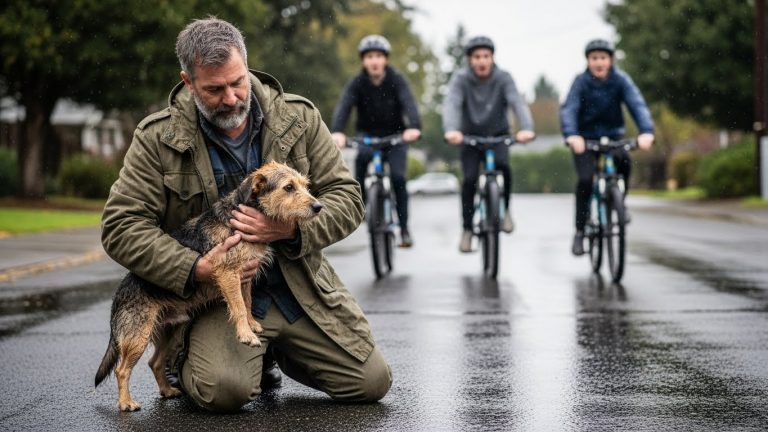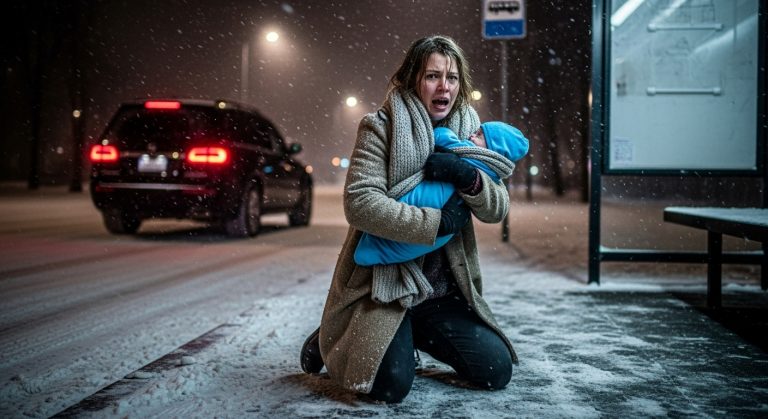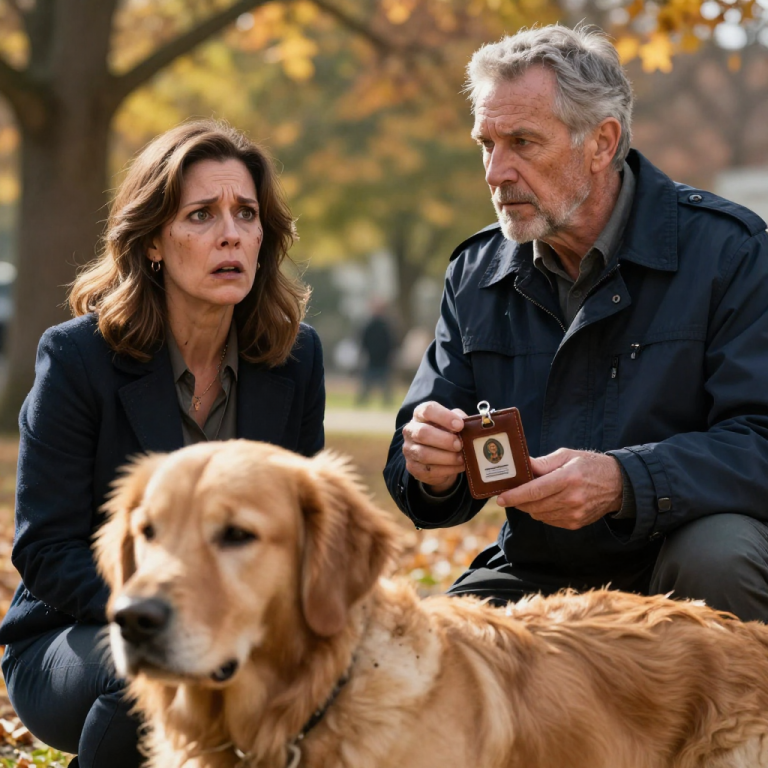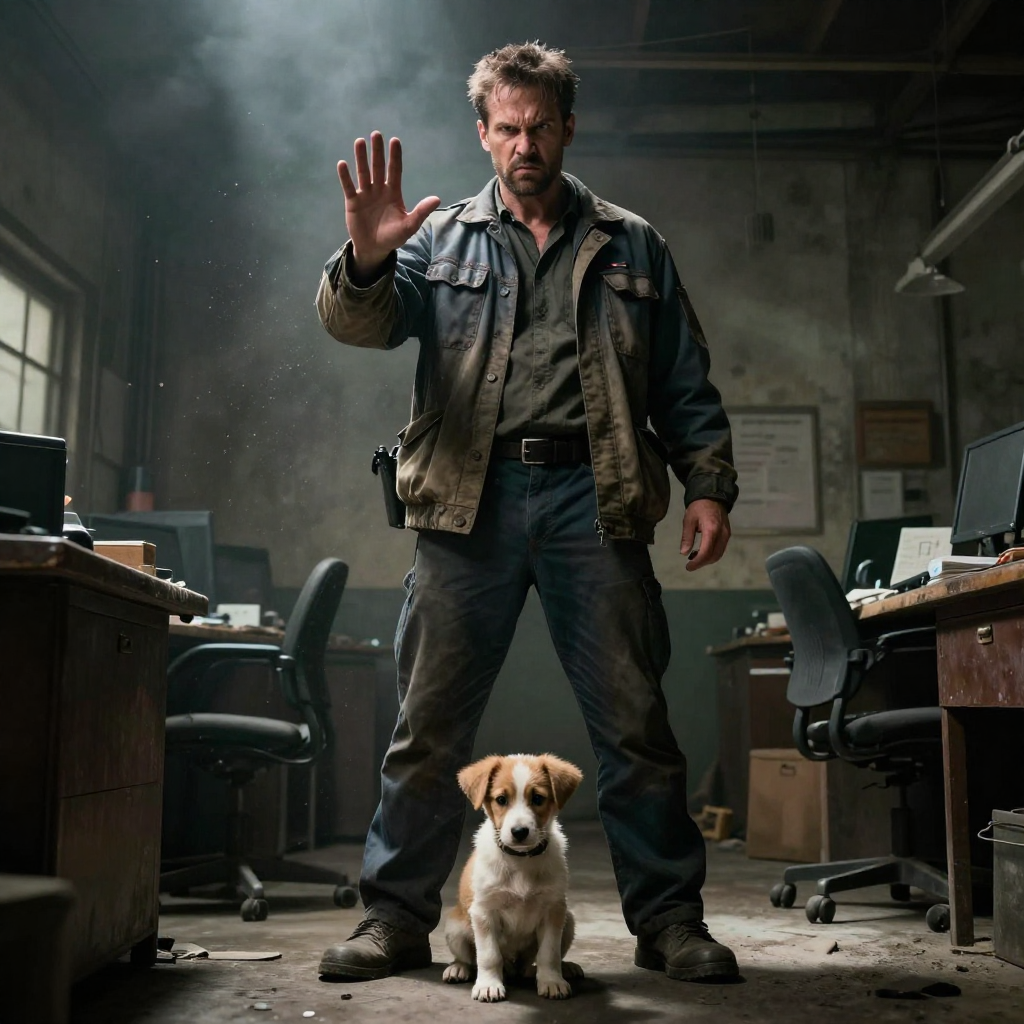
HE LAUGHED AS HE HURLED THE CHAIR AT THE HELPLESS PUPPY, AND I FORGOT I WAS UNDERCOVER. I slammed him against the wall, risking three years of investigation for one innocent life.
The smell of that office was the first thing that hit you—a mix of stale cigarette smoke, engine grease, and the sour tang of wet cardboard. It was a smell that had seeped into my pores over the last eight months, a second skin I couldn’t wash off. My name, according to the badge hidden in a safe deposit box three towns over, was Detective Jack Miller. But here, in the backroom of a failing shipping logistics center that served as a front for a massive fencing operation, I was just ‘Eddie.’
Eddie was quiet. Eddie laughed at bad jokes. Eddie didn’t ask questions. And Eddie certainly didn’t have a moral compass.
That was the job. You swallow the bile, you nod when they brag about things that make your stomach turn, and you wait. You wait for the big fish, the supplier, the guy at the top of the pyramid. I was close. So close I could feel the arrest warrant burning a hole in my mind. One more week, maybe two, and I’d have enough to bring the whole network down. I just had to keep my head down and my mouth shut.
Then Vinnie walked in.
Vinnie was the kind of guy who sucked the oxygen out of a room just to spite everyone else. He was a mid-level manager with too much ambition and a cruelty streak wide enough to drive a truck through. He walked in, kicking the door shut with a heavy boot, shaking rain off his jacket. He was in a foul mood; a deal had gone south earlier in the morning, and money had been lost. When men like Vinnie lose money, they look for something to break.
That’s when I saw the puppy.
It couldn’t have been more than eight weeks old—a scrappy, trembling thing with oversized paws and fur the color of street slush. It had wandered in from the loading dock, likely looking for warmth or a scrap of food dropped from a sandwich. It was huddled in the corner near the filing cabinets, trying to make itself invisible against the gray linoleum.
“What is this?” Vinnie’s voice was a low growl. He pointed a thick finger at the corner.
I was sitting on the edge of the desk, counting inventory sheets. I didn’t look up. “Just a stray, Vinnie. Came in with the rain. I’ll chase it out in a minute.”
“You’ll chase it out?” Vinnie sneered, walking toward the corner. The heavy thud of his boots made the puppy flinch. It pressed itself flatter against the metal cabinet, letting out a tiny, high-pitched whine. “We don’t run a shelter, Eddie. We run a business.”
“It’s harmless,” I said, keeping my voice even, though my pulse was already starting to climb. “Let it be. I’ll take it to the alley when I go for a smoke.”
But Vinnie wasn’t listening. He needed a target. He needed to feel big because the morning had made him feel small. He loomed over the dog, his shadow stretching across the floor. The puppy looked up, eyes wide, shaking so hard its teeth were clicking together. It didn’t run; it was too terrified to move. It just froze, praying to whatever god looks after the small and forgotten that the monster would pass.
Vinnie laughed. It was a dry, hollow sound. “Look at it. Pathetic. Just like the rest of this town.”
He reached for the metal folding chair leaning against the wall. It was heavy, rusted steel.
“Vinnie,” I said, and this time my voice dropped an octave. The ‘Eddie’ persona was slipping, just a fraction. “Don’t.”
He ignored me. He lifted the chair. The metal clanged as his ring hit the frame.
Time seemed to slow down. I saw the muscles in his forearm tense. I saw the look of pure, malicious boredom in his eyes. He wasn’t doing this because he was angry at the dog; he was doing it because he could. Because in his world, strength was measured by what you could crush.
“Get rid of the trash,” he muttered.
He swung.
He didn’t just toss it; he hurled it. He put his shoulder into the throw, aiming directly for the cowering ball of fur.
Logic screamed at me. *Stay seated. Stay undercover. Don’t blow three years of work for a dog. It’s just an animal. The case matters more. The thousands of victims of this fencing ring matter more. Do not move.*
But I wasn’t a detective in that split second. I wasn’t Eddie. I was a human being watching something evil happen in front of me.
My body moved before my brain signed the permission slip. I launched myself off the desk.
The chair smashed into the wall inches above the puppy’s head with a deafening *CRACK*, denting the plaster and sending dust raining down. The dog screamed—a sound of pure terror—and scrambled, slipping on the slick floor.
Vinnie was already reaching for something else, maybe to finish the job, maybe just to kick the animal.
He never got the chance.
I hit him at full speed. I drove my shoulder into his chest, lifting him off his feet. The air left his lungs in a wheezing *whoosh*. We crashed backward into the opposite wall, rattling the framed permits and shaking the dust from the ceiling lights.
I pinned him there. My forearm was pressed against his windpipe, hard enough to choke, not hard enough to kill. Yet.
The room went dead silent. The inventory sheets I had been holding fluttered to the floor like snow.
Vinnie’s eyes were wide, bulging with shock. He clawed at my arm, but I didn’t budge. I was six-foot-two and fueled by a rage that had been bottling up for eight months of pretending to be someone I hated.
“Eddie?” he rasped, his face turning a blotchy red.
“Touch him again,” I whispered. My face was inches from his. I could smell the coffee and onions on his breath. My voice was trembling, not with fear, but with the terrifying clarity of violence. “Touch that dog again, Vinnie, and see what happens.”
It wasn’t something Eddie would say. Eddie was a pushover. Eddie was just happy to be on the payroll. This was the voice of a man who had arrested murderers and stared down gang leaders. It was the voice of authority.
Vinnie froze. He stopped struggling. He looked at me, really looked at me, for the first time. He saw the shift in my eyes. He saw the way I held myself. The mask was gone. The sloppy posture was gone. The deferential nod was gone.
“Who… who are you?” he wheezed, the realization dawning slowly in his panicked gaze.
I tightened my grip on his collar, feeling the fabric strain. In the corner, the puppy was whimpering, a soft, rhythmic sound of distress.
I had done it. I had crossed the line. There was no going back to the desk, no going back to the inventory sheets. The moment I let him go, he would know. He would call the Boss. He would tell them that Eddie wasn’t just a quiet worker—Eddie was a threat.
The warehouse door at the far end of the hall creaked open. Heavy footsteps echoed on the concrete. Someone else was coming.
I looked at Vinnie, then back at the puppy shivering in the dust.
“I’m the guy who’s about to ruin your whole life,” I said, and I let him drop to the floor.
CHAPTER II
The sound of the footsteps was heavy, measured, and entirely too calm. It wasn’t the panicked run of a low-level corner boy. It was the sound of someone who owned the floorboards beneath their feet. I could feel Vinnie’s pulse thudding against my knuckles where I held his throat, a frantic, rhythmic tapping that told me he was terrified—not of me, but of the person walking through that door.
I didn’t let go. If I let go now, I was just Eddie, the guy who’d lost his mind over a stray. If I held on, I was something else. I had to be something else. The ‘Eddie’ I’d built over the last eight months—the quiet, reliable, slightly dim-witted driver—was dead. He’d died the second I tackled Vinnie to save that trembling ball of fur under the chair. I could feel the ghost of Eddie leaving the room, and in the vacuum he left behind, I had to find a new skin to wear.
The door creaked open. Silas didn’t barge in; he drifted. He was a man who seemed to take up more space than his physical frame allowed, dressed in a grey wool coat that looked too expensive for a warehouse full of stolen electronics. He stopped three feet from us, his eyes scanning the scene: Vinnie pinned to the wall, the heavy metal chair overturned, and the small, shivering puppy huddled in the corner, its eyes wide and glassy with fear.
“Vinnie looks like he’s having a hard time breathing, Eddie,” Silas said. His voice was like dry leaves skittering across pavement—soft, brittle, and cold. He didn’t sound angry. He sounded curious. That was worse.
“His name isn’t Eddie,” Vinnie wheezed, the words squeezing out of his constricted throat. “Look at him, Silas. This ain’t no driver. He moved like… like a pro.”
I tightened my grip for a fraction of a second, just enough to silence Vinnie, then I slowly, very slowly, released him. I didn’t step back. I didn’t drop my hands to my sides. I kept them up, ready, my weight centered. I looked Silas straight in the eye, something the old Eddie would never have dared to do. I needed to project a different kind of danger now—the kind that Silas would want to employ rather than eliminate.
“Vinnie was being loud,” I said. My voice was deeper, stripped of the nervous stutter I’d cultivated. “And he was being wasteful. I don’t like waste.”
Silas looked at the puppy, then back at me. A small, thin smile touched the corners of his mouth. “Waste? It’s a dog, Eddie. Or whatever your name is. A stray. Vinnie was just… clearing the workspace.”
“It’s a life,” I said. It was a stupid thing to say in this world, but it was the only truth I had left. “And he was doing it because he could, not because he had to. Men who kill things just because they’re bored are liabilities. They make mistakes. They get sloppy.”
I was reaching, and I knew it. I was trying to frame my moral reflex as a professional critique. I needed Silas to believe I was a high-level operator who had been playing small, someone hiding from a bigger shadow, someone whose skills were too valuable to lose over a domestic dispute.
But as I stood there, the smell of the damp warehouse floor and the metallic tang of old grease triggered something I hadn’t thought about in years. It was an old wound, one I thought I’d stitched shut with the badge and the years of service. I was twelve years old again, standing in my father’s garage. I remembered the heat of a July afternoon and the sound of my older brother, Leo, laughing. Leo had found a bird with a broken wing. He hadn’t tried to fix it. He’d wanted to see how much it could take before the fluttering stopped. I had stood there, frozen, my boots heavy as lead, watching. I hadn’t moved. I hadn’t said a word. I’d let it happen because I was afraid of Leo, afraid of his strength, afraid of the darkness he carried. That silence had rotted inside me for decades. It was the reason I became a cop. It was the reason I couldn’t let Vinnie drop that chair.
“You’re a long way from home, aren’t you?” Silas asked, breaking the silence. He stepped closer, his presence a physical pressure. “You didn’t come here to fence stolen iPhones. You move like a man who’s killed people, not birds. So, who are you?”
“Someone who’s tired of watching the wrong people get hurt,” I said. It was a half-truth, the most dangerous kind. “I’m someone who needs a place to stay quiet for a while. And I was doing that, until Vinnie decided to start a circus.”
Vinnie, sensing a shift in the power dynamic, moved to interject. “He’s a plant, Silas! He’s gotta be. No one fights like that for a mutt unless they’re…”
“Unless they’re what, Vinnie?” Silas cut him soulfully. “Unless they have a conscience? You think the police would send a man in for eight months, let him move thousands of dollars in merchandise, just to save a dog? No. The police are many things, but they aren’t that poetic.”
Silas turned his full attention back to me. This was the moment. The triggering event was unfolding. If I walked out of here without the dog, I was a liar. If I stayed and fought, I was dead. But there was a third path—a public challenge.
“I’m taking the dog,” I said. I didn’t ask. I stated it.
Two of Silas’s men, who had been hovering in the hallway, stepped into the room. They didn’t have guns out, but their hands were near their waistbands. The atmosphere in the room curdled. This was the point of no return. In this world, you don’t take things from men like Silas. You don’t make demands. By doing so, I was publicly undermining his authority in front of his crew. If he let me go, he looked weak. If he killed me, he lost the mystery of who I actually was.
“You’d die for it?” Silas asked, his voice genuinely perplexed. “You’d blow whatever cover you’re running, whatever life you’re hiding from, for a bag of bones?”
“I’m not dying today,” I said, my voice steady, though my heart was hammering a frantic rhythm against my ribs. “And neither is the dog. You want to know who I am, Silas? I’m the guy you want on your side when things go sideways. Because I don’t flinch. Vinnie flinches. He picks on things that can’t bite back. I don’t.”
I walked over to the corner. The men in the doorway shifted, their eyes darting to Silas for a signal. Silas stayed silent, his hand stroking his chin. I reached down. The puppy whimpered and tried to bury its head in the concrete. I felt a surge of raw, unadulterated protectiveness. I scooped it up. It was lighter than I expected, its heart beating so fast I thought it might burst. I tucked it inside my jacket, against my own chest.
I stood up and faced Silas. The secret of my identity was a thin veil now. I wasn’t Eddie, but I wasn’t quite Jack Miller, Detective, either. I was a man caught in the middle of a moral dilemma with no clean exit. If I went back to my handlers now, the mission was a failure. Eight months of work, the names of the wholesalers, the transit routes—all gone because I couldn’t watch a dog die. My commander would have my badge. But if I stayed, I was entering a deeper level of hell. Silas wouldn’t just use me; he’d test me. He’d want to see blood.
“Let him go,” Silas said suddenly.
Vinnie gasped. “Silas, you can’t be serious! He laid hands on me!”
“He did more than that, Vinnie. He showed me how pathetic you are,” Silas said, his eyes never leaving mine. “Eddie—or whatever you want to be called—you take your dog. You go home. You clear your head. But tomorrow, you don’t come back as a driver. You come back as mine. If you don’t show up, I’ll know Vinnie was right. And if Vinnie is right, I’ll find you. And I’ll find the dog.”
I nodded once. I didn’t say thank you. I couldn’t. I turned and walked toward the door. The two men stepped aside, their expressions a mix of confusion and redirected respect. I walked through the warehouse, past the stacks of crated televisions and the rows of stolen power tools. Every shadow felt like a threat. Every set of eyes felt like a weight.
I stepped out into the night air. It was raining—a cold, needle-like drizzle that felt like heaven on my skin. I walked three blocks before I let myself breathe. I ducked into a narrow alleyway, leaning my back against the brick wall, the puppy still huddled against my chest.
I was in deep. I had a secret that was rotting, a past that had clawed its way into the present, and a future that looked like a slow-motion car crash. I looked down at the dog. It had stopped shivering and was looking up at me with dark, intelligent eyes.
“What am I going to do with you?” I whispered.
I had a choice. I could drop the dog at a shelter, call my handler, admit I’d blown the op, and take the suspension. I’d be safe. The dog would be safe. But the network would stay intact. Silas would continue to move his poison through the city, and Vinnie would find something else to break.
Or, I could lean into the lie. I could become the ‘dangerous freelancer’ Silas thought I was. I could use that position to get closer to the top than Eddie ever could have. But to do that, I’d have to do things Jack Miller wouldn’t do. I’d have to cross lines I’d spent my life drawing.
Choosing the ‘right’ thing—reporting in—meant failing the mission and letting the criminals win. Choosing the ‘wrong’ thing—becoming Silas’s man—meant risking my soul to finish the job. There was no clean outcome. No matter what I chose, something was going to be destroyed.
I pulled my phone from my pocket. I looked at the contact for my handler, Miller’s ‘real’ life. My thumb hovered over the call button. I thought about the bird in the garage. I thought about the silence. I thought about the way Vinnie had looked when I’d pinned him to the wall—the realization that for the first time in his life, he was the one who was small.
I put the phone back in my pocket.
I started walking again, the puppy’s warmth the only real thing in a world made of mirrors and shadows. I had to find a place for the dog to stay, somewhere Silas wouldn’t look. And then, I had to prepare. Tomorrow, I wasn’t going to work. I was going to war.
The weight of the decision felt like lead in my stomach. I was no longer an observer of this life; I was a participant. The mask had slipped, and instead of putting it back on, I was carving a new one out of the wreckage. I was Jack Miller, I was Eddie, and now I was Silas’s newest pet.
As I reached my apartment, a nondescript studio in a building that smelled of cabbage and old carpet, I realized I was being watched. A black sedan was parked across the street, its lights off, its engine idling low. It wasn’t the police. It was Silas’s way of reminding me that I hadn’t escaped. I’d just been given a longer leash.
I went inside, locked the door, and set the puppy down on the floor. It wobbled for a moment, then began to sniff the perimeter of the room. It didn’t know about the sedan outside. It didn’t know about the internal affairs investigation that would surely follow if I didn’t check in. It just knew it was alive.
“Stay quiet,” I told it, as if it could understand.
I sat on the edge of my bed, my head in my hands. The old wound was open now, bleeding into my present. I had saved the dog, but in doing so, I’d trapped myself in a game where the rules changed every hour. I was a cop who had stopped acting like one, and a criminal who had never been one. I was nothing. I was just a man in a room with a dog, waiting for the sun to come up so I could go back into the dark.
I thought about Leo. I thought about the way he’d looked at me that day in the garage, a sneer on his face because he knew I wouldn’t stop him. I wasn’t that kid anymore. But as I looked at the door, listening for the sound of the sedan pulling away, I wondered if I was just a different kind of coward—the kind who does the right thing for all the wrong reasons.
The night stretched on, silent and oppressive. I didn’t sleep. I watched the puppy sleep on a pile of my old laundry, its chest rising and falling in a steady, peaceful rhythm. It was the only peace in the room. By morning, I would have to decide which version of myself to kill. And as the first grey light of dawn began to bleed through the blinds, I realized the choice had already been made. You don’t walk away from a man like Silas. You either break him, or you become him.
I reached for my boots. The leather was worn, the laces frayed. They were Eddie’s boots. I put them on, but I didn’t feel like Eddie. I felt like a ghost, haunting my own life, preparing to walk back into the warehouse and face the man who now held my leash. The dog woke up and looked at me, wagging its tail once, tentatively.
“I know,” I said to the empty room. “I know.”
CHAPTER III
The air in the city felt like it was made of iron. Cold, heavy, and tasting of rust. I didn’t sleep. I spent the night sitting on the floor of my apartment, watching the puppy—Soot—sleep in a box lined with my old police academy t-shirt. I shouldn’t have used that shirt. It was a reminder of a life that was currently dissolving like salt in a storm. My phone was dead. I’d turned it off. My handlers at the precinct were probably losing their minds, but they weren’t here. They weren’t the ones who had to look Silas in the eye.
I drove to the warehouse at dawn. The dog was in the passenger seat, his head resting on my thigh. Every time I hit a pothole, he’d let out a soft whimper that felt like a needle under my fingernails. I was Eddie the freelancer now. A man who snapped. A man who was too dangerous to ignore and too useful to kill. That was the lie, anyway. I kept repeating it until it sounded like a truth.
Silas’s main office was a converted penthouse above a meatpacking plant. It smelled of bleach and expensive leather. When the elevator doors slid open, Vinnie was waiting. His face was a map of bruises from our encounter the day before. One eye was swollen shut, a deep shade of plum. He didn’t say a word. He just stared at me with a look that promised a slow death. He was holding a heavy manila folder.
“Silas is waiting,” Vinnie rasped. The voice was thin, damaged. I’d done that to him. I didn’t feel bad about it. I felt a cold, clinical satisfaction.
I walked past him, Soot tucked under my arm. Silas was sitting behind a desk made of reclaimed shipwreck timber. He looked like a man who had never had a bad day in his life—composed, manicured, and utterly hollow. He didn’t look at me. He was looking at a series of monitors on the wall, showing flickering feeds of docks and loading bays.
“The dog,” Silas said, finally turning his chair. “You brought it back into the fire.”
“He’s mine,” I said. My voice was steady, which was a miracle. “I don’t leave my things behind.”
Silas smiled. It wasn’t a friendly expression. It was the smile of a man who had just found the handle on a door he wanted to open. He motioned for Vinnie to leave. Vinnie lingered for a second, his gaze darting between the folder in his hand and my throat, before he backed out.
“Loyalty is a rare currency, Eddie,” Silas said. He stood up and walked over to me. He reached out a hand to pet the puppy. I felt my muscles lock, a hair-trigger response. I wanted to break his wrist. I didn’t move. Silas felt the dog’s ears, his fingers surprisingly gentle. “But loyalty to a beast is just sentiment. I need to know your loyalty to the hand that feeds you.”
He walked back to his desk and picked up a silver key. He tossed it to me. It caught the light as it spun through the air.
“Downstairs. Sub-level two. There’s a man tied to a chair. His name is Mose. He’s been selling our transport schedules to the locals. He’s a leak. He’s a parasite.” Silas leaned back, his eyes locking onto mine. “I want you to cauterize the wound. Show me that the fire I saw in you yesterday wasn’t just a tantrum. Show me you can kill for a reason, not just an impulse.”
I gripped the key. The metal bit into my palm. My heart was a hammer against my ribs. “And if I do?”
“Then you’re in. You’ll have a seat at the table. You’ll have protection. And the dog? The dog gets the best life a mutt can have.” Silas’s voice dropped an octave. “If you don’t, Vinnie gets to finish what he started. And he’s been very creative with his suggestions for your afternoon.”
I turned and walked to the elevator. Every step felt like I was walking through deep water. Sub-level two was a basement that hadn’t seen paint in forty years. The air was thick with the smell of wet concrete and old grease. I found the room. It was a utility closet with a single bulb hanging from a frayed wire.
In the center of the room, a man was strapped to a wooden chair. He was old, maybe sixty, with a face like a crumpled paper bag. Mose. I knew him. He was a low-level CI—a confidential informant I’d used three years ago when I was in Narcotics. He was a grandfather. He sold information to buy medicine for a heart condition he couldn’t afford to treat. He looked up at me, his eyes wide and clouded with cataracts. He didn’t recognize me. Not yet.
“Please,” he whispered. The word was barely a vibration.
I set the puppy down in the corner of the room. Soot sensed the tension and curled into a ball, his tail tucked between his legs. I looked at the man. I looked at the gun Silas’s man had handed me in the hallway. A heavy, black semi-automatic. No serial number.
I thought about Leo. My brother. I remembered him holding a kitten over a rain barrel when we were ten. I remembered the way he laughed when I cried. I had stood there, frozen, unable to move, unable to save anything. The guilt of that moment had been the engine of my entire career. It was why I became a cop. It was why I was in this basement.
“I’m sorry, Mose,” I whispered.
I stepped closer. I had to play the part. I had to make it look real. I raised the gun. My hands were shaking. If I killed him, I was no longer a cop. I was just another monster in a city full of them. If I didn’t, we both died.
The door behind me creaked open. I didn’t turn. I knew the silhouette.
“Taking your time, aren’t you?” Vinnie’s voice was like a serrated blade. He walked into the light, holding the manila folder. Behind him, Silas appeared, his hands in his pockets, looking bored.
“He’s reflecting,” Silas said. “It’s a big step. The first one always is.”
“He’s not reflecting,” Vinnie spat. He threw the folder onto the floor. Papers spilled out—grainy photos, printouts of payroll records, a copy of a commendation from five years ago. My face was on the top page. Detective Jack Miller.
“He’s a pig, Silas,” Vinnie screamed. “I spent all night on the dark web, digging through the old precinct archives. He’s deep-cover. He’s been playing us for eight months.”
I froze. The world slowed down. I could hear the hum of the light bulb. I could hear the puppy’s frantic breathing. I could hear the blood rushing through my ears. I didn’t lower the gun. I kept it pointed at Mose, but my focus shifted to the periphery.
Silas didn’t look angry. He didn’t look shocked. He walked over to the papers, kicked them aside with a polished shoe, and looked at me.
“Jack,” Silas said. He used my real name. It sounded like a curse. “Vinnie thinks he’s found a gold mine. He thinks he’s saved the organization.”
Silas laughed. It was a dry, rattling sound.
“Do you want to tell him, Jack? Or should I?”
I didn’t say anything. My throat was a desert.
“I knew you were a cop the second week you were on the payroll,” Silas said. He stepped closer, right into the line of fire, as if he knew I wouldn’t pull the trigger. “Your posture was too good. You looked for cameras in every room. You didn’t do drugs, you didn’t drink to excess, and you never took a cut of the side-jobs. You were too clean. You were a beacon of light in a sewer.”
I finally lowered the gun. “If you knew… why?”
“Because a dirty cop is a liability, but a broken cop is an asset,” Silas said. “I’ve been waiting for this. I’ve been grooming you. I let you keep the dog because I knew you’d attach your soul to it. I let you beat Vinnie because I wanted to see if you had the stomach for the violence.”
Silas reached down and picked up the puppy. Soot let out a sharp yelp as Silas gripped him by the scruff of the neck. Silas held the dog out over the concrete floor, his arm extended.
“Vinnie wants to kill you, Jack. He wants to peel your skin off. But I have a better idea.” Silas looked at Mose, then back to me. “Kill the snitch. Right now. Do it, and the file Vinnie found disappears. You become my personal shadow. You get the intelligence I need to take out my rivals, and I keep you out of a cage. You keep the dog. You keep your life.”
“And if I don’t?” My voice was a ghost.
“Then I drop the dog. Vinnie kills Mose. And then we spend the next forty-eight hours making sure you regret the day you were born.” Silas’s eyes were dead. “Make a choice, Detective. Are you a hero who dies in a basement, or are you a man who survives?”
Vinnie was grinning, his one good eye gleaming with malice. He reached into his jacket, pulling out a knife. He wasn’t looking at me; he was looking at the puppy.
I looked at Mose. The old man was crying now, the tears carving tracks through the grime on his face. He knew what was happening. He was a pawn. Just like the dog. Just like me.
I thought about the oath I’d taken. I thought about the laws I’d spent my life defending. They felt like fairy tales told to children. In this room, there was only power and the lack of it.
“The dog has nothing to do with this,” I said.
“The dog is everything,” Silas countered. “He’s the only part of you that isn’t a lie. Kill the man, save the dog. It’s a simple trade. The kind of trade this world is built on.”
I felt a strange calm wash over me. It was the clarity of a man who has run out of exits. I looked at the gun in my hand. Then I looked at Silas.
“You’re right,” I said. “The dog is the only part of me that isn’t a lie.”
I didn’t point the gun at Mose. I didn’t point it at Silas.
I turned the gun and aimed it at the light bulb.
*Crack.*
The room plunged into absolute, suffocating darkness.
In the blackness, the world erupted. I heard Silas shout. I heard the puppy bark—a sharp, piercing sound. I lunged forward, not toward the door, but toward the memory of where Silas was standing.
I felt a body collide with mine. Vinnie. He smelled of cheap cologne and sweat. I felt the sting of a blade across my ribs, a cold line of fire. I didn’t scream. I slammed my forehead into where I thought his face was. I heard the crunch of cartilage. Vinnie went down, groaning.
I reached out, searching the air. My fingers brushed fur. I grabbed Soot, tucking him against my chest. He was shaking violently.
“Jack!” Silas’s voice was calm, even in the dark. “You’re making a mistake. You can’t see in here. My men are at the door. There is no version of this where you walk out with that animal.”
I backed away, my heels clicking on the concrete. I knew the layout of the room. Four paces to the left was a heavy metal table. Three paces behind that was the vent.
“I’m not walking out,” I said into the dark.
I heard the heavy thud of boots in the hallway. Silas’s backup. They were coming to finish the test.
Suddenly, the basement door didn’t just open—it was blown off its hinges. The sound was deafening, a roar of pressure and splintering wood.
Flashbangs.
The room was suddenly filled with a blinding, strobe-like white light. I squeezed my eyes shut, pressing the puppy into my stomach. Shout. Commands. The rhythmic, heavy cadence of tactical teams.
“State Police! Drop the weapon! Hands in the air!”
The authorities. But not my handlers. These were different uniforms. Black tactical gear, ‘Internal Affairs’ stenciled in white across their backs.
I stayed on the floor, the puppy whimpering in my arms. I saw Silas standing by the desk, his hands raised, a look of mild annoyance on his face, as if he were being interrupted during a boring movie. Vinnie was on the ground, clutching his broken nose, blood leaking through his fingers.
A man in a suit walked through the smoke. He wasn’t a tactical officer. He was older, gray-haired, carrying a briefcase. I recognized him from the news. Assistant District Attorney Henderson.
He didn’t look at the criminals. He didn’t look at the dead-eyed enforcers. He walked straight to me.
“Detective Miller,” Henderson said. His voice was cold, professional. “You’ve been a very hard man to find. Your department thought you went rogue three days ago.”
I looked up at him, the puppy’s heart beating against my own. “I was doing my job.”
“Were you?” Henderson looked at the folder Vinnie had dropped. He looked at Mose, still tied to the chair, shaking with terror. “Because from where I’m standing, it looks like you’ve been participating in a criminal enterprise without oversight. Your handlers didn’t authorize this ‘freelance’ pivot.”
Silas chuckled. “He’s one of yours, then? Truly? I was starting to hope he was mine.”
Henderson ignored him. He looked at me with something that might have been pity, if he were capable of it. “The operation is over, Jack. We’ve been monitoring Silas for months. We didn’t need you to blow it. But you did. You broke cover, you assaulted a civilian—even if that civilian is trash like Vinnie—and you went dark.”
“I saved the dog,” I whispered. It sounded pathetic even to me.
“You saved a dog and ruined a three-year investigation,” Henderson said. He signaled to the officers. “Take them all. Silas, the muscle, the snitch. And take the Detective. He’s got a lot of explaining to do to a grand jury.”
As they pulled me up, Silas caught my eye. He was being handcuffed, but he didn’t look like a man who had lost. He looked like a man who had just won a bet.
“See you soon, Jack,” Silas whispered as they led him past. “You’re not a cop anymore. You’re just a guy who knows too much. And in my world, those guys don’t last long in prison.”
I felt the cold steel of the handcuffs click around my wrists. They tried to take Soot from me. I held on. I held on until a young officer, looking uncomfortable, gently pried the puppy from my arms.
“I’ll take him to the shelter, sir,” the officer whispered.
“No,” I said, my voice breaking. “Don’t let him go back to a cage.”
But they were already pushing me toward the elevator. The light in the basement was harsh and unforgiving. The folder—my life, my career, my identity—lay scattered on the floor, being trampled by boots.
I had saved the dog. I had saved Mose. And in doing so, I had destroyed everything else. I wasn’t Eddie the freelancer. I wasn’t Jack the Detective.
I was just a man in the dark, waiting for the consequences to arrive.
CHAPTER IV
The fluorescent lights hummed, a sterile counterpoint to the chaos that had just ripped through Silas’s warehouse. My own kind had hauled me in—handcuffed, silent, a pariah in the very system I swore to protect. The metal of the cuffs bit into my wrists, a physical manifestation of the betrayal I felt from all sides. My career, my life, hung by a thread thinner than Soot’s tiny legs. Vinnie, Silas, Mose, Soot, Leo. Their faces swam behind my eyes, a gallery of ghosts and broken promises.
The holding cell was small, grey, and smelled of stale coffee and despair. I sat on the hard bench, my head in my hands. The silence was broken only by the muffled sounds of the precinct—phones ringing, voices raised, the distant clatter of keyboards. Each sound a reminder of the world I was now locked out of.
The weight of it all crashed down on me. I’d crossed lines, bent rules, all in the name of… what? Justice? Or just a desperate attempt to fill the hole Leo had left? I didn’t know anymore.
A guard appeared at the bars, his face unreadable. “Miller? You got a visitor.”
I followed him down the corridor, my footsteps echoing in the sterile space. The interrogation room was just as bleak as the cell, a table, two chairs, and a one-way mirror. Sitting at the table was ADA Reynolds, a woman I’d respected, a woman who now looked at me with a mixture of disappointment and something that might have been pity.
“Jack,” she said, her voice tired. “What the hell happened?”
I gave her the bare bones, the parts that wouldn’t incriminate me further. I left out the dog, the loyalty test, the full extent of Silas’s operation. I painted myself as a rogue cop who’d stumbled onto something big and acted impulsively. A half-truth, but the best I could manage.
Reynolds listened, her expression unchanging. When I finished, she sighed. “Jack, you’re facing serious charges. Assaulting a superior officer, obstruction of justice, possible conspiracy…”
“I saved lives,” I said, my voice flat. “Mose would be dead. Who knows what else Silas was planning?”
“And you think that justifies your actions?” She raised an eyebrow. “You went off the reservation, Jack. You broke the law. You put the whole investigation at risk.”
“The investigation was already compromised,” I said, my gaze meeting hers. “Silas knew I was a cop. Someone inside tipped him off.”
Reynolds didn’t react, but I saw a flicker of something in her eyes. Doubt? Curiosity? I couldn’t tell. “That’s a serious accusation, Jack.”
“It’s the truth.” I leaned forward. “You need to find out who’s protecting Silas. He’s not working alone.”
She stood up, her face hardening. “Right now, I’m more concerned with what you did. Cooperate with us, Jack. Tell us everything. It’s the only way you’re going to get out of this.”
She left, leaving me alone in the room, the weight of her words pressing down on me. Cooperate? And betray everyone who’d trusted me? Even Mose? Even Soot? I couldn’t. I wouldn’t.
Time blurred. I sat there for hours, lost in my thoughts, replaying the events of the past few days. The faces of the people I’d hurt, the choices I’d made, the lies I’d told. Each one a stone in the wall I’d built around myself.
The door opened again, and this time it was Silas. He was wearing a suit, his hair perfectly coiffed, his expression smug. He looked like he was about to close a lucrative business deal, not facing indictment.
“Jack, my boy,” he said, his voice dripping with false concern. “Such a mess you’ve made for yourself.”
“Get out of here, Silas,” I growled.
He chuckled. “Now, now, is that any way to treat an old friend? I just came to offer my condolences. And perhaps… a little advice.”
“I don’t need your advice.”
“Don’t you?” He sat down, crossing his legs. “You’re in a very precarious position, Jack. The DA wants your head. Internal Affairs wants to make an example of you. You’re a loose end, and loose ends tend to get… taken care of.”
“What do you want, Silas?”
“I want you to understand that we’re not so different, you and I. We both operate outside the lines. We both do what’s necessary to get the job done. The only difference is, I’m better at it.”
“You’re a monster.”
“Am I? Or am I just a realist? I saw potential in you, Jack. I saw a man who was willing to do what others wouldn’t. A man who was… broken. Like me.”
He leaned closer, his eyes glinting. “I can help you, Jack. I can make this all go away. All you have to do is… listen to me.”
“What are you talking about?”
“I have friends in high places, Jack. Friends who can make sure this case… disappears. Friends who can get you out of here, clean as a whistle. All you have to do is tell them what they want to hear.”
“And what’s that?”
“The truth, Jack. Or… a version of it that suits their needs. Blame it all on me. Say I forced you to do things you didn’t want to do. Say you were acting under duress. They’ll eat it up. They need a scapegoat, and you’re the perfect candidate.”
“And what happens to you?”
He smiled. “Don’t worry about me, Jack. I can take care of myself. I always do.”
I stared at him, my mind racing. It was a tempting offer, a way out of the mess I was in. But it would mean lying, betraying my own ideals, becoming the very thing I hated.
“I can’t do it, Silas,” I said, my voice firm.
His smile faded. “You’re a fool, Jack. You’re throwing your life away for nothing.”
“Maybe,” I said. “But I’m not going to become you.”
He stood up, his face contorted with rage. “You’ll regret this, Jack. You’ll regret the day you ever crossed me.”
He turned and walked out, leaving me alone again, the weight of my decision heavy on my shoulders. I’d chosen my path. Now I had to face the consequences.
The news hit the streets like a shockwave. “Undercover Cop Busted in Drug Raid,” the headlines screamed. My face was plastered all over the news, my name dragged through the mud. Some hailed me as a hero, a whistleblower exposing corruption. Others condemned me as a rogue cop, a disgrace to the badge.
The precinct was a pressure cooker. Cops I’d worked with for years avoided my gaze. Whispers followed me down the hallways. I was radioactive.
Reynolds called me in again. This time, there was no pity in her eyes, only cold professionalism. “The media is having a field day with this, Jack,” she said. “The public wants answers.”
“I told you the truth,” I said.
“The truth isn’t always what people want to hear,” she said. “We need a narrative, Jack. A story that will satisfy the public and protect the integrity of the department.”
“And what’s that narrative?”
“That you were a dedicated officer who got in too deep, that you were manipulated by Silas, that you acted in good faith but made some mistakes along the way.”
“Lies.”
“A necessary simplification,” she said. “Look, Jack, I’m trying to help you here. If you cooperate, we can minimize the damage. We can get you a deal. But if you continue to resist, you’re going to face the full weight of the law.”
I thought about Leo, about the sacrifices he’d made, about the oath I’d taken. I couldn’t lie. I wouldn’t.
“I can’t do it,” I said.
Reynolds sighed. “Then I can’t help you, Jack.”
She handed me a file. “This is your suspension notice. Pending further investigation.”
I took the file, my hand trembling. My career, my life, slipping away.
As I walked out of the precinct, I saw a group of reporters waiting outside. Cameras flashed, microphones were shoved in my face. “Detective Miller, do you have any comment?” “Detective Miller, are you guilty?” “Detective Miller, what about the dog?”
I pushed my way through the crowd, ignoring their questions. The dog. Soot. I hadn’t forgotten about him. He was still out there, somewhere. And I was going to find him.
That night, I sat alone in my apartment, the city lights twinkling outside my window. The silence was deafening. I was a ghost, haunting the edges of a world I no longer belonged to.
My phone rang. It was an unknown number.
“Hello?”
“Jack? It’s Mose.”
My heart leaped. “Mose? You’re alive!”
“Thanks to you, man,” he said. “I owe you one.”
“Where are you? Are you safe?”
“I’m laying low,” he said. “But I heard what happened. I wanted to let you know, I appreciate what you did. You saved my life.”
“It was the right thing to do,” I said.
“Yeah, well, not a lot of people would have done it,” he said. “Listen, I might have something that can help you. Something that can clear your name.”
“What is it?”
“I can’t say over the phone,” he said. “But meet me. Tomorrow night. Same place where Silas used to meet his contacts.”
I hesitated. It could be a trap. But I had nothing to lose.
“Okay,” I said. “I’ll be there.”
The next day crawled by. I spent the time trying to track down Soot, calling every animal shelter and rescue organization in the city. But no one had seen him. It was like he’d vanished into thin air.
The sun set, casting long shadows across the city. I drove to the meeting place, my heart pounding in my chest. The place was deserted, a run-down warehouse on the edge of the industrial district.
I parked the car and walked towards the entrance, my hand on my gun. I was alone, vulnerable. But I had to do this. For Mose, for Soot, for myself.
I pushed open the door and stepped inside. The warehouse was dark and empty, the air thick with dust and the smell of decay. I called out Mose’s name, but there was no response.
Suddenly, a light flickered on, illuminating a figure standing in the shadows. It wasn’t Mose.
It was Vinnie.
He grinned, his eyes cold and hard. “Hello, Jack,” he said. “I’ve been waiting for you.”
“Vinnie? What are you doing here?”
“Silas sent me,” he said. “He wants to tie up loose ends.”
He raised his gun, pointing it at me. “Say goodbye, Jack.”
But before he could pull the trigger, a shot rang out. Vinnie screamed and crumpled to the ground. I spun around, my gun raised.
Mose stepped out of the shadows, a smoking gun in his hand. “Sorry I’m late, man,” he said. “Traffic was a bitch.”
But as Mose said those words, I felt a sharp pain in my back. I looked down and saw a knife sticking out of my ribs.
I gasped, my knees buckling. I turned to see a young woman standing behind me, her face expressionless. She looked familiar, but I couldn’t place her.
“Who are you?” I whispered.
She didn’t answer. She simply pulled the knife out of my back and let me fall to the ground.
As I lay there, bleeding and dying, I finally recognized her.
She was Leo’s daughter. My niece, whom I had never met. The Old Wound had returned, seeking its final payment.
Everything went black.
The aftermath was a whirlwind of investigations, accusations, and recriminations. The DA’s office, desperate to salvage their reputation, launched a full-scale inquiry into Silas’s operation and the events that had led to my shooting. Vinnie, miraculously alive but facing a slew of charges, sang like a canary, implicating Silas and a network of corrupt officials within the police department.
The media frenzy intensified. My name, once synonymous with scandal, became a symbol of righteous defiance against a corrupt system. Activists rallied in my support, demanding justice for the “rogue cop” who had dared to expose the truth.
But amidst the public uproar, I remained in a coma, my fate hanging in the balance. My body was healing, but my mind was trapped in a labyrinth of memories and regrets. I saw Leo, Silas, Vinnie, Reynolds, Mose and Soot all trying to speak to me. Asking me questions I couldn’t answer.
The one question that hung over the entire case was, What became of Soot?
One morning, I awoke to a changed world. Sunlight streamed through the window, and I could feel the warmth of the sun on my skin. The pain in my body was still there, but it was dulled, muted. I was alive.
Reynolds was sitting by my bedside, her face etched with fatigue. She looked up when she saw me open my eyes.
“Jack,” she said, her voice soft. “You’re awake.”
“What happened?” I asked.
“You were shot,” she said. “You were in a coma for two weeks.”
“Vinnie… Mose…”
“Vinnie is in custody,” she said. “He’s cooperating with the investigation. Mose is safe, under witness protection.”
“And Silas?”
“Silas is going down,” she said. “We have enough evidence to put him away for a long time. Thanks to you.”
“And Leo’s daughter?”
Reynolds hesitated. “She’s been taken into custody. She’s very troubled Jack. But don’t worry, she’ll be looked after. She never spoke. We don’t know what motivated her.”
I closed my eyes, relief washing over me. I had done it. I had exposed Silas, saved Mose, and brought down a corrupt system. But at what cost?
“There’s something else, Jack,” Reynolds said.
I opened my eyes, bracing myself for the worst.
“We found him,” she said, a faint smile gracing her lips.
“Found who?”
“The dog, Jack,” she said. “We found Soot.”
She handed me a photo. It was a picture of Soot, sitting in a sunlit park, his tail wagging furiously. He was being held by a young woman, her face beaming with joy.
“He’s safe, Jack,” Reynolds said. “He’s with a good family. They’re taking care of him.”
I stared at the photo, tears welling up in my eyes. I had lost everything – my career, my reputation, my peace of mind. But Soot was safe. And in that moment, that was all that mattered.
But even as I felt a surge of relief, a wave of sadness washed over me. I knew I could never go back to the way things were. The scars of the past would always be with me, a constant reminder of the choices I had made and the price I had paid.
My actions have had widespread ramifications. The city has entered a new phase of cautious hope, yet I am forever changed, adrift from the world I once knew.
My old wound had come to a close, but now I have a fresh one.
CHAPTER V
The first thing I remember is the pain. Not a sharp, stabbing pain, but a dull, throbbing ache that seemed to emanate from every cell in my body. I was floating in and out of consciousness, tethered to the world by the persistent beeping of machines. The sterile smell of antiseptic hung heavy in the air, a constant reminder of where I was: a hospital bed, fighting for my life.
Days blurred into weeks. The nurses told me I was lucky to be alive. The stabbing had been close to vital organs, and the gunshot wound Mose had sustained was serious. He was in the room next to mine and his condition was touch and go. They didn’t tell me who had attacked us at first, just that there had been ‘an incident.’ I pieced together the rest from the snippets of conversation I overheard and the expressions on the faces of the few visitors I had. Reynolds came by a few times, her face etched with worry. She couldn’t tell me much about the Silas case, but she assured me that things were moving forward. Vinnie was in custody, facing a long list of charges, and Silas was going down. Soot was being looked after by a friend of Reynolds, safe and sound. But the information was cold comfort. My world had been turned upside down, and I was struggling to find my footing.
Then came the day I received the news I had dreaded: my niece. It was Reynolds who told me, her voice gentle but firm. Leo’s daughter had been the one who stabbed me. Revenge for Leo, for the time I had missed, for the father that I couldn’t protect. I felt numb, a cold wave washing over me, extinguishing the last embers of hope I had been clinging to. How could this have happened? How could my life have spiraled so far out of control that my own family wanted me dead?
I asked to see her. Reynolds hesitated, but eventually, she agreed. The meeting took place in a small, sterile room, the air thick with unspoken words. My niece sat across from me, her eyes devoid of emotion. She was just a kid, barely out of her teens, but her gaze was colder than any criminal I had ever faced. She didn’t speak, just stared at me. I could see Leo in her, the same stubbornness, the same vulnerability. “Why?” I asked, my voice barely a whisper. She didn’t answer, just continued to stare. I wanted to reach across the table, to hug her, to tell her I was sorry, but I knew it was no use. The damage was done. The gap was too wide. The trust was broken forever.
Time moved on. Mose recovered, eventually. But the bullet had done irreversible damage. He would never walk the same again. He visited me often, his face etched with a sadness that mirrored my own. We talked for hours, about the past, the present, and the future. He told me he didn’t regret helping me, even though it had nearly cost him his life. He said he believed I was a good man, despite everything. His words were a lifeline in the sea of despair that threatened to consume me.
The trial was a media circus. My actions were dissected, analyzed, and judged by everyone. The prosecution painted me as a rogue cop, a vigilante who had taken the law into his own hands. The defense argued that I was a hero, a man who had risked everything to expose corruption. The truth, as always, lay somewhere in between. I had broken the rules, yes, but I had done it for what I believed was right. I had crossed lines I should never have crossed, but I had done it to protect the innocent. In the end, the jury was hung. I was offered a plea deal: a reduced sentence in exchange for my cooperation in the Silas case. I took it.
I served my time, quietly, reflecting on my life and my choices. Prison was a harsh place, but it gave me the space I needed to confront my demons. I thought about Leo, about my niece, about Mose, about Soot. I thought about the lives I had touched, the good and the bad. I realized that I couldn’t change the past, but I could shape the future. I could use my experiences to make a difference, to help others who were struggling, to fight for justice in my own way.
When I was released, I was a different man. The anger and the cynicism that had driven me for so long were gone, replaced by a quiet determination. I was no longer a cop, but I was still a protector. I couldn’t go back to my old life, but I could create a new one.
I started volunteering at a local animal shelter. It wasn’t glamorous work, but it was honest. I cleaned kennels, fed the animals, and helped them find homes. It was therapeutic, being around creatures who needed my help, who didn’t judge me for my past. I found solace in their unconditional love, a love that I desperately needed.
Mose came to visit me at the shelter. He was using a cane now, but his eyes still sparkled with mischief. We sat on a bench outside, watching the dogs play. “You seem happy,” he said, his voice raspy. “I am,” I replied. “I finally feel like I’m doing something that matters.” He smiled. “I always knew you had it in you, Eddie.” We sat in silence for a while, just enjoying each other’s company. Then, he spoke again. “I heard about your niece,” he said, his voice soft. “She’s been having a hard time. She misses her father.” I nodded, tears welling up in my eyes. “I know,” I said. “I miss him too.” “Maybe,” Mose said, “maybe someday, you can find a way to reconnect with her. She needs you, Jack. Even if she doesn’t show it.” I didn’t know if that was possible, but I knew I had to try. For Leo, for my niece, and for myself. I asked Mose for the address of her caretaker. He was more than happy to provide it.
I hesitated, my hand hovering over the doorbell. It had been months since I had seen my niece. I had spent countless nights wondering what I would say to her, how I would bridge the gap that had grown between us. I took a deep breath and pressed the button. The door opened, and there she was. She looked older, more worn than I remembered. Her eyes widened when she saw me, but she didn’t say a word. “Can I come in?” I asked, my voice barely above a whisper. She nodded slowly, stepping aside to let me pass.
The apartment was small and sparsely furnished. It was clear that she was struggling. I sat down on the worn couch, and she sat opposite me, her eyes fixed on the floor. “I wanted to apologize,” I said. “For everything. For not being there for Leo, for not being there for you. I know I can’t undo the past, but I want you to know that I’m here now. I want to help you, in any way I can.” She finally looked up at me, her eyes filled with a mixture of anger and pain. “It’s too late,” she said, her voice cold. “You can’t fix anything.” “Maybe not,” I said, “but I can try. I can be here for you, if you’ll let me.” She stared at me for a long moment, her expression unreadable. Then, she sighed, a long, weary sigh. “I don’t know,” she said. “I don’t know if I can trust you.” “I understand,” I said. “But I’m willing to earn your trust. I’m willing to do whatever it takes.”
I started visiting her regularly, bringing groceries, helping her with her homework, just being there. Slowly, gradually, she began to thaw. She started talking to me, telling me about her struggles, her dreams, her fears. I listened, offering advice when I could, but mostly just being present. One day, she asked me about Soot. I told her the whole story, about how I had rescued him, about how he had become my companion. She smiled, a genuine smile that reached her eyes. “Can I meet him?” she asked. “Of course,” I said. “He’d love to meet you.”
I brought Soot to her apartment the next day. He was nervous at first, but he quickly warmed up to her, licking her hand and wagging his tail. She knelt down and hugged him, burying her face in his fur. I could see the tension melting away from her body. “He’s beautiful,” she said, her voice choked with emotion. “He is,” I replied. “He’s a good boy.” We spent the afternoon playing with Soot, laughing and talking. For the first time in a long time, I felt a glimmer of hope. Maybe, just maybe, we could rebuild our relationship. Maybe we could find a way to heal.
Months turned into years. My niece graduated from high school and enrolled in college. She was studying to be a social worker, wanting to help others who had been through difficult experiences. I continued to volunteer at the animal shelter, finding purpose and meaning in my work. Mose became a regular visitor, always ready with a joke or a story. And Soot, my loyal companion, was always by my side. I would never forget the pain I had endured, the losses I had suffered, but I had learned to live with them. I had found a new path, a path of compassion, forgiveness, and hope. I never became the hero I once thought I would be, but I found a different kind of purpose. I did my best to mend what was broken. And though my badge was gone, I found other ways to serve and protect.
Years later, walking Soot on the beach, the waves crashing gently on the shore, I received a phone call. It was Reynolds. Silas had died in prison. No grand pronouncements, no sense of victory. Just an ending. I told Reynolds that I appreciated her calling to inform me. We said our goodbyes, and I hung up, staring out at the water. Soot nudged my hand with his wet nose, sensing my sadness. I knelt down and hugged him tight. The sun was setting, casting a golden glow over the ocean. I thought about Silas, about Vinnie, about Leo. I thought about my niece. I thought about all the choices I had made, the mistakes I had committed. I had lost so much, but I had also gained so much. I had learned the true meaning of justice, the true meaning of forgiveness, the true meaning of love. The system had failed me, but I had refused to let it define me. I had found my own way, my own purpose, my own redemption.
The tide washes everything away, eventually.
The puppy I saved, saved me.
END.