THEY TOLD ME TO LEAVE THE ‘VERMIN’ TO FREEZE IN THE BLIZZARD, BUT WHEN I FELT THE DEAD MOTHER’S STIFF BODY STILL SHIELDING HER BABIES, I KNEW I WOULDN’T LET THEM DIE IN SILENCE.
The cold wasn’t just a temperature that night; it was a physical weight, pressing down on the roof of my beat-up sedan until the metal groaned under the strain. I shouldn’t have been driving. The radio had been screaming about the blizzard for hours—’historic lows,’ ‘life-threatening visibility’—but when you work two jobs and the rent is due on the first, the weather is just another obstacle you have to negotiate with. I was taking the shortcut through the Ridge, that stretch of sprawling estates and iron gates where the snow always seemed to look pristine, like powdered sugar, rather than the gray slush that piled up in my neighborhood. But tonight, everything was white. Just a wall of white.
My headlights were useless, reflecting off the swirling flakes like high-beams on a mirror. I was crawling along at maybe five miles an hour when I saw it. It wasn’t a shape, really. Just a break in the pattern. A dark smudge against the pristine drift piling up against the stone wall of the Halloway estate. Most people would have kept driving. In this weather, stopping was dangerous. If your engine died, you might not get it started again. But something about that smudge—the way it didn’t look like a rock or a branch—made my stomach turn over. It looked organic. It looked abandoned.
I pulled the handbrake and pushed the door open against the wind. The air hit me like a physical slap, stealing the breath from my lungs instantly. The sound was deafening, a high-pitched howl that drowned out the idling of my engine. I trudged through the knee-deep snow, my boots sinking, the cold seeping through my jeans in seconds. As I got closer, the smudge resolved into details. Fur. Brown, matted, wet fur.
It was a dog. A medium-sized shepherd mix, curled tightly into a ball, half-buried in the drift. She was positioned right against the gate of the estate, as if she had tried to scratch her way in, tried to find some shelter against the stone, before the cold took her. I dropped to my knees, ignoring the bite of the ice against my skin. “Hey,” I whispered, my voice lost in the wind. “Hey, girl.”
I reached out to touch her flank, expecting a flinch, a growl, something. But there was nothing. Her fur was stiff with ice. Underneath, her body was hard, unyielding. She was gone. She had been gone for a while. A heavy stone of grief dropped into my gut. It was a cruel way to go, alone in the dark, just inches from warmth. I saw the lights of the mansion glowing golden and distant up the driveway, mocking the death at their gate.
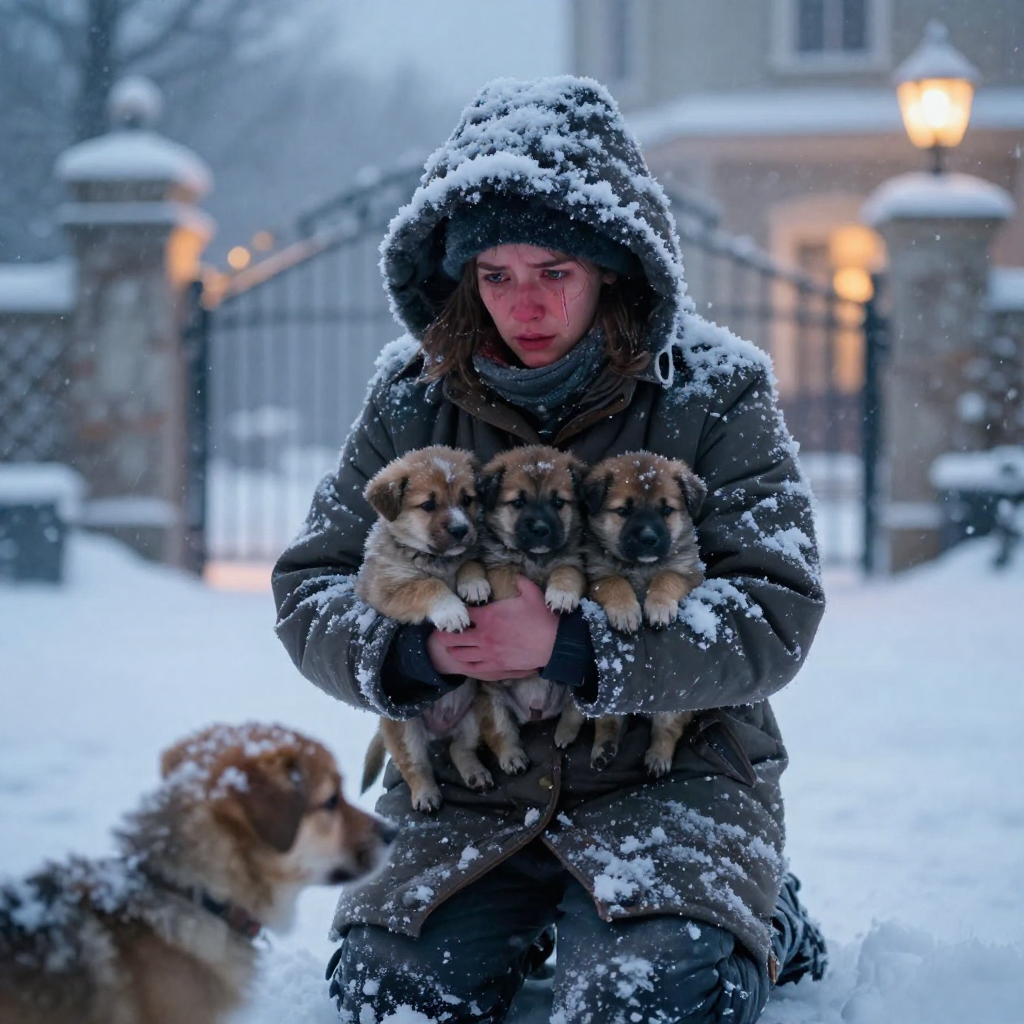
I was about to stand up, to get back in my car and call animal control, when I saw the movement. It was subtle, just a ripple in the fur near the mother’s belly. Then, a tiny, high-pitched squeak cut through the roar of the wind. My heart hammered against my ribs. I dug my hands into the snow, scooping away the powder that had drifted over her. She wasn’t just curled up for warmth. She was curled around something.
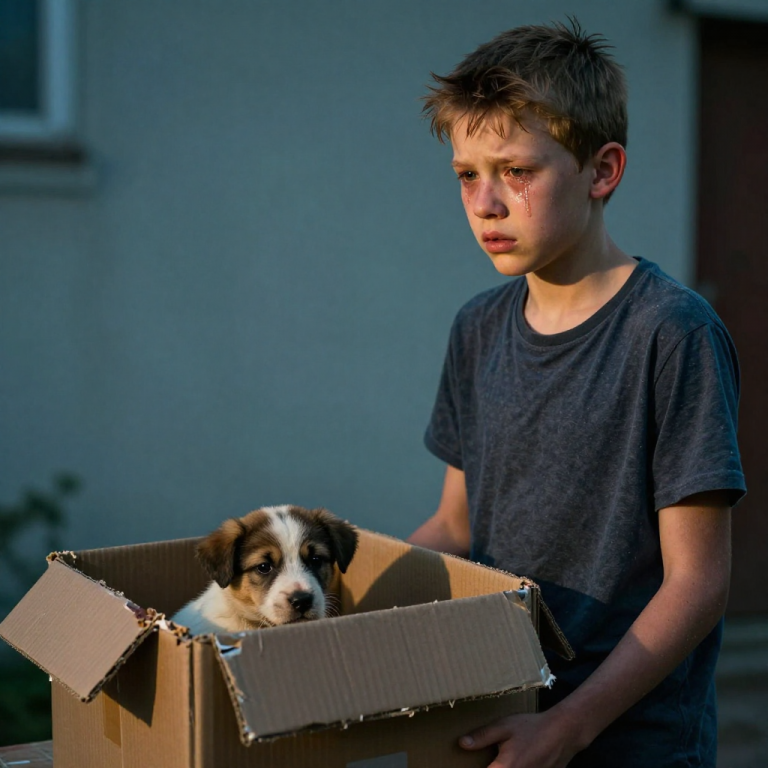
Three of them. Three tiny balls of brown and black fuzz, huddled desperately into the curve of her dead body. They were shivering so violently they looked like they were vibrating. They were trying to nurse, trying to find heat from a source that had gone cold. The mother… she had stayed there, taking the brunt of the wind, shielding them with her own body until the very end. She had frozen to death so they wouldn’t have to.
Tears pricked my eyes, freezing on my lashes instantly. “Oh god,” I choked out. I started pulling off my gloves, needing to feel them, to see if they were still warm enough to save. I unzipped my heavy coat, preparing to shove them inside against my chest.
That’s when the gate buzzed. The heavy iron mechanism groaned, and the gates swung inward. A black SUV with tinted windows rolled down the driveway, crunching over the snow. It stopped right next to me, the window sliding down with an electric hum. A blast of warm, climate-controlled air hit my face, smelling of expensive leather and vanilla.
The man inside looked annoyed. He was older, silver-haired, wearing a thick wool sweater that probably cost more than my car. He didn’t look at the dead dog. He looked at my car blocking his exit. “You can’t park there,” he said, his voice flat. “You’re blocking the sensor.”
I stared at him, holding one of the shivering puppies in my bare hand. “There are puppies here,” I said, my voice shaking with adrenaline and cold. “Their mother is dead. She froze to death right here.”
He glanced down, barely registering the scene. “Stray,” he muttered. “I told the groundskeeper to chase that thing off yesterday. It’s a coyote magnet. Look, you need to move your car. I have a dinner reservation in the city.”
I couldn’t believe what I was hearing. The disconnect was absolute. Here was a tragedy—a mother who had sacrificed everything—and to him, it was a landscaping issue. “They’re freezing,” I said, my voice rising. “I need to get them into the car. Can you… do you have a blanket? Anything?”
He sighed, rolling the window up an inch. “I’m not putting dirty animals in my car. Call the pound. That’s what taxes are for. Now move.”
The window sealed shut. He honked. A short, sharp blast that made the remaining puppies whimper.
Something inside me snapped. It wasn’t just anger; it was clarity. I looked at the dead mother, her eyes frosted over, her body a shield even in death. She had more humanity in her frozen corpse than the man in the heated car. I didn’t say another word to him. I didn’t move my car. I turned my back on his headlights.
I scooped up the other two puppies, shoving them deep inside my coat, against my thermal shirt. Their claws scratched my skin, their bodies like blocks of ice against my chest. I grabbed the first one, tucking him in with his siblings. Then, I took off my scarf—my good wool scarf—and draped it gently over the mother’s face. It was all I could do for her right now. “I promise,” I whispered to her, my breath clouding in the red glow of the SUV’s taillights. “I promise you, they will never feel cold again. And he… he’s going to know your name.”
The horn blared again, long and aggressive. I stood up, feeling the weight of the three lives against my heart. I walked back to my car, not rushing. Let him wait. Let him sit in his heated leather seat and wait. I got in, cranked the heat to the max, and felt the tiny bodies begin to squirm against me as the warmth hit them. I looked in the rearview mirror at the man’s furious face, illuminated by his dashboard lights. I wasn’t just a driver anymore. I was a witness. And as I put the car in gear, navigating blindly back into the storm, I knew this wasn’t over. The storm outside was bad, but the storm I was about to bring to his front gate would be worse.
CHAPTER II
The heater in my old sedan groaned, a mechanical plea for mercy as it struggled against the sub-zero air I’d invited in. I didn’t care about the car. I didn’t care about the frozen slush beginning to melt into my floorboards. My only focus was the rhythmic, frantic thrumming against my chest. Three heartbeats. They were tiny, irregular, and terrifyingly fast, vibrating through my damp coat like the ticking of three separate, fragile clocks.
I drove with one hand, the other pressed firmly against the bundle tucked into my chest, keeping the puppies pinned to my own body heat. I didn’t look back at the Halloway estate. I didn’t need to. The image of that man’s face—the smooth, unlined skin of a life lived without consequence, the way his eyes hadn’t even flickered toward the dead mother in the snow—was burned into my retinas. It was a coldness that no heater could ever touch.
The emergency vet clinic was a squat, brick building on the edge of the city, its neon sign flickering a pale, sickly blue through the swirling white of the blizzard. I didn’t wait to park properly. I skidded into a snowbank near the entrance, killed the engine, and ran.
Inside, the air smelled of antiseptic and old coffee. It was quiet, save for the hum of a vending machine and the distant, muffled bark of a dog in the back. The receptionist, a woman with tired eyes and a thick wool cardigan, looked up as I stumbled in, shivering and clutching my chest. I must have looked like a madman. I was covered in road salt, dog hair, and the lingering scent of frozen earth.
“I found them,” I gasped, my voice cracking. “At a gate. In the Ridge. Their mother… she didn’t make it.”
I opened my coat. The three puppies were a tangled mess of dark fur and shivering limbs. Two of them let out a high-pitched, warbling cry—a sound so thin it seemed it might snap in the air. The third, the smallest one, didn’t make a sound. It lay limp, its head lolling back against my sweater.
“Code blue!” the woman shouted, her exhaustion vanishing instantly. She hit a buzzer and a door swung open.
A man in green scrubs appeared—Dr. Aris. He had hands that looked too large for the tiny creatures he was about to handle, but when he took the runt from me, he did so with a grace that made my throat tighten. He didn’t ask about my insurance. He didn’t ask for a deposit. He just looked at the puppy, then at me, and ran.
I was left standing in the lobby, the sudden absence of their warmth leaving a cold void against my ribs. I sat down on a plastic chair that felt like ice. My hands were shaking. I looked down and saw a smear of dark blood on my sleeve. It wasn’t mine. It was from the mother. It was a stain of the life that had been sacrificed so these three might have a chance, a life that Mr. Halloway had stepped over as if it were a discarded candy wrapper.
As the minutes stretched into an hour, the silence of the waiting room began to pull at the edges of my memory. This wasn’t the first time I’d been in a room like this, waiting for news that would change the trajectory of a life. It was the Old Wound, the one I’d spent a decade trying to cauterize with a career in corporate logistics and a quiet, unremarkable existence.
Twenty years ago, my father had worked the grounds for men like Halloway. He was a man of the soil, a man who knew the temperament of every oak and hydrangea in the Ridge. One winter, much like this one, he had slipped on black ice while clearing a driveway for a homeowner who couldn’t be bothered to wait for the professional plow. He’d shattered his hip. He lay there for forty minutes in the snow before anyone noticed. When the homeowner finally came out, he didn’t call an ambulance first. He complained that the driveway wasn’t finished. My father was fired three weeks later for ‘unreliability.’ We lost the company housing. We lost everything.
I remembered my father’s face as he sat in our cramped apartment, looking at his hands—hands that were now useless for the only work he knew. He hadn’t been angry. He’d just been… diminished. He had been treated like a tool that had broken, and tools are replaced, not repaired. Seeing Halloway today, hearing him call those puppies ‘vermin,’ it wasn’t just about the dogs. It was about the way people like him view the world. There are those who matter, and there are the things that occupy their space.
Dr. Aris emerged from the back, his face unreadable. He pulled down his mask, revealing a graying beard and a tired smile.
“The two larger ones are stable,” he said, wiping his hands on a towel. “They’re dehydrated, borderline hypothermic, but they’re fighters. We’ve got them on fluids and heating pads.”
“And the little one?” I asked, standing up so fast the chair scraped harshly against the tile.
Aris hesitated. “He’s still with us. But it’s touch and go. His heart rate is low, and he’s not nursing yet. We’re doing what we can, but honestly? It’s up to him now. He’s been through a lot of trauma.”
“His mother died keeping him warm,” I said, my voice rising. “He has to make it. He has to.”
Aris nodded slowly. “Go home. Get some dry clothes. There’s nothing more you can do here tonight. I’ll call you if anything changes.”
I didn’t go home. I went to my car, but I couldn’t drive. The adrenaline was fading, leaving behind a cold, hard lump of resentment in my gut. I pulled out my phone. I had taken a photo before I left the gate. I hadn’t even realized I’d done it—a reflex of the modern age. It was a grainy, harrowing image: the mother dog, frozen in a protective curl, her fur dusted with snow, positioned directly in front of the ornate, wrought-iron gates of the Halloway estate. In the background, the soft, warm glow of the mansion’s windows mocked the scene in the foreground.
I looked at that photo for a long time. I knew the power of it. I also knew the danger.
Here was my Secret, the thing I hadn’t told the vet, the thing I’d been hiding from myself: I knew exactly who Halloway was. I didn’t just stumble upon his house. I worked for the firm that managed his family’s private equity fund. I was a mid-level analyst in a company that thrived on the patronage of men like him. If I did what I was thinking of doing, I wasn’t just attacking a cruel stranger. I was sabotaging the hand that fed me. I was a single man with a mortgage and no safety net. One word from a man like Halloway and I would be blacklisted in this city before the snow melted.
But then I thought of the runt. I thought of my father’s broken hip and his quiet, diminished eyes.
I opened a social media app. My thumb hovered over the ‘Post’ button. I didn’t use my real name; I used an old, anonymous account I’d set up years ago for venting about the industry. I typed a simple caption: ‘Tonight, in the Ridge. This mother stayed until the end to save her babies. The owner of the house told me to move my car because I was blocking his gate. He called them vermin. Humanity is freezing to death.’
I tagged the location as ‘The Ridge.’ I didn’t name Halloway, but I didn’t need to. The gate was iconic. Anyone who lived in this city knew that gate.
I hit send.
It started slowly. A few likes. A few shares. But then, it was as if a match had been dropped into a dry forest. The image was too visceral, the contrast between the dead animal and the luxury estate too sharp. By the time I reached my cold, empty apartment, the post had five thousand shares. People were tagging local news stations.
Then came the Triggering Event. The moment that made everything irreversible.
A local animal rights influencer with a million followers reposted the photo. But she did more than just share it. She used a public records database to identify the address.
‘This is the Halloway Estate,’ she wrote. ‘Owned by Arthur Halloway of Halloway & Associates. Let him know what you think of his hospitality.’
The internet did what it does best. It turned into a hive of righteous, unguided fury. Within two hours, Halloway’s business page was flooded with thousands of one-star reviews. His personal cell phone number—God knows how they found it—was leaked in the comments. People were posting photos of his SUV, the same one that had almost pinned me against the gate.
I sat on my couch, the blue light of the phone screen the only thing illuminating the room. I felt a sick sense of triumph, but beneath it, a growing dread. I had started something I couldn’t stop.
My phone buzzed. It was a text from my boss, Sarah.
‘Are you seeing this Halloway stuff? The firm is in crisis mode. He’s our biggest client and he’s losing his mind. He thinks someone in the neighborhood leaked it, but he’s demanding we find out who started the post. We need to talk first thing in the morning.’
My heart hammered. This was the Moral Dilemma. I could delete the post. I could try to scrub my digital footprints, though it was likely too late. I could stay silent and let Halloway burn, hoping they never traced the account back to my IP address. Or I could double down. I could come forward as the witness.
If I came forward, I would be a hero to the public, but I would be unemployed and potentially sued into oblivion by a man with infinite resources. If I stayed silent, Halloway might survive this, and the puppies—those three tiny lives—would just be a footnote in a PR disaster.
I thought about the mother dog. She had stayed. She hadn’t weighed the pros and cons of staying in the blizzard. She hadn’t calculated the risk to her own life. She had just done what was right because there was no other choice.
Around 3:00 AM, the phone rang. It was Dr. Aris.
“I have an update,” he said. His voice was heavy. “The runt… he’s in a crisis. We need to do an emergency procedure to drain fluid from his lungs. It’s expensive, and the success rate is low. I need your authorization to proceed.”
“How much?” I asked, my voice a whisper.
He named a number that represented nearly all of my savings. The money I’d set aside for my father’s long-term care, for the mortgage, for the safety net I never thought I’d need to pull.
“Do it,” I said.
“Are you sure? There’s no guarantee he’ll pull through, and even if he does, the recovery will be long.”
“He’s not vermin,” I said, tears finally stinging my eyes. “He’s not a tool. Do whatever it takes.”
I hung up and looked back at the viral storm on my screen. Halloway was now trending nationally. The news was calling it ‘The Gatekeeper Scandal.’ There were calls for a protest outside his house.
I realized then that I had crossed a line. By paying for the puppy, I was choosing a side. By keeping the post up, I was burning the bridge I was standing on. I was no longer an observer. I was the person who had pulled the pin on a grenade, and now I was waiting for the explosion to reach me.
I looked at the smear of blood on my sleeve, now dry and brown. It looked like the earth. It looked like the end of something. I closed my eyes and waited for the morning, knowing that when the sun rose, the world I knew would be gone.
CHAPTER III
The air in the lobby of Sterling & Finch was different that morning. Usually, it smelled of expensive floor wax and the faint, bitter aroma of the high-end espresso machine. But today, the atmosphere was thick, like the air before a summer thunderstorm when you can taste the electricity on your tongue. Everyone was whispering. The elevators, usually a place of polite, silent nods, were hubs of frantic, low-voiced speculation. I stepped into the lift and pressed the button for the 14th floor, my hand trembling just enough for the man next to me to notice. I shoved it into my pocket. My phone was a lead weight in my other pocket, vibrating with a persistence that made my skin crawl. It was Dr. Aris. I knew it was her. I didn’t answer. I couldn’t answer. Not yet.
When the doors opened, I saw Julian, our department head, standing by the reception desk. He looked like he hadn’t slept in forty-eight years. His tie was slightly askew, a cardinal sin in his world. He was barking orders at two IT specialists who were already hunched over the main server terminal. The ‘witch hunt’ had begun before the first cup of coffee had even been poured. My viral post—the photo of the dying mother dog, the red blood stark against the white snow of the Halloway estate—had become a wildfire. It wasn’t just a post anymore; it was a PR execution. And I was the one holding the axe, still standing in the middle of the woods, hoping no one smelled the smoke on my clothes.
I walked to my cubicle, keeping my head down. The fluorescent lights overhead felt like spotlights. Every time someone laughed or raised their voice, I flinched. I sat down and opened my computer, my fingers hovering over the keys. I looked at the news. ‘Social Media Erupts Over Halloway Cruelty.’ ‘Protestors Gather Outside Halloway Investment Firm.’ The comments sections were a battlefield of rage. People were calling for Arthur Halloway’s head. They were calling for the firm to drop him as a client. And in the middle of all that noise, there was me—a mid-level analyst with a father who died broke and a bank account that I had emptied at 3:00 AM to pay for a puppy’s surgery.
Julian’s voice boomed across the floor. ‘Everyone in the main conference room. Now.’
We filed in like sheep. The room was glass-walled, overlooking the gray city skyline. In the center of the long mahogany table sat Arthur Halloway. He didn’t look like the monster from the blizzard. He looked like a statesman. He wore a charcoal suit that probably cost more than my college education. He wasn’t yelling. He wasn’t even angry. He was something far more terrifying: he was inconvenienced. He sat there with a glass of water, watching us enter as if we were a biology experiment he was mildly bored with. Next to him was a woman I recognized from the executive floor—Sarah Thorne, the firm’s Chief Operating Officer. She was the shadow authority of the building, the one who made decisions that moved millions. Her presence meant this wasn’t just a meeting; it was a tribunal.
‘Sit down,’ Julian commanded. He didn’t look at me. He looked at the floor. ‘Mr. Halloway is understandably concerned about the recent… breach of privacy. A photograph was taken on his private property. A narrative was constructed. This narrative is now damaging a multi-billion dollar partnership. We are here to find out who among you was near the Halloway estate two nights ago.’
Halloway leaned forward. His eyes were like cold glass. ‘I don’t care about the dogs,’ he said, his voice a smooth, terrifying rasp. ‘Dogs die every day. What I care about is the audacity. The arrogance of a common person thinking they have the right to look through my gates and judge me. I pay this firm for discretion. I pay for a wall between me and the world. That wall has a hole in it.’
My phone vibrated again. I felt it against my thigh. It was a long, sustained pulse. A voicemail. Dr. Aris wouldn’t call three times in ten minutes unless the runt had taken a turn for the worse. The image of that tiny, shivering creature, its ribs visible with every labored breath, flashed in my mind. It was a sharp contrast to the man sitting in front of me, complaining about his ‘wall.’ The moral weight of the room began to shift. I felt a sudden, sickening clarity. I had been afraid of losing my job, but looking at Halloway’s indifferent face, I realized I had already lost my respect for the life I was trying to save here.
‘We’ve tracked the IP address of the initial upload,’ Sarah Thorne said, her voice cutting through the tension like a scalpel. She looked directly at our row. ‘The post originated from a device that has connected to our internal VPN within the last twenty-four hours. It’s someone in this room.’
The silence that followed was heavy. I could hear the hum of the air conditioning. I could hear Julian’s heavy breathing. I reached into my pocket and turned off the phone. If I left now to go to the clinic, I was confessing. If I stayed, the runt might die alone in a metal cage. I looked at Halloway. He was checking his watch. To him, the life of that puppy was a rounding error. To me, it was the only thing that felt real in a world made of spreadsheets and lies.
‘It was me,’ I said.
The words were quieter than I intended, but they stopped everything. Julian’s head snapped toward me, his mouth hanging open. Halloway didn’t move, but his eyes narrowed. Sarah Thorne leaned back, her expression unreadable. For a second, I felt a strange sense of peace. The secret was out. The bridge was blown. There was no going back.
‘You?’ Julian whispered. ‘You did this? After everything this firm has done for you?’
‘The firm didn’t do anything,’ I said, my voice gaining strength. ‘I was there. I saw the mother dog. She was dying in the snow. I asked for help, and Mr. Halloway told me to get them off his property. He called them garbage.’
Halloway let out a short, dry laugh. ‘They were garbage. Strays. Messy, diseased things cluttering up my driveway. And you turned a minor nuisance into a national scandal.’ He stood up and walked toward me. He didn’t stop until he was inches away. He smelled of cedarwood and power. He didn’t look at me like a person; he looked at me like a bug he was deciding whether or not to crush.
‘You think you’re a hero,’ Halloway said. ‘But you’re just a thief. You stole my privacy. You stole my peace of mind. And now, you’re going to pay for it.’
Sarah Thorne cleared her throat. ‘Arthur, let’s be professional.’ She looked at me. ‘Come into my office. Both of you.’
We moved to her office, a space filled with glass and white leather. It felt like an operating room. Sarah sat behind her desk and gestured for us to sit. She didn’t look angry. She looked like she was calculating a trade. She pulled a folder from her desk and slid a document across the table toward me. Beside it was a check. I didn’t have to look at the numbers to know it was more than I earned in a year. It was probably enough to cover the runt’s surgeries, my rent for a year, and the debt my father had left behind.
‘This is a non-disclosure agreement and a formal retraction,’ Sarah said. ‘You will post a statement saying you fabricated the story for attention. You will say the dogs were never on Mr. Halloway’s property. In exchange, Mr. Halloway will decline to file a civil suit for defamation, and this check will be yours as a… severance package.’
‘A bribe,’ I said.
‘A settlement,’ Halloway corrected, leaning back. ‘It’s a simple choice. You can be a martyr for a dead dog and spend the next ten years in court losing everything you own, or you can take the money, save your little ‘pet,’ and disappear. Nobody cares about the truth, kid. They care about the narrative. We’re just changing the narrative.’
I looked at the check. The paper was crisp. The ink was dark. It represented safety. It represented the end of the panic I had felt since that night in the blizzard. I thought about Dr. Aris. I thought about the runt’s heart, struggling to beat. With this money, I could give that dog the best care in the world. I could buy him a life. But the price was my soul. The price was telling the world that the cruelty I had seen wasn’t real. It was letting Halloway win.
‘The dog is dying,’ I said, more to myself than to them.
‘Then use the money to save it,’ Halloway said, his voice dripping with false empathy. ‘Be the hero you want to be. Just do it quietly.’
I picked up the pen. My hand was steady now. I looked at the retraction. *’I, the undersigned, admit that the events described in my social media post were a work of fiction…’* It was a lie so profound it felt like it would stain the air. I looked at Sarah Thorne. She was watching me with a cold, analytical curiosity. She didn’t care if I signed it or not; she just wanted the problem resolved. This was the authority I had spent my life respecting. This was the ‘success’ I had been chasing.
I thought about my father. I remembered the way he looked when he was fired from the factory—not angry, but hollowed out. He had been a ‘good man’ who stayed silent when the bosses cut corners, and it had destroyed him anyway. I realized then that Halloway wasn’t offering me a way out. He was offering me a way in. He was inviting me to be like him—to believe that everything and everyone has a price.
I put the pen down. I didn’t sign it.
‘I can’t,’ I said.
Halloway’s face hardened. The mask of the statesman slipped, revealing the jagged edge of the man I had met in the blizzard. ‘You’re a fool. You’ll have nothing. I will bury you in legal fees. I will make sure you never work in this city again. You think people will care about you in a week? You’ll be a footnote.’
‘Maybe,’ I said. ‘But I’ll know I told the truth.’
Sarah Thorne stood up. ‘Then we’re done here. You are terminated effective immediately. Security will escort you out. Leave your badge and your phone on the desk.’
I walked out of the office. I didn’t wait for security. I walked through the floor, past Julian, who looked away as I passed. I walked past the IT guys and the whispering analysts. I felt lighter with every step. When I reached the lobby, the cold air hit me, and for the first time in days, I could breathe. I reached for my phone, then remembered I had left it on Sarah’s desk. I was completely cut off. No money, no job, no way to call the vet.
I ran. I didn’t have money for a cab, so I ran the twelve blocks to the clinic. The wind was biting, the remnants of the blizzard still swirling in the gutters. My lungs burned. By the time I reached the glass doors of Dr. Aris’s office, I was gasping for air, my chest heaving.
I burst inside. The waiting room was empty. The silence was deafening. Dr. Aris was standing by the reception desk, her back to me. She was holding a clipboard, her head bowed.
‘Doctor,’ I wheezed. ‘I’m here. I… I lost my phone. How is he?’
She turned around slowly. Her eyes were tired, surrounded by dark circles. She didn’t say anything for a long time. She just looked at me—at my disheveled suit, my sweat-soaked shirt, my shaking hands. She looked at the man who had thrown away his entire life for a creature that didn’t even have a name.
‘He stopped breathing ten minutes ago,’ she said softly.
The world went silent. The hum of the refrigerator, the sound of traffic outside, the ticking of the clock—it all vanished. I felt a coldness spread from my chest to my limbs. Ten minutes. If I had left the meeting when the phone first buzzed, if I hadn’t stayed to face Halloway, if I had just walked away earlier… I could have been there. I could have held him.
‘I tried,’ she said, stepping toward me. ‘He was just too small. The trauma to his lungs from the cold… his body gave up.’
I sat down on the hard plastic chair in the waiting room. I didn’t cry. I didn’t have the energy to cry. I just sat there, looking at my hands. I had lost my job. I had lost my career. I had turned down a fortune. And the thing I had done it all for was gone. Halloway was still in his tower. Julian was still at his desk. The world was exactly as cruel as it had been two days ago.
‘Can I see him?’ I asked.
She led me to the back. The runt was lying on a blue towel on the exam table. He looked like he was sleeping. He looked peaceful, no longer struggling for air. I reached out and touched his head. The fur was soft, still slightly warm. He was so small. He was a tiny, insignificant life that had somehow brought a giant corporation to its knees, even if only for a moment.
‘The other two are doing well,’ Dr. Aris said quietly, standing by the door. ‘They’re eating. They’re strong. They’re going to make it.’
I nodded. I looked at the runt one last time. I had failed him, but in failing him, I had found the part of myself I thought I had lost years ago. I stood up and straightened my jacket. I had no money, no plan, and a mountain of trouble heading my way. But as I walked out of the clinic and into the gray afternoon, I realized I wasn’t afraid. Halloway had his wall, but I had the truth. And for the first time in my life, that was enough.
CHAPTER IV
The first summons arrived a week later. I knew it was coming, but the crisp, official paper still felt like a punch to the gut. Arthur Halloway, through his battalion of lawyers, was suing me for defamation, libel, and a host of other things I barely understood. Julian called me that same day, his voice tight with something that sounded almost like… pity? He told me, in that carefully neutral tone corporations train you to adopt, that Sterling & Finch were ‘severing all ties.’ Translation: no severance package, no recommendations, and a clear message to anyone else in the industry that I was untouchable.
The news cycle, predictably, moved on. The internet outrage flared, then faded. Halloway’s name wasn’t trending anymore. The think pieces stopped being written. People went back to their lives, their outrage replaced by the next shiny object demanding their attention. But I didn’t get to move on. I was still very much in the middle of it.
My apartment felt smaller, colder. The silence was deafening without the little whimpers and snuffles of the puppies. I kept replaying the moment the runt died in my head. His tiny body, so fragile in my hands. I’d failed him. And in failing him, I’d somehow failed myself. I’d traded everything for… what, exactly?
The phone calls stopped. The LinkedIn requests dried up. I was ghosted by people I considered friends, colleagues I’d shared late nights and inside jokes with. The isolation was crushing. I started eating ramen again, staring at the growing pile of bills on my kitchen counter. I was burning through what little savings I had left. I applied for dozens of jobs, tailoring my resume, crafting cover letters that tried to explain the unexplainable. Nothing.
I walked to Dr. Aris’ clinic most days. It was the only place I felt remotely human. She didn’t judge me. She didn’t offer platitudes. She just let me help, cleaning cages, feeding the animals, anything to keep my hands busy and my mind from spiraling. The two surviving puppies, Birch and Willow, were thriving. They were playful, mischievous, oblivious to the storm that had raged around them. Dr. Aris had arranged foster homes for them, good people who were willing to take them in once they were old enough.
One afternoon, while I was cleaning the exam room, Dr. Aris came in, her face etched with concern. “There’s someone here to see you,” she said quietly. I braced myself. Another lawyer? A reporter looking for a follow-up story? I followed her to the waiting room, where a woman sat, her back ramrod straight, her hands clasped tightly in her lap. I recognized her instantly.
Sarah Thorne. The COO of Sterling & Finch. What was she doing here?
She stood up as I approached, her expression unreadable. “We need to talk,” she said, her voice low and controlled. “Somewhere private.”
We ended up at a coffee shop a few blocks away. The air was thick with the smell of burnt coffee and unspoken tension. Sarah ordered a black coffee, took a sip, and then stared at me across the table, her eyes unwavering.
“Arthur Halloway is a cancer,” she said, her voice barely a whisper. “He’s been a cancer on this firm for years. Everyone knows it. But he’s too powerful, too connected. No one dares to cross him.”
I stared at her, dumbfounded. Was this some kind of elaborate game? Another attempt to manipulate me?
“Why are you telling me this?” I asked, my voice flat.
“Because what you did… it forced our hand,” she said. “The negative publicity, the client defections… it’s become unsustainable. The board is finally willing to act.”
“Act how?”
“They’re forcing him out,” she said. “He’ll be ‘retiring’ for ‘health reasons.’ A golden parachute, of course. He’ll land on his feet. He always does. But he’ll be gone.”
I felt a flicker of… something. Not quite relief. Not quite satisfaction. More like a weary resignation. It was over. Halloway was out. But at what cost?
“And what about me?” I asked. “Am I supposed to be grateful? Am I supposed to thank you for ruining my life and then telling me you finally got rid of the bad guy?”
Sarah sighed, her shoulders slumping slightly. “I can’t undo what happened,” she said. “I know that. But I can offer you something.”
She reached into her purse and pulled out a thick envelope. She slid it across the table towards me. I didn’t touch it.
“It’s not a bribe,” she said. “It’s… compensation. For the legal fees. For the lost wages. And… an apology. From me. For not doing more. For being complicit.”
I looked at the envelope, then back at Sarah. Her eyes were filled with a weariness that mirrored my own. We were both casualties of the same war, just on different sides.
“Keep it,” I said, pushing the envelope back towards her. “I don’t want your money.”
She didn’t argue. She just nodded, picked up the envelope, and put it back in her purse. We sat in silence for a long moment, the weight of everything hanging between us.
“There’s something else,” she said finally. “The lawsuit… it’s going to be dropped. Halloway agreed to it as part of the… settlement.”
A wave of relief washed over me, so powerful it almost knocked me off my feet. The lawsuit was gone. I wouldn’t have to spend the next few years of my life fighting a legal battle I couldn’t afford to lose.
Sarah stood up. “Thank you,” she said, her voice barely audible. “For doing what I couldn’t.”
Then she turned and walked away, leaving me alone with my thoughts and the bitter taste of coffee.
My phone buzzed. It was a text from Dr. Aris. “Come quick. Birch is sick.”
The drive to the clinic was a blur. My mind raced, filled with fear and a sickening sense of déjà vu. Not again. Please, not again.
Dr. Aris met me at the door, her face grim. “He’s stable for now,” she said. “But he’s not doing well. It’s… parvovirus. Highly contagious. We’re doing everything we can.”
Parvovirus. I knew what that meant. It was a death sentence, especially for puppies. My heart sank. I felt like I was drowning.
I spent the next two days at the clinic, sleeping on a cot in the corner, watching Birch struggle to breathe. Dr. Aris and her staff worked tirelessly, administering fluids, antibiotics, doing everything in their power to fight the virus.
Willow, thankfully, seemed to be immune. She was quarantined in a separate room, but I could see her through the glass, her tail wagging hopefully. She didn’t understand what was happening. She just wanted her brother.
On the third day, Birch started to rally. He opened his eyes, his tail gave a weak thump, and he even managed to drink a few drops of water. Hope flickered in my chest.
But it was short-lived. That night, his condition deteriorated rapidly. He started vomiting blood, his breathing became shallow and ragged. Dr. Aris called me into the exam room. She didn’t have to say anything. I knew.
I held Birch in my arms, stroking his soft fur, whispering words of comfort. He was so small, so vulnerable. He deserved so much more than this.
He died just before dawn, his body limp in my arms. I cried, tears streaming down my face, mourning not just Birch, but the runt, and everything else I had lost. It felt like I was burying a part of myself.
Dr. Aris helped me wrap Birch in a soft blanket. We buried him in the garden behind the clinic, under the shade of an old oak tree. I made a small marker out of a piece of wood and wrote his name on it.
As I stood there, staring at the freshly turned earth, I felt a profound sense of emptiness. What was the point of it all? What had I accomplished? I had exposed a cruel man, but I had also lost my job, my savings, and two innocent lives.
The next morning, I went to see Willow. She was still quarantined, but she seemed to sense that something was wrong. She whined and pawed at the glass, her eyes filled with anxiety.
I sat down on the floor next to her cage and talked to her, telling her about Birch, telling her that he was in a better place, telling her that everything was going to be okay. But it was a lie. I didn’t know if everything was going to be okay. I didn’t even know if I was going to be okay.
Later that day, Dr. Aris came to me with a proposition. “I need help,” she said. “I’m swamped, and I could really use someone who’s reliable and compassionate. And… the animals seem to like you.”
I looked at her, surprised. “You want to hire me?”
She smiled. “It wouldn’t be much. Just minimum wage. But it would be something. And… it would give you a purpose.”
I thought about it for a moment. It wasn’t what I had planned for my life. It wasn’t the career I had worked so hard for. But it was honest work. It was meaningful work. And it was a chance to make a difference, however small.
“I’ll do it,” I said.
The following weeks were a blur of cleaning cages, feeding animals, and answering phones. It wasn’t glamorous, but it was… healing. I found a strange sense of peace in the routine, in the simple act of caring for creatures in need. I learned their names, their personalities, their quirks. I became part of their world, and they became part of mine.
Willow was eventually adopted by a young couple who lived on a farm. They sent me pictures of her running through the fields, chasing butterflies, living her best life. It warmed my heart to see her so happy.
One day, while I was cleaning the kennels, I overheard Dr. Aris talking on the phone. She was arguing with someone, her voice rising with anger.
“I don’t care how much money they’re offering,” she said. “I’m not selling. This clinic is not for sale. And I will not be bullied by some rich developer who wants to tear it down and build another shopping mall.”
I stopped what I was doing and listened intently. A developer? Trying to buy the clinic?
Dr. Aris hung up the phone and turned to me, her face flushed. “They’re trying to force me out,” she said. “They want to buy this land and build another one of those awful malls. They’ve been pressuring me for months, offering me ridiculous amounts of money. But I won’t do it. This clinic is more than just a business. It’s a lifeline for this community.”
I felt a surge of anger. Not again. Not another wealthy bully trying to destroy something good for his own selfish gain.
“Who is it?” I asked.
Dr. Aris hesitated. “It’s… Arthur Halloway.”
The world seemed to tilt on its axis. Halloway? He wasn’t done yet? He was still trying to exert his power, still trying to crush anyone who stood in his way?
I knew what I had to do. I couldn’t stand by and watch him destroy another innocent life. I had to fight back. But this time, it wouldn’t just be about me. It would be about protecting the clinic, protecting the animals, protecting the community.
I reached for my phone. It was time to light another fire.
CHAPTER V
Halloway wanted the land. That’s all it ever came down to. He didn’t care about the animals, about Aris, or about the people who brought their pets to her, often as a last resort. He saw only potential, only profit. And that, I realized, was the core of everything I’d come to despise. The way some people see the world as nothing more than a ledger, a series of transactions. I’d been one of them, once.
The news of Halloway’s intentions spread like wildfire. Aris, ever the stoic, tried to downplay it. “He’s just trying to scare us,” she said, but I saw the worry in her eyes. It wasn’t just her clinic; it was her life’s work, her sanctuary. And he was threatening to bulldoze it all down.
The first sign of resistance came in the form of hand-painted signs popping up around town: “Save Aris’ Clinic.” Then came the online petition, started by a former client of Aris, a young woman whose cat Aris had saved from a near-fatal illness. Within days, it had thousands of signatures. People were angry. They remembered Halloway’s indifference to the puppies, his ruthless pursuit of me, and now, this blatant act of greed.
The town meeting was a turning point. It was held at the local community center, and it was packed. Halloway was there, of course, looking smug and confident, surrounded by his lawyers. He presented his case, talking about economic development and job creation, framing his plan as a benefit to the community. The crowd was silent, but I could feel the tension in the air.
Then Aris spoke. She didn’t talk about money or progress. She talked about the animals she’d helped, the lives she’d saved, the families she’d comforted. She spoke with a quiet passion that resonated with everyone in the room. She talked about Birch and the runt, and about Willow, thriving on the farm, a testament to the power of second chances. She didn’t attack Halloway; she simply told her story, and in doing so, she exposed the emptiness of his.
I spoke too. I talked about my own journey, about my complicity in the system that had allowed Halloway to thrive. I talked about the price of indifference, the cost of prioritizing profit over compassion. I talked about the dogs, about their vulnerability, about the simple act of kindness that could have saved them so much suffering.
Halloway tried to interrupt, but the moderator, a local farmer, shut him down. “Let him speak,” he said, and the crowd roared in agreement. It was a powerful moment, a clear sign that the tide had turned.
The vote was overwhelmingly in favor of preserving the clinic. Halloway’s proposal was rejected. He left the meeting looking defeated, his entourage trailing behind him.
It wasn’t over, not by a long shot. Halloway still owned the land, and he wasn’t one to give up easily. But something had shifted. The community had spoken, and they were united in their determination to protect Aris’ clinic. We had bought time, and that time would be used to solidify the defense.
I spent the next few weeks working alongside Aris, preparing for whatever Halloway might throw at us. We organized fundraising events, reached out to local media, and rallied support from animal rights organizations. The response was incredible. People from all walks of life stepped up to help, donating money, time, and resources.
Sarah Thorne even reached out. She told me that Halloway was furious, that he was threatening to sue the town, but that Sterling & Finch wouldn’t back him. They had already suffered enough damage from the scandal, and they weren’t willing to risk any more. She couldn’t offer me my old job back, but she could offer me something else: information. She gave me details about Halloway’s business dealings, information that could potentially expose his corrupt practices.
It was a risky move on her part, but I understood why she did it. She was tired of being complicit, tired of working for a company that prioritized profit over ethics. She was looking for a way out, a way to redeem herself.
I took the information and shared it with a local investigative reporter. The story broke a few weeks later, exposing Halloway’s shady dealings and triggering a series of investigations. His reputation was in tatters, his business empire crumbling.
Halloway retaliated, of course. He filed a new lawsuit, accusing me of defamation and harassment. But this time, the community stood behind me. They organized protests, wrote letters to the editor, and flooded the courthouse with messages of support.
The lawsuit was eventually dismissed. Halloway’s lawyers realized that they didn’t have a case, that the evidence was stacked against him. He was forced to withdraw, his tail between his legs.
The final confrontation took place at Aris’ clinic. Halloway arrived unannounced, looking disheveled and defeated. He walked into the clinic, his eyes scanning the room, taking in the sight of the animals, the volunteers, the happy clients.
He found me in the back, tending to a sick cat. He stood there for a moment, silent, his face a mask of anger and resentment. “You ruined me,” he said, his voice barely a whisper.
I looked at him, not with triumph, but with pity. He had lost everything: his reputation, his business, his power. And he had no one to blame but himself.
“You did this to yourself,” I said. “You had a chance to do the right thing, and you chose not to. You chose greed over compassion, and you paid the price.”
He stared at me for a long moment, then turned and walked away. I watched him go, feeling a strange mix of emotions: relief, sadness, and a sense of closure.
The clinic was saved. Halloway eventually sold the land to a conservation group, who promised to preserve it as a wildlife sanctuary. Aris continued to care for the animals, her clinic a beacon of hope in the community.
Willow thrived on the farm, running through the fields, chasing butterflies, and basking in the sunshine. Her life was a testament to the power of second chances, a reminder that even the smallest act of kindness can make a difference.
I stayed at the clinic, working alongside Aris, helping to care for the animals. It wasn’t glamorous work, but it was meaningful. I had found my purpose, my place in the world.
Julian called me one day. He’d left Sterling & Finch, disgusted by their continued complicity in Halloway’s actions, even after the scandal. He was starting a new firm, one that prioritized ethics and social responsibility. He asked me to join him.
I declined. I told him that I was happy where I was, that I had found something more important than money or status. He understood. He said he was proud of me.
Sarah Thorne also left Sterling & Finch. She started a non-profit organization, dedicated to promoting ethical business practices. She was using her knowledge and experience to make a positive impact on the world.
Halloway disappeared from public view. Some said he moved to another country, others said he was living in seclusion. I didn’t know, and I didn’t care. He was no longer a part of my life.
Time passed. The scars of the past remained, but they had faded. I had learned a valuable lesson: that true victory isn’t about individual gain, but about protecting the vulnerable and building community. I had learned that compassion is a powerful force, capable of overcoming even the most formidable obstacles.
Aris’ clinic became more than just a place for sick animals. It became a symbol of hope, a reminder that even in the darkest of times, there is always light to be found.
One evening, as I was closing up the clinic, Aris came to me, her eyes filled with tears. “Thank you,” she said. “You saved us all.”
I smiled and put my arm around her, “We saved each other.”
I often thought about Birch and the runt, about their short, difficult lives. I wished I could have done more for them. But I knew that their memory would live on, inspiring me to continue fighting for those who couldn’t fight for themselves.
And I thought about Willow, running free on the farm, a symbol of hope and resilience. Her life was a testament to the power of compassion, a reminder that even in the face of indifference, kindness can prevail.
The fight never truly ends, but we had won this battle. We had protected the vulnerable, built community, and found our purpose. And that, I realized, was enough.
I knew that somewhere, deep down, even Halloway had to know that he’d lost far more than just a business deal.
I looked around the clinic, at the sleeping animals, at the familiar faces of the volunteers, and I felt a sense of peace I hadn’t known was possible. The air was cool, smelling of antiseptic and love.
I drove home that night under a sky full of stars, the image of Willow running through the fields imprinted on my mind. She was a reminder of what was possible, a symbol of hope in a world that often felt hopeless. I wondered, as I often did, how different things would have been if Halloway had simply stopped his car that night, if he had simply shown a little compassion.
But I knew that dwelling on the past wouldn’t change anything. All I could do was focus on the present, on the work that still needed to be done, on the animals that still needed our help.
When I got home I was surprised to find an envelope taped to my door. Inside was a letter and a check. The letter was from Sarah. She wrote that the check was a small token of apology, and that the money came directly from the sale of the last shares she had owned in Sterling and Finch. She explained that she’d started a foundation to help support people who had been wronged by corporate greed. She hoped I would use the money to continue my work at the clinic, and to help other animals in need.
I sat there for a long time, staring at the check. It was more money than I’d seen in a long time, enough to pay off my debts and secure the clinic’s future for a little while longer. I knew I would use it wisely, to honor the memory of Birch and the runt, and to give Willow and all the other animals a chance at a better life.
The legal battles were over. The investigations had run their course. Halloway’s empire had crumbled. The clinic had been saved. Life went on. But for me, the world had changed. I saw things differently now. I understood the power of compassion, the importance of community, and the value of standing up for what is right, even when it’s difficult.
I kept the first dollar I earned at Sterling and Finch in my wallet as a reminder of what I was, but I never touched it.
I often visited Willow on the farm. She was always happy to see me, running to greet me with a wagging tail and a wet nose. She was a symbol of hope, a reminder that even in the darkest of times, kindness can prevail.
One day, as I was petting Willow, the farmer came over and said, “She’s a lucky dog, you know. She found her forever home.” I smiled and nodded. “We all did,” I said.
Aris and I never spoke much about the events of the past year. We didn’t need to. We shared something deeper than words, a bond forged in adversity, a shared commitment to compassion.
I remained at the clinic, and eventually Aris made me a partner. Together, we expanded our services, offering low-cost care to low-income families, and rescuing animals from abusive situations. The clinic became a haven for the vulnerable, a place where every creature was valued and loved.
Sometimes, late at night, when the clinic was quiet and the animals were sleeping peacefully, I would think about Halloway. I wondered if he ever regretted his actions, if he ever felt any remorse. I wondered if he ever thought about the dogs.
I knew that I would never forgive him for what he had done. But I also knew that holding onto anger and resentment would only poison me. So I let it go. I forgave him, not for his sake, but for my own.
Birch, Willow, and the runt… they became more than just dogs. They became symbols of everything I was fighting for. They became a reminder of the importance of compassion, the power of community, and the value of standing up for what is right.
And so, my life went on. Not in the way I had planned, not in the way I had expected, but in a way that was far more meaningful and fulfilling.
I am home.
The world is still full of Halloways, but it’s also full of Arises, of Julians, of Sarahs, and of Willows. And as long as there are people willing to stand up for what is right, there is always hope.
I learned that sometimes the greatest victories are the ones that no one else sees.
I still see Willow sometimes, even now, in my dreams. She’s always running, always free.
I learned the hard way that some wounds never fully heal, they just become a part of who you are.
END.