I WATCHED THE TAILLIGHTS OF HIS PICKUP FADE INTO THE MIST AFTER HE HEAVED THE TAPED CARDBOARD BOX OVER THE BRIDGE RAILING WITHOUT A SINGLE FLINCH. I DIDN’T THINK ABOUT THE TEMPERATURE OR THE CURRENT—I JUST DOVE INTO THE BLACK WATER, BUT WHAT I FOUND ATTACHED TO THE DROWNING PUPPIES’ COLLARS WASN’T JUST A NAME, IT WAS A HANDWRITTEN NOTE THAT EXPOSED A BETRAYAL SO CRUEL IT BROKE ME.
The sound of the splash was heavier than I expected. It wasn’t the light slap of garbage hitting the surface; it was a dull, heavy thud that echoed against the concrete pilings of the bridge. I was standing about fifty feet away, leaning against the rusted railing, trying to clear my head after a long shift at the warehouse. The air was biting, the kind of mid-February cold in Ohio that seeps through your coat and settles in your marrow.
I had seen the truck slow down. It was a beat-up red Ford, the wheel wells eaten away by salt and rust. I hadn’t paid it much mind until the driver’s side door opened. A man stepped out—heavy set, wearing a camouflage jacket and a baseball cap pulled low. He didn’t look around. He didn’t check to see if anyone was watching. He just reached into the bed of the truck, grabbed a cardboard box that had been aggressively wrapped in silver duct tape, and walked to the edge.
He didn’t hesitate. He didn’t look down. He just heaved it over the side with the casual indifference of someone tossing a cigarette butt. Then he got back in, slammed the door, and the tires spun on the gravel as he sped off. The taillights disappeared into the gray evening mist within seconds.
For a moment, I just stood there, paralyzed by the sheer banality of it. Then, the silence of the river below was broken. It wasn’t a splash this time. It was a sound that stops your heart.
Muffled, high-pitched yelping.
The box hadn’t sunk immediately. It was bobbing in the freezing, murky current, drifting toward the center where the water moved fast and deep. The tape was holding it shut, turning it into a floating coffin.
I didn’t make a conscious decision. There was no internal debate about safety or the freezing temperature. My body just moved. I vaulted the railing, scrambling down the steep, rocky embankment, tearing the skin on my palms against the frozen brush. I hit the muddy bank and didn’t stop, wading straight into the water.
The shock of the cold was violent. It felt like a thousand needles piercing my skin all at once. The air was punched out of my lungs, and for a second, my vision blurred. The water was up to my waist, then my chest. The current was stronger than it looked from up on the bridge. It tugged at my legs, trying to drag me downstream, but I kept my eyes on that brown cardboard square bobbing ten yards away.
“Hold on,” I gasped, though I knew they couldn’t hear me. “Just hold on.”
I pushed off the bottom, swimming now. My limbs felt heavy, leaden. The cold was already slowing my synapses, making my movements clumsy. I reached the box just as one corner began to dip below the surface. The water was soaking through the cardboard. The yelping inside had turned into a frantic scratching.
I grabbed the box with one arm, treading water with the other. It was heavy—too heavy for just air and cardboard. I tried to swim back one-handed, but the current fought me. I kicked hard, my boots dragging me down, panic rising in my throat. If I went under, we all went under.
I don’t remember hitting the bank. I just remember the feeling of mud under my knees and the burning sensation in my lungs as I heaved the box onto the frozen grass. My hands were numb, clumsy blocks of ice as I clawed at the duct tape. I couldn’t find the end. I bit into the tape, tearing it with my teeth, spitting out plastic and adhesive, ripping the flaps open.
Inside, four pairs of terrified eyes looked up at me.
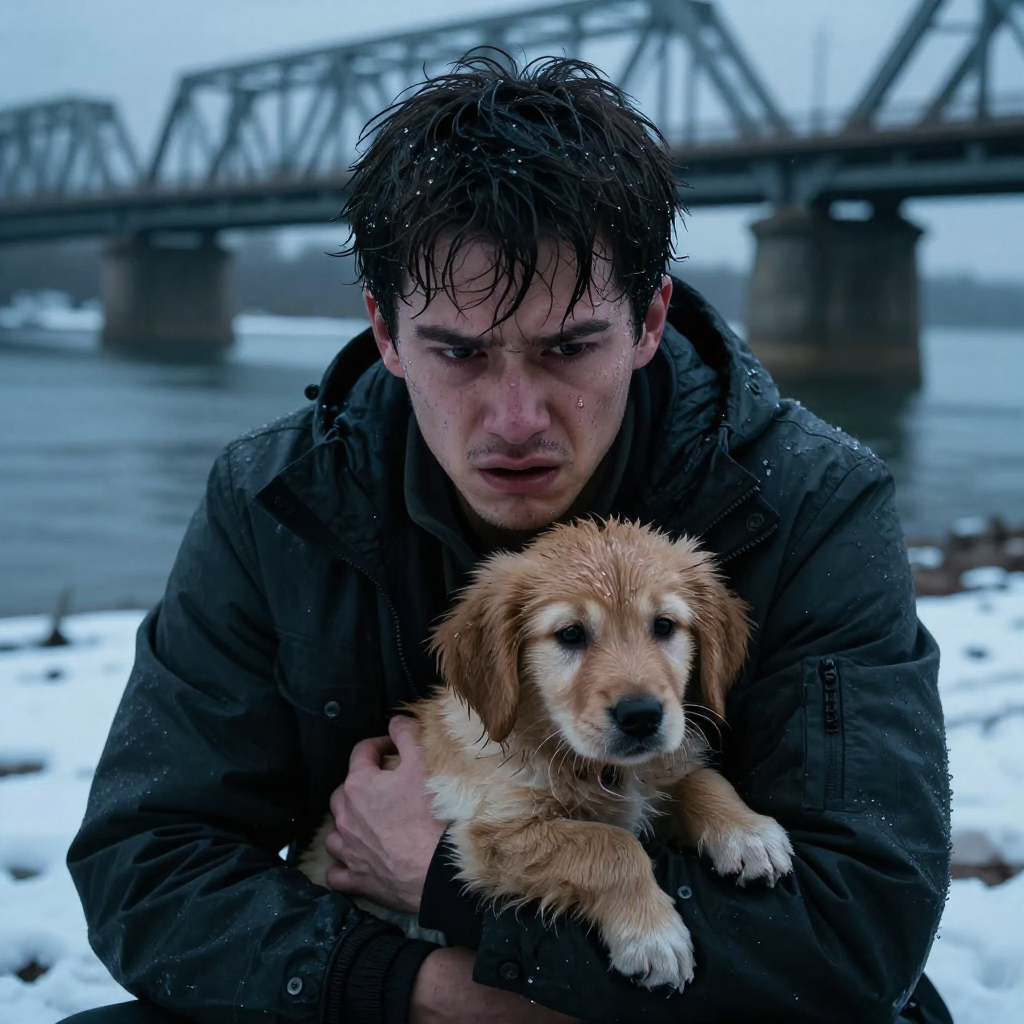
They were huddled together in a shivering pile—Golden Retriever mixes, maybe eight weeks old. They were soaked from the water seeping in, shaking so violently their teeth clicked. They didn’t bark. They just stared, frozen in absolute terror.
“It’s okay,” I whispered, my own voice shaking uncontrollably. “You’re safe.”
I started pulling them out one by one, tucking them inside my soaking wet coat, trying to share whatever body heat I had left. That’s when I saw it.
The first puppy, the smallest of the litter, had a cheap red nylon collar around its neck. But it wasn’t a store tag dangling from the metal ring. It was a laminated piece of paper, hole-punched and tied on with a ribbon. It looked homemade. Careless.
I squinted through the water dripping from my eyelashes to read it. I expected a name. Maybe a generic ‘Free to Good Home’ sign that had been ignored.
But the handwriting was shaky. It was the script of someone old, someone whose hands trembled when they held a pen.
It read: *”My name is Barnaby. My Mommy is going to the hospital today and she won’t be coming back. Her nephew promised her he would find us a warm home with children. Please love me like she did.”*
I froze. I looked at the next puppy. Another tag.
*”My name is Daisy. Mommy paid for our food for six months so we wouldn’t be a burden. Please tell her we are safe when you see her in heaven.”*
The third tag.
*”My name is Cooper. I am the brave one. Mommy cried when she gave us to her nephew, but he promised on the Bible he would take care of us. We trust him.”*
I fell back onto the snowy grass, the freezing wind whipping against my wet face, but I couldn’t feel the cold anymore. All I could feel was a white-hot rage burning in the center of my chest.
That man in the truck. The nephew.
He hadn’t just dumped unwanted strays. He had looked a dying woman in the eye, taken her money, taken her beloved pets, and promised her peace of mind. He had waited until she was gone—or maybe she was lying in a hospital bed right now, thinking her babies were safe—and then he had driven to a bridge and thrown them into the river like trash.
The cruelty wasn’t in the act of killing them. It was in the lie. It was in the betrayal of a final wish.
I gathered the four shivering bodies closer to my chest, burying my face in their wet fur. Barnaby licked my frozen chin, a tiny, hesitant gesture of trust.
“He lied,” I whispered into the cold air, my voice cracking. “But I won’t.”
I stood up, my legs shaking, water pouring off my clothes. I didn’t know who the woman was. I didn’t know who the nephew was. But I had the truck’s description. And I had these notes.
I wasn’t just going to save these dogs. I was going to find the man who threw them. And I was going to make sure everyone knew exactly what kind of monster hides behind a promise made to the dying.
CHAPTER II
The heat in my old truck didn’t work, or at least not well enough to combat the bone-deep chill that had settled into my marrow. I had the four of them—four shivering, whimpering bundles of wet fur—tucked inside my wool coat, pressed against my chest. Their tiny heartbeats were erratic, frantic little rhythms against my own ribs. I drove with one hand, the other holding the coat closed, feeling the dampness soak through my shirt. The smell of the river—silt, rot, and freezing death—filled the cabin.
I didn’t go home. I couldn’t. My apartment was a tomb of silence and old mistakes, and these creatures didn’t have time for me to figure out how to turn the space heater on. I drove straight to the 24-hour clinic on 4th Street. My mind was a chaotic loop of that red Ford truck, the splash, and the weight of the box. And the notes. Those laminated notes were still tucked in my pocket, the plastic edges digging into my thigh like a silent accusation.
Phase 1: The Sanctuary of Fluorescent Lights
The clinic smelled of antiseptic and floor wax. The young woman behind the desk, a girl named Sarah with tired eyes and a stained scrub top, didn’t even ask for my name when I walked in. She saw the way I was vibrating, the way my knuckles were white, and the way the coat was moving. She buzzed the inner door immediately.
“Get them on the table,” a voice barked. It was Dr. Aris, a man who looked like he hadn’t slept since the late nineties. He didn’t look at me; he looked at the puppies.
I laid them out. They were so small. Their eyes were barely open, clouded with the shock of the cold. As Aris and Sarah began the ritual of warming them—towels, heat lamps, glucose drops—I stood back, my hands finally free and shaking uncontrollably. I reached into my pocket and pulled out the notes.
I hadn’t looked at the back of them by the river. I had been too busy trying to keep the water out of my lungs. Now, under the harsh, unforgiving hum of the hospital lights, I turned them over. They weren’t just cardstock. They were cut from the back of a hospital discharge summary. I saw the header: *Saint Jude’s Hospice Care.* And there, in the corner of one scrap, was a name printed in a faint, inkjet blue: *Eleanor Gable. Room 412.*
Seeing that name made the air in the room feel thin. It wasn’t just a random act of cruelty anymore. It was a betrayal. It had a face, a room number, and a victim who was likely lying in a bed somewhere, believing her last earthly responsibilities were being handled with love.
“They’ll live,” Aris said, his voice softening just a fraction. He looked up at me then, noticing for the first time that I was soaked to the bone and shivering. “You need to get dry, son. You’re going to get pneumonia before they do.”
“I have to go,” I whispered.
“Go where? It’s three in the morning.”
“To find out who tried to kill them.”
Aris looked at the puppies, then back at me. He saw something in my eyes I couldn’t hide—the Old Wound. It’s the thing I carry, the memory of my younger brother, Leo. Twenty years ago, I was supposed to be watching him at the same river. I had turned my head for one minute to look at a dragonfly. One minute. The river didn’t give him back. I spent my life jumping into water to save things that weren’t Leo, trying to balance a scale that would never be even. Aris didn’t know the story, but he knew the look of a man haunted by a ghost.
“The bill?” I asked, reaching for my wallet.
“Forget the bill for now,” he said, turning back to the pups. “Just don’t do anything stupid. You have the look of someone about to do something stupid.”
Phase 2: The Hallways of Silence
I didn’t listen. I went to the truck, changed into a dry work shirt I kept behind the seat, and drove toward Saint Jude’s. The hospice was a low-slung brick building on the edge of town, surrounded by manicured lawns that looked gray in the pre-dawn light.
I walked through the sliding glass doors with a sense of purpose that felt like a fever. I wasn’t a visitor; I was a hunter. But as I reached the fourth floor, the silence of the hospice began to weigh on me. This wasn’t a place for confrontation. It was a place for the end.
I found Room 412. The door was cracked open. Inside, a woman lay under a pale blue blanket. She looked like a bird made of parchment paper—fragile, translucent. An oxygen tank hummed rhythmically beside her. This was Eleanor Gable.
I stood in the doorway, my heart hammering. On her bedside table was a framed photo. It showed Eleanor, much younger, laughing in a garden, and a man beside her. He had a wide, practiced smile and a hand draped over her shoulder in a way that looked more like a grip than an embrace. I recognized that jawline. It was the man from the red Ford.
“Is someone there?” her voice was a thin rasp.
I stepped inside, my anger curdling into a sickening kind of pity. “I… I’m a friend,” I lied. The words tasted like ash. “I was just checking in.”
She smiled, and it broke my heart. “Is it Marcus? Did Marcus send you? He’s such a good boy. He’s been so busy today… finding homes for my babies. My Lucy, my Max… he promised me they’d go to families with big yards.”
I felt a physical pain in my chest. This was the Secret I now held. If I told her the truth, I would destroy the only peace she had left. If I stayed silent, I was an accomplice to Marcus’s lie. Marcus, the ‘nephew.’ The ‘good boy.’ The man who had taped a box shut and thrown it into the dark.
“He’s… he’s taking care of it, Eleanor,” I said, the lie nearly choking me.
“I knew it,” she sighed, her eyes fluttering shut. “He’s always been the pillar of this family. Everyone says so. He’s going to be the next City Council President, you know. He has such a reputation to uphold. A heart of gold.”
Reputation. That was it. That was the Secret Marcus was protecting. A man running for office couldn’t be burdened by an old aunt’s dying wishes or a litter of unwanted mutts. He needed to be clean, unburdened, and heroic.
Phase 3: The Public Mask
I stayed in the shadows of the hallway for an hour, watching. At 7:00 AM, the atmosphere changed. People began to arrive. Not family, but people in suits. A local news crew pulled up into the parking lot below.
I asked a nurse what was happening.
“It’s the ‘Gable Legacy’ announcement,” she whispered, her voice full of admiration. “Marcus Gable is donating a massive wing to the hospice in his aunt’s honor. It’s a huge event. The Mayor is coming. It’s all over the morning news.”
I felt a cold, hard resolve settle over me. I looked down at my hands. They were still stained with the river mud that had been under my fingernails. I looked at the laminated notes in my pocket. Marcus was about to buy his way into a legacy using the money he’d inherit from the woman whose heart he was ready to break—the woman whose ‘babies’ he had tried to drown.
I followed the crowd toward the community room on the first floor. It was a large, bright space filled with folding chairs and a small podium. There was a banner: *BUILDING THE FUTURE OF CARE: THE MARCUS GABLE DONATION.*
I stood at the very back, leaning against the wall. I looked out of place in my work boots and grease-stained jeans, but no one noticed the man in the back. They were all looking at the front.
Then he walked in. Marcus Gable. He was taller than he’d looked from the bridge. He wore a navy suit that cost more than my truck. He shook hands, he patted backs, he flashed that same practiced smile from the photograph. He looked like the picture of civic virtue.
He took the podium. The room went silent.
“My aunt, Eleanor, taught me everything I know about compassion,” he began, his voice rich and steady. “She taught me that we have a responsibility to the most vulnerable among us. Whether it’s our elders, our children, or even the animals that depend on us for survival…”
I felt a surge of nausea. He was using the very thing he’d tried to destroy as a rhetorical tool. He was standing there, basking in the light of his own perceived goodness, while the puppies were struggling for air in an incubator three miles away.
This was the moment. The Moral Dilemma was a knife at my throat. If I spoke, I would stop him. I would expose the monster. But the news was filming. Eleanor would see it. It would be on every screen in the hospice. She would die knowing her nephew was a murderer at heart. She would die in shame.
But if I didn’t speak? He would win. He would become a leader. He would continue to be the ‘good man’ built on a foundation of drowned things.
Phase 4: The Triggering Event
I didn’t plan it. I didn’t think it through. It was the Old Wound—the memory of Leo, of the silence of the river, of the way people had looked at me afterward like I was the one who had pulled him under. I couldn’t let another silence win.
Marcus reached the crescendo of his speech. “And so, in Eleanor’s name, I pledge not just this money, but my life’s work to—”
“Why was the box taped shut, Marcus?”
My voice wasn’t loud, but it was jagged. It cut through the room like a shard of glass.
Marcus stopped. The smile stayed on his face for a second too long, a grotesque mask slipping. He squinted into the back of the room, into the shadows where I stood.
“I’m sorry?” he said, his tone patronizingly smooth. “Did someone have a question?”
I walked forward. The crowd parted. My boots made a heavy, rhythmic thud on the linoleum. I didn’t stop until I was five feet from the podium. I could smell his expensive cologne.
“The box,” I said, my voice gaining strength. “The one you threw off the Miller Street Bridge at midnight. The one with your aunt’s puppies inside. Why was it taped shut? If you were finding them ‘big yards,’ why did you need the river?”
The silence that followed was absolute. It was the kind of silence that precedes a crash. The news camera pivoted toward me. I saw the red light blinking.
Marcus’s face went from confusion to a pale, sickly gray. He recognized me. He recognized the man who had stood on the bank, the man who shouldn’t have been there.
“I don’t know what you’re talking about,” he stammered, his hand gripping the edge of the podium so hard the wood creaked. “Security, this man is clearly disturbed. He’s—”
“I have the notes, Marcus,” I said, reaching into my pocket. I pulled out the laminated cards—the ones Eleanor had made with such love. I held them up. “They have your aunt’s handwriting on one side. And they have her hospice room number on the back. You used her own discharge papers to label the dogs you were about to drown.”
I saw it then. The irreversible shift. It wasn’t just a private accusation. It was public. It was filmed. The Mayor stepped back. The donors began to whisper. Marcus’s reputation—the thing he valued more than life itself—was disintegrating in real-time.
But then, I saw the television monitor on the side of the room. It was tuned to the local news feed. And there, in the corner of the screen, I saw the live broadcast.
And I remembered.
Eleanor had a TV in her room.
She was watching.
In that moment, I realized I had won the battle and lost the soul of the mission. I had exposed the villain, but I had destroyed the victim. Marcus looked at me, and for a split second, the mask dropped completely. There was no more fear. There was only a cold, predatory hatred.
“You think you’re a hero?” he hissed, low enough that only I could hear as security grabbed my arms. “You just killed her. You think her heart can take this? You just killed the only person who ever loved me.”
They dragged me out. The room was a chaos of shouting and flashing lights. As the glass doors closed behind me, I looked up at the fourth floor.
I had done the ‘right’ thing. So why did I feel like I was the one who had just held a box under the water?
I stood in the parking lot, the morning sun finally breaking over the horizon, cold and indifferent. I had saved the puppies, but I had set a fire that was going to burn everything else down. And Marcus Gable wasn’t the kind of man to let a fire burn alone.
I got into my truck. My phone buzzed in the cupholder. It was a text from an unknown number.
*I know who you are, Elias Thorne. I know about Leo. I know why you moved here. Let’s see how much the town loves a savior with a dead brother in his closet.*
The Secret was out. The war had begun. And there was no going back to the river.
CHAPTER III
I sat in the dim fluorescent hum of Dr. Aris’s clinic, the weight of the silence pressing against my eardrums like deep water. On the small television mounted in the corner, the news cycle was already beginning to chew on the bones of my life. I saw my own face, blurred and frantic, shouting at Marcus Gable during the fundraiser. They called me a ‘disturbed intruder.’ They called me a ‘grieving-obsessed local.’ The puppies were asleep in a heap of warm, rhythmic breathing in the crate at my feet. They were the only quiet things in a world that had suddenly become very loud.
Then the phone rang. It wasn’t my phone—I’d turned that off after the third death threat—it was the clinic’s landline. Dr. Aris picked it up, her face hardening into a mask of pale marble. She looked at me, and I knew. Eleanor Gable was gone. She had slipped away less than an hour after my confrontation with Marcus. The nurse at St. Jude’s said she had been watching the broadcast. Her heart simply couldn’t navigate the distance between the nephew she thought she knew and the man I had revealed. I felt a cold, hollow space open up in my chest. I had tried to save her truth, and in doing so, I had likely shortened her life.
Marcus didn’t wait for the body to get cold. By morning, he had mobilized a narrative that felt like a burial shroud. He appeared on every local station, his eyes red-rimmed and perfectly calculated. He didn’t talk about the dogs. He talked about ‘elderly abuse’ and ‘targeted harassment.’ He spoke about his aunt’s ‘fragile mental state’ and how a ‘man with a history of negligence’—a direct, jagged reference to Leo—had broken her spirit in her final moments. He wasn’t just defending himself; he was erasing me. He was making sure that when people heard the name Elias Thorne, they didn’t think of a man saving puppies. They thought of the boy who let his brother drown, grown up into a man who killed an old lady with a lie.
I stayed in the back room of the clinic, watching the rain streak the windows. Dr. Aris brought me coffee I didn’t drink. She told me the police had been by, asking questions about the ‘theft’ of the dogs. Marcus was claiming I had stolen them from Eleanor’s estate. He was using the law as a scalpel, trying to cut me away from the only evidence of his cruelty. I looked at the runt, the smallest of the four, who was currently chewing on a loose thread of my sleeve. This dog didn’t know about politics or estates or the way a man’s reputation can be dismantled in a soundbite. It only knew that it was warm and that I was there.
I realized then that Marcus had made a mistake. In his rush to frame me as a thief, he had forgotten the small, mundane details that Eleanor had left behind. I reached into the pocket of my coat and pulled out the bundle of notes I’d found in the box. I began to spread them out on the stainless steel table. There was the list of names, the instructions for the ‘new homes,’ and then there was a small, plastic-wrapped card I hadn’t looked at closely before. It was a digital memory card from a voice recorder, taped to the back of a photo of Eleanor as a young girl. On the tape, she had written: ‘For the records.’
I borrowed Dr. Aris’s laptop and slotted the card in. My hands were shaking so hard I nearly dropped it. The audio files were dated from the last three months. I clicked the most recent one. Eleanor’s voice was thin, like dry leaves skittering across pavement, but her mind was terrifyingly sharp. She wasn’t talking about puppies. She was talking about ‘the signatures Marcus keeps asking for.’ She was documenting the way he was moving her money into offshore accounts to fund his campaign, and how he had threatened to ‘dispose of the burdens’—meaning her and the dogs—if she didn’t comply. It wasn’t just a animal cruelty case anymore. It was a systematic financial execution.
I didn’t call the police. I knew Marcus owned the local precinct. I knew the Sheriff was a regular at Marcus’s weekend barbecues. If I handed this over to them, it would disappear into a shredder before the sun went down. I needed a bigger stage. I needed the one thing Marcus couldn’t buy: the glare of an outside light. I called a contact I’d made years ago, a journalist from the state capital who specialized in white-collar corruption. We agreed to meet at the riverbank—the place where it all started. It felt right. If I was going to end this, it had to be at the water’s edge.
I drove out to the bridge as the sun began to dip below the horizon, turning the sky the color of a fresh bruise. The red Ford truck was already there. Marcus was leaning against the railing, looking out over the water where he had tossed those dogs. He looked calm. He looked like a man who had already won. When I stepped out of my car, he didn’t even turn around. He just spoke into the wind. ‘You should have stayed in the shadows, Elias. People like you don’t survive the light.’
‘I’m not looking to survive,’ I said, walking toward him. My heart was a steady drum in my ears. For the first time since Leo died, I wasn’t afraid of the water. ‘I’m just looking to finish the story Eleanor started.’
Marcus turned then, his face contorting into a sneer of pure, unadulterated arrogance. ‘The story is whatever I say it is. My aunt is dead. You’re a felon. And those dogs? They’re going to a shelter that won’t exist by next week. You’ve got nothing but a handful of scribbles from a senile woman.’
‘I have her voice, Marcus,’ I said, holding up the recorder. ‘I have every conversation you had with her about the embezzlement. I have the threats. I have the dates. And I’ve already sent the files to the State Attorney General’s office. They’ve been looking for a reason to audit your campaign for months. I just gave them the key.’
His face went from pale to a sickly, mottled grey. He stepped toward me, his hand reaching out, but I didn’t flinch. I felt a strange sense of peace. He could destroy my reputation, he could drag my past through the mud, but he couldn’t take back the truth once it was in the air. We stood there on the bridge, the same bridge where he had tried to drown four innocent lives, and for a moment, the power shifted. He wasn’t the powerful politician anymore. He was just a small, scared man standing over a dark river.
That’s when the sirens started. Not the local police—the black SUVs of the State Bureau of Investigation. They hadn’t come for me. They swept past my car and pinned Marcus’s truck against the railing. A tall woman in a dark suit stepped out, her eyes fixed on Marcus. She didn’t look at me. She didn’t look at the river. She looked at the man who had thought he was untouchable.
‘Marcus Gable?’ she called out. ‘We have some questions about your aunt’s estate and several campaign contributions.’
Marcus looked at the officers, then back at me. The mask was gone. There was only the raw, ugly reality of a cornered animal. He tried to speak, to charm his way out, to use the silver tongue that had gotten him this far, but the words died in his throat. They led him away in silence. No grand speech, no dramatic struggle. Just the click of metal and the slamming of a car door.
I stayed on the bridge long after they left. The rain started again, cold and persistent. I looked down at the water, the same water that had taken Leo, the same water that Marcus had tried to use as a grave. For the first time in twenty years, the river didn’t look like an enemy. It just looked like water. I went back to the car, where the puppies were waiting. We weren’t going to run away this time. We were going home.
CHAPTER IV
The silence after the storm wasn’t peaceful. It was the kind of silence that hummed with unspoken judgments, the kind that clung to you like the damp chill rising from the frozen Blackwood River. Marcus was gone, yes, taken away in handcuffs as the flashing lights of the SBI cruisers painted the snowy bridge in stark blues and reds. But the echoes of his accusations, his carefully constructed narrative of me as a troubled, unstable man, lingered. They burrowed into the town’s collective consciousness, intertwining with the long-held whispers about Leo. I was still ‘the boy who let his brother drown,’ now rebranded as a man obsessed, a man driven to the edge.
My apartment felt…exposed. Before, it was just my space, messy and cluttered, but mine. Now, it felt like a stage. I kept expecting the flash of a camera, the probing questions of a reporter. I hadn’t slept properly since finding the puppies. Exhaustion pulled at me, a bone-deep weariness that no amount of coffee could touch. The phone rang constantly. Most were hang-ups, heavy breathing on the other end, or just silence. A few were reporters, eager to get my ‘exclusive’ story. I ignored them all.
The biggest shock came from work. I walked into the hardware store that Monday morning, expecting…I don’t know, maybe a supportive pat on the back from Mr. Henderson. Instead, he met me at the door, his face grim. “Elias, we need to talk.” He didn’t mince words. The other employees, mostly teenagers and retirees, were giving me wide berths, whispering behind their hands. Apparently, customers had been calling, threatening boycotts. My presence was ‘bad for business.’ I was suspended, pending a review. Translation: I was fired. The axe hadn’t even fallen, but I already felt the phantom pain.
I walked out into the biting wind, the pink slip burning a hole in my pocket. I wasn’t surprised, not really. I’d known, deep down, that this was coming. Marcus’s poison had seeped into everything. The town had always been skeptical of me, and he’d just given them the excuse they needed to ostracize me completely. I didn’t go home. I drove. I drove until the familiar landmarks blurred into a grey, indistinct smear, until the gas gauge needle dipped dangerously low. I ended up back at the river. The bridge was empty now, the snowdrifts undisturbed. The only sound was the mournful creak of the frozen branches overhead. I parked the truck and got out, walking to the edge of the water. The ice was thicker now, a solid, unforgiving sheet. I stared at the spot where I’d found the puppies, where I’d nearly fallen through. It felt like a lifetime ago.
I called Sarah. She picked up on the third ring, her voice hesitant. “Elias? Are you okay?” I wanted to lie, to tell her everything was fine, that I was handling it. But the words wouldn’t come. “I lost my job,” I said, the words flat, devoid of emotion. There was a long silence on the other end. “Come over,” she said finally. “I’ll make coffee.” Her apartment was small, cluttered with books and art supplies, but it felt safe, warm. She didn’t pry, didn’t offer empty platitudes. She just sat with me while I drank the coffee, the silence punctuated only by the ticking of a clock.
Later that day, the local news ran a story about Marcus’s arrest. They mentioned the evidence I’d provided, the financial crimes, the abuse of Eleanor. But they also replayed snippets of Marcus’s speech from the fundraiser, the parts where he painted me as a dangerous stalker. They included a photo of me from high school, awkward and gangly, with a headline that screamed, “Local Man Exposes Political Corruption, But Questions Linger About His Past.” Even in taking down Marcus, I couldn’t escape the shadow of Leo.
The puppies were still at the vet, warm, fed, and thankfully oblivious to the chaos surrounding them. Dr. Olsen said they were healthy, playful. He’d already had a few inquiries about adoptions. That was one small victory, at least. Finding them homes. Finding them safety. It was something concrete I could do, something to push back against the all-consuming negativity.
I visited Eleanor’s grave. It was a simple headstone, almost hidden by the snow. I stood there for a long time, the wind whipping around me, whispering through the bare trees. I didn’t know what to say. Sorry didn’t seem like enough. Thank you felt inadequate. She had suffered so much, and in the end, I hadn’t been able to save her. All I could do was stand there, a silent witness to her absence, a monument to my own failures.
That night, I couldn’t sleep. Every time I closed my eyes, I saw Eleanor’s face, etched with weariness and fear. I heard Marcus’s voice, dripping with venom, twisting the truth. I felt the cold, gnawing guilt of Leo, a constant, unwelcome companion. I got out of bed and went to the window, staring out at the darkness. The town was quiet, sleeping, but I knew the whispers were still there, the judgments still being made. I was an outsider, forever marked by tragedy and suspicion.
The SBI agents contacted me again a few days later. They needed more information, clarification on some of the financial documents I’d found. Agent Sterling was professional, polite, but there was a distance in her eyes, a wariness that mirrored the town’s. I answered her questions honestly, laying out everything I knew. But I could feel her skepticism, the unspoken doubt. In their eyes, I was still a suspect, a potential loose end.
They also told me that Marcus wasn’t cooperating. He was denying everything, claiming the voice recorder was doctored, the financial records fabricated. He was fighting back, clinging to the last vestiges of his power. It wouldn’t be a quick or easy trial. And the media was having a field day. Every news outlet was running stories about the case, dissecting every detail, analyzing every angle. I was front-page news, a pariah, my life a public spectacle. The comments sections were filled with vitriol, the online forums buzzing with conspiracy theories. I stopped reading them. It was too much.
Sarah found me a pro-bono lawyer, a young woman named Emily who worked for a small firm in the next town over. Emily was sharp, determined, and surprisingly optimistic. She believed in my innocence, saw through Marcus’s lies. She was also realistic. “This is going to be a tough case,” she said. “Marcus has a lot of influence, a lot of resources. We need to be prepared for a long fight.” She started building a defense, gathering evidence, interviewing witnesses. She became my lifeline, a beacon of hope in the gathering storm.
I started volunteering at the animal shelter. It was a small, underfunded place, filled with abandoned dogs and neglected cats. The work was hard, messy, and often heartbreaking. But it was also therapeutic. Caring for the animals, giving them attention, feeding them, cleaning their cages, it gave me a sense of purpose, a way to channel my energy. I found solace in their unconditional affection, their simple, unwavering need. One scruffy terrier mix, with big, soulful eyes, attached himself to me immediately. He followed me everywhere, nudging my hand with his wet nose, whining when I left. His name was Buster. He’d been abandoned, left tied to the shelter’s gate in the middle of the night.
The media attention didn’t die down. If anything, it intensified. They dug up every detail of my past, rehashing Leo’s death, interviewing old classmates, scouring social media for anything they could use to paint me in a negative light. They even tracked down my estranged father, who gave them a tearful interview about my ‘troubled childhood.’ It was relentless, invasive, and utterly dehumanizing. I felt like I was being stripped bare, exposed to the world’s cruelest gaze.
One evening, as I was leaving the animal shelter, I saw a group of teenagers gathered across the street. They were holding signs, chanting slogans. “Justice for Marcus!” one sign read. “Thorne is a Liar!” shouted another. It was a small protest, but it felt like a punch to the gut. Marcus’s supporters were still out there, still believing his lies. The poison was still spreading. I turned away, my heart heavy with despair. Even after everything, even with the evidence, some people would never see the truth. Some people would always believe the worst about me.
Buster started sleeping at the foot of my bed. He’d sneak in when I wasn’t looking, curling up into a tight ball, his warm body a comforting presence. I didn’t mind. He was good company. He didn’t judge me, didn’t ask questions. He just offered his unwavering loyalty, his silent affection. He became my shadow, my constant companion. I started taking him for walks along the river. He loved the water, splashing and playing in the shallows, chasing after sticks. His joy was infectious, a small spark of light in the darkness.
I received a letter. It was handwritten, postmarked from out of state. Inside was a single sheet of paper. On it, someone had scrawled a single word: “Murderer.” I didn’t know who sent it, but the message was clear. I was being held responsible for Eleanor’s death. I crumpled the letter in my fist, the anger rising inside me. It wasn’t fair. I hadn’t wanted any of this. I’d just wanted to help the puppies, to do the right thing. But somehow, I’d become the villain.
The trial date was set for three months away. Emily said it was a good sign. It meant the prosecution was confident in their case, that they had enough evidence to convict Marcus. But I wasn’t so sure. I knew Marcus was a fighter. He wouldn’t go down without a battle. And I was still the boy who let his brother drown. That narrative was deeply embedded in this town, and it would take more than evidence to erase it. More than anything, it was going to take for me to be able to forgive myself, no matter the outcome of the trial.
I went back to the river. Buster trotted along beside me, his tail wagging. The sun was setting, casting long shadows across the snow. I stood at the edge of the water, staring at the frozen surface. It was beautiful, in a stark, unforgiving way. I closed my eyes, took a deep breath, and listened to the sound of the wind, the rush of the water beneath the ice. And for the first time in a long time, I felt a flicker of something that resembled peace. The weight was still there, the guilt, the sorrow, but it was a little lighter, a little less overwhelming. I wasn’t sure what the future held, but I knew I wasn’t alone. I had Buster, I had Sarah, I had Emily. And maybe, just maybe, that was enough.
A new event happened. Dr. Olsen called me, he told me that one of the puppy adopters returned the puppy because her husband got relocated for work and they wouldn’t be able to care for the puppy. The puppy was one of the female one, I called her ‘Lucky’ when I rescued them, she was the weakest one and she almost didn’t make it. Dr. Olsen asked if I could take her for now until they can find a suitable adopter. I hesitated for a moment, then I agreed. I named him Leo, in honor of my brother.
CHAPTER V
The hate mail kept coming, even after Marcus Gable’s arrest. Some were printed, some handwritten, some typed on ancient machines. They all said the same thing: I was to blame for Eleanor’s death. That I had harassed her, driven her to an early grave. That I was a monster hiding behind good deeds. I stopped opening them, letting Emily, my lawyer, sort through the threats from the pathetic ramblings. But the words still echoed in my head, a constant hum of guilt and self-doubt.
The trial was looming, a dark cloud on the horizon. Emily assured me that the SBI’s evidence against Marcus was solid. That I was not the one on trial. But public opinion was a fickle thing. I was already guilty in the court of public opinion.
I spent my days at the animal shelter, finding solace in the quiet companionship of the animals. Buster, my loyal shadow, was always by my side. And Leo, the puppy, was a constant reminder of what I had done, of what I had tried to do.
One evening, Emily called. “Elias,” she said, her voice unusually gentle. “The DA wants to offer you a deal.”
I listened as she explained. If I agreed to a plea bargain – a reduced charge of, essentially, disturbing the peace and harassing a vulnerable adult – the DA would drop the more serious charges. It would mean admitting some culpability, but it would avoid a lengthy and potentially damaging trial. And it would almost guarantee a light sentence – probation, community service. Nothing more.
“What do you think?” Emily asked.
I looked at Leo, curled up at my feet. Then at Buster, his tail thumping softly against the floor. I thought of Eleanor, of Marcus, of the lies and the manipulation.
“I think,” I said, my voice hoarse, “that I can’t.”
* * *
Emily sighed. “Elias, I understand your desire to fight this. But a trial is a gamble. And even if you win, the damage is already done. Your reputation…”
“Is already ruined,” I finished for her. “I know. But I can’t plead guilty to something I didn’t do. I can’t let Marcus win, even if it means losing everything else.”
Emily was silent for a moment. “Okay,” she said finally. “Then we fight.”
The trial began a few weeks later. The courtroom was packed, the atmosphere tense. Marcus Gable sat at the defendant’s table, his face a mask of carefully constructed innocence. He looked thinner, his expensive suit hanging loosely on his frame. The scandal had taken its toll.
The prosecution presented their case, laying out the evidence of Marcus’s financial crimes and his abuse of Eleanor. They played the recording I had found, Marcus’s voice cold and calculating as he manipulated his aunt.
Then it was my turn. I took the stand, my hands shaking slightly. Emily guided me through my testimony, carefully and deliberately. I told the story of finding the puppies, of meeting Eleanor, of uncovering Marcus’s lies. I spoke of my own past, of Leo’s death, of the guilt that had haunted me for so long.
Under cross-examination, the defense attorney tried to paint me as unstable, as obsessed, as a man driven by grief and anger. He brought up my past, my therapy sessions, my history of… well, of being the town’s resident eccentric. He twisted my words, trying to make me look like a villain.
But I stood my ground. I answered his questions honestly, even when they were painful. I refused to be intimidated.
* * *
The trial lasted for days. The media dissected every moment, every word. The town was divided. Some supported me, believing in my innocence. Others condemned me, convinced of my guilt. I was a pariah, a hero, a scapegoat – all at once.
The jury deliberated for what felt like an eternity. I spent those hours in a haze of anxiety, pacing the floor, unable to eat or sleep. Emily tried to reassure me, but I could see the worry in her eyes.
Finally, the verdict came. The courtroom fell silent as the jury foreman read the words: “Guilty. On all counts.”
Marcus Gable was convicted of fraud, elder abuse, and obstruction of justice. He was taken into custody immediately, his face ashen.
I felt a wave of relief wash over me, but it was quickly followed by a sense of emptiness. Marcus was going to prison, but Eleanor was still gone. And the damage had already been done.
The trial was over, but my life was not magically fixed. I was still unemployed, still ostracized by many in the town. The hate mail dwindled, but it didn’t disappear entirely. Some people would always see me as the man who had ruined Eleanor Gable’s life.
I went back to the animal shelter, seeking comfort in the familiar routine. Buster greeted me with his usual enthusiasm, jumping and barking. Leo, now bigger and stronger, wagged his tail tentatively.
I knelt down and hugged them both, burying my face in their fur. They were my family now, my only connection to… well, to anything.
One afternoon, Sarah came to visit me at the shelter. She looked tired, but her eyes were kind.
“How are you holding up?” she asked.
“I’m… okay,” I said. “It’s over, I guess.”
“It’s never really over, is it?” Sarah said softly. “But you did the right thing, Elias. You stood up for what you believed in.”
“Did I?” I asked. “Or did I just make things worse?”
Sarah shook her head. “You gave Eleanor a voice,” she said. “You exposed Marcus for what he was. You saved those puppies. That’s not nothing, Elias. That’s everything.”
I looked at her, searching her eyes for reassurance. I wanted to believe her, but it was hard.
“What about you, Sarah?” I asked. “Are you… okay with all of this?”
Sarah hesitated for a moment. “It’s been… difficult,” she admitted. “My family… they don’t really understand. They think I should stay away from you.”
“Then why are you here?” I asked.
Sarah smiled. “Because I believe in you, Elias,” she said. “And because… I care about you.”
I didn’t know what to say. I hadn’t expected that. I wasn’t sure I deserved it.
* * *
Time passed. Slowly, grudgingly, the town began to heal. The scandal faded from the headlines. People started to forget, or at least to forgive. I got a new job, working at a different animal shelter, a few towns away. It wasn’t glamorous, but it was honest work. And it allowed me to be around animals, which was all that really mattered.
I started taking Buster and Leo to the Blackwood River again. The water still held a certain… power over me, but it no longer felt like a source of unbearable grief. It was just a river, flowing on, indifferent to my pain.
One day, I was walking along the riverbank with Buster and Leo when I saw a group of children playing near the water. They were laughing and splashing, their faces alight with joy.
I stopped and watched them for a moment, a pang of sadness in my chest. I thought of Leo, of all the things he had missed. Of all the things I had missed because of his death.
Then, one of the children stumbled and fell into the water. He started to panic, thrashing and sputtering.
Without thinking, I ran towards the river. I plunged into the cold water, swimming towards the struggling child. I reached him just as he was about to go under. I grabbed him and pulled him to shore, where his friends were waiting, their faces pale with fear.
I coughed and sputtered, my body shaking with cold. But the child was safe. He was alive.
His friends thanked me profusely, their voices filled with gratitude. I just nodded, my throat too tight to speak.
As I walked back to Buster and Leo, I realized something. I had saved a life. I had done something good. Something meaningful.
And in that moment, I understood. I understood why I had risked everything to save those puppies. I understood why I had fought to expose Marcus Gable. I understood why I had dedicated my life to helping animals.
It wasn’t about guilt. It wasn’t about redemption. It was about… connection. It was about recognizing the value of every living thing, about fighting for those who couldn’t fight for themselves.
It was about saving Leo. Not the Leo who had drowned in the river, but the Leo who lived on in my heart. The Leo who represented innocence and vulnerability and the unwavering power of love.
I looked at Buster, his eyes filled with unwavering loyalty. I looked at Leo, his tail wagging tentatively. And I smiled.
The river flowed on, carrying its secrets to the sea. The sun shone down, warming my face. The world was still broken, still unfair, still full of pain. But it was also full of beauty, full of hope, full of the possibility of… something more.
I knelt down and hugged Buster and Leo again, holding them close. They were my family. They were my everything.
We stood there for a long time, watching the river flow. And in that moment, I felt… at peace.
The weight on my chest, the guilt that had haunted me for so long, finally began to lift.
I had lost so much. But I had also gained something. I had gained a new perspective. A new understanding. A new sense of purpose.
I was still Elias Thorne, the man who had lost his brother in the Blackwood River. But I was also Elias Thorne, the man who had saved four puppies, exposed a corrupt politician, and found a new life in the embrace of animals.
I was still haunted by the past. But I was no longer defined by it.
I was free.
The river whispered its secrets, and the dogs stayed close as the sun slowly set, reminding me that sometimes, a broken heart is the only way to let the light in.
END.