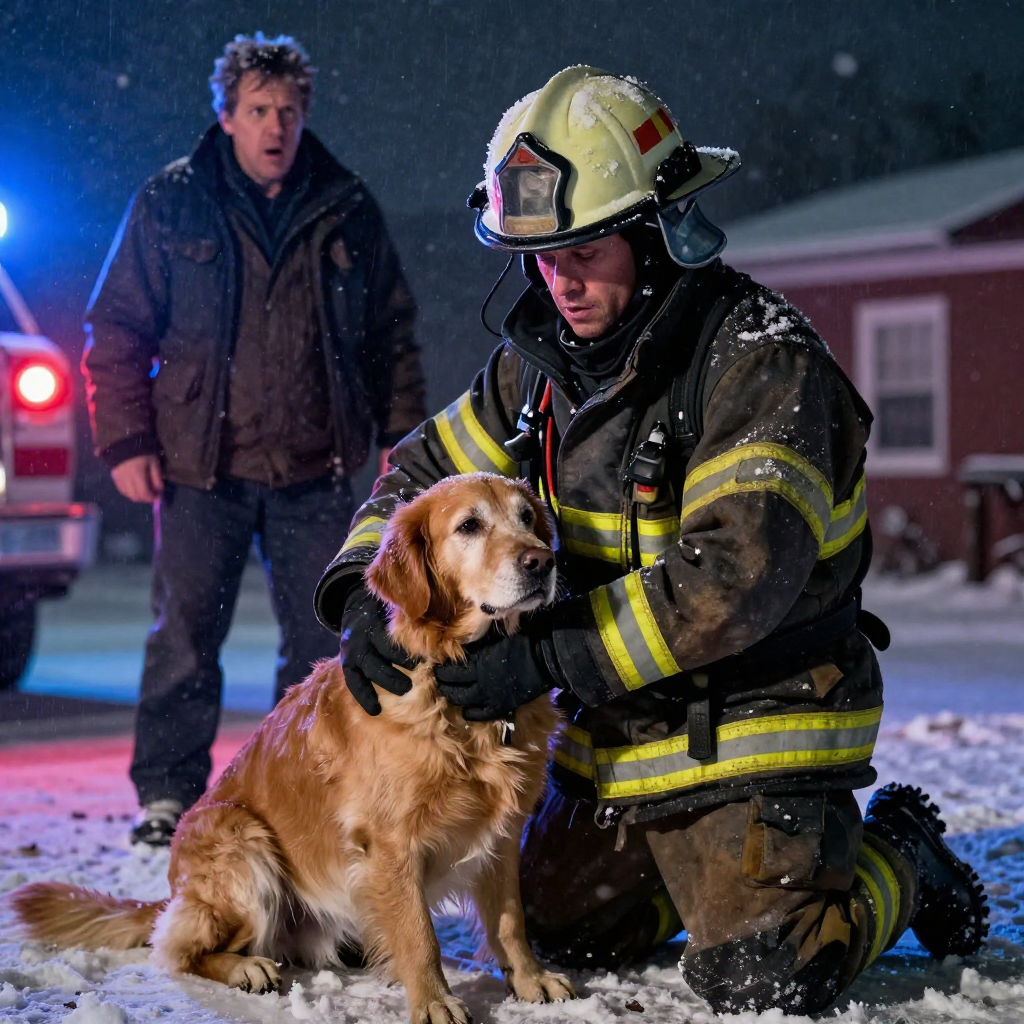
HE LAUGHED WHILE LOCKING MY SHIVERING DOG IN HIS FREEZING SHED, BUT HIS SMILE DIED WHEN A FIREFIGHTER BROKE DOWN THE DOOR AND SILENCE HIM WITH ONE LOOK.
The sound of the padlock clicking shut echoed like a gunshot in the frozen air. It wasn’t a loud noise, not really. Just a sharp, metallic snap. But in the silence of a Tuesday night, with the temperature hovering somewhere around five degrees below zero, it was the loudest thing I had ever heard.
I stood on the edge of my driveway, my breath hitching in my throat, forming thick white clouds that vanished instantly into the dark. I wasn’t wearing a coat. I hadn’t had time to grab one. I was in my oversized sweater and leggings, shivering not just from the cold, but from a rage so pure and hot it felt like it was burning a hole through my chest.
“Please,” I said. My voice cracked. I hated that it cracked. I wanted to scream, to sound dangerous, but I just sounded small. “Open the door, Greg. He’s going to freeze.”
Greg didn’t look at me. He was busy testing the lock, tugging on it with a smug, self-satisfied rhythm. *Clank. Clank.* Secure.
He turned slowly, leaning his back against the peeling wood of his garden shed. He crossed his arms over his chest, his breath smelling of stale beer and mints even from ten feet away. He smiled. It wasn’t a maniacal smile. It was worse. It was the calm, patient smile of a man who believes he is teaching a child a lesson.
“He was on my property, Sarah,” Greg said, his voice terrifyingly level. “We’ve talked about this. The property line is the azalea bush. He crossed it. Laws are laws.”
“He’s a Golden Retriever!” I screamed, stepping forward before the icy wind pushed me back. “He’s twelve years old! He wasn’t doing anything, he just sniffed a bush! You can’t lock a living thing in a shed in this weather!”
“It’s not a shed,” Greg corrected, holding up a finger. “It’s a temporary holding facility until Animal Control opens in the morning. I’m doing the neighborhood a service. Keeps the stray element under control.”
From inside the shed, a sound cut through the night. A low, confused whimper. Then a scratch against the wood. Barnaby.
Barnaby has arthritis in his hips. He sleeps on a memory foam bed with a heating pad. He doesn’t understand territory or property lines or the bitter cruelty of men who feel small in their own lives and need to make others feel smaller to compensate. He just knew it was dark, it was freezing, and I wasn’t there.
“Greg, open the door or I swear to God…”
“You’ll what?” Greg took a step toward the property line. He was a big man, heavy-set, with the kind of bulk that made him feel immovable. I was five-foot-four. I lived alone. He knew that. He counted on that. “You’ll call the cops? Go ahead. By the time they get here for a non-emergency dispute, it’ll be an hour. Maybe two. Dog might learn some discipline by then.”
He was right, and that was the horror of it. The police in our precinct were overstretched. A ‘neighbor dispute’ over a dog wouldn’t prioritize over the icy road accidents happening on the highway. Greg knew the system. He knew exactly how much cruelty he could get away with before it became a crime.
I could hear Barnaby whimpering louder now. It was a high-pitched, panicked sound that clawed at my insides. The temperature was dropping. I could feel the numbness starting in my fingers. If I was freezing out here, what was happening to him in that uninsulated wooden box?
“I’m begging you,” I whispered, the fight draining out of me, replaced by pure desperation. “I’ll pay you. I’ll build a higher fence. Just let him out.”
Greg laughed. A short, bark of a laugh. “It’s not about money, Sarah. It’s about respect. You people move into this neighborhood and think you can do whatever you want. You think the rules don’t apply to you.”
I didn’t know who “you people” were. I was just a graphic designer who bought a fixer-upper three months ago. But I knew what Greg saw. He saw a target.
I looked at the house windows around us. Dark. Curtains drawn. The Davises across the street had their porch light on, but no one came out. They heard. They had to hear me screaming earlier. But nobody wanted to deal with Greg. He was the neighborhood headache, the man who measured his lawn with a ruler, the man who sued the HOA over the color of a mailbox.
I was alone.
I turned back to my house, my hands shaking so hard I could barely grip my phone. I wasn’t calling the police. I dialed 911, but I didn’t ask for the police.
“Fire,” I choked out. “I smell smoke. There’s… I think there’s a fire in the shed next door. There are chemicals inside. Please.”
It was a lie. A dangerous, illegal lie. But I looked at the frost forming on the windshield of my car, and I listened to Barnaby’s whimpers turning into silence—which was infinitely worse—and I didn’t care. Let them arrest me. Let them charge me with filing a false report. At least they would open the door.
Greg was still standing there, watching me, looking amused. “Calling your boyfriend?”
I didn’t answer. I just stood by the fence, wrapping my arms around myself, praying.
Three minutes. That’s all it took. The station was six blocks away.
The night was ripped apart by sirens. Blue and red lights swept across the snow-covered lawns, bouncing off the icicles hanging from the gutters. The massive engine turned the corner, its air horn blasting once, shattering the quiet suburban standoff.
Greg’s face changed. The smugness faltered, replaced by confusion. “What the hell did you do?”
The truck screeched to a halt in front of our houses. Three men jumped out, fully geared up, heavy coats, helmets, axes in hand. They moved with a speed and purpose that made Greg look suddenly very small.
The one in the lead wasn’t just big; he was towering. The name on his turnout coat read **MILLER**. He didn’t look at me. He looked at the shed. He looked at Greg.
“Report of smoke,” Miller barked, his voice cutting through the wind. “Possible chemical hazard.”
Greg held up his hands, stepping forward. “No, no, she’s crazy! There’s no fire! It’s just a shed! She just wants her mutt back!”
Miller stopped. He was five feet from Greg. The other two firefighters paused, looking at the scene. They saw me, shivering in a sweater, tears freezing on my face. They saw Greg, defensive and belligerent. And then, they heard it.
A weak, scratching sound from inside the locked shed.
Miller turned his head slowly. He looked at the padlock. Then he looked at Greg.
“There’s a living thing in there?” Miller asked. His voice was dangerously quiet now.
“It’s a dog,” Greg sputtered, trying to regain his authority. “It was trespassing. I’m holding it for Animal Control. It’s perfectly legal under the—”
Miller didn’t let him finish. He didn’t argue. He didn’t cite a code. He simply walked past Greg as if he didn’t exist.
“Hey! You can’t—that’s private property! I’ll sue the department!” Greg shouted, reaching out to grab Miller’s arm.
Miller stopped. He turned his head and looked at Greg’s hand on his jacket. He didn’t say a word. He just looked. Under the streetlights, with the red strobes flashing across his face, Miller looked like judgment day. Greg snatched his hand back as if he’d touched a hot stove.
Miller stepped up to the shed. He didn’t ask for a key. He raised the Halligan bar—a heavy iron tool designed to tear through burning buildings—and drove the wedge into the hasp of the lock.
*CRACK.*
Wood splintered. Metal shrieked. With one effortless heave, the hasp was ripped clean off the frame. The door swung open.
The darkness inside was absolute, until Miller clicked on his chest light. The beam hit the corner.
Barnaby was curled into a tight ball on the dirt floor, shivering so violently his teeth were chattering. He looked up, his eyes wide and milky with fear. He tried to stand, but his back legs gave out. The cold had gotten into his joints.
“Oh, God,” I sobbed, rushing forward.
Miller blocked me with a gentle arm. “Wait. Let me get him.”
The giant man knelt down in the dirt. He took off his heavy gloves. He unbuckled his turnout coat—the thick, fire-resistant jacket that protects them from infernos—and took it off. He wrapped the heavy, warm coat around my freezing dog, scooping Barnaby up into his arms like he weighed nothing.
Barnaby buried his nose into the firefighter’s chest, letting out a long, shaky exhale.
Miller stood up, carrying my dog. He walked out of the shed. He walked over to me and gently passed the bundle into my arms. The coat was still warm from his body heat. It smelled like smoke and safety.
“Get him inside,” Miller said softly. “Warm bath. Not hot. Just warm.”
“Thank you,” I whispered. “I… I lied about the fire. I’m sorry.”
Miller winked. “I smelled smoke. Must have been a barbecue down the street. Easy mistake.”
Then he turned.
Greg was standing by his porch, watching, his face pale but his jaw set in stubborn anger. He opened his mouth, probably to threaten a lawsuit, probably to yell about his broken door.
Miller walked up to him. He didn’t shout. He didn’t push him. He just stood there, fully geared, looming over the bully in his cardigan.
Miller leaned in close. I couldn’t hear what he said. It was three sentences, maybe four. Spoken in a voice so low it was almost a rumble.
But I saw Greg’s face.
I saw the color drain out of it completely. I saw his eyes widen. I saw him take a step back, and then another, until he stumbled on his own porch step. The arrogance was gone. The ‘neighborhood enforcer’ was gone. In his place was a man who had just realized he was no longer the scariest thing on the block.
Miller held the stare for ten seconds. Ten long, silent seconds where the only sound was the wind and the idling engine.
Then, he turned his back on Greg, nodded to his crew, and climbed back into the truck.
I carried Barnaby inside, the heavy firefighter’s coat dragging on the floor, leaving Greg alone in the cold, staring at his broken door.
CHAPTER II
The sun rose the next morning with a clarity that felt invasive. It wasn’t the soft, forgiving light of a winter dawn, but a harsh, white glare that bounced off the frost and exposed every crack in the pavement. I didn’t sleep. I spent most of the night on the floor of the living room, my fingers buried in Barnaby’s thick, matted fur, listening to the rhythmic, slightly labored hitch of his breathing. He was alive, but he was changed. He wouldn’t eat the chicken I boiled for him. He just looked at me with those clouded, milky eyes, as if asking why the world had suddenly become a place where he was a pawn in a game of property lines and spite.
My hands were still shaking as I made coffee. The adrenaline of the previous night had curdled into a thick, acidic residue in my stomach. I had saved him, yes. But I had done it by weaponizing a lie. I had called 911 and reported a fire that didn’t exist. In the cold light of day, the weight of that choice began to press down on me. It was a crime. Filing a false police report, or in this case, a false emergency report to the fire department, carried weight. If Greg pushed back, if he realized that the legal system could be his shield just as easily as I had used it as my sword, I was in serious trouble.
I looked out the kitchen window toward the fence line. The shed door hung limp on its hinges, the wood splintered where Miller’s axe had kissed the frame. It was a jagged scar on the landscape of our mutual misery. Greg was already out there. He wasn’t yelling. He wasn’t pacing. He was standing perfectly still on his back porch, a mug in his hand, staring at my house. He looked diminished in his oversized puffer jacket, but there was a stillness about him that was more terrifying than his usual bluster. He wasn’t a man who had been defeated; he was a man who was recalculating.
That morning, the neighborhood began to breathe. Usually, our cul-de-sac was a place of polite indifference—a series of nodded heads and brief comments about the weather. But the sight of a fire truck at 11:00 PM changes the chemistry of a street. By 8:30 AM, Mrs. Gable from three houses down was at my door. She was holding a plastic container of muffins, her eyes wide with that specific brand of suburban curiosity that masquerades as concern.
“Sarah, dear, we saw the lights,” she said, her voice dropping to a conspiratorial whisper. “Is everything alright? Was it the wiring? These old houses, you know…”
I felt the lie catch in my throat. This was the moral dilemma I had built for myself. I could tell her the truth—that Greg had kidnapped my dog and I had panicked—but that would mean admitting to the false report. It would mean turning a ‘heroic rescue’ into a messy, legalistic neighborhood feud. So, I nodded. I let her believe the lie. “It was a scare,” I said, my voice sounding thin even to my own ears. “The fire department was incredibly fast. We’re just lucky no one was hurt.”
As I spoke, I saw Greg walking toward his mailbox. He saw us. He saw the muffins. He saw the way Mrs. Gable touched my arm in sympathy. I watched his face darken. He knew there had been no fire. He knew exactly what I had done. And in that moment, I realized the secret I was carrying was a double-edged blade. He couldn’t expose my lie without explaining why the firemen were breaking into his shed in the first place. We were locked in a stalemate of mutual destruction.
This feeling of being trapped wasn’t new. It was an old wound, one I hadn’t thought about in years. When I was twelve, my father had been bullied by a supervisor at the local mill. For three years, he came home smaller, quieter, until he was almost a ghost in his own house. I remember asking him why he didn’t fight back, why he didn’t say anything. He told me that some people have the power to ruin you if you make a sound, so the safest thing is to be silent. I had spent my entire adult life trying not to be silent, trying to protect the things I loved with a ferocity my father never found. But here I was, using a lie to protect a dog because I didn’t believe the truth would be enough. I was still that scared kid, just with a different set of shadows.
Around 10:00 AM, the HOA president, a man named Arthur who took his role with the solemnity of a Supreme Court justice, knocked on my door. He didn’t have muffins. He had a clipboard.
“Sarah,” he said, looking over his spectacles. “Greg has filed a formal complaint. He’s claiming property damage and trespassing. He says you directed the fire department to destroy his shed under false pretenses.”
My heart did a slow, heavy roll in my chest. “He had my dog, Arthur. He locked Barnaby in that shed in sub-zero temperatures. He was going to let him freeze.”
Arthur sighed, a sound of profound bureaucratic exhaustion. “He denies that. He says the dog must have wandered in when he left the door open for a moment, and he didn’t realize it. He’s demanding you pay for the door and that the board censure you for the ‘unnecessary’ emergency call. He’s even mentioned calling the precinct to report the false fire claim.”
There it was. The threat. Greg was leaning into the system, betting that the law would care more about a broken door than a cold dog.
“He’s lying,” I said, but my voice lacked the fire it had the night before.
“I believe you, Sarah,” Arthur said softly, glancing toward Greg’s house. “But the board has to follow protocol. Unless there’s some kind of proof of intent, it’s your word against his. And the fire department report… well, they didn’t find a fire.”
I felt the walls closing in. The secret was out, or at least, the leverage was shifting. Greg was playing the victim, and on paper, he was winning. He was the one with the broken property. I was the one who had brought the sirens to our quiet street.
I decided to walk Barnaby. He needed the air, and I needed to feel like I wasn’t hiding. As we stepped onto the sidewalk, the air was still biting. Barnaby moved slowly, his joints stiff, his head low. Greg was waiting by his driveway, washing his car—a ridiculous task in the middle of winter, clearly designed to keep him outside where he could watch me.
As I approached the edge of my property, he turned the hose off. The silence that followed was heavy.
“Hope you like the paperwork, Sarah,” he called out. His voice was smug, the tremor from the night before completely gone. “My lawyer says a false 911 call is a felony. You think that fireman is going to risk his pension for you? He’ll tell the truth when the deposition happens. There was no smoke. There was no fire. There was just you, being a hysterical neighbor.”
I stopped. I looked at him, and for a second, the old wound throbbed. I felt the urge to apologize, to offer to pay for the door just to make the fear go away. But then I looked down at Barnaby, who was leaning against my leg for support.
“You almost killed him, Greg,” I said quietly.
“I don’t know what you’re talking about,” he sneered, stepping closer to the property line. “I think you’re losing your mind. Maybe you aren’t fit to live here. Maybe you aren’t fit to take care of an animal.”
He reached out, not to hit me, but to dismissively wave me away, his hand coming dangerously close to my face. It was an act of intimidation, a public display of dominance meant to show anyone watching that he was back in control.
But he wasn’t as fast as he thought. Or perhaps, the neighborhood was smaller than he realized.
Suddenly, a red truck pulled up to the curb. It wasn’t a fire engine, but a personal vehicle. The door opened, and Miller stepped out. He wasn’t in his turnouts today; he was in a simple navy sweatshirt and jeans, but he still looked like a mountain.
Greg froze. The smugness on his face didn’t just fade; it evaporated.
Miller didn’t look at me. He walked straight up to Greg, stopping exactly one inch from the property line. He didn’t raise his voice. He didn’t touch him. He just stood there, his presence radiating a kind of cold, professional fury.
“I heard you’ve been talking about depositions, Greg,” Miller said. His voice was low, carrying easily in the crisp air.
Greg stammered, “I… I’m just protecting my rights. She lied. There was no fire.”
Miller leaned in. “You’re right. There wasn’t a fire. Not the kind that burns wood. But I smelled something else when I broke that lock. I smelled a man who thought he could hurt something small because no one was looking. I told you last night what would happen if I had to come back. Do you remember?”
I watched Greg’s throat move as he swallowed. This was the moment. The secret Miller had whispered. I leaned in, my heart hammering.
“You told him…” I started.
Miller turned his head slightly toward me, then back to Greg. “I told him that I grew up with a father exactly like him. A man who liked to hurt things in the dark. And I told him that I spent twenty years learning how to put out fires, but I also learned how to spot where the rot starts. I told him if he so much as breathes in your direction, I’ll make sure every inspector in this county spends the next month looking at the illegal basement apartment he’s running and the unpermitted electrical work in that shed.”
Greg went pale. The illegal basement—that was his secret. That was his livelihood. He had been renting out his cellar to college students for years, strictly against HOA rules and city zoning. If that was exposed, he wouldn’t just be fined; he’d be ruined.
“That’s… that’s harassment,” Greg whispered, but the fight was gone.
“No,” Miller said, stepping back. “That’s just making sure the neighborhood is safe. Like I said, I’m a fireman. I’m very concerned about safety.”
By now, several other neighbors had come out onto their porches. Mrs. Gable was there. Arthur was there. They had heard the word ‘illegal.’ They had seen the fear in Greg’s eyes as he backed away from the tall man in the navy sweatshirt.
Greg looked around, realizing the audience had shifted. He had tried to use the HOA and the law as his weapons, but in doing so, he had invited scrutiny he couldn’t survive. He saw the way Arthur was scribbling something new on his clipboard. He saw the way the community, which had once been indifferent, was now looking at him not as a wronged neighbor, but as a liability.
“Get inside, Greg,” Miller said, not as a threat, but as a piece of advice.
Greg didn’t say another word. He turned and retreated into his house, the door slamming behind him with a hollow thud. It was a public retreat, an irreversible loss of stature. The bully had been outmaneuvered not by a bigger fist, but by the weight of his own secrets.
Miller finally looked at me. He looked at Barnaby. He reached down and patted the dog’s head with a hand that was surprisingly gentle.
“Is he okay?” Miller asked.
“He’s getting there,” I said. I felt a strange mixture of relief and a new kind of fear. “You didn’t have to do that. You’re off duty.”
“Some things don’t have a shift,” Miller replied. He looked at the shed. “He won’t bother you again. But Sarah… be careful with the ‘fire’ stories. You got lucky this time because he had more to lose than you did. Next time, find a different way to scream.”
He walked back to his truck, leaving me standing there on the sidewalk. I felt the power shift, heavy and real. The neighborhood wasn’t the same. I wasn’t the same. I had won, but I had learned that the price of safety was often a piece of your own soul. I had traded my honesty for my dog’s life, and while I didn’t regret it, the weight of the lie still sat in my chest, a cold ember that refused to go out.
As I led Barnaby back into our house, I saw the curtains in Greg’s window twitch. He was still there, watching. He was quiet for now, but I knew that cornered things don’t always stay down. They just wait for the lights to go out again.
I closed my door and locked it. I looked at Barnaby, who finally walked over to his food bowl and took a small, tentative bite. It was a start. But as I sat back down on the floor, I realized the moral dilemma hadn’t ended. I had saved us, but I had entered into a silent pact with the neighborhood and with Miller. We were all keeping secrets now. And secrets, like fires, have a way of spreading when you least expect them.
CHAPTER III
The air that Saturday afternoon was brittle, the kind of cold that feels like it might snap if you speak too loudly. We were gathered in Arthur’s driveway, a makeshift forum for the Homeowners Association’s emergency session. It was supposed to be a formal review of the ‘disturbances’ on our block, but it felt more like a public execution. I stood on the edge of the asphalt, my fingers buried deep in Barnaby’s thick fur. He was calm, but I was vibrating. I could feel the eyes of Mrs. Gable and the others on me, curious and wary. They knew the peace had been broken, and they were looking for someone to blame for the cracks in their perfect suburban pavement.
Greg looked like a man who hadn’t slept in a week. His eyes were bloodshot, sunken into dark hollows that made his face look skeletal. He wasn’t the smug bully from Part 1 anymore; he was something far more dangerous: a cornered animal with nothing left to lose. He had a stack of papers in his hand, clutching them so tightly the edges were crinkled. Across from him stood Arthur, looking pained, his clipboard serving as a shield against the unpleasantness.
“The city inspector was at my door at 7:00 AM yesterday,” Greg’s voice was thin, reedy. It lacked its usual booming authority. “They red-tagged the basement. They’re talking about fines that exceed the equity in the house. And it all started with her.” He pointed a shaking finger at me. “It all started with a lie about a fire that never happened. A false report. A felony.”
I felt the blood drain from my face. This was it. The moment where the scaffolding of my ‘heroic’ act began to buckle. I looked around for Miller. He wasn’t there yet. I was alone with my secret, and Greg was tearing the veil away.
“We are here to discuss the property line and the noise complaints, Greg,” Arthur said, though his voice lacked conviction. He looked at me, then back at Greg. “The fire department handled the emergency call. It’s a matter of record.”
“The record is a fraud!” Greg screamed. The sound echoed off the brick facades of the surrounding houses. Mrs. Gable flinched. “I called the Fire Marshal’s tip line. I filed a formal complaint of official misconduct. I told them Miller and this… this woman… conspired. And look who just pulled up.”
A heavy, dark SUV turned the corner, followed by a city-marked sedan. My heart hammered against my ribs like a trapped bird. The SUV was Miller’s personal truck, but the sedan bore the gold seal of the Fire Marshal’s Office. Two men stepped out of the sedan—men in charcoal suits with badges clipped to their belts. Miller stepped out of his truck a moment later, still in his work blues, his expression unreadable, a mask of granite.
Chief Halloway, a man whose face looked like it had been carved from an old, weathered oak, walked toward the center of the driveway. The neighborhood went silent. Even the wind seemed to hold its breath.
“I’m Chief Halloway,” he said, his voice a low rumble that commanded immediate, terrifying respect. “We’re investigating a report of a deceptive emergency call placed on the night of the fourteenth. Ms. Sarah Thorne?”
I couldn’t speak. My throat was a desert. I nodded, the movement stiff and mechanical.
“And Firefighter Miller,” Halloway continued, turning his gaze toward Miller, who stood with his feet planted wide, his hands clasped behind his back. “You were the first responder on the scene. You authored the report stating there was an ‘imminent threat of electrical combustion’ originating from the outbuilding. Is that correct?”
“That is what I found, Chief,” Miller said. His voice was steady. Too steady.
Greg stepped forward, his desperation boiling over. “He’s lying! I was there! There were no wires, no smoke, nothing but a dog! She called it in to get her dog back, and he helped her! They used the city’s resources to settle a backyard grudge!”
Halloway looked at Greg, then at me. “Ms. Thorne, under the threat of a Class 4 felony for filing a false report, I’m going to ask you once. Did you see smoke? Did you see flames? Or did you call the department because your dog was in that shed?”
This was the point of no return. I looked at Miller. I expected him to give me a sign, a nod, a plea to keep the lie alive. But he just looked at me with a profound, weary sadness. I looked at Greg, whose face was twisted in a mask of vengeful triumph. Then I looked at Barnaby. I remembered the sound of his paws scratching against the wood in the dark. I remembered the cold.
“I didn’t see smoke,” I whispered.
“Louder, Ms. Thorne,” Halloway said.
“I didn’t see smoke,” I said, my voice gaining a jagged edge of honesty. “I lied. I was terrified for my dog. Greg had locked him in there to punish me, and the police said they couldn’t help for twenty-four hours. I thought Barnaby would freeze. I didn’t know what else to do. I’m sorry.”
A collective gasp went up from the neighbors. Mrs. Gable covered her mouth with her hand. Arthur looked down at his clipboard as if the answers were hidden in the HOA bylaws.
“There it is!” Greg crowed, his voice cracking with a hideous joy. “Arrest her! And fire him! He knew! He whispered to me that night—he told me he’d destroy me!”
Chief Halloway didn’t move. He didn’t reach for handcuffs. He looked at Miller. “Anything to add, Miller?”
Miller took a step forward, entering the circle. He didn’t look at Halloway; he looked directly at Greg. “I grew up in this neighborhood, Chief. A lot of people here don’t remember. My dad was the one who built the house Greg lives in now. The original one.”
I froze. The neighbors shifted, whispering. I had lived here for three years and never knew Miller was a local.
“My father was a carpenter,” Miller continued, his voice low and dangerous. “He spent his life savings on that property. And then the ‘redevelopment’ happened twenty years ago. A certain family—Greg’s family—used their seats on the zoning board to declare my father’s workshop a fire hazard. They used a series of false inspections and manufactured violations to force him into a fire sale. They bought the land for pennies, tore down my childhood home, and built that oversized monstrosity Greg sits in today.”
The silence was different now. It wasn’t the silence of shock; it was the silence of a long-buried secret being unearthed.
“I didn’t respond to Sarah’s call because I wanted to help her lie,” Miller said, finally turning to Halloway. “I responded because I knew exactly who lived at that address. I knew the history of that lot. And when I got there, I didn’t just find a dog. I found the very thing Greg’s father used to ruin mine.”
Miller pulled a small, scorched piece of plastic from his pocket and handed it to Halloway. “That’s a junction box from the illegal basement apartment Greg’s been running. I didn’t lie about the electrical threat, Chief. I just didn’t specify that the threat was coming from the main house’s bootlegged power line running into the shed. The whole place is a tinderbox of unpermitted wiring. I saw it through the window while I was retrieving the dog.”
Greg’s face went from white to a sickly, mottled grey. “You… you had no right to look in there.”
“Public safety gave me the right,” Miller said. “The minute that call went out, that property became an active scene. I didn’t manufacture the violation, Greg. I just finally reported the one your family has been hiding for two decades. The one that’s been a danger to every house on this block.”
Chief Halloway looked at the scorched plastic, then at the house. He turned to the other officers. “Get the city inspectors back out here. I want a full sweep of the main structure. If that wiring is as bad as this looks, we’re condemning the whole property today.”
“You can’t do that!” Greg screamed. “It’s my home!”
“It’s a hazard,” Halloway said firmly. He then turned to me. “Ms. Thorne, you lied to emergency services. That’s a serious offense. However, given that your report ultimately led to the discovery of a massive, documented public safety risk that was being criminally concealed… I’m going to refer your case for a diversion program. You’ll have community service. You’ll pay a fine. But you won’t have a felony.”
He then looked at Miller. The air between them was thick. “As for you, Miller… you didn’t follow protocol. You let a personal history cloud your reporting. You’re suspended pending a full board review. Hand over your badge. Now.”
The weight of that moment hit me harder than anything else. Miller, the man who had saved Barnaby, the man who had stood as a silent sentry against a bully, was losing the one thing that defined him. He didn’t hesitate. He unclipped his badge and placed it in Halloway’s open palm. His face was at peace.
“Wait,” I said, stepping forward. “This isn’t right. He did his job. He saved my dog. He found the danger.”
Miller looked at me, and for the first time, he smiled. It was a small, sad thing. “It’s okay, Sarah. Some debts take a long time to pay off. I’ve been waiting twenty years to tell the truth about that house. The badge was a heavy thing to carry while I was keeping that secret.”
As the inspectors moved toward Greg’s house, Greg collapsed onto his manicured lawn, weeping. It wasn’t a sympathetic sight. It was the sound of a man watching his stolen kingdom crumble. The HOA members, led by Arthur, began to move away, their faces full of a new kind of fear—the fear of people who realized their own secrets might be next.
I walked over to Miller as the crowd dispersed. Barnaby leaned against his leg, tail wagging slowly.
“What happens now?” I asked.
“Now?” Miller looked up at the sky, which was turning a bruised purple as the sun set. “Now the property line doesn’t matter anymore. The house is coming down, Sarah. The city will seize it for the fines and the violations. The land will be empty again.”
“I’m so sorry about your job,” I said, my voice cracking.
“Don’t be,” he said. “I didn’t do it for you. Not entirely. I did it because I was that kid once. The one who watched a bully take everything while the neighbors stayed behind their curtains and watched. I just decided I wasn’t going to be the one watching this time.”
He turned and walked toward his truck. He didn’t look back.
I stood there in the freezing air, holding Barnaby. I had won. The bully was gone. My dog was safe. But as I looked at the red tape being stretched across Greg’s front door, I realized the cost. My lie hadn’t just saved Barnaby; it had detonated a bomb that had been ticking for twenty years. I had sought justice for a dog, and in return, I had triggered a landslide that buried a man’s career and a family’s legacy.
I looked at the property line—the invisible wall that had caused so much misery. It seemed so small now. So insignificant. I realized then that the fences we build aren’t made of wood or wire. They’re made of the things we refuse to say to each other, and the lies we tell to keep the peace.
I started walking back to my house, Barnaby trotting by my side. The neighborhood was quiet again, but it was a different kind of quiet. The polite facade was gone. We all knew who we were now. We were people who lived next door to a fire, waiting for someone to finally pull the alarm.
CHAPTER IV
The silence was deafening. It had been a week since Greg’s house was condemned, a week since the news vans packed up and left, a week since Miller had turned in his badge. The neighborhood felt…hollow. Like a stage set after the actors have gone home, leaving behind only the props and the faint scent of stale perfume.
My own house felt alien. Every room echoed with the memory of my choices, each object a silent accusation. Barnaby, bless his oblivious heart, was the only one who seemed unaffected. He still demanded his walks, his belly rubs, his routine. In a way, he was my anchor, the only constant in a world that had tilted on its axis.
I hadn’t spoken to Miller since that night. He’d called once, a brief, awkward conversation where we both danced around the edges of what had happened. He was staying with his sister, he said. Figuring things out. I hadn’t dared ask what things.
The news had painted me as both a victim and a villain. Some saw me as the underdog who finally stood up to a bully. Others saw me as a liar, a manipulator who’d abused the system to settle a personal score. The truth, as always, was somewhere in the messy middle.
My biggest fear was seeing Arthur. The HOA meetings were canceled indefinitely. I knew I would have to see him eventually. The thought of facing his disappointment and disapproval made my stomach churn. He had always seemed to believe in me, to see something good in me. What did he see now?
Mrs. Gable, on the other hand, surprised me. She stopped me as I was walking Barnaby, her eyes sharp but not unkind. “You stirred things up, Sarah,” she said, her voice raspy. “Sometimes, that’s what’s needed. Even if it’s messy.”
**PHASE ONE: THE LETTER**
The new event arrived in the form of a certified letter. It was from a law firm representing Greg. I felt a jolt of adrenaline, a familiar wave of anxiety washing over me. What now?
I ripped open the envelope, my hands trembling. The letter was a notice of intent to sue. Greg was suing me for defamation, emotional distress, and property damage. He claimed that my false report had led to the condemnation of his house and the destruction of his life. The amount he was seeking was astronomical, enough to bankrupt me.
I sank into a chair, the letter fluttering to the floor. This couldn’t be happening. I had already lost so much. Was I going to lose everything?
Barnaby nudged my hand with his wet nose, sensing my distress. I buried my face in his fur, trying to regain some semblance of composure. I had to fight this. I couldn’t let Greg win, not after everything.
I called a lawyer, a sharp, no-nonsense woman named Ms. Evans. She listened patiently as I recounted the entire saga, from the initial property line dispute to the fire, to Miller’s revelations, to the condemnation. When I was finished, she leaned back in her chair, her expression unreadable.
“This is…complicated,” she said finally. “Mr. Miller’s actions certainly muddy the waters. And your initial false report is a significant liability.”
“But Greg was hiding building code violations,” I protested. “He was putting people in danger!”
“That may be,” Ms. Evans said. “But that doesn’t excuse your actions. The question is, can we prove that Greg’s violations were severe enough to warrant the condemnation, regardless of your report? And can we convince a jury that your actions were justified, given the circumstances?”
She paused, considering. “It’s an uphill battle, Ms. Thorne. But not impossible. We’ll need to gather evidence, interview witnesses, and prepare for a long and difficult trial.”
I nodded, steeling myself. I was ready to fight. I had to be. My future depended on it.
The cost of legal representation was terrifying, but I refinanced my house. Ms. Evans warned me that even if I won, the legal fees would be substantial.
**PHASE TWO: THE VISIT**
I decided to visit Miller. I needed to talk to him, to understand what had happened, to ask him…what? I didn’t even know. Forgiveness? Reassurance? An explanation?
His sister, a kind-faced woman named Carol, answered the door. She looked tired, her eyes shadowed with worry.
“He’s not doing so well,” she said, her voice low. “He’s been…withdrawn. Not sleeping. Blaming himself for everything.”
She led me into the living room. Miller was sitting in an armchair, staring out the window. He looked thinner, his face gaunt. He didn’t turn when I entered.
“Miller?” I said softly.
He flinched, as if startled. He turned slowly, his eyes meeting mine. There was a flicker of something in them – pain, regret, maybe even a hint of anger.
“Sarah,” he said, his voice hoarse. “What are you doing here?”
“I needed to talk to you,” I said. “About everything.”
He looked away, back out the window. “There’s nothing to talk about,” he said. “I screwed up. I let my personal vendetta cloud my judgment. I cost you…everything.”
“You didn’t cost me everything,” I said, my voice rising. “Greg is suing me now. I have to fight this, I need your help. I need you to tell the truth about what you found!”
He remained silent, his gaze fixed on the empty space outside.
“Miller, please,” I begged. “Don’t do this. Don’t let him win.”
He finally turned back to me, his eyes filled with a weary resignation. “What do you want me to say, Sarah? That I’m sorry? I am. But it doesn’t change anything. I can’t go back. I can’t undo what I did.”
“But you can help me now,” I insisted. “You can testify. You can tell the court what you found in Greg’s house. You can prove that he was putting people in danger.”
He shook his head slowly. “It won’t matter,” he said. “They’ll just see me as a disgruntled firefighter with an axe to grind. My testimony will be worthless.”
I stared at him, my heart sinking. He had given up. He was ready to let Greg win.
“Then what am I supposed to do?” I asked, my voice trembling. “How am I supposed to fight this alone?”
He didn’t answer. He just looked at me, his eyes filled with a profound sadness.
I left his sister’s house feeling defeated. The one person I thought I could count on had abandoned me. I was truly alone.
**PHASE THREE: ARTHUR’S RETURN**
Arthur appeared on my doorstep one evening. I hadn’t seen him since the news broke. He looked older, his shoulders slumped, his face etched with disappointment.
“Sarah,” he said, his voice heavy. “Can we talk?”
I hesitated, then nodded. I led him into the living room, trying to avoid his gaze.
He sat down on the sofa, his hands clasped in front of him. The silence stretched between us, thick with unspoken words.
“I’m…disappointed, Sarah,” he said finally. “I believed in you. I thought you were better than this.”
“I know,” I said, my voice barely a whisper. “I messed up. I made a mistake.”
“A mistake?” he said, his voice rising. “You lied! You abused the system! You put people in danger!”
“I didn’t mean to,” I said, tears welling up in my eyes. “I was just…desperate. I was trying to protect Barnaby.”
“That doesn’t excuse your actions,” he said, his voice softening slightly. “There were other ways to handle this. You didn’t have to resort to lies.”
I knew he was right. I had let my anger and fear cloud my judgment. I had made a series of terrible choices, and now I was paying the price.
“What happens now, Arthur?” I asked, my voice trembling. “What happens to the neighborhood? What happens to me?”
He sighed, running a hand through his thinning hair. “I don’t know, Sarah,” he said. “Things will never be the same. Trust has been broken. Wounds have been opened. It will take a long time to heal.”
He stood up to leave, his expression still etched with disappointment. “I hope you can find a way to make amends, Sarah,” he said. “For your sake, and for the sake of this community.”
He turned and walked out the door, leaving me alone in the silence.
**PHASE FOUR: A SMALL GESTURE**
The trial loomed. Ms. Evans was working tirelessly, gathering evidence and preparing witnesses. But I knew our chances were slim. Without Miller’s testimony, it was my word against Greg’s. And Greg, despite his faults, was a master manipulator.
One afternoon, I was walking Barnaby past the empty lot where Greg’s house used to stand. It was a desolate space, overgrown with weeds and littered with debris. A stark reminder of the destruction that had been wrought.
I saw a figure standing at the edge of the lot. It was Miller. He was staring at the ground, his shoulders slumped.
I hesitated, then approached him cautiously.
“Miller?” I said softly.
He looked up, his eyes meeting mine. There was a flicker of recognition in them, but also something else – a glimmer of hope.
“Sarah,” he said, his voice barely audible.
I didn’t say anything. I just stood there, looking at him.
“I…I’ve been thinking,” he said finally. “About what you said. About helping you.”
My heart leaped. “You mean…you’ll testify?”
He nodded slowly. “I can’t let him win, Sarah,” he said. “I can’t let him destroy you.”
I felt a surge of relief, a weight lifting from my shoulders. It wasn’t a complete victory, but it was a start.
“Thank you, Miller,” I said, my voice choked with emotion. “Thank you.”
He managed a weak smile. “Don’t thank me yet,” he said. “It’s going to be a tough fight.”
“I know,” I said. “But we’ll fight it together.”
I reached out and took his hand. His grip was firm, his touch reassuring.
We stood there for a moment, hand in hand, staring at the empty lot. The symbol of our shared mistakes, our shared pain, our shared hope.
I knew that the road ahead would be long and difficult. But for the first time in a long time, I felt like I wasn’t alone. I had a chance and maybe, just maybe, that was all that mattered.
CHAPTER V
The courtroom felt smaller this time. Maybe it was the weight of everything, pressing down. Ms. Evans squeezed my hand; her touch was reassuring, a stark contrast to the cold dread that had settled in my stomach. Greg was there, of course, looking thinner, angrier. His lawyer, a sharp-faced woman in a power suit, radiated confidence. Miller sat beside Ms. Evans and me, his presence a strange comfort. He had agreed to testify, to tell the truth about everything. It was the least we could do, I figured, after the chaos we’d unleashed.
The trial was a blur of legal jargon and painful memories. Greg’s lawyer painted me as a vindictive liar, a woman obsessed with petty grievances. It wasn’t entirely untrue. But Ms. Evans countered with the truth about the building violations, about Greg’s disregard for the community. And then Miller took the stand.
He spoke quietly, his voice steady. He admitted his anger, his personal stake in the matter. He didn’t excuse his actions, but he explained them. He talked about his family’s history, about the injustice they had suffered. He talked about the fire report, about how he had let his emotions cloud his judgment. It was raw, honest, and devastating. When he stepped down, the room was silent.
My turn came next. I recounted everything, from the initial argument about Barnaby to the fire report. I didn’t try to minimize my actions, or shift the blame. I admitted that I had lied, that I had let my anger consume me. I apologized to the community, to Greg, and to Miller. The words felt hollow, inadequate, but they were all I had.
The verdict came a week later. I was found guilty of filing a false police report. The sentence was community service, a hefty fine, and a restraining order preventing me from contacting Greg. It wasn’t unexpected, but it still stung. Greg won his lawsuit against the city, a considerable sum that didn’t seem to bring him any peace. Miller’s suspension was upheld, effectively ending his career as a firefighter.
The aftermath was quieter than I had anticipated. The initial fury and outrage subsided, replaced by a weary resignation. The condemned houses remained empty, ghostly reminders of what had been lost. People avoided me on the street. Mrs. Gable gave me sympathetic glances, but even she kept her distance. Arthur stopped talking to me completely. I was alone, facing the consequences of my actions.
But there was also a strange sense of clarity. For the first time in a long time, I wasn’t running from my past. I was facing it, owning it. It wasn’t easy, but it was necessary.
I started my community service at the local animal shelter. The work was hard, and often heartbreaking. Cleaning kennels, feeding stray animals, dealing with the endless stream of unwanted pets. But it was also therapeutic. Being around animals, caring for them, helped me to reconnect with something real and honest. Barnaby came with me every day. He seemed to sense my mood, offering silent comfort with his gentle presence.
One afternoon, while I was scrubbing a particularly dirty kennel, Miller showed up. He looked different, less burdened. The firehouse was gone from him, but some of its discipline remained. He told me he’d been thinking a lot about what happened, about the anger that had driven us both. He’d gotten a job at the hardware store down the road. Humble, honest work, he called it.
“I messed up, Sarah,” he said, his voice low. “I let my anger get the better of me. I’m sorry.”
I nodded, unable to speak. What could I say? We had both messed up, in ways that couldn’t be undone.
“I was wondering,” he continued, “if you’d be interested in helping me with something.”
He explained that he had an idea for a community garden, on the empty lot where Greg’s house had stood. A place where people could come together, grow food, and connect with nature. A symbol of hope and renewal.
I hesitated. The thought of working together, in such a public way, was daunting. But I also knew that it was the right thing to do. It was a chance to rebuild, to heal, to create something positive out of the wreckage.
“I’m in,” I said.
The garden was slow to take shape. We started small, clearing the debris, tilling the soil. We planted vegetables, herbs, and flowers. Slowly, people started to notice. Some offered to help. Others just watched from a distance. Arthur even came by one day, his face etched with a mixture of curiosity and disapproval. He didn’t say anything, but I saw a flicker of something in his eyes – perhaps a glimmer of hope.
Greg never came near the garden. I didn’t expect him to. The restraining order was still in place, a constant reminder of the chasm that separated us.
The garden became a focal point, a place where differences were set aside in favor of shared purpose. We organized workshops on gardening, cooking, and composting. We hosted community events, potlucks, and celebrations. The empty lot, once a symbol of division and destruction, was transformed into a vibrant space of life and connection.
One evening, as I was watering the tomatoes, Mrs. Gable approached me. She smiled, a genuine smile that reached her eyes.
“It’s beautiful, Sarah,” she said. “You’ve done a wonderful thing.”
I shrugged, embarrassed. “It wasn’t just me,” I said. “It was a community effort.”
“Still,” she said, “you were the one who started it. You showed us that even after everything, it’s possible to rebuild.”
Her words touched me deeply. Maybe, just maybe, I was starting to make amends. Maybe I was starting to heal.
Miller and I worked side by side in the garden, day after day. We didn’t talk much about the past, but it was always there, a silent presence between us. We focused on the present, on the task at hand. Planting, weeding, watering, nurturing. Slowly, a sense of trust and respect grew between us.
One afternoon, as we were harvesting the first crop of tomatoes, I turned to Miller.
“Thank you,” I said. “For everything.”
He nodded, his eyes meeting mine. “We all make mistakes, Sarah,” he said. “It’s what we do afterwards that matters.”
I knew that the scars of the past would never fully disappear. The loss of Greg’s house, Miller’s career, my reputation – these were wounds that would always ache. But I also knew that it was possible to find meaning and purpose, even in the midst of tragedy.
The garden was a testament to that. A symbol of resilience, forgiveness, and hope.
As the seasons changed, the garden continued to thrive. The vegetables grew, the flowers bloomed, and the community flourished. We learned to work together, to support each other, to find common ground. We learned that even in the darkest of times, it’s possible to create something beautiful.
One day, Carol visited the garden. She hugged Miller tightly. “I’m proud of you, Mark,” she said. “You’ve found your purpose.”
Miller smiled, a genuine smile that reached his eyes. He seemed content, at peace. He had lost his career, but he had found something even more valuable: a sense of belonging, a sense of purpose.
As I looked around the garden, at the vibrant colors, the happy faces, the sense of community, I realized that true justice wasn’t about winning or losing. It was about accepting responsibility, finding forgiveness, and building a better future. It was about turning ashes into something beautiful.
I thought of Barnaby, now old and grey, happily sniffing around the tomato plants. I thought of Mrs. Gable, tending her herbs with a gentle hand. I thought of Arthur, occasionally visiting the garden, his face still etched with disapproval, but his eyes filled with a glimmer of hope.
I knew that the road ahead would be long and difficult. There would be setbacks, challenges, and moments of doubt. But I also knew that we were not alone. We had each other, and we had the garden.
We had built something that could never be taken away.
I began teaching a class at the community college. It was a course on ethical decision-making. Ironic, I know. I used my experience as a case study, telling the students everything. The bullying, the anger, the lie, the consequences. I didn’t sugarcoat anything. I wanted them to understand the complexities of human behavior, the seductive pull of revenge, and the importance of taking responsibility for their actions.
Some students were critical. Some were sympathetic. But all of them were engaged. They asked tough questions, challenged my assumptions, and forced me to confront my own biases. It was a humbling experience, but it was also incredibly rewarding. I felt like I was finally using my experiences for good, helping others to avoid the mistakes I had made.
One day, a student came to my office after class. She was a young woman, with bright eyes and a determined spirit.
“Thank you, Professor Thorne,” she said. “Your story has really inspired me. I’ve been struggling with some difficult decisions in my own life, and your honesty has given me the courage to face them.”
Her words filled me with a sense of purpose. Maybe, just maybe, I was making a difference. Maybe I was turning my pain into something meaningful.
Greg eventually moved away. I heard he sold his remaining land to a developer, who planned to build a shopping mall. It was a disappointing end, but it was also a reminder that progress is inevitable, even in the face of resistance.
Before he left, he came to the garden one last time. I saw him standing at the edge, watching us work. He didn’t say anything, but I saw a flicker of something in his eyes. Regret? Sadness? I couldn’t tell. After a moment, he turned and walked away.
I never saw him again.
Years passed. The garden continued to flourish. Miller and I remained friends, partners in a shared mission. We expanded the garden, adding new features, new programs, and new partnerships. We became a model for other communities, a symbol of hope and resilience.
I often wondered what would have happened if I had made different choices. If I had let go of my anger, if I had found a way to forgive. But I knew that dwelling on the past was futile. All I could do was learn from my mistakes and try to make a better future.
One sunny afternoon, as I was sitting in the garden, watching the children play, I felt a sense of peace wash over me. I had come a long way. I had faced my demons, owned my mistakes, and found a way to rebuild. I had learned that true justice wasn’t about punishment, but about healing.
The garden was my sanctuary, my redemption, my hope.
Barnaby is buried beneath the oak tree at the center of it now. Sometimes I still catch Arthur tending his plot. Mrs. Gable is gone, too, but her daughter keeps her memory alive. Evenings are quiet, and the crickets still chirp. We all did the best we could.
The soil remembers everything.
END.