HE THOUGHT THE ALLEY WAS EMPTY WHEN HE RAISED HIS BOOT AGAINST THE HELPLESS ANIMAL, BUT HE DIDN’T SEE THE SHADOW RISING BEHIND HIM UNTIL IT WAS TOO LATE. The sound of the impact still echoes in my mind, not because of the cruelty, but because of the silence that followed when he turned around and realized that his rage had just met a consequence he was never prepared to face.
I wasn’t trying to be a hero that Tuesday. Honestly, I was just trying to get my laundry done before the rain started. The knees don’t like the damp anymore; they ache with a dull, rhythmic throb that serves as a better barometer than anything on the news. I’m sixty-four years old, and my days of conflict are supposed to be behind me, buried in a box of medals I never open and memories I try not to touch. I was walking the back way behind the strip mall, the path that cuts through the delivery loading docks, because it’s shorter and because I don’t like crowds. I like the quiet. I like the smell of wet asphalt and old cardboard. It feels real. It feels manageable.
Then I saw them.
It was a young man, maybe late twenties, wearing a jacket that cost more than my first car and looking like he was losing a fight with the entire world. He was pacing, shouting into a phone, his voice cracking with that desperate, high-pitched frustration of someone who feels power slipping away. And at his feet, tethered by a cheap nylon leash wrapped around a rusted pipe, was a dog. It wasn’t a pretty dog. It was a mutt, matted fur the color of dirty dishwater, ribs showing through the coat like the hull of a starving ship. It was trembling, not from the cold, but from the proximity to the man’s voice. It knew. Animals always know when the air pressure in a room changes, when the violence shifts from potential to kinetic.
I stopped. I should have kept walking. That’s what the civilian part of my brain said. *Mind your business, Old Man. You have detergent to buy. You have a bad back.* But the other part of me, the part that spent twenty years wearing boots that weighed more than my conscience, froze. I watched the man hang up the phone. He didn’t put it in his pocket; he threw it at the brick wall. It shattered. The sound was sharp, violent.
The dog flinched. Just a small movement. A cower.
That small movement was all it took. The man turned, his face red, his eyes wet with tears of rage that had nowhere to go. He looked at the dog, and I saw the calculation. He couldn’t hit his boss. He couldn’t hit his wife. He couldn’t hit the world that was crushing him. But he could hit the dog. The dog wouldn’t sue. The dog wouldn’t leave. The dog was there to take it.
“Stupid useless thing,” he hissed.
He pulled his leg back. He was wearing heavy work boots, pristine, barely scuffed. Fashion, not function. I saw the muscle coil in his thigh. I saw the intent. It wasn’t discipline; it was transfer. He was transferring his pain into that animal.
The kick landed. It was a dull, wet thud against the ribcage. The sound made my stomach turn over. The dog didn’t bark. It let out a sound that was worse than a bark—a sharp, high-pitched yelp that cut off immediately into a wheeze, like the air had been stolen from its lungs. The dog scrambled, claws skittering on the concrete, trying to back away, but the leash was too short. It hit the end of the tether and choked, collapsing onto its side, curling into a ball to protect its belly.
“Get up!” the man screamed. He raised his foot again.
I didn’t think. I didn’t plan. I just moved. The distance between us was thirty feet. I covered it in four seconds. My knees didn’t hurt anymore. The adrenaline, that old, familiar toxic friend, flooded the system, masking the arthritis, sharpening the vision. The world went gray at the edges, tunneling down to the man’s raised boot.
He was winding up for the second kick, the one meant to break bones, when my shadow fell over him. The sun was low, behind me, stretching my silhouette long and wide across the alley floor, swallowing him up. I stepped in close. Too close. Invasive close.
I didn’t touch him. I didn’t have to.
“Don’t,” I said.
My voice wasn’t loud. I haven’t shouted in anger in fifteen years. It was a gravel tone, dropped an octave, resonating in the chest. It was the voice of a man who isn’t asking a question.
The man spun around, startled, almost losing his balance. He looked at me, his eyes wide, pupils dilated from the adrenaline of his own violence. He saw an old man in a flannel shirt and a canvas jacket. He saw gray hair and a face lined with deep grooves. For a split second, he calculated his odds. He was younger. He was faster. He was angry.
“Mind your own business, old man,” he spat, trying to regain his momentum. “This is my dog.”
“It was,” I said. I didn’t move my feet. I stood in the ‘at ease’ stance, but anyone who knows what to look for knows that ‘at ease’ is a lie. My hands were loose at my sides. My weight was balanced. “Now it’s a witness.”
“Get the hell away from me,” he stepped forward, puffing his chest out. He wanted to intimidate me. He wanted to use his size. He didn’t realize that size is irrelevant when you don’t have the will to see things through to the end.
I looked him in the eyes. I didn’t blink. I let the silence stretch out between us, heavy and suffocating. I let him look into my face and see what was there. I let him see the history. I let him see that while he was angry about a phone call, I had carried friends in pieces out of places he couldn’t find on a map. I let him see that violence, for him, was an outburst. For me, it was a language I was fluent in but chose not to speak anymore.
“You kicked him because you’re weak,” I said softly. “Because you feel small. And kicking him made you feel big for a second. Did it work?”
He blinked. The aggression faltered. “What?”
“Did it fix your problem?” I asked, taking one slow step toward him. He instinctively took a step back. “Is the person on the phone happy now? Is your rent paid? Is your life fixed?”
He looked down at the dog. The dog was still wheezing, watching us with terrified, glassy eyes. The man’s hands started to shake. Not from rage this time. From shame.
“I… he wouldn’t listen,” the man stammered, his voice losing its edge.
“He’s terrified,” I said. “He’s not a punching bag for your bad day. Drop the leash.”
“You can’t tell me what to do,” he whispered, but the conviction was gone. He looked around the alley. It was empty. Just us. And the shadow.
“I’m not telling you,” I said. “I’m promising you. If you raise that boot again, you and I are going to have a very different conversation. And I don’t think you have the stomach for it.”
The wind blew through the alley, carrying a discarded candy wrapper across the asphalt. The man looked at me, then at the dog, then back at me. He saw something in my posture that told him I wasn’t bluffing. He saw that I was perfectly calm, while his heart was likely hammering out of his chest.
He unclipped the leash from the pipe. For a second, I thought he was going to swing the metal clip at me. Instead, he threw it on the ground.
“Fine,” he said, his voice trembling. “Take the useless thing. I don’t care. I don’t want him anyway.”
He was running away. He was framing it as a choice, as a rejection, but we both knew the truth. He was fleeing the judgment in my eyes. He turned and walked fast toward the street, his head down, shoving his hands into his pockets. He didn’t look back. Cowards never do.
I waited until he turned the corner before I let my shoulders drop. The ache in my knees came rushing back, sharp and biting. I let out a breath I didn’t know I was holding. My hands were steady, but my heart was doing a slow, heavy thud against my ribs.
I knelt down. It took a moment—the joints protested—but I got down to the wet concrete. The dog tried to scoot away, pressing itself against the brick wall, showing its teeth in a fear-grimace. It expected the next hit. It expected me to be him.
“Hey,” I whispered. “It’s okay. The storm’s over.”
I didn’t reach for him. I just sat there. I sat in the wet alley, ignoring the damp seeping into my jeans. I let him smell me. I let him see that I wasn’t towering over him anymore. I was on his level.
“I know,” I said to the dog, looking at the bruise already forming under his thin fur. “I know what it’s like to be punished for things you didn’t do. I know what it’s like to be afraid of the hand that feeds you.”
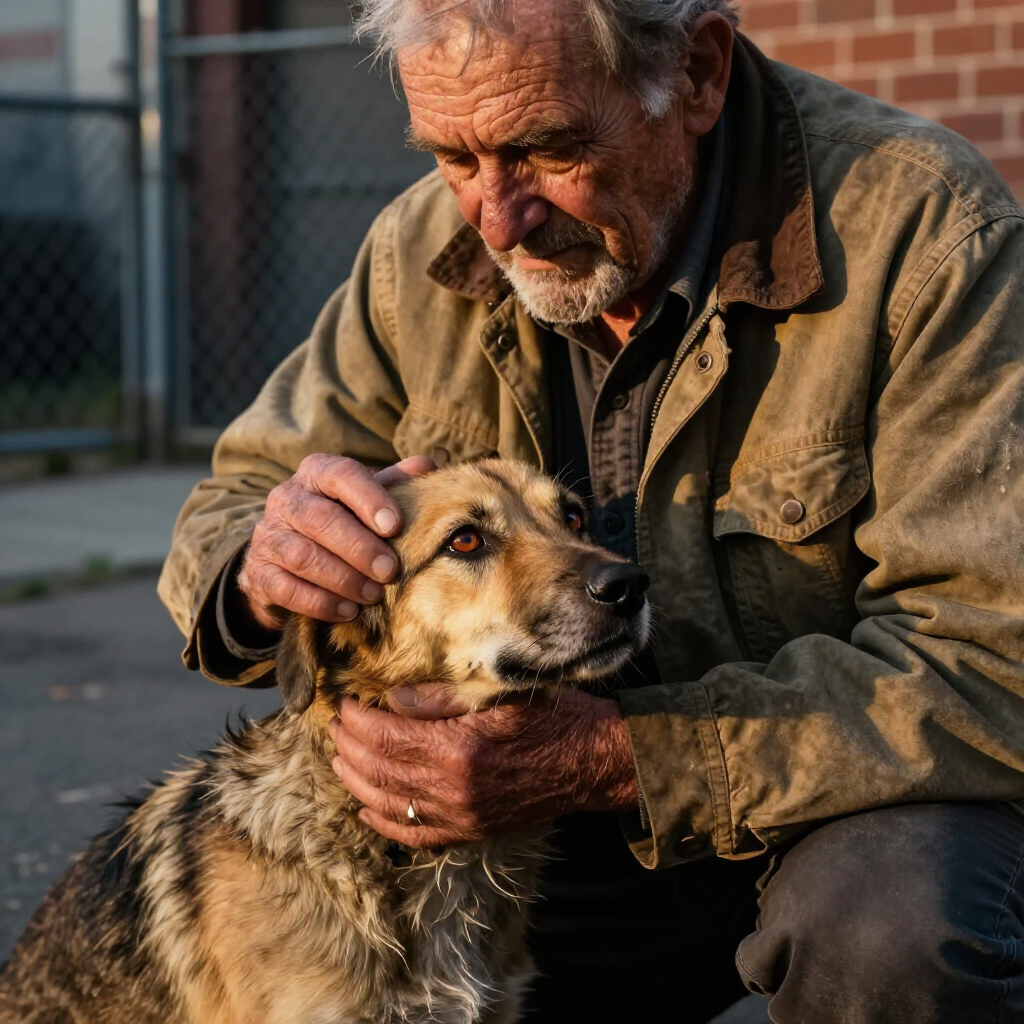
The dog stopped wheezing. He looked at me. Really looked at me. His eyes were amber, flecked with gold, and filled with a sorrow so deep it felt ancient. He stretched his neck out, just an inch, sniffing the air. He smelled the detergent on my clothes. He smelled the stale tobacco. He smelled the absence of anger.
Slowly, painfully, he crawled toward me. He rested his chin on my knee. I felt the vibration of his shivering against my leg. I slowly raised my hand, letting him see it every inch of the way, and rested it on his head. He didn’t flinch. He closed his eyes and leaned into the touch, letting out a long, shuddering sigh.
“Yeah,” I said, feeling a lump form in my own throat. “I got you, buddy. You’re safe now.”
I stood up, wincing, and gathered the cheap nylon leash. The dog struggled to stand, favoring his left side where the boot had connected. He looked up at me, waiting for a command.
“Let’s go home,” I said. “I’ve got some laundry to do. And I think you could use a meal that doesn’t come with a side of fear.”
We walked out of the alley together. I didn’t know his name. I didn’t know if he was microchipped or if the police would get involved. I didn’t care. All I knew was that for the first time in a long time, the silence in my head wasn’t empty. It was filled with a purpose.
But as we reached the sidewalk, I saw a car slow down. The window rolled down. It was the man. He hadn’t left. He was watching. And the look on his face wasn’t shame anymore. It was something else. Resentment. Calculated malice.
He drove off, but I memorized the plate. I knew this wasn’t over. Men like that don’t let go of their punching bags that easily. They need them to feel powerful. And he had just lost his power to an old man with bad knees.
I looked down at the dog. “Don’t worry,” I told him, though I felt a cold prickle on the back of my neck. “I’m not retiring today.”
CHAPTER II
The vet’s office smelled of floor wax and old fear. It was a sterile, unforgiving scent that took me back to the field hospitals where the air was always heavy with the metallic tang of blood and the sharp bite of rubbing alcohol. I sat on a plastic chair that felt too small for my frame, my hands resting on the handles of the carrier I’d borrowed from the neighbor. Inside, the dog—who I had started calling Blue—was a quiet, shivering weight. My knees were acting up, the familiar grinding in the joints a reminder that I wasn’t the man I used to be, no matter how much I’d blustered in that alley.
Dr. Aris was a woman of few words, which I appreciated. She didn’t ask where the dog came from, though the look she gave me when she saw the cigarette burns on his flank told me she knew it wasn’t a happy story. She worked with a clinical efficiency that reminded me of my own years in service. There’s a certain way you handle a body that’s been broken; you don’t offer pity, you offer stability.
“He’s lucky,” she said, her voice low as she palpated Blue’s ribs. “Bruised, malnourished, and someone’s been using him as an ashtray, but nothing is shattered. He’ll need a week of quiet. And someone who doesn’t raise their voice.”
I nodded, the weight of the responsibility settling in my gut like a stone. I paid the bill with money I’d been saving for a new mattress. It was a trade-off I didn’t have to think twice about. As I walked back to my truck, Blue limping beside me on a cheap nylon leash, I felt a strange, flickering warmth in my chest. It was the first time in years I’d felt like I was actually doing something, rather than just waiting for the clock to run out.
My apartment is a one-bedroom walk-up on the edge of town. It’s a place designed for a man who wants to be forgotten. The walls are thin, the carpet is a shade of beige that hides the dust, and the silence is usually absolute. I have a routine: coffee at 0600, a walk to the corner store for the paper, four hours of reading, and then the long, slow crawl toward sleep. It’s a disciplined life, a fortress built to keep the ghosts out.
But that night, the silence was broken. Blue didn’t bark. He just paced. The click-clack of his claws on the linoleum was a new rhythm in my world. I watched him from my armchair, my legs propped up to ease the swelling. Every time I moved, he flinched. It reminded me of my first tour, the way we all jumped at the sound of a backfiring truck. We were both carrying something we couldn’t put down.
I have an old wound, one that doesn’t show on an X-ray. Back in ’98, I was a sergeant leading a patrol through a village that should have been empty. It wasn’t. I made a call—a split-second decision based on a shadow and a sudden movement. I told my men to fire. When the smoke cleared, it wasn’t a combatant on the ground. It was an old man and a goat. No one ever disciplined me for it; it was ‘the fog of war.’ But I retired three months later. I couldn’t look at my uniform without seeing that old man’s eyes. I’ve spent the last twenty-five years trying to balance a ledger that can never be settled. Taking this dog… maybe it was just me trying to save one thing because I couldn’t save them.
By the third day, Blue had found a spot under the kitchen table. It was his bunker. I’d sit on the floor a few feet away, not looking at him, just talking. I told him about the weather, about the books I was reading, about the way the light hit the trees in the park. Slowly, the distance between us closed. First, it was a snout poking out from the shadows. Then, a tentative lick on my hand. By the end of the week, he was sleeping at the foot of my bed.
I thought we were safe. I thought the man in the alley was just a bad memory, a coward who had been sufficiently rattled. I was wrong. Cowards with money don’t just go away; they stew. They look for ways to win that don’t involve a fair fight.
The triggering event happened on a Tuesday. It was a bright, deceptively beautiful afternoon. I had taken Blue to the small community park three blocks over. It’s a modest patch of green surrounded by a low iron fence, usually populated by young mothers and retirees. Blue was on a long lead, sniffing at the base of an oak tree, his tail giving a hesitant wag for the first time.
Then I saw the car. The same black SUV from the alley. It didn’t drive by slowly this time; it screeched to a halt right at the park entrance.
Julian—I later learned that was his name—stepped out. He wasn’t alone. He was accompanied by a man in a sharp grey suit holding a briefcase, and a local police officer I recognized from the morning coffee shop, Officer Miller.
“That’s him,” Julian pointed a trembling finger at me. His face was flushed, his voice loud enough to make the mothers at the playground turn their heads. “That’s the man who assaulted me and stole my dog.”
I stood my ground, shortening the lead so Blue was tucked behind my legs. My heart was hammering against my ribs, a dull, rhythmic thud. “Assaulted you?” I said, my voice coming out gravelly and calm. “I stopped you from killing an animal in an alley, son. There’s a difference.”
“Officer,” the man in the suit stepped forward, his voice smooth and condescending. “My name is Marcus Thorne, representing Mr. Sterling. This dog is a purebred Hungarian Vizsla mix, a high-value animal registered to my client. We have the papers, the microchip records, and a witness who saw this man threaten Mr. Sterling with a weapon before forcibly taking the dog.”
“I didn’t have a weapon,” I said, looking at Miller. “I have my hands. And I have eyes. The dog was being beaten.”
Officer Miller looked uncomfortable. He knew me as the quiet veteran who never caused trouble. “Elias, look, he’s got the registration. If the dog is his property, I can’t just let you walk away with it. We have a report of theft and a formal complaint of physical intimidation.”
“Property?” I felt a surge of cold fury. I looked down at Blue, who was pressed against my calf, trembling so hard I could feel it through my trousers. “He’s not a toaster, Miller. Look at the scars on him. Look at his ribs.”
“The animal had a skin condition and was undergoing treatment,” Thorne lied, his face a mask of professional indifference. “Mr. Sterling was merely attempting to discipline a disobedient pet when he was accosted by a violent stranger. If you don’t surrender the animal immediately, we will be pressing charges for grand theft and aggravated assault.”
A crowd was gathering. People I saw every day—the librarian, the mail carrier, the kids from the school down the street—were all watching. I could see the judgment shifting. They didn’t see the alley. They saw a well-dressed, respectable young man with a lawyer and a cop, and they saw a haggard, angry old man holding onto a dog that didn’t belong to him.
This was the irreversible moment. If I gave Blue up now, he was dead. Maybe not that day, but Julian would make sure the dog paid for the humiliation I’d caused him. But if I kept him, I was a criminal. I have a secret I’ve kept for years: my discharge wasn’t the honorable one everyone assumes. It was a General Discharge under Honorable Conditions. It’s a fine distinction, but it means if the police start digging into my record, they’ll find the ‘instability’ reports. They’ll find the psychiatric evaluations that said I was ‘unfit for command due to emotional volatility.’ My reputation in this town—the only thing I have left—would be shredded in an afternoon.
“Elias,” Miller said, stepping closer, his hand resting near his belt. “Don’t make this a thing. Give him the leash. We can talk about this at the station.”
I looked at Julian. He was smiling now. It was a tiny, cruel twist of the lips that said he’d already won. He didn’t want the dog. He wanted to break me for making him feel small. He knew the system favored him. He had the ‘right’ paperwork, the ‘right’ clothes, and the ‘right’ connections. I was just a ghost from a war nobody wanted to remember.
I looked down at Blue. He looked up at me, his amber eyes wide and trusting. He didn’t know about registration papers or legal threats. He only knew that I was the person who fed him and didn’t hurt him.
My moral dilemma was a jagged blade. If I stood my ground, I was risking jail time and the exposure of my past. I would be labeled a thief and a violent kook. I’d lose my apartment, my pension could be at risk, and I’d be back in the system I spent decades escaping. If I gave him up, I’d be safe. I’d go back to my quiet room, my books, and my solitude. I’d have my ‘honor’ intact in the eyes of the town. But I would be a coward. I would be no better than the officers who told me to forget about that old man in the village.
“I’m not giving him to you,” I said. The words were quiet, but they carried the weight of a final order.
“Then you’re under arrest, Elias,” Miller sighed, looking truly sorry.
“Wait,” a voice called out from the crowd. It was Mrs. Gable, the woman who lived in the apartment below mine. She was eighty if she was a day, and she walked with a silver-tipped cane. She stepped into the circle, her eyes fixed on Julian. “I saw you,” she said, her voice shaking but clear. “A week ago. I was at the strip mall getting my prescriptions. I saw you in that alley. I saw what you were doing to that poor creature before this man stepped in.”
Julian’s face went pale for a second, then he sneered. “You’re a confused old woman. My lawyer has the papers.”
“I’m not confused about what a man looks like when he’s enjoying someone else’s pain,” she snapped. She turned to the crowd. “Is this who we are now? We let a man be arrested for saving a life because the brute has a better suit?”
A murmur went through the onlookers. The dynamic was shifting again. But Thorne was quick. “Witness testimony from a distance is unreliable and inadmissible in the face of legal ownership documentation. Officer, do your job. My client is being harassed.”
Miller moved in. He reached for the leash. I didn’t pull away, but I didn’t let go. My hand was a vice.
“Elias, let go,” Miller whispered. “Please.”
I looked at the handcuffs on Miller’s belt. I looked at the smug satisfaction on Julian’s face. And then I looked at the dog. I realized then that my secret didn’t matter. My reputation didn’t matter. The only thing that mattered was that for the first time in twenty-five years, I wasn’t the one causing the shadow. I was the one standing in front of it.
“No,” I said.
In that moment, Julian did something stupid. Frustrated by the delay and the growing crowd, he stepped forward and tried to snatch the leash from my hand. He was fast, but I was faster. I didn’t hit him. I just stepped into his space—the old ‘command presence’—and stared him down. He flinched, tripping over his own expensive shoes and falling backward into the dirt.
“He assaulted me!” Julian screamed from the ground. “You saw it! He pushed me!”
Miller hadn’t seen a push. He’d seen a man fall over his own feet. But the public nature of the fall forced his hand. He couldn’t ignore it anymore. He grabbed my arm and spun me around.
“Hands behind your back, Elias. Now.”
As the cold metal of the cuffs bit into my wrists, I felt a strange sense of relief. The choice was made. There was no going back. Blue was barking now, a frantic, high-pitched sound of distress as Miller led me toward the patrol car. Julian was standing up, brushing the dirt off his trousers, his eyes burning with a triumph that was only partially dampened by the boos of a few people in the crowd.
I was being taken away. The dog was still there, tied to the park fence, and Julian was walking toward him with a coiled, hateful energy. Mrs. Gable was trying to intervene, but Thorne was blocking her path.
I had tried to save him, but in doing so, I had stripped away my own protection. I was no longer the respected veteran. I was a prisoner. And as the door of the patrol car slammed shut, I realized that the real fight hadn’t even started yet. I had triggered a war I wasn’t sure I could win, and the cost was going to be everything I had spent a lifetime trying to hide.
CHAPTER III
The metal of the handcuffs was colder than the air in the park. It was a familiar cold, a reminder that the world has a way of locking you into a version of yourself you thought you’d buried. As Officer Miller led me to the cruiser, the gravel crunching under my boots sounded like bone. I didn’t look at the crowd. I didn’t look at Mrs. Gable, who was shouting something about injustice. I only looked at Blue. He was standing by the park bench, his head low, his tail tucked so tightly it disappeared. Julian was stepping toward him, a leash in one hand and a sneer on his face that said he had already won. That was the last thing I saw before the door clicked shut, sealing me into a vacuum of stale upholstery and silence.
Phase I: The Weight of the Walls
The precinct smelled like floor wax and old coffee. They didn’t put me in a cell immediately. They put me in an interview room—a small, windowless box with a bolted-down table and two chairs. My hands were still cuffed behind me. The pain in my shoulder, the one I’ve carried since 1998, started to pulse. It’s a rhythmic throb, like a heartbeat in the wrong place. I sat there for what felt like hours, watching the dust motes dance in the fluorescent light. Every time a door slammed in the hallway, I expected to see a ghost from the Balkans. Instead, I saw Marcus Thorne.
He entered the room with the practiced grace of a man who owns the air he breathes. He wasn’t wearing his coat anymore. Just a crisp white shirt with cufflinks that caught the light like tiny mirrors. Behind him walked a detective I didn’t recognize and Officer Miller, who looked like he wanted to be anywhere else. Thorne didn’t sit. He stood by the wall, leaning against it as if he were observing an exhibit in a museum. He looked at me with a pity that felt sharper than a blade.
“Mr. Thorne shouldn’t be in here,” I said. My voice was raspy, a dry rattle in the back of my throat.
“Mr. Thorne is here as a courtesy, Elias,” the detective said, dropping a thick folder onto the table. “And because his client is currently at an emergency vet clinic with a dog that has a chipped tooth and signs of trauma. A dog you stole.”
“I didn’t steal him,” I said. “I saved him.”
Thorne let out a soft, melodic laugh. “Saved. That’s a very noble word for a man with your history, Elias. Tell me, when you were in the service, did you use that word often? Or did they stop letting you use words like that after the incident in the valley?”
My heart skipped. The room seemed to shrink. The air became thick with the smell of wet earth and diesel—the smells of 1998. I looked at the folder on the table. It wasn’t my police file. It was a military record. A record that should have been sealed under a dozen layers of red tape.
“I don’t know what you’re talking about,” I whispered.
“Don’t you?” Thorne stepped forward, placing his hands on the table. He leaned in so close I could smell his peppermint breath. “October 14th, 1998. You were a Sergeant. You were given a direct order to hold a perimeter. Instead, you broke formation. You entered a restricted zone. You claimed you were ‘helping.’ But the official report says you suffered a psychological break. It says you were erratic, dangerous, and unable to distinguish between a threat and a civilian. They didn’t give you a medal, Elias. They gave you a psychological discharge. They called you a liability.”
Phase II: The Character Assassination
The detective leaned back, looking at me with a new kind of scrutiny. He wasn’t looking for a dog thief anymore. He was looking at a madman. Thorne was good. He wasn’t just building a case; he was erasing my humanity. He was taking the one thing I had left—the quiet pride of having survived—and turning it into a weapon against me.
“A man with a history of violent delusions,” Thorne continued, his voice rising just enough to be heard through the door. “A man who can’t control his impulses. You saw a young man walking his dog, and your fractured mind decided it was 1998 all over again. You saw a victim where there was none. You attacked Julian because you needed to play the hero to silence the voices of the people you couldn’t save back then.”
“That’s not true,” I said, but even to my own ears, it sounded weak. The memory of the valley was clawing at me. The faces of the children we were told to ignore. The way the mud felt under my boots as I ran toward the burning house, ignoring the radio screaming in my ear. I had been right then, and I was right now. But the law doesn’t care about being right. It cares about being documented.
“Julian is traumatized,” Thorne said, his voice dropping to a sympathetic whisper. “He’s a young man from a good family. His father is a donor to the Mayor’s initiative for urban peace. And you? You’re a squatter in a rent-controlled apartment with a medical file that suggests you should be in a ward, not a park. If this goes to trial, Elias, I won’t just take the dog. I’ll make sure you never see the sun without bars in front of it again.”
He was waiting for me to break. He wanted me to lash out, to prove his point. I felt the heat rising in my chest, the old rage that usually only comes out in my dreams. I wanted to reach across the table and show him exactly what a ‘liability’ looked like. But then I thought of Blue. I thought of the way he’d rested his head on my knee that morning. If I broke, Blue was dead. Julian wouldn’t keep him. He’d kill him just to prove he could.
“Where is the dog?” I asked. My voice was steady now. Cold.
“He’s being ‘evaluated,’” Thorne said, emphasizing the word with a cruel smile. “Given your history of assault, we’re arguing that the animal has been conditioned for aggression. He’ll likely be put down by the end of the week. It’s for the best, really. For public safety.”
Phase III: The Intervention
The door to the interview room swung open with a violence that made the detective jump. A woman walked in. She wasn’t a lawyer, and she wasn’t a cop. She was wearing a tailored navy suit and a small silver pin on her lapel—a crest I recognized from a lifetime ago. Behind her stood a man in a crisp uniform: Colonel Halloway. My breath hitched. Halloway was the man who had signed my discharge papers. He was the only one who knew the truth of what happened in the valley.
“This interview is over,” the woman said. Her voice was like iron. “My name is Sarah Vance. I’m with the Department of Veterans’ Advocacy, Special Oversight Division. And Colonel Halloway is here representing the regional JAG office.”
Thorne straightened up, his eyes narrowing. “This is a civil and local criminal matter. You have no standing here.”
“We have standing where there is a breach of federal privacy and the misappropriation of classified military health records,” Vance said, stepping right into Thorne’s personal space. She didn’t blink. “Mr. Thorne, how did you come into possession of Sergeant Elias’s sealed psychological profile? Because the Pentagon has no record of a subpoena.”
Thorne’s face went pale. The peppermint smell seemed to vanish, replaced by the scent of ozone—the smell of a coming storm. “I… my office conducted a thorough background check. We have resources.”
“You have a leak,” Halloway said, his voice deep and resonant. He looked at me, and for the first time in twenty-five years, he didn’t look away. “And you have a client with a very interesting history of his own. One you didn’t seem to mention to the police.”
Vance pulled a tablet from her bag and tapped the screen, sliding it toward the detective. “Julian Vance—no relation, thank God—has three sealed juvenile records for animal cruelty. He has two restraining orders from former partners who cited the harm of household pets as a primary method of intimidation. And we have four witnesses from the park today—neighbors of Elias—who have provided sworn statements that Julian was seen kicking the animal repeatedly before the Sergeant intervened.”
“That’s hearsay!” Thorne snapped, though his hands were beginning to shake.
“It’s a pattern of behavior,” Vance countered. “And as for the ‘psychological instability’ you’re so fond of, let’s talk about the 1998 incident. Colonel?”
Phase IV: The Truth in the Valley
Halloway stepped toward the table. He didn’t look at Thorne. He looked at the detective. “In 1998, Sergeant Elias was ordered to ignore a group of civilians trapped in a crossfire. He was told they were a strategic loss. He refused. He entered the zone alone, without backup, and pulled six people out of a basement before it collapsed. The ‘psychological discharge’ was a cover. It was a way for the command to avoid admitting we had ordered the abandonment of civilians. Elias didn’t break. He was the only one of us who stayed whole.”
The silence in the room was absolute. I felt the weight in my chest fracture and fall away. All these years, I had carried the shame of that discharge like a shroud, believing I was broken because the world told me I was. I had lived in the shadows because I thought I didn’t deserve the light.
“The charges against the Sergeant are being dropped,” Vance said, her eyes fixed on Thorne. “And we are filing an emergency injunction for the custody of the animal. Furthermore, we will be looking into how a private lawyer obtained military records. I suggest you find a very good lawyer of your own, Mr. Thorne. You’re going to need one.”
Thorne didn’t say another word. He gathered his things with trembling hands and practically ran from the room. The detective looked at the tablet, then at me, and slowly reached for his keys. He unlocked the handcuffs. The blood rushed back into my hands, stinging like a thousand needles.
“I’m sorry, Sergeant,” the detective said quietly. “I didn’t know.”
I didn’t answer him. I stood up, my legs feeling heavy but certain. I looked at Halloway. “Where is he? Where is Blue?”
“He’s at Dr. Aris’s clinic,” Halloway said. “We had him moved twenty minutes ago. Julian tried to stop us, but we had a court order and two MPs. He didn’t put up much of a fight once he realized the tide had turned.”
I walked out of that precinct with Vance and Halloway. The sun was setting, casting long, golden shadows across the pavement. It looked like the park, but everything was different now. The secret was out. The wound was open, but for the first time, it felt like it could finally heal.
We drove to the clinic in silence. When we arrived, Dr. Aris was waiting at the door. He didn’t say anything; he just pointed toward the back room. I walked down the hallway, my heart hammering against my ribs.
Blue was on a padded table. He had a bandage on his leg where they’d taken blood, and his eye was slightly swollen. When he saw me, he didn’t bark. He didn’t jump. He just let out a long, shaky breath and pressed his head into my stomach. I buried my hands in his fur, smelling the shampoo and the lingering scent of the park.
I looked up and saw Julian standing at the far end of the hallway, near the exit. He looked small. Without his lawyer, without his father’s influence, he was just a cruel boy who had finally run out of people to hurt. He looked at me, and for the first time, there was no sneer. Only fear.
“He’s mine,” Julian whispered, his voice cracking. “I have the papers.”
“Papers don’t make you a man,” I said, my voice echoing in the sterile hallway. “And they don’t make you a master. You lost him the moment you raised your foot.”
I didn’t wait for him to respond. I didn’t need to. I picked up Blue’s leash—the one I had bought, the one that smelled like our walks—and clipped it to his collar. I walked past Julian without a second glance.
As I stepped out into the night air, Blue walking limply but proudly by my side, I knew the battle wasn’t entirely over. Thorne would fight back. Julian’s family would use their money. But as I looked down at the dog who had saved me just as much as I had saved him, I realized that for the first time since 1998, I wasn’t fighting a ghost. I was fighting for a friend. And I wasn’t fighting alone.
CHAPTER IV
The silence after was the loudest thing I’d ever heard. Louder than the arguments, the accusations, even louder than the yelling at the police station. It was the silence of everyone knowing, everyone watching, everyone waiting to see what would break first. Me, probably.
I went back to the trailer. Blue, of course, came with me. Dr. Aris had offered to keep him longer, said he needed observation after everything, but I couldn’t. I needed him closer than ever.
The first few days were a blur of well-meaning visitors. Mrs. Gable brought casseroles, Sarah Vance stopped by with legal updates (or rather, the lack thereof), and even Colonel Halloway made the drive down, his face etched with a weariness that mirrored my own.
They all wanted to help, but there wasn’t anything to be done. Julian was gone, yes, humiliated and exposed. But his family… that was a different story. Everyone knew they wouldn’t let it end there.
The news vans parked down the road felt like vultures. They wanted my story, my pain, my moment of triumph. But I had nothing to give them. I just wanted to be left alone with my dog.
That’s all I ever wanted.
I started sleeping on the floor next to Blue’s bed. Not because I didn’t trust him, but because I didn’t trust the world. Every creak of the trailer, every passing car, sent my heart racing. The nightmares came back, vivid and relentless. 1998 all over again, but this time, Julian’s face was mixed in with the chaos.
Sarah called a week later. “Elias,” she said, her voice tight. “They’re filing for custody. Julian’s family. They’re claiming he’s unfit, but that Blue belongs with them, as property.”
I felt something inside me snap. Not in a violent way, but like a rubber band stretched too far. I’d been expecting it, dreading it, but hearing it made it real. They weren’t going to let me go. They were going to keep coming until they took everything.
“What can we do?” I asked, my voice flat.
“We fight,” Sarah said. “But Elias, this is going to be ugly. They have money, influence… they’ll try to bury us.”
I looked at Blue, sleeping peacefully on his bed. His fur was matted, and he still flinched sometimes when I raised my hand too quickly. He’d been through enough.
“Then we dig deeper,” I said. “We show them what we’re made of.”
**Phase 1: Community Mobilization**
The first call I made was to Mrs. Gable. She was furious. “That little monster,” she said, her voice trembling. “Trying to take that sweet dog after everything? I won’t let them, Elias. Not on my watch.”
She started a petition. It spread like wildfire through the community. People who had never spoken to me before were suddenly at my door, offering support, signing the petition, bringing food. It was overwhelming.
Dr. Aris offered to testify, to provide expert evidence on Blue’s condition, on the trauma he had suffered. “That dog is healing, Elias,” she said. “He’s finally learning to trust. Taking him away now would destroy him.”
Colonel Halloway called in some favors. He contacted other veterans, men and women I had served with, people who understood what it meant to fight for something you believed in. They started a social media campaign, sharing my story, Blue’s story, the truth about what happened in 1998.
The support was incredible, but it wasn’t enough. Julian’s family had hired a high-powered PR firm to spin the narrative. They painted me as a violent, unstable veteran, a danger to society. They dredged up every negative thing they could find, exaggerating, twisting, lying.
The media ate it up. The news vans were back, and this time, they weren’t asking for my story. They were telling theirs, and it wasn’t pretty.
I started to doubt myself. Maybe they were right. Maybe I was too broken to care for Blue. Maybe I was putting him in danger by keeping him with me.
Blue seemed to sense my fear. He started following me everywhere, his big brown eyes watching me, as if to say, “Don’t give up on me, Elias. I won’t give up on you.”
**Phase 2: The Hearing**
The custody hearing was a circus. The courtroom was packed with reporters, lawyers, and spectators. Julian’s family was there, looking smug and confident. Julian wasn’t.
Their lawyer, a slick, impeccably dressed man named Mr. Sterling, presented their case. He argued that Julian was now receiving treatment, that he was remorseful for his past actions, and that Blue deserved a stable, loving home with a family who could provide for his every need.
He presented photos of Julian’s family’s mansion, their sprawling property, their expensive cars. He made it sound like Blue would be living in a paradise.
Then it was Sarah’s turn. She presented evidence of Julian’s abuse, Dr. Aris’s testimony, the petition with thousands of signatures. She argued that Blue was not property, but a living being with rights, and that separating him from me would be cruel and inhumane.
She brought up 1998, the truth about my discharge, my heroism. She painted a picture of a man who had dedicated his life to serving others, who had sacrificed everything for his country, and who now just wanted to live in peace with his dog.
Mr. Sterling tried to discredit her, to twist the narrative, but Sarah was relentless. She wouldn’t let him get away with it.
Then I was called to the stand. Mr. Sterling questioned me aggressively, trying to trip me up, to make me look unstable. He asked about my PTSD, my nightmares, my past. He wanted to break me.
I looked at Blue, who was sitting quietly at Sarah’s feet. His eyes were locked on mine, and I knew I couldn’t let him down.
I answered Mr. Sterling’s questions honestly, but I didn’t give him anything to use against me. I spoke about my love for Blue, my commitment to his well-being, my determination to protect him.
“Mr. Sterling,” I said, my voice clear and steady. “Blue isn’t just a dog to me. He’s my family. He’s the only thing that’s kept me going these past few years. I won’t let you take him away from me.”
**Phase 3: The New Event**
The judge adjourned the hearing, saying she needed time to consider the evidence. We left the courtroom, surrounded by a throng of reporters. They shouted questions at me, but I ignored them. I just wanted to get Blue home.
That night, I got a call from Sarah. “Elias,” she said, her voice grave. “Something’s happened.”
It turned out that someone had broken into Dr. Aris’s clinic. Not to steal drugs or money, but to get to Blue. They hadn’t succeeded – Dr. Aris had reinforced the kennels after the threats started – but the message was clear. Julian’s family was escalating.
I felt a cold dread wash over me. This wasn’t just about custody anymore. It was about power, about intimidation, about showing me that they could do whatever they wanted, and I couldn’t stop them.
“We need to move him,” Sarah said. “They know where he is. They’ll try again.”
But where could we go? I didn’t trust anyone. I didn’t want to put anyone else in danger.
Then I had an idea. “The park,” I said. “The old military park. No one ever goes there.”
It was a long shot, but it was the only thing I could think of. The park was a forgotten place, a relic of a bygone era. It was overgrown and neglected, but it was also secluded and defensible.
We moved Blue that night, under the cover of darkness. Sarah, Dr. Aris, and I drove him to the park in separate cars, taking different routes to avoid being followed.
We set up a makeshift camp in an old storage shed. It wasn’t much, but it was safe. For now.
Lying there, I knew things would never be the same again. Even if I won the custody battle, even if Julian’s family backed down, the fear would always be there. The knowledge that they could come for me, for Blue, at any time.
**Phase 4: Moral Residues**
The next day, the news broke about the break-in at Dr. Aris’s clinic. The media went into a frenzy. They portrayed Julian’s family as ruthless and desperate, willing to stop at nothing to get what they wanted.
The public outcry was deafening. People were outraged, disgusted, determined to see justice done.
Julian’s family tried to distance themselves from the break-in, claiming they had nothing to do with it. But no one believed them. The damage was done.
The judge ruled in my favor. She granted me permanent custody of Blue, citing Julian’s history of abuse, the overwhelming public support, and the attempted break-in at Dr. Aris’s clinic.
Julian’s family appealed the decision, but their appeal was denied. They had run out of options.
I had won. But it didn’t feel like a victory. The park felt like a prison. I was constantly on edge, waiting for the other shoe to drop.
Blue sensed my unease. He stayed close to me, his presence a constant source of comfort. But I knew he was suffering too. He missed Dr. Aris, the clinic, the routine.
One day, Mrs. Gable came to visit. She brought a group of volunteers with her. They started cleaning up the park, clearing away the overgrown weeds, repairing the broken benches, planting flowers.
“We’re turning this place into a sanctuary, Elias,” she said. “A place where you and Blue can be safe, where you can heal.”
Other veterans joined in. They helped to restore the old military monuments, to create a memorial to those who had served.
The park began to transform. It became a place of beauty, of peace, of remembrance.
I started to let my guard down. I began to trust again.
One evening, as I was walking Blue through the park, I saw a figure standing by the memorial. It was Colonel Halloway.
“Elias,” he said, his voice soft. “I wanted to apologize. For what happened in 1998. For the lies, the cover-up. You deserved better.”
I looked at him, at the weariness in his eyes. I knew he was telling the truth.
“It’s okay, Colonel,” I said. “It’s over now.”
He smiled. “No, Elias,” he said. “It’s just beginning.”
CHAPTER V
The political pressure hit us like a tidal wave. One day, the judge’s ruling felt solid, the next, whispers started. Whispers in town, amplified by Julian’s family’s connections. An anonymous petition began circulating online, questioning my fitness as a dog owner, dredging up the decades-old incident in the Balkans. They called it a ‘lapse in judgment,’ said I was ‘unstable.’ They painted me as a danger, not just to Blue, but to the community itself. It was character assassination, plain and simple, and it was working.
I felt the shift in the air. People who’d smiled and waved now averted their eyes. The sanctuary felt less like a safe haven and more like a target. I started having nightmares again, the explosions, the screams, intermingling with Blue’s whimpers. I found myself pulling away from him, afraid that I would somehow fail him, that my past would drag him down. One morning, I woke up, and Blue was gone. Panic clawed at my throat. I searched everywhere, calling his name until my voice was hoarse. He was just… gone.
The next few hours were a blur of frantic searching and mounting dread. I called Dr. Aris, Mrs. Gable, even Colonel Halloway. Everyone mobilized, but it was like he’d vanished into thin air. The silence was deafening, punctuated only by the frantic thumping of my heart. Then, a call came from Sarah Vance. They’d found him. He was at the local animal shelter, Julian’s name was on the drop-off slip.
When I saw Blue at the shelter, his tail wasn’t wagging. He usually jumped and barked. This time, he just sat there, staring at the floor, his body trembling. That’s when it truly hit me: this wasn’t just about me anymore. It wasn’t just about a dog. It was about the power Julian’s family wielded, the way they could twist the system, manipulate public opinion, and inflict pain without consequence. It was about how my silence, my fear of exposure, had allowed them to get this far.
I knew what I had to do. I had to fight, not just for Blue, but for everyone who’d ever been silenced, marginalized, or bullied by those with power. The fear was still there, but beneath it was a new kind of resolve, a quiet defiance that wouldn’t be silenced.
First phase over. It was now time to fight.
I called a town meeting. It was held in the community center, and I expected a handful of people to show up. Instead, the place was packed. Mrs. Gable, Dr. Aris, the veterans, Sarah Vance — they were all there, along with dozens of people I’d never met, faces filled with anger and determination. I stood up, my hands shaking slightly, and looked out at the crowd. I told them everything — about the incident in the Balkans, about the cover-up, about my struggles with PTSD, about Julian’s cruelty, and about the fear that had haunted me for so long. I didn’t hold anything back. I laid bare my soul, exposing all my flaws, all my vulnerabilities.
When I finished, the room was silent for a moment. Then, Mrs. Gable stood up. She was small, but her voice resonated with strength. She spoke about her own experiences with injustice, about the times she’d been dismissed or ignored because of her age or her gender. She talked about the importance of standing up for what’s right, even when it’s difficult, even when it’s scary. Her words ignited something in the crowd. One by one, people began to share their own stories of being bullied, silenced, or marginalized. The room became a chorus of voices, each adding their own verse to the song of defiance.
Dr. Aris spoke next, talking about Blue’s emotional state. He explained to everyone about the scientific evidence of Blue’s affection, loyalty and dependency on Elias. He also spoke about the damage that can occur if a dependent animal is forcefully removed from his source of love and safety. He was speaking facts but everyone in the room could feel the emotional weight that he carefully avoided saying. Sarah Vance then presented a legal strategy, outlining the ways we could fight back against Julian’s family’s political pressure. She’d already filed a motion to dismiss their custody claim, arguing that it was based on false pretenses and designed to harass and intimidate me.
Colonel Halloway was the last to speak. He stood tall, his uniform crisp and his voice steady. He apologized for his role in the cover-up, acknowledging the injustice I’d suffered. He spoke about the importance of integrity and the responsibility of those in power to protect the vulnerable. He pledged his full support to the cause, vowing to use his influence to expose the truth and hold Julian’s family accountable.
The meeting ended with a renewed sense of hope and determination. We formed a committee, assigned tasks, and planned our next steps. The community had rallied around me and Blue. We were no longer alone in this fight.
Second phase complete. United.
The next few weeks were a whirlwind of activity. Sarah Vance fought tooth and nail in court, presenting evidence of Julian’s cruelty and exposing the flaws in his family’s arguments. Mrs. Gable organized protests and rallies, mobilizing the community to show their support for me and Blue. Dr. Aris provided expert testimony, detailing the emotional bond between us and the potential harm that separation would cause. Colonel Halloway used his connections to pressure politicians and media outlets, ensuring that our story was heard.
The political pressure from Julian’s family intensified. They tried to smear me in the press, leaking details of my past and questioning my mental stability. They pressured the judge, threatening to withdraw funding for local programs if he didn’t rule in their favor. They even sent threatening letters to Mrs. Gable and Dr. Aris, warning them to back down.
But we refused to be intimidated. We countered their attacks with truth and transparency. We shared my story with the world, highlighting the injustice and the courage of those who stood up against it. The media picked up on the story, and public opinion began to shift in our favor. People were outraged by Julian’s family’s actions, seeing them for what they were: a blatant abuse of power.
The day of the final hearing arrived. The courtroom was packed, filled with supporters from the community. Julian’s family was there too, their faces grim and determined. The tension in the room was thick enough to cut with a knife.
Sarah Vance presented a powerful closing argument, summarizing the evidence and highlighting the importance of protecting the vulnerable. She argued that Julian’s family’s actions were not only unjust but also harmful to Blue, who deserved to live in a safe and loving environment. Then it was my turn to speak. I walked to the podium, my heart pounding in my chest. I looked at the judge, at Julian’s family, and at the community members who had come to support me. I spoke from the heart, telling them about my bond with Blue, about the healing he had brought into my life, and about the importance of fighting for what’s right, even when it’s difficult.
I spoke about the incident in the Balkans. I explained to everyone why that incident continued to haunt me to this day. I spoke about being saved by my fellow soldiers. I explained how important it was to me to pay forward the sacrifice they made for me by saving Blue, who was facing certain death at the hands of Julian. When I finished, there wasn’t a dry eye in the courtroom. Even the judge looked moved. He paused for a long moment, then delivered his verdict.
He ruled in my favor. He condemned Julian’s family’s actions, calling them an abuse of power and a blatant attempt to manipulate the system. He praised the community for their courage and their unwavering support for me and Blue. He ordered Julian’s family to cease their harassment and to pay for all of our legal fees.
Third phase successful. Victory achieved.
The celebration that followed was joyous. The community gathered at the sanctuary, singing, dancing, and sharing stories. Blue, sensing the celebratory mood, ran around wagging his tail, licking faces, and basking in the attention. But amidst the celebration, I couldn’t shake a feeling of unease.
I knew that Julian’s family wouldn’t give up easily. They were too powerful, too accustomed to getting their way. I knew that they would continue to find ways to harass and intimidate me, to make my life miserable. I realized that true peace wouldn’t come from winning a legal battle. It would come from accepting my past, forgiving myself, and finding a way to live with the scars that would always remain.
The next day, I walked to the center of the sanctuary, Blue trotting happily beside me. I looked around at the trees, the flowers, the benches, the faces of the people who had come to support me. I realized that this wasn’t just a sanctuary for Blue. It was a sanctuary for me too, a place where I could find peace, healing, and community. I started working on a new project. I wanted to build a memorial, not just to the fallen soldiers I served with, but to all the victims of injustice, to all those who had been silenced, marginalized, or forgotten.
I spent weeks designing and constructing the memorial, pouring my heart and soul into the project. I carved names into stones, planted flowers in remembrance, and erected a statue of a soldier holding a dog. When it was finished, the memorial was a beautiful and moving tribute to the power of courage, resilience, and community. The memorial became a place of pilgrimage for people from all over the world, a place where they could come to reflect on the past, to honor the fallen, and to find hope for the future.
I still have nightmares sometimes, the explosions, the screams, the faces of the dead. But now, when I wake up, Blue is there, his warm body pressed against mine, his soft fur a comforting presence. And I know that I’m not alone. I have Blue, I have the community, and I have the memory of those who fought for justice, those who refused to be silenced, those who showed me the true meaning of courage and resilience. The last call I ever received from Julian’s family was for peace and understanding. They said it had all been a mistake. I hung up.
I finally understood the lesson that I was meant to learn: the past cannot be erased, but it can be transformed. The scars will always be there, but they can become symbols of strength, resilience, and hope. And the greatest victory of all is not winning a battle, but finding peace within oneself.
END.