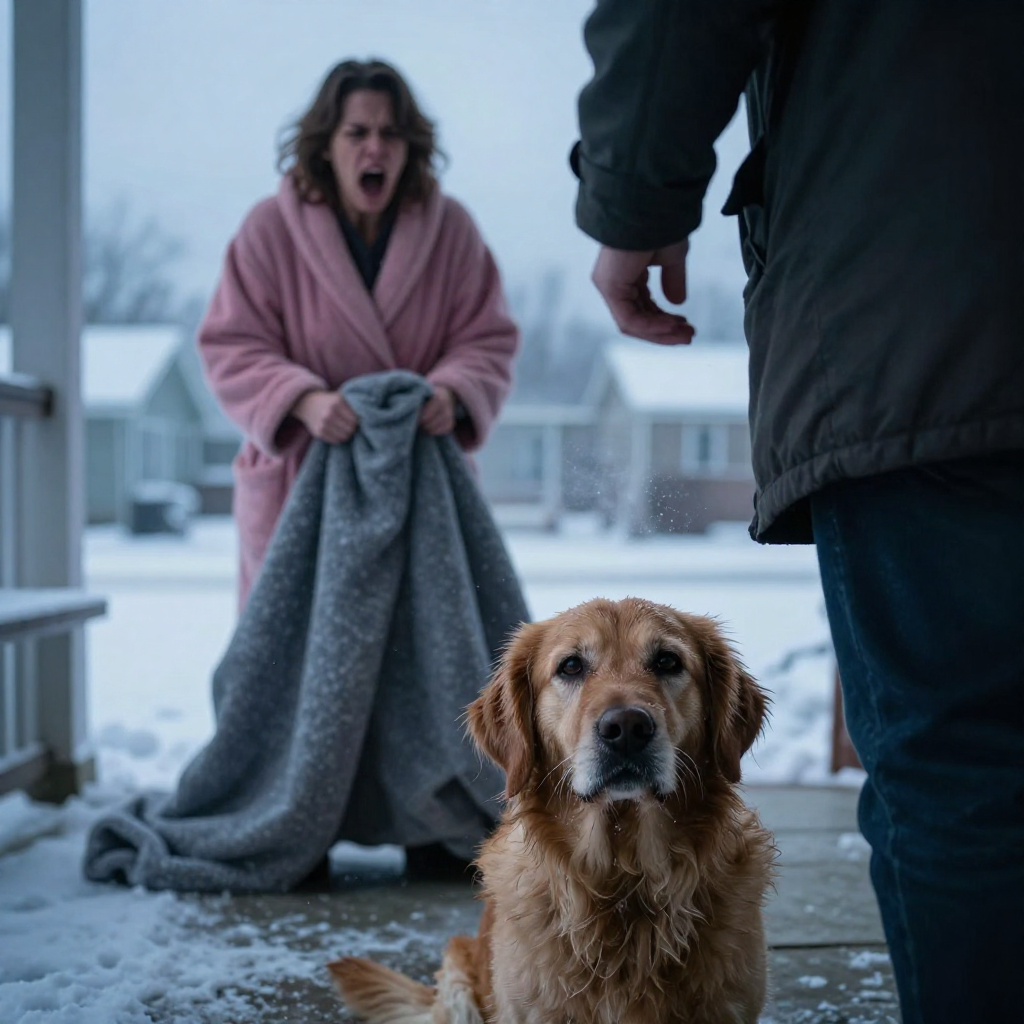
SHE RIPPED THE FREEZING DOG’S ONLY BLANKET TO SHREDS WHILE SCREAMING THAT HE DIDN’T DESERVE WARMTH, UNAWARE THAT THE QUIET MAN WATCHING FROM THE SHADOWS WASN’T JUST A RETIRED NEIGHBOR—HE WAS A FORMER OPERATIVE WHO HAD HUNTED MONSTERS FAR WORSE THAN HER, AND HE WAS DONE WATCHING.
The sound of fabric ripping is distinct. It doesn’t sound like paper, and it doesn’t sound like wood snapping. It has a dull, fibrous resistance to it, a sound that implies effort, a sound that implies intent. I heard it through the double-pane glass of my front window, cutting through the low hum of the refrigerator and the morning news playing softly on the television.
It was six in the morning. The sun hadn’t fully crested the horizon yet, leaving the cul-de-sac bathed in that gray, steel-blue light of early winter. The frost was thick on the lawns, the kind that crunches under your boots and burns the tips of your fingers if you touch the railing. It was twenty-two degrees outside.
I shouldn’t have been watching. That’s the first rule I set for myself when I moved here three years ago: stop watching. In my previous life—the one I don’t talk about at neighborhood barbecues, the one that exists only in redacted files in a basement in Virginia—watching was the currency. Observations were survival. If you noticed the slight bulge in a jacket, or the way a car was parked two inches too far from the curb, you lived. If you didn’t, you didn’t.
Retirement was supposed to be the end of that. I bought this house because it was boring. I bought it because the biggest drama on the street was supposed to be about trash can placement or whose kid drew chalk on the sidewalk. But the instinct never really goes away. It’s like a muscle that refuses to atrophy, twitching every time the pattern of the world feels off.
And this morning, the pattern was broken by the sound of ripping wool and a voice raised in a pitch that made the hair on my arms stand up.
I moved the curtain just an inch. Just enough to see across the street to the yellow ranch-style house with the peeling white trim. Mrs. Higgins.
She was on her porch, wrapped in a thick, plush pink bathrobe that looked warm enough to survive a blizzard. On her feet were sheepskin slippers. She was comfortable. She was safe.
Barnaby was not.
Barnaby was the dog. A mutt of some kind, maybe part Shepherd, part Lab, with a coat that had gone patchy and gray with age. I’d seen him limping around the yard for years. He was the kind of dog that didn’t bark, didn’t chase squirrels, didn’t do much of anything except exist. He was old, his hips were clearly shot, and he possessed a sadness in his eyes that was almost human.
He was lying on the concrete of the porch, curled into a tight, trembling ball. The concrete sucks the heat right out of a body in this weather. I knew that feeling. I’d spent a night in a shipping container in Gdansk once, huddled on cold steel. It gets into your bones and stays there for years.
Barnaby had a blanket. It was a ratty, plaid thing, probably a Goodwill reject, but it was the only thing between him and the frost. He had pulled it over his head, trying to create a pocket of warmth, trying to disappear.
Mrs. Higgins was holding the other end of it.
“Look at you!” she screamed. Her voice was shrill, shattering the morning silence. “Look at this mess! You drag this filth around my porch! I told you! I told you I didn’t want this trash out here!”
She yanked the blanket. Barnaby scrambled, his claws clicking frantically on the icy concrete as he tried to maintain his grip on the only source of heat he had. He didn’t growl. He didn’t snap. He just looked up at her, ears flattened against his skull, eyes wide with a terrifying confusion. He didn’t understand why the person who was supposed to protect him was currently assaulting him.
“Let go!” she shrieked.
She pulled harder. The old dog was weak. He slid across the porch, his hip hitting the railing with a dull thud. He let out a small, sharp yelp—not of anger, but of pain.
That sound. That specific sound.
I felt a coldness wash over me that had nothing to do with the winter air. It was the coldness of the ‘switch.’ That’s what we used to call it. The moment where empathy for the situation turns into a tactical assessment of a threat. The moment where the world slows down and simplifies into vectors, mass, and force.
I watched as she finally ripped the blanket from his paws. He shivered violently now, exposed to the biting wind.
“Disgusting!” she yelled. She held the blanket up like a trophy. “It smells! You smell! I am sick of looking at this!”
And then, she did the thing that made me put my coffee mug down on the windowsill.
She didn’t just take it away. She began to tear it. The fabric was old and brittle, and she was fueled by a manic, senseless rage. She ripped a strip off the side, then another. She threw the pieces into the wet grass of the front lawn, scattering them like confetti.
“No more!” she shouted at the shivering animal. “You want to be an animal? Live like an animal! No blankets! No beds! You stay there and you learn!”
Barnaby lowered his head onto his paws. He stopped shaking. He just went still. It was the stillness of surrender. It was the stillness of a creature that has accepted that no help is coming, that suffering is just the state of the world.
I looked at my hands. They were steady. No tremors. I looked at the phone on the counter. I could call Animal Control. They might come in three hours. Maybe tomorrow. They’d leave a notice. She’d talk her way out of it. She’d say the dog was destructive. She’d lie. And tonight, it was supposed to drop to fifteen degrees. Barnaby wouldn’t last the night.
I walked to the closet.
My movements were automatic. I put on my coat—the heavy canvas one. I sat on the bench and laced up my boots. I tied them tight, a habit from years of needing to be ready to run or fight at a second’s notice. I checked my reflection in the hallway mirror.
I saw a man in his late fifties, graying at the temples, with lines around his eyes carved by too much sun and too little sleep. But the eyes themselves… the eyes were different right now. The softness of the suburban retiree was gone. The neighbor was gone.
What stared back was the man who had walked into rooms where warlords were sleeping and walked out without waking them.
I opened my front door. The air hit me like a physical blow, sharp and icy. I didn’t zip my coat. I didn’t feel the cold.
I walked down my driveway. My boots made a heavy, rhythmic crunch on the pavement. I didn’t rush. Running draws attention. Running implies panic. Authority never runs. Authority arrives.
Mrs. Higgins was still screaming. She had her back to the street, facing the house, looming over the dog. She was shaking a finger in his face.
“…useless eater! Costing me money! Ruining the aesthetic of this house!”
I crossed the asphalt of the street. I stepped over the curb. I walked up her driveway.
Barnaby saw me first. He lifted his head. His tail gave a single, weak thump against the concrete. It broke my heart more than the abuse did—that despite everything, he still hoped a human might be a friend.
I stepped onto the porch.
The wood creaked under my weight.
Mrs. Higgins froze. The scream died in her throat. She spun around, clutching the tattered remains of the blanket to her chest. Her eyes went wide. She hadn’t heard me approach. People rarely do.
“Mr… Mr. Vance?” she stammered. Her face was flushed red with exertion and anger, but now, a pale cast of fear was seeping in. She knew me as the quiet guy who waved when he got the mail. She didn’t know this version of me.
I didn’t say a word.
I stood at the top of the stairs, blocking her path to the door, blocking her view of the street. I am six-foot-two. I filled the space. I looked at the shreds of the blanket in her hand. Then I looked at the dog. Then I looked at her.
I let the silence stretch.
In interrogation training, they teach you that silence is heavier than a fist. Most people can’t handle it. They feel the need to fill it with explanations, with lies, with nervous laughter.
“I… he was being bad,” she said, her voice dropping an octave, losing its screeching confidence. She took a half-step back, her slipper sliding on a patch of ice. “He was tearing it up. I had to… I’m teaching him.”
I looked at Barnaby. He wasn’t tearing anything up. He was freezing to death.
I finally spoke. My voice was low. I didn’t shout. I didn’t need to. It was the voice I used to use when the negotiation was over and the operation was beginning.
“Pick it up,” I said.
She blinked, confused. “Excuse me?”
“The pieces,” I said, gesturing to the wet lawn with a slight tilt of my head. “Pick them up.”
“Now see here, Frank,” she started, trying to summon her indignation, trying to remember that she was the president of the HOA and I was just a nobody. “You can’t come onto my property and—”
I took one step forward. Just one.
It wasn’t a threatening step. It was an inevitable one. It was the step of a glacier moving.
“Mrs. Higgins,” I said. “I stood in that window and watched you for five minutes. I watched you take the only warm thing this animal owns, and I watched you destroy it for your own entertainment.”
“It wasn’t entertainment! It was discipline!”
“It was cruelty,” I cut her off. The word hung in the air like smoke. “And I don’t tolerate cruelty. Not on my street. Not in front of me.”
She looked around, realizing for the first time that we were outside, that voices carry. But the street was empty. It was just us.
“He’s my dog,” she hissed, though her voice wavered. “I can do what I want.”
“No,” I said. “You can’t.”
I walked past her. She flinched, expecting a blow, trembling as the air displaced by my coat brushed against her. I knelt down beside Barnaby.
Up close, the smell of neglect was potent. Wet fur, old dirt. He shied away from my hand at first, expecting pain. I let my hand hover, palm open, fingers relaxed.
“It’s okay, buddy,” I whispered. “I’ve got you.”
He sniffed my fingers. Then, he pressed his cold, wet nose into my palm. He let out a long breath, his whole body sagging against my leg. He was an iceberg of sorrow, and I was the first warm thing he’d touched in a long time.
I took off my coat.
“What are you doing?” Mrs. Higgins asked, her voice shrill again but shaky. “That’s a… that’s an expensive coat.”
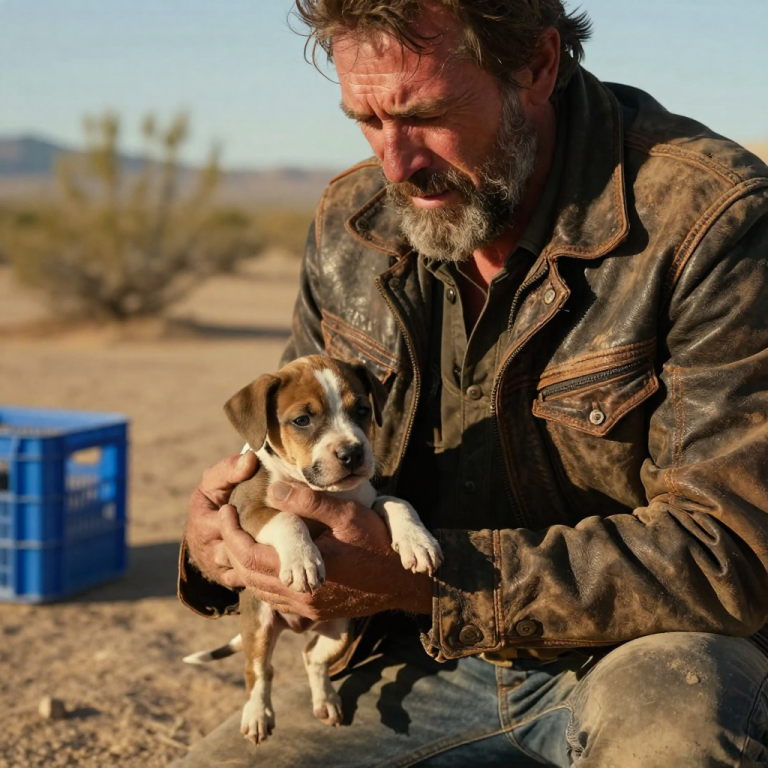
I ignored her. I draped the heavy canvas coat over the dog. It engulfed him. I tucked the edges under his shivering body, creating a cocoon. The fleece lining immediately began to trap his body heat. He looked up at me, his brown eyes wide, unable to comprehend the change in his fortune.
I stood up. I was just in my flannel shirt and thermal undershirt now. The cold bit at me, but I welcomed it. It kept me sharp.
I turned back to Mrs. Higgins. She was staring at the dog wrapped in my coat, then at me.
“You’re crazy,” she whispered.
“We’re going to make a deal,” I said.
“I don’t make deals with trespassers!”
“You’re going to go inside,” I continued, my voice flat, “and you’re going to bring out his food bowl. Then you’re going to bring out his papers. Vaccination records. Adoption certificate. Whatever you have.”
“I… why would I do that?”
“Because if you don’t,” I said, stepping closer to her again, invading her personal space just enough to make her heart rate spike, “I am going to make a phone call. And it won’t be to Animal Control.”
I paused. I let her look at my eyes. I let her see the things I wasn’t saying. I let her see the ghost of the man who used to extract information for a living.
“I know your son lives in Chicago,” I lied. Or maybe I didn’t lie. I knew a lot of things. I noticed things. “I know he pays the mortgage on this place. I know you’re on probation with the HOA for the fence dispute last year.”
Her mouth opened and closed like a fish.
“I know how fragile your little kingdom is, Brenda,” I said, using her first name for the first time. It hit her like a slap. “Do not test me. Not today.”
She gripped the porch railing. She looked at the dog, then at me. She weighed her pride against the terrifying certainty radiating off the man standing on her porch.
“Take him,” she spat, tears of frustration and humiliation welling in her eyes. “Take the damn thing. He’s useless anyway.”
“The papers,” I reminded her.
“Fine!” she screamed, turning and storming toward the front door. “Fine!”
The door slammed behind her.
I let out a breath I didn’t know I was holding. The adrenaline was still humming, but the anger was banked now, replaced by a focused resolve.
I looked down at Barnaby. He had stopped shivering. He was watching the door, terrified she would come back.
“She’s not hurting you again,” I told him. “Come on.”
I scooped him up. He was heavier than he looked, dead weight from exhaustion, but he was light compared to the burdens I usually carried. He groaned as I lifted him, but then he settled, resting his head on my shoulder.
I turned to walk back to my house, carrying the dog wrapped in my coat. The wind was still blowing, but the sun was finally starting to cut through the clouds.
I had broken my rule. I had gotten involved. I had revealed a part of myself I wanted to keep buried.
But as the old dog let out a sigh against my neck, I realized that for the first time in three years, I didn’t feel like a ghost. I felt like a human being.
CHAPTER II
My house has always been a fortress of curated silence. It is a place of hard angles, stainless steel, and the faint, persistent scent of industrial-grade disinfectant. When I retired, I didn’t want a home; I wanted a perimeter. I needed a space where nothing was out of place, where no unexpected sound could trigger the involuntary muscle memory of a man who spent twenty years waiting for the floorboards to creak. But as I carried Barnaby across the threshold, that silence didn’t just break—it shattered.
He was heavier than he looked, or perhaps it was just the weight of his exhaustion. He didn’t struggle. He didn’t even whine. He just lay in my arms like a heap of wet laundry, his breath coming in shallow, ragged hitches that vibrated against my ribs. I set him down in the center of the kitchen floor, on the white tile that I scrubbed every Saturday morning. Immediately, the perfection of the room was fouled. Mud, matted fur, and the copper tang of a small nick on his ear began to mar the surface. I didn’t care. For the first time in a decade, the sterility of my life felt like a clinical error.
I went to the utility closet and pulled out the kit. It wasn’t a standard first-aid box. It was a black Pelican case, the kind I’d used in safehouses from Riga to Recife. Inside were trauma shears, antiseptic wipes, sterile saline, and surgical staples. I knelt beside him, my knees cracking—a reminder of a jump in the Hindu Kush that hadn’t gone as planned—and I began the assessment. This was the only way I knew how to care: through the lens of a medic in a hot zone.
“Easy, soldier,” I whispered. My voice felt like rusted hinges moving for the first time in years.
I used the shears to cut away what was left of the ruined blanket Brenda had tried to strangle him with. Underneath, his ribs were a roadmap of neglect. Every bone was visible, a series of sharp ridges pushing against skin that was thin as parchment. There were old scars, too—circular burns that looked suspiciously like cigarette marks, and a patch of hairless, thickened skin on his haunch that suggested a break that had been allowed to knit back together without a vet’s intervention.
As I cleaned a raw patch on his neck where the collar had bitten in, a sudden flash of memory hit me, unbidden and violent. It was the Old Wound, the one that never quite closed. I wasn’t in my kitchen anymore; I was in a basement in Sarajevo, 1994. I was holding a boy, no older than ten, who had the same look in his eyes that Barnaby had now—a look of profound, quiet acceptance of pain. I had been told to leave him. My orders were to extract the asset, not the collateral. I had followed orders. I had left him there because the mission was ‘larger’ than one life. I can still feel the weight of that boy’s hand on my sleeve. I can still feel the coldness of the choice I made.
I shook the memory away and focused on the dog. I couldn’t fix Sarajevo. I couldn’t fix the twenty years of ‘necessary evils’ I’d participated in. But I could fix this. I spent an hour cleaning him. I fed him small, measured portions of lukewarm chicken broth, watching as his tongue lapped at it with a desperation that made my throat tight. By the time I was finished, he was curled on a pile of my softest bath towels, his breathing finally leveling out into the deep, rhythmic pulse of sleep.
I stood up, my back aching, and looked at the clock. It was nearly noon. The peace lasted exactly four more minutes.
The doorbell didn’t just ring; it was hammered. A frantic, rhythmic pounding that signaled a person who believed they were the protagonist of their own righteous drama. I didn’t need to look through the peephole to know it was Brenda. I walked to the door, my movements fluid and heavy, the old internal HUD of my mind already scanning for threats, exits, and vulnerabilities.
When I opened it, Brenda was there, but she wasn’t alone. Standing beside her was Arthur Miller, the President of the Homeowners Association. Arthur was a man who wore his self-importance like a cheap suit—tight, shiny, and ultimately transparent. He was holding a clipboard, the universal scepter of the suburban tyrant. Behind them, two other neighbors, the Millers from three doors down, stood on their lawn, pretending to prune roses while watching the spectacle.
This was the public trigger. The moment the private act of mercy became a public act of defiance.
“That’s him!” Brenda shrieked, pointing a trembling finger at my chest. Her face was a blotchy mask of rage and performance. “He assaulted me! He came onto my property, threatened me, and stole my property. He’s a lunatic, Arthur! I’m terrified to stay in my own home!”
Arthur cleared his throat, adjusting his glasses. “Frank, we’ve had some… disturbing reports. Brenda says you used physical intimidation to take her dog. Now, we don’t want to involve the police just yet, but the HOA has strict bylaws regarding—”
“The dog was dying, Arthur,” I said. I kept my voice low, the level of a predator that doesn’t need to snarl to be understood. “He was left out in sub-zero temperatures without food or water. He has cigarette burns on his flanks. He’s currently in my kitchen, recovering from shock.”
“That’s a lie!” Brenda screamed. “He’s an old dog, he has skin conditions! You have no right to touch him. Give him back, or I’m calling the sheriff right now. I’ve already got them on speed dial!”
I looked at her. Really looked at her. I saw the fear beneath the anger, but it wasn’t fear of me—it was the fear of being exposed. She didn’t want the dog; she wanted the control. She wanted to prove that she could be cruel without consequence.
“Frank,” Arthur said, his voice gaining a bit of false bravado from the presence of the audience. “You can’t just take things. This is a civil society. If there’s abuse, we call the authorities. We don’t have vigilantes in Whispering Oaks. Return the animal now, and we can discuss a fine for the HOA violation instead of a criminal charge.”
This was the moral dilemma. If I gave Barnaby back, he was dead. If I kept him, I was a thief and an assailant in the eyes of the law. My quiet life—the Secret I had worked so hard to maintain, the identity of a ‘boring retired consultant’—would be ripped open. A police investigation would look into my background. They’d find the discrepancies in my tax filings, the ‘black’ accounts I used to fund my retirement, the fact that Frank Vance didn’t technically exist before 2010. To save the dog, I had to risk the only safety I’d ever known.
I stepped back, inviting them in with a sharp, jagged gesture. “You want the dog, Arthur? Come see the dog. See what you’re defending.”
They entered hesitantly. Brenda stayed near the door, her eyes darting around my sterile living room. I led them to the kitchen. Barnaby didn’t wake up as we approached; he was too far gone in his exhaustion. He lay on the white towels, his skeletal frame shivering slightly in his sleep. The scars I had cleaned were now vividly apparent under the bright LED lights of the kitchen.
Arthur stopped. He looked at the trauma kit on the counter, then at the dog. He wasn’t a bad man, just a weak one who preferred the comfort of rules to the messiness of truth. I saw his face soften, then recoil in genuine disgust at the state of the animal.
“Brenda…” Arthur began, his voice trailing off.
“He’s faking!” Brenda hissed, though even she sounded less certain now. “The dog is old! Frank probably did those things himself just to frame me!”
I turned to her. I didn’t move fast, but I moved with a sudden, concentrated intent that made her back into the refrigerator. I reached into my pocket and pulled out my phone.
“Arthur, Brenda has a point. We should involve the authorities. But not the police. Not yet.” I tapped a command on my screen. This was the use of my ‘old skills’—the digital ghost I kept in my basement. I had spent the last hour, while Barnaby slept, doing more than just cleaning wounds. I had been digging.
“What is that?” Brenda asked, her voice high and thin.
“It’s your bank records, Brenda,” I said calmly. “And your correspondence with the insurance company regarding your late husband’s policy. It’s interesting how the ‘accidental’ nature of his fall was questioned, isn’t it? It’s even more interesting that you’ve been funneling HOA funds into a private account for the last three years to cover your gambling debts in Atlantic City.”
The silence in the room became absolute. It was the kind of silence that precedes a landslide.
Arthur looked at Brenda. “What?”
“He’s lying! He’s a hacker, he’s—”
“I’m a man who knows how to find things that people want to keep hidden,” I said, stepping closer to her. I could smell the stale perfume and the sweat of her panic. “I have the account numbers, Arthur. I have the dates of the transfers. I have the emails she sent to the insurance adjuster. If the police come here for a dog, they’re going to stay for a felony embezzlement case. And maybe a reopened cold case regarding a certain ‘accidental’ death.”
This was the irreversible moment. I had used a weapon I promised myself I’d never touch again. I had exposed a part of my old self to protect this broken, discarded creature on my floor. I had crossed a line that I couldn’t uncross.
Brenda’s face went gray. The bravado vanished, replaced by a raw, naked terror. She knew I wasn’t bluffing. People like me don’t bluff about things like this. We don’t have the patience for it.
“Arthur,” I said, my voice as cold as the frost on the windows. “I think Brenda is going to sign a document surrendering ownership of the dog to me. And I think she’s going to resign from the HOA and move out of this neighborhood within thirty days. And in exchange, I’m going to delete these files. If she stays, or if she ever mentions my name to a soul, these files go to the District Attorney, the IRS, and the state police.”
Arthur was shaking. He looked at me as if he were seeing a ghost, or a monster. I suppose, in a way, he was. He saw that I wasn’t the quiet neighbor who mowed his lawn on Tuesdays. He saw the shadow of the man I used to be—the man who liquidated problems for a living.
“Brenda?” Arthur whispered.
She didn’t even look at him. She was staring at me, her mouth working but no sound coming out. She nodded once, a quick, jerky motion.
“Get out,” I said.
They left. They didn’t run, but they moved with a frantic haste that was just as telling. I watched them through the front window as they hurried across the street, Arthur keeping a wide berth from Brenda as if her ruin were contagious.
I closed the door and locked it. I leaned my forehead against the cool wood, my heart hammering a rhythm I hadn’t felt in years. The adrenaline was fading, leaving behind a hollow, bitter ache. I had saved the dog, but at a cost. I had signaled my presence to a world I was supposed to be dead to. The digital footprint I’d just made was small, but in my world, a small ripple is enough to draw the sharks.
I walked back into the kitchen. Barnaby had finally woken up. He was sitting up on the towels, his head tilted to one side. He looked at me—not with fear, not with the hollowed-out resignation of a victim, but with a strange, tentative curiosity.
He wagged his tail. Just once. A weak, thumping sound against the floor.
It was the most beautiful thing I’d ever heard.
I sat on the floor next to him. I didn’t reach out to pet him yet; I didn’t want to overwhelm him. I just sat there in the silence of my compromised fortress. I thought about the boy in Sarajevo. I thought about the files I’d just accessed and the trail I’d left. I thought about the fact that tomorrow, the neighbors would whisper, and the HOA would be in turmoil, and my life would never be ‘quiet’ again.
I reached out and let him sniff my hand. His nose was cold and wet. He licked my palm, a sandpaper-rough gesture of forgiveness that I didn’t deserve.
“It’s just us now, Barnaby,” I whispered.
The moral dilemma was gone, replaced by a grim clarity. I had chosen a side. I had chosen the collateral over the mission. And as the sun began to set over the manicured lawns of Whispering Oaks, casting long, distorted shadows across my kitchen floor, I knew that the peace I had spent ten years building was over.
But as Barnaby laid his heavy, tired head on my knee, I realized I didn’t miss it. I didn’t miss the silence at all.
I stayed there on the floor for a long time, a man with a dangerous past and an uncertain future, holding onto the only thing in the world that didn’t care who I used to be. The kitchen was still messy, the tile was stained, and the secret was out—at least to those who mattered. But for the first time since I left the service, I didn’t feel like I was hiding. I felt like I was standing my ground.
And that, I realized, was a much more dangerous thing to be.
CHAPTER III
The silence in Whispering Oaks usually sounded like peace. That morning, it sounded like a held breath. I sat on my back porch, the wood grain rough beneath my calloused palms, watching Barnaby. The dog was limping less. He was sniffing the base of a hydrangea bush, his tail giving a tentative, rhythmic thump against the mulch. He looked like a normal dog in a normal yard. I looked like a normal man in a faded flannel shirt.
We were both lies.
I knew the clock had started the moment I bypassed the encrypted server to pull Brenda’s financial records. It was a rookie mistake, or maybe it wasn’t a mistake at all. Maybe, deep down, I was tired of being a ghost. You can only hold your breath for so long before your lungs scream for the very air that will give you away. I had traded my anonymity for a broken-down golden retriever, and as I watched him soak in the morning sun, I didn’t regret the bargain. But I knew the bill was coming due.
It arrived at 10:14 AM in the form of a silver Lexus. It didn’t speed. It didn’t creep. It drove exactly three miles per hour under the neighborhood limit, the mark of someone who had studied the local ordinances. It parked perfectly at the curb. A man stepped out. He wore a crisp navy blazer and khaki slacks. He looked like an insurance adjuster, or perhaps a regional manager for a mid-sized paper company. He was exactly the kind of person who belonged here.
That was how I knew he was one of us.
I didn’t stand up. I didn’t reach for the weapon tucked into the small of my back, though its weight felt like a hot coal against my skin. I just watched him walk up the driveway. He didn’t look at the house. He looked at the perimeter. He noted the dead angles of the neighboring windows. He noted the lack of a security sign in my yard. He was measuring the distance it would take to reach the door.
Barnaby sensed it first. The dog froze, his hackles rising in a jagged line down his spine. He didn’t bark. He let out a low, vibrating growl that seemed to come from the marrow of his bones. He moved toward me, positioning his battered body between me and the stranger.
“Easy, boy,” I whispered. My voice felt like sandpaper.
The man stopped at the edge of the porch. He had a face that was impossible to remember—symmetrical, bland, and entirely devoid of kindness. He looked at Barnaby, then at me.
“He’s looking better, Frank,” the man said. His voice was a smooth, cultivated baritone. “The last time I saw a dog in that condition, it was in the hills outside Sarajevo. Do you remember those dogs? They used to follow the convoys, hoping for a scrap of bread before the shelling started.”
My heart didn’t skip a beat. It slowed down. My peripheral vision sharpened. The world became a series of tactical vectors.
“His name is Barnaby,” I said. “And I don’t go by Frank when I’m talking to the Office, Silas.”
Silas Thorne smiled. It wasn’t a human expression. It was a muscular contraction intended to mimic rapport. He took a step onto the porch. Barnaby’s growl deepened.
“The Director was surprised to see your signature on the grid,” Silas said, leaning against the railing. He looked out at the manicured lawns of Whispering Oaks. “We thought you were dead. Or worse—that you’d gone over to the other side. But to find you here? Blackmailing a suburban housewife over some embezzled HOA funds? It’s beneath you, Vance. It’s like a concert pianist playing ‘Twinkle Twinkle Little Star’ in a dive bar.”
“I’m retired,” I said.
“No one retires from the Agency,” Silas replied. “They just go on a very long, very unapproved vacation. And your vacation just ended. That data breach you caused? It triggered a flag in the Internal Affairs division. They think you kept the Sarajevo files. They think you have the names of the contractors who authorized the strike on the hospital annex.”
I felt the ghost of a cold wind on my neck. Sarajevo. The girl with the red ribbon in her hair. The one I had tried to pull from the rubble while the radio in my ear told me to leave her, to move to the extraction point, to let the ‘collateral’ remain collateral. I had failed her. I had watched the dust settle over her small, still hand.
“The files are gone, Silas. I burned them years ago.”
“The Director doesn’t believe in fire,” Silas said. He turned his gaze to Barnaby. The dog was baring his teeth now. “He believes in leverage. He thinks you took something more valuable than files. He thinks you took your conscience with you. And a man with a conscience is a man who can be broken.”
Silas moved fast. It wasn’t an attack—it was a test. He reached down toward Barnaby, his hand open but his fingers stiff, ready to strike.
I was faster. I was off the chair and between them before Silas could finish the arc of his movement. I grabbed his wrist. The bones in his arm felt thin, like dry twigs. I didn’t squeeze, but I applied enough pressure to the radial nerve to make his fingers go limp.
“Don’t touch the dog,” I said. My voice was a dead thing.
Silas didn’t flinch. He looked down at my hand, then back at my eyes. “You’ve changed. You used to be surgical. Now you’re… protective. It’s a weakness, Vance. You’ve developed an attachment to a stray. It makes you predictable.”
He pulled his arm back, and I let him. He straightened his blazer, smoothing out the invisible wrinkles. “Here is the situation. You have forty-eight hours to turn over the encrypted drive from the Sarajevo mission. If you do, you can keep this little life. You can keep the dog. You can keep the flannel shirts and the lawnmower. If you don’t, we’ll send a cleanup crew. Not just for you. For the whole block. We’ll make it look like a gas leak. Brenda, the HOA president, the kids playing tag across the street… they’ll all be part of the collateral.”
He turned to leave, but he stopped at the steps. “And Frank? Don’t try to run. We’ve already tagged the dog’s microchip. We know where he is every second of the day. You can’t leave him behind, can you? Not after what happened in Bosnia.”
He walked back to his Lexus. I stood there, my hands shaking—not with fear, but with an old, cold rage that I thought I had buried under layers of suburban boredom. Barnaby came to my side and nudged my hand with his wet nose. I looked at the scar on his ear, the one Brenda had given him.
They were coming for us. They were coming for the only thing that made me feel like a human being again.
I didn’t wait for the forty-eight hours. I went inside and pulled the floorboards up in the pantry. Beneath the canned peaches and the bags of flour lay a Pelican case. I opened it. The smell of gun oil filled the room. It was the scent of my former life. I didn’t reach for the handgun. I reached for the satellite phone at the bottom of the case.
I dialed a number I had memorized fifteen years ago. A number that shouldn’t have existed.
“This is Vance,” I said when the line clicked open. “I’m calling in the debt.”
“Vance is dead,” a woman’s voice replied. It was cold, professional, and slightly surprised.
“The girl in Sarajevo had a brother,” I said. “He’s a Senator now. Tell him the man who held his sister’s hand is on the line. Tell him the Agency is coming to finish the job they started in 1994.”
There was a long silence. I could hear the hum of a secure server farm on the other end.
“What do you want?” she asked.
“I want a clean slate,” I said. “And I want Silas Thorne off the board. Permanently.”
“That’s a high price, Frank.”
“I have the original recordings of the strike order,” I lied. It was a gamble. I had nothing but a broken dog and a memory of a child’s hand. “If I don’t check in every six hours, they go to the Times. And the Senator’s career goes into the incinerator along with the Director’s reputation.”
“Stay where you are,” she said. The line went dead.
I spent the next three hours preparing. I didn’t pack a bag. I didn’t plan an escape. I turned the house into a funnel. I moved the furniture. I prepped the kitchen. I checked the sightlines from the front window. Barnaby watched me, his head tilted. He knew the energy in the house had shifted. The man who fed him treats was gone. The predator had returned.
At 3:00 PM, a black SUV pulled up. Not Silas. This was different. This was a government-plated Suburban. Two men in suits got out, but they weren’t Agency. They were Diplomatic Security. Behind them, a second car pulled up. A man with silver hair and a face I recognized from the nightly news stepped out. Senator Julian Vane. The brother of the girl I couldn’t save.
I met him on the porch. Barnaby stood at my side, a silent sentinel.
The Senator looked at me, his eyes searching my face for the young soldier he had met in a refugee camp a lifetime ago. He looked at the dog. He looked at the modest house.
“You stayed hidden for a long time,” the Senator said. His voice was tired, weighted with the gravity of power.
“I wasn’t hiding,” I said. “I was living. There’s a difference.”
“Thorne and his team were intercepted three miles from here,” the Senator said. “They’ve been reassigned to a black site in the Aleutians. They won’t bother you again. The Director has been… reminded… of the importance of your privacy.”
He stepped closer, his voice dropping to a whisper. “Do you really have the tapes, Frank?”
I looked him in the eye. I didn’t blink. “Does it matter? You’re here. The threat is gone. That’s the only reality that exists right now.”
The Senator let out a short, bitter laugh. “You were always the best of them. You knew how to use the truth as a weapon even when you didn’t have any.”
He turned to the dog, reaching out a hand. Barnaby didn’t growl. He sniffed the Senator’s fingers and gave a single, slow lick.
“He’s a good dog,” the Senator said.
“He’s the only reason I’m still standing,” I replied.
As the Senator’s motorcade pulled away, the neighborhood returned to its artificial stillness. But the air had changed. The lie of Whispering Oaks had been stripped away, leaving only the raw, jagged truth of what I was. I wasn’t a neighbor. I wasn’t a retiree. I was a man who had declared war on his own shadow to protect a creature that didn’t know how to do anything but love.
I walked back inside, Barnaby following close at my heels. I went to the pantry and looked at the Pelican case. I didn’t put the satellite phone back. I didn’t close the lid. I knew this wasn’t the end. The Senator had saved me today, but power is a fickle thing. I had exposed myself. I had shown them that I still had a pulse, and in my world, a pulse is a target.
I went to the kitchen and opened a can of premium beef tips—the expensive stuff I’d been saving. I put it in Barnaby’s bowl. He ate with a frantic, joyful energy.
I sat on the floor next to him, my back against the dishwasher. I felt the weight of the handgun in my waistband. I felt the ache in my joints. I felt the crushing weight of the memories I had tried so hard to drown in the mundane rhythm of mowing the lawn and checking the mail.
I had won the battle, but I had lost the sanctuary. Brenda was gone, Silas was gone, but the ghost of Sarajevo was sitting right there in the room with me, breathing in the scent of dog food and gun oil.
Then, Barnaby finished his meal. He walked over to me, circled twice, and collapsed against my side, his heavy head resting on my thigh. He sighed—a deep, contented sound that vibrated through my jeans.
In that moment, the fear vanished. The calculation died. The tactical vectors faded into the background.
I reached down and stroked his soft, velvet ears.
“We’re okay,” I whispered, though I knew it was a lie. “We’re okay for now.”
The sun began to set, casting long, bloody shadows across the linoleum floor. I stayed there on the floor with the dog, a man who had traded the world for a single life, waiting for the dark to fall, knowing that when it did, I would be ready. I wasn’t just Frank anymore. I wasn’t just Vance. I was something else—something more dangerous than an operative and more resilient than a victim.
I was a man with something worth dying for. And for the first time in my life, that made me truly dangerous.
CHAPTER IV
The silence after Silas left was the loudest thing I’d ever heard. Louder than the gunshots, the shouting, the endless barking of that first night. It was the silence of a vacuum, a black hole sucking everything—joy, peace, the illusion of safety—into its endless void. Whispering Oaks felt less like a sanctuary now, more like a stage set after the actors had gone home, leaving only the props and the faint scent of forgotten drama.
Barnaby, bless his heart, didn’t understand the shift. He was just happy I was still there, still scratching behind his ears, still filling his bowl. He’d come through it all relatively unscathed, a testament to his resilience, or maybe his simple, uncomplicated love. I envied him that.
I tried to settle back into a routine, but the routine felt like a costume that didn’t fit anymore. The morning walks were shadowed by the memory of Silas’s words, the friendly nods from neighbors felt like veiled curiosity, and the house…the house was no longer mine. It was a place I had defended, yes, but also a place where I had revealed too much of myself.
The news coverage started subtly. A small piece in the local paper about the ‘HOA dispute’ that had led to Brenda Higgins’ abrupt departure. Then, a slightly larger piece questioning Arthur Miller’s ‘sudden retirement.’ No names, no direct accusations, but the breadcrumbs were there, leading anyone who bothered to look down a very dangerous path.
Then came the calls. Old contacts, people I hadn’t spoken to in years, their voices a mix of concern and thinly veiled curiosity. They knew. They all knew. The Senator’s intervention had been effective, but it had also been a signal flare to anyone who still remembered Frank Vance. I was no longer a ghost. I was a target again.
I spent days staring at the walls, Barnaby’s warm body pressed against my leg, trying to figure out what came next. I had won, in a sense. Silas was gone, Brenda and Arthur were neutralized, Barnaby was safe. But at what cost? I had traded my anonymity for a dog, and while I wouldn’t have changed the trade, the reality of it was a heavy weight.
**PUBLIC FALLOUT**
The first real blow came from the HOA. A certified letter informing me that I was in violation of several covenants—unapproved landscaping, excessive noise complaints (Barnaby’s barking), and ‘conduct unbecoming a resident of Whispering Oaks.’ They wanted me out. Not explicitly, of course, but the message was clear: I was no longer welcome.
Then came Senator Vane’s visit. He arrived in a black SUV, two serious-looking men in suits flanking him. He seemed older than I remembered, his face etched with lines of worry. He thanked me, again, for protecting his sister’s memory. He assured me that Silas was ‘being dealt with.’ But there was a weariness in his eyes that mirrored my own.
“Frank,” he said, his voice low, “you need to disappear again. This… this situation has drawn too much attention. I can’t protect you if you’re a lightning rod.”
I nodded. I already knew it. The Senator’s protection was a gilded cage, and I was still a prisoner.
The media firestorm started a week later. A national news outlet picked up the story, focusing on the ‘rogue operative’ who had used his skills to terrorize a suburban neighborhood. They painted me as a villain, a dangerous man hiding in plain sight. They dug up old stories, twisting facts, exaggerating my past. My face was plastered across every screen, my name synonymous with fear and suspicion.
The online harassment was relentless. Death threats, accusations, personal attacks. They targeted Barnaby, too, calling him a ‘monster dog’ and threatening to harm him. I shut down my social media accounts, but it didn’t matter. The poison was already out there.
**PRIVATE COST**
The worst part wasn’t the public condemnation. It was the isolation. The knowing glances from the few neighbors who still dared to look me in the eye. The silence on the phone when I tried to reach out to old friends. The realization that I was alone, truly alone, with only a dog for company.
Sleepless nights became the norm. I’d lie awake, listening to every creak and groan of the house, my mind racing with possibilities, all of them bad. I replayed the events in Sarajevo, the image of the Senator’s sister burned into my memory. Had I done the right thing? Had I made things better, or just traded one set of nightmares for another?
Barnaby sensed my anxiety. He’d whine and nudge me with his nose, his big brown eyes full of concern. I’d hug him tight, burying my face in his fur, drawing strength from his unwavering love. He was the only thing keeping me from falling apart.
I started drinking again. Just a little at first, a glass of whiskey to take the edge off. But the little became more, and the more became a nightly ritual. I knew it was a bad habit, a dangerous crutch, but I couldn’t seem to stop myself. The whiskey dulled the edges of the fear, the guilt, the loneliness.
One evening, I found myself staring at my reflection in the bathroom mirror. A stranger stared back. A tired, haunted man with bloodshot eyes and a five o’clock shadow. I barely recognized myself.
“What have you done?” I whispered to the mirror. “What have you become?”
The silence was my only answer.
**NEW EVENT**
The knock on the door came late one night. I hesitated, my hand reaching for the Glock in the drawer. But something told me this wasn’t Silas, or anyone from the Agency. This was something different.
I opened the door a crack, Barnaby growling softly beside me. A woman stood on the porch, her face pale in the dim light. She looked familiar, but I couldn’t place her.
“Mr. Vance?” she said, her voice trembling. “My name is Elena. I… I knew Julian’s sister. In Sarajevo.”
My heart stopped. Elena. The name echoed in my mind, a ghost from the past.
I opened the door wider, inviting her in. Barnaby sniffed her cautiously, then seemed to relax, resting his head on her leg.
Elena sat on the edge of the sofa, her hands clasped tightly in her lap. She told me her story in a low, steady voice. She had been a child in Sarajevo, a friend of the Senator’s sister. She had witnessed the events that I had tried so hard to forget.
But her story wasn’t the same as mine. She told me about the chaos, the fear, the desperation of a city under siege. She told me about the choices people made, the compromises they were forced to accept. And she told me about the Senator’s sister, not as a victim, but as a hero.
“She helped so many people,” Elena said, her eyes filling with tears. “She risked her life every day to save others. She was… she was an angel.”
My world shifted. The narrative I had carried for so long, the narrative of guilt and failure, began to crumble. Maybe I had been wrong. Maybe the Senator’s sister hadn’t been a helpless victim. Maybe she had been something more.
Elena also revealed something else. Something that shook me to my core. She told me that Senator Vane had known about the war crime for years. That he had used his power to cover it up, to protect his family’s reputation. And that he had used me, and the Sarajevo files, to further his own agenda.
“He doesn’t care about justice, Mr. Vance,” Elena said. “He only cares about power.”
I stared at her, my mind reeling. Had I been a pawn in the Senator’s game all along?
**MORAL RESIDUES**
Elena left, leaving me with a new set of questions and doubts. The whiskey suddenly tasted like ash in my mouth. I poured the rest of the bottle down the drain, the clinking glass a hollow echo in the silence.
I spent the next few days re-examining everything. The events in Sarajevo, the Senator’s intervention, Silas’s arrival, the media firestorm. It all fit together now, a carefully constructed puzzle with me as the central piece.
I had been so focused on protecting Barnaby, on righting the wrongs of the past, that I had failed to see the larger game being played around me. I had been a fool.
I called the Senator. He answered on the third ring, his voice smooth and confident.
“Frank,” he said. “Good to hear from you. I trust you’re doing well?”
“I know about Elena,” I said, my voice flat. “I know about the cover-up. I know about everything.”
There was a long silence on the other end of the line. Then, the Senator spoke, his voice colder now.
“You’re playing a dangerous game, Frank,” he said. “You should have stayed hidden.”
“I’m done hiding,” I said. “I’m done being your pawn.”
I hung up the phone, severing the last tie to my old life.
I looked at Barnaby, his tail wagging tentatively. He didn’t understand what was happening, but he knew something was different. I knelt down and hugged him tight.
“We’re leaving, boy,” I said. “We’re going somewhere where no one knows our names.”
I packed a bag, filling it with essentials—a change of clothes, some cash, a map. I left the house as it was, the furniture, the pictures on the wall, the memories. It no longer felt like home.
As we drove away from Whispering Oaks, I looked in the rearview mirror. The house was a distant silhouette against the twilight sky. I didn’t feel sadness, or regret. Just a sense of liberation.
We drove for hours, Barnaby asleep in the passenger seat. The highway stretched out before us, a ribbon of asphalt leading to an unknown future.
As the sun began to rise, I pulled over to the side of the road. We were in the middle of nowhere, surrounded by fields and forests. I got out of the car and stretched, breathing in the fresh air.
Barnaby jumped out and ran around, sniffing the ground, his tail wagging furiously. He was free. And so was I.
I looked at him, his eyes full of joy, and I smiled. Maybe, just maybe, we could find a new life. A life where we weren’t running from the past, but running towards something better. A life where we could finally be ourselves.
We got back in the car and drove on, the rising sun casting long shadows before us. The road ahead was uncertain, but for the first time in a long time, I felt a glimmer of hope. The scars of the past would always be there, but they didn’t have to define us. We could choose our own future. And we would choose it together, one mile at a time.
CHAPTER V
The drive was long, directionless at first. Barnaby, bless his heart, seemed content just to be moving, his big head resting on the console between the seats, occasionally letting out a contented sigh. I hadn’t told him where we were going, mostly because I didn’t know. I just drove, away from Whispering Oaks, away from the wreckage of Julian Vane’s betrayal, away from the ghost of Sarajevo that had haunted me for so long.
Eventually, I started aiming south, towards the coast. I figured the ocean might offer some kind of solace, some sense of vastness that could swallow up the smallness of my current existence. The news cycle had moved on, as it always does. I was no longer front-page news, just another forgotten scandal. But the feeling of being used, of being a pawn in someone else’s game, that lingered.
I found a small town on the Outer Banks of North Carolina. It wasn’t fancy, just a collection of weathered houses and seafood shacks clinging to the edge of the continent. The kind of place where people minded their own business, where a man and his dog could blend in without raising too many eyebrows. I rented a small cottage overlooking the sound, the water grey and restless under a perpetually overcast sky.
The first few weeks were…quiet. Too quiet. I spent my days walking Barnaby on the beach, watching the waves crash, and trying not to think. But the silence was a breeding ground for memories, for regrets. Sarajevo, Maya, the faces of the people I had hurt in the name of duty. They all came back, sharper and more insistent than ever. I was haunted, not by ghosts, but by the weight of my own actions.
One afternoon, Barnaby and I were walking along the shore when we came across a group of volunteers cleaning up trash. They were mostly older folks, retirees looking for something to do, a way to give back. Something stirred in me, a faint echo of a purpose I thought I had lost forever.
I started joining them. At first, it was just an excuse to get out of the house, to have something to do other than stare at the walls. But as I worked alongside those people, picking up plastic bottles and tangled fishing nets, something began to shift inside me. It wasn’t much, just a small sense of satisfaction, a feeling of contributing to something bigger than myself.
The next morning, I found myself driving into town, looking for the local animal shelter. It was a small, underfunded place, run by a woman named Sarah with a heart as big as the ocean. She was always looking for volunteers, she told me, someone to walk the dogs, clean the cages, anything to help.
I started volunteering a few days a week. It wasn’t glamorous work, but it was honest. And it was…healing. Being around those animals, seeing their resilience, their capacity for love even after everything they had been through, it reminded me that even broken things could be made whole again.
One evening, Sarah told me about a dog they had just taken in. A young pit bull mix, abandoned on the side of the road, badly injured. They didn’t think he would make it.
I went to see him. He was lying in a cage in the back, his body thin and scarred, his eyes dull with pain. I knelt down and gently stroked his head. He flinched at first, then slowly relaxed under my touch.
“He needs a name,” Sarah said.
I looked at the dog, at his broken body, his haunted eyes. And I knew what to call him.
“Lucky,” I said. “I think he should be called Lucky.”
###
Lucky’s recovery was slow, but steady. I spent hours with him, talking to him, stroking him, just being there. He started to respond, his tail wagging faintly when he saw me, his eyes brightening with a spark of life.
Sarah was amazed. “You have a gift,” she said. “You can connect with these animals in a way that most people can’t.”
I didn’t know about any gift. All I knew was that I felt a connection to Lucky, a shared understanding of what it meant to be broken, to be abandoned, to be given a second chance.
One day, I took Lucky for a walk on the beach. He was still weak, but he was getting stronger every day. We walked slowly, Barnaby trotting alongside us, a picture of canine contentment.
As we walked, I noticed a group of boys throwing rocks at a flock of seagulls. I stopped and watched them for a moment, a familiar anger rising inside me.
I walked over to them. “Hey,” I said, my voice quiet but firm. “Why don’t you leave those birds alone?”
The boys looked at me, their faces defiant.
“They’re just birds,” one of them said.
“They’re living creatures,” I said. “They deserve to be treated with respect.”
The boys hesitated, then shrugged and walked away.
I watched them go, the anger slowly fading, replaced by a sense of…something else. Something like peace.
I realized that I didn’t need to be a hero, didn’t need to expose corruption or fight injustice on a grand scale. I could make a difference in small ways, by standing up for the vulnerable, by showing kindness to those who needed it most.
That evening, I sat on the porch of my cottage, watching the sunset over the sound. Barnaby was at my feet, Lucky curled up beside him. The sky was a riot of colors, orange and red and purple, reflected in the still water.
I closed my eyes and took a deep breath, the salty air filling my lungs. For the first time in a long time, I felt…content.
I wasn’t running anymore. I wasn’t hiding. I was just…living.
###
Time passed. I continued to volunteer at the animal shelter, helping Sarah care for the abandoned and neglected animals. I fostered dogs, nursed them back to health, and found them loving homes. I became a regular fixture at the local farmers market, buying fresh produce and chatting with the vendors. I even started attending town council meetings, advocating for animal rights and environmental protection.
The town accepted me, not as Frank Vance, the former Agency operative, but as just Frank, the guy who walked his dogs on the beach and cared about the animals. They didn’t know about my past, and I didn’t offer it. It was enough to be present, to be useful, to be part of a community.
One day, I received a letter. It was from Elena, the woman from Sarajevo who had exposed Julian Vane’s lies.
She wrote that she was living in Vienna, working as a translator. She had read about me in the news, about my work with the animal shelter. She said that she was glad I had found some peace.
She also wrote that Julian Vane had finally been brought to justice. The evidence I had provided, the Sarajevo files, had been used to prosecute him for war crimes. He was now serving a life sentence.
I read the letter slowly, carefully. I felt…nothing. No satisfaction, no vindication, no sense of closure. Just a faint sadness.
Vane’s imprisonment didn’t bring Maya back. It didn’t undo the damage I had done. It didn’t change the fact that I had been a part of something terrible.
I realized that justice wasn’t about revenge or punishment. It was about accountability, about acknowledging the truth, about trying to make amends.
And sometimes, it was about letting go.
I wrote Elena back, thanking her for the letter. I told her that I was doing well, that I had found a new life. I wished her happiness.
Then I folded the letter and put it away, in a box filled with old memories, old regrets. Things I could never forget, but things I no longer needed to carry with me.
###
Years passed. Barnaby grew old, his muzzle turning grey, his steps slowing. But his spirit remained strong. He was my constant companion, my loyal friend, my furry anchor to the present.
Lucky thrived, becoming a happy, well-adjusted dog. He loved to play fetch on the beach, to chase squirrels in the park, to cuddle up on the couch with Barnaby and me.
I grew old too, my hair thinning, my body aching. But my heart remained open. I continued to volunteer at the animal shelter, to advocate for animal rights, to make a difference in whatever small way I could.
One day, a new family moved into town. They had a young daughter, about ten years old. She was shy and withdrawn, clearly struggling to adjust to her new surroundings.
One afternoon, I saw her walking alone on the beach, her head down, her shoulders slumped. I approached her slowly, Barnaby and Lucky trotting beside me.
“Hello,” I said, my voice gentle. “I’m Frank. This is Barnaby, and this is Lucky.”
The girl looked up, her eyes filled with tears.
“Hi,” she said softly.
“What’s wrong?” I asked.
“I miss my old friends,” she said. “I don’t know anyone here.”
“I know how that feels,” I said. “But you’ll make new friends. This is a good town. People are friendly here.”
I paused, then smiled. “And you know what? Sometimes, the best friends are the ones with fur.”
The girl looked at Barnaby and Lucky, her eyes widening.
“Can I pet them?” she asked.
“Of course,” I said. “They love to be petted.”
The girl knelt down and stroked Barnaby’s head. He licked her hand, his tail wagging furiously.
For the first time since she had moved to town, the girl smiled.
I watched them, my heart swelling with a quiet joy.
I knew that I couldn’t undo the past. I couldn’t erase the mistakes I had made. But I could make a difference in the present, by offering kindness, by showing compassion, by being a friend to those who needed it most.
And that, I realized, was enough.
As I walked away, the girl still petting Barnaby, Lucky nudging her hand, I knew I had finally found my place, my purpose. Not in the shadows, not in the past, but in the light of the present, surrounded by love and friendship, making the world a little bit better, one small act of kindness at a time.
I kept walking. The sun was starting to set, painting the sky with hues of orange and pink, just like the day I met Barnaby.
I looked down at my old friend. He looked up at me, his tail wagging. I scratched behind his ears.
“We did okay, Barnaby,” I said to him. “We did okay.”
Barnaby barked softly, as if in agreement.
Another rescue, another chance at redemption.
The tide was going out.
END.