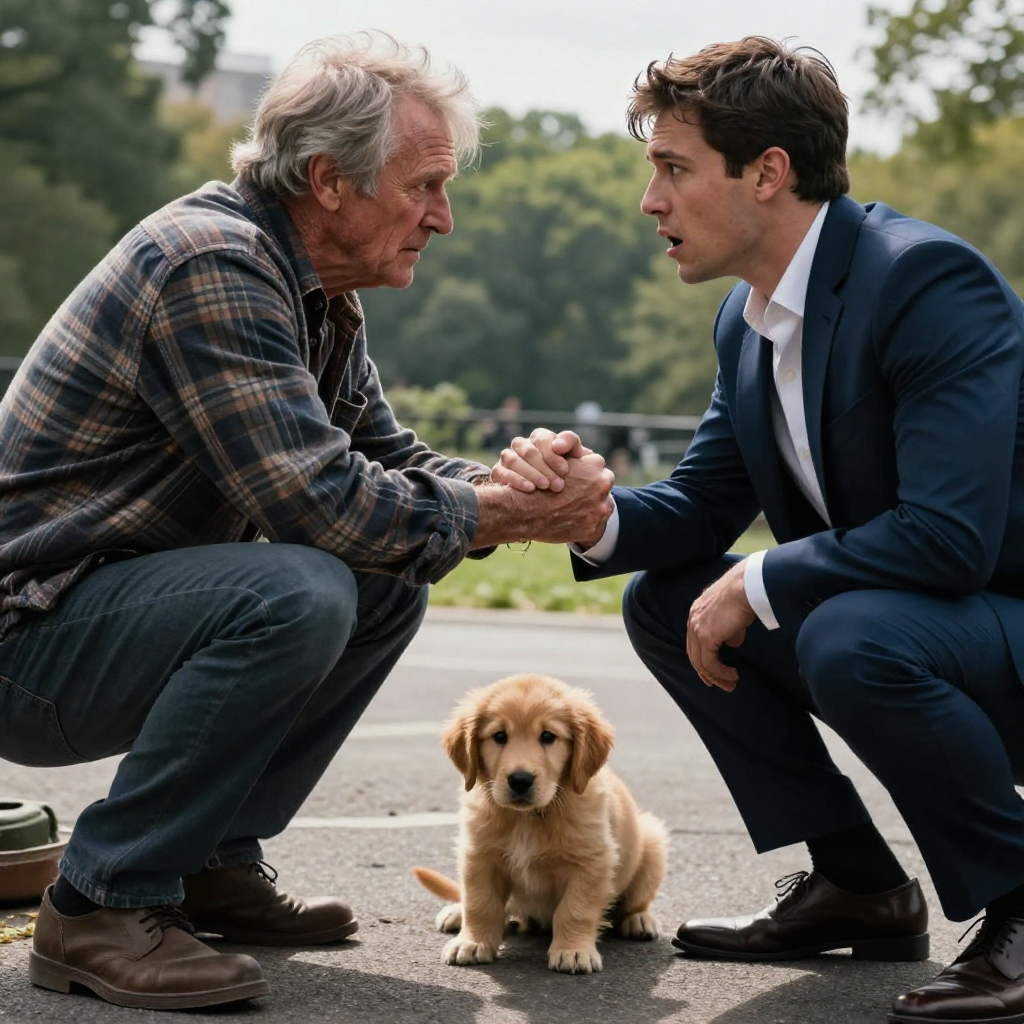
HE LIFTED THE TERRIFIED DOG INTO THE AIR BY ITS THROAT WHILE THE CROWD JUST WATCHED, BUT HE DIDN’T FEEL MY HAND CLOSE AROUND HIS WRIST UNTIL IT WAS TOO LATE. I LEANED IN CLOSE AND WHISPERED THE WORDS THAT MADE HIS ARROGANCE EVAPORATE: “PUT HIM DOWN NOW, OR I PROMISE YOU, THE NEXT THING TO HIT THE PAVEMENT WILL BE YOU.”
The sound wasn’t a bark. It was a high-pitched, strangled yelp that cut through the ambient hum of the Saturday morning traffic like a serrated knife. I was sitting on a park bench, nursing a lukewarm coffee and nursing the arthritis in my right knee, trying to convince myself that retirement was peaceful. It wasn’t. It was just quiet. And I hate the quiet.
Twenty yards away, the peace shattered.
The man was wearing a suit that probably cost more than my first car. Navy blue, tailored, Italian wool. He looked like the type of guy who checks his stock portfolio while his kid is at a recital. But right now, his face was a mask of contorted, ugly rage. He was screaming—actually screaming—at a Golden Retriever mix that couldn’t have been more than six months old.
“Look what you did!” he shrieked, his voice cracking. “Look at my pants!”
There was a smudge of mud on his thigh. A tiny, insignificant brown smear. For that crime, the dog was paying a price that made my stomach turn. The puppy was cowering, belly flat against the concrete, tail tucked so far between its legs it was practically invisible. It was shaking, violent tremors that rippled through its golden fur. It knew it had done something wrong, but it didn’t understand the magnitude of the punishment coming its way.
The man didn’t stop at yelling. He reached down, his fingers hooking under the leather collar. He didn’t pull the dog back; he lifted. He hauled the animal upward with a jerky, violent motion. The dog’s front paws left the ground. Then its back paws.
The puppy was dangling in the air, suspended entirely by its throat. It clawed frantically at the man’s forearm, eyes bulging, gasping for air that couldn’t get past the crushed windpipe. The man was shaking the dog, screaming directly into its terrified face, spit flying.
“You stupid, worthless animal! I should have left you at the pound!”
I looked around. This is the part that always haunts me, even after thirty years on the force. The park was full. There were mothers pushing strollers, joggers checking their watches, a group of teenagers filming a dance video. Everyone stopped. Everyone looked. A few people gasped. One woman covered her mouth with her hand.
But nobody moved.
They were frozen by the audacity of the violence. It’s a social paralysis. When someone acts with that much aggression in a public space, normal people assume there must be a reason, or they fear that the aggression will turn on them. They pulled out their phones. I saw at least three screens glowing, recording the abuse. They were documenting the horror, but not stopping it.
I put my coffee down on the bench. I didn’t rush. Rushing makes you sloppy. I stood up, feeling the familiar ache in my joints, but as soon as I took that first step, the pain disappeared. It was muscle memory. The part of me that had been asleep for three years woke up. The badge was in a drawer at home, but the authority doesn’t live in the metal. It lives in the walk.
I crossed the distance in six long strides. The gravel crunched under my boots, but he didn’t hear me. He was too busy enjoying the power he had over something that couldn’t fight back. The dog’s tongue was lolling out, turning a dark shade of purple.
I didn’t yell. I didn’t ask him to stop. I stepped into his personal space, invading the bubble of his rage.
My hand shot out. I grabbed his right wrist—the one holding the collar—and I didn’t just hold it. I clamped down. I pressed my thumb into the pressure point just below the palm, a technique I learned in the academy back when we didn’t rely on tasers.
He gasped, not from anger this time, but from the sudden, sharp shock of pain shooting up his arm. His grip loosened instinctively. The dog dropped to the pavement with a heavy thud, scrambling backward, coughing and wheezing, its nails scrabbling on the concrete to get away from him.
The man spun around, his face flushed, eyes wild. He tried to yank his hand away, but I held fast. I’m sixty-two years old, but I spent my life wrestling guys twice his size and half his IQ. He wasn’t going anywhere.
“Get your hands off me!” he shouted, his voice echoing off the nearby buildings. “Do you know who I am? I’ll sue you for assault! I’ll have your—”
I tightened my grip. He winced, his knees buckling slightly.
“Lower your voice,” I said. I didn’t shout. I spoke in that low, flat tone that usually signals the end of a negotiation. “The dog is breathing. That’s the only reason you aren’t on the ground in cuffs right now.”
He looked at me, really looked at me, for the first time. He saw the gray hair, the flannel shirt, the worn boots. He saw a nobody. His arrogance came rushing back, flooding over his fear.
“You old fool,” he spat, trying to twist his arm free. “That’s my property. I can discipline it however I want. Who do you think you are?”
I stepped closer. I could smell his expensive cologne mixed with the sour sweat of a bully. I looked him dead in the eye, holding his gaze until he blinked.
“I’m the guy giving you the only warning you’re going to get,” I whispered. “You hurt a child, you go to jail. You hurt a woman, you go to jail. You hurt a dog in my city, on my watch? You answer to me.”
He laughed, a nervous, jagged sound. “Your city? You’re just some washed-up grandpa playing hero. Let go of my arm before I call the police.”
I smiled. It wasn’t a nice smile. It was the smile I used to give suspects in the interrogation room right before I laid the evidence on the table.
“Please,” I said, releasing his wrist with a shove that sent him stumbling back a step. I pointed to the phone in his pocket. “Call them. call the 4th Precinct. Ask for Sergeant Miller. Tell him Arthur Vance has detained a suspect for animal cruelty and public disturbance. See how fast they get here.”
The color drained from his face. The name meant nothing to him, but the confidence with which I said it did. He rubbed his wrist, looking from me to the crowd that had now formed a tight circle around us. The phones were still recording. He realized suddenly that the audience wasn’t on his side.
The dog, the poor thing, had crawled behind my legs. I could feel it pressing its trembling body against my calves. It was seeking protection from a stranger because its master was a monster.
“This isn’t over,” he hissed, straightening his jacket, trying to regain some shred of dignity. “You can’t just steal my dog.”
I looked down at the dog, then back at him. “I didn’t steal anything. You surrendered your rights the moment you decided to hang him like a piece of laundry. Now, walk away.”
“I’m not leaving my dog with a psycho!”
I took one step forward. Just one. He flinched so hard he nearly tripped over his own Italian leather shoes.
“Walk. Away,” I repeated, spacing out the words. “Before I decide to treat you the exact same way you just treated him.”
He looked at the crowd. He looked at me. He looked at the dog. He did the math. He turned on his heel and stormed off toward the parking lot, pulling his phone out, presumably to call his lawyer—or his daddy.
I watched him go until he was out of sight. The adrenaline began to fade, leaving the ache in my knee to return with a vengeance. I looked down. The Golden Retriever looked up at me, eyes wide, brown, and filled with a confusing mix of terror and hope. There were red welts forming under the fur on its neck.
“It’s okay, buddy,” I murmured, crouching down slowly, ignoring the protest from my joints. I held out a hand, palm up. “He’s gone.”
The crowd started to murmur. Someone started clapping, a slow, awkward applause that made me cringe. I didn’t want applause. I wanted a drink. And I wanted to know what I was going to do with a dog that legally belonged to a man who probably had enough money to bury me in lawsuits for the rest of my life.
But then the dog licked my hand. A rough, warm, sandpaper tongue. And I knew, right then and there, that no matter how many lawyers he hired, he was never getting this dog back.
CHAPTER II
The blue and red lights did not dance the way they used to. When I was on the force, those strobes were a signal of order, a heartbeat of authority that I carried in my pocket. Now, standing on the damp grass of the park with a trembling Golden Retriever puppy huddled against my shins, the lights felt like a spotlight on a crime I hadn’t intended to commit. I was sixty-two years old, and for the first time in my life, I was on the wrong side of the caution tape.
Sergeant Miller was the first one out of the cruiser. I knew Miller. I’d mentored him when he was a green kid who couldn’t find his way out of a paper bag without a GPS. He looked at me, then at Julian—who was currently being fussed over by a man in a charcoal suit who smelled of expensive cologne and desperation—and then at the dog. Miller’s face didn’t change, but I saw the slight sag in his shoulders. He didn’t want this. I didn’t want this either.
“Arthur,” Miller said, his voice low, gravelly from years of precinct coffee. “Tell me you didn’t do what the witness reports are saying you did.”
“I stopped a man from killing a living thing, Ben,” I replied. My voice was steadier than my hands. The adrenaline was leaching out of my system, leaving behind a cold, hollow ache in my joints. “He was choking the pup. Not a correction. Not a discipline. Choking him. I used a compliance hold to break the grip. That’s it.”
“That’s not what Mr. Sterling says,” the man in the charcoal suit interrupted. This was the lawyer. Julian had made a phone call, and the cavalry had arrived in a Lexus. “My client, Julian Sterling, has a documented assault by a former officer with a known history of… let’s call it ‘excessive zeal.’ We want the property returned immediately, and we want Mr. Vance in custody.”
‘Property.’ That word stung worse than the threat of a cell. Buster—I’d already named him in my head, a mistake I knew better than to make—whimpered and pressed his wet nose against my palm. I could feel the heat radiating from his small body, the frantic, irregular thrum of a heart that had been terrified for far too long.
“He stays with me for the night,” I said, my voice dropping an octave. It wasn’t a request. It was the tone I used to use on suspects who thought they could talk their way out of a homicide charge. “Look at his neck, Ben. Look at the bruising. If you hand this dog back to him tonight, and something happens, that’s on your badge. Not mine. Mine’s already in a drawer.”
Miller looked at Julian, who was currently shouting into a cell phone, his face a mask of entitlement and rage. Then he looked at the crowd. This was the first narrative phase of my undoing: the realization that the world was no longer private. Dozens of phones were pointed at us. The glass lenses caught the strobe lights, flickering like the eyes of a digital beast. The video of me dropping Julian to his knees was already traveling through the airwaves, a ghost I couldn’t outrun.
“Fine,” Miller whispered, leaning in so the lawyer couldn’t hear. “Take the dog. I’ll process this as a ‘safekeeping’ measure pending a cruelty investigation. But Arthur… Julian Sterling’s father owns half the real estate in this district. You didn’t just kick a hornet’s nest. You threw a grenade into it. Go home. Stay there.”
I didn’t wait for the lawyer to object. I scooped Buster up—he was heavier than he looked, or maybe I was just older than I remembered—and walked to my truck. I didn’t look back at the cameras. I didn’t look back at Julian. I just drove.
***
Phase two of the night was the silence. My house is a small, Craftsman-style bungalow on the edge of the city. It’s a house built for two, but the second chair at the kitchen table has been empty for five years. Martha used to say that I had a ‘rescuer complex.’ She told me I collected broken things because I didn’t know how to fix myself.
Sitting in the kitchen, watching Buster lap up a bowl of water, the Old Wound began to throb. It wasn’t a physical injury. It was the memory of the day Martha died. She’d been sick for a long time, and I had used every connection, every dollar, and every ounce of my will to save her. I had bullied doctors and threatened hospital administrators. In the end, nature didn’t care about my badge or my grit. She slipped away while I was arguing with a nurse about her medication. I had failed the only person who mattered, and ever since, I’ve been looking for a way to balance the scales. Every stray I helped, every victim I stayed with long after the report was filed—it was all an attempt to win a fight I’d already lost.
I sat on the floor with Buster. He was cautious, his tail giving a tentative, single wag before tucking back between his legs. I started to check him over, really check him. This wasn’t just a one-time incident at the park. As my fingers moved through his golden fur, I felt it: a Secret written in scar tissue.
There were small, circular patches of hairlessness on his belly—old burns. His front right paw had a slight malformation, a break that had been allowed to knit back together without a vet’s intervention. This wasn’t ‘discipline’ gone wrong. This was a hobby of cruelty. Julian Sterling wasn’t just a man with a temper; he was a predator who enjoyed the power of the slow break.
My phone chimed. Then it chimed again. And again. I made the mistake of looking. The video was everywhere. Headlines called me the ‘Dog-Vigilante’ and the ‘Retired Hero.’ People were cheering for me in the comments, calling for Julian’s head. But I knew better. Public favor is a fickle thing. One minute you’re a hero, the next you’re a loose cannon who shouldn’t be allowed near the public. The police department was already issuing a statement distancing themselves from my ‘unauthorized intervention.’
I looked at Buster. He had finally fallen asleep, his head resting on my boot. And there it was—the Moral Dilemma. The law was clear: Buster was Julian’s property. If I kept him, I was a thief. If I used my old files—the ones I’d kept in the basement, the ones containing dirt on the Sterling family from an old, buried corruption case—I would be breaking a dozen non-disclosure agreements and possibly facing felony charges myself. My pension, my reputation, my freedom—all of it was on the line for a fifteen-pound dog I’d known for three hours.
If I gave him back, he would die. Maybe not tonight, but eventually. If I kept him, I would lose everything I had left. There was no clean way out. No ‘right’ choice that didn’t leave me bleeding.
***
By morning, the pressure had reached a boiling point. This was phase three: the shift from the private to the irreversible. I took Buster to a vet I trusted, a woman named Dr. Aris who had seen me through the final days of my old shepherd, Duke. I needed a professional record of the abuse. I needed evidence that could stand up in court, even if that court was the court of public opinion.
“He’s been through hell, Arthur,” Aris said, her voice tight as she examined the burns on Buster’s underside. “These are deliberate. Multiple stages of healing. If this dog goes back to that man, I’m calling the state board myself.”
“He’s not going back,” I said. I hadn’t slept. My eyes were red-rimmed, and the coffee in my system felt like battery acid. “I’ll do whatever it takes.”
“Whatever it takes is a dangerous phrase for a man like you,” she warned.
We were interrupted by the sound of the front door chimes. It wasn’t a client. It was the smell that hit me first—that charcoal-and-cologne scent. Julian Sterling walked into the small waiting room, followed by two men who didn’t look like lawyers. they looked like the kind of ‘private security’ you hire when you want to remind someone that you own the zip code.
Julian looked different today. The shock had been replaced by a cold, calculating arrogance. He knew he held the cards. He held the deed. He held the power of the purse.
“I want my dog, Vance,” Julian said, his voice calm, projecting for the two people in the waiting room who had already pulled out their phones. “You’ve had your fun. You’ve had your little moment of internet fame. But the vet records show I paid six thousand dollars for that animal. He is mine. You are currently in possession of stolen property.”
“He’s evidence in a cruelty case, Julian,” I said, stepping between him and the door to the exam room where Buster was. “Walk away. We can do this through the lawyers.”
“There is no case,” Julian sneered. He took a step closer, his eyes flicking to the cameras. He was performing now. “I’m a donor to the ASPCA. I have a clean record. You? You’re a retired cop with a history of disciplinary hearings for ‘unnecessary force.’ Who do you think the judge is going to believe? The man who provides jobs for this city, or the bitter widower who can’t stop playing hero?”
He mentioned Martha. He didn’t use her name, but the ‘bitter widower’ comment was a serrated knife across my throat. He knew. He had done his homework. He was poking the wound, trying to get a reaction. He wanted me to swing. He wanted a video of the ‘Vigilante’ attacking a ‘concerned pet owner.’
I felt the heat rising in my neck. My heart was a hammer against my ribs. I could see Dr. Aris watching me, her face pale. I could see the security guards tensing, waiting for the moment they could legally put me on the floor.
***
Then came the triggering event. The moment the bridge burned.
Julian didn’t wait for me to move. He reached past me, grabbing for the door handle to the exam room. I didn’t hit him. I didn’t use a compliance hold. I simply put my hand on his chest and pushed. It wasn’t a violent shove, but it was enough to make him stumble back into a display of pet food. Cans of expensive dog food cascaded around him like shrapnel.
In the silence that followed, Julian didn’t look angry. He looked delighted.
“Did you get that?” he asked, looking over his shoulder at one of his men. The man nodded, holding up a sleek smartphone.
Julian stood up, brushing dust from his suit. “Assault. Again. In front of witnesses. And this time, Arthur, I’m not just filing a report. I’m filing a restraining order that will keep you a thousand yards away from me and my property. Which includes the dog.”
He turned to Dr. Aris. “Doctor, if that dog is not in my vehicle in five minutes, I will sue this clinic into the ground. I’ll have your license reviewed by the board by noon.”
Aris looked at me, her eyes filled with an apology that gutted me. She had a staff. She had a mortgage. She couldn’t fight this war with me.
I stood there, my hands empty, my badge gone, my wife gone, and now, the one small thing I had tried to save was being pulled away by the very monster I had tried to stop.
“Arthur,” Julian whispered, leaning in close enough that I could see the triumph in his pupils. “You should have stayed in the park. Now, I’m going to make sure that dog pays for every bruise you gave me. I’m going to take my time with him. And every time he whimpers, I want you to remember it was your fault.”
He walked into the exam room. A moment later, he emerged, dragging Buster by the collar. The puppy was scuffling on the linoleum, his claws clicking frantically, his eyes locked on mine. He wasn’t barking. He was making a low, whistling sound of pure terror.
I didn’t stop him. I couldn’t. Not without confirming everything he said about me. Not without going to jail and losing the only chance I had to fight him legally.
I watched them walk out. I watched the Lexus pull away. The waiting room was dead silent, except for the sound of a woman in the corner sobbing quietly into a tissue.
I stood in the center of the room, a ‘hero’ who had just handed the victim back to the executioner. The video of me shoving Julian was already being uploaded. The narrative was shifting. I wasn’t the protector anymore; I was the harasser.
I walked out to my truck. I didn’t go home. I drove to the one place I said I’d never go again—the storage unit where I kept the boxes of files from my time on the force. The files that were never supposed to see the light of day. The files that contained the Sterling family’s darkest secrets.
I had tried to play by the rules, and I had lost the dog. Now, I was going to play the way I used to, back when the badge was the only thing keeping me from being a criminal. I was going to destroy Julian Sterling, even if it meant I had to go down with him.
There was no turning back. The public saw a vigilante. It was time to give them exactly what they were looking for.
CHAPTER III
The envelope felt heavier than it should have. It was just paper, yellowed at the edges and smelling of the damp basement where I’d hidden my failures for twenty years. But as I sat in my truck outside the Sterling estate, the weight of it pressed against my ribs like a lead plate. Inside those pages was the blueprint of a crime so vast it had swallowed careers, including mine. The Blackwood Land Trust. A series of forged signatures, coerced sales, and three mysterious deaths that had cleared the way for the Sterling family’s commercial empire. Back then, I was told to look away. I was told that some fires are too big to put out. So I’d let it smolder. Until now.
I looked at my hands. They were shaking. Not from fear, but from the sudden, sharp clarity of a man who has nothing left to lose. Julian had taken Buster. He had used Martha’s memory as a weapon to make me look like a senile thug. He thought he’d won because he owned the courts and the cameras. He didn’t realize that when you strip a man of his dignity, you also strip him of his restraints. I checked the glove box. My old service weapon was at home, locked away, but I had something more dangerous tonight: the truth, printed on 24-pound bond paper.
The Sterling estate was a fortress of glass and arrogance, perched on a hill that overlooked the city like a throne. It was the night of their annual Winter Gala, a gathering of the people who decided which laws applied to whom. I smoothed out my only suit—the one I’d worn to Martha’s funeral—and stepped out into the cold. The air tasted like charcoal and expensive perfume. I didn’t have an invitation, but I had a badge number that still worked on the junior security guards at the perimeter. I told them I was there on a follow-up for the Governor’s security detail. They didn’t check the list. They saw the grey hair, the straight back, and the way I didn’t ask for permission, and they waved me through.
Inside, the house was a hive of soft lighting and softer voices. Men in five-thousand-dollar tuxedos sipped bourbon while discussing urban renewal projects that were really just ways to move poor people out of sight. I moved through the crowd like a ghost. I wasn’t looking for the bar or the ballroom. I was looking for the stairs leading to the private wing. Every time a server passed me, I felt the phantom itch of a holster that wasn’t there. My eyes scanned the faces. I saw judges I’d testified before. I saw the District Attorney laughing with a woman in a silk dress. And then I saw him. Sergeant Miller.
Miller wasn’t in uniform. He was standing near the grand staircase, wearing a suit that cost more than a month of his police salary. He saw me before I could duck away. His face didn’t show surprise; it showed a weary kind of disappointment. He walked toward me, his hand instinctively hovering near his belt, even without his gear. He intercepted me near a large marble bust of some Roman tyrant. ‘Arthur,’ he said, his voice low and dangerous. ‘You need to turn around. Right now. This isn’t the park. You can’t just bully your way through this.’
‘How much, Miller?’ I asked. I didn’t whisper. I wanted the people around us to hear, though they were too polite to notice. ‘How much does it cost to watch a man break a dog’s ribs and call it legal procedure? Does it come with a pension?’ Miller’s jaw tightened. He looked around nervously. ‘It’s not that simple. The Sterlings… they support the department. They’ve funded the new precinct. You’re retired, Arthur. Go home. Don’t make me do something that ends with you in a cell.’ I looked him dead in the eye. ‘I’m already in a cell, Miller. I’ve been in one since I buried the Blackwood files. I’m just here to open the door.’ I pushed past him. He didn’t stop me. Maybe it was guilt, or maybe he knew that stopping me would cause the kind of scene the Sterlings didn’t pay him to allow.
I found Julian in the library. The room was a temple of mahogany and leather, secluded from the noise of the party. He was standing by the fireplace, a glass of amber liquid in one hand. And there, huddled in the corner by a heavy velvet chair, was Buster. The dog was shivering so hard I could hear his claws clicking against the hardwood. He didn’t bark when he saw me. He just tucked his head lower, his tail pressed tightly against his belly. There was a fresh, raw patch of skin on his neck where a collar had been pulled too tight. Julian followed my gaze and smiled. It wasn’t the smile of a man who had won a legal battle; it was the smile of a boy who had found a new way to pull the wings off a fly.
‘He’s been very difficult, Detective,’ Julian said, swirling his drink. ‘He doesn’t seem to understand that I’m the one who feeds him. He keeps looking at the door. Expecting a hero, I suppose.’ He took a slow sip. ‘I was going to have him put down. A tragic accident. An aggressive animal that couldn’t be rehabilitated. But then I realized that would be too quick. He’s much more useful as a reminder of what happens when people like you forget their place.’
‘The dog has nothing to do with this, Julian,’ I said, stepping further into the room. I felt the envelope in my hand. It was the only lever I had left. ‘Let him go. I have a car waiting. You hand him over, and I walk away. I’ll even sign a public apology. Whatever your lawyers want.’ Julian laughed. It was a high, thin sound. ‘You think I care about an apology? I have a PR firm for that. No, I want you to watch. I want you to know that every time this animal flinches, it’s because of you. You’re his curse, Vance. Not me.’
I didn’t answer. I reached into the envelope and pulled out a single sheet of paper. I held it out so he could see the letterhead. The Blackwood Land Trust. Julian’s expression didn’t change immediately, but the glass in his hand stopped moving. ‘Your father thought he destroyed these,’ I said. ‘He thought the detective who handled the case was a good soldier. He was right, for a long time. I was a very good soldier. I watched your family steal three hundred acres of land and bury the people who stood in the way. I kept the originals in a safety deposit box because I was too cowardly to use them and too guilty to burn them.’
Julian stepped toward me, his face flushing a deep, ugly red. ‘You’re bluffing. That’s ancient history. No one cares about land deals from the nineties.’
‘They care when the signatures belong to the current Chief of Police and the sitting State Senator,’ I countered. ‘They care when the evidence links those land grabs to the trust funds that pay for this house and your legal team. This isn’t just a scandal, Julian. It’s a demolition. I have three copies of this entire file. One is with a journalist I trust. One is with a lawyer out of state. And the third is right here. If I don’t call them in thirty minutes, they start hitting ‘send’ on a mass email to every major news outlet in the country.’
For the first time, the arrogance flickered. He looked at the paper, then at me, then at the dog. I saw the gears turning. He was calculating the cost of a dog against the cost of an empire. But then, the door behind me opened. An older man stepped in. He moved with a cane, but he didn’t lean on it. He wore authority like a second skin. This was Elias Sterling. The patriarch. The man who had actually signed the papers I was holding.
‘Give it to me, Arthur,’ Elias said. His voice was like grinding stones. ‘You’ve always been a sentimental man. It was your greatest weakness as a cop, and it’s your greatest weakness now. You think you’re saving a dog? You’re destroying a city. We built this place. We provide the jobs, the infrastructure, the stability. You’d throw all that away for a Golden Retriever?’
‘I’m throwing it away for the truth,’ I said. ‘The dog is just the reason I stopped lying to myself.’
Elias looked at his son, then back at me. He signaled to the hallway. Two large men in black suits stepped into the room. They weren’t cops. These were private contractors. They didn’t have badges, and they didn’t have names. They moved with a clinical efficiency that told me exactly what was about to happen.
‘This is the part where you realize the world doesn’t work like a movie,’ Elias said softly. ‘You aren’t going to make a phone call. You aren’t going to leave this house with that file. And the dog? Julian, do whatever you want with it.’
Julian’s face lit up with a cruel, manic energy. He reached down and grabbed Buster by the scruff of the neck, hauling him up. The puppy let out a sharp, terrified yelp that tore through me. One of the security guards moved toward me, his hand reaching for the envelope. This was the moment. The point of no return. I had the files. I could try to fight, try to run, try to expose the corruption that had poisoned my soul for twenty years. Or I could save the only living thing in this room that was still innocent.
I looked at Buster. His eyes were wide, fixed on mine. He wasn’t asking for justice. He was asking for me.
I didn’t hand over the files. I threw them. I didn’t throw them at the guard; I threw them into the fireplace. The papers hit the glowing embers, and for a second, nothing happened. Then, the dry sheets caught. A bright, orange flame licked upward, consuming the names, the dates, and the crimes. Elias made a strangled sound and lunged toward the fire, his cane clattering to the floor. The guards hesitated, their eyes darting between the burning evidence and their boss.
In that split second of chaos, I didn’t go for the guards. I went for Julian. I didn’t use a police hold this time. I hit him with forty years of repressed rage, a single, hard punch to the jaw that sent him reeling back into a glass display case. He slumped to the floor, stunned, his grip on Buster loosening. I scooped the puppy up. He was light, far too light, and he tucked his head into my chest, trembling.
‘Move!’ I screamed at the guards, who were still trying to salvage the charred remains of the papers from the hearth. They were more afraid of Elias than they were of me, which was their mistake. I kicked a heavy side table into the path of the nearest man and bolted for the French doors that led to the terrace.
I didn’t look back. I ran through the cold night air, the dog clutched against my suit jacket. I heard shouting behind me, the sound of radios, the heavy boots of Miller and his men. But I knew the grounds of this estate better than they did—I’d spent weeks surveilling it back in the nineties when I was still a man who believed in the law. I vaulted a low stone wall and slid down a muddy embankment, briars tearing at my trousers and my skin.
I reached the perimeter fence, found the spot where the drainage pipe created a gap, and squeezed through. My truck was half a mile down the road. I didn’t stop running until I felt the cold metal of the door handle. I threw Buster into the passenger seat and slammed the truck into gear, the tires screaming as I tore away from the Sterling gates.
My heart was drumming a frantic, irregular rhythm against my ribs. I looked at the rearview mirror. No headlights yet. I looked at the passenger seat. Buster was curled into a ball, his breathing shallow but steady. He looked up at me, and for the first time since the park, he licked my hand.
I had lost the files. I had destroyed the only evidence that could have truly dismantled the Sterling empire. Elias would stay powerful. Julian would heal, and his lawyers would find a way to make tonight disappear. I would be a fugitive by morning. Assault, trespassing, theft—they’d throw everything at me. My pension would be gone. My house would be seized. I was sixty-two years old, and I had just burned my entire life to the ground.
But as I drove into the darkness, leaving the city lights behind, I didn’t feel like a loser. I felt light. I felt clean. For twenty years, I had carried the weight of those files, a silent accomplice to a family of monsters. Tonight, I had traded my history for a future. It wouldn’t be a long future, and it certainly wouldn’t be quiet. But as Buster let out a long sigh and closed his eyes, finally safe, I knew I’d made the only choice that Martha would have recognized.
I wasn’t a detective anymore. I wasn’t a hero. I was just a man with a dog, heading toward a horizon that was finally, for the first time in a long time, completely wide open.
CHAPTER IV
The gala felt like a lifetime ago, or maybe just yesterday. Time had become warped, stretched thin by adrenaline and fear. The city was a maze now, every shadow a potential hiding place, every siren a threat. Buster, panting softly beside me in the stolen car, was the only anchor in the storm.
They called me a criminal on the news. My face, aged and weary, flashed across screens in every bar and diner. ‘Vigilante,’ ‘Dog Thief,’ ‘Public Enemy’ – the labels stuck like tar. Martha would have hated it. She always valued respectability, a clean reputation. Now, I was the kind of man she warned me about.
I drove all night, sticking to backroads, avoiding the main highways. The tank was almost empty. My wallet held less than a hundred dollars. I hadn’t eaten since the rubber chicken at that damn gala. But Buster, at least, had gnawed contentedly on a discarded bread crust I’d found near a dumpster. He didn’t care about the news or my reputation. He just needed me.
We ended up in a small town hours from the city, a place where the buildings seemed to lean into each other for support, and the silence was broken only by the creak of old signs. I parked the car behind a boarded-up motel, its windows like vacant eyes. It wasn’t much, but it was cover.
I. PUBLIC CONSEQUENCES
The first blow came sooner than I expected. My pension, my meager savings – frozen. The news report, played on repeat in a dusty diner, mentioned ‘misappropriation of funds’ and ‘abuse of authority.’ They were twisting everything. I was the one who’d been abused, but no one wanted to hear it. People like the Sterlings always win, don’t they?
The waitress, a woman with tired eyes and a nametag that read ‘Darlene,’ slid a plate of lukewarm coffee in front of me. She didn’t say anything, but I saw the flicker of recognition in her eyes. Fear? Pity? Probably both. The world had become binary – you were either with the Sterlings or against them. And being against them meant being against everyone.
Sergeant Miller, that smiling parasite, was everywhere. His smug face haunted every news report, every press conference. He painted me as a rogue cop, a disgruntled employee seeking revenge. The lie was so blatant, so easily disproven, but the Sterlings’ money talked louder than truth ever could.
Even old friends – guys I’d shared a squad car with, risked my life with – went silent. Calls went unanswered. Doors stayed closed. The brotherhood of the badge, once a sacred oath, had dissolved into a self-serving pact. I was a liability, a stain on their carefully polished image.
Then came the whispers about Martha. Dredging up old cases, half-truths, innuendo. They implied she’d been a ‘difficult’ woman, that her death had been suspicious. That was the lowest blow of all. To drag her name through the mud, to tarnish her memory… It was unforgivable.
II. PERSONAL COST
The exhaustion was bone-deep, a weariness that sleep couldn’t touch. I’d lost everything: my home, my reputation, my friends. Even my memories felt tainted, as if the Sterlings’ corruption had seeped into the very fabric of my life.
Buster, sensing my despair, nudged my hand with his wet nose. He didn’t understand the legal complexities or the moral compromises. He just knew I was hurting, and he offered the only comfort he could – unconditional loyalty.
The guilt was a constant companion. Had I made the right choice? Burning the files… was it worth it? Maybe I could have exposed the Sterlings, brought them down, and still saved Buster. But the moment had passed. The decision was made. And now, I was paying the price.
The image of Julian’s face at the gala – the twisted rage, the entitled fury – kept flashing in my mind. He had everything, and I’d dared to take something from him. He would never forgive me. And he would never stop hunting me.
But the deepest cut was the realization that I had become the kind of man I used to arrest. A lawbreaker. A fugitive. The line between right and wrong had blurred, and I wasn’t sure I could ever find my way back.
III. NEW EVENT
The new event came in the form of a young woman named Sarah, a reporter from a local paper. She found me at the motel, not because she was a great detective, but because I was careless. I left the car in plain sight, a beacon for anyone looking for a desperate man. She knocked on the door just as I was boiling water on a hot plate.
At first, I thought she was with the police. My hand instinctively went to the rusty pipe I kept hidden under the bed. But her eyes were different – curious, not accusatory. And she held a notepad, not a weapon.
‘Mr. Vance?’ she asked, her voice soft but firm. ‘I know who you are. And I know about Buster.’
My gut clenched. This could be it. The end of the line. But there was something in her gaze that gave me pause. A spark of defiance. A hint of… hope?
‘I’m not here to arrest you,’ she continued, sensing my hesitation. ‘I’m here to tell your story.’
I didn’t trust her, not completely. But I was desperate. And she offered a lifeline, a chance to fight back. I let her in.
Sarah knew about the Sterlings. Everyone in the county did. She had been investigating their business dealings for months, trying to find a crack in their armor. My story, she realized, could be the key.
She proposed a deal: I give her the full story, everything I know about the Sterlings and the Blackwood scheme, and she publishes it. No holds barred. In return, she would help me disappear, find a safe place for me and Buster to start over.
It was a risk, a huge one. But it was also my only chance to clear my name, to expose the Sterlings’ corruption, and to maybe, just maybe, find some peace.
I agreed.
IV. MORAL RESIDUES
The telling of my story to Sarah was like lancing a festering wound. The words poured out, raw and unfiltered. The Blackwood scheme, Julian’s cruelty, Miller’s betrayal – all of it. I held nothing back.
Sarah listened intently, her pen scribbling furiously across the notepad. She asked tough questions, challenging my assumptions, forcing me to confront the uncomfortable truths about myself.
When I finished, hours later, we both sat in silence, the weight of the story hanging heavy in the air. I felt…relieved, but also strangely empty. Like a balloon that had been deflated.
Publishing the story was a gamble. The Sterlings would retaliate, that was a given. But Sarah was fearless. She found a small, independent printing press willing to take the risk. The article went live online and in print, and the reaction was immediate.
Outrage. Disbelief. Demands for investigation. The Sterlings’ carefully constructed facade began to crumble. Protests erupted outside their mansions. Politicians scrambled to distance themselves. The tide had turned.
But it wasn’t a victory. Not really. The Sterlings were powerful, and they wouldn’t go down without a fight. They launched a counter-offensive, attacking Sarah’s credibility, accusing her of libel, threatening lawsuits.
And they came after me. Again. The manhunt intensified, the pressure mounting. Sarah helped me and Buster move from town to town, staying one step ahead of the law. It was exhausting, draining, but we kept going. Driven by a shared sense of purpose, a belief that we could make a difference.
In the end, the Sterlings weren’t brought to justice. Not in the way I had hoped. The legal system moved slowly, bogged down by bureaucracy and corruption. But their reputation was ruined. Their business empire suffered. And their influence waned. That was enough.
I found a small farm in Montana, far from the city, far from the Sterlings. Sarah helped me get a new identity. Arthur Vance was dead. I was now… John Smith. Buster, of course, remained Buster. He didn’t care about names or identities. He just cared about me.
I spent my days tending the farm, planting crops, feeding the animals. The work was hard, but it was honest. And it was peaceful. I missed Martha every day, but I found a measure of solace in the simple rhythms of life.
Sometimes, I wondered if I had made the right choice. If I should have just stayed out of it, let Julian Sterling abuse that dog. But then I would look at Buster, his tail wagging, his eyes full of gratitude, and I knew I had done the right thing. Even if it meant sacrificing everything.
Justice, if it existed, was incomplete. Costly. But sometimes, the smallest acts of defiance can make the biggest difference. And sometimes, all it takes is one dog to change a man’s life forever.
CHAPTER V
The years softened the edges. Not of the memory, but of the anger. The farm was good for that, I think. The rhythm of it. Up before dawn, feeding the chickens, mending fences, the endless turning of the seasons in a way the city never allowed. Buster, gray around the muzzle now, was always by my side. A constant, quiet presence. We were just two old souls, finding solace in the simple routine.
Sarah still called every few months, from some faraway city, chasing some new story. She’d ask how I was, and I’d tell her about the tomatoes, the weather, the price of feed. We never talked about the Sterlings anymore. It was a closed book, or so I thought.
Phase 1: The Letter
Then, the letter arrived. No return address. Just my alias, ‘Mr. Peterson,’ typed on the front in a font that looked like it belonged on a ransom note. My hands trembled as I opened it. Inside, a single sheet of paper. The message was brief:
‘Blackwood is dead. They all fell. Because of you.’
There was no signature. Just those stark, accusing words. ‘Because of you.’
My first reaction was disbelief. Could it be true? Had my desperate act, fueled by grief and rage, actually brought down the entire Blackwood scheme? I’d imagined it would be a pinprick, a momentary embarrassment for the Sterlings. I never dared to hope for anything more.
But then, the doubt crept in. Was it a trick? Another attempt to draw me out of hiding? The Sterlings had resources, influence. They could still reach me, even here. Paranoia, an old companion, tightened its grip.
I showed the letter to Buster. He tilted his head, his wise old eyes seeming to understand more than I gave him credit for. ‘What do you think, boy?’ I asked him. He just licked my hand. Not exactly helpful, but comforting nonetheless.
I spent the next few days in a state of nervous anticipation. Every car that drove past the farm sent my heart racing. Every unfamiliar sound made me jump. I scanned the news, looking for any mention of the Sterlings, of Blackwood, of anything that might confirm or deny the letter’s claim. There was nothing. Just the usual noise and clamor of the world going on without me.
I knew I couldn’t stay like this. I had to know the truth, one way or another.
Phase 2: Facing the Past
I decided to call Sarah. She was the only one I could trust, the only one who knew the whole story. It took her a few rings to answer. ‘Arthur?’ she said, her voice a mix of surprise and concern. ‘Is everything alright?’
I told her about the letter. I read it to her, word for word. There was a long silence on the other end of the line.
‘Wow,’ she finally said. ‘That’s… intense. I haven’t heard anything about the Sterlings in years. They just sort of… disappeared from the public eye. Julian had a spectacular fall from grace, lost everything. I always assumed they just retreated to lick their wounds.’
‘But the letter…’ I said. ‘It says Blackwood is dead. That they all fell.’
Sarah sighed. ‘Look, Arthur, I can dig around. See what I can find. But it might take some time. And it might not be worth it. You’ve built a good life for yourself there. Are you sure you want to stir things up again?’
‘I have to know,’ I said. ‘I can’t live with this uncertainty.’
‘Alright,’ she said. ‘I’ll see what I can do. But promise me you’ll be careful.’
I promised. But I knew I was already heading down a dangerous path.
The next few weeks were agonizing. I waited for Sarah’s call, each day feeling longer than the last. I tried to focus on the farm, on the animals, on the simple tasks that kept me grounded. But the letter was always there, lurking in the back of my mind, a constant reminder of the past.
Finally, the call came. It was late at night. I was already in bed, but I answered immediately.
‘Arthur,’ Sarah said, her voice low and urgent. ‘I have some news. It’s… complicated.’
Phase 3: The Truth Revealed
Sarah explained that the Blackwood scheme had indeed collapsed. The public outcry after our story was published had triggered investigations, audits, and lawsuits. Other victims had come forward, emboldened by my actions. The Sterlings’ empire had crumbled, piece by piece.
Julian Sterling had been charged with fraud and embezzlement. He’d lost his fortune, his reputation, his social standing. He was a pariah, shunned by everyone he knew.
His father, the mastermind behind Blackwood, had suffered a stroke shortly after the scandal broke. He was now confined to a nursing home, unable to speak or move.
As for Sergeant Miller, he’d been quietly demoted and transferred to a rural outpost, far from the corridors of power.
‘So it’s true?’ I said, my voice barely a whisper. ‘I did it?’
‘You did,’ Sarah said. ‘You exposed them. You gave the other victims the courage to speak out. You brought them down.’
But then, she added a note of caution. ‘It wasn’t just you, Arthur. You sparked it, but it was a lot of people who finished it. People who’d been hurt by Blackwood, people who were tired of the corruption, people who just wanted to see justice done.’
She also told me that the person who sent the letter was likely a former employee of the Sterlings, someone who’d been involved in the Blackwood scheme and had a change of heart. They wanted me to know that my actions had made a difference, but they couldn’t reveal themselves without risking their own safety.
The news hit me like a ton of bricks. I felt a surge of elation, of vindication. I had done it. I had avenged Martha. I had brought the Sterlings to justice. But then, the weight of it all settled in. The years of hiding, the constant fear, the ruined reputation, the loss of everything I had held dear. Was it worth it?
I looked at Buster, who was snoring softly at the foot of the bed. He didn’t care about Blackwood or the Sterlings or justice. He just cared about me. And in that moment, I realized that maybe, just maybe, it had been worth it.
Phase 4: Acceptance
I never found out who sent the letter. And I never went back to the city. I stayed on the farm, with Buster by my side. The years continued to pass, each one a little quieter, a little more peaceful than the last.
I started volunteering at a local animal shelter. I helped rescue dogs and cats, giving them a second chance at life. It was a small thing, but it felt good to be doing something positive, something that made a difference.
I also started writing. Not about the Sterlings or Blackwood, but about Martha. About our life together, about our love, about the things that really mattered. It was a way of keeping her memory alive, of honoring her legacy.
One day, Sarah came to visit. She brought a bottle of wine and a stack of old photographs. We sat on the porch, watching the sunset, and talked about the past. We talked about Martha, about the Sterlings, about the Blackwood scheme. We talked about everything and nothing.
‘Are you happy, Arthur?’ she asked me.
I thought about it for a moment. ‘I’m at peace,’ I said. ‘I don’t know if I’ll ever be truly happy again. But I’m at peace. And that’s enough.’
She smiled. ‘I’m glad,’ she said. ‘You deserve it.’
As she was leaving, she turned to me and said, ‘You know, Arthur, what you did… it wasn’t just about justice. It was about kindness. About standing up for the vulnerable. About refusing to let the powerful get away with hurting the innocent.’
I watched her drive away, her words echoing in my mind.
Buster nudged my hand. I reached down and scratched him behind the ears. He leaned into my touch, his tail wagging slowly.
I looked out at the fields, at the trees, at the endless expanse of sky. The world was still a beautiful, terrible place. But it was also a place where small acts of courage could make a difference. A place where even a broken old man could find redemption.
I finally understood. The anger had faded because I had learned to forgive. Not the Sterlings, not Miller, but myself. For the choices I made, for the pain I caused, for the darkness I had allowed to consume me. Forgiveness was the only way to truly heal.
The sun dipped below the horizon, casting long shadows across the farm. The air grew cool. I stood there for a long time, just breathing, just being. And for the first time in years, I felt a sense of hope. Not a naive, foolish hope, but a quiet, enduring hope that even in the face of darkness, there was always light to be found.
END.