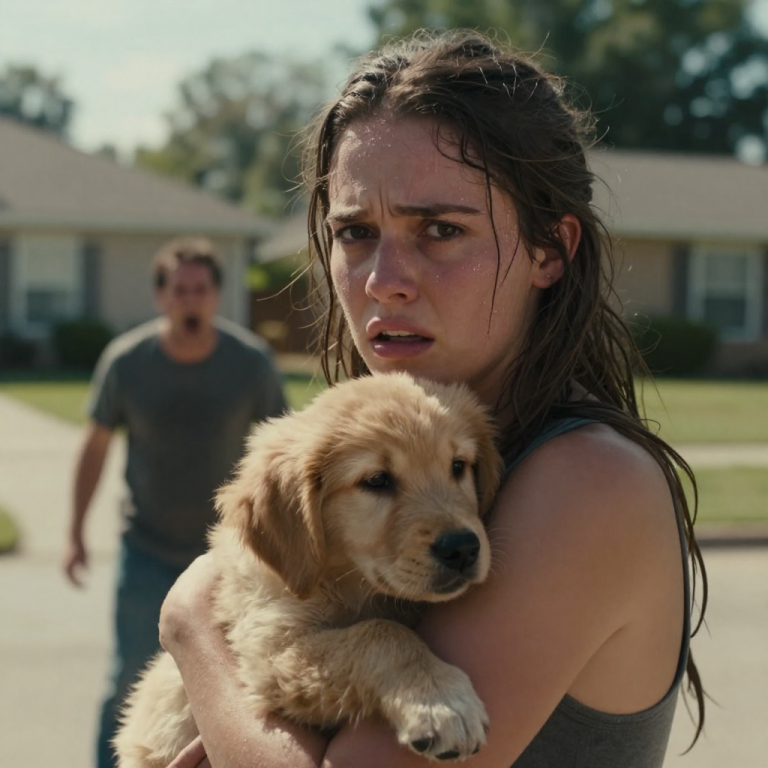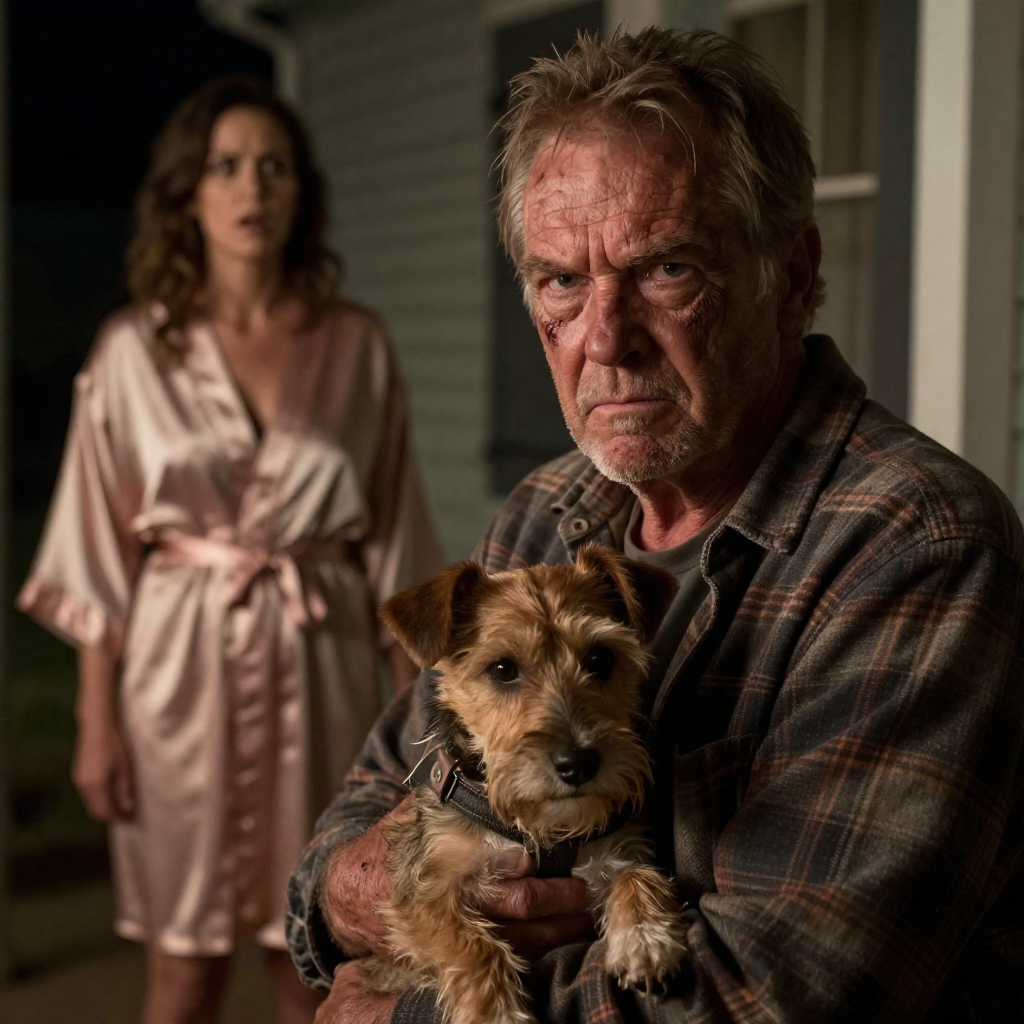
SHE SHOVED THE SHIVERING PUPPY OFF THE HIGH PORCH AND LAUGHED, BUT SHE DIDN’T KNOW A RETIRED HOMICIDE DETECTIVE WAS WATCHING FROM THE DARK.
The sound of a screen door slamming shut has a specific rhythm to it. In my line of work—or what used to be my line of work—it was often the punctuation mark at the end of a domestic dispute, usually right before the sirens started. I haven’t carried a badge in six years, but the instinct doesn’t retire just because you do. You don’t unlearn the sound of trouble.
It was a Tuesday, humid and heavy, the kind of heat that sticks your shirt to your back even when the sun goes down. I was sitting on my front porch in the dark, a habit I picked up after thirty years in the force. I like the shadows. They feel safer than the light. From my rocking chair, hidden behind the overgrown hydrangeas I keep meaning to trim, I had a clear view of the house next door.
Sheila moved in three months ago. She was loud, the kind of loud that demands attention but resents it when she gets it. She drove a silver sedan she couldn’t afford and wore heels that clicked aggressively on the pavement. But the thing I noticed most wasn’t her car or her clothes. It was the dog.
He was a terrier mix, mostly wiry hair and trembling legs. Scruffy thing. Maybe ten pounds soaking wet. She called him “Buster,” but she said the name like it was a curse word. I’d seen her yank the leash hard enough to lift his front paws off the ground. I’d seen her leave him out in the rain while she sat inside watching TV, the blue light flickering against the window while he scratched at the door. I cataloged these things. It’s what I do. I build a case in my head, even when there’s no judge to hear it.
That night, the yelling started before the door even opened.
“Get out! Just get the hell out!”
The screen door flew open, bouncing off the siding. Sheila stumbled out, a glass of wine in one hand, her phone in the other. Buster skittered out ahead of her, his tail tucked so far between his legs it was practically glued to his stomach. He didn’t run away; that was the saddest part. He just ran to the edge of the porch and froze, shaking, waiting for instructions that were never going to be kind.
“Look at you,” she slurred, stepping into the yellow circle of the porch light. “Useless. Absolutely useless. You peed on the rug again? Is that it? You think I buy expensive rugs for you to ruin them?”
Buster lowered his head, his ears pinned back. He let out a low, pathetic whine. It wasn’t a growl. It was a plea.
I stopped rocking. My hand tightened around the armrest of my chair. I’ve seen bad people do bad things to good people. I’ve seen parents hurt children. I’ve seen husbands hurt wives. But there is a specific, cold kind of evil reserved for people who hurt animals. It’s the bullying of the voiceless. It’s power exercised purely for the sake of power.
“Shut up!” she screamed, lurching forward. “I am sick of looking at you!”
She cornered him. Her porch was raised—a good five or six feet off the ground, with a concrete landing pad at the bottom of the stairs but hard-packed dirt and decorative rocks directly below the railing. Buster backed up until his hind legs hit the wooden lattice of the railing. He had nowhere to go.
“Please,” I whispered to myself, the old cop prayer. “Don’t do it. Just go back inside.”
She didn’t go back inside. She pointed a manicured finger inches from the dog’s wet nose.
“I should just get rid of you,” she spat. “Right now. Who would care? Huh? Who would even care?”
Buster licked his lips nervously. He looked up at her, eyes wide, searching for a shred of mercy in the woman who fed him.
Then, she laughed. It was a short, sharp sound.
“You want to go outside?” she asked, her voice dropping to a mock-sweet tone that made my stomach turn. “Fine. Go outside.”
She didn’t kick him. That would have been impulsive. This was deliberate. She bent down, grabbed him by the scruff of his neck and the loose skin of his back, and she lifted him. He yelped—a high-pitched screech of terror—and scrambled his legs in the air.
“Fly, Buster,” she said.
And she shoved him. She threw him over the railing.
Time slows down when you witness violence. It’s a survival mechanism. Your brain tries to process the threat frame by frame. I saw the arc of his small body against the night sky. I saw his legs flailing, trying to find purchase on air. I saw Sheila turn away before he even hit the ground, lifting her wine glass to her lips like she’d just taken out the trash.
The sound of the impact was sickening. A dull thud, followed by a sharp crack.
Then, silence.
That was the worst part. He didn’t cry out. He didn’t whimper. He just hit the rocks and went silent.
I was moving before I made the conscious decision to stand up. The aches in my knees, the stiffness in my back—it all vanished. I crossed my lawn in three strides, vaulting the low hedge that separated our properties. I didn’t run. Running makes people panic. I walked with the heavy, inevitable momentum of a freight train.
Sheila was leaning against the doorframe, tapping on her phone. She didn’t even look down to check on him.
“Hey!” I didn’t shout. I projected. It’s a voice that cuts through noise, a voice that stops suspects in their tracks.
Sheila jumped, dropping her phone. It clattered onto the wooden deck. She spun around, squinting into the darkness.
“Who’s there? Who is that?”
I stepped into the pool of light at the bottom of her stairs. I didn’t look at her. I went straight to the pile of grey fur lying on the rocks.
Buster was alive. I could see the rapid, shallow rise and fall of his ribs. His leg was bent at a wrong angle, twisted beneath him, and blood was trickling from his nose. He was in shock. His eyes were open, staring blankly at the dirt, glazed over with pain.
“Don’t move, buddy,” I murmured, my voice dropping an octave, becoming soft, gentle. “I got you. I’m here.”
“Excuse me?” Sheila’s voice rang out from above. “What are you doing in my yard? That’s private property!”
I took off my flannel overshirt and carefully wrapped it around the dog. He flinched but didn’t bite. He was too broken to fight. I scooped him up, supporting his weight, mindful of the twisted leg. He felt incredibly light, fragile, like a bundle of hollow bones.
“I said, what are you doing?” Sheila screeched. “Put my dog down!”
I turned slowly. I held the dog against my chest with one arm, shielding him. I looked up at her.
I let her see my face.
I have a scar that runs through my left eyebrow, a souvenir from a raid in ’98. I have eyes that have looked at crime scene photos that would make her vomit. I didn’t look like a neighbor. I looked like a reckoning.
“Your dog?” I asked. The calm in my voice was terrifying, even to me.
“Yes! Buster! Put him down or I’m calling the police!”
She reached for her phone on the deck, stumbling a little.
“Go ahead,” I said. I took a step up the stairs. The wood creaked under my boot.
She froze, hand hovering over the device. “What?”
“Call them,” I said, taking another step. “Call the police. Tell them you just threw a twelve-pound animal off a six-foot drop. Tell them you laughed while you did it.”
“I… he fell,” she stammered, the bravado slipping. “He jumped. He’s crazy. He jumped!”
“I was sitting twenty feet away,” I said. “I saw you lift him. I saw you throw him. And in the state of this state, animal cruelty is a felony. Aggravated cruelty? That’s prison time, Sheila.”
Her face went pale beneath the makeup. She gripped the railing. “You… you were watching me? You creep! You stalker!”
“I’m a witness,” I corrected her. “And I’m a retired Homicide Detective. Which means when the patrol car rolls up, they’re going to know my name. And when I tell them what you did, they aren’t going to ask you for your side of the story. They’re going to ask you to put your hands behind your back.”
She stared at me, her mouth opening and closing like a fish out of water. She looked at the dog in my arms, then back at my face. She saw the truth there. She saw that I wasn’t bluffing.
“He’s my property,” she whispered, but the venom was gone, replaced by fear.
“Not anymore,” I said.
I turned my back on her. It was the ultimate sign of disrespect, and the ultimate sign of control. I knew she wouldn’t attack me. Cowards only punch down.
“Where are you going?” she cried out, her voice cracking. “You can’t just take him!”
I walked back toward my house, feeling the heat of the dog’s body against my chest. He let out a small sigh, resting his head against my shoulder. He knew. Animals always know who the protectors are.
“I’m taking him to the emergency vet,” I called back without stopping. “And then I’m calling my old partner at the precinct. If I were you, Sheila, I wouldn’t worry about the dog. I’d worry about what you’re going to wear for your mugshot.”
I reached my porch and opened the door. Behind me, I heard Sheila burst into tears—loud, performative sobs meant to garner sympathy from a neighborhood that was fast asleep.
I looked down at the bundle in my arms. Buster looked up at me, one eye swollen shut, the other clear and brown. He licked my hand. A single, tentative lick.
“It’s over,” I told him. “You’re safe now.”
But as I walked into my kitchen and laid him gently on the table to check his injuries, I knew it wasn’t over. Sheila wasn’t the type to go down quietly. She had money, or at least she pretended to. She had entitlement. And she had just been humiliated.
I grabbed my phone and dialed the number I hadn’t used in years.
“Baker,” a gruff voice answered on the second ring.
“It’s Miller,” I said. “I need a favor. And I need a squad car.”
I didn’t know then that Sheila was already on the phone too. And she wasn’t calling a lawyer. She was calling someone much worse.
CHAPTER II
The silence in my kitchen was the heaviest thing I’d carried in years. It wasn’t the peaceful silence of a retired man; it was the pressurized quiet of a bomb squad technician waiting for a click. Buster was huddled on a pile of old towels near the radiator, his breathing a shallow, rhythmic rasp that seemed to sync up with the ticking of the clock over the stove. I’d given him some water, which he’d lapped at tentatively, but he wouldn’t look at me. His eyes were fixed on the door, wide and rimmed with white, as if he expected the wood to splinter at any moment.
My hands were shaking. I held them under the faucet, letting the cold water numb the tremors. It was an old trick from the field—cold for the nerves, heat for the aches. But the aches were deeper tonight. They weren’t just in my joints; they were in the memory of the way Sheila’s face had twisted when I’d stood over her. It wasn’t fear of me that I’d seen in her eyes in those final seconds. It was a calculated, cold realization. She wasn’t a woman who’d lost a fight; she was a woman who’d just started one.
I looked at the phone on the counter. Baker hadn’t called back yet. He was probably still at the precinct, buried in paperwork or nursing a drink at the bar across the street where the old guard used to congregate. I needed him to run a name, but more than that, I needed a voice that didn’t sound like it was judging me for being an old man who’d finally cracked.
Then the lights hit the window. Not the soft, yellow sweep of a passing car, but the rhythmic, aggressive strobing of red and blue. It washed over the kitchen walls, turning the white tile into a crime scene. I didn’t get up immediately. I just stood there, watching the colors pulse against the refrigerator. I knew that rhythm. I’d lived by it for thirty years. But for the first time in my life, I was on the wrong side of the glass.
I walked to the front door, my knees popping with every step. I didn’t turn on the porch light. I didn’t have to. The spotlights from the two cruisers parked at the curb were bright enough to blind. I saw them before they saw me—two young officers, uniforms crisp, belts heavy with gear that looked far more tactical than anything I’d worn in the nineties. They were standing by their open doors, hands hovering near their hips. Between them stood Sheila.
She was a different woman than the one I’d left on the porch an hour ago. The rage was gone, replaced by a fragile, trembling vulnerability that made my stomach turn. She was wrapped in a thick cardigan, clutching it to her chest, her hair disheveled just enough to look like she’d been through a struggle. When she saw me, she let out a small, choked sob and pointed a shaking finger.
“That’s him,” she cried, her voice carrying through the quiet street. “He broke into my house. He hit me and took my dog. Please, I’m scared he’s going to hurt him.”
The younger of the two cops, a tall kid with a buzz cut and eyes that hadn’t seen enough tragedy to be tired yet, stepped forward. “Mr. Miller? I’m Officer Chen. We need you to step out onto the porch with your hands where we can see them.”
I didn’t argue. I knew the protocol. I stepped out, the cold night air biting through my flannel shirt. I kept my hands open and visible. I felt the weight of my neighbors’ stares from behind their darkened windows. This was the trigger. This was the moment the world shifted. In a small neighborhood like this, you aren’t what you do for thirty years; you are what people see on a Tuesday night. And tonight, they saw a retired detective being treated like a common thief.
“Officer Chen,” I said, my voice low and steady. “I know how this looks. But I didn’t break in. I intervened. That woman threw that dog off a six-foot porch. The animal is injured inside. I’m a retired Homicide Detective, thirty years in the Fourth District. Check my ID in my back pocket.”
Chen didn’t move. He looked at his partner, an older guy named Halloway who I vaguely recognized from a retirement dinner. Halloway stepped up, his expression unreadable. “Miller? Is that you, Jim?”
“It’s me, Hal,” I said. “Look, she’s lying. She’s spinning a tale because she knows she’s in trouble for animal cruelty. The dog has a broken leg, maybe worse.”
Sheila’s voice rose to a shriek. “He’s lying! He’s always been a bully! He’s been watching me from his window for weeks! He’s obsessed! Officer, please, my brother is Julian Vance. He told me to call you directly. He’s on his way.”
The air seemed to go out of the yard. Julian Vance. The name hit me like a physical blow to the solar plexus. Vance wasn’t just a name; he was a power. He was a wealthy developer who’d practically bought the city council, a man with deep pockets and even deeper grudges. He was also a man who’d once been at the center of a corruption probe I’d tried to spearhead ten years ago. A probe that had been shut down from the top. A probe that had cost me my reputation and nearly my pension. That was my secret—the one I’d buried under layers of cynical retirement. I hadn’t just left the force; I’d been pushed out because I’d touched a wire that was still live.
Halloway’s posture changed instantly. The professional distance evaporated, replaced by a nervous, twitchy energy. “Miller, if Julian Vance is involved in this, you need to hand over the dog right now. This isn’t just a neighborhood dispute anymore.”
“I’m not giving her back that animal, Hal,” I said, my jaw tightening. “You know what happens to dogs like Buster in houses like that. He’s a piece of property to her, a thing to be kicked when she’s frustrated. I’ve seen the bruises on that dog.”
“It doesn’t matter what you’ve seen,” Halloway said, stepping closer, his voice dropping so Sheila couldn’t hear. “She’s calling it theft and assault. She’s got a bruise on her arm, Jim. She says you grabbed her. If Vance shows up and his sister is crying and you’re holding her property, I can’t protect you. You know how this works. The law doesn’t care about the dog’s feelings. It cares about the deed to the house and the title on the collar.”
This was the moral dilemma. If I handed Buster over, the charges would likely disappear. Vance would make sure the ‘misunderstanding’ was swept under the rug to avoid a public scandal involving his sister. But Buster would go back to that porch. He’d go back to the darkness and the fear, and next time, Sheila might not stop at a six-foot drop. If I kept him, I was a felon. I was a disgraced cop who’d finally lost his mind. I’d lose my house, my remaining dignity, and quite possibly my freedom.
“I can’t do it,” I whispered.
“Jim, don’t be a fool,” Halloway pleaded. “Think about your pension. Think about your life. It’s just a dog.”
“It’s never just a dog,” I said, the words tasting like copper in my mouth. I was thinking of an old wound—a case from ’98. A little boy named Leo. I’d seen the signs of abuse, but the father was a local hero, a high school coach. I’d followed the rules. I’d waited for the proper warrants. I’d let the system work. And by the time the system was ready, Leo was in a pine box. I’d carried that failure like a shard of glass in my heart for twenty-five years. I wasn’t going to let the system work tonight.
A black SUV pulled up behind the cruisers, its engine a low, expensive hum. The door opened, and a man stepped out who looked like he’d been carved from cold marble. Julian Vance didn’t look like a villain; he looked like a solution. He was impeccably dressed, his face a mask of concerned authority. He didn’t look at me. He went straight to Sheila, putting an arm around her shoulders. She buried her face in his chest, the perfect image of a victim.
Vance looked at Halloway. “Officer, why is this man still standing on his porch? My sister has been assaulted and her property stolen. I expect an arrest.”
“Mr. Vance, we’re just trying to clarify the situation,” Halloway said, his voice hitching. “Mr. Miller is a former detective…”
“I don’t care if he’s the Pope,” Vance said, his voice cutting like a razor. “He’s a private citizen who committed a violent crime. If you don’t do your job, I’ll call the Commissioner. Right now.”
Chen moved toward me, his hand on his handcuffs. “Mr. Miller, turn around.”
At that moment, an Animal Control van pulled up. It was public now. The whole block was watching. Mrs. Gable from three doors down was on her porch with a phone out, recording. The irreversible moment had arrived. They weren’t just taking me; they were taking the dog. A man in a tan uniform stepped out of the van, carrying a catch-pole—a long, cruel-looking stick with a wire loop at the end.
“No,” I said, stepping back into the doorway. “You’re not putting that thing on him.”
“Jim, stop,” Halloway warned. “You make a move now, and it’s resisting. I don’t want to do this.”
I looked at Vance. He was watching me with a faint, mocking smile. He knew he’d won. He knew the levers of the world, and he knew I was just a rusted gear. He thought this was about a dog. He didn’t realize that for me, this was the only way to finally stop the bleeding from an old wound.
I turned back to the officers. “The dog stays. If you want him, you’ll have to come inside. And you’ll need a warrant for that, because despite what Mr. Vance thinks, his sister doesn’t own the Fourth Amendment.”
“He’s got a weapon!” Sheila suddenly screamed, pointing at nothing. “I saw a gun in his waistband!”
It was a blatant, desperate lie, but in the tension of the moment, it was enough. Chen and Halloway both drew their weapons in a blur of motion. “Hands! Hands up now! Drop to your knees!”
I froze. My heart was drumming against my ribs. I had no weapon. My service piece was locked in a safe upstairs, its oil long since dried. But the lie had changed the physics of the scene. I was no longer a neighbor or a former colleague; I was a threat.
“I’m unarmed,” I said, keeping my voice as flat as possible. “Check the video from your body cams. She’s lying.”
“Down on the ground!” Chen yelled, his voice cracking with adrenaline.
I lowered myself slowly, my knees screaming in protest. The gravel of the porch bit into my skin. As Halloway moved in to cuff me, the Animal Control officer brushed past and entered my house. A few seconds later, I heard it—the sound that will haunt me until the day I die. It was Buster. Not a bark, not a growl, but a high-pitched, terrified yelp of absolute betrayal. Then the sound of a struggle, the scraping of claws on the linoleum, and the heavy thud of the door.
The man emerged, dragging Buster by the neck with the catch-pole. The wire loop was tight, choking the life out of the small dog as he thrashed, his injured leg dangling uselessly. Sheila didn’t look away. She watched with a grim, satisfied expression.
“Got the asset,” the Animal Control officer said, his voice bored, as he hoisted the struggling dog into the back of the van.
They loaded me into the back of Chen’s cruiser. The plastic seat was cold and smelled of bleach and old sweat. As we pulled away, I looked out the window. Vance was shaking Halloway’s hand. Sheila was standing on her porch, staring at my dark house. She’d won the first round. She had the dog, she had the law, and she had the power.
But as the cruiser turned the corner, I felt something cold and hard settle in my chest. It was the feeling I used to get right before a breakthrough in a homicide case. It was the clarity of a man who had nothing left to lose. They thought they’d broken me, but all they’d done was remind me of who I used to be.
I remembered the secret I’d kept for a decade—the file I’d never turned in, the one stashed in the lining of an old suitcase in my attic. It contained the real reason the Vance investigation had been killed. It wasn’t just corruption; it was a paper trail that led directly to the current Commissioner’s office. I’d kept it as insurance, a ‘dead man’s switch’ to protect my pension. I’d been a coward for ten years, choosing my own comfort over the truth.
But as I thought of Buster’s yelp, the cowardice evaporated. The moral dilemma was gone. There was no ‘right’ choice that didn’t involve sacrifice. If I had to burn my own life to the ground to take Vance and his sister with me, then I’d just have to learn to like the smell of smoke.
“Officer Chen,” I said, leaning my head against the plexiglass divider.
The kid looked at me in the rearview mirror, his eyes filled with a mix of fear and guilt. “Don’t talk to me, Miller. You’re under arrest.”
“I just wanted to tell you one thing,” I said, my voice sounding like it was coming from a long way off. “Tell Halloway to check the porch. There’s a hidden security camera in the birdhouse. It’s been running for six months. It saw everything Sheila did. And it saw exactly how she lied to you tonight.”
It was a bluff. There was no camera in the birdhouse. But I watched Chen’s eyes widen. I saw the doubt creep in. And I knew that by the time they realized there was no footage, I’d be out on bail, and the real investigation would begin. The detective wasn’t retired anymore. He was just working a new beat.
As we pulled into the precinct, the rain began to fall—a cold, needles-sharp downpour that washed the dust off the windshield. I looked at the gray walls of the station where I’d spent half my life. I was going inside as a prisoner, but for the first time in years, I felt like a free man. The old wound was open, the secret was ready to be told, and the fight was finally, mercifully, unavoidable.
CHAPTER III
The air outside the precinct didn’t taste like freedom. It tasted like damp asphalt, cheap cigarettes, and the metallic tang of a storm that refused to break. My wrists felt light without the cuffs, but the skin was chafed, a red reminder of where I’d spent the last twelve hours. Baker was waiting by his sedan, the engine idling in a low, rhythmic growl that matched the throbbing in my temples. He didn’t say a word as I walked toward him. He just opened the passenger door and nodded. He knew. He knew that every second I spent breathing in the recycled air of a jail cell, Buster was breathing in the scent of a woman who saw him as an object to be broken.
“They let you out fast,” Baker said, his voice a gravelly low-end frequency as we pulled away from the curb. “Vance must think he’s already won.”
“He thinks he’s buried me,” I said, staring out at the blurred streetlights of a city I used to protect. My hand went instinctively to my inner jacket pocket. The file wasn’t there—it was safe in my floorboard safe at home—but the weight of the secrets inside it felt like a lead weight against my ribs. “Where’s the dog, Baker? Halloway said Animal Control took him, but I know how the game is played.”
Baker gripped the steering wheel until his knuckles went white. “They didn’t take him to the county shelter, Jim. Julian Vance made a phone call. Emergency injunction. Claimed the dog was ‘evidence’ in an ongoing investigation and needed to be returned to the ‘victim’ for safekeeping until the hearing. Sheila’s got him. She’s had him for three hours.”
A cold, hollow sensation opened up in my gut. Three hours. In three hours, a person like Sheila, backed by a man like Julian, could make a small living thing disappear forever. They wouldn’t even have to do it themselves. They’d just find a vet who owed a favor or a patch of woods far enough away from the neighbors. My ‘Old Wound’—the ghost of the girl I couldn’t save ten years ago—flared up like a physical burn. I could still see her face, and now it was blending with Buster’s wide, trusting eyes. I couldn’t let it happen again. Not this time. Not when I had the fire to burn their whole world down.
“Take me home,” I said. My voice was flat, devoid of the anger that usually fueled me. This was past anger. This was math. Cold, hard, tactical math.
“Jim, if you go after them now, you’re violating bail. You’ll never see the light of day again. Your pension, your house—it’s all gone.”
“It’s already gone, Baker. The moment they put those cuffs on me, they took the only thing I had left: my name. If I’m going to be a villain in their story, I might as well be the one that keeps them awake at night.”
We reached my house in silence. The yellow crime scene tape across my porch was flapping in the wind, a cheap plastic shroud for a life that had ended. I didn’t care about the tape. I didn’t care about the neighbors watching from behind their curtains. I went straight to the bedroom, pulled up the floorboard, and grabbed the manila envelope. Inside were the bank statements, the land deeds, and the photographs of Julian Vance meeting with the very people he was supposed to be prosecuting. It was my insurance policy. It was my retirement. And now, it was my ransom.
I sat at my kitchen table for five minutes, just staring at the names. I could hear the clock ticking on the wall. Each tick was a heartbeat. Was Buster still breathing? Was he shivering in that crate in Sheila’s garage? I pulled out my phone and dialed a number I hadn’t called in three years. It wasn’t the police. It wasn’t a lawyer. It was the lead investigator for the State Attorney’s Office—the one office Julian Vance couldn’t touch.
“It’s Jim Miller,” I said when the man picked up. “I have the Ledger. Not the one you looked for during the 2018 audit. The real one. I’m going to Sheila Vance’s house right now. If I don’t call you in twenty minutes to tell you I’m safe, the entire digital backup goes to the press, and the physical copies end up on your doorstep. But if you want the arrest of the century, you’ll get a car to that address in ten.”
I didn’t wait for an answer. I hung up, grabbed my keys, and walked out. Baker was still in the driveway. He saw the look in my eyes and stepped back. He didn’t try to stop me. He just watched as I backed my truck out and headed toward the house next door. It was only fifty yards away, but it felt like I was crossing a border into a different country.
I didn’t knock. I kicked the front door of Sheila’s house. The wood groaned but held. I kicked again, the ghost of my younger self—the man who kicked down doors for a living—taking over. On the third strike, the frame splintered. I stepped into a hallway that smelled like expensive perfume and rot. Sheila was standing in the kitchen, a glass of wine in her hand, her face pale with a mixture of shock and predatory glee. Behind her, sitting at the island, was Julian. He looked immaculate in a grey suit, his hands folded neatly in front of him. He didn’t look like a criminal. He looked like a man waiting for a business meeting to begin.
“You just threw your life away, Detective,” Julian said softly. He didn’t even stand up. “Breaking and entering while out on bail? I won’t even have to try. The system will swallow you whole.”
“Where is the dog, Julian?” I asked. My heart was a drum in my chest, but my hands were steady.
Sheila let out a sharp, jagged laugh. “He’s where he belongs. Being dealt with. You thought you were a hero? You’re just a nuisance we’re finally swatting.”
“I’m not here to argue with you, Sheila,” I said, turning my gaze to Julian. I tossed a single photocopy from the envelope onto the marble island. It was a picture of Julian handing a briefcase to a man named Moretti—a name that meant certain death for any political career. Julian’s eyes flickered. Just for a second. It was the look of a man who had just realized the bridge behind him was on fire.
“That’s old news, Jim. Unverifiable.”
“The birdhouse camera,” I said. The lie tasted like copper, but I pushed it through. “You were so focused on the dog, you didn’t look at the angle of the lens. It’s a wide-angle, Julian. It didn’t just catch Sheila throwing Buster off the porch. It caught your car parked in my driveway last Tuesday. It caught you handing that same briefcase to Judge Sterling. Audio and video. High definition. It’s already on a cloud server. If I don’t enter a deactivation code in the next ten minutes, it hits the State Attorney, the FBI, and every news outlet in the tri-state area.”
Julian stood up then. The mask of calm didn’t just slip; it shattered. He looked at Sheila, then back at me. I saw the calculation happening in his brain. He was weighing his sister’s pride against his own survival. It wasn’t even a contest. Men like Julian Vance don’t have loyalties; they have assets. And right then, Sheila was a liability.
“Sheila,” Julian said, his voice dropping an octave. “Where is the dog?”
“Julian, you can’t be serious! He’s bluffing! He’s a washed-up drunk with a—”
“WHERE IS THE DOG?” Julian screamed. The sound echoed through the house, shattering the suburban silence. Sheila flinched, the wine sloshing out of her glass and staining her white rug like blood.
“The garage,” she whispered, her voice trembling. “In the trunk of the Lexus. I was… I was going to take him to the woods after dark.”
I didn’t wait for another word. I sprinted through the kitchen and into the garage. The Lexus was a gleaming silver beast in the shadows. I hit the trunk release on the wall. The lid hummed open. And there he was. Buster was curled into a ball, his breathing shallow and fast, his coat matted with sweat and fear. He looked up at me, and for a second, he didn’t wag his tail. He just shivered. I reached in and scooped him up. He was so light. So fragile. I tucked him under my arm, his head resting against my shoulder, and walked back into the kitchen.
Julian was on his phone, his face ashen. He was trying to call someone, probably a lawyer or a fixer, but I knew it was too late. I had made the call. The dice were already rolling.
“The birdhouse was a bluff, wasn’t it?” Julian asked, looking at me with a newfound, terrifying respect. “There was no audio of the judge.”
“Maybe,” I said. “But the file in my truck isn’t a bluff. And the State Attorney is five minutes away. You should have just let me keep the dog, Julian. You should have just been a decent neighbor.”
“You’re destroying yourself too, Jim,” Sheila spat, her eyes red with fury. “You’ll go to prison for this. You broke into my house. You’ve got no evidence that will hold up once Julian’s lawyers get through with it.”
“I don’t care,” I said, and for the first time in years, I meant it. “I saved the only thing in this neighborhood worth saving.”
Outside, the world turned blue and red. The sirens were distant at first, then deafening. But it wasn’t the local precinct. It wasn’t Halloway or Chen coming to finish the job. These were the black-and-whites of the State Police. They swarmed the driveway, their boots heavy on the pavement. I saw the lead investigator, the man I’d called, step out of the lead car. He looked at me, then at the house, then at Julian Vance standing in the doorway.
I walked out onto the lawn, still holding Buster. I felt the weight of the moment—the irreversible shift of power. Julian Vance, the man who owned the city, was being forced to put his hands behind his back. Sheila was screaming about her rights, her voice a shrill, dying echo. I sat down on the curb, the cold concrete seeping through my jeans. I let Buster down, and he immediately crawled into my lap, burying his nose in the crook of my elbow.
Baker walked over and stood over me, blocking the glare of the police lights. “You did it, Jim. You actually did it.”
“I lost everything, Baker,” I said, watching as they led Julian away in handcuffs. The ‘Secret’ was out. The file would be processed. My pension would be stripped the moment they realized I’d withheld evidence for years. I’d likely face charges for the break-in, maybe even for the corruption I’d sat on. My house would be sold to pay the legal fees. My name would be dragged through the mud of every court in the state.
“No,” Baker said, looking down at the dog, who was finally, tentatively, wagging his tail against my leg. “You didn’t lose everything.”
I looked at Buster. His eyes were clear now, reflecting the flashing lights. He wasn’t a piece of evidence anymore. He wasn’t a victim. He was just a dog who wanted to go home. I leaned my head back against the cold metal of Baker’s car and closed my eyes. The storm had finally broken, and while the rain was starting to fall, washing away the dirt and the noise, I realized I’d never felt cleaner. The price was high—higher than most would ever pay—but as I felt the warmth of the dog against my chest, I knew I’d finally settled the debt of the ‘Old Wound.’ I hadn’t saved the girl all those years ago. But I had saved him. And in the wreckage of my life, that was enough.
CHAPTER IV
The squad car idled, a silent sentinel. Halloway, looking less self-assured than usual, watched me from behind the wheel. Chen stared straight ahead, his face a mask. They’d driven me home from the station after the arraignment – breaking and entering, evidence tampering, a laundry list of charges I couldn’t even pretend weren’t true. The State Attorney’s office was ‘grateful’ for my help, but the law was the law.
I stepped out onto the curb, Buster padding close. The setting sun cast long shadows, making my little bungalow look smaller, more vulnerable than ever. I knew the neighbors were watching, curtains twitching. My life had become a public spectacle, a cautionary tale.
‘Thanks for the ride,’ I said, my voice raspy. Halloway just nodded, avoiding eye contact. Chen offered a curt, ‘Miller.’ The car pulled away, leaving me alone with the dog and the weight of what I’d done. It wasn’t just the charges hanging over my head. It was the look in Sarah’s eyes – my daughter – when she’d visited me in jail. Disappointment, yes, but something else too. Fear, maybe?
I unlocked the front door, the familiar creak suddenly amplified in the silence. The house felt empty, colder than usual. I hadn’t realized how much I relied on the routines, the small comforts that defined my life before Buster, before Sheila Vance, before I decided to burn everything to the ground.
Buster nudged my hand, his tail giving a tentative wag. He didn’t understand the mess I’d made, the storm I’d unleashed. All he knew was that I was here, and that was enough for him. I knelt down, burying my face in his fur. ‘We’re in this together, pal,’ I muttered. ‘We’ll figure it out.’ But even as I said the words, I wasn’t sure I believed them.
Days blurred into weeks. The media circus slowly died down, replaced by a low, constant hum of gossip. My phone stopped ringing. Even Baker seemed to be keeping his distance, his visits less frequent, his jokes less enthusiastic. I couldn’t blame him. Associating with me was bad for business. Bad for anyone.
The legal process lumbered forward. My lawyer, a young woman named Lisa, was doing her best, but the case was a mess. The DA was under pressure to make an example of me, to show that no one was above the law, not even a ‘hero’ cop. Lisa explored every angle, every loophole, but Julian Vance’s shadow loomed large. His network of influence, though damaged, was far from destroyed. He still had friends in high places, people who owed him favors, people who were willing to make my life a living hell.
The hardest part was seeing Sarah. She came by once a week, always on a Sunday afternoon. We’d sit in the living room, making small talk, avoiding the elephant in the room. I could see the strain in her face, the worry etched around her eyes. She was trying to be supportive, but she didn’t understand. She couldn’t understand why I’d thrown everything away for a dog, for a principle.
One Sunday, she brought my grandson, little Mikey. He ran straight to Buster, tackling him in a hug. Buster, usually so cautious, licked Mikey’s face, tail wagging furiously. Watching them, I felt a pang of something I hadn’t felt in a long time: joy. A simple, uncomplicated joy.
‘Grandpa, can we keep Buster?’ Mikey asked, his eyes wide with hope. I looked at Sarah. Her expression was unreadable. ‘We’ll see, sweetie,’ she said gently. ‘We’ll see.’
That night, I couldn’t sleep. Mikey’s question echoed in my head. *Can we keep Buster?* It wasn’t just about the dog. It was about everything. About my past, my future, my legacy.
I knew what I had to do. I called Lisa and told her to set up a meeting with the DA.
The meeting was held in a sterile conference room downtown. The DA, a stern-faced man named Thompson, didn’t offer me a seat. He stood behind his desk, his arms crossed. ‘Mr. Miller,’ he said, his voice cold. ‘I’m prepared to offer you a deal. A reduced sentence, probation. In exchange for a guilty plea and a full confession.’
I nodded. ‘And Buster?’
Thompson hesitated. ‘The dog is not part of the agreement.’
‘Then there’s no deal,’ I said, turning to leave.
‘Wait,’ Thompson said, his voice sharper. ‘What do you want, Miller?’
‘I want assurance that Buster will be safe. That he’ll never go back to Sheila Vance. That he’ll be protected.’
Thompson sighed. ‘That’s not my jurisdiction.’
‘Then find someone who does,’ I said. ‘Because I’m not pleading guilty to anything until I know that dog is taken care of.’
The negotiation stretched for hours. Lisa worked tirelessly, shuttling between rooms, relaying offers and counteroffers. Finally, as the sun began to set, they reached an agreement. I would plead guilty to a lesser charge – obstruction of justice – and receive a suspended sentence. In exchange, the State would guarantee Buster’s safety and place him in a foster home, pending a full investigation into Sheila Vance’s animal abuse.
It wasn’t a perfect solution. I still had a criminal record, still faced the stigma of my actions. But Buster was safe. And that was all that mattered.
The next day, I drove Buster to the animal shelter. He seemed to sense something was wrong, whining and pawing at my arm. It broke my heart to leave him, but I knew it was the right thing to do. He deserved a better life, a life free from fear and violence.
As I walked away, I turned back to look at him one last time. He was standing at the window, his tail drooping, his eyes filled with confusion. I raised my hand in farewell, tears streaming down my face.
The following weeks were quiet, almost eerily so. I spent my days cleaning the house, tending to the garden, trying to fill the void that Buster had left behind. I missed his wet nose nudging my hand, his happy barks, his unwavering loyalty.
One afternoon, Lisa called. ‘Good news, Jim,’ she said. ‘The investigation into Sheila Vance is complete. They’re filing charges. And… the foster family wants to adopt Buster permanently.’
A wave of relief washed over me. ‘That’s… that’s wonderful,’ I stammered.
‘They’re a nice couple,’ Lisa continued. ‘They have a big yard, lots of kids. They’ll give him a good home.’
‘Can I… can I see him?’ I asked.
Lisa hesitated. ‘I don’t know, Jim. Maybe it’s best to let him move on.’
I knew she was right. Seeing him again would only reopen the wound, make it harder for both of us to heal. But I couldn’t resist the urge. ‘Just once,’ I pleaded. ‘Please.’
She relented. ‘I’ll see what I can do.’
A few days later, Lisa called again. ‘Okay, Jim,’ she said. ‘I’ve arranged a visit. But it has to be brief. And you can’t take him home.’
The foster family lived in a quiet suburban neighborhood, a world away from my little bungalow. The house was large and bright, with a sprawling lawn and a swing set in the backyard. As I walked up the driveway, I saw Buster through the window, playing with a group of children. He looked happy, carefree.
The foster parents, a middle-aged couple named Tom and Mary, greeted me at the door. ‘Thank you for letting me see him,’ I said, my voice trembling.
‘Of course,’ Tom said. ‘He’s a wonderful dog. We’re so glad to have him.’
They led me into the backyard. Buster saw me and stopped playing. He tilted his head, his tail giving a hesitant wag. Then, he broke into a run, leaping into my arms, licking my face.
I knelt down, hugging him tight. ‘Hey, pal,’ I whispered. ‘You’re okay. You’re safe.’
We spent the next hour playing fetch, running around the yard, just like old times. But it wasn’t the same. There was a distance between us, a sense of finality.
As I prepared to leave, Buster sat at my feet, his eyes fixed on mine. He seemed to understand that this was goodbye.
I knelt down, stroking his fur one last time. ‘You be a good boy, Buster,’ I said, my voice thick with emotion. ‘You deserve all the happiness in the world.’
I stood up and walked away, without looking back. I knew that if I did, I would never be able to leave.
Back at home, I sat on the porch, watching the sunset. The sky was ablaze with color, a fiery farewell to the day. I thought about everything that had happened, the choices I had made, the consequences I had faced.
I had lost my job, my reputation, my pension. I had alienated my friends and family. But I had saved a dog’s life. And in the end, that was all that mattered.
A new event occurred a few weeks after Buster was permanently placed with his new family. I received a letter. It wasn’t a formal legal document or a bill; it was handwritten, on simple, lined paper. The return address was a local women’s shelter. Inside was a short note: ‘Thank you for what you did. Because of you, I had the courage to leave.’ There was no signature.
I sat with that letter for a long time. It was a small thing, a single piece of paper, but it held more weight than all the accolades I’d ever received as a detective. It was a reminder that even in the darkest of times, one person can make a difference. That even when you lose everything, you can still find meaning in your actions.
The days turned into months. I started volunteering at the local animal shelter, walking dogs, cleaning cages, offering a comforting hand to the animals who had been abandoned and abused. It wasn’t the life I had planned, but it was a life of purpose. A life of redemption.
I never saw Julian Vance again. He was eventually convicted on multiple counts of corruption and sentenced to a long prison term. Sheila Vance received probation and was ordered to undergo psychological counseling. I heard rumors that she had moved out of town, changed her name, and was trying to start a new life.
Sometimes, I wondered about Buster. I imagined him running through the fields, playing with the kids, basking in the love of his new family. I hoped he had forgotten about me, that he was happy.
One evening, as I was walking a dog at the shelter, I saw a familiar figure approaching. It was Sarah, with Mikey in tow.
‘Grandpa!’ Mikey shouted, running to hug my legs. ‘We have a surprise for you!’
Sarah smiled. ‘We’ve been talking,’ she said. ‘And we think it’s time you had another dog.’
I looked at her, tears welling up in my eyes. ‘Sarah, I…’
‘No, Dad,’ she said, cutting me off. ‘It’s time. You deserve it.’
She led me to a cage in the back of the shelter. Inside was a small, scruffy terrier mix, with big, soulful eyes. He was trembling, scared.
‘He’s been here for a few weeks,’ Sarah said. ‘He was abandoned. They think he was abused.’
I knelt down, reaching out a hand. The dog flinched, but he didn’t run away. I gently stroked his fur. ‘Hey, buddy,’ I whispered. ‘It’s okay. You’re safe now.’
He licked my hand, his tail giving a tentative wag.
I looked at Sarah, and then back at the dog. I knew that I couldn’t replace Buster, that he would always hold a special place in my heart. But I also knew that this little dog needed me. And maybe, just maybe, I needed him too.
‘What do you say, Grandpa?’ Mikey asked, his eyes shining. ‘Can we take him home?’
I smiled. ‘Yeah, Mikey,’ I said. ‘I think we can.’
And as I walked out of the shelter, with my daughter, my grandson, and a new dog by my side, I knew that I had finally found peace. It wasn’t the peace I had expected, the peace of retirement and comfort. It was a different kind of peace, a peace born of sacrifice, of redemption, of love.
I had lost everything, but I had gained something far more valuable: a soul worth saving.
CHAPTER V
The courtroom felt smaller this time. Maybe it was just me, feeling smaller. The judge was different, younger, with tired eyes that didn’t seem to hold any judgment, just weariness. My lawyer, a public defender named Ms. Rodriguez, squeezed my arm. “Just answer the questions honestly, Mr. Miller. We’ve got a good deal here.” A good deal meant probation, community service, and a fine I could barely afford. It was better than jail. It was better than losing everything.
Julian Vance sat across the room, stone-faced, flanked by his own lawyers, expensive suits that reeked of power. He didn’t look at me, not once. I wondered if he even remembered me, or if I was just a gnat he’d swatted away. Sheila wasn’t there.
The hearing was a blur of legal jargon, admissions, and apologies. I said I regretted breaking the law, but I didn’t say I regretted saving Buster. Ms. Rodriguez kept me on track, reminding me to stick to the script. It was over quickly. Probation. Two hundred hours of community service. A five-thousand-dollar fine. I walked out of the courthouse a free man, but a diminished one.
The world felt different. Grayer. People hurried past, their faces blank, their lives untouched by the storm that had ripped through mine. I went back to my empty apartment. The silence was deafening. Buster was gone. My career was gone. My reputation, whatever was left of it, was gone. I sat in the old armchair, the one Buster used to jump on, and stared at the wall. I didn’t cry. I didn’t feel anything, just a hollow ache in my chest.
Days turned into weeks. I started my community service at the local animal shelter. Cleaning cages, feeding strays, walking dogs that had been abandoned and forgotten. It was humbling work, but it was honest. The animals didn’t care about my past. They didn’t judge me. They just needed food, water, and a little bit of affection. Slowly, the ache in my chest began to ease.
One afternoon, a little girl came to the shelter with her mother. She was looking for a dog, a small, gentle one. I showed her a scruffy terrier mix with big, soulful eyes. The girl knelt down and the dog licked her face. Her mother smiled. “He likes you,” she said. As they filled out the adoption papers, the girl turned to me. “Thank you,” she said. “For taking care of him.” That night, I slept a little better. Maybe I wasn’t completely worthless after all.
It wasn’t a grand return. It wasn’t even a comeback. It was just a quiet, slow rebuilding. Sarah came by more often, bringing Mikey. We’d sit in the backyard, watching him play with the new dog we’d adopted, a goofy golden retriever named Lucky. Mikey didn’t ask about my old job, or why I wasn’t wearing a badge anymore. He just wanted to play fetch, to be lifted up and spun around until he giggled. Those moments were enough.
I still thought about Buster. I wondered if he was happy, if he remembered me. I knew he was in a good home, that he was loved. And that was all that mattered. I started volunteering more at the shelter, helping other animals find their forever homes. It wasn’t the same as catching criminals, but it was a way to make a difference, to protect the vulnerable. I started to feel some purpose in my life again.
One day, I received a letter. It was from the woman’s shelter. Inside was a handwritten note. “Dear Mr. Miller,” it read, “Your actions have given me the strength to leave. Thank you for showing me that there is hope.” The letter was unsigned. I didn’t need a name. I knew who it was from. And in that moment, I understood. It wasn’t about the badge, or the gun, or the power. It was about the courage to stand up for what’s right, even when it’s hard, even when it hurts.
I wasn’t a hero. I was just a flawed man trying to do the right thing. And maybe, just maybe, that was enough. The animal shelter became my haven. I found solace in the quiet rhythm of caring for the animals, in the simple act of providing them with food, shelter, and affection. It was a far cry from the adrenaline-fueled world of detective work, but it was a world where I could make a tangible difference, where I could offer protection to those who couldn’t protect themselves.
I saw Julian Vance’s name in the papers from time to time. Another investigation, another scandal. He always seemed to wriggle out of it, his wealth and power shielding him from the consequences of his actions. It didn’t anger me anymore. It just made me sad. Sad for the people he hurt, sad for the system that allowed him to get away with it.
I focused on what I could control. My own life, my own actions. I started attending Alcoholics Anonymous meetings again. It was hard, admitting my weaknesses, facing my demons. But it was necessary. I needed to heal, to forgive myself. I started to see that my drinking had been a way of self-medicating, of numbing the pain of my past. Sobriety was a long, slow process, but with each day, I felt a little stronger, a little clearer. I didn’t want to be that man anymore. The man who drank to forget, who lashed out in anger, who pushed away the people who loved him.
Ms. Rodriguez called me a few months later. “Mr. Miller, I have some news. You’re eligible to have your record expunged.” I was surprised. I hadn’t even thought about it. “It won’t erase what happened,” she said, “but it will give you a clean slate.” I thought about it for a long time. Did I want to erase my past? Did I want to pretend that none of it had happened?
I decided against it. I told Ms. Rodriguez that I appreciated her offer, but I didn’t want to expunge my record. “It’s a part of who I am,” I said. “I can’t change it. I can only learn from it.” She understood. She said she respected my decision. It was a relief, in a way. To stop running, to stop hiding. To accept the consequences of my choices, and to move forward with my life.
Years passed. Mikey grew into a teenager, taller than me, with a mop of unruly hair and a passion for skateboarding. Sarah remarried, a good man who treated her with kindness and respect. Lucky, the golden retriever, grew old and gray, but he still greeted me with a wagging tail and a wet nose every morning. I still volunteered at the animal shelter. I wasn’t in the papers, or on the news. I was just Jim Miller, the old man who walked the dogs.
One sunny afternoon, I was sitting on a bench outside the shelter, watching the animals play. A young woman approached me. She had kind eyes and a gentle smile. “Mr. Miller?” she asked. I nodded. “I’m Emily,” she said. “I adopted Buster.” My heart skipped a beat. “He’s doing great,” she said. “He’s a wonderful dog. We love him very much.” She showed me a picture on her phone. Buster, older now, but still recognizable, was lying on a couch, surrounded by children. He looked happy.
Tears welled up in my eyes. I couldn’t speak. Emily took my hand. “Thank you,” she said. “For saving him.” I squeezed her hand back. “Thank you,” I managed to say. “For giving him a good home.” She smiled again, a warm, genuine smile. “He’s brought so much joy to our lives,” she said. “We’re very grateful.” She left, and I sat there on the bench, watching her walk away.
The sun was setting, casting long shadows across the yard. The air was filled with the sounds of barking dogs and happy children. I closed my eyes and took a deep breath. The ache in my chest was gone. Replaced by a quiet sense of peace. I had lost so much, but I had also gained so much more. I had learned the true meaning of courage, of compassion, of redemption. And I had found my place in the world, not as a hero, but as a protector, a caregiver, a friend.
My daughter and grandson came to visit. I watched Mikey running around in the yard with the dogs. I smiled. I had finally found a place to belong. A place where my past didn’t matter. A place where I was accepted for who I was, not for who I used to be. I wasn’t the man I once was, the detective with a badge and a gun. I was something different, something more. I was a survivor. I was a helper. I was a friend. I was enough.
I sat in my backyard, the sun warming my face, Lucky snoring at my feet, Mikey’s laughter echoing in the air. My daughter patted my shoulder. “You seem happy, Dad,” she said. I smiled. “I am,” I said. “I finally am.” The darkness that had haunted me for so long had finally lifted. I was free. Not free from my past, but free from its grip. I had made mistakes, I had caused pain, but I had also learned, and I had grown. And in the end, that was all that mattered.
The stars began to appear in the sky, one by one, like tiny diamonds scattered across a velvet cloth. The air grew cool, and I wrapped my arms around myself. I looked up at the stars, and I felt a sense of wonder, a sense of gratitude. I was alive. I was loved. And I was finally at peace.
It wasn’t the ending I had expected, but it was the ending I needed. A quiet ending. A simple ending. An honest ending. I had faced my demons, I had made amends, and I had found my way back to the light. And in that light, I saw the truth. That true worth comes not from status or power, but from selflessness and compassion. That redemption is not about erasing the past, but about learning from it, and using it to build a better future.
I looked at my grandson playing with the dogs, tail wags as he hugged them tight. I knew what kind of man I wanted to be from then on. A better one.
Time marches on. Julian Vance is dead, now. Died of a heart attack on his yacht, or so the papers said. Sheila is who knows where. Probably living off of her brother’s fortune somewhere far away. It doesn’t matter. I’m still here. Still volunteering. Still loving. Still learning.
The sun sets on my life. It’s okay. It’s more than okay. It’s what I was meant for, I think.
The dogs bark, the boy laughs, and the old man remembers everything that brought him here.
It wasn’t a story of glory. It was a story of recovery.
I am not a hero. I am simply free.
And that’s the truth of it.
The sun dipped below the horizon, painting the sky in hues of orange and purple. I stood there for a long time, watching the day fade away, listening to the sounds of life all around me. The animals, the people, the world itself. It was all so beautiful, so fragile, so precious. And I was a part of it.
I am finally home.
Sometimes, the quietest acts of love leave the loudest echoes.
END.