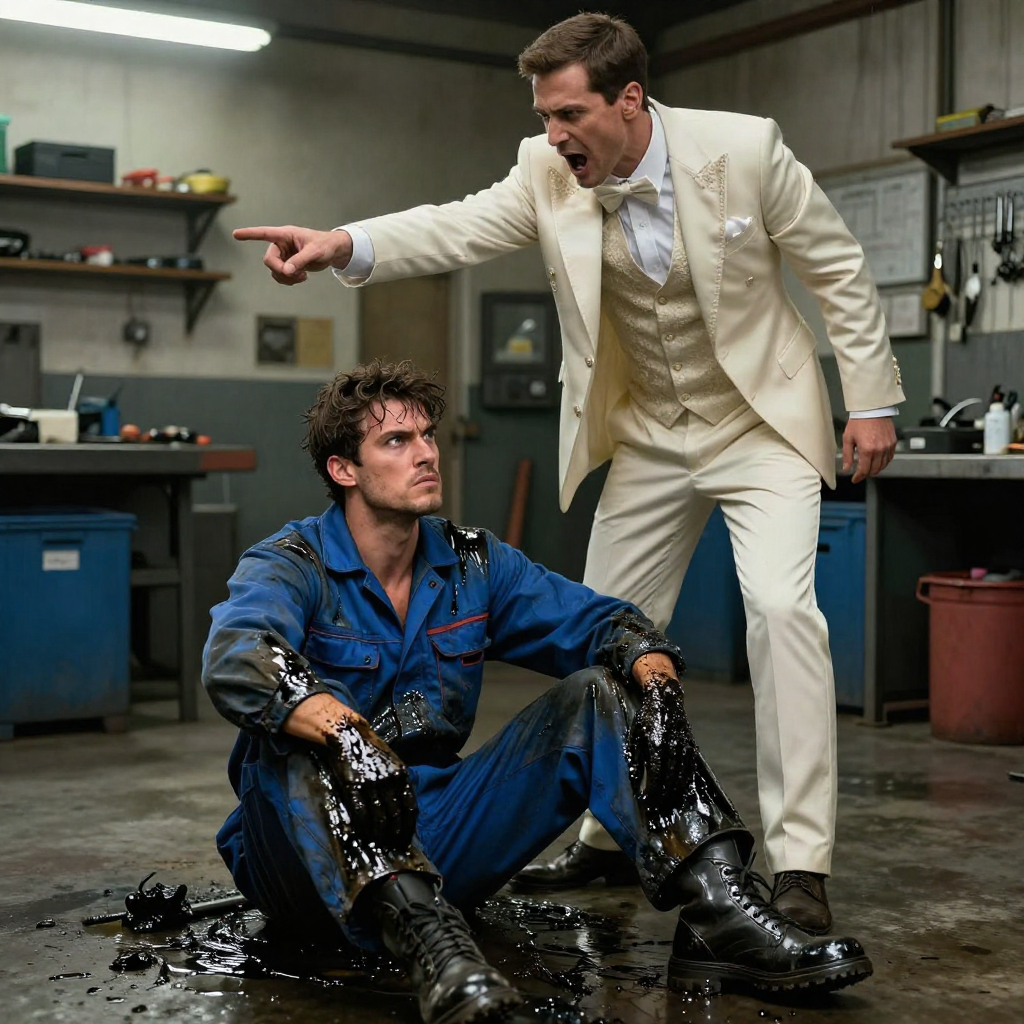
“GET YOUR FILTHY HANDS OFF MY CAR!” HE SCREAMED, SHOVING ME INTO A POOL OF BLACK OIL WHILE HIS GROOMSMEN LAUGHED. I WIPED THE GREASE FROM MY FACE AND WATCHED HIM DRIVE AWAY TO MARRY MY SISTER, CLUTCHING THE KEYS TO THE LIFE HE THOUGHT HE SECURED, UNAWARE THAT THE “DIRTY MECHANIC” HE JUST HUMILIATED WAS HOLDING THE ONE DOCUMENT THAT WOULD TURN HIS WEDDING DAY INTO A BANKRUPTCY HEARING.
The oil wasn’t the problem. Oil washes off. Grease, transmission fluid, the grime of a twelve-hour shift—it all comes out with enough pumice soap and hot water. I’ve never minded the dirt. In fact, I prefer it. It’s honest. You turn a wrench, the bolt tightens. You replace a gasket, the leak stops. There is a purity to mechanics that you don’t find in boardrooms or trust fund disbursements.
But the way he looked at me? That doesn’t wash off.
I was under the lift when the car rolled in. It was a vintage 1967 Jaguar E-Type, powder blue, completely restored. A beautiful machine. The kind of car that demands respect, not just money. I heard the engine cut, followed by the heavy, confident slam of the driver’s door. Then, the voices.
“I’m telling you, it’s making a ticking sound. A click. Right near the intake,” a man’s voice echoed off the concrete walls. It was a voice used to giving orders—sharp, impatient, and lacking any curiosity. It just wanted results.
“We’ve got an hour, Julian,” another voice said. “We can’t be late to the rehearsal dinner. Sarah will kill you.”
Sarah.
My wrench slipped, clattering against the undercarriage of the Ford I was working on. I froze. It had been five years since I’d heard her name spoken aloud in my presence. Five years since I walked away from the heavy oak doors of our family estate, leaving behind the suffocating weight of the inheritance, the expectations, and the endless, shark-like maneuvering of our social circle.
I slid out from under the Ford on my creeper, wiping my hands on a rag that was already black with grime. I stood up, adjusting my cap low over my eyes. I hadn’t planned on being this close to the wedding. I knew it was happening in town—the press had been covering the “Society Wedding of the Year” for months—but I had stayed in my shop, content to be the anonymous mechanic on the edge of town.
Standing by the Jaguar was Julian. I recognized him instantly from the tabloids. He was taller than he looked in photos, wearing a tailored linen suit that probably cost more than the annual rent of my garage. He was handsome in that sharp, predatory way—jawline tight, hair perfectly coiffed, eyes scanning the room with a mixture of boredom and disdain.
He didn’t see a person when he looked at me. He saw a function. A utility.
“You,” he snapped, pointing a manicured finger at me. “You the head mechanic?”
“I own the place,” I said softly. My voice was raspy from disuse; I hadn’t spoken to anyone since morning coffee.
“Good. Then you know what you’re doing. There’s a tick in the engine. Fix it. I need to be out of here in twenty minutes.”
He didn’t ask. He didn’t say please. He tossed the keys at me. They hit my chest and fell to the oil-stained floor. I didn’t move to pick them up.
“I’m booked solid,” I lied. “And I don’t do rush jobs on E-Types. They need patience.”
Julian laughed, a short, barking sound. He turned to his friend, a guy in a similar suit who looked like he was already three scotches deep. “Can you believe this? Blue collar pride. It’s adorable.”
He turned back to me, stepping closer. The smell of expensive cologne—sandalwood and arrogance—wafted over the scent of gasoline. “Listen, pal. I don’t think you understand who I am. I’m Julian Thorne. In about four hours, I’m marrying into the grandest family in this state. I have money in my pocket that would buy this entire rundown shack and turn it into a parking lot. Now, pick up the keys.”
My heart hammered against my ribs. Not from fear, but from a sudden, molten rage. He was marrying Sarah. My little sister. The girl who used to cry when her goldfish died. The girl who used to sneak me sandwiches when our father locked me in the study for ‘insubordination.’ She was marrying this man?
I bent down, not to pick up the keys, but to grab a shop rag I’d dropped. As I stood up, my hand brushed the fender of the Jaguar. It was a light touch, barely a graze.
“Hey!” Julian shrieked. It wasn’t a shout; it was a shriek.
He lunged forward. “Get your filthy hands off my car!”
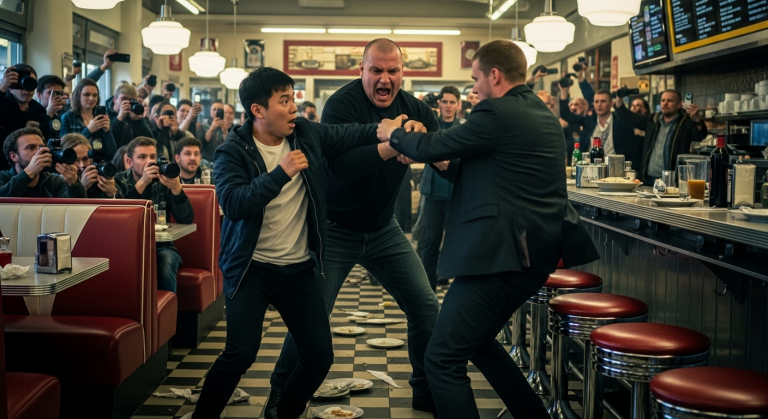
Before I could react, he shoved me. It wasn’t a fight—I wasn’t expecting physical contact. He pushed me hard with both hands against my chest. I stumbled back, my heel catching on the lip of the oil catch pan behind me.
I went down. Hard.
The pan flipped. Gallons of cold, black, used motor oil splashed up, coating my legs, my torso, and splattering across my face. The taste was metallic and foul. I sat there in the puddle, the thick sludge soaking through my coveralls, dripping from my chin.
The garage went silent. Even the air compressor seemed to hold its breath.
Julian stood over me, panting slightly, his face red. For a second, he looked shocked at his own violence. But then, he saw the grease on his own cuff—a tiny speck where he had touched me.
“Look at this!” he yelled, holding up his wrist. “You ruined my suit! You incompetent piece of trash!”
I wiped the oil from my eyes slowly. I didn’t stand up yet. I just looked at him. I memorized his face. I memorized the way his lip curled, the way his eyes held zero remorse, only annoyance.
“You’re lucky I don’t sue you for everything you have,” Julian spat, kicking the keys toward me. “Fix the car. Have it delivered to the church in an hour. Or I’ll make sure no one in this town ever hires you again.”
He turned on his heel and stormed out, his friend trailing behind him, casting a nervous glance back at me.
I sat in the oil for a long time after the door slammed shut. The silence returned, heavy and thick.
Slowly, I stood up. I was dripping. The oil felt like a second skin, heavy and suffocating. I walked to the sink and looked in the cracked mirror. I looked like a monster. A swamp creature. A ‘nobody.’
I reached for the soap, but then I stopped.
Julian Thorne thought he had secured the bag. He thought he was marrying Sarah Vance, heiress to the Vance shipping fortune. He thought the only obstacle between him and a life of leisure was a ticking engine.
He didn’t know that the Vance fortune was held in a trust.
He didn’t know that the trust required the signature of the eldest male heir to release any funds for a marriage settlement.
He didn’t know that the eldest male heir wasn’t dead, as the rumors said. He was just… away. Fixing cars. Living a quiet life.
I walked over to the safe in the back office. My hands were still slick with oil, leaving black smears on the dial as I spun the combination. Click. Click. Click.
The door swung open. Inside, untouched for five years, was a stack of legal documents. And on top of them, my birth certificate.
Name: Lucas Alexander Vance.
I picked up the phone. I dialed a number I hadn’t called in half a decade.
“It’s me,” I said when the voice on the other end answered. “Yes. I’m coming to the wedding. And I’m bringing the papers.”
I looked down at my oil-soaked clothes. I wouldn’t have time to shower and get all of it off. But maybe that was better. Julian wanted to see the mechanic? He was going to see the mechanic.
I walked out to the Jaguar. I didn’t fix the tick. I got in, oil and all, ruining the pristine white leather interior with my filth. I turned the key. The engine roared to life.
It was time to give the groom his wedding present.
CHAPTER II The smell of burnt synthetic oil and expensive leather was a cloying, suffocating fog inside the cabin of the Jaguar, but I didn’t roll down the windows. I wanted it to soak into my skin, to become a part of the memory I was about to forge. Every time I shifted gears, my grease-slicked palm slid against the steering wheel, leaving a dark, iridescent smear on the hand-stitched hide. Julian Thorne had wanted a vintage masterpiece; instead, I was delivering him a tomb of ruined ambition. As I turned the car onto the long, winding drive of the Greystone Estate, the old wound began to throb. It wasn’t a physical pain, but a hollow ache in my chest that had been there for five years, ever since the night my father told me I was a disgrace to the Vance name because I preferred the honesty of a wrench to the deception of a balance sheet. Sarah had been there that night. She had stood by the fireplace, her face a mask of practiced indifference, watching as I was cast out into the rain. She hadn’t said a word then, and she hadn’t reached out once in the half-decade that followed. That was the wound—not the exile itself, but the silence of the only person who was supposed to love me unconditionally. The estate was exactly as I remembered it: opulent, cold, and blindingly green. Manicured hedges lined the path like soldiers, and the scent of lilies—Sarah’s favorite—began to overpower the stench of the car. I pulled the Jaguar directly onto the gravel circle in front of the main house, ignoring the frantic waving of a valet who looked like he’d been plucked from a catalog. I killed the engine. The silence that followed was heavy, broken only by the ‘tink-tink’ of the cooling metal. I caught my reflection in the rearview mirror. I looked like a ghost from a subterranean world—hair matted with grime, a streak of black oil across my cheekbone, and my coveralls stained so deeply they looked like armor. I stepped out of the car, and the crunch of gravel under my heavy work boots sounded like a gunshot in the quiet afternoon. The valet approached, his face contorted in a mix of confusion and elitist disgust. ‘Sir, you can’t park here. This is a private event. Deliveries are at the rear.’ I didn’t look at him. I reached into the passenger seat and pulled out the thick, cream-colored envelope—the trust documents that carried the weight of a billion dollars. ‘I’m not a delivery,’ I said, my voice sounding raspy even to my own ears. ‘I’m the guest of honor.’ I started walking toward the massive oak doors of the ballroom, where the ceremony was already underway. Two security guards in crisp black suits stepped into my path, their bodies forming a wall. They looked at my stained clothes, my calloused hands, and the way the oil from the car had left a trail behind me on the pristine white carpet leading into the foyer. This was the secret I had guarded so fiercely in my little shop: that the man who fixed their brakes was the man who could buy their lives. I felt the weight of it now, a heavy golden chain I was finally willing to wrap around my knuckles. ‘Move,’ I said. One of the guards reached for my arm, but I pivoted, showing him the document in my hand. ‘If you touch me, you’ll be out of a job before I hit the floor. Ask Mr. Sterling who owns the ground you’re standing on.’ The mention of the family lawyer made them hesitate. That second was all I needed. I pushed past them, the heavy doors yielding to my weight. The music—some delicate string quartet piece that sounded like glass breaking—was playing as I entered the back of the ballroom. The sight was a sea of white and gold. Hundreds of people, the cream of society, sat in rows of mahogany chairs, their backs to me. At the end of the long aisle stood Julian and Sarah. Julian looked every bit the conqueror in his midnight-blue tuxedo, his hair perfectly coiffed, his posture radiating a stolen confidence. Sarah was a vision in lace, her veil trailing behind her like a cloud. They were holding hands, listening to the officiant drone on about ‘legacy’ and ‘union.’ I started walking down the center aisle. The sound of my boots on the polished marble was a rhythmic thud that slowly began to draw eyes. A woman in the back row turned, gasped, and nudged her husband. Then another. The murmur spread like a wildfire, a wave of shock that preceded me. I saw Julian’s shoulders stiffen. He recognized the sound of a man who didn’t belong. He turned his head slightly, a frown of annoyance deepening on his face, likely expecting a wayward caterer. But when his eyes met mine, the annoyance vanished, replaced by a flickering shadow of recognition and then, rapidly, by a cold, sharp terror. He remembered the garage. He remembered the oil. Sarah turned then, too. For a moment, the world stopped. The five years between us vanished, and for a heartbeat, I wasn’t the billionaire heir or the grease-stained mechanic—I was just her brother. Her eyes widened, her lips parting as she whispered my name, a sound so soft it was lost to the room but echoed in my soul. I stopped ten feet from the altar. The silence was absolute now, the kind of silence that precedes a disaster. This was the moral dilemma I had been chewing on since I left the shop. By standing here, I was destroying her day. I was humiliating her in front of everyone she knew. I could have waited. I could have met them in private. But Julian was a predator who had seen a mechanic as a subhuman object to be discarded, and Sarah had chosen to marry a man who would use her family’s name as a shield for his own cruelty. If I stayed silent, I was complicit. If I spoke, I was the villain of her fairy tale. I looked at Julian. He recovered quickly, his face twisting into a mask of righteous indignation. ‘What the hell is this?’ he shouted, his voice echoing off the high ceiling. ‘Security! Get this vagrant out of here!’ He stepped toward me, his hands balled into fists, forgetting for a moment that he was in a house of God and that he was supposed to be the refined gentleman. I didn’t move. I held up the envelope. ‘You forgot your car, Julian,’ I said, my voice calm and steady. ‘It’s outside. I think the interior is ruined, though. Oil is a bitch to get out of leather once it’s been rubbed in.’ A gasp rippled through the crowd. Julian’s face went from red to a sickly, pale grey. He looked at the envelope, then at Sarah, who was staring at me with a mix of horror and dawning realization. ‘Who are you?’ she whispered, her voice trembling. I looked her dead in the eye, ignoring the guests, ignoring the cameras, ignoring the man who wanted to be my brother-in-law. ‘I’m the man who holds the keys to the Vance Trust, Sarah. And I’m the man your husband-to-be shoved into a pool of waste oil three hours ago because he thought I was just a mechanic who couldn’t fight back.’ I stepped forward, closing the distance until I was standing directly in front of Julian. I could smell his expensive cologne, a sharp contrast to the grit on my skin. I took the document out of the envelope—the legal decree that required the signature of the primary heir for any transfer of assets. I held it up so he could see the name at the top: Lucas Vance. The realization hit the room like a physical blow. The ‘vagrant’ was the lost son. The mechanic was the king. Julian’s mouth opened and closed, but no sound came out. He looked down at his own hands, perhaps remembering the way he’d pushed me, and then he looked at the ruined Jaguar parked outside, which he now realized was the last thing he’d ever own of the Vance legacy. The power dynamic didn’t just shift; it shattered. I wasn’t just a brother returning home; I was the executioner of his dreams. I turned to Sarah, my heart breaking for the girl she used to be, even as I felt the cold iron of the man I had become. ‘The wedding can continue,’ I said, ‘but the money stays with me. You chose him, Sarah. Now you get to see who he is without my father’s checkbook.’ I dropped the papers at Julian’s feet, the white sheets fluttering onto the floor, already beginning to soak up the dark stains from my boots. This was the moment everything changed. The secret was out, the wound was exposed, and there was no going back to the shadows of the garage. I was Lucas Vance, and I had just burned the house down to keep it from falling into the wrong hands.
CHAPTER III
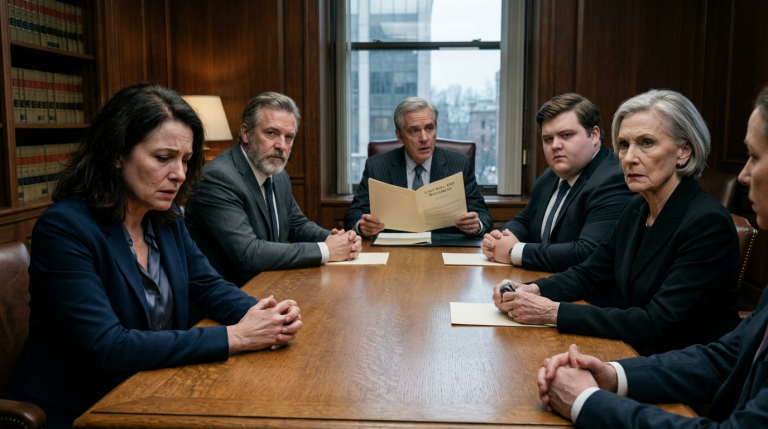
The silence at the altar was not the peaceful kind. It was the heavy, suffocating silence of a room where the air has suddenly been sucked out. I stood there, a man in grease-stained coveralls, feeling the grit of the garage beneath my fingernails, while the most expensive audience in the state watched me. The oil on my face was cooling, tightening my skin like a mask I was finally ready to take off. Julian’s face was a study in slow-motion collapse. The smug, polished veneer of the Thorne heir didn’t just crack; it disintegrated. His mouth opened, but no sound came out, just a small, wet clicking noise. He looked at the documents in my hand, then at Mr. Sterling, then back at me. I could see the gears turning, trying to find a way to make this a joke, a mistake, a hallucination. But Mr. Sterling didn’t do jokes. He stood like a stone monument to the law, his gray eyes fixed on Julian with a coldness that would have frozen the champagne in the glasses at the back of the lawn.
“This is a fabrication,” Julian finally managed to hiss. His voice was thin, stripped of its practiced baritone authority. “Lucas is dead. Or he’s a vagrant. This… this grease-monkey is an impostor.” He turned to the crowd, his arms spread wide, looking for an ally among the rows of silk and diamonds. “Can someone please call security? This man has clearly suffered a mental break. He’s dangerous.” But no one moved. The guests weren’t looking at him with sympathy anymore. They were looking at the man who had just been told his bank account was a hollow shell. In this world, there is no greater sin than being poor, and Julian was currently the poorest man in the room. I took a step forward, the heavy soles of my work boots thudding against the white silk runner. The sound was like a heartbeat. “Look at me, Julian,” I said. My voice was low, steady, the voice of a man who had spent three years under the chassis of broken things, learning how to fix them. “You didn’t even recognize me at the shop. You were too busy complaining about the smell of your own exhaust. You didn’t see the brother of the woman you were supposed to protect. You only saw a servant.”
Julian’s eyes darted to Sarah. She was shaking, her hands white-knuckled as she gripped her bouquet. The lilies were starting to bruise. I saw him reach out, his hand grabbing her upper arm with a grip that looked less like a husband and more like a captor. “Sarah, tell them,” he barked. “Tell them this is a lie. Tell them we have the contracts. Tell them about the merger.” Sarah didn’t look at him. She looked at me. There was a terror in her eyes that went deeper than just the humiliation of a ruined wedding. It was a primal, trapped look. “Lucas,” she whispered. It was the first time she’d said my name in three years. It sounded like a prayer and a confession all at once. “I thought you were never coming back. I thought I was alone.” Julian’s grip tightened. I saw her wince. “The merger, Sarah!” he yelled, his mask fully gone now. The gentleman was dead. In his place stood a desperate, cornered animal. “Tell your idiot brother to burn those papers before I ruin what’s left of this family!”
I didn’t wait for her to answer. I looked at Sterling. The lawyer stepped forward, pulling a second, smaller envelope from his breast pocket. This wasn’t the trust document. This was something else. “Mr. Thorne,” Sterling said, his voice cutting through Julian’s panic like a scalpel. “The Vance Trust is not merely protected by inheritance laws. It is protected by a morality clause instituted by the late Arthur Vance. A clause that triggers an immediate forensic audit of any spouse entering the family line through marriage, should the primary heir contest the union.” I watched Julian’s face go from pale to a sickly, mottled gray. He knew. He knew what an audit meant. It wasn’t just about the money he didn’t have. It was about where the money he *did* have came from. “You think you’re the only one who can play the long game, Julian?” I asked. “I didn’t stay away for three years because I was ashamed. I stayed away because I was watching. I was learning the trade. I was learning how things break.”
I looked at my sister. The way she was leaning away from him, the way her eyes were darting toward the estate’s main gates. “Sarah, why did you do it?” I asked. My voice softened, just a little. “Why him? You knew what he was. You knew he was a bottom-feeder.” Sarah’s breath hitched. She finally found the strength to rip her arm out of Julian’s grasp. She stumbled toward me, the train of her dress dragging through the oil I’d tracked onto the stage. “He told me Dad didn’t die in an accident, Lucas,” she sobbed, the words tumbling out in a rush of air and salt. “He said Dad was into something dark. He said he had proof that Dad had embezzled from the foundation. He said if I didn’t marry him, if I didn’t give him access to the Vance accounts to ‘clean’ the money, he’d go to the feds. He’d destroy Dad’s name. He’d make sure we were both in prison as accomplices.” I felt a coldness settle in my chest that had nothing to do with the wind. Julian was smiling now, a jagged, ugly thing. “That’s right, mechanic,” Julian spat. “Your old man was a thief. I was just the one holding the leash. If you pull this trust out from under me, I release everything. The Vance name will be synonymous with garbage by tomorrow morning.”
I looked at Julian, and for the first time, I felt a strange sense of pity. He really thought he was the smartest person in the room. He thought the Vance legacy was something I still cared about preserving at the cost of my soul. “My father was many things, Julian,” I said, stepping closer until I could smell the expensive cologne he used to mask the stench of his character. “But he wasn’t a thief. He was a collector. He collected people’s secrets. And he kept them in a very specific place.” I turned to Sterling. “The black box, Arthur. Tell him.” Sterling nodded once. “We recovered the encrypted drive from your father’s vehicle, Lucas. The one the police missed. The one that was supposedly destroyed in the fire.” Julian’s smile faltered. His eyes went wide. “The fire didn’t take it, Julian,” I said. “And it didn’t take the telemetry data either. You’re a fan of high-end cars, aren’t you? You know they record everything. Every brake pressure. Every steering input. Every sensor failure.”
I took another step. The distance between us was gone. “I spent the last three years as a mechanic because I needed to know exactly how a brake line fails,” I whispered, my voice vibrating with a decade of suppressed rage. “I needed to know the difference between a wear-and-tear snap and a clean, surgical cut. I needed to know why my father’s car, a car he maintained like a holy relic, suddenly lost all stopping power on a clear night on a straight road.” The crowd was dead silent now. Even the birds seemed to have stopped singing. Julian tried to back away, but he tripped on the hem of Sarah’s discarded veil. He fell back against the floral arch, sending a cascade of white roses tumbling over his shoulders. “You killed him,” I said. The words weren’t a question. They were a sentence. “You didn’t just want the money. You wanted the power he held over your family’s firm. You killed him and then you used his death to trap his daughter.”
“You can’t prove that!” Julian screamed, scrambling to his feet. He looked pathetic, his tuxedo covered in dirt and flower petals. “That car was crushed! The evidence is gone!” At that exact moment, the sound of sirens began to bleed into the garden. It started as a low hum in the distance, growing into a wail that tore through the afternoon air. Red and blue lights began to dance against the high stone walls of the estate. Julian froze. He looked toward the gates as three black SUVs tore up the gravel driveway, ignoring the valet and the manicured lawns. They didn’t stop until they were at the edge of the ceremony. Men in windbreakers with ‘State Police’ and ‘Forensic Bureau’ stenciled on the back stepped out. They weren’t here for a wedding. They were here for a crime scene.
“The car was crushed, Julian,” I said, watching the officers approach. “But the parts weren’t. I bought the scrap heap three years ago under a shell company. I’ve been putting the puzzle back together, bolt by bolt, in a small shop in the city. The shop you visited today.” The realization hit him like a physical blow. The Jaguar he’d brought in. The mechanic who knew too much. The timing. It hadn’t been a coincidence. I had lured him there. I had made him hand over the keys to his own destruction. “Detective Miller!” I called out, waving the lead officer forward. Miller was a tired-looking man who had been the only one to listen to my theories three years ago. He walked up the steps, his eyes fixed on Julian. “Julian Thorne?” Miller asked, his voice flat and professional. “You’re under arrest for the murder of Arthur Vance, and for the attempted extortion of Sarah Vance. We have the drive. We have the forensic reconstruction of the vehicle. And we have the witness statements from the firm you tried to buy off.”
Julian looked around, his eyes wild, looking for an exit that didn’t exist. He looked at the high-society friends who were now recording his downfall on their phones. He looked at Sarah, who was standing tall for the first time in years, her hand in mine. “This is my house!” Julian yelled as the officers moved in to cuff him. “This is my legacy!” “No, Julian,” I said, watching as they turned him around and pressed his face against the very altar where he was supposed to seal his victory. “This is my father’s house. And you’re just a guest who stayed too long.” As they led him away, his protests fading into the distance of the sirens, the garden felt different. The air was cleaner, despite the smell of the exhaust. The guests began to murmur, the spell of the wedding broken, replaced by the electric hum of the biggest scandal of the decade.
Sarah turned to me, her face a mask of grief and relief. “What happens now?” she asked, her voice trembling. “The money, the name… it’s all tainted, Lucas. He was right about one thing. People won’t remember the truth. They’ll only remember the mess.” I looked at the estate, at the sprawling acres of wealth that had felt like a prison for most of my life. I looked at my grease-stained hands and then at the legal documents still clutched in Sterling’s hand. I had reclaimed my name. I had gotten justice for our father. I had the power to step back into the world of suits and boardrooms, to become the billionaire heir everyone expected me to be. But as I felt the weight of the key to the Jaguar in my pocket, I realized I didn’t want the throne. I wanted the truth.
“We’re going to dismantle it, Sarah,” I said. I looked at Sterling, who was watching me with a strange expression—something that looked almost like pride. “Sell the estate. Liquify the trust. We’ll keep enough to ensure you’re safe, but the rest… it’s going to a foundation. A real one. For people who’ve been crushed by men like Julian. For the mechanics, the drivers, the people who actually keep the world running while guys like us sit in gardens and play god.” Sterling nodded. “It will take months to untangle, Lucas. You’ll have to remain the head of the company during the transition. You’ll have to be the face of the Vance legacy one last time.” I looked down at my oil-stained coveralls. “That’s fine,” I said, a small, tired smile forming on my lips. “I’m used to getting my hands dirty. I think I’ve got one more job to finish before I can finally go home.”
I walked off the stage, leaving the stunned socialites and the ruined wedding behind. I didn’t head for the limo or the manor. I walked back toward the garage, toward the smell of old iron and the honesty of a well-tuned engine. Sarah followed me, her white dress trailing in the dust, no longer caring about the dirt. We walked together, the heir and the heiress, two ghosts finally coming back to life. The sun was beginning to set, casting long, golden shadows across the lawn. The nightmare was over, but the work was just beginning. I could still feel the grease on my skin, and for the first time in three years, I didn’t want to wash it off. It was the only thing that felt real. It was the only thing that had helped me find my way back to the truth.
CHAPTER IV
The silence was the worst part. After the sirens faded and the news trucks pulled away, after Julian was gone and the last of the horrified guests had scattered like cockroaches when the lights come on, there was only silence. Not the peaceful kind. This was the heavy, suffocating silence of aftermath. The kind that fills your lungs and makes it hard to breathe.
Sarah and I stood in the ruined ballroom, confetti crunching under our feet like broken promises. The scent of lilies, once so sweet, now felt like a mockery. The caterers were already dismantling what was left, their movements mechanical and devoid of emotion. I envied them.
“Lucas?” Sarah’s voice was a whisper, barely audible above the clatter.
I turned to her. Her dress, a masterpiece of white silk and lace just hours before, was now stained with champagne and God knows what else. Her face was pale, her eyes wide and haunted. She looked like a ghost.
“I… I don’t understand,” she said, her voice trembling. “How could I not have seen it?”
I wanted to tell her it wasn’t her fault. That Julian was a master manipulator, that he’d fooled us all. But the words caught in my throat. Because part of it *was* her fault. She’d been so desperate to believe in him, so willing to ignore the red flags, because facing the truth about our father was too painful.
“It doesn’t matter now,” I said, my voice flat. “He’s gone.”
But he wasn’t, not really. Julian’s actions had set in motion a chain of events that would ripple through our lives for years to come.
**PUBLIC FALLOUT**
The next morning, the headlines screamed Julian’s name and our family’s shame. “Vance Heiress’s Fiancé Arrested for Murder!” “Billionaire Family Implodes in Wedding Day Scandal!” The media went into a frenzy, dissecting every detail of our lives, past and present. Every mistake our father had ever made, every questionable business deal, was dragged into the light. The Vance name, once synonymous with wealth and power, was now a punchline.
The company stock plummeted. Investors panicked, selling off their shares in droves. Within days, Vance Industries had lost billions in value. The board of directors, who had once fawned over me, were now calling for my resignation. They blamed me for the scandal, for the damage to the company’s reputation. They didn’t care about Julian’s crimes or Sarah’s suffering. All they cared about was their bottom line.
Even people I thought were my friends turned away. They avoided my calls, cancelled lunch dates, and pretended not to see me when we crossed paths on the street. It was as if I had become toxic, contagious. As if my family’s disgrace could somehow infect them.
But the worst part was the silence from our father’s old associates. The men who had once filled our lives with laughter and stories. The ones who had called our father their friend. They had vanished. They did not call. They did not offer a kind word or support, it was as if our family had been erased from their memories.
**PRIVATE COST**
Sarah retreated into herself. She stopped eating, barely slept, and spent hours staring out the window. She refused to talk about Julian, about what he had done to her. She was like a broken doll, fragile and unresponsive.
I tried to reach her, to comfort her, but she pushed me away. “Leave me alone, Lucas,” she’d say, her voice hollow. “I can’t… I can’t deal with this right now.”
I understood. She needed time to process everything, to grieve. But it hurt to see her like that, so lost and alone. And it hurt even more to know that I couldn’t fix it.
I, too, was struggling. The weight of responsibility was crushing me. I had exposed Julian, saved Sarah, and avenged our father. But at what cost? I had destroyed my family’s legacy, alienated everyone I knew, and shattered my sister’s heart. Was it worth it?
The mechanic inside me wanted to walk away. To disappear back into anonymity, to forget about the Vances and their problems. But I couldn’t. I had a responsibility to Sarah, to the employees of Vance Industries, and even to our father’s memory, however tarnished it may be.
I had to pick up the pieces, to try to rebuild what was broken. But I didn’t know where to start.
I spent days locked in my father’s old office, poring over financial statements and legal documents. The numbers swam before my eyes, a confusing mess of assets and liabilities. I felt like I was drowning in debt, betrayal, and regret.
One evening, as I was about to give up, I found a hidden file on my father’s computer. It was a recording of a conversation between him and Julian, made just weeks before his death. In it, Julian was threatening to reveal our father’s secrets unless he was given a significant share of the company.
“You wouldn’t dare,” my father said, his voice strained.
“Oh, but I would,” Julian replied, his tone cold and calculating. “I know things about you, Arthur, that would ruin you. Things that would make your precious little empire crumble.”
I listened in disbelief as Julian laid out his demands. He wanted power, money, and control. And he was willing to destroy our family to get it.
The recording ended abruptly. But the message was clear: Julian had been blackmailing our father for years.
A wave of anger washed over me. Anger at Julian, for his treachery and deceit. Anger at our father, for keeping secrets that had ultimately led to his death. And anger at myself, for being so blind.
**NEW EVENT**
The next morning, I received a call from a lawyer I didn’t know. His name was Mr. Davies, and he claimed to represent the Thorne family. He requested a meeting to discuss the “ongoing situation” and its impact on the Thorne family’s reputation.
I hesitated. I didn’t want to deal with Julian’s family. I assumed they would be just as corrupt and manipulative as he was. But something in Mr. Davies’s voice made me curious. There was a hint of desperation, of vulnerability.
I agreed to meet him that afternoon.
Mr. Davies was a small, unassuming man with gray hair and a nervous demeanor. He looked more like a librarian than a high-powered lawyer. He sat across from me in my office, fidgeting with his briefcase.
“Mr. Vance,” he said, his voice trembling slightly, “I understand that you are going through a difficult time.”
“You have no idea,” I replied, my voice cold.
“The Thorne family is deeply saddened by the events that have transpired,” he continued. “We were unaware of Julian’s… activities.”
I raised an eyebrow. “Really? You expect me to believe that?”
“It’s the truth,” Mr. Davies insisted. “Julian was… a difficult young man. He was always ambitious, always striving for more. But we never imagined he would go to such lengths.”
He paused, took a deep breath, and opened his briefcase. He pulled out a stack of documents and placed them on the table.
“These are Julian’s financial records,” he said. “They show that he was deeply in debt. He had been gambling heavily for years, and he owed a great deal of money to some very dangerous people.”
I stared at the documents in disbelief. Julian had been living a double life, hiding his financial troubles from everyone, including Sarah.
“He was desperate,” Mr. Davies said. “He needed money, and he was willing to do anything to get it. That’s why he blackmailed your father. That’s why he… killed him.”
I felt a strange mix of emotions. Relief that Julian’s actions were driven by desperation, not pure malice. Sadness for Sarah, who had loved a man she never really knew. And anger that Julian’s greed had destroyed so many lives.
Mr. Davies cleared his throat. “The Thorne family wants to make amends,” he said. “We know that no amount of money can bring back your father or undo the damage that Julian has caused. But we want to do what we can to help.”
He offered me a settlement. A significant sum of money to compensate for the financial losses caused by Julian’s actions. In exchange, the Thorne family wanted me to drop all charges against them and to publicly acknowledge that they were not involved in Julian’s crimes.
I was tempted. The money could help stabilize Vance Industries, provide for Sarah’s future, and maybe even restore some of our family’s reputation. But something held me back.
“I need time to think about it,” I said.
**MORAL RESIDUES**
I spent the next few days wrestling with my conscience. Accepting the settlement would be the pragmatic thing to do. It would be the best way to protect my family and the company. But it would also feel like a betrayal of my father’s memory.
Was I willing to compromise my principles for the sake of financial stability? Was I willing to let the Thorne family off the hook, even though they had indirectly benefited from Julian’s crimes?
I talked to Sarah about it. She was still withdrawn and fragile, but she listened patiently as I explained the situation.
“What do you think I should do?” I asked her.
She shrugged. “I don’t know, Lucas,” she said, her voice barely audible. “It doesn’t matter what I think. It’s your decision.”
“But I want your opinion,” I insisted. “This affects you too.”
She looked at me, her eyes filled with pain. “All I want is for this to be over,” she said. “I want to forget about Julian, about our father, about everything that has happened. If taking the money will help us do that, then maybe we should take it.”
Her words surprised me. I had expected her to be more resistant, more vengeful. But she was tired, broken. She just wanted to escape the nightmare.
I thought about her, about the sacrifices she had made for our family. About the pain she had endured because of Julian’s lies and our father’s secrets. I realized that I couldn’t make this decision alone.
The next day, I called Mr. Davies and told him that I had a counteroffer.
I agreed to accept the settlement, but on one condition: the Thorne family had to publicly apologize for Julian’s actions and acknowledge the harm he had caused to our family. They also had to donate a significant sum of money to a charity that supported victims of blackmail and abuse.
Mr. Davies was taken aback. He hadn’t expected me to make such demands. But after consulting with the Thorne family, he agreed.
The apology was issued. The donation was made. And the settlement was finalized.
Vance Industries was saved. Sarah and I were financially secure. And the Thorne family had paid for their son’s sins.
But it didn’t feel like a victory. The scars remained. The memories lingered. And the silence still echoed in my ears.
I had avenged my father and protected my family. But I had also lost something along the way. Something I couldn’t quite define. Perhaps it was innocence. Perhaps it was faith. Or perhaps it was simply the illusion that I could control my own destiny.
The question now was: Could I rebuild, or was I destined to remain a mechanic, forever haunted by the ghosts of the Vance family?
The answer, I suspected, lay in the small, unassuming box I had found in my father’s study. The box that contained his most prized possessions. The box that held the key to our past, and perhaps, to our future.
CHAPTER V
The days bled together in a haze of legal meetings, whispered conversations, and the constant, gnawing feeling that I’d irrevocably broken something within my sister. Julian was behind bars, Vance Industries was teetering, and I, the prodigal son, was expected to pick up the pieces. But the pieces weren’t just financial; they were the fragments of Sarah’s shattered faith in love, family, and the very foundation of our lives.
I found her most mornings in the sunroom, amidst the orchids our mother had so meticulously cared for. Now, their vibrant blooms seemed a cruel mockery of the desolation in her eyes. She barely spoke, offering only a vacant smile when I entered. It was as if a part of her had gone into hiding, retreating into a place I couldn’t reach.
“Sarah,” I began one morning, my voice barely a whisper, “we need to talk about Vance Industries.”
She didn’t respond, her gaze fixed on a spiderweb shimmering with dew. I pressed on, laying out the options: a complete sale, a restructuring under new management, or my own reluctant return to the helm.
“It’s your decision, Lucas,” she finally said, her voice flat. “Do whatever you think is best.”
Her apathy stung. This wasn’t the Sarah who had challenged me, who had debated every decision with fierce conviction. This was a ghost, haunted by the betrayal of a man she loved and the dark secrets of our family.
The Thorne family’s apology was released, a carefully worded statement expressing remorse for Julian’s actions without explicitly admitting guilt. The donation to the charity followed, a substantial sum that felt like blood money. It eased the legal pressure, but it did nothing to heal the deeper wounds.
The first phase was over. The dust had settled, revealing the wreckage. Now came the arduous task of rebuilding – or, perhaps, letting it all crumble.
I spent hours in our father’s study, a room I had always avoided. It was a shrine to his ambition, filled with mahogany furniture, leather-bound books, and the lingering scent of his pipe tobacco. It was also where he died, a fact that hung heavy in the air.
Mr. Davies, the Thorne family lawyer, called, requesting a final meeting. I agreed, needing to put an end to this chapter.
He arrived, a picture of corporate respectability, his face etched with a weariness that mirrored my own. We sat in strained silence, the only sound the ticking of the grandfather clock in the hall.
“Mr. Vance,” he began, his voice low, “I understand this has been… difficult for you and your sister.”
“Difficult is an understatement,” I replied, my voice tight.
He offered a settlement, a final attempt to erase the stain on the Thorne name. More money, more apologies, more empty gestures. I refused.
“I don’t want your money, Mr. Davies,” I said. “I want something you can’t give me: my father back, Sarah’s innocence back.”
He sighed, his shoulders slumping. “I understand. But I hope you can find some peace, Mr. Vance. Holding onto anger will only consume you.”
His words resonated, a harsh truth I had been avoiding. I had sought revenge, but it had brought me no satisfaction, only more pain.
I asked him about Julian. He said that Thorne was a changed man, and that he hoped that someday I can forgive him. I told him I would think about it.
The second phase began with the acceptance of loss. Loss of innocence. Loss of peace. Loss of family. But also the start of a recognition that something new could be built in its place. But what?
One afternoon, Sarah found me in the study, staring at the box of artifacts we had discovered – the mementos of our father’s life, the secrets he had kept hidden.
“What are you going to do with them?” she asked, her voice barely audible.
I shrugged. “I don’t know. Keep them, I suppose. Or donate them to a museum.”
She walked over to the box, her fingers tracing the worn edges of a photograph of our parents, young and carefree. A single tear rolled down her cheek.
“Maybe,” she said, her voice trembling, “we should let them go.”
The idea struck me with unexpected force. Letting go of the past, of the secrets, of the weight that had been crushing us for so long. It was a daunting prospect, but also a liberating one.
We spent the next few days sorting through the artifacts, reminiscing about the memories they evoked. There were letters from our mother, filled with love and laughter. There were photographs of family vacations, of birthdays, of simple moments of joy. And there were the darker objects: the blackmail letters, the financial records, the evidence of our father’s double life.
We decided to donate most of the items to a historical society, preserving them for posterity. But there were a few things we couldn’t part with: the photograph of our parents, a worn teddy bear from our childhood, a handwritten recipe book from our grandmother.
These we kept, not as relics of the past, but as reminders of the love that had sustained us, even in the darkest of times. I packed the box into the trunk of my car and drove it back to my garage.
I went back to work as a mechanic, and Sarah got a job as a teacher. The Vance’s name lost its prestige, but we were no longer ashamed of it. We began to enjoy our lives as private citizens.
Sarah and I spent an afternoon near the water at the beach. We talked about our childhoods. We talked about our parents. We talked about Julian. We talked about moving on with our lives.
“Do you forgive him?” she asked, her voice quiet.
“I don’t know,” I admitted. “Maybe someday. But I can forgive myself for what I did.”
She smiled, a genuine smile that reached her eyes. “That’s all that matters, Lucas.”
Phase three was a hard-won reprieve from the darkness, and a sense of self, both individually and together. This was the start of healing.
The decision about Vance Industries remained. The company was hemorrhaging money, its reputation in tatters. The board of directors was pressuring me to take over, to salvage what was left of our father’s legacy. But I hesitated. I had tasted freedom, integrity, and I wasn’t sure I wanted to return to the gilded cage.
One evening, I sat in my garage, surrounded by the familiar scent of oil and grease. I looked at my hands, calloused and stained, and I knew I couldn’t go back. I couldn’t spend my life chasing wealth and power, sacrificing my values for the sake of a name.
I called a board meeting and announced my decision: I would not be taking over Vance Industries. I would, however, oversee its restructuring, ensuring that it operated ethically and responsibly. I would then step down, allowing new leadership to take the helm.
The decision was met with resistance, disbelief, and even anger. But I stood firm, knowing that I was doing the right thing. I was choosing integrity over wealth, freedom over obligation.
Sarah supported my decision, understanding my need to forge my own path. She, too, was finding her purpose, her passion for teaching reigniting her spirit.
We sold the mansion, the symbol of our father’s ambition, and moved into a small cottage by the sea. We lived simply, surrounded by the things that truly mattered: love, family, and the pursuit of our own happiness.
I received a letter from Julian, a handwritten note from prison. He expressed his remorse for his actions, his regret for the pain he had caused. He didn’t ask for forgiveness, but he hoped that someday we could find it in our hearts to understand.
I read the letter in silence, a wave of conflicting emotions washing over me. Anger, sadness, and, perhaps, a flicker of compassion. I didn’t know if I could ever forgive him, but I knew that I could let go of the hatred that had consumed me for so long.
I wrote back, a short, simple message: “I hope you find peace, Julian.”
I sent the letter, releasing the final thread that had bound me to the past. I turned to Sarah, who was standing by the window, watching the sunset.
“It’s over,” I said, my voice filled with a quiet sense of relief.
She smiled, her eyes sparkling with tears. “Yes, Lucas. It’s over.”
The final phase: A quiet surrender to the present, and an attempt to accept that while the past could not be changed, it could be learned from.
I kept working as a mechanic, finding satisfaction in the simple act of fixing things. Sarah thrived as a teacher, inspiring young minds with her passion and her kindness. We lived a quiet life, far from the spotlight, content in our newfound peace.
Years passed. Vance Industries was successfully restructured, its reputation restored under new leadership. Julian was released from prison, a changed man, seeking to rebuild his life. I never saw him again, but I heard that he was working with a charity that supported victims of abuse.
Sarah and I remained close, our bond strengthened by the trials we had endured. We learned to forgive, to let go, and to embrace the beauty of the present moment. We visited our parents’ graves, not with sadness, but with gratitude for the love they had given us.
One day, Sarah and I were looking at the box of artifacts from our childhood. I wanted to throw it away, but Sarah wouldn’t let me.
“These artifacts may remind us of the things that have happened, but they also remind us of the good. And in them, there is a legacy of things that we can’t change, but that we can choose to improve upon in the future,” she said.
I began to cry.
We left the box in the attic, not to be opened again, but not to be forgotten.
In the end, I understood that revenge was a hollow victory, that forgiveness was the only path to true healing, and that the greatest legacy we could leave was not wealth or power, but love and compassion.
I have come to believe that the inevitability of mistakes are a part of the human condition, but what we do after we make them truly defines who we are.
I looked out the window at the setting sun, the sky ablaze with color. I thought of my father, of Julian, of Sarah, and of all the people whose lives had been touched by our family’s story. I knew that the past would always be a part of us, but it no longer defined us.
I realized that I had not found peace. That was an illusion. But I had found quiet acceptance of all that had been.
I sat and thought for a long time, and then I returned to work on the engine in front of me.
The engine turned over, and as I listened to it hum, I understood: The only way to truly move forward is to accept the weight of what you carry.
END.