HE SCREAMED THAT I WAS A “WASTE OF OXYGEN” AND TORE THE SCRIPT FROM MY HANDS, NOT REALIZING I WROTE THE VERY WORDS HE WAS DESTROYING. I stood trembling in the freezing artificial rain while the director humiliated me in front of two hundred people, mocking my cheap costume and calling me a “nobody” who didn’t deserve to breathe the same air as true artists. The entire set went deathly silent when the A-list lead actor didn’t call for a cut, but instead walked past the cameras, knelt at my feet, and waited for my command to end the director’s career forever.
The artificial rain on a movie set is colder than the real thing. It doesn’t smell like ozone or earth; it smells like recycled tank water and heavy machinery. I stood near the craft services table, shivering in a ragged wool coat that the wardrobe department had pulled from the ‘distressed’ rack three hours ago. My toes were numb inside boots that were two sizes too big, but I didn’t complain. I wasn’t supposed to complain. To everyone on Soundstage 4, I was just Atmosphere Extra #42—a warm body needed to fill the background of a Depression-era street scene.
I watched Julian, the director, pacing back and forth on the crane platform like a caged tiger. He was a man who confused cruelty with genius, a cliché of Hollywood entitlement wrapped in a black turtleneck and an expensive scarf. He had spent the last forty-five minutes screaming at the lighting gaffer because the shadows on the brick wall ‘didn’t feel sufficiently tragic.’
‘It looks like a sitcom!’ Julian roared, his voice echoing off the corrugated metal ceiling. ‘I am trying to make art here, and you gave me a soap opera! Fix it, or I swear I will replace you with a flashlight and a mirror!’
The gaffer, a man who had been lighting films since before Julian was born, just nodded tiredly and radioed his team. I looked down at my hands. They were stained with fake grime, trembling slightly—not from the cold, but from a simmering, volcanic heat in my chest that I was struggling to contain.
I adjusted the shawl around my shoulders, trying to blend into the shadows. I shouldn’t have been there. Technically, I was supposed to be in a glass-walled office in Los Angeles, reviewing marketing budgets. But when the dailies started coming in looking lifeless, and reports of crew mistreatment started filtering up to the executive suite, I couldn’t just read the emails. I had to see it. I had to feel the atmosphere on the set of the movie based on the book that had taken me ten years to write.
‘Action!’ Julian shouted, though he didn’t wait for the slate.
The scene was simple. The protagonist, played by Noah Vance—the only person on this set who treated the crew with genuine decency—was supposed to walk through the crowd of unemployed workers, searching for his lost daughter. I was just one of the faces in the crowd.
I stepped forward on my cue, keeping my head down, embodying the exhaustion I had written into the character of ‘The Apple Seller’ on page 54. I wasn’t acting, really. I was remembering. I was remembering the years of poverty I lived through before my manuscript sold, the days I spent choosing between heat and food. That was the soul of the book. That was what Julian was supposed to be capturing.
‘Cut! Cut! Cut!’
The silence that followed was immediate and terrifying. Julian jumped down from the camera dolly, landing heavily in the puddle of fake rain. He marched toward the crowd of extras, his finger pointing like a weapon.
‘You!’ he screamed.
I didn’t look up initially. I assumed he was yelling at the Assistant Director again.
‘You! The heavy one in the grey rags! Look at me when I’m speaking to you!’
My breath hitched. I slowly raised my eyes. Julian was standing two feet away from me, his face flushed with adrenaline and rage. The scent of expensive coffee and cigarettes wafted off him, clashing with the damp air.
‘What exactly are you doing?’ he hissed, his voice dropping to a dangerous, mock-polite register that was far scarier than his shouting.
‘I… I was walking to the mark, sir,’ I whispered, pitching my voice to sound like the terrified extra he thought I was.
‘Walking to the mark?’ He laughed, a harsh, barking sound. He turned to the crew, seeking an audience for his ridicule. ‘She says she was walking. Did it look like walking to you, Noah? Did it look like walking to anyone?’
Noah Vance, standing ten feet away in his costume suit, looked uncomfortable. ‘Julian, let’s just reset. It was fine. The background was blurry anyway.’
‘It is not fine!’ Julian spun back to me. ‘You are drawing focus! You are lumbering through my frame like a wounded cow! You look miserable, but not the right kind of miserable. You look bored. Are you bored?’
‘No, sir,’ I said, keeping my hands clasped to hide the fact that my fists were clenched tight enough to draw blood.
‘This is cinema!’ Julian shouted, getting right in my face now. Spittle flew from his lips. ‘This is the most important film of the decade, based on a masterpiece of literature, and you are ruining it with your incompetence! Do you have any idea how much film you just wasted? Do you have any concept of the budget I am managing?’
The irony was so sharp it almost made me laugh. I knew the budget down to the penny. I knew it because I was the one who approved the wire transfer for the overages last week. I was the one who fought the studio to keep the location shooting in New York instead of a green screen in Atlanta. I was the Executive Producer. My name was at the top of the call sheet, listed as ‘E.P. Vance’—my maiden name, which I used professionally.
Julian didn’t know my face. We had only ever spoken on conference calls where I was a voice on a speakerphone, or through email chains where I was the final authority he constantly tried to undermine.
‘I’m sorry,’ I said, my voice steadying. ‘I was just trying to convey the resignation of the character.’
‘The character?’ Julian looked at me as if I had spoken in tongues. He reached out and snatched the prop script—a few weathered pages—out of my pocket. He waved them in the air. ‘You don’t have a character! You are background! You are furniture with a pulse! You don’t get to have artistic interpretation. You stand where I tell you to stand, and you try not to look like a sack of potatoes while the real talent works!’
He threw the pages into the mud. The wet slap of the paper hitting the ground echoed in the silent studio.
‘Pick it up,’ he sneered.
Nobody moved. The camera operators looked down at their shoes. The script supervisor was biting her lip, looking on the verge of tears. This was how he controlled them. By making examples of the weakest people in the room.
‘I said, pick it up!’ Julian roared.
I looked at the muddy pages. It was a photocopy of Chapter Seven. My Chapter Seven. The chapter I wrote sitting in a laundromat because my apartment electricity had been cut off.
‘No,’ I said.
The word hung in the air, heavy and solid.
Julian blinked. He tilted his head, smiling a smile that didn’t reach his eyes. ‘Excuse me? Did the furniture just speak?’
‘I said no,’ I repeated, louder this time. I lifted my chin, shedding the posture of the beaten-down extra. I stood to my full height. ‘I won’t pick it up. And you aren’t going to speak to me, or anyone else on this crew, like that ever again.’
‘Get her off my set,’ Julian shouted to the security guard near the fire exit. ‘Get her out! She’s fired! And make sure she’s blacklisted from every agency in the city! I want her name in the mud!’
The security guard hesitated. He looked from Julian to me, unsure of the protocol for dragging a woman out of the rain.
‘Wait,’ a deep voice cut through the tension.
It was Noah. The lead actor stepped out of the key light and walked toward us. His expensive leather shoes splashed through the fake puddles, but he didn’t care. He walked right past Julian, ignoring the director entirely.
‘Noah, don’t engage with the help,’ Julian snapped. ‘We’re losing light.’
Noah stopped directly in front of me. He looked at my face—really looked at it, past the smudge of makeup dirt on my cheek and the woolen cap pulled low over my ears. A spark of recognition widened his eyes. We had met once, briefly, at the signing of the option contract three years ago.
‘Elara?’ Noah whispered, his voice full of disbelief.
‘Hello, Noah,’ I said softly.
Julian let out an exasperated sigh. ‘Oh, wonderful. You know this crazy woman? Is she a stalker? Is that it?’
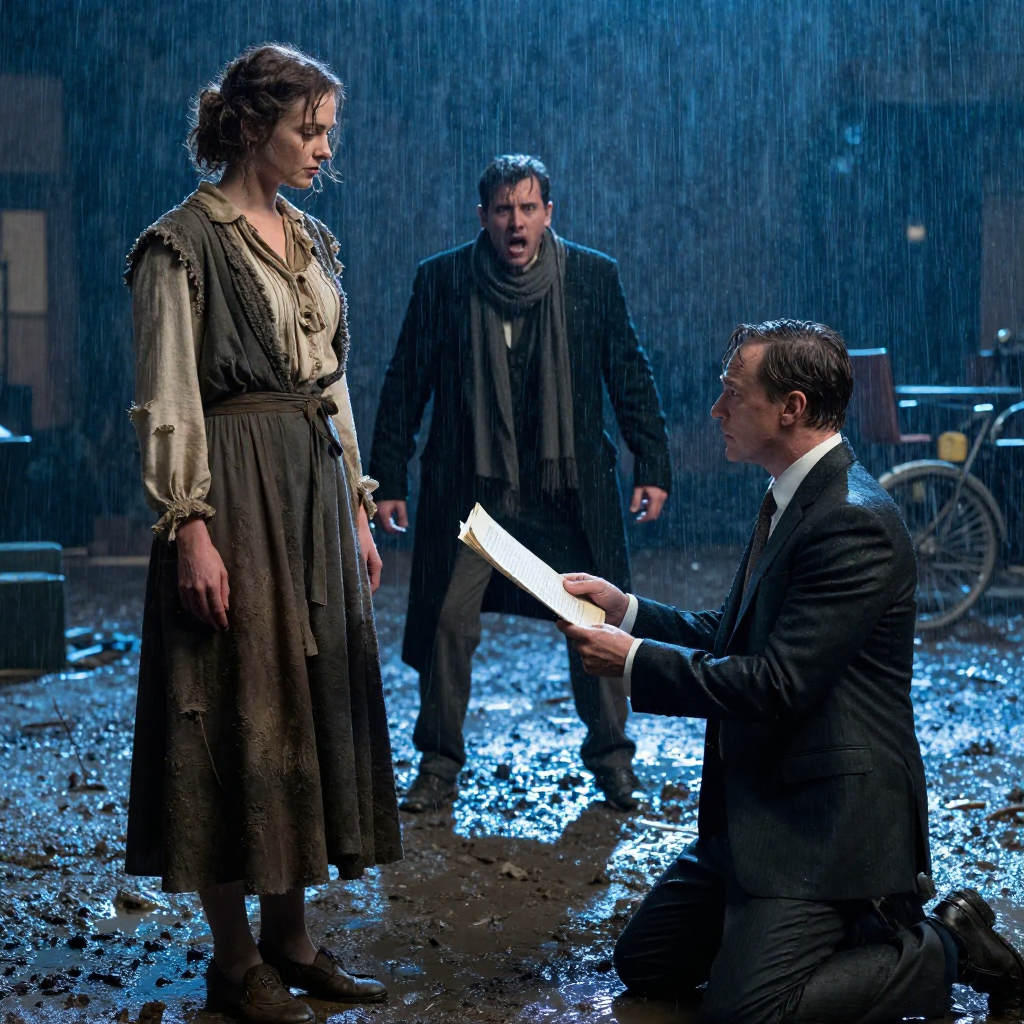
Noah didn’t answer him. Instead, in front of the entire crew, the A-list movie star, the man whose face was on billboards from Tokyo to London, slowly bent his knees. He didn’t just nod. He knelt. He knelt down in the mud, reached out, and picked up the soggy pages Julian had thrown.
He wiped the mud off the paper with his silk tie, stood up, and held them out to me with both hands, like an offering.
‘I didn’t know you were visiting the set, Ms. Vance,’ Noah said, his voice projecting clearly to the rafters. ‘If I had known the author was here, I would have asked for a better performance from myself.’
The silence that fell over the room was absolute. It was the kind of silence that happens when the oxygen is sucked out of a room.
Julian froze. His mouth opened, but no sound came out. He looked at Noah, then at me, and I saw the gears turning in his head. The arrogance began to crack, replaced by a slow, creeping horror. He looked at the ‘extra’ he had just called a sack of potatoes.
‘Ms. Vance?’ Julian choked out. ‘As in… Executive Producer Vance?’
I took the script from Noah and turned my gaze to Julian. I didn’t scream. I didn’t shout. I spoke with the quiet, absolute authority of the person who signed the checks.
‘You mentioned something about firing someone, Julian,’ I said, taking a step toward him. ‘I think that’s a brilliant idea.’
CHAPTER II
The silence that followed Noah’s words was not the peaceful kind. It was the heavy, suffocating pressure of a vacuum, the kind that makes your ears pop before a storm. Noah remained there, one knee pressed into the freezing mud, his hand still holding mine with a grip that was both a shield and an anchor. He didn’t look at the cameras, or the crew, or the lights. He looked only at me, his eyes carrying a quiet apology for having to end my charade so abruptly.
Across from us, Julian looked as though someone had replaced his blood with ice water. The color drained from his face in a way that was almost medical, leaving his skin a sallow, sickly grey. The megaphone he had used to broadcast his cruelty dangled limp from his hand, the strap caught around his wrist like a shackle. He didn’t move. He didn’t breathe. He just stared at the woman he had called a ‘useless piece of scenery’ only moments before, realizing the scenery owned the mountain he was standing on.
I felt the mud seeping through my thin leggings, a cold reminder of the indignity I’d just endured. My script—the words I had labored over for three years, the story that had crawled out of my own grief—lay ruined at my feet, soaked in the filth of a man’s ego. I looked down at it, then back at Julian. The power shift was so physical I could feel it hum in the air. The crew, nearly a hundred people who had spent weeks living under Julian’s boot, were frozen. Some were still holding light reflectors; others had their hands over their mouths. It was the moment the dragon realized the princess was the one who had built the cage.
“Elara,” Julian whispered. His voice was a thin, reedy thing, stripped of the booming authority he had used to lacerate the souls of everyone on this set. “I… I had no idea. You didn’t… you weren’t on the call sheet. Why weren’t you in the trailer? Why are you dressed like… like that?”
“Like a human being, Julian?” I asked. My voice was surprisingly steady, though my heart was hammering against my ribs. I stood up, gently pulling my hand from Noah’s. I didn’t brush the mud off my clothes. I wanted it there. I wanted the grime to be visible. “I’m dressed like the people you’ve been stepping on for fourteen hours a day. I’m dressed like the background actors you haven’t given a water break to in four hours. I’m dressed like the story I actually wrote—the one about dignity, not about your peculiar brand of sadism.”
Julian took a stumbling step forward, his hands coming up in a placating gesture. It was a pathetic sight—a man who had been a god five minutes ago now scrambling to find a footing on a crumbling cliff. “Listen, Elara—Ms. Vance—please. You caught me at a bad moment. The pressure of the shoot, the budget… you know how it is. I was just trying to get the best performance. I was pushing you! I saw something in you, truly. I was testing your range. It was a technique! Method directing!”
I looked at him, and for the first time, I didn’t feel the sharp sting of the insults he’d hurled at me. I felt a profound, weary pity. This was the ‘Old Wound’ I carried—the reason I had insisted on this undercover mission in the first place. My father had been a character actor, a man of immense talent and even greater humility. He had been broken by a director exactly like Julian—a man who mistook cruelty for ‘vision’ and eventually drove my father into a spiral of self-doubt that ended his career and, eventually, his will to live. I had promised myself, when I sold the rights to my book, that I would never let another person be the catalyst for that kind of destruction on a set that bore my name.
“A technique,” I repeated. I stepped over the ruined script. “You threw my work into the mud because of a ‘technique’? You told a young woman she was a failure of a human being because of ‘the budget’?”
“I’ll make it up to you,” Julian said, his words coming faster now, tripping over each other. He was looking around at the crew, his eyes darting, searching for an ally. But there were none. Every face was a mask of cold observation. “We’ll restart. We’ll do the scene your way. Noah, back me up here. We’re making magic, aren’t we?”
Noah stood up, his tall frame casting a long shadow over Julian. He didn’t say a word. He just crossed his arms and looked at the ground. The silence was Julian’s executioner.
I looked at Julian and saw the ‘Secret’ I had been keeping—not just my identity, but the fact that I had already seen his dailies from the previous week. I knew he was behind schedule because he spent hours screaming instead of blocking. I knew he was over budget because he insisted on expensive lens flares that added nothing to the narrative. My ‘Secret’ was that I had come here not to observe a director, but to confirm a replacement. I had been hoping I was wrong. I had been hoping the rumors were just industry gossip. But Julian had handed me the evidence on a silver platter, dripping with mud.
“Let’s walk, Julian,” I said.
I turned and headed toward the production tent, the heavy canvas structure that sat like a grey cloud at the edge of the field. I didn’t look back to see if he was following. I knew he was. He was a man who lived for the spotlight; he wouldn’t know how to exist in the dark I was about to lead him into.
Inside the tent, the air was warmer but no less tense. My assistant, Sarah, was there, looking pale. She had known the plan, and she knew what was coming. I sat down in a folding chair—not the ‘Director’ chair, but a simple, nameless one. Julian stood by the entrance, his hands shaking as he tried to light a cigarette.
“Don’t,” I said. He dropped the lighter.
“Elara, let’s be reasonable,” Julian started, his voice attempting a return to its oily, persuasive tone. “You’re a writer. You’re emotional. You see things through the lens of your characters. But this is a business. This is a multi-million dollar machine. If you disrupt it now, the investors will pull out. The studio will see you as ‘difficult.’ You’ll never get another project greenlit. I’m your protection. I’m the ‘bad guy’ so you don’t have to be.”
This was the ‘Moral Dilemma’ he was trying to trap me in. He wasn’t entirely wrong about the consequences. Firing a director in the middle of principal photography was a nuclear option. It would mean a two-week hiatus minimum. It would mean re-shooting half of what we’d already done. It would mean the crew—those same people I wanted to protect—might lose their paychecks if the bond company stepped in and shuttered the whole thing. If I chose ‘right’ by the people, I might cause them the ultimate personal loss: their livelihoods. If I chose ‘wrong’ and kept him, I was allowing a cancer to stay in the heart of my story.
I looked at Julian. “You think you’re the only one who can drive this machine, Julian? That’s your greatest arrogance. You think the art is in the whip, not the horse.”
“I am the vision!” he snapped, a flash of his old temper flickering for a second before he remembered who he was talking to. “Without me, this is just a Hallmark movie. I gave it edge. I gave it grit.”
“No,” I said, leaning forward. “You gave it trauma. There’s a difference. I’ve watched your footage, Julian. I’ve seen the way you cut Noah off when he’s reaching for an honest emotion because you’d rather see him cry out of frustration than grief. I’ve seen the way you treat the lighting technicians like they’re pieces of equipment. You aren’t building a masterpiece. You’re building a monument to your own insecurity.”
I pulled a tablet from Sarah’s hands and slid it across the table. On it was a list of safety violations and labor complaints I had quietly documented over the last four days while pretending to be a background extra.
“What is this?” Julian asked, though he didn’t touch the screen.
“That is the reason you won’t be receiving a severance package,” I said. “And that is why the studio won’t back you when I tell them you’re gone. You didn’t just mistreat people, Julian. You created an unsafe work environment. You ignored the union’s heat-index warnings. You cut the budget for the onset medic to pay for your personal driver.”
Julian’s face went from pale to a mottled, angry red. “You little… you think you can come onto my set and spy on me? You think your little book gives you the right to dismantle my career? I’ve been in this business twenty years!”
“And in twenty years, you never learned that the people holding the cameras are more important than the man behind them,” I replied. “You’re not a director, Julian. You’re a bully with a viewfinder. You didn’t even read the last thirty pages of the script, did you?”
He opened his mouth to lie, but I stopped him with a look.
“You didn’t. Because if you had, you’d know that the ending of this story isn’t about the protagonist being broken. It’s about her finding the strength to walk away from people like you. You were trying to film a tragedy about defeat, while I was writing a story about survival. You didn’t fail because you were mean, Julian. You failed because you were a bad reader. You didn’t understand the heart of the work, and therefore, you couldn’t possibly direct it.”
I felt a strange sense of clarity. The dilemma wasn’t a dilemma at all. The money, the schedule, the ‘difficult’ reputation—none of it mattered if the soul of the project was dead. If I let him stay, the book I wrote would become a lie.
“Sarah,” I said, not taking my eyes off Julian. “Call the UPM. Tell him we’re wrapped for the day. Full pay for the crew. Tell them there will be a mandatory production meeting tomorrow morning at nine. And call Marcus. Tell him the ’emergency contingency’ we discussed is now in effect. He’s on a plane tonight.”
Julian’s eyes widened. “Marcus? Marcus Thorne? You… you already had him on standby?”
“I had him on standby the moment I heard how you spoke to your last AD,” I said. “I gave you a week to prove the rumors wrong. You used that week to prove them right. You used today to prove you’re a liability.”
Julian stood there, his world collapsing in the space of a small, humid tent. He looked at the tablet, then at me, then at the door. He knew it was over. In this industry, once the ‘talent’ and the ‘money’ align against you, there is no appeal. He had lost the lead actor, the author, and the EP in a single afternoon.
“You’re making a mistake,” he hissed, but the venom was gone. It was just the sound of a snake with its fangs pulled. “You’ll be the one they blame when this goes over budget. You’ll be the one who killed this movie.”
“I’d rather bury it than let you touch it again,” I said.
He turned and walked out of the tent. He didn’t go back to the set. He headed straight for his trailer, his head down, the megaphone still swinging from his wrist like a dead weight.
I stayed in the chair for a long time, listening to the sounds of the set outside. I expected shouting, or perhaps a cheer, but it was just… quiet. And then, slowly, the sound of movement. Not the frantic, panicked movement of people trying to avoid a blow, but the steady, methodical sound of people packing up.
I stood up and walked out of the tent. The rain had started again, a soft, cleansing drizzle. Noah was standing by the craft services table, holding two cups of coffee. He handed one to me. It was hot, the paper cup warming my frozen fingers.
“Is he gone?” Noah asked.
“He’s gone,” I said.
I looked out over the field. The crew was moving through the mud, winding up cables, securing the lights. One of the grips, a man who had been the target of Julian’s ire earlier that morning, caught my eye. He didn’t say anything. He just gave a single, firm nod of his head before going back to his work.
It wasn’t a victory celebration. It was the aftermath of a surgery. The tumor had been removed, but the body was still weak, still bleeding. We had a long way to go. We had to rebuild the trust, the schedule, and the very air of the production.
“You okay?” Noah asked, his voice low.
“I don’t know,” I admitted. “I think I just became the person I’ve always been afraid of being. The one who has to make the cold decisions.”
“No,” Noah said, looking at the crew. “You’re the one who just reminded them why they love making movies. Julian made them feel like tools. You made them feel like people again. That’s not a cold decision, Elara. That’s an act of mercy.”
I looked down at my muddy clothes. I was still the ‘extra’ in their eyes, the one who had stood in the trenches with them. I realized then that I couldn’t go back to the trailer. I couldn’t go back to the fancy hotels and the insulated world of the ‘Executive Producer.’ If I was going to fix this, I had to stay here, in the mud, with them.
But as I looked at the horizon, I saw the headlights of a car pulling away. Julian was leaving. And as the tail lights disappeared into the fog, a new fear settled in my gut. Julian was a man with nothing left to lose, and in this town, that made him the most dangerous kind of enemy. He knew my secrets, he knew the production’s weaknesses, and he had twenty years of bridges he could burn on his way out.
I took a sip of the coffee. It tasted like burnt beans and plastic, but it was the best thing I’d ever had.
“Noah?” I said.
“Yeah?”
“Tomorrow is going to be a bloodbath, isn’t it?”
Noah looked at the empty space where Julian’s trailer had been and then back at me. A small, sad smile touched his lips.
“Probably. But at least we’ll be fighting for something worth winning.”
I nodded, the weight of the coming days settling on my shoulders. The first act was over. The villain had been cast out. But the real story—the struggle to create something beautiful out of the wreckage—was only just beginning. And I knew, with a sinking certainty, that Julian wouldn’t go quietly into the night. He would wait for his moment, and when he struck, it wouldn’t be with a megaphone. It would be with a knife in the dark of the trade papers.
I turned back toward the lights, toward the people who were now looking to me for more than just lines on a page. I was no longer an observer. I was the heart of the storm.
CHAPTER III
Marcus Thorne arrived at six in the morning. He didn’t come with a flourish or a grand announcement. He just walked onto the soundstage wearing a faded denim jacket and carrying a thermos of black coffee. He looked like a man who had seen too many midnight shoots and lived to tell the tale. I watched him from the shadows of the catering tent, my hands wrapped around a cup of tea that had long since gone cold. I wanted to feel a sense of relief. I wanted to believe that the poison Julian had pumped into this production had been drained with his departure. But the air felt heavy. It felt like the moments before a storm breaks, that static tension that makes the hair on your arms stand up.
Marcus approached me. He didn’t offer a handshake. He just looked at the set, then back at me. “It’s a mess, Elara,” he said. His voice was gravelly, devoid of Julian’s performative theater. “Not the script. The people. They look like they’re waiting for an execution.” I nodded, my throat tight. “They’ve been through a lot,” I managed to say. He looked at me for a long time, his eyes searching mine. “And you? You’re the one they’re whispering about. The undercover producer. The writer who played dress-up.” He wasn’t being unkind, just blunt. I didn’t have an answer for him yet. I didn’t know who I was to them anymore.
My phone vibrated in my pocket. Then it vibrated again. And again. A rhythmic, relentless buzzing that signaled a digital wildfire. I pulled it out, and the first thing I saw was a notification from a major industry trade. Then a link from a tabloid. Then a text from my agent that just said: *Don’t look at social media. We’re calling a meeting.* I looked, of course. I had to. The headline on the first link made the world tilt on its axis: “THE VANCE EXPERIMENT: ELITIST PRODUCER CAUGHT MOCKING WORKING CLASS CREW UNDERCOVER.”
Below it was a video. It was edited with surgical malice. It showed me in my extra’s uniform, sitting on a crate, looking exhausted. But the audio was different. It was a voiceover, Julian’s voice, recorded during one of our private arguments, spliced over footage of me watching the crew work. He had taken my words out of context—my frustrations about the script’s pace, my concerns about the budget—and made them sound like I was laughing at the crew’s incompetence. There was a clip of me looking at Sarah, the young PA, and in the edited version, it looked like I was sneering at her. The comments section was already a slaughterhouse. People were calling for a boycott. They were calling me a “nepo-baby voyeur” who used the struggles of the working class as research for my next award-winning drama.
I felt a cold sweat break across my neck. This was Julian’s scorched earth. He wasn’t just leaving; he was burning the house down with me inside it. I looked up and saw Noah walking toward me. His face was pale, his phone clutched in his hand like a weapon. “Have you seen it?” he asked. I couldn’t even speak. I just nodded. Noah looked around the set. The crew members who had been setting up lights and moving cables had stopped. They were huddled in small groups, their phones glowing in the dim light. They weren’t looking at the new director. They were looking at me. And for the first time, there was no solidarity. There was only the sharp, jagged edge of betrayal.
Phase 2: The Studio’s Iron Fist
Two hours later, the black SUVs arrived. They didn’t park in the designated lot; they drove straight onto the studio floor, their tires screeching against the polished concrete. Helena Sterling, the Head of Production for the studio, stepped out. She was a woman who navigated life like a guided missile—fast, precise, and lethal. She didn’t go to her office. She marched straight to my trailer and slammed the door behind her. Marcus was already there, leaning against the small kitchenette, looking like he wanted to be anywhere else.
“Shutdown,” Helena said. It wasn’t a suggestion. It was a sentence. “The PR metrics are a disaster, Elara. We have three major sponsors threatening to pull their placement. The union is fielding calls from crew members who feel ‘violated’ by your little undercover stunt.” She paced the narrow length of the trailer, her heels clicking like a metronome. “Julian might be a monster, but he’s a known monster. You? You’re a liability.” I stood my ground, though my knees felt like water. “The video is a lie, Helena. You know that. You saw the raw footage. Julian is the one who created the hostile environment.”
Helena stopped and looked at me. Her eyes were hard as flint. “It doesn’t matter what I know. It matters what the world believes. And right now, the world believes you’re a sociopath who played with people’s livelihoods for a ‘creative spark.’” She leaned in closer, her voice dropping to a dangerous whisper. “There is a way to fix this. A way to keep the cameras rolling. We need a narrative shift. We need to frame the ‘hostility’ on set as the result of a specific failure in management—someone other than you. Someone who can be the face of the safety violations.”
She pulled a folder from her bag and slid a photo across the table. It was Sarah. The production assistant who had helped me when I was ‘just’ an extra. The girl who had shared her lunch with me and told me about her dreams of becoming a cinematographer. “We say she was the one responsible for the safety checks on the day of the incident,” Helena said. “We say she falsified the reports to hide her own negligence. We fire her, issue a public apology for ‘failing to supervise a junior staffer,’ and you come out as the whistleblower who went undercover to find the truth.”
My heart hammered against my ribs. “You want me to ruin her career to save my reputation?” I asked. Helena didn’t blink. “I want you to save this fifty-million-dollar production. If you don’t, the studio pulls the plug. Everyone here loses their job. Every grip, every electric, every caterer. Their mortgages are on your head, Elara. Choose. Are you a producer, or are you a martyr?” I looked at Sarah’s photo. She was twenty-two. She had no power, no platform. She was the perfect scapegoat because she was invisible. I felt a wave of nausea. This was the same choice they had given my father twenty years ago. Sacrifice someone else, or be the one who burns.
Phase 3: The Town Hall
I told Helena I needed an hour. Instead, I called a mandatory meeting for the entire cast and crew on Stage 4. I didn’t tell the studio. I didn’t tell Marcus. I just sent the blast out on the internal comms. When I walked onto the stage, the atmosphere was thick enough to choke on. The entire crew was there, hundreds of people sitting on equipment crates and folding chairs. Sarah was in the front row, her eyes red-rimmed, her shoulders hunched. She looked terrified. Noah stood off to the side, his arms crossed, watching me with a look of profound disappointment. He thought I was going to follow Helena’s script.
I stood behind a lone microphone. Before I could speak, a voice boomed from the back of the room. “Is this the part where you tell us it was all for our own good?” The crowd parted. Julian walked in. He wasn’t supposed to be on the lot. He had been banned. But he walked with the confidence of a man who still owned the room. He was filming. A small crew of his own was following him, livestreaming the whole thing. He wanted a public execution.
“Look at her,” Julian said, gesturing to me as he approached the stage. “The great Elara Vance. She’s exactly what I told you she was. A fraud. A parasite who thinks she can buy empathy.” He climbed onto the stage, standing five feet from me. The crew was silent, mesmerized by the wreckage. “You think you’re different from me?” Julian sneered. “You think you’re the hero? You’re just like your father, Arthur. He was a hack who couldn’t cut it, so he tried to sue his way to the top. I was his assistant, did you know that? I saw him forge the signatures on the location permits. I saw him lie to the bond company.”
My breath hitched. The Old Wound ripped wide open. “You’re lying,” I whispered. Julian laughed, a dry, rasping sound. “I didn’t just see it, Elara. I’m the one who told the studio. I’m the one who ‘blew the whistle’ on him. He didn’t lose his career because of bad luck. He lost it because I took it from him. He was weak, and I was hungry. And now, twenty years later, I get to watch his daughter do the exact same thing.” He turned to the crew, his voice rising. “She’s about to blame Sarah. I’ve seen the studio’s memo. They’re going to sacrifice a PA to save the ‘Vance Legacy.’ Tell them, Elara. Tell them who you’re going to fire today.”
I looked at Sarah. She was shaking. I looked at Noah, who had moved closer to the stage, his face a mask of shock at Julian’s confession. The silence in the room was deafening. I could see the red tally light on Julian’s livestream camera. The whole world was watching. This was the moment. I could follow Helena’s plan, save the film, and keep my power. Or I could tell the truth and let it all fall apart. I felt my father’s ghost in the room—not the broken man he became, but the man who had taught me to love stories because they were supposed to mean something.
Phase 4: The Pivot and Intervention
“Julian is right about one thing,” I said, my voice steady, amplified by the speakers until it shook the rafters. “The studio did ask me to blame Sarah. They asked me to lie to you to save the production’s reputation. They told me that if I didn’t, the film would be shut down and you would all be out of work.” I paused, looking directly into the lens of Julian’s camera. “But Julian is wrong about everything else. My father didn’t forge those signatures. You did. You were the one in charge of the permits. You framed him because you wanted his chair. You’ve been a predator since the day you started, and you’ve spent your whole career looking for people to sacrifice for your ego.”
I turned back to the crew. “I didn’t go undercover to mock you. I went undercover because I was a coward. I was the Executive Producer, and I was too afraid to look at what was happening on my own set. I let Julian hurt you. I let him create a culture of fear because I wanted to make a ‘great’ movie. I am just as guilty as he is.” I reached into my pocket and pulled out my badge—not the producer’s pass, but the tattered extra’s badge I had worn. I dropped it on the floor. “I’m not firing Sarah. I’m not firing anyone. If the studio wants a scapegoat, they can have me. I’m resigning, effective immediately. I’ve already sent the raw, unedited footage of every safety violation and every one of Julian’s outbursts to the Union and the Labor Board. The film doesn’t belong to the studio anymore. It belongs to the people who actually built it.”
Julian’s face contorted with rage. He stepped toward me, his hand raised as if to strike, but he stopped. The room had changed. The crew wasn’t sitting anymore. They were standing. Hundreds of them, moving as one. They didn’t move toward Julian with violence; they moved toward the stage in a silent, overwhelming tide. Noah was the first one up. He stood between me and Julian, his massive frame a physical barrier. Then came the grips. Then the makeup artists. Then Sarah. They formed a human wall around me.
At that moment, the heavy steel doors at the back of the stage swung open. It wasn’t more security. It was a man in a gray suit, followed by three people in official uniforms. “I am David Chen, Legal Counsel for the International Alliance of Film Technicians,” the man announced. His voice was calm, but it carried the weight of absolute authority. “We have received the evidence provided by Ms. Vance. Under the emergency provisions of the collective bargaining agreement, this set is now under Union receivership due to systemic safety failures and executive misconduct.”
He walked toward the stage, ignoring Julian entirely. He looked at me, then at the crew. “The studio does not have the authority to shut this production down while a labor investigation is active. However, the current leadership is suspended.” He turned to Helena Sterling, who had appeared in the wings, looking ashen. “Ms. Sterling, your parent company’s board has been notified. They are concerned about the mounting legal liability. They have instructed us to facilitate a transition. Mr. Thorne will continue as Director, but he will report directly to a Union-appointed safety committee.”
Julian tried to speak, but Chen held up a hand. “Mr. Miller, you are being served with a cease-and-desist regarding the use of proprietary footage from this set. Furthermore, we have a team of investigators who would like to speak with you regarding the historical allegations brought forward by Ms. Vance.” The bravado drained out of Julian like air from a punctured tire. He looked around the room and saw not a crew, but a collective. He saw people who no longer feared him. He slunk off the stage, his camera crew following him like scavengers, their livestream still running, capturing his final, pathetic retreat.
I stood there, surrounded by the people I had lied to, then tried to save. Sarah reached out and took my hand. She didn’t say anything, but her grip was firm. The film might survive. My career might be over. The Vance legacy was no longer a secret burden or a polished lie. It was just the truth, messy and painful, laid out on the floor for everyone to see. I looked at Noah. He gave me a small, weary smile. The storm had broken. The house was still standing, but the landscape was unrecognizable.
CHAPTER IV
The silence after the town hall was deafening, a ringing in my ears that drowned out the city. Even the honking taxis seemed muted, respectful, or maybe I was just numb. Julian was gone, the studio heads were gone, but the weight of it all remained, a lead apron I couldn’t shrug off. The IAFT was in control, the crew ecstatic, but I felt like I was floating, detached from the victory.
I walked back to my apartment, the same one I’d lived in for years, but it felt different, tainted. The news was already buzzing with the story. “Executive Exposes Abuses,” “Studio Heads Ousted,” “Film Set Revolution.” My face was everywhere, plastered across screens, a reluctant hero. But inside, I didn’t feel like a hero. I felt hollow.
I poured myself a glass of scotch, neat, and sat on the balcony, watching the city lights blur. My phone buzzed with messages – congratulations, support, interview requests. I ignored them all. Noah had called several times, but I couldn’t bring myself to answer. What could we even say?
The next morning, Helena Sterling called. Her voice was clipped, devoid of emotion. “We need to discuss your resignation,” she said. “And the terms of your departure.” I wasn’t surprised. I’d known this was coming. “I’ll have my lawyer contact you,” I replied, and hung up. I didn’t have a lawyer yet. That was another thing on the list.
The public narrative was that I was a whistleblower, a champion of the underdog. But the reality was messier, more complicated. I had been complicit, profited from the system, and only acted when it threatened to consume me. The guilt gnawed at me, a constant reminder of my own failings.
**PHASE 1: PUBLIC AND PRIVATE**
The weeks that followed were a blur of legal meetings, media inquiries, and union negotiations. The IAFT was determined to finish the film, but they needed my cooperation. They wanted me to consult, to help guide the new director, someone they trusted, someone who understood the vision. I hesitated. I wasn’t sure I could face that set again, the memories, the constant reminder of Julian and my own mistakes.
The media attention was relentless. Every news outlet wanted an interview, a piece of the story. They painted me as a martyr, a victim, a savior. I tried to correct the narrative, to explain my own culpability, but it didn’t fit the story they wanted to tell. They wanted a simple narrative, a clear hero and villain. The truth was too nuanced, too uncomfortable.
One evening, I received a package. It was a box of old film reels, unlabeled. Curious, I set up my projector and threaded the first reel. It was footage of my father, Arthur Vance, directing his last film. He was young, vibrant, full of passion. I hadn’t seen this footage in years. As I watched, a wave of emotion washed over me – grief, regret, and a profound sense of loss.
I saw the joy in his eyes, the way he connected with the actors, the crew. He was a true artist, a visionary. And then, the footage shifted. Julian appeared, younger but with the same cold, calculating gaze. He was whispering to the producers, planting seeds of doubt, undermining my father’s authority. I watched in horror as my father’s vision slowly crumbled, his spirit broken.
The last reel was the most devastating. It showed my father, defeated, walking off the set for the last time. His shoulders were slumped, his head bowed. He looked like a broken man. I turned off the projector, tears streaming down my face. It was all clear now. Julian had systematically destroyed my father, and I had unknowingly followed in his footsteps.
I felt a surge of anger, a burning desire for revenge. But then, I realized that revenge wouldn’t bring my father back. It wouldn’t erase the past. The only thing I could do was learn from my mistakes and try to make amends. I picked up the phone and called the IAFT representative. “I’ll help you finish the film,” I said. “But on my terms.”
**PHASE 2: UNEXPECTED ALLIES**
Returning to the set was like walking into a graveyard. The atmosphere was heavy, haunted by the ghosts of the past. The crew was wary, unsure of how to act around me. They had seen me as the enemy, the boss, the one who protected Julian. Now, I was one of them, fighting for their rights.
The IAFT had appointed a new director, a woman named Maria Rodriguez. She was a seasoned filmmaker, known for her collaborative style and her commitment to social justice. She was the antithesis of Julian, and her presence brought a sense of calm and purpose to the set.
Maria and I worked closely together, rewriting scenes, adjusting the schedule, and addressing the concerns of the crew. We held open meetings, listened to their suggestions, and made them feel like they were part of the creative process. It was a slow, painstaking process, but it was essential to rebuilding trust and creating a positive work environment.
One day, Sarah, the young PA I had refused to scapegoat, approached me. She was hesitant, her eyes filled with a mixture of gratitude and apprehension. “Thank you,” she said softly. “For what you did. For not letting them blame me.”
I smiled. “You didn’t deserve it,” I replied. “And I should have done more to protect you and everyone else from the beginning.” Sarah nodded. “It’s okay,” she said. “We all make mistakes. The important thing is that we learn from them.” Her words were a balm to my wounded soul.
Noah showed up on set unexpectedly. He looked tired, his eyes shadowed with remorse. “Can we talk?” he asked. I nodded and led him to my trailer.
“I’m sorry,” he said, his voice barely above a whisper. “For everything. For betraying you, for siding with Julian, for being so blind.” I looked at him, searching for sincerity in his eyes. I saw genuine regret, a deep understanding of the pain he had caused.
“I was wrong,” he continued. “I let my ego get in the way. I thought Julian was invincible, that he could make or break my career. But I was wrong. You were right all along.” I sighed. “It doesn’t matter now,” I said. “It’s over.” But it wasn’t over, not really. The damage had been done, and the scars would remain.
**PHASE 3: LEGACIES AND COMPLICATIONS**
As we continued filming, a new challenge emerged. Julian’s lawyers filed a lawsuit, claiming that his termination was unlawful and that I had defamed his character. The lawsuit was a nuisance, a distraction, but it couldn’t be ignored.
The studio, now under new management, offered to settle the case, but I refused. I didn’t want to give Julian any satisfaction, any sense of victory. I wanted to fight him, to expose his lies and his abuse of power. The legal battle dragged on for months, consuming my time and energy.
During the deposition, Julian’s lawyers grilled me about my father, about his career, about the circumstances surrounding his downfall. They tried to paint him as a failure, a has-been, a drunk. I refused to let them. I defended my father’s legacy, his talent, his integrity.
I testified about Julian’s sabotage, his manipulation, his cruelty. I recounted the events on set, the toxic atmosphere, the abuse of power. I spoke the truth, even when it was painful, even when it made me look bad.
One day, I received a letter from an anonymous source. It contained documents that proved Julian had stolen my father’s ideas, his scripts, his concepts. The documents were damning, irrefutable evidence of Julian’s plagiarism and his betrayal of my father.
I turned the documents over to my lawyers, and they presented them in court. Julian’s lawyers tried to discredit the evidence, but it was too late. The truth was out, and Julian’s reputation was shattered.
The judge ruled in my favor, dismissing Julian’s lawsuit and awarding me damages. It was a victory, but it felt hollow. Julian was disgraced, his career ruined, but it didn’t bring my father back. It didn’t erase the past.
As the film neared completion, I began to think about my future. I had resigned from my position as executive producer, and I wasn’t sure what I wanted to do next. The studio offered me another job, but I declined. I needed a break, a chance to reflect, to heal.
**PHASE 4: THE COST OF JUSTICE**
The premiere of the film was a bittersweet moment. The crew was proud, the audience was enthusiastic, but I felt a sense of detachment. The film was a success, a testament to the resilience and talent of the crew. But it was also a reminder of the pain and suffering that had gone into its creation.
After the premiere, I visited my father’s grave. It was a simple headstone, unmarked except for his name and the dates of his birth and death. I stood there for a long time, talking to him, telling him about the film, about Julian, about everything that had happened.
“I did it, Dad,” I said, my voice choked with emotion. “I exposed him. I cleared your name. But it didn’t bring you back. It didn’t make things right.” I knelt down and placed a bouquet of flowers on his grave. “I miss you,” I whispered. “I always will.”
I walked away from the cemetery, feeling a sense of peace, a sense of closure. The past couldn’t be changed, but the future was still unwritten. I didn’t know what the future held, but I was ready to face it, to learn from my mistakes, and to honor my father’s memory.
I decided to take some time off, to travel, to explore new possibilities. I sold my apartment and bought a small cabin in the mountains. I wanted to be surrounded by nature, to find solace in the silence. I needed to disconnect from the world, to reconnect with myself.
One evening, as I sat on the porch of my cabin, watching the sunset, Noah called. “I wanted to let you know that I’m leaving Hollywood,” he said. “I’m going to work in theater, to focus on smaller, more meaningful projects.” I smiled. “That’s great, Noah,” I said. “I’m proud of you.”
“I also wanted to apologize again,” he continued. “For everything. I know it doesn’t change anything, but I wanted you to know that I’m truly sorry.” I sighed. “I know, Noah,” I said. “And I forgive you.” The line went silent for a moment. “Thank you, Elara,” he said softly. “Thank you.”
The sun dipped below the horizon, painting the sky in hues of orange and purple. I closed my eyes, feeling a sense of gratitude, a sense of hope. The storm had passed, and the sun was finally starting to shine again. The scars remained, but they were a reminder of the battles I had fought, the lessons I had learned, and the person I had become.
CHAPTER V
The lawsuit hit first. Not the frivolous one Julian had telegraphed, but a deeper cut: a civil suit from one of his former assistants. It alleged years of harassment, intimidation, and professional sabotage. I wasn’t named, not directly, but the suit claimed I’d enabled Julian’s behavior through willful ignorance and, later, by actively covering it up to protect the film. Helena was named. The studio was named. Everyone, it seemed, was going to pay for what had happened. My lawyers advised me to settle. “It’s cheaper,” they said. “Less messy. You don’t want this in the press again.” But I refused. I couldn’t. Not this time.
I spent weeks in depositions, reliving the ugliest moments of the past year. Julian’s lawyers were brutal, twisting my words, painting me as a ruthless executive who’d sacrificed anyone and everyone to get ahead. They weren’t entirely wrong. I had made choices I regretted. I had prioritized my career over people. I had looked the other way when I should have spoken up. But I wasn’t that person anymore, or at least, I was fighting like hell not to be. Sarah testified. Maria testified. Even Noah did, though he clearly hated every second of it. Their words mattered, but it was my own testimony that would determine the outcome.
I spoke about my father. About his passion, his talent, and the way Julian had systematically destroyed his career. I spoke about my own ambition, my own insecurities, and the fear that I would never be good enough. I spoke about the town hall, about the moment I realized I couldn’t keep running from the truth. And I spoke about Sarah, about how her courage had inspired me to finally do the right thing. The judge listened patiently. The lawyers scribbled furiously. I knew that whatever happened, I would never be able to erase the past. But I could try to atone for it. I could try to build something better. The settlement came weeks later. The studio paid. Helena paid. I paid, though not as much. But the money wasn’t the point. The point was that the truth had finally come out, and I had faced it. And survived.
The film was finally finished. Maria had taken over seamlessly, bringing a fresh perspective and a collaborative spirit to the set. The crew, empowered by the IAFT’s oversight, worked with a renewed sense of purpose. The atmosphere was lighter, more creative. The movie premiered, a quiet affair, more screening than event. I didn’t go. The reviews were good, respectful. It did okay at the box office, better internationally than at home. It would find its audience, or it wouldn’t. I no longer cared about the metrics of success. The real victory had been in the making, in the way we had all come together to create something meaningful out of the wreckage. I received a letter from my father’s old friend from film school.
He wrote: “Arthur would be proud of you, Elara. He always said you had a fire in your belly. I see now that it burns for the right reasons.” I sat with those words for a long time, letting them sink in. The fire was still there, but it was different now. It wasn’t fueled by ambition or ego. It was fueled by a desire to make a difference, to use my voice to speak up for those who didn’t have one. I started small. I mentored young filmmakers, especially women and people of color, using my connections and resources to help them get their start. I volunteered at a local community center, teaching film classes to underprivileged kids. I joined the board of a nonprofit organization that supported independent artists. It wasn’t glamorous work, but it was meaningful. It filled a void I hadn’t even realized was there. Months passed. The phone stopped ringing as much. The emails slowed to a trickle. I was no longer the “it” girl of Hollywood. I was just Elara, a woman trying to find her way in the world.
One day, I received a call from Noah. He was in New York, starring in a play. He invited me to come see it. I hesitated. I hadn’t seen him since the town hall, hadn’t spoken to him beyond a few brief emails. But I knew I couldn’t keep avoiding him forever. He was my cousin, my family. And despite everything that had happened, I still loved him. I flew to New York. We met for dinner before the show. He looked good, healthier than I’d seen him in years. The circles under his eyes were gone, replaced by a genuine smile. We talked awkwardly at first, skirting around the edges of the past. But slowly, as the evening wore on, we began to open up. He apologized for what he had done, for revealing my identity, for putting his own career ahead of our relationship. I apologized for not being there for him, for letting the pressure of Hollywood consume us both. We forgave each other. It wasn’t a dramatic moment, no tears or grand gestures. Just a quiet understanding, a recognition of the bond that still connected us.
The play was incredible. Noah was brilliant, captivating the audience with his raw emotion and vulnerability. I watched him on stage, not as a producer or an executive, but as a proud cousin. After the show, we went backstage. He introduced me to his castmates, his friends. They were a diverse group of people, artists from all walks of life, united by their passion for the theater. I felt a sense of belonging I hadn’t felt in a long time. I realized that I didn’t need Hollywood to be happy. I didn’t need the fame or the power or the validation. All I needed was connection, purpose, and the love of my family and friends. I stayed in New York for a few more days, exploring the city, reconnecting with my own artistic roots. I visited museums, went to concerts, and wandered through the vibrant neighborhoods, soaking up the energy and inspiration. I felt like I was finally coming home to myself.
I returned to Los Angeles, but things were different now. I sold my house in the Hollywood Hills, the one with the infinity pool and the panoramic views. I bought a small cottage in the foothills, surrounded by trees and birdsong. I started gardening, growing my own vegetables and herbs. I took long walks in the mountains, breathing in the fresh air and listening to the silence. I spent time with my father’s old friends, listening to their stories and learning about his life before Hollywood. I discovered that he had been a talented painter, a passionate activist, a loving husband and father. I had only seen the broken man, the one who had been defeated by the system. But he had been so much more than that. He had left behind a legacy of art, of compassion, of hope. And it was up to me to carry that legacy forward.
One afternoon, I drove to the cemetery. I stood before my father’s grave, the same grave I had visited so many times in the past. But this time, I didn’t feel the same sense of grief or anger. I felt a sense of peace, of acceptance. I had finally come to terms with his death, with his life, with my own life. I knew that I could never undo the past. But I could learn from it. I could use it to build a better future, for myself and for others. I placed a bouquet of wildflowers on his grave, wildflowers I had picked from my own garden. I whispered a silent prayer, a prayer of gratitude, of forgiveness, of love. And then I turned and walked away, leaving the past behind me, ready to embrace the future, whatever it may hold.
Weeks turned into months, months into a year. I still worked in the film industry, but on my own terms. I produced independent films, films that told stories that mattered, films that gave voice to the marginalized and the forgotten. I mentored young filmmakers, helping them navigate the treacherous waters of Hollywood, guiding them to stay true to their vision and their values. I used my platform to advocate for change, to fight for diversity and inclusion, to demand accountability and transparency. I wasn’t trying to save the world, but I was trying to make a difference, one film, one person, one day at a time. I found joy in the small things: a perfect sunset, a blooming flower, a shared laugh with a friend. I found peace in the quiet moments: a cup of tea in the morning, a walk in the woods, a good book by the fire.
I learned to forgive myself, to accept my flaws, to embrace my imperfections. I learned that it was okay to make mistakes, as long as I learned from them. I learned that it was okay to be vulnerable, to ask for help, to admit when I was wrong. I learned that it was okay to let go of the past, to stop clinging to the things I couldn’t change, to focus on the things I could. I learned that the most important thing in life was not success or recognition or power, but connection, purpose, and love. And I learned that those things were always within my reach, if only I was willing to open my heart and mind to them.
Sometimes, I think about Julian. I wonder where he is, what he’s doing. I hope he’s found some measure of peace, some way to atone for the harm he’s caused. But I don’t dwell on it. I have my own life to live, my own path to follow. And I know that the best way to honor my father’s memory is not to seek revenge or to hold onto bitterness, but to live a life of purpose, of integrity, of compassion. I continue to visit his grave, not out of obligation, but out of love. I tell him about my life, about my work, about my friends. I tell him about the young filmmakers I’m mentoring, the stories we’re telling, the change we’re trying to make.
I imagine him smiling, nodding his head, proud of the woman I’ve become. The woman he always knew I could be. The sun sets, casting long shadows across the cemetery. The air is cool and still. I take one last look at his grave, a silent farewell. And then I turn and walk away, leaving him to rest in peace, knowing that his spirit will always live on, in me, in my work, in the hearts of those who loved him. I don’t need to be in the spotlight to shine.
I’m sitting on the porch, watching the hummingbirds flit around the feeders. The air smells of jasmine and damp earth. It’s quiet here, far from the noise and the pretense of Hollywood. This is where I belong now. I smile faintly, remembering Arthur’s words, words I hadn’t understood then. “There’s a story in everything, Elara. You just have to learn to listen.” I’m still listening. A new script is open on my lap, pages filled with handwritten notes, thoughts, and images. I don’t know what it will become, but it doesn’t matter. The act of creation, that’s what matters. The process, the struggle, the joy. It’s all part of the story. It’s my story. A story of loss, of redemption, of finding my way back home. I take a sip of my tea and turn back to the page. There’s so much more to tell. So much more to live. And now, finally, I’m ready to begin. I whisper a thank you to the quiet air.
The phone rings. I watch it, let it ring. My peace cannot be bought. It cannot be sold. It must be earned. I take a deep breath and I keep writing.
It’s a quiet life, but it’s mine. It’s real. And it’s enough. I walk the dogs in the hills. I go to dinner with friends. I sit here, writing, remembering. Last week I saw Sarah again. She’s joined the IAFT, working to protect the rights of other young PAs. The movie that caused so much turmoil is a staple in film classes. Everyone is moving forward. A few weeks ago, I ran into Noah. He’s teaching acting. He looked good. We smiled and waved. We didn’t stop to talk. There was nothing left to say. Maybe someday. The dogs bark, and I look up to see the mailman. I walk to meet him. There’s a package from New York. It’s a playbill from Noah’s new show. I smile. The world is full of stories. I glance at my father’s headstone when I drive by. I still miss him.
There’s a bench near the rosebushes. I walk over and sit down. The roses are blooming, red and fragrant. I close my eyes and breathe deeply. The sun is warm on my face. The air is still. I’m at peace. For the first time in a long time, I am truly at peace. I trace the lines of a rose petal.
I do not know what comes next. But I am ready.
The best stories are the ones we write for ourselves.
END.