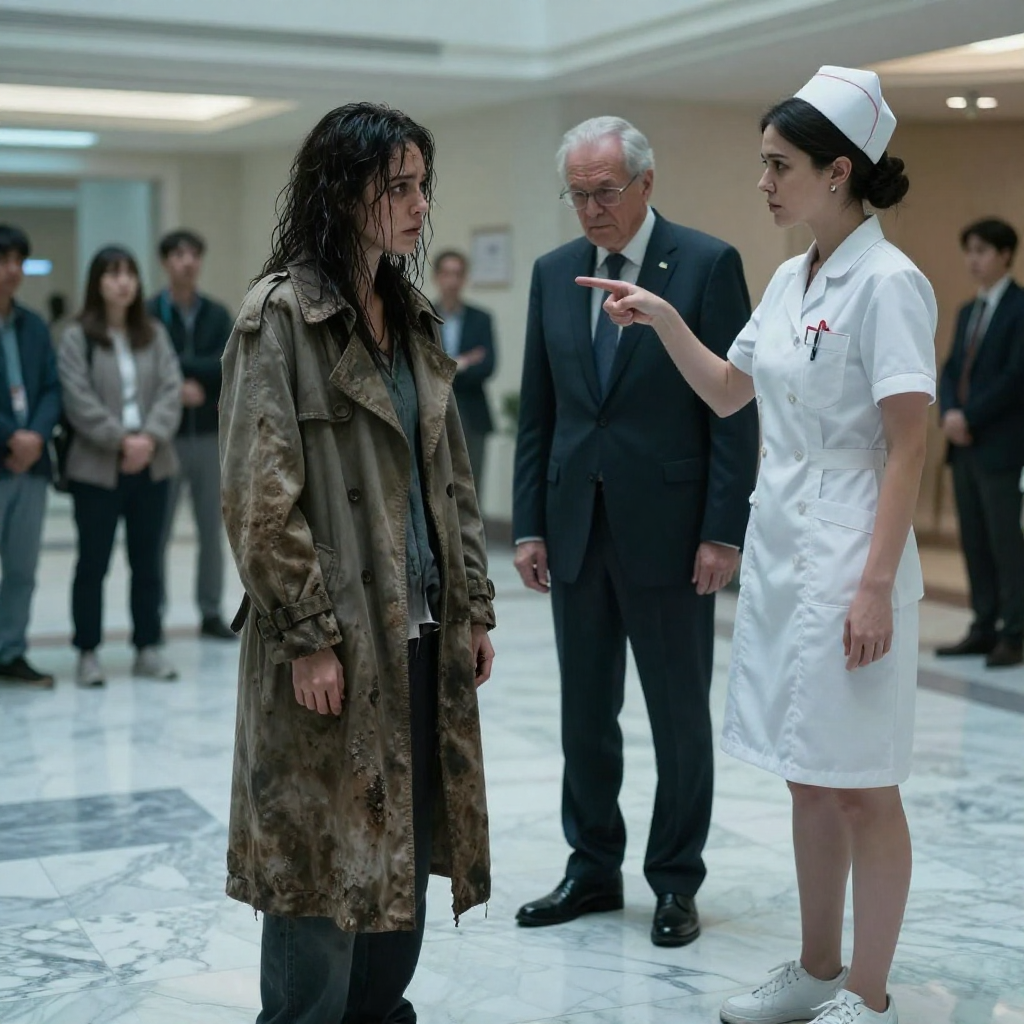
THE HEAD NURSE SAID I WAS POLLUTING THE AIR AND DRAGGED ME TOWARD THE EXIT, BUT HER FACE WENT GHOST-WHITE WHEN THE HOSPITAL DIRECTOR BOWED AND KISSED MY DIRTY HAND.
The automatic doors of St. Aethelgard’s Medical Center didn’t just slide open; they parted like the gates of a fortress, exhaling a breath of chilled, sanitized air that smelled of money and disinfectant. I stepped inside, bringing the storm with me. My trench coat was heavy with rain, the hem caked in mud from where I’d had to change a tire on the muddy shoulder of the interstate three miles back. I hadn’t showered in twenty-four hours. My hair was a frizzy, tangled mess shoved under a damp beanie, and my boots squeaked obnoxiously against the polished marble floor.
I didn’t care. The only thing that mattered was the text message burning a hole in my pocket: *He’s failing. Come now.*
I kept my head down, rushing toward the elevators that led to the Platinum Wing on the top floor. I knew the way. I knew every corner, every hallway, and every blueprint of this building. I should have—I’d signed off on them five years ago.
But to the world, and specifically to the woman standing guard at the reception desk of the VIP lift, I was just a vagrant who had wandered in off the street.
“Excuse me!” The voice was sharp, like a glass rod snapping. “Stop right there.”
I didn’t stop. I didn’t have time for bureaucracy. I pressed the call button for the elevator.
“I said, stop!”
A hand clamped onto my shoulder, fingers digging into the damp fabric of my coat with surprising strength. I was spun around, coming face-to-neck with a woman who looked less like a nurse and more like a pristine statue carved from ice. Her name tag read *H. Halloway, Head Nurse*. Her uniform was impeccably white, not a crease in sight, a stark contrast to my chaotic appearance.
“Can I help you?” she asked, though the tone suggested she wanted to sanitize her hand after touching me.
“I need to go to the Platinum Wing,” I said, my voice hoarse from crying in the car. “Room 402. It’s an emergency.”
Nurse Halloway didn’t blink. She looked me up and down, her gaze lingering on the mud on my boots and the frayed collar of my sweater. A sneer curled her lip, so subtle you’d miss it if you weren’t used to being judged.
“The Platinum Wing is for private patients and their authorized guests only,” she stated, positioning her body between me and the elevator doors. “The public clinic is on the ground floor, around the back. If you’re looking for a bed for the night, the shelter is three blocks east.”
“I’m not looking for a shelter,” I snapped, stepping forward. “I’m here to see Arthur Vance. I’m his daughter.”
The lie—or rather, the refusal to believe the truth—settled instantly in her eyes. She actually laughed. It was a dry, breathless sound. “Arthur Vance is a titan of industry, ma’am. His visitors are listed on a security manifest. They arrive in limousines, not… whatever this is.”
She gestured vaguely at my entire existence.
“Check the list,” I pleaded, desperation creeping into my voice. The elevator chimed behind her. It was opening. I tried to sidestep her. “Just check the list for Elena. Please.”
She shoved me.
It wasn’t a gentle guide; it was a firm, physical shove backward. I stumbled, my wet boots slipping on the marble, and I nearly went down. The few people in the lobby—wealthy visitors with bouquets of flowers and tailored suits—stopped and stared. The silence was instant and humiliating.
“I will not have you polluting the air of our patients,” Halloway hissed, her voice dropping to a menacing whisper so the donors in the lobby wouldn’t hear the venom. “You smell like wet dog and gasoline. You are disturbing the peace, and you are trespassing. Security!”
Two uniformed guards started walking toward us from the main entrance.
My hands shook. It wasn’t fear. It was a cocktail of grief and a cold, rising fury. “You are making a mistake,” I said, my voice shaking. “I funded this wing. I built this lobby. Let me up.”
“And I’m the Queen of England,” Halloway mocked, crossing her arms. “Get her out of here before she touches anything else.”
The guards were five feet away. I braced myself for the humiliation of being dragged out of my own hospital while my father lay dying upstairs. I closed my eyes, taking a breath, preparing to scream if I had to.
“What is the meaning of this?”
The voice boomed across the lobby, deep and authoritative.
The guards stopped instantly. Nurse Halloway’s posture straightened reflexively. We all turned.
Walking toward us was Dr. Marcus Sterling, the Chief of Medicine. He was flanked by two other surgeons, holding a clipboard, looking exhausted. He stopped ten feet away, his eyes scanning the scene—the guards, the smug look on Halloway’s face, and finally, me.
Halloway stepped forward, her smile returning, bright and fake. “Dr. Sterling, I apologize for the disturbance. This transient woman was trying to force her way into the Platinum Wing. She’s delusional, claiming to be related to Mr. Vance. I was just having security remove her to maintain the sterile environment.”
She looked at me with triumph. She expected praise. She expected him to nod and walk away.
Instead, Dr. Sterling’s clipboard clattered to the floor.
The sound echoed like a gunshot in the quiet lobby. He didn’t pick it up. He ignored Halloway completely. He ignored the guards. He walked straight toward me, his pace quickening, his face pale.
“Elena?” he whispered.
Halloway froze. Her mouth opened, but no sound came out.
Dr. Sterling didn’t care about the mud. He didn’t care about the wet coat. He stopped right in front of me and, to the absolute horror of the Head Nurse, he bowed his head deeply. It wasn’t just a nod; it was a bow of profound respect and apology.
He took my dirty, trembling hand in his clean ones.
“Madam Founder,” he said, his voice loud enough for the entire lobby to hear. “I am so, so sorry. We didn’t know you were coming ourselves. Why… why are you down here?”
I looked at Halloway.
The color had drained from her face so completely she looked like a corpse. Her eyes were wide, darting between Dr. Sterling and me. She took a step back, her hands trembling as they went to her mouth.
“She told me,” I said quietly, pointing a shaking finger at the nurse, “that I was polluting the air.”
Dr. Sterling slowly turned his head toward Halloway. The warmth vanished from his eyes, replaced by a cold, terrifying fury.
“You did what?” he asked softly.
CHAPTER II
The silence that followed Dr. Sterling’s words was not the peaceful kind. It was the heavy, pressurized silence that precedes a structural collapse. I could see the blood draining from Nurse Halloway’s face, leaving her skin a mottled, sickly grey that matched the industrial tile of the lobby floor. Her hand, which had been clamped firmly on my shoulder only seconds ago, began to twitch, then retreated as if the fabric of my grease-stained jacket had suddenly turned into white-hot iron.
“Madam… Founder?” she whispered, her voice cracking, the syllable catching in a throat constricted by terror.
I didn’t look at her. I couldn’t. If I looked at her, I would see the reflection of my own exhaustion and the absurdity of my appearance—the dirt under my fingernails, the streak of engine oil across my cheek, the smell of burnt rubber and desperation that clung to me like a second skin. Instead, I kept my eyes on Marcus Sterling. He was the only thing in this room that felt solid. He stood with his shoulders back, his expression a mask of professional fury directed entirely at the woman who had just treated the hospital’s primary benefactor like a stray animal.
“Nurse Halloway,” Sterling said, his voice dangerously low, “you will go to the administrative office immediately. You are to wait there for the Head of Human Resources. Do not speak to anyone. Do not return to your station. Your conduct today has been a catastrophic failure of every principle St. Aethelgard’s stands for.”
“Dr. Sterling, please,” she stammered, her eyes darting toward the security guards who were now standing awkwardly, their hands hovering near their belts, unsure of how to proceed. “I didn’t know. She… she looked like…”
“It doesn’t matter what she looked like!” Sterling’s voice finally broke its tether, echoing through the cavernous lobby. “This hospital was built on the premise that every soul entering these doors is deserving of dignity. You didn’t just insult Ms. Vance; you betrayed the very foundation of the Platinum Wing. Now, leave. Before I lose my composure.”
I felt a strange, hollow sensation in my chest. There was no triumph in watching her crumble. There was only a crushing sense of time slipping through my fingers. Every second spent watching this woman’s career dissolve was a second I wasn’t with my father. I reached out and touched Sterling’s sleeve, my grime-stained fingers leaving a faint mark on his pristine white coat.
“Marcus,” I said, my voice sounding thin and foreign to my own ears. “The time. How much time?”
His anger vanished instantly, replaced by a look of profound sorrow that chilled me more than the hospital’s air conditioning ever could. He didn’t answer immediately. He took a half-step toward me, his hand hovering as if to steady me. “The vitals began to drop twenty minutes ago, Elena. We’ve stabilized him for the moment, but it’s a fragile peace. We need to go. Now.”
He turned to the lead security guard. “Clear the express elevator. I want no delays. If anyone stops us for any reason, they answer to me personally.”
We moved across the lobby like a small, frantic storm. People stared—patients in designer robes, wealthy donors, staff members who had heard the shouting. They saw the Chief of Medicine, the man who held the keys to the most exclusive medical facility in the country, playing bodyguard to a woman who looked like she’d crawled out of a roadside ditch. I felt their judgment like heat on my skin, but it was distant now, muffled by the pounding of my own heart.
As the elevator doors slid shut, cutting off the prying eyes of the lobby, the silence returned, but this time it was intimate. The elevator was lined with mahogany and brushed gold—materials I had personally selected three years ago when I’d funneled forty million dollars into this project through a maze of offshore accounts. I had wanted the best for him. I had wanted a sanctuary where death couldn’t find him, or at least where it would have to knock politely before entering.
I leaned against the mirrored wall, catching a glimpse of myself. I looked like a ghost haunting my own creation.
“I’m sorry you had to see that, Elena,” Sterling said, staring at the floor indicator as it climbed toward the top floor. “I had no idea the staff had become so… emboldened. I’ll make sure it never happens again.”
“It’s not your fault, Marcus,” I said, closing my eyes. “I’m the one who insisted on the anonymity. I’m the one who didn’t want the Vance name on the plaque.”
This was the secret I had carried, the weight that had defined the last decade of my life. I was the architect of this empire, but I was also its prisoner. I had built the Platinum Wing as a monument to a man who didn’t even know I was capable of such a thing. My father, Arthur Vance, was a man of cold steel and industrial grit. He believed in things you could touch—factories, iron, sweat. He had watched me fail to fit into his world for twenty years, eventually dismissing me as a ‘dabbler,’ a girl with too much sentiment and not enough spine.
When his own company collapsed and his health followed, I didn’t step forward as the savior. I couldn’t. The old wound was too deep. I remembered the night he told me I’d never amount to anything but a ‘grease monkey’ after he found me under the hood of an old Mustang instead of at a debutante rehearsal. He had looked at me with a disappointment so profound it had rewritten my DNA.
So, when I struck gold in the tech sector under a pseudonym, I didn’t go back to him to gloat. I waited. I watched him wither from a distance, and when the end drew near, I bought this hospital. I built this wing. I paid for the specialists, the experimental drugs, the silk sheets. I did it all anonymously, providing him with a legacy he thought he’d earned back through some miracle of fate. I wanted him to die with his pride intact, even if it meant he died thinking I was still the failure he’d cast out.
“He asked for you,” Sterling said softly as the elevator dinged. “About an hour ago. He couldn’t speak clearly, but he said your name.”
My breath hitched. “Did he… did he seem angry?”
“No,” Sterling said, the doors sliding open to reveal a hallway that smelled of lavender and expensive filtration. “He seemed afraid. I’ve never seen Arthur Vance afraid before.”
We stepped out onto the top floor. The carpet here was deep, swallowing the sound of our footsteps. This was the inner sanctum. The nurses here were the elite, the best-paid and most discreet in the world. As we approached Suite 901, the double doors swung open, and a young resident stepped out, his face pale.
“Dr. Sterling,” the resident whispered, not even glancing at me. “He’s crashing. We’re preparing to intubate, but the directive says—”
“No intubation,” I snapped, my voice cutting through the resident’s report. “He was very clear about that in his living will.”
The resident looked at me then, his brow furrowing in confusion. “And you are?”
“She is the person who decides if this hospital continues to exist,” Sterling said, his voice cold. “Step aside.”
We entered the room, and the world seemed to slow down. The suite was massive, bathed in the soft, golden light of the setting sun streaming through floor-to-ceiling windows. In the center of the room, surrounded by a forest of monitors and IV poles, lay my father.
He looked so small. That was the first thing that hit me. The man who had loomed over my childhood like a colossus was now a fragile arrangement of skin and bone, barely indenting the mattress. The rhythmic *beep-beep-beep* of the heart monitor was the only thing proving he was still with us.
Standing at the foot of the bed were my siblings—my brother, Julian, and my sister, Claire. They were dressed in charcoal wool and pearls, looking every bit the grieving heirs. When they saw me, their expressions shifted from somber mourning to absolute revulsion.
“Elena?” Claire gasped, pulling her silk scarf tighter around her neck as if my presence were a physical contagion. “What on earth are you doing here? And why do you look like… like that? This is a private wing. You can’t just burst in here looking like a vagrant.”
“Get her out of here, Julian,” Claire hissed, turning to our brother. “This is disgraceful. Father is dying, and she shows up looking like she’s been sleeping under a bridge.”
Julian took a step toward me, his face set in a practiced scowl of authority. “You heard her, Elena. You’ve always been an embarrassment, but this is a new low. We have a reputation to maintain, even now. Leave before I call security.”
I stood my ground, my hands trembling. I looked at my siblings—the people who had spent the last year whispering about how they would split the remains of a fortune that didn’t even exist anymore. They didn’t know that every luxury they were currently enjoying was paid for by the ’embarrassment’ standing in front of them.
“The security guards report to Dr. Sterling,” I said, my voice gaining a hardness I didn’t know I possessed. “And Dr. Sterling reports to me.”
Julian laughed, a sharp, ugly sound. “Don’t be delusional. This is the Platinum Wing. You probably can’t even afford the parking fee for that wreck you drive.”
Then, the sudden, public, and irreversible event happened.
A loud, sustained tone erupted from the heart monitor. The steady rhythm broke into a flat, piercing whine.
“Code Blue! Room 901!” a nurse shouted from the hallway.
The doors burst open. A crash cart was wheeled in with violent efficiency. My siblings were shoved aside by a swarm of medical professionals. I was pushed back, my back hitting the cold glass of the window.
“Clear the room!” a doctor yelled, reaching for the defibrillator paddles.
“No!” Sterling shouted over the din. “Look at the chart! No heroic measures! He’s a DNR!”
“The family is right there!” the doctor countered, pointing at Julian. “He’s the proxy!”
Julian stepped forward, his eyes wide with a mix of fear and greed. “Save him! Do whatever you have to do! He hasn’t signed the final trust papers yet! You have to keep him alive!”
It was a confession, whispered in a room full of people, but loud enough to be heard over the alarm. Claire nodded frantically, her face twisted. They didn’t care about his peace; they cared about the signature.
I felt something snap inside me. The secret, the old wound, the moral dilemma of whether to let him go or keep him tethered to this world—it all collided.
“Stop!” I screamed. It wasn’t a request. It was a command that carried the weight of the millions of dollars I had poured into this floor.
The room went still. Even the doctors paused, the paddles hovering inches from my father’s chest.
“I am the sole benefactor of this wing,” I said, stepping into the center of the room, the light from the setting sun hitting the grease on my hands, making them look like they were coated in gold. “I am the owner of the Vance Holding Group. Julian is not the proxy. I am. I bought his debt, I bought his medical care, and I bought this building.”
I looked at Dr. Sterling. “Tell them.”
Sterling stepped forward, his face solemn. He looked at Julian and Claire, then at the gathered medical staff. “This is Elena Vance. She is the Founder. Her directives are absolute. Stand down.”
The silence that followed was absolute. The flatline on the monitor continued its steady, unrelenting scream, but no one moved to stop it. Julian’s mouth hung open, his face a mask of shock and newfound terror as he realized the sister he had mocked was the person who held his entire future in her hands. Claire looked like she was about to faint, her hand gripping the bedrail for support.
I walked to the head of the bed. I reached out and took my father’s hand. It was cold. I looked at his face, and for the first time in my life, I didn’t see a judge. I saw a man who was finally free from the burden of his own pride.
“It’s okay, Dad,” I whispered, tears finally carving tracks through the grime on my face. “You can go. I’ve taken care of everything. I’ve taken care of everyone.”
I reached over and turned off the monitor. The silence that followed was the loudest thing I had ever heard.
I stood there for a long time, holding the hand of the man who had never believed in me, in the room that I had built to prove him wrong. I had won. I was the most powerful person in the room, perhaps in the city. But as I looked at my siblings’ terrified faces and my father’s still form, the victory felt like ashes.
I had saved the legacy, but in doing so, I had finally, irrevocably destroyed the family.
“Marcus,” I said, not looking away from my father.
“Yes, Elena?”
“Have my brother and sister escorted out. They are no longer welcome on this property. And call my lawyers. There are some papers they need to see.”
I felt a hand on my shoulder—Sterling’s hand. It was the first time anyone had touched me with kindness all day.
“What about the nurse?” he asked quietly. “Halloway?”
I looked at my dirty hands, then at the clinical perfection of the room. A moral dilemma stayed with me. I could destroy her life with a single phone call. I could make sure she never worked in medicine again. It would be easy. It would be ‘just.’
But as I looked at my father, I realized that the cycle of pride and punishment had to end somewhere.
“Tell her to go home,” I said. “Tell her to wash her hands and think about why she chose this profession. If she’s still there in the morning, we’ll see.”
I sat down in the silk-covered chair by the bed, the grease from my clothes staining the fabric I had spent thousands of dollars to procure. I didn’t care. I was Elena Vance, the woman who owned the world, and I had never felt more alone.
CHAPTER III
The sun rose over St. Aethelgard’s like a spotlight on a crime scene. I stood by the floor-to-ceiling window of the executive suite, my reflection a ghost against the glass. The hospital below was waking up. Shift changes. Sirens. The mundane hum of a world that didn’t care my father was dead. I was wearing the same clothes from yesterday. They smelled like ozone and expensive antiseptic. My skin felt too tight. My phone was a vibrating weight in my pocket, heavy with the digital screams of a world I had accidentally set on fire.
Marcus Sterling walked in at 6:00 AM. He didn’t knock. He carried two cups of coffee that looked like black ink. He handed me one. His eyes were bloodshot. He looked at me not as a benefactor, or a grieving daughter, but as a survivor of a wreck. I took the cup. The heat burned my palms. It was the only thing I felt. My father’s body had been moved hours ago. The suite was empty, yet the air was thick with the things we hadn’t said. The silence was the loudest thing in the room.
“The board is meeting at nine,” Marcus said. His voice was a low rasp. “Your brother didn’t go home, Elena. Neither did Claire. They’ve been in the administrative wing all night with a legal team. They’re not mourning. They’re hunting.”
I looked at the notification on my phone. A link from a local tabloid. *’Mystery Benefactor or Mercenary Daughter? The Secret Owner of Platinum Wing Shuts Down Father’s Life Support.’* The headline was a scalpel. Julian had been busy. He was framing my intervention as a coup. He was turning my father’s death into a weapon to reclaim the empire he had already lost. I drank the coffee. It was bitter. I liked it.
“Let them hunt,” I said. I felt a strange, cold clarity. The panic of the previous night had crystallized into something harder. A diamond-edged resolve. “They think this is about a will. They think it’s about inheritance. They still don’t understand that I didn’t just buy the wing. I bought the hospital’s debt. I own the ground they’re standing on.”
Marcus leaned against the wall. He looked tired, but there was something else in his expression. Uncertainty. “They’re questioning your mental state, Elena. They’re going to use the car breakdown, your appearance when you arrived, the ‘hysteria’ Halloway reported. If they can prove you were unfit when you signed those papers, the whole structure collapses.”
I turned away from the window. “Then we go to the boardroom. We don’t hide. We don’t wait for them to come to us. We end this now.”
We walked through the hospital corridors like soldiers in a quiet war. The staff watched us pass. The whispers followed like a wake. Yesterday, I was a vagrant in their eyes. Today, I was the monster who owned the building. Neither version of me was real, but only one of them had power. We reached the administrative floor. The heavy oak doors of the boardroom were closed. Two security guards stood outside. They didn’t move to block me. They knew who signed their checks now.
I pushed the doors open. The room was a sea of suits and expensive perfume. Julian was at the head of the table, flanked by a man in a grey pinstripe who looked like he’d been born in a courtroom. Claire was sitting by the window, her face a mask of calculated tragedy. She had changed into a black designer dress. She was dressed for a funeral, but her eyes were searching for a kill.
“Elena,” Julian said. He didn’t stand. His voice was dripping with a false, oily compassion. “We were just discussing the best way to handle this… situation. You’ve clearly had a breakdown. We’re prepared to keep this quiet, for the sake of the family name, if you’ll just sign the rescission papers.”
I didn’t sit down. I walked to the opposite end of the table. I placed my hands on the polished wood. I could feel the vibrations of their fear. It smelled like expensive cologne and sweat.
“The family name died last night, Julian,” I said. My voice was steady. It didn’t belong to the girl who used to hide in the library from our father’s temper. “And the only thing we’re discussing is how quickly you and Claire can vacate the Vance estates. You’re trespassing on my property.”
The lawyer next to Julian stood up. He threw a folder onto the table. “Miss Vance, we have statements from Nurse Halloway and several staff members regarding your erratic behavior. We also have a preliminary medical report suggesting the DNR order was issued under duress. This isn’t a hostile takeover. This is a probate nightmare for you.”
“Is it?” I looked at the board members. They were men and women who had known my father for decades. They were waiting to see who the alpha was. They didn’t care about truth. They cared about stability.
Claire spoke up, her voice trembling with rehearsed emotion. “How could you do it, Elena? You let him die because you wanted his chair. You let him go just to prove you could. It’s monstrous.”
“I let him go because he was tired of living in a cage you built out of his own money,” I snapped. The air in the room felt thin. The tension was a physical pressure against my chest.
Suddenly, the door at the back of the room opened. It wasn’t more lawyers. It was Sir Alistair Thorne, the Chairman of the St. Aethelgard Foundation. He was eighty years old, a relic of the old world power, and the only person my father had ever truly respected. The room went silent. Even Julian stood up now. Thorne didn’t look at the board. He didn’t look at Julian. He walked straight to me.
“The hospital cannot afford a scandal, Elena,” he said. His voice was like grinding stones. “And the foundation cannot afford a civil war. We have reviewed the acquisition documents you filed through your shell companies. Legally, you are the majority shareholder of this institution’s debt. But morally…”
“Morality didn’t pay for the new oncology wing, Alistair,” I interrupted. “I did. Morality didn’t keep this hospital from bankruptcy three years ago. My anonymous grants did.”
The board members shifted. This was the revelation they hadn’t expected. I wasn’t just a daughter with a sudden windfall. I had been the invisible hand keeping them afloat for years. I saw the blood drain from Julian’s face. He realized then that he hadn’t been fighting a sibling. He had been fighting his own benefactor.
“However,” Thorne continued, holding up a hand. “There is the matter of the patient’s intent. Your father was a difficult man, but he was not a fool. Dr. Sterling?”
Marcus stepped forward. He held a small, black digital recorder. My heart skipped. I hadn’t known about this. Marcus looked at me, a silent apology in his eyes. He pressed play.
The sound of the hospital monitor filled the room. Beep. Beep. Then, a voice. It was raspy, wet, and unmistakably my father’s. It was from two weeks ago, when he was supposed to be in a drug-induced stupor.
“I know it’s her,” the recording said. My father was breathing hard. “I know Elena is the one buying the wing. I’ve known since the first payment cleared.”
I froze. The room disappeared. It was just me and that voice.
“She thinks she’s being clever,” the voice continued, a ghost of a chuckle rattling in his chest. “She thinks she’s hiding. But I taught her too well. She’s got the killer instinct. She’s the only one of my children who actually became what I wanted. Julian is a sycophant. Claire is a decoration. But Elena… Elena is a predator.”
There was a pause on the tape. I could hear the hum of the oxygen machine.
“Let her play her game,” Arthur’s voice whispered. “Let her think she’s winning. I want to see if she has the spine to pull the plug when the time comes. If she does, she earns it all. If she doesn’t, she’s as weak as the rest of them. Let’s see if my daughter can kill me to save herself.”
The recording ended with a click. The silence that followed was absolute. It was a vacuum that sucked the air out of the room.
I felt a sickening wave of vertigo. He had known. All those months I spent building this empire to spite him, to show him I was better than him, he had been watching me. He hadn’t been my victim. He had been my architect. My ‘mercy’ wasn’t an act of rebellion. It was the final exam of his twisted school of power. He hadn’t changed. He hadn’t found peace. He had manipulated me into becoming the very thing I hated, just so he could die knowing his legacy was safe in the hands of a monster.
Julian started to say something, but the words died in his throat. He looked at me with genuine horror. He saw what I was now. I was Arthur Vance, reborn in a younger, sharper skin.
Sir Alistair Thorne looked at the board, then back at me. “The patient’s intent is clear. He acknowledged your authority. He acknowledged the debt. The DNR was not a medical error; it was his final will.”
“It was a trap,” I whispered, though no one heard me but Marcus.
Thorne turned to Julian and Claire. “You will drop the challenge to the estate. You will resign your honorary positions on this board immediately. If you do not, the foundation will call in the personal loans Arthur Vance secured against your private holdings—loans that are now held by your sister.”
Claire let out a small, strangled sob. Julian just sank back into his chair, his face grey. They were defeated. Not by me, but by the father they thought they loved. He had discarded them like scrap because they weren’t ‘killers.’
“The meeting is adjourned,” Thorne announced.
The board members scrambled to leave. They avoided my eyes. They moved around me like I was a live wire. Julian and Claire were the last to go. Julian stopped at the door, his hand on the frame. He looked back at me, his eyes wet with a mixture of hatred and pity.
“You think you won, Elena?” he hissed. “Look at yourself. You’re standing in his room, using his tactics, wearing his crown. He didn’t die. He just moved into your head.”
He slammed the door.
I was alone in the boardroom with Marcus. The sunlight was blinding now, reflecting off the mahogany table. My coffee was cold. I felt a strange, terrifying hollowness. I had the money. I had the hospital. I had the power to ruin anyone who had ever looked down on me. I had reached the top of the mountain only to find it was made of my father’s bones.
Marcus walked over to me. He reached out as if to touch my shoulder, then stopped. He saw the wall I had built. It was the same wall my father had lived behind.
“Elena,” he said softly. “You did what you had to do. You saved the hospital.”
“Did I?” I asked. I looked at the digital recorder on the table. “Or did I just finish his last project?”
I walked to the head of the table. The chair was heavy, leather-bound, and cold. I sat in it. It fit me perfectly. I hated how much I liked the way it felt.
I looked at Marcus. My eyes were dry now. The grief was gone, replaced by a cold, calculating machine. “Call the legal department. I want Halloway’s pension revoked. I want the nurses who laughed at me yesterday reassigned to the night shift in the public ward. And find out which press outlet Julian spoke to. I want to buy it.”
Marcus stared at me. For a second, I saw a flash of the man who had helped a ‘vagrant’ in the lobby. Then his expression smoothed into a professional mask. He nodded.
“Yes, Miss Vance.”
He turned and left.
I sat in the silence of the boardroom. The Platinum Wing was mine. The legacy was mine. The debt was mine. I reached out and picked up a silver pen from the table. I gripped it until my knuckles turned white. I had won. Every single person who had ever doubted me was gone or broken.
I closed my eyes and I could hear my father’s laugh. It wasn’t a memory. It was coming from inside me. I had dismantled his world only to realize I had used the pieces to build a replica for myself. The climax of my life hadn’t been the moment he died. It was the moment I realized I didn’t want to change the world—I just wanted to own it.
I stood up and walked toward the door. I didn’t look back at the empty chairs. I had work to do. The hospital needed a new CEO. The Vance name needed to be scrubbed from the lobby and replaced with mine. I was no longer the daughter of a tyrant. I was the tyrant.
As I stepped into the hallway, a young nurse froze, clutching a clipboard to her chest. She looked at me with the same terror Halloway used to inspire. I didn’t smile. I didn’t offer a kind word. I just walked past her, my heels clicking like a countdown on the marble floor.
I had the power now. And the first thing I learned about power was that it’s never enough. I wanted more. I wanted to see how far this coldness could take me. I wanted to see if there was anything left of the girl who had arrived in a broken car, or if she had died in that elevator ride with the man who had finally, cruelly, given her everything she ever wanted.
CHAPTER IV
The news cycle moved with a ruthlessness I hadn’t fully appreciated until it turned on me. One day, I was the avenging angel, the secret benefactor finally claiming her due. The next, I was a monster in plain sight. “Vance Daughter Crushes Siblings in Hospital Takeover,” screamed one headline. “Was Arthur Vance’s Death a Calculated Power Play?” asked another.
The internet, of course, was far less nuanced. My face, pulled from old social media profiles, was plastered across forums with comments that ranged from speculating about my mental state to outright declaring me a sociopath. Julian and Claire, predictably, played the victim card to perfection. They gave tearful interviews about their father’s legacy and how I had supposedly manipulated him in his final moments. The truth – that they only ever saw him as a source of funds – was conveniently absent.
St. Aethelgard’s was in turmoil. Donations plummeted. Patients transferred to other facilities. The board, led by Sir Alistair, was in emergency meetings daily, trying to manage the PR disaster. Even Dr. Sterling seemed to avoid me, his polite nods replaced with a strained formality. The Platinum Wing, once a symbol of my secret hope, felt like a gilded cage.
My personal cost was steeper than any headline could convey. Sleep became a luxury. Every phone call felt like a threat. Every glance felt like judgment. The loneliness, which I’d thought I had conquered years ago, returned with a vengeance, amplified by the knowledge that I had engineered this isolation myself.
I started seeing a therapist. Her name was Dr. Eleanor Davies – a woman with kind eyes and an even kinder demeanor. I told her everything, or at least, as much as I could stomach. I talked about my father, my siblings, the hospital, and the suffocating weight of my newfound power. She listened patiently, occasionally offering a gentle question or a thoughtful observation.
“You seem to be struggling with the consequences of your actions, Elena,” she said during one session. “But you also seem to believe you had no other choice.”
I bristled. “Didn’t I? They were going to bleed the hospital dry. My father would have died without dignity.”
“Perhaps. But at what cost to yourself?” she asked softly.
I didn’t have an answer. The truth was, I wasn’t sure anymore what I had done for the ‘right’ reasons and what I had done simply because I could.
The first new event came in the form of a letter. It was delivered by hand, a thick envelope with no return address. Inside was a single sheet of paper, typed on an old-fashioned typewriter. The message was short, chillingly familiar:
*Elena, well played. But the game is never truly over. – A.V.*
The blood drained from my face. My father was dead. I watched him die. How could he send this letter?
The letter sent me spiraling. It was like he was still controlling me, even from the grave. This was his final manipulation. The fact that he enjoyed the pain he inflicted on me, the control he exerted, and the constant mind games he played was the cruelest part of his legacy.
I spent days trying to decipher the letter. Was it a posthumous threat? A confession? Or simply a final, cruel joke? I showed it to Dr. Davies, who suggested it might be a way for my father to maintain his hold on me, even after death.
“He knew you, Elena,” she said. “He knew what would haunt you. And he used it.”
This idea made me feel sick. I didn’t just hate my father. I hated the fact that I was so predictable to him.
The second event was the return of Nurse Halloway. Not to the hospital, but to my life. One evening, I was leaving a board meeting, exhausted and emotionally drained, when I saw her standing near my car. She looked different. Older, somehow. Her immaculate uniform was replaced with a simple, worn dress.
“Ms. Vance,” she said, her voice barely a whisper.
I froze. Part of me wanted to scream at her, to unleash all the pent-up rage and humiliation I had felt in her presence. But something in her demeanor stopped me. She looked… broken.
“I lost everything,” she continued, her eyes welling up with tears. “My job, my reputation… everything.”
“You deserved it,” I said coldly. But even as the words left my mouth, I felt a pang of guilt.
“I know,” she said, nodding slowly. “I was… ambitious. Cruel, even. But I never meant to hurt anyone. Not really.”
She paused, taking a shaky breath. “I just wanted to apologize. For everything.”
I stared at her, speechless. This wasn’t the Halloway I remembered. This woman was stripped bare, reduced to her most vulnerable self.
“I don’t know what to say,” I finally managed.
“You don’t have to say anything,” she said. “Just… please, believe me. I’m sorry.”
She turned and walked away, disappearing into the night. I watched her go, feeling a strange mix of emotions. Relief, certainly. But also, a deep sense of unease. Her apology didn’t fix anything. It didn’t undo the past. It just added another layer of complexity to an already tangled situation.
The public fallout continued. The hospital struggled to regain its footing. My siblings launched a new, albeit less aggressive, media campaign, painting themselves as the victims of my ruthless ambition.
Sir Alistair remained my staunch ally, but even he seemed to be keeping his distance. He had gotten what he wanted – the hospital’s debt erased – but I suspected he was beginning to question the price.
Dr. Sterling was reassigned to a different department, far from the Platinum Wing. Our interactions became infrequent, limited to brief, professional exchanges. The warmth that had once existed between us was gone, replaced by a polite, but palpable, chill. I missed him. I missed his kindness, his compassion, his unwavering belief in doing what was right. But I understood. I had become someone he no longer recognized.
The moral residue of my actions lingered like a persistent cough. I had won. I had saved the hospital. I had avenged myself against my family. But the victory felt hollow. The power I had craved felt like a burden. And the person I had become was a stranger to myself.
In the quiet hours of the night, I would often find myself wandering the empty halls of the Platinum Wing. The state-of-the-art equipment, the luxurious furnishings, the hushed atmosphere – it all felt meaningless. I had built this place to honor my father, to prove that I was worthy of his love. But in the end, all I had proven was that I was capable of becoming just like him.
The letter from my father continued to haunt me. I needed to know. I needed to understand.
I hired a private investigator, a discreet and resourceful man named Mr. Davies (no relation to my therapist). I tasked him with finding out everything he could about the letter. Who typed it? Where was it sent from? Was there any way to trace it back to my father?
Weeks turned into months. Mr. Davies followed every lead, no matter how tenuous. He interviewed former employees of my father, tracked down old associates, and scoured public records. Finally, he came back with a breakthrough.
“The typewriter,” he said, handing me a detailed report. “It’s a 1950s Underwood. It was purchased by your father in 1962 and kept in his private study until his death.”
“So, he did write it,” I said, my voice barely a whisper.
“Not necessarily,” Mr. Davies replied. “The typewriter was still in the study after his death. Anyone could have used it.”
He paused, then added, “However, I did find something else. A draft of the letter, hidden in a locked drawer in your father’s desk. It was written in his own handwriting.”
He handed me a copy of the draft. It was almost identical to the letter I had received, but with one crucial difference. At the end, scrawled in the margin, was a single word:
*Regret.*
The word hit me like a physical blow. My father, the man who had never shown an ounce of remorse in his life, had felt regret. But what did he regret? His treatment of me? His ruthless business practices? Or simply the fact that he was dying?
I didn’t know. And perhaps, I never would.
The discovery of the draft, with its single, haunting word, shifted something within me. It didn’t absolve my father of his sins. It didn’t erase the pain he had caused. But it did offer a glimmer of understanding. He was a flawed, damaged man, trapped by his own ambition and insecurity.
And so was I, it seemed.
I realized I had a choice to make. I could continue down the path I was on, wielding my power with ruthless efficiency, becoming the very thing I hated. Or I could try to find a different way. A way to use my resources to heal, to build, to create something positive out of the wreckage of my past.
The choice was mine. And for the first time in a long time, I felt a flicker of hope.
The final piece of this puzzle came unexpectedly. Sir Alistair Thorne called me one morning, his voice uncharacteristically grave. “Elena,” he began without preamble, “I believe we need to speak in person. Immediately.”
I met him in his office at the hospital. The tension in the room was palpable. He didn’t offer me a seat, nor did he mince words. “There’s been an… incident,” he said, his gaze fixed on some point beyond me. “With Nurse Halloway.”
My blood ran cold. “What happened?”
“She was found…”, he paused, searching for the right words, “…she took her own life. Overdose. Apparent suicide.”
The room started to spin. Halloway. Dead. Because of me? Indirectly, perhaps. But the weight of it was crushing. The apology I’d received now felt like a farewell. The brokenness I’d witnessed a final plea.
“There’s more, Elena,” Sir Alistair continued, his voice low. “She left a note. And in it, she mentioned your name.”
He handed me a folded piece of paper. My hands trembled as I unfolded it and read the scrawled words:
*I’m sorry. I couldn’t live with what I’ve done. Elena Vance was right. I was a terrible person. Maybe now, there will be peace.*
The note was a punch in the gut. A brutal, final consequence of my actions. I had destroyed her. And now, she was gone.
The injustice of it all was overwhelming. Halloway’s actions had been cruel, selfish, and wrong. But did she deserve to die? Did anyone?
I looked up at Sir Alistair, my eyes filled with tears. “What do I do?”
He sighed, running a hand through his thinning hair. “That, Elena, is entirely up to you.”
His words hung in the air, heavy with implication. I knew what he meant. I had the power to bury this. To make the note disappear. To protect the hospital’s reputation, and my own. But at what cost?
The weight of my father’s legacy, of my own ambition, of Halloway’s death, pressed down on me. I closed my eyes, took a deep breath, and made my decision.
“I’ll tell the truth,” I said, my voice barely a whisper. “I’ll tell everyone everything.”
It was the hardest thing I had ever done. But as the words left my mouth, I felt a sense of release. A burden lifted. The truth wouldn’t bring Halloway back. It wouldn’t erase the past. But it might, just might, pave the way for a different future.
As I walked out of Sir Alistair’s office, I knew that the game was far from over. But for the first time, I was playing by my own rules. And that, I realized, was the only victory that truly mattered.
CHAPTER V
The rain was relentless, mirroring the storm inside me. Halloway’s suicide note, though brief, was a constant echo. ‘Elena Vance knows why.’ The words clung to me, a cold shroud. I hadn’t killed her, not directly. But my actions, my choices born from a lifetime of trying to please a man who could never be pleased, had created a ripple effect that led to her despair.
I sat in Dr. Davies’ office, the familiar scent of old books and chamomile tea doing little to soothe my frayed nerves. He sat across from me, his expression unreadable. I’d told him everything – the letter, Halloway’s death, my father’s manipulations, the lawsuit, the Platinum Wing – everything. Stripped bare, I felt like a raw nerve, exposed to the elements.
“The board meeting is tomorrow,” Dr. Davies said, his voice calm. “Have you decided what you’re going to do?”
I looked out the window at the downpour. “I have to tell them the truth. All of it.”
He nodded slowly. “There will be consequences, Elena. Significant ones.”
“I know,” I said, the weight of it pressing down on me. “But I can’t live like this anymore. I can’t keep building on a foundation of lies and secrets. My father… he poisoned everything. And I let him.”
That night, sleep evaded me. Memories swirled, sharp and painful. My father’s disappointed gaze, Julian’s betrayal, Claire’s accusations, Halloway’s contempt. They all converged, forming a monstrous image of the woman I had become.
Phase 1
The next morning, the boardroom felt like a courtroom. Polished mahogany, stern faces, the air thick with anticipation. Sir Alistair sat beside me, a silent, imposing figure. His presence, usually a source of strength, now felt like a brand.
“Elena,” Mr. Peterson, the chairman, began, his voice grave. “We’ve called this meeting to address recent allegations regarding the Platinum Wing and your involvement in the Halloway matter.”
I took a deep breath. “I asked for this meeting, Mr. Peterson. Because I have something to say. The truth.”
And then I began. I told them everything. My father’s obsession with the hospital, his demand for a legacy, the Platinum Wing and the conditions attached to it. I told them about Halloway, my cruel behavior towards her, driven by insecurity and a desperate need to assert control. I told them about the lawsuit, the recording, my father’s manipulation of Julian and Claire. And finally, I told them about the letter, the draft Mr. Davies had found, the word ‘Regret’ that haunted my waking hours.
As I spoke, I saw expressions change around the table. Shock, disbelief, anger, and finally, a dawning understanding. Sir Alistair remained impassive, his gaze fixed on some distant point. When I finished, the room was silent. The only sound was the drumming of rain against the windows.
Mr. Peterson cleared his throat. “This is… a great deal to take in, Elena. A great deal.”
“I understand,” I said. “I’m prepared to accept the consequences of my actions.”
“Consequences?” a board member, Mrs. Abernathy, interjected, her voice sharp. “This could damage the hospital’s reputation irreparably. The Platinum Wing… it was built on…”
“On a lie,” I finished for her. “Yes. And I was complicit.”
The discussion that followed was long and heated. Some demanded my immediate resignation. Others argued for a more measured approach, citing the good the Platinum Wing had done. Sir Alistair remained silent throughout, his presence a heavy weight in the room. Finally, Mr. Peterson called for a vote.
The outcome was decisive. I was asked to step down from the board. The Platinum Wing would be renamed and its operating procedures thoroughly reviewed. An independent investigation would be launched into the allegations I had made.
As I walked out of the boardroom, I felt a strange sense of liberation. The weight of the secrets, the lies, the manipulations, had finally lifted. I had faced the truth, and in doing so, I had set myself free, even if it meant losing everything.
Sir Alistair caught up with me in the hallway. His face was grim. “Elena,” he said, his voice low. “You didn’t have to do this.”
“Yes, I did,” I said, meeting his gaze. “I couldn’t live with myself if I hadn’t.”
He shook his head, a flicker of disappointment in his eyes. “You’ve thrown it all away.”
“Perhaps,” I said. “Or perhaps I’ve finally found something worth having.”
Phase 2
The media frenzy was immediate and intense. Every newspaper, every television station, every online blog was filled with the story of Elena Vance’s confession. I became a pariah overnight. My friends distanced themselves. My social circle vanished. The Vance name, once synonymous with wealth and power, was now associated with scandal and disgrace.
I retreated to my apartment, shutting out the world. The phone rang incessantly, but I didn’t answer it. The doorbell buzzed, but I ignored it. I spent my days in silence, staring out the window at the city below, feeling utterly alone.
Dr. Davies came to visit. He found me curled up on the sofa, surrounded by newspapers filled with my shame. He sat beside me, saying nothing, simply offering his presence.
“It’s worse than I imagined,” I said, my voice barely a whisper.
“I know,” he said. “But you did the right thing, Elena. You faced the truth.”
“What good is the truth if it destroys everything?” I asked, tears welling up in my eyes.
“Sometimes,” he said gently, “destruction is necessary for rebuilding.”
He encouraged me to focus on the future, on what I could do to make amends. He suggested I volunteer at a local charity, or perhaps work to reform the hospital system from the outside. He reminded me that I had the resources and the intelligence to make a difference, even without the Vance name and fortune.
Slowly, I began to emerge from my self-imposed exile. I started volunteering at a homeless shelter, serving meals and offering companionship to those less fortunate than myself. It was humbling work, and it gave me a sense of purpose I hadn’t felt in years. I also began researching hospital ethics and patient rights, determined to find ways to prevent the kind of abuse that had occurred at St. Aethelgard.
The investigation into the Platinum Wing revealed widespread corruption and mismanagement. The conditions my father had imposed had led to substandard care and unethical practices. The hospital board vowed to implement reforms, but I knew it wouldn’t be enough. The system itself needed to change.
One day, I received a letter from Julian. It was brief and to the point. He and Claire were dropping the lawsuit. They had read the transcripts of the board meeting and understood the truth. They didn’t forgive me, not entirely, but they acknowledged that I had been a victim of my father’s manipulation as well.
The letter was a small gesture, but it meant the world to me. It was a sign that perhaps, one day, we could rebuild our relationship, brick by painful brick.
Phase 3
Months passed. The media attention faded, replaced by other scandals and tragedies. I continued my volunteer work and my research, slowly building a new life for myself. It wasn’t the life I had imagined, but it was a life of purpose and meaning.
One evening, I received a call from Dr. Sterling. He had heard about my efforts to reform the hospital system and wanted to offer his support. He admitted that he had been wrong to reveal my identity to Halloway, that he had been motivated by jealousy and ambition. He apologized for his actions and asked for my forgiveness.
I hesitated. Forgiveness didn’t come easily. But I knew that holding onto anger and resentment would only poison me further. I told him that I forgave him, not for his sake, but for my own.
Together, Dr. Sterling and I began working on a proposal for a new patient advocacy program at St. Aethelgard. The program would provide independent support and guidance to patients and their families, ensuring that their rights were protected and their voices were heard.
The proposal was met with resistance from some members of the hospital board, who saw it as a threat to their authority. But with Dr. Sterling’s support and my unwavering determination, we were able to win them over. The patient advocacy program was implemented, and it quickly proved to be a success.
I also started speaking out publicly about hospital ethics and patient rights. I gave interviews, wrote articles, and testified before government committees. I used my platform, however diminished, to advocate for change. I became a voice for the voiceless, a champion for those who had been mistreated and ignored.
My father’s legacy, the Platinum Wing, was still a source of controversy. Some argued that it should be torn down, a symbol of corruption and abuse. Others argued that it should be preserved, a reminder of the need for vigilance and reform. Ultimately, the decision was made to rename it the ‘Patient Advocacy Center,’ a testament to the power of truth and the importance of ethical care.
I visited my father’s grave one last time. The rain had stopped, and the sun was shining through the clouds. I stood there for a long time, saying nothing, simply remembering.
“I did it, Father,” I whispered. “I told the truth. And I’m finally free.”
Phase 4
Years passed. The Vance name was no longer synonymous with scandal. It was now associated with advocacy, reform, and a commitment to ethical care. I continued my work, tirelessly fighting for the rights of patients and their families.
I never fully reconciled with Julian and Claire. The wounds of the past were too deep, the betrayals too painful. But we maintained a civil relationship, acknowledging our shared history and our shared loss. We even managed to spend a few holidays together, awkwardly navigating the silences and the unspoken resentments.
I never married, never had children. My life was dedicated to my work, to making amends for the sins of my father and my own. It was a lonely life, but it was a meaningful one.
One day, I received a letter from a young woman who had been helped by the patient advocacy program at St. Aethelgard. She thanked me for my work, for giving her a voice when she had felt powerless. She told me that I had inspired her to become a nurse, to dedicate her life to caring for others.
Reading that letter, I felt a surge of emotion. A sense of peace, of fulfillment, of redemption. I had made a difference, however small. I had used my power, my resources, to do good. And in doing so, I had finally broken free from my father’s cycle of manipulation.
I looked out the window at the city below, the city that had once judged me so harshly. The sun was setting, painting the sky in hues of orange and purple. It was a beautiful sight, a reminder of the beauty that still existed in the world, even amidst the pain and the suffering.
I smiled, a genuine smile, the first I had felt in a long time. I had found my purpose, my peace, my truth. And that was enough.
The Platinum Wing, now the Patient Advocacy Center, stands as a testament not to my father’s ego, but to the enduring power of conscience.
It was a long road, and the scars remain, but they are a reminder of how far I’ve come, not how far I have to go.
I finally understood what the draft of my father’s letter meant when it trailed off with “Regret…” He knew, in the end, the cost of his ambition. He just couldn’t bring himself to admit it out loud.
I suppose that makes me the lucky one.
The weight of what I’d done, what he’d done, settled over me, not as a burden, but as a truth I could finally carry.
And as the city lights twinkled on, I realized that sometimes, the greatest act of defiance is simply choosing to live differently.
It was a life built on the ashes of the old, a testament to the possibility of change, even for someone like me.
The peace I found wasn’t happiness, not exactly, but something quieter, deeper… a sense of acceptance.
I finally understood that redemption wasn’t about erasing the past, but about building something new from its ruins.
It was a lonely journey, but it was mine.
The rain started again, a gentle patter against the windowpane, a soft lullaby to a soul finally at rest.
In the quiet of the night, I knew I had finally become my own person, separate and distinct from my father’s shadow.
The air was still, the city quiet, and in that silence, I heard the echo of my own heartbeat, steady and strong.
Even now, years later, I sometimes wonder if I did enough, if I could have done more, but then I remember the faces of those I helped, and I know I chose the right path.
And in the end, perhaps that’s all any of us can hope for: to leave the world a little better than we found it, to make a difference, however small, in the lives of others.
END.