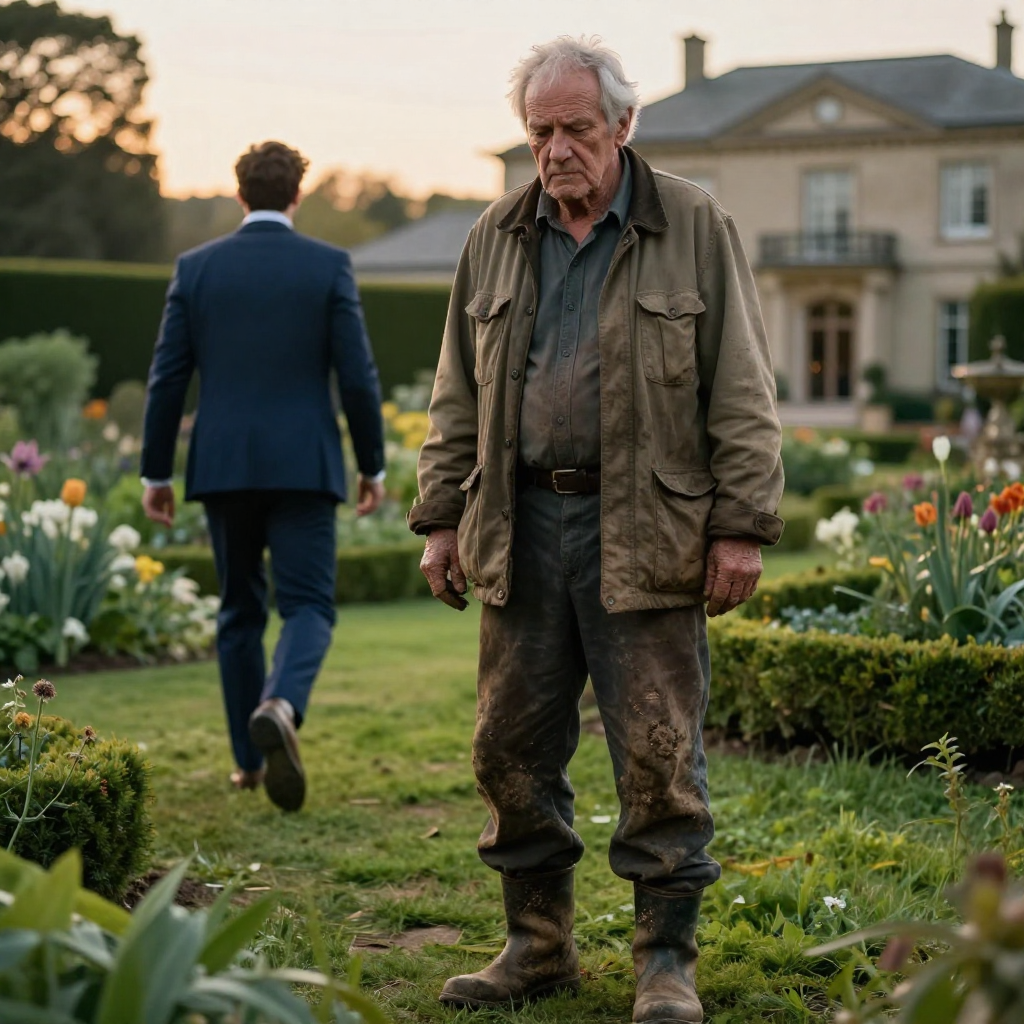
“YOU’RE JUST A GARDENER, KNOW YOUR PLACE!” HE SCREAMED, KICKING DIRT ONTO MY BOOTS, UNAWARE I WAS THE RETIRED CHIEF JUSTICE DECIDING HIS $50 MILLION INHERITANCE.
The soil under my fingernails was black and rich, a sharp contrast to the stark, sterile white of the marble patio just a few feet away. I have always found a peculiar kind of honesty in gardening that I never found in the courtroom. Plants do not lie. They do not bribe. If you neglect them, they wither; if you nurture them, they bloom. There is a justice in nature that human laws can only hope to emulate.
I was on my knees, tending to the roots of a grand hybrid tea rose—a delicate thing, susceptible to rot if the drainage isn’t perfect. My knees ached. They are eighty-year-old knees, after all, and they have carried the weight of judicial robes and the burden of deciding the fates of men for four decades. But today, I was not the Honorable Elias Thorne, Retired Chief Justice. Today, I was just the old man in the canvas jacket and the mud-stained boots.
I heard the car before I saw it. The aggressive growl of a German engine tearing up the gravel driveway, scattering the peace I had cultivated so carefully all morning. It was Julian. Of course, it was Julian.
The car door slammed with the heavy thud of expensive engineering. I didn’t look up. I kept my focus on the soil, loosening the earth around the root ball. I needed to see how he behaved when he thought no one of consequence was watching. That was the arrangement I had made with his late father. The old man knew his son was flawed, deeply and dangerously, but he wanted to give him one last chance before the trust was sealed. I was the executor. I was the final vetting process.
“Hey! You!”
The voice was shrill, lacking the timber of authority but compensating with volume. I paused my trowel but didn’t turn.
“I’m talking to you, old man! are you deaf?”
I slowly straightened my back, feeling the familiar pop in my lumbar spine. I turned to face him. Julian Vance stood there in a suit that cost more than most families earn in a year. He was sweating, his face flushed, clutching a leather portfolio as if it contained the nuclear codes. He looked at me not as a human being, but as a piece of landscaping that had been placed inconveniently.
“The gate,” he snapped, pointing a manicured finger back toward the driveway. “It’s stuck. The sensor isn’t reading my tag. Go open it. Now. I have a meeting with the estate attorneys in twenty minutes and I cannot be late.”
I looked at him calmly. I wiped my hands on a rag hanging from my belt. “I am afraid I don’t have the remote, son. I’m just tending the roses.”
“Son?” His eyes bulged. It was a fascinating reaction. Narcissism creates a fragile reality; the slightest puncture causes a disproportionate explosion. “Do you know who I am? I am Julian Vance. This is my house. You work for me.”
“Technically,” I said, my voice soft, scratching, “the probate hasn’t cleared yet, has it? The house belongs to the trust.”
Silence. For a second, he looked confused, perhaps wondering how a gardener knew legal terminology. But his arrogance overrode his curiosity instantly. He closed the distance between us, his expensive loafers crunching on the pristine white gravel.
“Listen to me, you senile incompetence,” he hissed. “I don’t care about technicalities. I care about that gate opening. If you can’t figure out how to push a button, then get out of my way.”
He stepped onto the garden bed. He stepped right onto the ‘Peace’ roses I had just planted. He crushed the stem under his heel without even looking down.
I felt a flash of anger, the same cold heat I used to feel when a prosecutor would knowingly suppress evidence. “You’re stepping on the flowers,” I said.
“I’ll pave over this whole damn garden tomorrow!” he shouted. And then, he did it. The act that sealed his fate.
He kicked the pile of loose dirt I had been working with. He kicked it hard, sending a spray of dark, wet mulch over my boots and up the legs of my trousers. It was a petty, childish, physically humiliating act. It was intended to demean. To remind me that I was dirt, and he was the boot.
“You’re just a gardener!” he screamed, his voice cracking. “Know your place! Clean that up, open the gate, or you’re fired before I even sign the deed!”
I looked down at my boots. Muddy. Scuffed. And now covered in the fresh dirt he had kicked at me. I looked at the crushed rose beneath his foot.
In my mind, I was back in the Supreme Court. I was wearing the black robe. I was holding the gavel. The courtroom was silent, waiting for the judgment. I had seen murderers with more dignity than this boy. I had seen thieves with more honor.
“I know my place, Mr. Vance,” I said quietly. I didn’t wipe the dirt off. I wanted to wear it. I wanted to walk into the boardroom wearing this dirt.
“Good,” he sneered, turning his back on me. “Then make yourself useful and get that gate open. I’m going inside to get a drink. If that car isn’t moving in five minutes, don’t bother coming back tomorrow.”
He stormed off toward the French doors of the mansion, pulling out his phone, likely to berate someone else. I watched him go.
I stood there for a long time in the silence of the garden. A bird chirped somewhere in the oak tree above. The sun was beginning to dip, casting long shadows across the lawn. I looked at my hands. They were trembling slightly, not from fear, but from the adrenaline of restraint. It takes a lot of energy to be treated like nothing when you hold the power to change everything.
I bent down and picked up the crushed rose stem. It was broken beyond repair. A shame. It had great potential.
I reached into my pocket and pulled out my own phone. It was an old model, simple, but it had one number on speed dial that mattered right now. I dialed the senior partner of the law firm handling the Vance estate—the very firm Julian was rushing to meet.
“Hello, Elias?” the voice on the other end answered, respectful and hushed. “Is everything alright? We’re expecting Mr. Vance shortly.”
“He’s on his way,” I said, my voice steady again. “Let the meeting proceed. But add a chair at the head of the table.”
“Sir?”
“I’m coming in,” I said. “And Robert?”
“Yes, Justice?”
“Don’t offer him a drink. He’s had enough power for one lifetime.”
I hung up. I didn’t brush the dirt off my trousers. I didn’t change my boots. I walked toward my old pickup truck parked around the back. I was going to the reading of the will exactly as I was. I wanted him to smell the fertilizer. I wanted him to see the mud. I wanted him to realize that the man he kicked was the man who was about to deliver the verdict.
CHAPTER II
The elevator at Sterling & Sterling didn’t just move; it glided, a silent upward surge through the spine of the city. I could feel the grit in my pockets. The mud on my boots had dried to a pale, crusty grey, and as I stood in the mirrored box, I saw myself through the eyes of the world. I was a stain on the polished chrome. My fingernails were lined with the dark soil of the Vance rose garden, and my work shirt smelled of damp earth and the sharp, acidic tang of fertilizer.
I stepped out onto the forty-second floor. The receptionist, a woman whose skin looked as though it were made of expensive paper, stopped typing. She didn’t look at my face; she looked at the trail of dried mud I was leaving on the white marble.
“The Vance meeting,” I said. My voice was raspy, a low growl I hadn’t bothered to smooth over.
“Delivery entrance is in the rear, sir,” she said, her voice a practiced shield of polite dismissal.
“I’m not delivering,” I said. “I’m the guest of honor.”
I didn’t wait for her to call security. I knew the layout of this firm. I had helped draft the very ethics guidelines that hung framed in their lobby. I walked past the glass-walled offices where junior associates hovered over laptops like monks in a high-tech monastery. I reached the double mahogany doors of the main boardroom and pushed them open.
The room was a sanctuary of silence and expensive wood. At the center of the long table sat Julian Vance. He looked immaculate in a navy suit that likely cost more than a year of a gardener’s salary. To his left were Silas and Marcus, two of the firm’s most senior partners—men I had mentored when their hair was still dark and their consciences were still flexible.
Julian didn’t look up at first. He was tapping a gold pen against his chin, looking bored.
“Finally,” Julian snapped, eyes still on his watch. “Are we going to start this circus or—”
He looked up. His face went through a remarkable transformation. First, confusion. Then, recognition. Finally, a sneer that seemed to curl his entire upper lip toward his nose.
“What the hell?” Julian stood up, his chair screeching against the floor. “What are you doing here, old man? Did you lose your way to the compost heap?”
Silas and Marcus had also stood up, but they weren’t looking at Julian. They were looking at me. Their faces had gone a peculiar shade of ashen grey.
“I told you to clean up the roses, not follow me to my inheritance,” Julian laughed, a sharp, ugly sound. He turned to the lawyers. “This is the help. He’s gone senile. Probably thinks I’m going to give him a tip for that bush he ruined. Get him out of here before he gets dirt on the leather.”
I didn’t move. I felt the weight of my ‘Old Wound’—a memory I had buried beneath layers of legal theory for decades. It was the face of a young man named David, a janitor’s son, who had been crushed by a drunk driver thirty years ago. The driver had been a boy like Julian, a boy whose father had bought him the best defense money could provide. I had been the young judge who followed the letter of the law but ignored the spirit of justice, allowing a technicality to set the boy free. David’s father had looked at me with the same hollow eyes I felt staring back from my own reflection now. I had promised myself then that if I ever saw that kind of unearned arrogance again, I wouldn’t be a passive observer.
“Julian,” Silas whispered. It was a plea.
“Julian nothing!” Julian barked. “Call security! Look at him! He’s disgusting. He’s tracking filth into the boardroom. Hey, gardener! Do you even know where you are? This is a place for men who matter. Get out before I have you arrested for trespassing.”
I looked at Silas. I didn’t say a word.
Silas cleared his throat, a sound like dry leaves skittering across pavement. “Julian… please sit down.”
“Why?” Julian demanded. “Why is he still standing there?”
“Because,” Marcus said, his voice trembling slightly as he stepped around the table, “you are speaking to the Honorable Elias Thorne. Former Chief Justice of the Supreme Court. The executor of your father’s estate. And your father’s oldest friend.”
The silence that followed was absolute. It was the kind of silence that exists in the heart of a storm. Julian’s mouth stayed open, but no sound came out. He looked at my dirty hands, then at my face, then at the lawyers who were now bowing their heads in a gesture of profound, terrified respect.
I walked to the head of the table. I didn’t sit. I placed my muddy hands directly onto the pristine white legal pad that sat at the chairman’s place. The dark stain of the earth seeped into the paper.
“You told me to know my place, Julian,” I said. My voice was no longer a growl; it was the voice of the bench—cold, clear, and final. “I am currently in my place. The question is, are you in yours?”
Julian’s face turned a mottled purple. The shock was being replaced by a frantic, desperate calculation. “This… this is a joke. A trick. You were digging in the dirt. You let me… you let me talk to you like that.”
“I didn’t let you do anything, Julian,” I said. “I simply observed who you were when you thought no one important was watching. It turns out, you are exactly the man your father feared you were.”
I reached into my pocket and pulled out a small, encrypted flash drive. I laid it on the table. This was my Secret. For the last six months, while I was pruning hedges and deadheading lilies, I wasn’t just watching Julian. I had been using my connections to look into the Vance Corporation’s offshore accounts. I knew that Julian had already begun selling off pieces of his father’s legacy to cover his own gambling debts in Macau—debts that would ruin the Vance name if they ever came to light.
“Silas,” I said. “Read the Character Clause.”
Silas fumbled with a heavy, ribbon-bound document. His hands shook so much the paper rattled.
“Section 4, Paragraph 9,” Silas read. “The ‘Vance Integrity Clause.’ It states that the primary heir shall forfeit all claims to the liquid assets and controlling interest of the Vance Estate if the designated Executor finds evidence of ‘moral turpitude, gross negligence of the family legacy, or a fundamental lack of character’ during the vetting period.”
Julian slumped back into his chair. He looked small. The navy suit seemed to swallow him. “You can’t do this. It’s my money. It’s my blood.”
“It was your father’s life’s work,” I corrected. “And he gave me the power to ensure it didn’t end up in the hands of a man who kicks dirt on those he deems beneath him.”
But here was the Moral Dilemma that clawed at my chest. If I invoked the clause now, the Vance Corporation would fall into a legal limbo. Thousands of employees—people like the other gardeners, the maids, the factory workers—would see their pensions frozen in the ensuing court battle. Julian was a cancer, yes, but cutting him out too quickly might kill the patient. If I showed mercy, I was betraying the memory of my friend and the ‘Old Wound’ of David. If I showed no mercy, I was the one causing the very harm I spent my life trying to prevent.
“I have the evidence of your debts, Julian,” I said, leaning over the table. The smell of the garden seemed to fill the room, overpowering the scent of expensive cologne. “I know about the Macau accounts. I know you’ve already signed ‘intent to sell’ papers for the northern preserve.”
Julian’s eyes went wide. The secret was out. He looked at Silas and Marcus, looking for a loophole, but they both looked away. They knew my reputation. I didn’t bluff.
“What do you want?” Julian whispered. The arrogance was gone, replaced by a raw, pathetic fear.
“I want to know if there is anything in you worth saving,” I said. “Because right now, I’m looking at a void. You have one hour to convince me not to sign the disqualification papers. Silas, Marcus—leave us.”
The lawyers scrambled out of the room as if it were on fire. The heavy doors clicked shut, leaving me alone with the man who had kicked dirt on my boots.
I sat down in the chairman’s chair, the mud from my trousers staining the butter-soft leather. I took a deep breath. The air in here was too thin, too filtered. I missed the smell of the roses, even the ones Julian had crushed.
“Talk, Julian,” I said, leaning back. “And remember—I’ve spent forty years listening to liars. Don’t make me bored.”
Julian looked at the table, his fingers twitching. He began to speak, his voice cracking. He talked about the pressure of being the son of a titan, about the fear of never being enough. It was a standard defense, the kind of polished sob story I’d heard a thousand times from trust-fund defendants. It was hollow. It was a performance.
But then, he said something that stopped me.
“He never loved me, you know,” Julian whispered, and for the first time, his voice didn’t sound like an act. “My father. He didn’t see a son. He saw a ‘project.’ He saw a legacy. He hired you to watch me because he didn’t want to bother doing it himself. You were the gardener. You spent more time with his roses in a week than he spent with me in a year.”
I felt a pang of something cold. I knew Julian was right. Arthur Vance had been a great man, but he had been a cold father. He had treated his son like a hedge that needed constant trimming, rather than a human being.
This was the conflict I hadn’t prepared for. If Julian was a monster, he was a monster Arthur and the world of privilege had built. Was I here to punish the creation, or the creator?
I looked at my hands. The dirt was starting to itch.
“That doesn’t excuse the Macau debts, Julian,” I said, though my voice had lost some of its edge. “And it certainly doesn’t excuse the way you treat people you think are ‘lesser.'”
“I’m not like him,” Julian said, his eyes suddenly burning with a desperate, dark intensity. “If you give me the inheritance, I’ll prove it. I’ll change everything.”
“You’ll sell it,” I said. “You’ll burn it down for the insurance money.”
“Maybe,” Julian said, a strange smile touching his lips. “But at least it would be mine to burn. Isn’t that what you lawyers always talk about? Property rights? Or is that only for the people you like?”
He was challenging me now. He had found the crack in my moral armor. I was a man of the law, and the law said this was his. The ‘Character Clause’ was a subjective weapon, a tool of power I was wielding based on my own personal distaste for his personality.
I stood up and walked to the floor-to-ceiling window. The city sprawled out below us, a grid of light and shadow. I thought about the roses back at the estate. A rose doesn’t choose to have thorns. It grows them to survive the world that tries to pluck it.
“The hour isn’t up,” I said, not turning around. “But I’ve heard enough for now.”
I picked up the flash drive and the legal pad. I could feel Julian watching my every move, his breath ragged in the silence of the room. I had the power to ruin him with a single signature. I had the power to avenge David, to punish the arrogance of the elite, and to fulfill Arthur’s dying wish.
But as I looked at the mud on my boots, I realized that I had become part of the very spectacle I loathed. I was playing God in a boardroom, using a garden as my stage.
“I’m going back to the estate,” I said. “The ‘Peace’ roses need attention. They were trampled today.”
“And the papers?” Julian asked, his voice a thin wire of tension.
“The papers stay with me,” I said. “For now. You have twenty-four hours to produce a full audit of your debts and a plan for how you intend to pay them back without touching the Vance employee pension fund. If one cent is missing, I sign the disqualification.”
I walked toward the door. Just before I left, I stopped.
“And Julian?”
“Yes?”
“Buy a new pair of boots. Size eleven. Send them to the gardener’s shed. The ones I’m wearing are ruined.”
I walked out of the boardroom, through the lobby, and back into the elevator. The receptionist didn’t say a word as I passed. She just watched the mud trail I left behind.
As the elevator descended, I felt the ‘Old Wound’ throb. I hadn’t found justice yet. I had only found a deeper, more complicated shade of grey. I was no longer just a gardener, and I was no longer a judge. I was something in between—a man holding a secret that could shatter a dynasty, wondering if the world was better off with the pieces or the lie.
When I reached the ground floor, I didn’t take a taxi. I walked. I wanted the city to see me. I wanted the grit of the sidewalk to mix with the soil of the garden. I had twenty-four hours to decide if a man like Julian Vance could ever truly change, or if I was simply waiting for the inevitable moment when the thorns would draw blood.
I reached the park and sat on a bench, watching the people pass by. They saw an old man in dirty clothes, a nobody. They didn’t know I held the fate of a multi-billion dollar empire in my pocket. They didn’t know about the ‘Character Clause’ or the Macau debts.
I looked at my hands one last time. The dirt was gone, rubbed away into the leather of the boardroom chairs and the paper of the legal pad. But the feeling of it—the weight of the earth—remained. It was a reminder that no matter how high we climb, we all end up back in the soil. The only thing that matters is what we do while we’re still standing above it.
I closed my eyes and breathed in the city air. The real work was just beginning.
CHAPTER III
The clock in my study didn’t tick; it pulsed. It was a rhythmic, heavy sound that felt like a heartbeat inside my temples. I had given Julian Vance twenty-four hours to prove he was something more than a hollowed-out echo of his father’s worst impulses. I spent those hours in the one place I felt I still belonged: the dirt. I returned to the Vance estate, not as the Chief Justice who had commanded the room the day before, but as the man with the spade. I needed to be near the roses. I needed to remember why Arthur had trusted me with this burden.
But the silence of the garden was broken before the sun even reached its zenith. A courier arrived, not with an apology from Julian, but with a thick, manila envelope. Inside were photographs and transcripts from thirty years ago. The ‘Sterling Case.’ My old wound. I sat on a stone bench, my hands still caked in the dark, loamy soil of the Peace roses, and looked at the evidence of my own greatest failure. I had ruled in favor of a conglomerate that ended up gutting a small town’s pension fund. I had followed the letter of the law, ignoring the spirit of justice. It was a technicality that had haunted my nights for decades. Julian hadn’t found a way to be better; he had found a way to drag me down into the mud with him.
I didn’t call him. I didn’t have to. I knew he would come to me when the shadows grew long. I spent the afternoon pruning. The Peace roses were Arthur’s pride—creamy yellow petals edged with a soft, bleeding pink. They were supposed to represent reconciliation. As I worked, I felt the weight of the ‘Vance Integrity Clause’ in my pocket. It was a piece of paper that could strip a man of everything, but it felt like lead against my thigh. I wondered if I was any better than Julian. I had spent a lifetime judging others while carrying a secret rot in my own ledger.
Twilight arrived with the sound of a high-performance engine screaming up the gravel driveway. Julian stepped out of the car, looking disheveled, his expensive silk shirt unbuttoned at the collar. He didn’t look like a man who had spent twenty-four hours reflecting on his character. He looked like a man who had spent twenty-four hours in a cage. He walked into the garden, his polished shoes sinking into the soft earth I had just turned. He didn’t care. He never cared about what was underneath him.
“You got my package, Elias?” he asked. His voice was brittle, cracking like dry wood. He didn’t wait for an answer. He stood over me while I knelt by a rosebush. “I did my homework. You’re the Great Moral Arbiter, right? The man who decides who is worthy? Well, it turns out you’re just a corporate shill who traded a thousand families’ futures for a seat on the high court. How does it feel to be seen, Judge?”
I didn’t look up. I continued to clip a dead stem. “I’ve seen those files every night for thirty years, Julian. You didn’t find a secret. You found a ghost I’ve been living with since before you were born. It doesn’t change the clause. It doesn’t change who you are.”
Julian laughed, a sharp, ugly sound that startled a bird from the hedges. “The clause doesn’t matter anymore, Elias. You think I spent my day worrying about your little integrity test? I spent it making sure there’s nothing left for you to take. I’ve signed the papers. Solstice Holdings bought the debt. They bought the estate. They bought the company. By Monday, this whole place will be a construction site for luxury condos. The employees? Gone. The legacy? Liquidated. I get my payout, I clear my markers in Macau, and you can take your integrity and bury it in this dirt.”
The shears slipped in my hand, nicking my thumb. A bead of dark blood fell onto a yellow petal. I looked at the Peace rose, then at Julian. He had sold his father’s soul to save his own skin. He wasn’t just arrogant; he was a scorched-earth policy in a designer suit. He had ensured that if he couldn’t have the crown, no one would. The thousands of families who relied on Vance Industries were now just collateral damage in his escape plan.
“You sold the estate?” I whispered. The betrayal felt physical, a cold draft in my chest. “This was your father’s life. He built this garden for your mother. He planted these roses for peace.”
“My father used this garden to hide from the fact that he was a cold, miserable bastard who couldn’t love his own son,” Julian spat. He stepped forward, kicking a mound of fresh mulch. “He loved you more than me, Elias. He gave you the power to break me. Why would I keep any of this? It’s just a monument to my own insignificance. Solstice is coming to survey the land tonight. They’ll be here in an hour. You’re trespassing now, Gardener.”
I stood up slowly, my joints aching. I looked at the Peace rosebush Julian had just kicked. Something was wrong with the base of the plant. I had noticed it earlier—a slight bulge in the graft, something Arthur had done himself years ago. He was a meticulous gardener, but this was clumsy, intentional. I reached down, ignoring Julian’s taunts, and felt a hard edge beneath the burlap wrap at the root ball. I pulled at it, my fingers digging through the soil, until I felt a plastic casing.
“What are you doing?” Julian demanded. “Searching for more dirt?”
I pulled the casing out. It was a small, weatherproofed canister. Inside was a single, hand-written note on Arthur’s personal stationery and a heavy, silver key. The ink was faded but legible. *’Elias, if you are reading this, Julian has chosen the fire. I knew he would. I hoped he wouldn’t, but I knew. The roses were always the key. Under the Peace bush lies the true deed to the Vance trust—a fund he can never touch, a fund meant for the hands that actually build the world. Use it. Forgive me for being too weak to do it myself.’*
I looked at the silver key. It wasn’t just money. It was the ownership of the land itself. Arthur had split the deed. Julian had sold a shell. The land, the garden, and the controlling interest in the pension funds were held in a separate entity that only the ‘Gardener’ could unlock. Arthur had played a long game, one that required Julian to fail in order for the people to be saved. It was a father’s final, devastating judgment on his son.
Julian saw the note. He lunged for it, his face contorted with a mix of greed and rage. “Give me that! That’s mine! Everything here is mine!”
I stepped back, but I didn’t have to move far. The sound of heavy tires on gravel echoed again. This time, it wasn’t a sports car. Two black sedans pulled up, followed by a vehicle with the seal of the State Attorney General. A woman stepped out—Sarah Vance. She was Arthur’s niece, a woman of iron reputation who had been estranged from the family for years because of Julian’s influence over her uncle. I had called her three hours ago, right after I received the blackmail folder.
“Julian Vance,” she said, her voice cutting through the humid evening air. “We’ve been monitoring the Solstice Holdings transaction. Selling assets under a contested probate with known gambling debts as a motivator is a violation of the Racketeering Act. And I believe Judge Thorne has something that clarifies the ownership of this estate.”
Julian froze. The power dynamic shifted so violently I could almost hear the air pop. He looked at me, then at the silver key in my hand, then at the woman who represented the very law he thought he could bypass. He wasn’t the king of the mountain anymore. He was a small man standing in a hole he had dug for himself.
“You think this changes anything?” Julian screamed at me, ignoring the officers. “You’re still a fraud, Thorne! I’ll release those files! I’ll ruin you! Everyone will know what you did in the Sterling case!”
I looked at Sarah Vance. I looked at the garden that Arthur had died trying to protect. I looked at my own dirt-stained hands. The blackmail was real. If I moved forward, if I used the key and the trust to void Julian’s sale and save the company, I would have to testify. The Sterling case would be reopened. My reputation, my legacy, my peaceful retirement—it would all be incinerated.
“I know,” I said softly. I turned to Sarah. “The files he has are true, Sarah. I made a mistake thirty years ago. I’m prepared to face the consequences of that. But right now, we need to protect the forty thousand employees Julian just tried to sell out. Here is the deed. Here is the trust. I am exercising the Vance Integrity Clause. Julian Vance is unfit.”
Julian tried to run, a pathetic, stumbling dash toward his car, but the officers intercepted him. There was no struggle, no shouting—just the quiet click of metal and the heavy sound of a man realizing he had nothing left. He looked back at me, his eyes wide with a terrifying realization. He had tried to destroy me with my past, not realizing I was willing to destroy myself to secure the future.
As they led him away, the representative from Solstice Holdings arrived—a sharp-faced man in a grey suit. He looked at the scene, then at Sarah, then at me. He knew the deal was dead. He didn’t even get out of the car. He signaled his driver, and they vanished back down the driveway, leaving the garden to the silence of the falling night.
I sat back down on the stone bench. The adrenaline was fading, replaced by a hollow, aching exhaustion. I had saved the company. I had saved the estate. But I had also ended my life as I knew it. By tomorrow, the headlines wouldn’t be about Julian’s greed; they would be about the fall of Chief Justice Elias Thorne.
I looked down at the Peace rose I had been pruning. It was beautiful, even with the drop of my blood staining its petal. Arthur had known this would happen. He had known that justice always required a sacrifice. He had sacrificed his relationship with his son. I was sacrificing my name. We were both just gardeners, in the end, trying to make sure something decent grew out of the wreckage we had made of our lives.
I stayed there for a long time, the silver key cold in my hand, watching the moon rise over the garden. The air was thick with the scent of damp earth and roses. It was the most expensive garden in the world, and for the first time, it finally felt like it belonged to the people who actually tended it.
CHAPTER IV
The dawn arrived gray and heavy, mirroring the weight in my chest. I woke in the small gardener’s cottage, the same one where I’d spent months tending Arthur Vance’s roses, a lifetime ago. The Vance estate, usually vibrant with morning activity, was eerily silent. Julian’s arrest had sucked the life out of the place, leaving a vacuum filled only by anxiety. I dressed slowly, the familiar routine now laced with a bitter awareness that this was my last day.
The news had broken overnight. The State Attorney General, Sarah Vance, had released the details of the Sterling Case, along with the evidence I’d provided. The headlines screamed about judicial misconduct, a betrayal of public trust. My name, once synonymous with integrity, was now dragged through the mud. The garden felt different, too. The ‘Peace’ roses, which had held a secret that could destroy Julian, now felt as if they were mocking me.
I walked towards the main house, my steps heavy. Maria, the head housekeeper, met me at the door, her eyes red-rimmed. She offered a weak smile. “Mr. Thorne,” she said, her voice barely a whisper. “They’re here.” I knew who ‘they’ were. The media. They had swarmed the gates, cameras flashing, reporters shouting questions about the Sterling Case. I steeled myself. There was no avoiding this.
I went into the library, where Arthur Vance had often sat, and found Sarah Vance waiting for me. Her face was pale, etched with fatigue. “Elias,” she began, her voice tight with controlled emotion, “this is… difficult.” I nodded, understanding the position she was in. She was doing her job, upholding the law, but the personal cost was evident. “The press is relentless,” she continued. “They want a statement. They want blood.” I sighed. “Then give them what they want, Sarah. The truth.”
She hesitated, then handed me a prepared statement. It acknowledged my cooperation in exposing Julian’s corruption but emphasized the severity of my past actions. It was a carefully worded condemnation, designed to appease the public while acknowledging my role in saving the Vance company. I read it silently, feeling a hollow ache in my chest. It was a fair assessment, perhaps even generous, but it still stung.
“Thank you, Sarah,” I said, handing the statement back. “But I’ll make my own.”
(PHASE 1: PUBLIC CONSEQUENCES)
The media circus was even worse than I’d imagined. As I walked out to the front steps, the reporters descended like vultures. Flashes exploded in my face, and a barrage of questions assaulted me. “Mr. Thorne, do you regret your actions in the Sterling Case?” “Are you a corrupt judge?” “How much were you paid to cover it up?” I held up my hand, silencing them.
“I am here to acknowledge my past mistakes,” I said, my voice clear and steady. “Years ago, I made a decision that compromised my integrity and betrayed the public trust. I accept full responsibility for my actions, and I am prepared to face the consequences.” I paused, taking a deep breath. “I came to the Vance estate to atone for my past. In doing so, I uncovered a conspiracy that threatened to destroy this company and the livelihoods of thousands of people. I took action to stop it, even though it meant exposing my own failings.”
I looked directly into the cameras. “I am not a hero. I am a flawed man who tried to do what was right, even if it meant sacrificing everything. I hope that my actions will serve as a reminder that no one is above the law, and that justice, however imperfect, must always prevail.” The reporters continued to shout questions, but I ignored them. I had said what I needed to say. I turned and walked back into the house, leaving the media frenzy behind me.
Inside, the silence was deafening. Maria stood in the hallway, her eyes filled with tears. “Mr. Thorne,” she whispered, “they don’t understand.” I shook my head. “It doesn’t matter, Maria. What matters is that you and everyone else here still have a job.”
(PHASE 2: PERSONAL COST)
The hardest part of the day was facing the employees. I asked to meet with a small group of representatives – people I’d come to know during my time as a gardener. We gathered in the old greenhouse, surrounded by the fragrant blooms that Arthur had so loved. Their faces were a mixture of gratitude and disappointment. They knew what I had done for them, but they also knew the truth about my past.
“Mr. Thorne,” said a woman named Emily, who worked in the accounting department. “We… we don’t know what to say. We’re grateful for everything you’ve done, but…” She trailed off, unable to finish the sentence. I nodded, understanding her hesitation. “I know,” I said gently. “It’s hard to reconcile the good and the bad. But I hope you can see that my actions, both then and now, were driven by a desire to do what I believed was right.”
A young man named David spoke up. “But what about your reputation, sir? Your legacy?” I smiled sadly. “My reputation is tarnished, perhaps beyond repair. As for my legacy… that’s not for me to decide. It will be written by others, based on the choices I’ve made. All I can do is hope that they will judge me fairly, with all the facts in mind.”
The meeting ended with a quiet sense of closure. They thanked me again, their voices filled with genuine emotion. I shook their hands, knowing that this was the last time I would see them. As I walked back to the cottage, I felt a profound sense of loss. I had saved the Vance company, but I had lost something irreplaceable in the process – my good name.
(PHASE 3: NEW EVENT)
As I packed my few belongings, a car pulled up to the cottage. It was Tom, my former colleague from the Supreme Court. I hadn’t seen him since I’d retired. He looked grave as he stepped out of the car.
“Elias,” he said, his voice low. “I need to talk to you.”
I invited him inside, and he sat down heavily on the small sofa. “The Bar Association is moving to disbar you,” he said bluntly. “Given the public outcry and the evidence against you, they have no choice.” I nodded, unsurprised. It was a formality, but it still stung.
“I expected as much,” I said. “Is there anything I can do?”
Tom hesitated. “There is one thing,” he said. “There’s been… another development in the Sterling Case. Something that could potentially mitigate the damage.”
He explained that new evidence had surfaced, suggesting that the defendant in the Sterling Case, the man I had helped convict, might have been involved in a larger criminal conspiracy. This evidence had been suppressed at the time, and its discovery now cast doubt on the original verdict.
“If this evidence had been presented at trial,” Tom said, “it’s possible the outcome would have been different. It doesn’t excuse what you did, Elias, but it could provide some context, some understanding.”
My mind raced. This was a chance to redeem myself, to clear my name. But it would also mean reopening old wounds, dredging up painful memories. And it wouldn’t change the fact that I had made a mistake, a serious one.
“What do you want me to do, Tom?” I asked.
“I want you to consider testifying,” he said. “Tell the truth about what happened, about what you knew and when you knew it. It won’t be easy, but it could make a difference.”
(PHASE 4: MORAL RESIDUES)
I spent the rest of the afternoon wrestling with Tom’s proposition. Testifying would be a public spectacle, a painful rehashing of my past. It could also expose others who were involved in the cover-up, people I had once considered friends. But it was also an opportunity to set the record straight, to offer some measure of justice to the man I had wronged.
As the sun began to set, I walked through the garden one last time. The ‘Peace’ roses were bathed in golden light, their petals glowing with an ethereal beauty. I knelt down and touched one of the blooms, feeling the soft velvet against my skin. Arthur had loved these roses, and he had entrusted them to me. I had tried to honor his trust, to protect his legacy. But in doing so, I had exposed my own failings, my own imperfections.
I realized that true justice wasn’t found in the courtroom or in the headlines. It was found in the quiet moments of reflection, in the willingness to confront one’s own mistakes and to strive for something better. It was found in the dirt of the garden, in the simple act of tending to the earth and nurturing new life.
I made my decision. I would testify. I would tell the truth, no matter the cost. It wouldn’t erase my past, but it might offer a glimmer of hope for the future.
As I walked away from the garden, I felt a sense of peace settle over me. I had done what I could. Now, it was time to face the consequences.
Tom drove me away from the Vance estate as darkness fell. Looking back, I saw the lights of the main house twinkling in the distance, a beacon of hope in the gathering gloom. I knew that I would never return, but I would always carry the memory of this place with me, a reminder of the choices I had made and the lessons I had learned.
CHAPTER V
The courtroom felt colder than I remembered. Maybe it was just the weight of what I was about to do, pressing down, chilling me from the inside out. Tom had laid out the new evidence – a misfiled document, a forgotten witness – enough to cast a shadow of doubt on the original Sterling Case verdict. Enough, maybe, to soften the blow. But that wasn’t why I was here. I wasn’t here for redemption, not exactly. I was here to face it. All of it.
Sarah Vance sat at the prosecution table, her face unreadable. We hadn’t spoken much since Julian’s arrest. A few formal exchanges, a nod in the hallway. The silence between us was thick with unspoken things – regret, perhaps, on her part; acceptance, on mine.
My lawyer, a young woman named Emily, gave my arm a reassuring squeeze. “Just tell the truth, Mr. Thorne. That’s all you have to do.” Easy for her to say. The truth was a tangled, thorny thing, and I was about to drag it out into the light for everyone to see.
The bailiff called my name, and I walked to the stand, the squeak of my shoes echoing in the sudden quiet. I raised my right hand, swore to tell the truth, the whole truth, and nothing but the truth. And then I began.
I told them about the Sterling Case, about the pressure, the ambition, the compromises I’d made. I didn’t try to excuse myself, didn’t try to paint myself as a victim. I laid it all bare, the good and the bad, the choices I regretted and the ones I still believed were necessary. I spoke of the sleepless nights, the gnawing guilt, the weight of a decision that had altered so many lives.
The questions came, sharp and relentless. Sarah Vance’s questions were the hardest. She didn’t pull any punches, didn’t spare me any pain. She wanted to know why, why I had done what I did, what I had gained, what I had lost. I answered as honestly as I could, knowing that every word was another nail in my coffin.
I talked about Arthur Vance, about his faith in me, about the trust he had placed in me. I spoke of Julian, of his arrogance and greed, of the threat he posed to everything Arthur had built. I explained why I had taken the job at the Vance estate, why I had felt compelled to intervene.
And then I told them about the trust, about the power Arthur had given me, about the choice I had made to sacrifice my reputation to save his company. I told them about the evidence I had given to Sarah, about Julian’s arrest, about the consequences I was now facing.
When it was over, I felt drained, emptied out. I had held nothing back. I had told them everything. The verdict, whatever it might be, was now out of my hands.
The media descended like vultures. Headlines screamed my name, dredging up the past, dissecting my every word. The new evidence in the Sterling Case offered a glimmer of hope, but the damage was done. My reputation was in tatters.
I retreated to my small apartment, the phone ringing off the hook. I ignored it all. I had said what I needed to say. I had done what I needed to do. Now, I just wanted to be left alone.
Emily visited me a few days later. She looked tired, but her eyes held a flicker of something that might have been respect. “The judge is deliberating,” she said. “It could be a while.”
“I understand,” I said.
She hesitated. “The new evidence… it’s made a difference. People are starting to see things differently.”
“It doesn’t change what I did,” I said. “It doesn’t erase the past.”
“No,” she said. “But it might… soften the sentence.”
I nodded. A softer sentence. Maybe that was all I could hope for.
A week later, the verdict came. The judge acknowledged the new evidence in the Sterling Case, but he also emphasized the gravity of my actions. He sentenced me to community service, a symbolic punishment for the abuse of power.
It wasn’t prison, but it wasn’t freedom either. It was a life sentence of a different kind – a constant reminder of my mistakes.
Sarah Vance came to see me after the sentencing. She stood in the doorway of my apartment, her face still unreadable.
“Thank you,” she said.
“For what?” I asked.
“For telling the truth,” she said. “For doing what was right, even when it was hard.”
“It cost me everything,” I said.
“I know,” she said. “But it saved the company. It saved a lot of people.”
She paused. “I… I understand now why Arthur trusted you so much.”
And then she was gone.
I spent the next few months fulfilling my community service, working in a soup kitchen, serving meals to the homeless. It wasn’t glamorous work, but it was honest. And it gave me a sense of purpose, a sense of connection to something larger than myself.
One day, I was working in the garden behind the soup kitchen when I saw Tom. He was older, grayer, but his eyes still twinkled with that familiar mischievousness.
“Heard you were here,” he said. “Thought I’d pay you a visit.”
“What brings you here, Tom?” I asked.
“Just wanted to see how you were doing,” he said. “And to tell you… I’m proud of you, Elias.”
I looked at him, surprised. “Proud? After everything?”
“Especially after everything,” he said. “You faced it, Elias. You didn’t run. You didn’t hide. You took responsibility for your actions. That takes courage.”
He paused. “And… the Sterling Case. It’s not over, you know. We’re still digging. We’re going to clear your name, Elias. I promise you that.”
I smiled, a genuine smile for the first time in a long time. “Don’t worry about it, Tom,” I said. “It doesn’t matter anymore.”
“It matters to me,” he said.
I shook my head. “What matters is that I did what I thought was right. And I’m willing to live with the consequences.”
He clapped me on the shoulder. “You always were a stubborn one, Elias.”
He left, and I went back to my gardening. The sun was warm on my face, the soil cool in my hands. I felt a sense of peace, a sense of acceptance that I hadn’t felt in years.
I knew I would never fully escape the shadow of the past. The Sterling Case would always be a part of me, a reminder of my mistakes. But it wouldn’t define me. I had learned from it. I had grown from it. I had become a better man because of it.
And maybe, just maybe, that was enough.
One evening, while tending to the small rose garden I had started at the soup kitchen, I received a letter. It was from Sarah Vance. She wrote of the changes at the Vance company, of the new leadership, of the renewed commitment to ethical practices. She wrote of Arthur, of his legacy, of the hope he had always embodied.
And then she wrote about me. She thanked me again for my courage, for my honesty, for my willingness to sacrifice everything for the sake of what was right. She said that I had restored her faith in the law, in justice, in the possibility of redemption.
She ended the letter with a quote from Arthur Vance: “The greatest roses bloom from the thorniest bushes.”
I folded the letter carefully and tucked it into my pocket. I looked out at the rose garden, at the vibrant colors, at the delicate petals. And I smiled.
I never remarried. The scandal made sure of that. I lived quietly, tending to my garden, volunteering at the soup kitchen, trying to make amends for the mistakes of my past.
Years passed. The Sterling Case faded from the headlines, replaced by newer scandals, newer controversies. But it never faded from my memory. It was a constant reminder of the price of ambition, the cost of compromise, the importance of integrity.
One day, I received a phone call from Emily, my former lawyer. She was now a judge herself.
“Elias,” she said. “I have some news. The State Bar… they’ve voted to reinstate your license.”
I was silent for a moment, stunned. “After all this time?” I asked.
“Yes,” she said. “They said… they said you’ve earned it.”
I didn’t know what to say. I had never expected this. I had never even hoped for it.
“Thank you, Emily,” I said, finally. “Thank you.”
“Don’t thank me,” she said. “Thank yourself. You did the work, Elias. You earned it.”
I hung up the phone and sat there for a long time, staring out the window. The sun was setting, casting long shadows across the room. I felt a sense of closure, a sense of completion that I had never thought possible.
I knew I would never be the same man I had been before the Sterling Case. I was older, wiser, scarred by experience. But I was also stronger, more resilient, more committed to justice than ever before.
I never practiced law again. The desire was gone. But I continued to volunteer at the soup kitchen, to tend to my garden, to try to make a difference in the world, one small act at a time.
And as I grew older, I came to realize that true justice wasn’t just about the law. It was about accountability, about forgiveness, about redemption. It was about recognizing our mistakes, learning from them, and striving to be better.
It was about finding peace, not in the absence of conflict, but in the acceptance of it.
I lived a long life, filled with both regret and gratitude. I made mistakes, but I also made amends. I caused pain, but I also brought healing. I was a flawed man, but I was also a good man.
And in the end, that was all that mattered.
The garden is overgrown now, the roses wild and untamed. But sometimes, on a quiet evening, I can still smell their fragrance, a reminder of Arthur Vance, of Sarah, of Tom, of all the people who touched my life.
And I can still hear the echo of a judge’s gavel, the whisper of a courtroom, the weight of a decision that changed everything.
I am at peace. Or close enough.
The sun sets, and I return to the house. It is time to rest.
The true debt is always the one we owe ourselves. END.