“DON’T YOU DARE LOOK ME IN THE EYE,” SHE HISSED, POURING HER SCALDING LATTE ONTO MY VINTAGE LOAFERS BECAUSE THE SUN WENT BEHIND A CLOUD. She thought I was just the clumsy, invisible intern sent to hold her reflector, but she didn’t know the woman silently cleaning up her mess was the Global Editor-in-Chief of the magazine she’s been dying to cover. Today, she didn’t just ruin a pair of shoes; she erased her name from every guest list in Paris, and the silence in the room tells me everyone knows it but her.
The heat hit my ankle first. It was a sharp, biting warmth that seeped immediately through the wool of my socks, staining the vintage tweed of my loafers—shoes that cost more than the rent of the studio we were standing in. I didn’t flinch. I didn’t gasp. I simply stood there, holding the silver reflector panel steady with my left hand, while the almond milk latte dripped from the hem of my trousers onto the concrete floor.
“Are you deaf?” The voice was shrill, polished to a jagged edge by years of getting exactly what it wanted. “I said, don’t look at me while I’m resetting. It ruins my vibe. And now look what you made me do.”
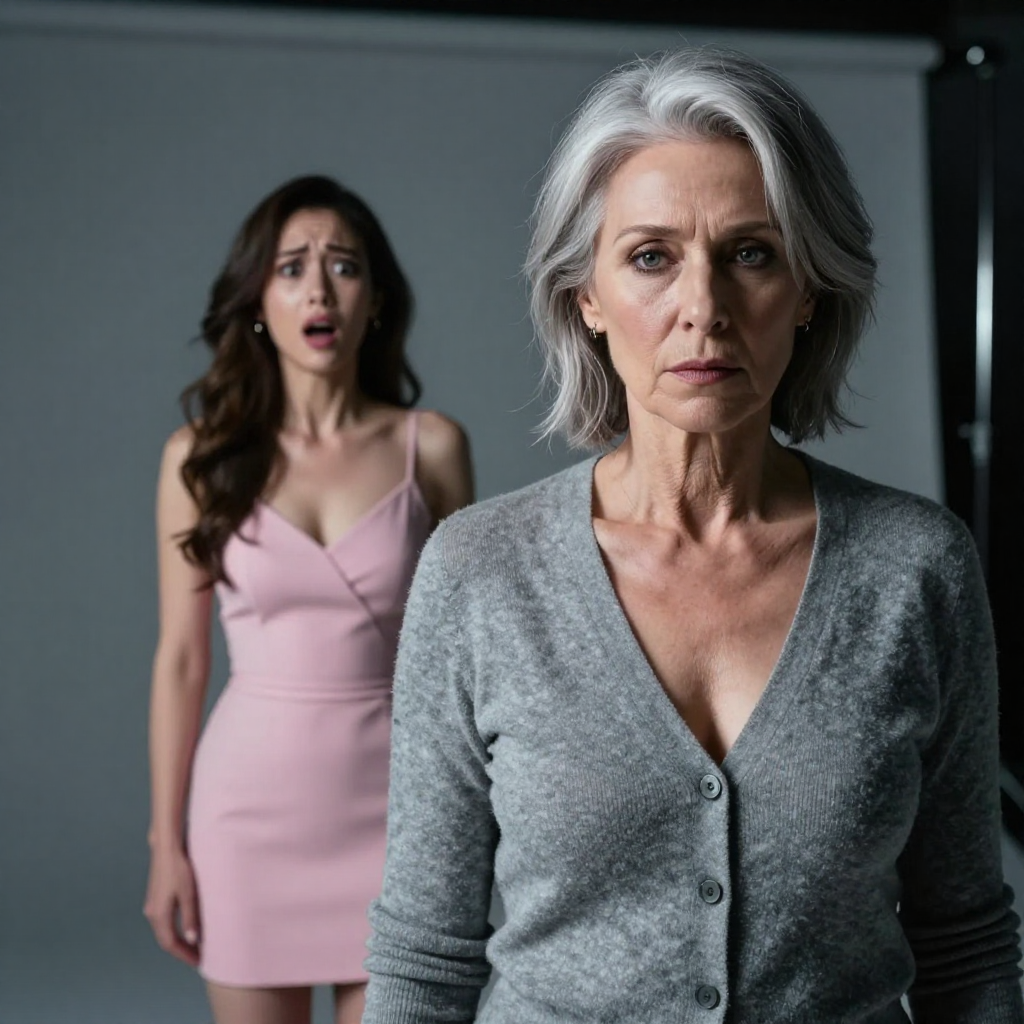
Sienna, known to her twelve million followers as ‘See-See,’ stood three feet away from me. She was beautiful in the way a digitally rendered architectural plan is beautiful: flawless, symmetrical, and entirely devoid of human warmth. She held the empty paper cup like a weapon she had just discharged, her manicured nails tapping against the cardboard. She wasn’t looking at me, of course. She was looking at her reflection in the monitor, checking if her outburst had caused a vein to pop in her forehead.
“I’m sorry,” I said. My voice was low, rasping slightly. I had been affecting a slight vocal fry for the last three days, a subtle camouflage to blend in with the twenty-year-olds running around the set. “I’ll clean it up.”
“You won’t clean it up,” she snapped, finally turning her head. Her eyes swept over me—my messy bun, my oversized gray cardigan, the lack of makeup—and dismissed me as waste matter. “You’ll go get me another one. And this time, make sure it’s actually 140 degrees. This was lukewarm trash.”
It wasn’t lukewarm. It was scalding. I could feel the skin on my ankle turning a angry shade of pink. But I didn’t move. I needed to see this. I needed to feel the absolute bottom of the barrel to understand why my industry was rotting from the inside out.
For thirty years, I have sat in the front row of every major runway from Milan to New York. I have decided whose face graces the September issue and whose career ends quietly in the back pages of a catalogue. My signature is on the contracts that turn girls like Sienna into icons. But from the glass tower in Manhattan, you forget what the ground feels like. You forget the cruelty that breeds in the shadows of the spotlight. So, I took a week of leave. I told my staff I was going to a wellness retreat in the Swiss Alps. Instead, I called a favor from an old friend, a photographer who owes me his career, and asked to be placed on set as a runner. A ‘shadow intern.’ No name. No status. Just a pair of hands.
I wanted to see the talent unfiltered. I wanted to see who had grace and who had rot.
Sienna had rot.
“Why are you still standing there?” she asked, stepping closer. The scent of expensive tuberose perfume and hairspray wafted off her. “Do you have a brain injury? Go.”
The photographer, Marcus, was standing behind the camera. I saw him tense up. He knew who I was. He was sweating, his knuckles white as he gripped the tripod. He looked at me, his eyes pleading, asking if he should intervene. I gave him a microscopic shake of the head. Not yet.
“I’m going,” I said softly. I bent down to pick up the cup she had dropped. As I crouched, my knee popped—a reminder of my fifty-four years. Sienna let out a short, cruel laugh.
“God, they’re hiring geriatrics now?” she said to her makeup artist, who was nervously powdering her nose. “It’s depressing. It brings the energy down.”
The makeup artist didn’t laugh. She looked terrified. She was young, maybe twenty-two, and she was brushing powder onto Sienna’s face with trembling hands. She glanced down at me, her eyes full of apology, but she said nothing. She couldn’t. Sienna was the client. Sienna was the paycheck.
I stood up, the crushed cup in my hand. “I’ll be right back with your coffee.”
“Don’t bother,” Sienna waved a hand. “I don’t want it from you. You’ve got…” She gestured vaguely at my person. “…bad energy. Just get out of my eye line. Go stand in the back with the equipment cases.”
I walked to the back of the studio. The pain in my foot was throbbing now, a steady, rhythmic pulse. I sat on an apple box in the shadows, hidden behind a rack of couture gowns—gowns I had personally approved for this editorial. I watched as Sienna turned back to the camera, her face instantly transforming into a mask of approachable, bubbly charm.
“Okay, Marcus!” she chirped. “Let’s get the shot! I’m feeling so inspired today!”
The dissonance was nauseating. It wasn’t just that she was rude; it was that she was entirely hollow. She treated the crew like furniture. She snapped her fingers at the lighting tech. She rolled her eyes when the stylist adjusted her hem. She was a tyrant in a tulle dress, drunk on a thimble of power.
I took out my phone. It was a burner, not my usual work phone, but it had my notes app open. I scrolled past the list of observations I’d made over the last three days.
*Day 1: Arrived late. Blamed traffic. Didn’t apologize.*
*Day 2: Refused to wear the Balenciaga because the color ‘clashed with her aura.’*
*Day 3: Physical aggression toward staff.*
I added a new line: *Splashed hot liquid on staff. verbal abuse. irredeemable.*
Then, I switched apps. I logged into my encrypted email client—the one that connects directly to the global server of the publishing house. I didn’t need to make a call. I didn’t need to shout. I just needed to send three emails.
The first was to the casting director for the Met Gala. Sienna had been on the provisional list—a ‘maybe,’ pushed by her agency because of her engagement numbers.
Subject: *Guest List Revision.*
Body: *Remove Sienna V. immediately. permanent ban. No discussion.*
The second was to the head of PR for the luxury brand Sienna was currently wearing. They were considering her for a global campaign. I have known the CEO since we were assistants in the 90s.
Subject: *Campaign Casting.*
Body: *She is not the face. Trust me. Pull the offer before the ink dries.*
The third was to my own assistant, who was currently covering for me in the office.
Subject: *The Cover.*
Body: *Kill the feature on the Influencer Rise. We are pivoting. I have a new angle regarding the unseen labor of the industry. Also, send the car to the studio in Brooklyn. I’m leaving early.*
I hit send. The reception in the studio was spotty, but the bars held. The messages flew out into the digital ether, invisible arrows aimed straight at the heart of Sienna’s career.
I looked up. Sienna was posing, her chin tilted up, catching the light. She looked magnificent. She looked like a star. She had no idea that the light was already fading.
“Great, Sienna, beautiful,” Marcus said, his voice strained. “Can we try one looking at the camera? Serious?”
“I don’t do serious, Marcus,” she giggled. “I’m a ray of sunshine.”
I stood up. My ankle was blistering, but the adrenaline of justice numbed the sting. I walked out from behind the rack of clothes. I didn’t slouch this time. I didn’t hide my walk. I walked with the stride that had cleared hallways in Paris for two decades.
Sienna saw me in her peripheral vision. Her smile dropped.
“I thought I told you to stay in the back,” she hissed. “Are you actually stupid?”
I didn’t stop. I walked right into the center of the set, the lights blindingly bright. The entire room went silent. The stylist froze. The assistants stopped moving. Marcus lowered his camera, letting out a long, shaky breath.
“You did,” I said. My voice was different now. The vocal fry was gone. My tone was crisp, authoritative, the Mid-Atlantic accent I had cultivated at boarding school. “You were very clear, Sienna.”
She blinked, confused by the change in tone. “Excuse me? Who do you think you’re talking to?”
“I’m talking to a young woman who has mistaken follower count for character,” I said calmly. I reached into my cardigan pocket and pulled out a silk handkerchief—monogrammed—and dabbed at the coffee stain on my shoe. “And who has unfortunately just realized that the internet is not the real world.”
“Get her out of here!” Sienna shrieked, looking at Marcus. “Marcus! Fire her! Now!”
Marcus didn’t move. He looked at me, then at Sienna. “I can’t do that, Sienna.”
“Why not?” she screamed, her face contorting into an ugly mask of rage. “She’s a nobody! She’s a runner!”
“Actually,” I said, stepping closer, until I was face to face with her. I saw the confusion in her eyes. She was trying to place me. She was trying to figure out why the texture of the room had changed, why the air felt heavier. “I’m the reason you’re in this room, Sienna. I approved this shoot. I approved the budget. And I approved you.”
Her mouth opened slightly. “What?”
“My name,” I said quietly, so only she and the terrified crew could hear, “is Eleanor Vance. And I believe you’re wearing my shoes.”
The color drained from her face faster than the coffee had drained from her cup. Eleanor Vance. The name was a monolith. It was the name on the masthead of the magazine she had slept with under her pillow since she was twelve. It was the name that could open doors to palaces and close doors to careers.
She looked at my shoes. Then at my face. She looked past the messy bun and the lack of makeup and finally, really looked at my eyes. They were cold. They were the eyes of a woman who had survived three recessions and a dozen corporate takeovers.
“Oh my god,” she whispered. Her voice trembled. “No. No, you’re… you’re on vacation. I saw the press release.”
“I lied,” I said.
I turned to Marcus. “We’re done here, Marcus. The lighting is… off.”
“Understood, Eleanor,” Marcus said, setting his camera down on the floor. The finality of the sound echoed in the silent loft.
Sienna looked around frantically. “Wait. Wait, please. I didn’t know. I was just… I was stressed. Please, Eleanor. Mrs. Vance. I can explain.”
I looked at her one last time. I didn’t feel anger anymore. Just a profound sense of boredom.
“There’s nothing to explain, my dear,” I said, turning my back on her. “You showed me exactly who you are when you thought no one who mattered was watching. That’s the only lighting that counts.”
As I walked toward the exit, my phone buzzed. A reply from the Met Gala team.
*Done. List updated. Who do you want in her slot?*
I stopped at the heavy steel door of the studio. Behind me, I heard the sound of weeping—not the cute, performative crying of social media, but the ugly, gasping sobs of someone who realizes they have lost everything. I didn’t look back. I had a magazine to run, and I needed a new pair of shoes.
CHAPTER II
The air outside the studio was surprisingly thin, as if the oxygen hadn’t quite caught up with the speed of my exit. I walked out into the gray afternoon of a Manhattan side street, the cheap sneakers I’d worn as ‘El’ squeaking against the damp pavement. My skin still felt the heat where the coffee had scalded me, a dull, pulsing reminder of the woman I had just dismantled inside that room. It was a strange sensation, this shedding of a skin. For three weeks, I had been the invisible woman. I had been the person who moved the racks, who fetched the lattes, who stood in the corner and watched the machinery of my own empire grind people into dust. Now, as the heavy industrial door clicked shut behind me, the invisibility was gone, replaced by a cold, sharp clarity.
Waiting at the curb was the black Mercedes S-Class, its engine idling with a low, expensive hum that seemed to mock the chaos I’d left behind. Marcus, my executive assistant for the last seven years, was leaning against the rear door. He was looking at his phone, his thumb moving with a frantic, rhythmic speed that told me the news was already traveling faster than I was. When he saw me, his face didn’t break into a smile. It didn’t even show relief. He looked at me with a mixture of awe and genuine, unadulterated fear. He opened the door without a word, and I slid into the leather interior, the scent of expensive cedar and silence enveloping me like a shroud.
“You’re trending,” Marcus said, his voice barely a whisper as he climbed into the passenger seat and turned to face me. He didn’t ask if I was okay. He knew me too well for that. He simply handed me his iPad.
The video was grainy, shot from a low angle—likely by one of the lighting assistants or perhaps the makeup girl who had been crying in the corner. It captured the exact moment I had dropped the facade. There I was, El, the haggard intern with the wet shirt, standing tall and speaking with the voice that had dictated the tastes of three continents for decades. The camera caught the look on Sienna’s face—that transition from predatory arrogance to a kind of hollow, existential terror. It was brutal. It was efficient. And within the three minutes it took for us to pull away from the curb and head toward Midtown, the view count had jumped by another hundred thousand.
“The agency has already called,” Marcus continued, his eyes fixed on mine. “Sienna’s manager is hysterical. They’re begging for a meeting. They’re offering a public apology, a donation to a charity of your choice, a total rebranding of her image. They’ll do anything, Eleanor.”
I looked out the window at the blurred shapes of people on the sidewalk. “It’s too late for that,” I said. My voice sounded foreign to me—not the voice of the intern, but not quite the voice of the Global Editor-in-Chief either. It was the voice of a judge who had already passed the sentence. “I didn’t do this because she was mean to me, Marcus. I did this because she represents a rot that we allowed to grow. We built the pedestal she stood on. It’s only fair that we’re the ones to knock it over.”
But as we moved through the city, the adrenaline began to ebb, leaving behind a cold, hollow space in my chest. This was the Old Wound. It wasn’t about Sienna, not really. It was about thirty years ago, when I was the girl with the wet shirt and the shaky hands, and a woman whose name is now etched in fashion history had told me I was nothing more than a ‘useful pair of legs.’ I had carried that humiliation like a stone in my pocket for three decades, promising myself I would never be like her. And yet, here I was, using the exact same power to annihilate a girl half my age. The irony wasn’t lost on me. I had become the very thing I sought to purge, just with better justifications.
“People are calling it a ‘masterclass in accountability,’” Marcus said, scrolling through the comments. “But the board… they’re worried, Eleanor. There’s a secret meeting being scheduled for tomorrow morning. They’re saying you went rogue. That you used company resources for a personal vendetta.”
I felt a slight tremor in my hands. The secret I had kept from Marcus—and from the board—was that this undercover stint wasn’t a whim. I had been documenting the toxic behavior of several high-profile influencers and designers for months, building a case to systematically de-platform them. It was a purge. I had the files, the testimonies, the legal groundwork laid out. I wasn’t just observing; I was hunting. If the board found out that I had intentionally baited Sienna into an outburst to make an example of her, my career would be over. I had crossed the line from journalism into manipulation.
“Let them meet,” I said, trying to steady my breath. “I have the data. I have the footage of how she treats the staff when she thinks no one is looking. If they want to protect a bully over the integrity of the brand, they can find a new Editor-in-Chief.”
We were stopped at a red light on 5th Avenue when the Triggering Event happened. It was sudden and irreversible. Marcus gasped, his phone vibrating violently in his hand. “Eleanor, look.”
He showed me a live stream. Sienna had gone live on her own platform. She was in the back of a car, her makeup smeared, her hair a mess—the classic ‘canceled influencer’ aesthetic. But she wasn’t apologizing. Not really. She was screaming. She was accusing me of entrapment, of elder abuse, of using my power to bully a young woman who was ‘just trying to do her job.’ She was crying, but there was a glint of something else in her eyes—a desperate, cornered kind of rage. And then, she did it. She named names. She mentioned the time I had allegedly covered up a harassment scandal at a major fashion house five years ago—a story that had been buried so deep I thought it had turned to oil.
“She’s going for the throat,” Marcus whispered. “If she has proof of that… if people believe her…”
“She doesn’t have proof,” I snapped, though my heart was hammering against my ribs. “It was an internal investigation. It was handled.”
“The public doesn’t care about ‘handled’,” Marcus said. “They care about the story. And right now, the story is that you’re a hypocrite.”
This was the irreversible moment. The industry wasn’t just watching a bully get her comeuppance anymore; they were watching a civil war. In an instant, the narrative had shifted. I was no longer the hero of the working class; I was the corporate titan who had staged a PR stunt to distract from her own skeletons. The brands that had been quick to distance themselves from Sienna ten minutes ago were now pausing. I could see the notifications on Marcus’s iPad—emails from LVMH and Kering, subject lines: ‘Urgent: Status of Partnership.’
We arrived at the magazine’s headquarters, but I didn’t get out. I couldn’t. Not yet. I looked at the glass tower, the monument to my life’s work, and realized how fragile it all was. I had a moral dilemma that felt like a noose. I could release the full dossier on Sienna—the evidence of her financial fraud, the way she bullied her own assistants into signing NDAs, the proof that she was a monster. That would end her forever. But to do it, I would have to admit that I had been planning this for months, which would prove the board’s point that I had gone rogue. Or, I could stay silent, let the scandal blow over, and hope my own secrets stayed buried—but that would mean letting Sienna win this round.
“What do we do?” Marcus asked. He looked exhausted. He was twenty-eight years old, and he was watching his future burn alongside mine.
“I need to think,” I said. “Drive. Don’t stop at the office. Just drive.”
We circled Central Park in silence. The city looked different from behind the tinted glass—more distant, more judgmental. I thought about the girl I used to be, the one who just wanted to see beautiful things. Somewhere along the way, the beauty had been replaced by the power to decide what was beautiful. And once you have that power, you start to believe you’re the only one who can be trusted with it. It’s a dangerous kind of loneliness.
My phone rang. It was the Chairman of the Board. I didn’t answer it. I watched the screen glow and then go dark. Then it glowed again.
“Marcus,” I said, my voice barely audible over the hum of the car. “Do you think I’m a good person?”
Marcus didn’t answer immediately. He looked out the window at the runners in the park, people who were just living their lives, unaware that the fashion world was currently undergoing a tectonic shift. “I think you’re a necessary person, Eleanor,” he finally said. “But ‘good’ is a luxury people in our position can’t usually afford. You did what you thought was right. But you did it the wrong way.”
“The wrong way,” I repeated. The words felt like lead.
I looked at the iPad again. Sienna’s video had been viewed ten million times. The comments were a battlefield. Half the people were calling her a spoiled brat who deserved to be humbled; the other half were calling me a predator who had abused a position of trust to ruin a young woman’s life. There was no middle ground. There was no room for nuance in the digital age. You were either a god or a monster, and the transition from one to the other could happen in a single heartbeat.
I thought about the secret meeting tomorrow. I thought about the files in my safe at home. If I walked into that boardroom and laid everything out, I would be setting fire to the entire industry. I would be exposing not just Sienna, but the system that allowed her to exist. I would be exposing the brands that paid her, the agencies that protected her, and the magazine—my magazine—that had given her the cover last September. It would be an act of total destruction.
Is it better to preserve a corrupt system that you love, or to destroy it in the name of a truth that might leave you with nothing?
Choosing ‘right’—the full disclosure—would cause me personal loss. I would lose my job, my reputation, my legacy. I would be the woman who burnt down the house to kill a spider. Choosing ‘wrong’—staying silent or making a deal with Sienna’s people—would harm others. It would allow the cycle to continue. It would mean that the next ‘El’ who walked into a studio would still have coffee thrown at her, and no one would be there to stop it.
“Take me home,” I told the driver.
“Not the office?” Marcus asked.
“No. I need to get the files. If I’m going down, I’m not going down alone. And I’m certainly not going down for a girl who doesn’t even know how to apologize without a ring light.”
As the car turned onto my street, I saw the swarm. Paparazzi, news vans, a sea of cameras and microphones. They were parked in front of my townhouse, waiting for the first glimpse of the woman who had dared to be human in an industry of mannequins. The secret was out, the battle lines were drawn, and for the first time in thirty years, I didn’t know if I had enough armor to survive the night.
I looked at Marcus one last time before we reached the driveway. “Tomorrow,” I said, “the world is going to see what this industry is really made of. And I don’t think they’re going to like it.”
He nodded, a grim, final movement of his head. “Nobody ever likes the truth, Eleanor. They just like the drama.”
I stepped out of the car, the flashes of a hundred cameras blinding me, the shouting of questions a wall of noise that I had to push through. I didn’t lower my head. I didn’t hide. I walked straight through them, my wet shirt still clinging to my back, a ghost of the intern I had been, and a herald of the storm I was about to become.
CHAPTER III
I stepped out of the elevator on the fortieth floor, and the first thing I noticed was the silence. It wasn’t the respectful, hushed silence of a busy office. It was the clinical, heavy silence of a tomb. The air-conditioning hummed at a frequency that felt like it was trying to vibrate the teeth right out of my skull. Marcus followed three paces behind me. I could hear his breathing—short, shallow, the sound of a man who knew he was walking toward a firing squad. I didn’t look back at him. If I looked at him, I might lose the mask, and the mask was the only thing I had left.
The double doors to the boardroom were mahogany, heavy enough to withstand a siege. I pushed them open without waiting for the secretary to announce me. Inside, the long glass table reflected the gray morning light filtering through the floor-to-ceiling windows. Seven people sat there. The board of directors. These were the people who had toasted my successes for two decades, the ones who had called me ‘the soul of the company’ when the stock was up. Now, they looked at me like I was a spill on a white rug.
Julian Thorne, the Chairman, sat at the head of the table. He didn’t rise. He didn’t smile. He just adjusted his gold cufflinks and looked at the clock. I was thirty seconds early. In this room, that was the same as being desperate. I took my seat at the far end, placing the black leather folder—the ‘Burn File’—directly in front of me. It felt heavy, like it was filled with lead instead of paper.
‘Eleanor,’ Julian said. His voice was like a dry leaf skittering across pavement. ‘We’ve all seen the footage. Both sets of footage. I assume you have an explanation for why you’ve turned our flagship brand into a digital circus.’
I didn’t answer immediately. I let the silence stretch. I looked at Beatrice, who had been my bridesmaid thirty years ago. She was staring at her iPad, refusing to meet my eyes. I looked at Harrison, the CFO, who was busy scribbling nonsense on a legal pad. They were already mourning me. They were just waiting for the body to stop twitching.
‘The footage you saw of Sienna is the reality of this industry,’ I said, my voice steady. It sounded foreign to my own ears, too calm. ‘I went undercover to see if the culture I built was still intact. It isn’t. It’s been replaced by a system that rewards cruelty and prioritizes vanity over craft. Sienna is a symptom. The rot is the disease.’
Julian leaned forward, his eyes narrowing. ‘And your solution to this rot was to humiliate a girl half your age on a global stage? To invite a lawsuit that could wipe out our quarterly earnings? You didn’t fix the culture, Eleanor. You became the villain of the story.’
‘I became the mirror,’ I corrected him. ‘And you don’t like what you see. But that’s not why we’re here.’ I tapped the leather folder. ‘We’re here because I have the records. For five years, this company has used shell corporations to funnel ‘marketing’ fees into influencer management firms that are nothing more than hush-money accounts. I have the signatures. I have the NDAs that were used to silence the interns who were harassed by the same people we put on our covers.’
I slid the folder toward the center of the table. I expected a gasp. I expected a panicked exchange of glances. I expected someone to try and grab it. Instead, nothing happened. Julian didn’t even touch the folder. He just looked at it with a bored expression, as if I’d offered him a stale appetizer.
‘Eleanor,’ he said softly, almost pityingly. ‘Did you really think we didn’t know? Who do you think authorized those shell corporations? Who do you think signed off on the legal fees for those NDAs?’
The room suddenly felt very cold. The hum of the air-conditioning became a roar in my ears. I looked around the table. Beatrice was finally looking at me, but there was no pity in her eyes. There was only the cold, hard logic of survival. They knew. They had always known. The ‘Burn File’ wasn’t a weapon; it was a map of the building they had all helped build.
‘We don’t care about the ethics of the business,’ Julian continued. ‘We care about the stability of the business. You were supposed to be the gatekeeper. You were supposed to manage the mess, not expose it. By going on that little crusade, you didn’t just hurt Sienna. You threatened the entire structure. You broke the first rule, Eleanor. You let the public see behind the curtain.’
I felt a sick lurch in my stomach. I had spent thirty years thinking I was the one in control, the one pulling the strings. In reality, I was just the most expensive piece of furniture in the room. I looked at Marcus. He was standing by the door, his face pale. He knew it before I did. We were trapped.
‘So, what happens now?’ I asked. My voice was thinner now. The mask was cracking.
‘Now,’ Julian said, ‘we control the narrative. We’ve drafted a statement. You’re stepping down for health reasons. A long-overdue sabbatical. You’ll keep your shares, your pension, and your reputation will remain intact—provided you never speak of this again. The folder stays here. We’ll find a new Editor who understands that the truth is something we sell, not something we tell.’
I looked at the folder. It was my exit ticket. A golden parachute. All I had to do was nod, walk out, and spend the rest of my life in a villa in Tuscany, pretending I hadn’t seen the bodies buried under the floorboards. I could be the legend who retired at the top. I could be the woman who was too big for the industry.
Just as I was about to speak, Julian’s phone buzzed on the table. Then Beatrice’s. Then Harrison’s. A synchronized chorus of notifications. In the fashion world, a synchronized buzz means the world has just changed.
Julian picked up his phone. His face went from calm to ashen in three seconds. He looked at me, then back at the screen. He didn’t speak. He just turned the phone toward me.
It was a video. Not a grainy cell phone clip, but a high-definition, professionally edited recording. It was Sienna. She was sitting in a dimly lit room, no makeup, looking vulnerable and shattered. But she wasn’t crying. She was reading from a transcript. My transcript.
‘Twenty-two years ago,’ Sienna’s voice came through the phone’s speakers, ‘Eleanor Vance sat in a room much like this one. She was told about a young model who had been hurt by a photographer. She was given a choice. She could tell the truth, or she could take the promotion. She took the promotion. I have the recording of that meeting. I have the proof that the woman who tried to ‘expose’ me is the same woman who built the system that broke me.’
The video cut to an audio file. I recognized my own voice immediately. It was younger, sharper, more ambitious. *’We can’t run the story,’* the younger me said. *’It would destroy the brand. Give her the contract. Tell her to stay quiet. If she doesn’t, we’ll make sure she never works in this city again.’*
The audio ended. The screen went black. The silence in the boardroom returned, but this time it was different. It was the silence of an explosion after the sound has faded. Sienna hadn’t just fought back. She had gone for the jugular. She had shown the world that I wasn’t a reformer. I was the architect of the very misery I was now pretending to despise.
‘She’s been holding that for years,’ Julian whispered. ‘Waiting for the right moment to burn you down. And you gave it to her. You gave her the platform, the motive, and the audience.’
He looked at me with genuine hatred. ‘The deal is off, Eleanor. We can’t save you now. If we stand by you, we go down with you. By the end of the day, you’ll be the most hated woman in the world. Security will escort you out. Don’t take anything. Everything in that office belongs to the company.’
I stood up. My legs felt like they were made of water, but I forced them to hold my weight. I looked at the ‘Burn File’ still sitting on the table. It was useless now. My evidence was tainted by my own history. I was the monster trying to slay the monster.
‘Wait,’ I said. I looked at Marcus. He was looking at his own phone. He looked up at me, and for the first time, I saw something other than fear in his eyes. I saw a choice.
‘Marcus,’ I said. ‘The secondary server. The one we backed up this morning. The one with the full list of names. Not just the influencers. The board members. The investors. The ones who signed the checks.’
Marcus hesitated. He looked at Julian, who was already calling security. He looked at me—a disgraced, ruined woman who had just been exposed as a hypocrite. He looked at the power in the room and then he looked at the phone in his hand.
‘Eleanor, don’t,’ Julian warned. ‘If you do this, there is no coming back. You’ll be sued into poverty. You’ll spend the rest of your life in depositions. You’ll lose everything.’
‘I’ve already lost everything, Julian,’ I said. I felt a strange, terrifying sense of freedom. The mask was gone. The reputation was gone. The legacy was a pile of ash. There was nothing left to protect. No more deals to be made. No more brands to save.
‘Marcus,’ I said again. ‘Send it. All of it. To the Times. To the wires. To every person in this building. If I’m going to be the villain, let’s make sure I’m the last one this industry ever sees.’
Marcus didn’t blink. He swiped his thumb across the screen. ‘Sent,’ he whispered.
The room erupted. Julian lunged across the table, but I was already moving toward the door. Beatrice was screaming. Harrison was on the phone with his lawyer. The doors opened, and two security guards stepped in. They looked confused, caught between the chaos of the directors and the woman walking toward them.
‘Get her!’ Julian shouted, pointing at me. ‘Take her phone! Take everything!’
I didn’t run. I walked. I walked past the guards, who hesitated just long enough for me to reach the elevators. Marcus was right behind me. We stepped into the car, and the doors slid shut on the screaming, panicked faces of the people who had ruled my world for thirty years.
As the elevator descended, I looked at the floor numbers ticking down. 40. 39. 38. Each floor felt like a year of my life being stripped away. I looked at my reflection in the polished brass of the elevator doors. I didn’t recognize the woman looking back. She looked old. She looked tired. But she looked real.
‘What happens when we hit the lobby?’ Marcus asked. His voice was trembling.
‘The world is waiting,’ I said. ‘And for the first time in my life, I don’t have a script for it.’
The elevator dived into the basement levels, avoiding the lobby where the cameras would be waiting. We stepped out into the cold, concrete parking garage. The air smelled of exhaust and damp stone. My car was waiting, but I didn’t go to it. I walked toward the exit, toward the street, toward the light.
Behind me, the building stood like a giant of glass and steel, housing the secrets I had just set on fire. The ‘Burn File’ was live. The names were out. My own confession was part of the data dump. I had burned the house down with myself inside it.
I stepped onto the sidewalk. The city was moving as it always did. Taxis honked. People rushed by with their heads down. Nobody knew yet. In a few minutes, their phones would buzz. In a few minutes, the name Eleanor Vance would be a curse word. The hierarchy I had spent my life perfecting was about to collapse, and I was just another person standing on the pavement, watching the sky fall.
I looked at Marcus. He was standing there, looking lost. I reached into my pocket and handed him the keys to my car.
‘Go,’ I said. ‘Get as far away from me as you can. They’ll try to say you were part of it. Tell them the truth. Tell them I forced you. Tell them you were the only one who tried to stop me.’
‘Eleanor,’ he started, his voice cracking.
‘Go, Marcus,’ I said, more gently this time. ‘The story is over. Let someone else write the next one.’
I turned away from him and started walking. I didn’t have a destination. I didn’t have a plan. I just kept walking until the sound of the traffic drowned out the sound of my own heart. I was no longer the Editor-in-Chief. I was no longer ‘El.’ I was just a woman walking through the ruins of her own empire, waiting for the first drop of rain to fall.
CHAPTER IV
The silence was the worst part. Louder than any screaming headline, more persistent than the lawyers circling like vultures. It filled the void left by ringing phones, cancelled meetings, and the absence of fawning faces. My penthouse felt like a tomb.
The news cycle, predictably, went supernova. Every outlet had a take: ‘Fashion’s Fall From Grace,’ ‘The Vance Legacy: From Icon to Outcast,’ ‘See-See Triumphs?’ They dissected the leaked files, the Board’s pathetic attempts at damage control, and Sienna’s carefully curated image as the ‘voice of truth.’ My name was mud. Worse than mud – a toxic waste slick clinging to everything I’d touched.
The official charges came quickly: Obstruction of justice, destruction of evidence, conspiracy to defraud. The Board, naturally, threw me under the bus, claiming I’d acted alone, a rogue editor gone wild. Marcus, bless his heart, tried to mount a defense, but his resources were limited, and his own reputation was collateral damage. I told him to stop. I was guilty. Maybe not in the strict legal sense of every charge, but guilty of something far greater: a lifetime of moral compromise.
My phone held one message. From Sienna. An address. No time. I wondered if it was a trap. I didn’t care. I had nothing left to lose.
The world outside was different. People stared. Whispered. Pointed. It was a level of public shaming I hadn’t imagined, even in my darkest moments. I hailed a cab; the driver recognized me and refused to take me. I walked.
The address Sienna had sent was a dive bar on the Lower East Side. The kind of place I wouldn’t have been caught dead in a month ago. Now, it felt like home.
Sienna was sitting in a booth in the back, nursing a beer. She looked tired. Older, somehow. The carefully constructed See-See facade was gone, replaced by something raw and vulnerable.
“You came,” she said, her voice flat.
“Did you think I wouldn’t?”
“Honestly? I didn’t know. Part of me thought you’d be on a yacht somewhere, sipping champagne while the world burned.”
“I don’t own a yacht,” I said. “And champagne gives me a headache.”
We sat in silence for a long moment, the sounds of the bar – the clinking glasses, the muffled conversations – filling the void.
“So,” I said finally. “What now? Did you want to gloat? Revel in my downfall?”
She shook her head. “No. I just… I wanted to see you. See if you were real.”
“Real? What do you mean?”
“All those years,” she said, her eyes fixed on her beer. “I hated you. I envied you. I thought you were some kind of… untouchable goddess. But you’re just… a person.”
“A terrible person,” I corrected.
“Maybe,” she said. “But a person nonetheless.”
I thought about that. About the image I had cultivated, the power I had wielded, the lives I had ruined. And I realized she was right. I was just a person. A flawed, broken person who had made a series of terrible choices.
**Phase 2: Personal Cost**
The legal battles stretched on for months. Depositions, hearings, endless paperwork. My savings dwindled. My friends disappeared. My family… well, they had never really been there to begin with. Marcus visited when he could, but he had his own life to rebuild. He’d found a new job at a small, independent magazine, a place where, he said, “people actually care about the work.” I was happy for him. And profoundly alone.
The penthouse was sold. I moved into a small, sparsely furnished apartment in a neighborhood I barely recognized. The silence there was different – not the oppressive silence of isolation, but the quiet hum of anonymity.
Sleep became a luxury. Nightmares plagued me: faces of people I had wronged, voices whispering accusations, the constant, gnawing feeling of regret.
I tried therapy. The therapist listened patiently, nodded sympathetically, and offered generic advice about “finding healthy coping mechanisms.” I stopped going. My problem wasn’t a lack of coping mechanisms; it was a surplus of bad decisions.
One day, I received a package in the mail. No return address. Inside was a single object: a framed photograph. It was a picture of my younger self, standing in front of the Vance Publishing building, a look of fierce determination on my face. Scrawled across the bottom were three words: “What Now, Eleanor?”
It was Sienna. I knew it. And the question hung in the air like a challenge.
What now, indeed?
I started volunteering at a local community center. Helping out in the kitchen, tutoring kids, organizing clothing drives. It wasn’t glamorous work, but it was honest. And it was a distraction from the constant churn of guilt in my mind.
One evening, while I was helping a young girl with her homework, she looked up at me and asked, “Have you ever made a mistake?”
I hesitated. How could I explain to this child the scope of my failures?
“Yes,” I said finally. “I’ve made many mistakes.”
“Did you fix them?” she asked.
“Not all of them,” I said. “But I’m trying to do better.”
She smiled, a gap-toothed grin that warmed my heart. “That’s all that matters,” she said.
Maybe she was right.
**Phase 3: New Event**
Six months after the scandal broke, I received a summons. I was being sued. Not by the Board, not by a disgruntled employee, but by the family of the woman whose assault I had covered up all those years ago. They had seen the leaked files, read the articles, and finally understood the extent of my complicity.
The lawsuit was a gut punch. Just when I thought I was starting to find some semblance of peace, I was dragged back into the darkness. I contacted a lawyer, a young woman who seemed genuinely committed to justice. She explained the situation: the family had a strong case. My chances of winning were slim.
“What do you want to do?” she asked.
I thought about fighting it. About hiring a high-powered attorney, spinning the narrative, trying to minimize the damage. But I couldn’t. I had spent my entire life manipulating the truth. I couldn’t do it anymore.
“I want to settle,” I said. “I want to give them whatever they want.”
The lawyer looked surprised. “Are you sure? This could bankrupt you.”
“I don’t care,” I said. “It’s the least I can do.”
The settlement was substantial. It wiped out what little savings I had left. I was forced to sell my apartment, move into an even smaller, more rundown place. But as I signed the final papers, I felt a strange sense of relief. It wasn’t absolution, but it was a start.
The lawsuit, however, had another, unexpected consequence. It reopened the case. The police launched a new investigation into the assault, and this time, they were determined to get to the truth. Suddenly, I found myself caught in a web of legal proceedings, facing the very real possibility of jail time.
I called Sienna. I didn’t know why. Maybe I just needed to hear a familiar voice. Maybe I needed to confess.
“They’re reopening the case,” I said, my voice trembling.
“I know,” she said. “I saw the news.”
“I’m scared, Sienna,” I said. “I don’t want to go to jail.”
“I know,” she said again. “But maybe you should.”
Her words stung. But they were also true. I deserved to be punished. I had spent too long escaping the consequences of my actions. It was time to face the music.
**Phase 4: Moral Residues**
The trial was a circus. The media descended, eager to witness the final act of the Eleanor Vance saga. I pleaded guilty to obstruction of justice and was sentenced to a year in prison.
Prison was… exactly what you would expect. Humiliating. Dehumanizing. Terrifying. But it was also… cleansing. Stripped of my power, my possessions, my identity, I was forced to confront the woman I had become.
I spent my days working in the prison laundry, folding sheets and towels alongside women who had committed far worse crimes than mine. We didn’t talk much. But there was a sense of shared experience, a silent understanding of the weight of our mistakes.
One day, I received a visitor. It was Marcus. He looked thinner, more tired than I remembered. But his eyes still held that familiar spark of loyalty.
“How are you holding up?” he asked.
“I’m surviving,” I said. “It’s not so bad.”
He didn’t believe me. But he didn’t push it.
“I wanted to tell you something,” he said. “The magazine… it’s changed. Really changed. They’re focusing on ethical fashion, sustainable practices, empowering women. It’s… it’s what you always wanted it to be.”
A flicker of pride sparked within me. Maybe, just maybe, my downfall had paved the way for something better.
“That’s good, Marcus,” I said. “I’m glad.”
He reached across the table and took my hand. “Don’t give up, Eleanor,” he said. “You still have a chance to make a difference.”
I served my time. When I was released, I was a different person. Humbled. Wiser. Broken, but not beyond repair.
I didn’t return to the fashion world. I couldn’t. Instead, I started a small non-profit organization dedicated to supporting victims of workplace abuse. It wasn’t glamorous. It wasn’t powerful. But it was meaningful.
One afternoon, while I was working in my office, Sienna walked in. She looked… softer. More at peace.
“I heard about what you’re doing,” she said. “It’s good work.”
“Thank you,” I said. “It’s… it’s my way of trying to make amends.”
We stood in silence for a moment, the weight of our shared history hanging in the air.
“I wanted to say… thank you,” she said finally.
“Thank you?” I asked, confused.
“For exposing the truth,” she said. “For tearing down the system. It was painful. It was messy. But it was necessary.”
I looked at her, really looked at her, and saw not an enemy, but a survivor. A fellow traveler on the long, arduous road to redemption.
“We both were victims, Eleanor. We were used, and abused. The change had to begin from somewhere.”
“We still have a long way to go,” I said. “But… maybe we’re finally on the right path.”
She smiled, a genuine smile that reached her eyes.
“Maybe,” she said. “Maybe.”
CHAPTER V
The courtroom felt smaller this time. Less imposing. Maybe because I was already broken. Maybe because the fluorescent lights seemed dimmer, or maybe it was because I was now used to a windowless room. The first time I walked in here, I still had something to lose. I was defending an empire. Now, I was just Eleanor Vance. Convicted felon. Advocate. Founder of a non-profit that barely scraped by. The news cameras weren’t here. The reporters had moved on to fresher scandals. I was old news. It was a Tuesday morning in late October, and I was facing the final hearing related to the lawsuit filed by Sarah Jenkins, the woman I’d tried to silence all those years ago.
I had settled, of course. There was no fighting it. No pretending I was innocent. My lawyers, bless their hearts, had tried to argue mitigating circumstances, the pressures of the industry, the culture of silence. I shut them down every time. There were no excuses. Only consequences. I had used my power to bury Sarah’s assault. Now, I had to pay for it. Not just with money, but with my reputation, my freedom, and the slow, agonizing process of accepting what I had done. Sarah wasn’t in the courtroom. I didn’t expect her to be. I had sent a letter, a real one, not crafted by PR people. I had apologized for the pain I caused, for the years of silence, for the way I prioritized my career over her well-being. I didn’t ask for forgiveness. I didn’t deserve it.
The judge, a woman with tired eyes and a no-nonsense demeanor, read the terms of the settlement into the record. The amount was substantial, enough to cripple my already precarious finances. I had to sell my apartment. Liquidate most of my assets. Marcus had offered to help, of course. He’d even found a small, rent-controlled place in his building, insisting it was perfect for me. I refused. I had to do this alone. This was my burden to carry.
After the hearing, I walked out of the courthouse into the pale sunlight. A few stragglers recognized me, whispering and pointing. I ignored them. I had learned to live with the whispers. They were a constant reminder of my past, a brand I would wear forever. A car was waiting for me. Not a town car, not anymore. Just a basic sedan hired by my pro-bono legal team. I got in, and we drove in silence to the community center where I volunteered.
That’s where I met Maria, a single mother working two jobs to support her kids. I saw her struggling with a mountain of paperwork, trying to navigate the complex bureaucracy of social services. She looked defeated, exhausted. I sat with her for hours, helping her fill out forms, making calls, advocating for her needs. It was the most meaningful work I had ever done. Fashion magazines seemed like a distant dream, a shallow pursuit compared to the real struggles of everyday people.
Later that evening, back in the halfway house that had become my temporary home, I sat on the small, uncomfortable bed and stared at the peeling paint on the walls. My phone buzzed. It was a text from Marcus. “Dinner tomorrow?” it read. I smiled, a small, genuine smile. “Maybe,” I replied. “I’m kind of busy saving the world.” He knew I wasn’t. He also knew I appreciated his sense of humor, which I always did.
My non-profit, “Second Chance,” was my life now. It focused on providing resources and support to women who had been silenced, marginalized, or abused. I used my connections, my knowledge of the media, and my newfound understanding of the system to help them find their voices. It wasn’t easy. Funding was scarce. The work was emotionally draining. But it was worth it. Every time I helped someone reclaim their life, I felt a tiny flicker of redemption. Not forgiveness, not absolution, but a chance to make amends.
I’d seen Sienna only once since the night at the bar. She had come to one of my events, a small fundraising gala held in a borrowed space. She stood in the back, watching me speak. Our eyes met, and for a moment, I saw a flicker of something in her gaze. Not forgiveness, perhaps, but understanding. She didn’t approach me. She simply nodded, almost imperceptibly, and then slipped away into the night. It was enough. The war was over. Maybe.
PHASE 2
Six months later, I was standing in a prison visiting room. The fluorescent lights hummed overhead, casting a sterile glow on the concrete walls. I was here to see Sarah Jenkins. She had agreed to meet with me, finally. It had taken months of letters, phone calls, and persistent requests. I didn’t know what to expect. Forgiveness? Anger? Indifference? I was prepared for anything.
She walked in, her face pale, her eyes guarded. She sat down across from me, a thick glass separating us. We picked up the phones. “Thank you for coming,” I said, my voice trembling slightly.
She didn’t say anything for a long moment. She just looked at me, her gaze unwavering. “Why?” she finally asked. “Why now? After all these years?”
“Because I needed to apologize,” I said. “Not just in a letter, not just through lawyers. I needed to say it to your face. I am sorry, Sarah. For what I did. For the pain I caused. For silencing you.”
Tears welled up in her eyes. “It ruined my life,” she said, her voice barely a whisper. “It took me years to recover. To feel safe again. To trust anyone.”
“I know,” I said. “And I am responsible for that. I can’t undo what I did. But I can try to make amends. I can dedicate my life to helping other women who have been through what you went through.”
She looked at me for a long time, her expression unreadable. “Do you really think that makes up for it?” she asked.
“No,” I said. “It doesn’t. But it’s all I can do.”
We sat in silence for a while, the only sound the hum of the fluorescent lights. Then, she spoke again. “I don’t forgive you,” she said. “Not yet. Maybe not ever. But I appreciate you coming here. I appreciate you saying those words.”
It was enough. It wasn’t forgiveness, but it was a start. It was a recognition of my humanity, even in the midst of my mistakes. It was a glimmer of hope.
I spent three months in prison. Not for assaulting Sarah, but for obstruction of justice, for covering up the crime. It was a white-collar prison, a far cry from the gritty images portrayed in movies. But it was still prison. The loss of freedom was crushing. The isolation was suffocating. I missed Marcus. I missed my work. I even missed the chaos of the magazine. But I also learned something. I learned about resilience, about the power of human connection, about the importance of fighting for justice, even when it’s unpopular.
PHASE 3
When I got out, the world had changed. The magazine was gone, shuttered after the scandal. The board members who had been complicit in my crimes had been ousted. The industry was in turmoil, grappling with its own toxic culture. There was a reckoning happening, a slow, painful process of dismantling the old power structures and building something new. It wasn’t perfect. There were still inequities, still abuses of power. But there was also a greater awareness, a greater willingness to listen to the voices of the marginalized.
Marcus met me at the prison gates. He was beaming, holding a bouquet of wildflowers. “Welcome back,” he said, his voice thick with emotion. “I missed you.”
“I missed you too,” I said, hugging him tightly. “What have you been up to?”
“I’ve been working,” he said. “At that small, ethical magazine I told you about. It’s not glamorous, but it’s honest. And they actually care about making a difference.”
“That’s great, Marcus,” I said. “I’m proud of you.”
“They’re hiring,” he said, his eyes twinkling. “They need someone with your…experience.”
I laughed. “I don’t think I’m qualified to work at an ethical magazine,” I said. “I’m too tainted.”
“Nonsense,” he said. “You’ve paid your debt. You’ve learned your lesson. You have something to offer. A unique perspective. A passion for justice.”
I looked at him, his earnest face, his unwavering belief in me. Maybe he was right. Maybe I did have something to offer. Maybe I could use my experience, my mistakes, to help build a better world.
I started small, volunteering at the magazine, proofreading articles, fact-checking sources. It was humbling work, a far cry from the power and prestige I had once enjoyed. But it was also rewarding. I was contributing to something meaningful, something that mattered. I was using my voice to amplify the voices of others.
Slowly, I started to write again. Not about fashion, not about celebrities, but about the issues I cared about. About women’s rights, about social justice, about the need for systemic change. My writing was raw, honest, and unflinching. It resonated with readers. People were hungry for authenticity, for truth.
One day, I received a letter. It was from Sarah Jenkins. She had read my articles, she wrote. She had seen the work I was doing with “Second Chance.” She said she was starting to understand. She wasn’t ready to forgive me, not yet. But she was willing to meet with me again.
PHASE 4
We met in a coffee shop, a small, unassuming place in her neighborhood. She looked different, softer, less guarded. We talked for hours, about our lives, about our pain, about our hopes for the future. She told me about her work as a therapist, helping other survivors of abuse. I told her about my non-profit, about the challenges and the triumphs. We found common ground, a shared understanding of the complexities of trauma and the long road to healing.
As we were leaving, she stopped me. “Eleanor,” she said, “I’m not ready to say I forgive you. But I want you to know that I see you. I see the work you’re doing. And I believe you’re trying to make amends.”
Tears streamed down my face. “Thank you,” I said, my voice choked with emotion. “That means more than you know.”
It wasn’t a complete reconciliation. There were still scars, still wounds that would never fully heal. But it was a step forward. It was a sign that healing was possible, even after the deepest betrayals. It was acceptance.
I continued to work at the magazine, writing and editing, advocating for change. I rebuilt my life, slowly and deliberately. It wasn’t the life I had imagined for myself, not the glamorous, powerful life of Eleanor Vance, editor-in-chief. It was a simpler life, a more meaningful life, a life grounded in purpose and compassion.
Sienna reached out a year or so later, inviting me to lunch. She apologized. Said she’d been young, manipulated. That the system had rewarded her for it. She was doing work now with underprivileged youth. The apology felt real. It felt earned.
My non-profit continued to grow, providing support and resources to countless women. I found joy in the work, a sense of fulfillment I had never known before. I learned to live with my past, to accept my mistakes, to forgive myself. Not completely, not entirely, but enough to move forward, to keep fighting for a better world. I never forgot what I had done. The memory of my actions served as a constant reminder of the importance of empathy, of justice, of using my power for good. I became a mentor. To young female journalists, especially. Warning them against the pitfalls I had fallen into. Showing them a different path. And I did have peace. Not happiness. But a quiet sense of acceptance.
One warm spring afternoon, I visited the community garden where I volunteered. The sun was shining, the flowers were in bloom, and the air was filled with the sweet scent of blossoms. I knelt down, weeding a patch of vegetables, feeling the earth beneath my fingers. It was a simple act, a humble task. But it filled me with a sense of peace. This was my life now. Not glamorous, not powerful, but real. Authentic. And I was grateful.
I looked up at the sky, the vast expanse of blue stretching out above me. The scars remained, a permanent reminder of what I had lost, what I had done. But they were also a testament to my resilience, to my capacity for change, to my unwavering hope for a better future. The cycle would always continue, but I had broken a small part of it. And if that cycle was ever rebuilt, it would be rebuilt better than before.
END.