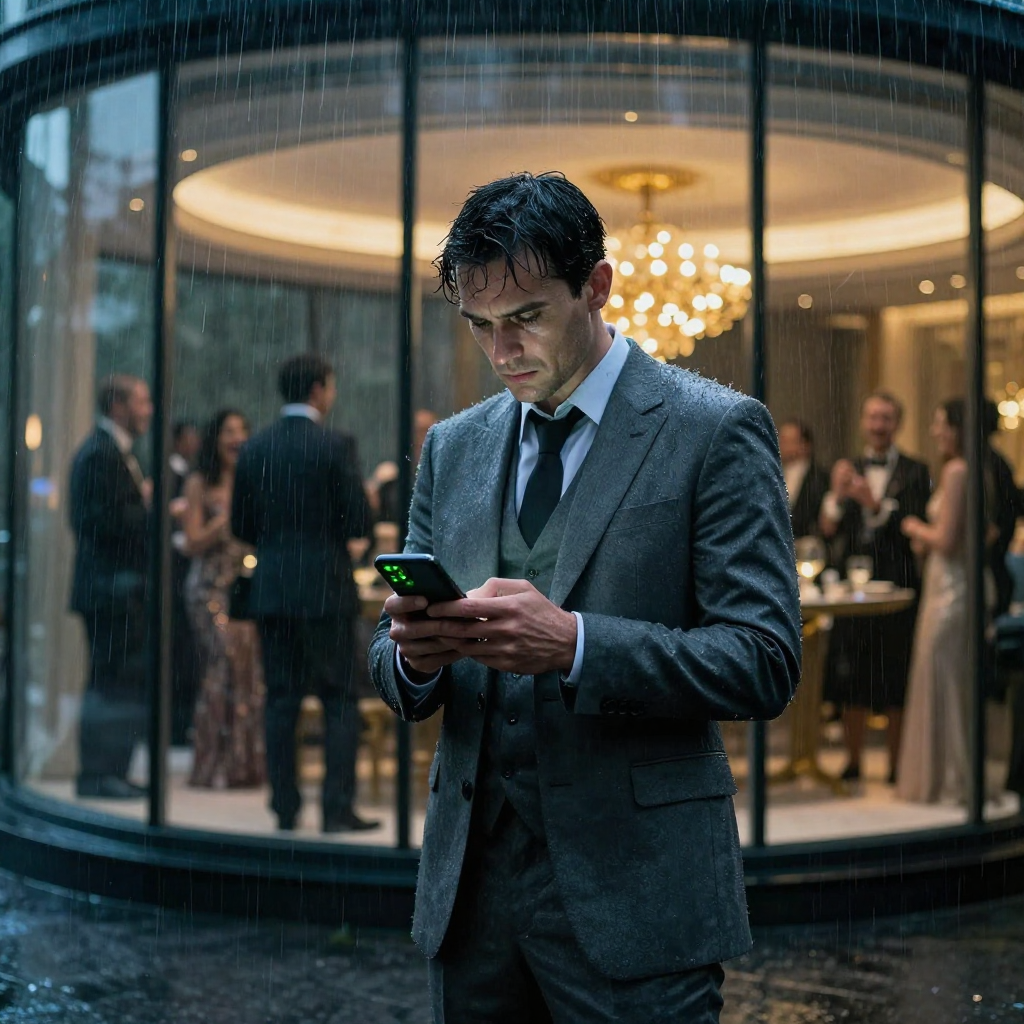
THEY LAUGHED AS THE RAIN SOAKED MY CHEAP SUIT, TAPPING ON THE GLASS OF THE VENUE I SECURED, UNAWARE THAT THE PHONE IN MY FREEZING HAND HELD THE MASTER KEY TO THEIR FORTUNES, AND I WAS ABOUT TO TEACH THEM THE PRICE OF INVISIBILITY.
The rain wasn’t just falling; it was driving, hard and cold, turning the world gray and blurring the lights of the city into long, weeping streaks. I stood there, shivering, the water soaking through the shoulders of my polyester blend jacket—the best I could afford on a salary that hadn’t changed in four years—watching the warmth inside.
It was the Sterling Gala. The annual celebration of ‘unprecedented growth’ for Archon Financial. I had built the growth. Not the sales, not the marketing, but the infrastructure. The Citadel System. The labyrinth of encryption and high-frequency trading algorithms that kept their billions safe and moving faster than thought. They called me the ‘IT Guy’ when the printer jammed. Behind my back, I knew they called me the ‘Server Goblin’ because I spent days in the basement, pale and caffeinated, fixing their messes.
But tonight, I was supposed to be a guest. The invite had come via automated email, likely a glitch in the HR batch processing, but I had printed it out. I had bought a tie. I had polished my scuffed shoes.
I stood six inches from the glass wall of the venue, a hyper-modern aquarium of wealth. Inside, the lighting was amber and soft. Men in bespoke tuxedos laughed with their heads thrown back, exposing vulnerable throats. Women in gowns that cost more than my car held flutes of champagne that sparkled like liquid gold.
I saw Julian. Julian, the VP of Operations. The man who had denied my raise three weeks ago because of ‘budget constraints’ while booking a corporate retreat to the Maldives. He was standing near the window, holding court with three junior executives.
He saw me.
I raised my hand, holding the soggy piece of paper—my invite—against the glass. I offered a tentative, hopeful smile. I wasn’t asking for much. Just to come in out of the cold. Just to be acknowledged as a human being who had helped build the roof over their heads.
Julian stopped laughing. He squinted, recognizing me. Then, he smiled. It wasn’t a kind smile. It was the smile of a predator seeing a wounded animal. He nudged the man next to him—Carter, I think—and pointed. They both looked. They both laughed.
Julian mimed a sad face. He mouthed the words, visible even through the double-paned soundproof glass: *“Wrong door, tech support.”*
Then he turned his back. He literally turned his back on me, closing the circle of warmth and wealth, leaving me in the deluge.
Something inside me didn’t snap. Snapping implies a loud, sudden break. This was different. This was a quiet, cold solidification. It was the feeling of water freezing into ice, expanding, cracking the stone around it.
They didn’t know who I was. To them, I was the guy who reset passwords. They didn’t understand that The Citadel wasn’t just software. It was me. I had written the kernel. I had designed the failsafes. And, because I was paranoid about security and trusted no one—least of all people like Julian—I had built a backdoor. Not for theft, but for maintenance. A skeleton key designed to flush the system in case of a catastrophic breach.
Or a catastrophic betrayal.
The rain ran down my neck, icy and relentless. My shoes were filled with water. I felt small, humiliatingly small. But in my pocket, my phone buzzed. It was a notification from the server monitoring app. *System Load: Normal.*
I pulled the phone out. The screen was wet, the light harsh against the dark evening. I wiped it on the dry patch of shirt under my jacket.
I looked at Julian one last time. He was clinking glasses with the CEO. They were celebrating a record quarter. A quarter built on the efficiency of my code.
“You want to lock me out?” I whispered, the sound swallowed by the wind. “Fine. I’ll lock you out.”
I opened the terminal app. It was a black screen with green text, simple, archaic, powerful. I bypassed the biometric security—my own biometrics were the master key. I typed in the command line. It wasn’t a hack. You can’t hack what you own. It was an administrative command.
`SUDO EXECUTE PROTOCOL_ZERO –TARGET ALL_ACCOUNTS –SCOPE ARCHON_GLOBAL`
My thumb hovered over the return key.
Protocol Zero wasn’t designed to steal money. Stealing leaves a trail. Stealing is a crime of greed. Protocol Zero was a scorched-earth defense. It scrambled the encryption keys for the accounts, randomizing the routing numbers and freezing the assets in a digital limbo that would take forensic accountants decades to untangle. It effectively turned their balances to zero—not by deleting the money, but by deleting their access to it.
For a moment, I hesitated. I thought about my mortgage. I thought about the severance package I wouldn’t get. I thought about the ethics of burning down the library because the librarian was rude.
Then I looked up. A waiter was passing a tray of hors d’oeuvres. Julian reached out, took a crab cake, ate it in one bite, and wiped his hands on a napkin he immediately dropped on the floor. He laughed again, a sound I couldn’t hear but felt in my bones.
He didn’t see me. He didn’t see the Shadow Architect.
I pressed Enter.
The screen flashed once: *COMMAND ACCEPTED. EXECUTING.*
I stood there in the rain, watching. It would take about thirty seconds for the banking alerts to start hitting their phones. Thirty seconds until the credit cards at the bar started declining. Thirty seconds until the notification emails hit the CEO’s Blackberry.
The cold didn’t bother me anymore. I felt a strange, terrifying warmth spreading through my chest. The warmth of absolute, unmitigated power.
Inside the glass, the music played on. Julian took a sip of champagne. He didn’t know he was already bankrupt. He didn’t know that the soaking wet man outside the window had just turned his golden carriage back into a pumpkin.
I waited. Ten seconds. Twenty.
Inside, a woman in a red dress frowned, looking at her phone. She tapped the screen, puzzled.
Then the music stopped. Not because the band stopped playing, but because the CEO, standing on the small stage, pulled his phone from his pocket, his face draining of all color.
It began.
CHAPTER II
I pushed through the heavy oak doors of the Grand Ballroom, my shoes squeaking against the polished marble. I was drenched. My cheap suit jacket clung to my shoulders like a cold, wet second skin, dripping onto the pristine floor. The security guard, a man I’d seen every morning for five years and whose name I knew was Marcus, didn’t even try to stop me this time. He was too busy staring at his handheld tablet, his brow furrowed in a deep, anxious V.
Inside, the gala was a sea of gold and silk, a shimmering bubble of wealth that felt entirely divorced from the storm raging outside. But the bubble was starting to leak. The atmosphere hadn’t curdled into panic yet, but the air was thick with a strange, jittery static. It was the sound of a hundred high-end smartphones vibrating simultaneously—a low, rhythmic hum that was beginning to drown out the string quartet.
I stood by the buffet table, a phantom in the corner, watching them. These were the architects of my misery, the people who viewed me as a line item in a budget, a necessary but distasteful expense. I picked up a glass of sparkling water, my hand trembling slightly. Not from fear, but from the sheer, terrifying weight of what I had just unleashed. Protocol Zero was a scorched-earth policy. It didn’t just lock the vault; it changed the locks, melted the keys, and erased the blueprints.
I looked over at the center stage. Julian was there, standing next to the CEO, a man named Sterling who looked like he’d been carved out of granite. They were preparing for the centerpiece of the evening: the ‘Citadel Legacy’ charity auction. It was supposed to be the crowning moment for the system I had built—a demonstration of how Archon Financial could move millions of dollars across the globe in seconds, secure and untouchable.
“Ladies and gentlemen,” Sterling’s voice boomed over the speakers, “if you could please direct your attention to the monitors. Tonight, we aren’t just raising money for the Metropolitan Children’s Fund; we are demonstrating the future of global trust.”
I watched Julian. He looked radiant, his teeth white against his tan, his hand resting casually on the back of an expensive chair. He was the face of my labor. He had taken my sleepless nights, my years of coding, and my revolutionary encryption algorithms and sold them as his own vision. He was the ‘visionary,’ and I was just the ‘technical lead’ who was too socially awkward to be invited to the table.
Sterling signaled to the auctioneer. “Our first item tonight is a rare collection of 19th-century maps, donated by the Archon Heritage Foundation. We’ll start the bidding at five hundred thousand dollars. Please use your Archon-linked devices to place your bids.”
A hush fell over the room. People pulled out their phones, their faces illuminated by the blue glow of the Archon App—the interface I had designed, the one that was currently a hollow shell.
I saw a man in the front row, a hedge fund manager named Aris, tap his screen repeatedly. He frowned. He tapped harder. Beside him, his wife was doing the same. Then, a few rows back, a woman gasped. It wasn’t a loud sound, but in the expectant silence of the ballroom, it was like a gunshot.
“Is there a problem with the Wi-Fi?” someone called out.
Julian stepped forward, a practiced smile on his face. “Just a momentary lag, I’m sure. The storm is quite heavy outside. Our servers are robust; please just refresh your apps.”
I watched him lie. It was what he was best at. But the lie didn’t hold. The murmurs grew louder. People weren’t just failing to bid; they were looking at their account balances. Or rather, the lack thereof. The app was designed to show a ‘Citadel Verified’ badge next to their total assets—a gold shield that represented the impenetrable nature of their wealth.
Now, that shield was gone. In its place was a flat, grey icon of a locked gate. And the balance? Zero. Not a negative number, not an error code. Just a haunting, empty circle of nothing.
“My account is empty,” Aris said, his voice rising in pitch. “Sterling, my entire liquidity portfolio is gone. It says ‘Access Revoked’.”
Panic is a contagion. It started at the front and swept back toward me like a wave. People were standing up, their chairs scraping harshly against the floor. The string quartet stopped playing, the cellist looking around in confusion. The waiters stood frozen with their silver trays, unsure whether to continue serving a room full of people who might no longer be able to pay for the wine they were drinking.
I felt a strange sense of detachment. This was the ‘Old Wound’ opening up. I remembered my father, a man who had spent forty years in a factory, only to lose his entire pension when the company’s leadership ‘restructured’ the funds into a black hole. I remembered him sitting at the kitchen table, staring at a letter that told him his life’s work had been erased by a clerical shift he didn’t understand. I had built Citadel to prevent that. I had built it to be a fortress where no one could ever reach in and take what didn’t belong to them.
But in doing so, I had created the ultimate weapon. If the creator decides the fortress is corrupt, he doesn’t just open the gates; he buries the fortress under the earth.
Julian was frantic now. He was on his own phone, his face turning a sickly shade of grey. He whispered something to Sterling, who pushed him aside and grabbed the microphone.
“Everyone, please! Stay calm. This is a technical glitch. Our engineers are already working on it. Your funds are safe. Archon Financial has layers of redundancy—”
“It’s not a glitch, Sterling!” a woman screamed from the back. “My personal bank app—not even the Archon one—is showing my linked accounts are frozen. Everything tied to the Citadel API is dead!”
That was the ‘Secret’. I hadn’t just scrambled Archon’s internal keys. Because Archon had licensed the Citadel backbone to dozens of other banks and platforms, the scramble was propagating. It was a digital autoimmune response. The system was treating the entire financial network as a threat and locking it out. I hadn’t just ruined a party; I had initiated a systemic cardiac arrest.
I stepped out of the shadows and began walking toward the stage. I moved slowly, deliberately. I was still dripping, leaving a trail of dark water on the white carpet. No one noticed me at first, until I was halfway down the center aisle.
Julian saw me first. His eyes widened, and for a second, I saw a flicker of genuine terror. Not of me—he still thought I was a nobody—but of the realization that the timing was too perfect.
“Elias?” he hissed as I reached the edge of the stage. “What the hell are you doing in here? You’re supposed to be—”
“Outside in the rain?” I finished for him. My voice was calm, which seemed to unnerve him more than if I had been shouting. “I decided I wanted to see the demonstration in person.”
Sterling turned his gaze on me. He didn’t know me, but he knew power when he saw it, and right now, I was the only person in the room who wasn’t panicking. “Who is this?” he demanded of Julian.
“He’s… he’s the lead architect. The guy who built the backend,” Julian stammered. He grabbed my arm, his fingers digging into my wet sleeve. “Elias, something is wrong with the system. It’s Protocol Zero. How is that possible? No one has that clearance but the board and—”
“And the man who wrote the code,” I said, loud enough for the people in the front rows to hear.
Julian’s grip tightened. “Fix it. Now. I don’t know what kind of stunt you’re pulling because you’re upset about the gala, but you’re going to end this right now. If you don’t, I will personally see to it that you never work in this industry again. You’ll be in a cell before the sun comes up.”
I looked down at his hand on my arm. Then I looked at the room full of millionaires and billionaires who were now, for all intents and purposes, penniless. They were staring at me, their faces a mixture of desperation and dawning horror.
“The industry is gone, Julian,” I said softly. “There is no ‘industry’ without the keys. And the keys are currently being rewritten every sixty seconds by an algorithm that only recognizes a signature that doesn’t exist anymore.”
Sterling stepped toward me, his voice a low, dangerous rumble. “Young man, do you have any idea of the scale of the damage you’re causing? There are pensions tied to these accounts. There are hospitals, infrastructure projects, international trade deals. This isn’t a game. You are destroying lives.”
This was my ‘Moral Dilemma’. Sterling wasn’t entirely wrong. I wasn’t just hurting Julian. I was hurting the secretary who had been kind to me, the janitors, the millions of people who had no idea what Archon Financial even was but whose lives were built on the stability I was currently incinerating. To stop it would be to surrender, to go to prison, and to let Julian continue his reign of theft and ego. To continue was to become the very monster I claimed to despise.
“I know exactly what I’m doing,” I said, my heart hammering against my ribs. “I spent ten years building a system that was supposed to be the most honest thing in the world. And I watched you, Sterling, and you, Julian, turn it into a shell game. You used my code to hide debts, to inflate assets, and to screw over anyone who didn’t have a seat at this table. You didn’t care about the ‘lives’ you were affecting when you were skimming the top. Why do you care now?”
“We can negotiate,” Julian pleaded, his voice cracking. He looked around at the angry faces of the guests. Some of them were starting to move toward the stage. The security guards were confused—do they protect the bosses or the people who pay the bosses? “Whatever you want. Money? Partnership? We’ll announce you as the co-founder tonight. Just… just get the system back online before the markets open in Asia.”
“It’s not about the money, Julian. You still don’t get it. You never did. You think everything has a price because you’ve never valued anything.”
Suddenly, the lights flickered and died. The emergency generators kicked in after a few seconds, bathing the room in a harsh, clinical red light. It made the ballroom look like a crime scene.
One of the guests, a man I recognized as a major shareholder, lunged toward the stage. “Give us the keys, you little freak!” he screamed. He was held back by a guard, but the dam was breaking. The civility of the gala was evaporating, replaced by the raw, primal fear of people who had lost their identity along with their bank balance.
I looked at Julian. He was shaking. This was the man who had mocked me three hours ago for being ‘part of the help’. Now, he was looking at me like I was a god—a cruel, vengeful god who held his entire existence in the palm of my hand.
“I have a secret, Julian,” I whispered, leaning in so only he and Sterling could hear. “The backdoor I used? It wasn’t something I added later. It was the very first line of code I wrote for Citadel. I knew, even back then, that one day someone like you would come along. I knew that the only way to keep the world honest was to have the power to burn it all down if it became too corrupt.”
“You’re insane,” Sterling breathed. “You’re a nihilist.”
“No,” I said, looking out at the red-lit room. “I’m just the architect. And I’ve decided the building is condemned.”
Julian fell to his knees. It was pathetic, really. He wasn’t even fighting anymore; he was just broken by the suddenness of his own irrelevance. “Please,” he whimpered. “My kids… my house… it’s all tied to the Archon stock. If this doesn’t fix, I have nothing.”
I felt a pang of guilt, a sharp, cold needle in my chest. I thought of his children, who had done nothing wrong. I thought of the thousands of employees who would wake up tomorrow to find their company insolvent. This was the weight of the lever I had pulled. It was too much for one person to carry.
But then I looked at Sterling. He wasn’t kneeling. He was on his phone, likely calling his lawyers or private security, already looking for a way to pivot, to blame someone else, to ensure he remained on top while the rest of the world drowned. People like him always survived. Unless the system itself was destroyed beyond repair.
I reached into my pocket and pulled out my phone. The screen was still showing the Protocol Zero execution log.
*Entropy increasing…*
*Keyspace randomized…*
*Identity verification: FAILED…*
“The system is asking for a final confirmation,” I lied. There was no confirmation; the process was already irreversible, but they didn’t know that. “I can try to trigger a rollback. But it requires an honest admission. Right here. Right now. In front of all these people you’ve been lying to.”
Julian looked up, hope flickering in his eyes like a dying candle. “What? Anything. What do you want me to say?”
“Tell them about the synthetic CDOs you hid in the ‘Safe-Guard’ portfolios. Tell them how you used Citadel’s encryption to mask the fact that you were forty percent under-collateralized on the venture fund. Tell them you’re a fraud, Julian.”
Sterling grabbed Julian’s shoulder, trying to pull him up, trying to keep him silent. “Don’t say a word, Julian. He’s bluffing. He wouldn’t destroy himself along with us.”
I looked Sterling dead in the eye. “I have nothing to lose, Sterling. You forgot to give me a life. You kept me in a basement and fed me coffee and code. I don’t have a house in the Hamptons. I don’t have a family who expects a certain lifestyle. I have a one-bedroom apartment and a cat that probably hates me. I am the only person in this room who is truly free.”
The room had gone silent again. Everyone was listening. The ‘Public’ nature of this moment was the one thing they couldn’t control. Even if they killed me, the truth was out there. The system was dead.
Julian looked at the crowd. He looked at the red light reflecting off the diamonds around the necks of women who were now staring at him with pure hatred. He looked at the monitors, which were now flashing a single, repeating message: *LIQUIDITY NULL*.
He opened his mouth to speak, but no sound came out. He was a man whose entire soul was built on a foundation of paper, and the paper was on fire.
I realized then that there was no going back. Even if I could fix it—and I wasn’t sure I could anymore—the trust was gone. The ‘Citadel’ had fallen. I had taken the one thing these people valued—their sense of absolute security—and I had shredded it in front of them.
I turned away from the stage and started walking back toward the doors.
“Where are you going?” Sterling shouted. “Fix it! You have to fix it!”
I didn’t stop. I didn’t look back. I walked past Marcus the security guard, who was now sitting on the floor, his head in his hands. I walked out of the ballroom, through the foyer, and back into the pouring rain.
The air felt different now. It was cold and harsh, but it was real. Behind me, the gala was a screaming, red-lit nightmare. In front of me was the dark, uncertain street. I had no plan. I had no money. I had no future.
But as I walked into the storm, for the first time in my life, I didn’t feel like a shadow. I felt like the man who had finally turned on the lights, even if all they revealed was the wreckage.
CHAPTER III
The silence of a city losing its pulse is heavier than any noise. When I walked out of the Archon gala, the air was sharp, smelling of wet pavement and the electric tang of an impending storm. My shoes clicked against the marble steps, a rhythmic, solitary sound that seemed to echo through the empty plazas. Usually, at this hour, the financial district is a hive of low-frequency hums—servers cooling, security systems chirping, the distant roar of late-night street sweepers. But tonight, the hum had died. The digital blood of the world was clotting in the veins I had built.
I didn’t take a car. I didn’t want to be tracked by a GPS that was already flickering in and out of existence. I walked. My shadow stretched long and thin under the orange glow of the streetlights. Every few blocks, I saw the first signs of the entropy. A man at an ATM was hitting the screen with the heel of his hand, his face lit by the pale blue glow of a ‘System Unavailable’ message. A convenience store clerk stood in the doorway, staring at a credit card reader that had become nothing more than a plastic brick. They didn’t know yet. They thought it was a glitch, a temporary hitch in the seamless fabric of their lives. They didn’t realize I had pulled the thread.
My phone was a dead weight in my pocket. I had disabled the cellular radio, but I could feel it vibrating with ghost notifications—demands from Sterling, pleas from Julian, alerts from the failsafes I’d ignored. I felt a strange, hollow peace. For years, I had been a ghost in their machine, a technician who kept the gears greased while they used the friction to burn down people like my father. Now, the machine was a monument to their greed, and I was the only one with the map to the exit. But I knew the exit came with a price. You don’t dismantle a god without the temple collapsing on your head.
I reached the river. The water was black, reflecting the flickering lights of the skyscrapers. Those buildings looked like headstones now. I sat on a concrete bench, my hands deep in my pockets, and watched the first gray light of dawn begin to bleed into the horizon. This was the moment of the Great Opening. In London, the markets were already screaming. In New York, the bells would remain silent. I thought about the billions of dollars that had vanished—the fake wealth, the leveraged debt, the engineered poverty. It wasn’t just gone. It was transformed. That was the secret I hadn’t told Sterling. Protocol Zero wasn’t a furnace; it was a prism.
I heard the car before I saw it. It wasn’t a siren or a screech of tires. It was the low, predatory purr of a high-end engine moving slowly, matching my pace from the street above. I didn’t run. There was nowhere to go that the Archon’s reach couldn’t touch, at least not yet. I stood up and smoothed my coat. A black sedan pulled to the curb fifty yards away. The door opened, and a man stepped out. He wasn’t a ‘suit’ in the corporate sense. He wore a dark tactical jacket and moved with the heavy, deliberate grace of someone who was paid to solve problems that laws couldn’t touch.
His name was Vance. I’d seen him in the periphery of Sterling’s meetings for years. He was the ‘cleaner’—the man who ensured that when the elite made mistakes, the evidence disappeared. He didn’t pull a weapon. He didn’t need to. The threat was in the way he stood, the way he occupied the space between me and the rest of the world. He walked toward me, his boots crunching on the gravel. He stopped six feet away, his face unreadable in the pre-dawn gloom.
‘Sterling wants the keys, Elias,’ Vance said. His voice was sandpaper on silk. ‘He’s not interested in the speech you gave at the gala. He’s not interested in your father. He wants the decryption sequence, and he wants it before the sun is fully up.’
I looked at him, really looked at him. ‘And if I don’t have them? If I burned them?’
‘You’re too smart for that,’ Vance replied. He took a step closer, his presence expanding. ‘You’re a builder. You don’t destroy things without keeping a way to put them back together. That’s your leverage. But leverage only works if you’re alive to pull the lever. Sterling is losing everything. A man with nothing left to lose is the most dangerous thing in this city. He’s already signed the order to make you a non-person. By noon, your accounts will be seized, your records erased, and you’ll be the prime suspect in a domestic terrorism investigation. Unless you give me the drive.’
I felt a cold shiver, but it wasn’t fear. It was the thrill of the final move. ‘He’s wrong, Vance. I didn’t just scramble the data. I didn’t keep the keys for myself. I didn’t even keep them for him.’
I reached into my inner pocket. Vance flinched, his hand moving toward his belt, but I pulled out a small, battered ledger—my father’s old accounting book—and a single, encrypted hardware token. I held it up between us. The light from the rising sun hit the casing, making it gleam like a dull tooth.
‘This is the Ghost Protocol,’ I said. ‘I redirected the fragmented assets. Every cent that Archon stole through hidden debts, every foreclosed home they turned into a derivative, every pension fund they hollowed out… it’s all been mapped back to the original victims. The money is sitting in a decentralized cloud. It’s not in an Archon vault. It’s in the hands of three hundred thousand people who don’t even know they’ve been repaid yet.’
Vance’s eyes narrowed. ‘You’re insane. You can’t just give away that much capital. The system will collapse.’
‘The system is already dead,’ I snapped. ‘I’m just deciding who gets to keep the ashes. This token doesn’t unlock the money for me. It unlocks the distribution algorithm. But there’s a catch. For the Ghost Protocol to execute, it needs a final biometric authorization. My heartbeat. If I stop, the protocol locks forever. If I sign it over to Sterling, he can try to reverse it, but it’ll trigger a permanent wipe of everything Archon owns. He’s trapped. You’re trapped.’
For the first time, I saw a flicker of something human in Vance’s eyes. It was doubt. He looked at the token, then at me. He was calculating his own survival. If the world I had built was gone, his paycheck was gone too. His loyalty to Sterling was a transaction, and the currency had just been devalued to zero.
Suddenly, the air was cut by the rhythmic thumping of rotors. Two black helicopters appeared over the skyline, their searchlights cutting through the mist. Below them, on the street, a convoy of dark SUVs with government plates swept around the corner, blue and red lights silent but blinding. They weren’t Sterling’s men. This was the Bureau of Financial Stability—the heavy-duty regulators who only show up when a nation’s sovereignty is at stake.
Vance stepped back, his hand dropping. He knew when a situation had escalated beyond his pay grade. The SUVs screeched to a halt, forming a perimeter. Men and women in tactical gear and windbreakers marked ‘BFS’ spilled out. At the center of them was a woman I recognized from a dozen C-SPAN hearings: Director Sarah Thorne. She was the one Sterling had spent millions to lobby, the one who was supposed to look the other way.
She walked straight toward us, her face a mask of iron. She ignored Vance entirely and stopped in front of me. Behind her, I could see the city waking up to a nightmare. People were coming out onto their balconies, looking at their dead phones, sensing the shift in the atmosphere. The world was waiting for an answer.
‘Mr. Thorne,’ she said, her voice projecting a cold, institutional authority. ‘I am not here to arrest you. Not yet. I am here because the global financial infrastructure is currently experiencing a total systemic failure. We have tracked the origin to the Archon servers. We also have a very long, very detailed anonymous data dump that arrived at our office an hour ago, detailing twenty years of racketeering, fraud, and illegal market manipulation by Archon Financial.’
I smiled. The data dump. That was the last piece of the puzzle I’d set to auto-send. ‘Then you know why I did it.’
‘I know what you claim to have done,’ Thorne said. ‘But I also know that you are currently holding the world hostage. You have redirected trillions into an unmapped network. You have destroyed the liquidity of the Western world.’
‘I’ve restored it to the people it was stolen from,’ I countered. ‘Sterling and his board are the hostages. Not the people.’
‘Give me the token, Elias,’ she demanded. ‘We can mitigate the damage. We can create a managed transition. If you keep this up, there won’t be a world left for your ‘victims’ to spend that money in. You’ll be responsible for a collapse that will kill more people than any war.’
I looked at the token in my hand. This was the moment of no return. I could hand it to the government, and they would do what they always did—stabilize the banks, protect the institutions, and bury the ‘Ghost Protocol’ in a decade of litigation until the money evaporated back into the pockets of the elite. Or, I could finish what I started.
‘There’s a condition,’ I said, my voice steady despite the adrenaline surging through me. ‘I will give you the token. I will give you the authorization. But you don’t get to ‘manage’ the transition. The Ghost Protocol is self-executing. Once I activate the final sequence, the redistribution is permanent. You don’t get to choose who gets paid. The code already did.’
‘You don’t have the authority to make that deal!’ Thorne shouted. ‘You’re a criminal! You’re a saboteur!’
‘I’m the only one who can turn the lights back on,’ I said. I looked past her to where Sterling had arrived in another car, flanked by lawyers, his face purple with rage. He was being held back by BFS agents. He was screaming, but no one was listening. His power had been tied to the digital ledger, and that ledger now belonged to me.
I turned back to Thorne. ‘The sequence requires a thirty-minute window of manual input at the Archon core. I need to go back in. And I need it broadcast. Not the code, but the confirmation. I want the world to see the moment the debt is cleared. I want them to see that the giants are made of paper.’
Thorne hesitated. She looked at the helicopters, at the rising sun, at the desperate, broken CEO in the background. She realized she wasn’t in control. The institutional authority she represented was a ghost too. It only existed as long as people believed in the currency. And right now, the only person with currency was the man standing on the riverbank with a piece of plastic.
‘Get him in the car,’ she ordered her team. ‘Clear the building. Secure the server room.’
As they ushered me toward the SUV, I caught a glimpse of myself in the tinted window. I looked old. I looked tired. But for the first time in thirty years, I didn’t look like a victim. I looked like the storm.
We drove through the city, and it was like traveling through a graveyard. The lights were on, but the spirit was gone. People were huddled in groups on street corners. Shops were closed. The ‘CLOSED’ signs felt more permanent than usual. I realized that even if I succeeded, I was ending one world to start another, and there was no guarantee the new one would be any kinder. It would just be more honest.
We arrived at the Archon building. It was surrounded by a sea of black vehicles. The lobby, once a cathedral of glass and ego, was now a command center. Agents were everywhere, hauling out servers, arresting executives who had tried to flee. I saw Julian being led out in handcuffs. He looked at me, his eyes wide and vacant. He didn’t even look angry. He looked relieved. The lie was over for him too.
Thorne led me to the private elevator. ‘You have thirty minutes, Elias. If that protocol does anything other than restore the markets, I will ensure you are buried in a hole so deep you’ll forget what the sun looks like.’
‘If the markets ‘restore’ to the way they were,’ I said, ‘then I’ve already failed.’
The elevator rose. The pressure in my ears was a reminder of the height we had climbed on the backs of others. I stepped out into the server room. The air was cold, the blue lights of the racks flickering like stars. I walked to the main terminal—the one I had built, the one I had programmed to betray its masters.
I plugged in the token. The screen bled red. ‘GHOST PROTOCOL: READY FOR FINAL AUTHORIZATION.’
I looked at my hand. It was shaking. To do this meant I would never be free. I would be the man who broke the world. I would be the villain in every textbook and the hero in every shadow. My life as Elias Thorne, the brilliant architect, was over.
I reached for the keyboard. I could hear Sterling’s voice echoing in the hallway, his desperate threats muffled by the heavy doors. I could feel the weight of my father’s ledger in my pocket. This wasn’t just for him. This was for everyone who had ever been told that the game wasn’t rigged.
I began to type. The code flowed out of me like blood. I wasn’t thinking about the numbers anymore. I was thinking about the millions of people waking up to find that their debts were gone, that their homes were theirs again, that the invisible chains had snapped.
‘Authorization confirmed,’ the machine whispered.
I hit the final key. The screen went black for a heartbeat, and then a single line of white text appeared, scrolling across every monitor in the building, and every screen still connected to the grid across the globe:
‘THE DEBT IS PAID. WE ARE FREE.’
I leaned back, my breath hitching in my chest. Outside, the sun finally crested the horizon, flooding the server room with a blinding, golden light. It was beautiful. And then, the door burst open.
CHAPTER IV
The handcuffs were cold. Colder than the server room had been, even with the adrenaline pumping. Now, nothing. Just cold steel and the hum of the transport van as it chewed up the miles. I stared out the reinforced window, watching the city blur. It wasn’t the same city I’d seen just days ago. The panic was gone, replaced by… what? A kind of stunned quiet. Like a battlefield after the guns fall silent.
They hadn’t said much since taking me into custody. Director Thorne had given me a curt nod, a flicker of something unreadable in her eyes. The rest were just faces, shields. I was a package now, being delivered.
My thoughts kept circling back to Dad. Had he seen it? Had he understood? The news footage I’d glimpsed before they confiscated my phone showed people celebrating in the streets, holding signs. ‘Elias Did It.’ Did he know I did it for him? For all of them?
The silence in the van stretched, thick and heavy. I closed my eyes, but the images wouldn’t stop: Sterling’s face, contorted with rage; Julian’s slick smile vanishing as Protocol Zero initiated; Vance’s relentless pursuit. And Dad’s face, etched with the quiet despair of a man who’d been ground down by the system.
That was the face that mattered. That was the face that justified everything.
**Public Fallout**
The trial was a circus. Not in the legal sense – Thorne had made sure of that. But the media… they descended like vultures. ‘The Architect of Ruin’ one headline screamed. ‘Savior of the People’ declared another. I was a Rorschach test, and everyone saw what they wanted to see.
The courtroom was packed. I saw faces I recognized from the news, faces of people who’d lost everything. And faces of people who’d gained everything. The air was thick with resentment and hope.
My lawyer, a sharp woman named Ms. Anya Sharma, kept telling me to remain silent. ‘Let me do the talking, Elias. You’re a symbol now. Anything you say will be twisted.’ She was probably right. Words had gotten me into this mess in the first place.
The prosecution painted me as a terrorist, a zealot who’d single-handedly crashed the global economy. They presented charts, graphs, expert witnesses who droned on about market volatility and systemic risk. It was all white noise to me. They didn’t understand. None of them understood.
Anya countered with stories. Stories of families evicted from their homes, of people driven to suicide by debt, of the predatory lending practices that Archon had perfected. She brought in witnesses – real people, not experts – who testified about the devastation Archon had wrought. Their voices, raw and broken, filled the courtroom.
I watched it all, detached. It was like watching a play about my life, but with actors who didn’t quite get the script. The real story wasn’t in the courtroom. It was in the empty spaces between the words, in the unspoken grief and anger that filled the room.
The world outside was changing. The old order was collapsing, slowly but surely. New currencies were emerging, based on community trust and shared resources. Local economies were flourishing. People were learning to rely on each other, not on banks. It was messy, chaotic, but there was a sense of… possibility. A chance to build something better.
Sterling and Julian weren’t so lucky. Their assets were frozen, their reputations destroyed. They were facing multiple lawsuits, criminal charges. I heard Sterling tried to flee the country, but he was caught at the airport, clutching a suitcase full of cash. Pathetic.
Vance disappeared. Some said he’d gone underground, others said he’d left the country. I didn’t care. He was a ghost, a shadow of the old order. He didn’t matter anymore.
**Personal Cost**
The trial dragged on for months. I became numb to the proceedings, to the accusations and defenses. The only thing that kept me going was the thought of Dad. I imagined him watching, finally free from the burden of debt. That image gave me strength.
But the cost… it was immense. I lost everything. My career, my reputation, my freedom. I was a pariah, a prisoner in my own life. Even the people who supported me, who saw me as a hero, couldn’t understand the weight of what I’d done.
I was isolated. Anya visited regularly, but our conversations were stilted, legalistic. I couldn’t tell her what I was really feeling. No one could. They saw the architect, the genius who’d taken down the system. They didn’t see the broken man inside.
The guilt was a constant companion. I knew I’d done the right thing, but that didn’t make it any easier. I’d unleashed chaos, disrupted lives. Some people had been hurt, even those I’d intended to help. The world wasn’t a simple equation. There were always unintended consequences.
I thought about Sarah Thorne. She’d played a complicated game, using me as a pawn in her own power struggle. I didn’t trust her, but I respected her. She was a survivor, a pragmatist. She’d done what she had to do to protect the system, even if it meant bending the rules.
I wondered if she ever regretted her choices. If she ever felt the weight of responsibility.
Then there was Maya. I hadn’t seen her since the gala. I didn’t know if she hated me, pitied me, or simply wanted to forget I ever existed. I imagined her life going on without me, smooth and untroubled. That thought stung more than any accusation.
I missed her. I missed her laughter, her intelligence, her unwavering belief in me. But I knew I could never go back. I’d crossed a line, and there was no turning back.
**New Event**
One day, Anya came to visit with a strange look on her face. ‘Elias,’ she said, ‘there’s someone who wants to see you.’
I frowned. ‘Who?’
‘His name is… David Sterling.’
My heart clenched. Sterling. What could he possibly want?
Anya explained that Sterling had requested a meeting, offering to testify in my defense in exchange for a private conversation. It was a desperate move, but Anya thought it might be worth considering.
I hesitated. I didn’t want to see him. I didn’t want to give him the satisfaction of knowing he still affected me. But there was a part of me that was curious. What had he become, now that his empire had crumbled?
I agreed to the meeting. A few days later, I was led to a small, windowless room. Sterling was already there, sitting at a table. He looked… different. Older, more haggard. The arrogance was gone, replaced by a kind of weary resignation.
‘Thank you for seeing me, Elias,’ he said, his voice hoarse.
I didn’t say anything. I just stared at him.
‘I know you probably hate me,’ he continued. ‘And you have every right to. But I need to tell you something.’
He paused, took a deep breath. ‘Protocol Zero… it didn’t just erase the digital wealth. It exposed something else. Something I didn’t even know existed.’
He told me about a hidden layer within Archon’s system, a black box that tracked not just money, but power. It recorded every transaction, every deal, every manipulation. It was a complete map of the global elite’s influence.
‘I don’t know how you did it,’ Sterling said, ‘but you unlocked it. You revealed everything.’
He explained that the information had been leaked to various investigative journalists and activist groups around the world. The fallout was just beginning. Scandals were erupting, governments were collapsing, and the old order was crumbling faster than ever.
‘I created a monster, Elias,’ Sterling said, his voice barely a whisper. ‘And you unleashed it.’
He looked at me, his eyes filled with a strange mixture of fear and awe. ‘What have you done?’
**Moral Residues**
I didn’t have an answer for him. I didn’t know what I’d done. I’d set something in motion, and I couldn’t control it anymore.
Sterling testified at my trial, confirming everything I’d said about Archon’s predatory practices. His testimony was devastating, and it swayed the jury. But it didn’t change the fact that I’d broken the law.
I was found guilty of multiple charges, including conspiracy, fraud, and破坏数字资产 (Destruction of digital assets). But the judge, recognizing the extenuating circumstances, gave me a lenient sentence. I was sentenced to five years in prison, with the possibility of parole.
As I was led away, I saw Dad in the courtroom. He was smiling, a genuine, heartfelt smile. He raised his hand in a silent salute.
That was enough. That was all that mattered.
Prison was… uneventful. I spent my days reading, writing, and trying to make sense of what I’d done. I met other inmates, men and women who’d been broken by the system. I listened to their stories, and I realized I wasn’t alone.
The world outside continued to change. The new economy was taking shape, slowly but surely. There were setbacks, challenges, but there was also progress. People were learning to live without debt, to rely on each other, to build a more just and equitable society.
I received letters from Maya. They were cautious, tentative, but they were there. She told me about her work with a community organization that was helping people rebuild their lives. She was making a difference.
One day, I received a letter from Sarah Thorne. She told me that she’d resigned from the Bureau of Financial Stability. She didn’t say why, but I suspected it had something to do with the information that had been leaked from Archon’s system.
She ended her letter with a quote from T.S. Eliot: ‘We shall not cease from exploration, and the end of all our exploring will be to arrive where we started and know the place for the first time.’
I thought about that quote a lot. I wondered if Thorne had found what she was looking for. If she’d finally understood the true cost of her choices.
When I was released from prison, five years later, the world was a different place. The old order was gone, replaced by something new, something uncertain. But there was hope. There was a chance for a better future.
I went to see Dad. He was older, frailer, but his eyes still sparkled with intelligence. We sat in silence for a long time, just holding hands.
‘You did good, son,’ he said finally.
I smiled. ‘We did good, Dad.’
We sat there, watching the sunset, two men who’d been through the fire and come out on the other side. Scarred, but not broken.
The weight on my shoulders finally lifted. I was free. Not just from prison, but from the past. I could finally move on, and build a new life. A life based on justice, equality, and compassion.
The world still wasn’t perfect. There were still problems, still inequalities. But there was also hope. And that was enough.
I thought about Maya, about Thorne, about Sterling, even about Vance. We were all connected, bound together by the events of the past. We were all survivors, trying to make sense of a world that had been turned upside down.
And I knew, deep down, that we would find a way. We always do.
CHAPTER V
The prison gates clanged shut with a finality that echoed more in my soul than in the cold, gray yard. Five years. It felt like a lifetime measured in regrets, in the weight of choices made and unmade. It wasn’t the brutality I’d feared, though the place was harsh. It was the silence, the constant internal reckoning that wore me down. The world outside moved on, but inside, I was stuck in a loop of what-ifs and should-haves.
My father visited when he could, his eyes holding a mixture of pride and sorrow that I never quite knew how to meet. He didn’t preach or offer empty reassurances. He just sat there, a quiet presence in the sterile visiting room, his hand gripping mine, offering a silent communion that spoke volumes. Those visits became my lifeline, a reminder of the man I wanted to be, the man he believed I still could be.
Anya came too, less frequently, but her visits were a sharp jolt of the outside world. She’d bring news, clippings about the fallout from the leaked Archon data, the investigations, the trials, the slow, grinding gears of change. She never sugarcoated anything, never pretended that what I’d done was simple or easily justified. She presented the facts, the good and the bad, and let me draw my own conclusions.
The letters from Maya were different. They weren’t filled with news or legal updates. They were about her work, about the communities she was helping to rebuild, about the small, incremental victories that were making a difference on the ground. She wrote about the challenges, the setbacks, the sheer exhaustion of fighting against deeply entrenched systems of inequality. But she also wrote about hope, about the resilience of the human spirit, about the power of collective action. Her words were a balm to my soul, a reminder that even in the darkest of times, there was still light to be found.
I used my time inside to learn. I devoured books on economics, sociology, and political theory. I studied the history of revolutions, the successes and failures of past attempts to create a more just and equitable world. I realized that what I had done was just a starting point, a necessary demolition, but that the real work lay in building something new, something sustainable.
Phase 1: Re-entry
The day I walked out of prison, the sun felt blinding, the air thick with the scent of freedom. Anya was waiting for me, her face etched with a weary smile. There were no reporters, no crowds, just her, a silent promise of support. The world looked different, harsher, more chaotic than I remembered. The news was filled with stories of political polarization, economic instability, and growing social unrest. The system I had tried to dismantle had only become more fragmented, more unpredictable.
Anya drove me to a small apartment she had arranged for me, a clean, minimalist space that felt both foreign and comforting. “Take your time,” she said, handing me the keys. “There’s no rush to figure things out. Just breathe.”
Breathing was harder than I expected. The weight of my past actions pressed down on me, the faces of those who had suffered because of my choices, the people who had lost everything in the chaos I had unleashed. I knew that I couldn’t undo what I had done, but I also knew that I couldn’t simply walk away.
I spent the first few weeks in a daze, haunted by nightmares, struggling to adjust to the rhythms of the outside world. I avoided the news, social media, any reminder of my former life. I just wanted to disappear, to fade into the background and forget everything that had happened.
But Maya’s letters kept pulling me back, her words a gentle reminder of the work that still needed to be done. I started volunteering at a local community center, helping with their after-school programs, tutoring kids in math and science. It was simple, unglamorous work, but it gave me a sense of purpose, a connection to something real.
One evening, Maya called. Her voice was warm, familiar, a welcome sound in the sterile silence of my apartment. She was in town for a conference, she said, and wanted to meet. I hesitated, unsure if I was ready to face her, unsure if I could meet her gaze without shame.
“It’s okay if you’re not ready,” she said, sensing my hesitation. “But I’d really like to see you.”
We met at a small cafe, the same one we used to frequent when we were working on Citadel. She looked tired, but her eyes still held that spark of idealism, that unwavering belief in the possibility of change.
We talked for hours, about everything and nothing. She told me about her work, about the challenges she was facing, about the small victories that kept her going. I told her about my time in prison, about the lessons I had learned, about the weight of my regrets.
“I don’t regret what I did,” I said, finally. “But I regret the pain it caused. I regret the chaos I unleashed.”
“I know,” she said, her hand covering mine. “But you also gave people hope. You showed them that the system wasn’t invincible, that change was possible.”
Phase 2: Reconciliation
The meeting with Maya was a turning point. It gave me the courage to start confronting my past, to start taking responsibility for the consequences of my actions. I reached out to some of the victims of the Archon fraud, offering my apologies, offering whatever help I could provide.
Some were angry, unforgiving. They saw me as a criminal, a destroyer, a symbol of everything that was wrong with the world. Others were more understanding, more willing to see the complexities of the situation. They recognized that I had acted out of a sense of justice, even if my methods had been flawed.
One woman, a retired teacher who had lost her life savings in the Archon collapse, agreed to meet with me. Her name was Mrs. Rodriguez, and her eyes were filled with a weariness that mirrored my own.
“I lost everything,” she said, her voice trembling. “My home, my security, my peace of mind.”
“I know,” I said, my voice barely a whisper. “And I’m so sorry.”
“Why did you do it?” she asked.
I told her about my father, about the injustices I had witnessed, about the rage and frustration that had driven me to act. I told her about my belief that the system was fundamentally broken, that it needed to be torn down in order to be rebuilt.
She listened patiently, her gaze unwavering. When I was finished, she said, “I understand your anger. I understand your desire for justice. But you can’t fight injustice with more injustice. You can’t heal the world by breaking it.”
Her words hit me hard, a painful reminder of the limitations of my actions. I had wanted to create a better world, but in the process, I had caused so much pain and suffering. I had become the very thing I had set out to destroy.
“What can I do?” I asked, my voice filled with despair. “How can I make amends?”
“Help others,” she said. “Use your skills, your knowledge, to build something positive. Don’t focus on tearing down the old system. Focus on creating a new one.”
Her words became my guiding principle. I started volunteering more of my time at the community center, using my programming skills to develop tools that would help people manage their finances, access resources, and connect with each other. I worked with local organizations to create affordable housing, provide job training, and support small businesses.
It was slow, painstaking work, but it was also deeply rewarding. I saw the impact of my efforts in the faces of the people I was helping, in the small victories that were making a difference in their lives.
Phase 3: Rebuilding
Sterling contacted me through Anya. He was a shadow of his former self, stripped of his power, his wealth, his illusions. He wanted to meet, he said, to talk.
I hesitated, unsure if I was ready to face him. But Anya urged me to go, to hear what he had to say.
We met in a deserted park, the air thick with the scent of decay. He looked older, his face lined with regret, his eyes hollow.
“I lost everything,” he said, his voice barely audible. “My job, my reputation, my family.”
“I know,” I said. “I’m sorry.”
He looked at me, his eyes filled with a mixture of anger and resignation. “You destroyed everything,” he said.
“I tried to,” I said. “But the system is still there. It’s just more fragmented, more chaotic.”
“What are you doing now?” he asked.
I told him about my work at the community center, about my efforts to rebuild the lives of those who had been affected by the Archon fraud.
He listened in silence, his expression unreadable. When I was finished, he said, “It’s not enough. You can’t fix a broken system with Band-Aids.”
“I know,” I said. “But it’s a start. It’s better than doing nothing.”
“There’s another layer,” he said, his voice dropping to a whisper. “A deeper level of control. The Archon data was just the tip of the iceberg.”
He told me about a secret network of individuals and organizations that were pulling the strings behind the scenes, manipulating governments, controlling markets, shaping the world to their own advantage.
“I don’t know who they are,” he said. “But I know they’re out there. And they’re more powerful than you can imagine.”
The information Sterling gave me was a chilling reminder of the forces I was up against. I realized that my efforts to rebuild the system were just a small drop in the ocean, that the real battle was against something much larger, much more insidious.
I spent months researching Sterling’s claims, poring over data, connecting the dots, trying to uncover the truth. I discovered a complex web of connections, a network of influence that stretched across the globe.
I knew that exposing this network would be dangerous, that it would put me and those around me at risk. But I also knew that I couldn’t stand by and do nothing. I had a responsibility to use the knowledge I had gained to fight for a more just and equitable world.
Phase 4: Acceptance
I contacted Maya, told her what I had learned. She listened without judgment, her eyes filled with concern.
“It’s dangerous, Elias,” she said. “You could get hurt.”
“I know,” I said. “But I can’t ignore it. I have to do something.”
“Then I’ll help you,” she said, her voice resolute. “We’ll do it together.”
Together, we assembled a team of trusted individuals, people with the skills and knowledge to help us expose the network. We worked in secret, gathering evidence, building our case, preparing to release the information to the public.
The day we launched our campaign, I felt a sense of both fear and exhilaration. I knew that we were taking on powerful forces, that we could face retaliation, imprisonment, even death. But I also knew that we were fighting for something worth fighting for, for a world where power was accountable, where justice prevailed.
The reaction was immediate and overwhelming. The information we released sparked outrage, protests, and investigations around the world. Governments were forced to respond, to launch inquiries, to hold those responsible accountable.
It wasn’t a revolution, but it was a start. It was a crack in the system, a sign that change was possible. And it gave me hope, a sense that maybe, just maybe, we could build a better world, a world where everyone had a chance to thrive.
I never sought forgiveness, never expected redemption. I simply tried to live a life of purpose, to use my skills and knowledge to make a positive impact on the world. I worked alongside Maya, helping to rebuild communities, to create opportunities for those who had been left behind. We didn’t always succeed, but we never gave up. We kept fighting, kept pushing, kept believing in the possibility of change.
Years passed. The world continued to evolve, to change, to surprise. There were setbacks, disappointments, moments of despair. But there were also victories, moments of joy, moments of hope.
One evening, as I sat with Maya, watching the sunset over the horizon, I realized that I had finally found peace. I had accepted my past, taken responsibility for my actions, and committed myself to building a better future. I had learned that true justice wasn’t about retribution, but about creating a more equitable world, a world where everyone had a chance to live a life of dignity and purpose.
The weight of my past lifted, replaced by a quiet sense of resolve. I was no longer running from my demons. I was walking alongside them, using their energy to fuel my fight for a better world.
I looked at Maya, her face etched with the lines of hard work and unwavering dedication. She smiled, her eyes reflecting the warmth of the setting sun. And in that moment, I knew that I was exactly where I was supposed to be, doing exactly what I was supposed to be doing.
It wasn’t a happy ending, but it was a true one. It was an ending filled with hope, with purpose, with the quiet satisfaction of knowing that I had made a difference, however small. It was a life lived with intention, a life dedicated to building a more just and equitable world.
END.