“GET OUT, YOU’RE TRASH!” HE SCREAMED, KICKING THE CHAIR FROM UNDER ME, NOT KNOWING I HELD THE ORDER TO SHUT HIS BUSINESS DOWN FOREVER.
I adjusted the collar of my coat. It was a chaotic blend of wool and synthetic fibers, intentionally frayed at the cuffs and smelling faintly of mothballs. To the average passerby on 5th Street, I was just another shadow in a city that had learned to look through people like me. But beneath the layers of thrift-store camouflage, my heart beat with a steady, practiced rhythm—the rhythm of a man who has spent forty years weighing truth against lies in the highest courts of the state.
I wasn’t here for the Risotto Nero, though “The Gilded Spoon” was famous for it. I was here because of the dossier sitting on my desk in the Hall of Justice. Three dozen complaints. Racial profiling. ADA violations. Wage theft. The legal system moves slowly, often too slowly for the victims, but tonight, I needed to see the rot with my own eyes before I signed the injunction that would strip them of their operating license.
I pushed open the heavy oak door. The warmth hit me first, smelling of roasted garlic, truffle oil, and expensive perfume. It was intoxicating. Then came the chill.
The hostess, a young woman with kind eyes but a terrified posture, looked up from her podium. Her professional smile faltered, not out of malice, but out of protocol. I saw her eyes dart nervously toward the back of the room. She was afraid. Not of me, but of him.
“I… I’m sorry, sir,” she stammered, her voice barely a whisper, her hands fidgeting with the reservation book. “We have a strict dress code. And we’re fully booked for the next month.”
“I see empty tables,” I said softly, leaning heavily on my cane. The cane was a prop, part of the test, but the fatigue in my legs was real. At seventy-two, the cold dampens your bones regardless of your title. “I only wish for a bowl of soup. I have money.”
I reached into my pocket, pulling out a crumpled twenty-dollar bill. It was dirty, stained with coffee. Legal tender, nonetheless.
“Put that filth away.”
The voice cut through the ambient jazz like a serrated knife. Vincent, the general manager. I recognized him immediately from the photos attached to the lawsuit on my desk. In person, he was smaller than I expected, but his presence was toxic. He wore a Italian suit that cost more than my first car, and his hair was slicked back with enough oil to fry an egg.
He didn’t walk; he marched. He stopped inches from my face, invading my personal space with the aggressive confidence of a man who has never been punched.
“This isn’t a shelter, pop,” Vincent sneered, his voice raising loud enough to turn heads at the nearby tables. “And it certainly isn’t a charity. We cater to the elite. Not the expired.”
I held my ground, keeping my eyes fixed on his. “I am a customer. I have money. By law, you cannot refuse service based on—”
“I can refuse service to anyone who disrupts the atmosphere,” he interrupted, snapping his fingers at a busboy who looked ready to bolt out the back door. “And you, looking like a wet dog, are disrupting my atmosphere. You’re bad for business.”
The restaurant had gone quiet. I could feel the eyes of the patrons on us. Some looked pitied, others annoyed, but most just looked relieved it wasn’t them being targeted. This is how tyranny thrives—in the silence of the comfortable. I waited for one person to speak up. Just one. But the clinking of silverware resumed, hesitant but complicit.
“I am asking you once,” I said, my voice dropping an octave, finding that old courtroom resonance that had silenced prosecutors for decades. “Seat me. Or explain to the State Board why you are violating Title III of the Civil Rights Act tonight.”
Vincent laughed. It was a dry, ugly sound that lacked any genuine humor. “Listen to the lawyer. You think citing codes scares me? I own this street. Now, get out.”
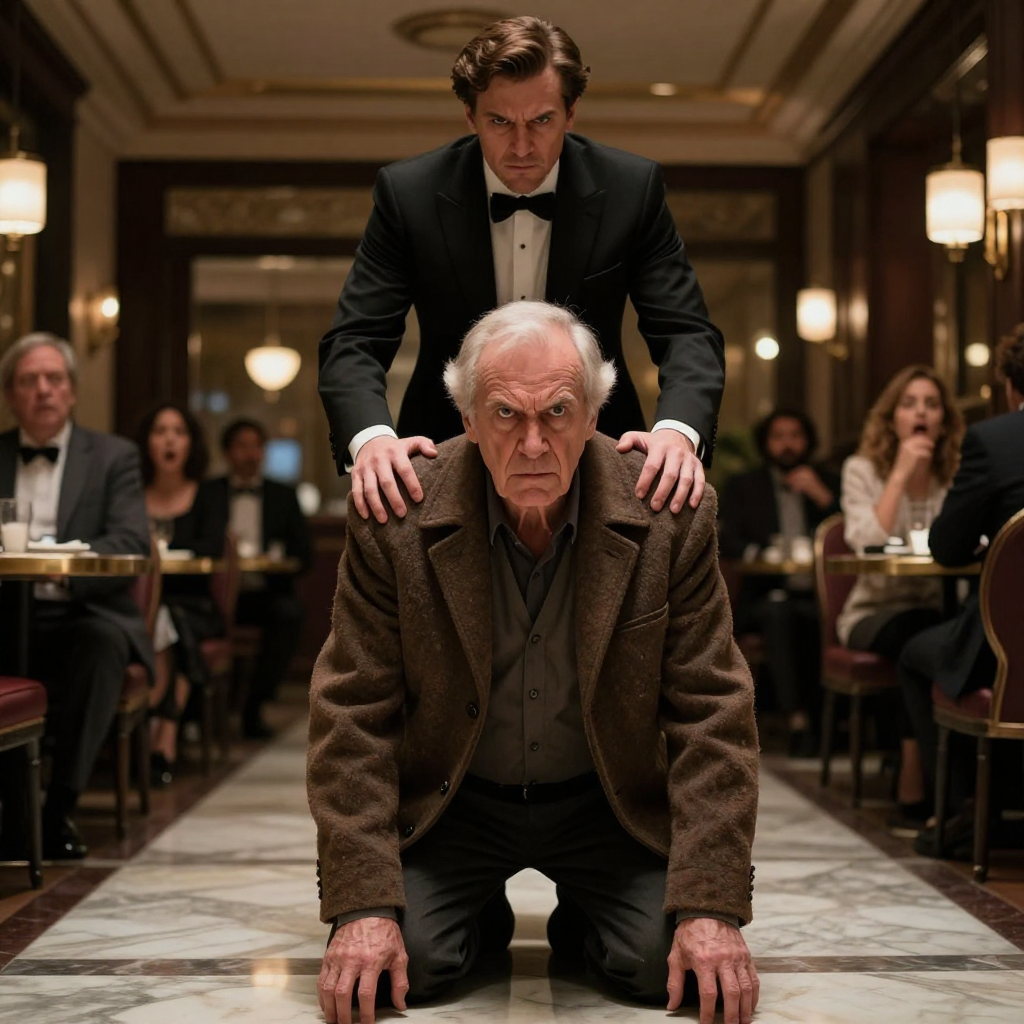
He didn’t wait for me to turn. He grabbed the back of the empty chair next to me—the one I had placed my hand on for support—and yanked it away violently.
The sudden loss of stability sent me stumbling. I wasn’t frail, but the floor was polished marble, and my boots were wet from the rain. My knee hit the ground with a sickening thud. My cane clattered away, sliding under a nearby table occupied by a couple who stared at their plates, refusing to acknowledge the scene.
A gasp finally rippled through the room. A woman in the corner half-rose from her seat, her hand over her mouth, but her male companion pulled her back down, whispering something about not getting involved.
Pain shot up my leg, sharp and hot. But the anger… the anger was colder. It was the cold clarity of judgment.
“Get out of my sight!” Vincent barked, standing over me like a conqueror, his face twisted in disgust. “Before I call the cops and have you thrown in a cell where you belong.”
I stayed on one knee for a moment, breathing through the pain. I looked up at him. I memorized the contempt in his eyes. He didn’t see Justice Elias Thorne, Senior Circuit Judge of the State Supreme Court. He didn’t see the man who had fought for civil liberties since the seventies. He saw trash.
Slowly, painfully, I reached into the inner pocket of my tattered coat. Not for a weapon. For something far more dangerous to a man like Vincent.
“You mentioned the police, Vincent,” I said, my voice steady, betraying none of the pain in my knee. I grabbed the edge of the table and pulled myself up, ignoring the throb in my joint. “I think that’s an excellent idea. Let’s get them here. I have some paperwork they, and you, need to see.”
I didn’t leave. I stood up to my full height. And for the first time, Vincent looked at my eyes, really looked at them, and he saw the glint of the guillotine.
CHAPTER II
I stayed on the floor for a longer moment than I actually needed to. Not because the pain in my knee was unbearable—though it was a sharp, biting heat that radiated up my thigh—but because I wanted to feel the coldness of the floor tiles against my palms. It was a grounding sensation. I needed to remember this exact texture: the smell of expensive floor wax mixed with the faint, cloying scent of truffle oil and the copper tang of my own adrenaline. I looked up at Vincent from the ground. He was standing over me, his face twisted into a mask of smug satisfaction, his hands already reaching for his phone to call the authorities. He looked down at me like I was a spill he was waiting for the janitor to mop up.
“Get up,” he sneered, his voice a low hiss so the other diners wouldn’t hear the full extent of his venom. “You’re making a scene. I told you this wasn’t your place. Now you’ve gone and tripped over your own feet like the drunk you probably are. If you aren’t out of that door in thirty seconds, the police will ensure your next meal is served through a tray slot in a holding cell.”
I didn’t answer him right away. I shifted my weight, feeling the gravelly grind in my kneecap. It was an old injury, a remnant of a car accident a decade ago that usually only flared up in the rain, but now it was screaming. I used the edge of the table—the very table he had denied me—to hoist myself up. My movements were slow, deliberate. I saw a few patrons at the nearby tables looking away, their eyes darting to their plates as if the sight of a struggling old man was a social faux pas they couldn’t quite stomach. That was the most painful part—not the knee, but the practiced indifference of the people I usually called my peers.
Vincent stepped back as I stood, as if my proximity might stain his tailored suit. “I’m calling them now,” he said, tapping at his screen. “You’ve harassed my staff and now you’re trespassing.”
“Actually, Vincent,” I said, my voice finally finding its natural resonance, the deep, measured baritone that had commanded courtrooms for thirty years, “I think you should wait. You’ve made enough mistakes for one afternoon.”
He froze. It wasn’t the words that stopped him; it was the tone. It was the sound of someone who was used to being obeyed. He looked at me again, his eyes narrowing, trying to reconcile the ragged, oversized coat and the stubble on my chin with the authority vibrating in my voice. He laughed, but it was a nervous, high-pitched sound. “What did you just say?”
I reached into the inner lining of my coat. For a split second, I saw fear flash in his eyes—he thought I was reaching for a weapon. He flinched, his shoulders hunching. But I didn’t pull out a knife or a gun. I pulled out a small, leather-bound case and a thick, sealed manila envelope that had been tucked against my chest. I flipped the case open. The gold of the shield caught the overhead light, reflecting a sharp glint into the dimness of the restaurant.
“My name is Elias Thorne,” I said, and for the first time in years, I felt the full weight of that name. “I am a Justice of the Supreme Court. And you, Vincent, are currently in violation of more than just a few civil codes.”
The silence that followed was heavy, almost physical. It was the kind of silence that happens right before a storm breaks. Vincent’s face didn’t just go pale; it turned a sickly, translucent shade of grey. The phone in his hand stayed raised, but his thumb went limp. He stared at the badge, then at my face, searching for the man he’d seen on the evening news or on the front page of the legal journals. It took several seconds for the pieces to click together in his mind. I could see the moment the realization hit him—the way his jaw tightened and his eyes dilated.
“Justice… Thorne?” he whispered. The arrogance was gone, replaced by a frantic, animalistic confusion. “I… I didn’t… You don’t look…”
“I look like a man who wanted to see how you treat people who can’t do anything for you,” I interrupted. I felt a coldness in my chest that I hadn’t felt in a long time. It was a familiar coldness, the one I used when I was handing down a life sentence. “And I’ve seen enough.”
At that moment, the heavy glass doors of ‘The Gilded Spoon’ swung open. Two uniformed officers, Miller and Santoro, stepped in. I knew them; I had seen them in my court a dozen times. They had been dispatched because of Vincent’s earlier call about a ‘vagrant’ causing a disturbance. They scanned the room, their hands resting habitually on their belts, their eyes landing on me and then on Vincent.
Vincent found his voice, though it was thin and reedy. “Officers! Thank god. This man… he’s… he says he’s…”
Officer Miller stepped forward, his eyes widening as he got a clear look at me. He didn’t even look at Vincent. He snapped his heels together slightly, a subconscious gesture of respect. “Justice Thorne? Sir? What’s going on? We got a call about a trespasser.”
“I’m the trespasser, Miller,” I said, gesturing to my clothes. “According to the manager here, I’m ‘bad for business.'”
Santoro looked at Vincent, then back at me, his expression shifting from confusion to a sort of grim realization. He knew what I was doing. Everyone in the legal community knew I was a man of ‘unorthodox methods,’ though usually, those methods stayed within the walls of the courthouse.
I handed the manila envelope to Vincent. He didn’t want to take it. His hands were shaking so hard the paper rattled. “Open it,” I commanded.
He fumbled with the seal. Inside was a court-ordered injunction, signed by the Chief Justice himself, based on the preliminary evidence I had gathered over the last three weeks—the testimonies of the busboys he’d cheated out of wages, the health code violations he’d paid to have overlooked, and the discriminatory practices that were the hallmark of his management. It was an immediate closure notice, pending a full evidentiary hearing.
“This is a mistake,” Vincent stammered, his eyes darting across the legalese on the page. “We can talk about this. I didn’t know it was you. If I had known…”
“That’s the point, isn’t it?” I said, stepping closer. I could smell the sweat on him now, the scent of a man who realized the floor was disappearing beneath his feet. “If you had known I was a Justice, you would have bowed and scraped. You would have given me the best table in the house. But because you thought I was a man with nothing, you thought you could break me. You thought you could trip me and laugh while I fell.”
I looked around the room. The diners were all staring now. Some had their phones out, recording. The secret I had been keeping—my presence here, my investigation—was now public property. By tomorrow, this would be the only thing the city talked about. My reputation as a ‘man of the people’ would be solidified, but at what cost? I felt a sudden, crushing weight in my stomach.
This brought back an old wound, one I had kept buried beneath my robes for decades. My father had been a man like the one I was pretending to be. He was a janitor at a bank, a man who worked sixteen-hour shifts and never complained. One evening, a young executive had accused him of stealing a fountain pen. My father was fired on the spot, humiliated in front of the entire staff. He never recovered his spirit. He spent the rest of his life looking at his feet when he walked. I had spent my entire career trying to avenge that moment, trying to ensure that no one ever felt that small again. But standing here, watching Vincent crumble, I didn’t feel the triumph I expected. I felt a hollow, aching fatigue.
“Officers,” I said, my voice sounding older than I felt. “Please clear the premises. This establishment is closed until further notice.”
Vincent looked like he wanted to cry. “Justice Thorne, please. I have a mortgage. I have a reputation. This will destroy me.”
“You destroyed yourself the moment you pulled that chair away,” I replied.
But as the staff began to emerge from the kitchen—the young waitresses, the dishwashers who relied on their weekly paychecks to feed their families—a moral dilemma began to gnaw at me. By shutting this place down to punish Vincent, I was also punishing them. They were the ones who would lose their livelihoods today. They were the collateral damage of my crusade for ‘ethics.’ Was this justice, or was it just my own ego, disguised as a badge?
I watched a young woman named Clara, a waitress I’d observed earlier, stand by the bar with her hands over her mouth. She looked terrified. She wasn’t the one who had insulted me; she had actually tried to offer me water before Vincent stopped her. Now, because of my ‘sting,’ she was out of a job.
The public nature of the event was irreversible. The news would paint me as a hero, a Justice who went into the trenches to root out corruption. But as I watched the police usher the last of the confused patrons out of the door, I felt like a fraud. I had a secret I hadn’t even admitted to myself: I didn’t do this just for the law. I did it because I was bored. I did it because the high-walled life of a Justice felt like a prison, and I wanted to feel the grit of the real world again. I had used these people—both the villains and the victims—to make myself feel alive.
Vincent was slumped against the mahogany host stand, the closure notice limp in his hand. He looked small. He was a bully, yes, but he was a small man in a large world, and I had just crushed him with the full power of the state.
“Is there anything else, sir?” Officer Miller asked, his tone respectful but curious. He was watching me closely, perhaps sensing the conflict in my eyes.
“No,” I said, looking at my bruised knee. “I think I’ve done enough for today.”
I walked toward the exit, my limp more pronounced now. As I passed Clara, I stopped. I reached into my pocket and pulled out a business card—not my official one, but a private line.
“Call this number on Monday,” I whispered to her. “I’ll make sure the staff is taken care of during the transition.”
She looked at me, her eyes wet with tears. “Why did you have to do it like this?” she asked. It was a simple question, but it hit me harder than Vincent’s trip ever could. “You could have just come in with the papers. Why did you have to wait for him to hurt you?”
I didn’t have an answer. I pushed through the heavy glass doors and stepped out into the bright, unforgiving afternoon sun. The street was already buzzing. A few reporters who monitored the police scanners were arriving, their cameras clicking. I pulled my ragged coat tighter around me, the Justice hiding inside the beggar, wondering if there was any difference between the two anymore.
I had won. The Gilded Spoon was dead. Vincent was a pariah. But as I walked down the sidewalk, ignored once again by the passing crowds who didn’t yet know who I was, I realized that the hardest part of the investigation was just beginning. The legal battle would be easy. The battle with my own conscience, however, was a trial I wasn’t sure I was prepared to win.
I thought about my father again. He wouldn’t have cheered for this. He would have been horrified by the spectacle. He valued quiet dignity, something I had discarded the moment I decided to play this game. I had become the very thing I hated—a man who used his power to orchestrate a drama, regardless of who got caught in the crossfire.
As I reached the corner, I saw my driver, Arthur, waiting in the black sedan a block away. He didn’t come to me; he knew the protocol. I had to walk the distance. Every step was a reminder of the fall. Every step was a reminder that while the law is black and white, the people it governs are a messy, bleeding shade of grey.
I looked back one last time. The police tape was already being stretched across the ornate entrance of the restaurant. ‘CLOSED BY COURT ORDER.’ It looked final. It looked like justice. But as I climbed into the back of the car and let the tinted windows shield me from the world, I knew that the ripples of what I’d done today would grow into a tidal wave that might just take me down with it.
“Home, sir?” Arthur asked softly.
“No,” I said, leaning my head against the cool leather. “Drive. Just drive. I’m not ready to be the Justice yet.”
I closed my eyes and could still feel the tile against my palms. I could still hear the sound of the chair scraping against the floor. I had set a trap, and while the rat was caught, I realized I was still inside the cage with him. The moral high ground I thought I was standing on was nothing more than a heap of broken promises and used intentions. I had my ‘triggering event,’ my public reveal, my irreversible moment. Now, I had to live with the person I had become to achieve it.
CHAPTER III
I sat in my high-backed leather chair, the silence of my judicial chambers feeling heavier than it ever had before. My fingers traced the edge of my mahogany desk. The wood was polished to a mirror shine. It was a stark contrast to the grime that had been embedded under my fingernails only forty-eight hours ago.
The television in the corner was muted, but the ticker tape at the bottom of the screen was a constant crawl of my own name. JUSTICE THORNE: HERO OR HOAX? The images flickered—the Gilded Spoon with yellow police tape across its gilded doors, a grainy cell phone video of me in my rags, standing tall as I handed Vincent the closure notice.
I should have felt triumphant. I had dismantled a den of elitism and cruelty. But the air in the room felt thin. The adrenaline of the confrontation had evaporated, leaving behind a cold, metallic taste of regret. My phone buzzed on the desk. It had been buzzing for six hours. It was my clerk, my colleagues, the Chief Justice. I ignored them all.
There was a knock at my heavy oak door. It wasn’t the polite, rhythmic knock of my secretary. It was erratic. Desperate. I stood up, my joints aching—a physical reminder of the fall Vincent had forced upon me. I opened the door.
Clara was standing there. She wasn’t wearing her crisp waitress uniform anymore. She looked smaller in a faded denim jacket, her hair pulled back in a messy knot. Behind her stood three other staffers from the restaurant—the busboy who had looked away when I was pushed, and two of the line cooks I had never spoken to.
“Your Honor,” Clara said. Her voice didn’t have the warmth it had possessed when she offered me that glass of water. It was brittle.
“Clara,” I said, stepping back to let them in. “I didn’t expect you to find me here.”
“It wasn’t hard,” she replied, her eyes scanning the opulent office, the floor-to-ceiling bookshelves, the velvet drapes. “You’re the man of the hour. Everyone knows where you live now.”
She didn’t sit down. None of them did. They stood in a semi-circle, a silent jury in the room where I usually played judge.
“I did what was necessary,” I began, the words sounding hollow even to me. “The labor violations, the health risks, the way they treated the vulnerable—it had to end.”
“It ended,” Clara whispered. “And so did my rent. And Marcus’s tuition. And Pete’s health insurance.”
She stepped forward, her hands trembling. “You didn’t just fire Vincent, Mr. Thorne. You burned the whole house down while we were still inside. You gave us no warning. No transition. You just… you performed. You made your point, and you walked away into your nice car, leaving us with nothing.”
I looked at Marcus, the busboy. He was barely twenty. He looked terrified. “I will ensure there is a fund,” I said quickly. “I have resources. I can make calls.”
“We don’t want your charity!” one of the cooks snapped. “We wanted our jobs. We wanted the law to work *with* us, not over our heads like a wrecking ball. You used us as props for your big reveal.”
I felt a sharp pang in my chest. My secret—the truth I hadn’t even admitted to myself—started to leak out. I hadn’t done this just for them. I had done it to feel something. To escape the stagnation of my own life. I had used their suffering as a stage for my own redemption arc.
“I’m sorry,” I said. The words felt tiny.
“Sorry doesn’t pay for my daughter’s medicine,” Clara said. She looked at me with a profound, soul-deep disappointment. “You’re just like Vincent, in your own way. You think your vision is the only one that matters. You just wear a more expensive robe.”
They left as quickly as they had arrived. The silence they left behind was louder than the shouting. I slumped back into my chair, my heart hammering against my ribs. I had wanted to be a savior. I was just a ghost in a suit.
An hour later, my internal line rang. It was the one line I couldn’t ignore. The Chief Justice’s office.
“Elias,” the voice was gravelly and stern. It was Chief Justice Sterling. “The Oversight Committee is convening. Room 4B. Now.”
I walked through the marble corridors of the courthouse. Usually, I felt a sense of belonging here. Today, I felt like an intruder. The bailiffs nodded to me, but their eyes lingered too long. They were wondering if I was the man they saw on the news or the man they saw in the halls.
Inside Room 4B, the air was cold. Three members of the disciplinary board sat behind a raised bench. They weren’t looking at me with admiration. They were looking at me with a clinical, detached concern that was far more terrifying.
“Justice Thorne,” Sterling began, leaning forward. “Your actions at the Gilded Spoon were… unorthodox. Some might say heroic. But the ethics of a sitting judge engaging in undercover investigative work without a warrant, without oversight, and using his position to summarily close a business?”
“The violations were clear, Chief,” I said, trying to regain my footing. “I witnessed them firsthand. I was the evidence.”
“You were a vigilante,” Sterling countered. “You bypassed the very system you are sworn to protect. You created a media circus that has compromised three other ongoing investigations into the restaurant’s ownership. Did you think about that, Elias? Or were you too busy playing the martyr?”
I opened my mouth to defend myself, but the door at the back of the room opened. A man in a charcoal suit walked in. He wasn’t a judge. He wasn’t a lawyer I recognized. He carried himself with the quiet, terrifying confidence of true, generational power.
He handed a folder to Sterling. The Chief Justice read it in silence. His face paled.
“This is Mr. Aris Thorne,” Sterling said, his voice dropping an octave. “Of the Thorne-Vanguard Group.”
I froze. The name hit me like a physical blow. Thorne. My father’s name. A name I had spent my life trying to outrun or outshine. But this man wasn’t my father. He was my cousin, Julian, whom I hadn’t seen in twenty years. The ‘black sheep’ who had gone into private equity while I went into the law.
Julian looked at me. There was no warmth in his eyes. Only a mocking sort of pity.
“Elias,” Julian said. “You always did have a flair for the dramatic. Our fathers would be so proud. One lost the family fortune, and the other built a new one on the very ground you just cleared.”
I looked at the folder. It was a property deed.
“What is this?” I asked, my voice shaking.
“Vanguard Holdings owned the land beneath the Gilded Spoon,” Julian explained, speaking to the committee as if I weren’t there. “We’ve been trying to break the lease for three years. The owners were stubborn. They had a legacy clause. The only way to void it was a permanent health and safety closure by a government official.”
He turned to me, a small, cold smile playing on his lips.
“We couldn’t get the city inspectors to do it. They were too slow. Too thorough. But then you showed up. A Supreme Court Justice, making a scene, handing out a closure notice on camera? That’s not just a closure, Elias. That’s a legal nuclear strike. The lease is dead. The owners are bankrupt. And Vanguard begins demolition tomorrow morning for a new luxury high-rise.”
I felt the room tilt. The walls seemed to close in.
“Vincent,” I whispered. “He was…”
“Vincent was a nobody,” Julian dismissed with a wave of his hand. “A middle manager who got too big for his boots. We let him play king of the castle because he kept the books messy enough to hide our tax shields. But he became a liability. We were going to fire him eventually. You just did it for us. And you did it for free.”
I looked at the members of the Oversight Committee. They weren’t angry anymore. They were looking at Julian with a mixture of respect and fear.
“Justice Thorne,” Sterling said, his tone shifting. “Mr. Thorne-Vanguard has expressed that the company will not be pursuing legal action against the state for your… interference. In fact, they are grateful for your ‘public service.'”
“Grateful?” I choked out. “I shut down a criminal enterprise!”
“You cleared the path for a billion-dollar development,” Julian corrected. “You didn’t save those people, Elias. You evicted them. Clara? The cooks? They’re out of work because you wanted to feel like a hero for one night.”
He walked toward me, leaning in so only I could hear him. “You thought you were fighting the ghost of our father’s failure. But you’re just like him, Elias. You’re a tool. He was a tool for his creditors, and you’re a tool for me.”
Julian turned and walked out of the room. The committee members began whispering among themselves. They were already discussing how to ‘frame’ the narrative—how to make my vigilantism look like a calculated, pro-business move to save the court’s reputation.
I stood in the center of the room, the weight of my robes feeling like a lead shroud. I had sought justice, but I had only delivered a profit margin. I had tried to heal an old wound, and instead, I had infected everyone I touched.
I walked out of the hearing room, my legs feeling like they belonged to someone else. The hallway was empty now, the gold leaf on the ceiling glinting in the artificial light.
I reached into my pocket and pulled out the small, crumpled piece of paper Clara had left on my desk. It wasn’t a thank-you note. It was a list of names. The fourteen people who worked the night shift at the Gilded Spoon.
I looked at the names. I didn’t know their last names. I didn’t know their stories. I had treated them like background characters in the movie of my life.
I walked toward the exit, ignoring the security guards who tried to speak to me. I stepped out onto the courthouse steps. The sun was setting, casting long, jagged shadows across the city.
In the distance, I could see the Gilded Spoon. Even from here, I could see the work trucks already arriving. They weren’t there to clean. They were there to tear it down.
I realized then that the ‘Old Wound’ wasn’t about my father at all. It was about my own arrogance. I had spent my life thinking the law was a sword I could wield to fix the world. I never realized that a sword doesn’t care who it cuts.
I reached the bottom of the steps. A reporter saw me and started running over, camera light blinding me.
“Justice Thorne!” she shouted. “A comment on the Vanguard announcement? Are you proud of the urban renewal you’ve sparked?”
I looked into the lens. My face was pale, my eyes hollow. I thought of Clara. I thought of the busboy who was too scared to look me in the eye. I thought of Julian’s smile.
“I have nothing to say,” I whispered.
But the camera didn’t care about my silence. It only cared about the image. The hero justice, standing in the light of the setting sun, while the world he had tried to save crumbled behind him.
I turned away from the light and started walking. I didn’t go to my car. I didn’t go back to my office. I just walked toward the shadows of the city, hoping that somewhere in the darkness, I could find the man I used to be, before I decided that I was the only one who knew what justice looked like.
The realization was a slow-motion car crash in my mind. Every move I had made—every ‘principled’ stand—had been anticipated and weaponized by people far more ruthless than Vincent. I wasn’t the hunter. I was the bird-dog, flushing out the prey for the real predators.
I stopped at a street corner. A group of protesters were already gathering near the restaurant site. Some held signs praising me. Others held signs demanding jobs. They were arguing with each other, their voices rising in the cool evening air.
I was the one who had set them against each other. I was the one who had turned their lives into a headline.
I felt a hand on my shoulder. I flinched, expecting Julian or a reporter.
It was Officer Miller. He looked tired. He wasn’t wearing his hat, and his tie was loose.
“Found out, didn’t you?” he asked quietly.
“You knew?” I asked, my voice cracking.
“We didn’t know it was Vanguard,” Miller said, looking out at the city. “But we knew guys like Vincent don’t own places like that. We knew someone was letting him run wild for a reason. We were trying to build a racketeering case, Justice. Real evidence. Paper trails. We needed another month.”
He looked at me, and for the first time, I saw the true cost of my ego.
“You gave them the perfect exit strategy,” Miller said. “You closed the crime scene before we could search the basement offices. By the time we get a warrant now, there won’t be a basement left. Just a foundation for a condo.”
He didn’t sound angry. He just sounded defeated.
“I thought I was helping,” I said.
“No,” Miller replied, stepping back. “You thought you were winning. There’s a difference.”
He walked away, leaving me alone on the corner. The city lights flickered on, one by one, cold and uncaring. I looked down at my hands. They were clean now. No dirt. No blood. Just the smooth, pale skin of a man who had destroyed everything by trying to be perfect.
CHAPTER IV
The silence was the loudest thing. Louder than the shouting, louder than the gavel, louder even than the gnawing in my gut that had become my constant companion. The news cycle, predictably, had moved on. I was old news. One-day outrage, two-day think pieces, and then… nothing. Except for the workers of The Gilded Spoon. And me.
The news had initially painted me as a hero, a champion of the working class, swiftly punishing injustice. Julian and Vanguard saw to that. But as Clara’s story and the stories of the others started to circulate – whispers at first, then louder, angrier voices online – the narrative shifted. I became the villain. The out-of-touch judge who’d destroyed livelihoods on a whim. Both sides were wrong. I was neither hero nor monster. Just a man who’d made a catastrophic mistake, fueled by ego and a misplaced sense of righteousness.
My colleagues at the courthouse treated me like a leper. Whispers followed me down the halls. The Chief Justice requested a meeting, a tense, formal affair where he ‘suggested’ I take some time off. Paid leave, of course. But the message was clear: stay out of sight. Let the storm pass. Julian, ever the concerned cousin, called frequently. Offering support, advice, and thinly veiled reminders of the ‘good’ Vanguard had done for the city. Each call felt like another turn of the screw. He’d gotten what he wanted. And I’d handed it to him.
Even my mother, usually my staunchest ally, was distant. She didn’t understand. How could she? She saw the headlines, the carefully crafted image of a judge fighting for the little guy. She didn’t see the fear in Clara’s eyes, the desperation in Vincent’s, or the cold calculation in Julian’s. She saw only what she wanted to see. And I couldn’t bring myself to shatter her illusions. Not yet. My phone rang again. Julian. I let it go to voicemail. I couldn’t face him. Not now.
I spent the days holed up in my apartment, the curtains drawn. I couldn’t sleep, couldn’t eat. Just replaying the hearing, Clara’s face, Vincent’s resignation, the sickening realization that I’d been played. My father’s shadow loomed larger than ever, a constant reminder of my failure to live up to his memory. I was supposed to be better than this. Supposed to be just. Instead, I’d become everything I despised. A tool of the powerful, blind to the suffering of the vulnerable.
One afternoon, a package arrived. No return address. Inside was a single newspaper clipping. An article about Vanguard’s latest development project, a luxury condo complex planned for the very site where The Gilded Spoon once stood. Below the article, a single word was scrawled in harsh black ink: ‘Enjoy.’ It was Julian, of course. A final, brutal twist of the knife.
I had to do something. I couldn’t just sit here and let him win. But what? My authority was gone. My reputation ruined. I was just Elias Thorne, a man who’d made a mess of things. But maybe, just maybe, that was enough to start over. To try to fix what I’d broken.
I started small. Anonymously donating to a local food bank that I knew Clara and the others would use. It wasn’t much, but it was a start. Then, I started digging. Going through old case files, revisiting documents related to Vanguard’s previous projects. I needed to understand how Julian operated, who his allies were, and where the bodies were buried.
Days bled into weeks. I barely left my apartment, fueled by coffee and a burning desire to make amends. I found patterns, inconsistencies, and whispers of shady dealings. Vanguard wasn’t just about luxury condos; it was about manipulating zoning laws, exploiting loopholes, and silencing anyone who got in their way.
One name kept popping up: Councilman Weber. A close ally of Julian, and a key player in approving Vanguard’s development projects. I decided to pay him a visit. Not as a judge, but as a concerned citizen. I found him at a local fundraiser, schmoozing with wealthy donors. I approached him, introduced myself, and asked about Vanguard’s plans for The Gilded Spoon site. He brushed me off, dismissing my concerns as ‘unfounded rumors.’ But I saw the flicker of unease in his eyes. He knew something.
I pressed harder, mentioning the names of the displaced workers, the families struggling to make ends meet. Weber’s smile tightened. He excused himself, claiming he had another appointment. As he walked away, I slipped a small, unmarked envelope into his pocket. Inside was a copy of a document I’d found, a memo detailing a secret agreement between Vanguard and the city council, promising Weber a hefty kickback in exchange for his support. I had his attention now.
Leaving the fundraiser, I knew I was playing a dangerous game. Julian wouldn’t take this lying down. But I was past the point of caring about the consequences. I had a responsibility to Clara, to Vincent, to all the people I’d hurt. And I wouldn’t rest until I’d done everything I could to make things right.
My phone rang. An unknown number. I hesitated, then answered.
‘Elias Thorne?’ a gruff voice said. ‘We need to talk.’
It was Officer Miller. He knew about the memo. He’d been watching me. And he had a plan.
Miller explained that he’d been building a case against Vanguard for years, but lacked the evidence to bring them down. My actions, however misguided, had opened a door. Weber, feeling the pressure, was ready to talk. To cut a deal. But he needed protection. And he needed assurance that he wouldn’t be the only one to take the fall.
We met in a deserted parking garage, Miller, Weber, and me. The air was thick with tension. Weber, sweating profusely, confessed everything. The racketeering, the bribery, the manipulation of city officials. He named names, dates, and amounts. Miller recorded everything. It was enough. Enough to bring down Vanguard. Enough to expose Julian’s lies.
The next morning, the headlines were different. ‘Vanguard Holdings Under Investigation.’ ‘City Councilman Admits to Corruption.’ ‘Judge Thorne Cooperates with Authorities.’ The narrative was shifting again. But this time, it felt different. This time, it felt real.
Julian called, his voice a mix of rage and desperation. He accused me of betrayal, of stabbing him in the back. I hung up on him. I was done with his lies. Done with his manipulations. I was finally free.
The investigation dragged on for months. Julian and several other Vanguard executives were arrested. Weber was granted immunity in exchange for his testimony. The Gilded Spoon site was seized by the city, and plans were announced to build affordable housing for the displaced workers and their families.
Clara visited me at my apartment. She didn’t say much. Just thanked me. Her eyes, though still weary, held a glimmer of hope. It wasn’t a perfect ending. The scars remained. But it was a start. A chance for her and the others to rebuild their lives.
I resigned from the bench. My reputation was tarnished, perhaps beyond repair. But I didn’t care. I’d learned a valuable lesson. That justice wasn’t about grand gestures or wielding power. It was about listening to the voices of the vulnerable, about fighting for what’s right, even when it’s difficult, even when it’s painful. And sometimes, it meant sacrificing everything, including your own pride.
Weeks later, I found a new job working at a legal aid clinic, helping low-income families navigate the complexities of the legal system. The pay was terrible, the hours long, and the work often frustrating. But it was honest. And it was meaningful. I was finally using my skills to help people, not to impress them. I was finally becoming the man my father wanted me to be.
One evening, I saw Vincent walking down the street. He looked tired, but he smiled when he saw me. We talked for a few minutes, catching up. He’d found a new job at a local diner. It wasn’t The Gilded Spoon, but it was a start. He told me he was grateful for what I’d done, even though it had cost him his job. He understood that sometimes, the road to justice is paved with unexpected sacrifices.
As we parted ways, he said something that stuck with me. ‘You know, Judge,’ he said, ‘sometimes, the best way to serve justice is to get your hands dirty.’ He was right. And I was finally ready to get my hands dirty.
The public reaction was mixed. Some saw my actions as a heroic redemption, a judge sacrificing his career to right a wrong. Others remained skeptical, viewing it as a cynical attempt to salvage my reputation. But I didn’t let it bother me. I knew the truth. And that was enough.
The New Event came subtly. A small article, buried on page 12 of the Metro section: ‘Affordable Housing Project Stalled.’ Bureaucratic red tape, the article claimed. But I knew better. Julian’s tentacles still reached far and wide, even from behind bars. He was still fighting, still trying to sabotage the project that would give Clara and the others a new home.
I visited Clara, told her what I’d learned. Her face fell. The hope that had begun to bloom in her eyes withered. ‘It’s never going to end, is it?’ she said, her voice heavy with resignation. I shook my head. ‘Not if we let him win,’ I said. ‘Not if we give up.’
We decided to fight back. Not through legal channels, not through political maneuvering, but through grassroots activism. We organized a community meeting, inviting the displaced workers, their families, and anyone else who supported the affordable housing project. We shared our stories, our struggles, and our hopes for the future.
The meeting was a success. Hundreds of people showed up, united in their determination to overcome the bureaucratic obstacles and make the affordable housing project a reality. We formed committees, organized protests, and put pressure on the city council to approve the project.
The fight was long and arduous. We faced setbacks, resistance, and moments of despair. But we never gave up. We knew that we were fighting for something bigger than ourselves. We were fighting for justice, for equality, for a better future for our community.
Finally, after months of tireless effort, we prevailed. The city council approved the affordable housing project. Construction began shortly thereafter. Clara and the others would soon have a place to call home.
The victory was sweet, but it was also bittersweet. Julian’s actions had left a lasting scar on our community. The displaced workers had lost their jobs, their homes, and their sense of security. The affordable housing project was a step in the right direction, but it couldn’t erase the pain and suffering that Julian had caused.
Even as the new homes went up, a sense of unease lingered. Julian still had resources, still had allies. The fight for justice was never truly over. It was a constant battle, a never-ending struggle against the forces of greed and corruption.
One evening, I received a letter. No return address. Inside was a single photograph. A picture of me, standing in front of the legal aid clinic, talking to a client. On the back of the photograph, a single word was scrawled: ‘Soon.’
I knew it was Julian. He was still out there, plotting his revenge. The victory was not complete.
I felt no triumph. Only weariness. Right had been done, but the doing had left everyone diminished. The world had not been set to rights. It had merely been…adjusted. And the adjustment cost.
Clara and Vincent found new lives. The city began to heal. But the scars remained. And so did Julian. Waiting.
CHAPTER V
The brick shattered against the wall of the legal aid clinic, spraying dust and a few pathetic flakes of plaster. I didn’t need to pick up the note taped to it to know what it said. Julian was still there, a shadow clinging to every good thing I tried to build.
My hand trembled as I reached for it anyway. The message was simple, printed in block letters: “You can’t stop what’s coming.”
I crumpled the paper, the cheap pulp tearing easily. Miller was already on his way. He’d been expecting something like this, too. We both knew Julian’s reach extended far beyond prison walls. The affordable housing project was stalled, Councilman Weber citing “unforeseen complications” – a euphemism for another payoff, another backroom deal greased with Vanguard money.
But this wasn’t just about the project. This was personal. Julian was reminding me that he could still touch my life, still make me feel the weight of my mistakes.
I looked at the faces inside the clinic – the weary paralegals, the hopeful clients, the small victories won and lost every day. These were the people I was trying to help, the people I had failed before. I couldn’t fail them again. And I knew, with a bone-deep certainty, that I was the only one who could truly stop Julian, not through legal maneuvers or exposing his network, but by confronting him directly.
I called Miller.
“I need to visit Julian,” I said. “Officially, unofficially, I don’t care. I need to see him.”
He didn’t try to talk me out of it. He knew this was something I had to do.
Visiting Julian in prison was like stepping into a warped reflection of my own life. The sterile gray walls, the echoing clang of metal doors – it all felt suffocatingly familiar, like a judgment I couldn’t escape. Julian sat behind the thick glass, a smug smile playing on his lips.
He looked… good. Too good. Like a man who still held all the cards.
“Elias,” he said, his voice amplified by the intercom. “To what do I owe the pleasure?”
“The housing project,” I said, my voice flat. “Weber. It all stops now.”
Julian chuckled. “You think you can stop me? From in here? You haven’t learned a thing, have you, cousin? This is bigger than you, bigger than both of us.”
“Maybe,” I said. “But it ends with you.”
I didn’t raise my voice. I didn’t threaten him. I just looked him in the eye, let him see the resolve that had hardened within me.
“What are you planning, Elias?” he asked, his smile faltering.
“I’m going to tell the truth,” I said. “Everything. About Vanguard, about Weber, about you. And about me.”
His face darkened. “You wouldn’t.”
“I would,” I said. “And I will. Starting now.”
I walked out of the prison and straight to the office of the Attorney General. I laid it all out – the bribes, the shell corporations, Julian’s network, my own complicity. I didn’t hold back anything. I knew it meant risking everything, including my own freedom. But I was done living a half-life, haunted by secrets and lies.
The Attorney General listened, his expression unreadable. When I was finished, he leaned back in his chair and steepled his fingers.
“Judge Thorne,” he said, using my old title with a hint of irony, “this is a serious accusation. Do you have proof?”
I handed him the documents Miller had helped me gather – the bank statements, the emails, the coded ledgers. It wasn’t everything, but it was enough to start an investigation.
“This will take time,” he said. “And it could get messy.”
“I know,” I said. “I’m ready.”
Days turned into weeks. The investigation dragged on, and the pressure mounted. Julian’s allies fought back, leaking stories to the press, trying to discredit me. Weber resigned, but not before using his influence to further delay the housing project. I was ostracized again, labeled a pariah, a traitor. The whispers followed me everywhere.
I lost clients at the clinic. Some people didn’t want to be associated with the scandal. Others thought I was too busy with my own problems to help them with theirs.
Even Clara seemed distant. She stopped coming to the clinic, stopped returning my calls. I understood. I had let her down before. Why should she trust me now?
One evening, I found her sitting on a bench near the construction site – the stalled construction site. The skeletal frame of the building loomed against the twilight sky, a monument to broken promises.
I sat down beside her, leaving a respectful distance between us.
“Clara,” I said, my voice soft. “I’m sorry.”
She didn’t look at me. “Sorry for what, Judge? For ruining our lives? For pretending to care?”
The anger in her voice was justified. I had earned it.
“I know I messed up,” I said. “I know I hurt you and everyone else. I’m trying to fix it.”
“Fix it?” she said, finally turning to face me. “You can’t fix it. The money’s gone, the jobs are gone, the trust is gone. What’s done is done.”
“Maybe,” I said. “But we can still build something new. Something better.”
She looked at the unfinished building, then back at me. “Why should we trust you, Elias? You’re one of them. Always will be.”
“I’m not,” I said, my voice firm. “I used to be. But not anymore. I’m trying to be different. I’m trying to be… worthy of your trust.”
She studied my face for a long moment, searching for any sign of deceit. I met her gaze, unflinching.
“Prove it,” she said finally. “Prove that you’re not just another rich man playing games.”
Proving it meant putting everything on the line. It meant working day and night, gathering evidence, talking to reporters, lobbying politicians. It meant facing the constant barrage of criticism and doubt. But most of all, it meant listening to the people I had hurt, understanding their needs, and fighting for their rights.
I organized community meetings, bringing together the displaced workers, the small business owners, the families who had been affected by Vanguard’s greed. We formed a coalition, a united front against the forces of corruption.
I reached out to other lawyers, other activists, other people who believed in justice. We shared information, resources, and support. We built a network of resistance.
Slowly, gradually, the tide began to turn. The Attorney General’s investigation gained momentum. More evidence surfaced, more witnesses came forward. Julian’s allies started to crack.
Weber was indicted on bribery charges. Other council members were implicated. Vanguard’s empire began to crumble.
The housing project was revived, with new funding and new leadership. This time, the community was involved in every step of the process, ensuring that the project would truly serve their needs.
Even Clara started to come around. She joined the coalition, lending her voice and her energy to the cause. We worked side by side, fighting for the same goals. The trust wasn’t fully restored, but the bridge was rebuilt, stronger this time, founded on shared struggle, not blind faith.
The final blow came when Julian was charged with racketeering, conspiracy, and fraud. The evidence was overwhelming, and he had no way out. He pleaded guilty, hoping to avoid a lengthy prison sentence. He failed.
He received a long sentence, and this time, there would be no backroom deals, no loopholes, no escapes. He was finally held accountable for his crimes.
The day of the sentencing, I sat in the courtroom, watching as Julian was led away in handcuffs. His eyes met mine for a brief moment, and I saw a flicker of something I hadn’t seen before: fear.
I felt no satisfaction, no triumph. Just a profound sense of sadness. Sadness for what could have been, for the choices we had both made, for the damage that had been done.
I knew that Julian’s fall wouldn’t solve all the problems. Corruption would still exist, greed would still thrive, injustice would still persist. But it was a start. A small victory in a long and ongoing battle.
After the trial, I went back to the legal aid clinic. I continued to work with the poor, the marginalized, the forgotten. I didn’t become a hero, or a savior. I just did what I could, one case at a time.
The affordable housing project was completed. It wasn’t perfect, but it was a start. A place where people could live with dignity, where families could build a future.
Clara became a leader in the community, advocating for better schools, better jobs, better healthcare. She was a force for change, a voice for the voiceless.
We never became close friends, but we became allies. We respected each other, trusted each other, and worked together for the common good.
One day, I was walking past the housing project when I saw Clara standing outside, talking to a group of children. She smiled when she saw me.
“Elias,” she said. “Come meet the future.”
The children gathered around me, their eyes bright with hope. They didn’t know about the past, about the corruption, about the struggles. They only knew that they had a home, a community, a chance.
I smiled back at them, feeling a sense of peace I hadn’t felt in a long time. The fight wasn’t over, but it was worth fighting. And I wasn’t alone.
Justice wasn’t a destination but a continuous struggle, and true redemption lay in embracing the ongoing fight for fairness, not in achieving a perfect victory.
That evening, after work, I sat on the porch of my small apartment, watching the sunset. The sky was ablaze with color, a reminder of the beauty and the chaos of the world.
I thought about my father, about Julian, about Clara, about all the people I had met along the way. I thought about the mistakes I had made, the lessons I had learned, the progress we had achieved.
I knew that the past would always be a part of me, a shadow that I couldn’t escape. But it didn’t have to define me. I could choose to live in the present, to fight for the future, to build a better world, one small step at a time.
I stood up, walked inside, and began preparing dinner, knowing that tomorrow, the struggle would begin again.
END.