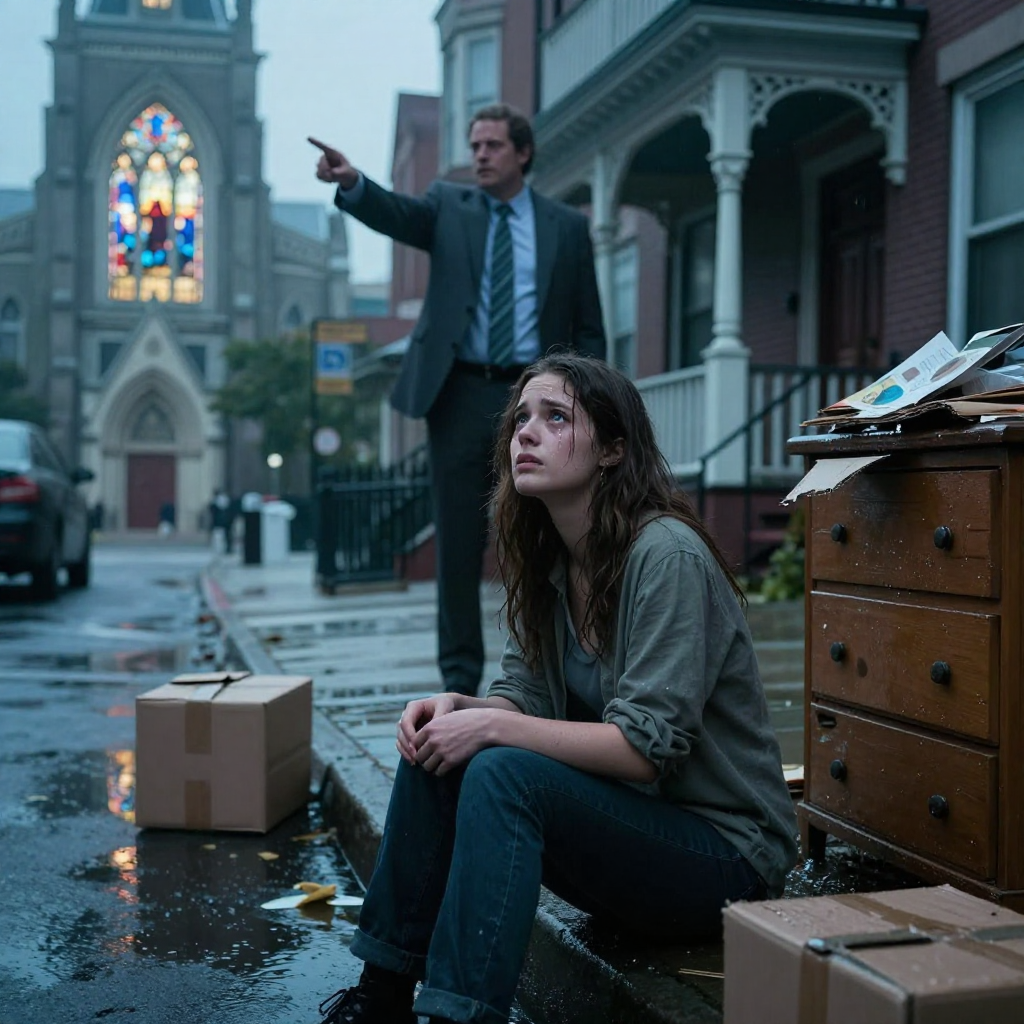
HE SCREAMED THAT HEAVEN HAS NO ROOM FOR PARASITES WHILE TOSSING MY MOTHER’S URN ONTO THE WET PAVEMENT. Mr. Henderson stood on the porch in his pressed Sunday suit, pointing a trembling finger at me as the neighbors watched in silence, his voice booming that poverty is a sin of the spirit. I had nowhere to go, just a sidewalk of shattered memories and the cold stare of the church across the road, until a six-year-old boy stepped through the crowd and placed a heavy iron key in my shaking hand.
The sound of cheap pine splintering against the asphalt was the only thing louder than Mr. Henderson’s voice. It was my dresser—the one I’d sanded and painted by hand when I first moved in three years ago—now lying face down in a puddle of dirty rainwater. The bottom drawer had popped open, spilling my folded winter sweaters into the oil-slicked gutter.
“The Lord provides for those who till the soil!” Henderson bellowed from the top of the porch steps. He wasn’t just evicting me; he was performing. He stood there in his three-piece charcoal suit, the one he wore to pass the collection plate every Sunday at Grace Community across the street. His face was flushed a deep, terrifying crimson, veins bulging in his neck like frantic worms.
“Please,” I whispered, though the word barely made it past the lump in my throat. I was kneeling on the sidewalk, scrambling to gather a box of paperwork before the wind took it. “Mr. Henderson, I start the new shift on Monday. I told you. The deposit is coming.”
“Monday!” He spat the word out like it was a curse. He descended one step, gripping the railing with a hand that looked like a claw. “You’ve had a month of Mondays, Elena. You think I don’t know sloth when I see it? You think I don’t recognize a spirit that refuses to labor?”
It wasn’t sloth. It was two bouts of pneumonia and a layoff that had decimated the factory where I’d worked for five years. It was the choice between antibiotics or rent, between keeping the heat on or filling the gas tank to get to interviews. But you cannot explain the math of survival to a man who believes wealth is a direct receipt of God’s favor.
He kicked a cardboard box toward the edge of the stairs. It tumbled end over end, bursting open at the bottom. My kitchen utensils clattered onto the concrete—a soup ladle, a spatula, a dull can opener spinning noisily into the street.
“Get your refuse off my property,” he hissed, his voice dropping to a low, dangerous rumble that carried more threat than his shouting. “I have a decent, God-fearing couple moving in tomorrow. People who understand obligation.”
The neighborhood was watching. Of course they were. I could feel the eyes behind the lace curtains of the duplex next door. Mrs. Gable, who I’d shared tea with, was nowhere to be seen. The young couple two doors down, the ones whose packages I signed for, had suddenly found something very interesting to look at in their own backyard. Poverty is contagious, you see. If they looked at me too long, maybe they’d catch it. Maybe they’d realize how thin the ice was beneath their own feet.
I stood up, my knees shaking. The rain had started as a mist but was turning into a steady, freezing drizzle. I grabbed a plastic tote bag, stuffing my wet clothes inside. My hands were numb, clumsy.
“You call yourself a Christian?” The words left my mouth before I could stop them. It was a mistake. I knew it instantly.
Henderson froze. The air on the porch seemed to suck tight, a vacuum of sudden silence. He walked down the remaining stairs slowly, deliberately, until he was standing just inches from me on the sidewalk. He smelled of old paper and peppermint lozenges—the smell of the church lobby.
“Do not,” he said softly, leaning in, “blaspheme in your ruin. The Bible says if a man will not work, he shall not eat. You are reaping the harvest of your own idleness. Don’t look for charity here. God doesn’t help the lazy, and neither do I.”
He turned his back on me. “You have one hour to clear this trash before I call the city to haul it away.”
He marched back up the stairs, slammed the heavy oak door, and slid the deadbolt home. The sound echoed like a gunshot.
I was alone. Truly, physically alone in a way that feels like drowning. I looked across the street at the church. It was a beautiful building, red brick with white pillars, a sign out front that read *ALL ARE WELCOME*. Henderson was the head Deacon there. He owned this row of houses. He sat in the front pew. I had sat a few rows behind him for two years, listening to sermons about mercy, about the widow’s mite, about the stranger at the gate.
I looked at the locked doors of the sanctuary. The lights were off. It was Tuesday. God wasn’t in office on Tuesdays.
I sat down on the curb, the damp soaking through my jeans. I pulled my knees to my chest and buried my face in my arms. I didn’t have a car to sleep in—I’d sold it last month to pay the previous month’s rent. I didn’t have family; my mother passed three years ago, leaving me nothing but the urn Henderson had just nearly smashed. I had $42 in my pocket and a pile of wet belongings that represented thirty years of life on this earth.
The bitterness rose in my chest, hot and acidic. I wanted to scream. I wanted to throw a brick through the stained-glass window of that church. I wanted to burn the world down because it felt like the world had already decided I was kindling.
I squeezed my eyes shut, trying to block out the image of Henderson’s sneering face. I tried to pray, but the words felt like ash. *God, if you’re real,* I thought, *why is your servant such a monster?*
I heard footsteps. Small, scuffing sounds on the pavement. Puddles splashing.
I didn’t look up. I couldn’t bear for another neighbor to come offer me a useless platitude, to tell me “everything happens for a reason” while they went back to their warm living rooms. I just wanted to disappear.
“Excuse me?”
The voice was high, tentative. A child’s voice.
I wiped my eyes with my wet sleeve and looked up. Standing in front of me, holding a bright yellow umbrella that was far too big for him, was a boy. He couldn’t have been more than six or seven. He was wearing a backpack that looked heavy, and his sneakers were untied.
I recognized him vaguely. He was always playing near the church steps on afternoons, kicking a soccer ball against the brickwork until the sexton chased him off. I didn’t know his name.
“Are you okay, lady?” he asked. His eyes were wide, brown, and serious.
I tried to smile, but my face crumbled. “I’m having a bad day, sweetie. You should go home. It’s raining.”
He didn’t move. He looked at the pile of my things—the broken dresser, the wet clothes, the boxes melting in the rain. Then he looked up at Henderson’s house, then back at me. He seemed to be doing a calculation in his head, processing the scene with a gravity that didn’t belong to a first-grader.
“Did Mr. Henderson yell at you?” he asked.
I nodded, fresh tears spilling over. “Yeah. He did.”
The boy frowned. He looked around to make sure no one was watching. The street was empty now; the show was over.
He stepped closer, tilting the umbrella so it covered me, leaving his own shoulder exposed to the drizzle. He reached into the pocket of his jeans. His hand was small, stained with markers from school.
“My dad says Mr. Henderson forgets what the book says sometimes,” the boy whispered. He pulled his hand out. He was making a fist.
“Your dad?” I asked, confused.
“He takes care of the building,” he said, pointing a thumb over his shoulder at the church. “The janitor.”
The boy took my hand. His fingers were warm. He turned my palm over and dropped something into it. It was heavy, cold, and metallic.
I looked down. It was a key. An old-fashioned iron key, not a modern house key. It looked like it opened something heavy, something important.
“What is this?” I breathed.
“The basement door around the back,” he said, his voice dropping to a conspiratorial whisper. “It’s warm down there. There’s a couch in the youth room. And a fridge.”
I stared at him. “You could get in trouble. Your dad…”
“Dad’s not there right now,” he said fast. “But he left his keys on the hook. He won’t know until tonight. You can dry your stuff.”
He looked up at Henderson’s house again, and for a second, I saw a flash of defiance in his little face that mirrored the rage burning in my own heart. But his was cleaner, purer.
“God helps everybody,” he said firmly, correcting the man who had just destroyed my life. “Even if they’re sad. Especially if they’re sad.”
I closed my fingers around the key. The metal bit into my skin, grounding me. For the first time in hours, the shaking in my hands stopped. I looked at the boy, really looked at him, and saw not just a child, but a lifeline thrown from the deck of a sinking ship.
“Thank you,” I choked out.
He shrugged, adjusting his backpack. “Just don’t turn on the big lights. Use the lamps.”
He turned and ran off down the sidewalk, his yellow umbrella bobbing like a buoy in the grey storm. I sat there for a moment longer, clutching the key. The rain was still falling, but I didn’t feel it anymore. I stood up, grabbed the box with my mother’s urn, and looked at the church one last time. Not as a fortress of judgment, but as a place with a back door.
I began to gather my things. I wasn’t just a victim anymore. I had a key.
CHAPTER II
The key felt like a shard of ice in my palm, though it was the only thing keeping me from freezing. My fingers were so stiff that I had to use both hands to turn the lock of the side door. It gave way with a heavy, metallic groan that seemed to echo across the empty street, a sound that felt like a scream in the silence of the rain. I slipped inside, closing the door behind me, and for a moment, the world simply ceased to exist. The roar of the downpour was replaced by a silence so thick it felt like wool against my ears. It was a cathedral of stillness, smelling of floor wax, old hymnals, and the faint, lingering scent of extinguished beeswax. My breath came in ragged, shallow gasps, visible in the dim light filtering through the stained glass windows. I was a ghost haunting a holy place, a trespasser in the house of a God who had, through the mouth of Mr. Henderson, just cast me out into the dirt.
I didn’t head for the pews. I knew the sanctuary was too exposed, too grand for a woman who felt as small as I did. I followed the boy’s instructions, finding the narrow wooden door that led to the basement. The stairs creaked under my weight, each protest of the wood sounding like a judgment. Below, the air was cooler, damp with the smell of earth and neglected history. This was where the church kept its secrets: broken chairs, boxes of moth-eaten choir robes, and stacks of dusty ledgers from decades past. I found a corner behind a row of industrial-sized water heaters. It was warm there, the hum of the machinery providing a low, vibrating comfort that felt almost like a heartbeat. I sank onto a pile of discarded velvet curtains, my body finally surrendering to the exhaustion that had been clawing at me for hours. My joints ached with a dull, throbbing intensity—a reminder of the illness that had stolen my career long before Henderson stole my home.
As I lay there, the darkness forced me to confront the old wound I had spent a year trying to cauterize. It wasn’t just the eviction that burned; it was the history of how I got here. Three years ago, I was a senior bookkeeper at a firm where Henderson served as a board member. I had been the one to find the discrepancies in the community outreach funds—small amounts at first, then larger, redirected into ‘consulting fees’ for shell companies. I hadn’t been a hero; I had been a professional. I took the files to him, believing the Deacon was the man the pulpit claimed he was. I remember the way he had looked at me then—not with fear, but with a terrifying, paternal pity. Two weeks later, my health began to fail, the chronic fatigue and joint pain making 60-hour weeks impossible. Henderson was the one who suggested the ‘compassionate layoff.’ He had promised I would be taken care of. He had even helped me find the apartment he owned, calling it a gesture of Christian charity. It wasn’t charity; it was a cage. He had moved me into his own property to keep me quiet, to keep me under his thumb, and when my savings finally ran dry and I was no longer a threat to his reputation, he had simply opened the cage and kicked me into the cold. The betrayal was a jagged thing, a piece of shrapnel still lodged in my chest, moving every time I breathed.
I must have drifted into a feverish sleep, because the next thing I knew, the basement lights flickered on with a harsh, buzzing hum. I pressed myself deeper into the velvet, my heart hammering against my ribs. Footsteps approached—heavy, rhythmic, the sound of someone who owned the space they walked in. It wasn’t Henderson’s sharp, polished stride. These were the dragging steps of a tired man. I saw a pair of worn work boots stop just feet from my hiding place. A broom leaned against the water heater, and then a heavy sigh broke the silence. I held my breath until my lungs burned, but a sudden, sharp cough—the one I had been suppressing for hours—erupted from me. The footsteps stopped. The broom clattered to the floor.
“I know you’re back there,” a voice said. It was deep, weary, and lacked the performative authority of the men upstairs. “My son doesn’t know how to keep a secret, and he certainly doesn’t know how to hide a key.”
I crawled out from behind the heater, trembling, my wet hair clinging to my face like seaweed. The man standing there was Silas, the church janitor. He looked older than he had from a distance, his face etched with the lines of a man who had spent his life cleaning up other people’s messes. He held a flashlight, but he didn’t aim it at my eyes. He aimed it at the floor between us. We stood there in a tense standoff, the hum of the furnace filling the gap between us. I expected him to shout, to call the police, or to drag me back out to the rain where Henderson’s men had left me. Instead, he reached into his pocket and pulled out a small, crumpled sandwich bag.
“Leo told me what happened,” Silas said quietly, his voice barely above a whisper. “He’s got too much of his mother in him. Doesn’t understand the rules of this place. You shouldn’t be here, Elena. If Henderson finds out, I lose this job. If I lose this job, we’re on the street right next to you.”
“I have nowhere else to go,” I whispered, my voice cracking. “Please. Just for tonight. I’ll be gone before the sun comes up.”
Silas looked at me, and for the first time, I saw the secret he was carrying. It wasn’t just fear; it was a deep, simmering resentment that mirrored my own. He stepped closer, his voice dropping even lower. “Henderson isn’t just a Deacon, Elena. He’s the one who signs the checks for the new development project. The one that’s going to turn this whole block into luxury lofts. My housing is tied to this building. He’s been ‘clearing the brush,’ he calls it. You were just the first to go because you knew too much about where the initial seed money came from. I’ve seen the ledgers he leaves in the vestry. I know what he’s doing.”
This was the moral dilemma that bound us together. Silas was a man of quiet faith and loud necessity. He was protecting his son’s future by enabling a man he knew to be a wolf. If he helped me, he risked everything. If he turned me in, he became the very thing he hated. He looked at the sandwich bag in his hand, then at me. He handed it over. It was a peanut butter sandwich, half-crushed. “Eat,” he commanded. “Then we need to figure out how to get you out of here before the 6 AM committee meeting.”
But the universe has a way of collapsing when you are at your most vulnerable. Above us, the heavy front doors of the church slammed open. We both froze. The sound of voices echoed down the stairs—loud, boisterous, and chillingly familiar. Henderson was back, and he wasn’t alone. I heard the distinct, sharp voice of a woman—Councilwoman Sarah Vance—and another man I didn’t recognize. They were laughing.
“The basement is the key to the whole structural expansion,” Henderson was saying, his voice booming with that practiced, pulpit resonance. “If we can reinforce the foundation here, the loft conversion will be seamless. It’s about stewardship, Sarah. Taking what is old and making it profitable for the kingdom.”
Silas’s face went pale. He grabbed my arm, his grip frantic, and tried to pull me toward a small crawlspace behind the old choir robes, but it was too late. The basement door swung open. Henderson led the way down, his expensive leather shoes clicking on the concrete. He was mid-sentence, gesturing with a gold-ringed hand toward the very water heater I had been hiding behind. He stopped dead. The Councilwoman and the developer piled in behind him, their eyes widening as they took in the scene: the disheveled, soaking wet woman standing in the center of the room, and the church janitor holding her arm in what looked like a desperate embrace.
This was the public, irreversible moment. There was no hiding now. The silence that followed was more violent than the storm outside. Henderson’s face didn’t crumble into guilt; it hardened into a mask of righteous fury. He looked at Silas, then at me, and I saw the calculation in his eyes. He wasn’t just caught; he was presented with an opportunity to destroy two threats at once.
“Silas?” Henderson said, his voice dropping to a terrifyingly calm register. “I thought I told you we were to have a private walkthrough of the facilities. And I certainly don’t recall authorizing the basement as a sanctuary for… trespassers.”
“She was freezing, Mr. Henderson,” Silas said, his voice trembling but holding its ground. “The boy found her. I couldn’t just—”
“The boy?” Henderson interrupted, a thin, cruel smile touching his lips. He turned to Councilwoman Vance, who looked deeply uncomfortable. “You see the challenges we face, Sarah. Even our most trusted staff fall prey to the manipulations of those who refuse to help themselves. This woman was evicted for non-payment and, quite frankly, for being a disruptive influence on the community. And now, she has coerced a simple man into violating the sanctity of this church.”
“I didn’t coerce anyone,” I said, stepping forward, my legs shaking so badly I had to lean against the cold metal of the heater. “You know exactly why I’m here, Arthur. And you know exactly what’s in those ledgers upstairs.”
The air in the room curdled. The Councilwoman looked from Henderson to me, her political instincts warring with the obvious drama unfolding. Henderson didn’t flinch. He took a step toward me, his presence suffocating.
“You are sick, Elena,” he said, his voice dripping with mock sympathy. “Your mind is as frail as your body. Silas, I’m afraid this is a breach of contract. A security violation of the highest order. I’ll need your keys. Now.”
Silas looked at me, a look of profound, soul-crushing defeat. He looked at the stairs, where his young son, Leo, was now standing, peering through the banisters with wide, terrified eyes. The boy had seen everything. He had seen his father’s kindness lead to his father’s ruin. The trigger had been pulled. The social contract of the church, the secret alliance of the oppressed, and the carefully maintained facade of the Deacon had all collided in this damp, dark room. There was no going back to the way things were. As Silas slowly reached for the heavy brass ring of keys at his belt, I realized that my presence here hadn’t just been a search for shelter—it had been the catalyst for a total collapse. The moral dilemma had been resolved in the worst possible way, and as Henderson turned back to the Councilwoman to continue his tour as if we were nothing more than debris to be cleared, I knew that the fire I had tried to survive was now going to burn everyone I had touched.
CHAPTER III
The silence that followed Henderson’s departure was louder than his shouting had been. It was the sound of a structural collapse. Silas stood in the center of the basement, his shoulders hunched, his hands hanging uselessly at his sides. He had been the ghost of this church for twenty years, the man who fixed the leaks and swept the dust, and in ten seconds of Henderson’s vitriol, he had been erased. Councilwoman Vance had followed the Deacon out, her face a mask of professional neutrality that couldn’t quite hide her distaste. The developer, a man whose name I never learned but whose suit cost more than my annual pension, lingered for a second, looking at me as if I were a smudge on a window he intended to replace. Then, they were gone. The heavy door at the top of the stairs clicked shut.
Leo moved first. He didn’t go to his father. He went to the corner where my few belongings were huddled. He picked up my sweater and brought it to me. His eyes were too wide, too bright. He was seeing the world break in real-time. Silas finally turned. He didn’t look angry. He looked hollow. He looked at me, and for a moment, I expected him to tell me to leave, to blame me for the roof over his head being stripped away. Instead, he sat down on a crate and put his head in his hands. He told me then that Henderson had already threatened him. The luxury development wasn’t just a business deal; it was a cleansing. They wanted the land the church sat on, and they wanted the people who lived in the shadow of the steeple gone. Silas knew because he had seen the blueprints in the trash. He had seen the names of the local families whose leases were being ‘terminated for cause.’
I felt a strange, cold clarity. My illness usually made my head feel like it was filled with wet wool, but the adrenaline was burning the fog away. I told Silas we couldn’t just sit here. If he was fired, he had nothing left to lose. I reminded him of the ledger I had seen years ago, the one Henderson had used to hide the ‘administrative fees’ he was siphoning from the community outreach fund. Silas looked up, his eyes bloodshot. He told me the physical archives hadn’t been moved. They were stored in the vault behind the vestry, a room no one entered because it smelled of rot and damp paper. Henderson thought he was safe because he’d digitized the ‘clean’ records, but the old books—the ones with the actual signatures and the mismatched totals—were still there, waiting for the incinerator that was scheduled for next week.
We moved through the church like thieves. My lungs were burning, a sharp, rhythmic stabbing with every breath, but I didn’t stop. Silas led the way with his master key—the one he was supposed to hand over by morning. We bypassed the sanctuary and slipped into the narrow hallway that led to the archives. The air here was colder, smelling of limestone and ancient dust. Every creak of the floorboards sounded like a gunshot. Leo followed behind us, silent as a shadow. He was holding something under his jacket, his arm pressed tight against his ribs, but I was too focused on the vault door to ask what it was.
Silas fumbled with the keys. His hands were shaking. I put my hand over his to steady them. We were two broken people trying to stop a wrecking ball. The lock turned with a heavy, metallic thud. Inside, the room was a tomb of cardboard boxes and filing cabinets. I knew what I was looking for. I had spent ten years as a bookkeeper for this man. I knew how he coded his thefts. We tore into the boxes. I ignored the pain in my joints as I knelt on the hard floor. It took an hour. The light from Silas’s flashlight danced over names of people I knew, people who had donated their last dollars to a roof fund that had actually gone toward Henderson’s vacation home in the hills. And then, I found it. The 2018 ledger. It was a heavy, leather-bound book that felt like lead in my hands. I flipped to the back. There it was. The ‘Grace Project’ entries. Millions of dollars diverted into a shell company owned by the developer I had just seen upstairs.
We didn’t have time to celebrate. The church bells began to chime. It was 7:00 PM. The public hearing for the development project was starting in the main sanctuary. Henderson was a man of theater; he wanted the community to witness the ‘blessing’ of the new project to stifle any dissent. We could hear the murmur of the crowd growing, the sound of footsteps on the floorboards above us. We were trapped in the basement of our own story, holding the truth while the lie was being narrated overhead. Silas looked at the ledger, then at me. He told me that if we walked up there, Henderson would destroy us. He would call the police. He would say we stole it. He would use my history of illness and Silas’s ‘insubordination’ to bury the evidence before anyone could read a single page.
That was when Leo stepped forward. He pulled a thick, red folder from under his jacket. He didn’t look like a child anymore; he looked like a witness. He told us that when Henderson was shouting at his father earlier, he had slipped into the Deacon’s temporary office in the vestry. He had seen the folder on the desk, the one marked ‘Strictly Confidential – Vance.’ He had taken it because he wanted to hurt Henderson back. I opened the folder. My breath hitched. It wasn’t just financial records. It was correspondence. Emails and handwritten notes between Henderson and Councilwoman Sarah Vance. It detailed the kickbacks. It showed exactly how much Vance was being paid to approve the rezoning. It wasn’t just a corporate crime; it was a political execution of the neighborhood.
We didn’t wait. We couldn’t. I took the ledger, and Silas took the folder. We walked out of the archives and toward the back entrance of the sanctuary. My heart was thumping against my ribs like a trapped bird. The double doors were propped open to let in the breeze, but the air inside was thick with the scent of lilies and expensive cologne. Henderson was standing at the pulpit, his voice booming, filled with the practiced cadence of a man who believed he was untouchable. He was talking about ‘renewal’ and ‘sacrifice.’ He was telling the congregation that the old buildings had to fall so the community could rise. Councilwoman Vance sat behind him, nodding with a serene, practiced smile.
I didn’t realize I was walking down the center aisle until the heads started to turn. I was a sight—my hair was matted with basement dust, my clothes were wrinkled, and my face was gaunt from the sickness. I looked like the very thing Henderson wanted to erase. Behind me, Silas walked with a grim, steady pace, and Leo followed, his eyes fixed on the floor. The murmuring started low, a ripple of confusion that grew into a wave of silence as I reached the front. Henderson stopped mid-sentence. His face turned a shade of purple I had never seen before. He tried to laugh it off, turning to the crowd with a wide, fake grin, calling me a ‘confused soul’ who needed prayer.
I didn’t shout. I didn’t have the breath for it. I reached the edge of the pulpit and laid the 2018 ledger down on the wood. The sound it made was final. I looked at Sarah Vance, not Henderson. I told her, my voice thin but clear, that I had found the records she thought were destroyed. I told her that the Grace Project was a fraud. The crowd gasped. Someone in the back stood up. Henderson moved toward me, his hand outstretched, his voice dropping into a low, dangerous hiss, telling me to step away before things got ‘unpleasant.’ He signaled for the security guard at the door.
But Silas stepped in front of me. He didn’t raise his hands, but he stood like a wall. He handed the red folder directly to a reporter from the local paper who was sitting in the front row. He didn’t give it to Henderson. He didn’t give it to the police. He gave it to the world. Sarah Vance’s face went white. She saw the folder. She recognized the handwriting. The power in the room shifted so violently it felt like the floor was tilting. The developer stood up, looking for an exit, but the aisles were packed with people who were starting to realize they had been robbed.
Suddenly, the side doors opened. It wasn’t more security. It was the District Attorney’s office investigators, accompanied by several uniformed officers. They hadn’t come because of us; they had been monitoring the developer for months on an unrelated racketeering charge. But as they entered the sanctuary, Councilwoman Vance did something I didn’t expect. She didn’t defend Henderson. She stood up, pointed a trembling finger at the Deacon, and shouted that he had coerced her. In an instant, the institution turned on itself. The authority that had been crushing us for years crumbled into a frantic scramble for self-preservation.
Henderson wasn’t a giant anymore. He was a man being led away in handcuffs while his own congregation watched in a horrifying, beautiful silence. He looked at me as he passed, his eyes full of a concentrated, impotent hatred. I didn’t feel triumph. I felt an overwhelming, crushing exhaustion. The truth had come out, but the cost was etched into Silas’s face. He had saved the community, but he was still a man without a job, standing in a church that was now a crime scene. Leo took my hand. His grip was tight. We walked out of the sanctuary together, leaving the chaos behind. The night air was cold and sweet. My lungs still hurt, and I knew that tomorrow, the landlord would still be gone, and I would still be homeless. But as I looked at the stars, I realized that for the first time in years, the weight on my chest wasn’t just the illness. It was the lightness of being finished. We had broken the world to save our souls, and now we had to figure out how to live in the ruins.
CHAPTER IV
The silence afterward was the worst. Not the absence of sound, but the heavy, expectant silence that settled over everything once the shouting stopped and the cameras went away. The kind of silence that felt like judgment, even when you knew you’d done the right thing.
The news vans had packed up by late afternoon, their satellite dishes retracting like startled snails. The reporters, buzzing with manufactured concern and practiced empathy, had moved on to the next scandal, the next tragedy, the next fleeting moment of manufactured outrage. They’d gotten their sound bites, their dramatic visuals of Henderson being led away in handcuffs, Vance sputtering denials that no one believed. They’d even managed a tearful interview with Silas, playing up the single-dad angle, and a stoic one with me, focusing on the ‘brave whistleblower’ narrative. But when the lights were gone, we were left with the wreckage.
My eviction notice was still taped to the basement door. Silas’s toolbox sat abandoned by the church entrance, a stark reminder of his unemployment. Leo, bless his heart, was trying to be cheerful, but I saw the worry etched on his young face, the way he clung to Silas’s hand a little tighter than usual. He understood more than he let on, that kid.
The immediate aftermath played out like a bizarre, disjointed movie. The remaining church council members, scrambling to distance themselves from Henderson and Vance, announced an ‘independent investigation’ and promised full transparency. Ironic, considering how opaque they’d been before. Donations, predictably, plummeted. Attendance at Sunday service dwindled. The air in the sanctuary felt stale, tainted.
Then came the online onslaught. Comment sections became battlegrounds. Some lauded us as heroes, praising our courage in exposing corruption. Others vilified us as troublemakers, accusing us of destroying the church, of airing dirty laundry in public. A few, the truly unhinged ones, sent threats. Silas tried to shield Leo from it, monitoring his internet access, but you can’t protect a kid from everything. Especially not in this world.
Personally, I felt numb. The adrenaline that had fueled our confrontation had evaporated, leaving behind a hollow ache. My body throbbed with a familiar, unwelcome fatigue. The coughing fits returned with renewed vigor, each one a harsh reminder of my own mortality. The truth was, I was tired. Bone-tired. Tired of fighting, tired of being sick, tired of being alone. I just wanted a warm bed and a quiet place to read.
Silas wasn’t doing much better. He spent the first few days pacing, his restless energy finding no outlet. He applied for every janitorial job in the county, his hopes rising with each application, only to be dashed by rejection after rejection. Henderson’s shadow loomed large, even from behind bars. Nobody wanted to hire the guy who’d brought down the church. It was a liability. A risk.
One evening, I found him sitting on the steps of the church, staring at the darkened sanctuary. Leo was inside, doing his homework, but Silas looked utterly defeated.
“It was all for nothing, Elena,” he said, his voice flat. “I lost my job. We’re still stuck in the basement. What did we even accomplish?”
I sat down beside him, the cold stone seeping into my bones.
“We exposed the truth, Silas,” I said quietly. “That’s not nothing. And we showed Leo that some things are worth fighting for, even when the odds are stacked against you.”
He didn’t respond, just kept staring at the church. I knew he was thinking about Leo, about providing for him, about the crushing weight of responsibility.
That’s when the first real consequence hit. Not a public one, not a headline, but something far more personal. Leo started acting out. Small things, at first. Talking back, skipping chores, a general air of defiance. Then it escalated. He started hanging out with a rougher crowd, kids who smoked and swore and talked about things no ten-year-old should be exposed to.
Silas was at his wit’s end. He tried everything – grounding, lectures, even a tearful plea. But Leo just pushed back harder. One night, he came home late, smelling of cigarettes. Silas blew up. They argued, harsh words echoing through the basement. I tried to intervene, but they both turned on me, their anger a tangible force.
“Stay out of it, Elena!” Silas yelled.
“Yeah, stay out of it,” Leo echoed, his eyes flashing with resentment. “You’re not our family.”
The words stung, sharper than I expected. I retreated to my corner, feeling the familiar sting of loneliness. I wasn’t their family. I was just a temporary lodger, a charity case, a reminder of their misfortune.
The next day, Silas came to me, his face etched with exhaustion.
“I don’t know what to do, Elena,” he confessed. “I’m losing him. I can’t reach him.”
I hesitated, then said, “Maybe he needs a male role model. Someone who isn’t…broken.”
Silas flinched, as if I’d slapped him.
“What are you saying?”
“Maybe he needs his grandfather,” I said softly. “Have you considered reaching out to your father?”
Silas’s face hardened. “No. Never. That man is…toxic. He’ll ruin Leo.”
“But what if he’s the only one who can save him?” I countered. “What if Leo needs to understand where he comes from, even the parts that are ugly?”
He didn’t answer, just stormed out of the basement. I knew I’d crossed a line, but I couldn’t shake the feeling that I was right. Leo was adrift, searching for something solid to cling to. And sometimes, the only way to find solid ground is to confront the quicksand in your own past.
Meanwhile, the legal wheels were turning, albeit slowly. Henderson, out on bail, was holed up in his mansion, issuing denials through his lawyer. Vance, having cut a deal with the prosecution, was cooperating with the investigation, throwing Henderson under the bus with gusto. The development project was officially dead, but the land remained a vacant lot, a monument to greed and corruption.
The church, reeling from the scandal, was struggling to regain its footing. A new deacon was appointed, a bland, cautious man whose primary goal was to avoid controversy. He offered Silas his old job back, but Silas refused.
“I can’t work here anymore,” he told me. “It’s too tainted. Too many bad memories.”
I understood. The church, once a sanctuary, had become a symbol of betrayal.
Then came the second consequence, the one that hit me the hardest. My doctor called with the results of my latest tests. The news wasn’t good. The cancer had spread. My time was limited.
I sat on the edge of my cot, staring at the cracked ceiling, trying to absorb the information. It wasn’t a surprise, not really. I’d known this was coming. But hearing it aloud, spoken by a disembodied voice on the phone, made it feel…real. Final.
I didn’t cry. I didn’t rage. I just felt a profound sense of weariness. What was the point of fighting anymore? I’d exposed the corruption, I’d helped Silas and Leo, I’d done my part. Wasn’t that enough?
That night, I made a decision. I wouldn’t tell Silas or Leo about the diagnosis. Not yet. I didn’t want to burden them with my impending death. They had enough to deal with.
Instead, I focused on finding a place to die. Somewhere peaceful, somewhere quiet, somewhere away from the church basement. I started making inquiries, discreetly, asking around at the local hospice centers. But they were all full, or prohibitively expensive.
I was running out of options, and running out of time.
Then, out of the blue, came an unexpected offer. Mrs. Davison, an elderly woman from the congregation who had always been kind to me, approached me after Sunday service.
“Elena, dear,” she said, her voice trembling slightly. “I heard about your…situation. And I wanted to offer you something.”
She explained that she had a small cottage in the countryside, a place she hadn’t visited in years. It was empty, she said, and she’d be honored if I would stay there. Rent-free.
I was stunned. “Mrs. Davison, I…I don’t know what to say.”
“Say yes, dear,” she said, her eyes twinkling. “It would make an old woman very happy.”
I accepted, of course. It was a lifeline, a godsend. But it also felt like a farewell.
Leaving the church basement was harder than I expected. I’d only been there for a few months, but it had become my home, my refuge. Saying goodbye to Silas and Leo was like tearing a piece of myself away.
“Take care of each other,” I told them, my voice thick with emotion. “And don’t forget what we did here. Don’t let anyone tell you that your voice doesn’t matter.”
Silas hugged me tightly, his grip surprisingly strong. Leo just stood there, his eyes downcast.
“We’ll miss you, Elena,” Silas said.
I smiled, but I knew it was a lie. They’d miss the idea of me, the symbol of hope and defiance. But they wouldn’t miss the reality, the sick woman coughing in the corner.
As I drove away, I looked back at the church, its steeple silhouetted against the setting sun. It was a beautiful building, a symbol of faith and community. But it was also a reminder of corruption and betrayal. I didn’t know if I’d ever be able to reconcile those two images.
The cottage was even more dilapidated than Mrs. Davison had described. The roof leaked, the windows were cracked, and the garden was overgrown with weeds. But it was quiet. Peaceful. And it was mine.
I spent the first few days cleaning, scrubbing, and trying to make the place habitable. It was exhausting work, but it felt good to be doing something, to be in control of my own destiny, however briefly.
One evening, as I sat on the porch, watching the sunset, I received a phone call from Silas.
“Elena,” he said, his voice urgent. “Leo’s gone.”
My heart sank. “What do you mean, gone?”
“He ran away. He left a note saying he was going to find his grandfather.”
I closed my eyes, feeling a wave of guilt wash over me. I’d planted the seed, I’d suggested the idea. And now Leo was gone, heading towards a man who could potentially destroy him.
“I’m coming back,” I said.
Silas protested, but I wouldn’t listen. I knew I had to do something. I couldn’t just sit here and wait to die while Leo was heading towards disaster.
As I turned the car around and headed back towards the city, I realized that my journey wasn’t over. Not yet. There was still one more battle to fight. One more life to save. And this time, it was personal.
CHAPTER V
The letter Leo left was short, almost businesslike. A child trying to sound like an adult, mimicking phrases he’d probably overheard. He was going to find his grandfather. He needed to understand things, he wrote. Silas crumpled it in his fist, his face a mask of controlled panic. I watched him, my own breath catching in my chest. The cottage Mrs. Davison had so generously provided felt suddenly small, airless. My illness, once a distant threat, was now a constant companion, a dull ache that mirrored the ache in Silas’s eyes.
“He doesn’t even know him,” Silas finally whispered, more to himself than to me. “He hasn’t seen him since… since he was a baby.”
I remembered the hushed conversations, the silences that spoke volumes. Silas had always been reluctant to talk about his father, a man shrouded in disappointment and regret. “He needs to understand,” I repeated, echoing Leo’s words. “Maybe this is something he needs to do.”
Silas looked at me, his expression a mixture of fear and something else… resignation? “I have to go after him,” he said. “I have to bring him back.”
I knew I couldn’t let him go alone. Not just for Leo, but for Silas himself. This journey, this confrontation with the past, was something he had to face, and I… well, I was running out of time. Time to make amends, time to help where I could.
We packed quickly, throwing clothes and essentials into a bag. Mrs. Davison, bless her heart, offered her old station wagon. “It’s not much,” she said, handing Silas the keys, “but it’ll get you there. And bring that boy home.”
The drive was long and filled with a silence that was heavier than any argument. Silas gripped the steering wheel, his knuckles white. I watched the landscape blur past, the trees a silent audience to our shared anxiety. I knew Silas was wrestling with his own demons, the ghosts of his past rising to meet him.
“He left because of me, didn’t he?” Silas finally said, his voice barely audible above the hum of the engine.
“No, Silas,” I said gently. “He left because he needed something. Something only his grandfather could give him.”
We arrived in a small town nestled in the foothills of the mountains. The kind of place where everyone knew everyone else’s business. Silas’s father lived in a dilapidated house on the edge of town, the paint peeling, the garden overgrown. It looked like a place where dreams went to die.
Silas hesitated before knocking on the door. I could feel the tension radiating from him, the years of hurt and resentment simmering beneath the surface.
The door creaked open, revealing a man who looked like an older, worn-down version of Silas. His eyes were the same, but they held a hardness that Silas’s didn’t. He looked at Silas, then at me, his expression unreadable.
“Silas,” he said, his voice rough. “What do you want?”
“Leo’s here,” Silas said, his voice tight. “He came to find you.”
A flicker of something that might have been surprise crossed his face. He stepped aside, and we entered the house. It was dark and cluttered, filled with the smell of stale cigarette smoke and unwashed laundry. Leo was sitting at a table in the corner, his face pale, his eyes wide.
He looked from his father to his grandfather, unsure of what to expect.
“Leo,” Silas said, his voice soft. “Are you alright?”
Leo nodded, but I could see the uncertainty in his eyes. He had found what he was looking for, but it wasn’t what he expected.
Silas and his father talked for hours that night, a conversation years in the making. I sat quietly in the corner, listening, watching. It was a painful, raw exchange, filled with accusations, regrets, and unspoken truths.
Silas’s father was a bitter man, hardened by life’s disappointments. He blamed everyone but himself for his failures. He had walked out on Silas and his mother, unable to cope with the responsibilities of family. He had chosen his own selfish desires over the needs of his son.
Leo listened intently, absorbing every word. I could see the disappointment growing in his eyes. His grandfather wasn’t the hero he had imagined. He was just a flawed, broken man.
In the morning, Leo came to me, his face troubled. “He’s not what I thought he would be,” he said. “He’s… angry.”
“People are complicated, Leo,” I said gently. “Sometimes, the people we admire the most disappoint us.”
“I want to go home,” he said.
Silas’s face softened when he heard those words. “I’m ready to take you home, son.”
Silas and his father didn’t say much as we left. There was no reconciliation, no forgiveness. Just a silent acknowledgement of the past and a fragile hope for the future.
The drive back was different. Lighter. Leo sat in the back seat, quiet but content. Silas’s grip on the steering wheel was relaxed. The tension had eased, replaced by a sense of weary acceptance.
Back at the cottage, Mrs. Davison welcomed us with open arms. She had prepared a simple meal, a comforting reminder of home. We ate in silence, each lost in their own thoughts.
Later that evening, Silas sat beside me on the porch, watching the sunset. “Thank you, Elena,” he said. “For everything.”
“We did it together, Silas,” I said. “And Leo’s home. That’s what matters.”
My health continued to decline. The days grew shorter, the pain more intense. But I wasn’t afraid. I had found peace in the simple things: the warmth of the sun on my skin, the sound of Leo’s laughter, the quiet companionship of Silas.
Mrs. Davison continued to visit, bringing food and stories. The community, once fractured, began to heal. People offered Silas work, helping him get back on his feet. Leo started attending school again, his grades improving. Life, slowly but surely, returned to some semblance of normalcy.
One afternoon, Silas found me sitting in the garden, gazing at the flowers. He sat beside me, his hand covering mine.
“I saw my father,” he said. “He came to see Leo. Didn’t say much, but… he came.”
I smiled, my heart filled with a quiet satisfaction.
“You did good, Silas,” I said. “You broke the cycle.”
I closed my eyes, feeling the warmth of the sun on my face. My time was near, I knew. But I wasn’t afraid. I had lived a good life, a life filled with love, loss, and redemption.
I opened my eyes and looked at Silas, his face etched with worry. I smiled, trying to reassure him.
“Don’t grieve for me, Silas,” I said. “Live your life. Be happy. And take care of Leo.”
He nodded, tears streaming down his face. “I will, Elena,” he said. “I promise.”
I closed my eyes again, and breathed my last.
News of my passing rippled through the community, leaving a quiet ache in its wake. People remembered me, not for the scandal, but for the kindness I had shown, the hope I had inspired. Silas and Leo mourned, but their grief was tempered by the knowledge that I had lived a full life, a life of purpose.
Silas found work at the local hardware store, a steady job that allowed him to provide for Leo. Leo excelled in school, his future bright. They moved out of the cottage, into a small house in town. A home filled with love, laughter, and memories.
Silas never forgot me. He told Leo stories about me, keeping my memory alive. He taught him the importance of kindness, compassion, and forgiveness.
Years later, Leo visited his grandfather, not out of anger or resentment, but out of curiosity and a desire to understand. He found a lonely, frail man, filled with regret. They talked for hours, sharing stories, bridging the gap of years.
Leo forgave his grandfather, not for his sake, but for his own. He realized that holding onto anger only poisons the soul.
He returned home, a wiser, more compassionate man.
Silas watched him, his heart filled with pride. He had raised a good son, a son who understood the importance of family, forgiveness, and love.
He knew that I was watching them, smiling.
The world is a complicated place, filled with both darkness and light. But it is the enduring bonds of family and community that give us strength to face the challenges ahead.
And sometimes, the smallest acts of kindness can make the biggest difference.
It wasn’t a grand, heroic gesture that defined my final moments, but the simple act of helping a father and son find their way back to each other.
The cottage, once a refuge, became a symbol of hope, a reminder that even in the darkest of times, love can prevail.
In the end, it wasn’t about what was taken from me, but what I was able to give back.
Time passes, wounds heal, and life goes on, leaving behind the quiet echo of choices made.
Sometimes, all you can do is offer what you have, even when you barely have enough to offer yourself.
I learned that lesson too late, but perhaps not too late for those I left behind.
The truth is, we all leave our mark, whether we intend to or not; the trick is to hope it’s a mark of kindness, not cruelty.
And what I leave behind is the quiet memory of a life lived, not perfectly, but with intention, and with love.
The world keeps spinning, and all that really matters is who you choose to spin it with.
The love you leave behind is the only thing they can’t take away.
And in the end, all that truly matters is who remembers you with a smile.
We are all just stories in the end; just make sure it’s a story worth telling.
The weight of unspoken things is often the heaviest to carry.
And what I remember most is the quiet comfort of knowing I wasn’t alone.
And the hardest thing is learning to live with the choices you can’t undo.
Maybe kindness is just another form of hope.
And sometimes, the greatest act of love is simply letting go.
The ripples of our actions extend far beyond what we can see.
In the end, the only legacy we truly leave is the love in people’s hearts.
Sometimes, the only way to heal is to forgive, even if the other person doesn’t deserve it.
And the hardest part is accepting that some wounds never fully heal.
It’s funny, the things you remember when you know you’re about to die; it’s never the big moments, but the small ones.
And sometimes, the greatest strength is found in the quiet moments of surrender.
Maybe hope is just the refusal to give up, even when there’s nothing left to hold onto.
And in the end, all that truly matters is the love you shared and the memories you made.
Sometimes, the most important battles are the ones we fight within ourselves.
And the hardest thing is learning to forgive yourself for the mistakes you’ve made.
It’s not about how you die, but how you lived.
And sometimes, the greatest gift you can give someone is the freedom to find their own way.
Maybe forgiveness is just the willingness to see the other person as human.
And in the end, all that truly matters is the love you gave and the love you received.
Sometimes, the most profound truths are found in the quietest moments.
And the hardest thing is accepting that life is both beautiful and cruel.
It’s not about what you leave behind, but what you leave in people’s hearts.
And sometimes, the greatest act of courage is simply showing up.
Maybe hope is just the ability to see the light, even in the darkest of times.
And in the end, all that truly matters is the love you shared and the memories you made.
Sometimes, the most important lessons are learned through pain.
And the hardest thing is accepting that some things are beyond our control.
It’s not about the destination, but the journey.
And sometimes, the greatest act of kindness is simply listening.
Maybe forgiveness is just the willingness to let go of the past.
And in the end, all that truly matters is the love you gave and the love you received.
Sometimes, the most profound changes are born from loss.
And the hardest thing is accepting that life is fleeting.
It’s not about the length of your life, but the depth.
And sometimes, the greatest act of love is simply being present.
Maybe hope is just the belief that things will get better.
And in the end, all that truly matters is the love you shared and the memories you made.
Sometimes, the most important stories are the ones we tell ourselves.
And the hardest thing is accepting that we are all imperfect.
It’s not about what you have, but what you give.
And sometimes, the greatest act of faith is simply trusting.
Maybe forgiveness is just the understanding that we all make mistakes.
And in the end, all that truly matters is the love you gave and the love you received.
Sometimes, the most profound connections are forged in silence.
And the hardest thing is accepting that some doors close forever.
It’s not about what you take, but what you leave behind.
And sometimes, the greatest act of love is simply letting go.
Maybe hope is just the courage to face another day.
And in the end, all that truly matters is the love you shared and the memories you made.
Sometimes, the most important lessons are learned too late.
And the hardest thing is accepting that some things can’t be fixed.
It’s not about the past, but the future.
And sometimes, the greatest act of kindness is simply being there.
Maybe forgiveness is just the willingness to move on.
And in the end, all that truly matters is the love you gave and the love you received.
Sometimes, the most profound truths are unspoken.
And the hardest thing is accepting that life is unfair.
It’s not about the questions, but the answers.
And sometimes, the greatest act of strength is simply surrendering.
Maybe hope is just the light at the end of the tunnel.
And in the end, all that truly matters is the love you shared and the memories you made.
We were never meant to carry it all.
END.