SHE LAUGHED AS SHE RIPPED YEARS OF MY WORK APART, BUT THE WIND CARRIED THE SCRAPS TO A STRANGER WHO WOULD CHANGE MY LIFE FOREVER.
The sound of heavy, high-quality sketch paper tearing is louder than you might expect. It sounds like a bone snapping. It sounds like a gasp that never ends.
I didn’t scream when she did it. I didn’t try to grab her wrists or beg. I just stood there, frozen in the middle of the crowded city plaza, watching my stepmother, Elena, destroy three years of my life with a calm, terrifying efficiency.
“I told you, Sophie,” she said, her voice not even raised. That was the worst part. She wasn’t shouting like a villain in a movie. She was speaking to me with the disappointed, measured tone of a parent disciplining a toddler who had drawn on the walls. “This is for your own good. You need to wake up.”
Rip.
There went the charcoal portrait of the old man at the bus stop, the one who had cried when I showed him the finished piece. I remembered the smell of the fixative spray I’d used to seal it, the hours I’d spent shading the wrinkles around his eyes to capture that specific kind of lonely kindness he radiated.
Rip.
There went the architectural study of the library, the one my art teacher, Mr. Halloway, said showed “prodigy-level perspective.” I had spent four months on that drawing. I had skipped lunches to buy the specific graphite pencils needed for the shadows.
“You are not an artist, Sophie,” Elena said, tearing the binding of the sketchbook now. Her manicured nails dug into the cardboard cover. “You are a girl with no money, no connections, and a head full of clouds. I promised your father I would raise you to be sensible. This? This is a disease.”
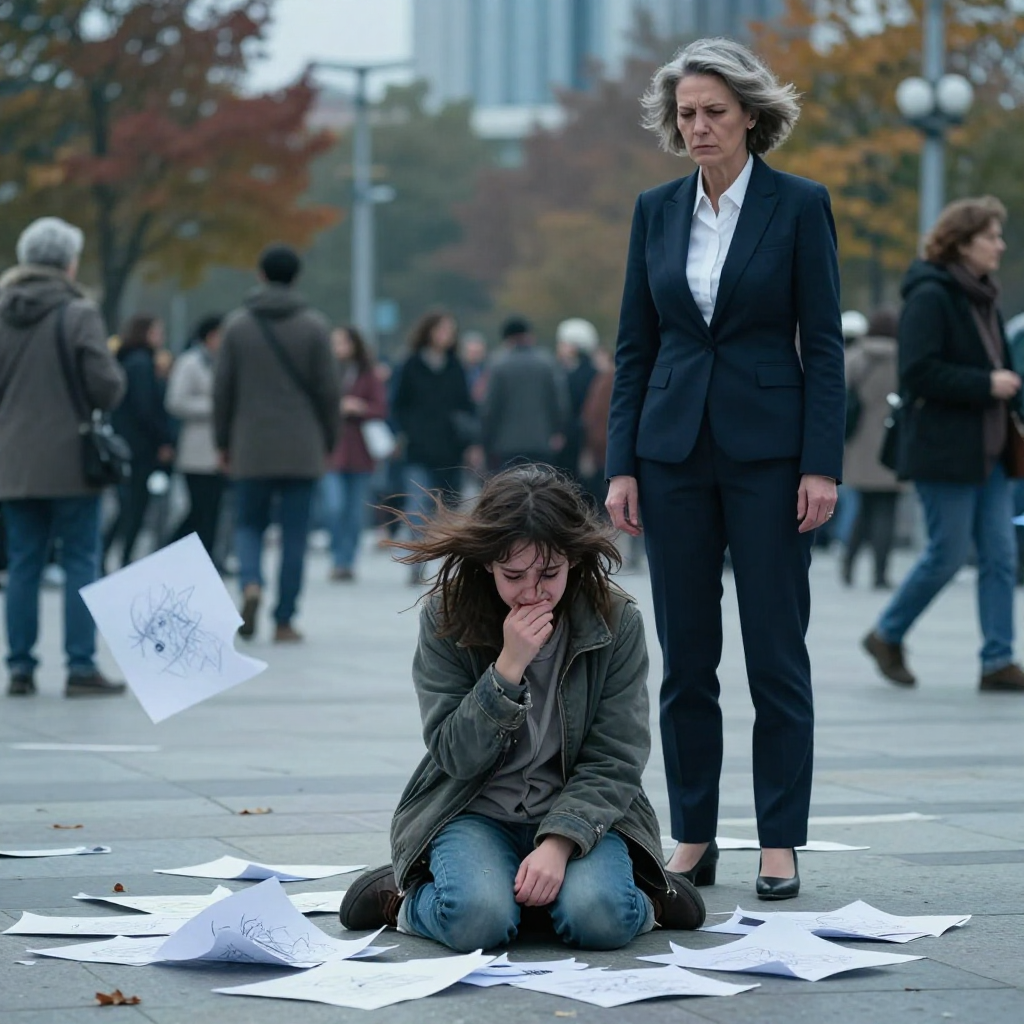
She threw the first handful of scraps into the air. It was a windy October day in Chicago, the kind of day where the wind whips around the skyscrapers and creates wind tunnels in the plazas. The paper didn’t just fall; it took flight.
My drawings—my soul, really—danced in the air like confetti. People were walking past us. Businessmen in gray suits, tourists with cameras, students with headphones. Some of them stopped. I felt their eyes on me. I felt the heat rising in my cheeks, a humiliation so deep it felt like it was burning my skin off.
“Look at that,” Elena said, gesturing to the scattering paper. “Trash. Just like I said. If it was valuable, would it blow away so easily?”
I finally found my voice. It was small, broken, a pathetic croak. “Why?”
She looked at me with cold, hard eyes. There was no love in them, not even a twisted kind. There was only a desire for control. “Because you were planning to apply to the Institute behind my back. I found the application in your drawer. I’m saving you from rejection, Sophie. I’m saving you from starving. You’ll thank me when you’re working a real job and not begging on a street corner.”
She dumped the rest of the sketchbook—the spine, the remaining half-torn pages—into a nearby metal trash can. The clang of the heavy book hitting the bottom echoed in my chest.
“Now,” she said, dusting off her hands as if she had just finished some dirty but necessary chore. “Clean up your face. We’re meeting the recruiter for the administrative assistant program in twenty minutes. Don’t embarrass me.”
She turned and walked away. She didn’t even look back to see if I was following. She knew I had nowhere else to go. She held the lease on the apartment. She controlled the bank account my father had left. I was eighteen, but I felt six years old and completely alone.
I didn’t follow her. Not yet.
My knees gave out. I sank onto the cold concrete of the plaza, heedless of the dirt or the people staring. I watched the pieces of my charcoal drawing of the old man swirling near the fountain. I watched the architectural study getting trampled under the heel of a woman rushing to catch a taxi.
I started to sob. It wasn’t a pretty cry. It was ugly, gasping, heaving sobs that made my ribs ache. I crawled forward on my hands and knees, trying to grab a piece of paper that had landed near a bench. It was just a corner of a page, a sketch of a hand reaching out. I clutched it to my chest, curling into a ball.
I thought about everything I had sacrificed. The nights I stayed up until 3:00 AM practicing anatomy. The weekends I spent working under the table at the diner to buy supplies Elena refused to pay for. It was all gone. She was right. I was nobody. The world was huge and indifferent, and my dreams were just litter blowing across the pavement.
I closed my eyes, listening to the city noises—the honking cars, the chatter, the wind. I wished the ground would just open up and swallow me whole. I wished I could disappear before I had to stand up and face the gray, colorless life she had planned for me.
I didn’t see the man who had been sitting on the bench behind me. I didn’t see him stand up when Elena started tearing the book. I didn’t see him catch one of the drawings—a full page that had miraculously survived the initial rip—before it hit the ground.
I only knew he was there when a shadow fell over me, blocking out the harsh autumn sun.
“Miss?” a voice said. It was deep, resonant, and startlingly gentle.
I flinched, expecting a security guard telling me to move along. I wiped my eyes frantically with my sleeve, keeping my head down. “I’m going,” I choked out. “I’m sorry. I’m cleaning it up.”
“Don’t apologize,” the voice said. Then, a pause. “Did you draw this?”
I looked up. Through my blurred vision, I saw a pair of polished black shoes and a long wool coat. I looked higher. An older man, maybe in his sixties, with silver hair and thick-rimmed glasses, was standing there. He was holding the page—the only surviving page. It was a sketch of my mother, from memory, before she died.
He wasn’t looking at me. He was staring at the drawing with an intensity that made the air around us feel still.
“Yes,” I whispered, terrified he was going to mock me too. “It’s trash. Let me have it.”
“Trash?” He looked at me then, and his expression was unreadable. He looked from the paper to the trash can where Elena had dumped the book, then back to my tear-stained face. “Who told you this was trash?”
“My stepmother,” I said, the shame rising again. “She says… she says I need to be realistic.”
The man looked around the plaza, his eyes scanning the scattered scraps of paper still dancing in the wind. He didn’t look like a tourist. He didn’t look like a businessman. He looked like someone who saw things others missed.
He crouched down, ignoring the dirt on his expensive trousers, so he was eye-level with me. He held the drawing of my mother like it was a religious artifact.
“What is your name?” he asked.
“Sophie,” I said.
“Well, Sophie,” he said, and for the first time, a small, sad smile touched his lips. “I think your stepmother just made a very big mistake. And I think she has no idea who I am.”
He reached into his coat pocket and pulled out a phone. He didn’t call the police. He didn’t call a doctor. He dialed a number and held the phone to his ear while looking straight at me.
“Arthur? It’s Julian,” he said into the phone, never breaking eye contact with me. “Cancel my afternoon meeting. Yes, the board meeting. I don’t care. I found something. No, not something. Someone.”
CHAPTER II
I stayed on the ground for a long time, my knees pressed into the hard, sun-baked stone of the plaza. The world felt thin, as if the air itself had been shredded along with my sketches. Around me, the city continued its indifferent hum—tires humming on asphalt, the distant chime of a bell—but for me, time had curdled. I watched the last few scraps of charcoal-stained paper dance in a small whirlwind near the fountain, disappearing into the water. My life’s work, the only evidence that I saw the world differently, was now just pulp and trash.
Then, a shadow fell over me. It wasn’t the sharp, jagged shadow of Elena, but something softer, broader. I didn’t look up at first. I couldn’t. I was too busy staring at the portrait of my mother, the one piece that hadn’t been swept away, now held by a pair of steady, aged hands. I recognized those hands from the corner of my eye—they were clean, the nails neatly trimmed, the skin etched with the fine lines of someone who had spent a lifetime handling delicate things.
“It’s a remarkable likeness,” a voice said. It was deep, resonant, and carried a weight of authority that felt like a physical pressure. “Not just in the anatomy, but in the way you captured the grief in her eyes. It takes a specific kind of courage to look at sorrow that closely without flinching.”
I finally lifted my head. The man standing over me looked like he belonged in a different century, or at least a different social class. He wore a charcoal-grey overcoat that cost more than my father’s car, and his eyes, silver-blue and piercing, were fixed on the crumpled drawing. This was Julian. I didn’t know his name yet, but I knew his presence. He had the air of a man who was used to being listened to, a man who didn’t have to raise his voice to be the loudest person in the room.
He reached out a hand to help me up. His grip was firm and dry. As I stood, my legs felt like they were made of water. I wiped my face with the back of my hand, feeling the grit of charcoal and salt from my tears.
“I’m sorry you had to see that,” I whispered, my voice cracking. “It’s just… it’s just paper now.”
“Paper can be replaced,” he said, his gaze shifting from the drawing to me. “Vision cannot. Do you have any idea who I am, Sophie?”
I blinked, startled that he knew my name. Then I remembered Elena shouting it at the top of her lungs just minutes before. “No, sir. I don’t.”
“My name is Julian Thorne,” he said simply.
The name hit me like a physical blow. Julian Thorne. The director of the Thorne Institute, the man whose reviews could make or break a career in the international art world, a man who hadn’t been seen in public for years. He was a ghost of the high-end galleries, a legend who had retreated into his own private collection. And here he was, standing in a dusty plaza, holding a drawing I’d made when I was fifteen.
“You… you’re him,” I stammered.
“I am someone who knows a miracle when he see one,” he replied. He looked down at the drawing again. “This woman. She was your mother?”
I nodded. The old wound in my chest, the one that never quite healed, began to throb. My mother had been a painter, too. A woman of immense talent who had been ground down by the same kind of ‘sensibility’ Elena preached. She had died in a small, cramped apartment, surrounded by unsold canvases that the world had ignored because she didn’t have the right connections, the right ‘polish.’ Elena had moved in six months later, replacing the smell of turpentine with the scent of expensive, suffocating lilies.
“She was beautiful,” Julian murmured. “And she was wasted. I knew her work, Sophie. I saw one of her pieces in a small shop in Lyon twenty years ago. I spent a decade trying to find her, but she had vanished into a life that didn’t deserve her.”
I felt a chill run down my spine. The secret I had kept—the fact that I had been secretly repairing and finishing my mother’s last, half-done canvases and selling them under a pseudonym just to pay for my supplies—suddenly felt like a lead weight in my stomach. If he knew her work, he might know what I had done. He might know I was a fraud of sorts, a ghost-painter for a dead woman.
Before I could respond, the sharp, rhythmic clicking of heels returned. It was a sound I knew in my marrow. Elena was coming back.
She had realized I wasn’t trailing behind her like a beaten dog. She appeared at the edge of the plaza, her face a mask of controlled fury. But as she drew closer and saw me standing with a man who looked like he owned the square, her expression shifted. The anger didn’t vanish; it just reorganized itself into a predatory curiosity.
“Sophie!” she called out, her voice dripping with a false, saccharine concern. “I thought you’d gone to the car. We have the interview at the firm in twenty minutes. You really shouldn’t linger here—it’s not safe for a girl of your… temperament.”
She stopped a few feet away, her eyes raking over Julian. She took in the quality of his coat, the watch on his wrist, the sheer gravitas of his posture. I saw the gears turning behind her eyes. This was the trigger. She didn’t see a man helping a girl; she saw a social ladder she hadn’t climbed yet.
“I’m sorry if my stepdaughter has been a nuisance, sir,” Elena said, stepping forward and extending a hand encased in a leather glove. “She’s had a bit of a breakdown. Artistic temperaments can be so… draining. I’m Elena Vance.”
Julian didn’t take her hand. He didn’t even look at it. He kept his eyes on me, but his words were directed at her. “The only thing draining here, Madame, is the spectacle of a woman attempting to murder a soul in public. I witnessed what you did to those drawings.”
Elena’s hand dropped. Her face paled, then flushed a deep, ugly red. She wasn’t used to being spoken to this way, especially not by a man of Julian’s obvious standing. “I was doing what was necessary for her future. Sophie has no sense of reality. She lives in a dream world. I am her guardian. I am the one who provides for her.”
“You provide a cage,” Julian said, his voice dropping an octave. It was the kind of silence that precedes a storm. “And you have just committed an act of cultural vandalism that I find personally offensive.”
“Who do you think you are?” Elena snapped, her composure finally breaking. She stepped closer, her voice rising, drawing the attention of the few passersby. “You have no right to interfere in a family matter. This girl is mine. Her father left her in my care, and I will not have some stranger filling her head with more nonsense about ‘talent.’ Talent doesn’t pay for the roof over her head!”
This was the irreversible moment. The public square had become a stage. Elena was screaming now, her face distorted. She looked like the monster I had always known her to be, stripped of her high-society grace.
Julian turned his head slowly to look at her. The contempt in his expression was so absolute it was almost beautiful. “I am Julian Thorne,” he said. “And as of this moment, Sophie is no longer under your jurisdiction. I am offering her a full residency at the Thorne Institute. I will provide her with a studio, a stipend, and a legal team to review the terms of her father’s estate—which, if I recall correctly from the public records of the Vance family, was supposed to be held in trust for Sophie’s education. An education you have clearly been obstructing.”
I gasped. The estate. The trust. That was the other secret. I had always suspected Elena was draining the money my father had left for my art studies, but I had no way to prove it. Julian had just thrown a grenade into the center of her life.
Elena froze. The mention of the trust was the killing blow. She looked around the plaza, seeing the eyes of the shopkeepers and the tourists on her. She was being exposed in the one place she felt most powerful: the public eye. Her reputation, her status, her control over the Vance name—it was all dissolving in the heat of Julian’s accusation.
“You’re lying,” she hissed, though her voice lacked conviction. “You can’t do this. She’s a minor… no, she’s nineteen, but she’s dependent!”
“She is an adult,” Julian said. “And she is leaving with me. Now.”
He turned to me. “Sophie?”
This was the moral dilemma I had never expected to face. If I left with him, I would be free. I would have everything I ever dreamed of—a place to paint, a mentor, a chance to be someone. But I would also be declaring open war on the only family I had left. I would be walking away from the house I grew up in, leaving behind the memories of my father, and stepping into the unknown with a man who was a stranger to me, however legendary he might be.
Moreover, if I went with him, the secret of the ‘ghost-paintings’ would eventually come out. Julian Thorne would see through me. He would see that I wasn’t just a girl with potential; I was a girl who had been pretending to be her dead mother for years to survive. If he found out I had been ‘forging’ my mother’s style to sell to low-end collectors, he would destroy me as quickly as he was currently destroying Elena.
I looked at Elena. She looked small now. Pathetic. She was grasping her designer handbag as if it were a shield. She had been my tormentor for so long, but in this moment, I saw her fear. She was afraid of losing the money. She was afraid of the scandal. She didn’t care about me; she cared about the optics.
Then I looked at Julian. He was offering me a path to the light, but it was a path paved with high expectations and the risk of a different kind of ruin.
“I… I don’t have anything,” I said, my voice barely audible. “My clothes, my brushes… she took everything.”
“Everything she took can be bought ten times over,” Julian said. “The only thing that matters is that you have that drawing in your hand. And that you have the courage to walk across this plaza.”
Elena stepped toward me, her hand reaching out, not in affection, but like a claw. “Sophie, don’t you dare. If you walk away now, don’t ever think about coming back. You’ll be penniless. You’ll be a charity case for this old man until he gets bored of you. Think about your father!”
“I am thinking about him,” I said, and for the first time in years, my voice didn’t shake. “He would have hated what you did today. He loved my mother’s work. You’re the one who’s been erasing him, bit by bit, until this house just smells like your perfume and lies.”
I stepped toward Julian. The distance between us was only a few feet, but it felt like crossing an ocean. With every step, I felt the weight of Elena’s gaze, a cold, poisonous thing on my back. I felt the eyes of the strangers in the plaza—the woman at the flower stall, the man reading the newspaper—all of them witnesses to this sudden, irreversible break.
When I reached Julian, he placed a hand on my shoulder. It wasn’t a gesture of ownership, but of protection. He looked at Elena one last time.
“My lawyers will be in touch regarding the Vance trust, Madame. I suggest you find yourself a very good accountant. And perhaps a hobby that doesn’t involve the destruction of beauty.”
He turned me around, and we began to walk away.
“Sophie!” Elena screamed behind us. It wasn’t a call; it was a howl of pure, unadulterated rage. “You’ll regret this! You’re nothing without me! You’re just a girl who draws ghosts!”
I didn’t turn back. I kept my eyes on the pavement, on the shadow we cast together—the tall, elegant man and the girl with the charcoal-stained hands. We walked toward a black sedan parked at the curb, its engine idling softly.
A driver in a dark suit opened the door for us. As I slid into the leather interior, the smell of expensive wood and silence enveloped me. It was a world away from the screeching wind and the dusty stones of the plaza.
Julian sat beside me as the car pulled away. He didn’t speak for a long time. He let me breathe. He let the adrenaline subside until I was left with the hollow, aching realization of what I had just done. I had burned my life to the ground.
“You did well,” he said eventually. He was still holding my mother’s portrait. He handed it back to me. “This is the start of everything. But you should know, Sophie, the world I am taking you into is not a kind one. It is a world of sharks and critics. They will look at your work not with the eyes of a mother, but with the eyes of a surgeon. Are you ready for that?”
I looked at the drawing. My mother’s eyes looked back at me, filled with that eternal, captured grief. I thought about the paintings I had finished in her name. I thought about the lie I was carrying.
“I’ve been living with a shark for ten years, Mr. Thorne,” I said, my fingers tracing the jagged edge of the torn paper. “I think I’m ready to see what the rest of the ocean looks like.”
But as we drove through the city, leaving the plaza and Elena behind, a new fear took root. Julian hadn’t just saved me; he had invested in me. And I knew, with a sinking certainty, that if I didn’t live up to the ‘miracle’ he saw in that drawing—or if he ever discovered that I had been profiting from my mother’s ghost—the fall from his grace would be much, much harder than the fall I had taken on the plaza stones.
The conflict wasn’t over. It had simply shifted from a battle for my survival to a battle for my identity. And in the silent, moving luxury of Julian’s car, I realized that I didn’t even know who Sophie Vance was anymore, now that the cage was gone. I was just a collection of secrets and charcoal dust, heading toward a destiny I wasn’t sure I deserved.
CHAPTER III
The air inside the Thorne Institute was cold, filtered, and smelled of expensive floor wax and the metallic tang of new frames. It was the kind of silence that didn’t feel like peace. It felt like a held breath. My own breath was shallow, caught in the back of my throat, as I stood in the center of the North Gallery. Around me, the walls were covered in my secrets.
Julian had titled the exhibition ‘Resurrection.’ He was always one for the dramatic, but to me, it felt like a burial. The canvases were large, aggressive things. They were the pieces I had spent the last six months ‘finishing’—taking my mother’s ghost-thin outlines and layering them with my own grief until they looked like something new. But I knew the bones beneath the oil. I knew whose hand had first mapped the curves of the shadows.
Julian moved through the room like a predator in a tuxedo. He didn’t speak to the guests yet. He just watched them watch me. He was curated, every silver hair in place, his presence a shield I wasn’t sure I deserved. Arthur followed three paces behind him, a tablet in hand, recording the names of collectors who were already placing red dots next to pieces that weren’t entirely mine.
My hands were sweating. I wiped them on the silk of my dress, a garment Julian had chosen for me. It was the color of a bruise. I felt like one, too—tender, dark, and lingering. I looked at the centerpiece, a portrait of a woman looking through a shattered window. I had painted the glass. My mother had painted the woman. In the harsh gallery lights, the seam between us looked like a scar.
‘You look like you’re waiting for a guillotine, Sophie,’ Julian whispered, appearing at my shoulder. He didn’t look at me. He looked at the portrait.
‘It’s just a lot of people,’ I lied.
‘It’s a lot of truth,’ he corrected. ‘Or as much truth as these people can handle. Smile. You’re the savior of a legacy tonight.’
I tried to smile, but my face felt like wet clay. The room was filling. The elite of the city, the critics who could kill a career with a single adjective, the wealthy who bought art to match their curtains—they were all here. They buzzed with the story Julian had fed them: the daughter of a forgotten genius, rising from the ashes of her stepmother’s cruelty. It was a perfect narrative. It was almost true.
Then the heavy double doors at the back of the hall swung open with a thud that cut through the polite chatter.
The crowd parted. It wasn’t a sudden movement, but a slow, rhythmic peeling away, like water receding before a tide of oil. Elena walked down the center of the gallery. She wasn’t the disheveled woman I’d left in the plaza months ago. She was armored in a sharp, ivory suit that screamed of borrowed money and desperate dignity. She looked skeletal, her eyes recessed and burning with a frantic, localized sun.
She didn’t look at the art. She looked at me.
Julian stepped forward, his body blocking her path, but Elena didn’t stop until she was inches from his chest. She didn’t shout. Her voice was low, trembling with a vibration that made the wine in the glasses nearby ripple.
‘You think you can just take her?’ Elena asked. Her voice carried. It was a stage whisper designed to infect the room. ‘You think you can take my life’s work and put her name on it?’
‘You have no standing here, Elena,’ Julian said. His voice was like a slab of marble—cold and immovable. ‘Leave before the security detail removes you.’
‘Security?’ Elena laughed, a dry, hacking sound. She reached into a leather portfolio she held under her arm and pulled out a stack of yellowed, translucent paper. ‘Tell me, Mr. Thorne, does the illustrious critic know how to recognize a fraud when he’s sponsoring one?’
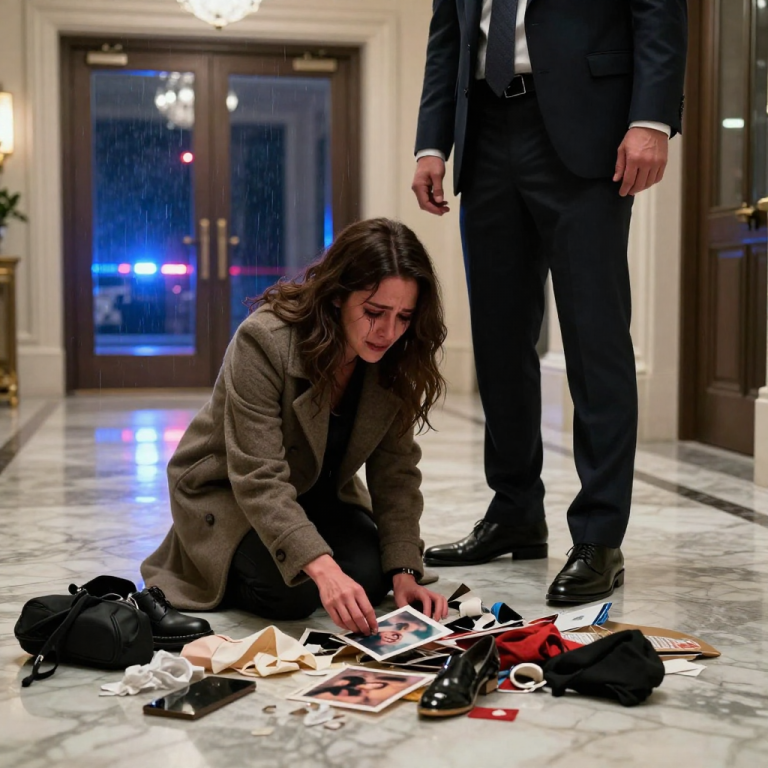
She began to throw the papers onto the floor. They weren’t just sketches. They were the vellum transfers my mother had used to plan her compositions. I recognized them instantly. I had searched for these for years; I thought Elena had burned them.
‘Look at them!’ Elena turned to the crowd, her arm sweeping across the room toward my paintings. ‘Look at the line work. Look at the anatomical errors in the sketches that Sophie ‘corrected’ in the final oils. These aren’t her visions. She’s a scavenger. She’s been raiding her mother’s grave for years, and Julian Thorne is the one who gave her the shovel.’
A woman in the front row gasped. I saw a critic I recognized—a man named Halloway—lean down and pick up one of the sketches. He looked at the paper, then at the painting on the wall behind me. His face went flat. The professional mask of a man who had been cheated.
‘Sophie?’ Julian’s voice was different now. It wasn’t a shield. It was a question.
I couldn’t speak. My heart was a bird hitting the walls of a cage. I looked at the sketches on the floor. My mother’s handwriting was in the margins. My mother’s soul was in those lines. And Elena was right. I had taken them. I had polished them. I had lied by omission every time I let Julian call me a ‘prodigy.’
‘She can’t answer,’ Elena sneered, stepping closer to me. I could smell the gin on her breath, hidden under layers of mint. ‘Because she knows that without these papers, she’s just a girl who can’t draw a straight line. She’s a thief, Julian. And you’ve staked your entire reputation on a lie.’
The room began to tilt. The murmurs were growing, a low drone of bees. Julian looked at the sketches on the floor. He looked at the painting of the shattered window. He looked at me. The silence he maintained was more agonizing than Elena’s screaming. I waited for him to point to the door. I waited for him to denounce me to save himself.
‘This is an outrage,’ a new voice boomed.
Everyone turned. Standing at the entrance to the gallery was Commissioner Marcus Vane, the head of the City Arts Council and a man who held the keys to every public grant and museum board in the country. He walked forward with two men in dark suits. Social authority followed him like a shadow.
‘Mrs. Rossi,’ Vane said, addressing Elena. ‘Your behavior is a public disturbance.’
‘The disturbance is the fraud being committed on these walls, Commissioner!’ Elena cried, her voice cracking. ‘Look at the evidence!’
Vane didn’t look at the sketches. He looked at Julian. ‘Julian, I’ve had three calls tonight about the legality of this estate. If these claims are true, the Institute’s charter is at risk. I need a statement. Now.’
Julian didn’t blink. He walked over to the sketch Halloway was holding and took it from his hands. He studied it for a long, agonizing minute. The entire room was frozen. I felt my career, my life, and my mother’s name dissolving in the air.
‘You’re right, Elena,’ Julian said quietly.
The crowd inhaled as one. Elena’s face lit up with a terrifying, vengeful joy.
‘She is a thief,’ Julian continued, his voice gaining strength. He looked at me, and for the first time, I saw something in his eyes that wasn’t calculated. It was a deep, ancient anger. ‘But she didn’t steal from you. She stole from a woman you kept prisoner for twenty years.’
Julian turned to Commissioner Vane. ‘Commissioner, I knew about these sketches. In fact, I’ve been waiting for them to appear.’
Elena’s joy faltered. ‘What? You’re lying. You couldn’t have—’
‘I didn’t just know Sophie’s mother, Elena,’ Julian said, his voice dropping into a register that commanded the very air in the room. ‘I was the one who bought her the first set of oils she ever owned. I was the one who watched you slowly choke the life out of her career because you couldn’t stand to live in her shadow. I knew Sophie was finishing her mother’s work because I recognized the hand. I’ve been waiting for you to bring these sketches out, because they are the final proof of the theft you committed decades ago.’
Julian pulled a small, black ledger from his inner pocket. He held it up.
‘This is the private ledger of the late Isabella Rossi,’ Julian announced. ‘It contains the dates and descriptions of every piece she ever started—and a detailed account of how her ‘manager’ and ‘sister-in-law’ Elena withheld her medical care unless she signed over the rights to her future works.’
‘That’s a forgery!’ Elena shrieked. She lunged for the ledger, but one of the Commissioner’s men stepped in her way, his hand firmly on her shoulder. It wasn’t a violent gesture, but the finality of it was absolute.
‘It’s not,’ Julian said. ‘It’s been authenticated by the estate’s original lawyers—the ones you fired when Sophie’s father died. I’ve spent the last six months finding them.’
Julian walked back to me. He stood so close I could feel the heat radiating off him. He turned to the room, to the critics, to the Commissioner.
‘Sophie didn’t commit fraud,’ Julian said. ‘She committed an act of devotion. She took the fragments of a life that this woman tried to erase and she completed them. She gave her mother the voice that was stolen from her. If that is a crime in the art world, then I am her accomplice.’
The silence that followed was different. It wasn’t a held breath anymore. It was the sound of a vacuum.
Commissioner Vane looked at Elena, then at the sketches, then at the ledger. ‘Mrs. Rossi,’ he said, his voice devoid of any warmth. ‘I think it would be best if you came with us. There are some very serious questions about the Rossi estate that have nothing to do with art, and everything to do with embezzlement.’
Elena looked around the room. She looked for a face that held a flicker of sympathy. She found none. She had played her final card, and Julian had turned it into her arrest warrant. As the men led her out, she didn’t scream. She just looked smaller, as if the air was being sucked out of her body, leaving only the brittle ivory suit behind.
The doors closed.
I looked at Julian. My vision was blurred with tears I refused to let fall. ‘You knew?’ I whispered. ‘All this time, you knew I was using her sketches?’
‘I didn’t want the sketches, Sophie,’ Julian said, his voice for my ears only. ‘I wanted you to stop being afraid of her. I needed her to bring the evidence herself so she could never claim it again. You’re free now.’
‘But the work…’ I gestured to the walls. ‘It’s still a lie. I’m not what you told them I am.’
Julian looked at the portrait of the shattered window. He reached out and touched the frame.
‘The lie was that you needed her bones to build your house,’ he said. ‘Now, look at the paintings again, Sophie. Look at the parts you painted. Look at the glass.’
I looked. I saw the shattered window I had rendered. I saw the light hitting the shards. I saw the technical skill, the raw, jagged emotion I had poured into those jagged edges. It was better than the woman behind the glass. It was more alive.
‘I didn’t help you because of your mother,’ Julian said, finally looking me in the eyes. ‘I helped you because you are the only person I’ve met in forty years who is more talented than she was. And more dangerous.’
He turned away to greet the Commissioner, leaving me standing in the center of my own life. The power had shifted. Elena was gone. Julian was my architect. But as the crowd began to applaud, a cold realization settled in my chest.
Julian hadn’t saved me for my sake. He had saved me for the art. And now that he had proven I was better than my mother, he would never let me go. I wasn’t his protege anymore. I was his masterpiece.
CHAPTER IV
The silence after was the loudest thing I’d ever heard. Not the silence of an empty room, but the silence of a city holding its breath. News crews packed up their cameras, their vans disappearing one by one, like vultures abandoning a carcass stripped clean. The art world, which had held its collective breath for weeks, exhaled, a sigh that rustled through galleries and studios from Tribeca to Chelsea.
Elena was gone. Taken away in handcuffs, her face a mask of fury and disbelief. It was over, wasn’t it? That’s what everyone kept saying. But the ‘over’ felt… hollow.
The headlines screamed about the Rossi scandal, the art fraud, the stepmother’s downfall. They called me a victim, a survivor, a prodigy. Julian, of course, was hailed as a visionary, a genius who had orchestrated it all. The truth, as always, was buried somewhere beneath the layers of narrative.
I walked back into the Thorne Institute. The exhibition felt like a crime scene. Marcus Vane caught my eye across the room, his expression unreadable. He nodded stiffly and moved on. It was a new world, and the players were already repositioning themselves.
PHASE 1
The next few days were a blur of lawyers, interviews, and gallery owners fawning over me. Julian managed everything, his grip tighter than ever. He decided which interviews I would give, which offers I would accept. My life, supposedly my own now, felt meticulously curated.
My apartment, which had felt like a sanctuary, now felt like a waiting room. The phone rang constantly. My sister, Clara, called, her voice a mix of relief and apprehension. She wanted to celebrate, to talk about the future. But I couldn’t. The future felt… tainted.
I tried to paint. I set up my easel, stared at the blank canvas, but my hand refused to move. The colors seemed dull, lifeless. The images in my head were fractured, distorted. The joy, the escape, was gone. I was empty.
Julian found me like that, staring blankly. He didn’t say anything. He simply stood behind me, his presence a weight on my shoulders. “You need to work, Sophie,” he said softly. “The world is waiting.”
I nodded, but I didn’t believe him. The world wasn’t waiting for me. It was waiting for the spectacle, for the next headline. And I was trapped inside it.
Then, the first real blow landed. A letter arrived from the university, informing me that my scholarship had been revoked. The Rossi Foundation, which had funded my education, had withdrawn its support. It was a formality, they said, but the message was clear. Elena’s disgrace had extended to me. I was no longer the protected protégé; I was collateral damage.
Clara offered to help financially, but I refused. I couldn’t take her money. Not after everything. Julian, of course, offered to ‘take care’ of it, but his offer felt like another chain. I was suffocating.
PHASE 2
The art world’s fickle nature revealed itself quickly. The whispers started. Questions about the authenticity of my work grew louder. Bloggers and online forums dissected my paintings, comparing them to my mother’s sketches. Doubts, once confined to Elena’s accusations, now circulated freely. Had Julian known all along? Was I a fraud? The questions echoed my own fears.
The gallery openings felt different. The smiles seemed forced, the compliments hollow. People looked at me with a mixture of curiosity and suspicion. I felt like an imposter in my own life. I started avoiding eye contact. The isolation deepened.
Even Julian seemed… different. He was more demanding, more critical. He pushed me to produce more, to replicate the ‘magic’ of the exhibition pieces. He micromanaged every detail, from the brushstrokes to the color palette. I was losing myself in his expectations. My own vision blurred, replaced by his.
One evening, after a particularly grueling session in the studio, Julian announced that he had arranged a major exhibition in Paris. It was a huge opportunity, he said, a chance to silence the critics and solidify my reputation. But all I felt was dread. Paris meant more exposure, more scrutiny. It meant being further away from Clara, further away from anything real.
“I don’t know, Julian,” I said, my voice barely a whisper. “I need some time.”
He stopped, his eyes hardening. “Time for what, Sophie? Time to doubt yourself? Time to listen to the whispers? You don’t have time. This is your moment. Don’t waste it.”
His words stung. He was right, in a way. I couldn’t afford to falter. But the price of success felt too high. I was becoming a puppet, dancing to his tune. And the thought terrified me.
Then, a new event. A package arrived at my apartment. No return address. Inside, a worn leather-bound sketchbook. It was my mother’s. One I hadn’t seen before. The last one she ever owned.
PHASE 3
The sketchbook felt like a message from the grave. Its pages were filled with sketches I had never seen: landscapes, portraits, abstract designs. But it was the last few pages that caught my attention. They were different. Darker. More tormented.
One sketch, in particular, haunted me. It was a self-portrait. But it wasn’t a likeness. It was a caricature, a grotesque distortion of her own features. Her eyes were wide with terror, her mouth twisted in a silent scream.
On the back of the sketch, a single word was scrawled in shaky handwriting: “Help.”
The word echoed in my mind. Help. Was my mother reaching out to me? Was she warning me about something? The sketchbook was a puzzle, a fragment of a past I didn’t fully understand. But it felt important. It felt like a key.
I showed the sketchbook to Julian. He dismissed it as ‘melodramatic,’ the ‘ravings of a troubled mind.’ He urged me to focus on the Paris exhibition, to put the past behind me. But I couldn’t. The sketchbook had awakened something inside me. A sense of unease, a need to understand. I started digging.
I contacted old friends of my mother, former colleagues, even distant relatives. I pieced together fragments of her life, her struggles, her fears. I learned about her growing isolation, her increasing paranoia. I learned about Elena’s subtle, insidious control. I learned about a darkness that I had never fully recognized.
The more I learned, the more I realized that my mother hadn’t simply ‘faded away.’ She had been suffocated. Her talent, her spirit, her very self, had been crushed. And Elena had been the one holding the pillow.
The weight of that realization was crushing. The ‘victory’ at the Thorne Institute felt like a sham. I had exposed Elena, but I hadn’t truly avenged my mother. I hadn’t freed myself. I had simply traded one cage for another.
PHASE 4
The Paris exhibition loomed. Julian had secured a prestigious gallery, a prime location. The invitations were sent. The press releases were drafted. Everything was set. Except me.
I couldn’t paint. The images in my head were consumed by my mother’s sketchbook, by her silent scream. I saw her face in every canvas, her pain in every brushstroke. I was paralyzed by her ghost.
Julian grew impatient. He berated me, he threatened me, he even tried to manipulate me with guilt. But I was unmoved. I had reached my breaking point. I couldn’t pretend anymore. I couldn’t be his puppet.
One evening, I went to his studio. I found him surrounded by my paintings, his eyes gleaming with pride. He was planning the layout of the exhibition, orchestrating the final act of his masterpiece.
“Julian,” I said, my voice trembling, “I can’t do it.”
He turned, his expression a mixture of surprise and anger. “What are you talking about?”
“I can’t go to Paris,” I said. “I can’t pretend that everything is okay. I can’t be your Sophie anymore.”
He laughed, a cold, dismissive sound. “Don’t be ridiculous. You’re just nervous. It’s perfectly normal.”
“No,” I said, my voice stronger now. “It’s not normal. I’m not normal. I’m not your creation. I’m my own person.”
I took the sketchbook from my bag and held it out to him. “This is my mother’s. Have you seen it?”
He glanced at it dismissively. “Some old scribbles. What’s the point?”
“The point is, she was more than just ‘scribbles,'” I said. “She was a person. A talented artist. And Elena destroyed her. And you… you used her. You used both of us.”
His face hardened. “Don’t be absurd. I gave you everything. I made you who you are.”
“No,” I said. “You tried to control me. You tried to mold me into something I’m not. But I won’t let you. I’m done.”
I turned and walked out of the studio. I didn’t look back. I didn’t know what the future held. But I knew one thing: I was finally free.
The silence that followed was still deafening, but it was a different kind of silence. It was the silence of a breath released. The silence of a choice made.
Two weeks later, the Paris exhibition opened. Without me. Julian displayed my paintings, but the critics savaged them. They called them derivative, soulless, empty. They said that without my ‘spark,’ they were nothing more than technical exercises.
Julian’s reputation took a hit. The art world, ever fickle, moved on to the next sensation. He was yesterday’s news.
I started painting again. Slowly, tentatively. I didn’t try to replicate my mother’s style, or Julian’s expectations. I painted what I felt, what I saw, what I remembered. I painted my pain, my anger, my hope. I painted my own truth.
It wasn’t easy. There were days when I wanted to give up, when the doubts crept back in. But I kept going. I kept painting. Because I knew that the only way to truly honor my mother was to find my own voice. Even if it was a whisper.
Clara helped, her quiet strength a constant source of support. We were closer than ever, bound by a shared understanding of the past and a cautious hope for the future. She has given birth to a girl, and named her mom’s name.
Commissioner Vane sent me a card of congratulations for my bravery and decision, with an invitation to show some work at a small gallery. He understood my decision to not live in Julian’s shadow. He saw my true potential.
Even though I have lost my scholarship, and the status I had, I didn’t regret my decision. It’s finally my time to spread my own wings.
CHAPTER V
The courtroom emptied, but the echoes stayed with me. Elena’s face, contorted with rage and defeat, Clara’s hesitant smile, Marcus’s nod of acknowledgement. And Julian… Julian’s carefully neutral expression, which, somehow, was the most devastating of all.
The scholarship was gone, of course. The Thorne Institute wouldn’t support someone who’d rejected their patron, someone who’d publicly questioned Julian’s methods. I hadn’t expected it to be any other way.
My apartment felt cavernous, stripped of the canvases that had lined the walls, the supplies that had cluttered every surface. I’d returned the materials to the Institute, every brush, every tube of paint, every meticulously stretched canvas. It felt like returning stolen property, which, in a way, it was.
The silence was the worst part. For years, there had been Elena’s constant criticisms, her belittling remarks, the subtle digs that chipped away at my confidence. Then there had been Julian’s pronouncements, his unwavering vision of what I should be. Now, there was nothing. Just the hollow echo of my own thoughts.
I sat on the floor, surrounded by the ghosts of my mother’s sketches, the faint pencil lines that had guided my hand for so long. They weren’t my creations, not truly. I had brought them to life, yes, but they were born of her pain, her hopes, her unfulfilled dreams. And I had used them to build a false identity, a career based on borrowed genius.
The truth was a bitter pill. I wasn’t a prodigy. I was… what? A talented mimic? A skilled executor of someone else’s vision? The label didn’t matter. What mattered was that I had nothing of my own.
I spent the next few weeks in a haze of self-doubt and quiet despair. I avoided Clara, avoided Marcus, avoided even looking at art. The city, once a source of inspiration, now felt like a cage. Every gallery, every museum, every street corner where I’d once sketched felt like a reminder of my failure.
One afternoon, I found myself wandering through a park I’d never visited before. It was small, tucked away between towering buildings, a forgotten oasis of green. Children shrieked with laughter as they chased pigeons, an old man sat on a bench reading a newspaper, a young couple picnicked on the grass.
I sat down on a bench, feeling utterly disconnected from the life around me. A small girl, no older than five, approached me, her face smeared with ice cream. She held out a crayon drawing, a chaotic swirl of colors that vaguely resembled a flower.
“Pretty?” she asked, her eyes shining.
I managed a weak smile. “Very pretty,” I said. “Did you make it?”
She nodded proudly. “All by myself!”
Her innocent joy, her unadulterated pride in her creation, struck me like a physical blow. It didn’t matter that the drawing wasn’t technically perfect, that it wouldn’t win any awards. It was hers. It was an expression of her unique perspective, her unfiltered view of the world.
And in that moment, I understood. Art wasn’t about technical skill, or critical acclaim, or pleasing a patron. It was about honesty, about vulnerability, about finding your own voice and daring to share it with the world.
I went back to my apartment, not with a burst of inspiration, but with a quiet determination. I cleared away the remnants of my old life, the meticulously organized art supplies, the framed reproductions of masterpieces. I needed to start from scratch, to strip away everything that wasn’t authentically me.
I bought a cheap sketchbook and a set of charcoal pencils. I didn’t have any grand ideas, no burning desire to create a masterpiece. I just wanted to draw. To experiment. To explore.
I started by sketching the objects in my apartment: a chipped coffee mug, a crumpled newspaper, a wilting flower in a vase. I didn’t try to make them look perfect, or beautiful, or even interesting. I just tried to capture their essence, their unique character.
The first few drawings were terrible. Stiff, lifeless, lacking any spark of originality. But I kept at it, day after day, slowly loosening my grip on perfection, allowing myself to make mistakes, to embrace the imperfections.
I ventured out into the city, sketching the people I saw on the streets, the buildings that lined the avenues, the parks that offered moments of respite from the urban chaos. I didn’t try to emulate my mother’s style, or Julian’s expectations. I just drew what I saw, what I felt, what resonated with me.
Slowly, tentatively, my own style began to emerge. It wasn’t polished, or refined, or particularly marketable. It was raw, and honest, and imperfectly me.
I started experimenting with different mediums: watercolors, pastels, ink. I let go of the need to control every aspect of the process, allowing the materials to guide me, to surprise me, to reveal unexpected possibilities.
One evening, Clara came to visit. She hadn’t called, hadn’t announced her arrival. She just showed up at my door, her eyes filled with concern.
“I was worried about you,” she said, her voice soft. “You disappeared. I didn’t know where you were.”
I smiled, genuinely this time. “I’m here,” I said. “I’m just… different.”
I showed her my sketchbook, the pages filled with my tentative drawings. She flipped through them slowly, her expression unreadable.
“These are… different,” she said finally. “They don’t look like your mother’s work.”
“They’re not,” I said. “They’re mine.”
She looked at me, her eyes searching. “Are you happy?” she asked.
I hesitated for a moment. Happy wasn’t the right word. Content? Fulfilled? At peace? Maybe all of those things.
“I’m… finding my way,” I said. “And that’s enough for now.”
Clara stayed for a while, and we talked. Not about Elena, or Julian, or the trial. We talked about ordinary things: the weather, the news, the silly things we’d done as children.
As she was leaving, she turned to me and said, “I’m proud of you, Sophie. For everything.”
Her words were a balm to my wounded soul. I realized that I didn’t need the approval of the art world, or the validation of a mentor, or even the legacy of my mother. All I needed was the support of the people who loved me, and the courage to keep creating.
Time passed. I continued to draw, to experiment, to explore. I started exhibiting my work in small, local galleries, the kind that catered to emerging artists, the kind that valued authenticity over commercial appeal.
I didn’t make a lot of money, but I made enough to support myself. And more importantly, I found a sense of purpose, a sense of belonging, a sense of self that I had never known before.
One day, I received a letter from Marcus. He wrote that Elena had been sentenced, that she was serving her time. He also wrote that he was leaving the Commissioner’s office, that he was moving to a small town in the countryside, where he planned to open a bookstore.
He ended the letter by saying, “I hope you’ve found your peace, Sophie. You deserve it.”
I smiled, a genuine, heartfelt smile. I didn’t hate Elena. I didn’t pity her. I just… accepted her. She was a part of my story, a painful chapter in my life, but not the defining one.
Julian never contacted me again. I saw his name in the papers from time to time, his pronouncements on the latest trends in the art world. But he was no longer a part of my life. He had served his purpose, however manipulative, and now it was time for me to move on.
I thought about my mother often, not with sadness or regret, but with gratitude and respect. She had given me a gift, even if it was a complicated one. She had shown me the power of art, the ability to transform pain into beauty, to find meaning in the midst of suffering.
I never tried to recreate her sketches, never tried to recapture her style. I honored her memory by creating my own art, by finding my own voice, by living my own life.
One afternoon, I was sitting in the park, sketching a group of children playing. A young woman approached me, her eyes filled with admiration.
“Your drawings are beautiful,” she said. “They’re so… honest.”
I smiled. “Thank you,” I said. “That’s the highest compliment I could receive.”
She hesitated for a moment, then said, “I’m an artist too. But I’ve been struggling to find my own style. Do you have any advice?”
I thought for a moment, then said, “Don’t try to be someone else. Don’t try to please anyone else. Just be yourself. And let your art be a reflection of that.”
She smiled. “Thank you,” she said. “I needed to hear that.”
As she walked away, I realized that I had finally found my purpose. Not as a prodigy, not as a protégé, but as an artist, a mentor, a survivor. I had faced my demons, I had embraced my imperfections, and I had emerged stronger, more resilient, more authentically me.
The sun began to set, casting long shadows across the park. The children’s laughter faded, the birds began to sing their evening song, and the city slowly began to quiet down.
I closed my sketchbook, feeling a sense of peace I had never known before. I had lost a lot, but I had gained so much more. I had lost my innocence, my illusions, my false identity. But I had gained my freedom, my voice, my self.
And as I walked home, I knew that my journey was far from over. But I also knew that I was finally on the right path, the path that led to my true self, the path that would allow me to create art that was honest, authentic, and uniquely mine.
The weight of everything I’d carried for so long finally lifted, and I realized art wasn’t about perfection, but about survival.
END.