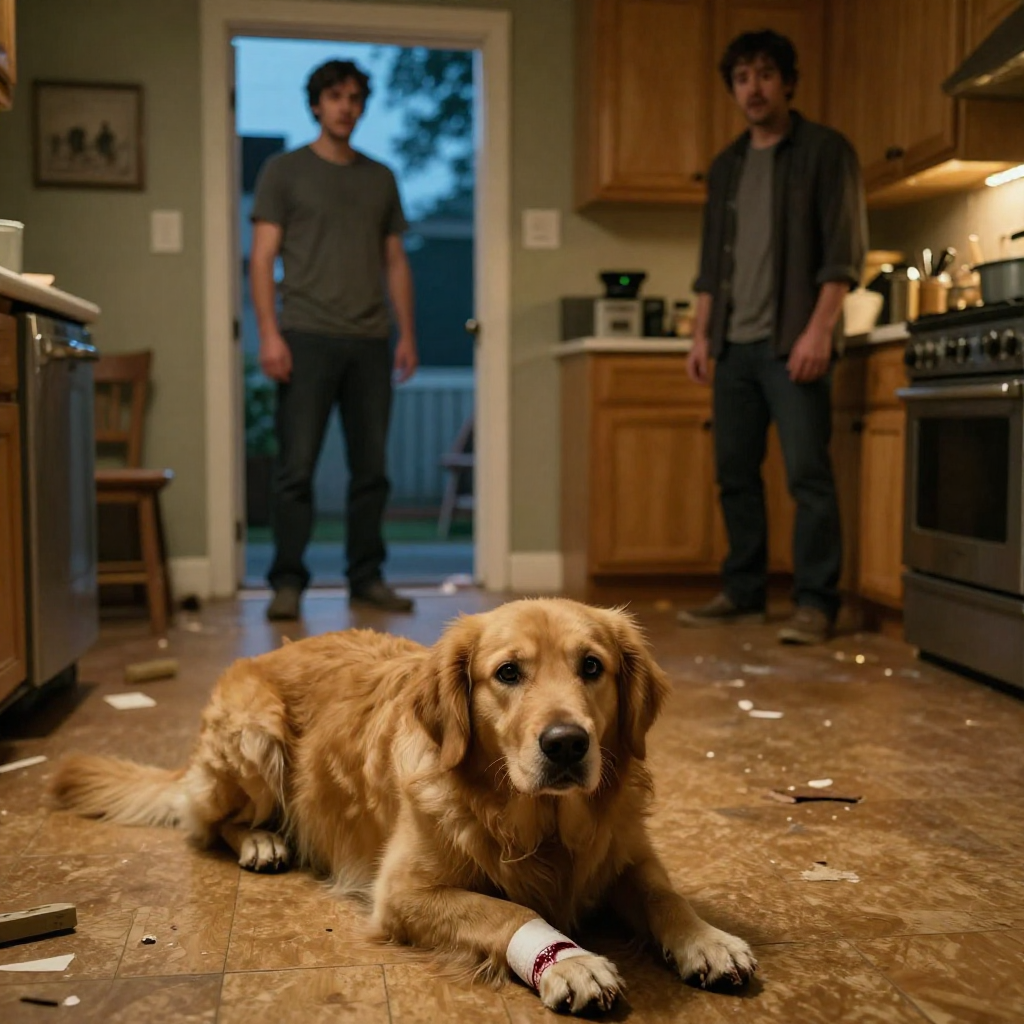
HE SHATTERED THE DINNER PLATE AGAINST MY DOG’S RIBS BECAUSE THE ROAST WAS DRY, BUT HIS REIGN OF TERROR ENDED THE MOMENT OUR “QUIET” NEIGHBOR KICKED THE FRONT DOOR OFF ITS HINGES.
The sound of porcelain exploding against bone isn’t something you ever forget. It doesn’t sound like dropping a plate in the sink, and it doesn’t sound like a movie effect. It’s a dull, wet thud followed immediately by the high-pitched chaotic chime of shattering glaze. And then, silence.
That absolute, suffocating silence that happens right before the screaming starts.
I was standing by the kitchen island, a dishtowel in my hand, my knuckles white as I gripped the granite. Mark was at the head of the table. He hadn’t stood up yet. He was just sitting there, his hand still suspended in the follow-through of the throw, his face twisted into that familiar mask of self-righteous exhaustion. The roast beef I had spent three hours preparing—searing it exactly how he liked, letting it rest, slicing it thin—was splattered across the cabinets and the floor. But I didn’t care about the food. I didn’t care about the mess.
My eyes were on Buster.
Buster is—was—the only pure thing in that house. A Golden Retriever mix with eyes that looked at you like you were the sun and the moon. He had been sleeping under the table, hoping for a crumb, just existing. He hadn’t barked. He hadn’t begged. He had just been there. And now he was scrambling on the linoleum, his paws slipping in the gravy and the shards, letting out a sound that tore my heart in half. It was a high, confused whimper, the sound of a child who has been struck for no reason.
“Look what you made me do,” Mark said. His voice wasn’t loud. That was the worst part about Mark. He never yelled until the end. He spoke in this low, disappointed monotone that made you feel like his violence was a logical consequence of your own failure.
“Buster,” I whispered. I took a step forward, but Mark’s chair scraped against the floor.
“Don’t,” he commanded. “Leave the mutt. Clean this up first. If he hadn’t been under my feet, he wouldn’t have gotten hit. It’s a discipline issue, Sarah. It’s always a discipline issue with you.”
I looked at the floor. There was blood. Bright, oxygenated red mixing with the brown gravy. A shard of the blue dinner plate—the ones we got for our wedding—was embedded in Buster’s front paw. The poor dog was trembling so hard his teeth were clicking together, but he was too terrified to run. He just looked at me, tail tucked, eyes wide and rolling, asking me why I was letting this happen.
And that was the question, wasn’t it? Why was I letting this happen?
“He’s bleeding, Mark,” I said. My voice shook. I hated how much my voice shook. I wanted to be a lioness defending her cub, but I was just a tired woman in a suburban kitchen, wearing a cardigan to hide the bruises on my upper arms from last Tuesday.
“He’s fine,” Mark said, standing up. He loomed over the table. He was a big man, soft in the middle but heavy with the weight of entitlement. “You care more about that damn dog than you do about providing a decent meal. The meat is dry, Sarah. It’s like leather. I work sixty hours a week, and I come home to this?”
He kicked a piece of meat toward the dog. Buster flinched, scrambling backward, smearing blood on the white tiles.
“I’m taking him to the vet,” I said. It was the first time in three years I had made a decision without asking him. I dropped the towel.
Mark’s face changed. The exhaustion vanished, replaced by a sharp, cold focus. He walked around the table, stepping on the broken glass with his boots, crunching it into the floor. He blocked my path to the dog.
“You aren’t going anywhere,” he said. “You’re going to get the broom. You’re going to sweep this up. And then you’re going to apologize for ruining dinner.”
“He’s hurt,” I pleaded, tears finally spilling over. “Mark, please. Look at him.”
“I said, get the broom.” He reached out and grabbed my wrist. His grip was like iron. “Do I need to make myself clearer?”
I flinched. I expected the backhand. I expected the shove. I closed my eyes, waiting for the impact, waiting for the pain that would tell me the argument was over and the punishment had begun.
But the blow didn’t come.
Instead, there was a sound from the front of the house. It wasn’t a doorbell. It wasn’t a knock.
It was a crash. A massive, splintering boom that shook the floorboards beneath my feet.
Mark froze. His grip on my wrist loosened just a fraction. “What the hell?”
We both turned toward the hallway. Through the archway of the kitchen, we could see the front door. Or rather, where the front door used to be closed. It was now hanging off its top hinge, the wood around the deadbolt shattered inward, jagged splinters littering the entryway mat.
Standing in the opening, framed by the dying light of the autumn evening, was Elias.
Elias lived three houses down. I knew almost nothing about him. He was a man in his fifties, graying at the temples, who mowed his lawn with precise, geometric lines every Saturday morning. He walked with a slight limp. He never came to the neighborhood potlucks. He never engaged in the gossip. He just gave a polite nod when he got his mail and disappeared inside his house.
But the man standing in my doorway wasn’t the polite neighbor who waved at the mailman.
He was wearing a faded grey t-shirt and work boots. His hands were empty, hanging loose at his sides. He didn’t look angry. He didn’t look crazy. He looked completely, terrifyingly calm. He looked like he was at work.
Mark released my wrist and puffed out his chest. “Who the hell do you think you are?” Mark shouted, his voice cracking with a mix of bravado and genuine fear. “Get out of my house! I’m calling the cops!”
Elias didn’t blink. He didn’t look at Mark. He looked past him, directly at the floor where Buster was cowering in a pool of blood and gravy.
Elias took a step inside. He moved differently than normal people. There was no wasted energy. He didn’t stomp; he flowed. He stepped over the threshold and walked down the hallway toward the kitchen.
“I said get out!” Mark roared, stepping forward to intercept him. Mark was younger, taller, and heavier. He raised a fist, the bully’s instinct taking over.
What happened next was so fast I almost missed it.
Mark threw a punch. Elias didn’t even block it. He just… wasn’t there anymore. He stepped inside Mark’s guard, his movement fluid and sharp. I heard a dull thud—Elias’s palm striking Mark’s solar plexus—followed by the sound of air violently leaving Mark’s lungs. Mark doubled over, gasping, his face turning purple.
Elias didn’t hit him again. He didn’t kick him while he was down. He simply placed a hand on Mark’s shoulder and guided him—firmly, irresistibly—into the wall. He pinned him there with one forearm, not choking him, just holding him in place with the immovable weight of a stone statue.
For the first time, Elias looked at Mark. His voice was soft. It was a library whisper.
“I heard the dog,” Elias said.
Mark wheezed, trying to claw at Elias’s arm, but he couldn’t move it. He was paralyzed.
“I heard the glass,” Elias continued. “And I heard her stop crying. That’s when I knew you’d gone too far.”
I was trembling against the counter, clutching my own chest. Elias turned his head slightly toward me. His eyes were kind, sad, and incredibly weary.
“Ma’am,” he said. “Get the dog. Put him in my truck. It’s running in the driveway.”
“I…” I stammered. “I can’t. He’ll…”
“He won’t do anything,” Elias said, looking back at Mark. Mark was struggling for breath, his eyes wide with the realization that he was completely outmatched. He wasn’t fighting a neighbor; he was fighting a ghost. “He’s going to stay right here until the police arrive. Aren’t you, Mark?”
Mark nodded frantically, tears streaming down his face—not from sadness, but from the sudden, crushing reality of consequence.
I looked at Buster. He tried to stand but collapsed. I rushed over, ignoring the glass cutting into my knees, and scooped him up. He was heavy, a sixty-pound deadweight of fear, but the adrenaline gave me strength I didn’t know I had. I held him close, his blood soaking into my cardigan.
I ran toward the door, past the shattered wood, past the man who had tormented me for years, and past the stranger who had just saved my life without raising his voice.
As I stepped out into the cool night air, I heard Mark start to say something—some excuse, some threat.
And then I heard Elias speak one last time before the sirens started in the distance.
“Quiet,” Elias said.
And the house went silent.
CHAPTER II
The interior of Elias’s truck smelled of old leather, diesel, and something metallic that I realized, with a jolt of nausea, was the blood on my hands. I sat in the passenger seat, my knees pulled up against my chest, while Buster lay across my lap. He was too still. His breathing was shallow, a rhythmic, wet whistling sound that made my heart hammer against my ribs like a trapped bird. I didn’t look back at the house. I couldn’t. If I looked back, I might see Mark breaking free, or I might see the ruins of a life I had spent seven years trying to glue together with silence and excuses.
Elias drove with a terrifying, calm precision. He didn’t ask me if I was okay. He didn’t offer me a tissue for the tears I didn’t realize were streaming down my face. He just drove. The streetlights flickered across his face—hard angles, a jaw set like granite, eyes that seemed to be looking at the road and something far beyond it at the same time. I felt a strange, cold vibration in my bones. It was the first time in nearly a decade that I was in a space where I wasn’t being managed, criticized, or threatened. The silence was heavy, but it wasn’t the suffocating silence of Mark’s house; it was the silence of an aftermath.
“He’s going to kill me,” I whispered. The words felt thin, dissolving in the air before they could reach Elias.
“No,” Elias said. His voice was low, a frequency that seemed to steady the air in the cab. “He’s going to jail. And you’re going to the emergency vet.”
“You don’t understand,” I said, my voice rising. “He has people. His brother is the District Attorney’s Chief of Staff. His friends… they’re all like him. They protect their own. You shouldn’t have… you shouldn’t have involved yourself. He’ll destroy you too.”
Elias didn’t flinch. He didn’t even turn his head. “I’ve been destroyed by better men than Mark. Focus on the dog, Sarah.”
I looked down at Buster. His golden fur was matted with red. The plate had shattered near his neck, and a shard must have nicked something deep. I pressed my palm against the wound, trying to remember the first aid I’d learned years ago. My hands were shaking so hard I could barely maintain the pressure. Every time the truck hit a bump, Buster let out a soft, broken whimper that tore through me. This was the old wound, the one I had carried since I was a girl: the knowledge that I was a witness to suffering I was too weak to stop. My father had been a man of quiet, cold rages, and my mother had been a master of the ‘peaceful’ breakfast after a night of shattered glass. I had inherited her talent for pretending. I had become an architect of my own cage.
We pulled into the parking lot of the 24-hour veterinary clinic. The neon sign buzzed, casting a sickly green light over the asphalt. Before the truck had even fully stopped, I was fumbling for the door handle. Elias was around the front of the vehicle in a heartbeat, lifting Buster from my arms with a gentleness that seemed impossible for a man who had just dismantled my husband with his bare hands.
Inside, the clinic was sterile and bright. The receptionist looked up, her eyes widening as she saw us—a blood-streaked woman in a torn dress and a large, silent man carrying a dying animal. The professional mask she wore slipped for a fraction of a second, replaced by a look of pure, unadulterated pity. I hated it. I wanted to hide. I wanted to tell her I’d fallen, that the dog had been hit by a car, that anything had happened except the truth.
“Emergency,” Elias said, his voice cutting through my rising panic. “Deep laceration. Blood loss. He’s in shock.”
They whisked Buster away on a gurney. I stood in the middle of the waiting room, my arms feeling strangely light and cold without the weight of the dog. I looked at my reflection in the glass door. I looked like a ghost. There was a bruise forming on my cheek where Mark’s hand had grazed me, and my hair was a wild, tangled mess.
“Sit,” Elias commanded. It wasn’t an order meant to demean; it was an anchor. I sat in a plastic chair that creaked under my weight.
He sat next to me, leaning forward with his elbows on his knees. He smelled like woodsmoke and rain. For a long time, we didn’t speak. The only sounds were the distant muffled barks of caged dogs and the hum of the vending machine.
“Why did you do it?” I finally asked. “You’ve lived next door for three years. You’ve never said more than ‘hello’ when I was gardening.”
Elias stared at his hands. They were scarred, the knuckles thickened by years of something I didn’t want to imagine. “I spent twenty years ignoring things I shouldn’t have,” he said quietly. “In the service, they tell you to focus on the mission. Sometimes the mission is wrong. Sometimes you see things—people being hurt, lives being erased—and you tell yourself it’s not your theater. It’s not your problem.” He paused, his breath hitching slightly. “I had a daughter. She’d be about your age now. She lived with her mother in another state. I stayed away because I thought the work was more important. I thought my absence was a kind of protection.”
“What happened?” I asked, my own pain momentarily eclipsed by the shadow in his voice.
“She didn’t make it to twenty-one,” he said, his voice flat. “Not because of war. Because of a man like Mark. A man who thought he owned her. I wasn’t there to kick the door down then. Tonight, I was home. And I heard you.”
I reached out, my fingers hovering near his sleeve, but I pulled back. I didn’t know how to comfort a man like him. I didn’t even know how to comfort myself.
Hours passed in a blur of fluorescent light. A vet came out—a young woman with tired eyes. She told me Buster was in surgery. He’d lost a lot of blood, and there was nerve damage, but he was stable for now. She asked me how it happened.
I opened my mouth to lie. The lie was right there, sitting on the tip of my tongue like a familiar bitter pill. *He ran into a fence. A freak accident with a garden tool.* But I looked at Elias, and I looked at the blood on my own hem.
“My husband threw a plate at him,” I said. The words felt like stones falling into a deep well.
The vet’s expression didn’t change, but she nodded slowly. “I have to report this, Sarah. You know that, right? Not just for the dog. For you.”
“I know,” I said. But I didn’t know. I didn’t know if I had the strength to go through with it.
Then, the doors to the clinic swung open.
It wasn’t the police. It wasn’t a nurse. It was Julian, Mark’s older brother. He was dressed in a charcoal suit that probably cost more than my first car, his hair perfectly coiffed despite the hour. He looked like the image of civic stability, the kind of man who shakes hands with mayors and signs off on charity galas. Behind him stood a man I recognized as one of Mark’s ‘associates’—a private security type with an earpiece and a face like a blank wall.
Julian didn’t look at Elias. He walked straight toward me, his face twisted into an expression of practiced, oily concern.
“Sarah,” he said, his voice echoing in the quiet waiting room. “Thank God you’re safe. We’ve been looking everywhere for you. Mark is… he’s in a terrible state. He’s at the station, and he’s devastated about what happened. He says there was an accident, a misunderstanding with the dog, and then this… neighbor… attacked him.”
I felt the air leave my lungs. “An accident? Julian, he tried to kill Buster. He would have hurt me.”
Julian reached out, taking my hands in his. His grip was firm, a reminder of the power his family held. “Sarah, honey, you’re in shock. You’re not thinking clearly. Mark is a good man who had a bad night. The stress of the firm, the pressure… he snapped. But he’s sorry. He wants to make it right.”
He leaned closer, his voice dropping to a whisper that didn’t reach the vet or the receptionist, but I knew Elias heard every word. “We’ve already spoken to the vet. We’re going to cover all the costs. The best surgeons, the best care. Buster will have a long, happy life on the estate in the country. But we need to handle this quietly. If this goes to court, Mark loses everything. His career, the family name… and you, Sarah, you lose your home. Your security. Do you really want to be the woman who destroyed a man over a plate?”
This was the secret I had kept: I was entirely dependent on them. Mark had systematically moved our savings into accounts I couldn’t access. He’d made sure my name wasn’t on the deed to the house. He’d isolated me until his family was my only safety net. If I pushed back, I would be on the street with a crippled dog and nothing else.
“He belongs in jail,” I said, my voice trembling.
Julian sighed, a sound of disappointed patience. “Is that what you want? To see him in a cell? To drag your own name through the mud in the tabloids? Because that’s what will happen. They’ll dig into your past, Sarah. They’ll talk about your father’s ‘problems.’ They’ll make you look like the unstable one. Or,” he paused, signaling his associate, who stepped forward with a legal folder, “you can sign a statement saying it was an accident. Mark will go to a private retreat for ‘stress management.’ You get the house in your name, a generous settlement, and Buster gets his surgery. Right now. No questions asked.”
I looked at the folder. It was a choice between a comfortable lie and a devastating truth. If I signed, Buster lived. If I didn’t, Julian would ensure the vet bills weren’t paid, that I was evicted, and that Mark’s lawyers would bury me before the first hearing.
“She’s not signing anything,” Elias said.
He had stood up. He wasn’t loud, but the sheer physical presence of him seemed to fill the room, pushing back against Julian’s polished authority.
Julian looked at Elias for the first time, his lip curling in a sneer. “And who are you? The hired muscle? The vigilante? I suggest you leave before the police arrive to take *your* statement about the breaking and entering you committed tonight.”
“I’m the witness,” Elias said. “And I’m the one who’s going to make sure she doesn’t have to choose between her soul and her dog.”
“Sarah,” Julian ignored him, pressing the pen into my hand. “Think about the dog. He’s in pain. He needs the next surgery within the hour or he’ll never walk again. I can authorize it right now. Just sign.”
The moral dilemma was a jagged blade at my throat. I looked at the surgery authorization form, then at the non-disclosure agreement beneath it. My heart was screaming for Buster. I could see him through the small window of the surgery prep room—a small, broken heap of fur.
“Sarah, don’t,” Elias whispered.
“I have to save him!” I snapped at him, my voice cracking. “I can’t let him die because I wanted to be a hero. I’m not a hero, Elias! I’m just a woman who’s tired of being afraid!”
I looked at Julian. His eyes were cold, calculating. He knew he had me. He had used the one thing I loved as a ransom.
I gripped the pen. The weight of the last seven years was pressing down on me, the thousands of small concessions I’d made to survive. This was the final one. The irreversible moment. If I signed this, I was admitting that my life, my safety, and the truth didn’t matter as long as the optics remained clean.
Suddenly, the clinic doors opened again. This time, it was the police. Two officers walked in, looking tired and annoyed.
“We’re looking for Sarah Vance,” the older officer said. “And an Elias Thorne?”
Julian stepped forward, his face shifting instantly into his ‘concerned citizen’ mask. “Officers, I’m Julian Vance. This is my sister-in-law. We’ve just had a terrible domestic accident, and this man here—” he pointed at Elias “—assaulted my brother.”
“Is that right?” the officer asked, looking at me.
I looked at the pen in my hand. I looked at Julian’s smug, expectant face. Then I looked at the officer’s badge. I thought about the blood on the floor of my kitchen. I thought about the way Mark had looked at me as he threw that plate—not with anger, but with the casual indifference of someone throwing away trash.
I dropped the pen. It clattered on the tile floor, the sound echoing like a gunshot.
“No,” I said. My voice was small, but it was mine. “That’s not right at all.”
Julian’s face turned a shade of purple I had never seen before. “Sarah, think very carefully about your next words.”
“He’s threatening me,” I said to the officer, pointing at Julian. “He’s trying to bribe me to hide the fact that his brother tried to kill my dog and threatened to kill me. There’s no accident. There’s only what Mark did.”
The younger officer moved toward Julian. “Sir, I’m going to need you to step back.”
“Do you have any idea who I am?” Julian hissed, his composure finally shattering. The mask was gone. In its place was the same predatory ugliness I saw in Mark every day. It was a public unmasking, witnessed by the vet, the receptionist, the police, and Elias. There was no going back. The bridge was not just burned; it had been vaporized.
“I know exactly who you are,” Elias said, stepping between me and Julian. “You’re the man who’s going to watch his brother go to prison.”
Julian let out a short, sharp laugh. “You think this is over? You think one statement changes anything? We will bury you, Sarah. You’ll be lucky if you’re sleeping in a shelter by the end of the week. You have nothing. No money, no house, no friends. Just a crippled dog and a neighbor who’s a ticking time bomb.”
He turned on his heel and stormed out, his associate following close behind. The silence that followed was thick with the weight of the war that had just been declared.
I sank back into the chair, my body shaking with a violent, uncontrollable tremor. The adrenaline was leaving me, replaced by a cold, hollow dread. Julian was right. I had nothing. I had chosen the truth, and the truth had stripped me bare.
The vet approached me cautiously. “Sarah? The surgeon needs to know… are we proceeding? We need a deposit for the next phase of the procedure. It’s… it’s significant.”
I looked at my purse. I had forty dollars and a credit card that Mark had probably already cancelled. I looked at the floor. The tears finally came—not the quiet, shameful tears of the past, but a jagged, racking sob of pure despair. I had won the moral victory, and it was going to cost me the only thing I had left to love.
Elias sat down next to me. He reached into his pocket and pulled out a worn, black wallet. He took out a card—not a credit card, but something that looked like a specialized banking token.
“Proceed,” Elias said to the vet. “Full surgery. 24-hour nursing care. Put it on my account.”
I looked at him, bewildered. “Elias, no. You can’t. That’s thousands of dollars. You don’t even know me.”
“I know you better than you think,” he said, his eyes fixed on the doors where Julian had exited. “And I know them. People like that think money is a shield. They think it’s the only language the world speaks.” He looked at me, and for the first time, I saw a flicker of something like a grim smile. “I’ve got a lot of back pay from the government that I never found a reason to spend. Tonight seems like a good reason.”
“I can’t repay you,” I sobbed.
“You already did,” he said. “You didn’t sign.”
But as the officers began to take my formal statement, and the vet went back to save Buster’s life, I realized the magnitude of what had happened. This wasn’t just a domestic dispute anymore. By defying Julian in a public clinic, in front of the police, I had declared war on a dynasty.
Mark wouldn’t just be angry now. He would be humiliated. And in Mark’s world, humiliation was a debt that could only be paid in blood. As I spoke into the officer’s digital recorder, detailing every punch, every scream, and every shattered plate of the last seven years, I knew that the physical walls of the house had been replaced by a different kind of prison. The legal battle would be a slaughter. Julian would use every connection, every dirty trick, and every lie to protect the Vance reputation.
I looked at Elias. He was standing by the window, watching the rain start to fall against the glass. He looked like a man waiting for an inevitable attack.
“What happens now?” I asked the officer as he finished his notes.
The officer looked at me with a mixture of respect and pity. “Now, we take this to the DA. We process your husband. And you, Mrs. Vance… you should probably find somewhere very safe to stay. Somewhere Julian Vance can’t find you.”
“She’s coming with me,” Elias said, not turning around.
I looked at this man—this stranger who had broken into my life and dismantled it to save me. I didn’t know if I could trust him. I didn’t know if I was just trading one protector for another. But as I looked at the empty space where Julian had stood, and the bright, sterile hallway where my dog was fighting for his life, I knew I had no other choice.
I had stepped off the ledge. The fall had begun. And the only thing I knew for certain was that when I finally hit the ground, I wouldn’t be the same woman who had cooked that roast beef only five hours ago. I was someone else now. Someone who had seen the monster behind the curtain and refused to bow.
As we walked out of the clinic in the grey light of dawn, the air felt cold and sharp. The police car sat in the lot, its lights off, a silent witness. My life was in a plastic bag—my phone, my keys, my bloody dress.
“Elias,” I said as he opened the truck door for me.
“Yeah?”
“Why did you really come over tonight? You said you heard me. But you were already at the door when the plate broke. How did you know?”
Elias paused, his hand on the doorframe. The morning light caught the scars on his knuckles. “I’ve had a camera on your front porch for six months, Sarah. Not to watch you. To watch him. I saw how he came home. I saw the way you flinched when he just walked past you. I was waiting for him to give me a reason.”
I felt a chill that had nothing to do with the morning air. He had been watching. My secret shame, my hidden bruises—he had seen them all. He had been a silent guardian to a tragedy I thought I was hiding from the world.
“You should have told me,” I whispered.
“You weren’t ready to hear it,” he said. “You had to see it for yourself. You had to decide it was over.”
He climbed into the driver’s seat and started the engine. As we pulled out of the lot, I saw a black SUV parked across the street. Its headlights flicked on for a second, then off. Julian’s people. They weren’t going away. They were going to follow us into the dark, into the courtroom, and into every corner of my new, terrifyingly empty life.
I leaned my head against the cool glass of the window. The battle had only just begun, and the person I feared most—the man I had promised to love and obey—was currently sitting in a cell, feeding on a rage that would eventually seek its target. And that target was me.
CHAPTER III
The silence of the night was not a absence of sound, but a heavy, pressurized weight. We were sitting in Elias’s living room, the only light coming from the amber glow of a single lamp and the rhythmic, medicinal breathing of Buster, who lay on a rug between us, his flank stitched and shaved. Elias hadn’t moved from his armchair by the window for three hours. He wasn’t looking at me; he was looking at the long, gravel driveway that led to his secluded house, his hands resting flat on his knees like he was carved out of the chair itself. My phone sat on the coffee table, a vibrating harbinger of the collapse I knew was coming. The first wave arrived not with sirens, but with the soft crunch of tires and the blinding flash of high beams through the curtains. I felt my stomach drop into a cold void. I knew those lights. They weren’t the police, not yet. They were the scouts.
Elias didn’t flinch. “They’re here for the optics first,” he said, his voice a low, gravelly vibration. “They’ll try to make this look like a rescue of a kidnapped wife before they bring the hammer down.” I stood up, my legs shaking, and walked to the window. Two black SUVs had parked at the edge of the property line, just outside the gate. Men in suits stood beside them, not moving, just watching. It was a psychological siege. They wanted me to feel the walls closing in. They wanted me to remember that Julian Vance didn’t just own the firm; he owned the very air I was breathing. Then came the second wave. Blue and red lights began to dance against the trees, spinning in a dizzying, silent strobe. The local police. I felt a momentary surge of relief that was immediately extinguished when I saw Julian’s personal attorney, a man named Henderson who I’d seen bury a dozen scandals, step out of a cruiser and begin talking to the sergeant as if they were old friends at a Sunday barbecue.
My phone shrieked. It was an unknown number, but I knew the caller. I answered because I had to know the shape of the trap. “Sarah,” Julian’s voice was smooth, devoid of the heat he’d shown at the hospital. It was the voice of a man presiding over a board meeting. “You’ve made a terrible mistake. Embezzlement is a serious felony, Sarah. Forty thousand dollars transferred from the household accounts into a private, offshore-linked fund? That’s not a ‘runaway fund,’ as you might call it. That’s corporate theft. We’ve already filed the affidavit.” My breath hitched. The secret account. The money I’d skimped and saved for three years, ten dollars here, fifty dollars there, hidden in a digital vault I thought was untouchable. Julian had turned my life jacket into an anchor. “If you come out now,” Julian continued, “if you admit you’re having a mental breakdown and that this man, this Elias, is holding you against your will, we can make the charges go away. Mark is… he’s hurt, Sarah. He’s confused. But we can fix this. If you stay, you go to prison for a decade. Is the dog worth that?”
I looked at Elias. He was watching me now, his eyes unreadable. I looked at Buster, who whimpered in his sleep. I looked back at the phone. “You’re the one who’s mistaken, Julian,” I said, though my voice cracked. “It wasn’t corporate money. It was mine. My inheritance from my mother that Mark ‘managed’ into his accounts. I took back what belonged to me.” Julian sighed, a sound of patronizing disappointment. “The paper trail says otherwise, Sarah. And in this town, the paper trail is the only truth that survives.” He hung up. Outside, a bullhorn crackled. The sergeant was calling for Elias to come out with his hands up, citing a warrant for my ‘recovery’ and Elias’s arrest for assault and kidnapping. The legal machinery was grinding us into the dirt. I felt a hand on my shoulder. Elias had moved with that predatory silence of his. “He’s lying to you about the paper trail,” Elias said. “But he’s right about one thing. In this town, they own the truth. Because people like me let them.”
I turned to him, the fear being replaced by a sudden, sharp suspicion. “What do you mean, people like you?” Elias walked to a bookshelf, pulled down a heavy, leather-bound volume, and took out a folded, yellowing document. He handed it to me. It was a non-disclosure agreement, dated ten years ago. It bore the Vance Global logo. “I wasn’t just your neighbor, Sarah. I was their head of security. I was the man Julian called when Mark got into trouble at university. I was the one who cleaned up the ‘incidents’ with the women who came before you.” I stepped back, my heart hammering against my ribs. I felt like I was in a room with two monsters instead of one. “You were one of them?” I whispered. Elias nodded slowly. “Until I wasn’t. Ten years ago, there was a girl. Not a wife, just a girl who worked in the mailroom. Mark… he went too far. I refused to bury it. Julian didn’t just fire me; he destroyed my reputation, took my pension, and made sure I could never work in security again. I’ve been sitting in that house next door for three years, watching you, waiting for the day they finally broke you, because I knew if I moved too soon, they’d bury us both. I didn’t just help you because it was the right thing to do. I helped you because I wanted to finish what I started ten years ago.”
The betrayal stung, but there was no time to bleed. The window shattered. A brick? No, it was a canisters of gas, but it didn’t hiss. It was a distraction. Outside, the shouting grew louder. The police weren’t moving in yet; they were waiting for something. That’s when I heard it. The roar of a high-performance engine, the screech of tires on gravel, and the sound of the gate being forced open. Not by the police. By a silver Porsche. Mark. He had broken bail. He had bypassed the police line—or more likely, they had let him through. Julian’s plan was clear: the police would ‘negotiate’ while Mark, in a fit of ‘husbandly concern’ and ‘mental distress,’ would enter the house to ‘save’ his wife. Whatever happened inside would be a tragedy of domestic passion, easily scrubbed by Julian’s legal team. Elias grabbed a heavy iron poker from the fireplace. “Stay behind me,” he commanded. But I looked at the back door, then at my phone, then at the man I had lived with for seven years who was now screaming my name outside like a wounded animal.
“No,” I said. “No more staying behind anyone.” I realized then that Julian and Mark’s power relied on a very specific narrative: the narrative of the victim and the protector. If I stayed behind Elias, I was just a prize being fought over. I had to change the story. I grabbed my phone and opened the app for the security system I’d installed in our house months ago, the one Julian didn’t know about because I’d paid for it with cash from my fund. It wasn’t just a security system; it was a cloud-synced recording of every room in the Vance mansion. I’d been recording for months, waiting for a moment of leverage. I hadn’t used it because I was afraid. But the fear was gone now, replaced by a cold, surgical clarity. I started the upload. Not to a lawyer, not to Julian. I uploaded the last three months of Mark’s ‘episodes’—the verbal abuse, the threats, the footage of him hurting Buster—directly to the local news station’s public tip line and to the State Attorney General’s personal social media page. I tagged every major outlet in the city. “Elias,” I said, my voice steady, “get the door.”
He looked at me, surprised, then a grim smile touched his lips. He stepped aside. I didn’t wait for Mark to break it down. I unlocked it and threw it open. Mark was standing there, his face bloated and bruised from the encounter with Elias, his eyes wide and bloodshot. He looked like a man who had lost his soul and was trying to find it in the wreckage of someone else’s life. Behind him, the police were hesitating, their flashlights cutting through the dark. Mark lunged toward me, his hands reaching for my throat. “You think you can leave?” he hissed, his voice a spray of spittle and rage. “You’re mine, Sarah. Everything you are belongs to the Vances!” I didn’t flinch. I didn’t scream. I stood my ground, and as his fingers brushed my neck, I held up the phone. “Look at the screen, Mark,” I said. The video was playing—the one from three nights ago where he’d bragged about Julian bribing the judge in his last tax case while he threw a glass at my head. “It’s live. Every news outlet in the state just got the password. If you touch me, they don’t just get the abuse. They get the corruption. They get Julian. They get everything.”
Mark froze. The mention of Julian was the only thing that could still reach him. He knew his brother would kill him if he brought the empire down. Behind him, the police sergeant’s radio crackled. I could hear the frantic voice of a dispatcher. “All units, stand down. We have a direct order from the State Attorney General’s office. I repeat, stand down. Federal agents are in transit.” The silence that followed was absolute. The power in the air shifted so violently it was almost physical. The police, who seconds ago were Julian’s personal guard, began to retreat toward their cars. Henderson, the lawyer, was frantically pacing, his phone pressed to his ear, his face pale in the strobe lights. The ‘siege’ was crumbling because the truth was no longer a private matter. It was public. It was viral. It was out of their control.
Mark looked around, realizing he was suddenly alone. The ‘protection’ of his name had vanished. He looked at me, and for the first time in seven years, I didn’t see a monster. I saw a pathetic, weak man who had nothing but a name he had disgraced. He started to weep, a jagged, ugly sound. Elias stepped forward, not to strike him, but to place a firm hand on his chest and push him back, out of the doorway and onto the wet gravel. “The game’s over, Mark,” Elias said. I felt a strange sense of detachment. I went back to Buster, kneeling on the floor and stroking his head. The dog licked my hand, his tail giving a weak, rhythmic thump against the floor. I didn’t feel like a hero. I didn’t feel ‘saved.’ I felt like someone who had walked through a fire and realized that the skin that burned off was the skin I never needed anyway.
A few minutes later, the driveway was flooded again, but this time it was different. Black Suburbans with government plates. Men and women in windbreakers that said ‘FBI’ and ‘State Police.’ They didn’t talk to Henderson. They didn’t wait for Julian. They walked straight to Mark and placed him in handcuffs. One of them, a woman with sharp eyes and a weary face, walked up to the porch. She looked at Elias, then at me. “Mrs. Vance?” she asked. I stood up, smoothing my hair. I felt Elias standing behind me, no longer a guard, but a witness. “My name is Sarah,” I said. “Just Sarah. And I have a lot more to show you.”
As they led Mark away, he turned to look at me one last time. There was no rage left, only a profound, hollow emptiness. He looked at the house, at Elias, and at the dog he had tried to kill. He was a ghost in his own life now. I watched the taillights of the police cars fade into the distance, replaced by the rising sun that was just beginning to grey the horizon. The siege was over. The Vances had used the law as a weapon, but they had forgotten that a weapon can be turned around if someone is brave enough to grab the blade. I looked at Elias. “You knew this would happen?” I asked. He shook his head. “I knew you were capable of it. I just didn’t know if you’d choose it. You chose to fight on your own terms, Sarah. That’s the only way anyone ever actually wins.”
I sat back down on the floor next to Buster. The adrenaline was leaving my system, replaced by a bone-deep exhaustion. The world was still broken. My marriage was a crime scene. I was technically a person of interest in a massive corruption investigation. Julian Vance was likely at this very moment destroying hard drives and burning bridges. But as I watched the sun finally break over the trees, casting long, golden fingers across the room, I realized I wasn’t afraid. For the first time in my adult life, the person I saw reflected in the darkened window wasn’t a victim or a wife or a runaway. She was just a woman. And for now, that was more than enough. I reached out and took Elias’s hand, not for support, but in a silent pact. The battle for the truth was just beginning, and for the first time, the Vances were the ones who should be afraid of the dark.
CHAPTER IV
The silence after the storm wasn’t peaceful. It was the kind of silence that buzzed, that vibrated with the unspoken. The news vans had finally pulled away from Elias’s street, the reporters had packed up their microphones, and the rubberneckers had found another spectacle to gawk at. But inside, everything was different. The world had changed. Or maybe it was just me.
The first few days were a blur of police interviews, meetings with lawyers I barely understood, and the relentless hum of the phone. Everyone wanted a piece of the story. Every news outlet, every true-crime podcast, every distant relative I hadn’t spoken to in years. They wanted to know about Mark, about the abuse, about the recordings, about Elias. They wanted to know about the dog.
Buster was quiet, too. He flinched at loud noises, even more than before. The vet said it would take time. Time for his body to heal, time for his mind to forget. I wondered if any of us would ever truly forget.
The first public consequence was the immediate suspension of Julian Vance from the City Council. The news anchors, who had been so quick to praise the Vance family’s philanthropy and community service, now tripped over themselves to condemn their corruption. It was a feeding frenzy, and I was the bait. I saw their faces and I knew what they wanted. They wanted a show trial. They wanted a confession, a tearful apology. They wanted me to be a victim.
But I wouldn’t. I couldn’t.
The legal process was a labyrinth. My lawyer, a sharp woman named Ms. Davies, kept telling me to remain calm, to stick to the facts. But the facts were buried under layers of legal jargon and political maneuvering. Julian Vance wasn’t going down without a fight. He had money, connections, and a lifetime of experience manipulating the system. He’d already started planting stories, subtle digs at my character, insinuating that I was unstable, that I had ulterior motives.
Elias kept his distance. He checked in, of course. A quick text message: “You okay?” A brief phone call: “Need anything?” But he didn’t come over. He didn’t offer any advice. I think he was trying to give me space, to let me find my own way. But I missed him. I missed his quiet strength, his unwavering support. But that was over now. He’d done what he promised. He’d saved me.
My personal cost was steeper than I ever imagined. My friends, the ones who had once envied my life, now looked at me with a mixture of pity and discomfort. They didn’t know what to say. They didn’t know how to act. Our carefully constructed world of dinner parties and charity galas had shattered. I was an outsider, a pariah. Some of them disappeared altogether, severing ties with polite excuses. I was bad for business.
And then there was my family. My mother, bless her heart, tried to be supportive, but she couldn’t understand. “Why didn’t you just leave him, Sarah?” she kept asking. “Why did you have to make such a scene?” She saw it as a personal failing, a stain on the family name. She couldn’t grasp the years of isolation, the slow erosion of my self-worth, the suffocating fear that had kept me trapped.
The emptiness was the worst. The relief I should have felt was smothered by a bone-deep exhaustion. I’d spent so long fighting, so long planning, that I didn’t know how to simply… exist. My days were filled with legal meetings and media requests, but my nights were haunted by nightmares. I saw Mark’s face, heard his voice, felt his hand.
The new event came in the form of a subpoena. Not for me. For Elias. Julian Vance’s lawyers were digging into his past, trying to find anything they could use to discredit him. They were claiming that he had a personal vendetta against the Vance family, that he had orchestrated the entire situation to bring them down. They were questioning his motives, his character, his loyalty.
I knew what they were trying to do. They were trying to make him the scapegoat. They were trying to shift the blame, to portray the Vance family as the victims of a disgruntled employee. I felt sick. I had dragged him into this, and now he was paying the price.
I went to see him. He was sitting on his porch, staring out at the empty street. Buster trotted along ahead of me, tail wagging tentatively. Elias looked up, his face etched with weariness.
“They got to you, too, huh?” he said, his voice flat.
“I’m so sorry, Elias,” I said. “I didn’t know it would come to this.”
“It’s okay, Sarah,” he said. “I knew what I was getting into.”
But I didn’t believe him. He was protecting me, as always. He never wanted any of this. He just wanted to help.
“What are you going to do?” I asked.
“I’ll tell the truth,” he said. “I always have.”
But the truth wasn’t enough. Not against the Vance family’s lawyers. They twisted his words, distorted his actions, and painted him as a bitter, vengeful man. The media picked up the story, and soon Elias was being vilified. He was no longer the hero who had saved me. He was the villain who had destroyed the Vance family.
The moral residue was bitter. I had won, in a sense. Mark was in jail, facing serious charges. Julian’s career was ruined. The Vance family’s empire was crumbling. But it didn’t feel like a victory. It felt like a pyrrhic triumph, a victory that had cost too much. Too much peace of mind, too much trust, too much innocence.
The trial was a circus. The courtroom was packed with reporters, spectators, and Vance family loyalists. Julian sat in the front row, his face a mask of righteous indignation. Mark, when he was present, was a shadow of his former self, gaunt and hollow-eyed. The prosecution presented a mountain of evidence: financial records, emails, text messages, and of course, my recordings. But the defense fought back with everything they had. They attacked my credibility, portraying me as a gold digger, a liar, a woman scorned.
Ms. Davies was a bulldog. She ripped apart their arguments, exposed their lies, and defended me with unwavering ferocity. But even she couldn’t erase the doubts, the whispers, the judgmental stares. It was exhausting. Emotionally and physically.
One day, during a recess, I found myself alone in the courthouse bathroom. I looked in the mirror and barely recognized myself. My face was pale, my eyes were bloodshot, and my hair was a mess. I looked like I had aged ten years in the past few months.
I splashed cold water on my face and tried to take a deep breath. But it was no use. I was suffocating. I was drowning in the weight of it all.
Suddenly, I heard a soft whimper. I looked down and saw Buster sitting at my feet, his tail tucked between his legs. He looked up at me with his big, brown eyes, and I knew he understood. He understood my pain, my fear, my exhaustion.
I knelt down and wrapped my arms around him. He licked my face, and for the first time in months, I felt a flicker of hope.
“We’ll get through this, boy,” I whispered. “We’ll get through this together.”
The trial dragged on for weeks. The jury deliberated for days. The verdict was guilty. Mark was convicted on multiple counts, including assault, embezzlement, and fraud. Julian was implicated in several of the charges and was looking at possible jail time and massive fines.
The courtroom erupted in chaos. The Vance family loyalists screamed and cursed. The reporters scrambled to file their stories. I sat there, numb. It was over. But it didn’t feel like an ending. It felt like the beginning of something else.
In the weeks that followed, I tried to rebuild my life. I sold the house, the house where I had been so unhappy for so long. I found a small apartment in a quiet neighborhood, a place where I could start over. Buster came with me, of course. He was my constant companion, my furry therapist.
I started seeing a real therapist, too. She helped me process the trauma, the abuse, the betrayal. She taught me how to forgive myself, how to let go of the past.
Elias slowly started reappearing. A cup of coffee left on my doorstep. A text message asking if Buster and I wanted to go for a walk. He never apologized for what had happened to him. He didn’t need to. I knew he would do it all again.
I saw Julian Vance one last time. It was at the grocery store. He looked older, defeated. Our eyes met, but he quickly looked away. There was no anger in his gaze, no hatred. Just emptiness. He didn’t look like a master of the universe anymore. He just looked like a broken old man.
I bought my groceries and walked to my car. As I drove away, I glanced back at the store. Julian was still standing there, staring into space.
I didn’t feel any satisfaction. I didn’t feel any pity. I just felt tired.
The war was over. But the scars would remain. The justice, if it existed, felt incomplete, costly. It was done. I had to live with that.
CHAPTER V
The silence in the courtroom after the verdict felt absolute, as if the world itself had held its breath. Mark was guilty. The word echoed in my mind, a hollow victory. It didn’t bring Buster back. It didn’t erase the years. It just…ended something. I looked at Elias. He didn’t smile, but his eyes held a quiet acknowledgement. It was over for the Vances, but it was only beginning for us. Or, more accurately, for me. Elias had always been his own man. Now, I had to become my own woman.
The press was a swarm as we left the courthouse. Flashes, questions, accusations. Elias shielded me, but I knew this was my burden now. I had started it; I had to face it. Later, at Elias’s house, the silence was different. A thick, uncomfortable quiet. “I should go,” I said, finally. He nodded. “Where will you go, Sarah?” I hadn’t thought that far. “Somewhere they don’t know my name.” He didn’t try to stop me. He just looked tired. “Be careful.”
The next morning, I packed a small bag. Clothes, Buster’s collar, the recording device that had changed everything. I left a note for Elias, thanking him, telling him I’d be okay. I didn’t know if it was true, but I needed him to believe it. I drove. Not knowing where to go, but knowing I had to leave.
**PHASE ONE: LEAVING**
The first few weeks were a blur of cheap motels and gas station coffee. I changed my hair, bought new glasses. Small things, but they made me feel like a different person. I found a small town in Montana, nestled in a valley surrounded by mountains. It was beautiful, quiet. The kind of place you go to disappear. I got a job as a waitress at a diner. The hours were long, the pay was terrible, but it was honest work. And nobody knew my name.
I thought about Elias a lot. Wondered if he was okay, if the Vance family was still trying to get to him. I wanted to call, but I knew I couldn’t. It was too dangerous, for both of us. I had to let him go, just like I had to let go of Mark, of Buster, of the life I had lost.
The diner became my world. The smell of bacon and coffee, the faces of the regulars, the rhythm of taking orders and clearing tables. It was mundane, but it was safe. I started to sleep better, the nightmares less frequent. I even started to smile again, a real smile, not the fake one I had perfected for Mark.
One day, a man came into the diner. He looked familiar, but I couldn’t place him. He sat at the counter, ordered coffee, and stared at me. My heart started to race. Had they found me? Was it Julian Vance? He smiled. “Sarah, right?” I froze. “You have the wrong person.” He chuckled. “No, I don’t. It’s me, David. From the trial.” David was one of the FBI agents who had worked on the Vance case. What was he doing here?
He explained that he was on vacation, driving through Montana, and recognized me. He seemed genuinely surprised, and not in a malicious way. We talked for a long time that day. About the trial, about the Vances, about Elias. He told me that Elias was doing okay, that the threats had subsided. He also told me that he admired my courage, my strength. It was the first time anyone had said that to me without an ulterior motive.
David’s visit was a turning point. It reminded me that I wasn’t alone, that there were people who cared, who believed in me. It also made me realize that I couldn’t run forever. I had to face my past, to find a way to live with it.
**PHASE TWO: CONFRONTING THE PAST**
I started seeing a therapist. It was hard at first, talking about the abuse, about Mark, about Buster. But slowly, I started to heal. I learned that it wasn’t my fault, that I wasn’t to blame for what had happened. I started to forgive myself, for staying with Mark for so long, for not protecting Buster. It was a long process, but it was worth it.
I also started volunteering at a local animal shelter. Being around animals again was therapeutic. It reminded me of Buster, of the love and loyalty he had given me. I started fostering dogs, giving them a safe place to stay until they found their forever homes. It was my way of honoring Buster’s memory.
One day, I got a letter from Elias. It was short and simple. He told me he was proud of me, that he was glad I was okay. He didn’t ask me to come back, but he said he would always be there for me. It was enough. I wrote back, telling him about my life in Montana, about the diner, about the dogs. I didn’t say I loved him, but I didn’t have to. He already knew.
Time passed. The Vances faded from the headlines. Mark was in prison, Julian was disgraced, their empire was gone. I started to feel like I could finally breathe, like the weight on my chest was finally lifting. I was still scared, still scarred, but I was also stronger, more resilient. I had survived. And I was starting to live again.
One afternoon, while volunteering at the animal shelter, I met a dog. A small, scruffy terrier mix with big, brown eyes. He had been abandoned, left tied to the shelter’s gate. He was scared and skittish, but there was something about him that reminded me of Buster. I took him home.
I named him Lucky. He was my second chance, my reminder that even after the darkest times, there is always hope.
**PHASE THREE: A NEW LIFE**
Years passed. I stayed in Montana. The diner became my home, the town my family. I adopted Lucky, and he became my constant companion. I continued to volunteer at the animal shelter, helping other dogs find their forever homes.
I didn’t date. I wasn’t ready. The thought of trusting someone again, of opening myself up to that kind of vulnerability, was terrifying. But I wasn’t lonely. I had friends, a purpose, a life. And I had Elias.
We stayed in touch, writing letters, occasionally talking on the phone. He never pressured me, never asked me to come back. He just listened, offered support, and reminded me that I was worthy of love and happiness.
One spring, he called and asked if he could visit. I hesitated. It had been so long. I was afraid of what it would be like, of what it would mean. But I said yes.
He arrived on a sunny afternoon. He looked older, his hair a little grayer, but his eyes were the same. Kind, strong, and full of a quiet understanding. We hugged, a long, comfortable hug that felt like coming home. We spent the next few days exploring Montana, hiking in the mountains, visiting the local brewery, talking about everything and nothing. It was easy, natural. Like no time had passed at all.
One evening, as we sat on my porch, watching the sunset, he took my hand. “Sarah,” he said, “I know you’ve been through a lot. And I know you’re scared. But I want you to know that I’m here. I’m not going anywhere. And I love you.”
I looked at him, tears in my eyes. “I love you too, Elias.”
We didn’t rush into anything. We took our time, building a relationship based on trust, respect, and mutual understanding. We both knew the scars of the past would always be there, but we also knew that we could face them together. He eventually moved to Montana.
**PHASE FOUR: ACCEPTANCE**
We built a life together, a quiet life, far away from the shadows of the Vance family. We adopted more dogs, volunteered at the animal shelter, and became active members of the community. I even started writing, telling my story, not for the world, but for myself. It was cathartic, a way of processing the trauma, of finding meaning in the pain.
I never fully recovered from what happened. The memories still haunted me, the nightmares still came. But I learned to live with them, to accept them as part of who I was. They didn’t define me, but they shaped me. They made me stronger, more compassionate, more resilient.
I also learned to forgive. Not Mark, not Julian, but myself. I forgave myself for my mistakes, for my weaknesses, for my failures. I forgave myself for not being able to save Buster. It was the hardest thing I ever had to do, but it was also the most liberating.
Elias was my rock, my anchor. He never judged me, never questioned me, never doubted me. He just loved me, unconditionally. He helped me heal, not by erasing the past, but by helping me build a future.
One day, we were sitting on the porch, watching the sunset, Lucky curled up at our feet. I looked at Elias, his face etched with the lines of time and experience, his eyes still full of kindness and love. I smiled. “Thank you,” I said. He knew what I meant.
I realized then that I had finally found peace. Not happiness, not bliss, but a quiet, enduring peace that came from accepting the past, embracing the present, and looking forward to the future. I had lost so much, but I had also gained so much more. I had lost my innocence, my naiveté, my sense of security. But I had gained strength, resilience, and a deep appreciation for the simple things in life.
I had become my own woman. Not the woman Mark had tried to mold me into, not the victim the Vances had tried to silence, but a woman who had survived, who had healed, who had found love and purpose in the most unexpected places.
As the sun dipped below the horizon, casting long shadows across the valley, I leaned my head against Elias’s shoulder and closed my eyes. I was home.
The world doesn’t let you keep your innocence, but it does let you choose what to do after you lose it.
END.