THEY LAUGHED WHILE HURTING THE HELPLESS DOG, UNAWARE THAT A RETIRED SECRET SERVICE AGENT WAS STANDING RIGHT BEHIND THEM.
You never really retire from the Service. You hand in the badge, you sign the NDAs, and you stop wearing the earpiece that buzzes with the pulse of the President’s life, but the eyes? The eyes never stop working.
For thirty years, my job was to look at a crowd and see the one thing that didn’t belong. To scan a thousand cheering faces and find the single pair of eyes that weren’t smiling. It rewires your brain. It turns a walk to the grocery store into a tactical assessment. It turns a quiet afternoon in the park into a sector scan. My wife, before she passed, used to tell me to turn it off. “Frank,” she’d say, touching my arm, “nobody is going to hurt us here. Look at the sunset, not the exits.”
I tried. God knows I tried. But when you spend three decades waiting for the world to break, you can’t help but notice the cracks.
It was a Tuesday, unseasonably cold for October. The wind was cutting through the alleyways of my neighborhood, the kind of biting chill that makes people keep their heads down and their hands in their pockets. I was walking, mostly because the silence in my house had become too loud to bear. The rhythm of my boots on the pavement was the only thing grounding me.
I turned the corner onto 4th Street, a stretch of asphalt that had seen better days. Warehouses sat empty, their windows like hollowed-out eyes, and the streetlights flickered with a dying amber buzz. It was a blind spot in the city’s vision, the kind of place where things happened because no one was watching.
Then I heard it.
It wasn’t a scream. It wasn’t a shout. It was a sound so small, so filled with despair, that it stopped me dead in my tracks. A whimper. Followed by a dull, wet thud.
The sound of stone hitting flesh.
My body reacted before my mind did. The muscle memory of a thousand training simulations kicked in. Pulse steady. Breath held. Weight shifted to the balls of my feet. I moved toward the sound, silent as a shadow. I wasn’t Frank the widower anymore. I was Agent Miller, Detail Leader, shifting into the red zone.
Between two rusted dumpsters, in a dead-end cut of the alley, I saw them. Three of them. Teenagers, maybe seventeen or eighteen years old. They wore expensive sneakers and hoodies that cost more than my first car, posturing like they owned the concrete beneath their feet. They were laughing. A high, cruel sound that bounced off the brick walls.
And in the corner, pressed against the chain-link fence, was the target.
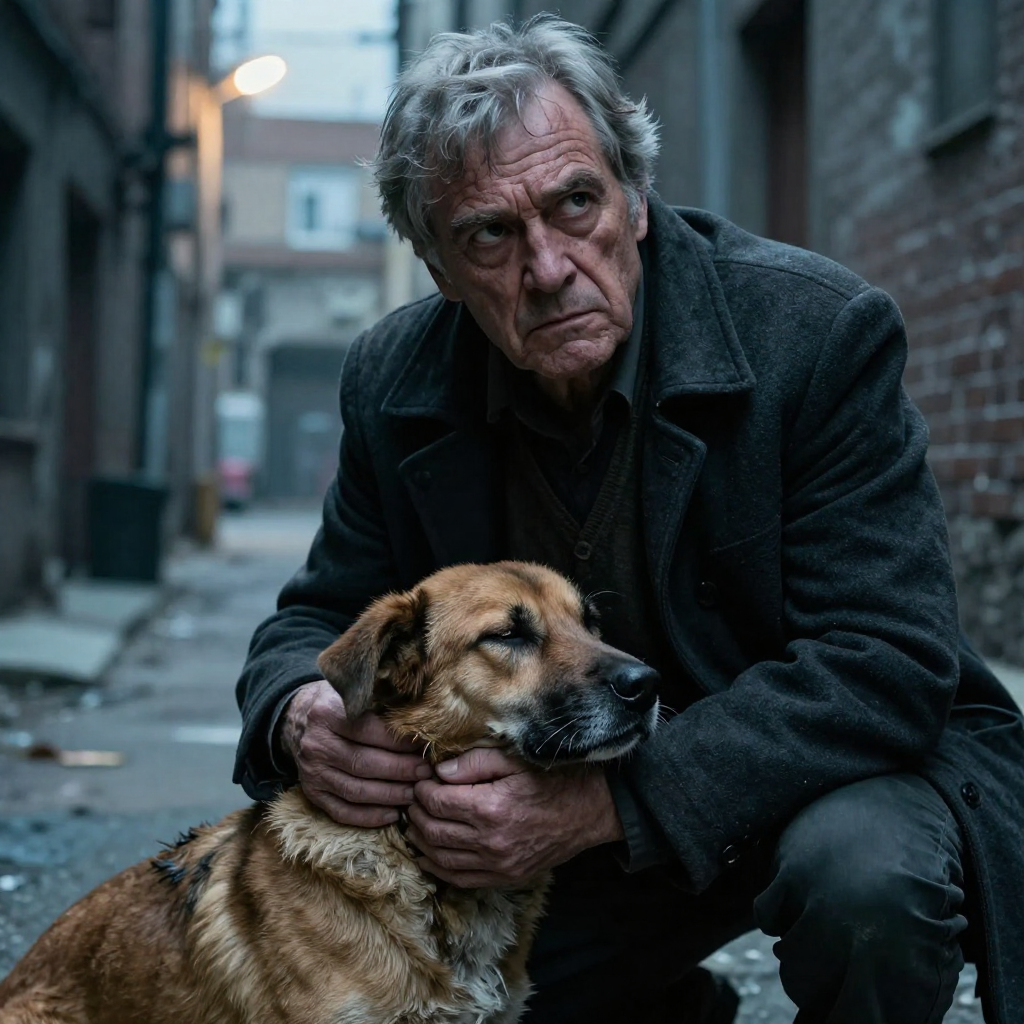
He wasn’t a threat. He was a skeleton wrapped in coarse, brown fur. A stray dog, ribs heaving like accordion bellows, caked in mud and shivering so violently it shook the fence behind him. He wasn’t growling. He wasn’t showing teeth. He was pressed as flat as he could get, eyes squeezed shut, waiting for the end.
One of the boys—the tall one in the red jacket—hefted a jagged piece of concrete in his hand. He weighed it, testing the balance, a grin plastered across his face. “Watch this,” he said to his friends. “Right in the gut.”
He pulled his arm back. The dog flinched, a tiny, involuntary spasm of pure terror.
I didn’t yell. Yelling gives away your position and your emotional state. Yelling tells the adversary you are scared or angry. I needed to be something worse than angry. I needed to be inevitable.
I stepped out from the shadows, my boots scraping intentionally against the grit.
“Drop it.”
The voice that came out of me wasn’t my library voice. It wasn’t my ordering-coffee voice. It was the Command Voice. Low. Flat. resonating from the diaphragm. The voice that tells a crowd to disperse or a threat to stand down. It cuts through adrenaline like a knife.
The boy in the red jacket froze, his arm still cocked back. He spun around, eyes wide, expecting a cop. When he saw me—a gray-haired man in a wool coat—his shoulders relaxed. The smirk returned, sharper this time.
“Get lost, gramps,” he sneered, turning back to the dog. “We’re busy.”
He didn’t understand. He looked at me and saw an old man. He didn’t see the way my hands were loose at my sides, ready. He didn’t see that I had already assessed the distance (fifteen feet), the terrain (slick oil patch to the left), and the threat level (low capability, high cruelty).
“I won’t ask twice,” I said. I took a step forward. Just one. But it closed the distance in a way that made the air in the alley feel heavier.
The other two boys stopped laughing. They sensed it before the leader did—the shift in atmospheric pressure that happens when a predator enters the room. They shuffled their feet, looking at the exit behind me.
“You deaf?” Red Jacket laughed, but it sounded brittle now. He turned fully toward me, the rock still in his hand. “I said walk away before you get hurt.”
I looked him in the eye. I didn’t blink. I let thirty years of violence and discipline flood into that stare. I let him see the things I had seen. The riots. The assassination attempts. The bodies that didn’t make it. I projected every ounce of authority I possessed into the space between us.
“Son,” I said, my voice barely a whisper, yet clear as a bell in the silence. “I have protected the most powerful men on this planet. I have stood in front of bullets. I have taken down men twice your size who were trained to kill. You are holding a rock. Do you really want to find out what happens next?”
Silence stretched tight as a piano wire.
The dog whimpered again, a low, painful sound.
My eyes flicked to the rock in his hand, then back to his face. “Drop. The. Rock.”
The boy’s bravado cracked. He looked at his friends, but they were already backing away, heads down, distancing themselves from the mistake he was about to make. He looked back at me, searching for fear, for hesitation. He found none. He saw a wall.
His hand shook. The rock slipped from his fingers and hit the pavement with a clatter that sounded like a gunshot in the quiet alley.
“Go,” I said.
They ran. They didn’t walk; they scrambled, tripping over their own expensive sneakers, terrified of the ghost in the wool coat. I didn’t watch them leave. I was done with them. The threat was neutralized.
I turned my attention to the corner.
The adrenaline faded, leaving that familiar cold ache in my joints. I kneeled down on the wet pavement, disregarding the ruin of my trousers. The dog was trembling so hard his teeth clicked together. He smelled of rain and sickness and old fear.
“Hey there,” I whispered, my voice changing instantly. The Command Voice was gone, replaced by the soft rumble I used to use when my wife had nightmares. “It’s okay. You’re clear. You’re clear now.”
I held out a hand, palm up, steady. I didn’t reach for him. I let him decide. Control is something you take from an enemy, but trust is something you have to wait for.
He opened one eye. It was brown, clouded with infection, but beneath the pain, there was a spark of intelligence. He looked at my hand. He looked at the space where the boys had been.
Slowly, painfully, he stretched his neck out. He sniffed my fingers. Then, he let out a long, shuddering breath and laid his heavy head directly into my open palm.
I felt the heat of his skin, the frantic beat of his heart slowing down against my hand. I looked at his ribs, the bruising already forming where the stones had hit. My chest tightened. I thought I was done saving things. I thought my watch was over.
But as I looked at this broken creature who had absolutely no one in the world, I realized the earpiece might be gone, but the job wasn’t.
“Come on, soldier,” I murmured, sliding my arms under his fragile body to lift him up. He weighed nothing. He groaned but didn’t fight me. “Let’s get you out of the cold.”
I stood up, carrying him like he was the most precious cargo I had ever been assigned. The alley was empty now, silent except for the wind. But I wasn’t just walking home anymore. I was on duty.
CHAPTER II
I laid him on the passenger seat of my old Ford F-150, spread across a threadbare moving blanket I’d kept in the back for years. He didn’t struggle. He didn’t even whimper. He just leaked. A slow, steady drip of copper-scented fluid onto the wool, and a rhythmic, wet rattle in his chest that told me his lungs were struggling to find space. I’ve heard that sound before. It’s the sound of a body deciding whether it’s worth the effort to keep the engine running. I put my hand on his flank, feeling the jagged ridges of his ribs through the matted, filthy fur. He was cold—dangerously cold—so I cranked the heat until the vents were blowing air that smelled like dust and old coffee.
Driving through the city at 10:00 PM felt like navigating a ghost town. The streetlights blurred into long, amber streaks against the windshield. I kept one hand on the steering wheel and the other resting lightly on the dog’s head. He didn’t flinch. He just leaned into my palm, his eyes half-closed, filmed over with a dull gray haze. I found myself checking my mirrors every thirty seconds, a habit I thought I’d buried with my badge. My mind was running through tactical routes, identifying potential threats in the shadows of the alleyways we passed, but my primary focus was the cargo. For thirty years, I’d protected people who changed the world, or at least thought they did. Men in suits who spoke in soundbites. Now, my entire universe was a thirty-pound mutt with a broken spirit and a heartbeat that felt like a failing watch battery.
I pulled into the parking lot of the 24-hour emergency clinic on 4th Street. The neon sign was humming, a buzzing blue ‘VET’ that flickered against the dark pavement. I didn’t wait for a spot. I parked it crooked right in front of the sliding glass doors, left the engine running, and scooped him up. He was lighter than he looked—mostly bone and air. As the doors hissed open, the smell of ozone and industrial bleach hit me, sharp and clinical. It was the same smell that permeated the hospice wing where Martha spent her final three weeks. It’s a smell that doesn’t just sit in your nose; it sticks to your clothes and follows you home.
“I need a doctor,” I said. My voice wasn’t loud, but it had that weight I used to use when clearing a room for a motorcade. The young woman behind the desk, her hair tied in a messy knot, started to point toward a clipboard, but then she looked down at what I was holding. She saw the blood on my sleeves and the way the dog’s head hung limp over my forearm. She didn’t ask for a credit card. She hit a buzzer and a door swung open immediately.
“Exam Room Three,” she said, her voice dropping the customer-service lilt for something more urgent. “I’ll get Dr. Thorne.”
I walked into the room, a sterile box of white tile and stainless steel. I laid him on the table. He looked so small against that cold metal. I didn’t step back. I stayed right there, my hand on his shoulder, keeping him grounded. A few minutes later, the door pushed open and a woman in charcoal scrubs walked in. She looked tired—the kind of deep, cellular exhaustion that comes from seeing too much of the world’s casual cruelty. She had sharp, intelligent eyes and hands that moved with a practiced, steady grace.
“I’m Aris Thorne,” she said, not looking at me yet, her focus entirely on the dog. She began her assessment with a silence that I respected. She checked his gums—pale, almost white. She listened to his chest with a stethoscope, her brow furrowing. She ran her fingers down his spine and felt each rib with a delicacy that made me realize just how much pain he must have been in when those kids were kicking him.
“He’s in shock,” she murmured, more to herself than me. “Severe malnutrition. Dehydration. At least three broken ribs, one of which might be puncturing the lung—that’s the rattle you’re hearing. And the eye… there’s significant trauma there. Blunt force.” She finally looked up at me. Her gaze was like a searchlight. “What happened?”
“Some kids,” I said. I felt the heat rising in my neck again. “They were using him for target practice with rocks. I stopped them.”
She didn’t ask how I stopped them. She just nodded, looking at my hands, which were still stained with the dog’s blood. “You’re the one who brought him in. Are you the owner?”
“No,” I said. “I’m just the guy who was there.”
“This is going to be expensive, Mr…?”
“Frank,” I said. “And I don’t care about the cost. Do what you have to do.”
She looked at me for a long beat, as if trying to figure out what a man like me—someone who clearly hadn’t slept or smiled in a long time—was doing in her clinic at midnight with a stray. “We need to stabilize him first. Oxygen, IV fluids, pain management. Then X-rays. If he makes it through the night, we’ll talk about the eye and the ribs.”
As she prepared a needle, I felt a familiar, hollow ache in my chest. This was the Old Wound. It wasn’t a physical scar, but a memory of the day the doctors told me Martha’s cancer had moved into her bones. I had been a protector my whole life. I’d taken bullets for people I didn’t even like. I’d spent forty-eight-hour shifts standing in the rain, watching windows and rooftops. But when the enemy was inside my wife’s body, I was useless. I had all the training in the world, and I couldn’t stop a single cell from turning. I stood in that hospital room the same way I stood in this exam room—impotent, watching the life drain out of someone I was supposed to keep safe.
“I’m going to take him back now,” Dr. Thorne said. She signaled for an assistant, a tall boy who looked too young to be seeing this much blood. They slid a gurney under the dog. For a second, as they moved him, his tail gave a tiny, almost imperceptible twitch. He looked at me, just for a second, and the fog in his eyes seemed to clear. It was a plea. Or maybe a thank you. Then they were gone, and the door clicked shut, leaving me in the humming silence of the white room.
I went to the lobby and sat in one of the hard plastic chairs. I waited. That’s what retirement had been—waiting for nothing. But now, I was waiting for something that mattered. I took out my phone and checked my bank balance. My pension was steady, but it wasn’t a fortune. Martha’s medical bills had eaten through most of our savings before she passed. I had enough for this, but if it went on for weeks, I’d be dipping into the equity of the house. I didn’t hesitate. I’d sell the house and live in the truck if it meant I didn’t have to watch one more thing die on my watch.
About an hour later, Dr. Thorne came back out. She looked even more drained. She held a small handheld device—a microchip scanner.
“He’s stable for the moment,” she said, sitting in the chair next to me. She didn’t maintain the professional distance anymore. “He’s on a morphine drip and oxygen. He’s a fighter, Frank. I’ll give him that.”
“Good,” I said. My voice was thick.
“There’s a complication,” she said, held up the scanner. “We scanned him for a chip. Standard procedure for strays. He has one.”
My heart sank. A chip meant an owner. An owner meant I might have to give him back to the very people who let him end up in that alley. “And?”
“His name is Titan,” she said, her voice turning cold. “He’s registered to a family in the Heights. The Vances.”
I knew the name. Everyone in this city knew the Vances. They were ‘old money’ with new-world cruelty. Thomas Vance was a developer who owned half the waterfront and had the mayor on speed dial. They weren’t just rich; they were insulated. They were the kind of people I used to protect—the ones who thought the rules were suggestions for the little people.
“If he belongs to them,” I said, my voice dropping to a low growl, “why was he starving in an alley getting stoned by kids?”
“The address on the chip is their estate,” Thorne said. “I’m legally required to notify them. In fact, the system does it automatically when the chip is scanned at a certified clinic. They’ve probably already received the alert.”
“He’s not going back there,” I said. It wasn’t an opinion. It was a fact.
“Frank, if they want him back, it’s a legal matter. He’s considered property. If you withhold him, it’s theft.”
“Look at him,” I said, gesturing toward the back rooms. “Is that how you treat property you care about? He’s a skeleton. He was being murdered.”
Before she could answer, the front doors of the clinic hissed open. The sudden gust of night air brought with it the smell of expensive cologne and rain. I stood up before I even realized I was doing it.
In walked a woman wrapped in a camel-hair coat that probably cost more than my truck. Behind her was a boy. My blood turned to ice. It was the kid from the alley—the one in the red jacket. He wasn’t wearing the jacket now, just a clean polo shirt, but I recognized the set of his jaw, the arrogant tilt of his head. He looked different in the light—less like a predator and more like a bored prince. But his eyes were the same. Cold. Vacant.
“I believe you have our dog,” the woman said. She didn’t look at me. She addressed the girl at the front desk as if she were a vending machine. “Titan. We received a notification.”
Dr. Thorne stepped forward, her posture stiffening. “Mrs. Vance? I’m Dr. Thorne. Titan is in critical condition. He has multiple broken ribs, severe malnutrition, and a traumatic eye injury.”
Mrs. Vance sighed, a long, theatrical sound of annoyance. “Yes, well, he’s been missing for a week. Julian here was devastated. We assumed he’d been hit by a car or something equally messy. It’s a relief he’s been found, though he sounds like a bit of a wreck. Julian, go see if you can see him.”
The boy started toward the door to the exam area. I stepped into his path. I’m not a small man, and when I stand straight, I still have the silhouette of the man who stood between presidents and assassins. The boy stopped dead. He looked up at me, and for the first time, I saw a flicker of recognition—and then a flash of pure, undiluted spite.
“You,” he hissed.
“Julian?” his mother asked, finally turning her gaze toward me. She looked me up and down, her lip curling in a way that told me exactly where she placed me on the social ladder. “Who is this?”
“He’s the guy, Mom,” Julian said, his voice rising. “The one I told you about. The crazy guy in the alley who threatened us. He stole Titan.”
“I didn’t steal him,” I said, my voice vibrating in my chest. “I rescued him from being murdered by your son and his friends. They were stoning him, Mrs. Vance. While he was too weak to even stand.”
The lobby went dead silent. The receptionist stopped typing. Dr. Thorne looked from me to the Vances, her face a mask of horrified realization.
“That is a very serious accusation,” Mrs. Vance said, her voice dropping to a dangerous, silky whisper. “My son is a decorated student. He wouldn’t hurt a fly. This dog is our property. He escaped our yard, and clearly, you’ve been keeping him somewhere, letting him rot, so you could play the hero. Or perhaps you’re looking for a reward?”
“I don’t want your money,” I said. “And the dog isn’t going anywhere with you.”
“He is our legal property,” she snapped. “Julian, call your father. Tell him we’re at the clinic and there’s a… person… here attempting to extort us.”
This was the Triggering Event. The moment where the path split. I could have stepped aside. I could have let them take the dog. I could have gone home to my quiet house, my cold bed, and my fading memories. I could have avoided the lawsuit, the police reports, and the weight of the Vance family’s influence. It would have been the ‘smart’ thing to do.
But I looked at the boy. I saw the way he was smiling—a small, cruel tuck at the corner of his mouth. He knew he was winning. He knew that in this world, people like him usually did. He looked at me as if I were a bug he was about to step on.
“The dog stays here,” I said. “He’s under medical care. He’s not stable enough to move.”
“That’s for us to decide,” Mrs. Vance said. She turned to Dr. Thorne. “Doctor, prepare the animal for transport. We’ll take him to our private vet.”
Dr. Thorne looked torn. I could see the calculation in her eyes—the weight of the Vance name against the ethics of her practice. “Mrs. Vance, he really isn’t in any condition to be moved. The risk of a collapsed lung is high.”
“I don’t care,” the woman said. “He is mine. Now.”
I reached into my pocket and pulled out my old wallet. I took out my retired ID—the one with the gold seal. I didn’t show it to the woman. I showed it to Dr. Thorne. Then I looked at the woman.
“My name is Frank Castleman,” I said. “I spent thirty years in the Secret Service. I’ve seen how people like you operate. You think everything is a transaction. You think you can buy silence and compliance. But here’s the thing about being retired: I have nothing left to lose. I have no career to protect. No reputation to worry about. If you try to take that dog out of this clinic tonight, I will call every contact I have in the press. I’ll make sure the story isn’t about a lost dog. It’ll be about the Vance heir torturing an animal to death while his mother tries to cover it up. I’ll make your name a synonym for cruelty.”
It was a bluff. Mostly. My ‘contacts’ were mostly retired guys who spent their days fishing or complaining about their prostates. But I still knew how to project authority. I still knew how to make a threat sound like a promise.
Mrs. Vance’s face turned a mottled, ugly red. Her composure cracked, revealing the jagged edges of her ego. “You wouldn’t dare. You’re a nobody.”
“Try me,” I said. “I’m a nobody with a lot of time on his hands and a very long memory.”
Julian’s smile vanished. He stepped back, bumping into a display of expensive dog treats. His mother grabbed his arm, her fingers digging in so hard he winced. She looked at Dr. Thorne, then at me, her eyes darting like a trapped animal.
“Fine,” she spat. “Keep the mutt. He’s probably going to die anyway. But don’t think this is over. You’ll be hearing from our attorneys. You’ve just made a very expensive mistake, Mr. Castleman.”
“I’ve made plenty of those,” I said. “One more won’t kill me.”
She turned on her heel and marched out, dragging Julian behind her. The door hissed shut, and for a moment, the lobby was silent again, except for the hum of the neon sign.
Dr. Thorne let out a breath she’d been holding for a long time. She looked at me, her eyes wide. “You realize what you just did, right? They’re going to come for you. They’ll sue you for everything you have. They’ll claim you stole him, that you abused him yourself to frame them.”
“I know,” I said. I felt a strange sense of calm. The weight in my chest hadn’t gone away, but it had shifted. It wasn’t the heavy, stagnant weight of grief anymore. It was the sharp, familiar weight of the mission.
“Why?” she asked. “Why do this for a dog you found in an alley an hour ago?”
I looked at my hands. The blood was drying, turning into a dark, crusty map of my failure to be a bystander.
“Because nobody else was going to,” I said. “And because I’m tired of watching things I’m supposed to protect get broken by people who think they’re entitled to do it.”
I sat back down in the hard plastic chair. My back ached, and my hands were shaking—just a little. The secret I’d been keeping from myself was that I was lonely enough to die. But as I sat there, listening to the muffled sounds of the clinic, I realized I wasn’t ready to go just yet.
I had a moral dilemma now. To keep the dog safe, I was going to have to break the law I’d spent my life upholding. I was going to have to lie, to manipulate, and perhaps to fight. I was going to have to be the man I was before I became a ghost in a suburban house.
“Frank?” Dr. Thorne said softly.
“Yeah?”
“He’s going to need a lot of surgery if he makes it through the night. The bill is already in the thousands.”
“Bill me,” I said. “I’ve got a house. I’ve got a truck. I’ve got a life I’m not using for much else. Use whatever it takes.”
I leaned my head back against the wall and closed my eyes. The Old Wound didn’t hurt as much. For the first time in three years, I knew exactly what I was doing. I was on a protective detail. And this time, I wasn’t going to let the target fall.
CHAPTER III
The silence of the recovery ward was the first thing that started to grate on my nerves. It wasn’t a peaceful silence. It was the kind of quiet you get in a bunker when you know the shells are landing closer with every passing hour. I sat in a plastic chair that had become my entire world, watching the rhythmic rise and fall of the dog’s chest. Titan. That was the name the Vances had given him, a name that felt like a heavy, iron collar. To me, he was still just the creature I’d pulled from the dark.
Dr. Aris Thorne walked in around 3:00 AM. She looked like she hadn’t slept since the Reagan administration. She held a tablet in one hand and a cup of lukewarm coffee in the other. She didn’t look at the dog first; she looked at me.
“They’re moving, Frank,” she said. Her voice was thin, like paper being folded. “The hospital board received a formal complaint an hour ago. Not just a complaint—a legal injunction. They’re claiming the dog is stolen property. They’ve also mentioned that I’m ‘aiding and abetting’ a known criminal. That’s you, apparently.”
I didn’t move. I didn’t even look up from the dog’s bandaged leg. “I’m a retired federal agent with a clean jacket and a pension that says I’ve done more for this country than Julian Vance will do in ten lifetimes. Let them talk.”
“It’s not just talk,” she whispered, sitting on the edge of a rolling stool. “The board wants me to discharge him into the custody of the Vances’ private veterinarian. They’ve already authorized a transport team. They’ll be here by morning. Frank, they aren’t playing. They’re erasing you.”
I reached into my pocket and pulled out my phone. I wanted to call my bank, just to check, even though I knew what I’d find. The screen flickered to life. Three missed calls from an unlisted number. One text from my bank’s fraud department. My accounts were flagged. Frozen. A ‘suspicious activity’ hold that would take days, maybe weeks, to clear. I tried my credit card on the hospital’s vending machine ten minutes later. Declined.
This was the Vance way. They didn’t need to hit you with a fist when they could hit you with the entire weight of the financial system. They weren’t just taking the dog; they were cutting my oxygen lines.
I went back to the room and looked at the dog. He opened one eye—the one that wasn’t swollen shut. It was a deep, soulful amber. He didn’t look at me with fear anymore. There was a flickering recognition there. He knew I was the one who had stayed.
“You’re not going back,” I told him. My voice was a low growl that surprised even me. “I’ve spent thirty years protecting people who didn’t always deserve it. I think I can spend one night protecting someone who does.”
By 6:00 AM, the atmosphere in the clinic had shifted from clinical to hostile. The morning shift nurses looked at me with a mix of pity and suspicion. I was the man who had brought the storm to their doorstep. Dr. Thorne was in her office, likely arguing for her career.
Then the glass doors at the front of the clinic hissed open. I heard the footsteps before I saw them. Not the soft squeak of medical clogs, but the hard, rhythmic strike of expensive leather soles.
I stood up and stepped into the hallway.
Mrs. Vance was there, flanked by two men in dark suits who tried very hard to look like they weren’t hired muscle. They were private security, the kind that cost more per hour than I made in a month. Behind them was Julian. He looked different today. He wasn’t hiding behind his mother. He had a smirk on his face, a look of pure, predatory anticipation. He was holding a leash. A brand-new, braided leather leash.
“Mr. Miller,” Mrs. Vance said, her voice dripping with a practiced, icy composure. “You’ve had your little moment of heroism. It’s over. We have a court order signed by Judge Halloway. The dog is to be returned to us immediately. If you interfere, these gentlemen have been instructed to assist the local police in your arrest.”
“The dog is in no condition to be moved,” I said. I kept my hands visible, at my sides. Old habits. “He has internal bleeding and three broken ribs. Moving him now is a death sentence.”
“He’s our property,” Julian stepped forward, his voice cracking with a strange, high-pitched excitement. “He’s my dog. I can do whatever I want with him. You’re just a thief. A smelly, old thief.”
I looked at Julian. I’d seen that look before. In interrogation rooms. In the eyes of men who didn’t feel the world the way the rest of us did. It wasn’t anger. It was a void. He didn’t want the dog back because he loved it. He wanted it back because he wasn’t finished breaking it.
“You’re not taking him, Julian,” I said softly.
Mrs. Vance scoffed. “Call the police, Arthur,” she said to one of the suits.
“No need,” a new voice boomed from the entrance.
We all turned. A man in a sharp, grey suit stood there. He wasn’t local. He had the unmistakable aura of federal authority—the kind that makes local judges and wealthy socialites very uncomfortable. Behind him were two uniformed officers from the State Police, not the local precinct the Vances had in their pocket.
“Special Agent Marcus Thorne,” the man said, flashing a badge. He looked remarkably like Dr. Thorne. “I’m with the Office of Professional Responsibility. And I believe there’s an issue here regarding the falsification of legal documents and the intimidation of a witness in an ongoing federal inquiry.”
Mrs. Vance’s face went pale. The composure didn’t just crack; it vanished. “This is a local matter. Judge Halloway—”
“Judge Halloway is currently being asked why he signed an emergency injunction at four in the morning for a family he shares a vacation home with,” Marcus Thorne said, walking toward us with a slow, deliberate gait. He looked at me and gave a microscopic nod. Aris had made the call. She’d reached out to her brother.
“And as for you, Mrs. Vance,” Marcus continued, “we’ve been looking into your family’s offshore holdings for six months. We were going to wait, but since you decided to use your influence to harass a retired service member and freeze his federal pension accounts… well, we decided to move up the timetable.”
Julian’s smirk died. He looked at the State Police officers, then at the dog’s room. For a second, I thought he might try to bolt past me. He took a step toward the door, his eyes locked on the dog.
“Don’t,” I said. It wasn’t a threat. It was a fact.
Julian looked at me, and for the first time, I saw the mask slip entirely. The boy didn’t feel remorse, but he felt frustrated. He hissed, a sound that wasn’t human, and swung the leather leash at the air. He looked like a cornered animal, one that had been told ‘no’ for the first time in its life.
“He’s just a dog!” Julian screamed. His voice echoed through the sterile hallway, bouncing off the glass and tile. “He’s mine! I can kill him if I want! I bought him!”
Mrs. Vance tried to grab his arm, to silence him, but it was too late. The State Police officers were watching him now, their expressions shifting from boredom to genuine alarm. They saw the darkness in him. Everyone in the hallway saw it.
“Take your son home, Mrs. Vance,” Marcus Thorne said, his voice cold and flat. “And I suggest you find a very good lawyer. Not the kind who plays golf with judges. The kind who knows how to navigate a federal indictment.”
They left. They didn’t leave with dignity; they retreated. Mrs. Vance dragged Julian by the arm, and the boy looked back at me one last time, his eyes full of a promise of future violence. But I knew he was done. The Vance name was poisoned now. The light had been turned on, and the cockroaches were scrambling.
I leaned against the wall, the adrenaline leaving my system like a receding tide. My knees felt weak. Dr. Thorne came out of the room, her eyes wet. She looked at her brother, then at me.
“Is it over?” she asked.
“For now,” Marcus said. He turned to me. “Frank, I can’t keep your accounts frozen forever, but it’ll take twenty-four hours to undo what they did. You need to get out of here. The Vances are down, but they’re not out. They have friends. This town isn’t safe for you anymore.”
I looked through the window at the dog. He was awake now, watching the door. He looked smaller than he had in the alley, but stronger.
“I’m not leaving him,” I said.
“You don’t have to,” Aris said. “I’m signing his discharge papers. Not to the Vances. To you. I’ve listed him as an abandoned animal in need of immediate foster care. The paperwork is dated two hours before their injunction. It’ll hold.”
I looked at her. “You could lose your license for this.”
“I’d rather lose my license than my soul, Frank,” she said with a small, tired smile. “Go. My brother has a car waiting in the back. Get him to the state line. I’ll send his medical records to a clinic I trust in Vermont.”
I went into the room. The dog didn’t flinch when I approached. I reached down and gently unhooked the IV. I wrapped him in a thick, wool blanket. He weighed almost nothing. I lifted him into my arms, careful of his ribs. He tucked his head under my chin, his breathing warm against my neck.
“You need a name,” I whispered as I walked down the back service corridor. “Titan is gone. That dog died in the alley.”
We reached the back exit. The morning air was crisp and smelled of rain. Marcus was waiting by a nondescript SUV. He opened the back door for me.
I climbed in, settling the dog onto the seat beside me. He looked out the window at the rising sun. The light hit his black fur, casting a long, dark silhouette across the upholstery.
“Shadow,” I said. “Your name is Shadow.”
He looked at me, and for the first time, he let out a tiny, soft huff of air. A sigh of relief.
As the SUV pulled away from the clinic, I looked back at the town I had called home for ten years. I had no money. My house was likely being watched. My reputation in this county was shredded. I was sixty-two years old, and I was starting over with nothing but a broken dog and a target on my back.
But as Shadow rested his head on my thigh, I felt a strange, terrifying lightness. For the first time in a long time, I didn’t feel like a man waiting for the end. I felt like a man who had finally found the beginning.
We hit the highway, the engine humming a steady, low tune. The trees blurred into a wall of green and gold. I didn’t know where we were going, not exactly. I just knew we were moving forward.
I reached out and ran my hand over Shadow’s head. His ears flickered. He didn’t pull away. He leaned into my touch.
I had lost my house. I had lost my savings. I had lost the quiet, predictable life I had built for myself. But as the sun climbed higher into the sky, illuminating the road ahead, I realized I hadn’t lost anything that actually mattered.
The Vances had their money and their power and their hollow, gilded lives. They had their secrets and their monster of a son. They had everything, and yet they had nothing.
I looked at my hands. They were steady. The tremors that had plagued me since retirement were gone. I was a protector again. I had a mission.
“We’re going to be okay,” I told the dog.
Shadow closed his eyes, his body finally relaxing into a deep, healing sleep. The war of attrition was over. We had survived the storm, and though we were both scarred and battered, we were still standing.
I drove on into the light, leaving the ruins of my old life in the rearview mirror, finally at peace with the man I had become.
CHAPTER IV
The news hit like a hammer. I saw it first on a gas station TV in Kentucky – the kind permanently tuned to CNN with the volume blasting. Vance Enterprises, the chyron read, Under Federal Investigation. Then Julian’s face flashed on the screen, looking blurry and scared in an old yearbook photo. I almost dropped the pump.
Shadow, resting by my feet, whined softly. He felt my tension like a physical touch. I knelt, scratched behind his ears, and told him it was okay, just news. But it wasn’t just news, was it? It was the reckoning we’d set in motion. A reckoning I wasn’t sure I even wanted anymore.
That night, holed up in another cheap motel, the details trickled in. Mrs. Vance was on every channel, looking severe and composed, denying everything. Julian had been quietly pulled from whatever fancy boarding school he attended. The whispers were louder now, the kind that money couldn’t silence – whispers about fraud, about offshore accounts, about a long history of bending the rules until they shattered.
The phone rang. I almost didn’t answer. I didn’t recognize the number, but a gut feeling told me. It was Aris.
Her voice was tight, strained. “Frank,” she said, like a sigh. “It’s… it’s bad. Really bad.”
I already knew. “Are you okay?”
“I’m… fine. Marcus is running point on everything. He says they have enough to indict. To indict everyone.”
I pictured her in that clinic, the sterile smell of antiseptic, the weight of her choices. “Did they come after you? Because of…”
“Not yet. But it’s coming. The board is already… concerned. My family name isn’t helping me here. Some think I aided and abetted a fugitive.”
Fugitive. That stung.
“I’m sorry, Aris.”
“Don’t be. I did what I did. I just… I don’t know, Frank. Is it worth it? Is any of this worth it?”
I didn’t have an answer then. I still don’t.
###
The weeks that followed were a blur of highways and cheap diners. I kept moving, never staying in one place for more than a night or two. The news cycle churned. The Vance story went from front-page headlines to page six filler. There were other scandals, other tragedies, other distractions to capture the public’s fleeting attention. But for Aris, for me, for Shadow, it was far from over.
I started getting the nightmares again. Not about the job, or the missions, or the faces I’d seen fall. These were different. They were about Julian, about his eyes, about the cold, empty space where his humanity should have been. I’d wake up sweating, heart hammering, Shadow whimpering and licking my face until I calmed down.
One morning, in a dusty town in Oklahoma, I got a letter. No return address, just my name scrawled on the envelope. Inside was a single newspaper clipping. Julian Vance had been charged as a minor with animal cruelty and several counts of assault. The article mentioned psychological evaluations, court-mandated therapy, and the possibility of juvenile detention. It was a slap on the wrist. Nothing more.
Rage, hot and blinding, flared in my chest. I wanted to find him, to look him in the eye and ask him if he understood what he’d done. But I knew that wouldn’t solve anything. It would only feed the cycle.
I crumpled the clipping, tossed it in the trash, and kept driving.
###
Shadow started flinching. He’d always been skittish around loud noises, but now it was constant. A slamming door, a revving engine, even a raised voice would send him cowering. I tried everything – treats, gentle words, a soft touch. Nothing worked.
One afternoon, I pulled into a small-town veterinary clinic in Arkansas. The waiting room was filled with the usual suspects – anxious owners, barking dogs, the lingering smell of disinfectant. When the vet, a kind-faced woman with tired eyes, finally called us in, I laid it all out. The abuse, the trauma, the constant fear.
She examined Shadow gently, her touch reassuring. “He’s got more than just scars,” she said quietly. “He’s got ghosts.”
She prescribed medication, a mild sedative to help him cope. But she also recommended something else: patience. “Time,” she said. “And love. That’s the only thing that really heals.”
That night, I held Shadow close, feeling his trembling body against mine. I knew she was right. Time. Love. It was all we had.
The medication helped, a little. But the flinching didn’t stop completely. Sometimes, in the dead of night, I’d wake up to find him staring at me, his eyes wide and haunted. And I knew, in that moment, that we were both broken. In ways that no one else could understand.
###
A year passed. The Vance case slowly faded from the public consciousness. There were rumors of plea deals, of settlements, of fortunes quietly shuffled overseas. Aris had lost her position at the clinic. She’d moved to a different state, started over. We spoke occasionally, stilted conversations filled with unspoken regrets.
I found a small, isolated cabin in Montana, far from everything and everyone. The days were quiet, filled with the simple routines of survival – chopping wood, hauling water, tending to the small garden I’d planted. Shadow roamed freely, chasing squirrels and barking at the occasional deer. He was still skittish, still scarred, but he was healing. Slowly.
One evening, as the sun dipped below the mountains, painting the sky in hues of orange and purple, I sat on the porch, watching Shadow sleep at my feet. He was twitching in his sleep, probably chasing rabbits in his dreams. I reached down, stroked his fur, and felt the familiar comfort of his presence.
The wind whispered through the trees, carrying the scent of pine and damp earth. It was a lonely life, a quiet life. But it was ours. And in that moment, surrounded by the vastness of the wilderness, I realized that maybe, just maybe, we’d finally found a place to heal.
A new sound interrupted my thoughts. A car. Coming up the track to the cabin. I hadn’t had any visitors in all this time. My hand instinctively reached for the pistol I kept in the drawer beside my chair. Who could it be? And why now? The car stopped and a figure emerged. Marcus Thorne. He looked tired. He walked towards me with an expression I couldn’t quite read. I tensed, waiting to hear what fresh hell he was bringing with him.
He held up his hands. “Frank,” he said, his voice weary. “I need to talk to you about Julian Vance.”
CHAPTER V
The letter arrived on a Tuesday, tucked into the usual pile of junk mail. I almost tossed it, didn’t recognize the handwriting. But the return address – a P.O. box in some backwater town in Arkansas – snagged my attention. It was from Aris. We’d kept in touch, sporadically. A quick email every few weeks, mostly checking in, making sure we were both still breathing. I hadn’t seen her since… since everything.
I unfolded the thin, blue paper, the scent of her perfume – lavender and something earthy I couldn’t quite place – a ghost of a memory. The words were simple, direct, like Aris herself. Julian was being released. He’d served his time, a pittance considering the havoc he’d wreaked, the damage he’d done. But the Vance family money still talked, even after everything. She didn’t say it, but I knew she was worried. Worried about me. Worried about Shadow.
My first instinct was to pack up, disappear again. Change our names, find another cabin, another life. But Shadow. He was lying at my feet, his head resting on my boot, one eye half-closed. He’d come so far. The nightmares were less frequent now, the trembling less pronounced. He deserved peace. We both did. Running wasn’t the answer. Not anymore.
That night, sleep eluded me. Images flickered behind my eyelids – Julian’s face, twisted with rage; Mrs. Vance’s cold, calculating eyes; Shadow, cowering in the corner of that godforsaken yard. But there was something else, too – a hollow ache in my chest, a need for something I couldn’t quite name. It wasn’t revenge. I didn’t want to hurt Julian. I just… needed to understand.
I decided to go back.
PHASE 1
The drive to Arkansas was a blur of asphalt and regret. Shadow sat beside me, his gaze fixed on the horizon, a low whine rumbling in his chest every few hours. I tried to reassure him, telling him it would be okay, that we were doing this for him, for us. But the words felt hollow, even to my own ears.
I checked into a motel on the outskirts of town, the kind with peeling paint and questionable stains on the carpet. It was a far cry from the life I used to lead, the expensive hotels, the fancy restaurants. But it was honest. It was real. And it was where I belonged, now.
I called Aris the next morning. Her voice was hesitant, guarded. She’d warned Julian I might come, but I could tell she didn’t believe it until she heard my voice. We agreed to meet at a diner on the other side of town, a neutral ground. I left Shadow at the motel. He wouldn’t have understood, and I didn’t want to put him through any more than I already had.
Aris was waiting for me when I arrived, sitting in a booth by the window. She looked tired, older than I remembered. There were lines around her eyes that hadn’t been there before, a weariness in her smile.
“Frank,” she said, her voice barely a whisper. She reached across the table and took my hand, her grip firm, reassuring. “I didn’t think you’d actually come.”
“I had to,” I said. “For Shadow. For myself.”
We talked for hours, about everything and nothing. About her practice, about the animals she’d saved, about the challenges of small-town life. She asked about Shadow, about Montana, about my new life. I told her the truth, as much as I could. About the peace I’d found, the nightmares that still haunted me, the love I felt for that goofy, scarred-up dog.
Finally, I broached the subject I’d come for.
“Julian,” I said, the name tasting like ash in my mouth. “Where is he?”
Aris hesitated, her eyes clouding over with pain. “He’s… staying at the Vance estate,” she said. “His mother… she’s trying to help him. But…”
“But it’s not working,” I finished for her. “Is it?”
She shook her head, her gaze fixed on her hands. “He’s… not well, Frank. He never was. But prison… it made him worse.”
I knew then that whatever I thought I was going to say, whatever confrontation I’d imagined, it wasn’t going to happen. Not the way I’d planned.
PHASE 2
Driving up to the Vance estate felt like stepping back into a nightmare. The wrought-iron gates, the manicured lawns, the imposing mansion looming in the distance – it was all exactly as I remembered it. A monument to wealth and power, built on a foundation of cruelty and lies.
I parked at the end of the long driveway and got out of the truck. My heart was pounding in my chest, my palms were sweating. I took a deep breath, trying to calm myself. This wasn’t about revenge. This was about closure. This was about finally putting the past behind me.
I walked towards the front door, my footsteps echoing on the gravel. A security guard emerged from the shadows, his hand resting on his holstered weapon. He recognized me, his eyes narrowing with suspicion.
“I need to see Julian,” I said, my voice firm, unwavering.
“Mr. Vance is not receiving visitors,” the guard said, his tone dismissive.
“Tell him Frank is here,” I said. “He’ll see me.”
The guard hesitated, then reluctantly reached for his radio. He spoke a few words into the device, then nodded curtly.
“Wait here,” he said.
I waited for what felt like an eternity, the tension coiling tighter and tighter in my chest. Finally, the front door opened, and Mrs. Vance emerged. She looked older, more frail than I remembered. But her eyes were still sharp, still calculating.
“Frank,” she said, her voice cold, devoid of emotion. “What do you want?”
“I want to see Julian,” I said. “I need to talk to him.”
Mrs. Vance hesitated, her gaze searching my face. “He’s not in a good place, Frank,” she said. “I don’t know if this is a good idea.”
“It’s not about what’s good for him,” I said. “It’s about what I need.”
She sighed, a flicker of something that might have been sadness crossing her face. “Very well,” she said. “But I’m warning you, he’s not himself.”
She led me inside, through the opulent foyer, past the portraits of stern-faced Vances, down a long, dimly lit hallway. The air was heavy with the scent of old money and decay.
She stopped in front of a closed door and turned to me. “He’s in here,” she said. “Don’t… don’t upset him.”
Then she left me alone.
PHASE 3
I took a deep breath and opened the door.
The room was dark, the curtains drawn tight. The only light came from a small lamp on a bedside table, casting long, distorted shadows across the walls. Julian was sitting in a chair by the window, his back to me. He looked smaller, more fragile than I remembered.
“Julian,” I said, my voice barely above a whisper.
He didn’t respond. I took a few steps closer, my heart pounding in my chest.
“Julian,” I said again, louder this time. “It’s Frank.”
He turned slowly, his eyes unfocused, vacant. He looked right through me, as if I wasn’t even there.
“Frank,” he said, his voice raspy, barely audible. “You came back.”
“I did,” I said. “I needed to see you.”
He stared at me for a long moment, his expression unreadable. Then, a flicker of recognition sparked in his eyes.
“The dog,” he said. “You took my dog.”
“He’s not your dog, Julian,” I said, my voice firm. “He’s Shadow. And he’s mine.”
He chuckled, a dry, humorless sound. “Mine,” he repeated. “Everything is mine.”
I took another step closer, my hand reaching out towards him.
“Julian,” I said, my voice soft, pleading. “Why? Why did you do it?”
He recoiled, his eyes widening with fear. “I… I don’t know,” he stammered. “I just… I had to.”
“Had to hurt him?” I asked. “Had to hurt everyone?”
He started to cry, silent tears streaming down his face. “I’m sorry,” he whispered. “I’m so sorry.”
I knelt down beside him, my hand resting on his arm. He didn’t flinch.
“It’s okay, Julian,” I said. “It’s okay.”
It wasn’t okay, of course. Nothing was okay. But I didn’t know what else to say.
We sat there in silence for a long time, the only sound the soft sobs coming from Julian’s chest. Finally, he looked up at me, his eyes filled with a mixture of pain and confusion.
“What do I do now, Frank?” he asked. “What do I do?”
I didn’t have an answer for him. I didn’t know what he should do. All I knew was that I had to let go. I had to forgive him. Not for his sake, but for mine.
“Just… try to be better, Julian,” I said. “That’s all you can do.”
I stood up and walked towards the door. I didn’t look back.
PHASE 4
I drove back to Montana that night, Shadow waiting anxiously in the motel. He leaped into my arms when he saw me, licking my face, burying his head in my chest. I held him tight, feeling the warmth of his body against mine, the steady beat of his heart.
We drove through the night, the endless ribbon of highway stretching out before us. The stars were out, bright and clear, and the moon cast a silvery glow over the landscape.
As the sun began to rise, painting the sky with hues of pink and gold, I felt a sense of peace settle over me. It wasn’t happiness, not exactly. But it was something close to it. Acceptance, maybe. Or maybe just resignation.
We arrived back at the cabin late that afternoon, exhausted but content. I built a fire in the fireplace, and Shadow curled up at my feet, his head resting on my boot.
I sat there for a long time, watching the flames dance and flicker, thinking about everything that had happened, everything that had changed. I thought about Julian, about Aris, about Mrs. Vance. I thought about the life I had lost, and the life I had found.
And I realized that it was all okay. It wasn’t perfect, but it was okay. I had Shadow, and he had me. And that was enough.
Weeks turned into months. Julian Vance entered a long-term treatment facility, paid for by his mother, who visited every week. Aris continued her practice, adopting a rescue dog of her own, a scruffy terrier mix she named Lucky. She still sent emails, less frequently now, but always with a warmth that made me smile.
Shadow and I settled into a comfortable routine. We hiked in the mountains, fished in the stream, and spent our evenings by the fire, reading books and listening to music. The nightmares faded, replaced by dreams of open fields and endless skies. He was healing, and so was I.
One evening, as the sun was setting, casting long shadows across the valley, I sat on the porch, watching Shadow chase butterflies in the meadow. He was happy, I could see it in his eyes, in the way he moved, in the carefree abandon with which he threw himself into every moment.
I smiled, a genuine, heartfelt smile. And I knew that I had finally found what I was looking for. Not forgiveness, not understanding, not even peace. But something simpler, something more profound: a reason to keep going.
I petted Shadow, looked out at the sunset, and knew that you carry your peace with you; it doesn’t arrive from elsewhere.
END.