HE LAUGHED AS HE KICKED THE BOX INTO THE DITCH, THINKING THE RAIN WOULD WASH AWAY THE EVIDENCE OF HIS BETRAYAL, BUT HE DIDN’T NOTICE THE HEADLIGHTS CUTTING THROUGH THE STORM OR THE MAN STEPPING OUT OF THE TRUCK WHO HAD SEEN EVERYTHING AND WAS ABOUT TO SHOW HIM WHAT REAL JUSTICE LOOKS LIKE.
The rain wasn’t just falling; it was hammering against the windshield of my pickup, a relentless, gray sheet that blurred the world into streaks of silver and charcoal. My shift had ended two hours ago, but the adrenaline of the day still hummed in my veins—a low-level static that usually took a few beers to quiet down. I was taking the back way home, a winding stretch of county road that snaked through the marshlands, usually empty this time of night. I just wanted to get home, dry off, and forget the things I’d seen in the city.
Then I saw the taillights.
They were bright red twin halos piercing the gloom ahead, belonging to a sleek, expensive SUV parked haphazardly on the soft shoulder. It was a late-model luxury vehicle, the kind that costs more than my house, gleaming darkly in the downpour. My first instinct was professional. Even off-duty, you never really turn it off. I thought maybe they had a flat, or had slid off the slick tarmac. I slowed my truck, easing onto the gravel behind them, flipping on my hazards. I didn’t reach for my badge immediately; I just reached for my umbrella.
But before I could open my door, I saw the driver.
He wasn’t inspecting a tire. He was wrestling with something in the backseat. He was a tall man, dressed in a sharp raincoat that looked tailored, his movements jerky and aggressive. He hauled a large, taped-up cardboard box out of the rear door. It looked heavy, awkward. The way he held it… there was no care in it. It was the way you hold a bag of garbage that’s leaking.
I watched, my hand freezing on the door handle, as he marched to the edge of the ditch. The ditch was swollen with runoff, a muddy slurry of water and dead leaves. He didn’t hesitate. He swung the box back and heaved it. It hit the mud with a wet, sickening thud, sliding halfway down the bank.
Then, he did something that made my blood turn to ice.
He stood there for a second, looking down at the box, and he spat. A glob of saliva flying into the rain, landing somewhere near the cardboard. He wiped his hands on his pants, a gesture of finality, of ridding himself of a burden. He turned back toward his car with a bounce in his step, like a man who had just finished a tedious chore.
Something inside me snapped. I didn’t grab my umbrella. I didn’t check for traffic. I kicked my door open and stepped out into the deluge. The rain soaked me instantly, plastering my hair to my skull, but I didn’t feel the cold. I only felt the heat rising in my chest.
“Hey!” I roared. The sound of my voice was swallowed by the wind, but he heard it. He froze, his hand on the door handle of his SUV.
He turned, squinting through the rain. When he saw me—a big guy in a soaked flannel shirt and jeans, stomping toward him—he didn’t look scared. He looked annoyed. He looked like I was a beggar asking for change.
“Car trouble?” he shouted back, his voice dripping with condescension. “I’m fine. Just clearing out some trash. Go on.”
Trash.
I looked past him, down into the ditch. The box was moving. It was a subtle shift, a rocking motion against the mud. And then, a sound cut through the noise of the storm. A high-pitched, muffled whine. It wasn’t the wind. It was a cry for help.
I didn’t stop walking until I was two feet from him. He smelled like expensive cologne and leather, a stark contrast to the smell of rain and ozone. “What’s in the box?” I asked. My voice was low, deadly quiet.
He scoffed, rolling his eyes. “None of your business, pal. Look, if you want a tip for stopping, I don’t carry cash. Just get back in your truck.”
I shoved past him. He stumbled back, slipping slightly on the wet gravel, indignation flashing across his face. “Hey! You touch me again and I’ll have you arrested for assault!”
I ignored him. I scrambled down the embankment, mud sucking at my boots. My hands tore at the wet cardboard. The tape gave way easily, soaked through. I ripped the flaps open.
Two eyes looked up at me. Milky, terrified eyes.
It was a dog. An old Golden Retriever, its muzzle white with age, its fur matted and filthy. It was shivering so violently that its teeth were chattering. It tried to stand up when it saw me, but its back legs were weak, giving out underneath it. It let out a soft whimper and licked the rain off its nose. It wasn’t aggressive. It wasn’t dangerous. It was just confused. It looked at me, then it looked past me, up at the man on the road—the man who had just thrown it away like a used wrapper.
The loyalty in those eyes broke me. Even after being tossed in a box, it was looking for him. It wanted to know what it had done wrong.
I carefully scooped the dog up. He was lighter than he looked, just bones under that thick, wet fur. He groaned as I lifted him, a sound of pure exhaustion. I climbed back up the slope, cradling the animal against my chest, shielding his head from the rain with my chin.
The man was still there. He hadn’t left. He was watching me with a look of pure disgust. “Oh for God’s sake,” he sneered. “Put it down. It’s done. The thing is sick, it’s incontinent, and I’m not ruining my upholstery for a trip to the vet. I did what had to be done.”
“You did what had to be done?” I repeated. I stepped onto the pavement. The dog was trembling against me, his heart beating a frantic rhythm against my own ribs.
“It’s a dog,” he said, spreading his hands. “It’s property. My property. And I’m disposing of it. Now put it back and walk away before I call the police.”
The irony was so sharp it almost made me laugh. I shifted the dog’s weight to my left arm. With my right hand, I reached into my back pocket. My fingers brushed the wet leather of my wallet.
“You want to call the police?” I asked, stepping into his personal space. I could see the veins in his neck, the arrogance faltering just a fraction as he realized I wasn’t backing down.
“I will,” he threatened, though his voice wavered. “I know people in this town. I’ll have you specifically hunted down.”
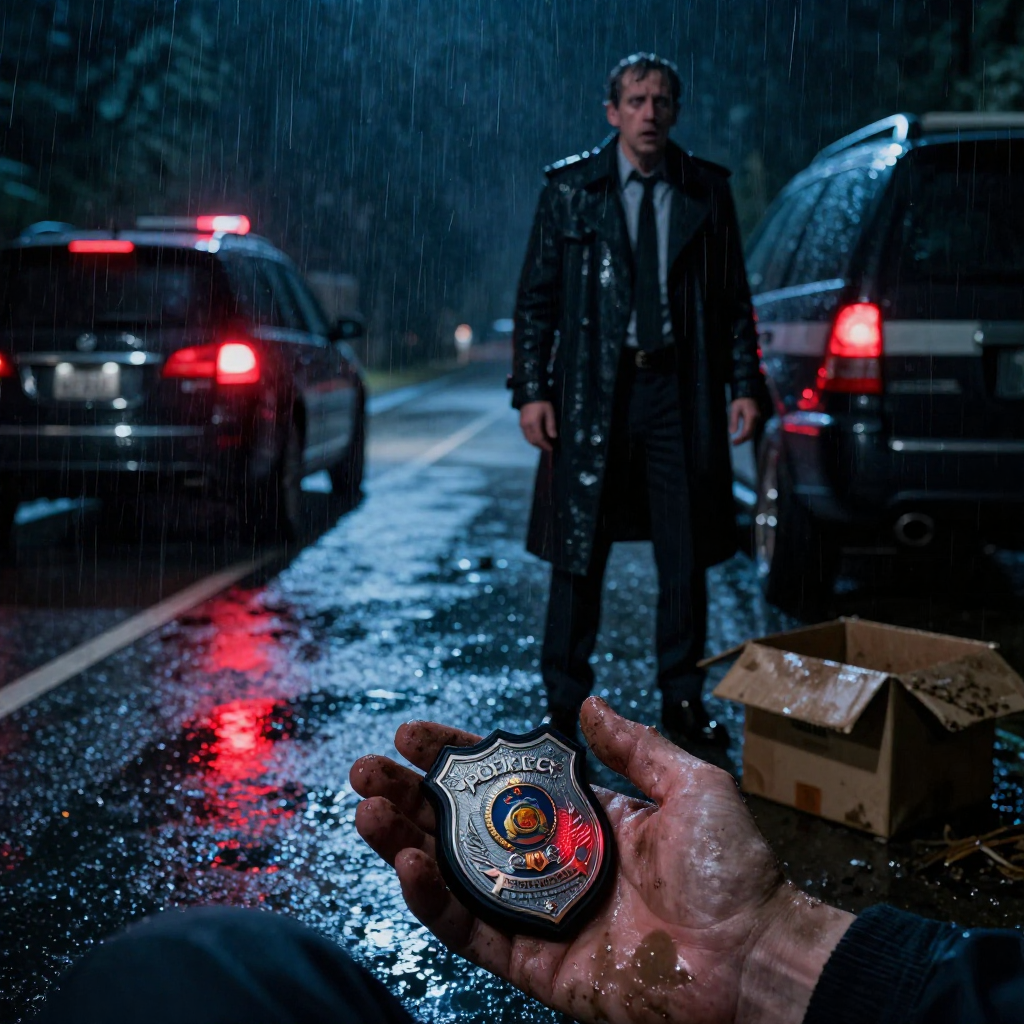
I pulled the wallet out and flipped it open. The gold badge caught the reflection of his headlights, shining bright and undeniable in the gloom.
“Go ahead,” I said, my voice shaking with the effort to not drop the dog and flatten him right there on the road. “Call them. Tell them Officer Miller is currently witnessing a felony under state animal cruelty laws. Tell them you just dumped a living creature in a ditch in freezing temperatures.”
The color drained from his face. It was instantaneous. The arrogance vanished, replaced by the hollow, sick look of a bully who has suddenly realized he picked the wrong target. He looked at the badge, then at me, then at the dog.
“Officer,” he stammered, holding up his hands. “Look, let’s not be hasty. It’s… it’s a misunderstanding. The dog was dead when I put him in there, I swear, I thought he was gone…”
“He’s licking my hand,” I said flatly. The dog was, in fact, pressing his cold nose against my neck, seeking warmth. “And you taped the box shut.”
He opened his mouth, but no words came out. He looked at his car, calculating his chances of fleeing.
“Don’t even think about it,” I said. “I have your plate. I have your face. And now, I have the victim.” I walked past him, toward my truck. I opened the passenger door and gently placed the old dog on the seat. I took off my flannel shirt—leaving me in just a t-shirt in the freezing rain—and wrapped it around the shivering animal. The dog let out a deep sigh, closing his eyes as the warmth of the heater hit him.
I slammed the door and turned back to the man. He was standing by his SUV, looking small and pathetic in the rain.
“You’re not going anywhere,” I told him. “Get in your car. Follow me to the station. If I lose sight of you for one second, I will add evading an officer to the list of charges I’m about to pile on you.”
“Please,” he said, his voice cracking. “I have a reputation. My family…”
“You should have thought about that before you threw your family in a ditch,” I said. I pulled out my phone and snapped a picture of him, then his car, then the empty box in the mud.
As I walked back to the driver’s side of my truck, I looked through the window. The old dog lifted his head and looked at me. The cloudiness in his eyes seemed to clear for a second, and I saw something there that I hadn’t seen in a long time. Hope.
I started the engine. The man in the rearview mirror was getting into his car, defeated. He knew his life was over. But for the old soul sitting next to me, life was just beginning.
CHAPTER II
The rain didn’t stop. It just turned into a steady, rhythmic drumming against the roof of my truck as I drove toward the 24-hour emergency clinic on the edge of town. In the passenger seat, the cardboard box was gone. I’d lifted the dog out and placed him on a thick wool blanket I usually kept for emergencies. He didn’t move much. His breathing was a series of shallow, raspy hitches that made my own chest feel tight. Every few minutes, I’d reach over and rest my hand on his flank, just to feel the faint, irregular heartbeat beneath his matted fur. He smelled like stagnant water and something deeper—the metallic tang of decay.
I didn’t go to the station first. My badge was sitting on the dashboard, catching the glare of the passing streetlights, but my priority was the life in the seat next to me. The station could wait. Richard Sterling—I’d seen the name on the registration when I made him pull over—was following me in his pristine SUV, a dark shadow in my rearview mirror. He was probably on his phone already, calling people who make problems go away. People like him don’t see consequences; they see inconveniences that require a checkbook.
When I pulled into the clinic’s parking lot, the neon sign flickered, casting a blue hue over the wet asphalt. I didn’t wait for Sterling. I scooped the dog up, blanket and all. He was heavier than he looked, a dead weight of bone and wet hair. As I pushed through the double doors, the smell of antiseptic hit me, sharp and cold. The girl behind the desk looked up, her eyes widening at the sight of me—drenched, mud-streaked, carrying a bundle of misery.
“Emergency,” I said, my voice sounding like it had been dragged over gravel. “I’m Officer Miller. I found him in a ditch.”
That was when Dr. Evans appeared. She was a small woman with graying hair tied back in a no-nonsense bun and eyes that had seen too much. She didn’t ask about the mud on my boots or why an off-duty cop was bringing in a half-dead animal. She just signaled a technician, and they moved the dog onto a stainless-steel gurney. I watched them wheel him away, the metal wheels clicking against the linoleum. It was a lonely sound.
I stood in the waiting room, my hands shaking. I shoved them into my pockets. It wasn’t just the cold. It was an old vibration, a tremor that started in my wrists and moved up my arms whenever the world felt like it was tilting off its axis. This was my secret—the one I kept from the department, the one that would end my career if the wrong person saw it. I’d been self-medicating with silence and steady breathing for a year, praying no one would notice the slight wobble when I held my service weapon.
Sterling walked in five minutes later. He looked out of place in the sterile room, his tailored coat shimmering with raindrops. He didn’t look guilty. He looked annoyed. Behind him was a man I recognized from the local news—Marcus Thorne, a lawyer known for defending the city’s most ‘complicated’ residents.
“Miller,” Sterling said, his voice smooth and dangerously quiet. “I think we’ve had enough of this theatrics. Give me the dog, and we can forget this ever happened. I’ll even contribute to your favorite charity. Let’s not make this more than it is.”
“It’s a felony, Richard,” I said, not looking at him. I was looking at the swinging doors where the dog had vanished. “Animal cruelty. Abandonment. You threw him out like trash.”
“It was an act of mercy,” Thorne stepped forward, his smile as sharp as a razor. “The animal was terminal. Mr. Sterling was merely… accelerating the inevitable in a private manner. You, Officer, have interfered with a private citizen’s right to manage his property. And you did so while off-duty, without a warrant, and using your badge to intimidate. That sounds like a very expensive lawsuit for the city.”
I felt the old wound opening then. It wasn’t a physical scar, but a memory of my father. He’d been a sergeant in the same precinct twenty years ago. I remembered him coming home, sitting at the kitchen table, and telling me that sometimes, you have to let the ‘big fish’ swim back into the pond because they pay for the water. He’d let a councilman’s son go after a hit-and-run because ‘the optics’ were bad. A week later, that same kid hit a girl on a bicycle. My father never looked at me the same way after that, and I never looked at him the same way either. I swore I wouldn’t be the man who let the big fish go. But here I was, facing a shark.
Dr. Evans came back out. She looked tired. She held a small plastic slip—a microchip report. “His name is Barnaby,” she said, her voice trembling with suppressed rage. “He’s twelve years old. He has advanced hip dysplasia, two treatable tumors on his abdomen, and he’s severely dehydrated. But the worst part, Officer? He’s been starved. This didn’t happen in a ditch. This happened in a home.”
She looked at Sterling. She knew who he was. Everyone in this town knew the Sterling family. They owned the malls, the construction firms, the land.
“I want him back,” Sterling said, stepping toward her. “He’s my property. I have the papers.”
“He’s evidence now,” I said, stepping between them. The tremor in my hand was worse. I gripped my belt to hide it. “Dr. Evans, please document everything. Scars, nutritional status, the condition of his coat. I want a full forensic veterinary report.”
Thorne laughed. It was a cold, dry sound. “You’re a beat cop, Miller. You’re not a detective. You’re overstepping, and you’re doing it with a history that isn’t exactly… pristine. I’ve read your file. The ‘incident’ three years ago? The use of force inquiry? You’re one bad day away from a desk job for life. Do you really want to spend your last bit of capital on a mutt that won’t last the week?”
He was hitting the bruise. They knew about my past. They knew I was vulnerable. This was the moral dilemma I’d been dreading. If I pushed this, Thorne would dig into my medical records. He’d find the neurologists I’d seen under a fake name. He’d find the tremors. I’d lose my badge, my pension, my identity. If I walked away, Barnaby would be handed back to the man who spat on him in a muddy ditch, and the world would keep spinning, indifferent to the suffering of a creature that couldn’t speak for itself.
Then the trigger happened. It was sudden and irreversible.
Sterling, emboldened by my silence, reached out to grab the folder from Dr. Evans’ hand. “Give me those records, you little…” he began, his face contorting into the mask of the man I’d seen in the rain.
Dr. Evans pulled back, and Sterling lunged. He didn’t just grab for the paper; he shoved her. She stumbled back, hitting a display case of pet vitamins. The glass shattered, a loud, violent crash that echoed through the quiet clinic.
A young woman in the waiting room, who had been sitting quietly with a cat carrier, gasped and pulled out her phone. She’d been recording the whole time. The look on Sterling’s face when he realized he’d been caught on camera—not by a cop, but by a citizen—was the first time I saw a crack in his armor.
“You saw that?” I asked the girl. She nodded, her hands shaking as much as mine. “I’m a witness,” she whispered. “He hit her.”
It was public now. It was on record. I couldn’t bury this even if I wanted to, and neither could the department. Sterling had just escalated a misdemeanor animal cruelty charge into a battery charge in front of a witness.
“Thorne, get me out of here,” Sterling hissed, his face turning a sickly shade of gray.
“You’re not going anywhere,” I said. I pulled my cuffs from my belt. The metal felt cold and heavy. “Richard Sterling, you’re under arrest for assault and battery, and animal cruelty. Turn around.”
As I clicked the cuffs shut, my hands were steady. For the first time in a year, the tremor was gone. But I knew the cost. Thorne was already on his phone. He wasn’t calling a bail bondsman; he was calling the Commissioner.
Twenty minutes later, after the patrol units arrived to transport Sterling, my cell phone buzzed in my pocket. It was Captain Vance. I didn’t want to answer it, but I knew I had to.
“Miller,” Vance’s voice was weary. He sounded like a man who had already been told what to do. “What the hell are you doing? I just got a call from the Mayor’s office. They’re talking about a civil rights violation. They’re talking about an off-duty officer harassing a primary donor.”
“He dumped a dog in a ditch, Captain. He assaulted a veterinarian.”
“I don’t care if he kicked a puppy into the sun, Miller! You’re not on the clock. You should have called it in and stayed out of it. Now, Thorne is making noise about your… ‘stability.’ He’s asking for an immediate fitness-for-duty evaluation. He says you were shaking, that you looked ‘manic.'”
I looked through the glass window into the treatment room. Barnaby was hooked up to an IV. His eyes were open now, dull but conscious. He looked so small under the bright lights.
“I’m not dropping it, Cap.”
“Then you’re alone on this one,” Vance said. “If this goes to a hearing, I can’t protect you. The department won’t protect you. You’ll be stripped of your badge before the week is out. Is a dying dog worth your life’s work?”
I looked at my hands. They were still steady. “My life’s work was supposed to be about protecting things that can’t protect themselves. If I can’t do that, the badge is just a piece of tin.”
“Don’t be a martyr, Miller. It’s a bad look on you. Go home. Sleep it off. Maybe tomorrow you’ll realize that the world doesn’t care about a Golden Retriever as much as you do.”
He hung up.
I went back into the treatment room. Dr. Evans was cleaning a small cut on her arm from the shattered glass. She looked up at me, then at Barnaby.
“He’s stabilized,” she said softly. “But he needs surgery on those tumors. And he needs a place to go where he won’t be afraid anymore. If Sterling’s lawyers get to a judge tonight, they might get an injunction to take him back.”
“They won’t,” I said. I didn’t know how I was going to keep that promise, but I knew I had to.
I sat down on the floor next to the gurney. I reached out and stroked Barnaby’s head. His fur was drying now, feeling softer. He leaned his head into my hand, a tiny, almost imperceptible movement, but it felt like a mountain moving. It was a gesture of trust from a creature that had every reason to hate every human he’d ever met.
I thought about my father. I thought about the silence he’d carried to his grave. I thought about the secret I’d been carrying, the fear of being ‘found out.’ Sterling and Thorne thought they had me in a corner. They thought they could use my past and my health to force me into the same silence my father had chosen.
But they didn’t understand one thing. When you have nothing left to lose, you become the most dangerous person in the room. I was already losing my career. I was already losing my health. The only thing I had left was the choice I was making right now.
I stayed there for hours. I watched the rain turn to mist as the sun began to rise. The clinic was quiet, save for the hum of the machines and the soft sound of Barnaby’s breathing. I knew that when I walked out those doors, the storm would really begin. There would be internal affairs investigations, subpoenas, and the public shredding of my reputation. Sterling would paint me as a rogue cop, a mentally unstable man who kidnapped a dog to settle a grudge.
But then Barnaby let out a long, deep sigh and closed his eyes, falling into a sleep that looked, for the first time, like it wasn’t a struggle.
I stood up, my knees popping. My back ached, and I still smelled like the ditch. I walked over to the desk and picked up a pen. I filled out the impoundment forms, the evidence logs, and the witness statements. I did everything by the book, even if the book was about to be burned in front of me.
As I finished the last signature, my phone buzzed again. A text from an unknown number. Just a link to a social media post. It was the video the girl had taken. It was already being shared. ‘Local Mogul Attacks Vet After Dumping Dog.’ The title was sensational, the comments were vitriolic.
Sterling had money. He had power. But he had forgotten that in the modern world, the truth doesn’t stay buried in a ditch for long.
The moral dilemma was no longer about whether I would keep my job. It was about whether I would let the system work the way it was designed, or if I would let the people who owned the system break it again. I knew what I had to do. I had to find the one person in this city who hated Sterling more than I did—his ex-wife. She was the one who had disappeared after the divorce, the one who had been silenced with a non-disclosure agreement.
Barnaby shifted on the gurney, his tail giving a single, weak thump against the metal.
“I’ve got you, pal,” I whispered. “I’ve got you.”
I walked out into the morning light. The air was cold and clean. The weight on my shoulders hadn’t disappeared, but it felt different now. It felt like a purpose. I drove back to the station, not as a man trying to save his career, but as a man who had finally decided what his career was actually for.
When I walked through the doors of the precinct, the atmosphere was thick. People were whispering. My sergeant looked at me with a mix of pity and warning. I didn’t stop at my desk. I walked straight to the evidence locker to check in the blanket and the photos I’d taken at the scene.
I was halfway through the paperwork when I saw Thorne standing in the hallway, talking to the Captain. They both looked at me. Thorne had a look of smug satisfaction. The Captain just looked away.
I knew what was coming. The suspension. The surrender of my weapon. The end of Officer Miller.
I reached into my pocket and felt the small, cold shape of the microchip ID tag Dr. Evans had given me. Barnaby. It was a name that meant ‘son of consolation.’
I wasn’t consolidated. I was focused. And for the first time in twenty years, I felt like my father’s son—not the son who followed in his footsteps, but the son who finally walked a different path.
The legal battle was just beginning. The powerful were circling their wagons. But I had a witness, I had a video, and I had a dog who refused to die.
It was going to be a long week. And I couldn’t wait for it to start.
CHAPTER III
I laid my badge on Captain Vance’s desk at six in the morning. The metal hit the wood with a hollow, lonely sound. It didn’t feel like a movie. There was no dramatic music. Just the hum of the vending machine in the hallway and the smell of stale coffee. Vance didn’t look at me. He looked at the badge like it was a piece of trash someone had left in his office. He told me I was suspended pending an Internal Affairs investigation. He told me I was a liability. He told me Sterling’s lawyers were already filing a civil suit for harassment, false arrest, and emotional distress. I didn’t say anything. I couldn’t. My right hand was tucked deep into my jacket pocket, curled into a fist to hide the vibration that was starting to travel up my forearm. It wasn’t fear. It was the clock ticking inside my nerves, the secret I’d kept for three years finally breaking the surface.
By noon, the secret wasn’t mine anymore. I was sitting in a diner three blocks from the precinct when the news alert hit the television above the counter. Thorne, Sterling’s shark of a lawyer, had held a press conference. He didn’t talk about the dog. He didn’t talk about the ditch. He talked about ‘public safety’ and ‘unstable officers.’ He leaked my medical records. The screen showed a grainy photo of me from the clinic, and then a headline scrolled across the bottom: ‘VIGILANTE COP OR MEDICAL LIABILITY? OFFICER’S NEUROLOGICAL CONDITION EXPOSED.’ Thorne had framed the entire arrest as the erratic behavior of a man losing control of his body. He suggested I hadn’t seen Sterling dump a dog; he suggested I’d had a ‘neurological episode’ and hallucinated the whole thing to cover my own incompetence. People in the diner were looking at the screen, then looking at me. I paid my bill and walked out, my hand shaking so hard I had to pin it against my thigh.
I drove. I didn’t have a plan, but I had a name. I’d spent the previous night digging through public records before my department login was revoked. Richard Sterling had been married once, ten years ago, to a woman named Elena. The divorce had been quiet, settled out of court with a massive non-disclosure agreement. It took me four hours to find the small cottage in the suburbs of a neighboring county. The garden was meticulously kept, a sharp contrast to the cold, sterile mansion Sterling occupied. When I knocked on the door, a woman in her late forties answered. She looked at my face, then at the bandage on my hand from where I’d scraped it the night before, and she knew. She didn’t ask who I was. She just looked at the silver chain around her neck and said, ‘You’re the one who found Barnaby.’
We sat in her kitchen. The air smelled like lavender and old paper. Elena told me that Barnaby hadn’t been Sterling’s dog. He had been hers. When she left him, she’d fought for the dog more than the money. Sterling didn’t even like animals, but he knew she loved Barnaby. He used his influence to strip her of everything in the settlement, including the Golden Retriever. He kept the dog just to ensure she knew he still had power over her heart. ‘He didn’t dump him because he was sick,’ Elena whispered, her voice cracking. ‘He dumped him because I finally stopped answering his calls. It was the last thing he had to break to get to me.’ She reached into a drawer and pulled out a folder. It wasn’t just medical records. It was a log. Dates, times, and photos of other animals Sterling had ‘disposed of’ over the years—dogs, horses, even a cat. It was a pattern of behavior that went back decades. But she was terrified. ‘If I testify, he’ll ruin me, Miller. He has people everywhere.’
I looked at her, and then I looked at my shaking hand. I told her that he’d already ruined me. I told her that if we didn’t stop him now, there would be another Barnaby, and another, until there was nothing left but the trail of things he’d broken. I left her with my phone number and a choice. As I walked back to my car, I saw a black sedan parked at the end of the street. It didn’t move. It was a warning. Sterling wasn’t just waiting for the hearing; he was watching my every move, waiting for me to trip over my own shadow. I felt the tremors again, but this time, I didn’t hide my hand. I let it shake. I let it remind me that I was still alive, and that the clock was still ticking.
The administrative hearing was held in a gray, windowless room at City Hall forty-eight hours later. It wasn’t a trial, but it felt like an execution. Captain Vance was there, looking everywhere but at me. Marcus Thorne sat next to Sterling, who looked bored, checking his gold watch every few minutes. The board consisted of three high-ranking officials who looked like they’d already made up their minds. Thorne opened with a blistering attack on my character. He played a slowed-down version of the clinic video, pointing at my hands. ‘Does this look like a man of sound mind?’ he asked, his voice echoing in the small room. ‘Or does it look like a man whose nervous system is failing, lashing out at a pillar of the community to justify his own career’s end?’ He presented my disciplinary record, highlighting every minor infraction I’d ever had. He made me look like a monster.
I stood up to speak, but my voice felt small. I tried to talk about the dog, about the rain, about the look in Sterling’s eyes. But Thorne interrupted me at every turn, twisting my words into the ramblings of a sick man. Then, the door at the back of the room opened. I expected Elena. I expected the woman who had lost everything. But it wasn’t her. It was the girl from the clinic—the one who had recorded the video. She wasn’t wearing the hoodie she’d had on that night. She was in a professional suit, her expression hard as flint. She walked straight to the witness stand. Thorne tried to object, claiming she wasn’t on the witness list. ‘I’m not just a witness,’ she said, her voice cutting through the room like a blade. ‘My name is Maya Vance. And I think it’s time the Board hears the truth about what happened to my father’s career.’
The room went silent. Captain Vance turned white. Maya wasn’t just a bystander. She was the daughter of a former captain—a man who had been forced into early retirement five years ago after trying to investigate Sterling’s construction firm for racketeering. She hadn’t been at the clinic by accident. She’d been following Sterling for months, waiting for him to slip up, waiting for the moment his ego outweighed his caution. She pulled a tablet from her bag and connected it to the room’s projector. ‘The video you saw was only half the story,’ she said. She played a second file. It wasn’t from the clinic. It was a recording from the night of the incident, taken from a dashcam she’d hidden near the ditch. It showed Sterling’s car. It showed him pulling Barnaby out. But it also showed something else: a second car pulling up. A city official’s car. A man stepped out and shook Sterling’s hand as they watched the dog crawl into the mud.
The man in the video was sitting at the head of the Board. The room erupted. Thorne started screaming about illegal surveillance, but the dam had broken. The power in the room shifted so violently it felt like the floor was tilting. Maya looked at me, a small, sad smile on her face. She’d used me as bait, and I didn’t even care. She had the one thing I didn’t: proof of the corruption that allowed men like Sterling to exist. But the climax wasn’t over. As the board members began to argue, a man in a dark suit walked in from the side entrance. He didn’t look like a local cop. He had the unmistakable air of federal authority. He was from the State Attorney General’s Special Crimes Unit. He walked straight to the front, ignored the Board, and handed a set of documents to Thorne. ‘The state is taking over this investigation,’ he said. ‘Not just the animal cruelty. The bribery. The witness intimidation. All of it.’
Sterling’s boredom vanished. He looked at the federal agent, then at Maya, then at me. For the first time, he looked small. He looked like the coward who dumps a sick dog in the dark. He tried to stand, to say something, but the agent put a hand on his shoulder and told him to sit down. The intervention was absolute. The local politics, the Captain’s fear, Thorne’s legal gymnastics—it all evaporated in the face of a higher power that had been waiting for a crack in the wall. I realized then that my career was over, regardless of the outcome. I’d broken the chain of command, I’d gone rogue, and my medical secret was now public record. But as I looked at Sterling, who was finally being forced to answer for the things he’d destroyed, I felt the tension in my hand ease. The tremors didn’t stop, but they didn’t matter anymore.
The hearing was adjourned indefinitely as the state moved in. The hallway was a chaos of reporters and officials. I found Maya near the exit. I asked her why she’d waited so long to come forward. ‘I needed someone who wouldn’t blink,’ she said. ‘I needed someone who would make the arrest even if it meant losing everything. My father didn’t. He blinked, and they destroyed him. You didn’t.’ She handed me a slip of paper with an address. ‘Elena is waiting for you at the vet clinic. She’s taking Barnaby home.’ I watched her walk away, a girl who had spent years planning a revenge that finally tasted like justice. I was the collateral damage of her war, and she was the architect of my downfall, but we had both won. I walked out of City Hall and into the bright, cold afternoon, my pockets empty of a badge, my future a blank, terrifying map.
I drove back to the clinic. The rain from a few nights ago had cleared, leaving the air sharp and clean. Inside, the atmosphere was different. The tension was gone, replaced by a quiet, exhausted relief. Dr. Evans met me in the lobby. He didn’t say anything; he just pointed toward the back rooms. I walked down the sterile hallway, my boots squeaking on the linoleum. In the last exam room, I saw her. Elena was sitting on the floor, her head resting against Barnaby’s golden fur. The dog was awake, his tail thumping weakly against the floor when he saw me. He looked better. His eyes were clear, and though he was still thin, the look of utter abandonment had vanished. Elena looked up at me, tears streaming down her face. She didn’t have to say a word. The cycle was broken. The dog was safe.
I sat on the floor with them. I let Barnaby lick my shaking hand. I thought about the career I’d lost and the man I’d become. I had spent fifteen years wearing a uniform, thinking that the authority came from the badge. I was wrong. The authority came from the moment you decided that some things were more important than your own safety. I looked at my hand—the tremors were steady now, a rhythmic reminder of the price I’d paid. I wasn’t an officer anymore. I was just a man with a broken nervous system and a dog that shouldn’t have survived the night. But for the first time in years, the air didn’t feel heavy. The silence didn’t feel like a threat. Sterling was in a holding cell, Thorne was frantically making calls to save his own skin, and the city was waking up to a truth it had tried to ignore. I reached out and scratched Barnaby behind the ears. He leaned into me, his warmth grounding me to the earth. I had lost my place in the world, but I had found my soul in a ditch in the rain, and as the sun began to set over the city, I realized that was a trade I would make every single time.
CHAPTER IV
The silence was deafening. Not the absence of sound, but the heavy, suffocating silence of unspoken judgment. The kind that settles over a man when the cheering stops and the cameras are gone. I found myself in a new reality, one where the badge was no longer clipped to my belt, the familiar weight of the Glock missing from my hip. My service weapon. Now just a memory.
The world moved on quickly after Sterling’s arrest. The State Attorney General’s office swooped in, a flurry of indictments followed, and the news cycle churned, hungry for the next scandal. Sterling was out of sight, held without bail, his empire crumbling. Captain Vance was placed on administrative leave pending investigation; Maya, his daughter, became a reluctant local hero, fielding calls from advocacy groups and even a few movie producers. She wanted none of it, she just wanted to put an end to the things her father did.
Elena got Barnaby back. I saw the pictures online – her face buried in his golden fur, both of them looking like they’d finally come home. A small victory, paid for with everything I had.
My phone didn’t ring. Not from the department, not from my old buddies, not even from the guys I played poker with every Tuesday. The silence was expected, but it still stung. Like a phantom limb, I kept reaching for my radio, my gun, the comforting weight of my authority – only to find nothing there.
I spent most days inside. The tremors had worsened. Maybe it was the stress finally catching up, or maybe Thorne’s little media bomb had triggered something I couldn’t control. Either way, the shaking was a constant reminder of what I’d lost. What I was.
I tried to fill the time, started fixing up the house. A leaky faucet, a broken step, things I’d always put off. It felt…hollow. Each swing of the hammer, each turn of the wrench, echoed the emptiness inside me.
One afternoon, a news van parked across the street. I ducked behind the curtains, heart pounding. They were still watching. Waiting. I was yesterday’s news, but the stain remained.
Then came the official letter. Dismissal. Conduct unbecoming an officer. Disclosing confidential medical information. A list of violations as long as my arm, each one a nail in the coffin of my career. I read it, crumpled it, threw it in the trash. Then I fished it out, smoothed it out, and filed it away with the rest of my regrets.
I started having nightmares. Barnaby, trapped in the ditch, his eyes pleading. Sterling, sneering, his voice dripping with contempt. Vance, shaking his head, his face a mask of disappointment. And then the tremors, the relentless shaking that never stopped, even when I was awake.
My brother, Danny, called. He offered to let me move in with him and his family. “Get you out of that house,” he said. “Get you back on your feet.” I appreciated the offer, but I couldn’t do it. I couldn’t face his pity. Or his questions.
The first public consequence came in the form of a civil suit. Sterling, from jail, sued me for defamation, malicious prosecution, and emotional distress. His lawyer, Thorne, was relentless, subpoenaing my medical records, digging into my past, trying to paint me as a monster. It was a joke. But no one was laughing.
I found a lawyer, a young woman named Sarah who seemed genuinely outraged by what had happened. She worked pro bono, said she believed in what I did. But I could see the exhaustion in her eyes, the weight of the case pressing down on her. I was dragging her down with me.
Elena called one evening. Said she wanted to thank me. Properly. I hesitated. Part of me wanted to see her, to feel her gratitude. But another part of me knew it was a mistake. We met at a diner on the edge of town. Neutral territory. She looked tired, but happy. Barnaby was with her, his tail wagging furiously.
“He’s doing so much better,” she said, stroking his fur. “He’s like a different dog.”
We talked for a while. About Sterling, about the case, about the future. She asked about my tremors. I shrugged. “It is what it is,” I said. She looked at me, her eyes filled with a mixture of pity and admiration. “You lost everything,” she said. “Didn’t you?”
I nodded. “Pretty much.”
“And you’d do it again?”
I didn’t answer right away. I looked at Barnaby, his eyes shining in the dim light of the diner. “Yeah,” I said. “I guess I would.”
Then came the news about Vance. He resigned. Quietly. No press conference, no farewell speech. Just a letter of resignation and a quick exit. I heard he was moving out of state, taking a job with a small-town police department. Starting over. I wondered if he ever thought about me. Or Maya.
The civil suit dragged on for months. Thorne was brutal, twisting my words, distorting my actions, trying to make me look like the bad guy. Sarah fought back, but it was an uphill battle. Sterling had money, power, and a reputation to protect. I had nothing.
Then, a new event. Sarah discovered something in Sterling’s financial records – a series of offshore accounts, hidden assets, and a pattern of illegal transactions. It was enough to bring new federal charges. Money laundering, tax evasion, conspiracy. Sterling was in even deeper trouble.
The news broke like a thunderclap. The media went wild. Suddenly, I was a hero again. The vindicated cop who brought down a corrupt tycoon. But it felt…hollow. The praise was fleeting, the attention superficial. The tremors were still there, the nightmares still haunted me.
The civil suit was dropped. Sterling’s lawyers knew they couldn’t win. But the damage was done. My reputation was in tatters, my career was over, and my life was forever changed.
I started volunteering at the local animal shelter. Cleaning cages, walking dogs, feeding cats. It wasn’t police work, but it was something. A way to give back, to make a difference. The animals didn’t judge me. They didn’t care about my past. They just wanted a little love and attention.
One day, I saw a familiar face at the shelter. Maya Vance. She was volunteering too. Cleaning cages, just like me. We didn’t say much. Just nodded. But I saw a flicker of understanding in her eyes. We were both damaged, both scarred. But we were both trying to heal.
I learned that Elena was training Barnaby as a therapy dog. Taking him to hospitals, nursing homes, schools. Bringing joy to people who needed it most. It was a perfect fit. Barnaby had been through so much, he knew what it was like to suffer. And he knew how to heal.
One evening, Elena called and asked if I wanted to join them on a visit to a children’s hospital. I hesitated. I wasn’t sure I was ready to face the world again. But she persisted. “They need you,” she said. “Barnaby needs you.”
I went. I sat in the corner of the room, watching Barnaby work his magic. Nudging the children with his nose, licking their hands, offering comfort and companionship. Elena smiled at me. I saw a glimpse of something I hadn’t seen in a long time – hope.
Afterward, as we were leaving, a little girl with a shaved head grabbed my hand. “Thank you,” she said. “You helped Barnaby.”
I knelt down and looked at her. “No,” I said. “He helped me.”
The justice I had helped bring was real but left a bad taste, and I’m not sure it was truly justice. But the animals and that little girl needed me and I was finally there. It wasn’t enough but it was something.
Then another blow came. My brother Danny died in a car wreck. Drunk driver they said. I don’t believe it for a minute. The cops in that town are dirty. I had enough money from what I had saved to hire my own private investigator. He came back with some information, Danny had been sniffing around a local politician, asking some questions. He probably got too close and they eliminated him. Just another case swept under the rug. I told the local sheriff I wanted to press charges. He laughed at me. Said it was an accident and I should just let it go. That’s when I knew I had to do something. Danny wouldn’t have let it go.
I have to find those people. Sterling was nothing compared to this evil. And I have to do it without a badge.
CHAPTER V
The funeral was a blur. Faces swam in and out of focus – my mother, her eyes red and swollen, clinging to me like I could somehow bring Danny back; Sarah, Danny’s girlfriend, a ghost in black, whispering apologies that weren’t hers to give; even some of the guys from the precinct, their handshakes stiff and pitying. Pity. That’s what stuck in my craw. They thought it was a goddamn accident. One too many beers, a dark road, bad luck. I saw something else entirely.
I saw Thorne’s smirk, echoing in my mind. I saw Sterling’s cold eyes, the ones that never blinked when he talked about hurting animals. And I saw the way the local news conveniently buried the story, how quickly it faded from the public consciousness. Coincidence? I don’t think so. I felt it in my bones – a deep, sickening certainty that this wasn’t random. This was orchestrated. This was payback. And I was the target.
The days that followed were a descent into a kind of controlled madness. I couldn’t sleep, haunted by the image of Danny’s mangled car. I couldn’t eat, the food turning to ash in my mouth. The tremors were worse than ever, my hands shaking so violently I could barely hold a glass of water. But through it all, one thing remained clear: I needed answers. And I would get them, even if it meant tearing this whole town apart.
Phase 1: The Investigation Begins
My first stop was Elena. I found her at the shelter, Barnaby weaving patiently between the legs of a nervous young girl. She saw the look on my face and ushered me into her small office, the door closing with a soft click.
“I know,” she said, her voice barely a whisper. “I heard about Danny. I’m so sorry, Tom.”
I didn’t want her sympathy. “It wasn’t an accident, Elena. I know it wasn’t.”
She looked at me, her eyes filled with a mixture of fear and understanding. “What do you need?”
I needed her help. I needed her access to Sterling’s records, anything that might connect him to a man named Councilman Hayes, a local politician whose pockets were as deep as his corruption ran. Danny had been sniffing around Hayes’s shady land deals just before he died.
Elena didn’t hesitate. She understood, better than anyone, what it was like to be betrayed by the system, to have your life ripped apart by someone with power and influence. She was in. The next few days were a blur of late nights, poring over documents, tracing connections, and following leads. We worked in the shadows, fueled by coffee and rage, piecing together a puzzle that pointed directly at Hayes. He had motive, opportunity, and the kind of ruthlessness that made Sterling look like a choirboy.
I visited the crash site, not looking for clues the police missed, but for something else – a feeling, a sense of what Danny might have seen in his final moments. The air still smelled faintly of gasoline and burnt rubber. I closed my eyes, trying to conjure his face, his laugh, the way he used to call me “Tommy” even when we were grown men.
Then, I found it – a small piece of chrome, broken off from a different car, lodged in the undergrowth. It wasn’t from Danny’s vehicle. It was from a late-model sedan, the kind Hayes drove.
The evidence was circumstantial, but it was enough to solidify my resolve.
Phase 2: Confrontation and Choice
I decided to confront Hayes directly. I found him at a fundraiser, shaking hands and kissing babies, the picture of a benevolent public servant. I waited until he was alone, stepping out onto a small balcony overlooking the manicured lawn.
“Councilman,” I said, my voice low and dangerous. “We need to talk about my brother.”
He turned, his face hardening. “Officer Miller. Or should I say, *former* officer? I express my condolences for your loss. A terrible tragedy.”
“Don’t insult me,” I spat. “I know you were involved. Danny was getting too close to your land deals.”
Hayes chuckled, a dry, humorless sound. “Are you making accusations, Miller? Do you have any proof?”
I pulled out the piece of chrome. “This was found at the crash site. It matches the paint on your car.”
He didn’t flinch. “That proves nothing. I drive all over this county. Anyone could have been there.”
He was right. It wasn’t enough. But I had one more card to play. I told him about Elena, about her access to Sterling’s records, about the connections we had uncovered. His eyes flickered, just for a moment, but it was enough. I had him rattled.
“Leave it alone, Miller,” he said, his voice now laced with menace. “For your own good. Some things are better left buried.”
“That’s not how it works,” I replied. “Not anymore.”
I walked away, knowing I had crossed a line. There was no turning back now. I was no longer a cop, bound by rules and regulations. I was something else entirely – a man driven by grief and a thirst for revenge. I thought about Danny’s body in the morgue, and the promise I made to him.
That night, I sat alone in my apartment, the tremors raging. I stared at my reflection in the darkened window. Who was I? What had I become? I was a broken man, stripped of my badge, haunted by my past. But I was also Danny’s brother. And I wouldn’t let his death be in vain.
I knew I couldn’t do this alone. I needed help, people I could trust, people who understood what was at stake. I thought about Maya. She had her own reasons for wanting to see Sterling brought to justice. I called her, and she agreed to meet. I showed her the evidence, explained my plan. She listened in silence, her eyes burning with a familiar fire.
“I’m in,” she said, her voice resolute.
Phase 3: The Reckoning
Together, Maya, Elena, and I worked to expose Hayes’s corruption. We leaked documents to the press, contacted federal investigators, and built an airtight case against him. It was a dangerous game, but we were playing for keeps. We knew Hayes would stop at nothing to protect himself, but we were prepared.
Hayes retaliated. He tried to discredit me, digging up old complaints from my time on the force, exaggerating my medical condition, and painting me as a rogue cop driven by vengeance. He even threatened Elena, hinting at what might happen to Barnaby if she didn’t cooperate.
But it was too late. The truth was out. The feds launched a full-scale investigation, and Hayes’s empire began to crumble. He was indicted on multiple charges, including bribery, fraud, and conspiracy. He tried to cut a deal, offering to name names, but no one was buying it. His political career was over, his reputation destroyed. He was going to prison.
I watched the news coverage, a grim satisfaction settling over me. I had avenged Danny’s death. I had brought Hayes to justice. But it didn’t bring me peace. The emptiness inside me remained, a constant reminder of what I had lost.
I went to visit Danny’s grave. It was a simple stone, adorned with flowers. I stood there for a long time, saying nothing, just feeling the weight of my grief. I told him everything. About Hayes, about the investigation, about the strange alliance with Elena and Maya. I told him that he can rest in peace, and that I will continue to protect the family.
As I turned to leave, I saw a figure standing in the distance. It was Thorne, Sterling’s lawyer. He didn’t say anything, just watched me with those cold, calculating eyes. I knew this wasn’t over. Sterling was still out there, pulling strings from behind the scenes. He may be facing jail time, but he wasn’t finished.
Phase 4: Embracing the Darkness
I knew that I couldn’t go back to the way things were. I couldn’t pretend that the system worked, that justice was always served. I had seen too much, lost too much. I was a different person now, scarred and broken, but also stronger, more determined.
I started working with Maya full-time at the shelter, using my skills to investigate animal abuse cases that the police were too busy to handle. We were a team, a makeshift family bound by shared trauma and a desire for justice. Elena helped us, offering her expertise and her unwavering support.
I embraced the darkness, the part of me that was willing to do whatever it took to protect the innocent. I became a vigilante, operating outside the law, dispensing my own brand of justice. I wasn’t proud of it, but I didn’t see any other way.
One night, I received an anonymous tip about Sterling. He was planning to leave the country, to escape the consequences of his actions. I knew I had to stop him.
I found him at a private airfield, boarding a small jet. He was surrounded by bodyguards, but I didn’t care. I was ready to die.
I confronted him, my gun drawn. He smirked, unfazed. “You can’t do this, Miller,” he said. “You’re not a cop anymore.”
“That’s right,” I replied. “I’m not.”
But I wasn’t going to kill him. I wasn’t going to become a murderer. I was going to expose him, to show the world what he really was. I called the feds, told them where he was. They arrived within minutes, arresting Sterling and his accomplices.
As they led him away, Sterling looked at me, his eyes filled with rage and defeat. I didn’t feel any satisfaction. I just felt empty.
I walked away, leaving him to his fate. I knew that my life would never be the same. I was forever changed, forever scarred. But I was also free. Free from the constraints of the law, free to fight for what was right, even if it meant walking in the shadows.
I keep working at the animal shelter, alongside Maya and Elena. We continue to fight for those who cannot fight for themselves. We’re not heroes, but we’re doing what we can, in our own small way, to make the world a little bit better.
It wasn’t the ending I expected, but it was the ending I deserved. It was an ending stained with loss, but tempered with a quiet, grim determination. The tremors are still there, a constant reminder of the battles I’ve fought, the price I’ve paid. But now, they feel less like a curse and more like a brand.
The fight goes on, it always does, but now I know I’m not alone. I have a family, forged in the fires of tragedy, united by a shared purpose.
I looked at my hands, and then at Barnaby, and then to the horizon, and back again. I accept the truth.
It’s a hard kind of peace, but it’s mine. END.