THE THERMOMETER READ 104 DEGREES, AND THEY WERE LAUGHING INSIDE THE AIR-CONDITIONED HOUSE WHILE HE DIED ON THE CONCRETE. I watched the golden retriever stop panting, his eyes rolling back as the heat radiated off the dry grass, and I knew the police wouldn’t arrive in time to save him. I didn’t care about the trespassing laws or the angry man screaming at me to get off his property as I kicked through the rotting wood of the fence. When I lifted that burning, limp body into my arms, the owner sneered that it was “just a dog,” and that was the moment my quiet retirement officially ended.
The heat was a physical weight, the kind that presses down on your shoulders and makes the air shimmer above the asphalt. It was two in the afternoon in mid-July, and the suburbs of Phoenix were baking under a relentless, cloudless sky. I was sitting on my porch, nursing a glass of iced tea that was sweating almost as much as I was, trying to ignore the heat.
But I couldn’t ignore the silence across the street.
The house opposite mine belonged to the Davises. They were new to the neighborhood—young, loud, driving expensive cars they probably leased, always throwing parties that went on until three in the morning. I didn’t mind the noise usually; I’d spent thirty years in a line of work where noise meant life. Silence was what worried me.
And the dog had been silent for twenty minutes.
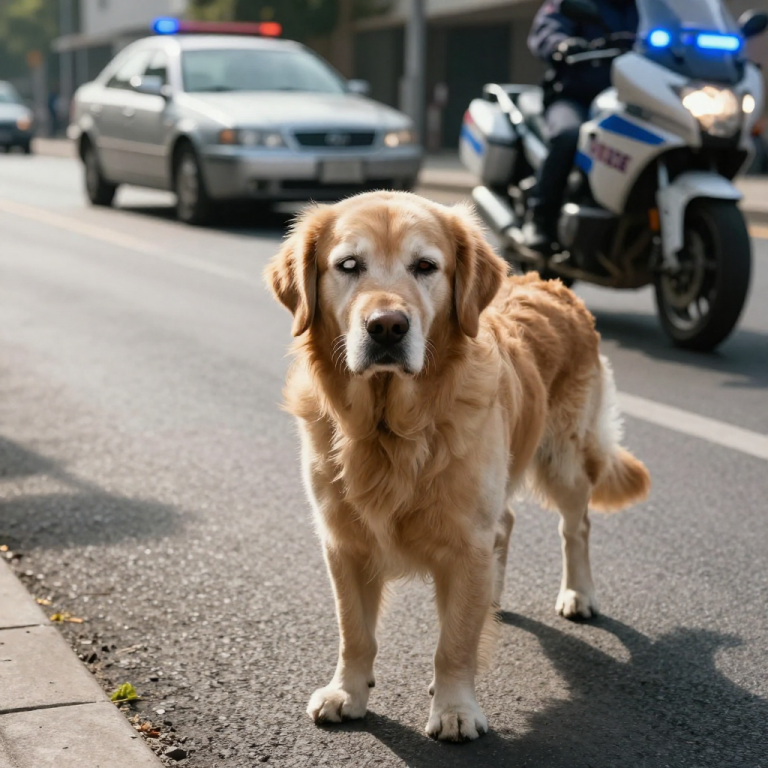
He was a Golden Retriever mix, maybe two years old, tethered to a rusted pole in the center of their backyard. I could see him through the gaps in their privacy fence. He had been barking earlier—a rhythmic, desperate bark that signaled distress. Then it had turned into a high-pitched yip. Then a whine. And now, nothing.
I stood up, the wicker chair creaking under me. My knees popped—a reminder of a fall I took in Baltimore ten years ago—but I ignored it. I walked to the edge of my lawn. The heat coming off the road hit me like an open oven door. 104 degrees. That’s what the news said. On the concrete, it was probably 130.
I squinted at the Davis’s yard. The dog was lying on his side. He wasn’t in the shade. The single tree in their yard cast a shadow that was three feet out of his reach. The silver water bowl was tipped over, bone dry, baking in the sun.
“Get up, buddy,” I whispered, gripping the railing of my fence. “Move to the shadow.”
He didn’t move. His flank wasn’t heaving anymore. The panting had stopped.
panic, cold and sharp, pierced through the heat haze in my brain. When a dog stops panting in this weather, they aren’t resting. They are dying.
I looked at the house. The windows were shut tight, blinds drawn. I could hear the faint hum of their central air conditioning unit chugging away, keeping them a crisp sixty-eight degrees while their animal cooked alive ten yards away. I saw a silhouette move past the window. Someone was in the kitchen, probably grabbing a cold beer.
I checked my watch. 2:14 PM. If I called Animal Control, they’d be here in an hour. The police? Maybe twenty minutes if I said there was a weapon involved, which there wasn’t. By then, the dog would be dead.
I didn’t make a conscious decision to move. It was muscle memory. The part of me that I thought I had buried when I handed in my badge and gun three years ago woke up. It was the part of me that assessed threats, calculated risks, and acted before the brain could catch up with the paperwork.
I crossed the street. My boots felt heavy on the melting tar. I didn’t run—running draws attention, and panic makes you clumsy. I walked with a purpose that usually made people step out of my way.
I reached their driveway and hammered on the front door. Nothing. Just the muffled sound of a bass line from a stereo system. I pounded again, harder, rattling the frame.
“Davis! Open the door!”
Still nothing.
I didn’t wait. I walked around the side of the house to the gate. It was a six-foot wooden privacy fence, padlocked from the inside. A pathetic deterrent if you knew where to kick.
I took a breath, steadied myself on my left leg, and drove my right heel into the wood right next to the latch. The wood splintered with a loud *crack*, and the gate swung inward, bouncing off the siding of the house.
I was inside.
The heat in the backyard was suffocating. It smelled of dry earth and impending death. I dropped to my knees beside the dog. Up close, it was worse. His fur was hot to the touch, like he was burning from the inside out. His gums were tacky and pale, his eyes glazed over, staring at nothing.
“Hey, hey, stay with me,” I said, my voice dropping to that low, commanding tone I used to use with rookies and victims. I unbuckled the collar—it was too tight, chafing his neck raw. I tossed it into the grass.
I scooped him up. He was heavy, dead weight, completely limp. His head lolled back against my shoulder. I could feel the faint, erratic thrum of his heart against my chest. It was fluttering, not beating.
I turned to carry him to the hose spigot on the side of the house, intending to cool him down slowly before rushing him to the vet.
That was when the back door slid open.
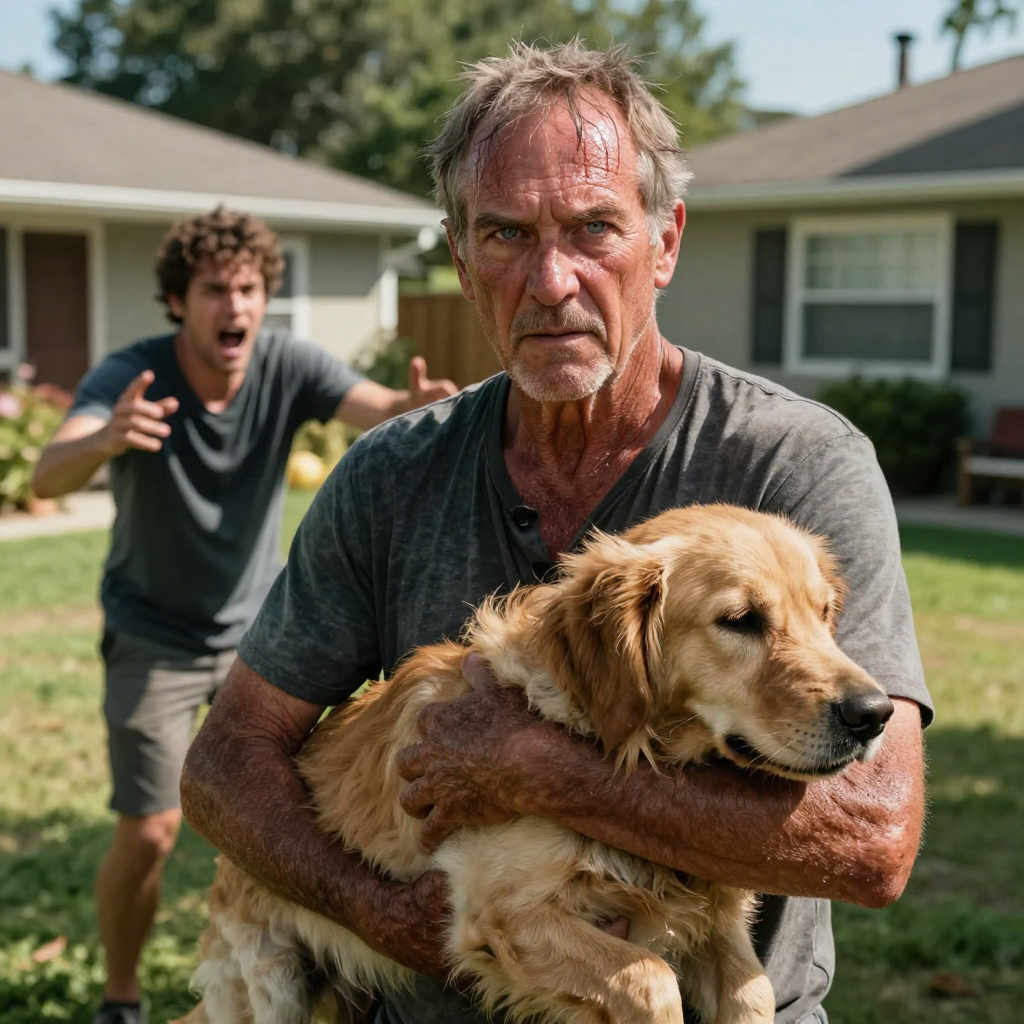
Greg Davis stepped out. He was wearing basketball shorts and holding a craft beer. He looked at the broken gate, then at me, then at the dog in my arms. His face went from confusion to red-faced anger in a split second.
“What the hell?” he shouted, stepping onto the patio. “Did you just kick in my fence? Are you crazy?”
I didn’t stop. I walked past him to the spigot. “Turn the water on,” I said. My voice wasn’t loud. It didn’t need to be.
“Get off my property!” Greg yelled, puffing his chest out. He was a big guy, gym-muscles, used to intimidation. He moved to block me. “Put the dog down and get the hell out before I call the cops!”
I stopped. I held the dying dog with one arm, supporting his weight against my hip. I looked Greg Davis in the eye. The sun was beating down on us, but I felt absolutely cold.
“This dog is dying, Greg,” I said slowly. “His temperature is likely over 106. He has heatstroke because you left him tied up without water.”
“He’s fine! He’s just sleeping!” Greg spat, gesturing wildly with his beer. “It’s a dog! They live outside! Now put him down!”
“I’m taking him,” I said. It wasn’t a request.
Greg laughed, a harsh, incredulous sound. “You’re stealing my dog? You old lunatic. You take one more step and I’ll drop you right here.”
He took a step toward me, his hand balling into a fist.
I had spent thirty years hunting down men who did terrible things for money, for power, or for fun. I had stared down cartel enforcers and domestic terrorists. I looked at this suburban bully, sweating in his designer shorts, threatening me while a life faded in my arms, and I felt a switch flip deep inside my chest.
I shifted my stance, balancing the dog carefully.
“Greg,” I said, and the air between us seemed to drop twenty degrees. “I suggest you look at my face very carefully. Do I look like a man who is worried about your fist?”
He hesitated. He saw something in my eyes—the ghost of the man I used to be. The man who didn’t write tickets, but ended threats.
“I am walking to my truck,” I continued, my voice flat. “I am taking this dog to the vet. If you try to stop me, the police will find you unconscious when they arrive. Do you understand?”
Greg blinked. His mouth opened, then closed. He looked at the broken fence, then back at me. The bravado flickered and died. He took a half-step back.
“I’m calling the cops,” he muttered, pulling out his phone, his hands shaking slightly. “You’re going to jail for this.”
“Make the call,” I said, turning my back on him. “But tell them to bring a thermometer. Because if this dog dies, I’m coming back for you.”
I walked to my truck, the heat still pounding down, but the dog let out a small, weak whimper against my neck. He was still alive.
For now.
CHAPTER II
The air conditioning in my truck was screaming, a mechanical howl that mirrored the tightness in my chest. I had the vents turned all the way toward the passenger seat, where the dog lay on a pile of old gym towels. He wasn’t moving. His tongue was a bruised, dark purple, lolling out of the side of his mouth, and his breathing was shallow—tiny, ragged hitches that sounded like dry leaves scraping on pavement. My hands were steady on the wheel, a muscle memory from a thousand high-speed transits in places I wasn’t supposed to be, but my heart was doing something entirely different. It was hammering against my ribs, a dull, thudding reminder that I was no longer the man who could compartmentalize everything into a mission file.
I hit the main strip of the town, ignoring the speed limit. Every red light felt like a personal insult from the universe. I kept glancing at the dog. He was a Golden Retriever mix, maybe four or five years old, with eyes that were rolled back, showing only the whites. He looked like he was already gone. I reached over, my fingers brushing his fur—it was scorching, radiating a heat that felt unnatural, like a fever that had boiled over. “Stay with me,” I muttered. My voice sounded foreign to my own ears, gravelly and thin. “Just a few more minutes, buddy. Stay with me.”
The Highland Veterinary Clinic was a low-slung brick building tucked between a dry cleaner and a hardware store. I didn’t bother with a parking spot. I pulled the truck onto the sidewalk, killed the engine, and scooped the dog up. He was heavier than he looked, a dead weight that pulled at the old injury in my lower back, the one I’d earned in a damp basement in Prague fifteen years ago. I didn’t care. I kicked the clinic door open, the bell above it chiming a cheerful greeting that felt utterly absurd given the situation.
“Heatstroke!” I barked at the girl behind the counter. She couldn’t have been more than twenty, with bright blue hair and a startled expression. “He’s been in the sun for hours. He’s non-responsive.”
The girl didn’t hesitate. She shouted for ‘Dr. Aris’ and vaulted over the counter. Together, we hauled the dog onto a gurney that appeared from a side room. A tall woman with grey-streaked hair and sharp, intelligent eyes—presumably the doctor—took over instantly. She began calling out vitals and instructions for cold water and fans. They wheeled him away, the swinging doors of the treatment area clicking shut behind them, leaving me standing in the lobby with nothing but the smell of wet dog and my own sweat for company.
I walked over to the corner of the waiting room and sat down in a plastic chair that groaned under my weight. My hands were finally starting to shake. I looked down at them, watching the tremor. It was an old friend, that shake. It had started the day I handed in my badge and my credentials, the day I realized I couldn’t distinguish the good guys from the bad guys anymore. I rubbed my palms against my jeans, trying to still the nerves. The room was quiet, save for the hum of a fish tank and the muffled sounds of medical urgency from behind the doors.
That was when the old wound started to throb. Not the physical one in my back, but the one in my mind. It was the memory of a kid in a village near the border, a kid I couldn’t save because the rules of engagement said he wasn’t my priority. I had watched him through a scope, watched the shadow of a threat close in on him, and I had done nothing because my orders were to stay dark. That silence had been my career. That silence had been my life. But today, I had broken the fence. I had broken the silence. And I knew, with a sinking feeling in my gut, that there would be a price to pay for that.
I was a ghost in this town. That was my secret. No one knew that Elias Thorne wasn’t just a quiet retiree who liked to fix old clocks and kept his lawn trimmed. They didn’t know I was living under a restructured identity, a ‘soft’ protection meant to keep me away from the reach of a certain cartel that still had a bounty on the man who had dismantled their European hub. If I ended up in a police report, if my fingerprints went into a system during a booking for trespassing or assault, the digital breadcrumbs would start to glow. I was risking my life for a dog whose name I didn’t even know. And the worst part? I knew I’d do it again.
Ten minutes later, the front door burst open. I didn’t need to look up to know who it was. The air in the room changed, turning heavy and foul. Greg Davis stormed in, his face a shade of mottled crimson that matched the heat of the day. Behind him was a police officer—a young man, mid-twenties, his uniform crisp and his expression a mix of boredom and professional curiosity.
“There he is!” Greg screamed, pointing a thick, trembling finger at me. “There’s the son of a bitch who broke into my yard! I want him arrested! Right now!”
I stayed seated. In my line of work, the first person to stand up is the one who loses the leverage. I looked at the officer. His name tag read ‘Miller.’
“Officer,” I said, my voice calm, leveled out into that flat, authoritative tone I hadn’t used in years. “The dog was dying. It’s a hundred degrees outside. He had no water, no shade. He was in the middle of a seizure when I got to him.”
“I don’t care if the dog was on fire!” Greg roared. He was pacing the small lobby, his boots clattering on the linoleum. “You don’t touch a man’s property! You don’t break down a fence! That’s my dog, and that’s my land! You’re a thief and a vandal!”
Officer Miller looked from Greg to me, then back to the reception desk. The blue-haired girl was staring at us, wide-eyed. “Sir,” Miller said to me, “is it true you entered Mr. Davis’s property without permission and removed the animal?”
“I entered the property to provide emergency medical assistance to a dying creature,” I replied. “There’s a ‘Good Samaritan’ clause in the state animal welfare statutes, Officer. I’m sure you’re familiar with it.”
Miller’s eyes narrowed. He wasn’t stupid. He recognized that I wasn’t talking like a typical civilian. “I’m familiar with the law, sir. I also know that breaking a fence is criminal damage. I’m going to need to see some ID.”
This was the moment. The moral dilemma that had been simmering since I grabbed that crowbar was now boiling over. If I gave him my ID, the paper trail started. If I refused, I’d be taken down to the station, which was even worse. And then there was the third option—the one that made my stomach turn.
“The dog is in the back,” I said, ignoring the request for ID for a moment. “Why don’t we ask the vet about his condition before we start talking about handcuffs? If that dog dies, Greg here isn’t looking at a trespassing victim; he’s looking at a felony animal cruelty charge. Is that what you want on the books today, Officer? A dead dog and a lawsuit?”
Greg’s face went from red to a sickly, pale yellow. “He’s lying! The dog was fine! He was just sleeping!”
“Sleeping in a seizure?” I stood up then, slowly, letting my height and the stillness I’d cultivated over two decades fill the space. I walked toward Greg. He flinched, stepping back toward the door. “He was boiling alive, Greg. You sat in your air-conditioned house while your ‘property’ cooked. You didn’t even notice me break the fence until I was halfway to my truck. That’s how much you cared.”
“That’s enough,” Miller said, stepping between us. He looked at me with a newfound intensity. “I still need that ID, sir. And you,” he pointed at Greg, “need to sit down and shut up. Now.”
I reached into my back pocket. My wallet felt like it weighed a hundred pounds. Inside was a driver’s license with the name Elias Thorne. It was a clean identity, but it was fragile. It wouldn’t stand up to a deep scrub. If Miller ran it through the NCIC and found the ‘DO NOT CONTACT’ flags attached to my real history, the game would be up.
I was about to hand it over when Dr. Aris walked out from the back. She was wiping her hands on a towel, her face grim. She didn’t look at Greg or the officer; she looked straight at me.
“He’s alive,” she said. “Barely. His core temperature was 109 when you brought him in. We’ve managed to get it down to 103, but he’s in disseminated intravascular coagulation. His blood isn’t clotting correctly. He needs a plasma transfusion and 24-hour monitoring. Without it, his organs will shut down by morning.”
“Do it,” I said immediately.
“Wait just a damn minute!” Greg pushed forward, his bravado returning. “I’m not paying for that! I didn’t authorize any of this! If the dog is that sick, just put him down. I’m not sinking thousands of dollars into a mutt.”
The silence that followed was suffocating. I saw the look of pure disgust on the vet’s face. I saw Officer Miller’s hand drop from his belt, his shoulders slumping slightly as he looked at Greg. Even the girl with the blue hair looked like she wanted to cry.
“He’s my dog,” Greg said, his voice lower now, more defensive. “I have the right to decide his medical care. I’m not paying. And I want him back. Now. Put him in my car.”
Dr. Aris shook her head. “Mr. Davis, moving him now would be a death sentence. He is in no condition to be transported.”
“I don’t care,” Greg snapped. “He’s mine. You can’t keep him here against my will. That’s theft. Officer, tell her!”
Miller looked torn. He was a cop in a small town. He knew the laws of property. He knew that, legally, Greg was right. A dog was an asset, a piece of property no different than a lawnmower or a car. If the owner wanted to take his ‘property’ home to die, the law generally didn’t have the teeth to stop him, not until after the crime was committed.
“He’s right, Doc,” Miller said softly, his voice full of reluctance. “Unless you have a court order or a direct seizure from animal control, you can’t hold the animal if the owner demands him.”
I felt a coldness settle over me. It was the same coldness I felt when I had to make the hard calls in the field. I looked at the vet. I looked at the dog’s life hanging by a thread in the other room. Then I looked at Greg, who was smirking now, a small, petty victory shining in his eyes.
I had a choice. I could stay in the shadows, keep my secret safe, and let this man walk out of here with a dying animal that he would surely let perish in some dusty corner of his garage just to spite me. Or I could step into the light and destroy the life I’d built to save something that had no voice of its own.
“He isn’t Greg’s dog,” I said.
Everyone turned to look at me. The lie felt heavy on my tongue, but I pushed it out anyway.
“What the hell are you talking about?” Greg barked. “I’ve had that dog since he was a pup!”
“No, you haven’t,” I said, stepping closer to the vet. “I bought that dog from your wife, Greg. Two weeks ago. We hadn’t finished the paperwork or the transfer of the microchip yet, but the deal was done. I gave her five hundred dollars cash. I was supposed to pick him up today. That’s why I was at your house. When I saw what you’d done to him, I didn’t wait for you to open the gate.”
It was a gamble. A massive, stupid gamble. I knew Greg’s wife had left him a month ago; I’d seen her packing the car while he shouted at her from the porch. I was betting he hadn’t talked to her since. I was betting he was too proud to admit he didn’t know where his own wife was or what she was doing.
Greg’s eyes bugged out. “You’re a liar! She wouldn’t… she didn’t…”
“She wanted him to have a good home, Greg. She knew you wouldn’t take care of him,” I said, my voice dripping with a feigned sympathy that made my skin crawl. I turned to Miller. “Check my truck, Officer. There’s a new dog bed and a bag of premium food in the back. I was ready for him. The fence? I’ll pay for it. But this dog belongs to me.”
I didn’t have a dog bed. I didn’t have food. But Miller wouldn’t check yet. He was looking at Greg, who was sputtering, his face turning a dark, dangerous purple again.
“This is bullshit!” Greg yelled. “He’s lying!”
“Is he, Mr. Davis?” Miller asked. The officer’s tone had shifted. He wanted to believe me. He wanted a reason to screw Greg over. “Can you produce the registration? The microchip info? Anything to prove ownership right now?”
“It’s in the house!” Greg screamed.
“Then go get it,” Miller said. “Go home, find the papers, and bring them back here. Until then, given the medical emergency and the disputed ownership, the dog stays under the clinic’s care. I’ll stay here and take a formal statement from Mr. Thorne.”
Greg looked like he was going to explode. He looked at me, his eyes full of a raw, unadulterated hatred. “You think you’re so smart, don’t you? You think you can just come in here and take what’s mine? I’m going to find out who you are. I’m going to find out everything.”
He turned and slammed his way out of the clinic. The silence that followed was heavy. The vet exhaled a long, shaky breath and looked at me with a mixture of gratitude and suspicion. She knew I was lying. She had to.
“I’ll get the plasma started,” she whispered, and disappeared back into the treatment room.
I was left alone with Officer Miller. He pulled out a notebook and a pen. He didn’t look at me; he looked at the door Greg had just exited.
“That was a hell of a story, Thorne,” he said quietly. “My sister works at the bank. She saw Greg’s wife leave. She said the woman didn’t take anything but her clothes. Certainly didn’t take the dog.”
I didn’t say anything. I just watched the fish in the tank, swimming in their little circles, trapped in their glass box.
“I’m not going to push you on the ownership thing,” Miller continued, finally looking up. His eyes were sharp, searching my face. “Because I think Greg Davis is a stain on this town. But I still need that ID. And I need to know why a guy with your ‘presence’ is living in a two-bedroom ranch on the edge of the woods fixing clocks.”
I reached into my pocket and pulled out the wallet. I handed him the license. As he took it, our fingers brushed, and I felt that old, cold familiar dread. The trigger had been pulled. The event was public. The lie was on the record.
I had saved the dog, but I had exposed the ghost. And as Miller walked over to his cruiser to run my name through the system, I knew that the quiet life I had spent three years building was officially over. The past was no longer behind me; it was standing in the lobby, waiting for the results of the plasma transfusion.
CHAPTER III
The air in the clinic smelled like ozone and cheap floor wax. I sat on a plastic chair that groaned under my weight, watching the red digital numbers on the wall clock crawl. Every minute was a mile. Every second was a debt. I could feel the weight of my wallet in my back pocket, specifically the driver’s license I’d handed to Officer Miller. That piece of plastic was a ghost story, a carefully constructed lie that had kept me alive for three years. Now, it was a beacon.
Dr. Aris stepped out of the back room. His scrubs were stained with something dark and wet. He didn’t look at me first. He looked at Miller, then at the floor. My heart did a slow, heavy roll in my chest. I stood up, my knees popping like small-caliber rounds in the quiet room.
“He’s stable,” Aris said. His voice was a rasp. “For now. We’ve managed to get the temperature down to 103, and the IV fluids are helping with the dehydration. But his blood isn’t clotting right. The heat—it’s like it cooked the proteins in his system. If he starts bleeding internally, there’s nothing more I can do.”
“Can I see him?” I asked.
Aris nodded, but before I could move, the front door chimes jangled. It wasn’t just a visitor; it was an intrusion. Greg Davis walked in, looking like he’d scrubbed the sweat off his face but kept the malice. He wasn’t alone. Beside him stood a man in a charcoal-gray suit that cost more than Greg’s truck. He carried a leather briefcase like a shield. This was the intervention I hadn’t planned for: the legal kind.
“That’s him,” Greg pointed at me, his finger trembling with a mix of fear and spite. “That’s the man who assaulted me and stole my property.”
Miller stood up, his hand resting instinctively on his belt. “Mr. Davis, we’re in the middle of a medical emergency here. I told you I’d handle the statement at the station.”
“My client isn’t interested in statements, Officer,” the lawyer said. His voice was smooth, like oil on water. “He’s interested in his property. My name is Marcus Vance. I represent Mr. Davis. We have the animal’s registration papers, the microchip records, and a formal complaint for grand theft and trespassing. We are here to take the dog back. Now.”
I felt a coldness settle over me. It was the old cold. The kind that comes when the mission goes sideways and the only way out is through. I looked at Greg. He was smirking. He didn’t want the dog. He wanted the win. He wanted to see the dog die just to prove he owned it.
“The dog stays here,” I said. My voice was low, vibrating in my own throat. “He moves, he dies.”
“That’s not your call, Mr. Thorne,” Vance said, stepping forward. “If that even is your name. Officer Miller, I believe you ran a check? I assume you’re waiting for the results?”
Miller’s radio chirped. It wasn’t the usual rhythmic chatter. It was a high-pitched, sustained tone—a priority alert. Miller frowned, pulling the device from his shoulder. He stepped away, his eyes never leaving mine. I knew that tone. It was the sound of a system flag. Somewhere in a basement in D.C., a light had turned red. My ID hadn’t just cleared; it had screamed.
“Officer Miller, I’m talking to you,” Vance continued, oblivious to the shift in the room. “We want the animal moved to a private facility of my client’s choosing. We have a transport van outside.”
“Shut up,” Miller said. It wasn’t a command to the lawyer. It was a reaction to whatever he was hearing in his earpiece. His face went from suspicious to pale. He looked at me, then at the door, then back to me. He wasn’t seeing a neighbor anymore. He was seeing a problem that was way above his pay grade.
“Thorne,” Miller said, his voice hushed. “I just got a call from the regional dispatcher. They didn’t even give me the details. They just told me to hold the scene. Federal Marshals are twenty minutes out. And someone from a specialized task force is on the line. They told me not to let you out of my sight.”
Greg’s smirk vanished. Vance blinked, his legal jargon dying in his throat. The room felt like it was shrinking. The air was getting thinner. I looked at the clock. Twenty minutes. In my world, twenty minutes was an eternity. It was enough time for the cartel scouts I’d been dodging to triangulate my position. If the feds knew where I was, the people I was hiding from knew, too. The system was a sieve.
“Dr. Aris,” I said, turning my back on the lawyer and the cop. “Is the dog movable?”
“In his condition? No,” Aris said, sensing the sudden, sharp violence in the atmosphere. “Why?”
I didn’t answer. I walked to the window and pulled the blind back an inch. A black sedan had just pulled into the gravel lot of the strip mall across the street. Two men were inside. They weren’t feds. Feds have a certain posture—stiff, professional, visible. These men were low in their seats, blending into the shadows. Cleaners. The cartel had found me faster than the government.
“Miller,” I said, my voice cutting through the lawyer’s confused protests. “You need to lock the front door. Now. And you need to call for backup, but not for me. Tell them there’s an armed threat in the parking lot.”
“What are you talking about?” Greg shouted. “Give me my dog!”
“Your dog is the least of your worries, Greg,” I said. I walked over to him. I didn’t hit him. I just stood close enough for him to see the abyss in my eyes. He backed up until he hit the reception desk. “Go into the kennel area. Stay on the floor. Don’t come out until the sirens stop.”
Vance was looking at the window now. He saw the sedan. He saw the door of the car open slightly. He wasn’t a fool. He saw the way the men moved—fluid, purposeful. They weren’t here for a legal dispute.
“Officer?” Vance’s voice was no longer smooth. It was brittle.
Miller was already on his radio, but the interference was thick. A jammer. They were close. The realization hit me like a physical blow. I had brought this to the dog’s doorstep. I had tried to save a life, and in doing so, I’d brought the shadow of my own death into this sanctuary.
“Get in the back,” I told Miller. “Take the doctor and the dog. There’s a steel-reinforced door in the surgical suite, right?”
Aris nodded, his eyes wide. “Yes, but—”
“Go. Now.”
I didn’t wait for them to move. I grabbed a heavy metal oxygen tank from the corner. It wasn’t a weapon I’d ever been trained with, but it had weight. It had utility. I watched through the glass as the two men from the sedan started walking toward the clinic. They weren’t rushing. They didn’t need to. They thought they had a retired ghost trapped in a cage.
I felt the old adrenaline—the cold, chemical burn in the back of my throat. This was the point of no return. If I fought them here, my life as Elias Thorne was over. If I didn’t, everyone in this room would be collateral damage. The dog, who had survived the sun and Greg’s neglect, would die on a linoleum floor because of a man he didn’t even know.
I looked at the dog through the open door of the exam room. He was lying on his side, his chest rising and falling in shallow, ragged hitches. He looked so small. So undeserving of this.
I stepped out the front door before they reached it.
The heat hit me again, but I didn’t feel it. I stood on the sidewalk, the oxygen tank at my side. The two men stopped ten feet away. They were dressed in nondescript clothes—jeans, work jackets. They looked like anyone. That was the point.
“Elias,” the one on the left said. He had a scar that traced his jawline like a topographical map. “It’s been a long time. The boss was disappointed when you left. He’s very interested in the files you took.”
“I don’t have any files,” I said. I kept my voice steady, my body loose. I was measuring the distance. The sun was behind them, casting long shadows toward me. “And I’m not Elias anymore.”
“You’re whoever we say you are,” the other one said. He reached for the small of his back.
I didn’t give him the chance. I didn’t use a gun. I used the environment. I swung the oxygen tank, not at them, but at the glass storefront of the empty unit next door. The explosion of glass was a physical wall of noise and light. In the split second of their flinch, I was on them.
I didn’t kill. I didn’t need to. I was a precision instrument. A strike to the throat of the first man, a sweep of the legs for the second. I used their own momentum against them. It was a blur of motion—a dance I had performed a thousand times in darker places than this. Within seconds, one was gasping for air on the pavement, and the other was pinned against the brick wall, my hand around his windpipe.
“Go back,” I whispered into his ear. “Tell him I’m dead. Tell him the feds got me. Because if you come back here, I won’t be Elias Thorne. I’ll be the man who hunted you in the first place.”
I felt the vibration of his fear. It was a familiar, sickening feeling. I let him go. He scrambled for his partner, dragging him back toward the sedan. They didn’t look back. They knew when the math had changed.
But the math had changed for me, too.
I heard the sirens in the distance—real sirens this time. Not the cartel, not the local cops. The heavy hitters. The feds were coming to reclaim their asset. I turned and walked back into the clinic.
The lobby was a wreck. Shattered glass from the neighboring unit glittered on the carpet. Greg Davis was curled in a ball behind the desk, his lawyer nowhere to be seen—likely hiding in the bathroom. Miller was standing by the surgical door, his service weapon drawn but shaking.
“Are they gone?” Miller asked.
“For now,” I said. I walked past him, into the back.
Dr. Aris was kneeling by the dog. The IV was still dripping. The monitors were still humming. The dog’s eyes were open now. They were cloudy, but they found me. He didn’t wag his tail. He didn’t have the strength. But he let out a tiny, high-pitched whimper that broke something inside me that the cartel never could.
“He’s through the worst of it,” Aris said, his voice trembling. “The shock is subsiding. If we can get him through the night… he’ll live.”
I reached down and touched the dog’s head. His fur was soft, despite the matted dirt. He leaned into my hand. A simple gesture of trust. He didn’t know about the files, or the agents, or the blood on my hands. He just knew I was the person who had pulled him out of the heat.
“He needs a name,” Aris whispered.
“Lucky,” I said. It was the most honest thing I’d said in years.
I heard the tires screeching in the parking lot. Multiple vehicles. The heavy thud of doors. The tactical boots hitting the pavement. My time had run out.
I looked at Miller. He was watching me with a look of profound realization. He knew I wasn’t going to wait for the handcuffs.
“Miller,” I said. “The dog belongs to the clinic now. Greg Davis has no claim. That lawyer will try to bully the doctor. Don’t let him. You saw what happened here. You saw the threat. Use it.”
Miller looked at the dog, then at the front door where his fellow officers were about to burst in. He nodded once, a slow, solemn movement. “Go out the back, Thorne. There’s a delivery alley. It leads to the woods behind the shopping center.”
“Why?” I asked.
“Because,” Miller said, looking at the dog. “Someone has to look after him. And it clearly isn’t going to be you.”
It was a harsh truth, and it stung. I took one last look at the dog—at Lucky. I wanted to stay. I wanted to be the person who took him for walks, who fed him steak, who watched him grow old in the sun without the fear of it killing him. But that man didn’t exist. That man was a ghost I had tried to inhabit, and the house had collapsed.
I turned and ran.
I burst through the back door into the humid evening air. The woods were a wall of green and shadow. I didn’t look back. I didn’t look at the flashing blue and red lights reflecting off the brick walls. I just ran until my lungs burned, until the sounds of the sirens faded into the background noise of the cicadas.
I had saved a life today. And in exchange, I had lost my own.
As I disappeared into the trees, the only thing I could think about was the way the dog’s head had felt under my hand. It was the first time in a long time I’d felt human. And it would have to be enough to last me for the rest of my life, however short that might be.
Behind me, in the clinic, the light stayed on. The dog lived. The truth was out. And the man known as Elias Thorne was gone again, swallowed by the very shadows he had tried to escape.
CHAPTER IV
The world shrinks when you’re running. It’s not the geography that changes, but the focus. Everything outside a tight, carefully managed radius fades into irrelevance. People become blurred shapes, buildings are just landmarks, and conversations are white noise. Only what directly impacts survival matters. And right then, survival meant Lucky.
The news cycle, predictably, went wild. At first, it was a local story: “Dog Rescue Turns Violent at Veterinary Clinic.” Then, as the bodies were identified and the feds descended, it morphed into something bigger, uglier. “Ex-Special Ops Agent Involved in Clinic Shootout?” The photos they dredged up were old, grainy, but undeniably me. Elias Thorne, the ghost, was back in the machine.
My phone, the burner I’d grabbed before bolting from the clinic, vibrated incessantly with news alerts. Each headline was a fresh stab. They got the basics right – former black ops, ties to Central American cartels – but the details were twisted, sensationalized. I saw myself portrayed as a vigilante, a rogue agent, even a domestic terrorist. None of it was true, not really. I was just a guy who wanted to save a dog.
The hardest part was not knowing. Not knowing if Lucky was okay, if Davis was trying to get him back, if Aris and her staff were safe. I couldn’t risk contact, couldn’t expose them further. So, I watched from the shadows, a digital ghost haunting online forums, local news sites, anything that might give me a clue.
The motel room I holed up in reeked of stale cigarettes and cheap disinfectant. It was a far cry from the quiet life I’d built, the illusion of normalcy shattered by a single act of compassion. Now, every siren, every passing car, sent a jolt of paranoia through me. I was back in the game, only this time, I wasn’t sure who was playing.
The silence was deafening. The television flickered with images of talking heads dissecting my past, judging my actions. They spoke of justice, of consequences, of the long arm of the law. But they didn’t know Lucky’s story, didn’t see the fear in his eyes, the welts on his back. They didn’t understand that sometimes, the law wasn’t enough.
I spent three days in that motel, a prisoner of my own caution. I ate sparingly, slept in shifts, and planned my next move. The immediate threat was Davis. He was litigious, vindictive, and now, probably even more determined to get his hands on Lucky. I needed to neutralize him, permanently.
But how? I couldn’t go near him, couldn’t risk another confrontation. Violence was no longer an option; it had only brought me here, to this dead-end motel room, to this endless cycle of running and hiding.
The answer came in the form of Marcus Vance, Davis’s lawyer. A slick, ambitious shark who probably saw Lucky as nothing more than a pawn in a lucrative lawsuit. He was my weak point, my way in.
I used my remaining contacts, the ones I’d buried deep, to dig into Vance’s past. It didn’t take long to find something. A pattern of shady dealings, offshore accounts, and a few whispers of professional misconduct. Nothing concrete, but enough to plant a seed of doubt, to make him vulnerable.
I leaked the information anonymously to the state bar association and a few local journalists. Not a full-blown exposé, just enough to put Vance on the defensive, to make him question his priorities. It was a gamble, but it was all I had.
Then came the waiting. Each hour felt like an eternity. I imagined Davis, enraged, blaming Vance for the media attention. I imagined Vance, scrambling to protect his reputation, distancing himself from Davis. And I imagined Lucky, safe and warm in Aris’s clinic, oblivious to the machinations that would determine his future.
The news finally broke late one night. Marcus Vance had withdrawn from the case, citing “irreconcilable differences” with his client. Davis, predictably, threw a tantrum, threatening legal action, but without Vance, he was just a bully with no teeth.
It was a small victory, but it felt like a weight lifted. Davis was neutralized, at least for now. But Lucky still wasn’t safe. He was still vulnerable, still subject to the whims of a flawed system.
I needed to ensure his future, to provide for him in a way I couldn’t provide for myself. I contacted another old contact, a discreet wealth manager who specialized in anonymous trusts. I wired him the last of my savings, enough to establish a fund dedicated solely to Lucky’s care. The money would cover his medical expenses, his food, his shelter, for the rest of his life.
The trust was airtight, untraceable. Davis could sue, he could scream, but he would never get his hands on that money, or on Lucky.
With that done, I felt a sense of closure, a strange, hollow peace. I had done everything I could. Now, it was up to fate, to Aris, to the kindness of strangers.
I packed my bag, paid for another night at the motel (just in case), and slipped out into the darkness. I had a new identity to build, a new life to create. But this time, I wouldn’t be running from the past. I would be running towards something, towards the hope that maybe, just maybe, I had made a difference.
The next few weeks were a blur of fake IDs, cheap hotels, and Greyhound buses. I moved from city to city, state to state, always looking over my shoulder, always waiting for the other shoe to drop. The feds were still out there, I knew, and the cartel… well, they never forgot.
But I was different now. I was no longer just Elias Thorne, the ghost. I was Elias Thorne, the dog rescuer. And that, somehow, gave me strength.
I made sure to check the news every day, always with a knot of anxiety in my stomach. There were occasional updates about the clinic shooting, about the ongoing investigation, but nothing about Lucky. No news was good news, I told myself.
Then, one day, I saw it. A small article in a local paper, buried on page six: “Local Veterinary Clinic Hosts ‘Lucky’s Day’ Adoption Event.” The accompanying photo showed Aris, beaming, holding Lucky in her arms. He looked healthy, happy, and loved.
I zoomed in on the photo, studying every detail. His fur was shiny, his tail was wagging, and his eyes… his eyes were full of life. He had found his forever home.
A wave of emotion washed over me, a mixture of relief, joy, and… regret. Regret that I couldn’t be there with him, that I couldn’t share in his happiness. Regret that my past had cost me the chance to have a future.
But I knew I had made the right choice. Lucky was safe, he was loved, and he was free. And that was all that mattered.
The road ahead was long and uncertain. I had no idea what the future held, but I knew one thing: I would never regret saving that dog. It was the one good thing I had done in a long time, and it had given me a purpose, a reason to keep fighting.
I stepped onto the bus, found a window seat, and watched as the city lights faded into the distance. I was leaving Lucky behind, but I was taking his spirit with me. And that, I knew, would be enough.
A few weeks later, I received a postcard. It was a picture of Lucky, lying in a sunny backyard, surrounded by children. On the back, a simple message: “He’s happy. Thank you.” It was signed, simply, “A friend.”
I smiled, a genuine smile, the first I had felt in months. I pinned the postcard to the wall of my new apartment, a small, dingy room in a rundown neighborhood. It was a reminder of what I had done, of the good that still existed in the world. And it was a reminder that even a ghost could find redemption.
The weight of the world didn’t disappear, but somehow, it felt lighter. I was still running, still hiding, but I was no longer alone. I had Lucky with me, in my heart, a symbol of hope, a reminder that even in the darkest of times, compassion could prevail. Maybe, just maybe, I could find peace, too.
CHAPTER V
The desert air felt different this time. Drier, maybe. Or maybe it was just me, drier inside, a little less haunted. I’d been running for so long, the landscape had become a blur of interchangeable highways and dusty towns. This time, though, I’d chosen the place deliberately. Not for escape, but for something else entirely. Something I wasn’t sure I deserved.
My name was Daniel now. Daniel Harding. A simple name, a simple life. Or so I hoped. The small adobe house I’d rented outside of Tucson was sparse, functional. A bed, a table, a chair. A small kitchen area with a fridge that hummed like a contented cat. It was enough. More than enough, considering where I’d been. Considering who I used to be.
The first few weeks were the hardest. The silence. After years of adrenaline and coded conversations and the constant threat of discovery, the silence was deafening. I’d find myself jumping at shadows, expecting a knock on the door that would shatter my fragile peace. But the knock never came.
Instead, there were sunrises. Blazing orange and red, painting the desert in hues I’d never noticed before. There were coyotes howling in the distance, their mournful cries a strangely comforting reminder that I wasn’t alone. And there were the stars, impossibly bright in the clear desert sky, a million tiny pinpricks of light that seemed to watch over me.
I started volunteering at a local animal shelter. It was small, understaffed, and overwhelmed with abandoned dogs and cats. The kind of place most people wouldn’t give a second glance. But for me, it was perfect. It was a chance to use my skills, the ones I thought I’d buried forever, for something good. Not for violence, not for deception, but for healing.
At first, I kept my distance. Cleaning cages, feeding the animals, the kind of grunt work that didn’t require interaction. But the animals, they have a way of seeing through walls. A skinny, one-eyed terrier started following me around, nudging my hand with his wet nose. A calico cat with a missing ear would curl up in my lap, purring like a rusty engine. Slowly, I began to let them in.
One day, a van pulled up to the shelter, and a woman got out, struggling to control a large, agitated dog. A German Shepherd, scarred and matted, his eyes wild with fear. She explained that she’d found him wandering in the desert, abandoned and alone. She couldn’t keep him, she said, she already had too many animals. Could the shelter take him?
The shelter director hesitated. They were already overflowing, stretched to their limit. But I saw something in the dog’s eyes, a flicker of recognition, a shared understanding of what it meant to be lost and broken. I stepped forward.
“I’ll take him,” I said.
And that was how I met Shadow.
Shadow was a mess. He was terrified of people, flinching at every sudden movement. He wouldn’t eat, wouldn’t sleep. He spent his days cowering in the corner of his kennel, his body trembling. The other volunteers tried to coax him out, but he wouldn’t budge. They said he was too far gone, that he’d never recover.
But I knew better. I’d seen that look in his eyes. I knew what it was like to be broken, to be afraid. I knew what it was like to feel like there was no way back.
So I started spending time with him. Just sitting in his kennel, not touching him, not talking to him. Just being there. Letting him get used to my presence. Slowly, he started to relax. He’d stop trembling when I came near, his breathing would become less frantic.
One day, I offered him a piece of meat from my hand. He hesitated, his eyes fixed on my face. Then, slowly, tentatively, he took it. It was a small thing, but it felt like a victory. A crack in the wall. A glimmer of hope.
I worked with Shadow every day, slowly building his trust. Taking him for walks in the desert, letting him explore, letting him sniff the strange new smells. Talking to him in a low, soothing voice, telling him he was safe, that he was loved. And slowly, he began to heal.
He started eating again, sleeping through the night. He started wagging his tail when he saw me, licking my hand, leaning against my leg. He even started playing, chasing after lizards in the desert, barking with joy.
One evening, as the sun was setting, I was sitting with Shadow outside my house, watching the sky turn purple and orange. He was lying at my feet, his head resting on my lap. I stroked his fur, feeling the warmth of his body against my hand. And in that moment, I felt a sense of peace I hadn’t felt in years.
It wasn’t a perfect peace. There were still shadows in my past, still regrets that haunted me. But it was a start. A chance to rebuild, to redeem myself. A chance to finally be the person I always wanted to be.
The anonymous updates on Lucky still came, infrequent but reassuring. A photo of him playing in the snow, a note from Dr. Aris saying he was healthy and happy. Each one a small reminder of what I’d done, of the life I’d saved. Each one a small spark of hope.
One day, a letter arrived. No return address, just a postmark from Flagstaff. Inside was a single photograph. A picture of Lucky, lying in a sunbeam, his eyes closed, a contented smile on his face. And on the back of the photo, a single word: “Thank you.”
I knew who it was from. Officer Miller. He’d risked everything to let me go, to give me a second chance. And now, he was letting me know that it hadn’t been in vain.
I kept the photo on my bedside table, a reminder of the good I’d done, of the lives I’d touched. A reminder that even in the darkest of times, there was always hope. Always a chance for redemption.
Time passed. The seasons changed. The desert bloomed and withered. And I continued to work at the animal shelter, helping animals like Shadow find their way back from the brink. It wasn’t a glamorous life, it wasn’t a life of excitement or adventure. But it was a life of purpose. A life of meaning.
One afternoon, a young woman came to the shelter, looking for a dog. She was shy, hesitant, her eyes filled with sadness. She said she’d recently lost her husband, and she was looking for a companion to help her through the grief.
I showed her around the shelter, introducing her to the various dogs, telling her their stories. But none of them seemed to be the right fit. Until we came to Shadow.
He was lying in his kennel, watching us with his intelligent eyes. I told her about his past, about his abandonment, about his fear. And as I spoke, I saw a flicker of recognition in her eyes. A shared understanding of what it meant to be broken, to be alone.
She knelt down in front of his kennel, reaching out her hand. Shadow hesitated for a moment, then slowly, tentatively, he licked her fingers. She smiled, a small, fragile smile, but a smile nonetheless.
“He’s the one,” she said.
And that was how Shadow found his forever home. I watched them leave, the young woman and the scarred dog, walking side by side, their steps in sync. And I knew that they would heal each other. That they would find comfort and companionship in each other’s company.
A few weeks later, I received another anonymous letter. This one was different. It wasn’t a photo, it wasn’t a note. It was a newspaper clipping. An article about a drug bust in Phoenix. A major cartel operation, shut down by the authorities. And in the photo accompanying the article, I saw a familiar face. Greg Davis.
He was being led away in handcuffs, his face contorted with rage. The article said he was facing multiple charges, including drug trafficking, money laundering, and animal abuse. It said he was likely to spend the rest of his life in prison.
I felt a pang of satisfaction, a sense of justice served. But it was a fleeting feeling. Because I knew that even with Greg Davis behind bars, the world was still full of darkness. Still full of cruelty and violence.
But it was also full of light. Full of kindness and compassion. Full of people willing to fight for what was right. And I knew that I had to keep fighting too. In my own small way, in my own quiet corner of the world.
I continued to volunteer at the animal shelter, helping animals in need. I started mentoring troubled youth, sharing my experiences, trying to guide them down a better path. I even started writing, telling my story, hoping to inspire others to make a difference.
It wasn’t the life I had planned. It wasn’t the life I had expected. But it was a life I could be proud of. A life of purpose. A life of meaning.
One day, I was walking through the desert, Shadow by my side. The sun was setting, casting long shadows across the sand. And as I looked out at the vast, empty landscape, I realized that I was finally home.
Not in a physical sense, not in a geographical sense. But in a deeper, more profound sense. I was home in my own skin. I was home in my own heart. I was finally at peace.
The desert air still felt dry, but it didn’t feel quite so harsh anymore. It felt like a reminder of the resilience of life, of the ability to find beauty and hope even in the most desolate of places. And as I stood there, watching the sun sink below the horizon, I knew that I would be okay. That I would survive. That I would even thrive.
Because I had learned that the most important thing in life wasn’t to escape the past, but to embrace the present. To find meaning in the everyday moments. To make a difference, however small, in the lives of others. And to never give up hope, even when the world seemed darkest.
I never completely shed the weight of my past, but I learned to carry it differently. Not as a burden, but as a reminder of what I had survived, and what I was capable of. The scars remained, but they were no longer wounds. They were badges of honor, symbols of my resilience.
And as I looked out at the desert, I smiled. Because I knew that even though I had lost so much, I had also gained so much more. I had gained a new life, a new purpose, a new sense of hope.
And I had gained the love of a dog named Shadow, who had taught me that even the most broken of creatures could be healed. That even the darkest of pasts could be overcome. That even the most lost of souls could find their way home.
I kept running, but it wasn’t from something, it was toward something. I wasn’t hiding, I was finally living.
The sun dipped below the horizon, painting the sky in shades of orange and purple. I turned and walked back towards the house, Shadow trotting faithfully at my heel. The night was coming, but I wasn’t afraid anymore.
Because I knew that even in the darkness, there was always light. Always hope. Always a chance for a new beginning.
It wasn’t the end of the story, not really. But it was the end of a chapter. A chapter filled with pain and loss, but also with hope and redemption. And as I closed that chapter, I knew that I was ready to face whatever the future might hold. Ready to embrace the unknown, with courage and with grace.
I finally understood. I wasn’t saving them. They were saving me.
And as I walked into the night, I whispered a silent thank you to the dog named Lucky, who had started it all. Who had shown me that even the smallest of acts could have the biggest of consequences. Who had reminded me that even in the darkest of times, there was always a reason to keep fighting.
It would all be okay. Not perfect, but okay.
That night, I dreamed of snow.
I woke to the sound of coyotes howling in the distance, a sound that no longer made me jump. I rose, made coffee, and watched the sun rise over the desert. Another day. Another chance. Another beginning.
The newspaper lay on the table, the article about Greg Davis still visible. I picked it up and looked at his face one last time. Then I threw it in the trash.
I walked outside, Shadow by my side, and breathed in the fresh desert air. The air felt clean, clear, and full of promise.
I had a new life now. A new name. A new purpose. And I wasn’t going to waste it.
I wasn’t going to let the past define me. I was going to define the future. One day at a time, one act of kindness at a time, one broken animal at a time.
I was Daniel Harding now. And I was finally free.
The work continued. The animals kept coming. The faces changed, but the stories remained the same. Abandonment, neglect, abuse. But also resilience, hope, and the unwavering spirit of survival.
And I was there to help them. To heal them. To give them a second chance.
Because I knew that everyone deserves a second chance. Even me.
The years passed, marked by the changing seasons, the rising and setting sun, the steady rhythm of life in the desert.
And as I grew older, I realized that the greatest gift I had been given wasn’t just a new life, but a new perspective. A new way of seeing the world. A new way of understanding myself.
I had learned that true strength wasn’t about power or control, but about vulnerability and compassion. That true freedom wasn’t about escaping the past, but about embracing the present.
And that true happiness wasn’t about finding the perfect life, but about finding the perfect way to live the life you have.
One evening, as I was sitting outside my house, watching the stars, I thought about Lucky. I wondered where he was, what he was doing. I hoped he was happy, that he was loved.
And I realized that even though I might never see him again, he would always be a part of me. A part of my story. A part of my heart.
Because he was the one who had shown me the way. The one who had given me the courage to change. The one who had reminded me that even in the darkest of times, there was always hope.
And for that, I would be forever grateful.
The desert air was cool and still. The stars twinkled in the sky, like diamonds scattered across a velvet cloth. And I felt a sense of peace, a sense of completion, that I had never felt before.
I was finally home. Not just in the desert, but in myself.
I stood up, stretched, and walked back inside the house, Shadow trotting by my side.
The night was waiting. And I was ready.
I looked up and smiled, thinking of Lucky and all the others I had helped along the way. All the creatures, great and small, who had touched my life and made me a better person.
And I knew that even though the past might haunt me, it could no longer define me.
I was Daniel Harding now. And I was finally free.
The desert wind whispered secrets only the stars could understand.
I closed my eyes, took a deep breath, and let the darkness wash over me.
It was over. It was finally over. I was finally free.
The memory of a small dog, running through the snow, would always be with me.
And as I drifted off to sleep, I knew that even though the world was full of darkness, there would always be light. Always hope. Always a chance for a new beginning.
And I was ready to face it.
With courage, with grace, and with a grateful heart.
I was finally home.
And I was finally at peace.
The desert never forgets; neither do I.
END.